

- Market Size (2026)
- USD 82.6 Bn
- Forecast (2036)
- USD 132.0 Bn
- CAGR (2026 to 2036)
- 4.8%
How big is the agricultural equipment market in 2026?
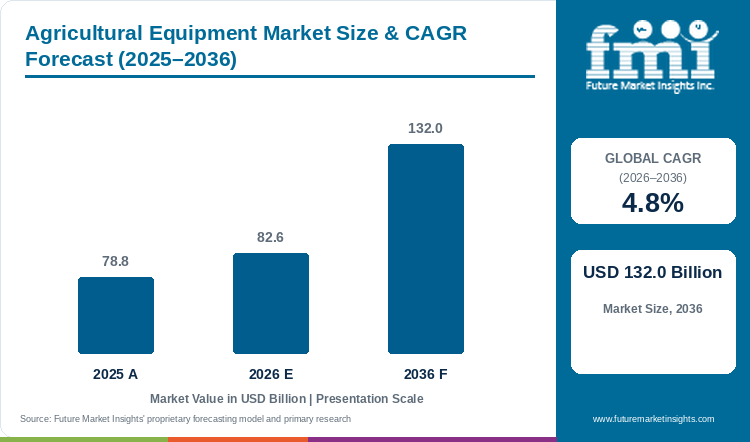
The agricultural equipment market is estimated at USD 82.6 billion in 2026, compared with USD 78.8 billion in 2025. Sales are forecast to reach USD 132.0 billion in 2036, growing at a 4.8% CAGR from 2026 to 2036.
Agricultural equipment has to complete work within limited seasonal windows, making the machine's fit with implements, ground conditions and local service support central to a purchase. Harvesting equipment can experience particularly concentrated use, when a short breakdown interrupts a substantial share of annual work and replacement parts become urgent. Tractors lead the 2026 product mix, the 71-130 HP range leads the power classification and diesel remains dominant in propulsion. Farm size and utilisation influence whether that capacity is owned directly or accessed through a contractor or hiring service. Precision retrofits create another investment route, provided the equipment is compatible and operators can use the information in field decisions. Public support can affect affordability and timing, although programme eligibility still leaves the actual purchase to be completed. Through 2036, useful machinery proposals will connect timely fieldwork with a manageable operating cost and support that remains available during the farm's busiest periods.
Key Market Trends & Insights
- The Tractors segment is projected to account for 49.0% of product type demand in 2026.
- The 71-130 HP segment is projected to account for 31.0% of power rating demand in 2026.
- Diesel / ICE is projected to account for 94.0% of propulsion demand in 2026.
- Large is projected to account for 41.0% of farm size demand in 2026.
Regional Highlights
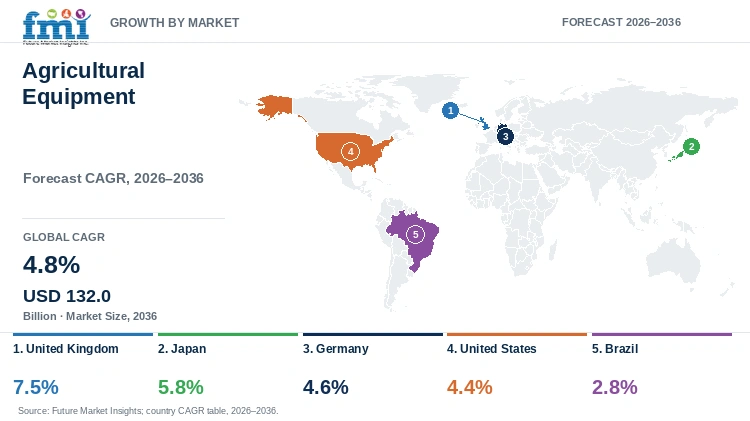
- United Kingdom records the highest profiled forecast at 7.5% CAGR from 2026 to 2036.
- Brazil is forecast at 2.8% CAGR over the same period. Country and combined-market rates are analyst estimates.
Market Size & Forecast
Table 1: Market Size and Forecast for Agricultural Equipment Market, 2026 to 2036
| Metric | Value |
|---|---|
| 2025 market value | USD 78.8 billion |
| 2026 market estimate | USD 82.6 billion |
| 2036 market forecast | USD 132.0 billion |
| CAGR, 2026 to 2036 | 4.8% |
Purchasing Evidence and Operating Requirements
Table 2: Purchasing Evidence and Operating Requirements
| Source | Date | Evidence | Coverage |
|---|---|---|---|
| John Deere Australia | 2025-08-12 | Product introduction | New 9RX tractors introduced to Australia in 2025.[1] |
| Department for Environment, Food and Rural Affairs | 2025-05-07 | Equipment grant programme | 2025 funding announcement.[2] |
| Ministry of Agriculture, Forestry and Fisheries, Japan | 2025-09-19 | Approved development and supply plans | Two plans approved September 2025.[3] |
| Rural Payments Agency | 2026-03-02 | Product eligibility specification | 2025 funding round; guidance updated March 2026.[4] |
Analyst Perspective
Farm equipment needs to complete the required work within the available season, making implement fit and local fault recovery important parts of usable capacity. Digital features enter that same assessment when they support a defined field task and can be maintained alongside the machinery during the busiest operating periods.
- Nikhil Kaitwade, Principal Analyst at Future Market Insights
How is the agricultural equipment market segmented?
By product type, the categories are Tractors, Harvesters, Planting Equipment, Tillage Equipment, Hay & Forage, Others. By power rating, the categories are Below 30 HP, 30-70 HP, 71-130 HP, Above 130 HP. By propulsion, the categories are Diesel / ICE, Electric, Hybrid / Alternative. By farm size, the categories are Small, Medium, Large.
Why does the Tractors segment account for 49.0% of product type demand in 2026?
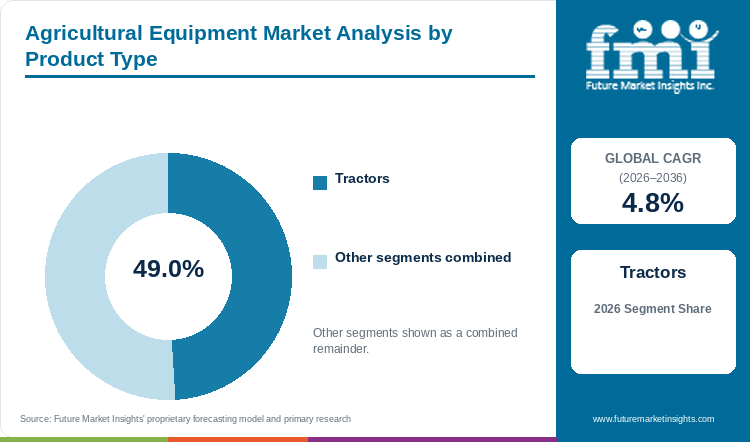
Tractors account for 49.0% of product type demand in 2026, providing the traction and hydraulic capacity needed to carry implements through varied field operations.
Table 3: Product Type Share for Agricultural Equipment Market, 2026
| Product Type | Share (2026) |
|---|---|
| Tractors | 49.0% |
| Other product type segments | 51.0% |
| Total | 100.0% |
The implement makes a tractor's general capability useful for a particular field task, so traction and hydraulic capacity need to be evaluated for the combination that the farm will actually use. Soil testing can inform the management decision behind an operation, but the machine and implement still have to complete that work within the available window. This relationship gives tractor sales a continuing compatibility requirement, with suppliers needing to match existing attachments and expected conditions before a larger engine or an added feature can be assessed as a productive investment.
- The Tractors segment accounts for 49.0% of product type demand in 2026.
- Tractor capability depends on the matched implement and ground conditions.
Why does the 71-130 HP segment account for 31.0% of power rating demand in 2026?
The 71-130 HP range represents 31.0% of power rating demand in 2026, serving farms whose implement and workload requirements fall below the largest machine classes.
Table 4: Power Rating Share for Agricultural Equipment Market, 2026
| Power Rating | Share (2026) |
|---|---|
| 71-130 HP | 31.0% |
| Other power rating segments | 69.0% |
| Total | 100.0% |
Engine loading in the 71-130 HP band follows implement width and working speed, so a farm can obtain little benefit from capacity that spends most of its time lightly loaded. Transport requirements and the work expected across the season also influence whether a particular configuration is practical. An assessment tied to those duties lets the buyer compare operating use and local repair support together, reducing the chance that a nominal increase in power leaves the farm with more cost but little additional fieldwork completed.
- The 71-130 HP segment accounts for 31.0% of power rating demand in 2026.
- The 71-130 HP band needs to be assessed against routine fieldwork.
What are the drivers, restraints, and opportunities in the agricultural equipment market?
Driver: Access programs support defined machinery purchases
John Deere's 2025 Australian launch of new 9RX tractors widened the configurations available to farms, while hiring centres provide a separate route to capacity where year-round ownership is unnecessary.[1] Compact equipment addresses construction work that may occur around agricultural sites, with the selected machine still needing to follow the task and utilisation expected of it.
Restraint: Seasonality makes service capacity a buying condition
A breakdown during a narrow fieldwork window can interrupt much more useful work than the same fault outside the season, making nearby parts and trained technicians important to ownership. Precision retrofits add another support question when sensors and displays are fitted to older machinery, requiring clear responsibility for compatibility and fault recovery.
Opportunity: Retrofits offer an alternative to full replacement
England's 2025 FETF specifications included grain analysis and retrofit yield monitoring, while Japan approved smart-agriculture plans involving seed sensors and mowing robots.[4][3] Those records describe eligibility and development stages, with machine control systems and battery charging equipment needing their own technical assessment when they support the proposed operating workflow.
Which country and market growth rates are profiled?
Table 5: Country CAGR Comparison for Agricultural Equipment Market, 2026 to 2036
| Country | CAGR |
|---|---|
| United Kingdom | 7.5% |
| Japan | 5.8% |
| Germany | 4.6% |
| United States | 4.4% |
| Brazil | 2.8% |
Growth rates in the table are FMI analyst forecasts.
Country-wise Analysis
United Kingdom
England's 2025 equipment fund covered productivity and farm-management applications, giving suppliers routes into both complete machinery and upgrades to equipment already owned.[2] The United Kingdom's 7.5% CAGR forecast for 2026 to 2036 is the highest profiled rate, but the programme envelope becomes equipment demand through individual eligibility and purchasing decisions. Identifying the actual product and installation required allows a dealer to assess the order opportunity without treating the announced funding as paid machinery revenue.
Japan
Japan approved development plans involving seed sensors and robotic mowing in 2025, describing a direction for automation before installed units are established.[3] A farmer assessing such features still needs compatible machinery, usable information and a service arrangement that can support the system during fieldwork. The 5.8% CAGR outlook over 2026 to 2036 includes these development opportunities alongside other equipment purchases, with the practical reduction in work dependent on the completed farm installation and operating method.
Germany
A precision feature fitted to machinery already working on a German farm has to enter an existing sequence of implements, operators and seasonal tasks. Demonstrating that sequence helps the buyer judge whether the upgrade adds useful capability, while continued parts support determines whether it can be relied on at the busy point of the season. Germany's forecast is 4.6% CAGR during 2026 to 2036, covering purchases where compatibility with the farm's installed equipment can be as significant as a new specification.
United States
Crop systems and operating scale leave United States farms with different ownership calculations. A large seasonal workload can justify capacity that a smaller operator would struggle to use, while versatility or contracted access can provide a better fit elsewhere. Dealer service and replacement parts become especially consequential when a breakdown interrupts peak operations. These decisions sit within the 4.4% CAGR forecast for 2026 to 2036, with the machine's value following timely fieldwork and the support needed to sustain it.
Brazil
A Brazilian operator working far from repair support may find that an upgrade which can be maintained locally offers a different return from replacing the complete machine. Field conditions, the implement being pulled and transport needs still determine the required power, so the selected features need to serve a defined workload. Demand is forecast at 2.8% CAGR over 2026 to 2036, with available support influencing how much of the proposed capability can remain usable through the season.
Who are the notable companies in the agricultural equipment market?
Deere & Company; CNH Industrial N.V.; AGCO Corporation; CLAAS KGaA mbH; Kubota Corporation
Deere, CNH and AGCO combine broad machinery ranges with dealer networks, while CLAAS brings harvesting exposure and Kubota serves tractors and other farm equipment. Crop, farm size and the machine-implement combination shape the relevant comparison, with nearby service capacity influencing how those portfolios can support the farm during peak operations.
Competitive Benchmarking: Agricultural Equipment Market
Table 6: Competitive Benchmarking
| Participant | Relevant portfolio | Purchasing comparison |
|---|---|---|
| Deere & Company | Tractors and agricultural machinery | Implement compatibility and dealer support |
| CNH Industrial N.V. | Farm machinery portfolios | Configuration and service access |
| AGCO Corporation | Tractors and precision agriculture | Machine and retrofit integration |
| CLAAS KGaA mbH | Harvesting and field equipment | Seasonal uptime and parts |
| Kubota Corporation | Tractors and farm machinery | Farm-scale suitability |
Key Developments in the Agricultural Equipment Market
- England announced its 2025 Farming Equipment and Technology Fund with support across productivity and other farm applications. The funding envelope does not establish equipment deliveries.[2]
- Japan approved smart-agriculture development plans in September 2025 for retrofit seed sensing and remote or autonomous mowing systems.[3]
Key Players in the Agricultural Equipment Market
- Deere & Company: Tractors and agricultural machinery.
- CNH Industrial N.V.: Farm machinery portfolios.
- AGCO Corporation: Tractors and precision agriculture.
- CLAAS KGaA mbH: Harvesting and field equipment.
- Kubota Corporation: Tractors and farm machinery.
Agricultural Equipment Market - Report Scope
Table 7: Report Scope for Agricultural Equipment Market
| Coverage field | Report scope |
|---|---|
| Market definition | Field machinery, harvest equipment, precision retrofits and farm automation; funding evidence is separated from delivered machinery. |
| Historical reference year | 2025 |
| Market breakdown | product type, power rating, propulsion, farm size |
| Quantitative Units | USD Billion |
| Regions covered | North America; Latin America; Western Europe; Eastern Europe; East Asia; South Asia and Pacific; Middle East and Africa |
| Countries profiled | United Kingdom; Japan; Germany; United States; Brazil |
| Forecast period | 2026 to 2036 |
| Key companies profiled | Deere & Company; CNH Industrial N.V.; AGCO Corporation; CLAAS KGaA mbH; Kubota Corporation |
Agricultural Equipment Market - Research Methodology
Table 8: Research Methodology
| Method | Approach |
|---|---|
| Quantitative analysis | Market values, category shares and country forecasts are presented as FMI analyst estimates. |
| Desk research | Government records, public procurement and technical research establish application conditions and documented activity. |
| Evidence assessment | Awards are distinguished from tenders. Laboratory and modeled results retain their stated operating limits. |
| Segmentation framework | Shares use the stated segment axis as their denominator; country rates use the stated forecast period. |
Agricultural Equipment Market by Segments
Product Type
- Tractors
- Harvesters
- Planting Equipment
- Tillage Equipment
- Hay & Forage
- Others
Power Rating
- Below 30 HP
- 30-70 HP
- 71-130 HP
- Above 130 HP
Propulsion
- Diesel / ICE
- Electric
- Hybrid / Alternative
Farm Size
- Small
- Medium
- Large
Agricultural Equipment Market by Region
- North America
- United States
- Canada
- Latin America
- Brazil
- Mexico
- Argentina
- Chile
- Western Europe
- Germany
- France
- United Kingdom
- Italy
- Spain
- Benelux
- Nordics
- Eastern Europe
- Poland
- Czech Republic
- Romania
- Hungary
- East Asia
- China
- Japan
- South Korea
- South Asia and Pacific
- India
- ASEAN
- Australia and New Zealand
- Middle East and Africa
- GCC Countries
- South Africa
- Türkiye
- Israel
Research Sources and Bibliography
- [1] John Deere Australia. (2025-08-12). 9RX Tractors Exceed All Expectations
- [2] Department for Environment, Food and Rural Affairs; Innovate UK. (2025-05-07). £50 million equipment and technology grants to boost food production and farm profitability
- [3] Ministry of Agriculture, Forestry and Fisheries, Japan. (2025-09-19).[Development and supply implementation plans approved under the Smart Agriculture Technology Utilization Promotion Act]
- [4] Rural Payments Agency; Department for Environment, Food and Rural Affairs. (2026-03-02). Productivity items and specifications - Farming Equipment and Technology Fund 2025
- Future Market Insights. (2026). Agricultural Equipment Market: Global industry analysis and opportunity assessment 2036.
This Report Answers
- How large is the agricultural equipment market in 2026?
- What market value is forecast for 2036?
- Which product type category leads in 2026?
- Why does 71-130 HP lead its category?
- Which profiled market has the highest forecast growth?
- Which companies participate in the agricultural equipment market?
Frequently Asked Questions
How large is the agricultural equipment market in 2026?
The market is estimated at USD 82.6 billion in 2026, compared with USD 78.8 billion in 2025.
What market value is forecast for 2036?
The forecast is USD 132.0 billion in 2036 at a 4.8% CAGR from 2026 to 2036.
Which product type category leads in 2026?
The Tractors segment is projected to account for 49.0% of product type demand in 2026.
Why does 71-130 HP lead its category?
The 71-130 HP category covers farms seeking useful field capacity without the costs of the largest machines.
Which profiled market has the highest forecast growth?
United Kingdom has the highest profiled rate at 7.5% CAGR during 2026 to 2036.
Which companies participate in the agricultural equipment market?
Deere & Company; CNH Industrial N.V.; AGCO Corporation; CLAAS KGaA mbH; Kubota Corporation.
Preview the report firsthand - request a free sample
Get SampleGet the brochure for pricing and purchase details.
Get PDFTable of Content
- Key Takeaways
- Market Size and CAGR
- Top Growth Driver
- Fastest Growing Segment
- Leading Region
- Key Companies
- Emerging Opportunities
- Executive Summary
- Global Market Outlook
- Demand-side Trends
- Supply-side Trends
- Technology Roadmap Analysis
- Analysis and Recommendations
- Analyst Perspective (What is happening? Why now? What should investors know?)
- Key Questions Answered
- How large is the market?
- What is the CAGR?
- What are key trends?
- Which region dominates?
- Who are the leaders?
- Market Overview
- Market Coverage / Taxonomy
- Market Definition / Scope / Limitations
- Research Methodology
- Chapter Orientation
- Analytical Lens and Working Hypotheses
- Market Structure, Signals, and Trend Drivers
- Benchmarking and Cross-market Comparability
- Market Sizing, Forecasting, and Opportunity Mapping
- Research Design and Evidence Framework
- Desk Research Programme (Secondary Evidence)
- Expert Input and Fieldwork (Primary Evidence)
- Tooling, Models, and Reference Databases
- Data Engineering and Model Build
- Quality Assurance and Audit Trail
- Market Background
- Market Dynamics (Drivers, Restraints, Opportunity, Trends)
- Scenario Forecast (Optimistic, Likely, Conservative)
- Impact Analysis
- AI Impact
- Sustainability Impact
- Regulatory Impact
- Technology Impact
- Consumer / Buyer Analysis
- Purchase Drivers
- Adoption Barriers
- Buyer Journey
- Opportunity Map Analysis
- Product Life Cycle Analysis
- Supply Chain Analysis
- Investment Feasibility Matrix
- Value Chain Analysis
- PESTLE and Porter's Analysis
- Regulatory Landscape
- Regional Parent Market Outlook
- Production and Consumption Statistics
- Import and Export Statistics
- Global Market Analysis and Forecast, 2021 to 2036
- Historical Market Size Value (USD Billion) Analysis, 2021 to 2025
- Current and Future Market Size Value (USD Billion) Projections, 2026 to 2036
- Y-o-Y Growth Trend Analysis
- Absolute $ Opportunity Analysis
- Global Market Pricing Analysis, 2021 to 2036
- Global Market Analysis and Forecast, By Product Type, 2021 to 2036
- Introduction / Key Findings
- Historical Market Size Value (USD Billion) Analysis By Product Type, 2021 to 2025
- Current and Future Market Size Value (USD Billion) Analysis and Forecast By Product Type, 2026 to 2036
- Tractors
- Harvesters
- Planting Equipment
- Tillage Equipment
- Hay & Forage
- Others
- Y-o-Y Growth Trend Analysis By Product Type, 2021 to 2025
- Absolute $ Opportunity Analysis By Product Type, 2026 to 2036
- Global Market Analysis and Forecast, By Power Rating, 2021 to 2036
- Introduction / Key Findings
- Historical Market Size Value (USD Billion) Analysis By Power Rating, 2021 to 2025
- Current and Future Market Size Value (USD Billion) Analysis and Forecast By Power Rating, 2026 to 2036
- Below 30 HP
- 30-70 HP
- 71-130 HP
- Above 130 HP
- Y-o-Y Growth Trend Analysis By Power Rating, 2021 to 2025
- Absolute $ Opportunity Analysis By Power Rating, 2026 to 2036
- Global Market Analysis and Forecast, By Propulsion, 2021 to 2036
- Introduction / Key Findings
- Historical Market Size Value (USD Billion) Analysis By Propulsion, 2021 to 2025
- Current and Future Market Size Value (USD Billion) Analysis and Forecast By Propulsion, 2026 to 2036
- Diesel / ICE
- Electric
- Hybrid / Alternative
- Y-o-Y Growth Trend Analysis By Propulsion, 2021 to 2025
- Absolute $ Opportunity Analysis By Propulsion, 2026 to 2036
- Global Market Analysis and Forecast, By Farm Size, 2021 to 2036
- Introduction / Key Findings
- Historical Market Size Value (USD Billion) Analysis By Farm Size, 2021 to 2025
- Current and Future Market Size Value (USD Billion) Analysis and Forecast By Farm Size, 2026 to 2036
- Small
- Medium
- Large
- Y-o-Y Growth Trend Analysis By Farm Size, 2021 to 2025
- Absolute $ Opportunity Analysis By Farm Size, 2026 to 2036
- Global Market Analysis and Forecast, By Region, 2021 to 2036
- Introduction
- Historical Market Size Value (USD Billion) Analysis By Region, 2021 to 2025
- Current Market Size Value (USD Billion) Analysis and Forecast By Region, 2026 to 2036
- North America
- Latin America
- Western Europe
- Eastern Europe
- East Asia
- South Asia and Pacific
- Middle East and Africa
- Market Attractiveness Analysis By Region
- North America Market Analysis and Forecast, By Country, 2021 to 2036
- Historical Market Size Value (USD Billion) Trend Analysis By Market Taxonomy, 2021 to 2025
- Market Size Value (USD Billion) Forecast By Market Taxonomy, 2026 to 2036
- By Country
- United States
- Canada
- By Product Type
- By Power Rating
- By Propulsion
- By Farm Size
- By Country
- Market Attractiveness Analysis
- By Country
- By Product Type
- By Power Rating
- By Propulsion
- By Farm Size
- Key Takeaways
- Latin America Market Analysis and Forecast, By Country
- Historical Market Size Value (USD Billion) Trend Analysis By Market Taxonomy, 2021 to 2025
- Market Size Value (USD Billion) Forecast By Market Taxonomy, 2026 to 2036
- By Country
- Brazil
- Mexico
- Argentina
- Chile
- By Product Type
- By Power Rating
- By Propulsion
- By Farm Size
- By Country
- Market Attractiveness Analysis
- By Country
- By Product Type
- By Power Rating
- By Propulsion
- By Farm Size
- Key Takeaways
- Western Europe Market Analysis and Forecast, By Country
- Historical Market Size Value (USD Billion) Trend Analysis By Market Taxonomy, 2021 to 2025
- Market Size Value (USD Billion) Forecast By Market Taxonomy, 2026 to 2036
- By Country
- Germany
- France
- United Kingdom
- Italy
- Spain
- Benelux
- Nordics
- By Product Type
- By Power Rating
- By Propulsion
- By Farm Size
- By Country
- Market Attractiveness Analysis
- By Country
- By Product Type
- By Power Rating
- By Propulsion
- By Farm Size
- Key Takeaways
- Eastern Europe Market Analysis and Forecast, By Country
- Historical Market Size Value (USD Billion) Trend Analysis By Market Taxonomy, 2021 to 2025
- Market Size Value (USD Billion) Forecast By Market Taxonomy, 2026 to 2036
- By Country
- Poland
- Czech Republic
- Romania
- Hungary
- By Product Type
- By Power Rating
- By Propulsion
- By Farm Size
- By Country
- Market Attractiveness Analysis
- By Country
- By Product Type
- By Power Rating
- By Propulsion
- By Farm Size
- Key Takeaways
- East Asia Market Analysis and Forecast, By Country
- Historical Market Size Value (USD Billion) Trend Analysis By Market Taxonomy, 2021 to 2025
- Market Size Value (USD Billion) Forecast By Market Taxonomy, 2026 to 2036
- By Country
- China
- Japan
- South Korea
- By Product Type
- By Power Rating
- By Propulsion
- By Farm Size
- By Country
- Market Attractiveness Analysis
- By Country
- By Product Type
- By Power Rating
- By Propulsion
- By Farm Size
- Key Takeaways
- South Asia and Pacific Market Analysis and Forecast, By Country
- Historical Market Size Value (USD Billion) Trend Analysis By Market Taxonomy, 2021 to 2025
- Market Size Value (USD Billion) Forecast By Market Taxonomy, 2026 to 2036
- By Country
- India
- ASEAN
- Australia and New Zealand
- By Product Type
- By Power Rating
- By Propulsion
- By Farm Size
- By Country
- Market Attractiveness Analysis
- By Country
- By Product Type
- By Power Rating
- By Propulsion
- By Farm Size
- Key Takeaways
- Middle East and Africa Market Analysis and Forecast, By Country
- Historical Market Size Value (USD Billion) Trend Analysis By Market Taxonomy, 2021 to 2025
- Market Size Value (USD Billion) Forecast By Market Taxonomy, 2026 to 2036
- By Country
- GCC Countries
- South Africa
- Türkiye
- Israel
- By Product Type
- By Power Rating
- By Propulsion
- By Farm Size
- By Country
- Market Attractiveness Analysis
- By Country
- By Product Type
- By Power Rating
- By Propulsion
- By Farm Size
- Key Takeaways
- Key Countries Market Analysis
- United States
- Pricing Analysis
- Market Share Analysis, 2025
- By Product Type
- By Power Rating
- By Propulsion
- By Farm Size
- Canada
- Pricing Analysis
- Market Share Analysis, 2025
- By Product Type
- By Power Rating
- By Propulsion
- By Farm Size
- Mexico
- Pricing Analysis
- Market Share Analysis, 2025
- By Product Type
- By Power Rating
- By Propulsion
- By Farm Size
- Brazil
- Pricing Analysis
- Market Share Analysis, 2025
- By Product Type
- By Power Rating
- By Propulsion
- By Farm Size
- Chile
- Pricing Analysis
- Market Share Analysis, 2025
- By Product Type
- By Power Rating
- By Propulsion
- By Farm Size
- Germany
- Pricing Analysis
- Market Share Analysis, 2025
- By Product Type
- By Power Rating
- By Propulsion
- By Farm Size
- United Kingdom
- Pricing Analysis
- Market Share Analysis, 2025
- By Product Type
- By Power Rating
- By Propulsion
- By Farm Size
- Italy
- Pricing Analysis
- Market Share Analysis, 2025
- By Product Type
- By Power Rating
- By Propulsion
- By Farm Size
- Spain
- Pricing Analysis
- Market Share Analysis, 2025
- By Product Type
- By Power Rating
- By Propulsion
- By Farm Size
- France
- Pricing Analysis
- Market Share Analysis, 2025
- By Product Type
- By Power Rating
- By Propulsion
- By Farm Size
- India
- Pricing Analysis
- Market Share Analysis, 2025
- By Product Type
- By Power Rating
- By Propulsion
- By Farm Size
- ASEAN
- Pricing Analysis
- Market Share Analysis, 2025
- By Product Type
- By Power Rating
- By Propulsion
- By Farm Size
- Australia and New Zealand
- Pricing Analysis
- Market Share Analysis, 2025
- By Product Type
- By Power Rating
- By Propulsion
- By Farm Size
- China
- Pricing Analysis
- Market Share Analysis, 2025
- By Product Type
- By Power Rating
- By Propulsion
- By Farm Size
- Japan
- Pricing Analysis
- Market Share Analysis, 2025
- By Product Type
- By Power Rating
- By Propulsion
- By Farm Size
- South Korea
- Pricing Analysis
- Market Share Analysis, 2025
- By Product Type
- By Power Rating
- By Propulsion
- By Farm Size
- Poland
- Pricing Analysis
- Market Share Analysis, 2025
- By Product Type
- By Power Rating
- By Propulsion
- By Farm Size
- Hungary
- Pricing Analysis
- Market Share Analysis, 2025
- By Product Type
- By Power Rating
- By Propulsion
- By Farm Size
- Türkiye
- Pricing Analysis
- Market Share Analysis, 2025
- By Product Type
- By Power Rating
- By Propulsion
- By Farm Size
- South Africa
- Pricing Analysis
- Market Share Analysis, 2025
- By Product Type
- By Power Rating
- By Propulsion
- By Farm Size
- United States
- Market Structure Analysis
- Competition Dashboard
- Competition Benchmarking
- Market Share Analysis of Top Players
- By Regional
- By Product Type
- By Power Rating
- By Propulsion
- By Farm Size
- Emerging Startups
- Innovation Benchmarking
- Competition Analysis
- Competition Deep Dive
- Deere & Company
- Overview
- Product Portfolio
- Profitability by Market Segments
- Sales Footprint
- Strategy Overview
- Marketing Strategy
- Product Strategy
- Channel Strategy
- CNH Industrial N.V.
- AGCO Corporation
- CLAAS KGaA mbH
- Kubota Corporation
- Deere & Company: Tractors and agricultural machinery.
- CNH Industrial N.V.: Farm machinery portfolios.
- AGCO Corporation: Tractors and precision agriculture.
- CLAAS KGaA mbH: Harvesting and field equipment.
- Kubota Corporation: Tractors and farm machinery.
- Deere & Company
- Case Studies
- Success Stories
- Recent Developments
- Competition Deep Dive
- Assumptions & Acronyms Used


