

- Market Size (2026)
- USD 232.1 Mn
- Forecast (2036)
- USD 760.3 Mn
- CAGR (2026 to 2036)
- 12.6%
How big is AI Campus Optical Network Commissioning Services Market in 2026?
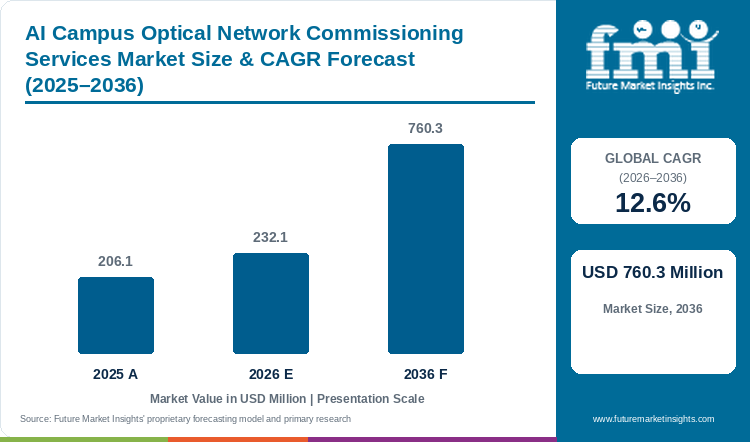
The market was valued at USD 206.1 Million in 2025 and is expected to reach USD 232.1 Million in 2026, with growth at a 12.6% CAGR from 2026 to 2036 taking its value to USD 760.3 Million by 2036.
Campus optical commissioning brings paths installed by several contractors into a common acceptance process, with each result tied to the as-built fiber identity. That association makes a passing measurement useful to maintenance teams after construction and allows failed channels to be corrected without disturbing accepted records. The contract also needs a boundary between passive-cabling checks and activated transport tests, because switches and power may become available at different stages. A phased plan therefore provides a more workable release process than a single assumed sign-off after construction. High testing throughput adds value when crews retain consistent methods and traceability across packages. The forecast measures contracted work that turns installed optical paths into an accepted network, excluding standalone instruments, cabling materials and unrelated management services; announced campus capacity remains project context until access and test scope are established. [5]
Key Market Trends & Insights
- 800G holds 38.0% of link speed in 2026, with new interface acceptance planned alongside maintenance needs in the existing 400G estate.
- Commissioning & certification holds 28.0% of service type in 2026, establishing identifiable loss and polarity records as a baseline for later maintenance.
- Inter-rack / scale-out holds 36.0% of deployment location in 2026, connecting the many paths needed for simultaneous communication across the AI training fabric.
- Hyperscale AI data centers account for 48.0% of data center type in 2026, allowing results across pods and halls to be compared through a common method and path record.
Regional Highlights
- South Korea has the highest profiled CAGR at 14.1% during 2026–2036.
- The next two profiled growth rates are UAE at 13.8% and USA at 13.4% over the same period.
Market Size & Forecast
| Metric | Value |
|---|---|
| 2025 market value | USD 206.1 Million |
| 2026 market estimate | USD 232.1 Million |
| 2036 market forecast | USD 760.3 Million |
| Forecast CAGR, 2026–2036 | 12.6% |
The market covers contracted commissioning, certification and related field services for AI-campus optical networks. Standalone test instruments, cabling materials and unrelated network-management services are outside the scope.
Campus optical readiness influences the productive use of data-center power by connecting compute capacity that would otherwise remain isolated or underused.
Infrastructure readiness and acceptance
| Documented operating context | Source |
|---|---|
| Fluke Networks launched CertiFiber Max for high-density multi-fiber testing in January 2026. | [1] |
| VIAVI announced an optical-loss test set supporting simultaneous testing of up to 24 fibers in February 2026. | [2] |
| VIAVI introduced an 800G transport module for the OneAdvisor 800 field tester in March 2025. | [3] |
| The Ethernet Alliance discussed AI-driven changes in Ethernet networking in January 2025. | [4] |
Analyst Perspective
Campus commissioning needs a consistent method that preserves the identity of each accepted path and isolates failures without losing completed records. A phased plan can then follow rack, switch and power readiness, giving the operating team a clear account of passive-cabling acceptance and the live transport work still required.
- Sudip Saha, Principal Analyst at Future Market Insights
How is the AI campus optical network commissioning services market segmented?
Link Speed covers 800G, 400G, 1.6T and 3.2T and above. Service Type covers Commissioning & certification, Link diagnostics, Reliability / interoperability testing, Cleaning & inspection and Managed optical operations. Deployment Location covers Inter-rack / scale-out, Intra-rack / scale-up, Spine-leaf fabric and Campus / DCI. Data Center Type covers Hyperscale AI data centers, Colocation AI facilities, Enterprise AI/HPC and Research / sovereign compute. Route to Market covers OEM direct, Network system integrators, Fiber/cabling specialists and Test & managed-service providers.
The commissioning handover should integrate with data-center infrastructure management so that fiber identity and test records remain accessible after the project team leaves.
Why does 800G lead link speed demand?
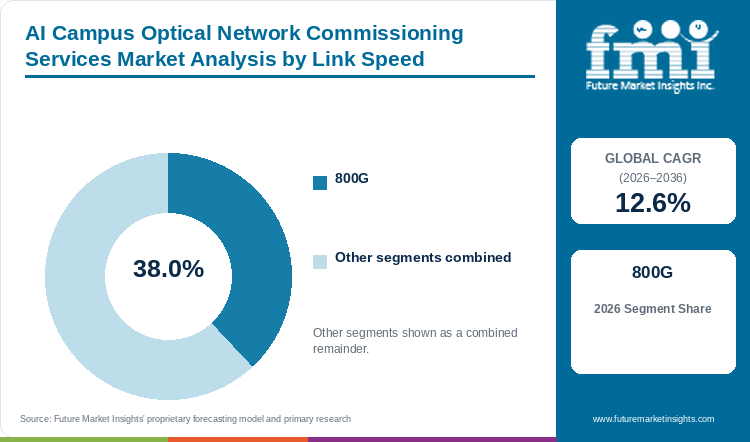
800G: 38.0% of link speed in 2026.
An 800G acceptance plan follows the actual fiber, transceiver and breakout arrangement, with physical-path findings reconciled against traffic testing by network engineers. Existing 400G links may continue to need maintenance alongside new interfaces, so records must distinguish the paths being released and retain their identifiers across contractor packages. This lets the owner establish which installed links passed the appropriate procedure instead of treating a nominal rate as a complete test specification.
- The 800G segment accounts for 38.0% of link speed in 2026.
- The 800G acceptance record should identify the actual interfaces and fiber route rather than rely only on the equipment's nominal rate.
Why does Commissioning & certification lead service type demand?
Commissioning & certification: 28.0% of service type in 2026.
Certification creates the optical baseline through agreed measurements, including loss and polarity, with further characterization defined where required. Cleaning or diagnosis may be corrective steps within this process, while consistent references make one installer’s results comparable with another’s. Documentation therefore belongs within service delivery, giving the operating team a starting point for later investigation without having to reconstruct the original path or infer whether a repair established acceptance.
- The Commissioning & certification segment accounts for 28.0% of service type in 2026.
- A common reference method makes results from different construction packages comparable and helps identify channels that still need corrective work.
What are the drivers, restraints, and opportunities in the AI campus optical network commissioning services market?
Dense optical campuses need traceable commissioning
An AI campus can contain many completed fiber installations without having a coherent network-acceptance record. Rack and switch delivery may occur in stages while different crews work on separate areas. Coordinated commissioning brings these pieces into a common release process. Buyers need test campaigns aligned with installation rather than a general sign-off after all work is presumed complete. The service is valuable when it establishes which paths are usable and what remains outstanding. That makes the network easier to operate and extend after construction has ended.
Polarity, cleanliness and records can delay handover
Multifiber polarity and connector differences can make an apparently simple test difficult to interpret. An incorrect reference may reject a good trunk or accept a marginal one. Labels and as-built records create another risk when changes are not documented. Live transport checks may also be delayed by unavailable power or switching equipment. Contractors should resolve these dependencies before final handover. Otherwise technically valid measurements can remain unusable because the owner cannot identify the path tested or determine which part of network acceptance is still incomplete.
Multi-fiber workflows improve testing throughput
Multi-fiber workflows can accelerate testing when the results remain tied to individual channels. Providers can package that execution with digital records that follow later moves and equipment refreshes. The same baseline can then support targeted recertification rather than unnecessary retesting of unchanged paths. Recurring work still requires funded access windows and a defined service scope. The opportunity is consistent acceptance across a large fiber population. Faster measurement should not become a reason to omit inspection or weaken the record needed for future fault investigation.
Optical-network acceptance complements AI infrastructure commissioning, with a specific requirement to distinguish passive-cabling certification from live transport performance.
Which country and market CAGRs are profiled for AI campus optical network commissioning services?
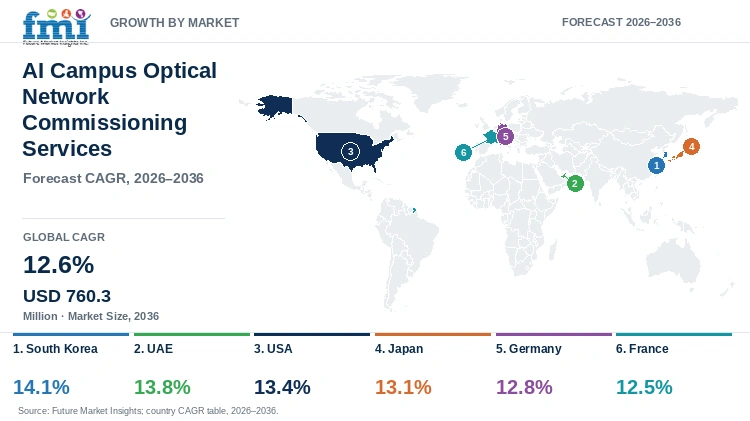
| Country | CAGR |
|---|---|
| South Korea | 14.1% |
| UAE | 13.8% |
| USA | 13.4% |
| Japan | 13.1% |
| Germany | 12.8% |
| France | 12.5% |
Country-wise Analysis
South Korea
- South Korean public and private fit-outs may use different procurement routes while requiring access during the relevant installation windows. The fastest profiled forecast is a 14.1% CAGR from 2026 to 2036, with multi-vendor work needing consistent fiber identities and connector records. Preserving those associations through later extensions gives operators a baseline that remains usable after project closeout.
UAE
- Individual site packages determine when UAE optical work can proceed, with successive crews needing a common method for comparable results. Within the market’s 13.8% CAGR forecast for 2026 to 2036, high throughput matters when failures are corrected while accepted links retain their records. Separating passive acceptance from activated-equipment tests also allows completed sections to be released with outstanding work still visible.
USA
- American halls and fabric renewals can create staged certification packages as supporting zones become usable, making agreed loss thresholds and path identity necessary before testing. The USA is forecast to grow at a 13.4% CAGR from 2026 to 2036, with contracts needing a boundary between physical sign-off and live transport validation. That distinction lets buyers coordinate tasks with power and network-equipment availability.
Japan
- Local optical specifications determine the Japanese procedure, while upgrades in operating research or enterprise facilities need to limit disruption. Japan’s 13.1% CAGR forecast for 2026 to 2036 includes work where preserved path-to-result records help avoid unnecessary retesting after extensions. A clear statement of activated-equipment scope also tells the owner which checks remain with the network team.
Germany
- German backbone extensions and new-build phases need optical tests aligned with electrical readiness, since planned computing capacity does not itself provide access to the paths. A common handover format within the 12.8% CAGR forecast for 2026 to 2036 helps reconcile several installation contractors. Exact route and method records expose channels still awaiting acceptance and give maintenance teams a reproducible starting point.
France
- Approved link schedules and building phases create French assignments once the owner can define the release process. The market’s forecast is a 12.5% CAGR from 2026 to 2036, with vendor-neutral records helping separate clean passive-fiber results from full communication-system readiness. Live transport validation remains a distinct deliverable where switching equipment or activated services are still required.
Who are the notable companies in the AI campus optical network commissioning services market?
EXFO; VIAVI Solutions; AFL; Fluke Networks; VeEX
Commissioning teams turn optical measurements into an accepted network. Instrument capabilities affect throughput and connector coverage but do not establish the quality of the handover by themselves. Buyers need a consistent method across technicians and a record that follows the installed paths.
Competitive Benchmarking: AI Campus Optical Network Commissioning Services Market
| Participant | Commercial focus | Buyer qualification priority |
|---|---|---|
| EXFO | Optical field-test platforms and support | Repeatable loss measurement and records |
| VIAVI Solutions | Optical and transport test platforms | Multi-fiber and high-speed test coverage |
| AFL | Fiber inspection and test solutions | Connector workflow and field usability |
| Fluke Networks | Cabling certification systems | Traceable acceptance results |
| VeEX | Network and optical test equipment | Protocol support and field troubleshooting |
Key Developments in the AI Campus Optical Network Commissioning Services Market
- Fluke Networks launched CertiFiber Max for high-density multi-fiber testing in January 2026. [1]
- VIAVI announced an optical-loss test set supporting simultaneous testing of up to 24 fibers in February 2026. [2]
Key Players in the AI Campus Optical Network Commissioning Services Market
- EXFO
- VIAVI Solutions
- AFL
- Fluke Networks
- VeEX
AI Campus Optical Network Commissioning Services Market - Report Scope
| Coverage field | Report scope |
|---|---|
| Market breakdown | Link Speed; Service Type; Deployment Location; Data Center Type; Route to Market; Region |
| Quantitative unit | USD Million |
| Market definition | The market covers contracted commissioning, certification and related field services for AI-campus optical networks. Standalone test instruments, cabling materials and unrelated network-management services are outside the scope. |
| Regions covered | North America; Latin America; Western Europe; Eastern Europe; East Asia; South Asia and Pacific; Middle East and Africa |
| Countries / markets profiled | South Korea; UAE; USA; Japan; Germany; France |
| Key companies profiled | EXFO; VIAVI Solutions; AFL; Fluke Networks; VeEX |
| Base year / forecast period | 2026 / 2026–2036 |
| Estimate coverage | 2025 and 2026 market estimates; 2036 forecast; segment shares and country / market CAGRs. |
AI Campus Optical Network Commissioning Services Market - Research Methodology
| Method | Application |
|---|---|
| Market definition | The analysis follows the stated product or service boundary and distinguishes direct category revenue from adjacent activities. |
| Secondary research | Official technical, regulatory, research and company publications provide the documented operating context and recent developments cited in this report. |
| Forecast and segmentation | Market estimates, segment shares and geographic forecasts are presented as analytical estimates within the stated commercial scope. |
| Competitive assessment | Participants are compared by their relevant products or services, commercial role and buyer qualification requirements. |
| Interpretation | The assessment considers purchasing conditions and the scope of the documented product, service or performance claim. |
AI Campus Optical Network Commissioning Services Market by Segments
Link Speed
- 800G
- 400G
- 1.6T
- 3.2T and above
Service Type
- Commissioning & certification
- Link diagnostics
- Reliability / interoperability testing
- Cleaning & inspection
- Managed optical operations
Deployment Location
- Inter-rack / scale-out
- Intra-rack / scale-up
- Spine-leaf fabric
- Campus / DCI
Data Center Type
- Hyperscale AI data centers
- Colocation AI facilities
- Enterprise AI/HPC
- Research / sovereign compute
Route to Market
- OEM direct
- Network system integrators
- Fiber/cabling specialists
- Test & managed-service providers
AI Campus Optical Network Commissioning Services Market by Region
- North America
- United States
- Canada
- Latin America
- Brazil
- Mexico
- Argentina
- Chile
- Western Europe
- Germany
- France
- United Kingdom
- Italy
- Spain
- Benelux
- Nordics
- Eastern Europe
- Poland
- Czech Republic
- Romania
- Hungary
- East Asia
- China
- Japan
- South Korea
- South Asia and Pacific
- India
- ASEAN
- Australia and New Zealand
- Middle East and Africa
- GCC Countries
- South Africa
- Türkiye
- Israel
Research Sources and Bibliography
- [1] Fluke Networks. (2026, January 20). Fluke Networks Launches CertiFiber Max, Setting a New Benchmark for High-Density Multi-Fiber Testing in Data Centers.
- [2] VIAVI Solutions. (2026, February 24). VIAVI Speeds Multifiber Certification with Optical Loss Test Set for Testing Up to 24 Fibers Simultaneously.
- [3] VIAVI Solutions. (2025, March 18). VIAVI Adds 800G Module to OneAdvisor 800 Family of Field Testers.
- [4] John D’Ambrosia, Ethernet Alliance. (2025, January 15). Ethernet’s AI Evolution.
- [5] Future Market Insights. (2026). AI Campus Optical Network Commissioning Services Market: Global industry analysis and opportunity assessment, 2026–2036.
This Report Answers
- How large is the AI campus optical network commissioning services market in 2026?
- What value and CAGR are forecast through 2036?
- Which link speed segment leads in 2026?
- Which service type segment has the largest share?
- Which profiled country or market has the fastest forecast growth?
- Which participants are covered in the competitive assessment?
Frequently Asked Questions
How large is the AI campus optical network commissioning services market in 2026?
The market was valued at USD 206.1 Million in 2025 and is expected to reach USD 232.1 Million in 2026.
What value and CAGR are forecast through 2036?
The market is projected to reach USD 760.3 Million by 2036, with a 12.6% CAGR during 2026–2036.
Which link speed segment leads in 2026?
The 800G segment accounts for 38.0% of link speed in 2026.
Which service type segment has the largest share?
The Commissioning & certification segment accounts for 28.0% of service type in 2026.
Which profiled country or market has the fastest forecast growth?
South Korea has the highest profiled CAGR at 14.1% during 2026–2036.
Which participants are covered in the competitive assessment?
The assessment covers EXFO, VIAVI Solutions, AFL, Fluke Networks and VeEX.
Preview the report firsthand - request a free sample
Get SampleGet the brochure for pricing and purchase details.
Get PDFTable of Content
- Key Takeaways
- Market Size and CAGR
- Top Growth Driver
- Fastest Growing Segment
- Leading Region
- Key Companies
- Emerging Opportunities
- Executive Summary
- Global Market Outlook
- Demand-side Trends
- Supply-side Trends
- Technology Roadmap Analysis
- Analysis and Recommendations
- Analyst Perspective (What is happening? Why now? What should investors know?)
- Key Questions Answered
- How large is the market?
- What is the CAGR?
- What are key trends?
- Which region dominates?
- Who are the leaders?
- Market Overview
- Market Coverage / Taxonomy
- Market Definition / Scope / Limitations
- Research Methodology
- Chapter Orientation
- Analytical Lens and Working Hypotheses
- Market Structure, Signals, and Trend Drivers
- Benchmarking and Cross-market Comparability
- Market Sizing, Forecasting, and Opportunity Mapping
- Research Design and Evidence Framework
- Desk Research Programme (Secondary Evidence)
- Expert Input and Fieldwork (Primary Evidence)
- Tooling, Models, and Reference Databases
- Data Engineering and Model Build
- Quality Assurance and Audit Trail
- Market Background
- Market Dynamics (Drivers, Restraints, Opportunity, Trends)
- Scenario Forecast (Optimistic, Likely, Conservative)
- Impact Analysis
- AI Impact
- Sustainability Impact
- Regulatory Impact
- Technology Impact
- Consumer / Buyer Analysis
- Purchase Drivers
- Adoption Barriers
- Buyer Journey
- Opportunity Map Analysis
- Product Life Cycle Analysis
- Supply Chain Analysis
- Investment Feasibility Matrix
- Value Chain Analysis
- PESTLE and Porter's Analysis
- Regulatory Landscape
- Regional Parent Market Outlook
- Production and Consumption Statistics
- Import and Export Statistics
- Global Market Analysis and Forecast, 2021 to 2036
- Historical Market Size Value (USD Million) Analysis, 2021 to 2025
- Current and Future Market Size Value (USD Million) Projections, 2026 to 2036
- Y-o-Y Growth Trend Analysis
- Absolute $ Opportunity Analysis
- Global Market Pricing Analysis, 2021 to 2036
- Global Market Analysis and Forecast, By Link Speed, 2021 to 2036
- Introduction / Key Findings
- Historical Market Size Value (USD Million) Analysis By Link Speed, 2021 to 2025
- Current and Future Market Size Value (USD Million) Analysis and Forecast By Link Speed, 2026 to 2036
- 800G
- 400G
- 1.6T
- 3.2T and above
- Y-o-Y Growth Trend Analysis By Link Speed, 2021 to 2025
- Absolute $ Opportunity Analysis By Link Speed, 2026 to 2036
- Global Market Analysis and Forecast, By Service Type, 2021 to 2036
- Introduction / Key Findings
- Historical Market Size Value (USD Million) Analysis By Service Type, 2021 to 2025
- Current and Future Market Size Value (USD Million) Analysis and Forecast By Service Type, 2026 to 2036
- Commissioning & certification
- Link diagnostics
- Reliability / interoperability testing
- Cleaning & inspection
- Managed optical operations
- Y-o-Y Growth Trend Analysis By Service Type, 2021 to 2025
- Absolute $ Opportunity Analysis By Service Type, 2026 to 2036
- Global Market Analysis and Forecast, By Deployment Location, 2021 to 2036
- Introduction / Key Findings
- Historical Market Size Value (USD Million) Analysis By Deployment Location, 2021 to 2025
- Current and Future Market Size Value (USD Million) Analysis and Forecast By Deployment Location, 2026 to 2036
- Inter-rack / scale-out
- Intra-rack / scale-up
- Spine-leaf fabric
- Campus / DCI
- Y-o-Y Growth Trend Analysis By Deployment Location, 2021 to 2025
- Absolute $ Opportunity Analysis By Deployment Location, 2026 to 2036
- Global Market Analysis and Forecast, By Data Center Type, 2021 to 2036
- Introduction / Key Findings
- Historical Market Size Value (USD Million) Analysis By Data Center Type, 2021 to 2025
- Current and Future Market Size Value (USD Million) Analysis and Forecast By Data Center Type, 2026 to 2036
- Hyperscale AI data centers
- Colocation AI facilities
- Enterprise AI/HPC
- Research / sovereign compute
- Y-o-Y Growth Trend Analysis By Data Center Type, 2021 to 2025
- Absolute $ Opportunity Analysis By Data Center Type, 2026 to 2036
- Global Market Analysis and Forecast, By Route to Market, 2021 to 2036
- Introduction / Key Findings
- Historical Market Size Value (USD Million) Analysis By Route to Market, 2021 to 2025
- Current and Future Market Size Value (USD Million) Analysis and Forecast By Route to Market, 2026 to 2036
- OEM direct
- Network system integrators
- Fiber/cabling specialists
- Test & managed-service providers
- Y-o-Y Growth Trend Analysis By Route to Market, 2021 to 2025
- Absolute $ Opportunity Analysis By Route to Market, 2026 to 2036
- Global Market Analysis and Forecast, By Region, 2021 to 2036
- Introduction
- Historical Market Size Value (USD Million) Analysis By Region, 2021 to 2025
- Current Market Size Value (USD Million) Analysis and Forecast By Region, 2026 to 2036
- North America
- Latin America
- Western Europe
- Eastern Europe
- East Asia
- South Asia and Pacific
- Middle East and Africa
- Market Attractiveness Analysis By Region
- North America Market Analysis and Forecast, By Country, 2021 to 2036
- Historical Market Size Value (USD Million) Trend Analysis By Market Taxonomy, 2021 to 2025
- Market Size Value (USD Million) Forecast By Market Taxonomy, 2026 to 2036
- By Country
- United States
- Canada
- By Link Speed
- By Service Type
- By Deployment Location
- By Data Center Type
- By Route to Market
- By Country
- Market Attractiveness Analysis
- By Country
- By Link Speed
- By Service Type
- By Deployment Location
- By Data Center Type
- By Route to Market
- Key Takeaways
- Latin America Market Analysis and Forecast, By Country
- Historical Market Size Value (USD Million) Trend Analysis By Market Taxonomy, 2021 to 2025
- Market Size Value (USD Million) Forecast By Market Taxonomy, 2026 to 2036
- By Country
- Brazil
- Mexico
- Argentina
- Chile
- By Link Speed
- By Service Type
- By Deployment Location
- By Data Center Type
- By Route to Market
- By Country
- Market Attractiveness Analysis
- By Country
- By Link Speed
- By Service Type
- By Deployment Location
- By Data Center Type
- By Route to Market
- Key Takeaways
- Western Europe Market Analysis and Forecast, By Country
- Historical Market Size Value (USD Million) Trend Analysis By Market Taxonomy, 2021 to 2025
- Market Size Value (USD Million) Forecast By Market Taxonomy, 2026 to 2036
- By Country
- Germany
- France
- United Kingdom
- Italy
- Spain
- Benelux
- Nordics
- By Link Speed
- By Service Type
- By Deployment Location
- By Data Center Type
- By Route to Market
- By Country
- Market Attractiveness Analysis
- By Country
- By Link Speed
- By Service Type
- By Deployment Location
- By Data Center Type
- By Route to Market
- Key Takeaways
- Eastern Europe Market Analysis and Forecast, By Country
- Historical Market Size Value (USD Million) Trend Analysis By Market Taxonomy, 2021 to 2025
- Market Size Value (USD Million) Forecast By Market Taxonomy, 2026 to 2036
- By Country
- Poland
- Czech Republic
- Romania
- Hungary
- By Link Speed
- By Service Type
- By Deployment Location
- By Data Center Type
- By Route to Market
- By Country
- Market Attractiveness Analysis
- By Country
- By Link Speed
- By Service Type
- By Deployment Location
- By Data Center Type
- By Route to Market
- Key Takeaways
- East Asia Market Analysis and Forecast, By Country
- Historical Market Size Value (USD Million) Trend Analysis By Market Taxonomy, 2021 to 2025
- Market Size Value (USD Million) Forecast By Market Taxonomy, 2026 to 2036
- By Country
- China
- Japan
- South Korea
- By Link Speed
- By Service Type
- By Deployment Location
- By Data Center Type
- By Route to Market
- By Country
- Market Attractiveness Analysis
- By Country
- By Link Speed
- By Service Type
- By Deployment Location
- By Data Center Type
- By Route to Market
- Key Takeaways
- South Asia and Pacific Market Analysis and Forecast, By Country
- Historical Market Size Value (USD Million) Trend Analysis By Market Taxonomy, 2021 to 2025
- Market Size Value (USD Million) Forecast By Market Taxonomy, 2026 to 2036
- By Country
- India
- ASEAN
- Australia and New Zealand
- By Link Speed
- By Service Type
- By Deployment Location
- By Data Center Type
- By Route to Market
- By Country
- Market Attractiveness Analysis
- By Country
- By Link Speed
- By Service Type
- By Deployment Location
- By Data Center Type
- By Route to Market
- Key Takeaways
- Middle East and Africa Market Analysis and Forecast, By Country
- Historical Market Size Value (USD Million) Trend Analysis By Market Taxonomy, 2021 to 2025
- Market Size Value (USD Million) Forecast By Market Taxonomy, 2026 to 2036
- By Country
- GCC Countries
- South Africa
- Türkiye
- Israel
- By Link Speed
- By Service Type
- By Deployment Location
- By Data Center Type
- By Route to Market
- By Country
- Market Attractiveness Analysis
- By Country
- By Link Speed
- By Service Type
- By Deployment Location
- By Data Center Type
- By Route to Market
- Key Takeaways
- Key Countries Market Analysis
- United States
- Pricing Analysis
- Market Share Analysis, 2025
- By Link Speed
- By Service Type
- By Deployment Location
- By Data Center Type
- By Route to Market
- Canada
- Pricing Analysis
- Market Share Analysis, 2025
- By Link Speed
- By Service Type
- By Deployment Location
- By Data Center Type
- By Route to Market
- Mexico
- Pricing Analysis
- Market Share Analysis, 2025
- By Link Speed
- By Service Type
- By Deployment Location
- By Data Center Type
- By Route to Market
- Brazil
- Pricing Analysis
- Market Share Analysis, 2025
- By Link Speed
- By Service Type
- By Deployment Location
- By Data Center Type
- By Route to Market
- Chile
- Pricing Analysis
- Market Share Analysis, 2025
- By Link Speed
- By Service Type
- By Deployment Location
- By Data Center Type
- By Route to Market
- Germany
- Pricing Analysis
- Market Share Analysis, 2025
- By Link Speed
- By Service Type
- By Deployment Location
- By Data Center Type
- By Route to Market
- United Kingdom
- Pricing Analysis
- Market Share Analysis, 2025
- By Link Speed
- By Service Type
- By Deployment Location
- By Data Center Type
- By Route to Market
- Italy
- Pricing Analysis
- Market Share Analysis, 2025
- By Link Speed
- By Service Type
- By Deployment Location
- By Data Center Type
- By Route to Market
- Spain
- Pricing Analysis
- Market Share Analysis, 2025
- By Link Speed
- By Service Type
- By Deployment Location
- By Data Center Type
- By Route to Market
- France
- Pricing Analysis
- Market Share Analysis, 2025
- By Link Speed
- By Service Type
- By Deployment Location
- By Data Center Type
- By Route to Market
- India
- Pricing Analysis
- Market Share Analysis, 2025
- By Link Speed
- By Service Type
- By Deployment Location
- By Data Center Type
- By Route to Market
- ASEAN
- Pricing Analysis
- Market Share Analysis, 2025
- By Link Speed
- By Service Type
- By Deployment Location
- By Data Center Type
- By Route to Market
- Australia and New Zealand
- Pricing Analysis
- Market Share Analysis, 2025
- By Link Speed
- By Service Type
- By Deployment Location
- By Data Center Type
- By Route to Market
- China
- Pricing Analysis
- Market Share Analysis, 2025
- By Link Speed
- By Service Type
- By Deployment Location
- By Data Center Type
- By Route to Market
- Japan
- Pricing Analysis
- Market Share Analysis, 2025
- By Link Speed
- By Service Type
- By Deployment Location
- By Data Center Type
- By Route to Market
- South Korea
- Pricing Analysis
- Market Share Analysis, 2025
- By Link Speed
- By Service Type
- By Deployment Location
- By Data Center Type
- By Route to Market
- Poland
- Pricing Analysis
- Market Share Analysis, 2025
- By Link Speed
- By Service Type
- By Deployment Location
- By Data Center Type
- By Route to Market
- Hungary
- Pricing Analysis
- Market Share Analysis, 2025
- By Link Speed
- By Service Type
- By Deployment Location
- By Data Center Type
- By Route to Market
- Türkiye
- Pricing Analysis
- Market Share Analysis, 2025
- By Link Speed
- By Service Type
- By Deployment Location
- By Data Center Type
- By Route to Market
- South Africa
- Pricing Analysis
- Market Share Analysis, 2025
- By Link Speed
- By Service Type
- By Deployment Location
- By Data Center Type
- By Route to Market
- UAE
- Pricing Analysis
- Market Share Analysis, 2025
- By Link Speed
- By Service Type
- By Deployment Location
- By Data Center Type
- By Route to Market
- United States
- Market Structure Analysis
- Competition Dashboard
- Competition Benchmarking
- Market Share Analysis of Top Players
- By Regional
- By Link Speed
- By Service Type
- By Deployment Location
- By Data Center Type
- By Route to Market
- Emerging Startups
- Innovation Benchmarking
- Competition Analysis
- Competition Deep Dive
- EXFO
- Overview
- Product Portfolio
- Profitability by Market Segments
- Sales Footprint
- Strategy Overview
- Marketing Strategy
- Product Strategy
- Channel Strategy
- VIAVI Solutions
- AFL
- Fluke Networks
- VeEX
- EXFO
- Case Studies
- Success Stories
- Recent Developments
- Competition Deep Dive
- Assumptions & Acronyms Used


