

- Market Size (2026)
- USD 608.6 Mn
- Forecast (2036)
- USD 1651.7 Mn
- CAGR (2026 to 2036)
- 10.5%
How big is AI Pod Factory Integration Services Market in 2026?
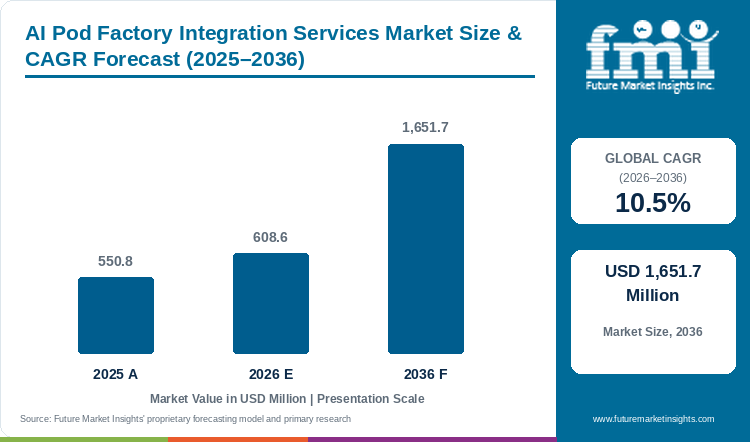
The market was valued at USD 550.8 Million in 2025 and is expected to reach USD 608.6 Million in 2026, with growth at a 10.5% CAGR from 2026 to 2036 taking its value to USD 1,651.7 Million by 2036.
Factory integration delivers a coordinated AI pod rather than leaving every component interface to be resolved at the construction site. The benefit depends on early agreement of receiving power, cooling and access requirements, since a quickly assembled package may still wait for an unresolved local connection. Contracts need to separate factory acceptance from checks following shipment and installation, with records tied to the delivered configuration rather than a standard build that substitutions have changed. Preservation during transport and arrival inspection support the same process. Repeat orders can reuse methods while retaining site-specific requirements, as Japan’s electricity and communications planning and French grid-readiness initiatives help illustrate. The forecast includes qualifying engineering, assembly, integration and validation services, excluding standalone compute equipment, unrelated construction and support outside the pod contract. [5]
Key Market Trends & Insights
- Commissioning & acceptance holds 27.0% of service scope in 2026, defining what factory tests established and which transport and site checks remain for operation.
- New AI hall build holds 36.0% of project stage in 2026, allowing receiving power, liquid loops, access and controls to influence the pod build before assembly.
- The 251–500 kW band holds 32.0% of AI rack density in 2026, identifying the specified integration band whose load and interfaces need to match the receiving site.
- Hyperscale AI data centers account for 46.0% of data center type in 2026, requiring repeat factory deliveries to follow staged power release and installation readiness.
Regional Highlights
- South Korea has the highest profiled CAGR at 12.1% during 2026–2036.
- The next two profiled growth rates are UAE at 11.8% and Saudi Arabia at 11.4% over the same period.
Market Size & Forecast
| Metric | Value |
|---|---|
| 2025 market value | USD 550.8 Million |
| 2026 market estimate | USD 608.6 Million |
| 2036 market forecast | USD 1,651.7 Million |
| Forecast CAGR, 2026–2036 | 10.5% |
The market covers engineering, assembly, factory or site integration, commissioning and related validation services directly associated with AI pods. Standalone compute equipment, unrelated construction and support outside the pod-integration contract are excluded.
Factory-integrated pods simplify some interfaces with data-center power, but the final connection to local electrical infrastructure remains a site responsibility.
Infrastructure readiness and acceptance
| Documented operating context | Source |
|---|---|
| Vertiv announced OneCore prefabricated infrastructure for high-density 5 MW data centers in August 2025. | [1] |
| Compass Datacenters and Schneider Electric announced a prefabricated white-space module in September 2025. | [2] |
| Schneider Electric introduced prefabricated pod and rack solutions for high-density AI applications in June 2025. | [3] |
| Siemens and partners described a reference architecture for NVIDIA AI data centers in June 2026. | [4] |
Analyst Perspective
A factory-integrated package needs records that follow the equipment actually shipped, including substitutions and the conditions already tested. Clear arrival checks and site-acceptance duties allow the receiving team to use that evidence while verifying transport effects and local interfaces, so assembly savings translate into a workable handover.
- Sudip Saha, Principal Analyst at Future Market Insights
How is the AI pod factory integration services market segmented?
Service Scope covers Commissioning & acceptance, Design & engineering, Performance validation, Retrofit & migration and Managed support. Project Stage covers New AI hall build, Rack/pod deployment, Capacity expansion, Legacy conversion and Ongoing operations. AI Rack Density covers 251–500 kW, 100–250 kW, Below 100 kW and Above 500 kW. Data Center Type covers Hyperscale AI data centers, Colocation AI facilities, Enterprise private AI and HPC & research centers. Commercial Model covers Direct enterprise contract, System integrator / EPC-led, Subscription / license and Managed-service contract.
The as-built factory configuration should transfer into data-center infrastructure management so that equipment records do not have to be reconstructed after installation.
Why does Commissioning & acceptance lead service scope demand?
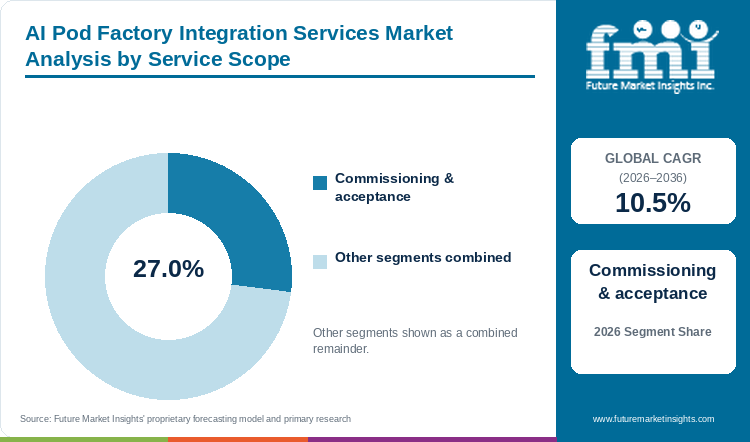
Commissioning & acceptance: 27.0% of service scope in 2026.
Factory acceptance needs a record of the configuration and conditions demonstrated before shipment, followed by a clear account of checks required after transport and local connection. Those later checks address circumstances the assembly setting could not reproduce, allowing site teams to use valid factory evidence without reconstructing the whole build. Separating verification from corrective work on an incomplete package also helps assign responsibility when an arrival finding delays readiness for operation.
- The Commissioning & acceptance segment accounts for 27.0% of service scope in 2026.
- The handover should identify post-shipment checks so that the site team knows which factory results remain valid after installation.
Why does New AI hall build lead project stage demand?
New AI hall build: 36.0% of project stage in 2026.
Designing a new hall and pod together lets electrical connections, liquid-loop routes, transport dimensions and installation access influence the factory build before assembly. The aim is to reduce difficult site work while resolving receiving requirements early, with controlled changes carried through factory and field tests. A package coordinated around its actual destination offers a more practical installation than a standard module requiring extensive alteration on arrival.
- The New AI hall build segment accounts for 36.0% of project stage in 2026.
- Transport and access limits should be settled during design so that a completed module can reach its intended position without unplanned disassembly.
What are the drivers, restraints, and opportunities in the AI pod factory integration services market?
Factory integration reduces site assembly complexity
Several infrastructure systems need readiness together for an AI deployment, so independent deliveries can leave field crews resolving interfaces under construction pressure. Factory integration moves part of that coordination into controlled assembly with a known build and records of completed tests. Explicit remaining tasks then let the buyer plan coolant preparation and electrical acceptance around delivery rather than discover those dependencies afterward.
Transport and interface changes can undo factory assurance
Shipment and installation can alter a factory-tested assembly, making preservation, cleanliness, arrival inspection and any revalidation part of the integration plan. Warranty boundaries and local responsibilities also need agreement before a technically suitable package reaches the site. Assigning these checks in the contract helps a later finding move toward correction without leaving factory and field teams disputing its origin.
Repeatable modules simplify deployment coordination
Repeat programs can standardize assembly and records while preserving the distinction between local cooling-loop preparation and final rack or distribution commissioning. Reusable procedures give the handover a consistent form, with controlled substitutions and site-specific checks keeping earlier evidence relevant. A predictable process across deliveries depends on that configuration control alongside the engineering required at each receiving facility. [6]
Factory testing can shorten AI infrastructure commissioning only when transport and site changes are controlled and the remaining acceptance tasks are explicit.
Which country and market CAGRs are profiled for AI pod factory integration services?
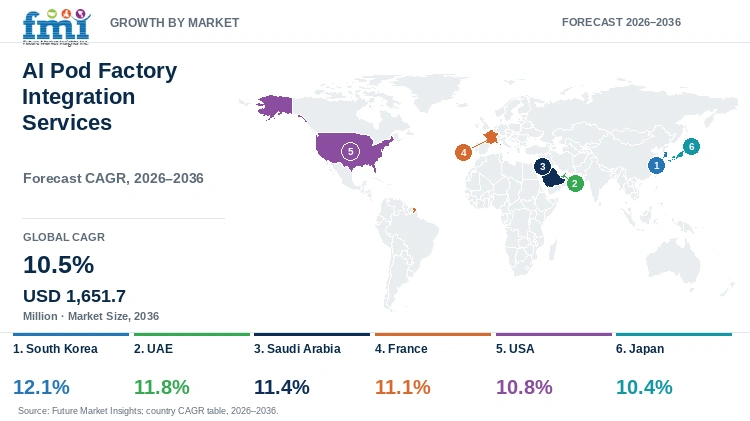
| Country | CAGR |
|---|---|
| South Korea | 12.1% |
| UAE | 11.8% |
| Saudi Arabia | 11.4% |
| France | 11.1% |
| USA | 10.8% |
| Japan | 10.4% |
Country-wise Analysis
South Korea
- South Korean integrators need GPU delivery schedules to match receiving-site electrical and cooling specifications, with records usable by local operating teams. The fastest profiled forecast is a 12.1% CAGR from 2026 to 2036, accompanied by a need to assign transport findings and interface changes to a responsible party. Separating those checks from completed factory work supports the release of repeat deliveries.
UAE
- Technology access, security requirements and platform acceptance can shape UAE participation alongside physical integration capability. Within the 11.8% CAGR forecast for 2026 to 2036, the configuration record needs to survive shipment and reassembly before utility connection. An explicit list of site confirmations helps convert time saved in assembly into a workable installation sequence.
Saudi Arabia
- Saudi Arabian programs become integration assignments when power and equipment schedules are defined well enough to qualify the receiving cooling loop and plan the operations handover. The market’s forecast is an 11.4% CAGR from 2026 to 2036, with repeat orders benefiting from a clear division between standard factory work and local engineering. Procedures validated during assembly must remain practical for the team receiving each pod.
France
- EDF’s identified industrial sites place grid readiness and developer qualification alongside French high-power deployment plans, requiring integrators to define receiving interfaces before dispatch. France’s 11.1% CAGR forecast for 2026 to 2036 includes packages where factory evidence can reduce repeated work while electrical compliance and heat rejection remain site duties. Stating the test boundary makes that division usable at installation.
USA
- American repeat programs need a controlled bill of materials and records aligned with each delivered assembly, especially when component substitutions affect tests or later service. The USA is forecast to grow at a 10.8% CAGR from 2026 to 2036, with substations and cooling distribution still needing readiness for delivery. Repeatability adds value when it prevents rediscovery across batches and the record continues to match the equipment shipped.
Japan
- Japanese location choices impose transport and access limits that need to enter the factory design along with electricity and network timing. Within Japan’s 10.4% CAGR forecast for 2026 to 2036, integrators must show how the package will reach its position and remain serviceable there. Coordinating those requirements preserves the assembly benefit without shifting difficult connection or maintenance questions to the final facility.
Who are the notable companies in the AI pod factory integration services market?
Vertiv; Siemens; Jacobs; Schneider Electric; Eaton
Factory integrators compete on how consistently they deliver an assembled package with usable records. Prefabrication reduces some site work but does not remove transport or local-utility risks. Buyers need those boundaries stated clearly rather than covered by a general claim of rapid deployment.
Competitive Benchmarking: AI Pod Factory Integration Services Market
| Participant | Commercial focus | Buyer qualification priority |
|---|---|---|
| Vertiv | Power, cooling and infrastructure services | Integrated commissioning and service access |
| Siemens | Electrical and building-system integration | Protection logic and controls handover |
| Jacobs | Engineering and facility integration | Cross-system acceptance and owner requirements |
| Schneider Electric | Power, cooling and prefabricated infrastructure | Interface definition and system-level testing |
| Eaton | Power infrastructure and services | Protection coordination and recovery behavior |
Key Developments in the AI Pod Factory Integration Services Market
- Vertiv announced OneCore prefabricated infrastructure for high-density 5 MW data centers in August 2025. [1]
- Compass Datacenters and Schneider Electric announced a prefabricated white-space module in September 2025. [2]
Key Players in the AI Pod Factory Integration Services Market
- Vertiv
- Siemens
- Jacobs
- Schneider Electric
- Eaton
AI Pod Factory Integration Services Market - Report Scope
| Coverage field | Report scope |
|---|---|
| Market breakdown | Service Scope; Project Stage; AI Rack Density; Data Center Type; Commercial Model; Region |
| Quantitative unit | USD Million |
| Market definition | The market covers engineering, assembly, factory or site integration, commissioning and related validation services directly associated with AI pods. Standalone compute equipment, unrelated construction and support outside the pod-integration contract are excluded. |
| Regions covered | North America; Latin America; Western Europe; Eastern Europe; East Asia; South Asia and Pacific; Middle East and Africa |
| Countries / markets profiled | South Korea; UAE; Saudi Arabia; France; USA; Japan |
| Key companies profiled | Vertiv; Siemens; Jacobs; Schneider Electric; Eaton |
| Base year / forecast period | 2026 / 2026–2036 |
| Estimate coverage | 2025 and 2026 market estimates; 2036 forecast; segment shares and country / market CAGRs. |
AI Pod Factory Integration Services Market - Research Methodology
| Method | Application |
|---|---|
| Market definition | The analysis follows the stated product or service boundary and distinguishes direct category revenue from adjacent activities. |
| Secondary research | Official technical, regulatory, research and company publications provide the documented operating context and recent developments cited in this report. |
| Forecast and segmentation | Market estimates, segment shares and geographic forecasts are presented as analytical estimates within the stated commercial scope. |
| Competitive assessment | Participants are compared by their relevant products or services, commercial role and buyer qualification requirements. |
| Interpretation | The assessment considers purchasing conditions and the scope of the documented product, service or performance claim. |
AI Pod Factory Integration Services Market by Segments
Service Scope
- Commissioning & acceptance
- Design & engineering
- Performance validation
- Retrofit & migration
- Managed support
Project Stage
- New AI hall build
- Rack/pod deployment
- Capacity expansion
- Legacy conversion
- Ongoing operations
AI Rack Density
- 251-500 kW
- 100-250 kW
- Below 100 kW
- Above 500 kW
Data Center Type
- Hyperscale AI data centers
- Colocation AI facilities
- Enterprise private AI
- HPC & research centers
Commercial Model
- Direct enterprise contract
- System integrator / EPC-led
- Subscription / license
- Managed-service contract
AI Pod Factory Integration Services Market by Region
- North America
- United States
- Canada
- Latin America
- Brazil
- Mexico
- Argentina
- Chile
- Western Europe
- Germany
- France
- United Kingdom
- Italy
- Spain
- Benelux
- Nordics
- Eastern Europe
- Poland
- Czech Republic
- Romania
- Hungary
- East Asia
- China
- Japan
- South Korea
- South Asia and Pacific
- India
- ASEAN
- Australia and New Zealand
- Middle East and Africa
- GCC Countries
- South Africa
- Türkiye
- Israel
Research Sources and Bibliography
- [1] Vertiv. (2025, August 5). Vertiv announces OneCore to accelerate deployment of scalable prefabricated infrastructure for AI, HPC, and high-density data centers.
- [2] Schneider Electric. (2025, September 9). Compass Datacenters and Schneider Electric announce prefabricated white space module to accelerate data center delivery timelines.
- [3] Schneider Electric. (2025, June 11). Schneider Electric Launches New Data Center Solutions to Meet Challenges of High-Density AI and Accelerated Compute Applications.
- [4] Siemens. (2026, June 1). Siemens and Partners Develop Reference Architecture Purpose-Built for NVIDIA AI Data Centers.
- [5] Future Market Insights. (2026). AI Pod Factory Integration Services Market: Global industry analysis and opportunity assessment, 2026–2036.
- [6] Open Compute Project. (2025, January 27). Guidelines for Pre-Commission Preparation of Technology Cooling System (TCS) Row Manifolds in Liquid Cooled Data Centers.
This Report Answers
- How large is the AI pod factory integration services market in 2026?
- What value and CAGR are forecast through 2036?
- Which service scope segment leads in 2026?
- Which project stage segment has the largest share?
- Which profiled country or market has the fastest forecast growth?
- Which participants are covered in the competitive assessment?
Frequently Asked Questions
How large is the AI pod factory integration services market in 2026?
The market was valued at USD 550.8 Million in 2025 and is expected to reach USD 608.6 Million in 2026.
What value and CAGR are forecast through 2036?
The market is projected to reach USD 1,651.7 Million by 2036, with a 10.5% CAGR during 2026–2036.
Which service scope segment leads in 2026?
The Commissioning & acceptance segment accounts for 27.0% of service scope in 2026.
Which project stage segment has the largest share?
The New AI hall build segment accounts for 36.0% of project stage in 2026.
Which profiled country or market has the fastest forecast growth?
South Korea has the highest profiled CAGR at 12.1% during 2026–2036.
Which participants are covered in the competitive assessment?
The assessment covers Vertiv, Siemens, Jacobs, Schneider Electric and Eaton.
Preview the report firsthand - request a free sample
Get SampleGet the brochure for pricing and purchase details.
Get PDFTable of Content
- Key Takeaways
- Market Size and CAGR
- Top Growth Driver
- Fastest Growing Segment
- Leading Region
- Key Companies
- Emerging Opportunities
- Executive Summary
- Global Market Outlook
- Demand-side Trends
- Supply-side Trends
- Technology Roadmap Analysis
- Analysis and Recommendations
- Analyst Perspective (What is happening? Why now? What should investors know?)
- Key Questions Answered
- How large is the market?
- What is the CAGR?
- What are key trends?
- Which region dominates?
- Who are the leaders?
- Market Overview
- Market Coverage / Taxonomy
- Market Definition / Scope / Limitations
- Research Methodology
- Chapter Orientation
- Analytical Lens and Working Hypotheses
- Market Structure, Signals, and Trend Drivers
- Benchmarking and Cross-market Comparability
- Market Sizing, Forecasting, and Opportunity Mapping
- Research Design and Evidence Framework
- Desk Research Programme (Secondary Evidence)
- Expert Input and Fieldwork (Primary Evidence)
- Tooling, Models, and Reference Databases
- Data Engineering and Model Build
- Quality Assurance and Audit Trail
- Market Background
- Market Dynamics (Drivers, Restraints, Opportunity, Trends)
- Scenario Forecast (Optimistic, Likely, Conservative)
- Impact Analysis
- AI Impact
- Sustainability Impact
- Regulatory Impact
- Technology Impact
- Consumer / Buyer Analysis
- Purchase Drivers
- Adoption Barriers
- Buyer Journey
- Opportunity Map Analysis
- Product Life Cycle Analysis
- Supply Chain Analysis
- Investment Feasibility Matrix
- Value Chain Analysis
- PESTLE and Porter's Analysis
- Regulatory Landscape
- Regional Parent Market Outlook
- Production and Consumption Statistics
- Import and Export Statistics
- Global Market Analysis and Forecast, 2021 to 2036
- Historical Market Size Value (USD Million) Analysis, 2021 to 2025
- Current and Future Market Size Value (USD Million) Projections, 2026 to 2036
- Y-o-Y Growth Trend Analysis
- Absolute $ Opportunity Analysis
- Global Market Pricing Analysis, 2021 to 2036
- Global Market Analysis and Forecast, By Service Scope, 2021 to 2036
- Introduction / Key Findings
- Historical Market Size Value (USD Million) Analysis By Service Scope, 2021 to 2025
- Current and Future Market Size Value (USD Million) Analysis and Forecast By Service Scope, 2026 to 2036
- Commissioning & acceptance
- Design & engineering
- Performance validation
- Retrofit & migration
- Managed support
- Y-o-Y Growth Trend Analysis By Service Scope, 2021 to 2025
- Absolute $ Opportunity Analysis By Service Scope, 2026 to 2036
- Global Market Analysis and Forecast, By Project Stage, 2021 to 2036
- Introduction / Key Findings
- Historical Market Size Value (USD Million) Analysis By Project Stage, 2021 to 2025
- Current and Future Market Size Value (USD Million) Analysis and Forecast By Project Stage, 2026 to 2036
- New AI hall build
- Rack/pod deployment
- Capacity expansion
- Legacy conversion
- Ongoing operations
- Y-o-Y Growth Trend Analysis By Project Stage, 2021 to 2025
- Absolute $ Opportunity Analysis By Project Stage, 2026 to 2036
- Global Market Analysis and Forecast, By AI Rack Density, 2021 to 2036
- Introduction / Key Findings
- Historical Market Size Value (USD Million) Analysis By AI Rack Density, 2021 to 2025
- Current and Future Market Size Value (USD Million) Analysis and Forecast By AI Rack Density, 2026 to 2036
- 251–500 kW
- 100–250 kW
- Below 100 kW
- Above 500 kW
- Y-o-Y Growth Trend Analysis By AI Rack Density, 2021 to 2025
- Absolute $ Opportunity Analysis By AI Rack Density, 2026 to 2036
- Global Market Analysis and Forecast, By Data Center Type, 2021 to 2036
- Introduction / Key Findings
- Historical Market Size Value (USD Million) Analysis By Data Center Type, 2021 to 2025
- Current and Future Market Size Value (USD Million) Analysis and Forecast By Data Center Type, 2026 to 2036
- Hyperscale AI data centers
- Colocation AI facilities
- Enterprise private AI
- HPC & research centers
- Y-o-Y Growth Trend Analysis By Data Center Type, 2021 to 2025
- Absolute $ Opportunity Analysis By Data Center Type, 2026 to 2036
- Global Market Analysis and Forecast, By Commercial Model, 2021 to 2036
- Introduction / Key Findings
- Historical Market Size Value (USD Million) Analysis By Commercial Model, 2021 to 2025
- Current and Future Market Size Value (USD Million) Analysis and Forecast By Commercial Model, 2026 to 2036
- Direct enterprise contract
- System integrator / EPC-led
- Subscription / license
- Managed-service contract
- Y-o-Y Growth Trend Analysis By Commercial Model, 2021 to 2025
- Absolute $ Opportunity Analysis By Commercial Model, 2026 to 2036
- Global Market Analysis and Forecast, By Region, 2021 to 2036
- Introduction
- Historical Market Size Value (USD Million) Analysis By Region, 2021 to 2025
- Current Market Size Value (USD Million) Analysis and Forecast By Region, 2026 to 2036
- North America
- Latin America
- Western Europe
- Eastern Europe
- East Asia
- South Asia and Pacific
- Middle East and Africa
- Market Attractiveness Analysis By Region
- North America Market Analysis and Forecast, By Country, 2021 to 2036
- Historical Market Size Value (USD Million) Trend Analysis By Market Taxonomy, 2021 to 2025
- Market Size Value (USD Million) Forecast By Market Taxonomy, 2026 to 2036
- By Country
- United States
- Canada
- By Service Scope
- By Project Stage
- By AI Rack Density
- By Data Center Type
- By Commercial Model
- By Country
- Market Attractiveness Analysis
- By Country
- By Service Scope
- By Project Stage
- By AI Rack Density
- By Data Center Type
- By Commercial Model
- Key Takeaways
- Latin America Market Analysis and Forecast, By Country
- Historical Market Size Value (USD Million) Trend Analysis By Market Taxonomy, 2021 to 2025
- Market Size Value (USD Million) Forecast By Market Taxonomy, 2026 to 2036
- By Country
- Brazil
- Mexico
- Argentina
- Chile
- By Service Scope
- By Project Stage
- By AI Rack Density
- By Data Center Type
- By Commercial Model
- By Country
- Market Attractiveness Analysis
- By Country
- By Service Scope
- By Project Stage
- By AI Rack Density
- By Data Center Type
- By Commercial Model
- Key Takeaways
- Western Europe Market Analysis and Forecast, By Country
- Historical Market Size Value (USD Million) Trend Analysis By Market Taxonomy, 2021 to 2025
- Market Size Value (USD Million) Forecast By Market Taxonomy, 2026 to 2036
- By Country
- Germany
- France
- United Kingdom
- Italy
- Spain
- Benelux
- Nordics
- By Service Scope
- By Project Stage
- By AI Rack Density
- By Data Center Type
- By Commercial Model
- By Country
- Market Attractiveness Analysis
- By Country
- By Service Scope
- By Project Stage
- By AI Rack Density
- By Data Center Type
- By Commercial Model
- Key Takeaways
- Eastern Europe Market Analysis and Forecast, By Country
- Historical Market Size Value (USD Million) Trend Analysis By Market Taxonomy, 2021 to 2025
- Market Size Value (USD Million) Forecast By Market Taxonomy, 2026 to 2036
- By Country
- Poland
- Czech Republic
- Romania
- Hungary
- By Service Scope
- By Project Stage
- By AI Rack Density
- By Data Center Type
- By Commercial Model
- By Country
- Market Attractiveness Analysis
- By Country
- By Service Scope
- By Project Stage
- By AI Rack Density
- By Data Center Type
- By Commercial Model
- Key Takeaways
- East Asia Market Analysis and Forecast, By Country
- Historical Market Size Value (USD Million) Trend Analysis By Market Taxonomy, 2021 to 2025
- Market Size Value (USD Million) Forecast By Market Taxonomy, 2026 to 2036
- By Country
- China
- Japan
- South Korea
- By Service Scope
- By Project Stage
- By AI Rack Density
- By Data Center Type
- By Commercial Model
- By Country
- Market Attractiveness Analysis
- By Country
- By Service Scope
- By Project Stage
- By AI Rack Density
- By Data Center Type
- By Commercial Model
- Key Takeaways
- South Asia and Pacific Market Analysis and Forecast, By Country
- Historical Market Size Value (USD Million) Trend Analysis By Market Taxonomy, 2021 to 2025
- Market Size Value (USD Million) Forecast By Market Taxonomy, 2026 to 2036
- By Country
- India
- ASEAN
- Australia and New Zealand
- By Service Scope
- By Project Stage
- By AI Rack Density
- By Data Center Type
- By Commercial Model
- By Country
- Market Attractiveness Analysis
- By Country
- By Service Scope
- By Project Stage
- By AI Rack Density
- By Data Center Type
- By Commercial Model
- Key Takeaways
- Middle East and Africa Market Analysis and Forecast, By Country
- Historical Market Size Value (USD Million) Trend Analysis By Market Taxonomy, 2021 to 2025
- Market Size Value (USD Million) Forecast By Market Taxonomy, 2026 to 2036
- By Country
- GCC Countries
- South Africa
- Türkiye
- Israel
- By Service Scope
- By Project Stage
- By AI Rack Density
- By Data Center Type
- By Commercial Model
- By Country
- Market Attractiveness Analysis
- By Country
- By Service Scope
- By Project Stage
- By AI Rack Density
- By Data Center Type
- By Commercial Model
- Key Takeaways
- Key Countries Market Analysis
- United States
- Pricing Analysis
- Market Share Analysis, 2025
- By Service Scope
- By Project Stage
- By AI Rack Density
- By Data Center Type
- By Commercial Model
- Canada
- Pricing Analysis
- Market Share Analysis, 2025
- By Service Scope
- By Project Stage
- By AI Rack Density
- By Data Center Type
- By Commercial Model
- Mexico
- Pricing Analysis
- Market Share Analysis, 2025
- By Service Scope
- By Project Stage
- By AI Rack Density
- By Data Center Type
- By Commercial Model
- Brazil
- Pricing Analysis
- Market Share Analysis, 2025
- By Service Scope
- By Project Stage
- By AI Rack Density
- By Data Center Type
- By Commercial Model
- Chile
- Pricing Analysis
- Market Share Analysis, 2025
- By Service Scope
- By Project Stage
- By AI Rack Density
- By Data Center Type
- By Commercial Model
- Germany
- Pricing Analysis
- Market Share Analysis, 2025
- By Service Scope
- By Project Stage
- By AI Rack Density
- By Data Center Type
- By Commercial Model
- United Kingdom
- Pricing Analysis
- Market Share Analysis, 2025
- By Service Scope
- By Project Stage
- By AI Rack Density
- By Data Center Type
- By Commercial Model
- Italy
- Pricing Analysis
- Market Share Analysis, 2025
- By Service Scope
- By Project Stage
- By AI Rack Density
- By Data Center Type
- By Commercial Model
- Spain
- Pricing Analysis
- Market Share Analysis, 2025
- By Service Scope
- By Project Stage
- By AI Rack Density
- By Data Center Type
- By Commercial Model
- France
- Pricing Analysis
- Market Share Analysis, 2025
- By Service Scope
- By Project Stage
- By AI Rack Density
- By Data Center Type
- By Commercial Model
- India
- Pricing Analysis
- Market Share Analysis, 2025
- By Service Scope
- By Project Stage
- By AI Rack Density
- By Data Center Type
- By Commercial Model
- ASEAN
- Pricing Analysis
- Market Share Analysis, 2025
- By Service Scope
- By Project Stage
- By AI Rack Density
- By Data Center Type
- By Commercial Model
- Australia and New Zealand
- Pricing Analysis
- Market Share Analysis, 2025
- By Service Scope
- By Project Stage
- By AI Rack Density
- By Data Center Type
- By Commercial Model
- China
- Pricing Analysis
- Market Share Analysis, 2025
- By Service Scope
- By Project Stage
- By AI Rack Density
- By Data Center Type
- By Commercial Model
- Japan
- Pricing Analysis
- Market Share Analysis, 2025
- By Service Scope
- By Project Stage
- By AI Rack Density
- By Data Center Type
- By Commercial Model
- South Korea
- Pricing Analysis
- Market Share Analysis, 2025
- By Service Scope
- By Project Stage
- By AI Rack Density
- By Data Center Type
- By Commercial Model
- Poland
- Pricing Analysis
- Market Share Analysis, 2025
- By Service Scope
- By Project Stage
- By AI Rack Density
- By Data Center Type
- By Commercial Model
- Hungary
- Pricing Analysis
- Market Share Analysis, 2025
- By Service Scope
- By Project Stage
- By AI Rack Density
- By Data Center Type
- By Commercial Model
- Türkiye
- Pricing Analysis
- Market Share Analysis, 2025
- By Service Scope
- By Project Stage
- By AI Rack Density
- By Data Center Type
- By Commercial Model
- South Africa
- Pricing Analysis
- Market Share Analysis, 2025
- By Service Scope
- By Project Stage
- By AI Rack Density
- By Data Center Type
- By Commercial Model
- UAE
- Pricing Analysis
- Market Share Analysis, 2025
- By Service Scope
- By Project Stage
- By AI Rack Density
- By Data Center Type
- By Commercial Model
- Saudi Arabia
- Pricing Analysis
- Market Share Analysis, 2025
- By Service Scope
- By Project Stage
- By AI Rack Density
- By Data Center Type
- By Commercial Model
- United States
- Market Structure Analysis
- Competition Dashboard
- Competition Benchmarking
- Market Share Analysis of Top Players
- By Regional
- By Service Scope
- By Project Stage
- By AI Rack Density
- By Data Center Type
- By Commercial Model
- Emerging Startups
- Innovation Benchmarking
- Competition Analysis
- Competition Deep Dive
- Vertiv
- Overview
- Product Portfolio
- Profitability by Market Segments
- Sales Footprint
- Strategy Overview
- Marketing Strategy
- Product Strategy
- Channel Strategy
- Siemens
- Jacobs
- Schneider Electric
- Eaton
- Vertiv
- Case Studies
- Success Stories
- Recent Developments
- Competition Deep Dive
- Assumptions & Acronyms Used


