

- Market Size (2026)
- USD 104.1 Mn
- Forecast (2036)
- USD 335.2 Mn
- CAGR (2026 to 2036)
- 12.4%
How big is AI Pod Functional Performance Testing Services Market in 2026?
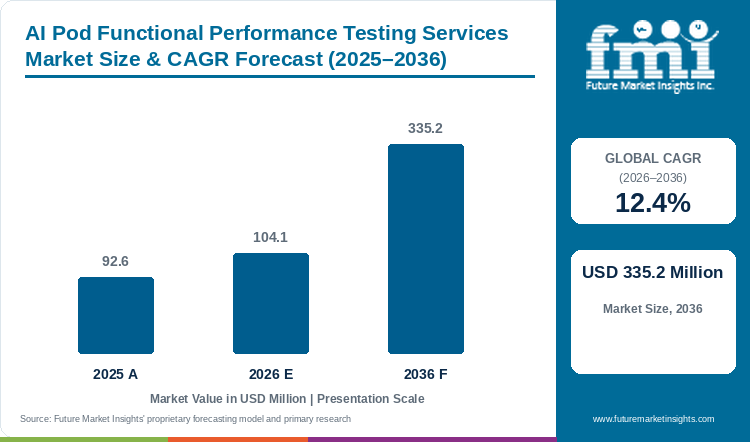
The market was valued at USD 92.6 Million in 2025 and is expected to reach USD 104.1 Million in 2026, with growth at a 12.4% CAGR from 2026 to 2036 taking its value to USD 335.2 Million by 2036.
An assembled AI pod needs to demonstrate how power transfer, coolant response and related controls behave under representative compute demand, including the recovery conditions agreed by the owner. Separate component checks cannot establish every interaction, making a defined configuration and measurable pass criteria necessary before execution. Site prerequisites matter as well: an unavailable feed or unstable cooling supply can prevent the intended test and lead to disagreement about the pod, plant or procedure. Records need to retain load conditions and changes made during testing so operations teams inherit more than a completion certificate. Phased deployment may support an interim result without demonstrating the final arrangement, while Japan’s coordination of power and telecommunications planning illustrates how wider site conditions shape timing. The forecast includes qualifying verification and testing services and excludes equipment sales and general construction outside the contracted performance scope. [5]
Key Market Trends & Insights
- Commissioning & acceptance holds 27.0% of service scope in 2026, requiring representative tests of temperature control, flow, electrical transfer and related alarms.
- New AI hall build holds 36.0% of project stage in 2026, allowing the pod test boundary to be planned alongside shared facility systems before handover.
- 251–500 kW holds 32.0% of AI rack density in 2026, requiring evidence of safe transitions and recovery when concentrated rack demand changes.
- Hyperscale AI data centers account for 46.0% of data center type in 2026, supporting repeated methods while each pod retains a configuration-specific acceptance record.
Regional Highlights
- Saudi Arabia has the highest profiled CAGR at 14.0% during 2026–2036.
- The next two profiled growth rates are France at 13.7% and South Korea at 13.4% over the same period.
Market Size & Forecast
| Metric | Value |
|---|---|
| 2025 market value | USD 92.6 Million |
| 2026 market estimate | USD 104.1 Million |
| 2036 market forecast | USD 335.2 Million |
| Forecast CAGR, 2026–2036 | 12.4% |
The market covers design verification, commissioning, functional performance testing and ongoing validation of AI-pod power, cooling and related controls. Equipment sales and general construction services outside the contracted performance-testing scope are excluded.
Pod performance testing must represent the interaction with data-center power, especially when AI load transitions stress shared infrastructure.
Infrastructure readiness and acceptance
| Documented operating context | Source |
|---|---|
| Jacobs released an AI data-center digital-twin solution in March 2026 covering compute, power and cooling interactions. | [1] |
| Schneider Electric introduced prefabricated pod and rack solutions for high-density AI applications in June 2025. | [2] |
| Vertiv launched a liquid-cooling services portfolio in February 2025 covering deployment and ongoing system support. | [3] |
| Siemens and partners described a reference architecture for NVIDIA AI data centers in June 2026. | [4] |
Analyst Perspective
An integrated pod test needs representative conditions, measurable criteria and a controlled configuration that remains identifiable after the work. Recording changes and outstanding restrictions lets the operator understand what acceptance established and gives later modifications a usable baseline, with prerequisites agreed before the test team mobilizes.
- Nikhil Kaitwade, Principal Analyst at Future Market Insights
How is the AI pod functional performance testing services market segmented?
Service Scope covers Commissioning & acceptance, Design & engineering, Performance validation, Retrofit & migration and Managed support. Project Stage covers New AI hall build, Rack/pod deployment, Capacity expansion, Legacy conversion and Ongoing operations. AI Rack Density covers 251–500 kW, 100–250 kW, Below 100 kW and Above 500 kW. Data Center Type covers Hyperscale AI data centers, Colocation AI facilities, Enterprise private AI and HPC & research centers. Commercial Model covers Direct enterprise contract, System integrator / EPC-led, Subscription / license and Managed-service contract.
The acceptance record should feed data-center infrastructure management so that operators inherit the configuration used for the passing performance test.
Why does Commissioning & acceptance lead service scope demand?
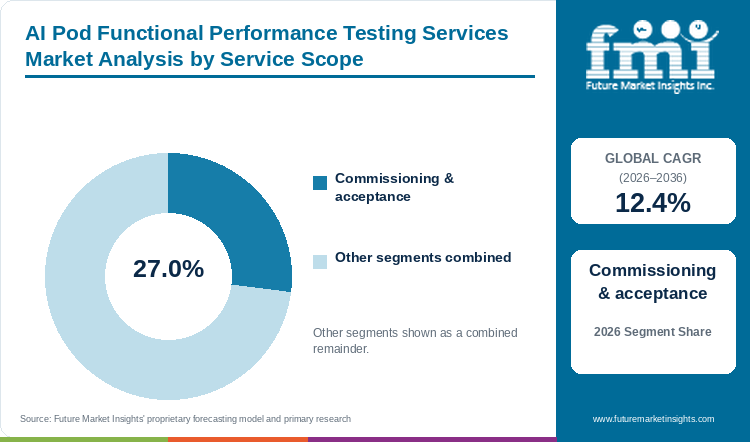
Commissioning & acceptance: 27.0% of service scope in 2026.
Acceptance turns a test program into a readiness decision by demonstrating integrated behavior against criteria agreed before execution. Temperature control and electrical transfer involve several subsystems, so earlier design work and individual approvals need to lead into a witnessed test of the assembled pod. The handover should state which configuration passed and what limitations remain, allowing the owner to distinguish a successful demonstration from performance obligations still requiring corrective work or later tests.
- The Commissioning & acceptance segment accounts for 27.0% of service scope in 2026.
- The acceptance record should state which operating conditions were demonstrated and which remain subject to later tests or corrective work.
Why does New AI hall build lead project stage demand?
New AI hall build: 36.0% of project stage in 2026.
Planning a new hall allows pod load profiles, temporary test sources and witness points to be coordinated with common cooling and electrical systems. Phased construction can still leave an interim utility arrangement that differs from the final installation, making readiness of coolant distribution and protective controls part of the same test plan. Explicitly identifying those conditions helps the owner interpret the pod result and avoids using the performance window to investigate unfinished supporting work.
- The New AI hall build segment accounts for 36.0% of project stage in 2026.
- Early agreement on load sources and witness points reduces the risk that a scheduled pod test becomes an investigation of unfinished facility work.
What are the drivers, restraints, and opportunities in the AI pod functional performance testing services market?
Integrated acceptance requires representative workloads
An interface failure discovered after production accelerators enter service can be disruptive to investigate. Owners therefore have a reason to test the pod as an operating unit before accepting it. The assignment needs to examine control response and load transitions rather than stop at visual inspection. A provider can then identify interactions that separate supplier checks would miss. The resulting record should be usable by the facilities team after turnover. This is what distinguishes a functional performance engagement from a generic visit confirming that equipment has been installed.
Synthetic tests can miss coupled operating failures
A pod may be delivered while energization permission, stable cooling or the planned load source remains unavailable, forcing reduced coverage or another visit. Once execution begins, configuration changes need control so results remain comparable and a failure can be assigned to the pod or supporting plant. A clear baseline and record of exceptions keep retesting directed toward an agreed acceptance decision.
Repeatable performance protocols support deployment sign-off
Digital models can expose likely interface problems before physical testing. They should be used to prepare the witnessed procedure rather than replace it. Providers can connect model assumptions with factory records and then check them against site measurements. For repeated pod deployments this creates a reusable test structure with a separate record for each installation. A design change can then be assessed for targeted retesting instead of automatically repeating every step. The customer benefits when the provider can explain why the selected checks are sufficient for the changed configuration.
Functional testing is a defined part of AI infrastructure commissioning, with particular emphasis on whether the assembled pod achieves its intended operating result.
Which country and market CAGRs are profiled for AI pod functional performance testing services?
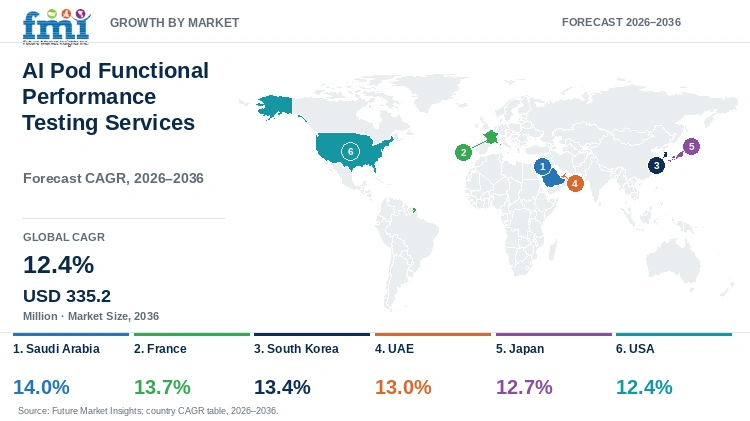
| Country | CAGR |
|---|---|
| Saudi Arabia | 14.0% |
| France | 13.7% |
| South Korea | 13.4% |
| UAE | 13.0% |
| Japan | 12.7% |
| USA | 12.4% |
Country-wise Analysis
Saudi Arabia
- Saudi Arabian heat-rejection checks need to represent summer conditions and the selected water-management approach once electrical and thermal packages are defined. The country has the fastest profiled forecast, at a 14.0% CAGR from 2026 to 2036, with test ownership needing agreement across utility, construction and compute teams. Load transitions can then demonstrate the assembled pod under local conditions rather than repeat separate component checks.
France
- Grid-connection schedules in France need to align with cooling readiness before integrated pod tests can proceed. Agreeing prerequisites and witness points protects the test window within a market forecast to grow at a 13.7% CAGR from 2026 to 2036. The resulting record must distinguish representative work completed on site from checks deferred until common plant becomes available, since factory approval alone does not establish installed performance.
South Korea
- Multi-vendor South Korean procurement requires compute installation to be coordinated with power conditioning and liquid cooling before each acceptance window. Repeatable reports can support comparison across phases while retaining environmental conditions and revisions, which may change behavior after an earlier pod enters service. South Korea is forecast to grow at a 13.4% CAGR from 2026 to 2036 within this contracted test scope.
UAE
- Large UAE campuses can be released in stages, with each test boundary matching the equipment and utilities available at that point. The 13.0% CAGR forecast for 2026 to 2036 accompanies a need to represent local ambient conditions and record temporary arrangements before applying an interim result to a final design. Clear ownership and exception closeout also help several development partners complete the handover.
Japan
- Design review can prepare Japanese test sequences while utility and cooling conditions develop, with existing buildings sometimes imposing tighter access or plant-room limits than a new hall. Japan’s 12.7% CAGR forecast for 2026 to 2036 includes assignments needing witness plans for normal behavior and recovery together. Preserved interactions and outstanding conditions then provide maintenance teams with a baseline before routine service begins.
USA
- American repeat deployments can reuse procedures while retaining separate criteria for electrical transfer and coolant conditions at each site. The market is forecast to grow at a 12.4% CAGR from 2026 to 2036, with contracts sometimes preceding utility readiness and requiring exception records across visits. Safely introduced abnormal conditions and verified recovery establish integrated performance beyond subsystem checks alone.
Who are the notable companies in the AI pod functional performance testing services market?
Vertiv; Siemens; Jacobs; Schneider Electric; Eaton
Pod-testing providers need to reproduce the operating conditions that matter to the owner. The equipment may pass individual checks yet fail when load changes affect several systems together. Buyers should examine how the provider defines those scenarios and traces a failed result back to the relevant interface.
Competitive Benchmarking: AI Pod Functional Performance Testing Services Market
| Participant | Commercial focus | Buyer qualification priority |
|---|---|---|
| Vertiv | Power, cooling and infrastructure services | Integrated commissioning and service access |
| Siemens | Electrical and building-system integration | Protection logic and controls handover |
| Jacobs | Engineering and facility integration | Cross-system acceptance and owner requirements |
| Schneider Electric | Power, cooling and prefabricated infrastructure | Interface definition and system-level testing |
| Eaton | Power infrastructure and services | Protection coordination and recovery behavior |
Key Developments in the AI Pod Functional Performance Testing Services Market
- Jacobs released an AI data-center digital-twin solution in March 2026 covering compute, power and cooling interactions. [1]
- Schneider Electric introduced prefabricated pod and rack solutions for high-density AI applications in June 2025. [2]
Key Players in the AI Pod Functional Performance Testing Services Market
- Vertiv
- Siemens
- Jacobs
- Schneider Electric
- Eaton
AI Pod Functional Performance Testing Services Market - Report Scope
| Coverage field | Report scope |
|---|---|
| Market breakdown | Service Scope; Project Stage; AI Rack Density; Data Center Type; Commercial Model; Region |
| Quantitative unit | USD Million |
| Market definition | The market covers design verification, commissioning, functional performance testing and ongoing validation of AI-pod power, cooling and related controls. Equipment sales and general construction services outside the contracted performance-testing scope are excluded. |
| Regions covered | North America; Latin America; Western Europe; Eastern Europe; East Asia; South Asia and Pacific; Middle East and Africa |
| Countries / markets profiled | Saudi Arabia; France; South Korea; UAE; Japan; USA |
| Key companies profiled | Vertiv; Siemens; Jacobs; Schneider Electric; Eaton |
| Base year / forecast period | 2026 / 2026–2036 |
| Estimate coverage | 2025 and 2026 market estimates; 2036 forecast; segment shares and country / market CAGRs. |
AI Pod Functional Performance Testing Services Market - Research Methodology
| Method | Application |
|---|---|
| Market definition | The analysis follows the stated product or service boundary and distinguishes direct category revenue from adjacent activities. |
| Secondary research | Official technical, regulatory, research and company publications provide the documented operating context and recent developments cited in this report. |
| Forecast and segmentation | Market estimates, segment shares and geographic forecasts are presented as analytical estimates within the stated commercial scope. |
| Competitive assessment | Participants are compared by their relevant products or services, commercial role and buyer qualification requirements. |
| Interpretation | The assessment considers purchasing conditions and the scope of the documented product, service or performance claim. |
AI Pod Functional Performance Testing Services Market by Segments
Service Scope
- Commissioning & acceptance
- Design & engineering
- Performance validation
- Retrofit & migration
- Managed support
Project Stage
- New AI hall build
- Rack/pod deployment
- Capacity expansion
- Legacy conversion
- Ongoing operations
AI Rack Density
- 251–500 kW
- 100–250 kW
- Below 100 kW
- Above 500 kW
Data Center Type
- Hyperscale AI data centers
- Colocation AI facilities
- Enterprise private AI
- HPC & research centers
Commercial Model
- Direct enterprise contract
- System integrator / EPC-led
- Subscription / license
- Managed-service contract
AI Pod Functional Performance Testing Services Market by Region
- North America
- United States
- Canada
- Latin America
- Brazil
- Mexico
- Argentina
- Chile
- Western Europe
- Germany
- France
- United Kingdom
- Italy
- Spain
- Benelux
- Nordics
- Eastern Europe
- Poland
- Czech Republic
- Romania
- Hungary
- East Asia
- China
- Japan
- South Korea
- South Asia and Pacific
- India
- ASEAN
- Australia and New Zealand
- Middle East and Africa
- GCC Countries
- South Africa
- Türkiye
- Israel
Research Sources and Bibliography
- [1] Jacobs. (2026, March 16). Jacobs releases digital twin solution for AI data centers.
- [2] Schneider Electric. (2025, June 11). Schneider Electric Launches New Data Center Solutions to Meet Challenges of High-Density AI and Accelerated Compute Applications.
- [3] Vertiv. (2025, February 11). Vertiv announces global launch of liquid cooling services portfolio.
- [4] Siemens. (2026, June 1). Siemens and Partners Develop Reference Architecture Purpose-Built for NVIDIA AI Data Centers.
- [5] Future Market Insights. (2026). AI Pod Functional Performance Testing Services Market: Global industry analysis and opportunity assessment, 2026–2036.
This Report Answers
- How large is the AI pod functional performance testing services market in 2026?
- What value and CAGR are forecast through 2036?
- Which service scope segment leads in 2026?
- Which project stage segment has the largest share?
- Which profiled country or market has the fastest forecast growth?
- Which participants are covered in the competitive assessment?
Frequently Asked Questions
How large is the AI pod functional performance testing services market in 2026?
The market was valued at USD 92.6 Million in 2025 and is expected to reach USD 104.1 Million in 2026.
What value and CAGR are forecast through 2036?
The market is projected to reach USD 335.2 Million by 2036, with a 12.4% CAGR during 2026–2036.
Which service scope segment leads in 2026?
The Commissioning & acceptance segment accounts for 27.0% of service scope in 2026.
Which project stage segment has the largest share?
The New AI hall build segment accounts for 36.0% of project stage in 2026.
Which profiled country or market has the fastest forecast growth?
Saudi Arabia has the highest profiled CAGR at 14.0% during 2026–2036.
Which participants are covered in the competitive assessment?
The assessment covers Vertiv, Siemens, Jacobs, Schneider Electric and Eaton.
Preview the report firsthand - request a free sample
Get SampleGet the brochure for pricing and purchase details.
Get PDFTable of Content
- Key Takeaways
- Market Size and CAGR
- Top Growth Driver
- Fastest Growing Segment
- Leading Region
- Key Companies
- Emerging Opportunities
- Executive Summary
- Global Market Outlook
- Demand-side Trends
- Supply-side Trends
- Technology Roadmap Analysis
- Analysis and Recommendations
- Analyst Perspective (What is happening? Why now? What should investors know?)
- Key Questions Answered
- How large is the market?
- What is the CAGR?
- What are key trends?
- Which region dominates?
- Who are the leaders?
- Market Overview
- Market Coverage / Taxonomy
- Market Definition / Scope / Limitations
- Research Methodology
- Chapter Orientation
- Analytical Lens and Working Hypotheses
- Market Structure, Signals, and Trend Drivers
- Benchmarking and Cross-market Comparability
- Market Sizing, Forecasting, and Opportunity Mapping
- Research Design and Evidence Framework
- Desk Research Programme (Secondary Evidence)
- Expert Input and Fieldwork (Primary Evidence)
- Tooling, Models, and Reference Databases
- Data Engineering and Model Build
- Quality Assurance and Audit Trail
- Market Background
- Market Dynamics (Drivers, Restraints, Opportunity, Trends)
- Scenario Forecast (Optimistic, Likely, Conservative)
- Impact Analysis
- AI Impact
- Sustainability Impact
- Regulatory Impact
- Technology Impact
- Consumer / Buyer Analysis
- Purchase Drivers
- Adoption Barriers
- Buyer Journey
- Opportunity Map Analysis
- Product Life Cycle Analysis
- Supply Chain Analysis
- Investment Feasibility Matrix
- Value Chain Analysis
- PESTLE and Porter's Analysis
- Regulatory Landscape
- Regional Parent Market Outlook
- Production and Consumption Statistics
- Import and Export Statistics
- Global Market Analysis and Forecast, 2021 to 2036
- Historical Market Size Value (USD Million) Analysis, 2021 to 2025
- Current and Future Market Size Value (USD Million) Projections, 2026 to 2036
- Y-o-Y Growth Trend Analysis
- Absolute $ Opportunity Analysis
- Global Market Pricing Analysis, 2021 to 2036
- Global Market Analysis and Forecast, By Service Scope, 2021 to 2036
- Introduction / Key Findings
- Historical Market Size Value (USD Million) Analysis By Service Scope, 2021 to 2025
- Current and Future Market Size Value (USD Million) Analysis and Forecast By Service Scope, 2026 to 2036
- Commissioning & acceptance
- Design & engineering
- Performance validation
- Retrofit & migration
- Managed support
- Y-o-Y Growth Trend Analysis By Service Scope, 2021 to 2025
- Absolute $ Opportunity Analysis By Service Scope, 2026 to 2036
- Global Market Analysis and Forecast, By Project Stage, 2021 to 2036
- Introduction / Key Findings
- Historical Market Size Value (USD Million) Analysis By Project Stage, 2021 to 2025
- Current and Future Market Size Value (USD Million) Analysis and Forecast By Project Stage, 2026 to 2036
- New AI hall build
- Rack/pod deployment
- Capacity expansion
- Legacy conversion
- Ongoing operations
- Y-o-Y Growth Trend Analysis By Project Stage, 2021 to 2025
- Absolute $ Opportunity Analysis By Project Stage, 2026 to 2036
- Global Market Analysis and Forecast, By AI Rack Density, 2021 to 2036
- Introduction / Key Findings
- Historical Market Size Value (USD Million) Analysis By AI Rack Density, 2021 to 2025
- Current and Future Market Size Value (USD Million) Analysis and Forecast By AI Rack Density, 2026 to 2036
- 251–500 kW
- 100–250 kW
- Below 100 kW
- Above 500 kW
- Y-o-Y Growth Trend Analysis By AI Rack Density, 2021 to 2025
- Absolute $ Opportunity Analysis By AI Rack Density, 2026 to 2036
- Global Market Analysis and Forecast, By Data Center Type, 2021 to 2036
- Introduction / Key Findings
- Historical Market Size Value (USD Million) Analysis By Data Center Type, 2021 to 2025
- Current and Future Market Size Value (USD Million) Analysis and Forecast By Data Center Type, 2026 to 2036
- Hyperscale AI data centers
- Colocation AI facilities
- Enterprise private AI
- HPC & research centers
- Y-o-Y Growth Trend Analysis By Data Center Type, 2021 to 2025
- Absolute $ Opportunity Analysis By Data Center Type, 2026 to 2036
- Global Market Analysis and Forecast, By Commercial Model, 2021 to 2036
- Introduction / Key Findings
- Historical Market Size Value (USD Million) Analysis By Commercial Model, 2021 to 2025
- Current and Future Market Size Value (USD Million) Analysis and Forecast By Commercial Model, 2026 to 2036
- Direct enterprise contract
- System integrator / EPC-led
- Subscription / license
- Managed-service contract
- Y-o-Y Growth Trend Analysis By Commercial Model, 2021 to 2025
- Absolute $ Opportunity Analysis By Commercial Model, 2026 to 2036
- Global Market Analysis and Forecast, By Region, 2021 to 2036
- Introduction
- Historical Market Size Value (USD Million) Analysis By Region, 2021 to 2025
- Current Market Size Value (USD Million) Analysis and Forecast By Region, 2026 to 2036
- North America
- Latin America
- Western Europe
- Eastern Europe
- East Asia
- South Asia and Pacific
- Middle East and Africa
- Market Attractiveness Analysis By Region
- North America Market Analysis and Forecast, By Country, 2021 to 2036
- Historical Market Size Value (USD Million) Trend Analysis By Market Taxonomy, 2021 to 2025
- Market Size Value (USD Million) Forecast By Market Taxonomy, 2026 to 2036
- By Country
- United States
- Canada
- By Service Scope
- By Project Stage
- By AI Rack Density
- By Data Center Type
- By Commercial Model
- By Country
- Market Attractiveness Analysis
- By Country
- By Service Scope
- By Project Stage
- By AI Rack Density
- By Data Center Type
- By Commercial Model
- Key Takeaways
- Latin America Market Analysis and Forecast, By Country
- Historical Market Size Value (USD Million) Trend Analysis By Market Taxonomy, 2021 to 2025
- Market Size Value (USD Million) Forecast By Market Taxonomy, 2026 to 2036
- By Country
- Brazil
- Mexico
- Argentina
- Chile
- By Service Scope
- By Project Stage
- By AI Rack Density
- By Data Center Type
- By Commercial Model
- By Country
- Market Attractiveness Analysis
- By Country
- By Service Scope
- By Project Stage
- By AI Rack Density
- By Data Center Type
- By Commercial Model
- Key Takeaways
- Western Europe Market Analysis and Forecast, By Country
- Historical Market Size Value (USD Million) Trend Analysis By Market Taxonomy, 2021 to 2025
- Market Size Value (USD Million) Forecast By Market Taxonomy, 2026 to 2036
- By Country
- Germany
- France
- United Kingdom
- Italy
- Spain
- Benelux
- Nordics
- By Service Scope
- By Project Stage
- By AI Rack Density
- By Data Center Type
- By Commercial Model
- By Country
- Market Attractiveness Analysis
- By Country
- By Service Scope
- By Project Stage
- By AI Rack Density
- By Data Center Type
- By Commercial Model
- Key Takeaways
- Eastern Europe Market Analysis and Forecast, By Country
- Historical Market Size Value (USD Million) Trend Analysis By Market Taxonomy, 2021 to 2025
- Market Size Value (USD Million) Forecast By Market Taxonomy, 2026 to 2036
- By Country
- Poland
- Czech Republic
- Romania
- Hungary
- By Service Scope
- By Project Stage
- By AI Rack Density
- By Data Center Type
- By Commercial Model
- By Country
- Market Attractiveness Analysis
- By Country
- By Service Scope
- By Project Stage
- By AI Rack Density
- By Data Center Type
- By Commercial Model
- Key Takeaways
- East Asia Market Analysis and Forecast, By Country
- Historical Market Size Value (USD Million) Trend Analysis By Market Taxonomy, 2021 to 2025
- Market Size Value (USD Million) Forecast By Market Taxonomy, 2026 to 2036
- By Country
- China
- Japan
- South Korea
- By Service Scope
- By Project Stage
- By AI Rack Density
- By Data Center Type
- By Commercial Model
- By Country
- Market Attractiveness Analysis
- By Country
- By Service Scope
- By Project Stage
- By AI Rack Density
- By Data Center Type
- By Commercial Model
- Key Takeaways
- South Asia and Pacific Market Analysis and Forecast, By Country
- Historical Market Size Value (USD Million) Trend Analysis By Market Taxonomy, 2021 to 2025
- Market Size Value (USD Million) Forecast By Market Taxonomy, 2026 to 2036
- By Country
- India
- ASEAN
- Australia and New Zealand
- By Service Scope
- By Project Stage
- By AI Rack Density
- By Data Center Type
- By Commercial Model
- By Country
- Market Attractiveness Analysis
- By Country
- By Service Scope
- By Project Stage
- By AI Rack Density
- By Data Center Type
- By Commercial Model
- Key Takeaways
- Middle East and Africa Market Analysis and Forecast, By Country
- Historical Market Size Value (USD Million) Trend Analysis By Market Taxonomy, 2021 to 2025
- Market Size Value (USD Million) Forecast By Market Taxonomy, 2026 to 2036
- By Country
- GCC Countries
- South Africa
- Türkiye
- Israel
- By Service Scope
- By Project Stage
- By AI Rack Density
- By Data Center Type
- By Commercial Model
- By Country
- Market Attractiveness Analysis
- By Country
- By Service Scope
- By Project Stage
- By AI Rack Density
- By Data Center Type
- By Commercial Model
- Key Takeaways
- Key Countries Market Analysis
- United States
- Pricing Analysis
- Market Share Analysis, 2025
- By Service Scope
- By Project Stage
- By AI Rack Density
- By Data Center Type
- By Commercial Model
- Canada
- Pricing Analysis
- Market Share Analysis, 2025
- By Service Scope
- By Project Stage
- By AI Rack Density
- By Data Center Type
- By Commercial Model
- Mexico
- Pricing Analysis
- Market Share Analysis, 2025
- By Service Scope
- By Project Stage
- By AI Rack Density
- By Data Center Type
- By Commercial Model
- Brazil
- Pricing Analysis
- Market Share Analysis, 2025
- By Service Scope
- By Project Stage
- By AI Rack Density
- By Data Center Type
- By Commercial Model
- Chile
- Pricing Analysis
- Market Share Analysis, 2025
- By Service Scope
- By Project Stage
- By AI Rack Density
- By Data Center Type
- By Commercial Model
- Germany
- Pricing Analysis
- Market Share Analysis, 2025
- By Service Scope
- By Project Stage
- By AI Rack Density
- By Data Center Type
- By Commercial Model
- United Kingdom
- Pricing Analysis
- Market Share Analysis, 2025
- By Service Scope
- By Project Stage
- By AI Rack Density
- By Data Center Type
- By Commercial Model
- Italy
- Pricing Analysis
- Market Share Analysis, 2025
- By Service Scope
- By Project Stage
- By AI Rack Density
- By Data Center Type
- By Commercial Model
- Spain
- Pricing Analysis
- Market Share Analysis, 2025
- By Service Scope
- By Project Stage
- By AI Rack Density
- By Data Center Type
- By Commercial Model
- France
- Pricing Analysis
- Market Share Analysis, 2025
- By Service Scope
- By Project Stage
- By AI Rack Density
- By Data Center Type
- By Commercial Model
- India
- Pricing Analysis
- Market Share Analysis, 2025
- By Service Scope
- By Project Stage
- By AI Rack Density
- By Data Center Type
- By Commercial Model
- ASEAN
- Pricing Analysis
- Market Share Analysis, 2025
- By Service Scope
- By Project Stage
- By AI Rack Density
- By Data Center Type
- By Commercial Model
- Australia and New Zealand
- Pricing Analysis
- Market Share Analysis, 2025
- By Service Scope
- By Project Stage
- By AI Rack Density
- By Data Center Type
- By Commercial Model
- China
- Pricing Analysis
- Market Share Analysis, 2025
- By Service Scope
- By Project Stage
- By AI Rack Density
- By Data Center Type
- By Commercial Model
- Japan
- Pricing Analysis
- Market Share Analysis, 2025
- By Service Scope
- By Project Stage
- By AI Rack Density
- By Data Center Type
- By Commercial Model
- South Korea
- Pricing Analysis
- Market Share Analysis, 2025
- By Service Scope
- By Project Stage
- By AI Rack Density
- By Data Center Type
- By Commercial Model
- Poland
- Pricing Analysis
- Market Share Analysis, 2025
- By Service Scope
- By Project Stage
- By AI Rack Density
- By Data Center Type
- By Commercial Model
- Hungary
- Pricing Analysis
- Market Share Analysis, 2025
- By Service Scope
- By Project Stage
- By AI Rack Density
- By Data Center Type
- By Commercial Model
- Türkiye
- Pricing Analysis
- Market Share Analysis, 2025
- By Service Scope
- By Project Stage
- By AI Rack Density
- By Data Center Type
- By Commercial Model
- South Africa
- Pricing Analysis
- Market Share Analysis, 2025
- By Service Scope
- By Project Stage
- By AI Rack Density
- By Data Center Type
- By Commercial Model
- Saudi Arabia
- Pricing Analysis
- Market Share Analysis, 2025
- By Service Scope
- By Project Stage
- By AI Rack Density
- By Data Center Type
- By Commercial Model
- UAE
- Pricing Analysis
- Market Share Analysis, 2025
- By Service Scope
- By Project Stage
- By AI Rack Density
- By Data Center Type
- By Commercial Model
- United States
- Market Structure Analysis
- Competition Dashboard
- Competition Benchmarking
- Market Share Analysis of Top Players
- By Regional
- By Service Scope
- By Project Stage
- By AI Rack Density
- By Data Center Type
- By Commercial Model
- Emerging Startups
- Innovation Benchmarking
- Competition Analysis
- Competition Deep Dive
- Vertiv
- Overview
- Product Portfolio
- Profitability by Market Segments
- Sales Footprint
- Strategy Overview
- Marketing Strategy
- Product Strategy
- Channel Strategy
- Siemens
- Jacobs
- Schneider Electric
- Eaton
- Vertiv
- Case Studies
- Success Stories
- Recent Developments
- Competition Deep Dive
- Assumptions & Acronyms Used


