

- Market Size (2026)
- USD 135.4 Mn
- Forecast (2036)
- USD 338.6 Mn
- CAGR (2026 to 2036)
- 9.6%
How Big is the AI Rack Factory Acceptance Testing Services Market in 2026?
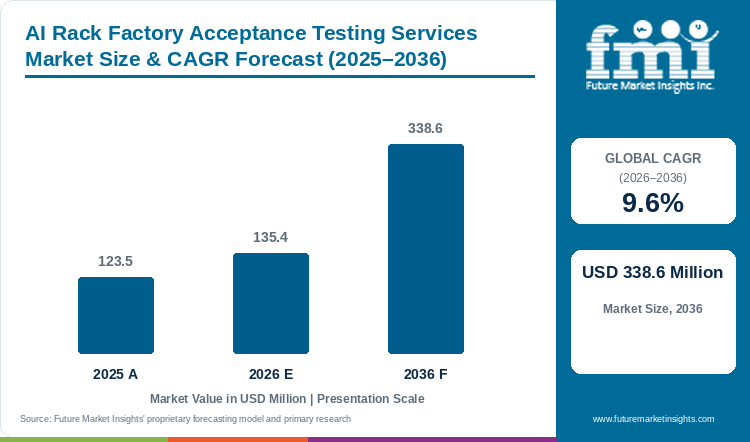
The AI rack factory acceptance testing services market size stands at USD 135.4 Million in 2026, up from USD 123.5 Million in 2025, and is projected to reach USD 338.6 Million by 2036 at 9.6% CAGR.
The AI rack factory acceptance testing services market size stands at USD 135.4 Million in 2026, up from USD 123.5 Million in 2025. Value is projected to reach USD 338.6 Million by 2036 at 9.6% CAGR, and the market size chart marks USD 203.2 Million of added value. Key drivers of the AI rack factory acceptance testing services market include direct liquid cooling, as Uptime Institute wrote in January 2026 that factory witness testing of coolant distribution units is essential [1]. Adoption is highest in new AI hall builds, at 36% of demand by project stage in 2026, as greenfield owners set test criteria early.
Commissioning & acceptance will take 27% of demand by service scope in 2026, according to FMI. Factory testing is close in size to the AI infrastructure functional commissioning services market, rising from USD 134.2 Million in 2026 to USD 354.5 Million by 2036, as owners split acceptance between factory and site. Vertiv said in July 2026 that a new Tognana laboratory, due in early 2027, will test liquid cooling under high-density loads [2]. Key trends in the AI rack factory acceptance testing services market point to scarce test slots until 2027, favouring providers near integration factories.
Key Takeaways
- Key players operating in the AI rack factory acceptance testing services market include Vertiv, Schneider Electric, Siemens and Jacobs.
- Commissioning & acceptance is projected to be the highest-demand service scope, owing to owner sign-off before racks leave the factory. In 2026, the segment will hold 27% of market share.
- Hyperscale AI data centers are estimated to account for 46% of demand by data center type in 2026, as one approved test script serves many identical halls.
- Demand for AI rack factory acceptance testing services is projected to grow fastest in Saudi Arabia, owing to state-backed AI programs building new halls from scratch. By country, Saudi Arabia will lead with 11.1% CAGR through 2036, ahead of the UAE at 10.8%.
Analyst Perspective
“Owners that book factory test slots at the design stage will bring AI halls online sooner, as high-density test bays stay scarce until new labs such as Vertiv's Tognana facility open in 2027. Direct enterprise contracts, at 42% of demand in 2026, show that owners want to control acceptance themselves, and independent providers in Saudi Arabia and the UAE, growing at 11.1% and 10.8% CAGR through 2036, are set to build the strongest order books.”
- Nikhil Kaitwade, Principal Consultant, Future Market Insights
How is the AI Rack Factory Acceptance Testing Services Market Segmented?
The AI rack factory acceptance testing services market is divided into service scope, project stage, AI rack density, data center type, commercial model and region.
As per FMI, the market is divided by service scope into commissioning & acceptance, design & engineering, performance validation, retrofit & migration, and managed support. Project stage is tracked across new AI hall build, rack/pod deployment, capacity expansion, legacy conversion, and ongoing operations. By AI rack density, the market is segregated into 251-500 kW, 100-250 kW, below 100 kW, and above 500 kW. Data center types covered in the study include hyperscale AI data centers, colocation AI facilities, enterprise private AI, and HPC & research centers. By commercial model, the market is split into direct enterprise contract, system integrator / EPC-led, subscription / license, and managed-service contract. The regional analysis covers seven regions and more than 30 countries.
Why Does Commissioning & Acceptance Lead the AI Rack Factory Acceptance Testing Services Market by Service Scope?
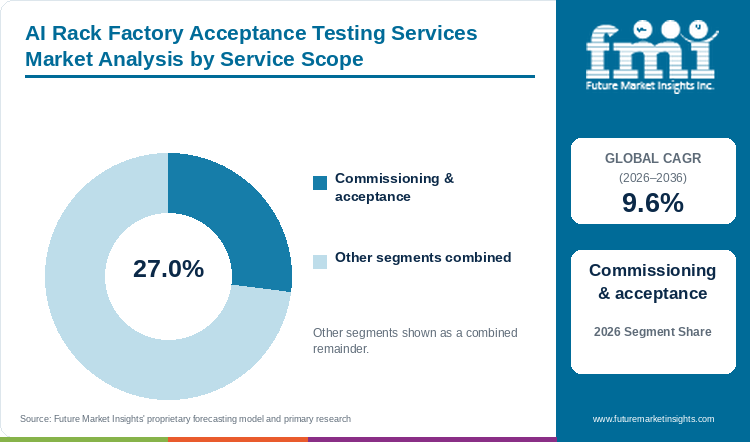
Commissioning & acceptance is set to lead service scope with 27% of market share in 2026.
Commissioning & acceptance holds the biggest slice of service scope spending, at 27% of demand in 2026. Owners treat formal sign-off as the gate before any rack leaves the factory, so this budget is released first in every AI program. Design & engineering, performance validation, retrofit & migration and managed support draw smaller budgets, since owners often accept the rack maker's reference design and order extra services for selected units only.
- In 2026, commissioning & acceptance will capture 27% of demand by service scope. Adoption is driven by owner sign-off before racks leave the factory.
- Vertiv said in July 2026 that customers and consultants can join witness testing of cooling technologies at the Tognana campus under real-world operating conditions [2].
Why Does New AI Hall Build Lead the AI Rack Factory Acceptance Testing Services Market by Project Stage?
New AI hall builds are expected to hold 36% of market share by project stage in 2026.
New AI hall builds represent 36% of demand by project stage in 2026, the highest in the category, because greenfield owners can book factory testing in the same contract as the racks. Spending on rack/pod deployment, capacity expansion, legacy conversion and ongoing operations is expected to rise at a gentler pace, with existing halls pushing more checks to the site and operators ordering tests mostly after faults or upgrades.
- New AI hall build is set to take 36% of demand by project stage in 2026, owing to test criteria written into greenfield contracts.
- In September 2025, Schneider Electric announced AI reference designs with integrated power management and liquid-cooling controls for NVIDIA GB300 NVL72 systems, sized for up to 1,152 GPUs in a single data hall [3].
Why Do 251-500 kW Racks Lead the AI Rack Factory Acceptance Testing Services Market by AI Rack Density?
251-500 kW racks will represent 32% of market share by AI rack density in 2026.
The 251-500 kW band is set to generate the most testing revenue by AI rack density, with 32% of demand in 2026. Current GPU programs place the bulk of new rack orders in this band. A single site defect at this power level can idle a full pod, so owners accept longer factory test plans. Racks of 100-250 kW and below 100 kW see limited growth in testing budgets as buyers already trust these designs, and orders above 500 kW remain confined to early programs.
- With 32% of demand by AI rack density in 2026, 251-500 kW racks will lead the category. Demand is driven by current GPU programs placing most new rack orders in this band.
- According to the Open Compute Project in October 2025, the Diablo power-sidecar specification supports high-density AI racks from 100 kW up to 1 MW [4].
Why Do Hyperscale AI Data Centers Lead the AI Rack Factory Acceptance Testing Services Market by Data Center Type?
Hyperscale AI data centers are estimated to capture 46% of market share by data center type in 2026.
With 46% of demand in 2026, hyperscale AI data centers are the largest buyer group by data center type. Program-scale purchasing gives hyperscale operators this position, as one approved test script covers many identical racks and pods across several sites. Colocation AI facilities, enterprise private AI and HPC & research centers will add demand at a lower rate, owing to suite-by-suite tenant designs, smaller enterprise orders and grant-funded research cycles.
- Hyperscale AI data centers are estimated to hold 46% of demand by data center type in 2026, due to repeated rack designs across large deployments.
- A Tier III-capable reference architecture for 100 MW hyperscale AI data centers using NVIDIA GB200 NVL72 systems was announced by Siemens and nVent in December 2025 [5].
Why Does Direct Enterprise Contract Lead the AI Rack Factory Acceptance Testing Services Market by Commercial Model?
Direct enterprise contracts will make up 42% of market share by commercial model in 2026.
Owner-signed direct enterprise contracts are expected to remain the preferred commercial model, accounting for 42% of demand in 2026, as owners want a direct say over witness points, defect thresholds and retest duties. Growth for system integrator / EPC-led, subscription / license and managed-service models will stay moderate, since EPC routes fit single-contractor projects, licenses cover test software alone and managed contracts begin after deployment.
- Direct enterprise contracts will account for 42% of demand by commercial model in 2026. Adoption of this model is driven by owners keeping control of acceptance criteria and defect closure.
- Jacobs released a digital twin in March 2026 that supports virtual commissioning of compute, power, cooling and water systems for gigawatt-scale AI facilities [6].
What are the Drivers, Restraints, and Opportunities in the AI Rack Factory Acceptance Testing Services Market?
Growth of the AI rack factory acceptance testing services market will come from liquid-cooled rack-scale systems raising the cost of post-shipment defects, according to FMI. Adoption of standard test methods is slowed by unsettled coolant interfaces, and digital twins linked to witnessed tests are expected to open new demand for test providers.
- Driver: Growth of AI rack factory acceptance testing services will come from liquid-cooled rack-scale systems, as a power or coolant defect found after shipment can delay compute across a full pod.
- Restraint: Unsettled coolant boundaries slow adoption of standard factory tests, as CDU vendors, rack makers and facility teams share responsibility for the same coolant path.
- Opportunity: Virtual commissioning linked to physical test bays is expected to open new revenue for test providers, as digital twins move more verification ahead of site work.
Rack power keeps adding test conditions before deployment, increasing demand for factory acceptance testing. NVIDIA's DGX GB user guide, updated in March 2026, lists approximate rack power of 120 kW with liquid cooling manifolds serving compute trays [7]. A site rework can idle a full pod, so owners are moving load, coolant flow, leak detection and redundancy checks into factory plans. Adjacent spending points the same way, with the AI datacenter liquid cooling market projected to rise at 16.9% CAGR from USD 3.7 Billion in 2026 to USD 17.8 Billion by 2036 and the direct-to-chip liquid cooling market at 20.5% CAGR through 2035. Test providers with coolant loops sized for such racks are expected to receive a larger share of factory orders through 2036.
Responsibility for the coolant path is split across CDU vendors, rack makers, facility teams and integrators, which slows agreement on factory test plans. Each party approves a different part of the loop, so new programs wait longer for the first witnessed test. In March 2026, Jacobs released a digital twin for gigawatt-scale AI facilities to support virtual commissioning ahead of physical tests [6]. Pre-site services are widening as well, with the data center liquid cooling failure-mode simulation services market projected to grow from USD 523.1 Million in 2026 to USD 1,744.5 Million by 2036 and the liquid cooling loop flushing services market adding one more step before handover. Test bays linked to such models are expected to shorten the path to signed acceptance.
Which Country CAGRs are Profiled in the AI Rack Factory Acceptance Testing Services Market?
| Country | CAGR, 2026 to 2036 |
|---|---|
| Saudi Arabia | 11.1% |
| UAE | 10.8% |
| France | 10.5% |
| South Korea | 10.2% |
| Japan | 9.8% |
| USA | 9.6% |
How do Country-level CAGRs Compare in the AI Rack Factory Acceptance Testing Services Market?
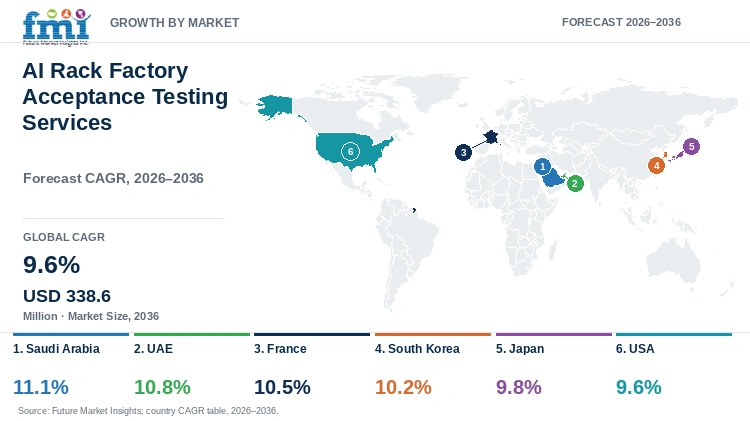
Greenfield AI programs and mature hyperscale bases follow two separate growth paths in FMI's country analysis. Rates on the country CAGR chart run from 11.1% in Saudi Arabia down to 9.6% in the USA through 2036. Saudi Arabia and the UAE are projected to grow fastest, at 11.1% and 10.8% CAGR through 2036, because state-backed campuses set test methods from the first rack. France, at 10.5%, and South Korea, at 10.2%, are expected to form a middle band on new campus investment and public computing centers outside Seoul. Japan will grow at 9.8% during the forecast period, with grid readiness setting the pace of new halls, and the USA is expected to match the global rate of 9.6% on the largest base of repeated rack deployments. The modular data center market is projected to grow from USD 29.3 Billion in 2026 to USD 106.7 Billion by 2036, adding factory-built halls that need testing before shipment.
- Saudi Arabia is projected to post the fastest growth at 11.1% CAGR through 2036. Demand is driven by state-backed AI programs building new halls from scratch.
- Multi-partner AI campuses needing traceable pod-level records will put the UAE second at 10.8% during the forecast period.
- France is expected to grow at 10.5% CAGR by 2036, ahead of South Korea, on large announced AI campus investment.
- National AI computing center construction will support 10.2% CAGR in South Korea through 2036, with new public sites built outside Seoul.
- At 9.8% CAGR through 2036, Japan will grow faster than the USA, with joint power and telecom planning setting the pace of new halls.
- Growth in the USA is projected at 9.6% CAGR during the forecast period, the slowest in the group. Mature operators judge suppliers on test depth and response time across repeated deployments.
Beyond these six profiles, the full report carries CAGR estimates for seven regions and more than 30 countries.
Country Outlook
- The Saudi Press Agency reported the launch of HUMAIN on May 12, 2025, as a PIF-owned company covering next-generation data centers and AI infrastructure [8]. A state program of this size builds halls from scratch, due to which each new site needs a repeatable acceptance method from the first rack. Providers able to run one approved script across a full program are expected to gain the most, as demand for factory testing in Saudi Arabia grows at 11.1% CAGR through 2036.
- The UAE is projected to grow at 10.8% CAGR through 2036, second among the profiled countries. Stargate UAE was announced in May 2025 as a 1 GW compute cluster, with the first 200 MW expected to go live in 2026 [9]. Multi-partner campuses of this kind need standardized pod-level scripts and shared digital records, and test providers offering remote witness access are expected to receive campus-wide contracts.
- Key drivers of demand for AI rack factory acceptance testing services in France include large campus commitments. SoftBank announced a €75 billion plan in June 2026 to build 5 GW of AI data center capacity in France, starting with 3.1 GW in Hauts-de-France [10]. Capacity at this scale needs commissioned halls on schedule, so more acceptance work moves to the factory, and France is projected at 10.5% CAGR during the forecast period. Providers with European test bays are expected to gain from shorter shipping and witness travel.
- Public computing programs are moving AI capacity outside the Seoul metropolitan area. Ground was broken for the National AI Computing Center in Haenam in August 2026, with construction expected to finish by 2028 [11]. Racks for such remote sites need to arrive ready for fast energization, supporting 10.2% CAGR in South Korea through 2036 for providers shipping pre-tested racks with complete records.
- Spending on factory acceptance testing services in Japan is expected to rise at 9.8% CAGR by 2036, with growth tied to grid readiness. METI and the Ministry of Internal Affairs and Communications published the Watt-Bit Collaboration report in June 2025 to coordinate electricity, telecom and data center development [12]. Long power lead times make factory readiness records important before racks reach constrained sites, and providers matching test evidence to energization dates are expected to receive repeat orders.
- Standard reference designs are shaping factory testing in the USA. Schneider Electric said in September 2025 that the company's NVIDIA-aligned reference designs are validated under both ANSI and IEC standards [3]. Repeated rack deployments at mature hyperscale and colocation sites keep a large testing base, and demand in the USA is projected to grow at 9.6% CAGR during the forecast period. Providers with deep test scripts and fast response times are expected to hold the largest US volume.
Who are the Notable Companies in the AI Rack Factory Acceptance Testing Services Market?
Vertiv, Schneider Electric, Siemens and Jacobs are among the leading companies profiled by FMI across power, cooling, controls and project delivery.
A small group of infrastructure suppliers with physical test sites, along with engineering firms on the owner side, handles most factory acceptance work for AI racks. Buyers compare providers on test independence, load and coolant capacity, digital traceability and the reach of field teams. Vertiv is adding a large-scale testing laboratory at the Tognana campus in Italy, due for completion in early 2027 [2]. Schneider Electric released NVIDIA-aligned AI reference designs in September 2025 [3]. Jacobs competes from the project-delivery side with a digital twin released in March 2026 [6]. Owners seldom change providers in the middle of a hall rollout, as approved test procedures become part of each program's method. Firms from the AI rack structural qualification services market are expected to add factory test services, and competition will increase through 2036. FMI identifies scarce high-density test-bay capacity as the main differentiator for recurring factory acceptance orders.
- Integrated AI Infrastructure and Factory Test Services: Vertiv and Schneider Electric combine critical power and cooling portfolios with commissioning, system testing and customer witness facilities.
- Electrical Distribution and Controls Commissioning: Siemens covers electrical distribution, automation, Level I-V commissioning and partner-based liquid cooling designs for AI facilities.
- EPCM and Virtual Commissioning: Jacobs links engineering, off-site modularization and system validation with virtual commissioning through AI data center digital twins.
Competitive Benchmarking
| Company | Factory / Witness Testing | Power-Cooling Integration | Digital / Virtual Commissioning | Geographic Reach |
|---|---|---|---|---|
| Vertiv | High | High | High | Global, with operations in more than 130 countries |
| Schneider Electric | High | High | High | Global data center and AI factory solutions across major regions |
| Siemens | Medium | Medium | Medium | Global, with data center competence in North America, Europe and Asia-Pacific |
| Jacobs | Medium | High | High | Global engineering and project delivery for AI and HPC facilities |
Scoring basis: Factory / Witness Testing rates documented capability to run or support formal acceptance, integrated system tests and witness procedures. Power-Cooling Integration rates the ability to validate electrical and thermal infrastructure as one operating system. Digital / Virtual Commissioning rates documented use of digital twins or model-based validation linked to commissioning. A High rating reflects broad direct capability, a Medium rating reflects a narrower or partner-based range, and a Low rating marks limited public documentation.
Key Developments
- In September 2025, Schneider Electric announced AI reference designs with integrated power management and liquid-cooling controls for NVIDIA GB300 NVL72 systems, supporting densities up to 142 kW per rack [3].
- In December 2025, Siemens and nVent announced a joint liquid-cooling and power reference architecture for 100 MW hyperscale AI data centers using NVIDIA GB200 NVL72 systems [5].
- In March 2026, Jacobs released a digital twin solution for gigawatt-scale AI facilities on the NVIDIA Omniverse DSX blueprint, covering compute, power, cooling and water systems [6].
- In July 2026, Vertiv announced an expansion of the Tognana campus in Italy, including a large-scale laboratory to test chillers and validate liquid cooling integration under high-density loads [2].
Key Players
Integrated AI Infrastructure and Factory Test Services
- Vertiv
- Schneider Electric
Electrical Distribution and Controls Commissioning
- Siemens
EPCM and Virtual Commissioning
- Jacobs
Report Scope and Methodology
| Coverage field | Report scope |
|---|---|
| Market breakdown | 5 categories plus region: Service Scope (Commissioning & acceptance, Design & engineering, Performance validation, Retrofit & migration, Managed support), Project Stage (New AI hall build, Rack/pod deployment, Capacity expansion, Legacy conversion, Ongoing operations), AI Rack Density (251-500 kW, 100-250 kW, Below 100 kW, Above 500 kW), Data Center Type (Hyperscale AI data centers, Colocation AI facilities, Enterprise private AI, HPC & research centers), Commercial Model (Direct enterprise contract, System integrator / EPC-led, Subscription / license, Managed-service contract), and Region |
| Quantitative units | USD Million |
| Market definition | Revenue from paid factory acceptance testing, commissioning and acceptance, design and engineering validation, performance validation, retrofit and migration testing and managed support for AI racks or rack-scale pods before shipment or formal handover. Hardware sales, downstream computing revenue and unrelated site-only construction services are excluded. |
| Regions covered | North America, Latin America, Western Europe, Eastern Europe, East Asia, South Asia and Pacific, Middle East and Africa |
| Countries covered | More than 30 countries, including the USA, Saudi Arabia, the UAE, South Korea, France and Japan |
| Key companies profiled | A few of the notable companies out of many players covered in the study: Vertiv, Schneider Electric, Siemens and Jacobs |
| Forecast period | 2026 to 2036 |
| Approach | A hybrid bottom-up and top-down model built by FMI reconciles service activity, deployment pipelines, demand by project stage and country-level adoption conditions within the defined revenue boundary. |
Research Methodology
| Method | Approach |
|---|---|
| Primary research | Interviews with data center owners and operators, EPC and commissioning specialists, system integrators, infrastructure vendors and technical procurement teams test acceptance criteria, test sequencing, handover terms, purchasing triggers and qualification barriers. |
| Desk research | The analysis reviews government publications, data center energy studies, engineering guidance, public project announcements, company releases and service documentation, retaining sources relevant to AI rack testing and commissioning. |
| Market sizing and forecasting | Estimates reconcile service revenue by scope with project stage, rack density, data center type, commercial model, deployment pipelines and retrofit activity. Forecasts reflect rising rack power, liquid cooling adoption, modular deployment and commissioning intensity. |
| Data validation | Findings are cross-checked across independent evidence types and company sources. Hardware revenue, downstream compute revenue, unrelated construction services and duplicate project value are excluded to keep the stated market boundary. |
AI Rack Factory Acceptance Testing Services Market by Segments
AI Rack Factory Acceptance Testing Services Market Segmented by Service Scope
- Commissioning & acceptance
- Design & engineering
- Performance validation
- Retrofit & migration
- Managed support
AI Rack Factory Acceptance Testing Services Market Segmented by Project Stage
- New AI hall build
- Rack/pod deployment
- Capacity expansion
- Legacy conversion
- Ongoing operations
AI Rack Factory Acceptance Testing Services Market Segmented by AI Rack Density
- 251-500 kW
- 100-250 kW
- Below 100 kW
- Above 500 kW
AI Rack Factory Acceptance Testing Services Market Segmented by Data Center Type
- Hyperscale AI data centers
- Colocation AI facilities
- Enterprise private AI
- HPC & research centers
AI Rack Factory Acceptance Testing Services Market Segmented by Commercial Model
- Direct enterprise contract
- System integrator / EPC-led
- Subscription / license
- Managed-service contract
AI Rack Factory Acceptance Testing Services Market Segmented by Region
- North America
- Latin America
- Western Europe
- Eastern Europe
- East Asia
- South Asia and Pacific
- Middle East and Africa
Research Sources and Bibliography
- [1] Uptime Institute (2026, January 12). Coolant Distribution Units Can Complicate Commissioning.
- [2] Vertiv (2026, July 21). Vertiv Expands Global Manufacturing Capacity for AI-Ready Data Center Cooling Solutions.
- [3] Schneider Electric (2025, September 18). Schneider Electric Announces New Reference Designs Featuring Integrated Power Management and Liquid Cooling Controls.
- [4] Open Compute Project Foundation and ASHRAE (2025, October 13). Open Compute Project Foundation and ASHRAE Form New Alliance.
- [5] Siemens (2025, December 9). Siemens and nVent to Release Joint Reference Architecture Purpose-Built for NVIDIA AI Data Centers.
- [6] Jacobs (2026, March 16). Jacobs Releases Digital Twin Solution for AI Data Centers.
- [7] NVIDIA (2026, March 3). Hardware, NVIDIA DGX GB Rack Scale Systems User Guide.
- [8] Saudi Press Agency (2025, May 12). HRH the Crown Prince Launches HUMAIN as Global AI Powerhouse.
- [9] Abu Dhabi Media Office (2025, May 22). Global Tech Alliance Launches Stargate UAE.
- [10] W.Media (2026, June 1). SoftBank to invest €75 billion in AI Data Center buildouts across France.
- [11] Kyunghyang Shinmun (2026, August 3). Ground broken for the National AI Computing Center in Haenam, some resources to be supplied early next year.
- [12] Ministry of Economy, Trade and Industry, Japan (2025, June 12). Report 1.0 of the Public-Private Advisory Council on Watt-Bit Collaboration Published.
This bibliography is provided for reader reference and is not exhaustive. The full report contains the complete reference list and detailed citations.
This Report Answers
- What revenue will AI rack factory acceptance testing services generate in 2026, and what value will the market reach by 2036?
- Which rack density and liquid cooling pressures will increase spending on pre-shipment testing?
- Why will commissioning & acceptance keep the leading position within the Service Scope category in 2026?
- In what ways will new AI hall builds change the scope of factory testing and owner sign-off?
- Why will 251-500 kW racks, hyperscale AI data centers and direct enterprise contracts anchor demand across the other categories?
- Which growth rates will Saudi Arabia, the UAE, France, South Korea, Japan and the USA post till 2036?
- Which coolant interface and vendor boundary issues will slow standardization of factory witness tests?
- What will technical procurement teams need to check before contracting a factory acceptance testing provider?
Frequently Asked Questions
How Big Is the AI Rack Factory Acceptance Testing Services Market Expected to Be in 2026?
Demand for AI rack factory acceptance testing services will reach USD 135.4 Million in 2026, up from USD 123.5 Million in 2025, according to FMI. Revenue will rise to USD 338.6 Million by 2036 as liquid-cooled racks need more witnessed testing before shipment.
What Is the CAGR of the AI Rack Factory Acceptance Testing Services Market from 2026 to 2036?
The market will grow at a 9.6% CAGR from 2026 to 2036. Higher rack power, direct liquid cooling and repeated hall templates will add testing hours to each AI program.
Which Service Scope Holds the Largest Share of the AI Rack Factory Acceptance Testing Services Market?
Commissioning & acceptance will lead with 27% of market share by service scope in 2026. Formal owner sign-off before shipment or site handover will support the position.
Which Data Center Type Leads the AI Rack Factory Acceptance Testing Services Market?
Hyperscale AI data centers will account for 46% of market share by data center type in 2026. Repeated rack architectures across large programs will make one approved test method valuable at many sites.
Which Country Is Expected to Grow Fastest in the AI Rack Factory Acceptance Testing Services Market?
Saudi Arabia will grow fastest at an 11.1% CAGR till 2036, followed by the UAE at 10.8% and France at 10.5%. The USA will post the slowest rate of the six profiled countries at 9.6%.
What Notable Restraint Affects the AI Rack Factory Acceptance Testing Services Market?
Key challenges will come from reproducing liquid cooling and power interfaces under representative factory conditions. Responsibility will be split across rack makers, CDU suppliers and facility teams, adding coordination effort to every test plan.
Which Are the Key Companies in the AI Rack Factory Acceptance Testing Services Market?
Vertiv, Schneider Electric, Siemens and Jacobs rank among the leading companies covered by FMI. The report places the four companies in three supplier groups.
Preview the report firsthand - request a free sample
Get SampleGet the brochure for pricing and purchase details.
Get PDFTable of Content
- Key Takeaways
- Market Size and CAGR
- Top Growth Driver
- Fastest Growing Segment
- Leading Region
- Key Companies
- Emerging Opportunities
- Executive Summary
- Global Market Outlook
- Demand-side Trends
- Supply-side Trends
- Technology Roadmap Analysis
- Analysis and Recommendations
- Analyst Perspective (What is happening? Why now? What should investors know?)
- Key Questions Answered
- How large is the market?
- What is the CAGR?
- What are key trends?
- Which region dominates?
- Who are the leaders?
- Market Overview
- Market Coverage / Taxonomy
- Market Definition / Scope / Limitations
- Research Methodology
- Chapter Orientation
- Analytical Lens and Working Hypotheses
- Market Structure, Signals, and Trend Drivers
- Benchmarking and Cross-market Comparability
- Market Sizing, Forecasting, and Opportunity Mapping
- Research Design and Evidence Framework
- Desk Research Programme (Secondary Evidence)
- Expert Input and Fieldwork (Primary Evidence)
- Tooling, Models, and Reference Databases
- Data Engineering and Model Build
- Quality Assurance and Audit Trail
- Market Background
- Market Dynamics (Drivers, Restraints, Opportunity, Trends)
- Scenario Forecast (Optimistic, Likely, Conservative)
- Impact Analysis
- AI Impact
- Sustainability Impact
- Regulatory Impact
- Technology Impact
- Consumer / Buyer Analysis
- Purchase Drivers
- Adoption Barriers
- Buyer Journey
- Opportunity Map Analysis
- Product Life Cycle Analysis
- Supply Chain Analysis
- Investment Feasibility Matrix
- Value Chain Analysis
- PESTLE and Porter's Analysis
- Regulatory Landscape
- Regional Parent Market Outlook
- Production and Consumption Statistics
- Import and Export Statistics
- Global Market Analysis and Forecast, 2021 to 2036
- Historical Market Size Value (USD Million) Analysis, 2021 to 2025
- Current and Future Market Size Value (USD Million) Projections, 2026 to 2036
- Y-o-Y Growth Trend Analysis
- Absolute $ Opportunity Analysis
- Global Market Pricing Analysis, 2021 to 2036
- Global Market Analysis and Forecast, By Service Scope, 2021 to 2036
- Introduction / Key Findings
- Historical Market Size Value (USD Million) Analysis By Service Scope, 2021 to 2025
- Current and Future Market Size Value (USD Million) Analysis and Forecast By Service Scope, 2026 to 2036
- Commissioning & acceptance
- Design & engineering
- Performance validation
- Retrofit & migration
- Managed support
- Y-o-Y Growth Trend Analysis By Service Scope, 2021 to 2025
- Absolute $ Opportunity Analysis By Service Scope, 2026 to 2036
- Global Market Analysis and Forecast, By Project Stage, 2021 to 2036
- Introduction / Key Findings
- Historical Market Size Value (USD Million) Analysis By Project Stage, 2021 to 2025
- Current and Future Market Size Value (USD Million) Analysis and Forecast By Project Stage, 2026 to 2036
- New AI hall build
- Rack/pod deployment
- Capacity expansion
- Legacy conversion
- Ongoing operations
- Y-o-Y Growth Trend Analysis By Project Stage, 2021 to 2025
- Absolute $ Opportunity Analysis By Project Stage, 2026 to 2036
- Global Market Analysis and Forecast, By AI Rack Density, 2021 to 2036
- Introduction / Key Findings
- Historical Market Size Value (USD Million) Analysis By AI Rack Density, 2021 to 2025
- Current and Future Market Size Value (USD Million) Analysis and Forecast By AI Rack Density, 2026 to 2036
- 251-500 kW
- 100-250 kW
- Below 100 kW
- Above 500 kW
- Y-o-Y Growth Trend Analysis By AI Rack Density, 2021 to 2025
- Absolute $ Opportunity Analysis By AI Rack Density, 2026 to 2036
- Global Market Analysis and Forecast, By Data Center Type, 2021 to 2036
- Introduction / Key Findings
- Historical Market Size Value (USD Million) Analysis By Data Center Type, 2021 to 2025
- Current and Future Market Size Value (USD Million) Analysis and Forecast By Data Center Type, 2026 to 2036
- Hyperscale AI data centers
- Colocation AI facilities
- Enterprise private AI
- HPC & research centers
- Y-o-Y Growth Trend Analysis By Data Center Type, 2021 to 2025
- Absolute $ Opportunity Analysis By Data Center Type, 2026 to 2036
- Global Market Analysis and Forecast, By Commercial Model, 2021 to 2036
- Introduction / Key Findings
- Historical Market Size Value (USD Million) Analysis By Commercial Model, 2021 to 2025
- Current and Future Market Size Value (USD Million) Analysis and Forecast By Commercial Model, 2026 to 2036
- Direct enterprise contract
- System integrator / EPC-led
- Subscription / license
- Managed-service contract
- Y-o-Y Growth Trend Analysis By Commercial Model, 2021 to 2025
- Absolute $ Opportunity Analysis By Commercial Model, 2026 to 2036
- Global Market Analysis and Forecast, By Region, 2021 to 2036
- Introduction
- Historical Market Size Value (USD Million) Analysis By Region, 2021 to 2025
- Current Market Size Value (USD Million) Analysis and Forecast By Region, 2026 to 2036
- North America
- Latin America
- Western Europe
- Eastern Europe
- East Asia
- South Asia and Pacific
- Middle East and Africa
- Market Attractiveness Analysis By Region
- North America Market Analysis and Forecast, By Country, 2021 to 2036
- Historical Market Size Value (USD Million) Trend Analysis By Market Taxonomy, 2021 to 2025
- Market Size Value (USD Million) Forecast By Market Taxonomy, 2026 to 2036
- By Country
- By Service Scope
- By Project Stage
- By AI Rack Density
- By Data Center Type
- By Commercial Model
- Market Attractiveness Analysis
- By Country
- By Service Scope
- By Project Stage
- By AI Rack Density
- By Data Center Type
- By Commercial Model
- Key Takeaways
- Latin America Market Analysis and Forecast, By Country
- Historical Market Size Value (USD Million) Trend Analysis By Market Taxonomy, 2021 to 2025
- Market Size Value (USD Million) Forecast By Market Taxonomy, 2026 to 2036
- By Country
- By Service Scope
- By Project Stage
- By AI Rack Density
- By Data Center Type
- By Commercial Model
- Market Attractiveness Analysis
- By Country
- By Service Scope
- By Project Stage
- By AI Rack Density
- By Data Center Type
- By Commercial Model
- Key Takeaways
- Western Europe Market Analysis and Forecast, By Country
- Historical Market Size Value (USD Million) Trend Analysis By Market Taxonomy, 2021 to 2025
- Market Size Value (USD Million) Forecast By Market Taxonomy, 2026 to 2036
- By Country
- By Service Scope
- By Project Stage
- By AI Rack Density
- By Data Center Type
- By Commercial Model
- Market Attractiveness Analysis
- By Country
- By Service Scope
- By Project Stage
- By AI Rack Density
- By Data Center Type
- By Commercial Model
- Key Takeaways
- Eastern Europe Market Analysis and Forecast, By Country
- Historical Market Size Value (USD Million) Trend Analysis By Market Taxonomy, 2021 to 2025
- Market Size Value (USD Million) Forecast By Market Taxonomy, 2026 to 2036
- By Country
- By Service Scope
- By Project Stage
- By AI Rack Density
- By Data Center Type
- By Commercial Model
- Market Attractiveness Analysis
- By Country
- By Service Scope
- By Project Stage
- By AI Rack Density
- By Data Center Type
- By Commercial Model
- Key Takeaways
- East Asia Market Analysis and Forecast, By Country
- Historical Market Size Value (USD Million) Trend Analysis By Market Taxonomy, 2021 to 2025
- Market Size Value (USD Million) Forecast By Market Taxonomy, 2026 to 2036
- By Country
- By Service Scope
- By Project Stage
- By AI Rack Density
- By Data Center Type
- By Commercial Model
- Market Attractiveness Analysis
- By Country
- By Service Scope
- By Project Stage
- By AI Rack Density
- By Data Center Type
- By Commercial Model
- Key Takeaways
- South Asia and Pacific Market Analysis and Forecast, By Country
- Historical Market Size Value (USD Million) Trend Analysis By Market Taxonomy, 2021 to 2025
- Market Size Value (USD Million) Forecast By Market Taxonomy, 2026 to 2036
- By Country
- By Service Scope
- By Project Stage
- By AI Rack Density
- By Data Center Type
- By Commercial Model
- Market Attractiveness Analysis
- By Country
- By Service Scope
- By Project Stage
- By AI Rack Density
- By Data Center Type
- By Commercial Model
- Key Takeaways
- Middle East and Africa Market Analysis and Forecast, By Country
- Historical Market Size Value (USD Million) Trend Analysis By Market Taxonomy, 2021 to 2025
- Market Size Value (USD Million) Forecast By Market Taxonomy, 2026 to 2036
- By Country
- By Service Scope
- By Project Stage
- By AI Rack Density
- By Data Center Type
- By Commercial Model
- Market Attractiveness Analysis
- By Country
- By Service Scope
- By Project Stage
- By AI Rack Density
- By Data Center Type
- By Commercial Model
- Key Takeaways
- Key Countries Market Analysis
- Saudi Arabia
- Pricing Analysis
- Market Share Analysis, 2025
- By Service Scope
- By Project Stage
- By AI Rack Density
- By Data Center Type
- By Commercial Model
- UAE
- Pricing Analysis
- Market Share Analysis, 2025
- By Service Scope
- By Project Stage
- By AI Rack Density
- By Data Center Type
- By Commercial Model
- France
- Pricing Analysis
- Market Share Analysis, 2025
- By Service Scope
- By Project Stage
- By AI Rack Density
- By Data Center Type
- By Commercial Model
- South Korea
- Pricing Analysis
- Market Share Analysis, 2025
- By Service Scope
- By Project Stage
- By AI Rack Density
- By Data Center Type
- By Commercial Model
- Japan
- Pricing Analysis
- Market Share Analysis, 2025
- By Service Scope
- By Project Stage
- By AI Rack Density
- By Data Center Type
- By Commercial Model
- USA
- Pricing Analysis
- Market Share Analysis, 2025
- By Service Scope
- By Project Stage
- By AI Rack Density
- By Data Center Type
- By Commercial Model
- Saudi Arabia
- Market Structure Analysis
- Competition Dashboard
- Competition Benchmarking
- Market Share Analysis of Top Players
- By Regional
- By Service Scope
- By Project Stage
- By AI Rack Density
- By Data Center Type
- By Commercial Model
- Emerging Startups
- Innovation Benchmarking
- Competition Analysis
- Competition Deep Dive
- Vertiv
- Overview
- Product Portfolio
- Profitability by Market Segments
- Sales Footprint
- Strategy Overview
- Marketing Strategy
- Product Strategy
- Channel Strategy
- Schneider Electric
- Siemens
- Jacobs
- Vertiv
- Case Studies
- Success Stories
- Recent Developments
- Competition Deep Dive
- Assumptions & Acronyms Used


