

- Market Size (2026)
- USD 259.0 Mn
- Forecast (2036)
- USD 559.2 Mn
- CAGR (2026 to 2036)
- 8.0%
How Big is the AI Rack Power Integrity Validation Services Market in 2026?
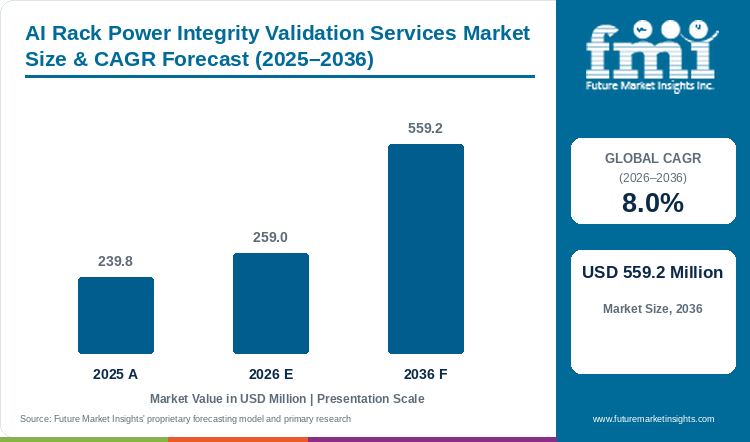
Spending on AI rack power integrity validation services reaches USD 259.0 Million in 2026, up from USD 239.8 Million in 2025. An 8% CAGR is projected to carry the market to USD 559.2 Million by 2036.
Spending in the AI rack power integrity validation services market totals USD 259.0 Million in 2026, according to FMI, and is projected to reach USD 559.2 Million by 2036 at 8% CAGR. The market size chart steps up from USD 239.8 Million in 2025 to the 2026 level, and the forecast period adds USD 300.2 Million. Hyperscale AI campuses account for 44% of validation demand by facility type in 2026.
Meta narrowed guidance for 2026 capital expenditures to USD 130-145 billion on July 29, 2026 [1]. Microsoft expects calendar 2026 capital spending of approximately USD 175 billion, and the company added another gigawatt of data center capacity in the quarter to June 2026 [2]. Against these budgets, validation spending of USD 259.0 Million in 2026 forms a thin service layer billed per energized power block. Each added gigawatt still brings switchgear, UPS systems and rack feeds needing acceptance records before release. OEM direct contracts take 38% of validation demand in 2026, so part of hyperscaler spending reaches testing inside equipment orders. Demand for validation services is expected to track each energized power block through 2036, so delays in campus energization will push test revenue into later years.
Key Takeaways
- Leading companies in the AI rack power integrity validation services market include Eaton, ABB, Siemens and Dranetz.
- Factory / site acceptance testing leads service scope with 24% of demand in 2026. Prefabricated power skids let owners check protection logic before shipment.
- Medium-voltage distribution is estimated to capture 31% of demand by electrical layer in 2026, as campus designs move protection and conversion upstream.
- Saudi Arabia is projected to grow at 9.6% CAGR through 2036, and the UAE at 9.3%. Both countries pair greenfield AI campuses with new power capacity.
Analyst Perspective
“Owners planning AI capacity for 2027 and 2028 should reserve validation crews at the equipment order stage, since a test slot booked after delivery can push back the energization date. Hyperscale campuses already account for 44% of demand in 2026, and I expect competition for medium-voltage acceptance teams to tighten further as the market moves toward USD 559.2 Million by 2036.”
- Nikhil Kaitwade, Principal Consultant, Future Market Insights
How is the AI Rack Power Integrity Validation Services Market Segmented?
The AI rack power integrity validation services market is divided into service scope, electrical layer, power capacity, facility type, route to market and region.
As per FMI, service scope is split into factory / site acceptance testing, engineering & design, commissioning, maintenance & asset management, and retrofit / upgrade. Electrical layer covers medium-voltage distribution, low-voltage distribution, rack / row-level and substation / grid interface. Power capacity is divided into 51-150 MW, 10-50 MW, below 10 MW and above 150 MW bands, and facility type spans hyperscale AI, colocation, enterprise / private cloud and HPC / research. Route to market is tracked across OEM direct, electrical EPC / contractor, system integrator and distributor / service partner. Country estimates reach beyond 30 markets, grouped under seven regional blocks.
Why Does Factory / Site Acceptance Testing Lead the AI Rack Power Integrity Validation Services Market by Service Scope?
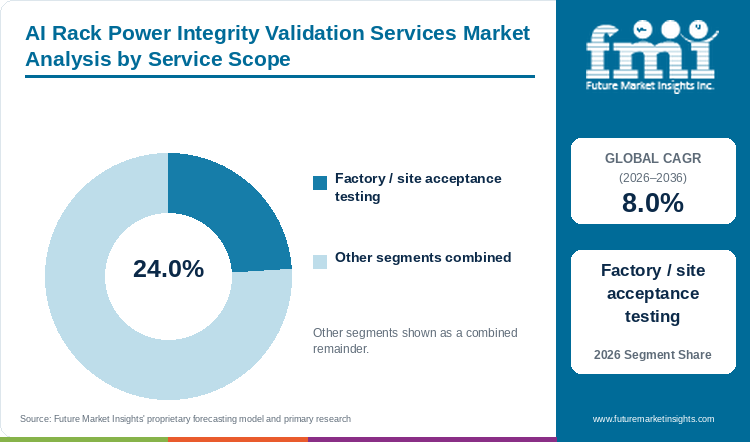
Factory / site acceptance testing leads service scope with 24% of demand in 2026.
As more AI switchgear, power skids and UPS blocks arrive prefabricated, factory / site acceptance testing accounts for 24% of demand by service scope in 2026. Owners pay for these checks to catch protection and control defects before site-wide commissioning begins. Engineering & design reviews are often bundled into equipment contracts, and maintenance & asset management starts only after handover, so both segments book less revenue in 2026.
- Buyers are expected to push more acceptance work onto vendor test floors through 2036, shortening site schedules after delivery.
- In June 2026, Siemens said the company's AI data center reference architecture uses pre-engineered and factory-tested power skids to improve quality and repeatability [3].
Why Does Medium-Voltage Distribution Lead the AI Rack Power Integrity Validation Services Market by Electrical Layer?
Medium-voltage distribution takes 31% of demand by electrical layer in 2026.
Medium-voltage distribution leads the electrical layer category with 31% of demand in 2026, with low-voltage distribution in second place. Relay coordination, UPS interaction and transfer logic at medium voltage need multi-vendor proof, and each test runs across several equipment makers. Low-voltage busway and panel checks follow standard procedures and finish in shorter windows, so the same campus books fewer low-voltage test hours.
- Owners adopting 800 VDC designs are expected to add DC conversion tests to medium-voltage packages, widening the scope of each contract.
- In June 2025, ABB announced a 400 MW AI factory partnership with Applied Digital built around a new medium-voltage power architecture [4].
Why Does the 51-150 MW Band Lead the AI Rack Power Integrity Validation Services Market by Power Capacity?
Projects of 51-150 MW represent the largest power capacity group at 31% in 2026.
The 51-150 MW band takes 31% of demand by power capacity in 2026, as first-phase AI campuses at this size justify dedicated substations and formal integrated systems tests. Projects of 10-50 MW and below 10 MW buy shorter test plans, and sites above 150 MW remain few in number for 2026.
- Developers are expected to repeat the same block-level test script across each phase, keeping orders in this band steady through 2036.
- In June 2025, South Korea’s Ministry of Science and ICT said the Ulsan AI Data Center would begin partial operation at 41 MW and expand to 103 MW [5].
Why Does Hyperscale AI Lead the AI Rack Power Integrity Validation Services Market by Facility Type?
Hyperscale AI campuses make up 44% of demand by facility type in 2026.
Hyperscale AI is the largest buyer group, with 44% of demand by facility type in 2026. Stargate UAE expects the first 200 MW cluster to go live in 2026 within a planned 5 GW campus, and each phase of such a build adds a fresh round of acceptance tests [6]. Colocation buys less, as tenant fit-outs vary and landlords split test duties with tenants. Enterprise sites deploy fewer AI racks per hall, and HPC / research centers purchase validation in small, program-funded lots.
- Hyperscale owners are expected to standardize acceptance scripts across campuses, favoring providers able to staff phased energization for several years.
- Meta reported capital expenditures of USD 31.08 billion for the second quarter of 2026, including principal payments on finance leases [1].
Why Does OEM Direct Lead the AI Rack Power Integrity Validation Services Market by Route to Market?
OEM direct contracts generate 38% of 2026 demand by route to market.
OEM direct accounts for 38% of demand by route to market in 2026, as warranty terms on new 800 VDC and modular power systems tie field tests to the equipment maker. Procurement teams keep protection settings and startup testing under one contract to protect warranty coverage. Electrical EPC / contractor routes grow more slowly, since contractors pass specialist tests back to the OEM, and distributor / service partners mostly cover smaller sites and routine maintenance.
- Mixed-vendor halls are expected to keep a share of orders with independent specialists, as owners want neutral evidence across equipment boundaries.
- In March 2026, Eaton launched the Beam Rubin DSX grid-to-chip platform for NVIDIA Vera Rubin AI factory designs [7].
What are the Drivers, Restraints, and Opportunities in the AI Rack Power Integrity Validation Services Market?
Denser AI racks and faster load swings are adding electrical behavior to verify before capacity release, according to FMI. Live-system access slows test execution, and lifecycle monitoring contracts open recurring service revenue.
- Driver: Higher-density AI racks and faster load swings add source-to-rack electrical behavior that owners verify before releasing capacity.
- Restraint: Testing around energized equipment and narrow maintenance windows stretches schedules, and multi-vendor test plans take longer to agree.
- Opportunity: Digital twins, factory testing and continuous monitoring can turn one-time commissioning into recurring lifecycle service contracts.
Rising electrical load from AI compute is the main source of new validation orders. Power use in AI-focused data centers is poised to triple by 2030, according to the IEA [8]. In August 2026, Siemens and Reinhausen announced a solid-state transformer converting grid voltage of up to 36 kV into 800 VDC for AI data centers [9]. New conversion stages add fault cases and load-step tests between the grid interface and the rack. Equipment spending in the switchgear for data centers market is projected to rise from USD 2.57 Billion in 2026 to USD 5.30 Billion by 2036, and the energy and power quality meters market is projected to grow from USD 3.33 Billion to USD 6.87 Billion over the same period.
Energized equipment limits test access on live AI halls, and site windows narrow once server load arrives. Each project carries a distinct protection and control scheme, so test plans need fresh engineering for every campus. Distribution spending in the data center LV/MV power distribution market is projected to grow at 11% CAGR through 2035, adding more interfaces to test. Sales in the 800VDC AI rack electrical commissioning services market are projected to rise at 13.8% CAGR from USD 429.0 Million in 2026 through 2036. Continuous baselines from the data center power quality monitoring market are expected to extend validation beyond handover.
Which Country CAGRs are Profiled in the AI Rack Power Integrity Validation Services Market?
| Country | CAGR, 2026 to 2036 |
|---|---|
| Saudi Arabia | 9.6% |
| UAE | 9.3% |
| South Korea | 9% |
| Ireland | 8.6% |
| USA | 8.3% |
| Germany | 8% |
How do Country-level CAGRs Compare in the AI Rack Power Integrity Validation Services Market?
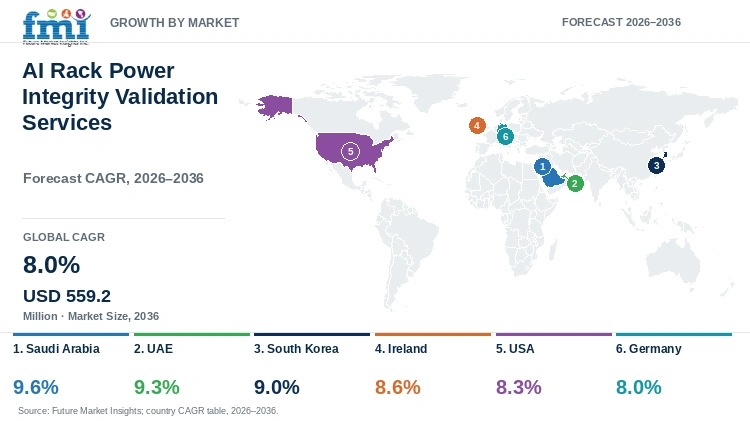
Saudi Arabia, the UAE and South Korea form the faster group, projected at 9% to 9.6% CAGR through 2036, as public and state-backed AI programs build campuses alongside new power capacity. On FMI's country CAGR chart, the profiled rates run from 9.6% in Saudi Arabia down to 8% in Germany. Ireland, the USA and Germany make up the mature group and are expected to grow between 8% and 8.6% by 2036, with larger installed bases shifting more revenue toward retrofit and lifecycle validation. New halls in all six countries draw feeds from the medium voltage AC PDU market in data centers, projected at 5.3% CAGR during the forecast period.
- Greenfield AI campuses that specify validation from the first design stage put Saudi Arabia at 9.6% CAGR through 2036.
- The UAE is projected to grow at 9.3% CAGR by 2036. Phased energization of very large campuses adds repeat test cycles.
- Public computing programs are expected to carry South Korea to 9% CAGR during the forecast period.
- Ireland is set for 8.6% CAGR through 2036, with grid-connection conditions shaping each new data center schedule.
- Demand for validation services in the USA will rise at 8.3% CAGR by 2036. Fast load growth is raising scrutiny of grid interfaces.
- Energy efficiency and reporting duties for data centers guide German demand toward 8% CAGR during the forecast period.
The full report extends CAGR estimates to seven regions and more than 30 countries beyond these six profiles.
Country Outlook
- PIF launched HUMAIN on May 12, 2025 to build next-generation data centers and AI infrastructure [10]. State-backed campuses on greenfield sites can write validation into design from the first power block, and Saudi Arabia is projected at 9.6% CAGR through 2036, the fastest rate among the six profiled countries.
- Stargate UAE was announced by the Abu Dhabi Media Office on May 22, 2025 as a 1 GW compute cluster inside a 5 GW AI campus [6]. Each phase of energization on blocks this large brings a separate acceptance cycle. Growth in the UAE is projected at 9.3% CAGR by 2036, and providers holding standard block-level scripts stand to gain repeat orders.
- South Korea is projected at 9% CAGR during the forecast period, as public computing programs commission capacity in staged power blocks. The Ministry of Science and ICT stated on June 27, 2025 that the Ulsan AI Data Center would reach 103 MW by February 2029 [5]. Every stage requires a separate acceptance record before capacity release.
- Data centers consumed 22% of Irish electricity in 2024, and the Commission for Regulation of Utilities published a final connection policy for new sites on December 12, 2025 [11]. New Irish data centers now align energization plans with grid-connection conditions, raising the value of grid-interface testing. Ireland is projected at 8.6% CAGR through 2036.
- Lawrence Berkeley National Laboratory estimated that US data centers could use between 9.5% and 15.3% of national electricity by 2030 [12]. Fast load growth meets slower grid and transformer build-out, so grid-interface checks carry more weight before capacity release. The USA is projected at 8.3% CAGR by 2036, and providers with medium-voltage test depth are expected to gain.
- Germany is projected at 8% CAGR during the forecast period, the slowest rate in the profiled group. The federal government approved a national data center strategy on March 18, 2026 that targets a doubling of connection capacity by 2030 [13]. Efficiency and energy management duties link power performance evidence to compliance reporting for German operators.
Who are the Notable Companies in the AI Rack Power Integrity Validation Services Market?
Eaton, ABB, Siemens and Dranetz are among the leading companies profiled by FMI across power equipment, digital commissioning and power-quality measurement.
Owners of AI campuses usually hand validation to the equipment maker supplying the power path and rarely switch providers within a campus program. ABB added medium-voltage switchgear and UPS assets to the NVIDIA Omniverse DSX blueprint in June 2026, and Eaton launched the Beam Rubin DSX grid-to-chip platform in March 2026 [14] [7]. Dranetz pointed to IEC 61000-4-30 measurement consistency and IEEE 519 harmonic limits as the basis of defensible power-quality analysis in June 2025 [15]. Backup systems from the data center UPS market, projected at 6.9% CAGR through 2035, add more OEM-held equipment to each power path. FMI expects independent evidence across vendor boundaries to separate specialist validation providers from bundled OEM commissioning through 2036. New 800 VDC and solid-state transformer designs will open fresh test scopes to new entrants.
- Integrated Power Architecture and Lifecycle Validation: Eaton and ABB pair medium-voltage, UPS and power conversion equipment with engineering, commissioning and field service for AI campuses.
- Digital Design and Modular Commissioning: Siemens connects power distribution with automation, digital twins, factory-tested power skids and Level I-V commissioning workflows.
- Power-Quality Measurement and Diagnostics: Dranetz offers IEC-aligned power-quality instruments, permanent monitoring and event analysis for mission-critical power systems.
Competitive Benchmarking
| Company | Grid-to-Rack Validation Coverage | Standards-Grade PQ Diagnostics | AI-Architecture Simulation & Commissioning | Geographic Reach |
|---|---|---|---|---|
| Eaton | High | High | High | Global power-management footprint with broad data center engineering and field-service coverage |
| ABB | High | Medium | High | Global electrification footprint with data center projects and commissioning across major regions |
| Siemens | High | Medium | High | Global infrastructure footprint with data center electrical services, modular systems and digital engineering |
| Dranetz | Medium | High | Low | Americas service hub with international product and support channels |
Scoring basis: Grid-to-Rack Validation Coverage rates documented engineering, testing and commissioning support across several electrical layers. Standards-Grade PQ Diagnostics rates documented harmonics, disturbance and waveform measurement capability. AI-Architecture Simulation & Commissioning rates evidence of digital twins, AI reference architectures and specialized commissioning for high-density data centers. A High rating reflects broad documented capability, a Medium rating reflects a narrower proven range, and a Low rating marks limited public documentation or an adjacent role.
Key Developments
- In July 2025, Dranetz became part of a consolidated GMC Instruments Americas hub in Edison, New Jersey, combining sales, service, calibration and repair support for North and South America [16].
- In March 2026, Eaton launched the Beam Rubin DSX platform for NVIDIA Vera Rubin AI factory designs, integrating modular power and cooling infrastructure from grid to chip [7].
- In June 2026, ABB integrated medium-voltage switchgear, electrical distribution equipment and UPS platforms as SimReady assets in the NVIDIA Omniverse DSX blueprint [14].
- In August 2026, Siemens announced a partnership with Reinhausen to develop a solid-state transformer for AI-ready data centers with grid voltage up to 36 kV and 800 VDC output [9].
Key Players
Integrated Power Architecture and Lifecycle Validation
- Eaton
- ABB
Digital Design and Modular Commissioning
- Siemens
Power-Quality Measurement and Diagnostics
- Dranetz
Report Scope and Methodology
| Coverage field | Report scope |
|---|---|
| Market breakdown | 5 categories plus region: Service Scope (Factory / site acceptance testing, Engineering & design, Commissioning, Maintenance & asset management, Retrofit / upgrade), Electrical Layer (Medium-voltage distribution, Low-voltage distribution, Rack / row-level, Substation / grid interface), Power Capacity (51-150 MW, 10-50 MW, Below 10 MW, Above 150 MW), Facility Type (Hyperscale AI, Colocation, Enterprise / private cloud, HPC / research), Route to Market (OEM direct, Electrical EPC / contractor, System integrator, Distributor / service partner), and Region |
| Quantitative units | USD Million |
| Market definition | Revenue from professional services used to design, test, commission, monitor, maintain and revalidate the electrical power path serving AI-dense racks within the stated segments. Hardware sales, electricity revenue, cooling-only validation, server performance testing and unrelated construction revenue are excluded. |
| Regions covered | North America, Latin America, Western Europe, Eastern Europe, East Asia, South Asia and Pacific, Middle East and Africa |
| Countries covered | More than 30 countries, including the USA, Ireland, Germany, South Korea, Saudi Arabia and the UAE |
| Key companies profiled | A few of the leading companies out of many players covered in the study: Eaton, ABB, Siemens and Dranetz |
| Forecast period | 2026 to 2036 |
| Approach | A hybrid bottom-up and top-down model built by FMI reconciles service intensity by facility capacity, electrical layer, service scope, facility type and route to market with country-level infrastructure activity. |
Research Methodology
| Method | Approach |
|---|---|
| Primary research | Discussions with electrical OEMs, testing and commissioning specialists, EPC firms, data center operators and procurement teams test service scope, buying criteria, qualification steps, pricing and adoption barriers. |
| Desk research | The analysis reviews energy and data center policy, grid-connection rules, technical standards, public infrastructure programs, company announcements and product documentation, retaining sources relevant to the defined service boundary. |
| Market sizing and forecasting | The sizing framework combines service revenue across project capacity, electrical layer, acceptance intensity, commissioning activity, retrofit work and lifecycle monitoring. Forecasts consider AI infrastructure deployment, power architecture change, grid constraints and modular construction. |
| Data validation | Estimates are cross-checked across standards, policy, project announcements, provider capabilities and segment and country assumptions. Hardware revenue, utility electricity sales, cooling-only testing and adjacent construction revenue are excluded to avoid double counting. |
AI Rack Power Integrity Validation Services Market by Segments
AI Rack Power Integrity Validation Services Market Segmented by Service Scope
- Factory / site acceptance testing
- Engineering & design
- Commissioning
- Maintenance & asset management
- Retrofit / upgrade
AI Rack Power Integrity Validation Services Market Segmented by Electrical Layer
- Medium-voltage distribution
- Low-voltage distribution
- Rack / row-level
- Substation / grid interface
AI Rack Power Integrity Validation Services Market Segmented by Power Capacity
- 51-150 MW
- 10-50 MW
- Below 10 MW
- Above 150 MW
AI Rack Power Integrity Validation Services Market Segmented by Facility Type
- Hyperscale AI
- Colocation
- Enterprise / private cloud
- HPC / research
AI Rack Power Integrity Validation Services Market Segmented by Route to Market
- OEM direct
- Electrical EPC / contractor
- System integrator
- Distributor / service partner
AI Rack Power Integrity Validation Services Market Segmented by Region
- North America
- Latin America
- Western Europe
- Eastern Europe
- East Asia
- South Asia and Pacific
- Middle East and Africa
Research Sources and Bibliography
- [1] Meta Platforms (2026, July 29). Meta Reports Second Quarter 2026 Results.
- [2] Microsoft (2026, July 29). Microsoft Fiscal Year 2026 Fourth Quarter Earnings Conference Call.
- [3] Siemens (2026, June 1). Siemens and partners develop reference architecture purpose-built for NVIDIA AI data centers.
- [4] ABB (2025, June 11). ABB and Applied Digital accelerate AI-ready data centers.
- [5] Ministry of Science and ICT, Republic of Korea (2025, June 27). Ulsan AI Data Center Launch Sparks Dialogue on Advancing Korea into a Top-Three Global AI Power.
- [6] Abu Dhabi Media Office (2025, May 22). Global tech alliance launches Stargate UAE.
- [7] Eaton (2026, March 16). Eaton collaborates with NVIDIA to unveil the Eaton Beam Rubin DSX platform.
- [8] International Energy Agency (2026, April 16). Data centre electricity use surged in 2025, even with tightening bottlenecks driving a scramble for solutions.
- [9] Siemens (2026, August 14). Siemens and Reinhausen develop direct current power solutions for AI data centers.
- [10] Public Investment Fund (2025, May 12). HRH Crown Prince launches HUMAIN as global AI powerhouse.
- [11] Commission for Regulation of Utilities (2025, December 12). The CRU Publishes its Decision on New Electricity Connection Policy for Data Centres.
- [12] Lawrence Berkeley National Laboratory (2026, June). United States Data Center Energy Usage Report: 2025 Update.
- [13] Government of Germany (2026, March 18). Mehr Rechenpower für Deutschland.
- [14] ABB (2026, June 1). ABB Expands Collaboration with NVIDIA through Integration of DSX Blueprint for AI Infrastructure.
- [15] Dranetz (2025, June 9). Power Quality Standards: What You Need to Know.
- [16] Dranetz (2025, July 15). GMC Instruments Americas expands with new headquarters, strengthening the Dranetz legacy.
This bibliography is provided for reader reference and is not exhaustive. The full report contains the complete reference list and detailed citations.
This Report Answers
- What will the AI Rack Power Integrity Validation Services Market size be in 2026, and what value will the market reach by 2036?
- Which AI infrastructure and power-system pressures will support demand for validation services through 2036?
- Why will factory / site acceptance testing hold the leading position within the Service Scope category in 2026?
- In what ways will medium-voltage and 800 VDC architectures change the scope of acceptance testing?
- Why will 51-150 MW projects, hyperscale AI and OEM direct contracts anchor demand across the other categories?
- Which growth rates will Saudi Arabia, the UAE, South Korea, Ireland, the USA and Germany post till 2036?
- Which execution limits around live electrical systems will slow adoption of validation services?
- What will data center owners need to verify before selecting a power integrity validation provider?
Frequently Asked Questions
How Big Is the AI Rack Power Integrity Validation Services Market Expected to Be in 2026?
Sales of AI rack power integrity validation services will reach USD 259.0 Million in 2026, up from USD 239.8 Million in 2025, as FMI estimates show. Revenue will rise to USD 559.2 Million by 2036 as AI campuses add denser power paths needing tests before capacity release.
What Is the CAGR of the AI Rack Power Integrity Validation Services Market from 2026 to 2036?
The market will grow at an 8% CAGR from 2026 to 2036. Growth will come from new AI campuses, medium-voltage and 800 VDC power designs and lifecycle monitoring after handover.
Which Service Scope Holds the Largest Share of the AI Rack Power Integrity Validation Services Market?
Factory / site acceptance testing will lead with 24% of market share by service scope in 2026. Earlier defect discovery before final energization and lower site rework will support the position.
Which Facility Type Leads the AI Rack Power Integrity Validation Services Market?
Hyperscale AI will account for 44% of market share by facility type in 2026. Dense GPU halls and the high cost of a delayed capacity phase will support the lead.
Which Country Is Expected to Grow Fastest in the AI Rack Power Integrity Validation Services Market?
Saudi Arabia will grow fastest at a 9.6% CAGR till 2036, followed by the UAE at 9.3% and South Korea at 9%. Germany will post the slowest rate of the six profiled countries at 8%.
What Notable Restraint Affects the AI Rack Power Integrity Validation Services Market?
Key challenges will come from testing electrical systems that also need to stay available, with narrow maintenance windows and multi-vendor interfaces. New 800 VDC and medium-voltage designs will need project-specific test plans, adding engineering time to each project.
Which Are the Key Companies in the AI Rack Power Integrity Validation Services Market?
Eaton, ABB, Siemens and Dranetz rank among the leading companies covered by FMI. The report assigns each company to one of three supplier groups.
Preview the report firsthand - request a free sample
Get SampleGet the brochure for pricing and purchase details.
Get PDFTable of Content
- Key Takeaways
- Market Size and CAGR
- Top Growth Driver
- Fastest Growing Segment
- Leading Region
- Key Companies
- Emerging Opportunities
- Executive Summary
- Global Market Outlook
- Demand-side Trends
- Supply-side Trends
- Technology Roadmap Analysis
- Analysis and Recommendations
- Analyst Perspective (What is happening? Why now? What should investors know?)
- Key Questions Answered
- How large is the market?
- What is the CAGR?
- What are key trends?
- Which region dominates?
- Who are the leaders?
- Market Overview
- Market Coverage / Taxonomy
- Market Definition / Scope / Limitations
- Research Methodology
- Chapter Orientation
- Analytical Lens and Working Hypotheses
- Market Structure, Signals, and Trend Drivers
- Benchmarking and Cross-market Comparability
- Market Sizing, Forecasting, and Opportunity Mapping
- Research Design and Evidence Framework
- Desk Research Programme (Secondary Evidence)
- Expert Input and Fieldwork (Primary Evidence)
- Tooling, Models, and Reference Databases
- Data Engineering and Model Build
- Quality Assurance and Audit Trail
- Market Background
- Market Dynamics (Drivers, Restraints, Opportunity, Trends)
- Scenario Forecast (Optimistic, Likely, Conservative)
- Impact Analysis
- AI Impact
- Sustainability Impact
- Regulatory Impact
- Technology Impact
- Consumer / Buyer Analysis
- Purchase Drivers
- Adoption Barriers
- Buyer Journey
- Opportunity Map Analysis
- Product Life Cycle Analysis
- Supply Chain Analysis
- Investment Feasibility Matrix
- Value Chain Analysis
- PESTLE and Porter's Analysis
- Regulatory Landscape
- Regional Parent Market Outlook
- Production and Consumption Statistics
- Import and Export Statistics
- Global Market Analysis and Forecast, 2021 to 2036
- Historical Market Size Value (USD Million) Analysis, 2021 to 2025
- Current and Future Market Size Value (USD Million) Projections, 2026 to 2036
- Y-o-Y Growth Trend Analysis
- Absolute $ Opportunity Analysis
- Global Market Pricing Analysis, 2021 to 2036
- Global Market Analysis and Forecast, By Service Scope, 2021 to 2036
- Introduction / Key Findings
- Historical Market Size Value (USD Million) Analysis By Service Scope, 2021 to 2025
- Current and Future Market Size Value (USD Million) Analysis and Forecast By Service Scope, 2026 to 2036
- Factory / site acceptance testing
- Engineering & design
- Commissioning
- Maintenance & asset management
- Retrofit / upgrade
- Y-o-Y Growth Trend Analysis By Service Scope, 2021 to 2025
- Absolute $ Opportunity Analysis By Service Scope, 2026 to 2036
- Global Market Analysis and Forecast, By Electrical Layer, 2021 to 2036
- Introduction / Key Findings
- Historical Market Size Value (USD Million) Analysis By Electrical Layer, 2021 to 2025
- Current and Future Market Size Value (USD Million) Analysis and Forecast By Electrical Layer, 2026 to 2036
- Medium-voltage distribution
- Low-voltage distribution
- Rack / row-level
- Substation / grid interface
- Y-o-Y Growth Trend Analysis By Electrical Layer, 2021 to 2025
- Absolute $ Opportunity Analysis By Electrical Layer, 2026 to 2036
- Global Market Analysis and Forecast, By Power Capacity, 2021 to 2036
- Introduction / Key Findings
- Historical Market Size Value (USD Million) Analysis By Power Capacity, 2021 to 2025
- Current and Future Market Size Value (USD Million) Analysis and Forecast By Power Capacity, 2026 to 2036
- 51-150 MW
- 10-50 MW
- Below 10 MW
- Above 150 MW
- Y-o-Y Growth Trend Analysis By Power Capacity, 2021 to 2025
- Absolute $ Opportunity Analysis By Power Capacity, 2026 to 2036
- Global Market Analysis and Forecast, By Facility Type, 2021 to 2036
- Introduction / Key Findings
- Historical Market Size Value (USD Million) Analysis By Facility Type, 2021 to 2025
- Current and Future Market Size Value (USD Million) Analysis and Forecast By Facility Type, 2026 to 2036
- Hyperscale AI
- Colocation
- Enterprise / private cloud
- HPC / research
- Y-o-Y Growth Trend Analysis By Facility Type, 2021 to 2025
- Absolute $ Opportunity Analysis By Facility Type, 2026 to 2036
- Global Market Analysis and Forecast, By Route to Market, 2021 to 2036
- Introduction / Key Findings
- Historical Market Size Value (USD Million) Analysis By Route to Market, 2021 to 2025
- Current and Future Market Size Value (USD Million) Analysis and Forecast By Route to Market, 2026 to 2036
- OEM direct
- Electrical EPC / contractor
- System integrator
- Distributor / service partner
- Y-o-Y Growth Trend Analysis By Route to Market, 2021 to 2025
- Absolute $ Opportunity Analysis By Route to Market, 2026 to 2036
- Global Market Analysis and Forecast, By Region, 2021 to 2036
- Introduction
- Historical Market Size Value (USD Million) Analysis By Region, 2021 to 2025
- Current Market Size Value (USD Million) Analysis and Forecast By Region, 2026 to 2036
- North America
- Latin America
- Western Europe
- Eastern Europe
- East Asia
- South Asia and Pacific
- Middle East and Africa
- Market Attractiveness Analysis By Region
- North America Market Analysis and Forecast, By Country, 2021 to 2036
- Historical Market Size Value (USD Million) Trend Analysis By Market Taxonomy, 2021 to 2025
- Market Size Value (USD Million) Forecast By Market Taxonomy, 2026 to 2036
- By Country
- By Service Scope
- By Electrical Layer
- By Power Capacity
- By Facility Type
- By Route to Market
- Market Attractiveness Analysis
- By Country
- By Service Scope
- By Electrical Layer
- By Power Capacity
- By Facility Type
- By Route to Market
- Key Takeaways
- Latin America Market Analysis and Forecast, By Country
- Historical Market Size Value (USD Million) Trend Analysis By Market Taxonomy, 2021 to 2025
- Market Size Value (USD Million) Forecast By Market Taxonomy, 2026 to 2036
- By Country
- By Service Scope
- By Electrical Layer
- By Power Capacity
- By Facility Type
- By Route to Market
- Market Attractiveness Analysis
- By Country
- By Service Scope
- By Electrical Layer
- By Power Capacity
- By Facility Type
- By Route to Market
- Key Takeaways
- Western Europe Market Analysis and Forecast, By Country
- Historical Market Size Value (USD Million) Trend Analysis By Market Taxonomy, 2021 to 2025
- Market Size Value (USD Million) Forecast By Market Taxonomy, 2026 to 2036
- By Country
- By Service Scope
- By Electrical Layer
- By Power Capacity
- By Facility Type
- By Route to Market
- Market Attractiveness Analysis
- By Country
- By Service Scope
- By Electrical Layer
- By Power Capacity
- By Facility Type
- By Route to Market
- Key Takeaways
- Eastern Europe Market Analysis and Forecast, By Country
- Historical Market Size Value (USD Million) Trend Analysis By Market Taxonomy, 2021 to 2025
- Market Size Value (USD Million) Forecast By Market Taxonomy, 2026 to 2036
- By Country
- By Service Scope
- By Electrical Layer
- By Power Capacity
- By Facility Type
- By Route to Market
- Market Attractiveness Analysis
- By Country
- By Service Scope
- By Electrical Layer
- By Power Capacity
- By Facility Type
- By Route to Market
- Key Takeaways
- East Asia Market Analysis and Forecast, By Country
- Historical Market Size Value (USD Million) Trend Analysis By Market Taxonomy, 2021 to 2025
- Market Size Value (USD Million) Forecast By Market Taxonomy, 2026 to 2036
- By Country
- By Service Scope
- By Electrical Layer
- By Power Capacity
- By Facility Type
- By Route to Market
- Market Attractiveness Analysis
- By Country
- By Service Scope
- By Electrical Layer
- By Power Capacity
- By Facility Type
- By Route to Market
- Key Takeaways
- South Asia and Pacific Market Analysis and Forecast, By Country
- Historical Market Size Value (USD Million) Trend Analysis By Market Taxonomy, 2021 to 2025
- Market Size Value (USD Million) Forecast By Market Taxonomy, 2026 to 2036
- By Country
- By Service Scope
- By Electrical Layer
- By Power Capacity
- By Facility Type
- By Route to Market
- Market Attractiveness Analysis
- By Country
- By Service Scope
- By Electrical Layer
- By Power Capacity
- By Facility Type
- By Route to Market
- Key Takeaways
- Middle East and Africa Market Analysis and Forecast, By Country
- Historical Market Size Value (USD Million) Trend Analysis By Market Taxonomy, 2021 to 2025
- Market Size Value (USD Million) Forecast By Market Taxonomy, 2026 to 2036
- By Country
- By Service Scope
- By Electrical Layer
- By Power Capacity
- By Facility Type
- By Route to Market
- Market Attractiveness Analysis
- By Country
- By Service Scope
- By Electrical Layer
- By Power Capacity
- By Facility Type
- By Route to Market
- Key Takeaways
- Key Countries Market Analysis
- Saudi Arabia
- Pricing Analysis
- Market Share Analysis, 2025
- By Service Scope
- By Electrical Layer
- By Power Capacity
- By Facility Type
- By Route to Market
- UAE
- Pricing Analysis
- Market Share Analysis, 2025
- By Service Scope
- By Electrical Layer
- By Power Capacity
- By Facility Type
- By Route to Market
- South Korea
- Pricing Analysis
- Market Share Analysis, 2025
- By Service Scope
- By Electrical Layer
- By Power Capacity
- By Facility Type
- By Route to Market
- Ireland
- Pricing Analysis
- Market Share Analysis, 2025
- By Service Scope
- By Electrical Layer
- By Power Capacity
- By Facility Type
- By Route to Market
- USA
- Pricing Analysis
- Market Share Analysis, 2025
- By Service Scope
- By Electrical Layer
- By Power Capacity
- By Facility Type
- By Route to Market
- Germany
- Pricing Analysis
- Market Share Analysis, 2025
- By Service Scope
- By Electrical Layer
- By Power Capacity
- By Facility Type
- By Route to Market
- Saudi Arabia
- Market Structure Analysis
- Competition Dashboard
- Competition Benchmarking
- Market Share Analysis of Top Players
- By Regional
- By Service Scope
- By Electrical Layer
- By Power Capacity
- By Facility Type
- By Route to Market
- Emerging Startups
- Innovation Benchmarking
- Competition Analysis
- Competition Deep Dive
- Eaton
- Overview
- Product Portfolio
- Profitability by Market Segments
- Sales Footprint
- Strategy Overview
- Marketing Strategy
- Product Strategy
- Channel Strategy
- ABB
- Siemens
- Dranetz
- Eaton
- Case Studies
- Success Stories
- Recent Developments
- Competition Deep Dive
- Assumptions & Acronyms Used


