

- Market Size (2026)
- USD 0.7 Bn
- Forecast (2036)
- USD 1.2 Bn
- CAGR (2026 to 2036)
- 5.9%
How big is Air Atomizing Nozzles Market in 2026?
The air atomizing nozzles market is valued at USD 0.7 billion in 2026 and is projected to reach USD 1.2 billion by 2036, expanding at a CAGR of 5.9% over the 2026–2036 period.
Sales of air atomizing nozzles are valued at USD 0.7 Billion in 2026 and are forecast to reach USD 1.2 Billion by 2036, advancing at a 5.9% CAGR between 2026 and 2036. Every plant that sprays a liquid faces the same question: how fine, how even, and at what cost in air and material. Air atomizing nozzles answer it by using compressed air to break liquid into controlled droplets, so they stay the preferred choice where hydraulic nozzles cannot hold quality.
Demand is driven by stricter emission and material-waste expectations, automation of coating and lubrication lines, and rising need for precise cooling and humidification. Restraints include compressed air energy cost, clogging with viscous or particle-laden fluids, and price pressure from simpler spray options. Opportunities lie in sensor-linked spray control, retrofits of legacy lines, and low-air-consumption designs. Purchasing is shaped by nozzle design, construction material, and end-use application, and buyers approve only after droplet performance is proven on their own fluids. Regionally, the USA leans on compliance and distributor support, Germany on energy efficiency, Japan on repeatability, Mexico on local availability, and South Korea on fast qualification cycles.
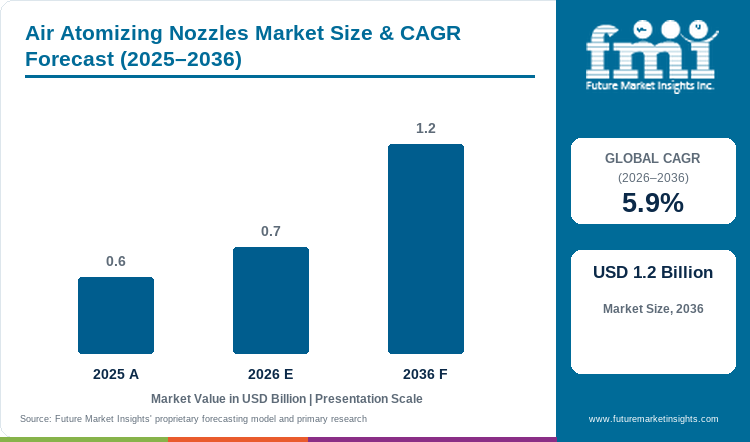
Key Takeaways of Air Atomizing Nozzles Market
- By nozzle type, internal mix nozzles are expected to lead in 2026, while round spray is projected to lead the spray pattern category.
- Stainless steel is estimated to lead the material category in 2026, with coating and painting leading applications, automotive leading end use, and industrial distributors leading the sales channel.
- Demand is driven by the need for repeatable fine atomization that reduces coating, lubricant, and process-fluid waste.
- Compressed-air energy cost and application tuning requirements remain the primary restraints, as they can weaken the operating-cost case.
- Automatic no-drip and digitally specified nozzles present an opportunity by simplifying integration into automated manufacturing, while South Korea records the highest profiled country CAGR at 6.2%, compared with Japan at 4.4%.
Analyst Perspective
Revenue capture depends on proving the process result and the total utility cost at the same time. Buyers need evidence on droplet size, pattern repeatability, fluid compatibility and shutoff behavior.
- Nikhil Kaitwade, Principal Consultant, Future Market Insights
How is the Air Atomizing Nozzles Market segmented?
The air atomizing nozzles market is segmented six ways: by nozzle type, spray pattern, material, application, end use, and sales channel.
Nozzle type covers internal mix nozzles, external mix nozzles, siphon-feed nozzles, and pressure-feed nozzles.
Spray pattern covers round spray, flat spray, wide angle, full cone, and custom pattern.
Material covers stainless steel, brass, hardened steel, plastic/polymer, and ceramic-tipped.
Application covers coating & painting, humidification, lubrication, cooling, and chemical spraying.
End use covers automotive, food & beverage, chemicals, pharma, and metalworking.
Sales channel covers industrial distributors, direct OEM, catalog/e-commerce, and system integrators.
What makes Internal mix nozzles central to the nozzle type category?
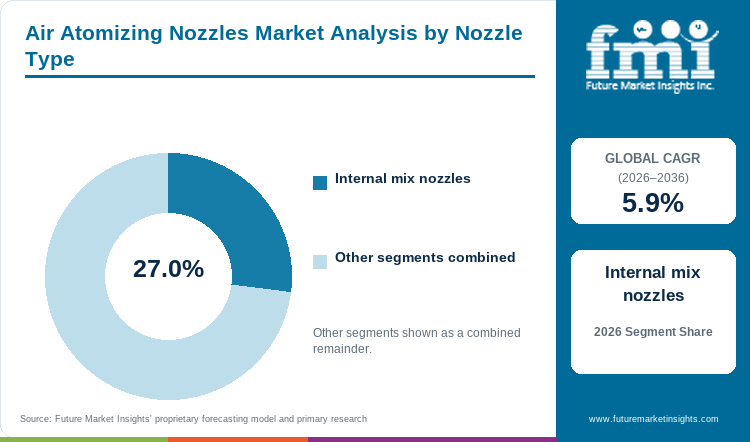
Internal mix nozzles fit accounts that want air and liquid combined inside a compact body before discharge. This arrangement supports repeatable fine atomization at controlled flow, particularly for fluids of low to moderate viscosity. In February 2023 EXAIR described an air atomizing range covering internal mix, external mix, and siphon-fed styles, with adjustable liquid and air operation and several spray patterns. That breadth shows internal mix is one option among several rather than a universal answer. External mix suits thicker fluids, pressure-feed nozzles supply liquid under pressure, siphon-feed handles low-pressure supply, and automatic models add no-drip cycling. Buyers therefore choose internal mix when compact installation and fine spray control matter most.
- By nozzle type, internal mix nozzles are estimated to hold 27.0% in 2026 owing to compact installation and controllable fine atomization.
- Buyers select this architecture when a repeatable spray is needed without the added setup of separate air and liquid interaction points.
Why does round spray lead the spray pattern category?
Round spray suits accounts that need a symmetrical footprint centered on the nozzle axis. That geometry works well for localized targets and for cylindrical or irregular surfaces where a flat fan would need careful alignment. In July 2024 Lechler stated that its redesigned Laval 1AW twin-fluid nozzle kept a very fine droplet spectrum with controllable flow, showing how air interaction is used to shape a consistent spray. Flat spray serves linear bands, while wide-angle, full-cone, and custom patterns address larger or geometry-specific coverage. Round spray therefore leads because its footprint is simple to position and scale across cooling, humidification, and spot-lubrication duties.
- Round spray is projected to represent 28.0% of pattern demand in 2026 as symmetrical coverage fits localized spray tasks and process conditioning.
- Users favor a pattern that is easy to align and can be repeated across many spray points with little adjustment.
How does stainless steel support the material category?
Stainless steel matches the mixed conditions that air atomizing nozzles meet in daily use, including water, coatings, lubricants, cleaning media, and chemical solutions. Corrosion resistance matters most where residual liquid sits in narrow passages or where washdown is routine. In February 2023 EXAIR stated that its atomizing nozzle line uses stainless-steel construction and tied the material to durability and corrosion resistance in washing, coating, cooling, and dust control uses. Durable metal also protects the internal geometry that sets air-liquid interaction and spray shape. Brass, hardened steel, ceramic-tipped, and polymer options serve narrower cost, wear, or weight needs, so stainless steel holds the widest compatibility.
- Stainless steel is anticipated to account for 42.0% of material demand in 2026 because corrosion resistance and cleanability cover many industrial fluids and maintenance routines.
- Buyers value a material that keeps nozzle geometry stable across repeated cleaning and chemical exposure.
What supports coating & painting in the application category?
Coating and painting link atomization quality directly to film quality and material use. Fine droplets help operators spread a controlled liquid load across a surface, while adjustable air and liquid settings allow for changes in viscosity or target finish. Automatic shutoff also limits drips between cycles. The U.S. EPA continued to list VOC performance standards for automobile surface-coating operations in its March 2026 update, with the rule history including a May 2023 final rule, which keeps coating transfer and emissions performance under formal scrutiny. Humidification, cooling, lubrication, and chemical spraying emphasize other outcomes, so coating leads because small droplet changes affect finish consistency and rework cost.
- Coating and painting are expected to hold 34.0% of application demand in 2026 as droplet control and shutoff precision shape film uniformity and material use.
- Finishing lines prefer nozzles that hold a consistent spray and stop cleanly between cycles.
Why does automotive hold the lead in the end use category?
Automotive plants combine high line speeds with repeated coating and lubrication, while cooling and other process-fluid tasks add further spray points. Production engineers work within tight finish tolerances and scheduled maintenance windows, which rewards nozzles that deliver repeatable patterns and restart cleanly after intermittent cycles. INEGI reported in January 2026 that Mexico produced 3,953,494 light vehicles during 2025, illustrating the large production base where precision spray components are specified and replaced. Food and beverage users weigh hygiene and washdown more heavily, chemical and pharma plants stress compatibility, and metalworking faces harsher contamination. Automotive leads because it creates many recurring spray points.
- Automotive is forecast to represent 26.0% of end use demand in 2026 because high-throughput production holds many spray tasks that reward repeatable atomization and controlled cycling.
- Plants in this sector favor nozzles that support automated control and predictable replacement schedules.
What drives Industrial distributors within the sales channel category?
Industrial distributors sit close to maintenance demand and shorten the path from a failed or underperforming nozzle to a replacement. That matters because spray problems are usually found during production rather than in long capital-equipment cycles. In June 2024 EXAIR stated that its combination with BETE would serve distributors and resellers alongside OEM, direct, and project customers, which shows how many buyers depend on channel breadth for spray products. Distributors help buyers compare thread sizes, materials, patterns, and flow ranges across standard configurations. Direct OEM supply and system integrators matter more for new machines, so distributors lead through maintenance speed and specification support.
- Industrial distributors are projected to account for 39.0% of sales channel demand in 2026 owing to local availability and application guidance in replacement purchasing.
- Maintenance teams rely on nearby stock to restore spray performance quickly without waiting on a new equipment project.
What are the drivers, restraints, and opportunities in the Air Atomizing Nozzles Market?
In the air atomizing nozzles market, the key driver is repeatable fine atomization that reduces coating, lubricant, and process-fluid waste, the key restraint is compressed-air energy cost and application tuning that weaken the operating-cost case, and the key opportunity is automatic no-drip and digitally specified nozzles that simplify integration into automated manufacturing lines.
- Driver: Need for repeatable fine atomization reduces coating, lubricant, and process-fluid waste in precision spray duties.
- Restraint: Compressed-air energy cost and application tuning can weaken the operating-cost case for air atomizing nozzles.
- Opportunity: Automatic no-drip and digitally specified nozzles can simplify integration into automated manufacturing lines.
Fine atomization is a factor supporting market growth because manufacturing engineers must hold surface quality while controlling liquid use and emissions. The U.S. EPA notes that surface-coating standards for automobile and light-duty truck operations limit VOC emissions at new or modified facilities. That requirement does not mandate air atomizing nozzles, but it raises attention to how coating liquid is transferred and controlled. Air-assisted designs create fine droplets at low liquid flow and let process teams tune air and liquid conditions around the required finish. Demand strengthens when reduced overspray or better film control translates into measurable material savings and fewer quality losses.
Compressed-air cost is a factor limiting growth since buyers must evaluate the operating penalty before changing nozzle technology. The U.S. Department of Energy Better Plants program states that more than 80% of compressor input energy is lost as heat. A nozzle that achieves fine atomization but consumes unnecessary air can shift cost from liquid waste to utilities. Plants must also provide clean, stable air and tune pressure around viscosity and target droplet size, which adds commissioning effort. Delavan notes that equipment with air atomizing nozzles costs more than equivalent pressure atomizing equipment because of the added compressor. Purchases are delayed most where process results are difficult to quantify or plant air is already constrained.
Automation-ready designs create an emerging opportunity when suppliers reduce the engineering burden around nozzle selection and control. Japan's Ministry of Economy, Trade and Industry launched a June 2026 NEDO challenge focused on accessible robot solutions for manufacturing, targeting labor shortages and surface-inspection automation in automotive production. Spray vendors can apply the same integration logic through automatic shutoff and stable parameter windows. IKEUCHI already offered pneumatic-nozzle CAD data and flow-rate guidance in November 2023, which cuts specification effort further. Suppliers that pair such tools with low-air designs and local application support can shorten qualification. The commercial opportunity is therefore a finer spray packaged for easier specification, automation, maintenance, and cost justification.
Which country CAGRs are profiled in the Air Atomizing Nozzles Market?
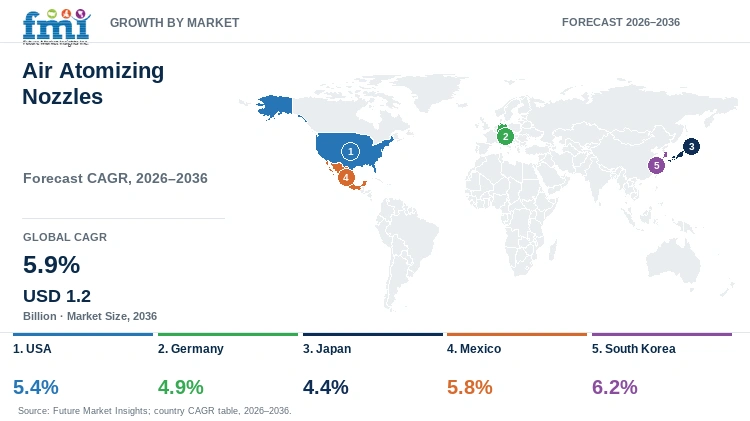
| Country | CAGR |
|---|---|
| USA | 5.4% |
| Germany | 4.9% |
| Japan | 4.4% |
| Mexico | 5.8% |
| South Korea | 6.2% |
How do country-level CAGRs compare in the Air Atomizing Nozzles Market?
The five profiled countries span a 1.8 percentage-point range from South Korea at 6.2% to Japan at 4.4% from 2026 to 2036. South Korea and Mexico form the faster-growth band. USA sits in the middle at 5.4%. Germany and Japan form a slower but still expanding band below 5.0%.
These rates describe expected pace rather than installed market size. The differences reflect how quickly users add or replace precision spray hardware under distinct manufacturing conditions. Automotive investment and automation intensity affect the time between technical interest and a purchase order.
Coating regulation, utility economics, and local service availability also shape that interval.
- South Korea leads Mexico by 0.4 percentage points. The small gap favors early investment in application support across both markets rather than radically different product strategies.
- Mexico leads the USA by 0.4 percentage points. Channel stock and support near vehicle plants can matter as much as incremental growth-rate advantage.
- The USA leads Germany by 0.5 percentage points. Suppliers can balance faster replacement demand in the USA against Germany's stronger focus on documented energy and VOC performance.
- Germany leads Japan by 0.5 percentage points. Both markets reward engineering proof, but Japan places greater emphasis on automation fit and disciplined production qualification.
CAGR alone does not determine commercial priority. A lower-growth country can still generate more revenue if it has a larger installed manufacturing base or more frequent replacement cycles. Product mix also changes value per nozzle.
Buyers may purchase standard components through MRO channels or engineered assemblies through OEM and integrator routes. The broader report therefore evaluates local end-use activity and technical qualification alongside the growth rate.
Utility cost, service expectations, and supplier access are considered as separate commercial tests. Those factors determine whether a country supports transactional replacement volume or higher-value application engineering.
Country-wise Analysis
- USA buyers commonly source standard replacements through industrial distributors while larger coating and automation projects involve OEM or direct engineering support. Demand for air atomizing nozzles in the USA is forecast to expand at 5.4% CAGR from 2026 to 2036. The U.S. EPA updated its automobile surface-coating NSPS page in March 2026 and continues to list the May 2023 final rule that limits VOC emissions for covered operations. The local friction is total compressed-air cost plus the time needed to prove transfer and finish performance. Suppliers can improve conversion with low-air or no-drip options, application testing, clear operating curves and rapid MRO availability.
- German process plants tend to examine nozzle performance together with energy consumption and formal environmental requirements. Demand for air atomizing nozzles in Germany is forecast to expand at 4.9% CAGR from 2026 to 2036. Germany's 31st Federal Immission Control Ordinance issued in January 2024 sets VOC limits for several surface-coating activities. Destatis reported in February 2026 that industrial production fell 1.1% in 2025 and automotive production fell 1.7%. That backdrop can tighten capital screening. Suppliers need to document liquid savings, air demand, material compatibility and maintenance value rather than relying on spray quality alone.
- Japanese manufacturers often require stable parameter windows and evidence that a component can be integrated without disrupting tightly controlled production. Demand for air atomizing nozzles in Japan is forecast to expand at 4.4% CAGR from 2026 to 2036. METI and NEDO launched a manufacturing robot challenge on 30 June 2026 that specifically includes automated surface-anomaly inspection for automotive production. The initiative highlights the pressure to automate work that remains labor intensive. The friction for nozzle suppliers is qualification effort and local technical support. CAD models, droplet and flow data, low-air designs and responsive engineering can shorten the route from test to approved production use.
- Mexico combines high-volume vehicle manufacturing with strong demand for practical replacement and line-support capabilities around industrial components. Demand for air atomizing nozzles in Mexico is forecast to expand at 5.8% CAGR from 2026 to 2036. INEGI reported on 9 January 2026 that the country produced 3,953,494 light vehicles in 2025. Light trucks represented 77.2% of that output. Nozzle purchases still face qualification and maintenance constraints at the individual plant level. Suppliers can keep common stainless configurations available locally and support plant trials. Fast field guidance should cover air and liquid pressure plus spray pattern and viscosity.
- South Korean buyers operate in a manufacturing environment where automotive technology changes quickly and production quality targets remain demanding. Demand for air atomizing nozzles in South Korea is forecast to expand at 6.2% CAGR from 2026 to 2036. The Ministry of Trade, Industry and Resources reported on 15 January 2026 that Korean automobile exports reached a record USD 72.0 billion in 2025.Rapid model and process transitions can raise qualification demands for spray components. Suppliers need repeatable automatic operation and clear process data. Responsive service and integration support should help plants validate new spray settings without extending production changeovers.
Who are the notable companies in the Air Atomizing Nozzles Market?
Spraying Systems Co. and Lechler are profiled. BETE Fog Nozzle and EXAIR are also covered. IKEUCHI and PNR Italia are also covered. Delavan and H. Ikeuchi USA are also covered. Düsen-Schlick and CYCO & Changyuan complete the notable-company set.
The competitive outlook combines nozzle specialists with companies that control application engineering and customer access at the point of specification or replacement. Broad industrial spray platforms compete through the breadth of air-assisted nozzle architectures and the depth of engineering support across many spray duties. Precision pneumatic specialists compete through fine atomization and configurable operating conditions for demanding process needs. Component and distribution specialists compete through focused product families and defined channels serving air-assisted spray duties. Commercial success depends on documented application results and reliable replacement access because buyers compare these roles rather than relying on one universal product ranking.
- Spraying Systems Co. and Lechler compete across broad industrial spray duties with engineering support. BETE Fog Nozzle and EXAIR now combine engineered spray and compressed-air capabilities under common ownership following their June 2024 transaction. Their commercial test is consistent application coverage across many industries rather than strength in one narrow spray duty.
- IKEUCHI and H. Ikeuchi USA bring pneumatic-nozzle selection tools plus regional technical access to buyers evaluating fine atomization. Düsen-Schlick focuses on configurable two-substance atomization for demanding process duties. The commercial test for this group is the ability to match operating conditions and droplet requirements to the specific process.
- PNR Italia provides pneumatic atomizers through an international distribution structure that supports buyers across several regions. Delavan offers specialized internal-mix air atomizing products for defined duties, while CYCO & Changyuan serves configurable industrial nozzle requirements. Supplier selection depends on product fit for the spray duty and the strength of specialist channels for replacement and technical support.
Competitive Benchmarking: Air Atomizing Nozzles Market
| Company | Air/Liquid Control Breadth | Process-Specific Atomization Engineering | Automation & Integration Support | Geographic Reach |
|---|---|---|---|---|
| Spraying Systems Co. | High | High | High | Global; manufacturing and service network across major industrial regions |
| Lechler | Medium | High | High | Europe, Americas, and Asia-Pacific through company locations and technical support |
| BETE Fog Nozzle | High | High | High | North America with international distributors and project support |
| EXAIR | High | Medium | Medium | North America plus international distribution and common BETE channel access |
| IKEUCHI | High | High | High | The company is based in Japan and supports customers in the USA. Coverage extends to Europe and China as well as Southeast Asia. |
| PNR Italia | Medium | Medium | Medium | The company serves Europe through its distribution network. Coverage extends across the Americas and Asia as well as Africa and Oceania. |
| Delavan | Medium | High | Medium | North America and Europe with specialist international channels |
| H. Ikeuchi USA | Medium | High | Medium | USA with sales responsibility supporting North and South American customers |
| Düsen-Schlick | Medium | High | High | Europe with international process-industry customer coverage |
| CYCO & Changyuan | High | Medium | Medium | China with international export and distributor channels |
Key Developments in the Air Atomizing Nozzles Market
- In July 2024, Lechler announced a redesigned Laval 1AW twin-fluid nozzle for DeNOx injection. Revised geometry and a standardized lance adapter simplify assembly while the atomizing-air arrangement maintains a very fine droplet spectrum and controllable flow. The change lowers integration friction in test and retrofit work where engineers need to exchange nozzle configurations without redesigning the surrounding lance connection.
- During June 2024 EXAIR and BETE Fog Nozzle announced a definitive merger agreement under which EXAIR acquired BETE. The transaction combines compressed-air expertise with engineered spray-nozzle and spraying-system capabilities. The companies highlighted worldwide distributors and resellers plus OEM relationships and direct sales. They also cited project customers. For air atomizing buyers, common ownership broadens the scope for bundled air-management and spray-engineering support.
Key Players in the Air Atomizing Nozzles Market
Broad Industrial Spray Platforms
- Spraying Systems Co.
- Lechler
- BETE Fog Nozzle
- EXAIR
Precision Pneumatic and Application Engineering
- IKEUCHI
- H. Ikeuchi USA
- Düsen-Schlick
Component, OEM and Distribution Specialists
- PNR Italia
- Delavan
- CYCO & Changyuan
Air Atomizing Nozzles Market - Report Scope
| Coverage field | Report scope |
|---|---|
| Market breakdown | Nozzle Type, Spray Pattern, Material, Application, End Use, and Sales Channel |
| Quantitative Units | Revenue in USD Billion and CAGR in %. |
| Market Definition | Revenue from air atomizing and twin-fluid industrial nozzles or nozzle assemblies sold within the stated segmentation universe. The scope excludes hydraulic single-fluid nozzles, compressors, pumps, tanks, manifolds, controllers, complete spray-system installation, downstream finished-product revenue, and adjacent substitute technologies. |
| Regions Covered | North America; Latin America; Western Europe; Eastern Europe; East Asia; South Asia and Pacific; Middle East and Africa |
| Countries Covered | USA, Germany, Japan, Mexico, South Korea, and more than twenty-five additional countries in the full report |
| Key Companies Profiled | Spraying Systems Co., Lechler, BETE Fog Nozzle, EXAIR, IKEUCHI, PNR Italia, Delavan, H. Ikeuchi USA, Düsen-Schlick, CYCO & Changyuan |
| Forecast Period | 2026 to 2036 |
| Approach | FMI uses a hybrid bottom-up and top-down sizing approach that reconciles supplier activity, end-use demand, application intensity, channel behavior, replacement needs, product mix, and price assumptions. |
Air Atomizing Nozzles Market - Research Methodology
| Method | Approach |
|---|---|
| Primary Research | FMI consults nozzle makers and OEM machine builders. Plant engineers and distributors explain selection criteria and service needs. The research tests purchase criteria and adoption barriers. |
| Desk Research | FMI reviews manufacturing statistics and regulations. Technical papers and product documentation establish air-assisted atomization use. Sources are retained when they support the defined market boundary. |
| Market Sizing and Forecasting | FMI reconciles supplier activity with manufacturing demand and replacement patterns. Forecasts reflect automation and compressed-air economics. Country conditions and channel structure are checked against the revenue boundary. |
| Data Validation | Findings are checked against independent evidence. The estimate excludes hydraulic single-fluid substitutes and downstream products. Duplicate revenue and unrelated nozzle categories are removed. |
Air Atomizing Nozzles Market by Segments
Air Atomizing Nozzles Market segmented by Nozzle Type:
- Internal mix nozzles
- External mix nozzles
- Siphon-feed nozzles
- Pressure-feed nozzles
Air Atomizing Nozzles Market segmented by Spray Pattern:
- Round spray
- Flat spray
- Wide angle
- Full cone
- Custom pattern
Air Atomizing Nozzles Market segmented by Material:
- Stainless steel
- Brass
- Hardened steel
- Plastic / polymer
- Ceramic-tipped
Air Atomizing Nozzles Market segmented by Application:
- Coating & painting
- Humidification
- Lubrication
- Cooling
- Chemical spraying
Air Atomizing Nozzles Market segmented by End Use:
- Automotive
- Food & beverage
- Chemicals
- Pharma
- Metalworking
Air Atomizing Nozzles Market segmented by Sales Channel:
- Industrial distributors
- Direct OEM
- Catalog / e-commerce
- System integrators
Air Atomizing Nozzles Market by Region:
- North America
- United States
- Canada
- Latin America
- Brazil
- Mexico
- Argentina
- Chile
- Western Europe
- Germany
- France
- United Kingdom
- Italy
- Spain
- Benelux
- Nordics
- Eastern Europe
- Poland
- Czech Republic
- Romania
- Hungary
- East Asia
- China
- Japan
- South Korea
- South Asia and Pacific
- India
- ASEAN
- Australia and New Zealand
- Middle East and Africa
- GCC Countries
- South Africa
- Türkiye
- Israel
Research Sources and Bibliography
- U.S. Environmental Protection Agency (2026, March 4). Automobile and Light-Duty Truck Surface Coating Operations: New Source Performance Standards (NSPS).
- U.S. Department of Energy, Better Plants (accessed 2026, September 6). Compressed Air.
- Federal Ministry of Justice, Germany (2024, January 10). 31st Ordinance on the Implementation of the Federal Immission Control Act, Annex III.
- German Federal Statistical Office, Destatis (2026, February 6). Production in December 2025: -1.9% on the previous month.
- Ministry of Economy, Trade and Industry, Japan (2026, June 30). NEDO Challenge, Robot Solutions for Manufacturing.
- INEGI (2026, January 9). Registro Administrativo de la Industria Automotriz de Vehículos Ligeros, diciembre de 2025.
- Ministry of Trade, Industry and Resources, Republic of Korea (2026, January 15). Automobile Exports Hit Record High of $72 Billion in 2025.
- Lechler (2024, July 10). New design of Laval 1AW nozzle.
- EXAIR (2024, June 27). EXAIR and BETE Announce Strategic Merger.
- BETE Spray Technology (2026, April 2). BETE to Present Technical Paper on Gas Cooling Considerations at ILASS-Americas 2026.
- H. IKEUCHI & CO., LTD. (2023, November 28). Learn How to Interpret the Pneumatic Spray Nozzle Flow-Rate Diagram with Our New Video.
- EXAIR (2023, February 22). New Air Atomizing Spray Nozzle Video Provides Key Features & Advantages.
- PNR Italia (accessed 2026, September 6). MA Pneumatic Atomizing Nozzle.
- Delavan (accessed 2026, September 6). AIRO Nozzle.
- Düsen-Schlick (accessed 2026, September 6). Two-Substance Nozzle Model 940.
This bibliography is provided for reader reference and is not exhaustive. The full report contains the complete reference list and detailed citations.
This Report Answers
- What is the Air Atomizing Nozzles Market size in 2026 and what value is forecast for 2036?
- Which manufacturing and process pressures support demand for air atomizing nozzles?
- Why do Internal mix nozzles hold the leading position within Nozzle Type?
- How does Round spray influence coverage and downstream application choice?
- Why does Stainless steel hold the leading position within Material?
- How do the profiled country growth rates compare for the Air Atomizing Nozzles market?
- Which product and channel roles are served by the profiled air atomizing nozzle companies?
- How do compressed-air cost and application qualification limit adoption?
Frequently Asked Questions
How big is the Air Atomizing Nozzles Market in 2026?
The air atomizing nozzles market is valued at USD 0.7 billion in 2026 and is forecast to reach USD 1.2 billion by 2036. Growth is supported by the need for repeatable fine atomization that reduces coating, lubricant, and process-fluid waste across automotive plants, coating lines, and other precision spray operations.
What is the CAGR of the Air Atomizing Nozzles Market from 2026 to 2036?
The air atomizing nozzles market grows at a CAGR of 5.9% between 2026 and 2036, supported by manufacturers seeking finer controlled spray, automation-friendly no-drip designs, and lower material waste, while compressed-air energy cost and application tuning remain the main factors slowing adoption across coating, cooling, and lubrication duties.
Which nozzle type leads the Air Atomizing Nozzles Market?
Internal mix nozzles account for 27.0% of the air atomizing nozzles market by nozzle type in 2026, driven by compact installation and controllable fine atomization that suit low-to-moderate viscosity duties, where liquid can be mixed reliably before discharge across coating, lubrication, and cooling applications.
How much will the Air Atomizing Nozzles Market add between 2026 and 2036?
The air atomizing nozzles market is set to add USD 0.5 billion between 2026 and 2036, growing from USD 0.7 billion to USD 1.2 billion as automatic no-drip and digitally specified nozzles simplify integration into automated manufacturing and repeatable atomization gains adoption across coating and process-spray applications.
Who are the leading companies in the Air Atomizing Nozzles Market?
Ten companies are profiled in the air atomizing nozzles market, including Spraying Systems Co., Lechler, BETE Fog Nozzle, EXAIR, and IKEUCHI, competing through air-assisted nozzle breadth, application engineering depth, automation integration support, and distributor access across industrial spray and replacement channels worldwide.
Preview the report firsthand - request a free sample
Get SampleGet the brochure for pricing and purchase details.
Get PDFTable of Content
- How big is Air Atomizing Nozzles Market in 2026?
- Key Takeaways
- Analyst Perspective
- How is the Air Atomizing Nozzles Market segmented?
- What makes Internal mix nozzles central to the Nozzle Type category?
- Why does Round spray lead the Spray Pattern category?
- How does Stainless steel support the Material category?
- What supports Coating & painting in the Application category?
- Why does Automotive hold the lead in the End Use category?
- What drives Industrial distributors within the Sales Channel category?
- What are the drivers, restraints, and opportunities in the Air Atomizing Nozzles Market?
- Which country CAGRs are profiled in the Air Atomizing Nozzles Market?
- How do country-level CAGRs compare in the Air Atomizing Nozzles Market?
- Country-wise Analysis
- Who are the notable companies in the Air Atomizing Nozzles Market?
- Competitive Benchmarking: Air Atomizing Nozzles Market
- Key Developments in the Air Atomizing Nozzles Market
- Key Players in the Air Atomizing Nozzles Market
- Broad Industrial Spray Platforms
- Precision Pneumatic and Application Engineering
- Component, OEM and Distribution Specialists
- Air Atomizing Nozzles Market - Report Scope
- Air Atomizing Nozzles Market - Research Methodology
- Air Atomizing Nozzles Market by Segments
- Air Atomizing Nozzles Market segmented by Nozzle Type:
- Air Atomizing Nozzles Market segmented by Spray Pattern:
- Air Atomizing Nozzles Market segmented by Material:
- Air Atomizing Nozzles Market segmented by Application:
- Air Atomizing Nozzles Market segmented by End Use:
- Air Atomizing Nozzles Market segmented by Sales Channel:
- Air Atomizing Nozzles Market by Region:
- Research Sources and Bibliography
- This Report Answers
- Frequently Asked Questions
- Competitive Landscape


