

- Market Size (2026)
- USD 532.2 Mn
- Forecast (2036)
- USD 917.7 Mn
- CAGR (2026 to 2036)
- 5.6%
How big is Sewer Jetting Nozzles Market in 2026?
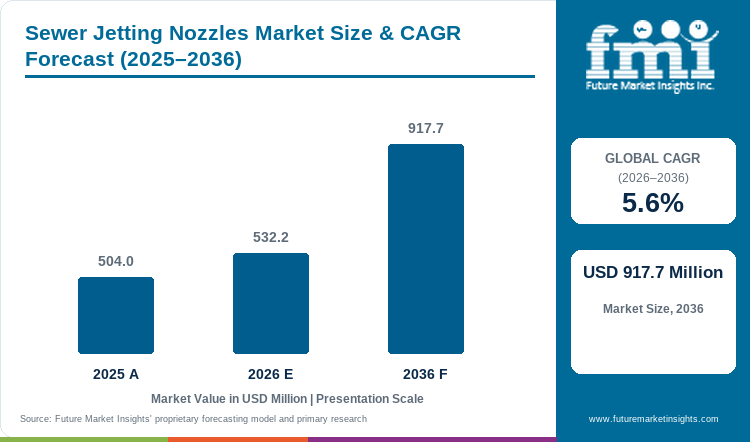
The sewer jetting nozzles market is valued at USD 532.2 million in 2026 and is projected to reach USD 917.7 million by 2036, expanding at a CAGR of 5.6% over the 2026-2036 period.
Demand for sewer jetting nozzles is projected to expand at 5.6% CAGR between 2026 and 2036. Industry value grows from USD 504.0 million in 2025 to USD 532.2 million in 2026 and is projected to reach USD 917.7 million by 2036. Municipal crews are replacing worn nozzle heads while keeping compatible jetters in service. Regular blockage work is keeping high-pressure cleaning active and is creating steady replacement demand for nozzle heads. The U.S. EPA listed blockages among the causes of sanitary sewer overflows in April 2026. The April 2026 EPA source estimated 23,000 to 75,000 sanitary sewer overflow events each year. Crews are choosing flushing, penetrating, rotating, or cutting heads based on the material they need to remove. Pump flow and hose losses are controlling how much useful cleaning force reaches the pipe.
Sewer fleets are facing different needs because countries are adding and maintaining sewer systems at different speeds. Brazil is adding new sewer assets, while UK and German operators are spending more on mature networks. In January 2026, Brazil's Ministry of Cities reported two project selections made in December 2025. The ministry said those projects were expected to benefit more than 13 million people. More sewer lines are giving local crews a larger network to inspect, flush, and clear over time. UK operators are focusing on nozzles that match pumps and hoses already in service. German operators are placing more weight on wear life and pump-and-nozzle fit because many jetters remain in use for years. Australian utilities are covering long routes, so nearby depots are keeping several nozzle types ready for different pipe conditions.
Key Takeaways
- Routine sewer cleaning and blockage work are keeping city and service fleets supplied with job-specific nozzles.
- Flushing nozzles are estimated to hold 24.0% of nozzle type demand in 2026 because crews are using them for routine debris removal.
- The 2,000-4,000 psi band is estimated to hold 39.0% of pressure-rating demand in 2026 because many professional jetters are using this range.
- Stainless steel is estimated to hold 36.0% of material demand in 2026 because reusable nozzle bodies need rust resistance and precise machining.
- Poor nozzle matching is cutting cleaning power because pump output and hose losses are different across jobs.
- Some of the key players in this market include Enz Technik, Warthog / StoneAge, KEG Technologies, NozzTeq, USB-USA, AquaTeq, Rioned, R+M de Wit, Hammelmann, and Spartan Tool.
Analyst Perspective
"Municipal fleets are giving nozzle makers a clear opportunity to sell matched heads while crews keep complete jetters in service. Manufacturers need simple proof of cleaning force and flow fit because older pumps and hoses are different across fleets."
- Nikhil Kaitwade, Principal Consultant, Future Market Insights
How is the sewer jetting nozzles market segmented?
The sewer jetting nozzles market is segmented six ways: by Nozzle Type, Pressure Rating, Material, End Use, Sales Channel, and Region. Flushing nozzles lead the Nozzle Type category with 24.0% of 2026 demand, 2,000-4,000 psi leads the Pressure Rating category with 39.0%, stainless steel leads the Material category with 36.0%, municipal sewer cleaning leads the End Use category with 34.0%, and sewer equipment dealers lead the Sales Channel category with 38.0%.
The sewer jetting nozzles market is segmented by nozzle type, pressure rating, material, end use, sales channel, and region for the 2026 to 2036 forecast period. Nozzle type covers flushing, penetrating, rotating, root cutting, sand - sludge, and hydro-excavation nozzles. Pressure bands are below 2,000 psi, 2,000-4,000 psi, 4,000-10,000 psi, and above 10,000 psi. Materials are stainless steel, hardened steel, ceramic insert, and tungsten carbide insert. End uses are municipal sewer cleaning, industrial drain cleaning, contract cleaning services, oil & grease removal, and hydro-excavation. Sales channels are sewer equipment dealers, direct manufacturer, rental - service fleets, and online - catalog. Regions are North America, Latin America, Western Europe, Eastern Europe, East Asia, South Asia and Pacific, and Middle East and Africa.
How do flushing nozzles shape demand within the nozzle type category?
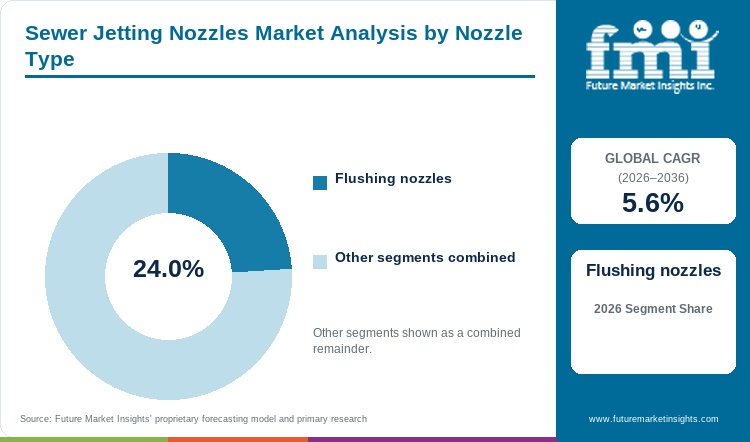
Crews are using flushing nozzles with rear jets to pull hoses and carry loose debris through sewer pipes. Crews are choosing these heads for plumbing drain cleaning jobs that need debris transport instead of cutting. Sydney Water reported that roots caused 48.1% of recorded sewer blockages in May 2026. Water jets are clearing loose material so cutting heads can reach roots with less obstruction. The blockage mix is keeping flushing and cutting tools available within the same municipal fleet.
- By nozzle type, flushing nozzles are projected to account for 24.0% in 2026 because crews are using them for routine debris removal.
- Crews are using flushing heads to restore flow and carry loose debris before switching to cutting tools for harder obstructions.
Why does 2,000-4,000 psi shape pressure-rating selection?
Pressure rating shows how much load a nozzle can handle within jetter and hose limits. Crews are checking water flow from high-pressure pumps because pressure alone does not determine cleaning force. Rioned introduced the updated AquaJet with pressure options from 140 to 200 bar in July 2025. Rioned is offering the model with flow rates from 45 to 70 lpm for different cleaning setups. Crews are using nozzle openings that match available pressure and water flow during field work.
- By pressure rating, the 2,000-4,000 psi band is estimated to hold 39.0% in 2026 because many professional jetters are using this range.
- Operators are matching nozzle opening size with available flow so the pump is delivering useful cleaning force during sewer cleaning.
How does stainless steel support the material category?
Stainless steel resists rust and allows precise machining of water passages in reusable nozzle bodies. Harder inserts are protecting smaller wear points that face abrasive water flow during sewer cleaning. Enz Technik introduced the KBR 16 with enhanced thrust jets and a hardening process in June 2025. The design is keeping the main body strong while adding extra protection at high-wear points. Crews are replacing worn inserts instead of changing the complete nozzle body.
- By material, stainless steel is forecast to represent 36.0% in 2026 since reusable nozzle bodies need rust resistance and precise machining.
- Ceramic and tungsten carbide inserts are protecting concentrated wear points without requiring a harder material across the complete nozzle body.
What supports municipal sewer cleaning within the end use category?
City sewer networks need planned cleaning and fast blockage response across many pipe conditions. Utility fleets are using storm water cleaning contractors for larger jobs and urgent public-network work. ASCE gave United States wastewater infrastructure a D+ grade in its March 2025 report. The report called for more asset checks and investment across wastewater systems nationwide. The maintenance need is keeping flushing and root-removal nozzles active within municipal fleets through regular service cycles.
- By end use, municipal sewer cleaning is estimated to hold 34.0% in 2026 as public networks need planned cleaning and blockage response.
- Municipal fleets are using replacement heads on existing pumps instead of buying a complete machine for routine cleaning.
What drives sewer equipment dealers within the sales channel category?
Dealers are matching nozzles with existing pumps and hoses across each fleet's job mix. Local stock is reducing delays during urgent blockage calls and planned maintenance work. Rioned named Prestec as its Swedish dealer for high-pressure equipment in December 2025. Prestec took responsibility for local sales and maintenance in January 2026. Fleets are using one local channel for nozzle matching, replacement parts, and machine service. Dealers are supporting vacuum truck fleets that combine jetting and suction during municipal and contractor service calls.
- By sales channel, sewer equipment dealers are estimated to hold 38.0% in 2026 because fleets need local stock and practical sizing support.
- Direct manufacturer sales are serving fleets that need custom tools or unusual nozzle sizes and designs.
What are the drivers, restraints and opportunities in the Sewer Jetting Nozzles Market?
In the sewer jetting nozzles market, the key driver is planned cleaning and blockage response that keeps crews supplied with task-specific nozzles for routine network work, the key restraint is poor pump-and-nozzle matching that reduces field performance, and the key opportunity is digital sizing tools and dealer support that help fleets choose the right nozzle with fewer setup mistakes.
- Driver: Planned cleaning and blockage response are keeping crews supplied with task-specific nozzles for routine network work.
- Restraint: Pump flow and hose losses are reducing cleaning power in nozzle setups with incorrect pump-and-nozzle sizing.
- Opportunity: Digital sizing tools and dealer support are helping fleets choose the right nozzle with fewer setup mistakes.
Daily sewer maintenance is keeping nozzle replacement active
City sewer crews are keeping lines open during upgrade projects and daily service across public networks. The Environment Agency described work on storm overflows and other sewer problems across England in November 2025. Construction work and daily service are creating a steady need to remove grit and loosened blockage material from pipes. Drain cleaning chemicals are treating some deposits, while water jets are carrying loose material through the sewer. Worn jets are losing cleaning force and are pushing crews to replace the head before replacing the complete jetter. Long cleaning hours are keeping several nozzle types in regular fleet use for planned maintenance and urgent blockage response.
Poor pump-and-nozzle matching is reducing cleaning performance
Nozzle performance depends on how well the head matches the jetter's available water output. Pump flow and hose length are controlling how much water reaches the nozzle. Nozzle opening size and pipe shape are changing cleaning force and reach inside the pipe. Rioned documented AquaJet pump integration with automatic bypass control in October 2025. The control is changing pump response as operating load changes. A poor nozzle opening size can waste water and reduce cleaning force at the pipe wall. Dealers are checking pump flow and hose length before fitting nozzles to drain cleaning equipment. A poor match can force extra cleaning passes or delay a higher-priced nozzle purchase.
Sizing support is helping dealers prevent wrong nozzle orders
Many fleets are keeping the same pumps and hoses on service vehicles already in use. Enz Technik launched MyEnz for sewer truck nozzle settings in April 2025. Crews are using the app to calculate settings from truck data and save them for later jobs. Dealers are starting nozzle orders with known machine data instead of guessing from pressure alone. Inspection robots are recording pipe size and blockage details before cleaning starts. Those records are helping dealers match each nozzle head to the machine and job. The same records are guiding insert replacement as nozzle wear increases. Better setup is cutting trial runs and is returning the jetter to service faster. Correct sizing is reducing orders for heads that cannot use the fleet's available flow.
What are the country CAGRs in the Sewer Jetting Nozzles Market?
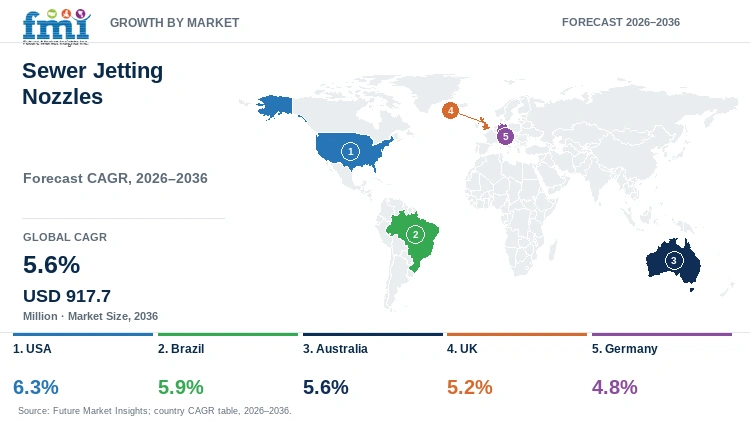
| Country | CAGR |
|---|---|
| USA | 6.3% |
| Brazil | 5.9% |
| Australia | 5.6% |
| UK | 5.2% |
| Germany | 4.8% |
How do country-level CAGRs compare in the Sewer Jetting Nozzles Market?
Brazil is adding sewer systems that need first-time cleaning and long-term maintenance. UK and German operators are spending more on keeping mature networks working with existing jetters. U.S. fleets are facing mixed pump and hose setups, while Australian crews are covering long service routes. These differences are changing which nozzles fleets keep in stock and how much sizing support they need.
- Across the USA, mixed municipal and contractor fleets are increasing demand for nozzle sizing support across different pump setups.
- Brazil's expanding sewer base is giving local crews more lines to clean, so dealers are stocking common nozzle sizes.
- Australian service routes are long, so local depots are keeping common nozzles nearby for urgent sewer work.
- UK water firms are relying on formal service contracts that reward clear nozzle sizing and local replacement support.
- German operators are favoring replaceable nozzle inserts for mature jetters kept in service through planned maintenance cycles.
These operating conditions are shaping sewer nozzle buying across different regions. The full report examines North America, Latin America, Western Europe, and Eastern Europe. The report also covers East Asia, South Asia and Pacific, and the Middle East and Africa.
Country-wise Analysis
- Sewer jetting nozzle demand in the United States is forecast to rise at 6.3% CAGR over the forecast period because mixed fleets are keeping public-network cleaning active. City crews and private service firms are using jetters with different pumps, hoses, and nozzle connections across service areas. EPA added sewer overflow and bypass event data to its national ECHO database in May 2025. Federal permit records are giving operators one place to review event sites, causes, and reported fixes. Different machine setups are making nozzle sizing harder across service areas. Dealers are checking pump flow and hose details before a replacement head enters service. Flow checks matter because one nozzle size cannot suit every pump and hose setup. Local stock is helping crews get matched heads quickly during urgent blockage calls.
- Brazil is estimated to post 5.9% CAGR over the forecast period as new sanitation projects are adding sewer assets. New projects are adding sewer lines and wastewater treatment equipment that local operators must inspect and maintain. The Ministry of Cities reported contracts for 255 sanitation projects in January 2026. The ministry said those projects were expected to benefit 3 million families. More sewer assets are increasing the number of lines crews must clean over time. Fleet managers are asking for pump and flow data before approving higher-priced heads. Dealers are using sizing charts and field training to reduce wrong orders across different jetters. Stocked common sizes are helping suppliers serve new systems and older networks without replacing installed machines.
- Demand for sewer jetting nozzles in Australia is estimated to expand at 5.6% CAGR through 2036 as utilities are maintaining networks across long service routes. Utilities are covering long distances between towns and remote work sites, so crews are carrying several nozzle types. The Bureau of Meteorology opened data entry for the national 2025-26 water performance cycle in July 2026. Service providers are reporting sewer main breaks, leaks, and chokes through that national program. Utilities are using flushing and cutting heads that match jetters already in service across varied pipe conditions. Local depots are reducing travel delays by stocking common heads near utility and contractor work areas. Providers of vacuum excavation services are supporting crews that use high-pressure water for field work. Flow charts are helping those crews avoid wrong orders during urgent sewer cleaning.
- Sewer jetting nozzle sales in the UK are forecast to expand at 5.2% CAGR by 2036 because formal service contracts are guiding buying across mature utility fleets. Water firms are buying sewer tools through planned programs that need clear technical and service terms. Water UK moved standards work into a new Standards Network in May 2026. The network is giving water companies one forum for shared technical guidance. Contract terms are delaying nozzle orders when flow data or service duties remain unclear. Manufacturers are providing sizing data and local parts support for utility and contractor agreements. Complete records are helping compatible heads enter field service with fewer setup delays across established fleets. Utilities are using outside drainage contractors under service agreements that require dependable replacement support.
- In Germany, sewer jetting nozzle demand is predicted to advance at 4.8% CAGR through 2036 because operators are maintaining mature wastewater systems through repair and replacement work. A large established wastewater network is keeping cleaning work active even without major network expansion. Destatis published wastewater tariff data for the 2025 service year in March 2026. Its March 2026 dataset counted 52.49 million residents in areas with both wastewater and stormwater fees. Utilities are renewing some sewer sections with polyolefin pipe while older sections remain in service. The mixed asset base is keeping nozzle replacement tied to maintenance and renewal work. Operators are asking for a clear wear-life case and pump settings before approving higher-priced nozzles. Replaceable inserts are reducing replacement costs while operators keep existing pumps and hoses in use.
Who are the notable companies in the Sewer Jetting Nozzles Market?
Notable companies in the sewer jetting nozzles market include Enz Technik, Warthog / StoneAge, KEG Technologies, NozzTeq, USB-USA, AquaTeq, Rioned, R+M de Wit, Hammelmann, and Spartan Tool.
Specialist nozzle makers are building heads for different debris types, pipe sizes, and wear conditions. Enz Technik, KEG Technologies, NozzTeq, USB-USA, and AquaTeq are offering several sewer-cleaning head families for municipal and contractor work. Rioned and Spartan Tool are matching nozzle choice with jetter models, pump output, hose size, and dealer support. Warthog / StoneAge, R+M de Wit, and Hammelmann are supplying high-pressure tools for demanding cleaning and cutting jobs. Fleets need clear pump-match data and ready spare parts before adding a new supplier. Combination units are combining jetting and suction on one service vehicle. Fleet managers are comparing nozzle fit, wear parts, dealer response, and price against equipment already in service.
- Enz Technik, KEG Technologies, NozzTeq, USB-USA, and AquaTeq are making sewer nozzles and wear parts for specific cleaning jobs.
- Warthog / StoneAge, R+M de Wit, and Hammelmann are offering high-pressure tools for demanding pipe-cleaning applications.
- Rioned and Spartan Tool are matching nozzle choice with jetters, controls, dealer support, and fleet service.
Competitive Benchmarking: Sewer Jetting Nozzles Market
| Company | Nozzle Range | Pump and Flow Setup Support | Job Tool Range | Geographic Reach |
|---|---|---|---|---|
| Enz Technik | High | High | High | Global |
| Warthog / StoneAge | High | High | High | North America and Europe |
| KEG Technologies | High | High | High | North America and international distribution |
| NozzTeq | High | High | High | North America and Europe |
| USB-USA | High | High | High | North America |
| AquaTeq | High | High | High | Europe and international distribution |
| Rioned | High | High | High | Global |
| R+M de Wit | High | Medium | High | Europe and international distribution |
| Hammelmann | Medium | High | Medium | International industrial water-jet channels |
| Spartan Tool | High | High | High | North America |
Benchmark scores show how much published evidence each company provides. For nozzle range, High means several sewer-nozzle families for different jobs. Medium means fewer documented families, and Low means one documented type. For pump and flow setup support, High means published pressure and flow guidance, a sizing calculator, or clear machine-matching instructions. Medium means partial guidance, and Low means limited public support. For job tools, High means several nozzles, cutters, or accessories for different tasks. Medium means a smaller documented set, and Low means limited tool coverage. Geographic reach shows where official company material confirms sales or service. AquaTeq's warranty names NozzTeq Inc. as an affiliate in the same group. The table keeps both brands separate because each sells products under its own name.
Key Developments in the Sewer Jetting Nozzles Market
- In June 2026, AquaTeq Sweden AB completed a two-day high-pressure jetting training program for Swedish and Norwegian operators in Kalmar. The training is building hands-on jetting skills for local operators.
- In March 2026, Rioned introduced the MaxCom 18T combination unit with 200 bar at 100 lpm jetting output for urban sewer work. The unit is giving crews one platform for high-pressure cleaning and suction work.
- In October 2025, Enz Technik introduced its 28 mm guiding nozzle with JetMax ceramic inserts for pipe inlets and branches. The nozzle is supporting cleaning work in confined pipe areas.
Key Players in the Sewer Jetting Nozzles Market
Specialist Sewer-Nozzle Engineering
- Enz Technik
- KEG Technologies
- NozzTeq
- USB-USA
- AquaTeq
High-Pressure Tool and Nozzle Platforms
- Warthog / StoneAge
- R+M de Wit
- Hammelmann
Jetter-System and Channel Integration
- Rioned
- Spartan Tool
Sewer Jetting Nozzles Market - Report Scope
| Coverage field | Report scope |
|---|---|
| Market breakdown | By nozzle type, pressure rating, material, end use, sales channel and region. |
| Quantitative Units | USD million. |
| Market Definition | Sewer jetting nozzles used with high-pressure water systems for blockage removal, flushing, cutting, sediment transport and related sewer or drain cleaning duties. |
| Regions Covered | North America, Latin America, Western Europe, Eastern Europe, East Asia, South Asia and Pacific, and Middle East and Africa. |
| Countries Covered | USA, Brazil, Australia, UK, Germany, and 20+ countries included in the full report. |
| Key Companies Covered | Enz Technik, Warthog / StoneAge, KEG Technologies, NozzTeq, USB-USA, AquaTeq, Rioned, R+M de Wit, Hammelmann, and Spartan Tool. |
| Forecast Period | 2026 to 2036. |
| Approach | Primary and secondary research with market triangulation. |
Sewer Jetting Nozzles Market - Research Methodology
| Method | Approach |
|---|---|
| Primary Research | FMI analysts gathered input from manufacturers, service providers, technology developers, distributors, end users, procurement teams, and subject-matter experts. Interviews examined purchasing decisions, product or service evaluation, adoption barriers, approval requirements, pricing considerations, and expectations for technical or commercial support. Respondents were also asked what evidence is required before a trial, pilot, or initial order develops into regular purchasing. |
| Desk Research | Desk research covered government statistics, regulatory publications, trade data, industry associations, technical literature, standards, company filings, product information, and official corporate announcements. Sources were reviewed for relevance, publication date, geographic coverage, and consistency with the defined market scope. Claims relating to performance, applications, approvals, capacity, investment, and commercial activity were retained only when supported by credible public evidence. |
| Market Sizing and Forecasting | The market model combined the baseline value with historical performance, segment structure, pricing and volume indicators, adoption levels, company participation, and country-level demand conditions. Forecast assumptions considered economic activity, investment trends, regulatory developments, technology adoption, purchasing cycles, supply availability, and barriers to wider market use. Segment and regional estimates were reconciled before the final market total was calculated. |
| Data Validation | Estimates were checked against multiple independent indicators, including public data, company activity, trade patterns, industry developments, and findings from primary interviews. Validation also tested whether products, services, applications, and company revenues fell within the defined market boundaries. Adjacent categories, unsupported claims, overlapping revenues, and activities without direct market relevance were excluded to reduce double counting and maintain consistency across segments and countries. |
Sewer Jetting Nozzles Market by Segments
Sewer Jetting Nozzles Market segmented by Nozzle Type:
- Flushing nozzles
- Penetrating nozzles
- Rotating nozzles
- Root cutting nozzles
- Sand - sludge nozzles
- Hydro-excavation nozzles
Sewer Jetting Nozzles Market segmented by Pressure Rating:
- 2,000-4,000 psi
- Below 2,000 psi
- 4,000-10,000 psi
- Above 10,000 psi
Sewer Jetting Nozzles Market segmented by Material:
- Stainless steel
- Hardened steel
- Ceramic insert
- Tungsten carbide insert
Sewer Jetting Nozzles Market segmented by End Use:
- Municipal sewer cleaning
- Industrial drain cleaning
- Contract cleaning services
- Oil & grease removal
- Hydro-excavation
Sewer Jetting Nozzles Market segmented by Sales Channel:
- Sewer equipment dealers
- Direct manufacturer
- Rental - service fleets
- Online - catalog
Sewer Jetting Nozzles Market by Region:
- North America
- United States
- Canada
- Latin America
- Brazil
- Mexico
- Chile
- Rest of Latin America
- Western Europe
- Germany
- United Kingdom
- Italy
- Spain
- France
- Nordics
- Benelux
- Rest of Western Europe
- Eastern Europe
- Russia
- Poland
- Hungary
- Balkan and Baltic States
- Rest of Eastern Europe
- East Asia
- China
- Japan
- South Korea
- South Asia and Pacific
- India
- ASEAN
- Australia and New Zealand
- Rest of South Asia and Pacific
- Middle East and Africa
- Kingdom of Saudi Arabia
- Other GCC Countries
- Türkiye
- South Africa
- Other African Union Countries
- Rest of Middle East and Africa
Research Sources and Bibliography
- U.S. Environmental Protection Agency. (2026, April 13). Sanitary Sewer Overflows (SSOs).
- Ministério das Cidades. (2026, January 14). Brazil records a year of investment and advances in basic sanitation.
- Sydney Water. (2026, May 4). Annual Environmental Performance Report.
- Rioned. (2025, July 15). Why the New Rioned AquaJet Is a Smarter Choice for Today’s Drainage Professionals.
- enz technik ag. (2025, June 10). KBR 16 with enhanced thrust jets.
- American Society of Civil Engineers. (2025, March 25). 2025 Infrastructure Report Card: Wastewater Infrastructure.
- Rioned. (2025, December 15). New Rioned Dealer in Sweden: Prestec Strengthens Our Network.
- Environment Agency. (2025, November 21). Environment Agency Chief Regulator’s report 2024-25.
- Rioned. (2025, October 1). The Honda iGX800 Engine and Speck Triplex Pump: Powering the Next Generation AquaJet.
- enz technik ag. (2025, April 28). The new MyEnz App is here!
- U.S. Environmental Protection Agency. (2025, May). Sewer Overflow and Bypass Event Data Added to ECHO.
- Bureau of Meteorology. (2026, July 1). National Performance Report 2025-26: Guidance memo for service providers with less than 10,000 connected properties.
- Water UK. (2026, May 5). Water UK Standards Management Transition.
- Federal Statistical Office of Germany (Destatis). (2026, March 27). Selected wastewater fees by tariff type, 2023 to 2025.
- AquaTeq Sweden AB. (n.d.). Limited Warranty. Retrieved September 22, 2026.
- Rioned. (2026, March 3). Rioned Strengthens Its JetVac Line-Up with the Urban-Ready MaxCom 18T.
- enz technik ag. (2025, October 2). New Guiding Nozzle 28 mm - compact, powerful and versatile.
- Warthog Sewer Nozzles. (2025, June 24). Same Place, New Face: Jetting Calculator Just Got a Major Upgrade.
- Rioned. (2026, June 17). New MSE camera systems: greater control, clearer insight, maximum efficiency.
- Rioned. (2026, June 10). CityJet + RioConnect: The New Standard in Connected Jetting.
- Rioned. (2025, March 4). Why Rioned’s New 2-Year Warranty Sets Us Apart.
- enz technik ag. (2026, June 11). Product update: AI-powered analysis for camera-nozzle video on MyEnz.
- StoneAge. (2025, April 29). It’s Time for an Update - Sentinel Link 2.2.1 Now Available.
- KEG Kanalreinigungstechnik GmbH. (2025, March 3). RO-KA-TECH, Kassel - 13.05. - 16.05.2025.
- Village of South Glens Falls. (2026, January 21). Regular Village Board Meeting minutes.
- United States Patent and Trademark Office. (2025, September 23). U.S. Patent No. 12,420,318: Cleaning nozzle for cleaning pipes.
- AquaTeq Sweden AB. (2026, June 5). Summer jetting training completed in Kalmar!
- Rioned. (2026, April 8). MaxCom powers growth for a Belgian drainage contractor.
- R+M / Suttner. (2025, February 27). New construction and renovation for Suttner in Lemgo.
- Hammelmann GmbH. (2026, June 26). Groundbreaking for new service center: Investment in customer proximity and future viability.
- Spartan Tool. (2025, April 16). eUrban Soldier: Leading the Charge in Electric Sewer Jetting.
The bibliography lists selected public sources used in the analysis. Additional references and detailed citations support the complete report.
This Report Answers
- What is the market size in 2026 and 2036?
- What keeps sewer jetting nozzle demand recurring?
- Why do flushing nozzles hold 24.0% share in 2026?
- How does the 2,000-4,000 psi band affect nozzle selection?
- Why does stainless steel hold 36.0% of material demand?
- Why do growth conditions differ among the five countries?
- Which supplier capabilities matter beyond unit price?
- What limits useful field performance at nominal pressure?
- Why does municipal sewer cleaning create recurring replacement demand?
Frequently Asked Questions
How big is the sewer jetting nozzles market in 2026?
The sewer jetting nozzles market reaches USD 532.2 million in 2026. Market value is projected to reach USD 917.7 million by 2036 because fleets are replacing worn heads while keeping compatible jetters in service.
What CAGR is projected for sewer jetting nozzles through 2036?
The sewer jetting nozzles market is projected to grow at 5.6% CAGR through 2036. Routine sewer upkeep is keeping crews supplied with job-specific heads as old nozzles wear and cleaning tasks change.
Which nozzle type leads sewer jetting nozzles?
Flushing nozzles hold 24.0% of nozzle type demand in 2026. Rear jets are moving loose debris during routine cleaning, so crews are keeping compatible jetter systems in service.
Which end-use segment leads sewer jetting nozzles?
Municipal sewer cleaning holds 34.0% of end-use demand in 2026. Public networks require planned cleaning throughout the year, while crews are responding quickly when blockages stop normal flow.
Which pressure-rating segment leads sewer jetting nozzles?
The 2,000-4,000 psi segment holds 39.0% of pressure-rating demand in 2026. Many professional jetters are using this range for routine sewer work with matched water flow.
What are the country CAGRs for sewer jetting nozzles?
USA demand is projected to grow at 6.3% CAGR through 2036 across mixed municipal and contractor fleets. Brazil is estimated to post 5.9% CAGR through 2036 as sanitation projects expand local sewer assets. Australia is projected to grow at 5.6% CAGR through 2036 for sewer jetting nozzles.
Which companies are active in sewer jetting nozzles?
Active companies include Enz Technik, Warthog / StoneAge, KEG Technologies, NozzTeq, USB-USA, AquaTeq, Rioned, R+M de Wit, Hammelmann, and Spartan Tool. Their product lines differ in nozzle design, flow support, job tools, and local service reach.
Preview the report firsthand - request a free sample
Get SampleGet the brochure for pricing and purchase details.
Get PDFTable of Content
- Key Takeaways
- Market Size and CAGR
- Top Growth Driver
- Fastest Growing Segment
- Leading Region
- Key Companies
- Emerging Opportunities
- Executive Summary
- Global Market Outlook
- Demand-side Trends
- Supply-side Trends
- Technology Roadmap Analysis
- Analysis and Recommendations
- Analyst Perspective (What is happening? Why now? What should investors know?)
- Key Questions Answered
- How large is the market?
- What is the CAGR?
- What are key trends?
- Which region dominates?
- Who are the leaders?
- Market Overview
- Market Coverage / Taxonomy
- Market Definition / Scope / Limitations
- Research Methodology
- Chapter Orientation
- Analytical Lens and Working Hypotheses
- Market Structure, Signals, and Trend Drivers
- Benchmarking and Cross-market Comparability
- Market Sizing, Forecasting, and Opportunity Mapping
- Research Design and Evidence Framework
- Desk Research Programme (Secondary Evidence)
- Expert Input and Fieldwork (Primary Evidence)
- Tooling, Models, and Reference Databases
- Data Engineering and Model Build
- Quality Assurance and Audit Trail
- Market Background
- Market Dynamics (Drivers, Restraints, Opportunity, Trends)
- Scenario Forecast (Optimistic, Likely, Conservative)
- Impact Analysis
- AI Impact
- Sustainability Impact
- Regulatory Impact
- Technology Impact
- Consumer / Buyer Analysis
- Purchase Drivers
- Adoption Barriers
- Buyer Journey
- Opportunity Map Analysis
- Product Life Cycle Analysis
- Supply Chain Analysis
- Investment Feasibility Matrix
- Value Chain Analysis
- PESTLE and Porter's Analysis
- Regulatory Landscape
- Regional Parent Market Outlook
- Production and Consumption Statistics
- Import and Export Statistics
- Global Market Analysis and Forecast, 2021 to 2036
- Historical Market Size Value (USD Million) Analysis, 2021 to 2025
- Current and Future Market Size Value (USD Million) Projections, 2026 to 2036
- Y-o-Y Growth Trend Analysis
- Absolute $ Opportunity Analysis
- Global Market Pricing Analysis, 2021 to 2036
- Global Market Analysis and Forecast, By Nozzle Type, 2021 to 2036
- Introduction / Key Findings
- Historical Market Size Value (USD Million) Analysis By Nozzle Type, 2021 to 2025
- Current and Future Market Size Value (USD Million) Analysis and Forecast By Nozzle Type, 2026 to 2036
- Flushing nozzles
- Penetrating nozzles
- Rotating nozzles
- Root cutting nozzles
- Sand - sludge nozzles
- Hydro-excavation nozzles
- Y-o-Y Growth Trend Analysis By Nozzle Type, 2021 to 2025
- Absolute $ Opportunity Analysis By Nozzle Type, 2026 to 2036
- Global Market Analysis and Forecast, By Pressure Rating, 2021 to 2036
- Introduction / Key Findings
- Historical Market Size Value (USD Million) Analysis By Pressure Rating, 2021 to 2025
- Current and Future Market Size Value (USD Million) Analysis and Forecast By Pressure Rating, 2026 to 2036
- 2,000-4,000 psi
- Below 2,000 psi
- 4,000-10,000 psi
- Above 10,000 psi
- Y-o-Y Growth Trend Analysis By Pressure Rating, 2021 to 2025
- Absolute $ Opportunity Analysis By Pressure Rating, 2026 to 2036
- Global Market Analysis and Forecast, By Material, 2021 to 2036
- Introduction / Key Findings
- Historical Market Size Value (USD Million) Analysis By Material, 2021 to 2025
- Current and Future Market Size Value (USD Million) Analysis and Forecast By Material, 2026 to 2036
- Stainless steel
- Hardened steel
- Ceramic insert
- Tungsten carbide insert
- Y-o-Y Growth Trend Analysis By Material, 2021 to 2025
- Absolute $ Opportunity Analysis By Material, 2026 to 2036
- Global Market Analysis and Forecast, By End Use, 2021 to 2036
- Introduction / Key Findings
- Historical Market Size Value (USD Million) Analysis By End Use, 2021 to 2025
- Current and Future Market Size Value (USD Million) Analysis and Forecast By End Use, 2026 to 2036
- Municipal sewer cleaning
- Industrial drain cleaning
- Contract cleaning services
- Oil & grease removal
- Hydro-excavation
- Y-o-Y Growth Trend Analysis By End Use, 2021 to 2025
- Absolute $ Opportunity Analysis By End Use, 2026 to 2036
- Global Market Analysis and Forecast, By Sales Channel, 2021 to 2036
- Introduction / Key Findings
- Historical Market Size Value (USD Million) Analysis By Sales Channel, 2021 to 2025
- Current and Future Market Size Value (USD Million) Analysis and Forecast By Sales Channel, 2026 to 2036
- Sewer equipment dealers
- Direct manufacturer
- Rental - service fleets
- Online - catalog
- Y-o-Y Growth Trend Analysis By Sales Channel, 2021 to 2025
- Absolute $ Opportunity Analysis By Sales Channel, 2026 to 2036
- Global Market Analysis and Forecast, By Region, 2021 to 2036
- Introduction
- Historical Market Size Value (USD Million) Analysis By Region, 2021 to 2025
- Current Market Size Value (USD Million) Analysis and Forecast By Region, 2026 to 2036
- North America
- Latin America
- Western Europe
- Eastern Europe
- East Asia
- South Asia and Pacific
- Middle East and Africa
- Market Attractiveness Analysis By Region
- North America Market Analysis and Forecast, By Country, 2021 to 2036
- Historical Market Size Value (USD Million) Trend Analysis By Market Taxonomy, 2021 to 2025
- Market Size Value (USD Million) Forecast By Market Taxonomy, 2026 to 2036
- By Country
- United States
- Canada
- By Nozzle Type
- By Pressure Rating
- By Material
- By End Use
- By Sales Channel
- By Country
- Market Attractiveness Analysis
- By Country
- By Nozzle Type
- By Pressure Rating
- By Material
- By End Use
- By Sales Channel
- Key Takeaways
- Latin America Market Analysis and Forecast, By Country
- Historical Market Size Value (USD Million) Trend Analysis By Market Taxonomy, 2021 to 2025
- Market Size Value (USD Million) Forecast By Market Taxonomy, 2026 to 2036
- By Country
- Brazil
- Mexico
- Chile
- Rest of Latin America
- By Nozzle Type
- By Pressure Rating
- By Material
- By End Use
- By Sales Channel
- By Country
- Market Attractiveness Analysis
- By Country
- By Nozzle Type
- By Pressure Rating
- By Material
- By End Use
- By Sales Channel
- Key Takeaways
- Western Europe Market Analysis and Forecast, By Country
- Historical Market Size Value (USD Million) Trend Analysis By Market Taxonomy, 2021 to 2025
- Market Size Value (USD Million) Forecast By Market Taxonomy, 2026 to 2036
- By Country
- Germany
- United Kingdom
- Italy
- Spain
- France
- Nordics
- Benelux
- Rest of Western Europe
- By Nozzle Type
- By Pressure Rating
- By Material
- By End Use
- By Sales Channel
- By Country
- Market Attractiveness Analysis
- By Country
- By Nozzle Type
- By Pressure Rating
- By Material
- By End Use
- By Sales Channel
- Key Takeaways
- Eastern Europe Market Analysis and Forecast, By Country
- Historical Market Size Value (USD Million) Trend Analysis By Market Taxonomy, 2021 to 2025
- Market Size Value (USD Million) Forecast By Market Taxonomy, 2026 to 2036
- By Country
- Russia
- Poland
- Hungary
- Balkan and Baltic States
- Rest of Eastern Europe
- By Nozzle Type
- By Pressure Rating
- By Material
- By End Use
- By Sales Channel
- By Country
- Market Attractiveness Analysis
- By Country
- By Nozzle Type
- By Pressure Rating
- By Material
- By End Use
- By Sales Channel
- Key Takeaways
- East Asia Market Analysis and Forecast, By Country
- Historical Market Size Value (USD Million) Trend Analysis By Market Taxonomy, 2021 to 2025
- Market Size Value (USD Million) Forecast By Market Taxonomy, 2026 to 2036
- By Country
- China
- Japan
- South Korea
- By Nozzle Type
- By Pressure Rating
- By Material
- By End Use
- By Sales Channel
- By Country
- Market Attractiveness Analysis
- By Country
- By Nozzle Type
- By Pressure Rating
- By Material
- By End Use
- By Sales Channel
- Key Takeaways
- South Asia and Pacific Market Analysis and Forecast, By Country
- Historical Market Size Value (USD Million) Trend Analysis By Market Taxonomy, 2021 to 2025
- Market Size Value (USD Million) Forecast By Market Taxonomy, 2026 to 2036
- By Country
- India
- ASEAN
- Australia and New Zealand
- Rest of South Asia and Pacific
- By Nozzle Type
- By Pressure Rating
- By Material
- By End Use
- By Sales Channel
- By Country
- Market Attractiveness Analysis
- By Country
- By Nozzle Type
- By Pressure Rating
- By Material
- By End Use
- By Sales Channel
- Key Takeaways
- Middle East and Africa Market Analysis and Forecast, By Country
- Historical Market Size Value (USD Million) Trend Analysis By Market Taxonomy, 2021 to 2025
- Market Size Value (USD Million) Forecast By Market Taxonomy, 2026 to 2036
- By Country
- Kingdom of Saudi Arabia
- Other GCC Countries
- Türkiye
- South Africa
- Other African Union Countries
- Rest of Middle East and Africa
- By Nozzle Type
- By Pressure Rating
- By Material
- By End Use
- By Sales Channel
- By Country
- Market Attractiveness Analysis
- By Country
- By Nozzle Type
- By Pressure Rating
- By Material
- By End Use
- By Sales Channel
- Key Takeaways
- Key Countries Market Analysis
- United States
- Pricing Analysis
- Market Share Analysis, 2025
- By Nozzle Type
- By Pressure Rating
- By Material
- By End Use
- By Sales Channel
- Canada
- Pricing Analysis
- Market Share Analysis, 2025
- By Nozzle Type
- By Pressure Rating
- By Material
- By End Use
- By Sales Channel
- Mexico
- Pricing Analysis
- Market Share Analysis, 2025
- By Nozzle Type
- By Pressure Rating
- By Material
- By End Use
- By Sales Channel
- Brazil
- Pricing Analysis
- Market Share Analysis, 2025
- By Nozzle Type
- By Pressure Rating
- By Material
- By End Use
- By Sales Channel
- Chile
- Pricing Analysis
- Market Share Analysis, 2025
- By Nozzle Type
- By Pressure Rating
- By Material
- By End Use
- By Sales Channel
- Germany
- Pricing Analysis
- Market Share Analysis, 2025
- By Nozzle Type
- By Pressure Rating
- By Material
- By End Use
- By Sales Channel
- United Kingdom
- Pricing Analysis
- Market Share Analysis, 2025
- By Nozzle Type
- By Pressure Rating
- By Material
- By End Use
- By Sales Channel
- Italy
- Pricing Analysis
- Market Share Analysis, 2025
- By Nozzle Type
- By Pressure Rating
- By Material
- By End Use
- By Sales Channel
- Spain
- Pricing Analysis
- Market Share Analysis, 2025
- By Nozzle Type
- By Pressure Rating
- By Material
- By End Use
- By Sales Channel
- France
- Pricing Analysis
- Market Share Analysis, 2025
- By Nozzle Type
- By Pressure Rating
- By Material
- By End Use
- By Sales Channel
- India
- Pricing Analysis
- Market Share Analysis, 2025
- By Nozzle Type
- By Pressure Rating
- By Material
- By End Use
- By Sales Channel
- ASEAN
- Pricing Analysis
- Market Share Analysis, 2025
- By Nozzle Type
- By Pressure Rating
- By Material
- By End Use
- By Sales Channel
- Australia and New Zealand
- Pricing Analysis
- Market Share Analysis, 2025
- By Nozzle Type
- By Pressure Rating
- By Material
- By End Use
- By Sales Channel
- China
- Pricing Analysis
- Market Share Analysis, 2025
- By Nozzle Type
- By Pressure Rating
- By Material
- By End Use
- By Sales Channel
- Japan
- Pricing Analysis
- Market Share Analysis, 2025
- By Nozzle Type
- By Pressure Rating
- By Material
- By End Use
- By Sales Channel
- South Korea
- Pricing Analysis
- Market Share Analysis, 2025
- By Nozzle Type
- By Pressure Rating
- By Material
- By End Use
- By Sales Channel
- Russia
- Pricing Analysis
- Market Share Analysis, 2025
- By Nozzle Type
- By Pressure Rating
- By Material
- By End Use
- By Sales Channel
- Poland
- Pricing Analysis
- Market Share Analysis, 2025
- By Nozzle Type
- By Pressure Rating
- By Material
- By End Use
- By Sales Channel
- Hungary
- Pricing Analysis
- Market Share Analysis, 2025
- By Nozzle Type
- By Pressure Rating
- By Material
- By End Use
- By Sales Channel
- Kingdom of Saudi Arabia
- Pricing Analysis
- Market Share Analysis, 2025
- By Nozzle Type
- By Pressure Rating
- By Material
- By End Use
- By Sales Channel
- Türkiye
- Pricing Analysis
- Market Share Analysis, 2025
- By Nozzle Type
- By Pressure Rating
- By Material
- By End Use
- By Sales Channel
- South Africa
- Pricing Analysis
- Market Share Analysis, 2025
- By Nozzle Type
- By Pressure Rating
- By Material
- By End Use
- By Sales Channel
- Australia
- Pricing Analysis
- Market Share Analysis, 2025
- By Nozzle Type
- By Pressure Rating
- By Material
- By End Use
- By Sales Channel
- United States
- Market Structure Analysis
- Competition Dashboard
- Competition Benchmarking
- Market Share Analysis of Top Players
- By Regional
- By Nozzle Type
- By Pressure Rating
- By Material
- By End Use
- By Sales Channel
- Emerging Startups
- Innovation Benchmarking
- Competition Analysis
- Competition Deep Dive
- Enz Technik
- Overview
- Product Portfolio
- Profitability by Market Segments
- Sales Footprint
- Strategy Overview
- Marketing Strategy
- Product Strategy
- Channel Strategy
- Warthog / StoneAge
- KEG Technologies
- NozzTeq
- USB-USA
- AquaTeq
- Rioned
- R+M de Wit
- Hammelmann
- Spartan Tool
- Enz Technik
- Case Studies
- Success Stories
- Recent Developments
- Competition Deep Dive
- Assumptions & Acronyms Used


