

- Market Size (2026)
- USD 4.9 Bn
- Forecast (2036)
- USD 9.9 Bn
- CAGR (2026 to 2036)
- 7.4%
How big is the Vacuum Excavation Services Market in 2026?
The market is projected to expand steadily as utility renewal and damage prevention keep vacuum excavation tied to recurring field work.
Demand for vacuum excavation services is projected to expand at 7.4% CAGR between 2026 and 2036, increasing valuation from USD 4.9 billion in 2026 to USD 9.9 billion by 2036. Utility owners increasingly expose buried lines before mechanical digging starts because records and surface marks do not always show precise depth. The Common Ground Alliance reported a 96.7 CGA Index for 2024 in August 2025, which keeps damage prevention under close review. Contractors working near pipeline safety systems are expected to use hydrovac potholing when tolerance zones demand direct confirmation before heavier excavation begins.
China and India service accounts are projected to favor fast local mobilization around pipeline renewal and urban water work. United States and German accounts are expected to stress one-call records and operator qualifications before site release. Project teams compare hose reach and debris capacity before deciding which truck class fits each access point. India’s Press Information Bureau reported more than 7,943 completed urban infrastructure projects by June 2026. The completion base points to a broad field for locating and controlled exposure work. Procurement teams linked to water treatment programs are anticipated to ask whether a contractor has enough trained crews to mobilize without delaying shutdown windows. The final service decision often turns on response time after an unexpected utility conflict.
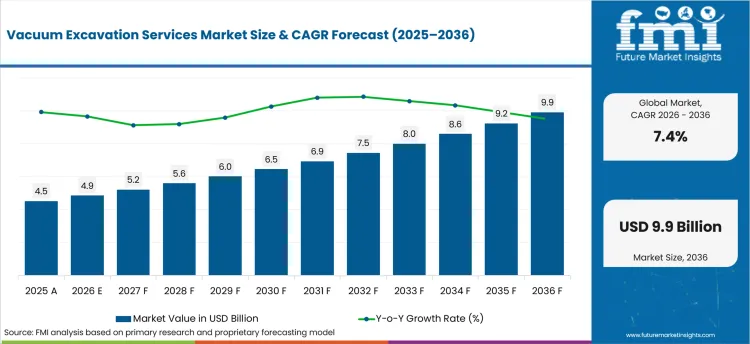
| Metric | Value |
|---|---|
| 2025 Market Size | USD 4.5 Billion |
| 2026 Market Size | USD 4.9 Billion |
| 2036 Market Size | USD 9.9 Billion |
| Forecast CAGR (2026-2036) | 7.4% |
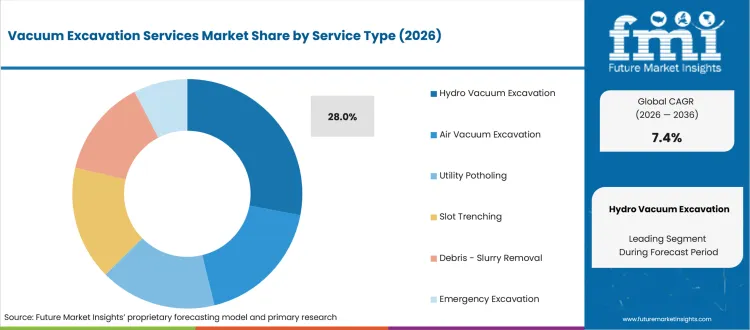
| Leading Service Type | Hydro Vacuum Excavation |
| Hydro Vacuum Excavation Share (2026) | 28.0% |
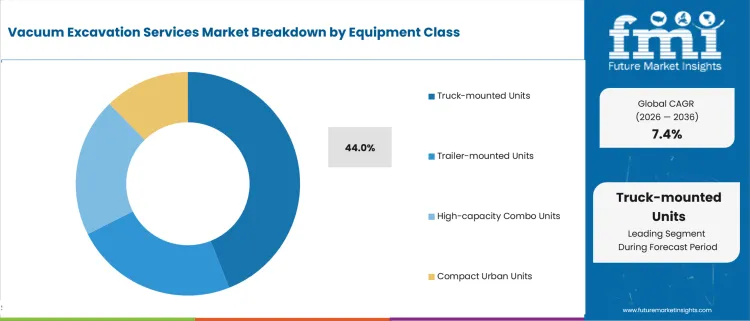
| Leading Equipment Class | Truck-mounted Units |
| Truck-mounted Units Share (2026) | 44.0% |
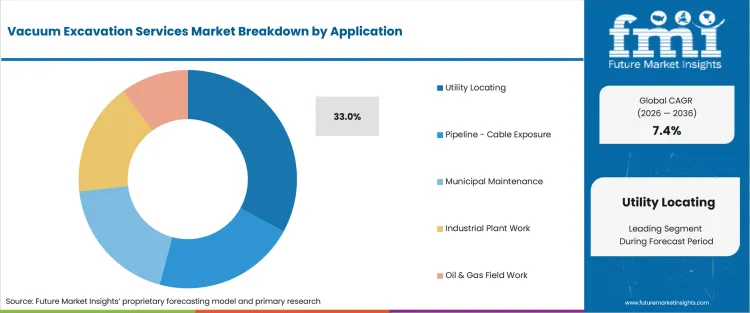
| Leading Application | Utility Locating |
| Utility Locating Share (2026) | 33.0% |
Summary of the Vacuum Excavation Services Market
| Market Signal | Commercial Impact |
|---|---|
| Demand and Growth Drivers | Service demand is expected to remain close to utility repair and buried-asset exposure work. Contractors use vacuum excavation when mechanical digging creates avoidable strike risk or restoration burden.
|
| Product and Segment View | Hydro excavation is projected to remain the central service format because pressurized water supports precise soil removal around buried assets. Truck-mounted units are expected to suit multi-stop field routes.
|
| Geography and Growth Outlook | Country demand is projected to split between infrastructure scale and service discipline. Dense utility corridors are expected to reward local mobilization while regulated accounts emphasize training and work records.
|
| Competitive Landscape | Competition is expected to turn on dispatch speed and operator quality instead of equipment ownership alone. Local branches are projected to improve response across recurring utility accounts.
|
| Analyst Perspective | Tolerance-zone work gives this service its commercial edge because crews must expose buried assets without turning the exposure step into another damage risk. Operator judgment therefore carries direct commercial weight.
|
Source: FMI's proprietary forecasting model and primary research
How is the vacuum excavation services market segmented?
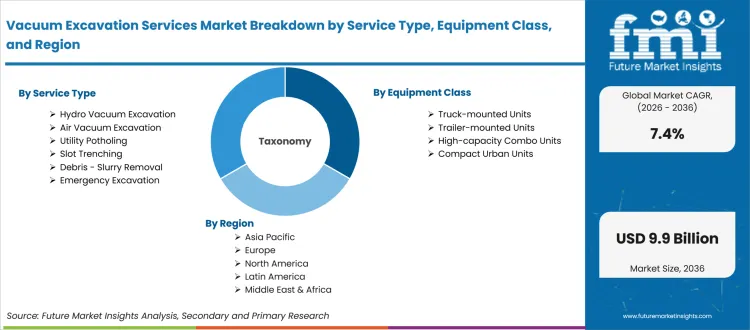
The vacuum excavation services industry is segmented by service type, equipment class, application, end use, contract type, and region.
The industry is segmented by service type, equipment class, application, end use, and contract type. Service type covers hydro vacuum excavation, air vacuum excavation, utility potholing, slot trenching, debris or slurry removal, and emergency excavation. Equipment class covers trailer-mounted units, truck-mounted units, high-capacity combo units, and compact urban units. Applications include utility locating, pipeline or cable exposure, municipal maintenance, industrial plant work, and oil or gas field work. End use covers utilities, construction contractors, municipalities, oil and gas operators, and telecom or fiber contractors. Contract type covers spot hire, project contracts, and long-term service agreements. Regional demand also connects fleet choice with compact construction equipment used on constrained sites.
What supports demand for hydro vacuum excavation within the service type category?
Hydro excavation crews work where a contractor needs soil removal and immediate spoil capture around live utilities. AIMS reported in September 2025 that its Las Vegas specialists performed remote hydrovac work beyond 200 feet from the truck through extended hose runs. That reach gives urban crews another way to handle fenced sites and congested streets without bringing the truck beside every exposure point.
- Based on service type, hydro vacuum excavation is projected to account for 28.0% in 2026 due to its fit with compacted soil and precise daylighting work. Clean Harbors reported 32% year-on-year Field Services revenue growth in April 2025, showing that broader field-service capacity expanded within its industrial network during the quarter.
- Hydro vacuum excavation is drawing demand from utility contractors due to the need to expose line depth before crossings and tie-ins begin. Teams that use equipment rental services are expected to compare operator availability and disposal logistics because an idle truck does not solve a narrow outage window during repairs.
How do utility contractors evaluate truck-mounted units within the equipment class category?
Truck-mounted units suit service routes that combine several exposure points with off-site slurry disposal. Vac-Ex detailed in July 2025 how tracked vacuum excavators address narrow access and unstable ground on utility and rail sites. The contrast helps fleets decide when road mobility and tank capacity outweigh the access benefit of smaller tracked equipment. Fleet planners then weigh access against haul-cycle efficiency.
- By equipment class, truck-mounted units are estimated to hold 44.0% in 2026 due to debris capacity and road mobility across multi-stop service routes. Badger planned hydrovac fleet growth of 4% to 7% for 2025 in its July 2025 update, which shows fleet investment remained tied to service demand overall.
- Utility and fiber contractors are projected to purchase truck-mounted service capacity driven by longer route days and the need to carry slurry away from crowded streets. Crews supporting direct-burial fiber projects are anticipated to value trucks that combine hose reach with enough tank capacity to finish several potholes before disposal locally.
What drives utility locating within the application category?
Utility locating starts before the excavation crew commits a bucket or bore head to the ground. PHMSA updated its State Damage Prevention Grant page in April 2026 and describes nine elements for effective damage-prevention programs. That policy setting keeps direct exposure work relevant when surface marks leave uncertainty about buried pipeline depth. Positive exposure turns uncertainty into a visible engineering decision point.
- In 2026, utility locating is expected to lead the application category with 33.0% share because project teams need depth confirmation at planned crossings. Ontario’s ORCGA recorded 3,933 underground utility damages in 2024. The damage record keeps potholing and clearance control close to contractor training during road and utility renewal work.
- Demand for utility locating is expected to grow among pipeline contractors supported by tie-in work and repair planning near live assets. Teams working under pipeline integrity programs are projected to favor service providers that document each exposed crossing because the record supports engineering review before backfill closes the site locally.
What are the drivers, restraints, and opportunities in the vacuum excavation services market?
Near-term purchases are projected to be supported by utility damage prevention, operator qualification burden, and pipeline renewal work outlined below.
- Driver: Utility owners are expected to book vacuum excavation when tolerance-zone work requires direct line exposure before heavier digging begins.
- Restraint: Long travel distances and slurry disposal steps are anticipated to weaken service economics on small jobs far from branch coverage.
- Opportunity: Pipeline renewal programs are projected to expand recurring potholing and emergency excavation work for contractors with trained local crews.
Utility owners face a basic field problem because drawings show route information but they do not remove uncertainty about depth at a crossing point. AIMS reported in December 2025 that Southern Hydro Vac had expanded from 2 trucks to 20. The fleet growth reflects recurring demand for precise exposure and response work across the Southeast. Contractors are expected to use hydrovac potholing more often where the permit or work plan requires positive exposure before drilling begins.
Public and pipeline work is expected to stall when operator records or site controls are incomplete before mobilization. PHMSA issued its Gas Pipeline Leak Detection and Repair final rule on January 17, 2025. The rule added another layer of procedure review around regulated gas systems. Vacuum excavation contractors are anticipated to face longer onboarding where utilities require safety manuals and named qualified operators. Service firms without nearby disposal routes are also expected to lose margin on small assignments that require long haul cycles.
Pipeline renewal work is expected to favor contractors that keep fleet uptime and trained crews close to utility corridors. Badger said in November 2025 that its central United States refurbishment facility was expected to become operational in 2026. In-house refurbishment is anticipated to shorten equipment turnaround when branch fleets need trucks back in service. Service providers that connect mobilization plans with gas pipeline infrastructure are projected to gain recurring work where replacement programs demand repeated daylighting across several crews.
Which country outlooks are profiled in the vacuum excavation services market?
.webp "Top Country Growth Comparison Vacuum Excavation Services Market Cagr (2026 2036)")
| Country | Service Outlook |
|---|---|
| United States | 6.4% |
| China | 8.5% |
| Germany | 6.0% |
| Japan | 5.6% |
| India | 9.2% |
| Canada | 6.9% |
| Australia | 7.1% |
Source: FMI's proprietary forecasting model and primary research
How do country-level CAGRs compare in the vacuum excavation services market?
Country outlook is projected to separate infrastructure-build markets from systems that place more weight on operator records and site release. India and China are expected to expand through water and underground pipeline programmes that create repeated exposure work. The United States and Canada are anticipated to keep damage prevention close to one-call practice and contractor training. Germany and Japan are projected to advance through civil works and aging-network renewal. AIMS moved its Las Vegas team to a larger centralized facility in September 2025. The branch move shows why proximity remains part of the country outlook. Related smart water grids are expected to add locating complexity at urban renewal sites.
- Vacuum excavation services in the United States are forecast to rise at 6.4% CAGR through 2036, supported by gas renewal and dense utility crossings. PHMSA’s gas-system modernization grants keep excavation work tied to municipal pipe replacement and safety records across American utility territories. PHMSA states that the NGDISM program provides five years of grant funding for eligible community-owned gas systems. Grant-funded renewal is expected to support repair and replacement work where potholing reduces uncertainty before crews cut pavement or open a trench. Local actors such as Badger Infrastructure Solutions and Pro-Vac are anticipated to compete on branch response and qualified operators. The next test is whether regional crews have enough coverage for emergency callouts without letting travel time erase project margins.
- China’s State Council has put underground pipelines at the center of its 2026 to 2030 urban renewal programme. The State Council reported planned construction and upgrades covering around 770,000 km of underground pipelines during the period. China’s vacuum excavation services outlook is anticipated to advance at 8.5% CAGR through 2036, driven by repeated exposure work around drainage and gas renewal. Ministry of Housing and Urban-Rural Development officials are expected to keep project teams focused on safe work around dense corridors and utility tunnels. Local municipal contractors are projected to select service crews that mobilize water and spoil handling inside congested city streets.
- Urban water and sewer work is spreading across Indian cities where road restoration time and buried-line uncertainty shape excavation choices. Official AMRUT data reported 890 grounded sewerage and septage management projects, along with 4,447 MLD of created sewage treatment capacity. Vacuum excavation service demand in India is anticipated to advance at 9.2% CAGR through 2036 and is supported by formal urban infrastructure programmes and contractor localization. Municipal bodies and EPC contractors are projected to use controlled excavation where dense water lines make mechanical exposure risky.
- Germany’s civil engineering output moved against the wider industrial decline in 2024 and gave underground contractors a firmer project base. Destatis reported that civil engineering production rose 2.1% in 2024 even as overall industrial production fell. Utility owners and Tiefbau contractors are expected to keep vacuum excavation tied to permit controls and careful exposure near existing lines. The German sector is projected to record 6.0% CAGR during the assessment period, supported by cautious site release and documentation review. Engineering teams are expected to favor crews that return clear exposure records before the next trade enters the trench.
- Aging sewer networks create a narrow field problem in Japan because crews must renew assets beneath compact streets and active neighborhoods. Adoption of vacuum excavation services in Japan is estimated to expand at 5.6% CAGR through 2036, supported by selective network renewal and space limits. Data from Japan’s MLIT showed about 40,000 km of sewer pipe older than 50 years in January 2026. MLIT renewal programmes are expected to keep contractors focused on compact access and controlled spoil removal near aging assets. Japanese utilities are anticipated to compare operator training and noise control alongside truck reach during urban jobs. Compact units and short-distance hose work are projected to fit streets where traffic management leaves little staging space.
- Canada is estimated to post 6.9% CAGR over the forecast period, supported by utility renewal and established hydrovac use in cold-ground work. Ontario One Call and ORCGA are expected to keep contractor behavior under review through locate records and damage reporting. Ontario’s damage records show why hydrovac work remains tied to locate quality and excavation practice across Canadian utility corridors. ORCGA recorded 3,836 facility damages in Ontario during 2025 and described the annual total as the lowest in more than ten years.
- Australia’s public works pipeline gives vacuum excavation providers a visible route into utility and transport packages across several states. Vacuum excavation service sales in Australia are forecast to expand at 7.1% CAGR by 2036, supported by utility interfaces inside public infrastructure projects. According to Infrastructure Australia, the five-year Major Public Infrastructure Pipeline grew 14% year on year in November 2025. Cleanaway and Rangedale are expected to compete on local fleet access and the ability to pair digging with drain or industrial services. Project contractors are anticipated to compare confined-site access and licensed spoil handling before choosing a service crew.
Who are the notable companies in the vacuum excavation services market?
Badger Infrastructure Solutions, AIMS Companies, Clean Harbors, Pro-Vac, US Hydrovac, Vac-Ex, Rangedale, Evergreen North America Industrial Services, McVac Environmental, and Cleanaway are the notable companies shaping this market.
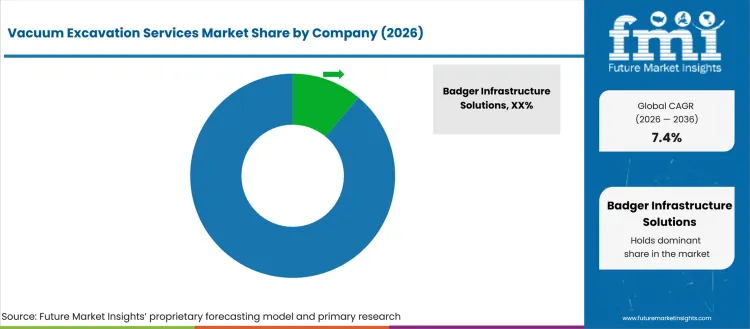
Service competition is expected to center on crew availability and branch coverage before price alone decides a contract. Utility owners compare operator qualifications and emergency dispatch times because the equipment only creates value when a trained crew arrives inside the work window. Municipal contractors also examine whether one provider offers potholing alongside sewer cleaning or inspection after exposure work ends. Badger reported a 1,723-truck hydrovac fleet at year-end 2025. Large accounts are expected to use that scale during branch coverage review. Providers connected to cured-in-place pipe services are projected to benefit when rehabilitation crews need verified access points before lining or repair.
- Badger Infrastructure Solutions and AIMS Companies compete in areas where branch proximity supports recurring utility accounts. Badger is expected to use standardized hydrovac operations across North America while AIMS is projected to pair excavation with pipeline inspection and stormwater work from regional offices.
- In the United Kingdom, Vac-Ex is anticipated to differentiate through operated hire and formal operator qualifications. Its CPCS-focused model is expected to fit rail and utility sites where contractors need both equipment and a qualified operator from one provider directly.
- Rangedale and Cleanaway are projected to compete in Australia through hydro excavation that connects with drain cleaning and industrial field work. Procurement teams comparing municipal pump systems are expected to value contractors that stay on site for adjacent cleaning tasks.
- Pro-Vac and US Hydrovac are expected to compete across American utility and construction accounts through service breadth and regional dispatch. McVac Environmental is projected to remain relevant in the Northeast where hydro excavation often accompanies sewer and environmental work locally.
Competitive Benchmarking: Vacuum Excavation Services Market
| Company | Hydro Excavation Focus | Adjacent Field Services | Specification Support | Service Reach |
|---|---|---|---|---|
| Badger Infrastructure Solutions | High | Medium | Medium | High |
| AIMS Companies | High | High | Medium | High |
| Clean Harbors | Medium | High | High | High |
| Pro-Vac | High | High | Medium | High |
| US Hydrovac | High | Medium | Medium | Low |
| Vac-Ex | High | Low | High | High |
| Rangedale | Medium | High | High | Medium |
| Cleanaway | Medium | High | High | High |
Source: Future Market Insights competitive analysis, 2026. Ratings reflect relative portfolio relevance and workflow fit. Service capability and geographic reach shape the remaining comparison.
Key Developments in the Vacuum Excavation Services Market
- In September 2025, AIMS Companies, merged its Phoenix office with Southwest Environmental under one regional operation. The combination brought teams and field capability together in Arizona while keeping hydro excavation and municipal services within the same network.
- In May 2026, Clean Harbors, announced the acquisition of Terra Nova Solutions for USD 225 million. Terra Nova operated five sites across the Carolinas that supported wastewater treatment and waste processing services. The acquisition is projected to broaden how Clean Harbors handles field work that produces complex material streams.
- In October 2025, Vac-Ex, published operator qualification guidance covering CPCS A78 and NPORS N021 pathways for vacuum-excavator crews. The company linked formal cards with practical training and CITB safety testing before site work begins.
Key Players in the Vacuum Excavation Services Market
Hydrovac and Underground Utility Specialists
- Badger Infrastructure Solutions
- AIMS Companies
- Pro-Vac
- US Hydrovac
- Vac-Ex
Industrial and Environmental Service Networks
- Clean Harbors
- Evergreen North America Industrial Services
- McVac Environmental
Australia-Based Vacuum Excavation Providers
- Rangedale
- Cleanaway
Vacuum Excavation Services Market - Report Scope
| Coverage field | Report scope |
|---|---|
| Market breakdown | By service type, equipment class, application, end use, contract type, and region. |
| Quantitative Units | Revenue and project assignment volume with annual growth rates. |
| Market Definition | Revenue earned by contracted hydro or air vacuum excavation services that expose utilities, remove soil or slurry, create narrow trenches, and support emergency excavation. |
| Regions Covered | North America, Latin America, Europe, East Asia, South Asia, Oceania, Middle East and Africa |
| Countries Covered | Selected national markets across North America and Europe. Coverage also includes East Asia and South Asia alongside Oceania. |
| Key Companies Profiled | Badger Infrastructure Solutions, AIMS Companies, Clean Harbors, Pro-Vac, US Hydrovac, Vac-Ex, Rangedale, Evergreen North America Industrial Services, McVac Environmental, and Cleanaway |
| Forecast Period | Ten-year assessment horizon. |
| Approach | Hybrid methodology using bottom-up service revenue estimates and top-down checks against infrastructure activity, fleet disclosures, and primary interviews. |
Source: Future Market Insights - analysis driven by proprietary forecasting models and primary research
Vacuum Excavation Services Market - Research Methodology
| Method | Approach |
|---|---|
| Primary Research | FMI interviews hydrovac operators and utility contractors to test utilization and pricing assumptions. Municipal procurement teams and rental managers provide additional views on travel radius and disposal patterns. Researchers compare responses across service types and contract models before country forecasts are finalized. Conflicting findings are reconciled against observed service scope and recurring field practices. |
| Desk Research | Desk research reviews infrastructure programmes and damage-prevention records before any directional assumption enters the model. Company service disclosures are used to understand branch coverage and adjacent field capabilities. Researchers compare public programme documents with industry operating practices. |
| Market Sizing and Forecasting | The sizing model builds service revenue from estimated fleet activity and average billed work. Contract mix and country-level project intensity provide further inputs. Bottom-up estimates are checked against regional infrastructure activity and service coverage. FMI then applies scenario weights for branch access and renewal spending before reconciling the assessment horizon with the market growth path. |
| Data Validation | Validation compares model outputs with operator interviews and primary public records across the profiled countries. Analysts test whether service assumptions fit local utility work and contractor access patterns. Segment shares and company relevance receive separate checks before final formatting. The process keeps service claims aligned with actual hydro or air vacuum excavation activity across the defined market scope. |
Source: Future Market Insights (FMI) analysis, based on proprietary forecasting model and primary research
Vacuum Excavation Services Market by Segments
Vacuum Excavation Services Market segmented by Service Type:
- Hydro Vacuum Excavation
- Air Vacuum Excavation
- Utility Potholing
- Slot Trenching
- Debris / Slurry Removal
- Emergency Excavation
Vacuum Excavation Services Market segmented by Equipment Class:
- Trailer-mounted Units
- Truck-mounted Units
- High-capacity Combo Units
- Compact Urban Units
Vacuum Excavation Services Market segmented by Application:
- Utility Locating
- Pipeline / Cable Exposure
- Municipal Maintenance
- Industrial Plant Work
- Oil & Gas Field Work
Vacuum Excavation Services Market segmented by End Use:
- Utilities
- Construction Contractors
- Municipalities
- Oil & Gas
- Telecom or Fiber
Vacuum Excavation Services Market segmented by Contract Type:
- Spot Hire
- Project Contract
- Long-term Service Agreement
Vacuum Excavation Services Market by Region:
- North America
- United States
- Canada
- Latin America
- Brazil
- Mexico
- Argentina
- Europe
- Germany
- United Kingdom
- France
- Italy
- Spain
- East Asia
- China
- Japan
- South Korea
- South Asia
- India
- Thailand
- Indonesia
- Oceania
- Australia
- New Zealand
- Middle East and Africa
- GCC countries
- South Africa
- Turkey
Research Sources and Bibliography
- AIMS Companies. (2025, September). AIMS Las Vegas Office Relocates. AIMS Companies.
- AIMS Companies. (2025, September). AIMS Phoenix Office and Southwest Environmental Merge! AIMS Companies.
- AIMS Companies. (2025, September). Las Vegas, Remote Hydrovac Specialists. AIMS Companies.
- AIMS Companies. (2025, December). Southern Hydro Vac - Built on Service. AIMS Companies.
- AIMS Companies. (2025, December). Winery, Brewery & Beverage Vacuum Cleaning. AIMS Companies.
- Badger Infrastructure Solutions Ltd. (2025, April). Badger Infrastructure Solutions Ltd. Delivers Solid Growth in 2025 First Quarter Revenue, Adjusted EBITDA and Adjusted Net Earnings. Badger Infrastructure Solutions.
- Badger Infrastructure Solutions Ltd. (2025, July). Badger Infrastructure Solutions Ltd. Delivers Double Digit Growth in 2025 Second Quarter Revenue, Adjusted EBITDA and Adjusted Net Earnings. Badger Infrastructure Solutions.
- Badger Infrastructure Solutions Ltd. (2025, November). Badger Infrastructure Delivers Another Quarter of Double Digit Growth in Revenue, Adjusted EBITDA and Adjusted Net Earnings. Badger Infrastructure Solutions.
- Badger Infrastructure Solutions Ltd. (2026, March). Badger Delivers Solid Growth in 2025, and Announces Record Fleet Build for 2026. Badger Infrastructure Solutions.
- Clean Harbors, Inc. (2025, April). Clean Harbors Announces First-Quarter 2025 Financial Results. Clean Harbors.
- Clean Harbors, Inc. (2026, May). Clean Harbors Announces Acquisition of Terra Nova Solutions. Clean Harbors.
- Common Ground Alliance. (2025, August). CGA DIRT Report Highlights Concerning Levels of Damages to Buried Utilities, Signals Need for Industry-Wide Changes. Common Ground Alliance.
- Department of Water Resources, River Development and Ganga Rejuvenation. (2025, December). Achievements of the DoWR, RD & GR for the year 2025. Government of India.
- Federal Statistical Office. (2025, February). Production in December 2024: -2.4% on the previous month. Destatis.
- Infrastructure Australia. (2025, November). Billions injected into national infrastructure pipeline as governments target energy and housing growth. Infrastructure Australia.
- Ontario Regional Common Ground Alliance. (2025, April). 2024 DIRT Report. ORCGA.
- Ontario Regional Common Ground Alliance. (2026, April). 2025 DIRT Report. ORCGA.
- Pipeline and Hazardous Materials Safety Administration. (2025, January). PHMSA Final Rule - Gas Pipeline Leak Detection and Repair. USA Department of Transportation.
- Pipeline and Hazardous Materials Safety Administration. (2026, March). Natural Gas Distribution Infrastructure Safety and Modernization Grant Program. USA Department of Transportation.
- Pipeline and Hazardous Materials Safety Administration. (2026, April). State Damage Prevention Grants. USA Department of Transportation.
- Press Information Bureau Research. (2026, June). Infrastructure at the Core of India’s Development. Government of India.
- State Council of the People’s Republic of China. (2026, June). China to build, upgrade 770,000 km of urban underground pipelines during 2026-2030. Government of China.
- Vac-Ex. (2025, July). What is a Mini Vacuum Excavator and When Should You Hire One? Vac-Ex.
- Vac-Ex. (2025, July). Operated vs. Self-Drive Vac-Ex Hire: What’s the way to go? Vac-Ex.
- Vac-Ex. (2025, October). What Qualifications Should a Vac-Ex Operator Have? Vac-Ex.
This bibliography is provided for reader reference and uses primary government, standards-body, official trade body, and company sources.
This Report Answers
- What is the estimated value of the vacuum excavation services market in 2026 and its projected value by 2036?
- What CAGR is the vacuum excavation services market projected to record from 2026 to 2036?
- Which service types, equipment classes, and applications are expected to shape demand across the parent categories?
- Which utility damage risks and infrastructure pressures are projected to support service purchase activity?
- How are country CAGRs expected to differ across the seven profiled national markets?
- Which companies compete across branch coverage, operator support, adjacent field services, and regional reach?
- How does FMI validate forecasts using its hybrid methodology and bottom-up service revenue checks?
- What should utility procurement teams address before wider account expansion or long-term service commitments?
- How do operator qualifications, one-call practice, and damage-prevention rules affect contractor selection?
Frequently Asked Questions
What is driving growth in the Vacuum Excavation Services Market?
Growth is expected to be driven by utility renewal and safer buried-line exposure. Local crew access is projected to support recurring service demand.
Who are the key players in the Vacuum Excavation Services Market?
Notable companies include Badger Infrastructure Solutions and AIMS Companies alongside Clean Harbors and Pro-Vac. Competition is projected to center on crew access and field support.
What is a significant restraint in the Vacuum Excavation Services Market?
A significant restraint is weak branch coverage near remote or low-density jobs. Adoption is anticipated to slow when travel distance and slurry disposal weaken project economics.
Why should executives track the Vacuum Excavation Services Market?
Executives should track the market because utility renewal creates recurring exposure work near active assets. Service availability also affects project timing and damage risk.
What business problem does the Vacuum Excavation Services Market address?
The market addresses the need to expose buried utilities without relying on aggressive mechanical digging. Vacuum methods support controlled soil removal around sensitive lines and congested work areas.
What should procurement leaders evaluate before selecting service providers?
Procurement leaders should evaluate crew qualification and branch response before selecting contractors. Reviews should also cover equipment fit and slurry handling responsibilities for the planned work.
What limits return on investment for service purchasers?
Return on investment is expected to weaken when mobilization distances are long and job volumes remain irregular. Disposal complexity can further reduce savings on small assignments.
How do service providers build long-term account confidence?
Service providers build account confidence through dependable dispatch and clear work records. Consistent crew practices are expected to support repeat assignments across utility maintenance and repair programmes.
Preview the report firsthand - request a free sample
Get SampleGet the brochure for pricing and purchase details.
Get PDFTable of Content
- Key Takeaways
- Market Size and CAGR
- Top Growth Driver
- Fastest Growing Segment
- Leading Region
- Key Companies
- Emerging Opportunities
- Executive Summary
- Global Market Outlook
- Demand-side Trends
- Supply-side Trends
- Technology Roadmap Analysis
- Analysis and Recommendations
- Analyst Perspective (What is happening? Why now? What should investors know?)
- Key Questions Answered
- How large is the market?
- What is the CAGR?
- What are key trends?
- Which region dominates?
- Who are the leaders?
- Market Overview
- Market Coverage / Taxonomy
- Market Definition / Scope / Limitations
- Research Methodology
- Chapter Orientation
- Analytical Lens and Working Hypotheses
- Market Structure, Signals, and Trend Drivers
- Benchmarking and Cross-market Comparability
- Market Sizing, Forecasting, and Opportunity Mapping
- Research Design and Evidence Framework
- Desk Research Programme (Secondary Evidence)
- Expert Input and Fieldwork (Primary Evidence)
- Tooling, Models, and Reference Databases
- Data Engineering and Model Build
- Quality Assurance and Audit Trail
- Market Background
- Market Dynamics (Drivers, Restraints, Opportunity, Trends)
- Scenario Forecast (Optimistic, Likely, Conservative)
- Impact Analysis
- AI Impact
- Sustainability Impact
- Regulatory Impact
- Technology Impact
- Consumer / Buyer Analysis
- Purchase Drivers
- Adoption Barriers
- Buyer Journey
- Opportunity Map Analysis
- Product Life Cycle Analysis
- Supply Chain Analysis
- Investment Feasibility Matrix
- Value Chain Analysis
- PESTLE and Porter's Analysis
- Regulatory Landscape
- Regional Parent Market Outlook
- Production and Consumption Statistics
- Import and Export Statistics
- Global Market Analysis and Forecast, 2021 to 2036
- Historical Market Size Value (USD Billion) & Volume (Unit) Analysis, 2021 to 2025
- Current and Future Market Size Value (USD Billion) & Volume (Unit) Projections, 2026 to 2036
- Y-o-Y Growth Trend Analysis
- Absolute $ Opportunity Analysis
- Global Market Pricing Analysis, 2021 to 2036
- Global Market Analysis and Forecast, By Service Type, 2021 to 2036
- Introduction / Key Findings
- Historical Market Size Value (USD Billion) & Volume (Unit) Analysis By Service Type, 2021 to 2025
- Current and Future Market Size Value (USD Billion) & Volume (Unit) Analysis and Forecast By Service Type, 2026 to 2036
- Hydro Vacuum Excavation
- Air Vacuum Excavation
- Utility Potholing
- Slot Trenching
- Debris - Slurry Removal
- Emergency Excavation
- Hydro Vacuum Excavation
- Y-o-Y Growth Trend Analysis By Service Type, 2021 to 2025
- Absolute $ Opportunity Analysis By Service Type, 2026 to 2036
- Global Market Analysis and Forecast, By Equipment Class, 2021 to 2036
- Introduction / Key Findings
- Historical Market Size Value (USD Billion) & Volume (Unit) Analysis By Equipment Class, 2021 to 2025
- Current and Future Market Size Value (USD Billion) & Volume (Unit) Analysis and Forecast By Equipment Class, 2026 to 2036
- Truck-mounted Value (USD Billion) & Volume (Unit)s
- Trailer-mounted Value (USD Billion) & Volume (Unit)s
- High-capacity Combo Value (USD Billion) & Volume (Unit)s
- Compact Urban Value (USD Billion) & Volume (Unit)s
- Truck-mounted Value (USD Billion) & Volume (Unit)s
- Y-o-Y Growth Trend Analysis By Equipment Class, 2021 to 2025
- Absolute $ Opportunity Analysis By Equipment Class, 2026 to 2036
- Global Market Analysis and Forecast, By Application, 2021 to 2036
- Introduction / Key Findings
- Historical Market Size Value (USD Billion) & Volume (Unit) Analysis By Application, 2021 to 2025
- Current and Future Market Size Value (USD Billion) & Volume (Unit) Analysis and Forecast By Application, 2026 to 2036
- Utility Locating
- Pipeline - Cable Exposure
- Municipal Maintenance
- Industrial Plant Work
- Oil & Gas Field Work
- Utility Locating
- Y-o-Y Growth Trend Analysis By Application, 2021 to 2025
- Absolute $ Opportunity Analysis By Application, 2026 to 2036
- Global Market Analysis and Forecast, By End Use, 2021 to 2036
- Introduction / Key Findings
- Historical Market Size Value (USD Billion) & Volume (Unit) Analysis By End Use, 2021 to 2025
- Current and Future Market Size Value (USD Billion) & Volume (Unit) Analysis and Forecast By End Use, 2026 to 2036
- Utilities
- Construction Contractors
- Municipalities
- Oil & Gas
- Telecom - Fiber
- Utilities
- Y-o-Y Growth Trend Analysis By End Use, 2021 to 2025
- Absolute $ Opportunity Analysis By End Use, 2026 to 2036
- Global Market Analysis and Forecast, By Contract Type, 2021 to 2036
- Introduction / Key Findings
- Historical Market Size Value (USD Billion) & Volume (Unit) Analysis By Contract Type, 2021 to 2025
- Current and Future Market Size Value (USD Billion) & Volume (Unit) Analysis and Forecast By Contract Type, 2026 to 2036
- Project Contract
- Spot Hire
- Long-term Service Agreement
- Project Contract
- Y-o-Y Growth Trend Analysis By Contract Type, 2021 to 2025
- Absolute $ Opportunity Analysis By Contract Type, 2026 to 2036
- Global Market Analysis and Forecast, By Region, 2021 to 2036
- Introduction
- Historical Market Size Value (USD Billion) & Volume (Unit) Analysis By Region, 2021 to 2025
- Current Market Size Value (USD Billion) & Volume (Unit) Analysis and Forecast By Region, 2026 to 2036
- North America
- Latin America
- Western Europe
- Eastern Europe
- East Asia
- South Asia and Pacific
- Middle East & Africa
- Market Attractiveness Analysis By Region
- North America Market Analysis and Forecast, By Country, 2021 to 2036
- Historical Market Size Value (USD Billion) & Volume (Unit) Trend Analysis By Market Taxonomy, 2021 to 2025
- Market Size Value (USD Billion) & Volume (Unit) Forecast By Market Taxonomy, 2026 to 2036
- By Country
- USA
- Canada
- By Service Type
- By Equipment Class
- By Application
- By End Use
- By Contract Type
- By Country
- Market Attractiveness Analysis
- By Country
- By Service Type
- By Equipment Class
- By Application
- By End Use
- By Contract Type
- Key Takeaways
- Latin America Market Analysis and Forecast, By Country
- Historical Market Size Value (USD Billion) & Volume (Unit) Trend Analysis By Market Taxonomy, 2021 to 2025
- Market Size Value (USD Billion) & Volume (Unit) Forecast By Market Taxonomy, 2026 to 2036
- By Country
- Brazil
- Mexico
- Chile
- Rest of Latin America
- By Service Type
- By Equipment Class
- By Application
- By End Use
- By Contract Type
- By Country
- Market Attractiveness Analysis
- By Country
- By Service Type
- By Equipment Class
- By Application
- By End Use
- By Contract Type
- Key Takeaways
- Western Europe Market Analysis and Forecast, By Country
- Historical Market Size Value (USD Billion) & Volume (Unit) Trend Analysis By Market Taxonomy, 2021 to 2025
- Market Size Value (USD Billion) & Volume (Unit) Forecast By Market Taxonomy, 2026 to 2036
- By Country
- Germany
- UK
- Italy
- Spain
- France
- Nordic
- BENELUX
- Rest of Western Europe
- By Service Type
- By Equipment Class
- By Application
- By End Use
- By Contract Type
- By Country
- Market Attractiveness Analysis
- By Country
- By Service Type
- By Equipment Class
- By Application
- By End Use
- By Contract Type
- Key Takeaways
- Eastern Europe Market Analysis and Forecast, By Country
- Historical Market Size Value (USD Billion) & Volume (Unit) Trend Analysis By Market Taxonomy, 2021 to 2025
- Market Size Value (USD Billion) & Volume (Unit) Forecast By Market Taxonomy, 2026 to 2036
- By Country
- Russia
- Poland
- Hungary
- Balkan & Baltic
- Rest of Eastern Europe
- By Service Type
- By Equipment Class
- By Application
- By End Use
- By Contract Type
- By Country
- Market Attractiveness Analysis
- By Country
- By Service Type
- By Equipment Class
- By Application
- By End Use
- By Contract Type
- Key Takeaways
- East Asia Market Analysis and Forecast, By Country
- Historical Market Size Value (USD Billion) & Volume (Unit) Trend Analysis By Market Taxonomy, 2021 to 2025
- Market Size Value (USD Billion) & Volume (Unit) Forecast By Market Taxonomy, 2026 to 2036
- By Country
- China
- Japan
- South Korea
- By Service Type
- By Equipment Class
- By Application
- By End Use
- By Contract Type
- By Country
- Market Attractiveness Analysis
- By Country
- By Service Type
- By Equipment Class
- By Application
- By End Use
- By Contract Type
- Key Takeaways
- South Asia and Pacific Market Analysis and Forecast, By Country
- Historical Market Size Value (USD Billion) & Volume (Unit) Trend Analysis By Market Taxonomy, 2021 to 2025
- Market Size Value (USD Billion) & Volume (Unit) Forecast By Market Taxonomy, 2026 to 2036
- By Country
- India
- ASEAN
- Australia & New Zealand
- Rest of South Asia and Pacific
- By Service Type
- By Equipment Class
- By Application
- By End Use
- By Contract Type
- By Country
- Market Attractiveness Analysis
- By Country
- By Service Type
- By Equipment Class
- By Application
- By End Use
- By Contract Type
- Key Takeaways
- Middle East & Africa Market Analysis and Forecast, By Country
- Historical Market Size Value (USD Billion) & Volume (Unit) Trend Analysis By Market Taxonomy, 2021 to 2025
- Market Size Value (USD Billion) & Volume (Unit) Forecast By Market Taxonomy, 2026 to 2036
- By Country
- Kingdom of Saudi Arabia
- Other GCC Countries
- Türkiye
- South Africa
- Other African Union
- Rest of Middle East & Africa
- By Service Type
- By Equipment Class
- By Application
- By End Use
- By Contract Type
- By Country
- Market Attractiveness Analysis
- By Country
- By Service Type
- By Equipment Class
- By Application
- By End Use
- By Contract Type
- Key Takeaways
- Key Countries Market Analysis
- USA
- Pricing Analysis
- Market Share Analysis, 2025
- By Service Type
- By Equipment Class
- By Application
- By End Use
- By Contract Type
- Canada
- Pricing Analysis
- Market Share Analysis, 2025
- By Service Type
- By Equipment Class
- By Application
- By End Use
- By Contract Type
- Mexico
- Pricing Analysis
- Market Share Analysis, 2025
- By Service Type
- By Equipment Class
- By Application
- By End Use
- By Contract Type
- Brazil
- Pricing Analysis
- Market Share Analysis, 2025
- By Service Type
- By Equipment Class
- By Application
- By End Use
- By Contract Type
- Chile
- Pricing Analysis
- Market Share Analysis, 2025
- By Service Type
- By Equipment Class
- By Application
- By End Use
- By Contract Type
- Germany
- Pricing Analysis
- Market Share Analysis, 2025
- By Service Type
- By Equipment Class
- By Application
- By End Use
- By Contract Type
- UK
- Pricing Analysis
- Market Share Analysis, 2025
- By Service Type
- By Equipment Class
- By Application
- By End Use
- By Contract Type
- Italy
- Pricing Analysis
- Market Share Analysis, 2025
- By Service Type
- By Equipment Class
- By Application
- By End Use
- By Contract Type
- Spain
- Pricing Analysis
- Market Share Analysis, 2025
- By Service Type
- By Equipment Class
- By Application
- By End Use
- By Contract Type
- France
- Pricing Analysis
- Market Share Analysis, 2025
- By Service Type
- By Equipment Class
- By Application
- By End Use
- By Contract Type
- India
- Pricing Analysis
- Market Share Analysis, 2025
- By Service Type
- By Equipment Class
- By Application
- By End Use
- By Contract Type
- ASEAN
- Pricing Analysis
- Market Share Analysis, 2025
- By Service Type
- By Equipment Class
- By Application
- By End Use
- By Contract Type
- Australia & New Zealand
- Pricing Analysis
- Market Share Analysis, 2025
- By Service Type
- By Equipment Class
- By Application
- By End Use
- By Contract Type
- China
- Pricing Analysis
- Market Share Analysis, 2025
- By Service Type
- By Equipment Class
- By Application
- By End Use
- By Contract Type
- Japan
- Pricing Analysis
- Market Share Analysis, 2025
- By Service Type
- By Equipment Class
- By Application
- By End Use
- By Contract Type
- South Korea
- Pricing Analysis
- Market Share Analysis, 2025
- By Service Type
- By Equipment Class
- By Application
- By End Use
- By Contract Type
- Russia
- Pricing Analysis
- Market Share Analysis, 2025
- By Service Type
- By Equipment Class
- By Application
- By End Use
- By Contract Type
- Poland
- Pricing Analysis
- Market Share Analysis, 2025
- By Service Type
- By Equipment Class
- By Application
- By End Use
- By Contract Type
- Hungary
- Pricing Analysis
- Market Share Analysis, 2025
- By Service Type
- By Equipment Class
- By Application
- By End Use
- By Contract Type
- Kingdom of Saudi Arabia
- Pricing Analysis
- Market Share Analysis, 2025
- By Service Type
- By Equipment Class
- By Application
- By End Use
- By Contract Type
- Türkiye
- Pricing Analysis
- Market Share Analysis, 2025
- By Service Type
- By Equipment Class
- By Application
- By End Use
- By Contract Type
- South Africa
- Pricing Analysis
- Market Share Analysis, 2025
- By Service Type
- By Equipment Class
- By Application
- By End Use
- By Contract Type
- USA
- Market Structure Analysis
- Competition Dashboard
- Competition Benchmarking
- Market Share Analysis of Top Players
- By Regional
- By Service Type
- By Equipment Class
- By Application
- By End Use
- By Contract Type
- Emerging Startups
- Innovation Benchmarking
- Competition Analysis
- Competition Deep Dive
- Badger Infrastructure Solutions
- Overview
- Product Portfolio
- Profitability by Market Segments (Product/Region/Sales Channel)
- Sales Footprint
- Strategy Overview
- Marketing Strategy
- Product Strategy
- Channel Strategy
- AIMS Companies
- Clean Harbors
- US Hydrovac
- Vac UK
- KOR Equipment Solutions
- Veolia
- Rangedale
- Total Drain Cleaning
- National Trench Safety
- Badger Infrastructure Solutions
- Case Studies
- Success Stories
- Recent Developments
- Competition Deep Dive
- Assumptions & Acronyms Used


