

- Market Size (2026)
- USD 667.2 Mn
- Forecast (2036)
- USD 1565.1 Mn
- CAGR (2026 to 2036)
- 8.9%
How big is Ultrasonic Spray Nozzles Market in 2026?
USD 667.2 Million in 2026 and USD 1,565.1 Million by 2036 at an 8.9% CAGR.
Demand for ultrasonic spray nozzles is projected to expand at 8.9% CAGR between 2026 and 2036. Market valuation is expected to rise from USD 667.2 million to USD 1565.1 million over the forecast. Medical-device coating remains an important source of demand for precision atomization technologies. Sono-Tek reported a 54% increase in medical end-market sales during fiscal 2026, supported by balloon catheter and stent coating programs. Expanding coating activity reinforces the need for ultrasonic spray systems capable of delivering uniform thin films and repeatable deposition across regulated manufacturing environments.
Advanced-manufacturing qualification capacity creates different adoption paths across major countries and determines where new coating tools can enter process trials. NIST announced in January 2025 that Arizona State University Research Park was the planned site for a 300 mm semiconductor manufacturing and advanced packaging research facility. The facility is intended to bridge laboratory research with full-scale production and gives USA process teams additional locations for testing functional coating materials. Taiwan and South Korea rely more heavily on dense domestic electronics supply networks for comparable qualification work.
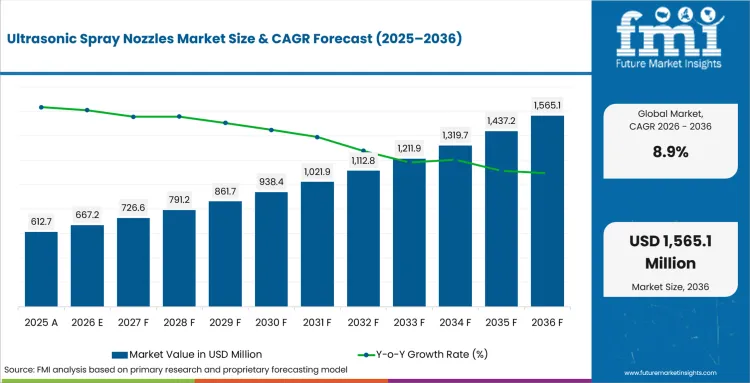
Key Takeaways of Ultrasonic Spray Nozzles Market
- Manufacturers adopt ultrasonic atomization when expensive formulations require low-flow deposition and controlled film thickness across repeatable production cycles.
- Wide spray ultrasonic nozzles are projected to account for 29.0% of nozzle type demand in 2026, supported by broader controlled substrate coverage.
- Thin film coating is anticipated to represent 27.0% of application demand in 2026 as electronics and medical processes require uniform functional layers.
- Qualification can delay adoption because nozzle performance must transfer into validated film thickness and production throughput under the customer’s operating conditions.
- Sono-Tek, Sonaer, Siansonic, MTI Corporation, Cheersonic, Ultrasonic Systems Inc., Spraying Systems Co. and Nadetech Innovations are some key players in the market.
Analyst Perspective
"Process engineers should compare coating repeatability and scale-up support during qualification before comparing nozzle price alone. Suppliers earn stronger positions when validated recipes transfer into production without forcing customers to rebuild liquid delivery or motion control and service arrangements."
- Nikhil Kaitwade, Principal Consultant, Future Market Insights
How is the Ultrasonic Spray Nozzles Market segmented?
The ultrasonic spray nozzles market is segmented by nozzle type, frequency, application, end use, sales channel and region.
Nozzle type covers wide spray, focused spray, vortex, multi-nozzle arrays and high-temperature ultrasonic nozzles. Frequency covers 20-40 kHz, 40-80 kHz, 80-120 kHz and above 120 kHz. Applications include thin film coating, medical device coating, fuel cell or battery coating, semiconductor coating and food or pharma spraying. End uses cover electronics, medical devices, energy storage, research labs and industrial coating. Sales channels include direct OEM, lab equipment distributors, system integrators and aftermarket nozzles.
How does thin film coating shape demand within the application category?
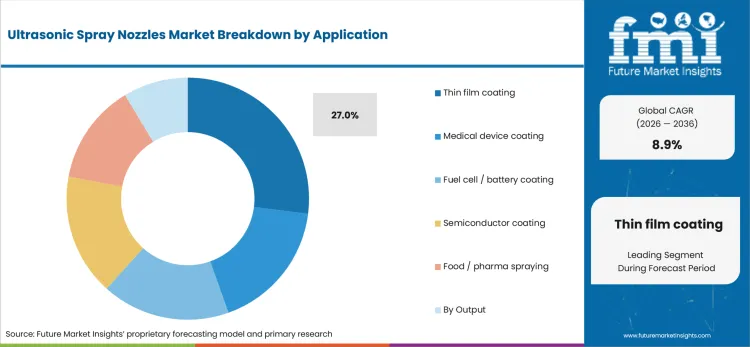
Thin film coating places the ultrasonic nozzle inside a performance-sensitive liquid deposition step used in advanced manufacturing. Process teams evaluating medical coatings compare droplets with film uniformity, while surface-active device coatings require repeatable recipes after scale-up.
- Thin film coating is estimated to hold 27.0% of application demand in 2026, supported by electronics and medical surfaces that require functional layers.
- Sono-Tek reported in May 2026 that electronics end-market sales increased 16% during fiscal 2026 overall. That increase supports equipment evaluation for electronics films where deposition control must survive transition from development into routine manufacturing.
What makes wide spray ultrasonic nozzles central to the nozzle type category?
Wide spray ultrasonic nozzles address larger substrates without replacing low-velocity ultrasonic atomization with pressure-driven spray. Their value rises during scale-up because functional films need wider coverage without excessive overspray or unstable edge thickness.
- By nozzle type, wide spray ultrasonic nozzles are projected to account for 29.0% in 2026 owing to broader controlled coverage across automated coating layouts.
- The European Commission approved German state aid for Infineon’s Dresden semiconductor fab in February 2025, while Infineon later stated that the Smart Power Fab doubled its manufacturing capacity at the Dresden site. New fabrication capacity expands qualification points for precision coating equipment used during process development work.
How do electronics manufacturers evaluate the leading end-use segment?
Electronics manufacturers specify ultrasonic coating where functional materials must be placed uniformly on wafers and packages or engineered surfaces. Similar control is required in perovskite photovoltaic modules where film quality must remain stable as coated area increases.
- Electronics is forecast to represent 24.0% of end-use demand in 2026 because semiconductor processes require controlled layers on high-value components.
- Taiwan’s Ministry of Economic Affairs broke ground in February 2026 on a 12-inch semiconductor pilot line with localized equipment and material validation. The facility gives coating-equipment developers a direct route into electronics process trials before full production qualification.
What drives direct OEM leadership within the sales channel category?
Direct OEM engagement suits a market where nozzle geometry and liquid delivery must be tuned with motion control for one coating result. Production orders follow application trials because medical programs for bioactive coating devices require direct process support before integration.
- Direct OEM is set to lead sales channel demand with 43.0% share in 2026 as engineering support connects process qualification with larger integrated equipment orders.
- Sono-Tek’s May 2026 filing reported USD 7.1 million of fiscal-year in-line coating-system sales, equal to 34% of product sales and favoring direct technical coordination for production-line integration.
What are the drivers, restraints and opportunities in the Ultrasonic Spray Nozzles Market?
Precision coating requirements support demand, qualification work limits order conversion and application engineering creates the clearest route from laboratory trials into production systems.
- Driver: Electronics, medical-device and energy manufacturers require controlled thin-film deposition where material loss or film variation affects product performance.
- Restraint: Process qualification can extend purchase cycles because atomization quality must translate into acceptable coating thickness and production repeatability.
- Opportunity: Application trials and scalable integrated systems can convert validated laboratory recipes into multi-nozzle or in-line production orders.
Advanced Packaging Investment Expands Coating Qualification Points
Semiconductor packaging and battery separator coatings create qualification points where specialized deposition equipment must match production requirements. NIST finalized advanced packaging awards during January 2025, including funding for materials research and a national piloting facility. Ultrasonic coating suppliers gain access after droplet control is tied to a qualified film process that fits packaging throughput and automation.
Qualification Risk Extends the Capital Approval Cycle
A successful spray pattern does not guarantee an acceptable finished coating because formulation and substrate conditions interact during validation. Sono-Tek reported in May 2026 that alternative and clean-energy sales declined 19% after reduced electrolysis demand linked to policy shifts. The decline illustrates how application-specific equipment orders can weaken quickly when a downstream program changes before capital approval.
Application Engineering Converts Trials Into Production Orders
One lucrative commercial opening lies in reducing the work required between a laboratory coating and a repeatable manufacturing recipe. Sono-Tek reported near-record year-end backlog and a shift toward medical and microelectronics orders in May 2026, reinforcing the role of application support in converting trials into larger production systems after qualification.
Which country CAGRs are profiled in the Ultrasonic Spray Nozzles Market?
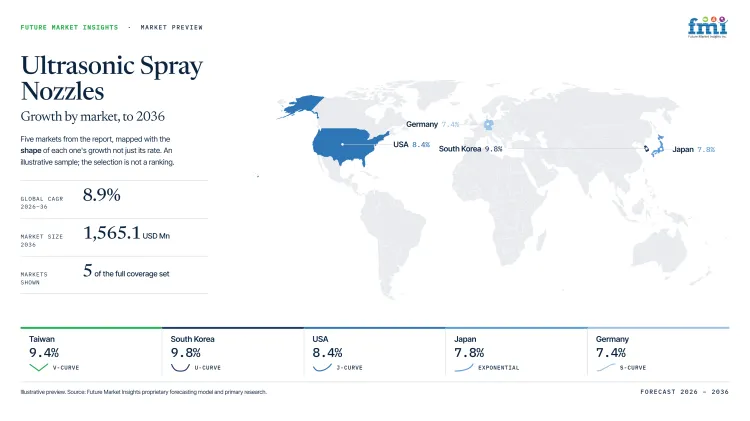
| Country | CAGR |
|---|---|
| South Korea | 9.8% |
| Taiwan | 9.4% |
| USA | 8.4% |
| Japan | 7.8% |
| Germany | 7.4% |
How do country-level CAGRs compare in the Ultrasonic Spray Nozzles Market?
The five countries span a 2.4 percentage-point CAGR range, with South Korea and Taiwan forming the upper group around semiconductor investment. The USA occupies the middle position while Japan and Germany form a steadier lower band. The spacing reflects qualification capacity and manufacturing expansion rather than current market size.
- South Korea links expansion to new foundry capacity and semiconductor qualification.
- Taiwan concentrates equipment validation inside Hsinchu’s fabrication network and public pilot infrastructure.
- The USA combines advanced packaging investment with dispersed medical-device coating and service needs.
- Japan applies repeatability tests before qualified manufacturing lines accept deposition changes.
- Germany pairs Dresden capacity additions with process-economics tests for specialized coating equipment purchases.
Similar CAGRs can still produce different entry conditions because qualification routes and service needs vary. The full report provides country-level CAGR analysis across North America, Latin America, Europe, East Asia, South Asia, Oceania and the Middle East and Africa.
Country-wise Analysis
- High-volume electronics production makes throughput proof a practical condition for new coating equipment in South Korea, especially as process tools must connect with established automation and local-material supplier networks during full plant qualification. South Korea is projected to record 9.8% CAGR during the assessment period as domestic semiconductor concentration creates recurring qualification points for thin-film process equipment across major electronics manufacturing sites. Korea.net reported in December 2025 that the planned mutual-growth foundry is designed for 12-inch, 40-nanometer chips, making local throughput validation the main filter before coating trials progress into production orders.
- Taiwanese semiconductor programs compress equipment qualification into a dense network of fabs and research institutes that expect rapid technical response during coating trials and production integration work across Hsinchu’s advanced manufacturing cluster. Adoption of ultrasonic spray nozzles in Taiwan is estimated to expand at 9.4% CAGR through 2036 as local validation infrastructure gives equipment developers frequent access to advanced semiconductor manufacturing programs and qualification teams. The Ministry of Economic Affairs said in February 2026 that its new 12-inch pilot line is expected to provide localized equipment validation, giving suppliers a clearer route to prove recipes before customer-specific integration begins.
- USA demand spans semiconductor packaging and medical-device manufacturing across distant customer sites, so coating suppliers must support several qualification paths and materially different production environments with dependable local engineering and responsive field service. Ultrasonic spray nozzle demand in the USA is forecast to rise at 8.4% CAGR over the forecast period as domestic manufacturing programs create additional equipment evaluation points across electronics and medical applications. The Department of Commerce recorded Micron’s January 2026 groundbreaking for a New York megafab program, but dispersed demand means field support and application validation remain important differentiators after initial technical interest.
- Japanese precision manufacturers typically require stable process documentation and local engineering continuity before introducing a new deposition method into qualified semiconductor or engineered-device production lines operating against demanding repeatability and strict acceptance targets. Japan is estimated to post 7.8% CAGR over the forecast period as semiconductor investment sustains equipment evaluation within established manufacturing clusters and creates commercial openings for precision coating suppliers across domestic networks. METI’s AI and semiconductor framework targets more than ten years of public-private investment momentum through FY2030, so suppliers with documented coating windows and repeatability data are better positioned for conservative adoption cycles.
- Germany’s semiconductor and industrial equipment buyers compare specialized coating tools against established alternatives using measurable process economics and integration risk before approving production-line changes at mature manufacturing sites across established electronics clusters. Ultrasonic spray nozzle sales in Germany are forecast to expand at 7.4% CAGR by 2036 as Dresden’s growing fabrication base adds qualification points for coating processes around advanced electronic components and assemblies. Infineon opened its Smart Power Fab in Dresden during July 2026 and stated that the facility doubled local manufacturing capacity, strengthening demand for suppliers that can demonstrate film performance while fitting established industrial approval routines.
Who are the notable companies in the Ultrasonic Spray Nozzles Market?
Sono-Tek, Sonaer, Siansonic, MTI Corporation, Cheersonic, Ultrasonic Systems Inc., Spraying Systems Co. and Nadetech Innovations are the notable companies profiled in this market.
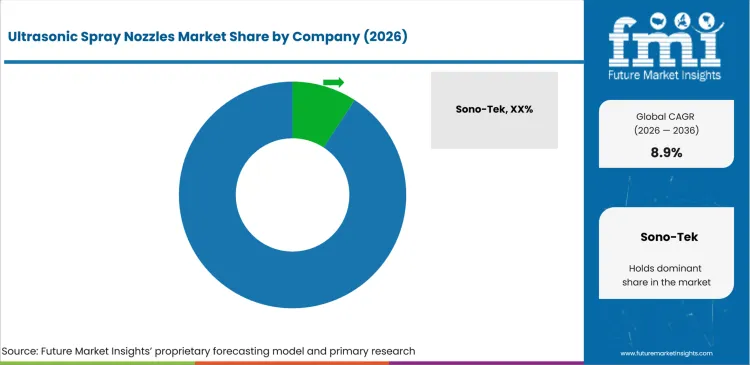
Competition separates by ultrasonic atomization depth and process engineering provided around each coating step during customer qualification. Integrated specialists combine atomization with liquid delivery and motion control, while laboratory platforms emphasize flexible trial access. Adjacent demand from thin film photovoltaics broadens application overlap, although exact-market evidence still separates ultrasonic specialists from conventional spray-system companies.
- Sono-Tek, Siansonic and Cheersonic compete with integrated ultrasonic coating platforms that extend from application trials into production-oriented systems.
- Sonaer, MTI Corporation and Nadetech Innovations address laboratory or specialized process work where equipment flexibility and technical access shape initial adoption.
- Ultrasonic Systems Inc. offers a nozzle-less ultrasonic alternative, while Spraying Systems Co. remains adjacent to scope through documented engineered-spray research.
Competitive Benchmarking: Ultrasonic Spray Nozzles Market
| Company | Ultrasonic Architecture Breadth | Production Integration Depth | Thin-Film Application Depth | Geographic Reach |
|---|---|---|---|---|
| Sono-Tek | High | High | High | North America; international distributor and customer network |
| Siansonic | High | High | High | China; international customer base |
| Cheersonic | High | High | High | China; international sales and support |
| Sonaer | High | Medium | High | United States; international sales |
| MTI Corporation | Unscored | Unscored | Unscored | United States; current exact-market ratings not independently scored |
| Ultrasonic Systems Inc. | Low | High | High | United States; worldwide installations |
| Nadetech Innovations | Unscored | Unscored | Unscored | Spain; current exact-market ratings not independently scored |
| Spraying Systems Co. | Unscored | Unscored | Unscored | Global spray-technology network; ultrasonic scope unverified |
Scoring basis: High ultrasonic architecture breadth requires several verified nozzle or system configurations, while Medium requires two and Low identifies one verified route. High production integration requires automated line capability, while Medium covers pilot or semi-automated equipment and Low covers stand-alone operation. High thin-film depth requires three verified application groups, while Medium requires two and Low identifies one.
Key Developments in the Ultrasonic Spray Nozzles Market
- In August 2026, Sonaer: TIC Corporation began distributing 3D CAD models for Sonaer’s WS40K and WS130K ultrasonic spray nozzles. The models support interference checks and equipment-design simulations before installation while reducing engineering work for precision-coating system integration.
- In May 2026, Noanix Corporation: Noanix announced its participation in Manufacturing World Tokyo 2026, where it showcased advanced ultrasonic spray nozzles for medical-device and electronics precision-coating applications. The development expands the company’s exposure to equipment manufacturers seeking ultrasonic deposition technologies for advanced manufacturing processes.
Key Players in the Ultrasonic Spray Nozzles Market
Integrated Ultrasonic Coating Platforms
- Sono-Tek
- Siansonic
- Cheersonic
Ultrasonic Nozzle and Laboratory Platforms
- Sonaer
- MTI Corporation
- Nadetech Innovations
Alternative and Adjacent Precision Coating Platforms
- Ultrasonic Systems Inc.
- Spraying Systems Co.
Ultrasonic Spray Nozzles Market - Report Scope
| Coverage field | Report scope |
|---|---|
| Market breakdown | By nozzle type, frequency, application, end use, sales channel and region. |
| Quantitative Units | Revenue in USD million and CAGR in %. |
| Market Definition | Commercial ultrasonic spray nozzles and coating systems that atomize liquid with ultrasonic vibration for controlled thin-film or precision deposition. |
| Regions Covered | North America, Latin America, Europe, East Asia, South Asia and Pacific, and Middle East and Africa. |
| Countries Covered | South Korea, Taiwan, USA, Japan, Germany, and 20+ countries included in the full report. |
| Key Companies Profiled | Sono-Tek, Sonaer, Siansonic, MTI Corporation, Cheersonic, Ultrasonic Systems Inc., Spraying Systems Co., Nadetech Innovations. |
| Forecast Period | 2026 to 2036. |
| Approach | Primary and secondary research with market triangulation. |
Ultrasonic Spray Nozzles Market - Research Methodology
| Method | Approach |
|---|---|
| Primary Research | FMI analysts gathered input from manufacturers, service providers, technology developers, distributors, end users, procurement teams, and subject-matter experts. Interviews examined purchasing decisions, product or service evaluation, adoption barriers, approval requirements, pricing considerations, and expectations for technical or commercial support. Respondents were also asked what evidence is required before a trial, pilot, or initial order develops into regular purchasing. |
| Desk Research | Desk research covered government statistics, regulatory publications, trade data, industry associations, technical literature, standards, company filings, product information, and official corporate announcements. Sources were reviewed for relevance, publication date, geographic coverage, and consistency with the defined market scope. Claims relating to performance, applications, approvals, capacity, investment, and commercial activity were retained only when supported by credible public evidence. |
| Market Sizing and Forecasting | The market model combined the baseline value with historical performance, segment structure, pricing and volume indicators, adoption levels, company participation, and country-level demand conditions. Forecast assumptions considered economic activity, investment trends, regulatory developments, technology adoption, purchasing cycles, supply availability, and barriers to wider market use. Segment and regional estimates were reconciled before the final market total was calculated. |
| Data Validation | Estimates were checked against multiple independent indicators, including public data, company activity, trade patterns, industry developments, and findings from primary interviews. Validation also tested whether products, services, applications, and company revenues fell within the defined market boundaries. Adjacent categories, unsupported claims, overlapping revenues, and activities without direct market relevance were excluded to reduce double counting and maintain consistency across segments and countries. |
Ultrasonic Spray Nozzles Market by Segments
Ultrasonic Spray Nozzles Market segmented by Nozzle Type:
- Wide spray ultrasonic nozzles
- Focused spray nozzles
- Vortex ultrasonic nozzles
- Multi-nozzle arrays
- High-temperature ultrasonic nozzles
Ultrasonic Spray Nozzles Market segmented by Frequency:
- 40-80 kHz
- 20-40 kHz
- 80-120 kHz
- Above 120 kHz
Ultrasonic Spray Nozzles Market segmented by Application:
- Thin film coating
- Medical device coating
- Fuel cell / battery coating
- Semiconductor coating
- Food / pharma spraying
Ultrasonic Spray Nozzles Market segmented by End Use:
- Electronics
- Medical devices
- Energy storage
- Research labs
- Industrial coating
Ultrasonic Spray Nozzles Market segmented by Sales Channel:
- Direct OEM
- Lab equipment distributors
- System integrators
- Aftermarket nozzles
Ultrasonic Spray Nozzles Market by Region:
- North America
- United States
- Canada
- Latin America
- Brazil
- Mexico
- Chile
- Rest of Latin America
- Western Europe
- Germany
- United Kingdom
- Italy
- Spain
- France
- Nordics
- Benelux
- Rest of Western Europe
- Eastern Europe
- Russia
- Poland
- Hungary
- Balkan and Baltic States
- Rest of Eastern Europe
- East Asia
- China
- Japan
- South Korea
- South Asia and Pacific
- India
- ASEAN
- Australia and New Zealand
- Rest of South Asia and Pacific
- Middle East and Africa
- Kingdom of Saudi Arabia
- Other GCC Countries
- Türkiye
- South Africa
- Other African Union Countries
- Rest of Middle East and Africa
Research Sources and Bibliography
- Sono-Tek Corporation. (2026, May 28). Sono-Tek Reports Fiscal Fourth Quarter and Full Year 2026 Financial Results.
- National Institute of Standards and Technology. (2025, January 6). Biden-Harris Administration Announces Arizona State University Research Park as Planned Site for Third CHIPS for America R&D Flagship Facility.
- European Commission Representation in Germany. (2025, February 20). Infineon-Halbleiterwerk in Dresden: Kommission genehmigt deutsche Beihilfe von 920 Millionen Euro für neue Megafabrik.
- Ministry of Economic Affairs, Taiwan. (2026, February 11). MOEA Breaks Ground on Advanced Semiconductor R&D Center: Taiwan's First 12-Inch Pilot Line to Target AI, Silicon Photonics, and Quantum Technology.
- National Institute of Standards and Technology. (2025, January 16). USA Department of Commerce Announces $1.4 Billion in Final Awards to Support the Next Generation of USA Semiconductor Advanced Packaging.
- Sono-Tek Corporation. (2026, January 13). Sono-Tek Reports Fiscal Third Quarter and Nine-Month Fiscal 2026 Financial Results.
- Korea.net. (2025, December 11). Plan eyes making Korea world's No. 2 semiconductor superpower.
- IDASONIC. (2026, April 16). Idasonic Expands Global Footprint with UltraSprayer Pro Delivery to Jolt Solutions in Spain.
- IDASONIC. (2026, July 14). UltraSprayer Delivered to HyLab Portugal to Support Green Hydrogen Research.
- USA Department of Commerce. (2026, January 16). Micron Breaks Ground in $100B investment with USA Secretary of Commerce Howard Lutnick.
- Ministry of Economy, Trade and Industry, Japan. (2025, January 1). New Year Greetings 2025 - Minister of Economy, Trade and Industry.
- Infineon Technologies AG. (2026, July 2). Impuls für Deutschland, Europa und die Welt: Infineon eröffnet in Dresden die weltweit größte Fabrik für Leistungshalbleiter und Analog/ Mixed-Signal-Technologien.
- TIC Corporation. (2026, August 4). Start of distribution of 3D CAD data for Sonia Corporation's ultrasonic spray nozzle.
- Noanix Corporation. (2026, May 19). Manufacturing World Tokyo 2026.
- Ultrasonic Systems, Inc. (2026). Company. Retrieved August 14, 2026.
- Spraying Systems Co. (2025, June 6). Spraying Systems Co to Highlight Innovations in Battery Composite Manufacturing at TechConnect.
- Nadetech Innovations. (2026). Nadetech Innovations. Retrieved August 14, 2026.
- Sono-Tek Corporation. (2025, October 13). Sono-Tek Wins $2.8 Million Order for Advanced Medical Device Coating Systems.
- Sono-Tek Corporation. (2025, September 3). Sono-Tek Wins Order for Medical Device Coating Systems Valued at Over $5 Million.
This bibliography is provided for reader reference and is not exhaustive. The full report contains the complete reference list and detailed citations
This Report Answers
- What is the ultrasonic spray nozzles market worth in 2026 and what value is expected by 2036?
- What manufacturing requirements are increasing demand for ultrasonic atomization in precision coating processes?
- Why do wide spray ultrasonic nozzles hold the largest disclosed share within nozzle type?
- How do thin film coating and electronics shape equipment qualification across advanced manufacturing programs?
- Why does direct OEM remain the principal disclosed sales channel for production-oriented purchasing?
- What separates the five profiled country growth paths despite a relatively narrow CAGR range?
- Which technical and commercial frictions slow conversion from coating trials into production equipment orders?
- How do profiled companies differ in ultrasonic architecture depth and production integration capability?
Frequently Asked Questions
How big is the Ultrasonic Spray Nozzles Market in 2026?
The ultrasonic spray nozzles market is expected to be valued at USD 667.2 million in 2026 and reach USD 1565.1 million by 2036. Precision thin-film requirements increase equipment demand when process teams transfer laboratory coating recipes into reliable production workflows.
What is the CAGR of the Ultrasonic Spray Nozzles Market from 2026 to 2036?
The ultrasonic spray nozzles market is projected to grow at a CAGR of 8.9% from 2026 to 2036. Expansion is tied to electronics and medical-device applications that require controlled deposition with lower overspray and repeatable film quality.
Which nozzle type is expected to hold dominance in the Ultrasonic Spray Nozzles Market?
The wide spray ultrasonic nozzles segment is projected to account for 29.0% of nozzle-type demand in 2026. Its broader controlled coverage helps manufacturers scale beyond narrow laboratory patterns without replacing the underlying low-velocity ultrasonic atomization method.
Which sales channel is projected to lead the Ultrasonic Spray Nozzles Market?
The direct OEM segment is projected to account for 43.0% of sales-channel demand in 2026. Direct engineering contact remains necessary because production purchases require coating trials and technical support before a validated process enters routine manufacturing.
Which companies are active in the Ultrasonic Spray Nozzles Market?
Active companies in the ultrasonic spray nozzles market include Sono-Tek, Sonaer, Siansonic, MTI Corporation, Cheersonic, Ultrasonic Systems Inc., Spraying Systems Co. and Nadetech Innovations. Their documented positions vary between integrated ultrasonic systems and laboratory platforms or adjacent precision-spray equipment serving industrial users.
Preview the report firsthand - request a free sample
Get SampleGet the brochure for pricing and purchase details.
Get PDFTable of Content
- Key Takeaways
- Market Size and CAGR
- Top Growth Driver
- Fastest Growing Segment
- Leading Region
- Key Companies
- Emerging Opportunities
- Executive Summary
- Global Market Outlook
- Demand-side Trends
- Supply-side Trends
- Technology Roadmap Analysis
- Analysis and Recommendations
- Analyst Perspective (What is happening? Why now? What should investors know?)
- Key Questions Answered
- How large is the market?
- What is the CAGR?
- What are key trends?
- Which region dominates?
- Who are the leaders?
- Market Overview
- Market Coverage / Taxonomy
- Market Definition / Scope / Limitations
- Research Methodology
- Chapter Orientation
- Analytical Lens and Working Hypotheses
- Market Structure, Signals, and Trend Drivers
- Benchmarking and Cross-market Comparability
- Market Sizing, Forecasting, and Opportunity Mapping
- Research Design and Evidence Framework
- Desk Research Programme (Secondary Evidence)
- Expert Input and Fieldwork (Primary Evidence)
- Tooling, Models, and Reference Databases
- Data Engineering and Model Build
- Quality Assurance and Audit Trail
- Market Background
- Market Dynamics (Drivers, Restraints, Opportunity, Trends)
- Scenario Forecast (Optimistic, Likely, Conservative)
- Impact Analysis
- AI Impact
- Sustainability Impact
- Regulatory Impact
- Technology Impact
- Consumer / Buyer Analysis
- Purchase Drivers
- Adoption Barriers
- Buyer Journey
- Opportunity Map Analysis
- Product Life Cycle Analysis
- Supply Chain Analysis
- Investment Feasibility Matrix
- Value Chain Analysis
- PESTLE and Porter's Analysis
- Regulatory Landscape
- Regional Parent Market Outlook
- Production and Consumption Statistics
- Import and Export Statistics
- Global Market Analysis and Forecast, 2021 to 2036
- Historical Market Size Value (USD Million) Analysis, 2021 to 2025
- Current and Future Market Size Value (USD Million) Projections, 2026 to 2036
- Y-o-Y Growth Trend Analysis
- Absolute $ Opportunity Analysis
- Global Market Pricing Analysis, 2021 to 2036
- Global Market Analysis and Forecast, By Nozzle Type, 2021 to 2036
- Introduction / Key Findings
- Historical Market Size Value (USD Million) Analysis By Nozzle Type, 2021 to 2025
- Current and Future Market Size Value (USD Million) Analysis and Forecast By Nozzle Type, 2026 to 2036
- Wide spray ultrasonic nozzles
- Focused spray nozzles
- Vortex ultrasonic nozzles
- Multi-nozzle arrays
- High-temperature ultrasonic nozzles
- By Sensor Technology
- Wide spray ultrasonic nozzles
- Y-o-Y Growth Trend Analysis By Nozzle Type, 2021 to 2025
- Absolute $ Opportunity Analysis By Nozzle Type, 2026 to 2036
- Global Market Analysis and Forecast, By Frequency, 2021 to 2036
- Introduction / Key Findings
- Historical Market Size Value (USD Million) Analysis By Frequency, 2021 to 2025
- Current and Future Market Size Value (USD Million) Analysis and Forecast By Frequency, 2026 to 2036
- 40-80 kHz
- 20-40 kHz
- 80-120 kHz
- Above 120 kHz
- By Pressure Range
- 40-80 kHz
- Y-o-Y Growth Trend Analysis By Frequency, 2021 to 2025
- Absolute $ Opportunity Analysis By Frequency, 2026 to 2036
- Global Market Analysis and Forecast, By Application, 2021 to 2036
- Introduction / Key Findings
- Historical Market Size Value (USD Million) Analysis By Application, 2021 to 2025
- Current and Future Market Size Value (USD Million) Analysis and Forecast By Application, 2026 to 2036
- Thin film coating
- Medical device coating
- Fuel cell / battery coating
- Semiconductor coating
- Food / pharma spraying
- By Output
- Thin film coating
- Y-o-Y Growth Trend Analysis By Application, 2021 to 2025
- Absolute $ Opportunity Analysis By Application, 2026 to 2036
- Global Market Analysis and Forecast, By End Use, 2021 to 2036
- Introduction / Key Findings
- Historical Market Size Value (USD Million) Analysis By End Use, 2021 to 2025
- Current and Future Market Size Value (USD Million) Analysis and Forecast By End Use, 2026 to 2036
- Electronics
- Medical devices
- Energy storage
- Research labs
- Industrial coating
- By Application
- Electronics
- Y-o-Y Growth Trend Analysis By End Use, 2021 to 2025
- Absolute $ Opportunity Analysis By End Use, 2026 to 2036
- Global Market Analysis and Forecast, By Sales Channel, 2021 to 2036
- Introduction / Key Findings
- Historical Market Size Value (USD Million) Analysis By Sales Channel, 2021 to 2025
- Current and Future Market Size Value (USD Million) Analysis and Forecast By Sales Channel, 2026 to 2036
- Direct OEM
- Lab equipment distributors
- System integrators
- Aftermarket nozzles
- By Sales Channel
- Direct OEM
- Y-o-Y Growth Trend Analysis By Sales Channel, 2021 to 2025
- Absolute $ Opportunity Analysis By Sales Channel, 2026 to 2036
- Global Market Analysis and Forecast, By Region, 2021 to 2036
- Introduction
- Historical Market Size Value (USD Million) Analysis By Region, 2021 to 2025
- Current Market Size Value (USD Million) Analysis and Forecast By Region, 2026 to 2036
- North America
- Latin America
- Western Europe
- Eastern Europe
- East Asia
- South Asia and Pacific
- Middle East & Africa
- Market Attractiveness Analysis By Region
- North America Market Analysis and Forecast, By Country, 2021 to 2036
- Historical Market Size Value (USD Million) Trend Analysis By Market Taxonomy, 2021 to 2025
- Market Size Value (USD Million) Forecast By Market Taxonomy, 2026 to 2036
- By Country
- USA
- Canada
- By Nozzle Type
- By Frequency
- By Application
- By End Use
- By Sales Channel
- By Country
- Market Attractiveness Analysis
- By Country
- By Nozzle Type
- By Frequency
- By Application
- By End Use
- By Sales Channel
- Key Takeaways
- Latin America Market Analysis and Forecast, By Country
- Historical Market Size Value (USD Million) Trend Analysis By Market Taxonomy, 2021 to 2025
- Market Size Value (USD Million) Forecast By Market Taxonomy, 2026 to 2036
- By Country
- Brazil
- Mexico
- Chile
- Rest of Latin America
- By Nozzle Type
- By Frequency
- By Application
- By End Use
- By Sales Channel
- By Country
- Market Attractiveness Analysis
- By Country
- By Nozzle Type
- By Frequency
- By Application
- By End Use
- By Sales Channel
- Key Takeaways
- Western Europe Market Analysis and Forecast, By Country
- Historical Market Size Value (USD Million) Trend Analysis By Market Taxonomy, 2021 to 2025
- Market Size Value (USD Million) Forecast By Market Taxonomy, 2026 to 2036
- By Country
- Germany
- UK
- Italy
- Spain
- France
- Nordic
- BENELUX
- Rest of Western Europe
- By Nozzle Type
- By Frequency
- By Application
- By End Use
- By Sales Channel
- By Country
- Market Attractiveness Analysis
- By Country
- By Nozzle Type
- By Frequency
- By Application
- By End Use
- By Sales Channel
- Key Takeaways
- Eastern Europe Market Analysis and Forecast, By Country
- Historical Market Size Value (USD Million) Trend Analysis By Market Taxonomy, 2021 to 2025
- Market Size Value (USD Million) Forecast By Market Taxonomy, 2026 to 2036
- By Country
- Russia
- Poland
- Hungary
- Balkan & Baltic
- Rest of Eastern Europe
- By Nozzle Type
- By Frequency
- By Application
- By End Use
- By Sales Channel
- By Country
- Market Attractiveness Analysis
- By Country
- By Nozzle Type
- By Frequency
- By Application
- By End Use
- By Sales Channel
- Key Takeaways
- East Asia Market Analysis and Forecast, By Country
- Historical Market Size Value (USD Million) Trend Analysis By Market Taxonomy, 2021 to 2025
- Market Size Value (USD Million) Forecast By Market Taxonomy, 2026 to 2036
- By Country
- China
- Japan
- South Korea
- By Nozzle Type
- By Frequency
- By Application
- By End Use
- By Sales Channel
- By Country
- Market Attractiveness Analysis
- By Country
- By Nozzle Type
- By Frequency
- By Application
- By End Use
- By Sales Channel
- Key Takeaways
- South Asia and Pacific Market Analysis and Forecast, By Country
- Historical Market Size Value (USD Million) Trend Analysis By Market Taxonomy, 2021 to 2025
- Market Size Value (USD Million) Forecast By Market Taxonomy, 2026 to 2036
- By Country
- India
- ASEAN
- Australia & New Zealand
- Rest of South Asia and Pacific
- By Nozzle Type
- By Frequency
- By Application
- By End Use
- By Sales Channel
- By Country
- Market Attractiveness Analysis
- By Country
- By Nozzle Type
- By Frequency
- By Application
- By End Use
- By Sales Channel
- Key Takeaways
- Middle East & Africa Market Analysis and Forecast, By Country
- Historical Market Size Value (USD Million) Trend Analysis By Market Taxonomy, 2021 to 2025
- Market Size Value (USD Million) Forecast By Market Taxonomy, 2026 to 2036
- By Country
- Kingdom of Saudi Arabia
- Other GCC Countries
- Türkiye
- South Africa
- Other African Union
- Rest of Middle East & Africa
- By Nozzle Type
- By Frequency
- By Application
- By End Use
- By Sales Channel
- By Country
- Market Attractiveness Analysis
- By Country
- By Nozzle Type
- By Frequency
- By Application
- By End Use
- By Sales Channel
- Key Takeaways
- Key Countries Market Analysis
- USA
- Pricing Analysis
- Market Share Analysis, 2025
- By Nozzle Type
- By Frequency
- By Application
- By End Use
- By Sales Channel
- Canada
- Pricing Analysis
- Market Share Analysis, 2025
- By Nozzle Type
- By Frequency
- By Application
- By End Use
- By Sales Channel
- Mexico
- Pricing Analysis
- Market Share Analysis, 2025
- By Nozzle Type
- By Frequency
- By Application
- By End Use
- By Sales Channel
- Brazil
- Pricing Analysis
- Market Share Analysis, 2025
- By Nozzle Type
- By Frequency
- By Application
- By End Use
- By Sales Channel
- Chile
- Pricing Analysis
- Market Share Analysis, 2025
- By Nozzle Type
- By Frequency
- By Application
- By End Use
- By Sales Channel
- Germany
- Pricing Analysis
- Market Share Analysis, 2025
- By Nozzle Type
- By Frequency
- By Application
- By End Use
- By Sales Channel
- UK
- Pricing Analysis
- Market Share Analysis, 2025
- By Nozzle Type
- By Frequency
- By Application
- By End Use
- By Sales Channel
- Italy
- Pricing Analysis
- Market Share Analysis, 2025
- By Nozzle Type
- By Frequency
- By Application
- By End Use
- By Sales Channel
- Spain
- Pricing Analysis
- Market Share Analysis, 2025
- By Nozzle Type
- By Frequency
- By Application
- By End Use
- By Sales Channel
- France
- Pricing Analysis
- Market Share Analysis, 2025
- By Nozzle Type
- By Frequency
- By Application
- By End Use
- By Sales Channel
- India
- Pricing Analysis
- Market Share Analysis, 2025
- By Nozzle Type
- By Frequency
- By Application
- By End Use
- By Sales Channel
- ASEAN
- Pricing Analysis
- Market Share Analysis, 2025
- By Nozzle Type
- By Frequency
- By Application
- By End Use
- By Sales Channel
- Australia & New Zealand
- Pricing Analysis
- Market Share Analysis, 2025
- By Nozzle Type
- By Frequency
- By Application
- By End Use
- By Sales Channel
- China
- Pricing Analysis
- Market Share Analysis, 2025
- By Nozzle Type
- By Frequency
- By Application
- By End Use
- By Sales Channel
- Japan
- Pricing Analysis
- Market Share Analysis, 2025
- By Nozzle Type
- By Frequency
- By Application
- By End Use
- By Sales Channel
- South Korea
- Pricing Analysis
- Market Share Analysis, 2025
- By Nozzle Type
- By Frequency
- By Application
- By End Use
- By Sales Channel
- Russia
- Pricing Analysis
- Market Share Analysis, 2025
- By Nozzle Type
- By Frequency
- By Application
- By End Use
- By Sales Channel
- Poland
- Pricing Analysis
- Market Share Analysis, 2025
- By Nozzle Type
- By Frequency
- By Application
- By End Use
- By Sales Channel
- Hungary
- Pricing Analysis
- Market Share Analysis, 2025
- By Nozzle Type
- By Frequency
- By Application
- By End Use
- By Sales Channel
- Kingdom of Saudi Arabia
- Pricing Analysis
- Market Share Analysis, 2025
- By Nozzle Type
- By Frequency
- By Application
- By End Use
- By Sales Channel
- Türkiye
- Pricing Analysis
- Market Share Analysis, 2025
- By Nozzle Type
- By Frequency
- By Application
- By End Use
- By Sales Channel
- South Africa
- Pricing Analysis
- Market Share Analysis, 2025
- By Nozzle Type
- By Frequency
- By Application
- By End Use
- By Sales Channel
- USA
- Market Structure Analysis
- Competition Dashboard
- Competition Benchmarking
- Market Share Analysis of Top Players
- By Regional
- By Nozzle Type
- By Frequency
- By Application
- By End Use
- By Sales Channel
- Emerging Startups
- Innovation Benchmarking
- Competition Analysis
- Competition Deep Dive
- Sono-Tek
- Overview
- Product Portfolio
- Profitability by Market Segments
- Sales Footprint
- Strategy Overview
- Marketing Strategy
- Product Strategy
- Channel Strategy
- Sonaer
- Siansonic
- MTI Corporation
- Cheersonic
- Ultrasonic Systems Inc.
- Spraying Systems Co.
- Nadetech Innovations
- Micropoint
- Ralsonics
- Sono-Tek
- Case Studies
- Success Stories
- Recent Developments
- Competition Deep Dive
- Assumptions & Acronyms Used


