

- Industry Size (2026):
- USD 4.5 Bn
- Forecast (2036):
- USD 18.7 Bn
- CAGR (2026 to 2036)
- 15.3%
Perovskite Photovoltaic Modules Market Forecast and Outlook 2026 to 2036
A move from USD 4.5 billion in 2026 to USD 18.7 billion by 2036 places the perovskite photovoltaic modules market on a 15.3% CAGR path. Investment decisions in this segment are driven by the tradeoff between conversion efficiency potential and long term stability risk rather than by module price alone. Utility developers, building integrated solar projects, and specialty off grid applications evaluate these modules through pilot deployments and staged rollouts. Regions with strong research ecosystems and supportive demonstration programs account for early volume, while large scale adoption remains tied to bankability assessments and warranty acceptance.
Reliability data accumulation and certification progress determine how quickly these modules move from niche to mainstream use. Financing institutions and insurers influence procurement criteria because long duration performance guarantees are central to project approval. Manufacturing scale up depends on yield stability and materials supply control more than on nominal factory capacity. Some markets move faster due to policy support for next generation solar technologies, while others remain cautious. The market expands through phased integration into project portfolios, not through immediate displacement of established silicon based photovoltaic technologies.
Quick Stats for Perovskite Photovoltaic Modules Market
- Perovskite Photovoltaic Modules Market Value (2026): USD 4.5 billion
- Perovskite Photovoltaic Modules Market Forecast Value (2036): USD 18.7 billion
- Perovskite Photovoltaic Modules Market Forecast CAGR 2026 to 2036: 15.3%
- Leading Type in Perovskite Photovoltaic Modules Market: Single-junction perovskite modules
- Key Growth Regions in Perovskite Photovoltaic Modules Market: Asia Pacific, Europe, North America
- Top Players in Perovskite Photovoltaic Modules Market: Oxford PV, Saule Technologies, Microquanta Semiconductor, Huasun Energy

What is the Growth Forecast for Perovskite Photovoltaic Modules Market through 2036?
The perovskite photovoltaic modules industry is evolving as the solar sector looks for higher efficiency and flexible product formats that conventional silicon technology cannot easily provide on its own. In the early phase, adoption remains limited to pilot-scale manufacturing, demonstration deployments, and niche applications such as lightweight solar panels and building-integrated photovoltaics. During this stage, the technology is still moving beyond experimentation, supported by improvements in stability, encapsulation techniques, and tandem cell designs that combine perovskite layers with silicon to boost performance.
As the industry reaches its next stage, growth becomes driven less by proof-of-concept projects and more by industrial-scale production and integration into mainstream solar supply chains. Manufacturers increasingly replicate factories, expand capacity, and develop standardized product formats suitable for commercial rooftops and selected utility-scale installations. Over time, perovskite-based technologies gain wider geographic presence and stronger commercial acceptance, supported by higher conversion efficiency per installed area. Long-term growth depends primarily on manufacturing yields, durability validation, and bankability confidence among investors and developers. As these factors strengthen, perovskite modules are expected to move from an emerging technology into a competitive, scalable option within global solar deployment strategies.
Perovskite Photovoltaic Modules Market Key Takeaways
| Metric | Value |
|---|---|
| Market Value (2026) | USD 4.5 billion |
| Forecast Value (2036) | USD 18.7 billion |
| Forecast CAGR 2026 to 2036 | 15.3% |
How Is the Perovskite Photovoltaic Modules Market Shaping Next-Generation Solar Energy?
Perovskite photovoltaic modules are increasingly adopted to deliver high-efficiency, lightweight, and cost-competitive solar energy solutions for residential, commercial, and utility-scale applications. Historically, conventional silicon-based solar panels dominated the market, offering reliable performance but with higher material and manufacturing costs and limited flexibility. Modern perovskite modules combine tunable bandgap materials, solution-processable layers, and advanced encapsulation techniques to enhance energy conversion efficiency, reduce production costs, and enable flexible or semi-transparent designs. Solar panel manufacturers, renewable energy developers, and building-integrated photovoltaic (BIPV) providers prioritize module efficiency, durability, and compatibility with existing installation systems. Early adoption focused on pilot projects and research installations, while current demand spans rooftop solar, utility-scale plants, and hybrid BIPV applications, driven by energy yield, cost-effectiveness, and design versatility. Efficiency, environmental stability, and module lifespan influence supplier selection.
Energy yield optimization, cost reduction, and adaptability to varied installation scenarios are shaping market growth. Compared with conventional silicon modules, perovskite photovoltaics emphasize high efficiency at lower production costs, lightweight form factors, and compatibility with flexible substrates. Cost structures depend on material synthesis, layer deposition, and encapsulation processes, concentrating margins among suppliers capable of producing reliable, high-performance modules. Developers adopt these modules to achieve higher energy output per area, integrate solar solutions into buildings, and reduce overall system costs. By 2036, perovskite photovoltaic modules are expected to become a key technology in solar energy deployment, supporting higher energy conversion efficiency, flexible installation, and competitive cost structures across residential, commercial, and utility-scale projects.
What Factors Are Shaping Segment-Wise Demand for Perovskite Photovoltaic Modules in 2026?
The Perovskite Photovoltaic Modules Market in 2026 is segmented by material type and by application. By module architecture, demand in the Perovskite Photovoltaic Modules Market is divided into single junction perovskite modules, tandem perovskite silicon modules, flexible perovskite modules, and semi transparent perovskite modules, each representing different trade offs between efficiency, stability, manufacturability, and integration flexibility. By application, demand in the Perovskite Photovoltaic Modules Market is organized around utility scale solar installations, building integrated photovoltaics, commercial and industrial rooftops, and residential solar systems, which differ in project size, qualification requirements, and tolerance for technology risk. These segments show how adoption balances performance ambition against bankability and deployment scale.
Why Do Single Junction Perovskite Modules Lead Early Volume Adoption in the Perovskite Photovoltaic Modules Market?
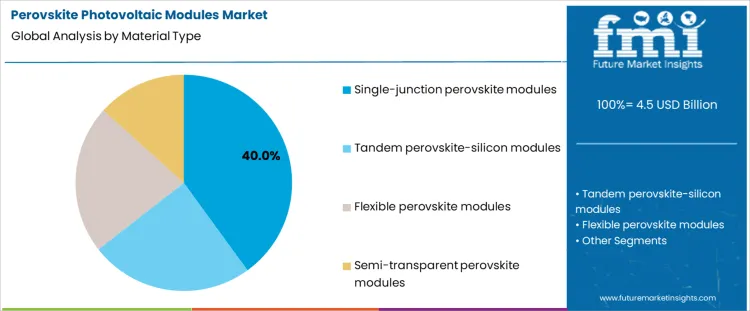
Single junction perovskite modules account for about 40% of demand in the Perovskite Photovoltaic Modules Market in 2026 because they represent the simplest and most mature form of perovskite module architecture available for scaled production. Manufacturing processes for single junction designs are less complex, yields are higher, and cost structures are easier to control. In the Perovskite Photovoltaic Modules Market, early deployments focus on proving long term stability, degradation behavior, and field performance rather than on achieving record efficiencies. Single junction designs provide a practical pathway for this validation because they can be produced and qualified faster than multi-layer structures. This role as the primary commercialization platform explains why they lead early shipment volumes.
Tandem, flexible, and semi-transparent modules in the Perovskite Photovoltaic Modules Market target more specialized or future oriented use cases. Tandem modules offer higher efficiency but involve more complex manufacturing and integration with silicon. Flexible and semi-transparent formats enable new applications, yet their markets are smaller and more design driven. These variants attract attention and investment, but their deployment volumes remain limited compared with the more straightforward single junction products that anchor initial market scale.
Why Do Utility Scale Solar Installations Dominate Application Demand in the Perovskite Photovoltaic Modules Market?
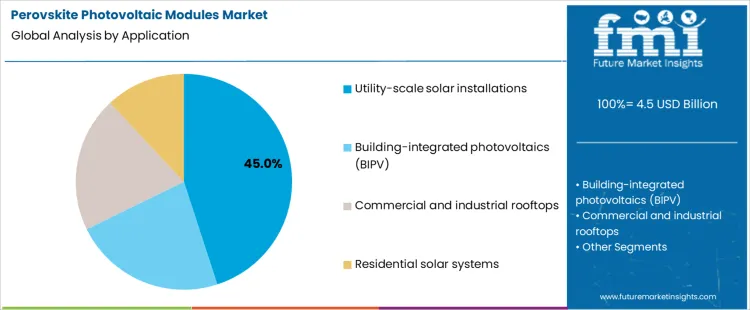
Utility scale solar installations represent about 45% of demand in the Perovskite Photovoltaic Modules Market in 2026 because large projects offer the fastest route to meaningful deployment volumes. Even a small number of utility projects can absorb large quantities of modules, which helps manufacturers build production experience and cost curves. In the Perovskite Photovoltaic Modules Market, utility developers also operate under centralized procurement and standardized plant designs, which simplifies the evaluation of new technologies at scale. Once performance and reliability thresholds are met, adoption can expand quickly across multiple sites.
Building integrated, rooftop, and residential applications in the Perovskite Photovoltaic Modules Market follow different adoption paths. BIPV and architectural uses value form factor and appearance but involve smaller project sizes. Commercial rooftops require proven reliability and long warranties before adopting new module types. Residential systems are highly risk sensitive and slow to change technology platforms. These segments are strategically important for long term differentiation, but utility scale projects remain the primary driver of early volume deployment in the Perovskite Photovoltaic Modules Market.
How Are the Key Dynamics Reshaping the Perovskite Photovoltaic Modules Market?
The category is being shaped by efficiency ambition, durability skepticism, and the push to industrialize new cell platforms. Perovskites promise high efficiency and flexible form factors, but bankability depends on lifetime performance, yield stability, and scalable manufacturing. At the same time, manufacturers and project developers want fewer, standardized module platforms to simplify qualification and deployment. This creates a market where progress is gated by proof and process control rather than by laboratory results. Scale will come from being embedded in certified product families and factory lines, not from isolated pilot projects or one off demonstration installations.
Why Is Efficiency and Form Factor Potential Driving Adoption?
Demand is anchored in limits of conventional silicon. Perovskites offer higher theoretical efficiency and enable lightweight, tandem, or building integrated designs that expand where solar can be deployed. In space constrained rooftops and specialty applications, performance per area and per weight matters more than module price alone. Once a design proves stable, it can unlock new project types and higher energy yield from the same footprint. This ties growth to applications where silicon approaches its practical limits. Volume then follows successful productization of these advantages rather than simple replacement of existing mainstream modules.
What Is Slowing Commercialization of Perovskite Modules?
The main barrier is bankability risk. Long term stability under heat, moisture, and UV exposure remains under scrutiny, and investors require multi year field data. Manufacturing yield, encapsulation reliability, and degradation modes must be proven at scale. Any change in stack or materials can reset qualification timelines. Project developers and insurers are cautious because failures affect asset performance for decades. As a result, deployment is cautious and often limited to pilots or niche uses. These factors keep commercialization paced by evidence generation and process maturity rather than by headline efficiency announcements.
How Are Platformization and Tandem Architectures Changing the Market?
The trend is toward platform based products rather than standalone cells. Many efforts focus on tandem modules that combine perovskite with silicon, fitting into existing manufacturing and balance of system frameworks. This reduces adoption friction and allows gradual integration. Manufacturers are also standardizing stacks and encapsulation approaches to create repeatable, certifiable products. Procurement and qualification shift to module families instead of experimental variants. Over time, success depends on being included in certified platforms and factory roadmaps, with demand scaling through standard product lines rather than bespoke or laboratory grade solutions.
What is the Demand for Perovskite Photovoltaic Modules by Country?
| Country | CAGR (%) |
|---|---|
| USA | 14.0 |
| UK | 13.5 |
| China | 16.5 |
| India | 17.5 |
| Brazil | 14.2 |
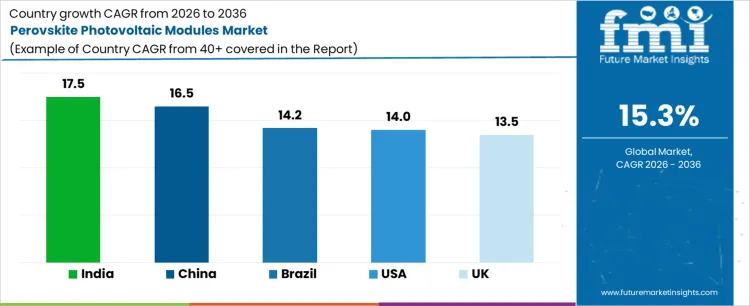
Demand for perovskite photovoltaic modules is rising as solar energy developers and electricity providers adopt high-efficiency, lightweight, and cost-effective solar solutions. India leads with a 17.5% CAGR, driven by expansion of solar installations, government incentives for renewable energy, and growing electricity demand. China follows at 16.5%, supported by large-scale solar farms, manufacturing capacity, and adoption of advanced photovoltaic technologies. Brazil records 14.2% growth, shaped by solar power projects and rising focus on electricity generation from renewable sources. The USA grows at 14.0%, influenced by replacement and upgrade of conventional photovoltaic systems. The UK shows 13.5% CAGR, reflecting steady adoption of high-efficiency perovskite modules in solar projects.
How is the United States experiencing growth in the perovskite photovoltaic modules market?
United States is experiencing growth at a CAGR of 14%, driven by the growing number of utility-scale solar farms and commercial rooftop installations in California, Texas, and Arizona. The installed base of conventional photovoltaic systems encourages replacement and integration with high-efficiency perovskite modules. Market concentration exists in energy-focused states with dense renewable deployment programs, while regional energy cooperatives support additional demand. Investments emphasize durability, lightweight module design, and seamless integration with smart inverters and energy storage solutions. Growth reflects state and federal incentives for renewable adoption, increasing electricity demand, and the need for decarbonized energy solutions in industrial and residential sectors. Urban and suburban deployment, combined with corporate sustainability initiatives, is further expanding the uptake of perovskite modules.
How is the United Kingdom witnessing growth in the perovskite photovoltaic modules market?
United Kingdom is witnessing growth at a CAGR of 13.5%, supported by renewable energy expansion and export-oriented solar technology adoption. Solar developers and energy service companies in London, Birmingham, and Manchester prioritize perovskite modules for commercial rooftops and microgrid applications. Market concentration is moderate, with adoption concentrated around metropolitan and suburban areas with high electricity tariffs. Investments focus on high conversion efficiency, long-term module stability, and compatibility with existing silicon-based installations. Growth reflects government-backed renewable energy targets, corporate ESG commitments, and incentives for low-carbon energy generation. The adoption of perovskite technology is also influenced by the UK’s push for decentralized energy generation, integration with smart grid systems, and reduction of dependency on imported electricity.
How is China experiencing growth in the perovskite photovoltaic modules market?
China is experiencing growth at a CAGR of 16.5%, fueled by large-scale solar installations in Jiangsu, Guangdong, and Shandong provinces. Industrial clusters focused on electronics and renewable energy drive concentrated adoption, while regional deployment supports utility and commercial rooftop projects. Investments prioritize high-throughput perovskite module production, energy efficiency, and seamless grid integration. Growth reflects the national push for renewable energy capacity expansion, rapid industrial electricity demand growth, and ambitious decarbonization targets. Local government policies encourage domestic manufacturing of perovskite modules, while incentives for distributed solar systems further stimulate adoption. Urban industrial hubs, combined with the need for energy-intensive manufacturing sectors to lower electricity costs, create strong demand for advanced, high-efficiency photovoltaic technologies.
How is India witnessing growth in the perovskite photovoltaic modules market?
India is experiencing growth at a CAGR of 17.5%, driven by large solar parks and rooftop installations in Maharashtra, Gujarat, and Karnataka. Installed base expansion and replacement of aging conventional modules promote adoption of perovskite technology with higher efficiency and lower cost per watt. Market concentration is strongest in urban and industrial zones, while government programs encourage deployment in semi-urban and rural electrification projects. Investments focus on energy yield optimization, durability under high temperatures, and integration with battery storage systems. Growth reflects increasing electricity demand, state-backed solar incentives, and corporate renewable adoption. The modularity and lightweight nature of perovskite modules allow installation in dense urban rooftops and industrial facilities, enabling faster project execution.
How is Brazil experiencing growth in the perovskite photovoltaic modules market?
Brazil is experiencing growth at a CAGR of 14.2%, supported by utility-scale solar farms and commercial installations in São Paulo, Minas Gerais, and Rio de Janeiro. Sensitivity to electricity cost pressures and operational efficiency drives adoption of perovskite modules, which offer higher energy output and faster deployment. Market concentration exists in urban industrial zones, with moderate regional dispersion across emerging solar markets. Investments focus on climate-adaptable materials, module durability, and grid integration. Growth reflects government incentives for renewable energy, rising electricity prices, and corporate sustainability initiatives. Urban commercial rooftops and industrial facilities seeking lower operational costs provide concentrated demand for perovskite technology, while distributed solar adoption in suburban areas complements utility-scale growth.
How Are Companies Advancing Performance and Commercial Adoption of Perovskite Solar Modules?

Oxford PV focuses on tandem perovskite-silicon cells, emphasizing high power conversion efficiency and reliability for large-scale utility and rooftop applications. Saule Technologies develops flexible modules using innovative printing techniques, enabling lightweight and curved installations suitable for building-integrated photovoltaics. Microquanta Semiconductor delivers planar perovskite modules engineered for reproducibility in wafer-scale production, targeting consistent performance and long-term operational stability. Huasun Energy integrates perovskite module fabrication with established solar manufacturing processes, balancing efficiency, material costs, and scalability to support commercial deployment across energy markets. Each supplier invests in material optimization, encapsulation methods, and process control to enhance performance, extend module lifespan, and reduce degradation under thermal and environmental stress.
Other regional developers and research-focused companies contribute niche solutions, including advanced encapsulation or novel module designs, to improve moisture, UV, and thermal resistance. Competitive differentiation arises from achieving high efficiency while ensuring long-term stability and manufacturability at scale. Adoption is driven by the ability to integrate modules into existing PV systems, compliance with emerging standards, and demonstrated reliability in field testing. Suppliers offering validated performance data, scalable production methods, and clear pathways to commercialization are gaining traction as perovskite technology moves from laboratory research to mainstream solar energy deployment.
Key Players in the Perovskite Photovoltaic Modules Market
- Oxford PV
- Saule Technologies
- Microquanta Semiconductor
- Huasun Energy
Scope of the Report
| Items | Values |
|---|---|
| Quantitative Units (2026) | USD billion |
| Material Type | Single-junction perovskite modules, Tandem perovskite-silicon modules, Flexible perovskite modules, Semi-transparent perovskite modules |
| Application | Utility-scale solar installations, Building-integrated photovoltaics (BIPV), Commercial and industrial rooftops, Residential solar systems |
| Region | Asia Pacific, Europe, North America, Latin America, Middle East & Africa |
| Countries Covered | China, Japan, South Korea, India, Australia & New Zealand, ASEAN, Germany, United Kingdom, France, Italy, Spain, Nordic, BENELUX, United States, Canada, Mexico, Brazil, Chile, Saudi Arabia, Turkey, South Africa, and other regional markets |
| Key Companies Profiled | Oxford PV, Saule Technologies, Microquanta Semiconductor, Huasun Energy |
| Additional Attributes | Dollar by sales by material type and application; early volumes led by single-junction modules and utility-scale projects; adoption gated by bankability, durability validation, and certification; scale-up linked to yield stability and encapsulation reliability; growth driven by tandem architectures, BIPV formats, and phased integration into mainstream solar portfolios. |
Perovskite Photovoltaic Modules Market Segmentation
Material Type:
- Single-junction perovskite modules
- Tandem perovskite-silicon modules
- Flexible perovskite modules
- Semi-transparent perovskite modules
Application:
- Utility-scale solar installations
- Building-integrated photovoltaics (BIPV)
- Commercial and industrial rooftops
- Residential solar systems
Region
- Asia Pacific
- China
- Japan
- South Korea
- India
- Australia & New Zealand
- ASEAN
- Rest of Asia Pacific
- Europe
- Germany
- United Kingdom
- France
- Italy
- Spain
- Nordic
- BENELUX
- Rest of Europe
- North America
- United States
- Canada
- Mexico
- Latin America
- Brazil
- Chile
- Rest of Latin America
- Middle East & Africa
- Kingdom of Saudi Arabia
- Other GCC Countries
- Turkey
- South Africa
- Other African Union
- Rest of Middle East & Africa
Bibliography
- International Energy Agency Photovoltaic Power Systems Programme. (2024). Trends in photovoltaic applications 2024. IEA PVPS.
- International Energy Agency Photovoltaic Power Systems Programme, Task 13. (2025). Degradation and failure modes in new photovoltaic cell and module technologies (IEA-PVPS T13-30:2025). IEA PVPS.
- National Renewable Energy Laboratory. (2025). Best research-cell efficiencies [Chart]. U.S. Department of Energy.
Frequently Asked Questions
How big is the perovskite photovoltaic modules market in 2026?
The global perovskite photovoltaic modules market is estimated to be valued at USD 4.5 billion in 2026.
What will be the size of perovskite photovoltaic modules market in 2036?
The market size for the perovskite photovoltaic modules market is projected to reach USD 18.7 billion by 2036.
How much will be the perovskite photovoltaic modules market growth between 2026 and 2036?
The perovskite photovoltaic modules market is expected to grow at a 15.3% CAGR between 2026 and 2036.
What are the key product types in the perovskite photovoltaic modules market?
The key product types in perovskite photovoltaic modules market are single‑junction perovskite modules , tandem perovskite‑silicon modules, flexible perovskite modules and semi‑transparent perovskite modules.
Which application segment to contribute significant share in the perovskite photovoltaic modules market in 2026?
In terms of application, utility‑scale solar installations segment to command 45.0% share in the perovskite photovoltaic modules market in 2026.
Preview the report firsthand - request a free sample
Get SampleGet the brochure for pricing and purchase details.
Get PDFTable of Content
- Executive Summary
- Global Market Outlook
- Demand-side Trends
- Supply-side Trends
- Technology Roadmap Analysis
- Analysis and Recommendations
- Market Overview
- Market Coverage / Taxonomy
- Market Definition / Scope / Limitations
- Market Background
- Market Dynamics
- Drivers
- Restraints
- Opportunity
- Trends
- Scenario Forecast
- Demand in Optimistic Scenario
- Demand in Likely Scenario
- Demand in Conservative Scenario
- Opportunity Map Analysis
- Product Life Cycle Analysis
- Supply Chain Analysis
- Investment Feasibility Matrix
- Value Chain Analysis
- PESTLE and Porter’s Analysis
- Regulatory Landscape
- Regional Parent Market Outlook
- Production and Consumption Statistics
- Import and Export Statistics
- Market Dynamics
- Global Market Analysis 2021 to 2025 and Forecast, 2026 to 2036
- Historical Market Size Value (USD Million) Analysis, 2021 to 2025
- Current and Future Market Size Value (USD Million) Projections, 2026 to 2036
- Y-o-Y Growth Trend Analysis
- Absolute $ Opportunity Analysis
- Global Market Pricing Analysis 2021 to 2025 and Forecast 2026 to 2036
- Global Market Analysis 2021 to 2025 and Forecast 2026 to 2036, By Material Type
- Introduction / Key Findings
- Historical Market Size Value (USD Million) Analysis By Material Type , 2021 to 2025
- Current and Future Market Size Value (USD Million) Analysis and Forecast By Material Type , 2026 to 2036
- Single‑junction perovskite modules
- Tandem perovskite‑silicon modules
- Flexible perovskite modules
- Semi‑transparent perovskite modules
- Single‑junction perovskite modules
- Y-o-Y Growth Trend Analysis By Material Type , 2021 to 2025
- Absolute $ Opportunity Analysis By Material Type , 2026 to 2036
- Global Market Analysis 2021 to 2025 and Forecast 2026 to 2036, By Application
- Introduction / Key Findings
- Historical Market Size Value (USD Million) Analysis By Application, 2021 to 2025
- Current and Future Market Size Value (USD Million) Analysis and Forecast By Application, 2026 to 2036
- Utility‑scale solar installations
- Building‑integrated photovoltaics (BIPV)
- Commercial and industrial rooftops
- Residential solar systems
- Utility‑scale solar installations
- Y-o-Y Growth Trend Analysis By Application, 2021 to 2025
- Absolute $ Opportunity Analysis By Application, 2026 to 2036
- Global Market Analysis 2021 to 2025 and Forecast 2026 to 2036, By Region
- Introduction
- Historical Market Size Value (USD Million) Analysis By Region, 2021 to 2025
- Current Market Size Value (USD Million) Analysis and Forecast By Region, 2026 to 2036
- North America
- Latin America
- Western Europe
- Eastern Europe
- East Asia
- South Asia and Pacific
- Middle East & Africa
- Market Attractiveness Analysis By Region
- North America Market Analysis 2021 to 2025 and Forecast 2026 to 2036, By Country
- Historical Market Size Value (USD Million) Trend Analysis By Market Taxonomy, 2021 to 2025
- Market Size Value (USD Million) Forecast By Market Taxonomy, 2026 to 2036
- By Country
- USA
- Canada
- Mexico
- By Material Type
- By Application
- By Country
- Market Attractiveness Analysis
- By Country
- By Material Type
- By Application
- Key Takeaways
- Latin America Market Analysis 2021 to 2025 and Forecast 2026 to 2036, By Country
- Historical Market Size Value (USD Million) Trend Analysis By Market Taxonomy, 2021 to 2025
- Market Size Value (USD Million) Forecast By Market Taxonomy, 2026 to 2036
- By Country
- Brazil
- Chile
- Rest of Latin America
- By Material Type
- By Application
- By Country
- Market Attractiveness Analysis
- By Country
- By Material Type
- By Application
- Key Takeaways
- Western Europe Market Analysis 2021 to 2025 and Forecast 2026 to 2036, By Country
- Historical Market Size Value (USD Million) Trend Analysis By Market Taxonomy, 2021 to 2025
- Market Size Value (USD Million) Forecast By Market Taxonomy, 2026 to 2036
- By Country
- Germany
- UK
- Italy
- Spain
- France
- Nordic
- BENELUX
- Rest of Western Europe
- By Material Type
- By Application
- By Country
- Market Attractiveness Analysis
- By Country
- By Material Type
- By Application
- Key Takeaways
- Eastern Europe Market Analysis 2021 to 2025 and Forecast 2026 to 2036, By Country
- Historical Market Size Value (USD Million) Trend Analysis By Market Taxonomy, 2021 to 2025
- Market Size Value (USD Million) Forecast By Market Taxonomy, 2026 to 2036
- By Country
- Russia
- Poland
- Hungary
- Balkan & Baltic
- Rest of Eastern Europe
- By Material Type
- By Application
- By Country
- Market Attractiveness Analysis
- By Country
- By Material Type
- By Application
- Key Takeaways
- East Asia Market Analysis 2021 to 2025 and Forecast 2026 to 2036, By Country
- Historical Market Size Value (USD Million) Trend Analysis By Market Taxonomy, 2021 to 2025
- Market Size Value (USD Million) Forecast By Market Taxonomy, 2026 to 2036
- By Country
- China
- Japan
- South Korea
- By Material Type
- By Application
- By Country
- Market Attractiveness Analysis
- By Country
- By Material Type
- By Application
- Key Takeaways
- South Asia and Pacific Market Analysis 2021 to 2025 and Forecast 2026 to 2036, By Country
- Historical Market Size Value (USD Million) Trend Analysis By Market Taxonomy, 2021 to 2025
- Market Size Value (USD Million) Forecast By Market Taxonomy, 2026 to 2036
- By Country
- India
- ASEAN
- Australia & New Zealand
- Rest of South Asia and Pacific
- By Material Type
- By Application
- By Country
- Market Attractiveness Analysis
- By Country
- By Material Type
- By Application
- Key Takeaways
- Middle East & Africa Market Analysis 2021 to 2025 and Forecast 2026 to 2036, By Country
- Historical Market Size Value (USD Million) Trend Analysis By Market Taxonomy, 2021 to 2025
- Market Size Value (USD Million) Forecast By Market Taxonomy, 2026 to 2036
- By Country
- Kingdom of Saudi Arabia
- Other GCC Countries
- Turkiye
- South Africa
- Other African Union
- Rest of Middle East & Africa
- By Material Type
- By Application
- By Country
- Market Attractiveness Analysis
- By Country
- By Material Type
- By Application
- Key Takeaways
- Key Countries Market Analysis
- USA
- Pricing Analysis
- Market Share Analysis, 2025
- By Material Type
- By Application
- Canada
- Pricing Analysis
- Market Share Analysis, 2025
- By Material Type
- By Application
- Mexico
- Pricing Analysis
- Market Share Analysis, 2025
- By Material Type
- By Application
- Brazil
- Pricing Analysis
- Market Share Analysis, 2025
- By Material Type
- By Application
- Chile
- Pricing Analysis
- Market Share Analysis, 2025
- By Material Type
- By Application
- Germany
- Pricing Analysis
- Market Share Analysis, 2025
- By Material Type
- By Application
- UK
- Pricing Analysis
- Market Share Analysis, 2025
- By Material Type
- By Application
- Italy
- Pricing Analysis
- Market Share Analysis, 2025
- By Material Type
- By Application
- Spain
- Pricing Analysis
- Market Share Analysis, 2025
- By Material Type
- By Application
- France
- Pricing Analysis
- Market Share Analysis, 2025
- By Material Type
- By Application
- India
- Pricing Analysis
- Market Share Analysis, 2025
- By Material Type
- By Application
- ASEAN
- Pricing Analysis
- Market Share Analysis, 2025
- By Material Type
- By Application
- Australia & New Zealand
- Pricing Analysis
- Market Share Analysis, 2025
- By Material Type
- By Application
- China
- Pricing Analysis
- Market Share Analysis, 2025
- By Material Type
- By Application
- Japan
- Pricing Analysis
- Market Share Analysis, 2025
- By Material Type
- By Application
- South Korea
- Pricing Analysis
- Market Share Analysis, 2025
- By Material Type
- By Application
- Russia
- Pricing Analysis
- Market Share Analysis, 2025
- By Material Type
- By Application
- Poland
- Pricing Analysis
- Market Share Analysis, 2025
- By Material Type
- By Application
- Hungary
- Pricing Analysis
- Market Share Analysis, 2025
- By Material Type
- By Application
- Kingdom of Saudi Arabia
- Pricing Analysis
- Market Share Analysis, 2025
- By Material Type
- By Application
- Turkiye
- Pricing Analysis
- Market Share Analysis, 2025
- By Material Type
- By Application
- South Africa
- Pricing Analysis
- Market Share Analysis, 2025
- By Material Type
- By Application
- USA
- Market Structure Analysis
- Competition Dashboard
- Competition Benchmarking
- Market Share Analysis of Top Players
- By Regional
- By Material Type
- By Application
- Competition Analysis
- Competition Deep Dive
- Oxford PV
- Overview
- Product Portfolio
- Profitability by Market Segments (Product/Age /Sales Channel/Region)
- Sales Footprint
- Strategy Overview
- Marketing Strategy
- Product Strategy
- Channel Strategy
- Saule Technologies
- Microquanta Semiconductor
- Huasun Energy
- Oxford PV
- Competition Deep Dive
- Assumptions & Acronyms Used
- Research Methodology


