

- Market Size (2026)
- USD 77.5 Mn
- Forecast (2036)
- USD 181.8 Mn
- CAGR (2026 to 2036)
- 8.9%
How Big is the Applesauce Market in 2026?
The applesauce market is estimated at USD 77.5 million in 2026.
The global applesauce market was valued at USD 71.2 million in 2025 and is estimated to reach USD 77.5 million in 2026. The market is projected to reach USD 181.8 million by 2036, expanding at a compound annual growth rate (CAGR) of 8.9% between 2026 and 2036. Standard grade accounted for the largest share of the market, contributing 44.0% of total revenue in 2026. Demand is supported by bakeries that use apple puree to add fruit character and to replace part of the fat and sugar in cakes and muffins. Apple supply is ample. The US Apple Association (USApple) forecast the 2025/26 US apple crop at 11.7 billion pounds, or 278.5 million bushels, up 1.3% from the previous year and 3.6% above the five-year average[5]. In Europe, the World Apple and Pear Association (WAPA) raised its 2025/26 EU apple forecast by 5.0% to between 10.9 and 11 million tons, and noted that quality challenges had directed higher volumes to the processing sector[6]. The costs of the ingredients that applesauce can replace are rising, with the FAO Sugar Price Index up 14.7% and its Vegetable Oil Price Index up 18.3% year on year in September 2026[7].
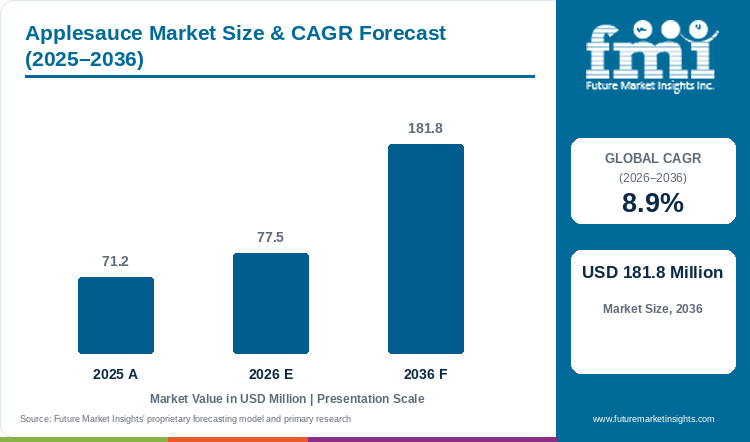
Table 1: Applesauce Market Size and Forecast (USD million), 2025 to 2036
| Market size and forecast | Value |
|---|---|
| 2025 market size | USD 71.2 million |
| Estimated market size in 2026 | USD 77.5 million |
| Projected market size by 2036 | USD 181.8 million |
| CAGR (2026-2036) | 8.9% |
| Added revenue, 2026 to 2036 | USD 104.3 million |
Key Market Trends & Insights
- By Product Type: The Standard grade segment accounted for the largest share of the applesauce market in 2026, representing 44.0% of total market revenue.
- By Form: Powder / dry products held the leading market position with a share of 49.0% in 2026.
- By Application: Cakes & muffins remained the largest application segment, accounting for 25.0% of the market in 2026.
Regional Highlights
- Fastest-growing country: The UAE is expected to record the highest growth rate among the eight profiled countries, with a projected CAGR of 10.2% between 2026 and 2036.
- Growth across other countries: Saudi Arabia is projected to expand at a CAGR of 9.8%, followed by South Korea at 9.5% and the UK at 9.2%. Japan is expected to register comparatively slower growth, with a CAGR of 8.0% during the forecast period.
The functional role of applesauce is a key driver of bakery use. A 2024 study examined apple puree as a replacement for part of the fat and sugar in muffins and assessed the resulting texture and physical properties[1]. Such substitution becomes more attractive when fat and sugar prices rise. According to the Food and Agriculture Organization of the United Nations (FAO), its Sugar Price Index reached its highest level since April 2025 in September 2026, and international palm oil prices rose for a fourth consecutive month[7]. The workable dose still depends on the recipe, mixing method and quality retained through storage. Within bakery ingredient purchasing, the specification must therefore include the fruit's effect on batter as well as its flavour.
Apple supply in the main producing regions is strong. Washington, the leading US producer, was forecast to harvest a record crop of more than 180 million bushels in 2025/26, valued at nearly USD 2.3 billion[5]. The United States Department of Agriculture (USDA) had earlier forecast an 11.5-billion-pound crop across surveyed states, about 6.0% above 2024[3]. In Europe, WAPA's revised forecast included an increase of around 400,000 tons for Poland, although the EU crop remained well below its full potential of 13 million tons and the 2018 peak of 13.2 million tons[6]. Large crops and higher volumes directed to processing support the availability of apple puree at stable prices.
Conditions differ by origin and fruit category. Defra's June 2026 statistics recorded UK culinary apple production of about 51 thousand tonnes in 2025, down 6.1% from the previous year[4], while US and EU crops increased. A broad supply total does not determine the acidity, solids or texture required from a particular preparation, so processor sourcing and blending connect agricultural conditions with the agreed bakery specification. Format is a further consideration. Research published in 2023 examined spray-drying conditions and carrier composition in relation to apple powder properties, including moisture uptake and reconstitution[2].
Table 2: Supporting Industry Indicators for the Applesauce Market, 2023 to 2026
| Indicator | Data point | Why it matters | Source |
|---|---|---|---|
| US apple crop | USApple forecast 2025/26 US apple production at 11.7 billion pounds, up 1.3% and 3.6% above the five-year average. | A larger crop supports the availability of apples for processing. | [5] |
| Washington crop | Washington was forecast to produce a record crop of more than 180 million bushels, valued at nearly USD 2.3 billion. | Washington is the main source of US apples. | [5] |
| USDA outlook | USDA forecast an 11.5-billion-pound 2025 crop across surveyed states, about 6.0% above 2024. | The outlook provides a reference for raw fruit sourcing. | [3] |
| EU apple crop | WAPA raised its 2025/26 EU apple forecast by 5.0% to between 10.9 and 11 million tons. | European supply affects puree availability for European bakeries. | [6] |
| Processing volumes | Quality challenges directed higher EU apple volumes to the processing sector. | More fruit for processing supports puree supply. | [6] |
| UK culinary apples | Defra reported about 51 thousand tonnes in 2025, down 6.1%. | Variety-specific outcomes show the need to maintain puree specifications. | [4] |
| Sugar prices | The FAO Sugar Price Index stood 14.7% above its year-earlier level in September 2026. | Higher sugar costs encourage sugar reduction using fruit purees. | [7] |
| Fat prices | The FAO Vegetable Oil Price Index stood 18.3% above its year-earlier level in September 2026. | Higher fat costs encourage partial fat replacement. | [7] |
| Muffin research | A 2024 study examined apple puree substitution for part of the fat and sugar in muffins. | The research links puree use with a specific formulation task. | [1] |
| Powder research | A 2023 study assessed spray-drying, carrier composition, moisture uptake and reconstitution. | These properties affect dry ingredient storage and dispersion. | [2] |
Demand Intensity Analysis
A comparison of FMI's market estimate with US apple production provides a measure of the small share of apples used in bakery applesauce. USApple forecast the 2025/26 US crop at 11.7 billion pounds, or approximately 5.31 million tonnes[5]. FMI estimated the global applesauce market at USD 71.2 million in 2025, which is equivalent to approximately USD 13.4 for every tonne of US apples produced. The EU crop of around 11 million tons[6] provides a further supply base, which indicates that bakery applesauce draws on only a small fraction of global apple supply.
Input costs provide another reference point. The FAO Sugar Price Index rose by 14.7% and the Vegetable Oil Price Index by 18.3% in the year to September 2026[7]. With apple crops above average in the United States and Europe[5][6], the relative cost of apple puree compared with sugar and fat has fallen, which supports its use as a partial replacement in cakes and muffins.
A similar comparison can be made between projected market growth and apple supply. FMI expects the applesauce market to grow at a CAGR of 8.9% between 2026 and 2036, while the US apple crop grew by 1.3% in 2025/26[5]. The difference implies that growth will rely on wider bakery use of apple puree and powder, particularly for fat and sugar reduction, rather than on growth in apple production.
Segment values show where demand is concentrated. Cakes & muffins accounted for USD 19.4 million of Application revenue in 2026, while Powder / dry represented USD 38.0 million of Form revenue. Direct to industrial bakeries represented USD 34.9 million on the Sales Channel axis. FMI projects USD 104.3 million in added market revenue between 2026 and 2036, with the market reaching 2.3 times its 2026 value.
Table 3: Demand Intensity Metrics for the Applesauce Market, 2025/26 Crop Data Against 2025 and 2026 Market Values
| Demand intensity metric | Value | Basis |
|---|---|---|
| FMI market value, 2025 | USD 71.2 million | FMI estimate of applesauce revenue. |
| US apple crop, 2025/26 | 11.7 billion pounds | USApple forecast. |
| US apple crop in tonnes | Approximately 5.31 million tonnes | 11.7 billion pounds converted at 0.4536 kg per pound. |
| FMI value per tonne of US apples | Approximately USD 13.4 | The calculation divides USD 71.2 million by 5.31 million tonnes. |
| EU apple crop, 2025/26 | 10.9 to 11 million tons | WAPA revised forecast. |
| FAO Sugar Price Index, year-on-year change | +14.7% | September 2026. |
| FAO Vegetable Oil Price Index, year-on-year change | +18.3% | September 2026. |
| US apple crop growth, 2025/26 | 1.3% | USApple. |
| FMI value CAGR, 2026 to 2036 | 8.9% | FMI market forecast. |
| Powder / dry revenue, 2026 | USD 38.0 million | 49.0% of the market. |
| Cakes & muffins revenue, 2026 | USD 19.4 million | 25.0% of the market. |
| Market expansion multiple | 2.3 times | Projected 2036 market value relative to 2026. |
Analyst Perspective
"With sugar and fat both more expensive and apple crops above average, applesauce has a clear cost case in cakes and muffins, provided it delivers the same crumb on every batch."
- Nandini Roy Choudhury, Principal Analyst at Future Market Insights
How is the applesauce market segmented?
The applesauce market is segmented by product type, form, application, claim and sales channel. Product Type comprises Standard grade, Premium / specialty grade, Organic certified and Clean label grade. Form comprises Powder / dry, Liquid, Paste / semi-solid and Granules / pieces. Application comprises Cakes & muffins, Bread & rolls, Biscuits & cookies, Viennoiserie & pastry and Other bakery & snacks. Claim comprises Conventional, Clean label, Organic and Non-GMO / identity preserved. Sales Channel comprises Direct to industrial bakeries, Ingredient distributors, Foodservice & artisan supply and Online B2B.
Why does Standard grade anchor Product Type purchasing?
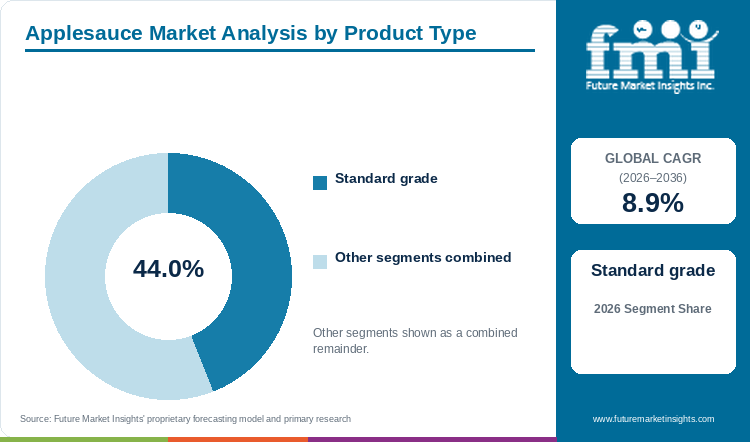
Standard grade holds 44.0% of the Product Type category in 2026.
A smooth puree and a coarser applesauce can have the same apple content but behave very differently, as particle size influences preparation and texture while acidity and solids affect the surrounding formula. A standard specification records these properties together, and Standard grade generated approximately USD 34.1 million in 2026. Deliveries can be compared with the material used in an accepted cake or muffin, so changes are identified before mixing. Several everyday recipes can share a dependable standard fruit base, and its delivered cost becomes meaningful at the dose that achieves the intended result.
- Standard grade holds 44.0% of the Product Type category in 2026.
- Particle size and acidity complete the specification alongside apple solids.
How does Powder / dry fit Form selection?
Powder / dry represents 49.0% of Form revenue in 2026.
Apple powder can enter the dry-weighing sequence while water is added elsewhere, and dry formats generated approximately USD 38.0 million in 2026. Whether that arrangement is useful depends on how readily the apple disperses and how the material behaves in storage. Research published in Heliyon in 2023 examined drying conditions and carrier composition in relation to apple powder properties[2]. A wet puree distributes fruit immediately but introduces its own liquid contribution, so preparation time and the baked result need to be compared at the accepted addition level.
- Powder / dry represents 49.0% of Form revenue in 2026.
- Liquid adjustment and mixing effort need to be compared at the dose used in the finished recipe.
What makes Cakes & muffins the primary Application?
Cakes & muffins lead Application with 25.0% in 2026.
Cakes and muffins are where apple puree has the clearest functional role, and the segment generated approximately USD 19.4 million in 2026. Apple puree contributes flavour while also changing batter composition and texture. The 2024 muffin study examined substitution for part of the fat and sugar, linking puree use with assessment of physical properties[1]. Rising sugar and vegetable oil prices[7] strengthen the case for such substitution. Height, crumb structure and eating quality establish whether the fruit serves its purpose at the selected addition level.
- Cakes & muffins lead Application with 25.0% in 2026.
- Height, crumb and eating quality reveal whether the intended formulation change works through production.
Why does Conventional lead the Claim classification?
Conventional contributes 54.0% of Claim revenue in 2026.
Conventional products contributed 54.0% of Claim revenue in 2026. Unsweetened puree and preparations containing added sugar leave different amounts of recipe control with the bakery, so full composition needs to be clear regardless of the claim. Conventional grades provide flexibility in texture, sourcing and supply arrangements, while organic or identity-preserved purchasing adds requirements to be planned with the processor. Across these options, acidity and solids must remain consistent enough to preserve the intended flavour and crumb.
- Conventional contributes 54.0% of Claim revenue in 2026.
- Declared composition needs to match both the purchased preparation and the bakery's claim records.
Why is Direct to industrial bakeries the leading Sales Channel?
Direct to industrial bakeries accounts for 45.0% of Sales Channel revenue in 2026.
Industrial bakeries buying direct from processors can agree particle size, consistency and packaging in one contract, and direct supply accounted for approximately USD 34.9 million in 2026. The plant's rate of use determines which format is practical. A large aseptic pack may reduce unpacking work but needs compatible handling, while cans or distributor packs suit shorter runs. Shared technical records give several facilities the same reference, and planned deliveries maintain it as volumes change.
- Direct to industrial bakeries accounts for 45.0% of Sales Channel revenue in 2026.
- A large pack is useful only when the plant can handle and use it at the planned rate.
What are the drivers, restraints and opportunities in the applesauce market?
Fat and sugar reduction sustains repeat applesauce demand, although fruit variation and format changes can unsettle an accepted recipe, making clear ingredient formats useful for more controlled reformulation.
Fat and sugar reduction sustains repeat applesauce demand
Applesauce supports recurring demand where its fruit character or effect on batter has a defined role in the recipe. The 2024 muffin research examined puree substitution for part of the fat and sugar[1], and rising prices for both ingredients, with the FAO Sugar Price Index up 14.7% and the Vegetable Oil Price Index up 18.3% year on year[7], make this role more valuable. Commercial use still depends on the dose and texture obtained through the bakery's own process. Within cake and muffin mix development, an identified apple preparation also clarifies the fruit contribution relative to the dry blend and added liquid.
Fruit variation and format changes can unsettle an accepted recipe
A broad apple crop total does not describe every processor's sourcing position. Defra's 2026 statistics recorded a 6.1% decline in UK culinary apples in 2025[4], while WAPA noted quality challenges in the EU crop that directed more fruit to processing[6]. The processor's task is to manage the selected fruit into an agreed sweetness, acidity and texture. At the bakery, switching preparations can change liquid contribution and dispersion even if the ingredient is still called applesauce, so a cheaper offer requires assessment in the existing recipe. These differences explain why replacing a successful grade can take time.
Clear ingredient formats can support more controlled reformulation
Smooth batter puree, textured fruit layers and dry apple inputs serve distinct formulation purposes, and defining their properties separates dose and liquid adjustment from changes in the fruit itself. The same distinction matters when a pilot batch moves to larger output. Ingredient processing and handling determine whether packing, storage and introduction into the mixer preserve the selected material's behaviour. With US and EU apple crops above average in 2025/26[5][6], processors have good raw material availability to develop dedicated bakery formats.
Which country CAGRs are profiled in the applesauce market?
Table 4: Country growth outlook for the applesauce market
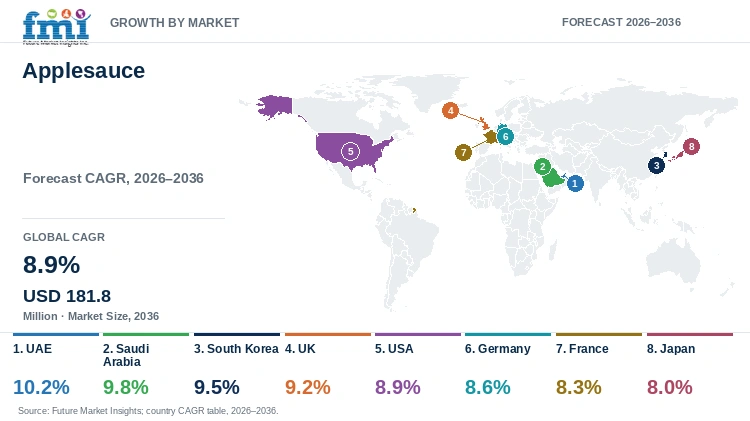
| Country | CAGR |
|---|---|
| UAE | 10.2% |
| Saudi Arabia | 9.8% |
| South Korea | 9.5% |
| UK | 9.2% |
| USA | 8.9% |
| Germany | 8.6% |
| France | 8.3% |
| Japan | 8.0% |
UAE
- The UAE is the fastest-growing market among the profiled countries, with a forecast CAGR of 10.2% from 2026 to 2036. In UAE cake production, batch planning and storage capacity influence the choice between wet and dry apple preparations. Ready puree introduces fruit and water together, while powder places liquid addition elsewhere in the mixing sequence. Smaller distributor quantities support initial formulation, and consistency in the apple specification preserves the accepted formula as production becomes regular.
Saudi Arabia
- Saudi bakery products such as fruit layers and muffins need different textures and concentrations from an apple preparation, so the intended application determines dose and handling format. Saudi Arabia is forecast to grow at a CAGR of 9.8% for 2026 to 2036. Preparation instructions are particularly relevant where powder is rehydrated, and stable acidity preserves flavour through these adjustments.
South Korea
- With a projected CAGR of 9.5% from 2026 to 2036, South Korea ranks third among the profiled countries. A smooth apple puree can disappear into the texture of a soft cake, whereas a coarser preparation makes the fruit more apparent in a centre, so South Korean development begins with how the apple should be perceived. Small trials can compare grades against that target, and colour and acidity remain useful reference points between deliveries.
UK
- UK culinary apple production fell by 6.1% to about 51 thousand tonnes in 2025, according to Defra's June 2026 statistics[4], which gives UK bakeries a reason to discuss the fruit behind their selected preparation. The UK is forecast to grow at a CAGR of 9.2% from 2026 to 2036. What matters in production is whether the ingredient continues to perform in the established recipe, so origin or blend changes need clear communication. Smaller producers also need manageable packs.
USA
- US apple supply is strong, with USApple forecasting a 2025/26 crop of 11.7 billion pounds and a record of more than 180 million bushels in Washington[5]. The USA is forecast to grow at a CAGR of 8.9% from 2026 to 2036. Individual bakery requirements remain specific. A high-volume muffin line may need stable solids and smooth dispersion, while a smaller producer may prefer cans or pails. Qualifying a contingency grade before any interruption gives the bakery an option it can use without urgent reformulation.
Germany
- German industrial bakeries can compare applesauce preparations directly on the water and fruit solids entering the mixer. Powder may fit dry weighing, while puree introduces a separate handling stage. Germany is forecast to grow at a CAGR of 8.6% for 2026 to 2036. The EU apple crop of around 11 million tons in 2025/26[6] supports regional supply. Once a preparation has been selected, maintaining acidity and particle size helps preserve the formula as batch sizes change.
France
- French pastry formulators often prefer plain apple puree, which leaves sweetness and seasoning under their control. Smoothness, acidity and baking behaviour distinguish its contribution to cake from its use in a fruit layer. France is forecast to grow at a CAGR of 8.3% from 2026 to 2036. Pack configuration affects how efficiently larger kitchens use the preparation, while smaller quantities accommodate development before a recipe enters regular use.
Japan
- Japan is expected to register the slowest growth among the profiled countries, with a projected CAGR of 8.0% from 2026 to 2036. In a smaller Japanese cake or pastry, apple needs to remain in proportion to the whole portion, and a subtle batter addition and a distinct centre are separate formulation tasks. Acidity, solids and particle-size information make trials comparable, and a practical pack and consistent preparation procedure support repetition.
Who are the notable companies in the applesauce market?
Tree Top; Knouse Foods / Musselman’s; SVZ; Ariza; Andros
Tree Top, Knouse Foods / Musselman's, SVZ, Ariza and Andros supply commercial applesauce or apple puree. US-based suppliers draw on a 2025/26 crop of 11.7 billion pounds[5], while European suppliers such as SVZ and Andros source from an EU crop of around 11 million tons[6]. Concentration, acidity, particle size and packaging distinguish their formats and provide concrete points of comparison for a bakery.
Smooth batter puree and textured fruit layers place different requirements on apple processing. Concentration and particle specifications identify the intended role, while logistics and application support determine how the grade performs in the customer's recipe.
Competitive Benchmarking: Applesauce Market
Table 5: Company capabilities in the applesauce market
| Company | Relevant offering | Purchasing consideration |
|---|---|---|
| Tree Top | Single-strength apple puree in aseptic and frozen formats | Choose particle size and packaging for the plant |
| Knouse Foods / Musselman’s | Unsweetened applesauce and bulk ingredient supply | Compare commercial packs and declared ingredients |
| SVZ | Apple single-strength puree and puree concentrate | Select variety, concentration and origin |
| Ariza | Low-acid organic apple puree | Match mild acidity with the intended formulation |
| Andros | Unsweetened apple puree in professional packs | Plan refrigerated handling and pack consumption |
Key Developments in the Applesauce Market
- In August 2025, USApple forecast the 2025/26 US apple crop at 11.7 billion pounds, up 1.3%, with a record crop of more than 180 million bushels in Washington[5].
- In September 2025, USDA forecast an 11.5-billion-pound apple crop across surveyed US states, about 6.0% above 2024[3].
- In November 2025, WAPA raised its EU apple forecast by 5.0% to between 10.9 and 11 million tons[6].
- In June 2026, Defra reported that UK culinary apple production was about 51 thousand tonnes in 2025, a decline of 6.1%[4].
- In October 2026, the FAO reported that its Sugar Price Index was 14.7% higher and its Vegetable Oil Price Index 18.3% higher than a year earlier[7].
Key Players in the Applesauce Market
- Tree Top
- Knouse Foods / Musselman’s
- SVZ
- Ariza
- Andros
Applesauce Market - Report Scope
Table 6: Report scope for the applesauce market
| Coverage field | Report scope |
|---|---|
| Market breakdown | Product Type; Form; Application; Claim; Sales Channel |
| Quantitative Units | USD Million |
| Market Definition | Revenue from apple-based applesauce, puree and processed apple preparations sold as bakery ingredients across the stated Product Type, Form, Application, Claim and Sales Channel categories. Excludes retail finished baked goods, downstream desserts, juice concentrates sold for beverage use, and other-fruit substitutes; mixed-fruit products qualify only for attributable apple-preparation revenue. |
| Regions Covered | North America, Latin America, Western Europe, Eastern Europe, East Asia, South Asia and Pacific, Middle East and Africa |
| Countries Covered | UAE; Saudi Arabia; South Korea; UK; USA; Germany; France; Japan |
| Key Companies Profiled | Tree Top; Knouse Foods / Musselman’s; SVZ; Ariza; Andros |
| Forecast Period | 2026 to 2036 |
| Approach | Market assessment supported by official technical and regulatory publications, company product information and country operating conditions. |
Applesauce Market - Research Methodology
Table 7: Research approach for the applesauce market
| Method | Approach |
|---|---|
| Market definition | The assessment separates qualifying ingredient revenue from finished bakery products and unrelated formulation inputs. |
| Secondary evidence | Government publications, regulatory material, technical literature and first-party product documentation establish the operating context. |
| Commercial assessment | Product performance, supply continuity and customer qualification requirements are considered within each segment and country profile. |
| Comparability | Market values, segment shares and country forecasts use the stated revenue boundary, units and forecast period. |
Applesauce Market by Segments
Product Type
- Standard grade
- Premium / specialty grade
- Organic certified
- Clean label grade
Form
- Powder / dry
- Liquid
- Paste / semi-solid
- Granules / pieces
Application
- Cakes & muffins
- Bread & rolls
- Biscuits & cookies
- Viennoiserie & pastry
- Other bakery & snacks
Claim
- Conventional
- Clean label
- Organic
- Non-GMO / identity preserved
Sales Channel
- Direct to industrial bakeries
- Ingredient distributors
- Foodservice & artisan supply
- Online B2B
Applesauce Market by Region
- North America
- United States
- Canada
- Latin America
- Brazil
- Mexico
- Argentina
- Chile
- Western Europe
- Germany
- France
- United Kingdom
- Italy
- Spain
- Benelux
- Nordics
- Eastern Europe
- Poland
- Czech Republic
- Romania
- Hungary
- East Asia
- China
- Japan
- South Korea
- South Asia and Pacific
- India
- ASEAN
- Australia and New Zealand
- Middle East and Africa
- GCC Countries
- South Africa
- Türkiye
- Israel
Research Sources and Bibliography
- [1] Huțu, D., & Amariei, S. (2024, October 6). Effect of apple puree as a substitute for fat and sugar on the texture and physical properties of muffins.
- [2] Qadri, T., Naik, H. R., Hussain, S. Z., Bhat, T. A., Naseer, B., Zargar, I., & Beigh, M. A. (2023, July 21). Impact of spray drying conditions on the reconstitution, efficiency and flow properties of spray dried apple powder: Optimization, sensorial and rheological assessment.
- [3] U.S. Department of Agriculture, Economic Research Service. (2025, September 25). Fruit and tree nuts outlook: September 2025 (FTS-383).
- [4] Department for Environment, Food & Rural Affairs. (2026, June 25). Horticulture statistics 2025.
- [5] US Apple Association. (2025, August 15). 2025-26 apple production will reach nearly 279 million bushels.
- [6] FreshFruitPortal. (2025, November 10). Favorable weather lifts EU apple and pear crop outlook, market remains balanced.
- [7] Food and Agriculture Organization of the United Nations. (2026, October 2). FAO Food Price Index.
Future Market Insights. (2026). Applesauce Market: Global Industry Analysis and Opportunity Assessment 2036.
This Report Answers
- What are the applesauce market values in 2026 and 2036?
- How does apple preparation affect bakery formulation?
- Why does Standard grade lead Product Type in 2026?
- What determines the choice between wet and dry apple formats?
- How do the eight profiled country CAGRs compare?
- Which suppliers offer commercial applesauce and apple-puree products?
Frequently Asked Questions
How big is the applesauce market in 2026, and what is forecast for 2036?
The market is valued at USD 77.5 million in 2026 and is forecast to reach USD 181.8 million by 2036.
What is the forecast CAGR from 2026 to 2036?
The market is forecast to grow at a CAGR of 8.9% from 2026 to 2036.
Which Product Type leads the applesauce market in 2026?
Standard grade leads with 44.0% in 2026, supporting repeatable specifications for bakery use.
Which Form has the leading share?
Powder / dry leads with 49.0% in 2026, and buyers should assess dispersion, moisture uptake and recipe liquid requirements.
Which profiled country grows fastest?
The UAE leads at 10.2%, followed by Saudi Arabia at 9.8% and South Korea at 9.5% from 2026 to 2036.
Which companies are profiled?
The report profiles Tree Top, Knouse Foods / Musselman's, SVZ, Ariza and Andros.
Preview the report firsthand - request a free sample
Get SampleGet the brochure for pricing and purchase details.
Get PDFTable of Content
- Key Takeaways
- Market Size and CAGR
- Top Growth Driver
- Fastest Growing Segment
- Leading Region
- Key Companies
- Emerging Opportunities
- Executive Summary
- Global Market Outlook
- Demand-side Trends
- Supply-side Trends
- Technology Roadmap Analysis
- Analysis and Recommendations
- Analyst Perspective (What is happening? Why now? What should investors know?)
- Key Questions Answered
- How large is the market?
- What is the CAGR?
- What are key trends?
- Which region dominates?
- Who are the leaders?
- Market Overview
- Market Coverage / Taxonomy
- Market Definition / Scope / Limitations
- Research Methodology
- Chapter Orientation
- Analytical Lens and Working Hypotheses
- Market Structure, Signals, and Trend Drivers
- Benchmarking and Cross-market Comparability
- Market Sizing, Forecasting, and Opportunity Mapping
- Research Design and Evidence Framework
- Desk Research Programme (Secondary Evidence)
- Expert Input and Fieldwork (Primary Evidence)
- Tooling, Models, and Reference Databases
- Data Engineering and Model Build
- Quality Assurance and Audit Trail
- Market Background
- Market Dynamics (Drivers, Restraints, Opportunity, Trends)
- Scenario Forecast (Optimistic, Likely, Conservative)
- Impact Analysis
- AI Impact
- Sustainability Impact
- Regulatory Impact
- Technology Impact
- Consumer / Buyer Analysis
- Purchase Drivers
- Adoption Barriers
- Buyer Journey
- Opportunity Map Analysis
- Product Life Cycle Analysis
- Supply Chain Analysis
- Investment Feasibility Matrix
- Value Chain Analysis
- PESTLE and Porter's Analysis
- Regulatory Landscape
- Regional Parent Market Outlook
- Production and Consumption Statistics
- Import and Export Statistics
- Global Market Analysis and Forecast, 2021 to 2036
- Historical Market Size Value (USD Million) Analysis, 2021 to 2025
- Current and Future Market Size Value (USD Million) Projections, 2026 to 2036
- Y-o-Y Growth Trend Analysis
- Absolute $ Opportunity Analysis
- Global Market Pricing Analysis, 2021 to 2036
- Global Market Analysis and Forecast, By Product Type, 2021 to 2036
- Introduction / Key Findings
- Historical Market Size Value (USD Million) Analysis By Product Type, 2021 to 2025
- Current and Future Market Size Value (USD Million) Analysis and Forecast By Product Type, 2026 to 2036
- Standard grade
- Premium / specialty grade
- Organic certified
- Clean label grade
- Y-o-Y Growth Trend Analysis By Product Type, 2021 to 2025
- Absolute $ Opportunity Analysis By Product Type, 2026 to 2036
- Global Market Analysis and Forecast, By Form, 2021 to 2036
- Introduction / Key Findings
- Historical Market Size Value (USD Million) Analysis By Form, 2021 to 2025
- Current and Future Market Size Value (USD Million) Analysis and Forecast By Form, 2026 to 2036
- Powder / dry
- Liquid
- Paste / semi-solid
- Granules / pieces
- Y-o-Y Growth Trend Analysis By Form, 2021 to 2025
- Absolute $ Opportunity Analysis By Form, 2026 to 2036
- Global Market Analysis and Forecast, By Application, 2021 to 2036
- Introduction / Key Findings
- Historical Market Size Value (USD Million) Analysis By Application, 2021 to 2025
- Current and Future Market Size Value (USD Million) Analysis and Forecast By Application, 2026 to 2036
- Cakes & muffins
- Bread & rolls
- Biscuits & cookies
- Viennoiserie & pastry
- Other bakery & snacks
- Y-o-Y Growth Trend Analysis By Application, 2021 to 2025
- Absolute $ Opportunity Analysis By Application, 2026 to 2036
- Global Market Analysis and Forecast, By Claim, 2021 to 2036
- Introduction / Key Findings
- Historical Market Size Value (USD Million) Analysis By Claim, 2021 to 2025
- Current and Future Market Size Value (USD Million) Analysis and Forecast By Claim, 2026 to 2036
- Conventional
- Clean label
- Organic
- Non-GMO / identity preserved
- Y-o-Y Growth Trend Analysis By Claim, 2021 to 2025
- Absolute $ Opportunity Analysis By Claim, 2026 to 2036
- Global Market Analysis and Forecast, By Sales Channel, 2021 to 2036
- Introduction / Key Findings
- Historical Market Size Value (USD Million) Analysis By Sales Channel, 2021 to 2025
- Current and Future Market Size Value (USD Million) Analysis and Forecast By Sales Channel, 2026 to 2036
- Direct to industrial bakeries
- Ingredient distributors
- Foodservice & artisan supply
- Online B2B
- Y-o-Y Growth Trend Analysis By Sales Channel, 2021 to 2025
- Absolute $ Opportunity Analysis By Sales Channel, 2026 to 2036
- Global Market Analysis and Forecast, By Region, 2021 to 2036
- Introduction
- Historical Market Size Value (USD Million) Analysis By Region, 2021 to 2025
- Current Market Size Value (USD Million) Analysis and Forecast By Region, 2026 to 2036
- North America
- Latin America
- Western Europe
- Eastern Europe
- East Asia
- South Asia and Pacific
- Middle East and Africa
- Market Attractiveness Analysis By Region
- North America Market Analysis and Forecast, By Country, 2021 to 2036
- Historical Market Size Value (USD Million) Trend Analysis By Market Taxonomy, 2021 to 2025
- Market Size Value (USD Million) Forecast By Market Taxonomy, 2026 to 2036
- By Country
- United States
- Canada
- By Product Type
- By Form
- By Application
- By Claim
- By Sales Channel
- By Country
- Market Attractiveness Analysis
- By Country
- By Product Type
- By Form
- By Application
- By Claim
- By Sales Channel
- Key Takeaways
- Latin America Market Analysis and Forecast, By Country
- Historical Market Size Value (USD Million) Trend Analysis By Market Taxonomy, 2021 to 2025
- Market Size Value (USD Million) Forecast By Market Taxonomy, 2026 to 2036
- By Country
- Brazil
- Mexico
- Argentina
- Chile
- By Product Type
- By Form
- By Application
- By Claim
- By Sales Channel
- By Country
- Market Attractiveness Analysis
- By Country
- By Product Type
- By Form
- By Application
- By Claim
- By Sales Channel
- Key Takeaways
- Western Europe Market Analysis and Forecast, By Country
- Historical Market Size Value (USD Million) Trend Analysis By Market Taxonomy, 2021 to 2025
- Market Size Value (USD Million) Forecast By Market Taxonomy, 2026 to 2036
- By Country
- Germany
- France
- United Kingdom
- Italy
- Spain
- Benelux
- Nordics
- By Product Type
- By Form
- By Application
- By Claim
- By Sales Channel
- By Country
- Market Attractiveness Analysis
- By Country
- By Product Type
- By Form
- By Application
- By Claim
- By Sales Channel
- Key Takeaways
- Eastern Europe Market Analysis and Forecast, By Country
- Historical Market Size Value (USD Million) Trend Analysis By Market Taxonomy, 2021 to 2025
- Market Size Value (USD Million) Forecast By Market Taxonomy, 2026 to 2036
- By Country
- Poland
- Czech Republic
- Romania
- Hungary
- By Product Type
- By Form
- By Application
- By Claim
- By Sales Channel
- By Country
- Market Attractiveness Analysis
- By Country
- By Product Type
- By Form
- By Application
- By Claim
- By Sales Channel
- Key Takeaways
- East Asia Market Analysis and Forecast, By Country
- Historical Market Size Value (USD Million) Trend Analysis By Market Taxonomy, 2021 to 2025
- Market Size Value (USD Million) Forecast By Market Taxonomy, 2026 to 2036
- By Country
- China
- Japan
- South Korea
- By Product Type
- By Form
- By Application
- By Claim
- By Sales Channel
- By Country
- Market Attractiveness Analysis
- By Country
- By Product Type
- By Form
- By Application
- By Claim
- By Sales Channel
- Key Takeaways
- South Asia and Pacific Market Analysis and Forecast, By Country
- Historical Market Size Value (USD Million) Trend Analysis By Market Taxonomy, 2021 to 2025
- Market Size Value (USD Million) Forecast By Market Taxonomy, 2026 to 2036
- By Country
- India
- ASEAN
- Australia and New Zealand
- By Product Type
- By Form
- By Application
- By Claim
- By Sales Channel
- By Country
- Market Attractiveness Analysis
- By Country
- By Product Type
- By Form
- By Application
- By Claim
- By Sales Channel
- Key Takeaways
- Middle East and Africa Market Analysis and Forecast, By Country
- Historical Market Size Value (USD Million) Trend Analysis By Market Taxonomy, 2021 to 2025
- Market Size Value (USD Million) Forecast By Market Taxonomy, 2026 to 2036
- By Country
- GCC Countries
- South Africa
- Türkiye
- Israel
- By Product Type
- By Form
- By Application
- By Claim
- By Sales Channel
- By Country
- Market Attractiveness Analysis
- By Country
- By Product Type
- By Form
- By Application
- By Claim
- By Sales Channel
- Key Takeaways
- Key Countries Market Analysis
- United States
- Pricing Analysis
- Market Share Analysis, 2025
- By Product Type
- By Form
- By Application
- By Claim
- By Sales Channel
- Canada
- Pricing Analysis
- Market Share Analysis, 2025
- By Product Type
- By Form
- By Application
- By Claim
- By Sales Channel
- Mexico
- Pricing Analysis
- Market Share Analysis, 2025
- By Product Type
- By Form
- By Application
- By Claim
- By Sales Channel
- Brazil
- Pricing Analysis
- Market Share Analysis, 2025
- By Product Type
- By Form
- By Application
- By Claim
- By Sales Channel
- Chile
- Pricing Analysis
- Market Share Analysis, 2025
- By Product Type
- By Form
- By Application
- By Claim
- By Sales Channel
- Germany
- Pricing Analysis
- Market Share Analysis, 2025
- By Product Type
- By Form
- By Application
- By Claim
- By Sales Channel
- United Kingdom
- Pricing Analysis
- Market Share Analysis, 2025
- By Product Type
- By Form
- By Application
- By Claim
- By Sales Channel
- Italy
- Pricing Analysis
- Market Share Analysis, 2025
- By Product Type
- By Form
- By Application
- By Claim
- By Sales Channel
- Spain
- Pricing Analysis
- Market Share Analysis, 2025
- By Product Type
- By Form
- By Application
- By Claim
- By Sales Channel
- France
- Pricing Analysis
- Market Share Analysis, 2025
- By Product Type
- By Form
- By Application
- By Claim
- By Sales Channel
- India
- Pricing Analysis
- Market Share Analysis, 2025
- By Product Type
- By Form
- By Application
- By Claim
- By Sales Channel
- ASEAN
- Pricing Analysis
- Market Share Analysis, 2025
- By Product Type
- By Form
- By Application
- By Claim
- By Sales Channel
- Australia and New Zealand
- Pricing Analysis
- Market Share Analysis, 2025
- By Product Type
- By Form
- By Application
- By Claim
- By Sales Channel
- China
- Pricing Analysis
- Market Share Analysis, 2025
- By Product Type
- By Form
- By Application
- By Claim
- By Sales Channel
- Japan
- Pricing Analysis
- Market Share Analysis, 2025
- By Product Type
- By Form
- By Application
- By Claim
- By Sales Channel
- South Korea
- Pricing Analysis
- Market Share Analysis, 2025
- By Product Type
- By Form
- By Application
- By Claim
- By Sales Channel
- Poland
- Pricing Analysis
- Market Share Analysis, 2025
- By Product Type
- By Form
- By Application
- By Claim
- By Sales Channel
- Hungary
- Pricing Analysis
- Market Share Analysis, 2025
- By Product Type
- By Form
- By Application
- By Claim
- By Sales Channel
- Türkiye
- Pricing Analysis
- Market Share Analysis, 2025
- By Product Type
- By Form
- By Application
- By Claim
- By Sales Channel
- South Africa
- Pricing Analysis
- Market Share Analysis, 2025
- By Product Type
- By Form
- By Application
- By Claim
- By Sales Channel
- UAE
- Pricing Analysis
- Market Share Analysis, 2025
- By Product Type
- By Form
- By Application
- By Claim
- By Sales Channel
- Saudi Arabia
- Pricing Analysis
- Market Share Analysis, 2025
- By Product Type
- By Form
- By Application
- By Claim
- By Sales Channel
- United States
- Market Structure Analysis
- Competition Dashboard
- Competition Benchmarking
- Market Share Analysis of Top Players
- By Regional
- By Product Type
- By Form
- By Application
- By Claim
- By Sales Channel
- Emerging Startups
- Innovation Benchmarking
- Competition Analysis
- Competition Deep Dive
- Tree Top
- Overview
- Product Portfolio
- Profitability by Market Segments
- Sales Footprint
- Strategy Overview
- Marketing Strategy
- Product Strategy
- Channel Strategy
- Knouse Foods / Musselman’s
- SVZ
- Ariza
- Andros
- Tree Top
- Case Studies
- Success Stories
- Recent Developments
- Competition Deep Dive
- Assumptions & Acronyms Used


