

- Market Size (2026)
- USD 1.5 Bn
- Forecast (2036)
- USD 2.8 Bn
- CAGR (2026 to 2036)
- 6.9%
How big is Aquaculture Disinfectants Market in 2026?
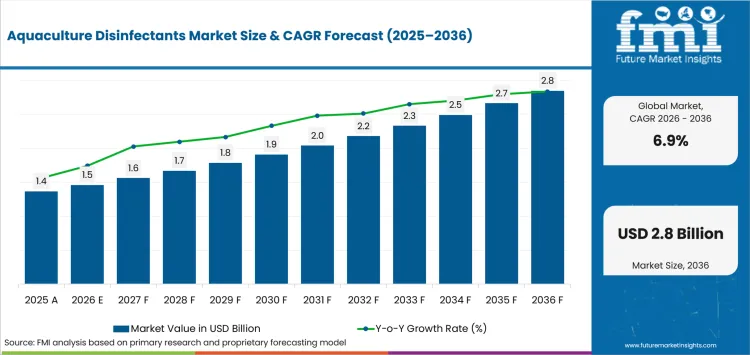
USD 1.5 billion in 2026 and USD 2.8 billion by 2036 at a 6.9% CAGR.
Aquaculture Disinfectants revenue is projected to rise from USD 1.5 billion in 2026 to USD 2.8 billion by 2036 at a 6.9% CAGR. Aquaculture disinfectant demand follows the physical footprint of farmed aquatic production and the number of sanitation events built into each production cycle. The Food and Agriculture Organization reported in June 2026 that aquaculture aquatic animal production reached 103 million tonnes in 2024, representing 53% of total aquatic animal production. That scale creates a broad base of ponds, tanks, hatcheries, transport systems, nets, tools, and access points that require hygiene controls. Commercial conversion occurs when operators turn disease-prevention goals into repeat procedures with defined dilution, contact time, use site, and replenishment frequency.
Adoption conditions vary by production system and jurisdiction. Export-oriented shrimp systems in Vietnam, Indonesia, and Ecuador place high value on biosecurity discipline, while Norway operates a mature salmonid industry where equipment hygiene and movement controls are embedded in aquatic animal health practice. In the USA, antimicrobial claims and approved use sites are label-specific, and Japan continues to strengthen aquatic disease-prevention controls. Across these settings, chemistry performance is only one part of the purchase. Farms also assess registration status, material compatibility, animal safety, dosing practicality, and access to local technical support.
Key Takeaways
- Recurring demand increases as farms formalize sanitation across ponds, tanks, hatcheries, equipment and transport systems.
- Peroxygen disinfectants account for 26.0% of Disinfectant Type in 2026, supported by their use across several aquaculture sanitation applications where registrations permit.
- Liquid concentrate holds 48.0% of Form in 2026, reflecting its suitability for repeat dosing and dilution-based farm routines.
- Pond / tank disinfection accounts for 28.0% of Application in 2026, as production vessels require recurring sanitation between cycles and during disease-control programs.
- Shrimp holds 27.0% of Species System in 2026, driven by intensive production conditions and the need for disciplined biosecurity.
- Aquaculture distributors account for 42.0% of Sales Channel in 2026, supported by local stock, replenishment and application guidance.
- Registration limits, label-specific use conditions and dosing errors can slow adoption, while suppliers can create more value through technical support and closer integration with farm biosecurity routines.
- Neogen, LANXESS, Evonik, Solvay, Virkon / LANXESS, Ecolab, Kemin AquaScience, Antec International, Sanosil and BioSafe Systems are among the notable companies profiled in the market.
Analyst Perspective
“The commercial value of aquaculture disinfectants is created at the operating level. Farms need chemistry that fits an approved use site, a repeatable dosing routine, and the practical realities of water systems, equipment, staff movement, and production turnover. Suppliers that combine active chemistry with clear application guidance and dependable local replenishment are better placed to turn biosecurity requirements into recurring demand through 2036.”
- Nikhil Kaitwade, Principal Consultant, Future Market Insights
How is the Aquaculture Disinfectants Market segmented?
The market is segmented by Disinfectant Type, Form, Application, Species System, Sales Channel, and Region.
The market is segmented by Disinfectant Type into Peroxygen Disinfectants, Iodophors, Quaternary Ammonium Compounds, Chlorine-Based Disinfectants, Glutaraldehyde Blends, and Biosecurity Disinfectant Blends; by Form into Liquid Concentrate, Powder, Tablets, and Foam / Spray; by Application into Pond / Tank Disinfection, Equipment Disinfection, Hatchery Sanitation, Transport Water Sanitation, and Footbath / Facility Biosecurity; by Species System into Shrimp, Finfish, Salmonids, Tilapia, and Ornamental Fish; and by Sales Channel into Aquaculture Distributors, Direct Farm Supply, Veterinary / Biosecurity Channel, and Retail / E-commerce.
Why does Pond / tank disinfection lead the Application category?
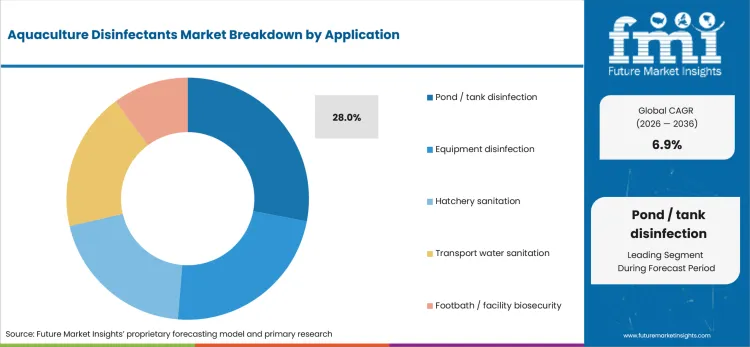
Pond and tank disinfection leads because production vessels and their water-contact surfaces form a large contamination interface between cycles. Whole-system sanitation can be part of pond preparation, tank reset, recirculating-system hygiene, or outbreak response, depending on species and operating protocol. Treated volumes are often higher than those associated with a boot bath or a single tool, and poor preparation can allow pathogens to persist into the next production cycle. Product choice remains use-specific because some chemistries are suited to empty-system sanitation while other formulations have defined conditions for use in operating water systems.
- Pond / tank disinfection is projected to account for 28.0% of the market in 2026 because production vessels create a large and recurring sanitation interface.
- Active-oxygen supply chains are relevant to this application because hydrogen peroxide is one of the chemistry platforms used across water treatment and hygiene markets, including aquaculture-related applications where permitted.
Why does Peroxygen disinfectants lead the Disinfectant Type category?
Peroxygen disinfectants lead because oxidizing chemistries can be positioned across several aquaculture sanitation tasks when product labels permit the intended use. Peroxymonosulfate, hydrogen peroxide, and peracetic acid each offer active-oxygen routes that can support surface, equipment, or water-system hygiene. LANXESS describes Virkon AQUATIC as an aquaculture-dedicated powder disinfectant for fish and shrimp production, while Evonik markets peracetic acid solutions for recirculating systems, ponds, and hatchery settings. Their commercial appeal comes from breadth of application and decomposition profiles that can fit modern biosecurity programs, subject to local approval and use conditions.
- Peroxygen disinfectants are projected to account for 26.0% of the market in 2026. The share reflects their fit across multiple sanitation workflows where product registrations support the intended application.
- The segment also benefits from technology transfer across broader peracetic acid uses, which encourages formulation development, supply availability, and dosing know-how that can be adapted to aquaculture under the relevant label.
Why does Liquid concentrate lead the Form category?
Liquid concentrate leads because commercial farms often need a format that can be diluted quickly, metered into a standard operating procedure, and replenished in repeat-use volumes. Concentrates reduce the transport and storage burden associated with ready-to-use liquids and can integrate with dosing equipment in recirculating or high-throughput operations. The advantage depends on operator discipline: under-dosing can reduce efficacy, while over-dosing can raise cost, safety, and material-compatibility risks. Liquid leadership therefore reflects preparation efficiency and dosing control rather than a universal performance advantage over powders, tablets, foam, or spray formats.
- Liquid concentrate is projected to hold a 48.0% share in 2026, supported by dilution efficiency and compatibility with repeat-use dosing workflows.
- Procurement teams also compare concentrates with alternative disinfectants when balancing storage, preparation time, chemistry compatibility, residue profile, and approved use conditions.
Why does Shrimp lead the Species System category?
Shrimp leads because intensive pond production can combine high stocking density, frequent water-management decisions, and substantial economic exposure to disease events. Biosecurity begins before stocking and continues through the cycle as farms manage water intake, equipment movement, staff access, pond preparation, and response protocols. Vietnam and Indonesia have both emphasized biosecurity and disease-control practices in recent aquaculture policy and industry guidance. These measures do not prescribe a single disinfectant chemistry, but they increase the value of registered products that fit pond preparation, equipment hygiene, and facility sanitation without disrupting the farm protocol.
- Shrimp is projected to hold a 27.0% share in 2026, reflecting the recurring biosecurity needs of intensive shrimp production systems.
- In September 2025, Indonesia’s Ministry of Marine Affairs and Fisheries highlighted biosecurity and Good Aquaculture Practice in its strategy to strengthen upstream shrimp production, reinforcing the operating context for disciplined sanitation programs.
Why does Aquaculture distributors lead the Sales Channel category?
Aquaculture distributors lead because disinfectants are repeat-purchase operating inputs that often require local stock, short replenishment cycles, and practical guidance. Farms may need support with dilution, contact time, protective equipment, permitted use sites, and compatibility with local production systems. Distributors bridge global formulation portfolios with country registrations and farm-level access, particularly in fragmented shrimp and finfish regions where many sites are far from chemical manufacturing hubs. Direct supply remains important for large farms and integrated producers, but the distributor channel has an advantage where service intensity and local inventory are part of the buying decision.
- Aquaculture distributors are projected to account for 42.0% of the market in 2026, supported by local availability, application support, and repeat replenishment requirements.
- This channel sits within a broader farm-input ecosystem that also carries recurring inputs such as fish feed, although disinfectants remain a separate biosecurity category with distinct registration and use-site requirements.
What are the drivers, restraints and opportunities in the Aquaculture Disinfectants Market?
Aquaculture scale and disease-control discipline drive repeat sanitation demand, while label-specific use conditions and operating sensitivity restrain adoption; integrated chemistry, dosing support, and local service create the main commercial opportunity.
- Driver: expansion and intensification of aquaculture increase the number of water systems, surfaces, tools, and movement points that require recurring sanitation.
- Restraint: registration, label limitations, dilution accuracy, contact time, species safety, and material compatibility can restrict product substitution and slow standardization.
- Opportunity: suppliers can combine chemistry with dosing tools, training, farm protocols, local inventory, and sustainability improvements to reduce application error and improve repeat use.
The principal demand driver is the shift from occasional cleaning toward structured biosecurity. FAO’s 2026 production update shows that aquaculture now accounts for more than half of aquatic animal production globally. As farms intensify and cycle assets more frequently, the number of sanitation events rises across ponds, tanks, hatcheries, nets, transport containers, tools, and access points. Disease-control programs turn that physical footprint into addressable demand when operators specify when disinfection occurs and how a treatment fits before stocking, between batches, during equipment transfer, or during outbreak response.
The main restraint is qualification for a specific use. In the USA, EPA-registered disinfectant labels define pathogens, use sites, directions, dilution, and contact time, and similar jurisdiction-specific requirements affect commercial deployment elsewhere. Buyers may compare a broad set of disinfectant chemicals, but they cannot treat chemistry as interchangeable when registrations, corrosion risk, residues, or animal-safety conditions differ.
The opportunity lies in reducing application friction. Suppliers can improve conversion by pairing formulations with dosing guidance, compatibility information, training, technical service, and local stock. Active-oxygen products also create room for innovation around handling and environmental profile. Evonik’s 2026 introduction of lower-carbon-footprint peracetic acid in Europe illustrates how upstream chemistry suppliers are adding sustainability attributes without changing the core operating requirement for compliant disinfection. For aquaculture customers, the winning commercial proposition is a repeatable procedure that works within a farm’s biosecurity plan, not chemistry sold in isolation.
Which country CAGRs are profiled in the Aquaculture Disinfectants Market?
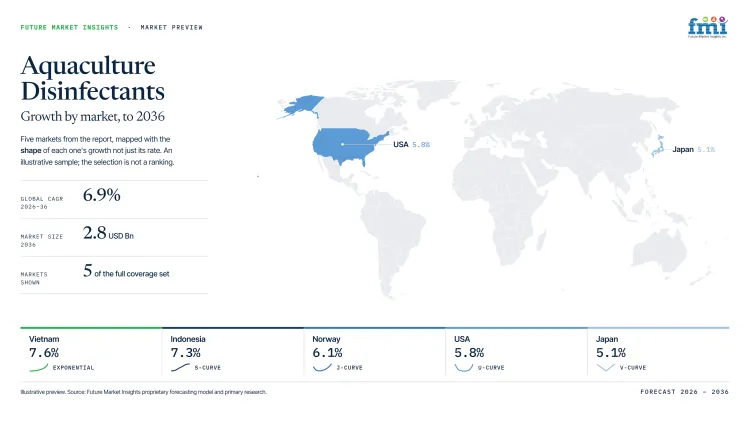
| Country | CAGR, 2026-2036 |
|---|---|
| Vietnam | 7.6% |
| USA | 5.8% |
| Japan | 5.1% |
| Indonesia | 7.3% |
| Norway | 6.1% |
| Brazil | 6.5% |
| Ecuador | 7.0% |
How do country-level CAGRs compare in the Aquaculture Disinfectants Market?
Projected growth is distributed across different aquaculture models rather than one uniform regional pattern. Vietnam and Indonesia combine shrimp expansion with formal biosecurity initiatives, while Ecuador and Brazil add scale in Latin American aquaculture and increasing attention to aquatic animal health. Norway grows from a mature salmonid base with established hygiene expectations. The USA combines a diverse farm structure with detailed antimicrobial-label requirements, while Japan’s disease-prevention framework supports disciplined control even at a more measured forecast pace. The CAGR figures describe growth rates and should not be read as a ranking of absolute country market size.
- Vietnam: Demand is forecast to expand at 7.6% CAGR from 2026 to 2036. Shrimp production, disease surveillance and tighter control of aquaculture chemical use are encouraging farms to adopt more structured sanitation routines.
- USA: Demand is projected to grow at 5.8% CAGR through 2036. A diverse aquaculture base and EPA label requirements favor disinfectants with clearly defined use sites, dosing instructions and technical support.
- Japan: Demand is expected to rise at 5.1% CAGR from 2026 to 2036. Aquatic disease-prevention controls and import safeguards keep sanitation closely tied to animal-health compliance and disciplined farm practices.
- Indonesia: Demand is forecast to grow at 7.3% CAGR through 2036. Good Aquaculture Practice and biosecurity initiatives in shrimp farming are increasing the need for repeat pond, equipment and facility sanitation.
- Norway: Demand is projected to expand at 6.1% CAGR from 2026 to 2036. Established salmonid production and strict fish-health practices support regular disinfection of equipment, water-contact surfaces and facilities.
- Brazil: Demand is forecast to rise at 6.5% CAGR through 2036. Aquatic animal-health programs and updated disease-notification requirements are increasing attention to preventive sanitation as commercial aquaculture develops.
- Ecuador: Demand is projected to grow at 7.0% CAGR from 2026 to 2036. Export-oriented shrimp production creates a strong need for consistent sanitation, reliable coastal distribution and uninterrupted farm operations.
Country-wise Analysis
- Vietnam - 7.6% CAGR: Vietnam is projected to expand at 7.6% from 2026 to 2036. In 2025, fisheries authorities in Cần Thơ called for stronger environmental and disease monitoring, disease-safe production areas, tighter control of aquaculture chemicals, and reserve disinfectant chemicals for outbreak response. The commercial implication is a shift toward planned biosecurity procurement rather than ad hoc cleaning. Shrimp and finfish farms that formalize sanitation schedules create recurring demand for pond preparation, equipment hygiene, and facility disinfection, while suppliers still need local registration and distributor support to convert that need into sales.
- USA - 5.8% CAGR: The USA is projected to grow at 5.8% from 2026 to 2036. USDA’s 2023 Census of Aquaculture counted 3,453 farms with USD 1.9 billion in sales, illustrating a diverse production base spanning food fish, mollusks, crustaceans, ornamental species, and other farmed aquatic products. EPA registration and label language shape which pathogens and use sites a disinfectant can address. Suppliers that pair compliant products with clear dilution, contact-time, and water-system guidance are positioned to serve farms that value repeatable procedures over commodity chemistry alone.
- Japan - 5.1% CAGR: Japan is projected to grow at 5.1% from 2026 to 2036. The Ministry of Agriculture, Forestry and Fisheries revised parts of the aquatic disease-prevention framework in 2026 and continued to maintain controls covering domestic prevention and import-related disease risk. This regulatory discipline supports consistent demand for sanitation practices across hatcheries, equipment, transport, and production systems. Growth is likely to favor products with clear instructions and local technical support rather than rapid switching between chemistries.
- Indonesia - 7.3% CAGR: Indonesia is projected to grow at 7.3% from 2026 to 2036. The Ministry of Marine Affairs and Fisheries highlighted biosecurity and Good Aquaculture Practice in its 2025 strategy for strengthening the shrimp industry. Farm-level implementation increases the need for repeat sanitation across pond preparation, staff access, equipment, and water-management workflows. Local distribution is important because production is geographically dispersed and farms need reliable stock during routine turnover as well as elevated disease-risk periods.
- Norway - 6.1% CAGR: Norway is projected to grow at 6.1% from 2026 to 2036. The Norwegian Food Safety Authority advises disinfection of fishing and water-contact equipment to reduce disease transfer between river systems and points to approved disinfectants as part of that practice. In commercial salmonid production, similar hygiene logic supports demand around nets, equipment, boats, well systems, and facility movement controls. Suppliers compete on documented use conditions, material compatibility, and service reliability in a technically mature market.
- Brazil - 6.5% CAGR: Brazil is projected to grow at 6.5% from 2026 to 2036. The Ministry of Agriculture and Livestock’s Aquicultura com Sanidade program focuses on prevention, control, and eradication of aquatic animal diseases, and the ministry updated its mandatory aquatic-disease notification framework in June 2026. As aquaculture scales across tilapia and other systems, disease awareness and official surveillance can increase the value of planned sanitation, especially where distributors combine chemistry with farm-level guidance and regional inventory.
- Ecuador - 7.0% CAGR: Ecuador is projected to grow at 7.0% from 2026 to 2036. The country’s export-oriented aquaculture sector continues to emphasize diversification, quality, and access to major overseas markets. For shrimp producers, production continuity and sanitary consistency are commercially important because disease events can affect both yield and export schedules. Disinfectant suppliers can gain traction through coastal distribution, pond and equipment sanitation programs, and practical support that fits high-throughput shrimp operations.
Who are the notable companies in the Aquaculture Disinfectants Market?
Neogen, Lanxess, Evonik, Solvay, Virkon / LANXESS, Ecolab, Kemin AquaScience, Antec International, Sanosil, and BioSafe Systems.
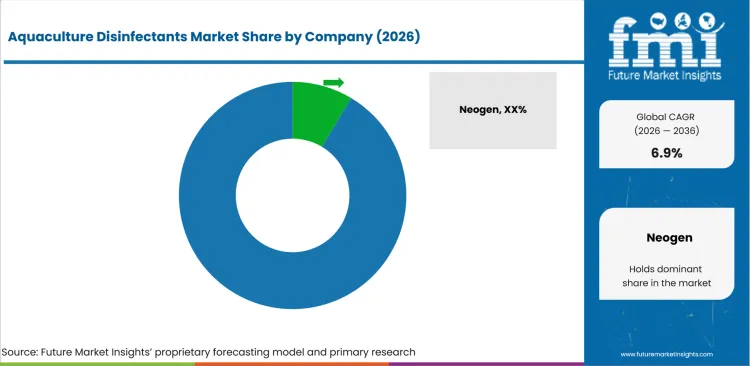
The competitive landscape includes dedicated aquaculture biosecurity platforms, active-oxygen suppliers, broader hygiene and water-treatment companies, and aquaculture-health providers. LANXESS, Virkon / LANXESS and Antec International operate within the same broader biosecurity platform, while Evonik, Solvay, Sanosil and BioSafe Systems compete through peroxide, peracetic-acid and related oxidation chemistries. Ecolab adds a hygiene and water-management position, Kemin AquaScience brings aquaculture-focused technical access, and Neogen’s direct disinfectant position changed following the divestiture of its global cleaners and disinfectants business in July 2025.
- LANXESS, Virkon / LANXESS and Antec International: Aquaculture biosecurity and disinfectant platforms supported by technical guidance and distribution.
- Evonik, Solvay, Sanosil and BioSafe Systems: Active-oxygen and water-treatment suppliers serving sanitation applications subject to local approvals.
- Ecolab and Kemin AquaScience: Hygiene, water-management and aquaculture-health positions supported by technical service and customer access.
- Neogen: An animal and food-safety company whose direct disinfectant position changed after its 2025 portfolio divestiture.
Competitive Benchmarking: Aquaculture Disinfectants Market
| Company | Primary position | Market-relevant capabilities | Route to aquaculture demand |
|---|---|---|---|
| Neogen | Portfolio transition | Animal and food safety heritage; cleaners and disinfectants business divested in July 2025 | Installed customer relationships and adjacent animal-safety channels, with direct disinfectant position changing |
| Lanxess | Aquaculture biosecurity platform | Virkon AQUATIC and broader Virkon / biosecurity portfolio | Global registrations, distributors, and technical biosecurity support |
| Evonik | Active-oxygen specialist | Peracetic acid and hydrogen peroxide platform; aquaculture-specific VIGOROX Trident in the USA | Direct chemistry supply and technical support for water-system applications |
| Solvay | Peroxide supply platform | Hydrogen peroxide production and regional chemical supply | Upstream active-oxygen availability, including aquaculture-served regions |
| Virkon / LANXESS | Aquaculture-focused disinfectant brand | Aquaculture-dedicated oxygen-based powder for fish and shrimp biosecurity | Brand-specific farm use cases supported by LANXESS distribution and technical infrastructure |
| Ecolab | Water and hygiene platform | Cleaning, disinfection, water-management expertise; aquaculture net-hygiene collaboration | Programmatic service model and process training for selected aquaculture operations |
| Kemin AquaScience | Aquaculture health channel | Aquaculture technical relationships alongside broader Kemin farm-biosecurity and water-hygiene offerings | Species-focused customer access and technical advisory channels |
| Antec International | Biosecurity operating platform | LANXESS Material Protection Products entity linked to Virkon biosecurity solutions | Technical and regional support infrastructure within the LANXESS biosecurity network |
| Sanosil | Hydrogen-peroxide-based disinfection | Stabilized/catalytically enhanced hydrogen-peroxide systems for water and surface hygiene | International distributor network and water-system positioning |
| BioSafe Systems | Peroxyacetic-acid and peroxide platform | Peroxyacetic-acid disinfectants, sanitation, aquatics, and water-treatment portfolio | North and South American product and service footprint with label-dependent applications |
Benchmarking focuses on aquaculture-specific use-site fit, chemistry breadth, application support, local availability, and the ability to operate within label and biosecurity constraints. It does not imply a market-share ranking. Companies with dedicated aquaculture products can compete on use-case specificity, while upstream oxidant suppliers can compete on chemistry scale and regional availability. Service-led platforms add value where farms need training, dosing discipline, and documented procedures as much as the formulation itself.
Key Developments in the Aquaculture Disinfectants Market
- June 2026: Evonik introduced lower-carbon-footprint peracetic acid in Europe across its established peracetic-acid portfolio. The move adds a sustainability dimension to active-oxygen chemistry while retaining the operating requirements around compliant formulation use and dosing.
- March 2026: LANXESS marked 40 years of the Virkon biosecurity platform and reported availability in more than 80 countries. For aquaculture, the relevance is the distribution and registration infrastructure surrounding a brand family that includes Virkon AQUATIC for fish and shrimp biosecurity.
- July 2025: Neogen completed the divestiture of its global cleaners and disinfectants business. The transaction changes how customers and competitors should interpret Neogen’s direct disinfectant positioning even though the company remains relevant to the broader animal and food-safety ecosystem.
- June 2025: Peróxidos do Brasil, a Solvay Group company, announced a USD 12 million investment in its Coronel, Chile hydrogen-peroxide plant, with completion expected in 2026. Aquaculture is among the sectors served by the regional peroxide platform, making the investment relevant to active-oxygen availability in Latin America.
Key Players in the Aquaculture Disinfectants Market
Aquaculture biosecurity and hygiene platforms
- Lanxess
- Virkon / LANXESS
- Antec International
- Ecolab
Active-oxygen and water-treatment platforms
- Evonik
- Solvay
- Sanosil
- BioSafe Systems
Aquaculture-health and portfolio-transition platforms
- Kemin AquaScience
- Neogen
Aquaculture Disinfectants Market - Report Scope
| Coverage field | Report scope |
|---|---|
| Market breakdown | Disinfectant Type; Form; Application; Species System; Sales Channel |
| Quantitative units | USD Billion |
| Market definition | Revenue from disinfectant formulations sold for aquaculture sanitation and biosecurity across ponds/tanks, equipment, hatcheries, transport water, and facility access controls where permitted by applicable labels. |
| Exclusions | Aquatic medicines, vaccines, feed additives, probiotics, non-disinfectant water conditioners, downstream seafood revenue, and adjacent substitute products outside the defined disinfectant scope. |
| Regions covered | North America; Latin America; Western Europe; Eastern Europe; East Asia; South Asia and Pacific; Middle East and Africa |
| Profiled country CAGRs | Vietnam; USA; Japan; Indonesia; Norway; Brazil; Ecuador |
| Key companies profiled | Neogen; Lanxess; Evonik; Solvay; Virkon / LANXESS; Ecolab; Kemin AquaScience; Antec International; Sanosil; BioSafe Systems |
| Forecast period | 2026 to 2036 |
| Assessment focus | Market sizing, segment mix, country growth, biosecurity demand mechanisms, competitive positioning, and company developments relevant to aquaculture disinfection |
Aquaculture Disinfectants Market - Research Methodology
| Method | Approach |
|---|---|
| Market definition and boundary setting | Define qualifying disinfectant revenue by chemistry, form, application, species system, channel, and geography; exclude adjacent animal-health and water-conditioning categories outside the stated scope. |
| Demand-side assessment | Assess aquaculture production intensity, farm biosecurity routines, sanitation frequency, species-system needs, and channel behavior that influence recurring disinfectant consumption. |
| Supply-side assessment | Review company product portfolios, active-chemistry positions, application support, regional availability, ownership changes, and recent developments that shape competition. |
| Country analysis | Compare country-specific aquaculture structure, disease-prevention policy, regulatory conditions, and channel readiness to interpret forecast growth. |
| Forecasting and validation | Reconcile demand-side and supply-side indicators, apply consistent segment and country definitions, and review the resulting outlook for internal coherence across the 2026-2036 period. |
Aquaculture Disinfectants Market by Segments
Aquaculture Disinfectants Market segmented by Disinfectant Type:
- Peroxygen disinfectants
- Iodophors
- Quaternary ammonium compounds
- Chlorine-based disinfectants
- Glutaraldehyde blends
- Biosecurity disinfectant blends
Aquaculture Disinfectants Market segmented by Form:
- Liquid concentrate
- Powder
- Tablets
- Foam / spray
Aquaculture Disinfectants Market segmented by Application:
- Pond / tank disinfection
- Equipment disinfection
- Hatchery sanitation
- Transport water sanitation
- Footbath / facility biosecurity
Aquaculture Disinfectants Market segmented by Species System:
- Shrimp
- Finfish
- Salmonids
- Tilapia
- Ornamental fish
Aquaculture Disinfectants Market segmented by Sales Channel:
- Aquaculture distributors
- Direct farm supply
- Veterinary / biosecurity channel
- Retail / e-commerce
Aquaculture Disinfectants Market by Region:
- North America
- United States
- Canada
- Latin America
- Brazil
- Mexico
- Argentina
- Chile
- Western Europe
- Germany
- France
- United Kingdom
- Italy
- Spain
- Benelux
- Nordics
- Eastern Europe
- Poland
- Czech Republic
- Romania
- Hungary
- East Asia
- China
- Japan
- South Korea
- South Asia and Pacific
- India
- ASEAN
- Australia and New Zealand
- Middle East and Africa
- GCC Countries
- South Africa
- Türkiye
- Israel
Research Sources and Bibliography
- Food and Agriculture Organization of the United Nations (2026, June 16). SOFIA 2026: Global fisheries and aquaculture production reaches new highs.
- USA Environmental Protection Agency (current). Selected EPA-Registered Disinfectants.
- USA Department of Agriculture, National Agricultural Statistics Service (2024, December 16). 2023 Census of Aquaculture results.
- Cần Thơ Fisheries and Fisheries Surveillance authorities (2025, August 1). Aquaculture environmental monitoring, disease prevention, chemical control, and disinfectant reserve measures.
- Ministry of Agriculture, Forestry and Fisheries, Japan (2026). Aquatic animal disease prevention and revised disease-control framework.
- Ministry of Marine Affairs and Fisheries, Indonesia (2025, September 29). Upstream shrimp strategy emphasizing Good Aquaculture Practice and biosecurity.
- Norwegian Food Safety Authority (2025, May 26). Guidance on disinfection of fishing and water-contact equipment to reduce disease spread.
- Ministry of Agriculture and Livestock, Brazil (2026, August 7). Aquicultura com Sanidade and aquatic animal health program information.
- PRO ECUADOR (2025, January 9). Diversification in Ecuadorian Aquaculture for the Chinese Market.
- LANXESS (current). Virkon AQUATIC product information and Biosecurity Solutions disinfectant portfolio.
- LANXESS (current). Biosecurity Solutions contact information identifying Antec International Limited within LANXESS Material Protection Products.
- Evonik (current). Aquaculture and VIGOROX Trident peracetic-acid product information.
- Ecolab (2024, May 6). Steen-Hansen and Ecolab collaboration on fish welfare and aquaculture net hygiene.
- Solvay / Peróxidos do Brasil (2025, June 23). Strategic hydrogen-peroxide investment in Coronel, Chile.
- Neogen Corporation (2025, July 18). Completion of divestiture of the global cleaners and disinfectants business.
- LANXESS (2026, March 11). Virkon biosecurity platform 40-year milestone and international availability.
- Evonik (2026, June 11). Introduction of lower-carbon-footprint peracetic acid in Europe.
- Sanosil (current). Water-system and surface disinfection portfolio information.
- Kemin Industries and Kemin AquaScience (current). Aquaculture-health, biosecurity, and water-hygiene portfolio information.
- BioSafe Systems (current). Peroxyacetic-acid disinfectant, aquatics, sanitation, and water-treatment portfolio information.
The bibliography lists sources used to interpret market mechanisms, country conditions, company capabilities, and 2025-2026 developments. Market values, forecast growth, segment shares, and country CAGRs are presented consistently throughout the report.
This Report Answers
- Which aquaculture production and biosecurity pressures create recurring demand for disinfectants?
- How do active chemistry, formulation format, and use-site requirements influence product selection?
- Why do pond, tank, hatchery, equipment, transport, and access-point sanitation create different purchasing needs?
- How do shrimp, finfish, salmonid, tilapia, and ornamental systems differ in sanitation priorities?
- Why do local distributors remain important in a technically sensitive repeat-purchase category?
- How do regulations, label conditions, corrosion risk, dosing accuracy, and animal safety constrain adoption?
- What country-specific biosecurity and aquaculture structures shape demand in the profiled markets?
- How are biosecurity brands, active-oxygen suppliers, hygiene platforms, and aquaculture-health channels positioned competitively?
- Which 2025-2026 company actions are most relevant to chemistry availability, sustainability, distribution, and portfolio structure?
- What should procurement and biosecurity teams evaluate when qualifying a disinfectant supplier?
Frequently Asked Questions
How big is the Aquaculture Disinfectants Market in 2026?
The market is valued at USD 1.5 billion in 2026 and is forecast to reach USD 2.8 billion by 2036.
What is the forecast CAGR for the Aquaculture Disinfectants Market?
The market is forecast to expand at a 6.9% CAGR from 2026 to 2036.
Which Disinfectant Type leads the Aquaculture Disinfectants Market?
Peroxygen disinfectants are projected to lead the Disinfectant Type category with a 26.0% share in 2026.
What is the incremental market opportunity from 2026 to 2036?
The market is projected to add approximately USD 1.4 billion between 2026 and 2036.
Which companies are active in the Aquaculture Disinfectants Market?
Neogen, Lanxess, Evonik, Solvay, Virkon / LANXESS, Ecolab, Kemin AquaScience, Antec International, Sanosil, and BioSafe Systems are profiled in the market.
What is the main operating restraint for aquaculture disinfectant adoption?
Products must fit the permitted use site and label conditions while meeting farm requirements for dilution, contact time, material compatibility, species safety, and operator handling.
Why are distributors important in this market?
Distributors provide local inventory and application support for a repeat-purchase input whose correct use can depend on country registration, dilution procedures, and farm-specific sanitation routines.
Preview the report firsthand - request a free sample
Get SampleGet the brochure for pricing and purchase details.
Get PDFTable of Content
- Key Takeaways
- Market Size and CAGR
- Top Growth Driver
- Fastest Growing Segment
- Leading Region
- Key Companies
- Emerging Opportunities
- Executive Summary
- Global Market Outlook
- Demand-side Trends
- Supply-side Trends
- Technology Roadmap Analysis
- Analysis and Recommendations
- Analyst Perspective (What is happening? Why now? What should investors know?)
- Key Questions Answered
- How large is the market?
- What is the CAGR?
- What are key trends?
- Which region dominates?
- Who are the leaders?
- Market Overview
- Market Coverage / Taxonomy
- Market Definition / Scope / Limitations
- Research Methodology
- Chapter Orientation
- Analytical Lens and Working Hypotheses
- Market Structure, Signals, and Trend Drivers
- Benchmarking and Cross-market Comparability
- Market Sizing, Forecasting, and Opportunity Mapping
- Research Design and Evidence Framework
- Desk Research Programme (Secondary Evidence)
- Expert Input and Fieldwork (Primary Evidence)
- Tooling, Models, and Reference Databases
- Data Engineering and Model Build
- Quality Assurance and Audit Trail
- Market Background
- Market Dynamics (Drivers, Restraints, Opportunity, Trends)
- Scenario Forecast (Optimistic, Likely, Conservative)
- Impact Analysis
- AI Impact
- Sustainability Impact
- Regulatory Impact
- Technology Impact
- Consumer / Buyer Analysis
- Purchase Drivers
- Adoption Barriers
- Buyer Journey
- Opportunity Map Analysis
- Product Life Cycle Analysis
- Supply Chain Analysis
- Investment Feasibility Matrix
- Value Chain Analysis
- PESTLE and Porter's Analysis
- Regulatory Landscape
- Regional Parent Market Outlook
- Production and Consumption Statistics
- Import and Export Statistics
- Global Market Analysis and Forecast, 2021 to 2036
- Historical Market Size Value (USD Billion) Analysis, 2021 to 2025
- Current and Future Market Size Value (USD Billion) Projections, 2026 to 2036
- Y-o-Y Growth Trend Analysis
- Absolute $ Opportunity Analysis
- Global Market Pricing Analysis, 2021 to 2036
- Global Market Analysis and Forecast, By Disinfectant Type, 2021 to 2036
- Introduction / Key Findings
- Historical Market Size Value (USD Billion) Analysis By Disinfectant Type, 2021 to 2025
- Current and Future Market Size Value (USD Billion) Analysis and Forecast By Disinfectant Type, 2026 to 2036
- Peroxygen disinfectants
- Iodophors
- Quaternary ammonium compounds
- Chlorine-based disinfectants
- Glutaraldehyde blends
- Biosecurity disinfectant blends
- Peroxygen disinfectants
- Y-o-Y Growth Trend Analysis By Disinfectant Type, 2021 to 2025
- Absolute $ Opportunity Analysis By Disinfectant Type, 2026 to 2036
- Global Market Analysis and Forecast, By Form, 2021 to 2036
- Introduction / Key Findings
- Historical Market Size Value (USD Billion) Analysis By Form, 2021 to 2025
- Current and Future Market Size Value (USD Billion) Analysis and Forecast By Form, 2026 to 2036
- Liquid concentrate
- Powder
- Tablets
- Foam / spray
- Liquid concentrate
- Y-o-Y Growth Trend Analysis By Form, 2021 to 2025
- Absolute $ Opportunity Analysis By Form, 2026 to 2036
- Global Market Analysis and Forecast, By Application, 2021 to 2036
- Introduction / Key Findings
- Historical Market Size Value (USD Billion) Analysis By Application, 2021 to 2025
- Current and Future Market Size Value (USD Billion) Analysis and Forecast By Application, 2026 to 2036
- Pond / tank disinfection
- Equipment disinfection
- Hatchery sanitation
- Transport water sanitation
- Footbath / facility biosecurity
- Pond / tank disinfection
- Y-o-Y Growth Trend Analysis By Application, 2021 to 2025
- Absolute $ Opportunity Analysis By Application, 2026 to 2036
- Global Market Analysis and Forecast, By Species System, 2021 to 2036
- Introduction / Key Findings
- Historical Market Size Value (USD Billion) Analysis By Species System, 2021 to 2025
- Current and Future Market Size Value (USD Billion) Analysis and Forecast By Species System, 2026 to 2036
- Shrimp
- Finfish
- Salmonids
- Tilapia
- Ornamental fish
- Shrimp
- Y-o-Y Growth Trend Analysis By Species System, 2021 to 2025
- Absolute $ Opportunity Analysis By Species System, 2026 to 2036
- Global Market Analysis and Forecast, By Sales Channel, 2021 to 2036
- Introduction / Key Findings
- Historical Market Size Value (USD Billion) Analysis By Sales Channel, 2021 to 2025
- Current and Future Market Size Value (USD Billion) Analysis and Forecast By Sales Channel, 2026 to 2036
- Aquaculture distributors
- Direct farm supply
- Veterinary / biosecurity channel
- Retail / e-commerce
- Aquaculture distributors
- Y-o-Y Growth Trend Analysis By Sales Channel, 2021 to 2025
- Absolute $ Opportunity Analysis By Sales Channel, 2026 to 2036
- Global Market Analysis and Forecast, By Region, 2021 to 2036
- Introduction
- Historical Market Size Value (USD Billion) Analysis By Region, 2021 to 2025
- Current Market Size Value (USD Billion) Analysis and Forecast By Region, 2026 to 2036
- North America
- Latin America
- Western Europe
- Eastern Europe
- East Asia
- South Asia and Pacific
- Middle East & Africa
- Market Attractiveness Analysis By Region
- North America Market Analysis and Forecast, By Country, 2021 to 2036
- Historical Market Size Value (USD Billion) Trend Analysis By Market Taxonomy, 2021 to 2025
- Market Size Value (USD Billion) Forecast By Market Taxonomy, 2026 to 2036
- By Country
- USA
- Canada
- By Disinfectant Type
- By Form
- By Application
- By Species System
- By Sales Channel
- By Country
- Market Attractiveness Analysis
- By Country
- By Disinfectant Type
- By Form
- By Application
- By Species System
- By Sales Channel
- Key Takeaways
- Latin America Market Analysis and Forecast, By Country
- Historical Market Size Value (USD Billion) Trend Analysis By Market Taxonomy, 2021 to 2025
- Market Size Value (USD Billion) Forecast By Market Taxonomy, 2026 to 2036
- By Country
- Brazil
- Mexico
- Chile
- Rest of Latin America
- By Disinfectant Type
- By Form
- By Application
- By Species System
- By Sales Channel
- By Country
- Market Attractiveness Analysis
- By Country
- By Disinfectant Type
- By Form
- By Application
- By Species System
- By Sales Channel
- Key Takeaways
- Western Europe Market Analysis and Forecast, By Country
- Historical Market Size Value (USD Billion) Trend Analysis By Market Taxonomy, 2021 to 2025
- Market Size Value (USD Billion) Forecast By Market Taxonomy, 2026 to 2036
- By Country
- Germany
- UK
- Italy
- Spain
- France
- Nordic
- BENELUX
- Rest of Western Europe
- By Disinfectant Type
- By Form
- By Application
- By Species System
- By Sales Channel
- By Country
- Market Attractiveness Analysis
- By Country
- By Disinfectant Type
- By Form
- By Application
- By Species System
- By Sales Channel
- Key Takeaways
- Eastern Europe Market Analysis and Forecast, By Country
- Historical Market Size Value (USD Billion) Trend Analysis By Market Taxonomy, 2021 to 2025
- Market Size Value (USD Billion) Forecast By Market Taxonomy, 2026 to 2036
- By Country
- Russia
- Poland
- Hungary
- Balkan & Baltic
- Rest of Eastern Europe
- By Disinfectant Type
- By Form
- By Application
- By Species System
- By Sales Channel
- By Country
- Market Attractiveness Analysis
- By Country
- By Disinfectant Type
- By Form
- By Application
- By Species System
- By Sales Channel
- Key Takeaways
- East Asia Market Analysis and Forecast, By Country
- Historical Market Size Value (USD Billion) Trend Analysis By Market Taxonomy, 2021 to 2025
- Market Size Value (USD Billion) Forecast By Market Taxonomy, 2026 to 2036
- By Country
- China
- Japan
- South Korea
- By Disinfectant Type
- By Form
- By Application
- By Species System
- By Sales Channel
- By Country
- Market Attractiveness Analysis
- By Country
- By Disinfectant Type
- By Form
- By Application
- By Species System
- By Sales Channel
- Key Takeaways
- South Asia and Pacific Market Analysis and Forecast, By Country
- Historical Market Size Value (USD Billion) Trend Analysis By Market Taxonomy, 2021 to 2025
- Market Size Value (USD Billion) Forecast By Market Taxonomy, 2026 to 2036
- By Country
- India
- ASEAN
- Australia & New Zealand
- Rest of South Asia and Pacific
- By Disinfectant Type
- By Form
- By Application
- By Species System
- By Sales Channel
- By Country
- Market Attractiveness Analysis
- By Country
- By Disinfectant Type
- By Form
- By Application
- By Species System
- By Sales Channel
- Key Takeaways
- Middle East & Africa Market Analysis and Forecast, By Country
- Historical Market Size Value (USD Billion) Trend Analysis By Market Taxonomy, 2021 to 2025
- Market Size Value (USD Billion) Forecast By Market Taxonomy, 2026 to 2036
- By Country
- Kingdom of Saudi Arabia
- Other GCC Countries
- Türkiye
- South Africa
- Other African Union
- Rest of Middle East & Africa
- By Disinfectant Type
- By Form
- By Application
- By Species System
- By Sales Channel
- By Country
- Market Attractiveness Analysis
- By Country
- By Disinfectant Type
- By Form
- By Application
- By Species System
- By Sales Channel
- Key Takeaways
- Key Countries Market Analysis
- USA
- Pricing Analysis
- Market Share Analysis, 2025
- By Disinfectant Type
- By Form
- By Application
- By Species System
- By Sales Channel
- Canada
- Pricing Analysis
- Market Share Analysis, 2025
- By Disinfectant Type
- By Form
- By Application
- By Species System
- By Sales Channel
- Mexico
- Pricing Analysis
- Market Share Analysis, 2025
- By Disinfectant Type
- By Form
- By Application
- By Species System
- By Sales Channel
- Brazil
- Pricing Analysis
- Market Share Analysis, 2025
- By Disinfectant Type
- By Form
- By Application
- By Species System
- By Sales Channel
- Chile
- Pricing Analysis
- Market Share Analysis, 2025
- By Disinfectant Type
- By Form
- By Application
- By Species System
- By Sales Channel
- Germany
- Pricing Analysis
- Market Share Analysis, 2025
- By Disinfectant Type
- By Form
- By Application
- By Species System
- By Sales Channel
- UK
- Pricing Analysis
- Market Share Analysis, 2025
- By Disinfectant Type
- By Form
- By Application
- By Species System
- By Sales Channel
- Italy
- Pricing Analysis
- Market Share Analysis, 2025
- By Disinfectant Type
- By Form
- By Application
- By Species System
- By Sales Channel
- Spain
- Pricing Analysis
- Market Share Analysis, 2025
- By Disinfectant Type
- By Form
- By Application
- By Species System
- By Sales Channel
- France
- Pricing Analysis
- Market Share Analysis, 2025
- By Disinfectant Type
- By Form
- By Application
- By Species System
- By Sales Channel
- India
- Pricing Analysis
- Market Share Analysis, 2025
- By Disinfectant Type
- By Form
- By Application
- By Species System
- By Sales Channel
- ASEAN
- Pricing Analysis
- Market Share Analysis, 2025
- By Disinfectant Type
- By Form
- By Application
- By Species System
- By Sales Channel
- Australia & New Zealand
- Pricing Analysis
- Market Share Analysis, 2025
- By Disinfectant Type
- By Form
- By Application
- By Species System
- By Sales Channel
- China
- Pricing Analysis
- Market Share Analysis, 2025
- By Disinfectant Type
- By Form
- By Application
- By Species System
- By Sales Channel
- Japan
- Pricing Analysis
- Market Share Analysis, 2025
- By Disinfectant Type
- By Form
- By Application
- By Species System
- By Sales Channel
- South Korea
- Pricing Analysis
- Market Share Analysis, 2025
- By Disinfectant Type
- By Form
- By Application
- By Species System
- By Sales Channel
- Russia
- Pricing Analysis
- Market Share Analysis, 2025
- By Disinfectant Type
- By Form
- By Application
- By Species System
- By Sales Channel
- Poland
- Pricing Analysis
- Market Share Analysis, 2025
- By Disinfectant Type
- By Form
- By Application
- By Species System
- By Sales Channel
- Hungary
- Pricing Analysis
- Market Share Analysis, 2025
- By Disinfectant Type
- By Form
- By Application
- By Species System
- By Sales Channel
- Kingdom of Saudi Arabia
- Pricing Analysis
- Market Share Analysis, 2025
- By Disinfectant Type
- By Form
- By Application
- By Species System
- By Sales Channel
- Türkiye
- Pricing Analysis
- Market Share Analysis, 2025
- By Disinfectant Type
- By Form
- By Application
- By Species System
- By Sales Channel
- South Africa
- Pricing Analysis
- Market Share Analysis, 2025
- By Disinfectant Type
- By Form
- By Application
- By Species System
- By Sales Channel
- USA
- Market Structure Analysis
- Competition Dashboard
- Competition Benchmarking
- Market Share Analysis of Top Players
- By Regional
- By Disinfectant Type
- By Form
- By Application
- By Species System
- By Sales Channel
- Emerging Startups
- Innovation Benchmarking
- Competition Analysis
- Competition Deep Dive
- Neogen
- Overview
- Product Portfolio
- Profitability by Market Segments
- Sales Footprint
- Strategy Overview
- Marketing Strategy
- Product Strategy
- Channel Strategy
- Lanxess
- Evonik
- Solvay
- Virkon / LANXESS
- Ecolab
- Kemin AquaScience
- Antec International
- Sanosil
- BioSafe Systems
- Neogen
- Case Studies
- Success Stories
- Recent Developments
- Competition Deep Dive
- Assumptions & Acronyms Used


