

- Market Size (2026)
- USD 1.5 Bn
- Forecast (2036)
- USD 2.9 Bn
- CAGR (2026 to 2036)
- 7.0%
How big is Aquaculture Water Conditioners Market in 2026?
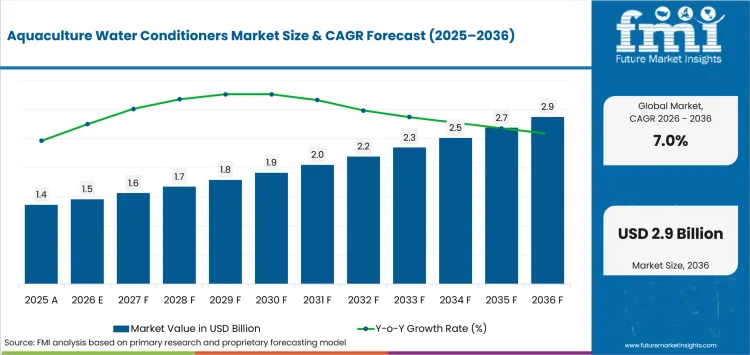
USD 1.5 billion in 2026 and USD 2.9 billion by 2036 at a 7.0% CAGR.
Demand for aquaculture water conditioners is projected to expand at 7.0% CAGR between 2026 and 2036, increasing valuation from USD 1.5 billion in 2026 to USD 2.9 billion by 2036. Repeat purchasing depends on whether operators can connect a treatment to a measured issue such as ammonia, pH, mineral balance or microbial load.
Higher cultured biomass raises the consequence of nitrogen loading and organic residues, so farms use conditioners when monitoring identifies a correctable water-quality deviation that husbandry or equipment cannot resolve quickly enough.
Key Takeaways
- Aquaculture water conditioner demand expands when higher culture intensity turns water-quality correction into a repeated operating task.
- Ammonia binders are projected at 23.0% of Product Type demand in 2026 because acute ammonia risk creates a clear corrective use case.
- Ponds are estimated at 38.0% of Culture System demand in 2026 due to large treated volumes and exposure to changing weather or organic load.
- Shrimp is forecast at 26.0% of Species demand in 2026 as pond chemistry and microbial pressure remain close to survival and cycle continuity.
- Pentair Aquatic Eco-Systems, API / Mars Fishcare, Seachem Laboratories, Tetra, Aquatic Science, INVE Aquaculture and Skretting serve direct conditioning, pond care or commercial aquaculture water-management needs.
Analyst Perspective
"Conditioner suppliers need to show the farm what parameter changes, how quickly it changes and what repeated dosing costs over a production cycle. Products gain commercial credibility when the treatment fits local salinity, alkalinity and biofiltration conditions instead of masking a persistent system problem."
- Nikhil Kaitwade, Principal Consultant, Future Market Insights
How is the Aquaculture Water Conditioners Market segmented?
The aquaculture water conditioners market is segmented by Product Type, Culture System, Species, Buyer Type, Sales Channel and Region.
Aquaculture water conditioners are analyzed by Product Type, Culture System, Species, Buyer Type, Sales Channel and Region. Product Type covers ammonia binders, pH buffers, dechlorinators, mineral / hardness conditioners, microbial conditioners and water clarifying conditioners. Culture System spans ponds, RAS systems, cages / pens, hatcheries and aquarium / ornamental aquaculture. Species includes shrimp, tilapia, carp, salmonids, catfish and ornamental fish. Buyer Type separates commercial farms from hatcheries, feed / input dealers, aquaculture service providers and the retail aquarium channel. Sales Channel covers aquaculture input distributors, direct farm supply, retail / aquarium stores and e-commerce.
Why do Aquaculture input distributors account for 39.0% of Sales Channel demand?
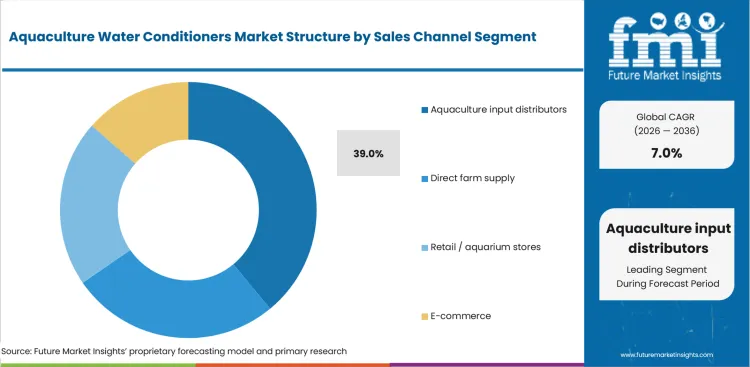
Aquaculture input distributors combine local inventory with application guidance for farms that need a treatment quickly after a water test. Direct farm supply is practical for established commercial accounts, while retail / aquarium stores serve smaller systems. E-commerce improves replenishment access but gives less on-site help with dose selection and water-specific troubleshooting.
- Aquaculture input distributors are estimated to account for 39.0% of Sales Channel demand in 2026 because farms often need both available stock and local guidance on dose or application timing.
- Skretting launched AquaCare Mineral Balance in India with planned expansion across Vietnam and Indonesia, illustrating how water-care products are localized through established aquaculture sales and technical-support routes.
Why do Ammonia binders account for 23.0% of Product Type demand?
Ammonia binders address a parameter that can become acutely toxic before biological conversion catches up. pH buffers and dechlorinators solve different chemistry problems, while mineral / hardness conditioners support ionic balance. Microbial conditioners and water clarifying conditioners are used when the operating issue is biological load or suspended material rather than free ammonia.
- Ammonia binders are projected to account for 23.0% of Product Type demand in 2026 because farms and aquatic-system operators can use them as a direct response to elevated ammonia readings.
- API Aqua Essential is specified for removal of chlorine and chloramines and for ammonia-related correction, while Seachem Prime removes chlorine and binds ammonia so biological filtration can continue processing it.
Why do Ponds account for 38.0% of Culture System demand?
Pond water is exposed to rain, evaporation and feed residues across a large treatment volume, which makes chemistry less stable than in tightly controlled RAS systems. Cages / pens rely more on exchange with surrounding water, while hatcheries emphasize early-life sensitivity and controlled intake water. Aquarium / ornamental aquaculture uses smaller doses and retail-oriented formats. The algaecides market sits beside conditioners when bloom management becomes the operating priority.
- Ponds are projected to account for 38.0% of Culture System demand in 2026 because operators repeatedly manage pH, mineral balance and microbial conditions across open production water.
- Skretting describes AquaCare Mineral Balance as a water-care solution for fish and shrimp pond farming and has paired mineral, probiotic and disinfectant products with water-quality testing in commercial shrimp programs.
Why does Shrimp account for 26.0% of Species demand?
Shrimp production places water chemistry close to daily survival and feed-conversion outcomes, especially in high-density ponds. Tilapia, carp and catfish can be managed across varied freshwater systems, while salmonids depend strongly on oxygen and intake-water quality. Ornamental fish create a separate route through aquarium-oriented dechlorination and conditioning products.
- Shrimp is forecast to account for 26.0% of Species demand in 2026 because mineral balance, microbial management and ammonia control are recurring pond-management requirements during a production cycle.
- Skretting has marketed AquaCare Mineral Balance, AquaCare 3D and probiotic water-management products to shrimp farmers in Indonesia, showing how conditioning can be packaged around measured pond-water needs rather than a single chemistry correction.
Why do Commercial farms account for 42.0% of Buyer Type demand?
Commercial farms carry the economic cost of biomass loss and therefore evaluate conditioners against treatment cost per water volume and production cycle. Hatcheries apply tighter protocols around intake water and early life stages. Feed / input dealers and aquaculture service providers influence product selection through technical support. The retail aquarium channel overlaps with the aquarium water treatment market and places more weight on convenience, pack size and simple dosing instructions.
- Commercial farms are projected to account for 42.0% of Buyer Type demand in 2026 because recurring treatment decisions are tied directly to crop survival and cycle economics.
- Pentair Aquatic Eco-Systems sells conditioners, biological treatments and water-quality tools for aquaculture ponds, tanks and hatchery applications, supporting buyers that need product choice together with measurement capability.
What are the drivers, restraints and opportunities in the Aquaculture Water Conditioners Market?
Rising culture intensity supports recurring intervention, while variable treatment performance constrains repeat dosing and testing-linked protocols create a route to more precise conditioning.
- Driver: Higher biomass and feed loading increase the frequency of ammonia, mineral and organic-load problems that can require corrective water treatment.
- Restraint: Product response changes with salinity, alkalinity, organic load and biological-filtration conditions, so a dose that works in one system may underperform in another.
- Opportunity: Testing-linked conditioning can pair measured water parameters with defined dosing protocols, technical support and repeat procurement.
Feed loading links conditioner demand to the aquafeed market because uneaten feed and metabolic waste add nitrogen or organic load to cultured water. As farms raise biomass per unit of water, operators have less tolerance for prolonged ammonia or pH excursions and may use conditioners alongside aeration, exchange and biological treatment.
Conditioners do not perform uniformly across every water matrix. Seachem notes that Prime binds ammonia while biological filtration continues to consume it, which means test interpretation and biofilter status matter after treatment. Farms may reject repeat dosing when a product masks the symptom, interferes with measurement or costs more than correcting the underlying process.
A more durable commercial route is to connect treatment with measurement. Aquatic Science directs users to test pond parameters and select a treatment for the parameter that has deviated, while Skretting has presented water-care products with a test kit for shrimp farming. That model gives distributors and farm technicians a clearer basis for product choice than routine dosing without a measured trigger.
Which country CAGRs are assessed in the Aquaculture Water Conditioners Market?
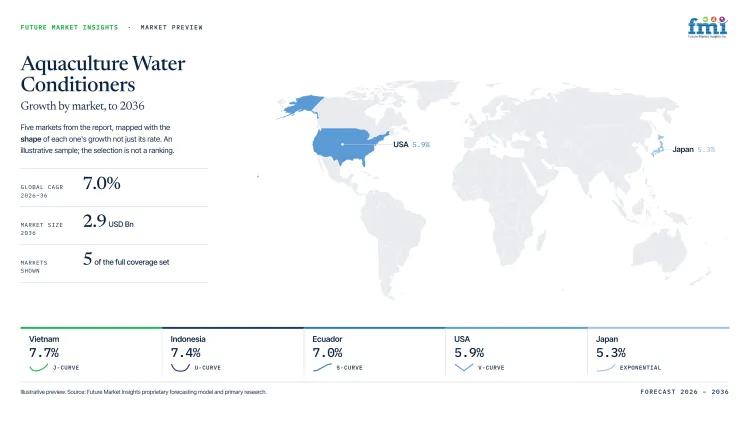
| Country | CAGR |
|---|---|
| Vietnam | 7.7% |
| USA | 5.9% |
| Japan | 5.3% |
| Indonesia | 7.4% |
| Ecuador | 7.0% |
| Norway | 5.6% |
| Brazil | 6.6% |
How do country-level CAGRs compare in the Aquaculture Water Conditioners Market?
The seven assessed CAGRs span 2.4 percentage points from 5.3% to 7.7%. Vietnam and Indonesia are above 7.0%, while Ecuador matches the global 7.0% rate. Brazil, USA, Norway and Japan range from 5.3% to 6.6%. These rates describe expected expansion rather than current country market size.
- Vietnam is projected at 7.7% CAGR as commercial aquaculture expands under a regulatory framework that specifically covers environmental treatment products and traceability requirements.
- USA is forecast at 5.9% CAGR, with farm and hatchery investment operating alongside an updated National Aquaculture Development Plan released in December 2024.
- Japan is estimated at 5.3% CAGR as intensive marine production continues to manage water-quality events such as red tides that can affect cultured fish.
- Indonesia is projected at 7.4% CAGR as shrimp farming creates recurring demand for mineral, microbial and pond-water management programs delivered through local technical channels.
- Ecuador is forecast at 7.0% CAGR, supported by a shrimp-production ecosystem in which registered aquaculture products include pH regulators, flocculants and bioremediation treatments.
- Norway is estimated at 5.6% CAGR as regulated commercial aquaculture relies on measured production conditions across land and sea sites, with conditioner demand concentrated where water treatment is operationally relevant.
- Brazil is projected at 6.6% CAGR as farmed-fish production expands and producers formalize water-quality management across pond-based systems.
Similar growth rates can reflect different purchasing conditions. Tropical pond markets use conditioners around mineral balance and microbial load, while temperate hatchery or recirculating systems place more emphasis on controlled intake water and treatment compatibility with filtration. The full report provides country-level analysis across the covered regions.
Country-wise Analysis
- Vietnam has formal rules that cover environmental treatment products used in aquaculture alongside feed, quarantine, food safety and traceability. This gives suppliers a defined compliance route but raises the need for locally accepted labels and technical documentation. Demand in Vietnam is projected to expand at 7.7% CAGR through 2036.
- USA aquaculture operates across finfish, shellfish and hatchery systems with different water-management needs. NOAA reported the release of an updated National Aquaculture Development Plan in December 2024, the first update since 1983, which supports a policy framework for responsible sector development. The USA market is forecast at 5.9% CAGR through 2036.
- Japan combines marine aquaculture with material exposure to harmful algal events. The Japan Fisheries Agency reported that red tides from May to August 2024 caused about JPY 3.13 billion in fishery damage by the end of March 2025, reinforcing the value of monitoring and targeted water-management responses. Japan is estimated at 5.3% CAGR through 2036.
- Indonesia has a large shrimp-farming base and established use of pond water-management programs. Skretting presented Mineral Balance, AquaCare 3D, probiotic water treatment and testing tools to Indonesian shrimp farmers at FARM 2025. Indonesia is projected to record 7.4% CAGR through 2036.
- Ecuador has an established regulatory route for aquaculture-use products. The Ministry of Production sanitary-registration list includes products classified for pH regulation, algae flocculation and bioremediation in fish or shrimp culture, showing that water treatment is a recognized input category. Ecuador is forecast at 7.0% CAGR through 2036.
- Norway tracks aquaculture production across active commercial and development licenses at land and sea sites. The operating environment favors measured water-management protocols, especially in hatchery and land-based systems where treatment can be controlled. Norway is estimated at 5.6% CAGR through 2036.
- Brazil reported 887,029 tonnes of farmed fish production in 2023, according to the Ministry of Fisheries and Aquaculture, up 3.1% from the prior year. Greater pond production broadens the installed base in which pH, hardness and microbial management can become recurring farm tasks. Brazil is projected at 6.6% CAGR through 2036.
Who are the notable companies in the Aquaculture Water Conditioners Market?
Pentair Aquatic Eco-Systems, API / Mars Fishcare, Seachem Laboratories, Tetra, Aquatic Science, INVE Aquaculture and Skretting are notable companies serving the aquaculture water conditioners market.
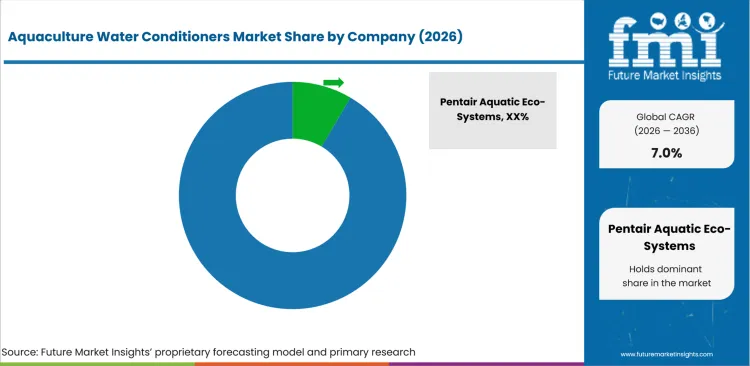
Competition separates consumer aquatics brands from suppliers built around commercial farm water management. Aquarium and pond brands compete through broad treatment ranges and simple dose instructions. Commercial aquaculture suppliers are judged more heavily on field support, compatibility with production protocols and the ability to connect treatment with water-quality measurement.
- API / Mars Fishcare, Seachem Laboratories, Tetra and Aquatic Science supply direct water-conditioning products through aquarium or pond channels.
- Pentair Aquatic Eco-Systems combines treatment products with water-quality equipment and aquaculture technical supply for ponds, tanks and hatchery settings.
Competitive Benchmarking: Aquaculture Water Conditioners Market
| Company | Treatment scope | Biological / mineral | Commercial aquaculture integration | Primary route to market |
|---|---|---|---|---|
| Pentair Aquatic Eco-Systems | High | High | High | Aquaculture technical supply |
| API / Mars Fishcare | High | Low | Medium | Aquarium and pond retail |
| Seachem Laboratories | High | Medium | Medium | Aquatics dealer and retail |
| Tetra | Medium | Low | Low | Consumer aquarium and pond retail |
| Aquatic Science | High | High | Medium | Pond and ornamental dealer network |
| INVE Aquaculture | Medium | High | High | Commercial aquaculture programs |
| Skretting | High | High | High | Farm and distributor programs |
Scoring basis: Treatment scope is High when the verified portfolio covers several conditioning jobs, Medium for a narrower direct range and Low where conditioning is incidental. Biological / mineral is High when current products directly manage microbial activity or mineral balance, Medium for one supported route and Low when evidence is limited to chemical conditioning. Commercial aquaculture integration is High for products or programs documented for farms or hatcheries, Medium for mixed professional and consumer use and Low for primarily consumer aquatics. Primary route to market describes the documented channel emphasis and is not a revenue ranking.
Key Developments in the Aquaculture Water Conditioners Market
- In June 2026, INVE Aquaculture introduced Sanolife PRO-TAB for fish, shifting part of its probiotic management approach toward direct ingestion in nursery systems and complementing its water-applied Sanolife portfolio.
- In September 2025, Skretting Indonesia presented AquaCare Mineral Balance, AquaCare 3D, probiotic treatment and a water-quality test kit to shrimp farmers at FARM 2025.
- In June 2021, Skretting introduced AquaCare Mineral Balance in India as a water-care solution for fish and shrimp pond farming, with planned expansion to Vietnam and Indonesia.
Key Players in the Aquaculture Water Conditioners Market
Direct Conditioner and Pond-care Brands
- API / Mars Fishcare
- Seachem Laboratories
- Tetra
- Aquatic Science
Commercial Aquaculture Water Management
- INVE Aquaculture
- Skretting
Aquaculture Systems and Technical Supply
- Pentair Aquatic Eco-Systems
Aquaculture Water Conditioners Market - Report Scope
| Coverage field | Report scope |
|---|---|
| Market breakdown | By Product Type, Culture System, Species, Buyer Type, Sales Channel and Region. |
| Quantitative Units | USD billion. |
| Market Definition | Water-conditioning products sold for aquaculture or aquatic-production water that adjust or stabilize ammonia, pH, chlorine / chloramine exposure, mineral balance, microbial conditions or water clarity. Feed, medicines, aeration equipment and filtration hardware are outside the defined product scope. |
| Regions Covered | North America, Latin America, Western Europe, Eastern Europe, East Asia, South Asia and Pacific, and Middle East and Africa. |
| Countries Covered | Vietnam, USA, Japan, Indonesia, Ecuador, Norway, Brazil and additional countries included in the full report. |
| Notable Companies | Pentair Aquatic Eco-Systems, API / Mars Fishcare, Seachem Laboratories, Tetra, Aquatic Science, INVE Aquaculture and Skretting. |
| Forecast Period | 2026 to 2036. |
| Approach | Primary and secondary research with market triangulation. |
Aquaculture Water Conditioners Market - Research Methodology
| Method | Approach |
|---|---|
| Primary Research | FMI analysts gathered input from aquaculture farms, hatcheries, input distributors, water-treatment suppliers and technical service providers. Interviews examined treatment triggers, dosing decisions, product evaluation, repeat purchasing and the evidence buyers require before a conditioner becomes part of a routine protocol. |
| Desk Research | Desk research covered government aquaculture statistics, regulatory publications, technical literature, official company product information and corporate announcements. Claims on applications, product functions, launches and country operating conditions were retained only when relevant to the defined market. |
| Market Sizing and Forecasting | The market model combined the 2026 baseline with historical performance, product mix, channel structure, aquaculture production conditions and country-level adoption. Forecast assumptions considered farm intensity, treatment frequency, price and volume trends, water-quality management practices and barriers to wider use. |
| Data Validation | Estimates were checked against independent indicators such as aquaculture output, documented treatment applications, company activity and findings from primary interviews. Products outside the water-conditioner boundary and overlapping adjacent revenues were excluded from the market model. |
Aquaculture Water Conditioners Market by Segments
Aquaculture Water Conditioners Market segmented by Product Type:
- Ammonia binders
- pH buffers
- Dechlorinators
- Mineral / hardness conditioners
- Microbial conditioners
- Water clarifying conditioners
Aquaculture Water Conditioners Market segmented by Culture System:
- Ponds
- RAS systems
- Cages / pens
- Hatcheries
- Aquarium / ornamental aquaculture
Aquaculture Water Conditioners Market segmented by Species:
- Shrimp
- Tilapia
- Carp
- Salmonids
- Catfish
- Ornamental fish
Aquaculture Water Conditioners Market segmented by Buyer Type:
- Commercial farms
- Hatcheries
- Feed / input dealers
- Aquaculture service providers
- Retail aquarium channel
Aquaculture Water Conditioners Market segmented by Sales Channel:
- Aquaculture input distributors
- Direct farm supply
- Retail / aquarium stores
- E-commerce
Aquaculture Water Conditioners Market by Region:
- North America
- United States
- Canada
- Latin America
- Brazil
- Mexico
- Argentina
- Chile
- Western Europe
- Germany
- France
- United Kingdom
- Italy
- Spain
- Benelux
- Nordics
- Eastern Europe
- Poland
- Czech Republic
- Romania
- Hungary
- East Asia
- China
- Japan
- South Korea
- South Asia and Pacific
- India
- ASEAN
- Australia and New Zealand
- Middle East and Africa
- GCC Countries
- South Africa
- Türkiye
- Israel
Research Sources and Bibliography
- Food and Agriculture Organization of the United Nations. (2024, June 7). FAO report: Global fisheries and aquaculture production reaches a new record high.
- NOAA Fisheries. (2024, December 16). White House National Science and Technology Council Finalizes New Aquaculture Plan.
- Ministry of Agriculture and Environment, Viet Nam. (2026, July 11). Viet Nam and Brazil strengthen aquaculture cooperation.
- Japan Fisheries Agency. (2025). Continuing damage from red tides.
- Ministry of Production, Foreign Trade, Investment and Fisheries, Ecuador. List of Current Unified Sanitary Registration Certificates for aquaculture products.
- Norwegian Directorate of Fisheries. (2024, October 10). About Statistics for Aquaculture.
- Ministry of Fisheries and Aquaculture, Brazil. (2024, February 29). Aquaculture yearbook launch and sector production update.
- Pentair Aquatic Eco-Systems. Pond Chemicals, Conditioners & Additives.
- API Fishcare. API AQUA ESSENTIAL Water Conditioner.
- Seachem Laboratories. Prime.
- Tetra. AquaSafe Plus.
- Aquatic Science. Water treatment for ponds.
- INVE Aquaculture. Environment: water and microbial management.
- INVE Aquaculture. (2026, June 4). Sanolife PRO-TAB for fish.
- Skretting. (2025, September 25). Aquaculture Specialty Product solutions at FARM 2025.
- Skretting. (2021, June 9). Introducing AquaCare Mineral Balance.
This bibliography is provided for reader reference and is not exhaustive. The full report contains the complete reference list and detailed citations.
This Report Answers
- How large is the Aquaculture Water Conditioners Market in 2026 and 2036?
- Which operating conditions support recurring demand for aquaculture water conditioners?
- Why do ammonia binders account for 23.0% of Product Type demand in 2026?
- Why do ponds account for 38.0% of Culture System demand in 2026?
- Why does shrimp account for 26.0% of Species demand in 2026?
- How do Buyer Type and Sales Channel shape conditioner purchasing?
- How do assessed country growth rates affect commercial entry conditions?
- Which companies serve aquaculture water-conditioning applications?
Frequently Asked Questions
How big is the aquaculture water conditioners market in 2026?
USD 1.5 billion represents the aquaculture water conditioners market value in 2026. Demand is projected to reach USD 2.9 billion by 2036 as farms use targeted products for ammonia control, pH correction, mineral balance and microbial water management.
What is the CAGR of the aquaculture water conditioners market from 2026 to 2036?
A 7.0% CAGR is projected for the aquaculture water conditioners market between 2026 and 2036. Growth depends on recurring treatment use in farm systems where measured water-quality deviations justify corrective or preventive conditioning.
Which Product Type accounts for 23.0% of the aquaculture water conditioners market?
Ammonia binders are projected to account for 23.0% of Product Type demand in 2026. Their use is tied to direct correction when toxic ammonia rises beyond the rate that biological filtration or water exchange can manage.
How much will the aquaculture water conditioners market add between 2026 and 2036?
About USD 1.4 billion is expected to be added to the aquaculture water conditioners market between 2026 and 2036. The increase reflects broader use across commercial farms, hatcheries and other aquatic-production systems with recurring water-quality management needs.
Which companies are active in the aquaculture water conditioners market?
Seven companies active in the aquaculture water conditioners market include Pentair Aquatic Eco-Systems, API / Mars Fishcare, Seachem Laboratories, Tetra, Aquatic Science, INVE Aquaculture and Skretting. Their verified offerings cover direct chemical conditioning, biological pond management or integrated commercial aquaculture water-care programs.
Preview the report firsthand - request a free sample
Get SampleGet the brochure for pricing and purchase details.
Get PDFTable of Content
- Key Takeaways
- Market Size and CAGR
- Top Growth Driver
- Fastest Growing Segment
- Leading Region
- Key Companies
- Emerging Opportunities
- Executive Summary
- Global Market Outlook
- Demand-side Trends
- Supply-side Trends
- Technology Roadmap Analysis
- Analysis and Recommendations
- Analyst Perspective (What is happening? Why now? What should investors know?)
- Key Questions Answered
- How large is the market?
- What is the CAGR?
- What are key trends?
- Which region dominates?
- Who are the leaders?
- Market Overview
- Market Coverage / Taxonomy
- Market Definition / Scope / Limitations
- Research Methodology
- Chapter Orientation
- Analytical Lens and Working Hypotheses
- Market Structure, Signals, and Trend Drivers
- Benchmarking and Cross-market Comparability
- Market Sizing, Forecasting, and Opportunity Mapping
- Research Design and Evidence Framework
- Desk Research Programme (Secondary Evidence)
- Expert Input and Fieldwork (Primary Evidence)
- Tooling, Models, and Reference Databases
- Data Engineering and Model Build
- Quality Assurance and Audit Trail
- Market Background
- Market Dynamics (Drivers, Restraints, Opportunity, Trends)
- Scenario Forecast (Optimistic, Likely, Conservative)
- Impact Analysis
- AI Impact
- Sustainability Impact
- Regulatory Impact
- Technology Impact
- Consumer / Buyer Analysis
- Purchase Drivers
- Adoption Barriers
- Buyer Journey
- Opportunity Map Analysis
- Product Life Cycle Analysis
- Supply Chain Analysis
- Investment Feasibility Matrix
- Value Chain Analysis
- PESTLE and Porter's Analysis
- Regulatory Landscape
- Regional Parent Market Outlook
- Production and Consumption Statistics
- Import and Export Statistics
- Global Market Analysis and Forecast, 2021 to 2036
- Historical Market Size Value (USD Billion) Analysis, 2021 to 2025
- Current and Future Market Size Value (USD Billion) Projections, 2026 to 2036
- Y-o-Y Growth Trend Analysis
- Absolute $ Opportunity Analysis
- Global Market Pricing Analysis, 2021 to 2036
- Global Market Analysis and Forecast, By Product Type, 2021 to 2036
- Introduction / Key Findings
- Historical Market Size Value (USD Billion) Analysis By Product Type, 2021 to 2025
- Current and Future Market Size Value (USD Billion) Analysis and Forecast By Product Type, 2026 to 2036
- Ammonia binders
- pH buffers
- Dechlorinators
- Mineral / hardness conditioners
- Microbial conditioners
- Water clarifying conditioners
- Ammonia binders
- Y-o-Y Growth Trend Analysis By Product Type, 2021 to 2025
- Absolute $ Opportunity Analysis By Product Type, 2026 to 2036
- Global Market Analysis and Forecast, By Culture System, 2021 to 2036
- Introduction / Key Findings
- Historical Market Size Value (USD Billion) Analysis By Culture System, 2021 to 2025
- Current and Future Market Size Value (USD Billion) Analysis and Forecast By Culture System, 2026 to 2036
- Ponds
- RAS systems
- Cages / pens
- Hatcheries
- Aquarium / ornamental aquaculture
- Ponds
- Y-o-Y Growth Trend Analysis By Culture System, 2021 to 2025
- Absolute $ Opportunity Analysis By Culture System, 2026 to 2036
- Global Market Analysis and Forecast, By Species, 2021 to 2036
- Introduction / Key Findings
- Historical Market Size Value (USD Billion) Analysis By Species, 2021 to 2025
- Current and Future Market Size Value (USD Billion) Analysis and Forecast By Species, 2026 to 2036
- Shrimp
- Tilapia
- Carp
- Salmonids
- Catfish
- Ornamental fish
- Shrimp
- Y-o-Y Growth Trend Analysis By Species, 2021 to 2025
- Absolute $ Opportunity Analysis By Species, 2026 to 2036
- Global Market Analysis and Forecast, By Buyer Type, 2021 to 2036
- Introduction / Key Findings
- Historical Market Size Value (USD Billion) Analysis By Buyer Type, 2021 to 2025
- Current and Future Market Size Value (USD Billion) Analysis and Forecast By Buyer Type, 2026 to 2036
- Commercial farms
- Hatcheries
- Feed / input dealers
- Aquaculture service providers
- Retail aquarium channel
- Commercial farms
- Y-o-Y Growth Trend Analysis By Buyer Type, 2021 to 2025
- Absolute $ Opportunity Analysis By Buyer Type, 2026 to 2036
- Global Market Analysis and Forecast, By Sales Channel, 2021 to 2036
- Introduction / Key Findings
- Historical Market Size Value (USD Billion) Analysis By Sales Channel, 2021 to 2025
- Current and Future Market Size Value (USD Billion) Analysis and Forecast By Sales Channel, 2026 to 2036
- Aquaculture input distributors
- Direct farm supply
- Retail / aquarium stores
- E-commerce
- Aquaculture input distributors
- Y-o-Y Growth Trend Analysis By Sales Channel, 2021 to 2025
- Absolute $ Opportunity Analysis By Sales Channel, 2026 to 2036
- Global Market Analysis and Forecast, By Region, 2021 to 2036
- Introduction
- Historical Market Size Value (USD Billion) Analysis By Region, 2021 to 2025
- Current Market Size Value (USD Billion) Analysis and Forecast By Region, 2026 to 2036
- North America
- Latin America
- Western Europe
- Eastern Europe
- East Asia
- South Asia and Pacific
- Middle East & Africa
- Market Attractiveness Analysis By Region
- North America Market Analysis and Forecast, By Country, 2021 to 2036
- Historical Market Size Value (USD Billion) Trend Analysis By Market Taxonomy, 2021 to 2025
- Market Size Value (USD Billion) Forecast By Market Taxonomy, 2026 to 2036
- By Country
- USA
- Canada
- By Product Type
- By Culture System
- By Species
- By Buyer Type
- By Sales Channel
- By Country
- Market Attractiveness Analysis
- By Country
- By Product Type
- By Culture System
- By Species
- By Buyer Type
- By Sales Channel
- Key Takeaways
- Latin America Market Analysis and Forecast, By Country
- Historical Market Size Value (USD Billion) Trend Analysis By Market Taxonomy, 2021 to 2025
- Market Size Value (USD Billion) Forecast By Market Taxonomy, 2026 to 2036
- By Country
- Brazil
- Mexico
- Chile
- Rest of Latin America
- By Product Type
- By Culture System
- By Species
- By Buyer Type
- By Sales Channel
- By Country
- Market Attractiveness Analysis
- By Country
- By Product Type
- By Culture System
- By Species
- By Buyer Type
- By Sales Channel
- Key Takeaways
- Western Europe Market Analysis and Forecast, By Country
- Historical Market Size Value (USD Billion) Trend Analysis By Market Taxonomy, 2021 to 2025
- Market Size Value (USD Billion) Forecast By Market Taxonomy, 2026 to 2036
- By Country
- Germany
- UK
- Italy
- Spain
- France
- Nordic
- BENELUX
- Rest of Western Europe
- By Product Type
- By Culture System
- By Species
- By Buyer Type
- By Sales Channel
- By Country
- Market Attractiveness Analysis
- By Country
- By Product Type
- By Culture System
- By Species
- By Buyer Type
- By Sales Channel
- Key Takeaways
- Eastern Europe Market Analysis and Forecast, By Country
- Historical Market Size Value (USD Billion) Trend Analysis By Market Taxonomy, 2021 to 2025
- Market Size Value (USD Billion) Forecast By Market Taxonomy, 2026 to 2036
- By Country
- Russia
- Poland
- Hungary
- Balkan & Baltic
- Rest of Eastern Europe
- By Product Type
- By Culture System
- By Species
- By Buyer Type
- By Sales Channel
- By Country
- Market Attractiveness Analysis
- By Country
- By Product Type
- By Culture System
- By Species
- By Buyer Type
- By Sales Channel
- Key Takeaways
- East Asia Market Analysis and Forecast, By Country
- Historical Market Size Value (USD Billion) Trend Analysis By Market Taxonomy, 2021 to 2025
- Market Size Value (USD Billion) Forecast By Market Taxonomy, 2026 to 2036
- By Country
- China
- Japan
- South Korea
- By Product Type
- By Culture System
- By Species
- By Buyer Type
- By Sales Channel
- By Country
- Market Attractiveness Analysis
- By Country
- By Product Type
- By Culture System
- By Species
- By Buyer Type
- By Sales Channel
- Key Takeaways
- South Asia and Pacific Market Analysis and Forecast, By Country
- Historical Market Size Value (USD Billion) Trend Analysis By Market Taxonomy, 2021 to 2025
- Market Size Value (USD Billion) Forecast By Market Taxonomy, 2026 to 2036
- By Country
- India
- ASEAN
- Australia & New Zealand
- Rest of South Asia and Pacific
- By Product Type
- By Culture System
- By Species
- By Buyer Type
- By Sales Channel
- By Country
- Market Attractiveness Analysis
- By Country
- By Product Type
- By Culture System
- By Species
- By Buyer Type
- By Sales Channel
- Key Takeaways
- Middle East & Africa Market Analysis and Forecast, By Country
- Historical Market Size Value (USD Billion) Trend Analysis By Market Taxonomy, 2021 to 2025
- Market Size Value (USD Billion) Forecast By Market Taxonomy, 2026 to 2036
- By Country
- Kingdom of Saudi Arabia
- Other GCC Countries
- Türkiye
- South Africa
- Other African Union
- Rest of Middle East & Africa
- By Product Type
- By Culture System
- By Species
- By Buyer Type
- By Sales Channel
- By Country
- Market Attractiveness Analysis
- By Country
- By Product Type
- By Culture System
- By Species
- By Buyer Type
- By Sales Channel
- Key Takeaways
- Key Countries Market Analysis
- USA
- Pricing Analysis
- Market Share Analysis, 2025
- By Product Type
- By Culture System
- By Species
- By Buyer Type
- By Sales Channel
- Canada
- Pricing Analysis
- Market Share Analysis, 2025
- By Product Type
- By Culture System
- By Species
- By Buyer Type
- By Sales Channel
- Mexico
- Pricing Analysis
- Market Share Analysis, 2025
- By Product Type
- By Culture System
- By Species
- By Buyer Type
- By Sales Channel
- Brazil
- Pricing Analysis
- Market Share Analysis, 2025
- By Product Type
- By Culture System
- By Species
- By Buyer Type
- By Sales Channel
- Chile
- Pricing Analysis
- Market Share Analysis, 2025
- By Product Type
- By Culture System
- By Species
- By Buyer Type
- By Sales Channel
- Germany
- Pricing Analysis
- Market Share Analysis, 2025
- By Product Type
- By Culture System
- By Species
- By Buyer Type
- By Sales Channel
- UK
- Pricing Analysis
- Market Share Analysis, 2025
- By Product Type
- By Culture System
- By Species
- By Buyer Type
- By Sales Channel
- Italy
- Pricing Analysis
- Market Share Analysis, 2025
- By Product Type
- By Culture System
- By Species
- By Buyer Type
- By Sales Channel
- Spain
- Pricing Analysis
- Market Share Analysis, 2025
- By Product Type
- By Culture System
- By Species
- By Buyer Type
- By Sales Channel
- France
- Pricing Analysis
- Market Share Analysis, 2025
- By Product Type
- By Culture System
- By Species
- By Buyer Type
- By Sales Channel
- India
- Pricing Analysis
- Market Share Analysis, 2025
- By Product Type
- By Culture System
- By Species
- By Buyer Type
- By Sales Channel
- ASEAN
- Pricing Analysis
- Market Share Analysis, 2025
- By Product Type
- By Culture System
- By Species
- By Buyer Type
- By Sales Channel
- Australia & New Zealand
- Pricing Analysis
- Market Share Analysis, 2025
- By Product Type
- By Culture System
- By Species
- By Buyer Type
- By Sales Channel
- China
- Pricing Analysis
- Market Share Analysis, 2025
- By Product Type
- By Culture System
- By Species
- By Buyer Type
- By Sales Channel
- Japan
- Pricing Analysis
- Market Share Analysis, 2025
- By Product Type
- By Culture System
- By Species
- By Buyer Type
- By Sales Channel
- South Korea
- Pricing Analysis
- Market Share Analysis, 2025
- By Product Type
- By Culture System
- By Species
- By Buyer Type
- By Sales Channel
- Russia
- Pricing Analysis
- Market Share Analysis, 2025
- By Product Type
- By Culture System
- By Species
- By Buyer Type
- By Sales Channel
- Poland
- Pricing Analysis
- Market Share Analysis, 2025
- By Product Type
- By Culture System
- By Species
- By Buyer Type
- By Sales Channel
- Hungary
- Pricing Analysis
- Market Share Analysis, 2025
- By Product Type
- By Culture System
- By Species
- By Buyer Type
- By Sales Channel
- Kingdom of Saudi Arabia
- Pricing Analysis
- Market Share Analysis, 2025
- By Product Type
- By Culture System
- By Species
- By Buyer Type
- By Sales Channel
- Türkiye
- Pricing Analysis
- Market Share Analysis, 2025
- By Product Type
- By Culture System
- By Species
- By Buyer Type
- By Sales Channel
- South Africa
- Pricing Analysis
- Market Share Analysis, 2025
- By Product Type
- By Culture System
- By Species
- By Buyer Type
- By Sales Channel
- USA
- Market Structure Analysis
- Competition Dashboard
- Competition Benchmarking
- Market Share Analysis of Top Players
- By Regional
- By Product Type
- By Culture System
- By Species
- By Buyer Type
- By Sales Channel
- Emerging Startups
- Innovation Benchmarking
- Competition Analysis
- Competition Deep Dive
- Pentair Aquatic Eco-Systems
- Overview
- Product Portfolio
- Profitability by Market Segments
- Sales Footprint
- Strategy Overview
- Marketing Strategy
- Product Strategy
- Channel Strategy
- API / Mars Fishcare
- Seachem Laboratories
- Tetra
- Aquatic Science
- INVE Aquaculture
- BioMar
- AquaCare
- Nutriad / Adisseo
- AquaPro Solutions
- Pentair Aquatic Eco-Systems
- Case Studies
- Success Stories
- Recent Developments
- Competition Deep Dive
- Assumptions & Acronyms Used


