

- Industry Size (2026)
- USD 2.0 Bn
- Forecast (2036)
- USD 4.0 Bn
- CAGR (2026 to 2036)
- 7.1%
Aqueous Barrier Board Market Size, Market Forecast and Outlook By FMI
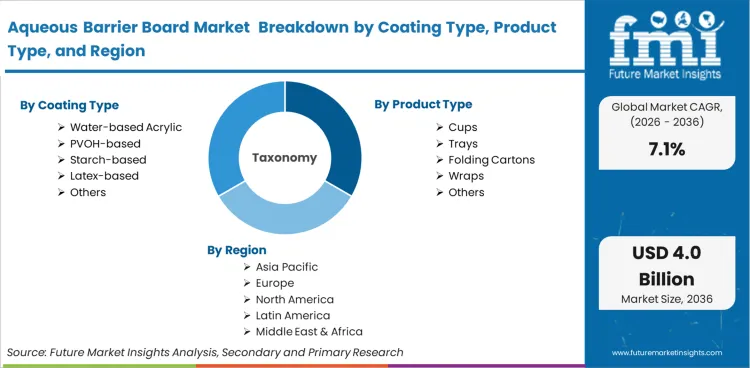
The aqueous barrier board market was valued at USD 1.9 billion in 2025. The market is projected to reach USD 2.0 billion in 2026 and USD 4.0 billion by 2036, expanding at a CAGR of 7.1% during the forecast period. The Water-based Acrylic segment leads coating type with a 32.9% share in 2026. The Cups segment is projected to remain the leading product type segment with a 31.5% share in 2026. The Foodservice segment is expected to lead end-use demand with a 46.1% share in 2026.
Summary of Aqueous Barrier board Market
- Key Drivers
- Water-based transition: Converters and brand owners are giving more prominence to barrier system that fit fiber recovery narratives and lower dependence on solvent-heavy processes.
- Foodservice redesign: Cup, lid, tray, and takeaway formats are being re-specified as regulators and major buyers push for easier-to-recycle paper-led packs.
- Machine compatibility: Aqueous coatings can be integrated into existing coating and converting workflows faster than more radical packaging redesigns.
- Key Segments Analyzed in the Report
- Coating type: water-based acrylic, PVOH-based, starch-based, latex-based, and others
- Product type: cups, trays, folding cartons, wraps, and others
- End use industry: foodservice, food & beverage, home & personal care, e-commerce & consumer goods, and others
- Region: North America, Latin America, Europe, Asia Pacific, and Middle East & Africa
- Analyst Opinion
- Ismail Sutaria, Senior Consultant at Future Market Insights says, "The commercial edge in aqueous barrier board is not the coating itself. It is the ability to deliver a water-based barrier that still survives converting stress, sealing demands, and shelf-life expectations at industrial scale. That is where supplier differentiation becomes visible."
- Aqueous Barrier board Market Definition
- The aqueous barrier board market comprises paperboard materials coated with water-based barrier formulations to improve resistance to grease, moisture, water vapour, and selected migration risks in packaging. It includes acrylic, PVOH, starch, latex, and hybrid aqueous systems applied to cupstock, tray board, cartonboard, and wrap grades. These solutions are used across foodservice, packaged foods, personal care, and e-commerce applications where brands want a fibre-based structure with better repulpability and lower dependence on traditional extrusion layers.
- Aqueous Barrier Board Market Inclusions
- Aqueous-coated barrier board sold into cups, trays, cartons, wraps, lids, and other packaging applications.
- Revenue from substrate sales, barrier coating conversions, and converter-ready coated board formats.
- Demand across North America, Latin America, Europe, Asia Pacific, and the Middle East & Africa.
- Aqueous Barrier Board Market Exclusions
- Polymer extrusion-coated board without an aqueous barrier system except as a competitive benchmark.
- Revenue from finished packaged consumer products.
- Commodity carton board and foodservice board without functional barrier coatings.
- Aqueous Barrier board Market Research Methodology
- This study evaluates the aqueous barrier board market across coating type, product type, end use industry, and region, using 2025 as the base year and 2026 to 2036 as the forecast period. Market value is expressed in USD billion. Evidence inputs include EU packaging regulation, paper recyclability guidance, CEPI and company barrier-paper programs, technical literature on aqueous coatings, and first-party product announcements. Triangulation combines end-use demand, pack conversion intensity, barrier-function value density, material substitution rates, and supplier positioning to derive the segment and regional estimates.
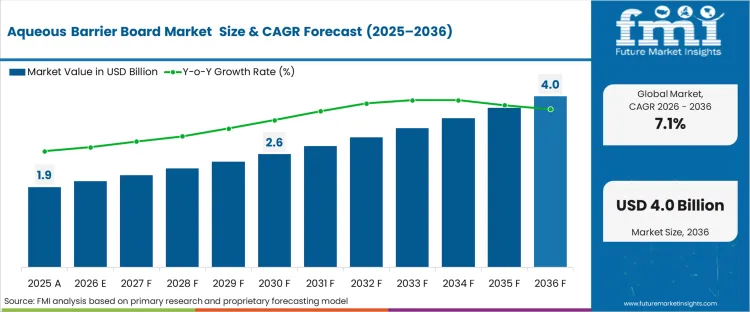
Key Drivers, Restraints, and Trends in Aqueous Barrier board Market
Drivers
Aqueous barrier board demand rises because packaging teams are trying to keep the fibre story intact while still protecting the pack. Water-based coating systems answer that need in cups, wraps, cartons, and trays where regulators, retailers, and foodservice operators are looking for lower-plastic solutions. Adoption also grows because aqueous coatings can be tuned for grease, moisture, and mineral-oil protection without automatically forcing a heavy extrusion structure. That matters to converters trying to preserve line familiarity and to brands trying to reduce recyclability friction. Once procurement starts measuring packaging through EPR costs, recovery pathways, and fibre content, aqueous barrier board becomes a specification decision rather than a pilot project.
Restraints
Barrier durability remains the main hurdle. Water-based systems must withstand sealing heat, flexing, and shelf-life demands without blistering or pinholing. Application consistency is another restraint because coating defects quickly show up in grease leakage or moisture loss. In high-moisture or very long shelf-life uses, aqueous systems still compete with stronger incumbent multilayers. Qualification is slow when filling lines, food-contact compliance, and repulpability claims all need validation. Margin pressure also builds when converters expect a premium function at near-commodity board economics.
Trends
The market is moving toward application-specific coating recipes instead of one broad aqueous platform for all uses. Suppliers are combining aqueous barriers with optimized base papers and lighter grammages to improve material efficiency. Foodservice remains the largest proving ground, but higher-value consumer-food formats are becoming more important as sealing and crack resistance improve. Commercial messaging has also changed, with producers increasingly selling aqueous barrier board as a balance of barrier, printability, and paper-stream compatibility rather than as a simple plastic-free claim.
Segmental Analysis
Aqueous Barrier Board Analysis by Coating Type
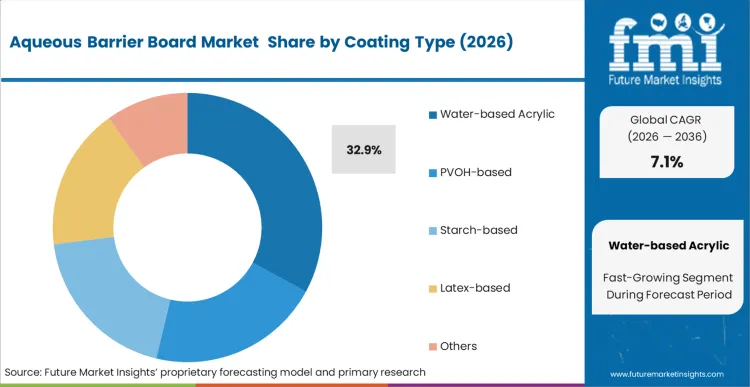
The Water-based Acrylic segment is expected to lead the coating type segment with a 32.9% share in 2026. Water-based acrylic systems lead because they provide a broad performance window, strong coat ability, and commercial familiarity across foodservice and carton applications. They help converters achieve moisture and grease protection at industrial speeds while keeping formulation flexibility for different substrates and end uses. Mondi has expanded its Functional Barrier Paper range and described customized barriers against grease and water vapour, underlining how water-based chemistry is becoming central to scalable paper packaging design.
Aqueous Barrier Board Analysis by Product Type
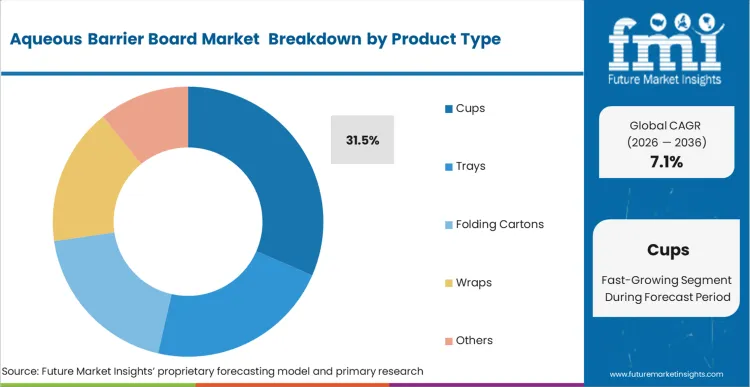
The Cups segment is expected to lead the product type segment with a 31.5% share in 2026. Cups lead the product mix because they combine high unit consumption with a constant need for grease, moisture, and heat-handling performance. They also face sustained pressure from foodservice chains to move toward fibre-led structures that still run well on established forming and sealing equipment. Stora Enso's work around cup materials and barrier-coated boards shows why cupstock remains one of the highest-volume applications for aqueous barrier board commercialisation.
Competitive Aligners for Market Players
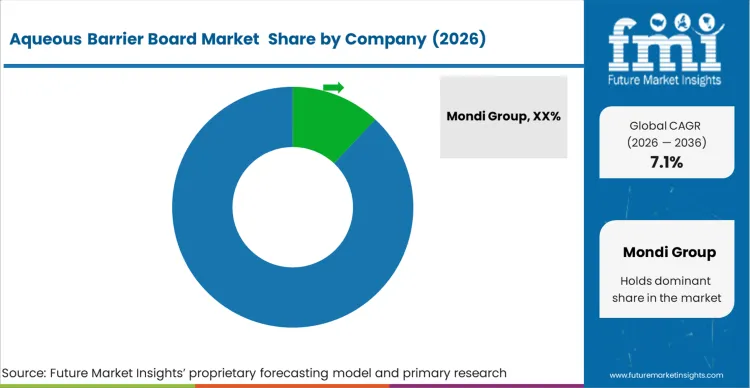
Competition in aqueous barrier board is shaped by coating performance under real converting stress, not by barrier claims on a lab sheet. Buyers want evidence on sealability, flex-crack behaviour, food-contact compliance, and repulpability. Mondi has invested behind high and ultra-high barrier paper offerings, signalling that the market is widening beyond low-spec wraps. Koehler Paper continues to position NexFlex and NexPlus grades around application-specific barrier surfaces, while Billerud and other fibre players are developing coated papers that reduce the role of plastic films. The firms that win are the ones that can convert water-based chemistry into stable factory output, not just promising sustainability language.
Key Players in Aqueous Barrier Board Market
- Mondi Group
- Stora Enso
- Billerud
- Koehler Paper
- Metsa Board
- Sappi
- Graphic Packaging International
- Mayr-Melnhof Karton
- Lecta
- WestRock
Strategic Outlook by FMI on Aqueous Barrier board Market
FMI sees aqueous barrier board moving deeper into mainstream packaging because it fits the direction of regulation, procurement scrutiny, and converter economics. Growth will come from systems that prove reliable in fast foodservice and packaged-food lines while holding a credible paper-recycling case. The strongest positions will belong to suppliers that couple coating formulation expertise with substrate engineering and end-use testing discipline.
Scope of the Report
| Metric | Value |
|---|---|
| Market Value | USD 1.9 billion in 2025 to USD 4.0 billion by 2036 |
| CAGR | 7.1% fr om 52026 to 2036 |
| Base Year | 2025 |
| Forecast Period | 2026 to 2036 |
| Coating Type Segmentation | Water-based Acrylic, PVOH-based, Starch-based, Latex-based, Others |
| Product Type Segmentation | Cups, Trays, Folding Cartons, Wraps, Others |
| End Use Industry Segmentation | Foodservice, Food & Beverage, Home & Personal Care, E-commerce & Consumer Goods, Others |
| Regions Covered | North America, Latin America, Europe, Asia Pacific, Middle East & Africa |
Bibliography
- European Parliament and Council. 2025. Regulation (EU) 2025/40 on packaging and packaging waste.
- Mondi Group. 2025. Mondi ramps up FunctionalBarrier Paper Ultimate to meet growing demand for sustainable high-barrier paper-based packaging.
- Mondi Group. FunctionalBarrier papers.
- Koehler Paper. 2025. Packaging Innovation: High Gloss for Paper Packaging with Koehler Paper Barrier Paper.
- Billerud. 2019. New environmentally friendly barrier paper for food packaging.
- Stora Enso. Barrier coatings for paperboard materials.
Frequently Asked Questions
What is the projected size of the Aqueous Barrier board market by 2036?
The aqueous barrier board market is projected to reach USD 4.0 billion by 2036.
What is the CAGR of the Aqueous Barrier board market from 2026 to 2036?
The aqueous barrier board market is projected to expand at a CAGR of 7.1% from 2026 to 2036.
Which coating type segment leads the Aqueous Barrier board market?
The Water-based Acrylic segment leads the aqueous barrier board market with a 32.9% share in 2026.
Which product type segment dominates the Aqueous Barrier board market?
The Cups segment holds the leading position in the aqueous barrier board market with a 31.5% share in 2026.
Which end use industry leads the Aqueous Barrier board market?
The Foodservice segment is expected to account for the largest share of the aqueous barrier board market at 46.1% in 2026.
Who are the key companies in the Aqueous Barrier board market?
Key companies active in the aqueous barrier board market include Mondi Group, Stora Enso, Billerud, Koehler Paper, Metsa Board, and other packaging-material and converter specialists.
What is driving demand in the Aqueous Barrier board market?
Demand in the aqueous barrier board market is being driven by packaging redesign toward better recyclability, stronger barrier performance, and improved line economics.
Preview the report firsthand - request a free sample
Get SampleGet the brochure for pricing and purchase details.
Get PDFTable of Content
- Key Takeaways
- Market Size and CAGR
- Top Growth Driver
- Fastest Growing Segment
- Leading Region
- Key Companies
- Emerging Opportunities
- Executive Summary
- Global Market Outlook
- Demand-side Trends
- Supply-side Trends
- Technology Roadmap Analysis
- Analysis and Recommendations
- Analyst Perspective (What is happening? Why now? What should investors know?)
- Key Questions Answered
- How large is the market?
- What is the CAGR?
- What are key trends?
- Which region dominates?
- Who are the leaders?
- Market Overview
- Market Coverage / Taxonomy
- Market Definition / Scope / Limitations
- Research Methodology
- Chapter Orientation
- Analytical Lens and Working Hypotheses
- Market Structure, Signals, and Trend Drivers
- Benchmarking and Cross-market Comparability
- Market Sizing, Forecasting, and Opportunity Mapping
- Research Design and Evidence Framework
- Desk Research Programme (Secondary Evidence)
- Expert Input and Fieldwork (Primary Evidence)
- Tooling, Models, and Reference Databases
- Data Engineering and Model Build
- Quality Assurance and Audit Trail
- Market Background
- Market Dynamics (Drivers, Restraints, Opportunity, Trends)
- Scenario Forecast (Optimistic, Likely, Conservative)
- Impact Analysis
- AI Impact
- Sustainability Impact
- Regulatory Impact
- Technology Impact
- Consumer / Buyer Analysis
- Purchase Drivers
- Adoption Barriers
- Buyer Journey
- Opportunity Map Analysis
- Product Life Cycle Analysis
- Supply Chain Analysis
- Investment Feasibility Matrix
- Value Chain Analysis
- PESTLE and Porter's Analysis
- Regulatory Landscape
- Regional Parent Market Outlook
- Production and Consumption Statistics
- Import and Export Statistics
- Global Market Analysis and Forecast, 2021 to 2036
- Historical Market Size Value (USD Billion) & Volume (Unit) Analysis, 2021 to 2025
- Current and Future Market Size Value (USD Billion) & Volume (Unit) Projections, 2026 to 2036
- Y-o-Y Growth Trend Analysis
- Absolute $ Opportunity Analysis
- Global Market Pricing Analysis, 2021 to 2036
- Global Market Analysis and Forecast, By Coating Type, 2021 to 2036
- Introduction / Key Findings
- Historical Market Size Value (USD Billion) & Volume (Unit) Analysis By Coating Type, 2021 to 2025
- Current and Future Market Size Value (USD Billion) & Volume (Unit) Analysis and Forecast By Coating Type, 2026 to 2036
- Water-based Acrylic
- PVOH-based
- Starch-based
- Latex-based
- Others
- Water-based Acrylic
- Y-o-Y Growth Trend Analysis By Coating Type, 2021 to 2025
- Absolute $ Opportunity Analysis By Coating Type, 2026 to 2036
- Global Market Analysis and Forecast, By Product Type, 2021 to 2036
- Introduction / Key Findings
- Historical Market Size Value (USD Billion) & Volume (Unit) Analysis By Product Type, 2021 to 2025
- Current and Future Market Size Value (USD Billion) & Volume (Unit) Analysis and Forecast By Product Type, 2026 to 2036
- Cups
- Trays
- Folding Cartons
- Wraps
- Others
- Cups
- Y-o-Y Growth Trend Analysis By Product Type, 2021 to 2025
- Absolute $ Opportunity Analysis By Product Type, 2026 to 2036
- Global Market Analysis and Forecast, By End Use Industry, 2021 to 2036
- Introduction / Key Findings
- Historical Market Size Value (USD Billion) & Volume (Unit) Analysis By End Use Industry, 2021 to 2025
- Current and Future Market Size Value (USD Billion) & Volume (Unit) Analysis and Forecast By End Use Industry, 2026 to 2036
- Foodservice
- Food & Beverage
- Home & Personal Care
- E-commerce & Consumer Goods
- Others
- Foodservice
- Y-o-Y Growth Trend Analysis By End Use Industry, 2021 to 2025
- Absolute $ Opportunity Analysis By End Use Industry, 2026 to 2036
- Global Market Analysis and Forecast, By Region, 2021 to 2036
- Introduction
- Historical Market Size Value (USD Billion) & Volume (Unit) Analysis By Region, 2021 to 2025
- Current Market Size Value (USD Billion) & Volume (Unit) Analysis and Forecast By Region, 2026 to 2036
- North America
- Latin America
- Western Europe
- Eastern Europe
- East Asia
- South Asia and Pacific
- Middle East & Africa
- Market Attractiveness Analysis By Region
- North America Market Analysis and Forecast, By Country, 2021 to 2036
- Historical Market Size Value (USD Billion) & Volume (Unit) Trend Analysis By Market Taxonomy, 2021 to 2025
- Market Size Value (USD Billion) & Volume (Unit) Forecast By Market Taxonomy, 2026 to 2036
- By Country
- USA
- Canada
- Mexico
- By Coating Type
- By Product Type
- By End Use Industry
- By Country
- Market Attractiveness Analysis
- By Country
- By Coating Type
- By Product Type
- By End Use Industry
- Key Takeaways
- Latin America Market Analysis and Forecast, By Country
- Historical Market Size Value (USD Billion) & Volume (Unit) Trend Analysis By Market Taxonomy, 2021 to 2025
- Market Size Value (USD Billion) & Volume (Unit) Forecast By Market Taxonomy, 2026 to 2036
- By Country
- Brazil
- Chile
- Rest of Latin America
- By Coating Type
- By Product Type
- By End Use Industry
- By Country
- Market Attractiveness Analysis
- By Country
- By Coating Type
- By Product Type
- By End Use Industry
- Key Takeaways
- Western Europe Market Analysis and Forecast, By Country
- Historical Market Size Value (USD Billion) & Volume (Unit) Trend Analysis By Market Taxonomy, 2021 to 2025
- Market Size Value (USD Billion) & Volume (Unit) Forecast By Market Taxonomy, 2026 to 2036
- By Country
- Germany
- UK
- Italy
- Spain
- France
- Nordic
- BENELUX
- Rest of Western Europe
- By Coating Type
- By Product Type
- By End Use Industry
- By Country
- Market Attractiveness Analysis
- By Country
- By Coating Type
- By Product Type
- By End Use Industry
- Key Takeaways
- Eastern Europe Market Analysis and Forecast, By Country
- Historical Market Size Value (USD Billion) & Volume (Unit) Trend Analysis By Market Taxonomy, 2021 to 2025
- Market Size Value (USD Billion) & Volume (Unit) Forecast By Market Taxonomy, 2026 to 2036
- By Country
- Russia
- Poland
- Hungary
- Balkan & Baltic
- Rest of Eastern Europe
- By Coating Type
- By Product Type
- By End Use Industry
- By Country
- Market Attractiveness Analysis
- By Country
- By Coating Type
- By Product Type
- By End Use Industry
- Key Takeaways
- East Asia Market Analysis and Forecast, By Country
- Historical Market Size Value (USD Billion) & Volume (Unit) Trend Analysis By Market Taxonomy, 2021 to 2025
- Market Size Value (USD Billion) & Volume (Unit) Forecast By Market Taxonomy, 2026 to 2036
- By Country
- China
- Japan
- South Korea
- By Coating Type
- By Product Type
- By End Use Industry
- By Country
- Market Attractiveness Analysis
- By Country
- By Coating Type
- By Product Type
- By End Use Industry
- Key Takeaways
- South Asia and Pacific Market Analysis and Forecast, By Country
- Historical Market Size Value (USD Billion) & Volume (Unit) Trend Analysis By Market Taxonomy, 2021 to 2025
- Market Size Value (USD Billion) & Volume (Unit) Forecast By Market Taxonomy, 2026 to 2036
- By Country
- India
- ASEAN
- Australia & New Zealand
- Rest of South Asia and Pacific
- By Coating Type
- By Product Type
- By End Use Industry
- By Country
- Market Attractiveness Analysis
- By Country
- By Coating Type
- By Product Type
- By End Use Industry
- Key Takeaways
- Middle East & Africa Market Analysis and Forecast, By Country
- Historical Market Size Value (USD Billion) & Volume (Unit) Trend Analysis By Market Taxonomy, 2021 to 2025
- Market Size Value (USD Billion) & Volume (Unit) Forecast By Market Taxonomy, 2026 to 2036
- By Country
- Kingdom of Saudi Arabia
- Other GCC Countries
- Türkiye
- South Africa
- Other African Union
- Rest of Middle East & Africa
- By Coating Type
- By Product Type
- By End Use Industry
- By Country
- Market Attractiveness Analysis
- By Country
- By Coating Type
- By Product Type
- By End Use Industry
- Key Takeaways
- Key Countries Market Analysis
- USA
- Pricing Analysis
- Market Share Analysis, 2025
- By Coating Type
- By Product Type
- By End Use Industry
- Canada
- Pricing Analysis
- Market Share Analysis, 2025
- By Coating Type
- By Product Type
- By End Use Industry
- Mexico
- Pricing Analysis
- Market Share Analysis, 2025
- By Coating Type
- By Product Type
- By End Use Industry
- Brazil
- Pricing Analysis
- Market Share Analysis, 2025
- By Coating Type
- By Product Type
- By End Use Industry
- Chile
- Pricing Analysis
- Market Share Analysis, 2025
- By Coating Type
- By Product Type
- By End Use Industry
- Germany
- Pricing Analysis
- Market Share Analysis, 2025
- By Coating Type
- By Product Type
- By End Use Industry
- UK
- Pricing Analysis
- Market Share Analysis, 2025
- By Coating Type
- By Product Type
- By End Use Industry
- Italy
- Pricing Analysis
- Market Share Analysis, 2025
- By Coating Type
- By Product Type
- By End Use Industry
- Spain
- Pricing Analysis
- Market Share Analysis, 2025
- By Coating Type
- By Product Type
- By End Use Industry
- France
- Pricing Analysis
- Market Share Analysis, 2025
- By Coating Type
- By Product Type
- By End Use Industry
- India
- Pricing Analysis
- Market Share Analysis, 2025
- By Coating Type
- By Product Type
- By End Use Industry
- ASEAN
- Pricing Analysis
- Market Share Analysis, 2025
- By Coating Type
- By Product Type
- By End Use Industry
- Australia & New Zealand
- Pricing Analysis
- Market Share Analysis, 2025
- By Coating Type
- By Product Type
- By End Use Industry
- China
- Pricing Analysis
- Market Share Analysis, 2025
- By Coating Type
- By Product Type
- By End Use Industry
- Japan
- Pricing Analysis
- Market Share Analysis, 2025
- By Coating Type
- By Product Type
- By End Use Industry
- South Korea
- Pricing Analysis
- Market Share Analysis, 2025
- By Coating Type
- By Product Type
- By End Use Industry
- Russia
- Pricing Analysis
- Market Share Analysis, 2025
- By Coating Type
- By Product Type
- By End Use Industry
- Poland
- Pricing Analysis
- Market Share Analysis, 2025
- By Coating Type
- By Product Type
- By End Use Industry
- Hungary
- Pricing Analysis
- Market Share Analysis, 2025
- By Coating Type
- By Product Type
- By End Use Industry
- Kingdom of Saudi Arabia
- Pricing Analysis
- Market Share Analysis, 2025
- By Coating Type
- By Product Type
- By End Use Industry
- Türkiye
- Pricing Analysis
- Market Share Analysis, 2025
- By Coating Type
- By Product Type
- By End Use Industry
- South Africa
- Pricing Analysis
- Market Share Analysis, 2025
- By Coating Type
- By Product Type
- By End Use Industry
- USA
- Market Structure Analysis
- Competition Dashboard
- Competition Benchmarking
- Market Share Analysis of Top Players
- By Regional
- By Coating Type
- By Product Type
- By End Use Industry
- Emerging Startups
- Innovation Benchmarking
- Competition Analysis
- Competition Deep Dive
- Mondi Group
- Overview
- Product Portfolio
- Profitability by Market Segments (Product/Region/Sales Channel)
- Sales Footprint
- Strategy Overview
- Marketing Strategy
- Product Strategy
- Channel Strategy
- Stora Enso
- Billerud
- Koehler Paper
- Metsa Board
- Sappi
- Graphic Packaging International
- Mayr-Melnhof Karton
- Lecta
- WestRock
- Mondi Group
- Case Studies
- Success Stories
- Recent Developments
- Competition Deep Dive
- Assumptions & Acronyms Used


