

- Market Size (2026)
- USD 1098.9 Mn
- Forecast (2036)
- USD 3293.1 Mn
- CAGR (2026 to 2036)
- 11.6%
How Big is the Artisan Bread Market in 2026?
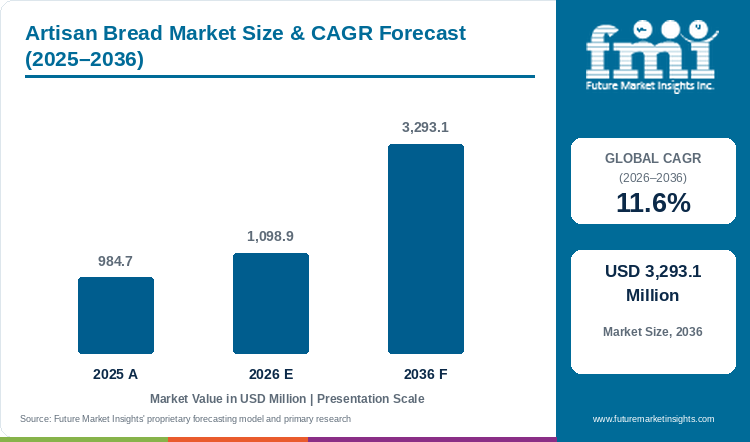
USD 1,098.9 Million in 2026 and USD 3,293.1 Million by 2036 at an 11.6% CAGR.
The Artisan Bread Market is valued at USD 1,098.9 Million in 2026. It is forecast to reach USD 3,293.1 Million by 2036 at an 11.6% CAGR from 2026 to 2036. As per FMI, the market was valued at USD 984.7 Million in 2025. The large U.S. retail bakery network is an indicator of fresh-bread infrastructure. Retailers, therefore are looking at formats that limit waste and protect margin.
Artisan bread demand is heavily influenced by global tourist footfall. Dubai reported 9.88 million international overnight visitors in the first half of 2025 and 80.6% hotel occupancy, which supports premium foodservice demand in the UAE. Demand is also shaped by regulations and culinary preferences. For instance, French bread cannot be frozen during production under regulations, and this creates certain restrictions in both manufacturing as well as overall demand.
Key Takeaways
- Classic/original is likely to account for 37.0% share of Product Type in 2026 owing to strong consumer preference.
- Conventional is likely to leads Claim / Nature with a 56.0% share in 2026.
- Fresh accounts for a 32.0% share of Format in 2026 owing to the growing preference on healthy food.
- Labor shortages, higher ingredient and energy costs, compliance requirements and limited shelf life can make premium products less profitable for retailers.
Analyst Perspective
“Frozen and bake-off formats can reduce the amount of skilled work needed at store level, which makes them useful for retailers and foodservice operators. The trade-off is product quality. Research on frozen dough has shown losses in bread volume, texture and gluten performance during frozen storage. Suppliers therefore need to make convenience work without giving up the crust, crumb and freshness expected from artisan bread.”
- Nandini Roy Choudhury, Principal Consultant, Future Market Insights
How is the Artisan Bread Market Segmented?
The market is segmented by Product Type, Claim / Nature, Format, Packaging Format and Sales Channel.
Product Type covers Classic / original, Whole grain & seeded, Flavored & filled, Mini & snacking formats and Premium / artisan. Claim / Nature includes Conventional, Clean label, Organic, Gluten-free and High-protein / fortified. Format includes Fresh, Frozen, Ambient packaged, Chilled and Par-baked / thaw-and-serve. Packaging Format includes Multipack, Single-serve, Family / loaf pack and Bulk foodservice. Sales Channel covers Supermarkets & hypermarkets, Artisan & specialty bakeries, Convenience & forecourt, Online & DTC and Foodservice distributors.
Why Does Classic / Original Anchor the Product Type Category?
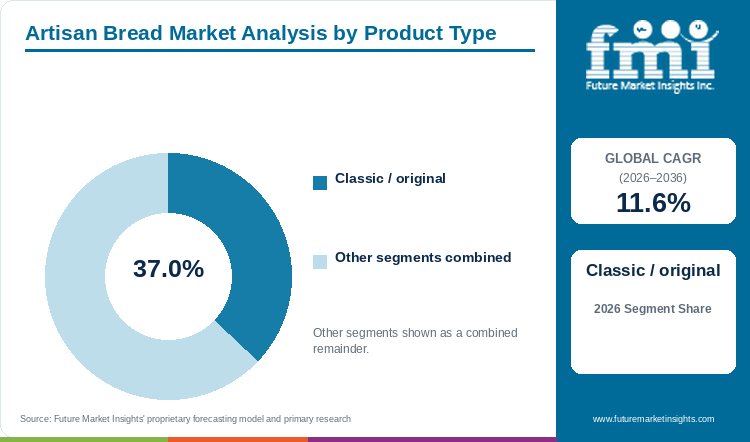
Classic / original bread benefits from routine consumption and a low adoption barrier.
Classic bread remains the easiest choice for regular purchases because buyers already know what to expect from it. It works across breakfast, sandwiches and meal occasions, giving bakeries and retailers a reliable product to keep in everyday rotation. Flavored, whole grain and premium varieties can sit alongside that base range and give customers more reasons to trade up.
- Classic / original accounts for 37.0% of Product Type demand in 2026.
Why Does Conventional Remain Central to Claim / Nature?
Conventional bread fits established flour systems and commercial bakery processes.
Conventional bread remains easier to produce and distribute at scale because it fits existing flour supply, bakery processing and retail systems. Products carrying organic, gluten-free or added-nutrition claims usually require tighter ingredient controls and additional sourcing or formulation work. For many suppliers, the conventional range therefore remains the volume base, while claimed products are added for shoppers willing to pay more.
- Conventional accounts for 56.0% of Claim / Nature demand in 2026.
- UK government guidance sets nutrient requirements for common wheat flour and will add folic-acid fortification from 13 December 2026. This shows how established mainstream flour products already operate within a well-defined production and compliance system.
What Keeps Fresh at the Front of the Format Category?
Fresh bread carries the sensory cues buyers associate with artisan quality.
A good crumb matters alongside crust, especially for bread sold at a premium. Fresh bread, however, leaves little room for poor planning. Bakeries need enough skilled staff to manage production through the day, while anything left unsold quickly becomes waste. Frozen and par-baked systems reduce those frictions while Fresh remains the benchmark for eating quality.
- Fresh segment leads Format with a 32.0% share in 2026 as per FMI because immediate eating quality is central to artisan positioning and supports premium merchandising.
Why Does Multipack Lead Packaging Format?
Multipack formats balance repeat consumption with controlled household inventory.
Bread packs have to balance two things that often work against each other: giving households enough product for several meals without leaving too much bread open long enough to lose freshness. Multipacks fit that need well for rolls, buns and smaller bread formats as consumers can buy several units at once while using them gradually. Larger family packs compete more heavily on value, while single portions are better suited to immediate consumption.
- Multipack accounts for 34.0% of Packaging Format demand in 2026.
What Makes Supermarkets & Hypermarkets the Primary Sales Channel?
Supermarkets & hypermarkets combine broad shopper traffic with several ways to merchandise artisan bread.
Stores can stock packaged premium loaves, multipacks and ambient ranges while also using in-store bakery or bake-off programs where available. Supermarkets remain the main buying point because they put packaged bread, in-store bakery products and premium variants in front of the same shopper. That makes the channel useful for routine purchases as well as trade-up products. Independent bakeries compete more on freshness and craftsmanship, while foodservice distributors serve buyers that need consistent supply and larger pack sizes.
- Supermarkets & hypermarkets account for 45.0% of Sales Channel demand in 2026, supported by high shopper traffic and the ability to sell both packaged bread and fresh bakery products under one roof.
What are the Drivers, Restraints and Opportunities in the Artisan Bread Market?
The opportunity is not simply to sell more premium bread, but to make it easier to produce and sell consistently. Labor shortages, higher ingredient costs and short shelf life can quickly erode margins on fresh products. Bake-off formats, smaller pack sizes and carefully chosen premium claims can help suppliers protect freshness while giving retailers more control over waste and operating cost.
- Driver: Wider retail and foodservice availability is making artisan-style bread easier to buy outside specialist bakeries.
- Restraint: Higher production costs and fewer new bakery workers make fresh, labor-intensive formats harder to scale.
- Opportunity: Bake-off products, smaller packs and more flexible formats can help retailers reduce waste and match changing household needs.
Artisan-style bread is no longer limited to neighborhood bakeries. Sourdough, seeded loaves and rustic breads are now sold through supermarkets, specialty stores and foodservice channels. That wider availability gives consumers more chances to buy these products and allows suppliers to reach customers without relying only on fresh bakery counters. The challenge is consistency. A premium loaf still has to deliver the crust, crumb and freshness buyers expect each time they purchase it.
Pack size gives suppliers another way to manage freshness and waste. Smaller loaves and portioned formats can suit households that do not finish a full loaf quickly, while multipacks can spread consumption across several meals. The commercial value comes from matching the amount sold with the amount likely to be eaten before quality declines. Bake-off systems address the same problem from the production side by allowing stores and foodservice operators to finish bread closer to the time of sale.
Product development can also come from the bread itself rather than from added claims. Whole-grain and seeded loaves can use different grain blends, while poolish, biga and natural levain can alter flavor, crumb and keeping quality. Research on sourdough has found that fermentation can affect crumb texture and staling, although the result varies with flour and process conditions. These methods can help bakers create a more distinctive product, but they also add time and control requirements to production.
Which Country CAGRs are Profiled in the Artisan Bread Market?
Profiled country CAGRs for 2026 to 2036 are shown below.
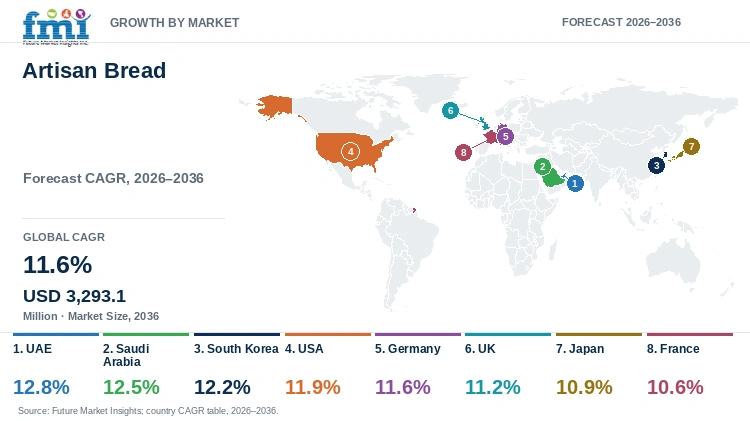
| Country | CAGR, 2026 to 2036 |
|---|---|
| UAE | 12.8% |
| Saudi Arabia | 12.5% |
| South Korea | 12.2% |
| USA | 11.9% |
| Germany | 11.6% |
| UK | 11.2% |
| Japan | 10.9% |
| France | 10.6% |
Country Outlook
The UAE and Saudi Arabia share a common growth engine, hospitality, but the buying patterns it creates are not identical. In the UAE, the buyer base is unusually concentrated. Dubai recorded 9.88 million international overnight visitors in the first half of 2025 and hotel occupancy of 80.6%. For a premium bread supplier, that means a handful of hotel groups, restaurants, and cafés effectively control access to a large, high-willingness-to-pay audience. The operational implication is just as concentrated: kitchens serving this volume at service speed cannot manage daily fresh production, so frozen and par-baked formats dominate. Fresh lines remain viable only where staff levels allow a bakery to absorb the waste risk that unsold bread carries.
Saudi Arabia's hospitality demand is broader but spikier. GASTAT reported roughly 63% hotel room occupancy in Q1 2025 and 983,253 people employed in tourism activities that quarter, a sector large enough to generate substantial foodservice buying, but one whose demand swings between everyday restaurant covers and banquet-scale events. That unevenness is why bake-off and bulk packs suit the market: they decouple bread supply from precise daily forecasting. A premium fresh line can work in Saudi kitchens, but only with forecasting tight enough to avoid the rapid value loss of unsold product.
South Korea's 12.2% CAGR rests on a demographic shift rather than a channel. The country counted 8.045 million one-person households in 2024, 36.1% of all households, which shrinks the viable pack size. Single-serve and mini formats with controlled counts are the natural response, and convenience and online channels extend reach.
The USA's 9,219 employer retail bakeries (County Business Patterns, 2023, NAICS 311811) give the market a genuine local-craft base. Premium positioning erodes fastest when a product marketed as artisan travels through a channel that degrades its eating quality or compresses the margin needed to sustain it.
Germany is an example of what scale without fragmentation looks like and what it costs. Sixty years ago, former West Germany alone had 55,000 bakeries, the geographies aren't directly comparable, but the direction is clear: consolidation. Demand, meanwhile, is deep and habitual. Households bought 1.519 million tonnes of bread in 2025, averaging 38 kg per buying household, with Mischbrot at 24.88% of the basket (second to toast at 27.99%) and 3,023 registered specialties as of May 2024, under a bread culture holding intangible cultural heritage status. For an artisan supplier, the branch network model spreads reach but the same model puts fermentation and bake-off quality under strain across dozens of outlets, and a bad loaf at one branch is indistinguishable from a bad brand.
Japan shows how centralized control can square that circle. Yamazaki Baking launches over a thousand new bread products a year, reflecting short product life cycles and fast consumer-feedback loops, and its Asian operations feed fresh retail outlets from frozen dough produced in central bakeries, process control exerted centrally, freshness delivered locally. The lesson cuts both ways. Centralized production can protect quality at scale, but a launch cadence that aggressive fragments demand; smaller packs and store-specific ranges build loyalty only when they reduce waste, not when they multiply choice.
In the UK, craft bakeries number around 4,500 (Federation of Bakers, 2021) yet produce just 3% of bread by volume, against 85% from plant bakeries and 12% from supermarket in-store bakeries. There is no legal definition of "artisan" or "sourdough”, the Real Bread Campaign has coined "sourfaux" for bread marketed as sourdough but leavened or soured by additives, and is pushing the Honest Crust Act to establish marketing standards. For independents, this cuts both ways: undefined terms are easy to claim, which also means they signal nothing. Process and ingredient transparency is currently the only way to make "artisan" mean something, and from 13 December 2026, mandatory folic-acid fortification of non-wholemeal wheat flour, with declared added nutrients on labels, will give consumers more label information to judge it by.
Who are the Notable Companies in the Artisan Bread Market?
The notable companies are Grupo Bimbo and Flowers Foods plus Aryzta and Lantmannen Unibake. The profile also includes Vandemoortele alongside Yamazaki Baking. Warburtons and King’s Hawaiian join Europastry and St Pierre Groupe.
Competition separates into three practical business models. Grupo Bimbo and Warburtons use branded portfolios and retail distribution to place artisan-style or premium cues into repeat grocery occasions. Flowers Foods and Yamazaki Baking use similar packaged routes. Aryzta and Lantmannen Unibake join Vandemoortele and Europastry in frozen and par-baked supply. Their buyers want fresh output with less on-site production. King’s Hawaiian and St Pierre Groupe hold narrower specialty positions built around sweet bread or brioche. Packaged suppliers need shelf-life and route-to-market strength. Bake-off specialists must prove finishing consistency and operational fit.
- Global branded and packaged bread platforms: Grupo Bimbo, Flowers Foods, Yamazaki Baking and Warburtons.
- Frozen and bake-off specialists: Aryzta, Lantmannen Unibake, Vandemoortele and Europastry.
- Premium specialty consumer bread brands: King’s Hawaiian and St Pierre Groupe.
Competitive Benchmarking: Artisan Bread Market
| Company | Artisan / Sourdough Bread Depth | Bake-off / Frozen Service Capability | Packaged Retail Bread Breadth | Geographic Reach |
|---|---|---|---|---|
| Grupo Bimbo | High | Low | High | North America and Europe |
| Flowers Foods | High | Low | High | United States |
| Aryzta | High | High | Medium | Europe, Asia, Australia and New Zealand |
| Lantmannen Unibake | High | High | Medium | Europe, United States and other international markets |
| Vandemoortele | High | High | Medium | Europe and United States |
| Yamazaki Baking | Medium | High | High | Japan, Asia, United States and France |
| Warburtons | Medium | Low | High | United Kingdom |
| King’s Hawaiian | Medium | Low | Medium | United States |
| Europastry | High | High | Medium | Europe and United States |
| St Pierre Groupe | Medium | Low | Medium | United States and international retail markets |
Artisan / Sourdough Bread Depth rates the documented range of sourdough and rustic or artisan-style bread. Bake-off / Frozen Service Capability covers frozen dough and par-baked formats plus thaw-and-serve products and in-store finishing. Packaged Retail Bread Breadth reflects the documented range of retail-ready loaves and related breads. High indicates broad documented capability. Medium reflects a credible but narrower range. Low indicates limited or unverified public evidence.
Key Developments in the Artisan Bread Market
- In February 2025 Vandemoortele acquired Lizzi in Italy. Lizzi brought frozen bakery production and brands spanning sourdough bread plus natural bread and focaccia. Four northern Italian plants supplied HoReCa and large-scale retail. The deal expanded Vandemoortele’s ability to serve artisan-style bread through frozen formats.
- In September 2025 Lantmannen Unibake acquired Boboli Benelux. The deal added focaccia plus sharing and specialty breads. It also extended access to retail and foodservice in the Benelux region as well as the UK and Germany. The acquisition broadened Lantmannen Unibake’s savory artisan-style bread occasions.
- In October 2025 Flowers Foods added Dave’s Killer Bread Supreme Sourdough and a higher-protein Nature’s Own loaf. It also introduced a thick-sliced Italian Herb loaf. The additions widened the company’s artisan-style and claim-led packaged bread range. Retailers could merchandise premium lines without relying on in-store production.
Key Players in the Artisan Bread Market
Global branded and packaged bread platforms
- Grupo Bimbo
- Flowers Foods
- Yamazaki Baking
- Warburtons
Frozen, bake-off and foodservice bakery specialists
- Aryzta
- Lantmannen Unibake
- Vandemoortele
- Europastry
Premium specialty consumer bread brands
- King’s Hawaiian
- St Pierre Groupe
Artisan Bread Market - Report Scope
| Coverage field | Report scope |
|---|---|
| Market breakdown | Product Type; Claim / Nature; Format; Packaging Format; Sales Channel |
| Quantitative Units | USD Million |
| Market Definition | Revenue includes artisan and craft-style bread sold within the Product Type, Claim / Nature, Format, Packaging Format and Sales Channel categories covered by this report. It excludes downstream sandwich or meal revenue, adjacent pastries and cakes, bakery ingredients and equipment, and substitute bakery snacks outside the bread boundary. |
| Regions Covered | North America; Latin America; Western Europe; Eastern Europe; East Asia; South Asia and Pacific; Middle East and Africa |
| Countries Covered | USA; Germany; France; UK; Saudi Arabia; UAE; Japan; South Korea |
| Key Companies Profiled | Grupo Bimbo; Flowers Foods; Aryzta; Lantmannen Unibake; Vandemoortele; Yamazaki Baking; Warburtons; King’s Hawaiian; Europastry; St Pierre Groupe |
| Forecast Period | 2026 to 2036 |
| Approach | Primary and secondary research with market triangulation. |
Artisan Bread Market - Research Methodology
| Method | Approach |
|---|---|
| Primary Research | FMI analysts interviewed manufacturers alongside service providers and technology developers. They also spoke with distributors and end users plus procurement teams and subject-matter experts. The interviews examined purchasing choices and product evaluation as well as adoption barriers and approval requirements. They covered pricing and technical support too. Respondents described evidence needed to move trials into regular purchasing. |
| Desk Research | Desk research covered government statistics and regulatory publications. It also reviewed trade data and industry associations along with technical literature and standards. Company filings and product information complemented official corporate announcements. Analysts checked publication dates and geographic coverage and tested each source against the market scope. Claims about performance and applications were retained only when credible public evidence supported them. The same rule applied to approvals and capacity plus investment and commercial activity. |
| Market Sizing and Forecasting | The market model combined the baseline value with historical performance and segment structure. It also used pricing and volume indicators alongside adoption and company participation. Forecast assumptions covered economic activity and investment trends plus regulation and technology adoption. They also considered purchasing cycles and supply availability. Segment and regional estimates were reconciled before calculating the market total. |
| Data Validation | Estimates were checked against independent indicators such as public data and company activity. Analysts also reviewed trade patterns and industry developments alongside primary interview findings. Validation checked whether products and services belonged within the defined market boundaries and whether company revenues fit that scope. Adjacent categories and unsupported claims were excluded. Analysts also removed overlapping revenues and activities without direct market relevance to reduce double counting across segments and countries. |
Artisan Bread Market by Segments
Artisan Bread Market segmented by Product Type:
- Classic / original
- Whole grain & seeded
- Flavored & filled
- Mini & snacking formats
- Premium / artisan
Artisan Bread Market segmented by Claim / Nature:
- Conventional
- Clean label
- Organic
- Gluten-free
- High-protein / fortified
Artisan Bread Market segmented by Format:
- Fresh
- Frozen
- Ambient packaged
- Chilled
- Par-baked / thaw-and-serve
Artisan Bread Market segmented by Packaging Format:
- Multipack
- Single-serve
- Family / loaf pack
- Bulk foodservice
Artisan Bread Market segmented by Sales Channel:
- Supermarkets & hypermarkets
- Artisan & specialty bakeries
- Convenience & forecourt
- Online & DTC
- Foodservice distributors
Artisan Bread Market by Region:
- North America
- United States
- Canada
- Latin America
- Brazil
- Mexico
- Argentina
- Chile
- Western Europe
- Germany
- France
- United Kingdom
- Italy
- Spain
- Benelux
- Nordics
- Eastern Europe
- Poland
- Czech Republic
- Romania
- Hungary
- East Asia
- China
- Japan
- South Korea
- South Asia and Pacific
- India
- ASEAN
- Australia and New Zealand
- Middle East and Africa
- GCC Countries
- South Africa
- Türkiye
- Israel
Research Sources and Bibliography
- UNESCO (2022). Baguette heritage record (Artisanal know-how and culture of baguette bread).
- Légifrance (1993, September 13). French bread decree (Décret n°93-1074 du 13 septembre 1993 pris pour l’application de la loi du 1er août 1905 en ce qui concerne certaines catégories de pains).
- Statistisches Bundesamt (Destatis) (2024, April 30). German bread prices (Preise für Brot und Brötchen überdurchschnittlich gestiegen: +34,4 % von 2019 bis 2023).
- Department for Environment, Food & Rural Affairs and Food Standards Agency (2025, April 23). UK flour rules (Bread and flour: labelling and composition).
- Dubai Department of Economy and Tourism (2025, August 3). Dubai visitor figures (Dubai welcomes 9.88 million international visitors in first half of 2025).
- General Authority for Statistics, Saudi Arabia (2025, July 3). Saudi tourism data (GASTAT publishes Tourism Establishments Statistics for Q1 2025).
- U.S. Census Bureau (2025, June 26). US bakery count (All Sectors: County Business Patterns, including ZIP Code Business Patterns, by Legal Form of Organization and Employment Size Class for the U.S., States, and Selected Geographies: 2023).
- Ministry of Data and Statistics, Republic of Korea (2025, December 9). Korean household data (2025 Statistics of One-person Households).
- Yamazaki Baking (n.d.). Yamazaki bread business (Bread Business).
- Yamazaki Baking (n.d.). Yamazaki global operations (Overseas Operations).
- Grupo Bimbo (n.d.). Bimbo North American brands (North America Brands).
- Grupo Bimbo (n.d.). Bimbo Europe brands (Europe and Africa Brands).
- Grupo Bimbo (2025, February 25). Bimbo Colombia update (Bimbo Colombia transforma su receta de pan blanco con más beneficios nutricionales).
- Flowers Foods (n.d.). Flowers company overview (Flowers Foods At-A-Glance).
- Flowers Foods (2024, April 22). Flowers 2024 launches (Flowers Foods Doubles Down on Innovation, Introduces 11 New Products).
- Flowers Foods (2025, October 27). Flowers 2025 launch (Flowers Foods Taps into Higher-Protein and Sourdough Trends with New Products).
- ARYZTA (n.d.). Aryzta company profile (Company Profile).
- ARYZTA (n.d.). Aryzta product portfolio (Portfolio).
- ARYZTA (2026, January 22). Aryzta 2025 results (Full year 2025 targets achieved; Revenue growth & improved performance expected in 2026; New €40m bun bakery in Portugal).
- ARYZTA (2026, August 26). Perth bakery opening (New Perth bakery officially opened).
- Lantmännen (2025, March 18). Lantmannen farm program (Korvbrödsbagarn joins Lantmännen’s cultivation program Climate & Nature).
- Lantmännen (2025, May 28). Swedish bakery investment (Lantmännen makes strategic and long-term investment in new production facility for bread).
- Lantmännen (2025, September 1). Boboli acquisition release (Lantmännen Unibake expands in savoury with acquisition of Boboli Benelux B.V.).
- Lantmannen Unibake (n.d.). Unibake product range (Product Portfolio).
- Vandemoortele (2025, February 14). Lizzi acquisition release (Vandemoortele acquires Lizzi in Italy, a specialty player in frozen Bakery).
- Vandemoortele (n.d.). Farmer’s baguette product (Farmer’s Baguette).
- Warburtons (n.d.). Warburtons bread range (Bread).
- King’s Hawaiian (n.d.). King’s Hawaiian products (King’s Hawaiian Products).
- Europastry (n.d.). Europastry artisan loaves (Artisan Bread - USA Product Range).
- St Pierre (n.d.). St Pierre company profile (About Us).
- St Pierre (n.d.). Brioche loaf product (Brioche Loaf).
- Google Arts & Culture (n.d.). French baguette figures (The baguette is also a story told in numbers by Société nationale des Meilleurs Ouvriers de France).
- Zentralverband des Deutschen Bäckerhandwerks (2026). German bakery statistics (Zahlen rund ums Bäckerhandwerk).
- Federation of Bakers (n.d.). UK bakery market data (UK bakery market).
- Federation of Bakers (2021). UK craft bakery count (Statement on CSR in the UK bakery sector).
- Real Bread Campaign (2026). Honest Crust Act proposals (Honest Crust Act).
- Devos, F. (2018). Traditional leavening systems (Traditional Versus Modern Leavening Systems. Cereal Foods World, 63(2)).
- Islam, M. A., and Islam, S. (2024). Sourdough quality review (Sourdough Bread Quality: Facts and Factors. Foods, 13(13), 2132).
This bibliography is provided for reader reference and is not exhaustive. The full FMI report contains the complete reference list and detailed citations.
This Report Answers
- How large is the Artisan Bread Market in 2026, and what value is forecast for 2036?
- Which industry pressures are supporting demand for artisan bread?
- Why does Classic / original lead Product Type?
- Why does Conventional lead Claim / Nature?
- How do the profiled country growth rates differ from 2026 to 2036?
- Which companies supply relevant artisan, packaged and bake-off bread categories?
- What limits adoption, purchasing or supplier switching in the artisan bread market?
- What should buyers evaluate before choosing an artisan bread supplier or format?
Frequently Asked Questions
How Big is the Artisan Bread Market in 2026, and What is Forecast for 2036?
As per FMI, the Artisan Bread Market is valued at USD 1,098.9 Million in 2026 and is forecast to reach USD 3,293.1 Million by 2036. Demand is strongest where buyers combine crafted sensory quality with repeatable availability through retail and foodservice systems that can replenish fresh bread consistently.
What is the CAGR of the Artisan Bread Market from 2026 to 2036?
The Artisan Bread Market grows at an 11.6% CAGR between 2026 and 2036, moving from USD 1,098.9 Million to USD 3,293.1 Million. Growth is supported by suppliers that preserve crust and crumb quality while controlling labor, freshness losses and replenishment across supermarkets, artisan bakeries and foodservice distributors.
Which Product Type Leads the Artisan Bread Market?
Classic / original accounts for 37.0% of the Artisan Bread Market by Product Type in 2026, driven by routine consumption and a low adoption barrier that let familiar profiles serve breakfast, sandwich and table-bread occasions without a specialized claim and give retailers a dependable base assortment.
How Much Will the Artisan Bread Market Add Between 2026 and 2036?
The Artisan Bread Market is set to add USD 2,194.2 Million between 2026 and 2036, growing from USD 1,098.9 Million to USD 3,293.1 Million as suppliers match craft-style eating quality to the labor, compliance and finishing model of scaled retail and foodservice channels.
Who are the Notable Companies in the Artisan Bread Market?
As per FMI, 10 companies are profiled in the Artisan Bread Market, including Grupo Bimbo, Flowers Foods, Aryzta, Lantmannen Unibake, Vandemoortele, Yamazaki Baking, Warburtons, King’s Hawaiian, Europastry and St Pierre Groupe, across branded packaged bread, frozen and bake-off supply, and premium specialty positions.
Preview the report firsthand - request a free sample
Get SampleGet the brochure for pricing and purchase details.
Get PDFTable of Content
- Key Takeaways
- Market Size and CAGR
- Top Growth Driver
- Fastest Growing Segment
- Leading Region
- Key Companies
- Emerging Opportunities
- Executive Summary
- Global Market Outlook
- Demand-side Trends
- Supply-side Trends
- Technology Roadmap Analysis
- Analysis and Recommendations
- Analyst Perspective (What is happening? Why now? What should investors know?)
- Key Questions Answered
- How large is the market?
- What is the CAGR?
- What are key trends?
- Which region dominates?
- Who are the leaders?
- Market Overview
- Market Coverage / Taxonomy
- Market Definition / Scope / Limitations
- Research Methodology
- Chapter Orientation
- Analytical Lens and Working Hypotheses
- Market Structure, Signals, and Trend Drivers
- Benchmarking and Cross-market Comparability
- Market Sizing, Forecasting, and Opportunity Mapping
- Research Design and Evidence Framework
- Desk Research Programme (Secondary Evidence)
- Expert Input and Fieldwork (Primary Evidence)
- Tooling, Models, and Reference Databases
- Data Engineering and Model Build
- Quality Assurance and Audit Trail
- Market Background
- Market Dynamics (Drivers, Restraints, Opportunity, Trends)
- Scenario Forecast (Optimistic, Likely, Conservative)
- Impact Analysis
- AI Impact
- Sustainability Impact
- Regulatory Impact
- Technology Impact
- Consumer / Buyer Analysis
- Purchase Drivers
- Adoption Barriers
- Buyer Journey
- Opportunity Map Analysis
- Product Life Cycle Analysis
- Supply Chain Analysis
- Investment Feasibility Matrix
- Value Chain Analysis
- PESTLE and Porter's Analysis
- Regulatory Landscape
- Regional Parent Market Outlook
- Production and Consumption Statistics
- Import and Export Statistics
- Global Market Analysis and Forecast, 2021 to 2036
- Historical Market Size Value (USD Million) Analysis, 2021 to 2025
- Current and Future Market Size Value (USD Million) Projections, 2026 to 2036
- Y-o-Y Growth Trend Analysis
- Absolute $ Opportunity Analysis
- Global Market Pricing Analysis, 2021 to 2036
- Global Market Analysis and Forecast, By Product Type, 2021 to 2036
- Introduction / Key Findings
- Historical Market Size Value (USD Million) Analysis By Product Type, 2021 to 2025
- Current and Future Market Size Value (USD Million) Analysis and Forecast By Product Type, 2026 to 2036
- Classic / original
- Whole grain & seeded
- Flavored & filled
- Mini & snacking formats
- Premium / artisan
- Y-o-Y Growth Trend Analysis By Product Type, 2021 to 2025
- Absolute $ Opportunity Analysis By Product Type, 2026 to 2036
- Global Market Analysis and Forecast, By Claim / Nature, 2021 to 2036
- Introduction / Key Findings
- Historical Market Size Value (USD Million) Analysis By Claim / Nature, 2021 to 2025
- Current and Future Market Size Value (USD Million) Analysis and Forecast By Claim / Nature, 2026 to 2036
- Conventional
- Clean label
- Organic
- Gluten-free
- High-protein / fortified
- Y-o-Y Growth Trend Analysis By Claim / Nature, 2021 to 2025
- Absolute $ Opportunity Analysis By Claim / Nature, 2026 to 2036
- Global Market Analysis and Forecast, By Format, 2021 to 2036
- Introduction / Key Findings
- Historical Market Size Value (USD Million) Analysis By Format, 2021 to 2025
- Current and Future Market Size Value (USD Million) Analysis and Forecast By Format, 2026 to 2036
- Fresh
- Frozen
- Ambient packaged
- Chilled
- Par-baked / thaw-and-serve
- Y-o-Y Growth Trend Analysis By Format, 2021 to 2025
- Absolute $ Opportunity Analysis By Format, 2026 to 2036
- Global Market Analysis and Forecast, By Packaging Format, 2021 to 2036
- Introduction / Key Findings
- Historical Market Size Value (USD Million) Analysis By Packaging Format, 2021 to 2025
- Current and Future Market Size Value (USD Million) Analysis and Forecast By Packaging Format, 2026 to 2036
- Multipack
- Single-serve
- Family / loaf pack
- Bulk foodservice
- Y-o-Y Growth Trend Analysis By Packaging Format, 2021 to 2025
- Absolute $ Opportunity Analysis By Packaging Format, 2026 to 2036
- Global Market Analysis and Forecast, By Sales Channel, 2021 to 2036
- Introduction / Key Findings
- Historical Market Size Value (USD Million) Analysis By Sales Channel, 2021 to 2025
- Current and Future Market Size Value (USD Million) Analysis and Forecast By Sales Channel, 2026 to 2036
- Supermarkets & hypermarkets
- Artisan & specialty bakeries
- Convenience & forecourt
- Online & DTC
- Foodservice distributors
- Y-o-Y Growth Trend Analysis By Sales Channel, 2021 to 2025
- Absolute $ Opportunity Analysis By Sales Channel, 2026 to 2036
- Global Market Analysis and Forecast, By Region, 2021 to 2036
- Introduction
- Historical Market Size Value (USD Million) Analysis By Region, 2021 to 2025
- Current Market Size Value (USD Million) Analysis and Forecast By Region, 2026 to 2036
- North America
- Latin America
- Western Europe
- Eastern Europe
- East Asia
- South Asia and Pacific
- Middle East and Africa
- Market Attractiveness Analysis By Region
- North America Market Analysis and Forecast, By Country, 2021 to 2036
- Historical Market Size Value (USD Million) Trend Analysis By Market Taxonomy, 2021 to 2025
- Market Size Value (USD Million) Forecast By Market Taxonomy, 2026 to 2036
- By Country
- United States
- Canada
- By Product Type
- By Claim / Nature
- By Format
- By Packaging Format
- By Sales Channel
- By Country
- Market Attractiveness Analysis
- By Country
- By Product Type
- By Claim / Nature
- By Format
- By Packaging Format
- By Sales Channel
- Key Takeaways
- Latin America Market Analysis and Forecast, By Country
- Historical Market Size Value (USD Million) Trend Analysis By Market Taxonomy, 2021 to 2025
- Market Size Value (USD Million) Forecast By Market Taxonomy, 2026 to 2036
- By Country
- Brazil
- Mexico
- Argentina
- Chile
- By Product Type
- By Claim / Nature
- By Format
- By Packaging Format
- By Sales Channel
- By Country
- Market Attractiveness Analysis
- By Country
- By Product Type
- By Claim / Nature
- By Format
- By Packaging Format
- By Sales Channel
- Key Takeaways
- Western Europe Market Analysis and Forecast, By Country
- Historical Market Size Value (USD Million) Trend Analysis By Market Taxonomy, 2021 to 2025
- Market Size Value (USD Million) Forecast By Market Taxonomy, 2026 to 2036
- By Country
- Germany
- France
- United Kingdom
- Italy
- Spain
- Benelux
- Nordics
- By Product Type
- By Claim / Nature
- By Format
- By Packaging Format
- By Sales Channel
- By Country
- Market Attractiveness Analysis
- By Country
- By Product Type
- By Claim / Nature
- By Format
- By Packaging Format
- By Sales Channel
- Key Takeaways
- Eastern Europe Market Analysis and Forecast, By Country
- Historical Market Size Value (USD Million) Trend Analysis By Market Taxonomy, 2021 to 2025
- Market Size Value (USD Million) Forecast By Market Taxonomy, 2026 to 2036
- By Country
- Poland
- Czech Republic
- Romania
- Hungary
- By Product Type
- By Claim / Nature
- By Format
- By Packaging Format
- By Sales Channel
- By Country
- Market Attractiveness Analysis
- By Country
- By Product Type
- By Claim / Nature
- By Format
- By Packaging Format
- By Sales Channel
- Key Takeaways
- East Asia Market Analysis and Forecast, By Country
- Historical Market Size Value (USD Million) Trend Analysis By Market Taxonomy, 2021 to 2025
- Market Size Value (USD Million) Forecast By Market Taxonomy, 2026 to 2036
- By Country
- China
- Japan
- South Korea
- By Product Type
- By Claim / Nature
- By Format
- By Packaging Format
- By Sales Channel
- By Country
- Market Attractiveness Analysis
- By Country
- By Product Type
- By Claim / Nature
- By Format
- By Packaging Format
- By Sales Channel
- Key Takeaways
- South Asia and Pacific Market Analysis and Forecast, By Country
- Historical Market Size Value (USD Million) Trend Analysis By Market Taxonomy, 2021 to 2025
- Market Size Value (USD Million) Forecast By Market Taxonomy, 2026 to 2036
- By Country
- India
- ASEAN
- Australia and New Zealand
- By Product Type
- By Claim / Nature
- By Format
- By Packaging Format
- By Sales Channel
- By Country
- Market Attractiveness Analysis
- By Country
- By Product Type
- By Claim / Nature
- By Format
- By Packaging Format
- By Sales Channel
- Key Takeaways
- Middle East and Africa Market Analysis and Forecast, By Country
- Historical Market Size Value (USD Million) Trend Analysis By Market Taxonomy, 2021 to 2025
- Market Size Value (USD Million) Forecast By Market Taxonomy, 2026 to 2036
- By Country
- GCC Countries
- South Africa
- Türkiye
- Israel
- By Product Type
- By Claim / Nature
- By Format
- By Packaging Format
- By Sales Channel
- By Country
- Market Attractiveness Analysis
- By Country
- By Product Type
- By Claim / Nature
- By Format
- By Packaging Format
- By Sales Channel
- Key Takeaways
- Key Countries Market Analysis
- United States
- Pricing Analysis
- Market Share Analysis, 2025
- By Product Type
- By Claim / Nature
- By Format
- By Packaging Format
- By Sales Channel
- Canada
- Pricing Analysis
- Market Share Analysis, 2025
- By Product Type
- By Claim / Nature
- By Format
- By Packaging Format
- By Sales Channel
- Mexico
- Pricing Analysis
- Market Share Analysis, 2025
- By Product Type
- By Claim / Nature
- By Format
- By Packaging Format
- By Sales Channel
- Brazil
- Pricing Analysis
- Market Share Analysis, 2025
- By Product Type
- By Claim / Nature
- By Format
- By Packaging Format
- By Sales Channel
- Chile
- Pricing Analysis
- Market Share Analysis, 2025
- By Product Type
- By Claim / Nature
- By Format
- By Packaging Format
- By Sales Channel
- Germany
- Pricing Analysis
- Market Share Analysis, 2025
- By Product Type
- By Claim / Nature
- By Format
- By Packaging Format
- By Sales Channel
- United Kingdom
- Pricing Analysis
- Market Share Analysis, 2025
- By Product Type
- By Claim / Nature
- By Format
- By Packaging Format
- By Sales Channel
- Italy
- Pricing Analysis
- Market Share Analysis, 2025
- By Product Type
- By Claim / Nature
- By Format
- By Packaging Format
- By Sales Channel
- Spain
- Pricing Analysis
- Market Share Analysis, 2025
- By Product Type
- By Claim / Nature
- By Format
- By Packaging Format
- By Sales Channel
- France
- Pricing Analysis
- Market Share Analysis, 2025
- By Product Type
- By Claim / Nature
- By Format
- By Packaging Format
- By Sales Channel
- India
- Pricing Analysis
- Market Share Analysis, 2025
- By Product Type
- By Claim / Nature
- By Format
- By Packaging Format
- By Sales Channel
- ASEAN
- Pricing Analysis
- Market Share Analysis, 2025
- By Product Type
- By Claim / Nature
- By Format
- By Packaging Format
- By Sales Channel
- Australia and New Zealand
- Pricing Analysis
- Market Share Analysis, 2025
- By Product Type
- By Claim / Nature
- By Format
- By Packaging Format
- By Sales Channel
- China
- Pricing Analysis
- Market Share Analysis, 2025
- By Product Type
- By Claim / Nature
- By Format
- By Packaging Format
- By Sales Channel
- Japan
- Pricing Analysis
- Market Share Analysis, 2025
- By Product Type
- By Claim / Nature
- By Format
- By Packaging Format
- By Sales Channel
- South Korea
- Pricing Analysis
- Market Share Analysis, 2025
- By Product Type
- By Claim / Nature
- By Format
- By Packaging Format
- By Sales Channel
- Poland
- Pricing Analysis
- Market Share Analysis, 2025
- By Product Type
- By Claim / Nature
- By Format
- By Packaging Format
- By Sales Channel
- Hungary
- Pricing Analysis
- Market Share Analysis, 2025
- By Product Type
- By Claim / Nature
- By Format
- By Packaging Format
- By Sales Channel
- Türkiye
- Pricing Analysis
- Market Share Analysis, 2025
- By Product Type
- By Claim / Nature
- By Format
- By Packaging Format
- By Sales Channel
- South Africa
- Pricing Analysis
- Market Share Analysis, 2025
- By Product Type
- By Claim / Nature
- By Format
- By Packaging Format
- By Sales Channel
- UAE
- Pricing Analysis
- Market Share Analysis, 2025
- By Product Type
- By Claim / Nature
- By Format
- By Packaging Format
- By Sales Channel
- Saudi Arabia
- Pricing Analysis
- Market Share Analysis, 2025
- By Product Type
- By Claim / Nature
- By Format
- By Packaging Format
- By Sales Channel
- United States
- Market Structure Analysis
- Competition Dashboard
- Competition Benchmarking
- Market Share Analysis of Top Players
- By Regional
- By Product Type
- By Claim / Nature
- By Format
- By Packaging Format
- By Sales Channel
- Emerging Startups
- Innovation Benchmarking
- Competition Analysis
- Competition Deep Dive
- Grupo Bimbo
- Overview
- Product Portfolio
- Profitability by Market Segments
- Sales Footprint
- Strategy Overview
- Marketing Strategy
- Product Strategy
- Channel Strategy
- Flowers Foods
- Aryzta
- Lantmannen Unibake
- Vandemoortele
- Yamazaki Baking
- Warburtons
- King’s Hawaiian
- Europastry
- St Pierre Groupe
- Grupo Bimbo
- Case Studies
- Success Stories
- Recent Developments
- Competition Deep Dive
- Assumptions & Acronyms Used


