

- Industry Size (2025)
- USD 1.6 Bn
- Forecast (2035)
- USD 3.3 Bn
- CAGR (2025 to 2035)
- 7.5%
Aspirating System Market Size and Share Forecast Outlook 2025 to 2035
The Aspirating System Market is estimated to be valued at USD 1.6 billion in 2025 and is projected to reach USD 3.3 billion by 2035, registering a compound annual growth rate (CAGR) of 7.5% over the forecast period.
Quick Stats for Aspirating System Market
- Aspirating System Market Value (2025): USD 1.6 billion
- Aspirating System Market Forecast Value (2035): USD 3.3 billion
- Aspirating System Market Forecast CAGR: 7.5%
- Leading Segment in Aspirating System Market in 2025: Medium Sized Application (300 m2 to 1000 m2) (45.0%)
- Key Growth Regions in Aspirating System Market: North America, Asia-Pacific, Europe
- Top Key Players in Aspirating System Market: Siemens, Honeywell International, Protec, Minimax USA, Patol, Kidde-Fenwal, Aguilera Group, Zeta Alarms, Pertronic Industries, Eurofyre, Vimal Fire Controls
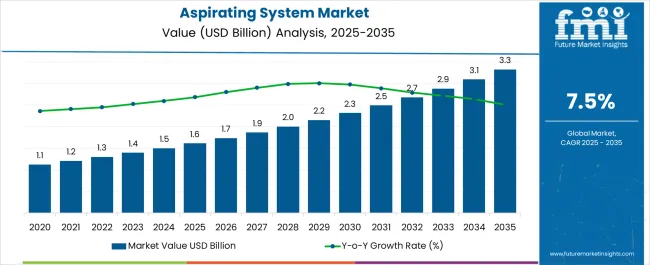
Aspirating System Market Key Takeaways
| Metric | Value |
|---|---|
| Aspirating System Market Estimated Value in (2025 E) | USD 1.6 billion |
| Aspirating System Market Forecast Value in (2035 F) | USD 3.3 billion |
| Forecast CAGR (2025 to 2035) | 7.5% |
Why is the Aspirating System Market Growing?
The Aspirating System market is experiencing significant growth driven by the increasing need for early detection and rapid response in fire safety and security applications. The future outlook for this market is shaped by the rising demand for high-performance detection systems in commercial and institutional buildings, where safety regulations and insurance requirements are stringent. Continuous advancements in detection technologies have enabled aspirating systems to deliver highly sensitive and reliable performance, ensuring prompt identification of smoke, fire, or hazardous conditions.
The market is further supported by the growing adoption of intelligent building management systems, which integrate aspirating systems to enhance operational safety and efficiency. Additionally, increasing construction of commercial complexes, office spaces, educational institutions, and healthcare facilities has propelled the need for scalable detection solutions.
The transition from conventional fire detection methods to sophisticated aspirating systems allows for better coverage, flexibility, and real-time monitoring, reinforcing market growth As safety compliance and risk mitigation continue to be priorities for property owners and managers, aspirating systems are expected to maintain strong adoption across global markets.
Segmental Analysis
The aspirating system market is segmented by detection range, end use, and geographic regions. By detection range, aspirating system market is divided into Medium Sized Application (300 m2 to 1000 m2), Small Sized Application (<300 m2), and Large Sized Application (>1000 m2). In terms of end use, aspirating system market is classified into Commercial & Institutional, Residential, and Industrial. Regionally, the aspirating system industry is classified into North America, Latin America, Western Europe, Eastern Europe, Balkan & Baltic Countries, Russia & Belarus, Central Asia, East Asia, South Asia & Pacific, and the Middle East & Africa.
Insights into the Medium Sized Application Detection Range Segment
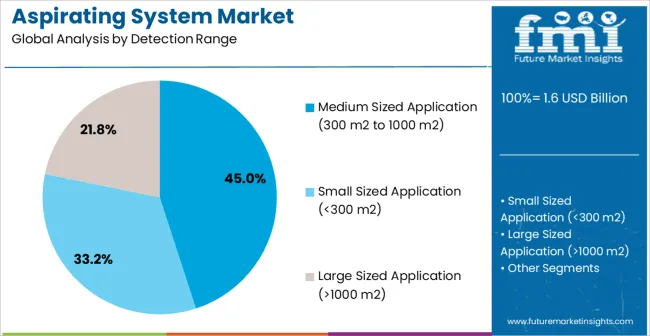
The medium sized application detection range segment, covering areas from 300 m2 to 1000 m2, is projected to hold 45.00% of the Aspirating System market revenue share in 2025, establishing it as the leading detection range. This dominance is driven by the suitability of this range for a majority of commercial and institutional facilities, which require efficient coverage without overinvestment in oversized systems.
The segment has benefited from improvements in aspirating technology, including enhanced sensitivity, quicker response times, and lower false alarm rates. The ability to integrate seamlessly with building management systems and other safety infrastructure has further reinforced the adoption of this detection range.
Moreover, the flexibility to adapt to diverse layouts and architectural designs makes medium sized detection systems highly attractive to building managers and safety consultants The cost-effectiveness, combined with reliable performance and compliance with safety standards, supports the continued growth and dominance of this segment in the market.
Insights into the Commercial & Institutional End Use Segment
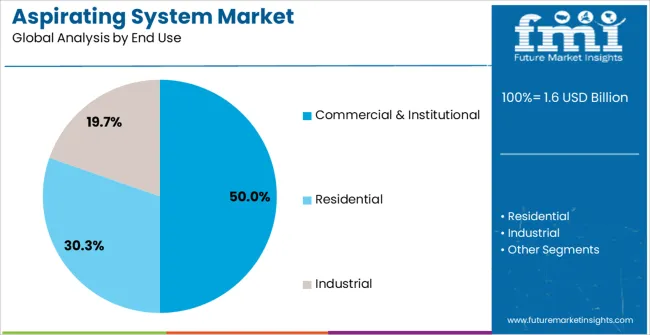
The commercial and institutional end-use segment is expected to capture 50.00% of the Aspirating System market revenue in 2025, positioning it as the leading industry segment. The growth of this segment has been influenced by the increasing emphasis on safety, regulatory compliance, and operational risk management in commercial buildings, educational institutions, healthcare facilities, and public infrastructures.
Aspirating systems offer scalable, high-performance solutions that allow real-time monitoring and early detection, minimizing potential damages and ensuring occupant safety. The ability to customize system configurations based on specific building layouts and operational requirements has further driven adoption.
Additionally, rising awareness of fire safety protocols, insurance incentives, and government-mandated safety standards have reinforced the importance of aspirating systems in this sector The convergence of technological advancements, regulatory pressure, and operational efficiency requirements ensures that the commercial and institutional segment continues to dominate market revenue share.
Market Overview
Aspirating System Market Outlook (2025-2035)
Aspirating systems are highly sensitive smoke detecting systems used primarily for detection of fires at early stages. They have become standard safety equipment adopted across residential, commercial and industrial infrastructures for providing earliest possible warning of an impending fire hazard.
Demand for aspirating systems has witnessed substantial increase across developed and developing regions over the last few years. They have become ideal alternatives to ordinary fire detections systems due to their faster speeds, compact nature and higher sensitivity.
An aspirating system analyze the presence of smoke by taking a sample of air from monitoring areas. It consists of central detection unit which draws air through a network of pipes and efficiently detect smoke even before it is visible to the naked eye.
Aspirating systems are specially designed to provide unrivalled safety to residential buildings, businesses, industries, healthcare facilities and educational setups. Increasing safety concerns across these end use verticals is one of the major factors fueling the adoption of aspirating systems.
Early detection of fire can be very helpful in minimizing or preventing the overall loss across fire prone places like data centers, healthcare facilities, laboratories, homes etc. In order to achieve this, aspirating systems are being installed across these places.
People are increasingly employing aspirating systems to detect fire at its initial stage, on account of their high level of immunity against false alarms, low maintenance costs and reduced downtime. Adoption of these safety systems not only helps to minimize the property damage but also helps to save lives as well.
Moreover, rising integration of internet of things (IoT) and big data in aspirating systems will further support their adoption across end use verticals during the forecast period
Analysis of Aspirating System Market By Key Countries
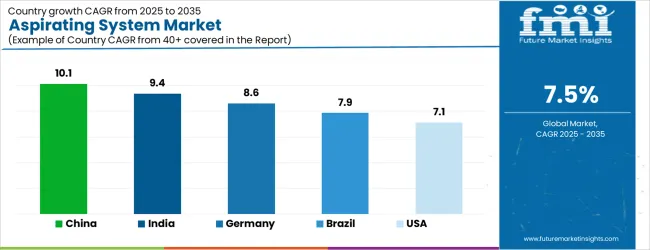
| Country | CAGR |
|---|---|
| China | 10.1% |
| India | 9.4% |
| Germany | 8.6% |
| Brazil | 7.9% |
| USA | 7.1% |
| UK | 6.4% |
| Japan | 5.6% |
Country-wise Analysis
The Aspirating System Market is expected to register a CAGR of 7.5% during the forecast period, exhibiting varied country level momentum. China leads with the highest CAGR of 10.1%, followed by India at 9.4%. Developed markets such as Germany, France, and the UK continue to expand steadily, while the USA is likely to grow at consistent rates. Japan posts the lowest CAGR at 5.6%, yet still underscores a broadly positive trajectory for the global Aspirating System Market. In 2024, Germany held a dominant revenue in the Western Europe market and is expected to grow with a CAGR of 8.6%. The USA Aspirating System Market is estimated to be valued at USD 567.3 million in 2025 and is anticipated to reach a valuation of USD 567.3 million by 2035. Sales are projected to rise at a CAGR of 0.0% over the forecast period between 2025 and 2035. While Japan and South Korea markets are estimated to be valued at USD 73.4 million and USD 53.2 million respectively in 2025.
Key Players in the Aspirating System Market
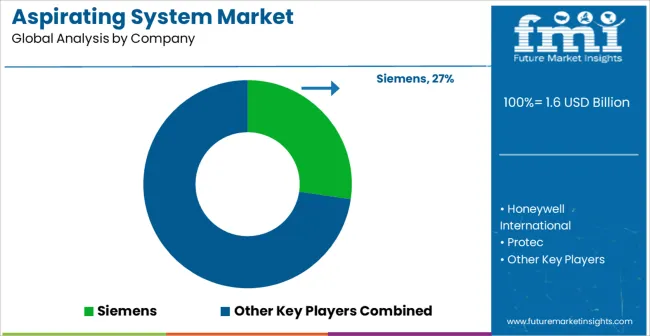
- Siemens
- Honeywell International
- Protec
- Minimax USA
- Patol
- Kidde-Fenwal
- Aguilera Group
- Zeta Alarms
- Pertronic Industries
- Eurofyre
- Vimal Fire Controls
Scope of the Report
| Item | Value |
|---|---|
| Quantitative Units | USD 1.6 Billion |
| Detection Range | Medium Sized Application (300 m2 to 1000 m2), Small Sized Application (<300 m2), and Large Sized Application (>1000 m2) |
| End Use | Commercial & Institutional, Residential, and Industrial |
| Regions Covered | North America, Europe, Asia-Pacific, Latin America, Middle East & Africa |
| Country Covered | United States, Canada, Germany, France, United Kingdom, China, Japan, India, Brazil, South Africa |
| Key Companies Profiled | Siemens, Honeywell International, Protec, Minimax USA, Patol, Kidde-Fenwal, Aguilera Group, Zeta Alarms, Pertronic Industries, Eurofyre, and Vimal Fire Controls |
Aspirating System Market by Segments
-
Detection Range :
- Medium Sized Application (300 m2 to 1000 m2)
- Small Sized Application (<300 m2)
- Large Sized Application (>1000 m2)
-
End Use :
- Commercial & Institutional
- Residential
- Industrial
-
Region :
- North America
- USA
- Canada
- Mexico
- Latin America
- Brazil
- Chile
- Rest of Latin America
- Western Europe
- Germany
- UK
- Italy
- Spain
- France
- Nordic
- BENELUX
- Rest of Western Europe
- Eastern Europe
- Russia
- Poland
- Hungary
- Balkan & Baltic
- Rest of Eastern Europe
- East Asia
- China
- Japan
- South Korea
- South Asia and Pacific
- India
- ASEAN
- Australia & New Zealand
- Rest of South Asia and Pacific
- Middle East & Africa
- Kingdom of Saudi Arabia
- Other GCC Countries
- Turkiye
- South Africa
- Other African Union
- Rest of Middle East & Africa
- North America
Frequently Asked Questions
How big is the aspirating system market in 2025?
The global aspirating system market is estimated to be valued at USD 1.6 billion in 2025.
What will be the size of aspirating system market in 2035?
The market size for the aspirating system market is projected to reach USD 3.3 billion by 2035.
How much will be the aspirating system market growth between 2025 and 2035?
The aspirating system market is expected to grow at a 7.5% CAGR between 2025 and 2035.
What are the key product types in the aspirating system market?
The key product types in aspirating system market are medium sized application (300 m2 to 1000 m2), small sized application (<300 m2) and large sized application (>1000 m2).
Which end use segment to contribute significant share in the aspirating system market in 2025?
In terms of end use, commercial & institutional segment to command 50.0% share in the aspirating system market in 2025.
Preview the report firsthand - request a free sample
Get SampleGet the brochure for pricing and purchase details.
Get PDFTable of Content
- Executive Summary
- Global Market Outlook
- Demand-side Trends
- Supply-side Trends
- Technology Roadmap Analysis
- Analysis and Recommendations
- Market Overview
- Market Coverage / Taxonomy
- Market Definition / Scope / Limitations
- Market Background
- Market Dynamics
- Drivers
- Restraints
- Opportunity
- Trends
- Scenario Forecast
- Demand in Optimistic Scenario
- Demand in Likely Scenario
- Demand in Conservative Scenario
- Opportunity Map Analysis
- Product Life Cycle Analysis
- Supply Chain Analysis
- Investment Feasibility Matrix
- Value Chain Analysis
- PESTLE and Porter’s Analysis
- Regulatory Landscape
- Regional Parent Market Outlook
- Production and Consumption Statistics
- Import and Export Statistics
- Market Dynamics
- Global Market Analysis 2020 to 2024 and Forecast, 2025 to 2035
- Historical Market Size Value (USD Million) Analysis, 2020 to 2024
- Current and Future Market Size Value (USD Million) Projections, 2025 to 2035
- Y-o-Y Growth Trend Analysis
- Absolute $ Opportunity Analysis
- Global Market Pricing Analysis 2020 to 2024 and Forecast 2025 to 2035
- Global Market Analysis 2020 to 2024 and Forecast 2025 to 2035, By Detection Range
- Introduction / Key Findings
- Historical Market Size Value (USD Million) Analysis By Detection Range , 2020 to 2024
- Current and Future Market Size Value (USD Million) Analysis and Forecast By Detection Range , 2025 to 2035
- Medium Sized Application (300 m2 to 1000 m2)
- Small Sized Application (<300 m2)
- Large Sized Application (>1000 m2)
- Y-o-Y Growth Trend Analysis By Detection Range , 2020 to 2024
- Absolute $ Opportunity Analysis By Detection Range , 2025 to 2035
- Global Market Analysis 2020 to 2024 and Forecast 2025 to 2035, By End Use
- Introduction / Key Findings
- Historical Market Size Value (USD Million) Analysis By End Use, 2020 to 2024
- Current and Future Market Size Value (USD Million) Analysis and Forecast By End Use, 2025 to 2035
- Commercial & Institutional
- Residential
- Industrial
- Y-o-Y Growth Trend Analysis By End Use, 2020 to 2024
- Absolute $ Opportunity Analysis By End Use, 2025 to 2035
- Global Market Analysis 2020 to 2024 and Forecast 2025 to 2035, By Region
- Introduction
- Historical Market Size Value (USD Million) Analysis By Region, 2020 to 2024
- Current Market Size Value (USD Million) Analysis and Forecast By Region, 2025 to 2035
- North America
- Latin America
- Western Europe
- Eastern Europe
- East Asia
- South Asia and Pacific
- Middle East & Africa
- Market Attractiveness Analysis By Region
- North America Market Analysis 2020 to 2024 and Forecast 2025 to 2035, By Country
- Historical Market Size Value (USD Million) Trend Analysis By Market Taxonomy, 2020 to 2024
- Market Size Value (USD Million) Forecast By Market Taxonomy, 2025 to 2035
- By Country
- USA
- Canada
- Mexico
- By Detection Range
- By End Use
- By Country
- Market Attractiveness Analysis
- By Country
- By Detection Range
- By End Use
- Key Takeaways
- Latin America Market Analysis 2020 to 2024 and Forecast 2025 to 2035, By Country
- Historical Market Size Value (USD Million) Trend Analysis By Market Taxonomy, 2020 to 2024
- Market Size Value (USD Million) Forecast By Market Taxonomy, 2025 to 2035
- By Country
- Brazil
- Chile
- Rest of Latin America
- By Detection Range
- By End Use
- By Country
- Market Attractiveness Analysis
- By Country
- By Detection Range
- By End Use
- Key Takeaways
- Western Europe Market Analysis 2020 to 2024 and Forecast 2025 to 2035, By Country
- Historical Market Size Value (USD Million) Trend Analysis By Market Taxonomy, 2020 to 2024
- Market Size Value (USD Million) Forecast By Market Taxonomy, 2025 to 2035
- By Country
- Germany
- UK
- Italy
- Spain
- France
- Nordic
- BENELUX
- Rest of Western Europe
- By Detection Range
- By End Use
- By Country
- Market Attractiveness Analysis
- By Country
- By Detection Range
- By End Use
- Key Takeaways
- Eastern Europe Market Analysis 2020 to 2024 and Forecast 2025 to 2035, By Country
- Historical Market Size Value (USD Million) Trend Analysis By Market Taxonomy, 2020 to 2024
- Market Size Value (USD Million) Forecast By Market Taxonomy, 2025 to 2035
- By Country
- Russia
- Poland
- Hungary
- Balkan & Baltic
- Rest of Eastern Europe
- By Detection Range
- By End Use
- By Country
- Market Attractiveness Analysis
- By Country
- By Detection Range
- By End Use
- Key Takeaways
- East Asia Market Analysis 2020 to 2024 and Forecast 2025 to 2035, By Country
- Historical Market Size Value (USD Million) Trend Analysis By Market Taxonomy, 2020 to 2024
- Market Size Value (USD Million) Forecast By Market Taxonomy, 2025 to 2035
- By Country
- China
- Japan
- South Korea
- By Detection Range
- By End Use
- By Country
- Market Attractiveness Analysis
- By Country
- By Detection Range
- By End Use
- Key Takeaways
- South Asia and Pacific Market Analysis 2020 to 2024 and Forecast 2025 to 2035, By Country
- Historical Market Size Value (USD Million) Trend Analysis By Market Taxonomy, 2020 to 2024
- Market Size Value (USD Million) Forecast By Market Taxonomy, 2025 to 2035
- By Country
- India
- ASEAN
- Australia & New Zealand
- Rest of South Asia and Pacific
- By Detection Range
- By End Use
- By Country
- Market Attractiveness Analysis
- By Country
- By Detection Range
- By End Use
- Key Takeaways
- Middle East & Africa Market Analysis 2020 to 2024 and Forecast 2025 to 2035, By Country
- Historical Market Size Value (USD Million) Trend Analysis By Market Taxonomy, 2020 to 2024
- Market Size Value (USD Million) Forecast By Market Taxonomy, 2025 to 2035
- By Country
- Kingdom of Saudi Arabia
- Other GCC Countries
- Turkiye
- South Africa
- Other African Union
- Rest of Middle East & Africa
- By Detection Range
- By End Use
- By Country
- Market Attractiveness Analysis
- By Country
- By Detection Range
- By End Use
- Key Takeaways
- Key Countries Market Analysis
- USA
- Pricing Analysis
- Market Share Analysis, 2024
- By Detection Range
- By End Use
- Canada
- Pricing Analysis
- Market Share Analysis, 2024
- By Detection Range
- By End Use
- Mexico
- Pricing Analysis
- Market Share Analysis, 2024
- By Detection Range
- By End Use
- Brazil
- Pricing Analysis
- Market Share Analysis, 2024
- By Detection Range
- By End Use
- Chile
- Pricing Analysis
- Market Share Analysis, 2024
- By Detection Range
- By End Use
- Germany
- Pricing Analysis
- Market Share Analysis, 2024
- By Detection Range
- By End Use
- UK
- Pricing Analysis
- Market Share Analysis, 2024
- By Detection Range
- By End Use
- Italy
- Pricing Analysis
- Market Share Analysis, 2024
- By Detection Range
- By End Use
- Spain
- Pricing Analysis
- Market Share Analysis, 2024
- By Detection Range
- By End Use
- France
- Pricing Analysis
- Market Share Analysis, 2024
- By Detection Range
- By End Use
- India
- Pricing Analysis
- Market Share Analysis, 2024
- By Detection Range
- By End Use
- ASEAN
- Pricing Analysis
- Market Share Analysis, 2024
- By Detection Range
- By End Use
- Australia & New Zealand
- Pricing Analysis
- Market Share Analysis, 2024
- By Detection Range
- By End Use
- China
- Pricing Analysis
- Market Share Analysis, 2024
- By Detection Range
- By End Use
- Japan
- Pricing Analysis
- Market Share Analysis, 2024
- By Detection Range
- By End Use
- South Korea
- Pricing Analysis
- Market Share Analysis, 2024
- By Detection Range
- By End Use
- Russia
- Pricing Analysis
- Market Share Analysis, 2024
- By Detection Range
- By End Use
- Poland
- Pricing Analysis
- Market Share Analysis, 2024
- By Detection Range
- By End Use
- Hungary
- Pricing Analysis
- Market Share Analysis, 2024
- By Detection Range
- By End Use
- Kingdom of Saudi Arabia
- Pricing Analysis
- Market Share Analysis, 2024
- By Detection Range
- By End Use
- Turkiye
- Pricing Analysis
- Market Share Analysis, 2024
- By Detection Range
- By End Use
- South Africa
- Pricing Analysis
- Market Share Analysis, 2024
- By Detection Range
- By End Use
- USA
- Market Structure Analysis
- Competition Dashboard
- Competition Benchmarking
- Market Share Analysis of Top Players
- By Regional
- By Detection Range
- By End Use
- Competition Analysis
- Competition Deep Dive
- Siemens
- Overview
- Product Portfolio
- Profitability by Market Segments (Product/Age /Sales Channel/Region)
- Sales Footprint
- Strategy Overview
- Marketing Strategy
- Product Strategy
- Channel Strategy
- Honeywell International
- Protec
- Minimax USA
- Patol
- Kidde-Fenwal
- Aguilera Group
- Zeta Alarms
- Pertronic Industries
- Eurofyre
- Vimal Fire Controls
- Siemens
- Competition Deep Dive
- Assumptions & Acronyms Used
- Research Methodology


