

- Market Size (2026)
- USD 0.90 Bn
- Forecast (2036)
- USD 2.17 Bn
- CAGR (2026 to 2036)
- 9.2%
Athletic Greens Alternative Market Size, Market Forecast and Outlook By FMI
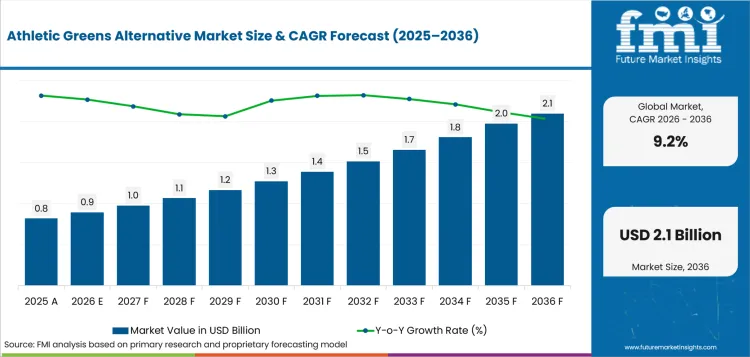
The athletic greens alternative market is estimated to grow from USD 0.82 billion in 2025 to USD 2.17 billion by 2036 at 9.2% CAGR as buyers compare premium daily greens with multivitamins and probiotic blends. Daily greens powder is forecast to represent 62.0% share in 2026 because one-scoop use remains the clearest format for daily routines. Premium subscription is expected to secure 48.0% share in 2026, led by monthly refill behavior and trial kits.
Key Takeaways, Market Size, and Forecast
- 2026 Market Size: USD 0.90 billion
- 2036 Market Size: USD 2.17 billion
- Forecast CAGR: 9.2% from 2026 to 2036
- Leading Product Format: Daily Greens Powder
- Daily Greens Powder Share in 2026: 62.0%
- Leading Price Tier: Premium Subscription
- Premium Subscription Share in 2026: 48.0%
- Fastest-growing Country: Saudi Arabia
- Saudi Arabia CAGR: 10.8% by 2036
Summary of Athletic Greens Alternative Market
- Demand and Growth Drivers
- Buyers are replacing stacks of basic daily supplements with one-scoop greens blends that promise routine simplicity.
- Retailers now ask for stronger safety files after greens powder recalls made contamination risk more visible.
- Premium brands are moving from direct subscriptions into specialty retail so that trial is no longer only online.
- Product and Segment View
- Daily Greens Powder is forecast to account for 62.0% share in 2026, led by familiar mixing and lower shipping weight.
- Foundational Nutrition is projected to hold 42.5% share in 2026 as buyers seek daily nutrient coverage rather than single-benefit claims.
- Premium Subscription is expected to secure 48.0% share in 2026 because refill discipline supports repeat revenue.
- Geography and Competitive Outlook
- Saudi Arabia is expected to advance at 10.8% CAGR by 2036 through premium pharmacy access and imported wellness demand.
- South Korea is projected to rise at 10.2% CAGR by 2036 as health functional food rules support evidence-led positioning.
- AG1 and Huel compete on formula breadth and routine behavior while Bloom Nutrition competes on mass discovery.
- Bactolac and other premium supplement CMOs compete by quality files, powder blending control and packaging support.
- Analyst Opinion
- Nandini Roy Choudhury, Principal Consultant for Food and Beverage at FMI, observes, “I see this category less as a trust race. Buyers are not only asking whether a scoop contains spirulina or probiotics. They are asking who made it, how it was tested and whether the serving fits daily life. AG1 created the premium benchmark, but alternatives are now building their own reasons to be chosen. Some win on price per serving. Others win through retail access or local claim fit. The next ten years should reward brands that make the routine simple and make the quality record easy to verify.”
- Athletic Greens Alternative Market Value Analysis
- Market value is built from finished premium daily greens products sold through subscriptions, specialty retail and online channels.
- Adoption patterns significantly increase lifetime value, as daily usage behavior converts first-time buyers into repeat subscribers, with refill packs reinforcing consistent monthly revenue growth.
- Market expansion is supported by low-barrier entry formats, such as single-serve sticks and starter kits, which improve trial rates and accelerate adoption among new users, especially in emerging markets and younger demographics.
- Growth outlook remains moderately strong, with medium forecast confidence, as increasing consumer awareness and channel expansion signal continued demand growth, despite limited direct revenue disclosure from leading brands.
Quality proof has become the main pressure point for AG1-style alternatives because these products combine botanicals, probiotics, vitamins, minerals and digestive ingredients in one daily serving. FDA stated in February 2024 that dietary supplements are not approved before they enter the market, which shifts trust back to manufacturer controls and retailer screening. The January 2026 Salmonella recall linked to Live it Up Super Greens added urgency because FDA reported 45 illnesses and 12 hospitalizations across the United States. This changed buyer focus from ingredient breadth to supplier traceability, microbial testing, label discipline and recall readiness. Brands with complete supplier files, verified serving claims and finished-product testing are better placed to gain shelf space than brands relying mainly on premium greens positioning.
Why is the Athletic Greens Alternative Market Growing?
- Buyers are using premium greens as a daily shortcut when they want one routine product instead of separate capsules.
- Brands are competing on ingredient breadth and quality proof rather than only on green vegetable content.
- Retailers are screening safety files more closely after greens powder recalls made contamination risk visible.
- Subscription programs are reducing missed refills and giving brands better repeat revenue visibility.
Growth is led by premium daily use rather than occasional detox positioning. The broader green supplement category gives brands a familiar entry point, but AG1-style alternatives must justify higher monthly cost. AG1 Next Gen lists more than 75 ingredients, while Huel Daily Greens presents 91 vitamins, minerals and nutrients. These references show why alternatives need a clear reason to be compared with multivitamins and probiotic capsules.
Regulation also affects how premium greens scale. The dietary supplement category is not approved by the United States Food and Drug Administration before sale. The agency explained this point in February 2024. That means brands carry the burden of ingredient safety and claim discipline before retailers place products beside vitamins or protein powders.
Format strategy is widening as superfood powders move beyond basic tubs. Stick packs help trial because they lower pack size and support travel use. Ready-to-drink greens add convenience, but they raise cold-chain and shelf-stability questions. Powder remains the main revenue base because shipping cost and serving economics are easier to control.
Market Segmentation Analysis
- Daily Greens Powder is projected to secure 62.0% share in 2026, supported by one-scoop use and lower delivery cost.
- Foundational Nutrition is anticipated to hold 42.5% share in 2026 as buyers compare greens with daily multivitamins.
- Multinutrient Greens is forecast to account for 46.0% share in 2026 through formulas combining greens and micronutrients.
- Premium Subscription is expected to represent 48.0% share in 2026 as monthly refill behavior remains central.
- Direct Consumer is projected to hold 44.0% share in 2026 before specialty retail adds wider trial.
- Busy Professionals are expected to account for 36.5% share in 2026 because travel and workday routines support daily use.
The market is segmented around how buyers start a routine and how suppliers keep that routine active. Product format determines shipping economics and daily convenience. Health positioning shapes the promise on the label. Ingredient system decides whether the product competes with vitamins, probiotics or botanical blends. Price tier and sales channel then decide whether trial becomes repeat purchase.
Insights into Athletic Greens Alternative Market by Product Format
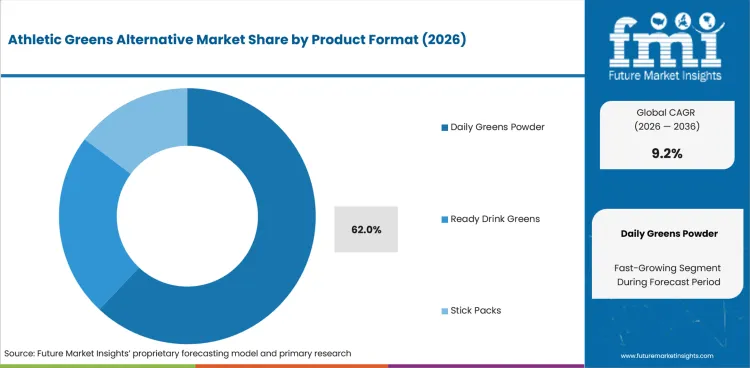
- Daily Greens Powder accounts for 62.0% share in 2026 since a scoop format keeps serving cost clear and shipping simple.
- Ready Drink Greens and stick packs gain trial when buyers want travel use. Dietary supplement packaging choices affect shelf stability and sampling cost.
Insights into Athletic Greens Alternative Market by Health Positioning
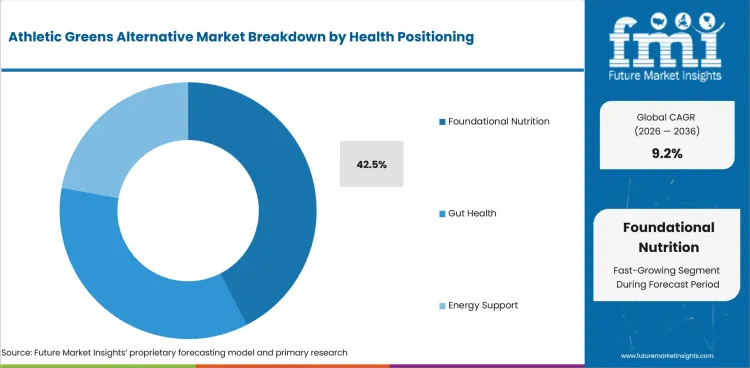
- Foundational Nutrition holds 42.5% share in 2026 as buyers compare products with multivitamins and probiotic capsules.
- Gut Health products gain share when brands document strain choice and avoid broad digestive claims.
Insights into Athletic Greens Alternative Market by Ingredient System
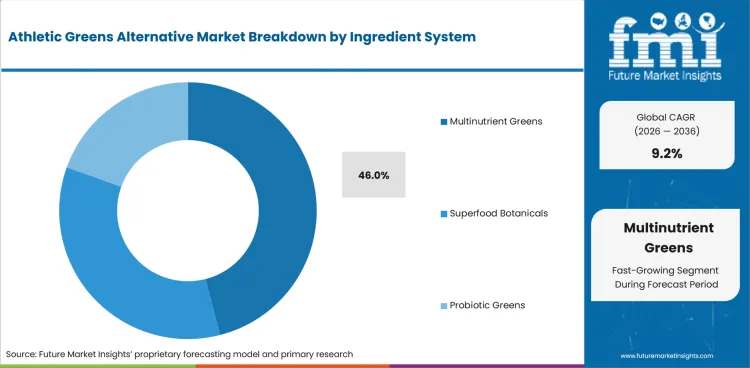
- Multinutrient Greens captures 46.0% share in 2026 because brands combine greens with vitamin and mineral blends.
- Probiotic Greens gain attention as postbiotic supplements raise buyer interest in gut-health formats beyond live strains.
Insights into Athletic Greens Alternative Market by Price Tier
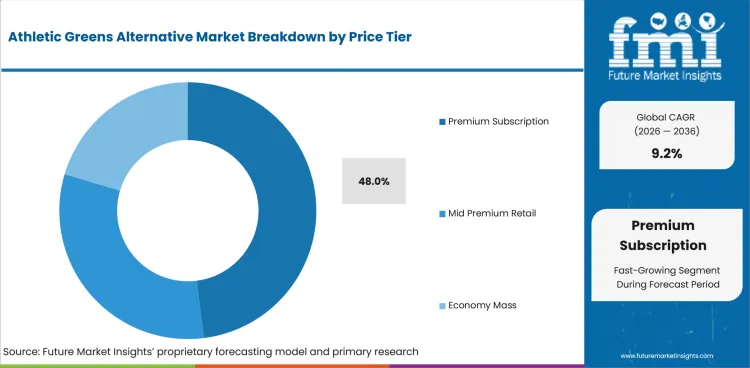
- Premium Subscription represents 48.0% share in 2026 as refill systems hold the monthly habit after first trial.
- Trial Packs support buyer entry when full-size tubs cost more than basic vitamin stacks.
Insights into Athletic Greens Alternative Market by Sales Channel
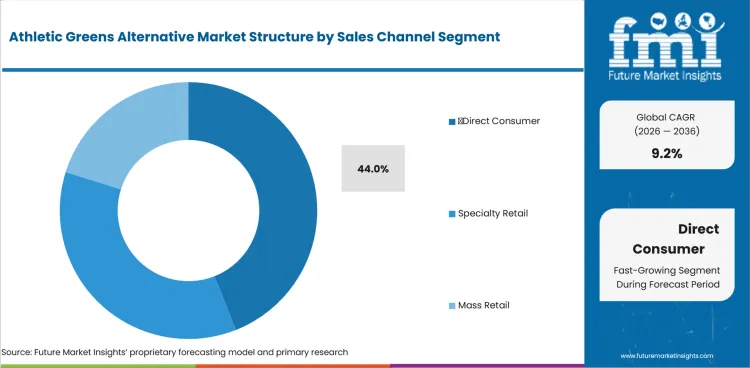
- Direct Consumer accounts for 44.0% share in 2026 because brand education and refill control stay close to the seller.
- Specialty Retail gains share when buyers want staff guidance and visible third-party quality claims.
Insights into Athletic Greens Alternative Market by Buyer Group
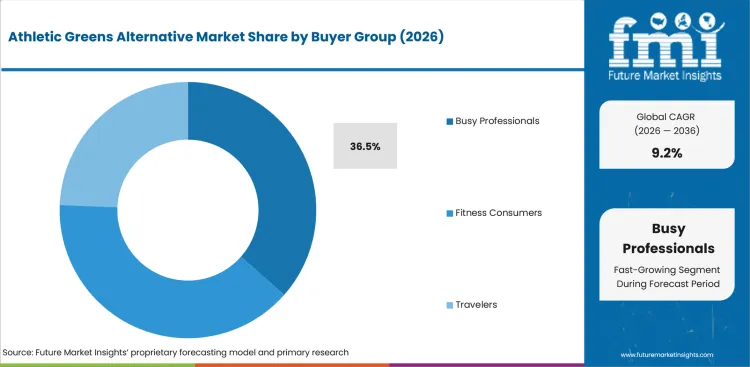
- Busy Professionals account for 36.5% share in 2026 as they value quick routine products for travel and workdays.
- Fitness Consumers remain important when greens are sold beside protein powders and hydration products.
Athletic Greens Alternative Market Drivers, Restraints, and Opportunities
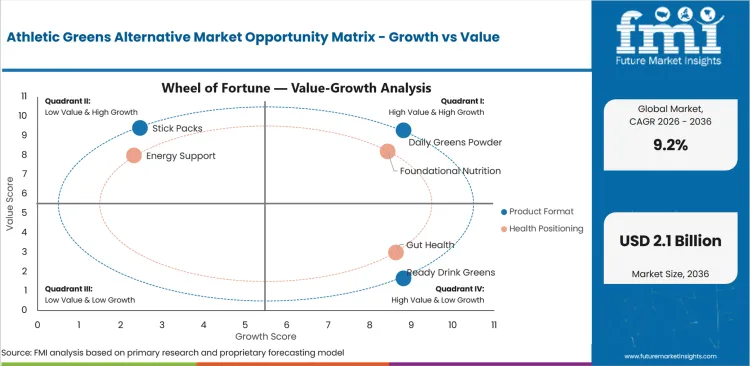
- Driver: Premium buyers want one daily product that combines greens, micronutrients and gut-health support.
- Restraint: Botanical powder blends face contamination and claim-review risk when supplier files are weak.
- Opportunity: Retail-ready starter kits can convert online interest into repeat use through specialty stores.
Consumer Segmentation and Purchase Behavior Analysis
Consumer segmentation centers on supplement users who want a simpler daily routine. CDC NCHS reported in May 2026 that 60.2% of U.S. adults used a dietary supplement in the past 30 days. This gives AG1-style alternatives a large routine-ready audience. Busy professionals use these products as a morning shortcut when they want vitamins, probiotics and greens in one serving. Fitness consumers compare them with protein powders and hydration sticks because taste, mixability and timing affect repeat use. Wellness buyers focus on testing files and ingredient logic because premium pricing needs proof beyond a long label. Subscription shoppers become valuable when the first pouch delivers predictable taste and a clear daily purpose.
Voice of Customer and Decision-driver Analysis
Purchase decisions depend on price per serving and refund flexibility. Council for Responsible Nutrition reported in October 2024 that supplement users had a median monthly spend of USD 50 in 2024. This means premium greens alternatives compete inside a defined wellness budget. Buyers often compare one daily greens serving against the cost of a multivitamin, probiotic and greens powder stack.
Brands are reducing friction when packaging explains serving count, CFU logic and testing in plain language. NIH Office of Dietary Supplements stated in November 2025 that probiotic labels should list genus, species and strain when a product contains probiotics. Retail placement adds trust when shoppers can compare claims before committing to subscription packs. The strongest decision-driver is a product that feels simple, tastes acceptable and proves why it costs more than standard greens powder.
Analysis of Athletic Greens Alternative Market by Key Countries
.webp "Top Country Growth Comparison Athletic Greens Alternative Market Cagr (2026 2036)")
| Country | CAGR |
|---|---|
| United States | 9.6% |
| Canada | 8.6% |
| United Kingdom | 8.8% |
| Saudi Arabia | 10.8% |
| South Korea | 10.2% |
| Japan | 7.9% |
| Australia | 9.0% |
Source: Future Market Insights, 2026.
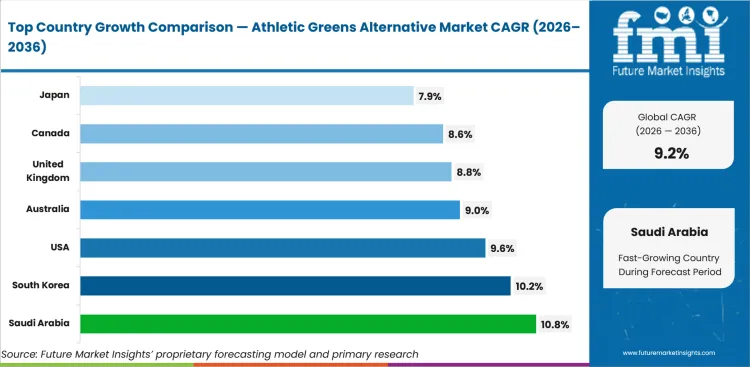
Athletic Greens Alternative Market CAGR Analysis by Country
- United States is projected to record a 9.6% CAGR through 2036, supported by supplement routine depth and national specialty retail scale.
- Canada is expected to expand at 8.6% CAGR through 2036, supported by Natural Product Number screening and health food retail trust.
- United Kingdom is forecast to grow at 8.8% CAGR through 2036, guided by digital nutrition brands and food supplement guidance.
- Saudi Arabia is expected to advance at 10.8% CAGR through 2036, supported by premium pharmacy corridors and clearer product classification.
- South Korea is projected to rise at 10.2% CAGR through 2036, linked to health functional food scale and beauty wellness routines.
- Japan is forecast at 7.9% CAGR through 2036, reflecting evidence-file discipline and slower conversion into imported premium powders.
- Australia is expected to post 9.0% CAGR through 2036, supported by complementary medicine trust and pharmacy-led selection.
Sales Outlook for Athletic Greens Alternative Market in the United States
Retail scale and quality proof center · 2026 to 2036
Country Market Snapshot Table
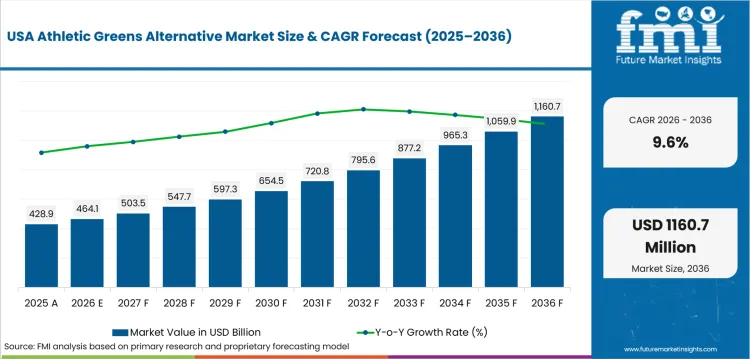
| Parameter | Value |
|---|---|
| Market Size in 2025 (Value) | USD 300 million |
| Market Size in 2026 (Value) | USD 330 million |
| Market Forecast in 2036 (Value) | USD 840 million |
| CAGR (2026 to 2036) | 9.6% |
| Years Considered | 2021 to 2036 |
| Base Year | 2025 |
| Forecast Period | 2026 to 2036 |
| Units Considered | Value (USD million) |
| Leading Sub-Region | California and national specialty retail corridors |
United States Athletic Greens Alternative Market Outlook
United States buyers treat AG1-style greens as a daily routine product rather than an occasional powder. Brand screening begins with ingredient count, third-party testing and subscription price clarity.
Retail expansion adds trial beyond direct subscriptions. The Council for Responsible Nutrition reported 75.0% dietary supplement use among Americans in October 2024. That base supports powder trial at specialty retail and online channels.
Key Growth Drivers
- United States supplement routines support repeat use. The Council for Responsible Nutrition reported 75.0% of Americans used dietary supplements in October 2024.
- Specialty retail access is widening brand discovery. The Vitamin Shoppe launched AG1 across more than 640 stores in January 2026.
- Third-party sport certification helps buyers compare premium greens against protein and pre-workout products already sold in fitness channels.
- Subscription packs give brands a monthly revenue base while trial kits lower the first-purchase barrier.
Key Restraints
- Food safety risk has become more visible. The Centers for Disease Control and Prevention reported 65 Salmonella outbreak cases across 28 states in January 2026.
- Powder manufacturing needs tighter botanical testing as formulas combine greens extracts with probiotics and flavor systems.
- High price per serving limits conversion when buyers compare greens against basic multivitamins.
What makes United States unique
The United States is unique because specialty retail, direct subscriptions and influencer-led discovery all operate at national scale.
Key Companies
- AG1
- Bloom Nutrition
- Amazing Grass
- Live It Up
- Organifi
- Bactolac Pharmaceutical
- Vibrant Health
Sales & Marketing Channels
- Brand subscriptions
- Specialty supplement stores
- Online marketplaces
- Mass retail wellness aisles
- Fitness retailers
- Dietitian-led commerce
Country Segment Breakdown Table
| Segment | Sub-Segments |
|---|---|
| By Product Format | Daily Greens Powder · Ready Drink Greens · Stick Packs · Gummies · Capsules |
| By Health Positioning | Foundational Nutrition · Gut Health · Energy Support · Immune Support · Beauty Wellness · Sports Readiness |
| By Ingredient System | Multinutrient Greens · Superfood Botanicals · Probiotic Greens · Adaptogen Blends · Algae Greens · Mushroom Blends |
| By Price Tier | Premium Subscription · Mid Premium Retail · Economy Mass · Clinical Grade · Trial Packs |
| By Sales Channel | Direct Consumer · Specialty Retail · Mass Retail · Online Marketplace · Pharmacy Channels · Fitness Channels |
| By Buyer Group | Busy Professionals · Fitness Consumers · Travelers · Wellness Buyers · Plant Based Buyers · Family Buyers |
| Key Sub-Regions Covered, Urban Wellness Clusters | California · Texas · Florida · New York · Midwest specialty retail · Pacific Northwest |
Frequently Asked Questions
How fast is United States athletic greens alternative market growing?
United States is expected to grow at 9.6% CAGR from 2026 to 2036, supported by the country conditions discussed above.
Who leads United States athletic greens alternative market?
AG1, Bloom Nutrition, Amazing Grass and Live It Up compete through local channels and premium wellness positioning.
What is driving adoption in United States athletic greens alternative market?
Adoption is driven by daily routine positioning, channel trust and clearer comparison against multivitamin or protein stacks.
Opportunity Analysis for Athletic Greens Alternative Market in Canada
Natural health product licensing center · 2026 to 2036
Country Market Snapshot Table
| Parameter | Value |
|---|---|
| Market Size in 2025 (Value) | USD 60 million |
| Market Size in 2026 (Value) | USD 60 million |
| Market Forecast in 2036 (Value) | USD 140 million |
| CAGR (2026 to 2036) | 8.6% |
| Years Considered | 2021 to 2036 |
| Base Year | 2025 |
| Forecast Period | 2026 to 2036 |
| Units Considered | Value (USD million) |
| Leading Sub-Region | Ontario and British Columbia wellness corridors |
Canada Athletic Greens Alternative Market Outlook
Canadian buyers look for Natural Product Numbers before they compare taste or price. This makes local regulatory clearance a buying signal for premium greens brands.
Health Canada moved natural health product site licensing to its Regulatory Operations and Enforcement Branch on April 1, 2024. That shift makes site discipline more visible for imported greens powders and Canadian-made blends.
Key Growth Drivers
- Regulated natural health product access gives premium greens a formal route. Health Canada’s Natural Health Products Regulations require product licensing before sale.
- Site licensing became more inspection-centered after April 1, 2024. This helps buyers screen manufacturers before adding private label greens.
- Pharmacy and health food stores support routine use by explaining label claims in a controlled retail setting.
- Canadian brands can position powder as daily nutrition rather than weight-loss support when claims stay within approved wording.
Key Restraints
- Natural Product Number review can delay new SKU entry when botanical blends need stronger ingredient files.
- Small brands face working-capital pressure when compliance files and bilingual labels are prepared before broad launch.
- Lower population scale narrows retail velocity compared with the United States.
What makes Canada unique
Canada is unique because regulatory clearance is part of the shelf conversation for natural health products.
Key Companies
- Natural Factors
- CanPrev
- AOR
- Genuine Health
- Prairie Naturals
- New Roots Herbal
- SISU
Sales & Marketing Channels
- Health food stores
- Pharmacy chains
- Brand websites
- Online marketplaces
- Practitioner channels
- Warehouse clubs
Country Segment Breakdown Table
| Segment | Sub-Segments |
|---|---|
| By Product Format | Daily Greens Powder · Ready Drink Greens · Stick Packs · Gummies · Capsules |
| By Health Positioning | Foundational Nutrition · Gut Health · Energy Support · Immune Support · Beauty Wellness · Sports Readiness |
| By Ingredient System | Multinutrient Greens · Superfood Botanicals · Probiotic Greens · Adaptogen Blends · Algae Greens · Mushroom Blends |
| By Price Tier | Premium Subscription · Mid Premium Retail · Economy Mass · Clinical Grade · Trial Packs |
| By Sales Channel | Direct Consumer · Specialty Retail · Mass Retail · Online Marketplace · Pharmacy Channels · Fitness Channels |
| By Buyer Group | Busy Professionals · Fitness Consumers · Travelers · Wellness Buyers · Plant Based Buyers · Family Buyers |
| Key Sub-Regions Covered, Urban Wellness Clusters | Ontario · British Columbia · Quebec · Alberta · Manitoba · Atlantic Canada |
Frequently Asked Questions
How fast is Canada athletic greens alternative market growing?
Canada is expected to grow at 8.6% CAGR from 2026 to 2036, supported by the country conditions discussed above.
Who leads Canada athletic greens alternative market?
Natural Factors, CanPrev, AOR and Genuine Health compete through local channels and premium wellness positioning.
What is driving adoption in Canada athletic greens alternative market?
Adoption is driven by daily routine positioning, channel trust and clearer comparison against multivitamin or protein stacks.
Growth Outlook for Athletic Greens Alternative Market in the United Kingdom
Convenience nutrition and claims control center · 2026 to 2036
Country Market Snapshot Table
| Parameter | Value |
|---|---|
| Market Size in 2026 (Value) | USD 70 million |
| Market Forecast in 2036 (Value) | USD 170 million |
| CAGR (2026 to 2036) | 8.8% |
| Years Considered | 2021 to 2036 |
| Base Year | 2025 |
| Forecast Period | 2026 to 2036 |
| Units Considered | Value (USD million) |
| Leading Sub-Region | London and national online wellness retail |
United Kingdom Athletic Greens Alternative Market Outlook
United Kingdom demand is shaped by digital-first wellness brands and convenience nutrition buyers. Consumers compare greens powders against protein blends and vitamin packs before paying premium prices.
Food supplement rules keep claims under close review. The Department of Health and Social Care updated nutrition legislation guidance in February 2024 for businesses selling or importing supplements.
Key Growth Drivers
- Food supplement guidance gives sellers a clear compliance base. The Department of Health and Social Care updated nutrition legislation guidance in February 2024.
- The Food Standards Agency issued consumer guidance in January 2026 as millions of people across the United Kingdom regularly take supplements.
- Local direct-to-consumer brands have trained buyers to compare per-serving value and subscription flexibility. The UK sports nutrition space also makes powder-led routines familiar to gym and wellness buyers.
- Greens powder trial benefits from protein powder familiarity inside gym and wellness communities.
Key Restraints
- Claims review limits broad wellness wording. The Food Standards Agency tells buyers to check labels and buy from reputable sources.
- Premium greens compete with lower-priced vitamin tablets and protein powders in the same online basket.
- Retailers need short labels and clear allergen statements before adding powder blends to shelves.
What makes United Kingdom unique
The United Kingdom is unique because local nutrition brands already sell powders through subscription and grocery-adjacent channels.
Key Companies
- Huel
- Myprotein
- Bulk
- The Protein Works
- Free Soul
- Rheal Superfoods
- Motion Nutrition
Sales & Marketing Channels
- Brand subscriptions
- Online wellness stores
- Grocery online channels
- Specialty nutrition stores
- Fitness channels
- Marketplace sellers
Country Segment Breakdown Table
| Segment | Sub-Segments |
|---|---|
| By Product Format | Daily Greens Powder · Ready Drink Greens · Stick Packs · Gummies · Capsules |
| By Health Positioning | Foundational Nutrition · Gut Health · Energy Support · Immune Support · Beauty Wellness · Sports Readiness |
| By Ingredient System | Multinutrient Greens · Superfood Botanicals · Probiotic Greens · Adaptogen Blends · Algae Greens · Mushroom Blends |
| By Price Tier | Premium Subscription · Mid Premium Retail · Economy Mass · Clinical Grade · Trial Packs |
| By Sales Channel | Direct Consumer · Specialty Retail · Mass Retail · Online Marketplace · Pharmacy Channels · Fitness Channels |
| By Buyer Group | Busy Professionals · Fitness Consumers · Travelers · Wellness Buyers · Plant Based Buyers · Family Buyers |
| Key Sub-Regions Covered, Urban Wellness Clusters | London · South East England · Manchester · Birmingham · Scotland · Wales |
Frequently Asked Questions
How fast is United Kingdom athletic greens alternative market growing?
United Kingdom is expected to grow at 8.8% CAGR from 2026 to 2036, supported by the country conditions discussed above.
Who leads United Kingdom athletic greens alternative market?
Huel, Myprotein, Bulk and The Protein Works compete through local channels and premium wellness positioning.
What is driving adoption in United Kingdom athletic greens alternative market?
Adoption is driven by daily routine positioning, channel trust and clearer comparison against multivitamin or protein stacks.
Demand Outlook for Athletic Greens Alternative Market in Saudi Arabia
Premium pharmacy and imported wellness center · 2026 to 2036
Country Market Snapshot Table
| Parameter | Value |
|---|---|
| Market Size in 2026 (Value) | USD 40 million |
| Market Forecast in 2036 (Value) | USD 120 million |
| CAGR (2026 to 2036) | 10.8% |
| Years Considered | 2021 to 2036 |
| Base Year | 2025 |
| Forecast Period | 2026 to 2036 |
| Units Considered | Value (USD million) |
| Leading Sub-Region | Riyadh and Jeddah premium pharmacy corridors |
Saudi Arabia Athletic Greens Alternative Market Outlook
Saudi Arabia buyers show interest in imported wellness formats where premium pharmacies and online retail explain product use. Greens powders also benefit from active nutrition spending among younger urban consumers.
Saudi Food and Drug Authority classification guidance in November 2024 clarified how borderline products move between food and drug oversight. That matters for greens brands using herbs, probiotics and treatment-like claims.
Key Growth Drivers
- Regulatory pathways became clearer after the Saudi Food and Drug Authority issued product classification guidance in November 2024.
- The Saudi Food and Drug Authority reported more than 60 new laws, guidelines and requirements across regulated sectors during 2024.
- Premium pharmacy corridors in Riyadh and Jeddah give imported greens brands a visible route to health-focused shoppers.
- Online wellness retail helps subscription brands reach buyers outside central pharmacy networks.
Key Restraints
- Classification risk remains high when formulas use medicinal herbs or treatment-like claims.
- Imported powder brands need Arabic labeling and local registration support before retail listing.
- High serving price limits household repeat purchase when premium products rely on imported supply.
What makes Saudi Arabia unique
Saudi Arabia is unique because premium pharmacy access and product classification decide which imported greens brands scale first.
Key Companies
- Nahdi Medical Company
- Al-Dawaa Medical Services
- Whites Pharmacy
- Tamer Group
- Jamjoom Pharma
- Avalon Pharma
- Saudi Health House
Sales & Marketing Channels
- Premium pharmacies
- Online wellness stores
- Hospital-adjacent retail
- Mall pharmacies
- Importer distributors
- Fitness retail
Country Segment Breakdown Table
| Segment | Sub-Segments |
|---|---|
| By Product Format | Daily Greens Powder · Ready Drink Greens · Stick Packs · Gummies · Capsules |
| By Health Positioning | Foundational Nutrition · Gut Health · Energy Support · Immune Support · Beauty Wellness · Sports Readiness |
| By Ingredient System | Multinutrient Greens · Superfood Botanicals · Probiotic Greens · Adaptogen Blends · Algae Greens · Mushroom Blends |
| By Price Tier | Premium Subscription · Mid Premium Retail · Economy Mass · Clinical Grade · Trial Packs |
| By Sales Channel | Direct Consumer · Specialty Retail · Mass Retail · Online Marketplace · Pharmacy Channels · Fitness Channels |
| By Buyer Group | Busy Professionals · Fitness Consumers · Travelers · Wellness Buyers · Plant Based Buyers · Family Buyers |
| Key Sub-Regions Covered, Urban Wellness Clusters | Riyadh · Jeddah · Dammam · Makkah · Madinah · Khobar |
Frequently Asked Questions
How fast is Saudi Arabia athletic greens alternative market growing?
Saudi Arabia is expected to grow at 10.8% CAGR from 2026 to 2036, supported by the country conditions discussed above.
Who leads Saudi Arabia athletic greens alternative market?
Nahdi Medical Company, Al-Dawaa Medical Services, Whites Pharmacy and Tamer Group compete through local channels and premium wellness positioning.
What is driving adoption in Saudi Arabia athletic greens alternative market?
Adoption is driven by daily routine positioning, channel trust and clearer comparison against multivitamin or protein stacks.
Commercial Outlook for Athletic Greens Alternative Market in South Korea
Health functional food and beauty wellness center · 2026 to 2036
Country Market Snapshot Table
| Parameter | Value |
|---|---|
| Market Size in 2026 (Value) | USD 50 million |
| Market Forecast in 2036 (Value) | USD 140 million |
| CAGR (2026 to 2036) | 10.2% |
| Years Considered | 2021 to 2036 |
| Base Year | 2025 |
| Forecast Period | 2026 to 2036 |
| Units Considered | Value (USD million) |
| Leading Sub-Region | Seoul metropolitan wellness commerce cluster |
South Korea Athletic Greens Alternative Market Outlook
South Korea has a large health functional food base and fast product turnover. Buyers compare greens blends against red ginseng, probiotics and beauty nutrition products.
The United States Department of Agriculture Foreign Agricultural Service reported that South Korea’s health functional food sector reached 5.07 trillion Korean won in 2024. Imported products accounted for 28.4% of the category.
Key Growth Drivers
- Health functional food scale supports premium greens entry. The United States Department of Agriculture Foreign Agricultural Service placed the 2024 category at 5.07 trillion Korean won.
- Imported products already account for 28.4% of South Korea health functional food value according to the same April 2026 brief.
- Beauty wellness and gut-health claims fit local buyer routines when evidence files are prepared before launch.
- Domestic contract manufacturers can reformulate greens around approved functional ingredients for local channels.
Key Restraints
- Functional claims need review before label use. The Ministry of Food and Drug Safety keeps health functional food advertising under formal screening.
- Fast product cycles raise inventory risk for imported powders that lack local flavor adaptation.
- Premium pricing must compete with red ginseng and probiotic brands already trusted by consumers.
What makes South Korea unique
South Korea is unique because health functional food rules and beauty wellness routines create a separate playbook for greens blends.
Key Companies
- Korea Ginseng Corporation
- Daesang Wellife
- Kolmar BNH
- Cosmax NBT
- Novarex
- Chong Kun Dang Healthcare
- hy
Sales & Marketing Channels
- Home shopping
- Online marketplaces
- Pharmacy retail
- Beauty wellness stores
- Brand malls
- Convenience commerce
Country Segment Breakdown Table
| Segment | Sub-Segments |
|---|---|
| By Product Format | Daily Greens Powder · Ready Drink Greens · Stick Packs · Gummies · Capsules |
| By Health Positioning | Foundational Nutrition · Gut Health · Energy Support · Immune Support · Beauty Wellness · Sports Readiness |
| By Ingredient System | Multinutrient Greens · Superfood Botanicals · Probiotic Greens · Adaptogen Blends · Algae Greens · Mushroom Blends |
| By Price Tier | Premium Subscription · Mid Premium Retail · Economy Mass · Clinical Grade · Trial Packs |
| By Sales Channel | Direct Consumer · Specialty Retail · Mass Retail · Online Marketplace · Pharmacy Channels · Fitness Channels |
| By Buyer Group | Busy Professionals · Fitness Consumers · Travelers · Wellness Buyers · Plant Based Buyers · Family Buyers |
| Key Sub-Regions Covered, Urban Wellness Clusters | Seoul · Gyeonggi · Busan · Incheon · Daegu · Daejeon |
Frequently Asked Questions
How fast is South Korea athletic greens alternative market growing?
South Korea is expected to grow at 10.2% CAGR from 2026 to 2036, supported by the country conditions discussed above.
Who leads South Korea athletic greens alternative market?
Korea Ginseng Corporation, Daesang Wellife, Kolmar BNH and Cosmax NBT compete through local channels and premium wellness positioning.
What is driving adoption in South Korea athletic greens alternative market?
Adoption is driven by daily routine positioning, channel trust and clearer comparison against multivitamin or protein stacks.
Forecast Outlook for Athletic Greens Alternative Market in Japan
Functional claim discipline and convenience center · 2026 to 2036
Country Market Snapshot Table
| Parameter | Value |
|---|---|
| Market Size in 2026 (Value) | USD 70 million |
| Market Forecast in 2036 (Value) | USD 140 million |
| CAGR (2026 to 2036) | 7.9% |
| Years Considered | 2021 to 2036 |
| Base Year | 2025 |
| Forecast Period | 2026 to 2036 |
| Units Considered | Value (USD million) |
| Leading Sub-Region | Tokyo and Kansai functional food channels |
Japan Athletic Greens Alternative Market Outlook
Japanese buyers value routine formats but expect clear evidence behind function claims. Premium greens therefore compete on trust as much as taste. The Japan green supplement category shows how local greens positioning connects with evidence-led wellness routines.
The Consumer Affairs Agency explained in April 2026 that Foods with Function Claims are submitted by businesses under their own responsibility. Unlike government-approved foods, these products rely on submitted evidence before sale.
Key Growth Drivers
- Foods with Function Claims support evidence-based positioning. The Consumer Affairs Agency updated its explanatory material in April 2026.
- Convenience retail gives powders and sticks a familiar route when packs communicate daily use and claim scope.
- Older consumer routines support daily nutrition products when labels avoid broad disease wording.
- Local companies can adapt flavor and serving size to green tea, vegetable juice and probiotic habits.
Key Restraints
- Food safety scrutiny increased after regulatory revisions tied to functional foods and adverse event reporting.
- Premium imported powders can lose repeat use when serving size and flavor do not match Japanese routines.
- Claims must be handled carefully as the Consumer Affairs Agency does not pre-approve Foods with Function Claims.
What makes Japan unique
Japan is unique because evidence files and understated claims influence buyer trust before brand storytelling begins.
Key Companies
- Suntory Wellness
- Fancl
- Asahi Group Foods
- Yakult Honsha
- Otsuka Pharmaceutical
- DHC Corporation
- Orihiro
Sales & Marketing Channels
- Drugstores
- Convenience retail
- Brand subscriptions
- Television commerce
- Online marketplaces
- Wellness catalogues
Country Segment Breakdown Table
| Segment | Sub-Segments |
|---|---|
| By Product Format | Daily Greens Powder · Ready Drink Greens · Stick Packs · Gummies · Capsules |
| By Health Positioning | Foundational Nutrition · Gut Health · Energy Support · Immune Support · Beauty Wellness · Sports Readiness |
| By Ingredient System | Multinutrient Greens · Superfood Botanicals · Probiotic Greens · Adaptogen Blends · Algae Greens · Mushroom Blends |
| By Price Tier | Premium Subscription · Mid Premium Retail · Economy Mass · Clinical Grade · Trial Packs |
| By Sales Channel | Direct Consumer · Specialty Retail · Mass Retail · Online Marketplace · Pharmacy Channels · Fitness Channels |
| By Buyer Group | Busy Professionals · Fitness Consumers · Travelers · Wellness Buyers · Plant Based Buyers · Family Buyers |
| Key Sub-Regions Covered, Urban Wellness Clusters | Tokyo · Kansai · Chubu · Kyushu · Hokkaido · Hiroshima |
Frequently Asked Questions
How fast is Japan athletic greens alternative market growing?
Japan is expected to grow at 7.9% CAGR from 2026 to 2036, supported by the country conditions discussed above.
Who leads Japan athletic greens alternative market?
Suntory Wellness, Fancl, Asahi Group Foods and Yakult Honsha compete through local channels and premium wellness positioning.
What is driving adoption in Japan athletic greens alternative market?
Adoption is driven by daily routine positioning, channel trust and clearer comparison against multivitamin or protein stacks.
Sales Outlook for Athletic Greens Alternative Market in Australia
Complementary medicine trust and pharmacy center · 2026 to 2036
Country Market Snapshot Table
| Parameter | Value |
|---|---|
| Market Size in 2026 (Value) | USD 60 million |
| Market Forecast in 2036 (Value) | USD 130 million |
| CAGR (2026 to 2036) | 9.0% |
| Years Considered | 2021 to 2036 |
| Base Year | 2025 |
| Forecast Period | 2026 to 2036 |
| Units Considered | Value (USD million) |
| Leading Sub-Region | Sydney and Melbourne complementary medicine retail |
Australia Athletic Greens Alternative Market Outlook
Australian buyers often judge greens powders through the complementary medicine lens. Store trust and AUST listing cues shape which brands receive trial.
The Therapeutic Goods Administration stated in May 2025 that medicines sold in Australia must be included in the Australian Register of Therapeutic Goods. Listed medicines carry an AUST L number on the label.
Key Growth Drivers
- Complementary medicine use gives greens powders a clear buyer base. Complementary Medicines Australia placed industry revenue at USD 6.2 billion equivalent in its October 2024 snapshot.
- Retail trust is supported by the Australian Register of Therapeutic Goods pathway for listed medicines.
- Pharmacy chains can explain product quality and ingredient cautions better than open online listings.
- Australian brands use practitioner and health food channels to support repeat use in higher-income cities.
Key Restraints
- Therapeutic Goods Administration rules constrain disease-like claims and require compliant label signals.
- Imported products face scrutiny when online sellers do not match local register or label requirements.
- Small premium brands compete with established Australian vitamin brands that already hold pharmacy space.
What makes Australia unique
Australia is unique because complementary medicine regulation and pharmacy trust shape premium greens conversion.
Key Companies
- Blackmores
- Swisse Wellness
- BioCeuticals
- Naturopathica
- Nutra-Life
- Nutrition Care
- Healthylife
Sales & Marketing Channels
- Pharmacy chains
- Health food stores
- Practitioner clinics
- Brand websites
- Online marketplaces
- Grocery wellness aisles
Country Segment Breakdown Table
| Segment | Sub-Segments |
|---|---|
| By Product Format | Daily Greens Powder · Ready Drink Greens · Stick Packs · Gummies · Capsules |
| By Health Positioning | Foundational Nutrition · Gut Health · Energy Support · Immune Support · Beauty Wellness · Sports Readiness |
| By Ingredient System | Multinutrient Greens · Superfood Botanicals · Probiotic Greens · Adaptogen Blends · Algae Greens · Mushroom Blends |
| By Price Tier | Premium Subscription · Mid Premium Retail · Economy Mass · Clinical Grade · Trial Packs |
| By Sales Channel | Direct Consumer · Specialty Retail · Mass Retail · Online Marketplace · Pharmacy Channels · Fitness Channels |
| By Buyer Group | Busy Professionals · Fitness Consumers · Travelers · Wellness Buyers · Plant Based Buyers · Family Buyers |
| Key Sub-Regions Covered, Urban Wellness Clusters | Sydney · Melbourne · Brisbane · Perth · Adelaide · Canberra |
Frequently Asked Questions
How fast is Australia athletic greens alternative market growing?
Australia is expected to grow at 9.0% CAGR from 2026 to 2036, supported by the country conditions discussed above.
Who leads Australia athletic greens alternative market?
Blackmores, Swisse Wellness, BioCeuticals and Naturopathica compete through local channels and premium wellness positioning.
What is driving adoption in Australia athletic greens alternative market?
Adoption is driven by daily routine positioning, channel trust and clearer comparison against multivitamin or protein stacks.
Competitive Landscape and Strategic Positioning
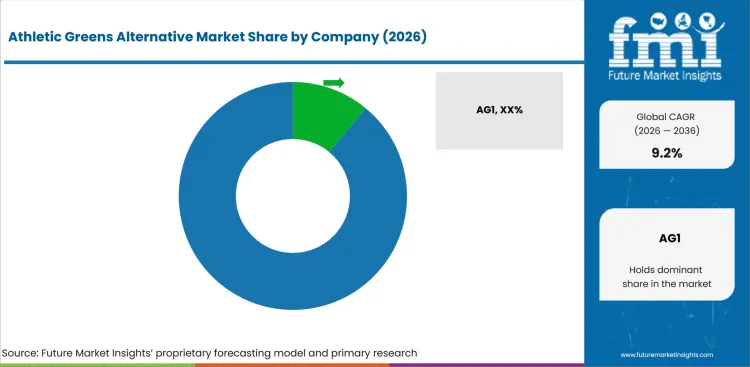
- AG1 defines the premium reference point through formula breadth, quality claims and specialty retail access.
- Bloom Nutrition competes through mass discovery and social commerce, supported by Nutrabolt investment.
- Huel competes through daily nutrition credibility and a ready-to-drink extension of its greens offer.
- Contract manufacturers compete on blend control, probiotic stability and pack readiness for private label brands.
Company positions differ by the role each brand plays in the buyer decision. AG1 sets the benchmark for premium daily use. Bloom Nutrition widens awareness through mainstream wellness shoppers. Huel brings meal-nutrition credibility into greens. Amazing Grass keeps plant-based familiarity visible through legacy retail placement.
Capability is now an important factor driving the adoption. Brands need sourcing files and sensory control before they can scale a powder. Bactolac positions itself as a turnkey supplement manufacturer with current good manufacturing practice-aligned systems. This helps smaller brands convert concepts into repeatable production. Barriers are higher for brands that depend only on online attention. Premium greens must keep taste acceptable, price clear and safety files ready. Suppliers that support trial packs and country-specific labels should gain better retail access. This favors brand owners with operational discipline and CMOs with tested powder systems.
Key Companies in the Athletic Greens Alternative Market
Competition includes benchmark daily greens brands, social commerce greens brands and contract manufacturers serving private label buyers. These companies compete on routine fit, safety proof and channel access.
- Benchmark Daily Greens Brands: AG1, Huel and Amazing Grass.
- Specialist Greens Brands: Bloom Nutrition, Live It Up and Organifi.
- Manufacturing and Formulation Partners: Bactolac Pharmaceutical and other premium supplement CMOs.
Competitive Benchmarking: Athletic Greens Alternative Market
| Company | Relevance to Market Title | Formula Signal | Quality Signal | Channel Signal | Channel Reach | Geographic Footprint |
|---|---|---|---|---|---|---|
| AG1 | Very High | Ingredient breadth | Third-party sport certification | Specialty retail access | Very Strong | Global |
| Huel | High | Daily nutrition credibility | Ready-to-drink extension | Direct consumer strength | Strong | United Kingdom and United States |
| Bloom Nutrition | High | Mass wellness appeal | Nutrabolt backing | Social commerce reach | Strong | United States |
| Amazing Grass | Medium | Legacy plant-based positioning | Retail shelf familiarity | Natural channel access | Medium | North America |
| Live It Up | Medium | Greens and superfoods focus | Recall recovery pressure | Direct consumer sales | Medium | United States |
| Bactolac Pharmaceutical | High | CMO formulation support | cGMP-aligned systems | Private label supply | Medium | United States |
Key Developments in Athletic Greens Alternative Market
- In June 2026, Unilever completed its acquisition of Grüns and added the greens supplement brand to its Wellbeing business. The deal strengthened Unilever’s position in AG1-style daily nutrition alternatives through a gummy-based greens format.
- In January 2026, Quince’s Daily Superfood Greens gained visibility as a lower-price AG1-style alternative. The product positioned 30 servings at USD 40.00 with a listed price of USD 1.34 per serving and 78 vitamins, minerals, probiotics and superfoods.
Key Players in the Athletic Greens Alternative Market
- AG1
- Huel
- Amazing Grass
- Bloom Nutrition
- Live It Up
- Organifi
- Vibrant Health
- Bactolac Pharmaceutical
- Cosmax NBT
- Kolmar BNH
- Novarex
Athletic Greens Alternative Market - Report Scope
| Item | Value |
|---|---|
| Market size by 2036 | USD 2.17 billion |
| Growth rate | 9.2% CAGR from 2026 to 2036 |
| Forecast period | 2026 to 2036 |
| Base year value (2025) | USD 0.82 billion |
| 2026 value | USD 0.90 billion |
| By product format | Daily greens powder, ready drink greens, stick packs, gummies, capsules |
| By health positioning | Foundational nutrition, gut health, energy support, immune support, beauty wellness, sports readiness |
| By ingredient system | Multinutrient greens, superfood botanicals, probiotic greens, adaptogen blends, algae greens, mushroom blends |
| By price tier | Premium subscription, mid premium retail, economy mass, clinical grade, trial packs |
| By sales channel | Direct consumer, specialty retail, mass retail, online marketplace, pharmacy channels, fitness channels |
| By buyer group | Busy professionals, fitness consumers, travelers, wellness buyers, plant based buyers, family buyers |
| Regions covered | North America, Latin America, Europe, East Asia, South Asia and Pacific, Middle East and Africa |
| Countries covered | United States, Canada, United Kingdom, Saudi Arabia, South Korea, Japan, Australia |
| Key companies profiled | AG1, Huel, Bloom Nutrition, Amazing Grass, Live It Up, Organifi, Vibrant Health, Bactolac Pharmaceutical, Cosmax NBT, Kolmar BNH, Novarex |
| Approach | Bottom-up product-boundary approach using eligible SKU revenue, retail pricing, subscription behavior, product format depth, health positioning, ingredient system, price tier, channel reach, and country-level adoption |
Source: Future Market Insights, 2026.
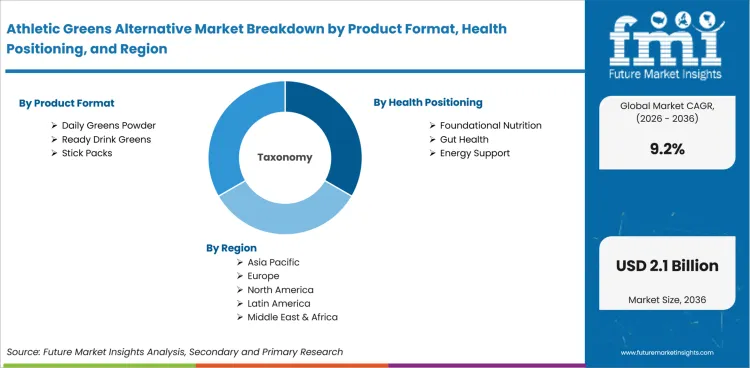
Athletic Greens Alternative Market Breakdown by Product Format, Health Positioning, Ingredient System, Price Tier, Sales Channel, Buyer Group, and Region
Athletic Greens Alternative Market Segmented by Product Format:
- Daily Greens Powder
- Ready Drink Greens
- Stick Packs
- Gummies
- Capsules
Athletic Greens Alternative Market Segmented by Health Positioning:
- Foundational Nutrition
- Gut Health
- Energy Support
- Immune Support
- Beauty Wellness
- Sports Readiness
Athletic Greens Alternative Market Segmented by Ingredient System:
- Multinutrient Greens
- Superfood Botanicals
- Probiotic Greens
- Adaptogen Blends
- Algae Greens
- Mushroom Blends
Athletic Greens Alternative Market Segmented by Price Tier:
- Premium Subscription
- Mid Premium Retail
- Economy Mass
- Clinical Grade
- Trial Packs
Athletic Greens Alternative Market Segmented by Sales Channel:
- Direct Consumer
- Specialty Retail
- Mass Retail
- Online Marketplace
- Pharmacy Channels
- Fitness Channels
Athletic Greens Alternative Market Segmented by Buyer Group:
- Busy Professionals
- Fitness Consumers
- Travelers
- Wellness Buyers
- Plant Based Buyers
- Family Buyers
Athletic Greens Alternative Market by Region:
- North America
- Latin America
- Europe
- East Asia
- South Asia and Pacific
- Middle East and Africa
This Report Answers
- What is the value of the athletic greens alternative market in 2026 and 2036?
- Which product format holds the largest share in premium daily greens alternatives?
- Why are premium subscriptions important for AG1-style greens products?
- How do safety events affect retailer screening for greens powder brands?
- Which countries offer the fastest forecast rates for athletic greens alternatives?
- How does South Korea’s health functional food system shape premium greens positioning?
- Which companies compete in benchmark daily greens and specialist greens products?
- What role do contract manufacturers play in private label greens powder supply?
- How should suppliers build market entry around testing, flavor and starter packs?
Research Sources and Bibliography
- AG1. (2025, May 4). Meet AG1 Next Gen.
- AG1. (2026). AG1 Next Generation.
- Bactolac Pharmaceutical. (2026). Certified supplement manufacturer.
- Centers for Disease Control and Prevention. (2026, January 29). Investigation update: Salmonella outbreak.
- Complementary Medicines Australia. (2024, October 10). CMA industry snapshot 2024.
- Council for Responsible Nutrition. (2024, October 29). CRN survey shows consistent supplement usage.
- Department of Health and Social Care. (2024, February 20). Nutrition legislation information sheet.
- European Food Safety Authority. (2026, January 6). Food supplements.
- Food Standards Agency. (2026, January 20). New year, new guidance: FSA helps consumers navigate food supplements safely.
- Health Canada. (2024, September 11). Transition of natural health product site licensing activities.
- Health Canada. (2026, March 30). Regulating natural and non-prescription health products.
- Huel. (2026). Daily Greens ready-to-drink
- Nutrabolt. (2024, January 17). Nutrabolt leads equity investment in Bloom Nutrition.
- Nutrabolt. (2025, September 9). Nutrabolt expands strategic partnership with Bloom Nutrition.
- Saudi Food and Drug Authority. (2024, November 20). Products classification guidance.
- Saudi Food and Drug Authority. (2026, April). The SFDA annual report.
- The Vitamin Shoppe. (2026, January 12). The Vitamin Shoppe launches AG1 nationwide.
- Therapeutic Goods Administration. (2025, May 16). Understanding complementary medicines.
- Therapeutic Goods Administration. (2026). Listed medicines.
- United States Department of Agriculture Foreign Agricultural Service. (2026, April 6). South Korea: Health functional food and supplements market brief.
- United States Food and Drug Administration. (2024, February 21). Questions and answers on dietary supplements.
- United States Food and Drug Administration. (2024, April 24). Current good manufacturing practices for food and dietary supplements.
- United States Food and Drug Administration. (2026, June 3). Outbreak investigation of Salmonella: Moringa leaf powder.
- Unilever. April 9, 2026. Unilever to acquire U.S. Greens Supplement company Grüns. Unilever. The source also confirms the June 1 2026 completion update.
- Quince. 2026. Daily Superfood Greens. Quince. Mindbodygreen’s January 2026 review supports the timing of wider market visibility.
This bibliography is provided for reader reference and is not exhaustive. The full report contains the complete reference list and detailed citations.
Athletic Greens Alternative Market - Research Methodology
| Method | Description |
|---|---|
| Primary Research | FMI analyst interviews with supplement formulators, premium supplement CMOs, direct-to-consumer greens brands, distributors, specialty retail buyers, pharmacy buyers, and private label developers across key markets |
| Desk Research | Review of regulator pages, trade association releases, official company product pages, company newsrooms, product launches, and supplement safety references. |
| Market Sizing & Forecasting | Bottom-up product-boundary approach using eligible SKU revenue, retail pricing, subscription presence, product format segmentation, health positioning, ingredient system, price tier, sales channel mix, and country-level adoption |
| Data Validation | Cross-verification using supplement use evidence, safety events, regulatory conditions, premium supplement pricing, refill behavior, store count signals, active supplier portfolios, and finished greens product availability across leading countries |
Athletic Greens Alternative Market - Scope & Definition
| Attribute | Detail |
|---|---|
| Market Definition | Premium daily greens blends positioned against AG1-style products, including powders, ready drink greens, stick packs, gummies, and capsules marketed for daily foundational nutrition |
| Functions Covered | Daily greens supplementation, multinutrient support, gut-health positioning, energy support, immune support, travel-friendly use, and subscription-led routine support |
| Applications Covered | Daily greens powder, ready drink greens, stick packs, gummies, capsules, starter kits, refill packs, and premium daily nutrition blends |
| End-Use Industries | Dietary supplements, functional nutrition, wellness retail, sports nutrition, pharmacy wellness, direct-to-consumer nutrition, and supplement contract manufacturing |
| Product Formats Covered | Daily greens powder, ready drink greens, stick packs, gummies, and capsules |
| Inclusions | Finished consumer brands, private label premium greens, AG1-style alternatives, subscription-based greens blends, supplement CMO programs, specialty retail starter packs, and products positioned around foundational nutrition |
| Exclusions | Ordinary vegetable powders, single-ingredient superfood powders, basic multivitamins without greens-based drink positioning, standard protein powders, meal replacements, and finished products without premium daily greens positioning |
Frequently Asked Questions
How big is the athletic greens alternative market in 2026?
The market is estimated at USD 0.90 billion in 2026 based on premium daily greens product revenue.
What is the athletic greens alternative market forecast for 2036?
The market is projected to reach USD 2.17 billion by 2036 at 9.2% CAGR from 2026.
Which product format leads the market?
Daily Greens Powder leads with 62.0% share in 2026 because one-scoop routines are easy to explain.
Which price tier leads the market?
Premium Subscription leads with 48.0% share in 2026 as monthly refill programs support repeat purchase.
Which country grows fastest through 2036?
Saudi Arabia grows fastest at 10.8% CAGR through 2036 because premium pharmacy corridors support imported wellness formats.
Why are quality controls important in this category?
Quality controls matter because greens blends combine botanicals and probiotics that need testing before broad retail placement.
Who are the key companies in the market?
AG1, Huel, Bloom Nutrition, Amazing Grass and Bactolac Pharmaceutical are key companies in this market.
What is an athletic greens alternative?
An athletic greens alternative is a premium daily greens product positioned against AG1-style foundational nutrition drinks.
Is this market the same as ordinary greens powder?
No. Ordinary greens powders are excluded unless they match premium daily drink positioning and multi-ingredient supplement scope.
How should suppliers enter this market?
Suppliers should start with verified raw materials, clear serving value and format choices suited to subscription or starter kits.
Preview the report firsthand - request a free sample
Get SampleGet the brochure for pricing and purchase details.
Get PDFTable of Content
- Executive Summary
- Global Market Outlook
- Demand to side Trends
- Supply to side Trends
- Technology Roadmap Analysis
- Analysis and Recommendations
- Market Overview
- Market Coverage / Taxonomy
- Market Definition / Scope / Limitations
- Research Methodology
- Chapter Orientation
- Analytical Lens and Working Hypotheses
- Market Structure, Signals, and Trend Drivers
- Benchmarking and Cross-market Comparability
- Market Sizing, Forecasting, and Opportunity Mapping
- Research Design and Evidence Framework
- Desk Research Programme (Secondary Evidence)
- Company Annual and Sustainability Reports
- Peer-reviewed Journals and Academic Literature
- Corporate Websites, Product Literature, and Technical Notes
- Earnings Decks and Investor Briefings
- Statutory Filings and Regulatory Disclosures
- Technical White Papers and Standards Notes
- Trade Journals, Industry Magazines, and Analyst Briefs
- Conference Proceedings, Webinars, and Seminar Materials
- Government Statistics Portals and Public Data Releases
- Press Releases and Reputable Media Coverage
- Specialist Newsletters and Curated Briefings
- Sector Databases and Reference Repositories
- FMI Internal Proprietary Databases and Historical Market Datasets
- Subscription Datasets and Paid Sources
- Social Channels, Communities, and Digital Listening Inputs
- Additional Desk Sources
- Expert Input and Fieldwork (Primary Evidence)
- Primary Modes
- Qualitative Interviews and Expert Elicitation
- Quantitative Surveys and Structured Data Capture
- Blended Approach
- Why Primary Evidence is Used
- Field Techniques
- Interviews
- Surveys
- Focus Groups
- Observational and In-context Research
- Social and Community Interactions
- Stakeholder Universe Engaged
- C-suite Leaders
- Board Members
- Presidents and Vice Presidents
- R&D and Innovation Heads
- Technical Specialists
- Domain Subject-matter Experts
- Scientists
- Physicians and Other Healthcare Professionals
- Governance, Ethics, and Data Stewardship
- Research Ethics
- Data Integrity and Handling
- Primary Modes
- Tooling, Models, and Reference Databases
- Desk Research Programme (Secondary Evidence)
- Data Engineering and Model Build
- Data Acquisition and Ingestion
- Cleaning, Normalisation, and Verification
- Synthesis, Triangulation, and Analysis
- Quality Assurance and Audit Trail
- Market Background
- Market Dynamics
- Drivers
- Restraints
- Opportunity
- Trends
- Scenario Forecast
- Demand in Optimistic Scenario
- Demand in Likely Scenario
- Demand in Conservative Scenario
- Opportunity Map Analysis
- Product Life Cycle Analysis
- Supply Chain Analysis
- Investment Feasibility Matrix
- Value Chain Analysis
- PESTLE and Porter’s Analysis
- Regulatory Landscape
- Regional Parent Market Outlook
- Production and Consumption Statistics
- Import and Export Statistics
- Market Dynamics
- Global Market Analysis 2021 to 2025 and Forecast, 2026 to 2036
- Historical Market Size Value (USD Million) Analysis, 2021 to 2025
- Current and Future Market Size Value (USD Million) Projections, 2026 to 2036
- Y to o to Y Growth Trend Analysis
- Absolute $ Opportunity Analysis
- Global Market Pricing Analysis 2021 to 2025 and Forecast 2026 to 2036
- Global Market Analysis 2021 to 2025 and Forecast 2026 to 2036, By Product Format
- Introduction / Key Findings
- Historical Market Size Value (USD Million) Analysis By Product Format , 2021 to 2025
- Current and Future Market Size Value (USD Million) Analysis and Forecast By Product Format , 2026 to 2036
- Daily Greens Powder
- Ready Drink Greens
- Stick Packs
- Daily Greens Powder
- Y to o to Y Growth Trend Analysis By Product Format , 2021 to 2025
- Absolute $ Opportunity Analysis By Product Format , 2026 to 2036
- Global Market Analysis 2021 to 2025 and Forecast 2026 to 2036, By Health Positioning
- Introduction / Key Findings
- Historical Market Size Value (USD Million) Analysis By Health Positioning, 2021 to 2025
- Current and Future Market Size Value (USD Million) Analysis and Forecast By Health Positioning, 2026 to 2036
- Foundational Nutrition
- Gut Health
- Energy Support
- Foundational Nutrition
- Y to o to Y Growth Trend Analysis By Health Positioning, 2021 to 2025
- Absolute $ Opportunity Analysis By Health Positioning, 2026 to 2036
- Global Market Analysis 2021 to 2025 and Forecast 2026 to 2036, By Ingredient System
- Introduction / Key Findings
- Historical Market Size Value (USD Million) Analysis By Ingredient System, 2021 to 2025
- Current and Future Market Size Value (USD Million) Analysis and Forecast By Ingredient System, 2026 to 2036
- Multinutrient Greens
- Superfood Botanicals
- Probiotic Greens
- Multinutrient Greens
- Y to o to Y Growth Trend Analysis By Ingredient System, 2021 to 2025
- Absolute $ Opportunity Analysis By Ingredient System, 2026 to 2036
- Global Market Analysis 2021 to 2025 and Forecast 2026 to 2036, By Price Tier
- Introduction / Key Findings
- Historical Market Size Value (USD Million) Analysis By Price Tier, 2021 to 2025
- Current and Future Market Size Value (USD Million) Analysis and Forecast By Price Tier, 2026 to 2036
- Premium Subscription
- Mid Premium Retail
- Economy Mass
- Premium Subscription
- Y to o to Y Growth Trend Analysis By Price Tier, 2021 to 2025
- Absolute $ Opportunity Analysis By Price Tier, 2026 to 2036
- Global Market Analysis 2021 to 2025 and Forecast 2026 to 2036, By Sales Channel
- Introduction / Key Findings
- Historical Market Size Value (USD Million) Analysis By Sales Channel, 2021 to 2025
- Current and Future Market Size Value (USD Million) Analysis and Forecast By Sales Channel, 2026 to 2036
- Direct Consumer
- Specialty Retail
- Mass Retail
- Direct Consumer
- Y to o to Y Growth Trend Analysis By Sales Channel, 2021 to 2025
- Absolute $ Opportunity Analysis By Sales Channel, 2026 to 2036
- Global Market Analysis 2021 to 2025 and Forecast 2026 to 2036, By Buyer Group
- Introduction / Key Findings
- Historical Market Size Value (USD Million) Analysis By Buyer Group, 2021 to 2025
- Current and Future Market Size Value (USD Million) Analysis and Forecast By Buyer Group, 2026 to 2036
- Busy Professionals
- Fitness Consumers
- Travelers
- Busy Professionals
- Y to o to Y Growth Trend Analysis By Buyer Group, 2021 to 2025
- Absolute $ Opportunity Analysis By Buyer Group, 2026 to 2036
- Global Market Analysis 2021 to 2025 and Forecast 2026 to 2036, By Region
- Introduction
- Historical Market Size Value (USD Million) Analysis By Region, 2021 to 2025
- Current Market Size Value (USD Million) Analysis and Forecast By Region, 2026 to 2036
- North America
- Latin America
- Western Europe
- Eastern Europe
- East Asia
- South Asia and Pacific
- Middle East & Africa
- Market Attractiveness Analysis By Region
- North America Market Analysis 2021 to 2025 and Forecast 2026 to 2036, By Country
- Historical Market Size Value (USD Million) Trend Analysis By Market Taxonomy, 2021 to 2025
- Market Size Value (USD Million) Forecast By Market Taxonomy, 2026 to 2036
- By Country
- USA
- Canada
- Mexico
- By Product Format
- By Health Positioning
- By Ingredient System
- By Price Tier
- By Sales Channel
- By Buyer Group
- By Country
- Market Attractiveness Analysis
- By Country
- By Product Format
- By Health Positioning
- By Ingredient System
- By Price Tier
- By Sales Channel
- By Buyer Group
- Key Takeaways
- Latin America Market Analysis 2021 to 2025 and Forecast 2026 to 2036, By Country
- Historical Market Size Value (USD Million) Trend Analysis By Market Taxonomy, 2021 to 2025
- Market Size Value (USD Million) Forecast By Market Taxonomy, 2026 to 2036
- By Country
- Brazil
- Chile
- Rest of Latin America
- By Product Format
- By Health Positioning
- By Ingredient System
- By Price Tier
- By Sales Channel
- By Buyer Group
- By Country
- Market Attractiveness Analysis
- By Country
- By Product Format
- By Health Positioning
- By Ingredient System
- By Price Tier
- By Sales Channel
- By Buyer Group
- Key Takeaways
- Western Europe Market Analysis 2021 to 2025 and Forecast 2026 to 2036, By Country
- Historical Market Size Value (USD Million) Trend Analysis By Market Taxonomy, 2021 to 2025
- Market Size Value (USD Million) Forecast By Market Taxonomy, 2026 to 2036
- By Country
- Germany
- UK
- Italy
- Spain
- France
- Nordic
- BENELUX
- Rest of Western Europe
- By Product Format
- By Health Positioning
- By Ingredient System
- By Price Tier
- By Sales Channel
- By Buyer Group
- By Country
- Market Attractiveness Analysis
- By Country
- By Product Format
- By Health Positioning
- By Ingredient System
- By Price Tier
- By Sales Channel
- By Buyer Group
- Key Takeaways
- Eastern Europe Market Analysis 2021 to 2025 and Forecast 2026 to 2036, By Country
- Historical Market Size Value (USD Million) Trend Analysis By Market Taxonomy, 2021 to 2025
- Market Size Value (USD Million) Forecast By Market Taxonomy, 2026 to 2036
- By Country
- Russia
- Poland
- Hungary
- Balkan & Baltic
- Rest of Eastern Europe
- By Product Format
- By Health Positioning
- By Ingredient System
- By Price Tier
- By Sales Channel
- By Buyer Group
- By Country
- Market Attractiveness Analysis
- By Country
- By Product Format
- By Health Positioning
- By Ingredient System
- By Price Tier
- By Sales Channel
- By Buyer Group
- Key Takeaways
- East Asia Market Analysis 2021 to 2025 and Forecast 2026 to 2036, By Country
- Historical Market Size Value (USD Million) Trend Analysis By Market Taxonomy, 2021 to 2025
- Market Size Value (USD Million) Forecast By Market Taxonomy, 2026 to 2036
- By Country
- China
- Japan
- South Korea
- By Product Format
- By Health Positioning
- By Ingredient System
- By Price Tier
- By Sales Channel
- By Buyer Group
- By Country
- Market Attractiveness Analysis
- By Country
- By Product Format
- By Health Positioning
- By Ingredient System
- By Price Tier
- By Sales Channel
- By Buyer Group
- Key Takeaways
- South Asia and Pacific Market Analysis 2021 to 2025 and Forecast 2026 to 2036, By Country
- Historical Market Size Value (USD Million) Trend Analysis By Market Taxonomy, 2021 to 2025
- Market Size Value (USD Million) Forecast By Market Taxonomy, 2026 to 2036
- By Country
- India
- ASEAN
- Australia & New Zealand
- Rest of South Asia and Pacific
- By Product Format
- By Health Positioning
- By Ingredient System
- By Price Tier
- By Sales Channel
- By Buyer Group
- By Country
- Market Attractiveness Analysis
- By Country
- By Product Format
- By Health Positioning
- By Ingredient System
- By Price Tier
- By Sales Channel
- By Buyer Group
- Key Takeaways
- Middle East & Africa Market Analysis 2021 to 2025 and Forecast 2026 to 2036, By Country
- Historical Market Size Value (USD Million) Trend Analysis By Market Taxonomy, 2021 to 2025
- Market Size Value (USD Million) Forecast By Market Taxonomy, 2026 to 2036
- By Country
- Kingdom of Saudi Arabia
- Other GCC Countries
- Turkiye
- South Africa
- Other African Union
- Rest of Middle East & Africa
- By Product Format
- By Health Positioning
- By Ingredient System
- By Price Tier
- By Sales Channel
- By Buyer Group
- By Country
- Market Attractiveness Analysis
- By Country
- By Product Format
- By Health Positioning
- By Ingredient System
- By Price Tier
- By Sales Channel
- By Buyer Group
- Key Takeaways
- Key Countries Market Analysis
- USA
- Pricing Analysis
- Market Share Analysis, 2025
- By Product Format
- By Health Positioning
- By Ingredient System
- By Price Tier
- By Sales Channel
- By Buyer Group
- Canada
- Pricing Analysis
- Market Share Analysis, 2025
- By Product Format
- By Health Positioning
- By Ingredient System
- By Price Tier
- By Sales Channel
- By Buyer Group
- Mexico
- Pricing Analysis
- Market Share Analysis, 2025
- By Product Format
- By Health Positioning
- By Ingredient System
- By Price Tier
- By Sales Channel
- By Buyer Group
- Brazil
- Pricing Analysis
- Market Share Analysis, 2025
- By Product Format
- By Health Positioning
- By Ingredient System
- By Price Tier
- By Sales Channel
- By Buyer Group
- Chile
- Pricing Analysis
- Market Share Analysis, 2025
- By Product Format
- By Health Positioning
- By Ingredient System
- By Price Tier
- By Sales Channel
- By Buyer Group
- Germany
- Pricing Analysis
- Market Share Analysis, 2025
- By Product Format
- By Health Positioning
- By Ingredient System
- By Price Tier
- By Sales Channel
- By Buyer Group
- UK
- Pricing Analysis
- Market Share Analysis, 2025
- By Product Format
- By Health Positioning
- By Ingredient System
- By Price Tier
- By Sales Channel
- By Buyer Group
- Italy
- Pricing Analysis
- Market Share Analysis, 2025
- By Product Format
- By Health Positioning
- By Ingredient System
- By Price Tier
- By Sales Channel
- By Buyer Group
- Spain
- Pricing Analysis
- Market Share Analysis, 2025
- By Product Format
- By Health Positioning
- By Ingredient System
- By Price Tier
- By Sales Channel
- By Buyer Group
- France
- Pricing Analysis
- Market Share Analysis, 2025
- By Product Format
- By Health Positioning
- By Ingredient System
- By Price Tier
- By Sales Channel
- By Buyer Group
- India
- Pricing Analysis
- Market Share Analysis, 2025
- By Product Format
- By Health Positioning
- By Ingredient System
- By Price Tier
- By Sales Channel
- By Buyer Group
- ASEAN
- Pricing Analysis
- Market Share Analysis, 2025
- By Product Format
- By Health Positioning
- By Ingredient System
- By Price Tier
- By Sales Channel
- By Buyer Group
- Australia & New Zealand
- Pricing Analysis
- Market Share Analysis, 2025
- By Product Format
- By Health Positioning
- By Ingredient System
- By Price Tier
- By Sales Channel
- By Buyer Group
- China
- Pricing Analysis
- Market Share Analysis, 2025
- By Product Format
- By Health Positioning
- By Ingredient System
- By Price Tier
- By Sales Channel
- By Buyer Group
- Japan
- Pricing Analysis
- Market Share Analysis, 2025
- By Product Format
- By Health Positioning
- By Ingredient System
- By Price Tier
- By Sales Channel
- By Buyer Group
- South Korea
- Pricing Analysis
- Market Share Analysis, 2025
- By Product Format
- By Health Positioning
- By Ingredient System
- By Price Tier
- By Sales Channel
- By Buyer Group
- Russia
- Pricing Analysis
- Market Share Analysis, 2025
- By Product Format
- By Health Positioning
- By Ingredient System
- By Price Tier
- By Sales Channel
- By Buyer Group
- Poland
- Pricing Analysis
- Market Share Analysis, 2025
- By Product Format
- By Health Positioning
- By Ingredient System
- By Price Tier
- By Sales Channel
- By Buyer Group
- Hungary
- Pricing Analysis
- Market Share Analysis, 2025
- By Product Format
- By Health Positioning
- By Ingredient System
- By Price Tier
- By Sales Channel
- By Buyer Group
- Kingdom of Saudi Arabia
- Pricing Analysis
- Market Share Analysis, 2025
- By Product Format
- By Health Positioning
- By Ingredient System
- By Price Tier
- By Sales Channel
- By Buyer Group
- Turkiye
- Pricing Analysis
- Market Share Analysis, 2025
- By Product Format
- By Health Positioning
- By Ingredient System
- By Price Tier
- By Sales Channel
- By Buyer Group
- South Africa
- Pricing Analysis
- Market Share Analysis, 2025
- By Product Format
- By Health Positioning
- By Ingredient System
- By Price Tier
- By Sales Channel
- By Buyer Group
- USA
- Market Structure Analysis
- Competition Dashboard
- Competition Benchmarking
- Market Share Analysis of Top Players
- By Regional
- By Product Format
- By Health Positioning
- By Ingredient System
- By Price Tier
- By Sales Channel
- By Buyer Group
- Competition Analysis
- Competition Deep Dive
- AG1
- Overview
- Product Portfolio
- Profitability by Market Segments (Product/Age /Sales Channel/Region)
- Sales Footprint
- Strategy Overview
- Marketing Strategy
- Product Strategy
- Channel Strategy
- Huel
- Amazing Grass
- Bloom Nutrition
- Live It Up
- Organifi
- Vibrant Health
- AG1
- Competition Deep Dive
- Assumptions & Acronyms Used


