

- Market Size (2026)
- USD 240.0 Mn
- Forecast (2036)
- USD 499.3 Mn
- CAGR (2026 to 2036)
- 7.6%
Kids Greens Powder Market Size, Market Forecast and Outlook By FMI
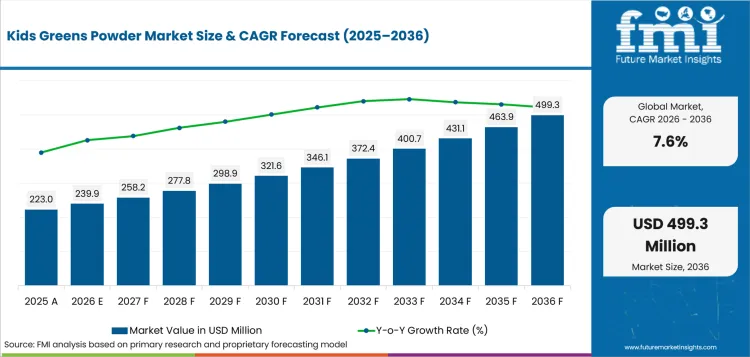
The kids greens powder market is forecast to grow from USD 223.0 million in 2025 to USD 499.3 million by 2036 at 7.6% CAGR as parents look for easier ways to add vegetable cues to child meals. Parent-led daily use is forecast to represent 58.4% share in 2026 because adults control serving timing and repeat purchase. DTC subscriptions are expected to secure 51.7% share in 2026, led by refill routines and bundled child wellness products.
Key Takeaways, Market Size, and Forecast
- 2026 Market Size: USD 240.0 million
- 2036 Market Size: USD 499.3 million
- Forecast CAGR: 7.6% from 2026 to 2036
- Leading Buyer Type: Parent-Led Daily Use
- Parent-Led Daily Use Share in 2026: 58.4%
- Leading Sales Channel: DTC Subscriptions
- DTC Subscription Share in 2026: 51.7%
- Fastest-growing Country: Saudi Arabia
- Saudi Arabia CAGR: 8.5% by 2036
Summary of Kids Greens Powder Market
- Demand and Growth Drivers
- Parents are using child-specific powders to bridge the gap between family meals and daily vegetable intake goals.
- Brand messaging is moving toward zero-sugar flavors and simpler allergen statements for younger children.
- Retailer review is stricter when powders contain moringa, wheatgrass, spirulina, or probiotic strains.
- Product and Segment View
- Parent-led daily use is projected to account for 58.4% share in 2026 because adults manage dosing and repeat purchase.
- DTC subscriptions are expected to secure 51.7% share in 2026, reflected by refill routines and parent-managed monthly plans.
- Chocolate powder is forecast to represent 42.6% share in 2026, led by taste masking and easier mixing in milk.
- Geography and Competitive Outlook
- Saudi Arabia is projected to record 8.5% CAGR by 2036, supported by child nutrition concern and premium pharmacy access.
- The United States is expected to expand at 7.9% CAGR by 2036 through DTC brands and supplement habit formation.
- Hiya Health Products and USANA Health Sciences compete through child-specific branding and subscription infrastructure.
- Private-label manufacturers compete by powder blending and child-safe label support.
- Analyst Opinion
- Nandini Roy Choudhury, Principal Consultant for Food and Beverage at FMI, observes, “Kids’ greens powders are fundamentally a trust-led category where safety signals drive initial purchase, while taste determines retention. Parents typically begin their evaluation with clear age suitability, followed by a close review of sugar levels and ingredient transparency. Products that resemble “adult greens repackaged for kids” often face skepticism, as parents increasingly expect formulations designed specifically for children’s nutritional needs and palates”
- Kids Greens Powder Market Value Analysis
- Market value is driven by finished child-specific greens powder revenue before adult greens products are removed from scope.
- Supplier pricing reflects ingredient count, flavor masking, testing depth, and pack format rather than powder weight alone.
- Revenue improves when parent trials convert into monthly refill plans and multi-child household repeat orders.
- Retail trust rises when labels state age use, allergen controls and serving directions in plain language.
The kids greens powder market is moving toward parent-led routine building rather than adult greens reformulation. Parents are less likely to buy these products as performance supplements and more likely to treat them as flavor-managed nutrition support for picky eating days. CDC reported in May 2026 that 35.7% of USA youth used dietary supplements during August 2021 to August 2023. This shows that child supplement behavior already exists. Repeat purchase still depends on age-fit directions, sugar control and taste acceptance. In August 2024, Hiya Health Products launched Kids Daily Greens + Superfoods as a zero-sugar powder for children aged two and above. The launch signals a shift toward child-first product design where brands use smaller servings, simpler preparation and subscription packaging to reduce parent friction. Suppliers that can make greens taste familiar while keeping labels easy to understand should gain trust faster than brands that only reduce adult greens formulas into smaller child servings.
Why is the Kids Greens Powder Market Growing?
- Parents are choosing powders when children reject visible vegetables during routine meals.
- Child-specific flavors help brands reduce the taste gap that limits adult greens powder use among children.
- Subscription packs make monthly routines easier for households using the product as a daily add-on.
The kids greens powder market is shifting toward sugar-controlled breakfast and snack add-ons rather than smaller versions of adult greens powders. USDA FNS stated in September 2025 that school breakfast and lunch programs will need to keep added sugars below 10% of weekly calories from school year 2027 to 2028. That policy direction makes sugar level and serving clarity more important in child-facing nutrition products. Beam Kids shows the product response through an all-in-one children’s superpowder with 40+ ingredients and age-two-plus positioning. A lucrative opportunity is in powders that fit milk, smoothies or breakfast routines without creating another mealtime fight for parents.
Market Segmentation Analysis
- Parent-led daily use is projected to account for 58.4% share in 2026 because adults control serving timing and reorder decisions.
- DTC subscriptions are expected to represent 51.7% share in 2026 through monthly refill cycles and bundled child wellness products.
- Chocolate powder is projected to secure 42.6% share in 2026 because cocoa flavor masks greens notes in milk and smoothies.
- Ages 4 to 8 are forecast to hold 41.2% share in 2026 as picky eating is most visible in this group.
- Whole-food greens are anticipated to account for 39.8% share in 2026 through parent preference for recognizable ingredients.
- Zero sugar is anticipated to hold 36.9% share in 2026 as parents compare powders against gummies and sweet drinks.
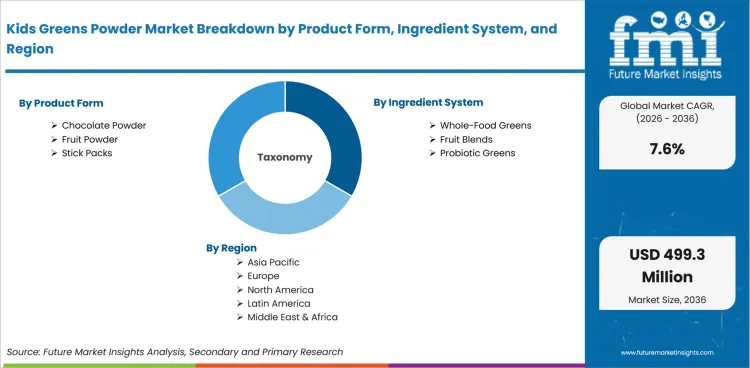
The kids greens powder industry is segmented by product form, ingredient system, age group, sales channel, buyer type, claim positioning, and region. The product boundary overlaps with superfood powders when brands use vegetable and fruit ingredient claims. It overlaps with fruit powders when taste masking relies on berry or tropical profiles.
Insights into Kids Greens Powder Market by Product Form
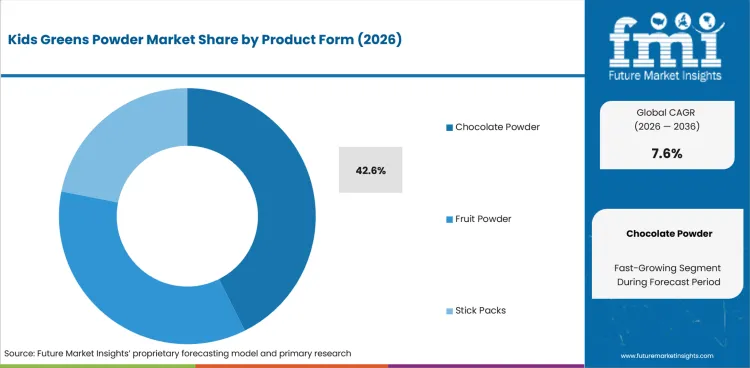
- Chocolate powder is expected to account for 42.6% share in 2026, supported by taste masking and simple use in milk.
- Stick packs gain share where parents want travel portions and fewer measuring steps during morning routines.
Insights into Kids Greens Powder Market by Ingredient System
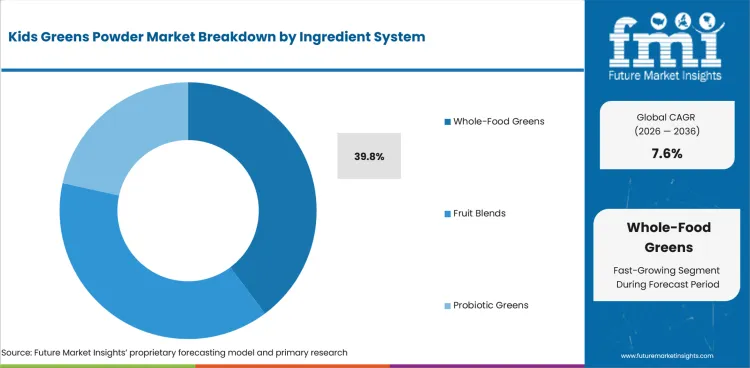
- Whole-food greens are projected to hold 39.8% share in 2026 through recognizable spinach, broccoli, and kale cues.
- Probiotic greens create a higher-price tier when gut support claims are paired with child-safe strains.
Insights into Kids Greens Powder Market by Age Group
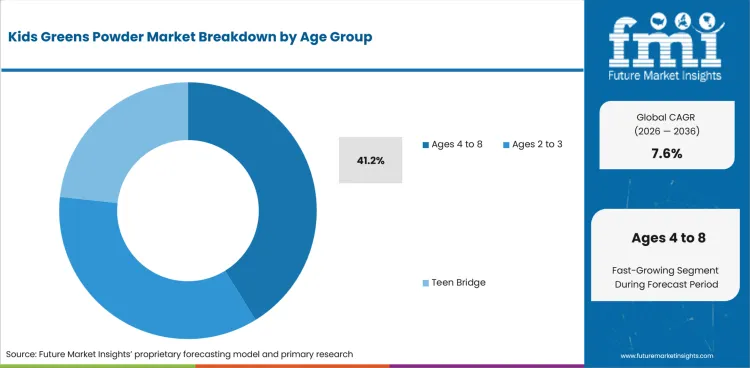
- Ages 4 to 8 are forecast to represent 41.2% share in 2026 as school routines expose meal gaps.
- Ages 9 to 12 support larger serving sizes when parents shift from toddler nutrition to tween wellness.
Insights into Kids Greens Powder Market by Sales Channel
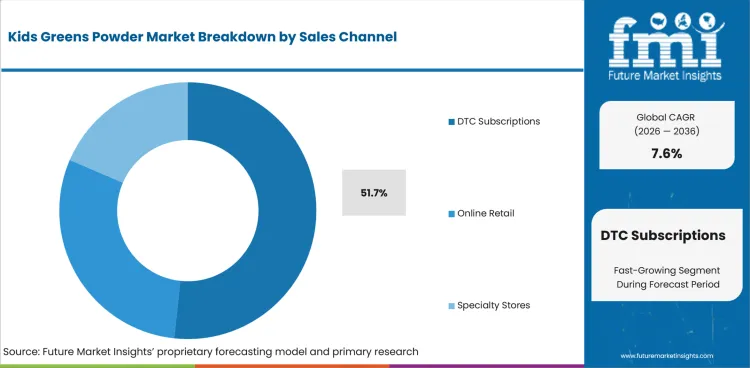
- DTC subscriptions are anticipated to secure 51.7% share in 2026 through repeat refills and parent community referrals.
- Pharmacy retail gains trust in countries where supplements and child nutrition claims receive closer counter review.
Insights into Kids Greens Powder Market by Buyer Type
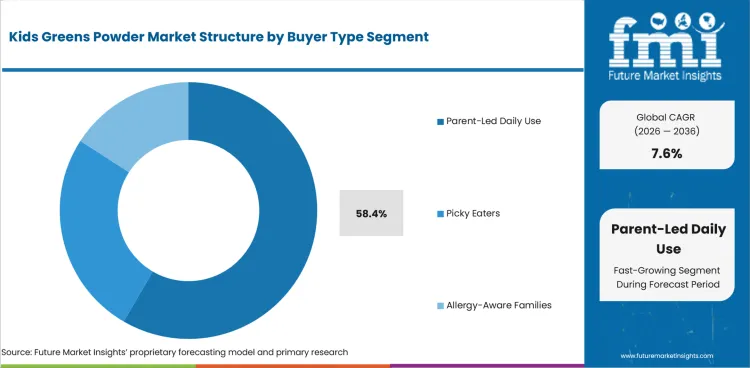
- Parent-led daily use is projected to account for 58.4% share in 2026 because adults control serving timing.
- Allergy-aware families compare allergen statements and third-party testing before they compare flavor variety.
Insights into Kids Greens Powder Market by Claim Positioning
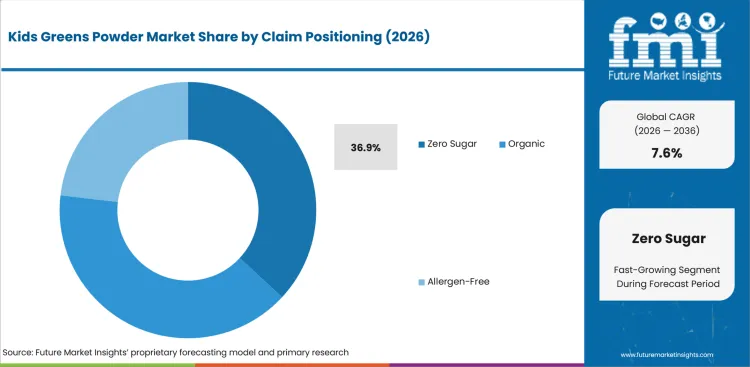
- Zero sugar is expected to hold 36.9% share in 2026 as parents compare powders with gummies and flavored drinks.
- Organic claims are important in Japan and Germany where certification marks influence ingredient trust. Ingredient systems also borrow from the wider vegetable powders value chain when suppliers source leaf and root powders for blends.
Kids Greens Powder Market Drivers, Restraints, and Opportunities
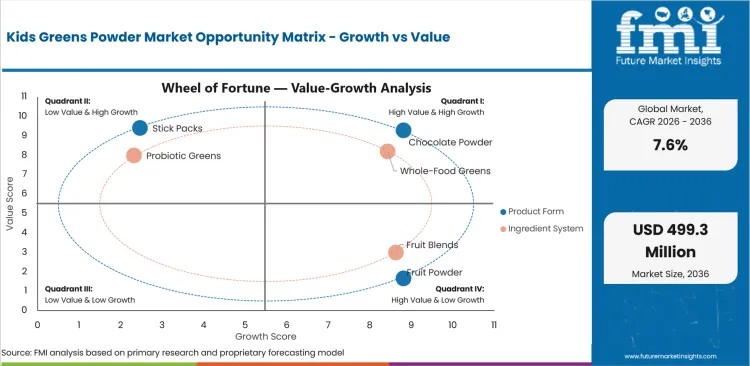
- Driver: Picky eating pushes parents toward powders that add vegetable cues without changing the meal plate.
- Restraint: Botanical powder recalls can slow buyer trust when suppliers lack pathogen testing and lot tracking.
- Opportunity: Child-specific stick packs can support school-day routines and improve serving control for parents.
Demand outlook for kids green powder is moving toward products that combine child taste design with parent-readable safety cues. These products sit near pediatric nutrition but remain outside clinical nutrition because they are sold as dietary supplements. The United States Food and Drug Administration updated its Salmonella outbreak investigation tied to imported moringa leaf powder in June 2026. That event keeps botanical supplier screening central for greens blends.
Consumer Segmentation and Purchase Behavior Analysis
Consumer segmentation is expected to center on parents who already buy daily child supplements. Repeat use depends on whether the powder mixes into breakfast without changing taste or texture. The National Institutes of Health Office of Dietary Supplements stated in October 2025 that multivitamin and mineral supplements are among the most common dietary supplement products used by children and adults. That habit gives kids greens powder brands a familiar purchase path, but it does not remove the need for child-specific serving guidance.
Parent buying is also influenced by lunchbox and snack comparisons. This places child greens powders near kids food beverages when parents judge whether a powder can fit breakfast, smoothies, yogurt, or after-school routines. Brands that explain use occasions clearly should reduce first-order hesitation.
Voice of Customer and Decision-driver Analysis
Purchase decisions are expected to depend first on age range, sugar content, allergen status, and taste masking. Parents usually compare child greens powders against gummies and multivitamins before they compare them against adult greens. Powder texture matters because grit or visible vegetal color can stop repeat use after trial. Buyers also look for plain directions that explain when the product should be used and what it should not replace.
Pack quality becomes more important when powders move through subscription and refill channels. Moisture control and child-use labels connect this market with dietary supplement packaging because clumping and unclear serving directions can weaken parent trust.
Competitive Landscape and Strategic Positioning
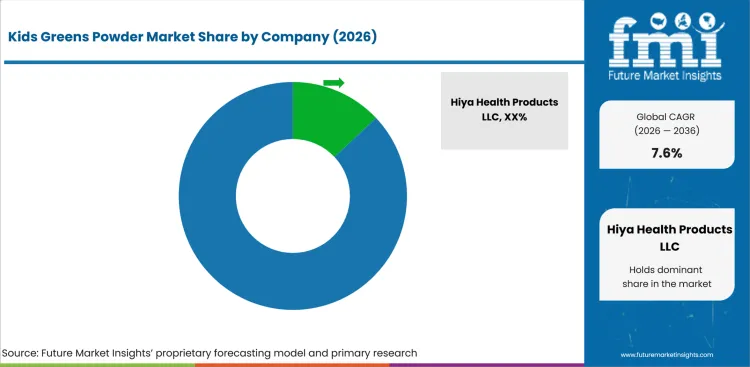
- Child-specific brands hold the best position when product design starts with taste masking and parent safety cues.
- Private-label powder makers compete through blending capacity, allergen control, flavor work, and label documentation.
- Retail-facing supplement firms gain trust when they combine pharmacy access with child nutrition education.
- Subscription brands protect repeat sales through refill timing, bundled vitamins, and parent reminder systems.
Competition is shifting from adult greens adaptation toward child-first formulas. Ingredient suppliers using moringa and wheatgrass powders need stronger testing files before child-use brands accept their inputs. Brand owners that can prove taste and lot control should keep better repeat purchase. Retail buyers assess age use and allergen wording before giving shelf access.
Manufacturing depth is a competitive separator because child greens powders need powder blending and flavor masking together. Private-label manufacturers with lower minimum order sizes can win startup brands, while larger contract manufacturers fit retailers that need stable supply. Supplier files must cover allergen statements, botanical origin, and serving instructions. Scale alone is not enough if parent trust signals are weak.
Regional supplement firms can win through local regulatory knowledge and pharmacy relationships. Canada, Australia, Germany, and Japan reward cautious label language and simpler ingredient files. The best-positioned companies are those that simplify formulas without weakening parent trust. Brands relying only on bright flavor names are expected to face weaker acceptance in regulated retail channels.
Key Companies in the Kids Greens Powder Market
Competition differs across child-specific brand owners, private-label powder manufacturers, and adjacent whole-food supplement companies. Broader greens powder platforms add flavor knowledge and subscription learning.
- Child-Specific Brand Owners: Hiya Health Products and USANA Health Sciences compete through child-focused branding, DTC subscription systems, and product expansion into greens powder.
- Private-Label Powder Manufacturers: Matsun Nutrition, SMP Nutra, Makers Nutrition, Bactolac Pharmaceutical, and NutraPak USA compete through blending, packaging, and compliance support.
- Adjacent Whole-Food Supplement Brands: Llama Naturals, First Day, Amazing Grass, Organifi, and Live it Up compete through whole-food nutrition cues and greens powder recognition.
Competitive Benchmarking: Kids Greens Powder Market
| Company | Relevance to Market Title | Child Formula Fit | Powder Manufacturing Depth | Allergen Label Control | DTC Subscription Reach | Geographic Footprint |
|---|---|---|---|---|---|---|
| Hiya Health Products | Very High | Very Strong | Moderate | Very Strong | Very Strong | United States |
| USANA Health Sciences | High | Strong | Strong | Strong | Strong | Global |
| Matsun Nutrition | High | Moderate | Very Strong | Strong | Moderate | United States |
| SMP Nutra | High | Moderate | Very Strong | Strong | Moderate | United States |
| Makers Nutrition | High | Moderate | Strong | Strong | Moderate | United States |
| Bactolac Pharmaceutical | Moderate to High | Moderate | Very Strong | Very Strong | Moderate | United States |
| NutraPak USA | Moderate to High | Moderate | Strong | Strong | Moderate | United States |
| Llama Naturals | Moderate | Strong | Low to Moderate | Strong | Moderate | United States |
| First Day | Moderate | Strong | Low to Moderate | Strong | Strong | United States |
| Amazing Grass | Moderate | Moderate | Strong | Moderate | Strong | United States |
Source: Future Market Insights competitive analysis, 2026.
Key Developments in Kids Greens Powder Market
- In January 2026, AdvoCare launched Daily Greens as an all-in-one greens supplement with more than 70 organic superfoods, antioxidants, digestive enzymes, prebiotics and multivitamins. The formula includes spinach, spirulina and wheatgrass as chlorophyll-rich greens for daily nutrition positioning.
- In February 2025, Chlorophyll Water announced new 16 oz aluminum cans and 1-liter bottles for Natural Products Expo West. The launch expanded the brand beyond its existing bottle format and supported cleaner single-serve and larger-format chlorophyll beverage positioning.
Key Players in the Kids Greens Powder Market
- Hiya Health Products LLC
- USANA Health Sciences Inc.
- Matsun Nutrition
- SMP Nutra
- Makers Nutrition
- Bactolac Pharmaceutical Inc.
- NutraPak USA
- Llama Naturals
- First Day
- Amazing Grass
- Organifi
- Live it Up
Analysis of Kids Greens Powder Market by Key Countries
.webp "Top Country Growth Comparison Kids Greens Powder Market Cagr (2026 2036)")
| Country | CAGR |
|---|---|
| Saudi Arabia | 8.5% |
| United States | 7.9% |
| Canada | 7.6% |
| United Kingdom | 7.4% |
| Japan | 6.9% |
| Australia | 6.7% |
| Germany | 6.5% |
Source: Future Market Insights, 2026.
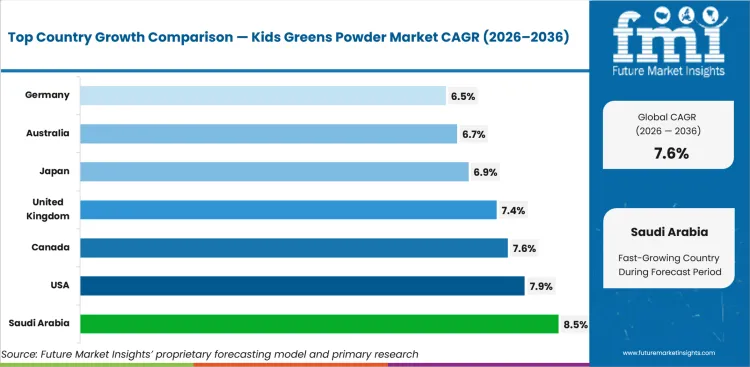
Kids Greens Powder Market CAGR Analysis by Country
- Saudi Arabia is forecast to record 8.5% CAGR by 2036 as child nutrition concern and premium pharmacy access support higher trial.
- The United States is expected to expand at 7.9% CAGR from 2026 to 2036 through DTC brand scale and parent supplement routines.
- Canada is projected to grow at 7.6% CAGR through 2036 as natural health product review supports cautious child supplement listings.
- The United Kingdom is estimated to rise at 7.4% CAGR by 2036 with low fruit and vegetable intake shaping parent interest in simple daily add-ons.
- Japan is expected to advance at 6.9% CAGR over the forecast period as compact pack formats and certification marks support ingredient trust.
- Australia is forecast to grow at 6.7% CAGR through 2036 as pharmacy-led supplement review keeps claims controlled but trusted.
- Germany is projected to post 6.5% CAGR by 2036 as food supplement notification and pharmacy caution narrow faster rollout.
Opportunity Analysis for Kids Greens Powder Market in Saudi Arabia
Premium pharmacy retail and child nutrition concern center 2026 to 2036
Country Market Snapshot Table
| Parameter | Value |
|---|---|
| Market Size in 2025 (Value) | USD 10.1 million |
| Market Size in 2026 (Value) | USD 11.0 million |
| Market Forecast in 2036 (Value) | USD 24.8 million |
| CAGR (2026 to 2036) | 8.5% |
| Years Considered | 2021 to 2036 |
| Base Year | 2025 |
| Forecast Period | 2026 to 2036 |
| Units Considered | Value (USD million) |
| Leading Sub-Region | Riyadh and Jeddah premium pharmacy networks |
Saudi Arabia Kids Greens Powder Market Outlook
Saudi Arabia demand starts from family concern over child diet quality and weight status. Parents in Riyadh and Jeddah are more likely to test premium powders when products carry clear Arabic labels and safe serving directions.
Saudi Arabia is projected to record 8.5% CAGR through 2036, supported by child weight management concern and premium retail. The General Authority for Statistics reported child obesity at 14.6% among children aged 2 to 14 in 2024. The same pressure can increase parent interest in low-sugar nutrition add-ons.
Key Growth Drivers
- Riyadh pharmacy chains support premium supplement trial when products include Arabic directions and child age guidance.
- General Authority for Statistics reported 33.3% overweight prevalence among children aged 2 to 14 in 2024.
- Saudi Food and Drug Authority classification guidance supports clearer review of supplement components and claims.
- Jeddah premium grocery channels can test imported child greens powders when label files are complete.
Key Restraints
- Saudi Food and Drug Authority pre-registration review can delay entry when heavy metal and pathogen files are incomplete.
- Hot-climate logistics in Riyadh can affect powder stability when packs lack moisture control.
- Price sensitivity outside premium urban stores can limit refill rates for imported child nutrition powders.
What makes Saudi Arabia unique
Saudi Arabia is unique because child weight concern and premium pharmacy retail can move low-sugar powders faster than in many GCC peers.
Key Companies
- Nahdi Medical Company
- Dawaa Medical Services Company
- Jamjoom Pharma
- Saudi Pharmaceutical Industries
- Cigalah Healthcare
- Banaja Holdings
- Al-Dawaa Pharmacies
Sales & Marketing Channels
- Pharmacy chains
- Premium grocery
- E-commerce platforms
- Hospital-adjacent retail
- Wellness clinics
- Family stores
Country Segment Breakdown Table
| Segment | Sub-Segments |
|---|---|
| By Product Form | Chocolate Powder · Fruit Powder · Stick Packs · Sachets · Ready Mix |
| By Ingredient System | Whole-Food Greens · Fruit Blends · Probiotic Greens · Fiber Greens · Botanical Blends |
| By Age Group | Ages 2 to 3 · Ages 4 to 8 · Ages 9 to 12 · Teen Bridge |
| By Sales Channel | DTC Subscriptions · Online Retail · Pharmacy Retail · Specialty Stores · Club Retail |
| By Buyer Type | Parent-Led Daily Use · Picky Eaters · Allergy-Aware Families · Plant-Based Families · Practitioner Guided |
| By Claim Positioning | Zero Sugar · Organic · Allergen-Free · Gut Support · Immune Support |
| Key Sub-Regions Covered, Child Nutrition Retail Areas | Riyadh · Jeddah · Dammam · Khobar · Makkah · Madinah |
Frequently Asked Questions
How fast is Saudi Arabia kids greens powder market growing?
Sales in Saudi Arabia are expected to grow at 8.5% CAGR from 2026 to 2036, supported by child weight management and premium retail.
Who leads Saudi Arabia kids greens powder market?
Nahdi Medical Company, Dawaa Medical Services Company, Jamjoom Pharma, Saudi Pharmaceutical Industries compete through local child nutrition trust and retail access in Saudi Arabia.
What is driving adoption in Saudi Arabia kids greens powder market?
Parent concern over diet quality and label clarity is moving buyers toward child-specific greens powders in Saudi Arabia.
Demand Outlook for Kids Greens Powder Market in the United States
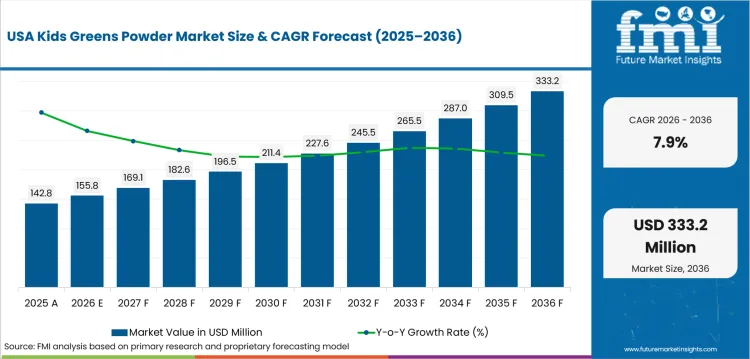
DTC child supplement scale and parent refill routines center 2026 to 2036
Country Market Snapshot Table
| Parameter | Value |
|---|---|
| Market Size in 2025 (Value) | USD 90.8 million |
| Market Size in 2026 (Value) | USD 98.0 million |
| Market Forecast in 2036 (Value) | USD 209.7 million |
| CAGR (2026 to 2036) | 7.9% |
| Years Considered | 2021 to 2036 |
| Base Year | 2025 |
| Forecast Period | 2026 to 2036 |
| Units Considered | Value (USD million) |
| Leading Sub-Region | Pacific Coast and national DTC subscription corridors |
United States Kids Greens Powder Market Outlook
United States buyers compare kids greens powders through DTC reviews, sugar content, and age-specific serving directions. Subscription brands have an advantage because parents can add greens powder to an existing child supplement routine.
The United States is expected to expand at 7.9% CAGR through 2036, supported by DTC brand scale and child supplement routines. The National Center for Health Statistics reported in May 2026 that 35.7% of youth used dietary supplements in August 2021 to August 2023. Suppliers with child-safe flavor systems and clear Supplement Facts panels should gain more repeat orders.
Key Growth Drivers
- California and New York DTC corridors support subscription trial through parent reviews and refill programs.
- National Center for Health Statistics data showed 41.9% supplement use among youth aged 2 to 11 in August 2021 to August 2023.
- Food and Drug Administration label rules make serving directions and ingredient identity central to child supplement trust.
- Hiya Health Products shows child-specific positioning after its August 2024 zero-sugar greens powder launch.
Key Restraints
- Food and Drug Administration action on imported moringa leaf powder in June 2026 keeps pathogen testing central for greens suppliers.
- Allergen-sensitive households in California and Texas can reject powders without clear nut and dairy controls.
- Overfortified formulas can face parent caution when vitamin amounts are not easy to compare with daily intake needs.
What makes the United States unique
The United States is unique due to DTC subscription scale and large child supplement use among elementary-age children.
Key Companies
- Hiya Health Products LLC
- USANA Health Sciences Inc.
- Matsun Nutrition
- SMP Nutra
- Makers Nutrition
- Bactolac Pharmaceutical Inc.
- NutraPak USA
Sales & Marketing Channels
- DTC subscriptions
- Online retail
- Natural stores
- Pharmacy retail
- Club retail
- Pediatric referral retail
Country Segment Breakdown Table
| Segment | Sub-Segments |
|---|---|
| By Product Form | Chocolate Powder · Fruit Powder · Stick Packs · Sachets · Ready Mix |
| By Ingredient System | Whole-Food Greens · Fruit Blends · Probiotic Greens · Fiber Greens · Botanical Blends |
| By Age Group | Ages 2 to 3 · Ages 4 to 8 · Ages 9 to 12 · Teen Bridge |
| By Sales Channel | DTC Subscriptions · Online Retail · Pharmacy Retail · Specialty Stores · Club Retail |
| By Buyer Type | Parent-Led Daily Use · Picky Eaters · Allergy-Aware Families · Plant-Based Families · Practitioner Guided |
| By Claim Positioning | Zero Sugar · Organic · Allergen-Free · Gut Support · Immune Support |
| Key Sub-Regions Covered, Child Nutrition Retail Areas | California · Texas · New York · Florida · Midwest retail clusters · Pacific Northwest |
Frequently Asked Questions
How fast is United States kids greens powder market growing?
Sales in United States are expected to grow at 7.9% CAGR from 2026 to 2036, supported by DTC scale and child supplement use.
Who leads United States kids greens powder market?
Hiya Health Products LLC, USANA Health Sciences Inc., Matsun Nutrition, SMP Nutra compete through local child nutrition trust and retail access in United States.
What is driving adoption in United States kids greens powder market?
Parent concern over diet quality and label clarity is moving buyers toward child-specific greens powders in United States.
Sales Analysis for Kids Greens Powder Market in Canada
Natural health product review and pharmacy trust center 2026 to 2036
Country Market Snapshot Table
| Parameter | Value |
|---|---|
| Market Size in 2025 (Value) | USD 16.7 million |
| Market Size in 2026 (Value) | USD 18.0 million |
| Market Forecast in 2036 (Value) | USD 37.4 million |
| CAGR (2026 to 2036) | 7.6% |
| Years Considered | 2021 to 2036 |
| Base Year | 2025 |
| Forecast Period | 2026 to 2036 |
| Units Considered | Value (USD million) |
| Leading Sub-Region | Ontario and British Columbia natural health retail corridors |
Canada Kids Greens Powder Market Outlook
Canadian parents often treat child supplements as a regulated natural health product purchase. That makes dosage clarity and bilingual labels important before taste claims influence repeat buying.
Canada is forecast to grow at 7.6% CAGR through 2036, supported by natural health product channels and parent trust in supplements. Health Canada stated in October 2025 that 79.6% of breastfed or partly breastfed infants received vitamin D supplements. This supplement habit gives child nutrition brands a trusted entry point.
Key Growth Drivers
- Ontario pharmacies support child supplement purchases when bilingual directions and dosage limits are clear.
- Health Canada recommends 10 micrograms of vitamin D daily for infants and young children under defined feeding conditions.
- British Columbia natural stores can trial greens powders when products fit parent demand for lower sugar formats.
- Health Canada supplemented food rules sharpen label expectations for added ingredients and caution statements.
Key Restraints
- Bilingual label changes can slow launch timing when brands adapt United States packs for Canadian sale.
- Natural health product licensing can raise documentation work for formulas using botanicals and probiotics.
- Higher shipping cost across the Prairies can limit small DTC refill orders for powder tubs.
What makes Canada unique
Canada is unique because natural health product oversight makes label files and bilingual directions part of the buying decision.
Key Companies
- Jamieson Wellness Inc.
- Webber Naturals
- Sisu Inc.
- CanPrev Natural Health Products
- Natural Factors
- Organika Health Products
- SmartyPants Vitamins Canada
Sales & Marketing Channels
- Pharmacy retail
- Natural stores
- Online retail
- Pediatric clinics
- Grocery wellness aisles
- Club stores
Country Segment Breakdown Table
| Segment | Sub-Segments |
|---|---|
| By Product Form | Chocolate Powder · Fruit Powder · Stick Packs · Sachets · Ready Mix |
| By Ingredient System | Whole-Food Greens · Fruit Blends · Probiotic Greens · Fiber Greens · Botanical Blends |
| By Age Group | Ages 2 to 3 · Ages 4 to 8 · Ages 9 to 12 · Teen Bridge |
| By Sales Channel | DTC Subscriptions · Online Retail · Pharmacy Retail · Specialty Stores · Club Retail |
| By Buyer Type | Parent-Led Daily Use · Picky Eaters · Allergy-Aware Families · Plant-Based Families · Practitioner Guided |
| By Claim Positioning | Zero Sugar · Organic · Allergen-Free · Gut Support · Immune Support |
| Key Sub-Regions Covered, Child Nutrition Retail Areas | Ontario · Quebec · British Columbia · Alberta · Manitoba · Saskatchewan |
Frequently Asked Questions
How fast is Canada kids greens powder market growing?
Sales in Canada are expected to grow at 7.6% CAGR from 2026 to 2036, supported by natural health product rules and parent supplement use.
Who leads Canada kids greens powder market?
Jamieson Wellness Inc., Webber Naturals, Sisu Inc., CanPrev Natural Health Products compete through local child nutrition trust and retail access in Canada.
What is driving adoption in Canada kids greens powder market?
Parent concern over diet quality and label clarity is moving buyers toward child-specific greens powders in Canada.
Growth Outlook for Kids Greens Powder Market in the United Kingdom
Low produce intake and pharmacy-led parent trust center 2026 to 2036
Country Market Snapshot Table
| Parameter | Value |
|---|---|
| Market Size in 2025 (Value) | USD 18.6 million |
| Market Size in 2026 (Value) | USD 20.0 million |
| Market Forecast in 2036 (Value) | USD 40.9 million |
| CAGR (2026 to 2036) | 7.4% |
| Years Considered | 2021 to 2036 |
| Base Year | 2025 |
| Forecast Period | 2026 to 2036 |
| Units Considered | Value (USD million) |
| Leading Sub-Region | London and national pharmacy retail chains |
United Kingdom Kids Greens Powder Market Outlook
United Kingdom parents face a visible gap between public nutrition guidance and daily child meals. This helps child greens powders enter as a support product rather than a meal substitute.
The United Kingdom is expected to advance at 7.4% CAGR through 2036, driven by low fruit and vegetable intake among older children. The National Diet and Nutrition Survey reported in June 2025 that children aged 11 to 18 ate 2.8 portions of fruit and vegetables per day. Only 9.0% met the 5-a-day guide.
Key Growth Drivers
- London pharmacy chains can test child greens powders when packs avoid medical claims and state age use clearly.
- United Kingdom government evidence showed 53.0% of families in the COT20s study gave child vitamin drops.
- School meal discussion supports parent interest in simple home products that complement routine meals.
- Online subscription brands can reach parents who already buy child vitamins through DTC wellness sites.
Key Restraints
- Novel botanical ingredients can face caution when safety history is unclear for young children.
- Price pressure in lower-income households can reduce monthly refills when powders are positioned above basic vitamins.
- Claims review can restrict immune or gut wording if substantiation is not clear for child users.
What makes the United Kingdom unique
The United Kingdom is unique because low produce intake and vitamin drop familiarity create a clear parent education route.
Key Companies
- Vitabiotics Ltd.
- Holland & Barrett International Limited
- Healthspan Limited
- BetterYou Ltd.
- Nutravita Limited
- Together Health Ltd.
- BioCare Ltd.
Sales & Marketing Channels
- Pharmacy retail
- Health stores
- Online retail
- Supermarket wellness aisles
- Subscription stores
- Practitioner retail
Country Segment Breakdown Table
| Segment | Sub-Segments |
|---|---|
| By Product Form | Chocolate Powder · Fruit Powder · Stick Packs · Sachets · Ready Mix |
| By Ingredient System | Whole-Food Greens · Fruit Blends · Probiotic Greens · Fiber Greens · Botanical Blends |
| By Age Group | Ages 2 to 3 · Ages 4 to 8 · Ages 9 to 12 · Teen Bridge |
| By Sales Channel | DTC Subscriptions · Online Retail · Pharmacy Retail · Specialty Stores · Club Retail |
| By Buyer Type | Parent-Led Daily Use · Picky Eaters · Allergy-Aware Families · Plant-Based Families · Practitioner Guided |
| By Claim Positioning | Zero Sugar · Organic · Allergen-Free · Gut Support · Immune Support |
| Key Sub-Regions Covered, Child Nutrition Retail Areas | London · Manchester · Birmingham · Leeds · Scotland · Wales |
Frequently Asked Questions
How fast is United Kingdom kids greens powder market growing?
Sales in United Kingdom are expected to grow at 7.4% CAGR from 2026 to 2036, supported by low fruit and vegetable intake among older children.
Who leads United Kingdom kids greens powder market?
Vitabiotics Ltd., Holland & Barrett International Limited, Healthspan Limited, BetterYou Ltd. compete through local child nutrition trust and retail access in United Kingdom.
What is driving adoption in United Kingdom kids greens powder market?
Parent concern over diet quality and label clarity is moving buyers toward child-specific greens powders in United Kingdom.
Sales Outlook for Kids Greens Powder Market in Japan
Small-pack discipline and certification-led ingredient trust center 2026 to 2036
Country Market Snapshot Table
| Parameter | Value |
|---|---|
| Market Size in 2025 (Value) | USD 12.2 million |
| Market Size in 2026 (Value) | USD 13.0 million |
| Market Forecast in 2036 (Value) | USD 25.3 million |
| CAGR (2026 to 2036) | 6.9% |
| Years Considered | 2021 to 2036 |
| Base Year | 2025 |
| Forecast Period | 2026 to 2036 |
| Units Considered | Value (USD million) |
| Leading Sub-Region | Tokyo and Kansai health retail clusters |
Japan Kids Greens Powder Market Outlook
Japan supply conditions favor compact packs, mild flavors, and clear ingredient marks. Buyers expect powder products to fit small kitchens and daily school routines without bulky tubs.
Japan is projected to rise at 6.9% CAGR through 2036, supported by small-pack retail and ingredient certification needs. The Ministry of Agriculture, Forestry and Fisheries updated Organic JAS information in July 2024, keeping certification marks important for organic plant ingredients. Suppliers can win when they combine mild taste with label discipline.
Key Growth Drivers
- Tokyo drugstores support small pouch formats that fit frequent shopping and limited storage space.
- Organic JAS certification helps buyers compare organic plant ingredients used in child-focused powders.
- Kansai health stores can support mild fruit flavors when product messaging stays close to food-based nutrition.
- Municipal food stockpile planning keeps dried vegetables and nutrition support visible in public nutrition discussion.
Key Restraints
- Strict taste expectations can slow repeat purchase when vegetal notes remain visible after mixing.
- Imported botanical powders need clear origin and residue controls before premium Japanese retailers list them.
- Small pack sizes can raise cost per serving and limit bulk subscription savings for families.
What makes Japan unique
Japan is unique because compact packaging and certification marks influence parent trust before broad flavor variety matters.
Key Companies
- Fancl Corporation
- Asahi Group Foods Ltd.
- Suntory Wellness Limited
- Morinaga Milk Industry Co. Ltd.
- Otsuka Pharmaceutical Co. Ltd.
- Yakult Honsha Co. Ltd.
- AFC-HD AMS Life Science Co. Ltd.
Sales & Marketing Channels
- Drugstores
- Convenience retail
- Online retail
- Department store wellness
- Subscription sites
- Family grocery
Country Segment Breakdown Table
| Segment | Sub-Segments |
|---|---|
| By Product Form | Chocolate Powder · Fruit Powder · Stick Packs · Sachets · Ready Mix |
| By Ingredient System | Whole-Food Greens · Fruit Blends · Probiotic Greens · Fiber Greens · Botanical Blends |
| By Age Group | Ages 2 to 3 · Ages 4 to 8 · Ages 9 to 12 · Teen Bridge |
| By Sales Channel | DTC Subscriptions · Online Retail · Pharmacy Retail · Specialty Stores · Club Retail |
| By Buyer Type | Parent-Led Daily Use · Picky Eaters · Allergy-Aware Families · Plant-Based Families · Practitioner Guided |
| By Claim Positioning | Zero Sugar · Organic · Allergen-Free · Gut Support · Immune Support |
| Key Sub-Regions Covered, Child Nutrition Retail Areas | Tokyo · Osaka · Kanagawa · Aichi · Fukuoka · Hokkaido |
Frequently Asked Questions
How fast is Japan kids greens powder market growing?
Sales in Japan are expected to grow at 6.9% CAGR from 2026 to 2036, supported by organic certification and small-pack discipline.
Who leads Japan kids greens powder market?
Fancl Corporation, Asahi Group Foods Ltd., Suntory Wellness Limited, Morinaga Milk Industry Co. Ltd. compete through local child nutrition trust and retail access in Japan.
What is driving adoption in Japan kids greens powder market?
Parent concern over diet quality and label clarity is moving buyers toward child-specific greens powders in Japan.
Demand Analysis for Kids Greens Powder Market in Australia
Listed medicine oversight and parent label caution center 2026 to 2036
Country Market Snapshot Table
| Parameter | Value |
|---|---|
| Market Size in 2025 (Value) | USD 11.2 million |
| Market Size in 2026 (Value) | USD 12.0 million |
| Market Forecast in 2036 (Value) | USD 22.9 million |
| CAGR (2026 to 2036) | 6.7% |
| Years Considered | 2021 to 2036 |
| Base Year | 2025 |
| Forecast Period | 2026 to 2036 |
| Units Considered | Value (USD million) |
| Leading Sub-Region | Sydney and Melbourne pharmacy-led wellness corridors |
Australia Kids Greens Powder Market Outlook
Australian parents often compare child supplements through pharmacy trust and label caution. Products that resemble therapeutic goods need careful claims and ingredient review before broad retail listing.
Australia is forecast at 6.7% CAGR through 2036, constrained by listed medicine oversight and conservative child supplement review. The Therapeutic Goods Administration stated in May 2025 that most complementary medicines are listed medicines and carry an AUST L number. Brands must separate food-style powders from therapeutic claims.
Key Growth Drivers
- Sydney pharmacy groups support child nutrition powders when products use clear serving directions and cautious claims.
- Australian Bureau of Statistics nutrient data released in September 2025 showed 14.8% of children aged 2 to 17 had inadequate vitamin A from food and drinks.
- Melbourne health stores can trial child greens powders when allergen statements and country-of-origin details are clear.
- Therapeutic Goods Administration ingredient controls help retailers screen formulas before listing child-use supplements.
Key Restraints
- Therapeutic claims can pull products toward stricter listed medicine expectations and extra compliance work.
- High freight cost can raise delivered price for imported tubs sold through online refill programs.
- Parent caution can limit powders using complex botanical blends without simple child-use explanations.
What makes Australia unique
Australia is unique because pharmacy trust and listed medicine oversight shape how child supplement claims are written.
Key Companies
- Blackmores Limited
- Swisse Wellness Pty Ltd
- PharmaCare Laboratories Pty Ltd
- Healthylife Group Pty Ltd
- Nutra-Life Australia
- Caruso’s Natural Health
- Nature’s Way Australia
Sales & Marketing Channels
- Pharmacy retail
- Online retail
- Health stores
- Supermarket wellness aisles
- Practitioner retail
- Subscription stores
Country Segment Breakdown Table
| Segment | Sub-Segments |
|---|---|
| By Product Form | Chocolate Powder · Fruit Powder · Stick Packs · Sachets · Ready Mix |
| By Ingredient System | Whole-Food Greens · Fruit Blends · Probiotic Greens · Fiber Greens · Botanical Blends |
| By Age Group | Ages 2 to 3 · Ages 4 to 8 · Ages 9 to 12 · Teen Bridge |
| By Sales Channel | DTC Subscriptions · Online Retail · Pharmacy Retail · Specialty Stores · Club Retail |
| By Buyer Type | Parent-Led Daily Use · Picky Eaters · Allergy-Aware Families · Plant-Based Families · Practitioner Guided |
| By Claim Positioning | Zero Sugar · Organic · Allergen-Free · Gut Support · Immune Support |
| Key Sub-Regions Covered, Child Nutrition Retail Areas | Sydney · Melbourne · Brisbane · Perth · Adelaide · Canberra |
Frequently Asked Questions
How fast is Australia kids greens powder market growing?
Sales in Australia are expected to grow at 6.7% CAGR from 2026 to 2036, supported by listed medicine oversight and parent label caution.
Who leads Australia kids greens powder market?
Blackmores Limited, Swisse Wellness Pty Ltd, PharmaCare Laboratories Pty Ltd, Healthylife Group Pty Ltd compete through local child nutrition trust and retail access in Australia.
What is driving adoption in Australia kids greens powder market?
Parent concern over diet quality and label clarity is moving buyers toward child-specific greens powders in Australia.
Sales Outlook for Kids Greens Powder Market in Germany
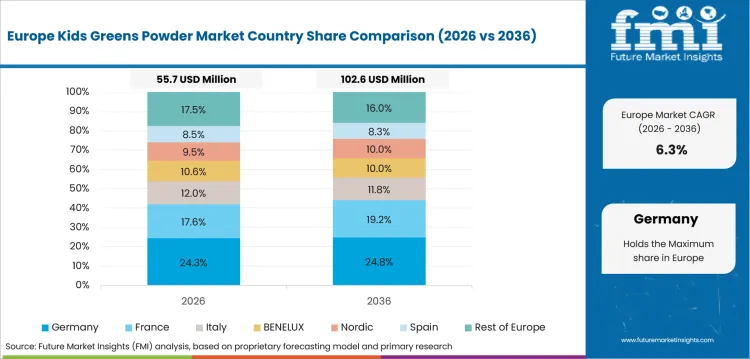
Food supplement notification and pharmacy caution center 2026 to 2036
Sydney Melbourne Brisbane Perth Adelaide Canberra
| Parameter | Value |
|---|---|
| Market Size in 2025 (Value) | USD 16.0 million |
| Market Size in 2026 (Value) | USD 17.0 million |
| Market Forecast in 2036 (Value) | USD 31.9 million |
| CAGR (2026 to 2036) | 6.5% |
| Years Considered | 2021 to 2036 |
| Base Year | 2025 |
| Forecast Period | 2026 to 2036 |
| Units Considered | Value (USD million) |
| Leading Sub-Region | North Rhine-Westphalia and Bavaria retail clusters |
Germany Kids Greens Powder Market Outlook
German buyers place food supplement powders under close ingredient and claim review. Pharmacy trust matters more when formulas contain botanicals or probiotic strains aimed at children.
Germany is expected to post 6.5% CAGR through 2036, shaped by EU food supplement notification and pharmacy caution. The Federal Office of Consumer Protection and Food Safety stated in March 2026 that food supplements are subject to notification duty. That keeps ingredient files and claim wording central for market entry.
Key Growth Drivers
- North Rhine-Westphalia pharmacy retail supports compliant child supplements with clear ingredient and age-use information.
- Federal Office of Consumer Protection and Food Safety substance lists help suppliers review minerals and botanicals before launch.
- Bavaria health retailers can trial organic-positioned child powders when certification and origin files are complete.
- German parents often compare sugar and additive statements before accepting flavored powders for children.
Key Restraints
- Notification duty can slow SKU rollout when formulas include multiple botanicals and probiotic cultures.
- Strict claim review can limit gut and immune wording if evidence is not child-specific.
- Price-sensitive households can keep basic vitamins ahead of premium greens powders in monthly budgets.
What makes Germany unique
Germany is unique because notification duty and pharmacy caution reward suppliers with simple formulas and complete files.
Key Companies
- Doppelherz Pharma GmbH
- Orthomol pharmazeutische Vertriebs GmbH
- Queisser Pharma GmbH & Co. KG
- Salus Haus GmbH & Co. KG
- Dr. Loges + Co. GmbH
- Pure Encapsulations Germany GmbH
- Sunday Natural Products GmbH
Sales & Marketing Channels
- Pharmacy retail
- Drugstores
- Online retail
- Organic stores
- Practitioner retail
- Family grocery
Country Segment Breakdown Table
| Segment | Sub-Segments |
|---|---|
| By Product Form | Chocolate Powder · Fruit Powder · Stick Packs · Sachets · Ready Mix |
| By Ingredient System | Whole-Food Greens · Fruit Blends · Probiotic Greens · Fiber Greens · Botanical Blends |
| By Age Group | Ages 2 to 3 · Ages 4 to 8 · Ages 9 to 12 · Teen Bridge |
| By Sales Channel | DTC Subscriptions · Online Retail · Pharmacy Retail · Specialty Stores · Club Retail |
| By Buyer Type | Parent-Led Daily Use · Picky Eaters · Allergy-Aware Families · Plant-Based Families · Practitioner Guided |
| By Claim Positioning | Zero Sugar · Organic · Allergen-Free · Gut Support · Immune Support |
| Key Sub-Regions Covered, Child Nutrition Retail Areas | North Rhine-Westphalia · Bavaria · Baden-Württemberg · Berlin · Hamburg · Hesse |
Frequently Asked Questions
How fast is Germany kids greens powder market growing?
Sales in Germany are expected to grow at 6.5% CAGR from 2026 to 2036, supported by EU ingredient review and pharmacy caution.
Who leads Germany kids greens powder market?
Doppelherz Pharma GmbH, Orthomol pharmazeutische Vertriebs GmbH, Queisser Pharma GmbH & Co. KG, Salus Haus GmbH & Co. KG compete through local child nutrition trust and retail access in Germany.
What is driving adoption in Germany kids greens powder market?
Parent concern over diet quality and label clarity is moving buyers toward child-specific greens powders in Germany.
Kids Greens Powder Market - Report Scope
| Item | Value |
|---|---|
| Market size by 2036 | USD 499.3 million |
| Growth rate | 7.6% CAGR from 2026 to 2036 |
| Forecast period | 2026 to 2036 |
| Base year value (2025) | USD 223.0 million |
| 2026 value | USD 240.0 million |
| By product form | Chocolate powder, fruit powder, stick packs, sachets, ready mix |
| By ingredient system | Whole-food greens, fruit blends, probiotic greens, fiber greens, botanical blends |
| By age group | Ages 2 to 3, ages 4 to 8, ages 9 to 12, teen bridge |
| By sales channel | DTC subscriptions, online retail, pharmacy retail, specialty stores, club retail |
| By buyer type | Parent-led daily use, picky eaters, allergy-aware families, plant-based families, practitioner guided |
| By claim positioning | Zero sugar, organic, allergen-free, gut support, immune support |
| Regions covered | North America, Latin America, Europe, East Asia, South Asia and Pacific, Middle East and Africa |
| Countries covered | Saudi Arabia, United States, Canada, United Kingdom, Japan, Australia, Germany |
| Key companies profiled | Hiya Health Products LLC, USANA Health Sciences Inc., Matsun Nutrition, SMP Nutra, Makers Nutrition, Bactolac Pharmaceutical Inc., NutraPak USA, Llama Naturals, First Day, Amazing Grass, Organifi, Live it Up |
| Approach | Bottom-up product-boundary approach using eligible SKU revenue, retail pricing, DTC subscription presence, product form depth, ingredient system, age-group suitability, claim positioning, channel activity, and country-level adoption |
Source: Future Market Insights, 2026.
Kids Greens Powder Market - Scope & Definition
| Attribute | Detail |
|---|---|
| Market Definition | Flavored powdered dietary supplements made for children using vegetable powders, fruit powders, greens extracts, fiber blends, probiotics, vitamins, or minerals with clear child-use positioning. |
| Functions Covered | Daily nutrition support, vegetable cue delivery, parent-managed supplement routines, taste-masked powder use, refill-based household purchasing. |
| Applications Covered | Chocolate powders, fruit powders, stick packs, sachets, ready mix formats, and refill pouches sold for child-specific use. |
| End-Use Industries | Children health supplements, dietary supplements, family wellness retail, pharmacy nutrition, and DTC child wellness platforms. |
| Product Scope | Child-specific greens powders sold through DTC subscriptions, online retail, pharmacy retail, specialty stores, club retail, and selected grocery channels. |
| Exclusions | Ordinary children multivitamins, gummies, probiotic drops, electrolyte powders, meal replacement shakes, adult greens powders, prescription nutrition products, and clinical enteral formulas. |
| Report Coverage | Market values, segment shares, country outlook, company benchmarking, competitive positioning, developments, report scope, methodology, and FAQs. |
Kids Greens Powder Market - Research Methodology
| Method | Description |
|---|---|
| Primary Research | FMI analyst interviews with supplement brand owners, private-label powder manufacturers, flavor houses, nutrition retail buyers, and channel specialists. |
| Desk Research | Review of public evidence from the United States Centers for Disease Control and Prevention, the United States Food and Drug Administration, Health Canada, United Kingdom government sources, and national food regulators. |
| Market Sizing & Forecasting | The market size has been estimated using a bottom-up product-boundary approach. Each category has been defined by eligible SKUs, retail and direct-to-consumer revenue pools, channel availability, product positioning, and country-level adoption patterns. Standard children multivitamins, gummies, probiotic drops, meal replacement powders, and adult greens powders were excluded unless they clearly matched the category definition. |
| Data Validation | Cross-verification using public supplement use rates, visible child greens SKUs, DTC subscription benchmarks, country-level retail readiness, and CAGR plausibility testing. |
Kids Greens Powder Market Breakdown by Product Form, Ingredient System, Age Group, Sales Channel, Buyer Type, Claim Positioning, and Region
Kids Greens Powder Market Segmented by Product Form
- Chocolate Powder
- Fruit Powder
- Stick Packs
- Sachets
- Ready Mix
Kids Greens Powder Market Segmented by Ingredient System
- Whole-Food Greens
- Fruit Blends
- Probiotic Greens
- Fiber Greens
- Botanical Blends
Kids Greens Powder Market Segmented by Age Group
- Ages 2 to 3
- Ages 4 to 8
- Ages 9 to 12
- Teen Bridge
Kids Greens Powder Market Segmented by Sales Channel
- DTC Subscriptions
- Online Retail
- Pharmacy Retail
- Specialty Stores
- Club Retail
Kids Greens Powder Market Segmented by Buyer Type
- Parent-Led Daily Use
- Picky Eaters
- Allergy-Aware Families
- Plant-Based Families
- Practitioner Guided
Kids Greens Powder Market Segmented by Claim Positioning
- Zero Sugar
- Organic
- Allergen-Free
- Gut Support
- Immune Support
Kids Greens Powder Market by Region
- North America
- Latin America
- Europe
- East Asia
- South Asia and Pacific
- Middle East and Africa
Research Sources and Bibliography
- Centers for Disease Control and Prevention. (2024, July 22). Childhood nutrition facts.
- National Center for Health Statistics. (2026, May). Dietary supplement use: United States, August 2021-August 2023. Centers for Disease Control and Prevention
- United States Food and Drug Administration. (2024, February 21). Questions and answers on dietary supplements.
- United States Food and Drug Administration. (2024, April 3). Draft guidance on New Dietary Ingredient Notification Master Files for dietary supplements.
- United States Food and Drug Administration. (2026, June 3). Outbreak investigation of Salmonella: Moringa leaf powder.
- National Institutes of Health Office of Dietary Supplements. (2025, October 29). Multivitamin/mineral supplements: Fact sheet for health professionals.
- Health Canada. (2024, May 27). Discover if supplements and supplemented foods are one and the same.
- Health Canada. (2025, October 30). Nutrition for healthy term infants: Recommendations from birth to six months.
- Department of Health and Social Care. (2024, February 20). Nutrition legislation information sheet.
- Department of Health and Social Care. (2025, June 11). National Diet and Nutrition Survey: Diet, nutrition and physical activity in 2019 to 2023.
- Ministry of Agriculture, Forestry and Fisheries. (2024, July 1). Organic JAS.
- General Authority for Statistics. (2024, November 18). Health determinants statistics publication 2024.
- Saudi Food and Drug Authority. (2024, July). Pre-registration evaluation of food products.
- Therapeutic Goods Administration. (2025, May 16). Understanding complementary medicines.
- Australian Bureau of Statistics. (2025, September 5). National Nutrition and Physical Activity Survey 2023.
- Federal Office of Consumer Protection and Food Safety. (2026, March 23). Lists of substances for food supplements and fortified foods.
- Hiya Health Products LLC. (2024, August 19). Hiya launches zero sugar kids daily greens + superfoods.
- USANA Health Sciences Inc. (2024, December 23). USANA announces acquisition of Hiya Health Products.
- USANA Health Sciences Inc. (2025, February 25). USANA reports fourth quarter and fiscal year 2024 results.
This bibliography is provided for reader reference and is not exhaustive. The full report contains the complete reference list and detailed citations.
This Report Answers
- What is the 2026 value and 2036 forecast for kids greens powder market?
- What buyer type is projected to hold the leading share during the forecast period?
- What sales channel is expected to account for the leading 2026 share?
- How do child-specific flavor and label controls affect product rollout?
- What companies compete in kids greens powder products?
Frequently Asked Questions
What is the kids greens powder market size in 2026?
The kids greens powder market size is anticipated to reach USD 240.0 million in 2026.
What is the kids greens powder market forecast for 2036?
The kids greens powder industry revenue is predicted to reach USD 499.3 million by 2036 as child-specific powder routines expand.
What is the kids greens powder market CAGR?
The kids greens powder sector is projected to expand at 7.6% CAGR from 2026 to 2036.
What segment leads the kids greens powder market?
Parent-led daily use is likely to capture 58.4% share in 2026 because adults manage serving timing and repeat purchase.
What country grows fastest in the kids greens powder market?
Saudi Arabia is set to record 8.5% CAGR by 2036, driven by child nutrition concern and premium pharmacy access.
Preview the report firsthand - request a free sample
Get SampleGet the brochure for pricing and purchase details.
Get PDFTable of Content
- Executive Summary
- Global Market Outlook
- Demand to side Trends
- Supply to side Trends
- Technology Roadmap Analysis
- Analysis and Recommendations
- Market Overview
- Market Coverage / Taxonomy
- Market Definition / Scope / Limitations
- Research Methodology
- Chapter Orientation
- Analytical Lens and Working Hypotheses
- Market Structure, Signals, and Trend Drivers
- Benchmarking and Cross-market Comparability
- Market Sizing, Forecasting, and Opportunity Mapping
- Research Design and Evidence Framework
- Desk Research Programme (Secondary Evidence)
- Company Annual and Sustainability Reports
- Peer-reviewed Journals and Academic Literature
- Corporate Websites, Product Literature, and Technical Notes
- Earnings Decks and Investor Briefings
- Statutory Filings and Regulatory Disclosures
- Technical White Papers and Standards Notes
- Trade Journals, Industry Magazines, and Analyst Briefs
- Conference Proceedings, Webinars, and Seminar Materials
- Government Statistics Portals and Public Data Releases
- Press Releases and Reputable Media Coverage
- Specialist Newsletters and Curated Briefings
- Sector Databases and Reference Repositories
- FMI Internal Proprietary Databases and Historical Market Datasets
- Subscription Datasets and Paid Sources
- Social Channels, Communities, and Digital Listening Inputs
- Additional Desk Sources
- Expert Input and Fieldwork (Primary Evidence)
- Primary Modes
- Qualitative Interviews and Expert Elicitation
- Quantitative Surveys and Structured Data Capture
- Blended Approach
- Why Primary Evidence is Used
- Field Techniques
- Interviews
- Surveys
- Focus Groups
- Observational and In-context Research
- Social and Community Interactions
- Stakeholder Universe Engaged
- C-suite Leaders
- Board Members
- Presidents and Vice Presidents
- R&D and Innovation Heads
- Technical Specialists
- Domain Subject-matter Experts
- Scientists
- Physicians and Other Healthcare Professionals
- Governance, Ethics, and Data Stewardship
- Research Ethics
- Data Integrity and Handling
- Primary Modes
- Tooling, Models, and Reference Databases
- Desk Research Programme (Secondary Evidence)
- Data Engineering and Model Build
- Data Acquisition and Ingestion
- Cleaning, Normalisation, and Verification
- Synthesis, Triangulation, and Analysis
- Quality Assurance and Audit Trail
- Market Background
- Market Dynamics
- Drivers
- Restraints
- Opportunity
- Trends
- Scenario Forecast
- Demand in Optimistic Scenario
- Demand in Likely Scenario
- Demand in Conservative Scenario
- Opportunity Map Analysis
- Product Life Cycle Analysis
- Supply Chain Analysis
- Investment Feasibility Matrix
- Value Chain Analysis
- PESTLE and Porter’s Analysis
- Regulatory Landscape
- Regional Parent Market Outlook
- Market Dynamics
- Global Market Analysis 2021 to 2025 and Forecast, 2026 to 2036
- Historical Market Size Value (USD Million) Analysis, 2021 to 2025
- Current and Future Market Size Value (USD Million) Projections, 2026 to 2036
- Y to o to Y Growth Trend Analysis
- Absolute $ Opportunity Analysis
- Global Market Pricing Analysis 2021 to 2025 and Forecast 2026 to 2036
- Global Market Analysis 2021 to 2025 and Forecast 2026 to 2036, By Product Form
- Introduction / Key Findings
- Historical Market Size Value (USD Million) Analysis By Product Form , 2021 to 2025
- Current and Future Market Size Value (USD Million) Analysis and Forecast By Product Form , 2026 to 2036
- Chocolate Powder
- Fruit Powder
- Stick Packs
- Chocolate Powder
- Y to o to Y Growth Trend Analysis By Product Form , 2021 to 2025
- Absolute $ Opportunity Analysis By Product Form , 2026 to 2036
- Global Market Analysis 2021 to 2025 and Forecast 2026 to 2036, By Ingredient System
- Introduction / Key Findings
- Historical Market Size Value (USD Million) Analysis By Ingredient System, 2021 to 2025
- Current and Future Market Size Value (USD Million) Analysis and Forecast By Ingredient System, 2026 to 2036
- Whole-Food Greens
- Fruit Blends
- Probiotic Greens
- Whole-Food Greens
- Y to o to Y Growth Trend Analysis By Ingredient System, 2021 to 2025
- Absolute $ Opportunity Analysis By Ingredient System, 2026 to 2036
- Global Market Analysis 2021 to 2025 and Forecast 2026 to 2036, By Age Group
- Introduction / Key Findings
- Historical Market Size Value (USD Million) Analysis By Age Group, 2021 to 2025
- Current and Future Market Size Value (USD Million) Analysis and Forecast By Age Group, 2026 to 2036
- Ages 4 to 8
- Ages 2 to 3
- Teen Bridge
- Ages 4 to 8
- Y to o to Y Growth Trend Analysis By Age Group, 2021 to 2025
- Absolute $ Opportunity Analysis By Age Group, 2026 to 2036
- Global Market Analysis 2021 to 2025 and Forecast 2026 to 2036, By Sales Channel
- Introduction / Key Findings
- Historical Market Size Value (USD Million) Analysis By Sales Channel, 2021 to 2025
- Current and Future Market Size Value (USD Million) Analysis and Forecast By Sales Channel, 2026 to 2036
- DTC Subscriptions
- Online Retail
- Specialty Stores
- DTC Subscriptions
- Y to o to Y Growth Trend Analysis By Sales Channel, 2021 to 2025
- Absolute $ Opportunity Analysis By Sales Channel, 2026 to 2036
- Global Market Analysis 2021 to 2025 and Forecast 2026 to 2036, By Buyer Type
- Introduction / Key Findings
- Historical Market Size Value (USD Million) Analysis By Buyer Type, 2021 to 2025
- Current and Future Market Size Value (USD Million) Analysis and Forecast By Buyer Type, 2026 to 2036
- Parent-Led Daily Use
- Picky Eaters
- Allergy-Aware Families
- Parent-Led Daily Use
- Y to o to Y Growth Trend Analysis By Buyer Type, 2021 to 2025
- Absolute $ Opportunity Analysis By Buyer Type, 2026 to 2036
- Global Market Analysis 2021 to 2025 and Forecast 2026 to 2036, By Claim Positioning
- Introduction / Key Findings
- Historical Market Size Value (USD Million) Analysis By Claim Positioning, 2021 to 2025
- Current and Future Market Size Value (USD Million) Analysis and Forecast By Claim Positioning, 2026 to 2036
- Zero Sugar
- Organic
- Allergen-Free
- Zero Sugar
- Y to o to Y Growth Trend Analysis By Claim Positioning, 2021 to 2025
- Absolute $ Opportunity Analysis By Claim Positioning, 2026 to 2036
- Global Market Analysis 2021 to 2025 and Forecast 2026 to 2036, By Region
- Introduction
- Historical Market Size Value (USD Million) Analysis By Region, 2021 to 2025
- Current Market Size Value (USD Million) Analysis and Forecast By Region, 2026 to 2036
- North America
- Latin America
- Western Europe
- Eastern Europe
- East Asia
- South Asia and Pacific
- Middle East & Africa
- Market Attractiveness Analysis By Region
- North America Market Analysis 2021 to 2025 and Forecast 2026 to 2036, By Country
- Historical Market Size Value (USD Million) Trend Analysis By Market Taxonomy, 2021 to 2025
- Market Size Value (USD Million) Forecast By Market Taxonomy, 2026 to 2036
- By Country
- USA
- Canada
- Mexico
- By Product Form
- By Ingredient System
- By Age Group
- By Sales Channel
- By Buyer Type
- By Claim Positioning
- By Country
- Market Attractiveness Analysis
- By Country
- By Product Form
- By Ingredient System
- By Age Group
- By Sales Channel
- By Buyer Type
- By Claim Positioning
- Key Takeaways
- Latin America Market Analysis 2021 to 2025 and Forecast 2026 to 2036, By Country
- Historical Market Size Value (USD Million) Trend Analysis By Market Taxonomy, 2021 to 2025
- Market Size Value (USD Million) Forecast By Market Taxonomy, 2026 to 2036
- By Country
- Brazil
- Chile
- Rest of Latin America
- By Product Form
- By Ingredient System
- By Age Group
- By Sales Channel
- By Buyer Type
- By Claim Positioning
- By Country
- Market Attractiveness Analysis
- By Country
- By Product Form
- By Ingredient System
- By Age Group
- By Sales Channel
- By Buyer Type
- By Claim Positioning
- Key Takeaways
- Western Europe Market Analysis 2021 to 2025 and Forecast 2026 to 2036, By Country
- Historical Market Size Value (USD Million) Trend Analysis By Market Taxonomy, 2021 to 2025
- Market Size Value (USD Million) Forecast By Market Taxonomy, 2026 to 2036
- By Country
- Germany
- UK
- Italy
- Spain
- France
- Nordic
- BENELUX
- Rest of Western Europe
- By Product Form
- By Ingredient System
- By Age Group
- By Sales Channel
- By Buyer Type
- By Claim Positioning
- By Country
- Market Attractiveness Analysis
- By Country
- By Product Form
- By Ingredient System
- By Age Group
- By Sales Channel
- By Buyer Type
- By Claim Positioning
- Key Takeaways
- Eastern Europe Market Analysis 2021 to 2025 and Forecast 2026 to 2036, By Country
- Historical Market Size Value (USD Million) Trend Analysis By Market Taxonomy, 2021 to 2025
- Market Size Value (USD Million) Forecast By Market Taxonomy, 2026 to 2036
- By Country
- Russia
- Poland
- Hungary
- Balkan & Baltic
- Rest of Eastern Europe
- By Product Form
- By Ingredient System
- By Age Group
- By Sales Channel
- By Buyer Type
- By Claim Positioning
- By Country
- Market Attractiveness Analysis
- By Country
- By Product Form
- By Ingredient System
- By Age Group
- By Sales Channel
- By Buyer Type
- By Claim Positioning
- Key Takeaways
- East Asia Market Analysis 2021 to 2025 and Forecast 2026 to 2036, By Country
- Historical Market Size Value (USD Million) Trend Analysis By Market Taxonomy, 2021 to 2025
- Market Size Value (USD Million) Forecast By Market Taxonomy, 2026 to 2036
- By Country
- China
- Japan
- South Korea
- By Product Form
- By Ingredient System
- By Age Group
- By Sales Channel
- By Buyer Type
- By Claim Positioning
- By Country
- Market Attractiveness Analysis
- By Country
- By Product Form
- By Ingredient System
- By Age Group
- By Sales Channel
- By Buyer Type
- By Claim Positioning
- Key Takeaways
- South Asia and Pacific Market Analysis 2021 to 2025 and Forecast 2026 to 2036, By Country
- Historical Market Size Value (USD Million) Trend Analysis By Market Taxonomy, 2021 to 2025
- Market Size Value (USD Million) Forecast By Market Taxonomy, 2026 to 2036
- By Country
- India
- ASEAN
- Australia & New Zealand
- Rest of South Asia and Pacific
- By Product Form
- By Ingredient System
- By Age Group
- By Sales Channel
- By Buyer Type
- By Claim Positioning
- By Country
- Market Attractiveness Analysis
- By Country
- By Product Form
- By Ingredient System
- By Age Group
- By Sales Channel
- By Buyer Type
- By Claim Positioning
- Key Takeaways
- Middle East & Africa Market Analysis 2021 to 2025 and Forecast 2026 to 2036, By Country
- Historical Market Size Value (USD Million) Trend Analysis By Market Taxonomy, 2021 to 2025
- Market Size Value (USD Million) Forecast By Market Taxonomy, 2026 to 2036
- By Country
- Kingdom of Saudi Arabia
- Other GCC Countries
- Turkiye
- South Africa
- Other African Union
- Rest of Middle East & Africa
- By Product Form
- By Ingredient System
- By Age Group
- By Sales Channel
- By Buyer Type
- By Claim Positioning
- By Country
- Market Attractiveness Analysis
- By Country
- By Product Form
- By Ingredient System
- By Age Group
- By Sales Channel
- By Buyer Type
- By Claim Positioning
- Key Takeaways
- Key Countries Market Analysis
- USA
- Pricing Analysis
- Market Share Analysis, 2025
- By Product Form
- By Ingredient System
- By Age Group
- By Sales Channel
- By Buyer Type
- By Claim Positioning
- Canada
- Pricing Analysis
- Market Share Analysis, 2025
- By Product Form
- By Ingredient System
- By Age Group
- By Sales Channel
- By Buyer Type
- By Claim Positioning
- Mexico
- Pricing Analysis
- Market Share Analysis, 2025
- By Product Form
- By Ingredient System
- By Age Group
- By Sales Channel
- By Buyer Type
- By Claim Positioning
- Brazil
- Pricing Analysis
- Market Share Analysis, 2025
- By Product Form
- By Ingredient System
- By Age Group
- By Sales Channel
- By Buyer Type
- By Claim Positioning
- Chile
- Pricing Analysis
- Market Share Analysis, 2025
- By Product Form
- By Ingredient System
- By Age Group
- By Sales Channel
- By Buyer Type
- By Claim Positioning
- Germany
- Pricing Analysis
- Market Share Analysis, 2025
- By Product Form
- By Ingredient System
- By Age Group
- By Sales Channel
- By Buyer Type
- By Claim Positioning
- UK
- Pricing Analysis
- Market Share Analysis, 2025
- By Product Form
- By Ingredient System
- By Age Group
- By Sales Channel
- By Buyer Type
- By Claim Positioning
- Italy
- Pricing Analysis
- Market Share Analysis, 2025
- By Product Form
- By Ingredient System
- By Age Group
- By Sales Channel
- By Buyer Type
- By Claim Positioning
- Spain
- Pricing Analysis
- Market Share Analysis, 2025
- By Product Form
- By Ingredient System
- By Age Group
- By Sales Channel
- By Buyer Type
- By Claim Positioning
- France
- Pricing Analysis
- Market Share Analysis, 2025
- By Product Form
- By Ingredient System
- By Age Group
- By Sales Channel
- By Buyer Type
- By Claim Positioning
- India
- Pricing Analysis
- Market Share Analysis, 2025
- By Product Form
- By Ingredient System
- By Age Group
- By Sales Channel
- By Buyer Type
- By Claim Positioning
- ASEAN
- Pricing Analysis
- Market Share Analysis, 2025
- By Product Form
- By Ingredient System
- By Age Group
- By Sales Channel
- By Buyer Type
- By Claim Positioning
- Australia & New Zealand
- Pricing Analysis
- Market Share Analysis, 2025
- By Product Form
- By Ingredient System
- By Age Group
- By Sales Channel
- By Buyer Type
- By Claim Positioning
- China
- Pricing Analysis
- Market Share Analysis, 2025
- By Product Form
- By Ingredient System
- By Age Group
- By Sales Channel
- By Buyer Type
- By Claim Positioning
- Japan
- Pricing Analysis
- Market Share Analysis, 2025
- By Product Form
- By Ingredient System
- By Age Group
- By Sales Channel
- By Buyer Type
- By Claim Positioning
- South Korea
- Pricing Analysis
- Market Share Analysis, 2025
- By Product Form
- By Ingredient System
- By Age Group
- By Sales Channel
- By Buyer Type
- By Claim Positioning
- Russia
- Pricing Analysis
- Market Share Analysis, 2025
- By Product Form
- By Ingredient System
- By Age Group
- By Sales Channel
- By Buyer Type
- By Claim Positioning
- Poland
- Pricing Analysis
- Market Share Analysis, 2025
- By Product Form
- By Ingredient System
- By Age Group
- By Sales Channel
- By Buyer Type
- By Claim Positioning
- Hungary
- Pricing Analysis
- Market Share Analysis, 2025
- By Product Form
- By Ingredient System
- By Age Group
- By Sales Channel
- By Buyer Type
- By Claim Positioning
- Kingdom of Saudi Arabia
- Pricing Analysis
- Market Share Analysis, 2025
- By Product Form
- By Ingredient System
- By Age Group
- By Sales Channel
- By Buyer Type
- By Claim Positioning
- Turkiye
- Pricing Analysis
- Market Share Analysis, 2025
- By Product Form
- By Ingredient System
- By Age Group
- By Sales Channel
- By Buyer Type
- By Claim Positioning
- South Africa
- Pricing Analysis
- Market Share Analysis, 2025
- By Product Form
- By Ingredient System
- By Age Group
- By Sales Channel
- By Buyer Type
- By Claim Positioning
- USA
- Market Structure Analysis
- Competition Dashboard
- Competition Benchmarking
- Market Share Analysis of Top Players
- By Regional
- By Product Form
- By Ingredient System
- By Age Group
- By Sales Channel
- By Buyer Type
- By Claim Positioning
- Competition Analysis
- Competition Deep Dive
- Hiya Health Products LLC
- Overview
- Product Portfolio
- Profitability by Market Segments (Product/Age /Sales Channel/Region)
- Sales Footprint
- Strategy Overview
- Marketing Strategy
- Product Strategy
- Channel Strategy
- USANA Health Sciences Inc.
- Matsun Nutrition
- SMP Nutra
- Makers Nutrition
- Bactolac Pharmaceutical Inc.
- NutraPak USA
- Hiya Health Products LLC
- Competition Deep Dive
- Assumptions & Acronyms Used


