

- Industry Size (2025)
- USD 1.6 Bn
- Forecast (2035)
- USD 3.2 Bn
- CAGR (2025 to 2035)
- 7.1%
Autosampler Vials Market Size and Share Forecast Outlook 2025 to 2035
The Autosampler Vials Market is estimated to be valued at USD 1.6 billion in 2025 and is projected to reach USD 3.2 billion by 2035, registering a compound annual growth rate (CAGR) of 7.1% over the forecast period.
Quick Stats for Autosampler Vials Market
- Autosampler Vials Market Value (2025): USD 1.6 billion
- Autosampler Vials Market Forecast Value (2035): USD 3.2 billion
- Autosampler Vials Market Forecast CAGR: 7.1%
- Leading Segment in Autosampler Vials Market in 2025: HPLC Autosampler Vials (55.3%)
- Key Growth Regions in Autosampler Vials Market: North America, Asia-Pacific, Europe
- Top Key Players in Autosampler Vials Market: Agilent Technologies, Inc., Thermo Fisher Scientific Inc., Shimadzu Corporation, Waters Corporation, PerkinElmer Inc., Bio-Rad Laboratories Inc., Gilson Inc., Restek Corporation, Scion Instruments, Tecan Group Ltd., HTA s.r.l., KNAUER Wissenschaftliche Geräte GmbH, CTC Analytics AG
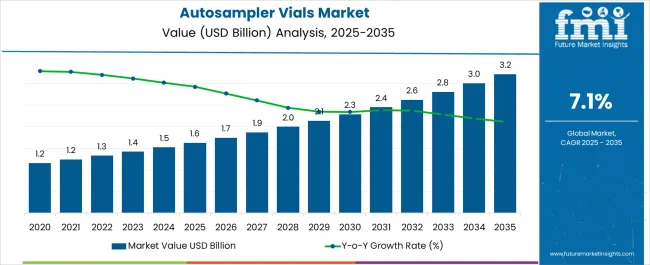
Autosampler Vials Market Key Takeaways
| Metric | Value |
|---|---|
| Autosampler Vials Market Estimated Value in (2025 E) | USD 1.6 billion |
| Autosampler Vials Market Forecast Value in (2035 F) | USD 3.2 billion |
| Forecast CAGR (2025 to 2035) | 7.1% |
Why is the Autosampler Vials Market Growing?
The Autosampler Vials market is witnessing steady growth, driven by the increasing adoption of automated laboratory equipment across pharmaceutical, biopharmaceutical, and chemical industries. Rising demand for precise and reproducible sample analysis in high-performance liquid chromatography and other analytical techniques is supporting market expansion. Technological advancements in vial design, including improved sealing mechanisms, contamination-free materials, and compatibility with automated systems, are enhancing efficiency and accuracy in laboratory operations.
Growing investments in research and development, coupled with increasing pharmaceutical production and quality control testing, are further fueling market adoption. The market is also being influenced by regulatory compliance requirements that mandate stringent sample handling and storage protocols, which make high-quality autosampler vials essential for analytical workflows.
As laboratories prioritize automation, efficiency, and reliability in testing processes, the Autosampler Vials market is expected to maintain sustained growth Increasing emphasis on laboratory standardization, sample integrity, and reproducibility is creating long-term opportunities across multiple sectors, including pharmaceuticals, biotechnology, and environmental testing.
Segmental Analysis
The autosampler vials market is segmented by product type, material type, end user, and geographic regions. By product type, autosampler vials market is divided into HPLC Autosampler Vials and GC Autosampler Vials. In terms of material type, autosampler vials market is classified into Glass Autosampler Vials, Deactivated Glass Autosampler Vials, Expansion Glass Autosampler Vials, and Polypropylene Plastic Autosampler Vials. Based on end user, autosampler vials market is segmented into Pharmaceutical And Biopharmaceutical Industry, Food And Beverage Industry, Oil And Gas Industry, Environmental Testing Industry, and Others. Regionally, the autosampler vials industry is classified into North America, Latin America, Western Europe, Eastern Europe, Balkan & Baltic Countries, Russia & Belarus, Central Asia, East Asia, South Asia & Pacific, and the Middle East & Africa.
Insights into the HPLC Autosampler Vials Product Type Segment
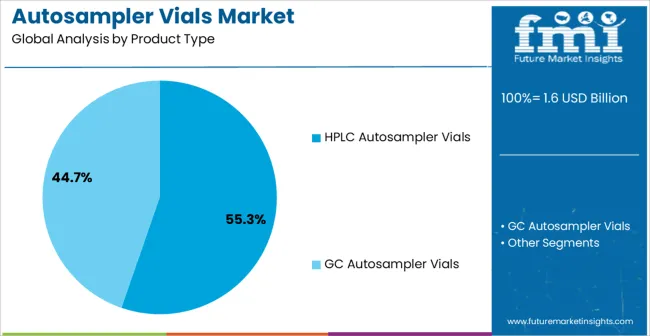
The HPLC autosampler vials segment is projected to hold 55.3% of the market revenue in 2025, establishing it as the leading product type. This dominance is driven by the segment’s critical role in high-performance liquid chromatography applications, which require precise and contamination-free sample handling for accurate analytical results. The design of HPLC autosampler vials allows compatibility with automated sampling systems, ensuring consistent injection volumes and minimizing human error.
Their widespread adoption is supported by increasing demand for quality control and analytical testing in pharmaceutical, biopharmaceutical, and chemical industries. Technological improvements, including optimized cap and septa materials and leak-resistant closures, enhance reliability and extend vial usability.
The ability to maintain sample integrity under varying laboratory conditions further reinforces the preference for HPLC autosampler vials As laboratories continue to prioritize efficiency, reproducibility, and automation in analytical workflows, this product type is expected to maintain its leadership, supported by ongoing innovations and growing adoption across multiple research and industrial applications.
Insights into the Glass Autosampler Vials Material Type Segment
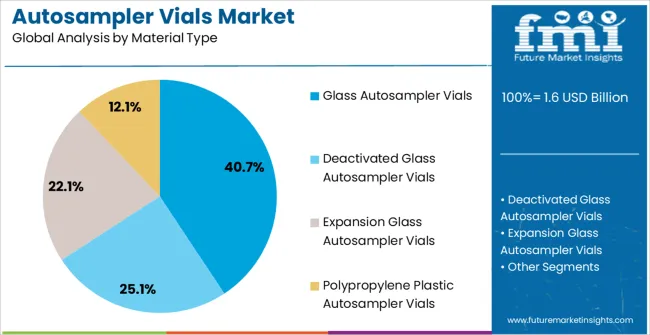
The glass autosampler vials segment is anticipated to account for 40.7% of the market revenue in 2025, making it the leading material type. Growth in this segment is driven by the inherent chemical inertness, transparency, and thermal stability of glass, which make it ideal for handling a wide range of liquid samples without contamination or reaction. Glass vials ensure compatibility with most automated sampling systems and analytical instruments, providing consistent results and minimizing interference with analytical measurements.
The material’s durability, resistance to solvents, and ability to withstand repeated cleaning and sterilization contribute to its preference among laboratories and pharmaceutical manufacturers. Increasing demand for high-precision analysis in quality control, research, and biopharmaceutical production further supports adoption.
Glass vials also facilitate visual inspection of sample clarity and volume, which is critical for laboratory workflows As the need for reliable, contamination-free, and high-performance sample containers continues to grow, the glass autosampler vials segment is expected to maintain its leading market position, supported by technological improvements and sustained demand from analytical laboratories worldwide.
Insights into the Pharmaceutical and Biopharmaceutical Industry End-User Segment
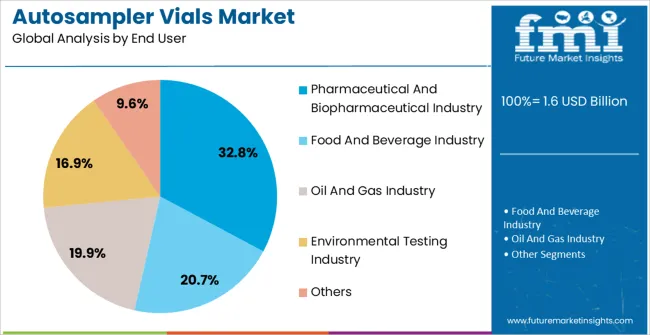
The pharmaceutical and biopharmaceutical industry segment is projected to hold 32.8% of the market revenue in 2025, establishing it as the leading end-user category. Growth in this segment is driven by the critical requirement for accurate, reproducible, and contamination-free sample handling in drug development, quality control, and clinical research applications. Autosampler vials enable high-throughput testing in HPLC and other analytical systems, supporting efficiency in large-scale pharmaceutical and biopharmaceutical operations.
The increasing focus on compliance with Good Laboratory Practice and other regulatory standards has reinforced the adoption of high-quality vials that maintain sample integrity. Advancements in automation and laboratory standardization have further enhanced operational efficiency and reduced human error, increasing reliance on autosampler vials in the sector.
As pharmaceutical and biopharmaceutical research continues to expand globally, the demand for reliable sample management solutions is expected to rise The segment’s emphasis on precision, safety, and reproducibility ensures sustained growth, with autosampler vials remaining a key component in analytical and quality control workflows.
Market Overview
Autosampler Vials: Market Insights
Autosampler vials are broadly used for performing analysis procedures in chromatography. These are essential commercial vials used within autosamplers so they must adhere strictly to specific dimensions. Autosampler vials are manufactured in a way that is compatible with all kind of autosampler systems.
Manufacturing procedures for autosampler vials are highly assured for quality and cleanliness as any contamination in their manufacturing and packaging would result in analytic errors in chromatographic procedures. Autosampler vials are majorly developed to be used in separation laboratories that are involved in impurities investigation, stability testing, and quantitation values and offer high-standard instruments.
These vials are made such that they do not interfere with the accuracy and precision of HPLC and GC procedures. They are made up of pharmaceutical packaging grade glass and are usually bought together with septa and vial caps to offer high-grade performance.
As autosampler vials are made with either glass or plastic, thus they have minimal impact on the processing of sensitive samples. The caps of autosampler vials are fitted with septa that do not allow any leakage from the autosampler under any condition. The autosampler vials must be operated following the appropriate regulations for safe use to ensure no errors in the chromatography procedures.
Autosampler vials commonly find applications in various industries that involve HPLC and GC techniques. They are available in various categories including screw thread vials, screw top vials, snap ring vials, crimp headspace vials, crimp top vials and others. Based on type autosampler vials are categorized into HPLC autosampler vials and GC vials which are further categorized into liquid autosampler vials, headspace autosampler vials and others.
However, based on the end user, they are utilized in the pharmaceutical and biopharmaceutical industry, food and beverage industry, oil and gas, environment testing laboratories and others. The rising demand for technologically advanced autosampler vials and the growing need for improved sample security and integrity are expected to drive revenue generation in the global autosampler vials market. They are manufactured via the most advanced techniques that are 100% automated.
There are several restraining factors associated with autosampler vials that would hamper the growth of the autosampler vials market. Some of these limiting factors include the money constraints of small-size market players in the autosampler vials industry.
However, with the increased advantage of autosamplers over conventional manual injection systems, the autosampler vials market registers robust growth. The Autosampler vials market offers products for various types of industries and is majorly utilized in performing HPLC tests for drug approvals.
Analysis of Autosampler Vials Market By Key Countries
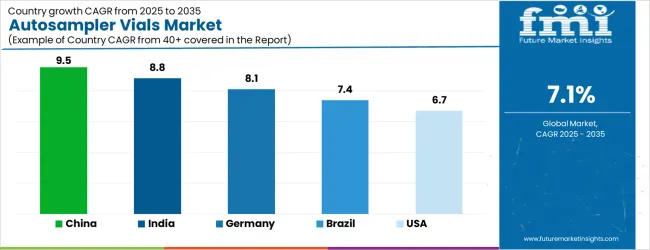
| Country | CAGR |
|---|---|
| China | 9.5% |
| India | 8.8% |
| Germany | 8.1% |
| Brazil | 7.4% |
| USA | 6.7% |
| UK | 6.0% |
| Japan | 5.3% |
Country-wise Analysis
The Autosampler Vials Market is expected to register a CAGR of 7.1% during the forecast period, exhibiting varied country level momentum. China leads with the highest CAGR of 9.5%, followed by India at 8.8%. Developed markets such as Germany, France, and the UK continue to expand steadily, while the USA is likely to grow at consistent rates. Japan posts the lowest CAGR at 5.3%, yet still underscores a broadly positive trajectory for the global Autosampler Vials Market. In 2024, Germany held a dominant revenue in the Western Europe market and is expected to grow with a CAGR of 8.1%. The USA Autosampler Vials Market is estimated to be valued at USD 607.9 million in 2025 and is anticipated to reach a valuation of USD 607.9 million by 2035. Sales are projected to rise at a CAGR of 0.0% over the forecast period between 2025 and 2035. While Japan and South Korea markets are estimated to be valued at USD 84.1 million and USD 46.4 million respectively in 2025.
Key Players in the Autosampler Vials Market
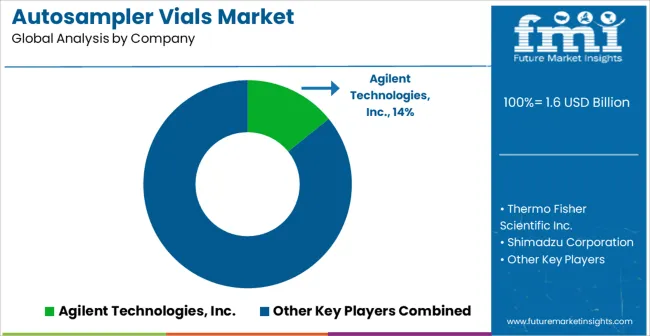
- Agilent Technologies, Inc.
- Thermo Fisher Scientific Inc.
- Shimadzu Corporation
- Waters Corporation
- PerkinElmer Inc.
- Bio-Rad Laboratories Inc.
- Gilson Inc.
- Restek Corporation
- Scion Instruments
- Tecan Group Ltd.
- HTA s.r.l.
- KNAUER Wissenschaftliche Geräte GmbH
- CTC Analytics AG
Scope of the Report
| Item | Value |
|---|---|
| Quantitative Units | USD 1.6 Billion |
| Product Type | HPLC Autosampler Vials and GC Autosampler Vials |
| Material Type | Glass Autosampler Vials, Deactivated Glass Autosampler Vials, Expansion Glass Autosampler Vials, and Polypropylene Plastic Autosampler Vials |
| End User | Pharmaceutical And Biopharmaceutical Industry, Food And Beverage Industry, Oil And Gas Industry, Environmental Testing Industry, and Others |
| Regions Covered | North America, Europe, Asia-Pacific, Latin America, Middle East & Africa |
| Country Covered | United States, Canada, Germany, France, United Kingdom, China, Japan, India, Brazil, South Africa |
| Key Companies Profiled | Agilent Technologies, Inc., Thermo Fisher Scientific Inc., Shimadzu Corporation, Waters Corporation, PerkinElmer Inc., Bio-Rad Laboratories Inc., Gilson Inc., Restek Corporation, Scion Instruments, Tecan Group Ltd., HTA s.r.l., KNAUER Wissenschaftliche Geräte GmbH, and CTC Analytics AG |
Autosampler Vials Market by Segments
Product Type:
- HPLC Autosampler Vials
- GC Autosampler Vials
Material Type:
- Glass Autosampler Vials
- Deactivated Glass Autosampler Vials
- Expansion Glass Autosampler Vials
- Polypropylene Plastic Autosampler Vials
End User:
- Pharmaceutical And Biopharmaceutical Industry
- Food And Beverage Industry
- Oil And Gas Industry
- Environmental Testing Industry
- Others
Region:
- North America
- USA
- Canada
- Mexico
- Latin America
- Brazil
- Chile
- Rest of Latin America
- Western Europe
- Germany
- UK
- Italy
- Spain
- France
- Nordic
- BENELUX
- Rest of Western Europe
- Eastern Europe
- Russia
- Poland
- Hungary
- Balkan & Baltic
- Rest of Eastern Europe
- East Asia
- China
- Japan
- South Korea
- South Asia and Pacific
- India
- ASEAN
- Australia & New Zealand
- Rest of South Asia and Pacific
- Middle East & Africa
- Kingdom of Saudi Arabia
- Other GCC Countries
- Turkiye
- South Africa
- Other African Union
- Rest of Middle East & Africa
Frequently Asked Questions
How big is the autosampler vials market in 2025?
The global autosampler vials market is estimated to be valued at USD 1.6 billion in 2025.
What will be the size of autosampler vials market in 2035?
The market size for the autosampler vials market is projected to reach USD 3.2 billion by 2035.
How much will be the autosampler vials market growth between 2025 and 2035?
The autosampler vials market is expected to grow at a 7.1% CAGR between 2025 and 2035.
What are the key product types in the autosampler vials market?
The key product types in autosampler vials market are hplc autosampler vials and gc autosampler vials.
Which material type segment to contribute significant share in the autosampler vials market in 2025?
In terms of material type, glass autosampler vials segment to command 40.7% share in the autosampler vials market in 2025.
Preview the report firsthand - request a free sample
Get SampleGet the brochure for pricing and purchase details.
Get PDFTable of Content
- Executive Summary
- Global Market Outlook
- Demand-side Trends
- Supply-side Trends
- Technology Roadmap Analysis
- Analysis and Recommendations
- Market Overview
- Market Coverage / Taxonomy
- Market Definition / Scope / Limitations
- Market Background
- Market Dynamics
- Drivers
- Restraints
- Opportunity
- Trends
- Scenario Forecast
- Demand in Optimistic Scenario
- Demand in Likely Scenario
- Demand in Conservative Scenario
- Opportunity Map Analysis
- Product Life Cycle Analysis
- Supply Chain Analysis
- Investment Feasibility Matrix
- Value Chain Analysis
- PESTLE and Porter’s Analysis
- Regulatory Landscape
- Regional Parent Market Outlook
- Production and Consumption Statistics
- Import and Export Statistics
- Market Dynamics
- Global Market Analysis 2020 to 2024 and Forecast, 2025 to 2035
- Historical Market Size Value (USD Million) Analysis, 2020 to 2024
- Current and Future Market Size Value (USD Million) Projections, 2025 to 2035
- Y-o-Y Growth Trend Analysis
- Absolute $ Opportunity Analysis
- Global Market Pricing Analysis 2020 to 2024 and Forecast 2025 to 2035
- Global Market Analysis 2020 to 2024 and Forecast 2025 to 2035, By Product Type
- Introduction / Key Findings
- Historical Market Size Value (USD Million) Analysis By Product Type , 2020 to 2024
- Current and Future Market Size Value (USD Million) Analysis and Forecast By Product Type , 2025 to 2035
- HPLC
- GC
- Y-o-Y Growth Trend Analysis By Product Type , 2020 to 2024
- Absolute $ Opportunity Analysis By Product Type , 2025 to 2035
- Global Market Analysis 2020 to 2024 and Forecast 2025 to 2035, By Material Type
- Introduction / Key Findings
- Historical Market Size Value (USD Million) Analysis By Material Type, 2020 to 2024
- Current and Future Market Size Value (USD Million) Analysis and Forecast By Material Type, 2025 to 2035
- Glass
- Deactivated Glass
- Expansion Glass
- Polypropylene Plastic
- Y-o-Y Growth Trend Analysis By Material Type, 2020 to 2024
- Absolute $ Opportunity Analysis By Material Type, 2025 to 2035
- Global Market Analysis 2020 to 2024 and Forecast 2025 to 2035, By End User
- Introduction / Key Findings
- Historical Market Size Value (USD Million) Analysis By End User, 2020 to 2024
- Current and Future Market Size Value (USD Million) Analysis and Forecast By End User, 2025 to 2035
- Pharmaceutical And Biopharmaceutical Industry
- Food And Beverage Industry
- Oil And Gas Industry
- Environmental Testing Industry
- Others
- Y-o-Y Growth Trend Analysis By End User, 2020 to 2024
- Absolute $ Opportunity Analysis By End User, 2025 to 2035
- Global Market Analysis 2020 to 2024 and Forecast 2025 to 2035, By Region
- Introduction
- Historical Market Size Value (USD Million) Analysis By Region, 2020 to 2024
- Current Market Size Value (USD Million) Analysis and Forecast By Region, 2025 to 2035
- North America
- Latin America
- Western Europe
- Eastern Europe
- East Asia
- South Asia and Pacific
- Middle East & Africa
- Market Attractiveness Analysis By Region
- North America Market Analysis 2020 to 2024 and Forecast 2025 to 2035, By Country
- Historical Market Size Value (USD Million) Trend Analysis By Market Taxonomy, 2020 to 2024
- Market Size Value (USD Million) Forecast By Market Taxonomy, 2025 to 2035
- By Country
- USA
- Canada
- Mexico
- By Product Type
- By Material Type
- By End User
- By Country
- Market Attractiveness Analysis
- By Country
- By Product Type
- By Material Type
- By End User
- Key Takeaways
- Latin America Market Analysis 2020 to 2024 and Forecast 2025 to 2035, By Country
- Historical Market Size Value (USD Million) Trend Analysis By Market Taxonomy, 2020 to 2024
- Market Size Value (USD Million) Forecast By Market Taxonomy, 2025 to 2035
- By Country
- Brazil
- Chile
- Rest of Latin America
- By Product Type
- By Material Type
- By End User
- By Country
- Market Attractiveness Analysis
- By Country
- By Product Type
- By Material Type
- By End User
- Key Takeaways
- Western Europe Market Analysis 2020 to 2024 and Forecast 2025 to 2035, By Country
- Historical Market Size Value (USD Million) Trend Analysis By Market Taxonomy, 2020 to 2024
- Market Size Value (USD Million) Forecast By Market Taxonomy, 2025 to 2035
- By Country
- Germany
- UK
- Italy
- Spain
- France
- Nordic
- BENELUX
- Rest of Western Europe
- By Product Type
- By Material Type
- By End User
- By Country
- Market Attractiveness Analysis
- By Country
- By Product Type
- By Material Type
- By End User
- Key Takeaways
- Eastern Europe Market Analysis 2020 to 2024 and Forecast 2025 to 2035, By Country
- Historical Market Size Value (USD Million) Trend Analysis By Market Taxonomy, 2020 to 2024
- Market Size Value (USD Million) Forecast By Market Taxonomy, 2025 to 2035
- By Country
- Russia
- Poland
- Hungary
- Balkan & Baltic
- Rest of Eastern Europe
- By Product Type
- By Material Type
- By End User
- By Country
- Market Attractiveness Analysis
- By Country
- By Product Type
- By Material Type
- By End User
- Key Takeaways
- East Asia Market Analysis 2020 to 2024 and Forecast 2025 to 2035, By Country
- Historical Market Size Value (USD Million) Trend Analysis By Market Taxonomy, 2020 to 2024
- Market Size Value (USD Million) Forecast By Market Taxonomy, 2025 to 2035
- By Country
- China
- Japan
- South Korea
- By Product Type
- By Material Type
- By End User
- By Country
- Market Attractiveness Analysis
- By Country
- By Product Type
- By Material Type
- By End User
- Key Takeaways
- South Asia and Pacific Market Analysis 2020 to 2024 and Forecast 2025 to 2035, By Country
- Historical Market Size Value (USD Million) Trend Analysis By Market Taxonomy, 2020 to 2024
- Market Size Value (USD Million) Forecast By Market Taxonomy, 2025 to 2035
- By Country
- India
- ASEAN
- Australia & New Zealand
- Rest of South Asia and Pacific
- By Product Type
- By Material Type
- By End User
- By Country
- Market Attractiveness Analysis
- By Country
- By Product Type
- By Material Type
- By End User
- Key Takeaways
- Middle East & Africa Market Analysis 2020 to 2024 and Forecast 2025 to 2035, By Country
- Historical Market Size Value (USD Million) Trend Analysis By Market Taxonomy, 2020 to 2024
- Market Size Value (USD Million) Forecast By Market Taxonomy, 2025 to 2035
- By Country
- Kingdom of Saudi Arabia
- Other GCC Countries
- Turkiye
- South Africa
- Other African Union
- Rest of Middle East & Africa
- By Product Type
- By Material Type
- By End User
- By Country
- Market Attractiveness Analysis
- By Country
- By Product Type
- By Material Type
- By End User
- Key Takeaways
- Key Countries Market Analysis
- USA
- Pricing Analysis
- Market Share Analysis, 2024
- By Product Type
- By Material Type
- By End User
- Canada
- Pricing Analysis
- Market Share Analysis, 2024
- By Product Type
- By Material Type
- By End User
- Mexico
- Pricing Analysis
- Market Share Analysis, 2024
- By Product Type
- By Material Type
- By End User
- Brazil
- Pricing Analysis
- Market Share Analysis, 2024
- By Product Type
- By Material Type
- By End User
- Chile
- Pricing Analysis
- Market Share Analysis, 2024
- By Product Type
- By Material Type
- By End User
- Germany
- Pricing Analysis
- Market Share Analysis, 2024
- By Product Type
- By Material Type
- By End User
- UK
- Pricing Analysis
- Market Share Analysis, 2024
- By Product Type
- By Material Type
- By End User
- Italy
- Pricing Analysis
- Market Share Analysis, 2024
- By Product Type
- By Material Type
- By End User
- Spain
- Pricing Analysis
- Market Share Analysis, 2024
- By Product Type
- By Material Type
- By End User
- France
- Pricing Analysis
- Market Share Analysis, 2024
- By Product Type
- By Material Type
- By End User
- India
- Pricing Analysis
- Market Share Analysis, 2024
- By Product Type
- By Material Type
- By End User
- ASEAN
- Pricing Analysis
- Market Share Analysis, 2024
- By Product Type
- By Material Type
- By End User
- Australia & New Zealand
- Pricing Analysis
- Market Share Analysis, 2024
- By Product Type
- By Material Type
- By End User
- China
- Pricing Analysis
- Market Share Analysis, 2024
- By Product Type
- By Material Type
- By End User
- Japan
- Pricing Analysis
- Market Share Analysis, 2024
- By Product Type
- By Material Type
- By End User
- South Korea
- Pricing Analysis
- Market Share Analysis, 2024
- By Product Type
- By Material Type
- By End User
- Russia
- Pricing Analysis
- Market Share Analysis, 2024
- By Product Type
- By Material Type
- By End User
- Poland
- Pricing Analysis
- Market Share Analysis, 2024
- By Product Type
- By Material Type
- By End User
- Hungary
- Pricing Analysis
- Market Share Analysis, 2024
- By Product Type
- By Material Type
- By End User
- Kingdom of Saudi Arabia
- Pricing Analysis
- Market Share Analysis, 2024
- By Product Type
- By Material Type
- By End User
- Turkiye
- Pricing Analysis
- Market Share Analysis, 2024
- By Product Type
- By Material Type
- By End User
- South Africa
- Pricing Analysis
- Market Share Analysis, 2024
- By Product Type
- By Material Type
- By End User
- USA
- Market Structure Analysis
- Competition Dashboard
- Competition Benchmarking
- Market Share Analysis of Top Players
- By Regional
- By Product Type
- By Material Type
- By End User
- Competition Analysis
- Competition Deep Dive
- Agilent Technologies, Inc.
- Overview
- Product Portfolio
- Profitability by Market Segments (Product/Age /Sales Channel/Region)
- Sales Footprint
- Strategy Overview
- Marketing Strategy
- Product Strategy
- Channel Strategy
- Thermo Fisher Scientific Inc.
- Shimadzu Corporation
- Waters Corporation
- PerkinElmer Inc.
- Bio-Rad Laboratories Inc.
- Gilson Inc.
- Restek Corporation
- Scion Instruments
- Tecan Group Ltd.
- HTA s.r.l.
- KNAUER Wissenschaftliche Geräte GmbH
- CTC Analytics AG
- Agilent Technologies, Inc.
- Competition Deep Dive
- Assumptions & Acronyms Used
- Research Methodology


