

- Market Size (2026)
- USD 515.4 Mn
- Forecast (2036)
- USD 839.5 Mn
- CAGR (2026 to 2036)
- 5.0%
How big is Axial Joints Market in 2026?
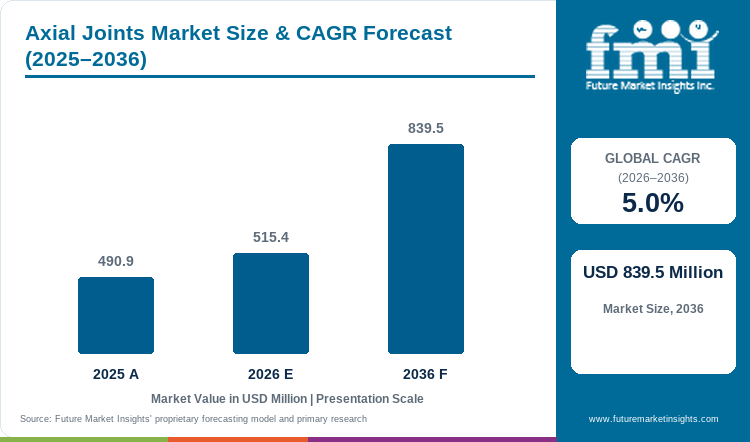
USD 515.4 Million in 2026 and USD 839.5 Million by 2036 at a 5.0% CAGR.
Sales of axial joints are estimated to grow at 5.0% from 2026 to 2036, increasing from USD 490.9 million in 2025 to USD 515.4 million in 2026 and reaching USD 839.5 million by 2036. Demand continues well beyond the vehicle production cycle because axial joints wear during use. Movement inside the joint, damage to the protective boot and gradual increase in clearance can all lead to replacement. This gives the market a steady service component across steering systems and industrial linkages.
The growth mechanism differs by country. Mature vehicle markets generate recurring replacement demand, while manufacturing hubs add OEM orders from new platforms. Exact fitment matters because joint length, thread dimensions and articulation affect steering geometry. This keeps axial joints closely connected with the wider automotive steering system supply chain. Germany combines a large passenger-car base with demanding repair specifications. Mexico is more closely tied to assembly activity and a high light-truck mix. Brazil adds a sizeable repair market where vehicle owners often keep cars in service for longer. Suppliers therefore need both platform coverage and reliable replacement availability.
Key Takeaways
- Axial-joint demand is sustained by wear and repair cycles across steering systems, vehicle linkages and industrial motion assemblies.
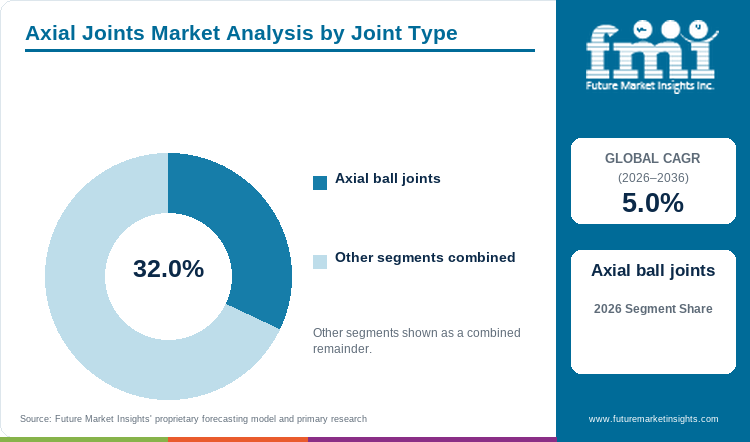
- Axial ball joints are projected to lead Joint Type with 32.0% share in 2026 because the architecture combines axial force transfer with angular articulation.
- Passenger vehicles account for 34.0% of Vehicle / Equipment demand in 2026, supported by broad OEM fitment and a large downstream repair base.
- Forged steel holds 49.0% of Material demand in 2026, reflecting the need for strength and fatigue resistance in safety-sensitive load paths.
- Fitment precision and the alignment work associated with steering repairs remain important restraints on low-cost substitution.
- ZF Friedrichshafen, Schaeffler, SKF, Mevotech, MOOG / DRiV, Febi Bilstein, TRW Aftermarket, CTR, Delphi Technologies and Lemförder are notable participants.
Analyst Perspective
"Axial-joint revenue is won at the fitment level. A large catalogue has limited value when thread geometry, joint length or material treatment does not match the vehicle or machine. Suppliers that connect accurate application data with durable joint construction and workshop-ready replacement packages will capture more of the recurring service opportunity."
- Nikhil Kaitwade, Principal Consultant, Future Market Insights
How is the axial joints market segmented?
The axial joints market is segmented by Joint Type, Vehicle / Equipment, Material, Sales Channel, Application and Region.
The market is segmented by Joint Type into Axial ball joints, Inner tie rod joints, Rod-end axial joints, Heavy-duty axial joints and Precision linkage joints. Vehicle / Equipment covers Passenger vehicles, Commercial vehicles, Off-highway equipment, Industrial linkages and Agricultural machinery. Material includes Forged steel, Stainless steel, Aluminum alloy and Polymer-lined / hybrid designs. Sales Channel includes OEM supply, Aftermarket distributors, MRO / repair shops and Industrial distributors. Application covers Steering systems, Suspension linkages, Control rods and Industrial motion assemblies.
Why do Axial ball joints lead demand within the Joint Type category?
Axial ball joints are widely used because they can carry force along the linkage while still allowing the connection to move through a limited angle. This is important in rack-and-pinion steering, where the inner joint must follow tie-rod movement without becoming loose. The same design principle is useful in industrial linkages where a rigid connection would restrict motion. Their role is therefore tied directly to how the mechanism works, not simply to part standardization.
- Axial ball joints are projected to hold 32.0% of Joint Type demand in 2026.
- Replacement selection depends on matching joint length, thread geometry, allowable articulation and the load path of the original assembly.
Why do Passenger vehicles lead demand within the Vehicle / Equipment category?
Passenger vehicles create demand at two points: during vehicle production and later during repair. Even similar-looking joints can differ by thread size, overall length, housing shape and allowable movement. Once vehicles enter service, wear in the socket or damage to the boot can create replacement demand for many years. This gives suppliers a large number of model-specific applications across both OEM and independent repair channels.
- Passenger vehicles are forecast to account for 34.0% of Vehicle / Equipment demand in 2026.
- Commercial and off-highway equipment can place higher loads on individual joints, but passenger vehicles create a larger number of model-specific replacement opportunities.
Why does Forged steel lead demand within the Material category?
Forged steel suits the repeated pulling and pushing forces handled by steering-side axial joints. The joint must remain strong while keeping clearance low at the moving interface. Proper forging and heat treatment help the component resist fatigue over long service periods. This makes material quality central to joint life. The same need for controlled material properties is visible in the wider bearing steel value chain.
- Forged steel is projected to hold 49.0% of Material demand in 2026.
- Stainless steel and hybrid designs can address corrosion or weight requirements, but forged steel remains well suited to high-load steering and linkage duty.
Why does OEM supply lead demand within the Sales Channel category?
OEM suppliers work with the component before the vehicle reaches production. They receive platform dimensions, load requirements and material specifications early in the development cycle. This matters because an axial joint cannot be selected from thread size alone. Overall length, housing design and articulation all affect how the steering system behaves. Suppliers that enter at this stage can later use the same fitment knowledge when replacement demand develops.
- OEM supply is forecast to hold 38.0% of Sales Channel demand in 2026.
- Aftermarket distributors remain commercially important once the installed fleet enters recurring repair cycles, a pattern also visible in the broader automotive bearing and clutch component aftermarket.
Why do Steering systems lead demand within the Application category?
Steering systems are the clearest use case for automotive axial joints. The inner joint connects the steering rack to the tie rod and passes steering force toward the wheel. When wear develops, the result can be poor alignment, looseness or reduced handling accuracy. Industrial motion systems also use axial joints, but steering creates the most established combination of fitment, safety and replacement demand.
- Steering systems are projected to hold 43.0% of Application demand in 2026.
- Replacement can require subsequent toe and steering-angle correction, making installation quality part of the total service economics.
What are the drivers, restraints and opportunities in the Axial Joints Market?
Installed fleets create recurring replacement demand, fitment and alignment requirements restrain substitution, and newer vehicle plus industrial applications create room for application-specific joint packages.
- Driver: Aging vehicle and equipment populations continue to generate replacement demand when steering play, damaged boots or linkage wear require corrective maintenance.
- Restraint: Fitment precision and post-installation alignment increase the cost of choosing or replacing an axial joint incorrectly.
- Opportunity: Application-specific kits, faster new-platform coverage and durable designs for high-use vehicles can improve repair economics for workshops and fleet operators.
Fleet wear turns installed vehicles into recurring replacement demand
Demand continues after a vehicle or machine leaves the factory. Every unit in service becomes part of a future repair pool as joints wear, protective boots deteriorate or impact damage develops. This is especially important in steering and the wider automotive suspension system, where workshops usually replace individual worn components instead of the full system. Suppliers gain more value when their application coverage extends across older model years and when related hardware is available with the joint.
Fitment and alignment make a low-cost substitution expensive when it fails
A cheaper joint can become costly if the dimensions are wrong. Incorrect length can change steering geometry, while the wrong thread or housing can stop installation entirely. Even the correct part may still require wheel alignment after replacement. Workshops therefore look beyond the purchase price and consider labor time, returns, rework and the risk of a customer coming back with the same problem.
Repair-ready kits create value beyond the joint itself
A complete repair package can reduce workshop effort. When the correct joint is supplied with the required hardware, corrosion protection and clear application information, technicians spend less time searching for separate parts or resolving fitment issues. This matters most in high-mileage fleets and heavily used vehicles, where avoiding repeat repairs has a clear economic benefit.
Which country CAGRs are profiled in the Axial Joints Market?
| Country | CAGR |
|---|---|
| USA | 4.5% |
| Germany | 4.9% |
| Japan | 3.9% |
| Mexico | 5.2% |
| Brazil | 5.6% |
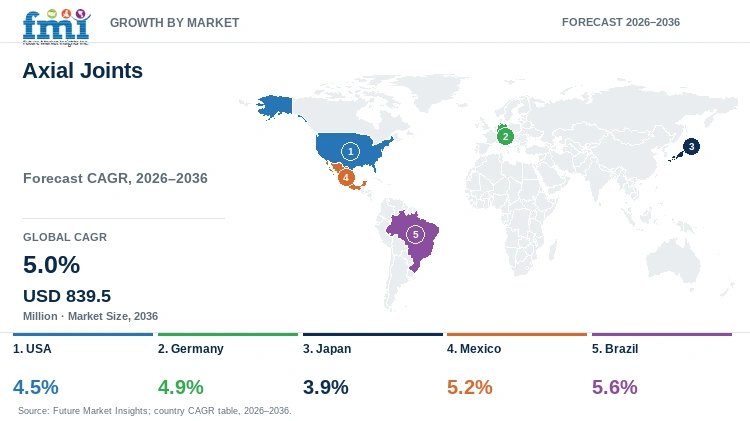
The profiled country CAGRs cover the 2026 to 2036 forecast period.
How do country-level CAGRs compare in the Axial Joints Market?
Brazil records the highest profiled CAGR at 5.6%, followed by Mexico at 5.2% and Germany at 4.9%. USA is projected at 4.5% while Japan records 3.9%. The 1.7 percentage-point spread reflects different market structures rather than a simple difference in demand strength. Brazil and Mexico benefit from a stronger production and replacement mix, while Germany, USA and Japan have more mature installed fleets.
- Brazil exceeds Mexico by 0.4 percentage points, with domestic production and replacement demand operating together.
- Mexico sits 0.3 percentage points above Germany as its assembly-oriented market creates a stronger link to OEM program timing.
- Germany exceeds USA by 0.4 percentage points, although the commercial routes differ between specification-intensive European repair and the broader North American installed base.
- USA exceeds Japan by 0.6 percentage points, with a larger repair-driven opportunity across numerous vehicle applications.
- Japan's 3.9% CAGR reflects a mature automotive environment where application precision carries more commercial weight than rapid unit expansion.
Growth rate alone does not decide which country offers the best commercial opportunity. A mature market can still generate strong replacement revenue if the vehicle base is large and parts move regularly through workshops. Supplier priorities therefore depend on inventory turnover, application coverage and the structure of local repair channels as much as on CAGR.
Country-wise Analysis
- USA: Axial-joint demand in USA is forecast to expand at 4.5% CAGR from 2026 to 2036. The market is supported by a large vehicle parc and a well-developed independent repair network. ZF reported in July 2025 that its TRW chassis expansion added coverage for about 54 million vehicles in operation across the USA and Canada. That scale makes fitment accuracy important because one application error can affect many model years. Axial joints also compete for workshop attention alongside other wear parts in the automotive wheel bearing aftermarket.
- Germany: Demand in Germany is projected to rise at 4.9% CAGR through 2036. Destatis recorded 49.339 million passenger cars in stock on January 1, 2025, giving suppliers a large replacement base alongside domestic OEM demand. German repair channels place strong emphasis on correct dimensions and specification matching. Suppliers therefore need precise application data and consistent materials to maintain workshop confidence.
- Japan: Axial-joint demand in Japan is forecast to expand at 3.9% CAGR. The market includes a wide mix of passenger cars, mini vehicles and commercial applications supported by a mature domestic manufacturing base. Growth is slower than in Brazil or Mexico, but technical expectations remain high. Suppliers need accurate model coverage and dependable product consistency across a fragmented vehicle mix.
- Mexico: Demand in Mexico is projected to rise at 5.2% CAGR. INEGI reported 1.996 million light vehicles produced during the first half of 2026, with light trucks representing 79.6% of output. This gives the market a stronger OEM and production-linked character than many mature replacement markets. The light-truck mix also increases the importance of components designed for higher loads and demanding use.
- Brazil: Brazil is forecast to expand at 5.6% CAGR, the highest rate among the profiled countries. ANFAVEA reported 2.644 million vehicles produced in 2025, up 3.5%, while exports rose 32.1%. High financing costs can encourage owners to keep vehicles longer rather than replace them. That supports demand for durable steering repairs, especially when a lower-cost component replacement can extend vehicle life.
Who are the notable companies in the Axial Joints Market?
ZF Friedrichshafen, Schaeffler, SKF, Mevotech, MOOG / DRiV, Febi Bilstein, TRW Aftermarket, CTR, Delphi Technologies and Lemförder are notable companies serving the axial joints market.
Competition depends on where a supplier sits in the vehicle lifecycle. OE-linked companies work from platform specifications and validation requirements. Aftermarket brands compete for workshop and distributor demand through fitment coverage, installation support and stock availability. Catalogue-led suppliers need broad application coverage, but they also need to avoid errors that lead to returns or warranty claims.
- ZF Friedrichshafen, Schaeffler, SKF and Lemförder combine chassis or steering engineering with OE-linked product development.
- Mevotech, MOOG / DRiV, TRW Aftermarket and Febi Bilstein emphasize workshop-oriented steering and suspension replacement.
- CTR and Delphi Technologies compete through broad application coverage and steering-component catalogues.
Competitive Benchmarking: Axial Joints Market
| Company | Axial Joint / Inner Tie Rod Coverage | OE-Spec Materials & Validation | Workshop / Repair Support | Geographic Reach |
|---|---|---|---|---|
| ZF Friedrichshafen | High | High | High | Europe, North America and Asia |
| Schaeffler | Medium | High | Unscored | Europe and international vehicle-lifetime markets |
| SKF | High | High | High | Europe, North America and Asia-Pacific |
| Mevotech | High | High | High | USA and Canada |
| MOOG / DRiV | High | High | High | North America, Europe and selected Asia-Pacific markets |
| Febi Bilstein | High | High | High | Europe and broad international aftermarket distribution |
| TRW Aftermarket | High | High | High | North America, Europe and other ZF Aftermarket markets |
| CTR | High | Medium | Unscored | Asia, North America and Europe |
| Delphi Technologies | High | High | High | North America, Europe and Asia-Pacific |
| Lemförder | High | High | High | Europe, North America and Asia |
Scoring basis: Axial Joint / Inner Tie Rod Coverage reflects the breadth of directly relevant product applications. OE-Spec Materials & Validation reflects vehicle-specific engineering, material control and testing against original-equipment requirements. Workshop / Repair Support covers installation guidance, included hardware, technical information and service-oriented product design. High indicates broad capability across the stated criterion, Medium indicates a narrower position and Unscored indicates that no rating is assigned for that criterion.
Key Developments in the Axial Joints Market
- In July 2025, ZF Aftermarket expanded the TRW chassis portfolio in North America. The additions included control-arm and tie-rod assemblies and related chassis components, extending coverage to around 54 million additional vehicles in operation across the USA and Canada.
- In April 2025, Mevotech announced 193 new steering, suspension and wheel-hub part numbers, including 58 first-to-market applications. The release expanded replacement coverage across a large USA and Canadian vehicle population.
- In November 2025, Delphi launched its Professional+ steering and suspension line for fleet and working vehicles. The range includes tie-rod ends alongside ball joints and other chassis components intended for demanding operating conditions.
Key Players in the Axial Joints Market
OE-linked chassis and steering engineering
- ZF Friedrichshafen
- Schaeffler
- SKF
- Lemförder
Repair-focused steering aftermarket platforms
- Mevotech
- MOOG / DRiV
- TRW Aftermarket
- Febi Bilstein
Application-coverage and fitment specialists
- CTR
- Delphi Technologies
Axial Joints Market - Report Scope
| Coverage field | Report scope |
|---|---|
| Market breakdown | Joint Type; Vehicle / Equipment; Material; Sales Channel; Application; Region |
| Quantitative Units | USD Million |
| Market Definition | Revenue includes standalone axial joints, axial ball joints, inner tie rod joints and related rod-end or precision axial joints sold for steering, linkage and motion-control use across the stated segmentation universe. It excludes finished steering racks or suspension systems, complete vehicles or machines and adjacent joint products sold outside the axial-joint boundary. |
| Regions Covered | North America; Latin America; Western Europe; Eastern Europe; East Asia; South Asia and Pacific; Middle East and Africa |
| Countries Covered | USA, Germany, Japan, Mexico, Brazil and more than twenty-five additional countries in the full report |
| Key Companies Profiled | ZF Friedrichshafen; Schaeffler; SKF; Mevotech; MOOG / DRiV; Febi Bilstein; TRW Aftermarket; CTR; Delphi Technologies; Lemförder |
| Forecast Period | 2026 to 2036 |
| Approach | Hybrid bottom-up and top-down market sizing using application mapping, channel assessment, industry indicators and company information |
Axial Joints Market - Research Methodology
| Method | Approach |
|---|---|
| Primary Research | Discussions with steering and chassis suppliers, distributors, repair professionals, equipment manufacturers, procurement teams and technical specialists assess replacement triggers, fitment requirements and purchasing behavior. |
| Desk Research | Industry statistics, company documentation, vehicle-production information, technical publications and relevant product information are used to evaluate market conditions and operating mechanisms. |
| Market Sizing and Forecasting | Demand is mapped against vehicle and equipment populations, OEM production, replacement cycles, application structure, material mix and sales-channel behavior. |
| Data Validation | Findings are cross-checked across source types and assessed against the defined market boundary before the forecast narrative and market structure are finalized. |
Axial Joints Market by Segments
Axial Joints Market segmented by Joint Type:
- Axial ball joints
- Inner tie rod joints
- Rod-end axial joints
- Heavy-duty axial joints
- Precision linkage joints
Axial Joints Market segmented by Vehicle / Equipment:
- Passenger vehicles
- Commercial vehicles
- Off-highway equipment
- Industrial linkages
- Agricultural machinery
Axial Joints Market segmented by Material:
- Forged steel
- Stainless steel
- Aluminum alloy
- Polymer-lined / hybrid
Axial Joints Market segmented by Sales Channel:
- OEM supply
- Aftermarket distributors
- MRO / repair shops
- Industrial distributors
Axial Joints Market segmented by Application:
- Steering systems
- Suspension linkages
- Control rods
- Industrial motion assemblies
Axial Joints Market by Region
- North America
- United States
- Canada
- Latin America
- Brazil
- Mexico
- Argentina
- Chile
- Western Europe
- Germany
- France
- United Kingdom
- Italy
- Spain
- Benelux
- Nordics
- Eastern Europe
- Poland
- Czech Republic
- Romania
- Hungary
- East Asia
- China
- Japan
- South Korea
- South Asia and Pacific
- India
- ASEAN
- Australia and New Zealand
- Middle East and Africa
- GCC Countries
- South Africa
- Türkiye
- Israel
Research Sources and Bibliography
- Federal Highway Administration (2026). Highway Statistics 2024, Table VM-1: Annual Vehicle Distance Traveled in Miles and Related Data.
- Statistisches Bundesamt (Destatis) (2026, March 23). Bestand an Kraftfahrzeugen und Schienenfahrzeugen für die Jahre 2021 bis 2025.
- Japan Automobile Manufacturers Association (2025). The Motor Industry of Japan 2025.
- Instituto Nacional de Estadística y Geografía (INEGI) (2026, July 7). Registro administrativo de la industria automotriz de vehículos ligeros. Junio de 2026.
- Associação Nacional dos Fabricantes de Veículos Automotores (ANFAVEA) (2026, January 15). Produção e venda de autoveículos crescem em 2025 e Anfavea projeta nova alta em 2026.
- National Highway Traffic Safety Administration (2024, June 28). Recall 24V-467: Loss of Steering Control from Tie Rod Failure.
- Nissan Group of the Americas / NHTSA (2024, June 17). NTB23-078B: 2020-2022 Sentra; Inner Tie Rod Voluntary Safety Recall Campaign.
- ZF Aftermarket (2024, March 13). ZF Aftermarket: New Lemförder Chassis Parts for Electric Vehicles.
- ZF Aftermarket (2025, July 22). ZF Aftermarket Expands TRW Chassis Line, Extending NA Coverage to an Additional 54 Million Vehicles in Operation in 2025.
- Mevotech (2024, August 7). Mevotech Releases 158 New Part Numbers: Expanding Coverage with More Engineered Solutions.
- SKF Automotive (2023, January 16). Leaders in Safety and Comfort: SKF Introduces New Steering & Suspension Product Range Equipped with High-Performance Synthetic Grease.
- Delphi Technologies (2022, July 13). Steering Tie Rod Ends and Inner Tie Rods Fact Sheet.
- CTR (2024, December). New Items: Steering & Suspension Parts, December 2024.
- Ferdinand Bilstein GmbH + Co. KG (2021, November). Steering You Through Life with febi Steering & Suspension.
- MOOG / DRiV (2015, October 14). Federal-Mogul Motorparts Expands MOOG Steering and Suspension Line.
This bibliography is provided for reader reference and is not exhaustive. The full report contains the complete reference list and detailed citations.
This Report Answers
- What is the Axial Joints Market size in 2026 and what value is forecast by 2036?
- Why do Axial ball joints lead the Joint Type category?
- Why do Passenger vehicles represent the largest Vehicle / Equipment segment?
- Why does Forged steel hold the leading position within Material?
- What creates recurring replacement demand for axial joints?
- How do axial-joint growth rates compare across USA, Germany, Japan, Mexico and Brazil?
- Which companies compete through OE engineering, aftermarket execution and fitment coverage?
- What should procurement teams evaluate before specifying or replacing an axial joint?
Frequently Asked Questions
How big is the Axial Joints Market in 2026?
The Axial Joints Market is valued at USD 515.4 million in 2026 and is projected to reach USD 839.5 million by 2036.
What is the CAGR of the Axial Joints Market from 2026 to 2036?
Demand is forecast to grow at a 5.0% CAGR between 2026 and 2036.
Which Joint Type leads the Axial Joints Market?
Axial ball joints are projected to lead Joint Type with 32.0% share in 2026 because they transfer axial force while accommodating controlled angular movement.
Which country has the highest profiled CAGR in the Axial Joints Market?
Brazil has the highest profiled CAGR at 5.6% from 2026 to 2036, followed by Mexico at 5.2%.
Which companies are active in the Axial Joints Market?
Notable companies include ZF Friedrichshafen, Schaeffler, SKF, Mevotech, MOOG / DRiV, Febi Bilstein, TRW Aftermarket, CTR, Delphi Technologies and Lemförder.
Preview the report firsthand - request a free sample
Get SampleGet the brochure for pricing and purchase details.
Get PDFTable of Content
- Key Takeaways
- Market Size and CAGR
- Top Growth Driver
- Fastest Growing Segment
- Leading Region
- Key Companies
- Emerging Opportunities
- Executive Summary
- Global Market Outlook
- Demand-side Trends
- Supply-side Trends
- Technology Roadmap Analysis
- Analysis and Recommendations
- Analyst Perspective (What is happening? Why now? What should investors know?)
- Key Questions Answered
- How large is the market?
- What is the CAGR?
- What are key trends?
- Which region dominates?
- Who are the leaders?
- Market Overview
- Market Coverage / Taxonomy
- Market Definition / Scope / Limitations
- Research Methodology
- Chapter Orientation
- Analytical Lens and Working Hypotheses
- Market Structure, Signals, and Trend Drivers
- Benchmarking and Cross-market Comparability
- Market Sizing, Forecasting, and Opportunity Mapping
- Research Design and Evidence Framework
- Desk Research Programme (Secondary Evidence)
- Expert Input and Fieldwork (Primary Evidence)
- Tooling, Models, and Reference Databases
- Data Engineering and Model Build
- Quality Assurance and Audit Trail
- Market Background
- Market Dynamics (Drivers, Restraints, Opportunity, Trends)
- Scenario Forecast (Optimistic, Likely, Conservative)
- Impact Analysis
- AI Impact
- Sustainability Impact
- Regulatory Impact
- Technology Impact
- Consumer / Buyer Analysis
- Purchase Drivers
- Adoption Barriers
- Buyer Journey
- Opportunity Map Analysis
- Product Life Cycle Analysis
- Supply Chain Analysis
- Investment Feasibility Matrix
- Value Chain Analysis
- PESTLE and Porter's Analysis
- Regulatory Landscape
- Regional Parent Market Outlook
- Production and Consumption Statistics
- Import and Export Statistics
- Global Market Analysis and Forecast, 2021 to 2036
- Historical Market Size Value (USD Million) Analysis, 2021 to 2025
- Current and Future Market Size Value (USD Million) Projections, 2026 to 2036
- Y-o-Y Growth Trend Analysis
- Absolute $ Opportunity Analysis
- Global Market Pricing Analysis, 2021 to 2036
- Global Market Analysis and Forecast, By Joint Type, 2021 to 2036
- Introduction / Key Findings
- Historical Market Size Value (USD Million) Analysis By Joint Type, 2021 to 2025
- Current and Future Market Size Value (USD Million) Analysis and Forecast By Joint Type, 2026 to 2036
- Axial ball joints
- Inner tie rod joints
- Rod-end axial joints
- Heavy-duty axial joints
- Precision linkage joints
- Y-o-Y Growth Trend Analysis By Joint Type, 2021 to 2025
- Absolute $ Opportunity Analysis By Joint Type, 2026 to 2036
- Global Market Analysis and Forecast, By Vehicle / Equipment, 2021 to 2036
- Introduction / Key Findings
- Historical Market Size Value (USD Million) Analysis By Vehicle / Equipment, 2021 to 2025
- Current and Future Market Size Value (USD Million) Analysis and Forecast By Vehicle / Equipment, 2026 to 2036
- Passenger vehicles
- Commercial vehicles
- Off-highway equipment
- Industrial linkages
- Agricultural machinery
- Y-o-Y Growth Trend Analysis By Vehicle / Equipment, 2021 to 2025
- Absolute $ Opportunity Analysis By Vehicle / Equipment, 2026 to 2036
- Global Market Analysis and Forecast, By Material, 2021 to 2036
- Introduction / Key Findings
- Historical Market Size Value (USD Million) Analysis By Material, 2021 to 2025
- Current and Future Market Size Value (USD Million) Analysis and Forecast By Material, 2026 to 2036
- Forged steel
- Stainless steel
- Aluminum alloy
- Polymer-lined / hybrid
- Y-o-Y Growth Trend Analysis By Material, 2021 to 2025
- Absolute $ Opportunity Analysis By Material, 2026 to 2036
- Global Market Analysis and Forecast, By Sales Channel, 2021 to 2036
- Introduction / Key Findings
- Historical Market Size Value (USD Million) Analysis By Sales Channel, 2021 to 2025
- Current and Future Market Size Value (USD Million) Analysis and Forecast By Sales Channel, 2026 to 2036
- OEM supply
- Aftermarket distributors
- MRO / repair shops
- Industrial distributors
- Y-o-Y Growth Trend Analysis By Sales Channel, 2021 to 2025
- Absolute $ Opportunity Analysis By Sales Channel, 2026 to 2036
- Global Market Analysis and Forecast, By Application, 2021 to 2036
- Introduction / Key Findings
- Historical Market Size Value (USD Million) Analysis By Application, 2021 to 2025
- Current and Future Market Size Value (USD Million) Analysis and Forecast By Application, 2026 to 2036
- Steering systems
- Suspension linkages
- Control rods
- Industrial motion assemblies
- Y-o-Y Growth Trend Analysis By Application, 2021 to 2025
- Absolute $ Opportunity Analysis By Application, 2026 to 2036
- Global Market Analysis and Forecast, By Region, 2021 to 2036
- Introduction
- Historical Market Size Value (USD Million) Analysis By Region, 2021 to 2025
- Current Market Size Value (USD Million) Analysis and Forecast By Region, 2026 to 2036
- North America
- Latin America
- Western Europe
- Eastern Europe
- East Asia
- South Asia and Pacific
- Middle East and Africa
- Market Attractiveness Analysis By Region
- North America Market Analysis and Forecast, By Country, 2021 to 2036
- Historical Market Size Value (USD Million) Trend Analysis By Market Taxonomy, 2021 to 2025
- Market Size Value (USD Million) Forecast By Market Taxonomy, 2026 to 2036
- By Country
- United States
- Canada
- By Joint Type
- By Vehicle / Equipment
- By Material
- By Sales Channel
- By Application
- By Country
- Market Attractiveness Analysis
- By Country
- By Joint Type
- By Vehicle / Equipment
- By Material
- By Sales Channel
- By Application
- Key Takeaways
- Latin America Market Analysis and Forecast, By Country
- Historical Market Size Value (USD Million) Trend Analysis By Market Taxonomy, 2021 to 2025
- Market Size Value (USD Million) Forecast By Market Taxonomy, 2026 to 2036
- By Country
- Brazil
- Mexico
- Argentina
- Chile
- By Joint Type
- By Vehicle / Equipment
- By Material
- By Sales Channel
- By Application
- By Country
- Market Attractiveness Analysis
- By Country
- By Joint Type
- By Vehicle / Equipment
- By Material
- By Sales Channel
- By Application
- Key Takeaways
- Western Europe Market Analysis and Forecast, By Country
- Historical Market Size Value (USD Million) Trend Analysis By Market Taxonomy, 2021 to 2025
- Market Size Value (USD Million) Forecast By Market Taxonomy, 2026 to 2036
- By Country
- Germany
- France
- United Kingdom
- Italy
- Spain
- Benelux
- Nordics
- By Joint Type
- By Vehicle / Equipment
- By Material
- By Sales Channel
- By Application
- By Country
- Market Attractiveness Analysis
- By Country
- By Joint Type
- By Vehicle / Equipment
- By Material
- By Sales Channel
- By Application
- Key Takeaways
- Eastern Europe Market Analysis and Forecast, By Country
- Historical Market Size Value (USD Million) Trend Analysis By Market Taxonomy, 2021 to 2025
- Market Size Value (USD Million) Forecast By Market Taxonomy, 2026 to 2036
- By Country
- Poland
- Czech Republic
- Romania
- Hungary
- By Joint Type
- By Vehicle / Equipment
- By Material
- By Sales Channel
- By Application
- By Country
- Market Attractiveness Analysis
- By Country
- By Joint Type
- By Vehicle / Equipment
- By Material
- By Sales Channel
- By Application
- Key Takeaways
- East Asia Market Analysis and Forecast, By Country
- Historical Market Size Value (USD Million) Trend Analysis By Market Taxonomy, 2021 to 2025
- Market Size Value (USD Million) Forecast By Market Taxonomy, 2026 to 2036
- By Country
- China
- Japan
- South Korea
- By Joint Type
- By Vehicle / Equipment
- By Material
- By Sales Channel
- By Application
- By Country
- Market Attractiveness Analysis
- By Country
- By Joint Type
- By Vehicle / Equipment
- By Material
- By Sales Channel
- By Application
- Key Takeaways
- South Asia and Pacific Market Analysis and Forecast, By Country
- Historical Market Size Value (USD Million) Trend Analysis By Market Taxonomy, 2021 to 2025
- Market Size Value (USD Million) Forecast By Market Taxonomy, 2026 to 2036
- By Country
- India
- ASEAN
- Australia and New Zealand
- By Joint Type
- By Vehicle / Equipment
- By Material
- By Sales Channel
- By Application
- By Country
- Market Attractiveness Analysis
- By Country
- By Joint Type
- By Vehicle / Equipment
- By Material
- By Sales Channel
- By Application
- Key Takeaways
- Middle East and Africa Market Analysis and Forecast, By Country
- Historical Market Size Value (USD Million) Trend Analysis By Market Taxonomy, 2021 to 2025
- Market Size Value (USD Million) Forecast By Market Taxonomy, 2026 to 2036
- By Country
- GCC Countries
- South Africa
- Türkiye
- Israel
- By Joint Type
- By Vehicle / Equipment
- By Material
- By Sales Channel
- By Application
- By Country
- Market Attractiveness Analysis
- By Country
- By Joint Type
- By Vehicle / Equipment
- By Material
- By Sales Channel
- By Application
- Key Takeaways
- Key Countries Market Analysis
- United States
- Pricing Analysis
- Market Share Analysis, 2025
- By Joint Type
- By Vehicle / Equipment
- By Material
- By Sales Channel
- By Application
- Canada
- Pricing Analysis
- Market Share Analysis, 2025
- By Joint Type
- By Vehicle / Equipment
- By Material
- By Sales Channel
- By Application
- Mexico
- Pricing Analysis
- Market Share Analysis, 2025
- By Joint Type
- By Vehicle / Equipment
- By Material
- By Sales Channel
- By Application
- Brazil
- Pricing Analysis
- Market Share Analysis, 2025
- By Joint Type
- By Vehicle / Equipment
- By Material
- By Sales Channel
- By Application
- Chile
- Pricing Analysis
- Market Share Analysis, 2025
- By Joint Type
- By Vehicle / Equipment
- By Material
- By Sales Channel
- By Application
- Germany
- Pricing Analysis
- Market Share Analysis, 2025
- By Joint Type
- By Vehicle / Equipment
- By Material
- By Sales Channel
- By Application
- United Kingdom
- Pricing Analysis
- Market Share Analysis, 2025
- By Joint Type
- By Vehicle / Equipment
- By Material
- By Sales Channel
- By Application
- Italy
- Pricing Analysis
- Market Share Analysis, 2025
- By Joint Type
- By Vehicle / Equipment
- By Material
- By Sales Channel
- By Application
- Spain
- Pricing Analysis
- Market Share Analysis, 2025
- By Joint Type
- By Vehicle / Equipment
- By Material
- By Sales Channel
- By Application
- France
- Pricing Analysis
- Market Share Analysis, 2025
- By Joint Type
- By Vehicle / Equipment
- By Material
- By Sales Channel
- By Application
- India
- Pricing Analysis
- Market Share Analysis, 2025
- By Joint Type
- By Vehicle / Equipment
- By Material
- By Sales Channel
- By Application
- ASEAN
- Pricing Analysis
- Market Share Analysis, 2025
- By Joint Type
- By Vehicle / Equipment
- By Material
- By Sales Channel
- By Application
- Australia and New Zealand
- Pricing Analysis
- Market Share Analysis, 2025
- By Joint Type
- By Vehicle / Equipment
- By Material
- By Sales Channel
- By Application
- China
- Pricing Analysis
- Market Share Analysis, 2025
- By Joint Type
- By Vehicle / Equipment
- By Material
- By Sales Channel
- By Application
- Japan
- Pricing Analysis
- Market Share Analysis, 2025
- By Joint Type
- By Vehicle / Equipment
- By Material
- By Sales Channel
- By Application
- South Korea
- Pricing Analysis
- Market Share Analysis, 2025
- By Joint Type
- By Vehicle / Equipment
- By Material
- By Sales Channel
- By Application
- Poland
- Pricing Analysis
- Market Share Analysis, 2025
- By Joint Type
- By Vehicle / Equipment
- By Material
- By Sales Channel
- By Application
- Hungary
- Pricing Analysis
- Market Share Analysis, 2025
- By Joint Type
- By Vehicle / Equipment
- By Material
- By Sales Channel
- By Application
- Türkiye
- Pricing Analysis
- Market Share Analysis, 2025
- By Joint Type
- By Vehicle / Equipment
- By Material
- By Sales Channel
- By Application
- South Africa
- Pricing Analysis
- Market Share Analysis, 2025
- By Joint Type
- By Vehicle / Equipment
- By Material
- By Sales Channel
- By Application
- United States
- Market Structure Analysis
- Competition Dashboard
- Competition Benchmarking
- Market Share Analysis of Top Players
- By Regional
- By Joint Type
- By Vehicle / Equipment
- By Material
- By Sales Channel
- By Application
- Emerging Startups
- Innovation Benchmarking
- Competition Analysis
- Competition Deep Dive
- ZF Friedrichshafen
- Overview
- Product Portfolio
- Profitability by Market Segments
- Sales Footprint
- Strategy Overview
- Marketing Strategy
- Product Strategy
- Channel Strategy
- Schaeffler
- SKF
- Mevotech
- MOOG / DRiV
- Febi Bilstein
- TRW Aftermarket
- CTR
- Delphi Technologies
- Lemförder
- ZF Friedrichshafen
- Case Studies
- Success Stories
- Recent Developments
- Competition Deep Dive
- Assumptions & Acronyms Used


