

- Market Size (2026)
- USD 520.6 Mn
- Forecast (2036)
- USD 840.0 Mn
- CAGR (2026 to 2036)
- 4.9%
How big is Clevis Joints Market in 2026?
USD 520.6 million in 2026 and USD 840.0 million by 2036 at a 4.9% CAGR.
Demand for clevis joints is projected to expand at a 4.9% CAGR between 2026 and 2036, pushing valuation to grow from USD 520.6 million in 2026 to USD 840.0 million by 2036. Expansion is supported by machinery production because clevis joints are widely used in hydraulic cylinders, linkages, and motion-control assemblies across industrial and mobile equipment. Germany’s Destatis recorded machinery and equipment orders 12.7% higher month on month during June 2026. The June machinery-order increase expands the pool of new machines that require hydraulic cylinder attachments and adjustable linkage hardware. Clevis-joint revenue therefore follows initial machine assembly plus later replacement of worn forks and pins during service.
Country conversion depends on equipment activity and replacement sourcing speed more than on the global forecast rate alone. Statistics Poland recorded March 2025 industrial production 2.5% above the same month of 2024. Poland therefore pairs the highest profiled CAGR with manufacturing activity that can generate replacement orders for clevis joints and adjacent bearing steel components. The USA carries a lower profiled CAGR because its larger installed equipment base can sustain replacement demand without faster forecast growth.
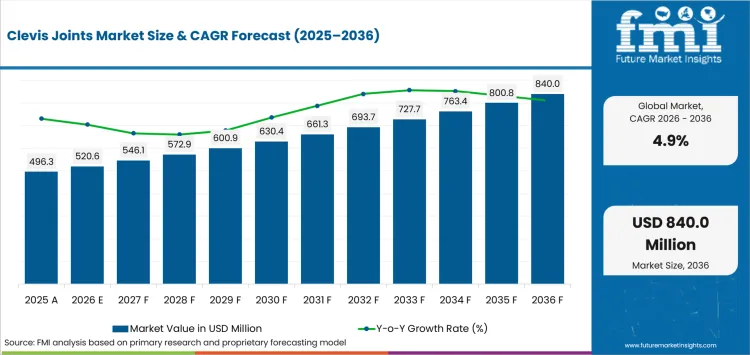
Key Takeaways of Clevis Joints Market
- Replacement demand follows wear at fork-and-pin interfaces because a failed joint can stop an otherwise serviceable cylinder or mechanical linkage.
- By joint type, clevis forks are estimated to hold 28.0% in 2026 owing to direct fork-and-pin geometry and practical field replacement procedures.
- In 2026, carbon steel is expected to lead material with 37.0% share because common linkage loads fit its strength-to-cost balance.
- Male thread is set to lead the thread type category with 26.0% share in 2026 due to direct engagement that keeps adjustment compact and visible.
- Dimensional mismatch can delay replacement because fork width, pin diameter, thread pitch and retention design must match the installed linkage before approval.
- Some of the key players in this market include Elesa+Ganter, KIPP, JW Winco, Midwest Control Products, Boneham & Turner, RBC Bearings, SKF, and Schaeffler.
Analyst Perspective
"Clevis-joint sourcing becomes expensive once a replacement reaches the machine and misses the installed pin or thread geometry. The strongest commercial offers pair verified dimensional cross-references with stocked common variants so maintenance teams can restore the linkage without redesigning the surrounding assembly."
- Nikhil Kaitwade, Principal Consultant, Future Market Insights
How is the Clevis Joints Market segmented?
The clevis joints market is segmented by joint type, material, thread type, end use, sales channel and region.
Market taxonomy covers joint type, material, thread type, end use, sales channel and region. Joint types include clevis forks, clevis rod ends, clevis pins, clevis brackets and adjustable clevis joints. Materials include carbon steel, stainless steel, alloy steel, zinc-plated steel and aluminum. Thread types cover male and female forms plus right-hand and left-hand thread directions. End uses include hydraulic cylinders, pneumatic cylinders, agricultural equipment, industrial linkages and automotive components. Sales channels include motion component distributors, direct OEM supply, industrial MRO and catalog or e-commerce routes.
Why do Hydraulic cylinders lead demand within the End use category?
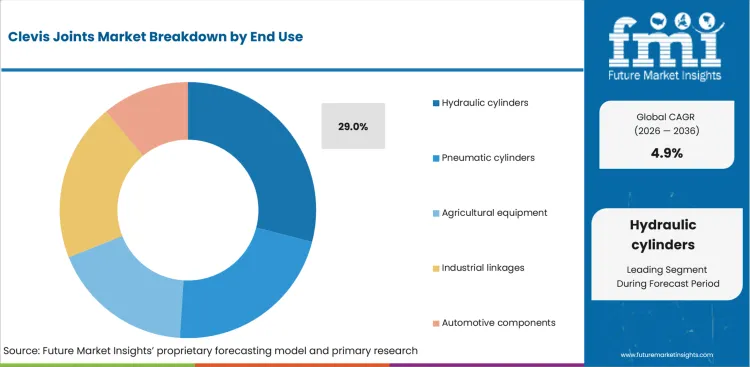
Hydraulic cylinders require end connections that transfer linear force and let the machine linkage rotate through its working arc. Tolomatic launched the RSX50 electric linear actuator in March 2026 with 50 tons of force as a hydraulic replacement. The RSX50 launch increases substitution pressure because clevis hardware may need to fit both fluid-power and electric linear actuators entering high-force equipment.
- By end use, hydraulic cylinders are forecast to represent 29.0% in 2026 driven by pinned mounts that accommodate pivoting under cylinder load.
- Electric actuators increase interface-compatibility requirements because machine builders may preserve existing linkage geometry during a power-system redesign instead of replacing surrounding hardware.
Why do Clevis forks lead demand within the Joint type category?
Clevis forks use a transverse pin between two arms to transfer load and preserve a simple pivot at the actuator end. JW Winco expanded its articulated-joint range in August 2025 with axial ball joints for linear drives and lifting systems. The new axial joints document continued engineering work on compact interfaces that tolerate angular movement beside actuator systems.
- By joint type, clevis forks are estimated to hold 28.0% in 2026 owing to direct fork-and-pin geometry and familiar replacement procedures.
- Maintenance departments can exchange a worn fork or pin without rebuilding the linkage if original dimensions and retention hardware remain available from stock.
Why does Carbon steel lead demand within the Material category?
Carbon steel suits standard clevis production because common grades machine efficiently and accept protective finishes for routine industrial load cases. In February 2026, Boneham & Turner described material-certification checks and heat-treatment inspection within its precision-component quality process. Boneham & Turner’s inspection controls demonstrate why traceable metal processing remains practical beside specialized condition-monitoring bearings and stainless alternatives serving narrower operating requirements.
- In 2026, carbon steel is expected to lead material with 37.0% share because common linkage loads rarely require the cost premium of specialized alloys.
- Stainless steel becomes preferable under persistent corrosion exposure, leaving carbon steel strongest where plated surfaces satisfy the required service conditions without excessive cost.
What supports Male thread within the Thread type category?
Male-thread clevises screw directly into tapped mating features and leave engagement length visible during final adjustment or later maintenance. Elesa+Ganter expanded its special-screw range in May 2025 with continuous-thread and reduced-head designs for constrained machine assemblies. The release shows how thread geometry changes available installation space beside leadscrew systems and other adjustable motion components.
- Male thread is set to lead the thread type category with 26.0% share in 2026 due to direct engagement that reduces separate fastening interfaces.
- Female and left-hand forms are required for existing rods or turnbuckle adjustment, forcing distributors to carry several pitches and thread directions for replacement work.
What are the drivers, restraints and opportunities in the Clevis Joints Market?
Machinery investment increases new linkage requirements, dimensional mismatch slows substitution, and faster cross-referencing improves conversion of replacement orders.
- Driver: Machinery investment and installed equipment replacement generate repeated requirements for fork ends, pins and adjustable linkage connections in working machinery.
- Restraint: Small differences in pin size, fork opening or thread form can stop a replacement from clearing engineering review.
- Opportunity: Better dimensional data and stocked variants shorten the interval between identifying a worn joint and returning equipment to service.
Machinery investment raises clevis demand where cylinders and mechanical linkages enter new equipment bills of material. AMT reported first-half 2026 manufacturing technology orders 36.0% above the same period of 2025. More installed production equipment expands the future replacement base for pinned linkage hardware without implying a one-for-one relationship to clevis-joint sales.
Specification mismatch slows substitution because similar-looking parts can carry different thread pitches or pin diameters. Elesa+Ganter introduced a chamfered-pin indexing plunger in March 2025 for assemblies without a conventionally aligned locating hole. The example demonstrates how small geometry changes alter functional fit within factory automation controls and machine assemblies before replacement approval.
Replacement revenue improves if distributors identify dimensions quickly and hold the required variant near industrial users. Elesa opened a second automated semi-finished warehouse in Monza during 2025 with initial capacity for 29,000 containers. Faster internal material movement can shorten standard-component fulfillment and improve conversion of urgent industrial automation maintenance orders.
Which country CAGRs are profiled in the Clevis Joints Market?
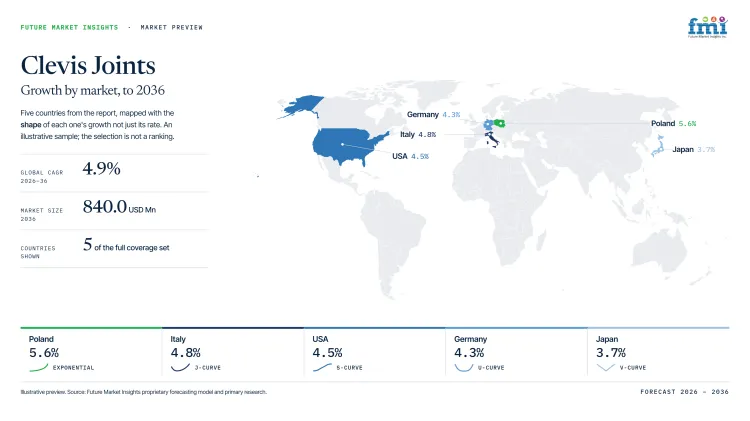
| Country | CAGR |
|---|---|
| Poland | 5.6% |
| Italy | 4.8% |
| USA | 4.5% |
| Germany | 4.3% |
| Japan | 3.7% |
How do country-level CAGRs compare in the Clevis Joints Market?
The five country forecasts span 1.9 percentage points from Poland at 5.6% to Japan at 3.7%. Poland leads, while Italy and the USA remain clustered near 5.0% CAGR. Germany and Japan follow at 4.3% and 3.7%, respectively.
- Poland’s EU machinery trade favors metric standardization during local component replacement workflows.
- Mexico’s export manufacturing links clevis demand to mixed vehicle and industrial production programs.
- USA application diversity spreads clevis demand among mobile and stationary equipment programs.
- Germany’s custom-machining depth gives local firms another route for unusual clevis geometry.
- Japan application diversity spreads clevis demand among mobile and stationary equipment programs.
Similar CAGRs still produce different ordering conditions because installed equipment differs materially. The full report provides country-level CAGR analysis across North America, Latin America, Europe, East Asia, South Asia, Oceania and the Middle East and Africa.
Country-wise Analysis
- Polish machinery plants and farm-equipment workshops depend on distributors that can cover metric fork and pin sizes during uneven production schedules. Statistics Poland recorded March 2025 sold industrial production 2.5% above the same month of 2024. Poland is projected to grow at 5.6% CAGR through 2036 because active manufacturing keeps new-build and replacement requirements in circulation. Stocked standard parts let local maintenance departments start routine repairs without waiting for cross-border replenishment. Smaller factories may delay purchases until thread and retention details are confirmed. Distributors with reliable dimensional cross-references are better placed to convert urgent repairs without carrying every possible configuration in every local branch.
- Nearshore automotive and machinery plants create short maintenance windows in Mexico because line stoppages quickly expose missing linkage hardware. The market outlook is anticipated to advance at 5.1% CAGR over the assessment period attributable to continuing factory investment and regional component demand. INEGI measured industrial activity 2.1% higher month on month in April 2026. Local stocking shortens routine replacement cycles, but uncommon finishes or threads can require cross-border replenishment before repair work closes. Cross-border replenishment can keep one nonstandard clevis unavailable beyond a scheduled maintenance window. Smaller industrial sites therefore face longer downtime than the market growth rate alone suggests.
- USA factories and mobile-equipment operators can source standard linkage hardware through an industrial distribution network with broad regional coverage. The Census Bureau recorded durable-goods orders 0.3% higher month on month in June 2026. USA is estimated to post 4.5% CAGR over the forecast period propelled by a large installed equipment base and repeated maintenance requirements. Distribution depth speeds routine MRO orders, though the mix of SAE and metric legacy designs increases cross-reference work for older machines. The lower profiled CAGR does not imply weaker replacement economics than Poland or Mexico because faster identification can convert existing demand with less channel expansion.
- Germany’s engineering and industrial-equipment base supports clevis-joint demand through replacement, maintenance, and specialized machinery applications. Clevis-joint demand in Germany is forecast to grow at 4.3% CAGR over the forecast period, supported by established manufacturing activity and a sizable installed equipment base. Germany’s strong supplier network enables access to standard clevis components, while specialized workshops can address nonstandard dimensions or customized linkage requirements. Standard stocked parts generally remain more economical for routine maintenance than bespoke machining. If industrial equipment activity remains moderate, distributors with broad replacement inventories and reliable delivery capabilities could strengthen their position in recurring MRO demand.
- Japan’s precision-manufacturing ecosystem creates demand for clevis joints across machinery, automation, and equipment-maintenance applications. The Japanese clevis-joint market is estimated to expand at 3.7% CAGR over the forecast period, reflecting steady replacement needs across an established industrial base. High machining precision allows suppliers to accommodate application-specific fork, pin, and linkage requirements where standard components may not provide an exact fit. However, customized production typically carries higher costs than readily available standard hardware. As equipment owners prioritize maintenance efficiency, suppliers offering accurate cross-referencing, dependable quality, and readily available replacement components may capture routine orders.
Who are the notable companies in the Clevis Joints Market?
Elesa+Ganter, KIPP, JW Winco, Midwest Control Products, Boneham & Turner, RBC Bearings, SKF, and Schaeffler are the notable companies serving this market.
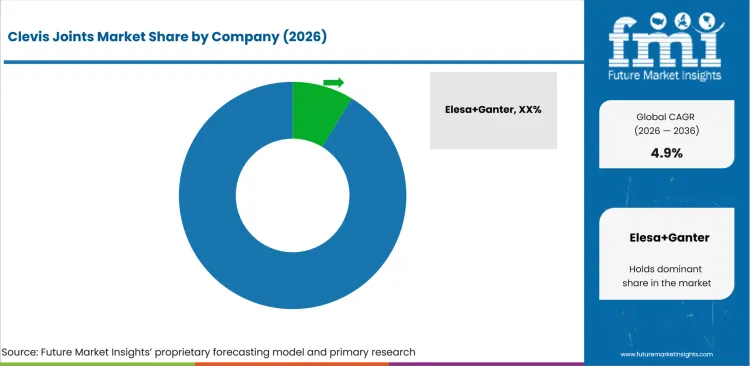
Competition divides between standard-component specialists and broader motion companies whose bearing or actuator portfolios influence linkage specifications. Dimensional coverage and engineering documentation form the main entry barriers for catalog-focused firms. Distributor reach determines how quickly replacement demand becomes a confirmed industrial order. Machinery engineers also compare adjacent high-speed bearings and linkage hardware during machine redesigns.
- Elesa+Ganter, KIPP and JW Winco concentrate on cataloged standard machine elements with broad dimensional selection.
- Midwest Control Products and Boneham & Turner focus more heavily on metal linkage hardware, precision components and replacement-oriented manufacturing.
- RBC Bearings, SKF and Schaeffler bring wider motion engineering that covers rod ends, sensor bearings and actuator-interface choices.
Competitive Benchmarking: Clevis Joints Market
| Company | Standard Linkage Breadth | Material and Thread Coverage | Motion-System Integration | Geographic Reach |
|---|---|---|---|---|
| Elesa+Ganter | High | High | Medium | Global |
| KIPP | High | High | Medium | Europe and international sales |
| JW Winco | High | High | Medium | North America and international sales |
| Midwest Control Products | Medium | High | Low | North America |
| Boneham & Turner | Medium | High | Low | United Kingdom and export markets |
| RBC Bearings | Medium | Medium | High | Global |
| SKF | Low | Medium | High | Global |
| Schaeffler | Medium | Medium | High | Global |
Scoring basis: High standard-linkage breadth requires at least three verified joint or fastening families. Medium requires two documented families, and Low identifies one direct family with verified exact-market coverage. High material and thread coverage requires multiple verified material and thread variants. Medium identifies partial material or thread coverage, and Low indicates one narrow verified configuration. High motion-system integration requires at least three documented adjacent motion technologies in the company current portfolio. Medium requires two documented technologies, and Low identifies one documented adjacent technology within the reviewed scope. Geographic reach reflects documented company operations or distributor coverage and is not scored.
Key Developments in the Clevis Joints Market
- In August 2026, RBC Bearings completed the acquisition of PSC Couplings through Dodge Industrial for USD 24.2 million, expanding its engineered industrial coupling portfolio.
- In April 2026, Schaeffler introduced EMA-50 and EMA-60 electromechanical linear actuators for industrial automation, mobile machinery and material-handling applications.
- In September 2025, SKF inaugurated its automated Airasca super-precision bearing center in Italy with manufacturing, engineering and research functions at one site.
Key Players in the Clevis Joints Market
Standard Component Specialists
- Elesa+Ganter
- KIPP
- JW Winco
Precision Linkage and Replacement Hardware
- Midwest Control Products
- Boneham & Turner
Motion Engineering Groups
- RBC Bearings
- SKF
- Schaeffler
Clevis Joints Market - Report Scope
| Coverage field | Report scope |
|---|---|
| Market breakdown | By joint type, material, thread type, end use, sales channel and region. |
| Quantitative Units | USD Million. |
| Market Definition | Commercial clevis forks, rod ends, pins, brackets and adjustable clevis joints used in cylinder and mechanical linkage interfaces. |
| Regions Covered | North America, Latin America, Western Europe, Eastern Europe, East Asia, South Asia and Pacific and Middle East and Africa. |
| Countries Covered | Poland, Mexico, Brazil, Italy, USA, and 20+ countries included in the full report. |
| Key Companies Profiled | Elesa+Ganter, KIPP, JW Winco, Midwest Control Products, Boneham & Turner, RBC Bearings, SKF, Schaeffler. |
| Forecast Period | 2026 to 2036. |
| Approach | Primary and secondary research with market triangulation. |
Clevis Joints Market - Research Methodology
| Method | Approach |
|---|---|
| Primary Research | FMI analysts gathered input from manufacturers, service providers, technology developers, distributors, end users, procurement teams, and subject-matter experts. Interviews examined purchasing decisions, product or service evaluation, adoption barriers, approval requirements, pricing considerations, and expectations for technical or commercial support. Respondents were also asked what evidence is required before a trial, pilot, or initial order develops into regular purchasing. |
| Desk Research | Desk research covered government statistics, regulatory publications, trade data, industry associations, technical literature, standards, company filings, product information, and official corporate announcements. Sources were reviewed for relevance, publication date, geographic coverage, and consistency with the defined market scope. Claims relating to performance, applications, approvals, capacity, investment, and commercial activity were retained only when supported by credible public evidence. |
| Market Sizing and Forecasting | The market model combined the baseline value with historical performance, segment structure, pricing and volume indicators, adoption levels, company participation, and country-level demand conditions. Forecast assumptions considered economic activity, investment trends, regulatory developments, technology adoption, purchasing cycles, supply availability, and barriers to wider market use. Segment and regional estimates were reconciled before the final market total was calculated. |
| Data Validation | Estimates were checked against multiple independent indicators, including public data, company activity, trade patterns, industry developments, and findings from primary interviews. Validation also tested whether products, services, applications, and company revenues fell within the defined market boundaries. Adjacent categories, unsupported claims, overlapping revenues, and activities without direct market relevance were excluded to reduce double counting and maintain consistency across segments and countries. |
Clevis Joints Market by Segments
Clevis Joints Market segmented by Joint Type:
- Clevis forks
- Clevis rod ends
- Clevis pins
- Clevis brackets
- Adjustable clevis joints
Clevis Joints Market segmented by Material:
- Carbon steel
- Stainless steel
- Alloy steel
- Zinc-plated steel
- Aluminum
Clevis Joints Market segmented by Thread Type:
- Male thread
- Female thread
- Right-hand thread
- Left-hand thread
Clevis Joints Market segmented by End Use:
- Hydraulic cylinders
- Pneumatic cylinders
- Agricultural equipment
- Industrial linkages
- Automotive components
Clevis Joints Market segmented by Sales Channel:
- Motion component distributors
- Direct OEM supply
- Industrial MRO
- Catalog/e-commerce
Clevis Joints Market by Region:
- North America
- United States
- Canada
- Latin America
- Brazil
- Mexico
- Argentina
- Chile
- Western Europe
- Germany
- France
- United Kingdom
- Italy
- Spain
- Benelux
- Nordics
- Eastern Europe
- Poland
- Czech Republic
- Romania
- Hungary
- East Asia
- China
- Japan
- South Korea
- South Asia and Pacific
- India
- ASEAN
- Australia and New Zealand
- Middle East and Africa
- GCC Countries
- South Africa
- Türkiye
- Israel
Research Sources and Bibliography
- Federal Statistical Office of Germany. (2026, August 6). New orders in manufacturing in June 2026: +3.1% on the previous month.
- Statistics Poland. (2025, April 22). Index of sold production of industry in March 2025.
- JW Winco. (2025, August 28). Precise, Compensating and Articulated.
- Boneham & Turner. (2026, February 25). A Day in the Life of a Quality Lead at Boneham & Turner.
- Elesa+Ganter. (2025, May 20). Special Applications Require Special Screws - Beyond Typical Standards GN 912.3, GN 7984.3, GN 14580.5, GN 418.3, ....
- Tolomatic, Inc.. (2026, March 23). Tolomatic Doubles Force Capacity of RSX Linear Actuators With New RSX50.
- AMT - The Association For Manufacturing Technology. (2026, August 10). 2026 Manufacturing Technology Orders Set Half-Year Record.
- Elesa+Ganter. (2025, March 25). Self-Latching Thanks to Chamfered Pin GN 824.
- Elesa+Ganter. (2025, December 2). A look inside Elesa S.p.A.’s automated semi-finished warehouse.
- Instituto Nacional de Estadística y Geografía. (2026, June 11). Monthly Industrial Activity Indicator (IMAI). Base 2018. April, 2026.
- Brazilian Institute of Geography and Statistics. (2026, July 3). Industrial production changes -0.2% in May.
- Italian National Institute of Statistics. (2026, August 6). Industrial production - June 2026.
- USA Census Bureau. (2026, July 27). Monthly Advance Report on Durable Goods Manufacturers' Shipments Inventories and Orders.
- RBC Bearings Incorporated. (2026, August 10). RBC Bearings Incorporated Announces Acquisition of PSC Couplings, LLC.
- Schaeffler Technologies AG & Co. KG. (2026, April 21). The future is electric: New EMA-series of electromechanical linear actuators.
- SKF. (2025, September 19). SKF inaugurates Super-precision bearing facility in Airasca, Italy.
- Parker-Hannifin Corporation. (2025, September 18). Parker Completes Curtis Instruments Acquisition.
- Bosch Rexroth. (2025, June 10). Durable cylinders for high forces: High power electromechanical cylinders cover heavy-duty applications with forces up to 250 kN.
- Festo SE & Co. KG. (2025, May 5). News.
- Thomson Industries, Inc.. (2025, July 23). Thomson expands H-Track actuator capabilities with marine-grade corrosion resistance and underwater functionality.
- igus GmbH. (2025, April 16). igus Introduces drylin® SLX Linear Axis with Lead Screw Drive for Heavy-Duty, Self-lubricating Applications.
- SCHNEEBERGER. (2025, September 22). PULSE PRO - Product launch 2025!.
- NSK Ltd.. (2025, November 13). NSK to Exhibit at iREX 2025.
- Schaeffler Technologies AG & Co. KG. (2025, September 10). New series for automation: Four-row linear recirculating ball bearing and guideway assembly in X arrangement.
- SCHNEEBERGER. (2025, September 23). Quality, Compliance, and Innovation - Backed by ISO Certifications.
This bibliography is provided for reader reference and is not exhaustive. The full report contains the complete reference list and detailed citations
This Report Answers
- What is the clevis joints market size in 2026 and what value is projected for 2036?
- Which machinery and replacement conditions support clevis-joint demand during the forecast period?
- Why do clevis forks hold the leading position within the joint type category?
- Why does carbon steel hold the leading position within the material category?
- How does male thread affect compact linkage assembly and field adjustment?
- Why do hydraulic cylinders account for the largest 2026 end-use share?
- How do Poland, Mexico, Brazil, Italy and USA compare on profiled country CAGRs?
- Which operating frictions slow direct replacement of an installed clevis joint?
- Which companies are profiled in the clevis joints market competitive assessment?
Frequently Asked Questions
How big is the clevis joints market in 2026?
The clevis joints market is valued at USD 520.6 million in 2026 and is projected to reach USD 840.0 million by 2036. Growth follows new machinery assembly and replacement of worn linkage interfaces in installed equipment.
What is the CAGR of the clevis joints market from 2026 to 2036?
The clevis joints market is projected to grow at a CAGR of 4.9% between 2026 and 2036. Expansion is supported by machinery investment, cylinder use and recurring maintenance requirements for pinned linkages.
Which joint type leads the clevis joints market?
The clevis forks segment is expected to hold 28.0% of the clevis joints market in 2026, driven by direct fork-and-pin attachment. The geometry also supports practical field replacement without changing the downstream linkage.
Which material leads the clevis joints market?
The carbon steel segment is expected to hold 37.0% of the clevis joints market in 2026, attributable to its cost-strength balance. Plating extends suitability for common industrial service without the premium attached to specialized alloys.
Which companies are active in the clevis joints market?
Key companies operating in the market include Elesa+Ganter, KIPP, JW Winco, Midwest Control Products, Boneham & Turner, RBC Bearings, SKF, and Schaeffler. Competition centers on dimensional coverage, motion engineering, manufacturing depth and distribution reach in clevis-joint sourcing.
Preview the report firsthand - request a free sample
Get SampleGet the brochure for pricing and purchase details.
Get PDFTable of Content
- Key Takeaways
- Market Size and CAGR
- Top Growth Driver
- Fastest Growing Segment
- Leading Region
- Key Companies
- Emerging Opportunities
- Executive Summary
- Global Market Outlook
- Demand-side Trends
- Supply-side Trends
- Technology Roadmap Analysis
- Analysis and Recommendations
- Analyst Perspective (What is happening? Why now? What should investors know?)
- Key Questions Answered
- How large is the market?
- What is the CAGR?
- What are key trends?
- Which region dominates?
- Who are the leaders?
- Market Overview
- Market Coverage / Taxonomy
- Market Definition / Scope / Limitations
- Research Methodology
- Chapter Orientation
- Analytical Lens and Working Hypotheses
- Market Structure, Signals, and Trend Drivers
- Benchmarking and Cross-market Comparability
- Market Sizing, Forecasting, and Opportunity Mapping
- Research Design and Evidence Framework
- Desk Research Programme (Secondary Evidence)
- Expert Input and Fieldwork (Primary Evidence)
- Tooling, Models, and Reference Databases
- Data Engineering and Model Build
- Quality Assurance and Audit Trail
- Market Background
- Market Dynamics (Drivers, Restraints, Opportunity, Trends)
- Scenario Forecast (Optimistic, Likely, Conservative)
- Impact Analysis
- AI Impact
- Sustainability Impact
- Regulatory Impact
- Technology Impact
- Consumer / Buyer Analysis
- Purchase Drivers
- Adoption Barriers
- Buyer Journey
- Opportunity Map Analysis
- Product Life Cycle Analysis
- Supply Chain Analysis
- Investment Feasibility Matrix
- Value Chain Analysis
- PESTLE and Porter's Analysis
- Regulatory Landscape
- Regional Parent Market Outlook
- Production and Consumption Statistics
- Import and Export Statistics
- Global Market Analysis and Forecast, 2021 to 2036
- Historical Market Size Value (USD Million) Analysis, 2021 to 2025
- Current and Future Market Size Value (USD Million) Projections, 2026 to 2036
- Y-o-Y Growth Trend Analysis
- Absolute $ Opportunity Analysis
- Global Market Pricing Analysis, 2021 to 2036
- Global Market Analysis and Forecast, By Joint Type, 2021 to 2036
- Introduction / Key Findings
- Historical Market Size Value (USD Million) Analysis By Joint Type, 2021 to 2025
- Current and Future Market Size Value (USD Million) Analysis and Forecast By Joint Type, 2026 to 2036
- Clevis forks
- Clevis rod ends
- Clevis pins
- Clevis brackets
- Adjustable clevis joints
- Clevis forks
- Y-o-Y Growth Trend Analysis By Joint Type, 2021 to 2025
- Absolute $ Opportunity Analysis By Joint Type, 2026 to 2036
- Global Market Analysis and Forecast, By Material, 2021 to 2036
- Introduction / Key Findings
- Historical Market Size Value (USD Million) Analysis By Material, 2021 to 2025
- Current and Future Market Size Value (USD Million) Analysis and Forecast By Material, 2026 to 2036
- Carbon steel
- Stainless steel
- Alloy steel
- Zinc-plated steel
- Aluminum
- Carbon steel
- Y-o-Y Growth Trend Analysis By Material, 2021 to 2025
- Absolute $ Opportunity Analysis By Material, 2026 to 2036
- Global Market Analysis and Forecast, By Thread Type, 2021 to 2036
- Introduction / Key Findings
- Historical Market Size Value (USD Million) Analysis By Thread Type, 2021 to 2025
- Current and Future Market Size Value (USD Million) Analysis and Forecast By Thread Type, 2026 to 2036
- Male thread
- Female thread
- Right-hand thread
- Left-hand thread
- Male thread
- Y-o-Y Growth Trend Analysis By Thread Type, 2021 to 2025
- Absolute $ Opportunity Analysis By Thread Type, 2026 to 2036
- Global Market Analysis and Forecast, By End Use, 2021 to 2036
- Introduction / Key Findings
- Historical Market Size Value (USD Million) Analysis By End Use, 2021 to 2025
- Current and Future Market Size Value (USD Million) Analysis and Forecast By End Use, 2026 to 2036
- Hydraulic cylinders
- Pneumatic cylinders
- Agricultural equipment
- Industrial linkages
- Automotive components
- Hydraulic cylinders
- Y-o-Y Growth Trend Analysis By End Use, 2021 to 2025
- Absolute $ Opportunity Analysis By End Use, 2026 to 2036
- Global Market Analysis and Forecast, By Sales Channel, 2021 to 2036
- Introduction / Key Findings
- Historical Market Size Value (USD Million) Analysis By Sales Channel, 2021 to 2025
- Current and Future Market Size Value (USD Million) Analysis and Forecast By Sales Channel, 2026 to 2036
- Motion component distributors
- Direct OEM supply
- Industrial MRO
- Catalog/e-commerce
- Motion component distributors
- Y-o-Y Growth Trend Analysis By Sales Channel, 2021 to 2025
- Absolute $ Opportunity Analysis By Sales Channel, 2026 to 2036
- Global Market Analysis and Forecast, By Region, 2021 to 2036
- Introduction
- Historical Market Size Value (USD Million) Analysis By Region, 2021 to 2025
- Current Market Size Value (USD Million) Analysis and Forecast By Region, 2026 to 2036
- North America
- Latin America
- Western Europe
- Eastern Europe
- East Asia
- South Asia and Pacific
- Middle East & Africa
- Market Attractiveness Analysis By Region
- North America Market Analysis and Forecast, By Country, 2021 to 2036
- Historical Market Size Value (USD Million) Trend Analysis By Market Taxonomy, 2021 to 2025
- Market Size Value (USD Million) Forecast By Market Taxonomy, 2026 to 2036
- By Country
- USA
- Canada
- By Joint Type
- By Material
- By Thread Type
- By End Use
- By Sales Channel
- By Country
- Market Attractiveness Analysis
- By Country
- By Joint Type
- By Material
- By Thread Type
- By End Use
- By Sales Channel
- Key Takeaways
- Latin America Market Analysis and Forecast, By Country
- Historical Market Size Value (USD Million) Trend Analysis By Market Taxonomy, 2021 to 2025
- Market Size Value (USD Million) Forecast By Market Taxonomy, 2026 to 2036
- By Country
- Brazil
- Mexico
- Chile
- Rest of Latin America
- By Joint Type
- By Material
- By Thread Type
- By End Use
- By Sales Channel
- By Country
- Market Attractiveness Analysis
- By Country
- By Joint Type
- By Material
- By Thread Type
- By End Use
- By Sales Channel
- Key Takeaways
- Western Europe Market Analysis and Forecast, By Country
- Historical Market Size Value (USD Million) Trend Analysis By Market Taxonomy, 2021 to 2025
- Market Size Value (USD Million) Forecast By Market Taxonomy, 2026 to 2036
- By Country
- Germany
- UK
- Italy
- Spain
- France
- Nordic
- BENELUX
- Rest of Western Europe
- By Joint Type
- By Material
- By Thread Type
- By End Use
- By Sales Channel
- By Country
- Market Attractiveness Analysis
- By Country
- By Joint Type
- By Material
- By Thread Type
- By End Use
- By Sales Channel
- Key Takeaways
- Eastern Europe Market Analysis and Forecast, By Country
- Historical Market Size Value (USD Million) Trend Analysis By Market Taxonomy, 2021 to 2025
- Market Size Value (USD Million) Forecast By Market Taxonomy, 2026 to 2036
- By Country
- Russia
- Poland
- Hungary
- Balkan & Baltic
- Rest of Eastern Europe
- By Joint Type
- By Material
- By Thread Type
- By End Use
- By Sales Channel
- By Country
- Market Attractiveness Analysis
- By Country
- By Joint Type
- By Material
- By Thread Type
- By End Use
- By Sales Channel
- Key Takeaways
- East Asia Market Analysis and Forecast, By Country
- Historical Market Size Value (USD Million) Trend Analysis By Market Taxonomy, 2021 to 2025
- Market Size Value (USD Million) Forecast By Market Taxonomy, 2026 to 2036
- By Country
- China
- Japan
- South Korea
- By Joint Type
- By Material
- By Thread Type
- By End Use
- By Sales Channel
- By Country
- Market Attractiveness Analysis
- By Country
- By Joint Type
- By Material
- By Thread Type
- By End Use
- By Sales Channel
- Key Takeaways
- South Asia and Pacific Market Analysis and Forecast, By Country
- Historical Market Size Value (USD Million) Trend Analysis By Market Taxonomy, 2021 to 2025
- Market Size Value (USD Million) Forecast By Market Taxonomy, 2026 to 2036
- By Country
- India
- ASEAN
- Australia & New Zealand
- Rest of South Asia and Pacific
- By Joint Type
- By Material
- By Thread Type
- By End Use
- By Sales Channel
- By Country
- Market Attractiveness Analysis
- By Country
- By Joint Type
- By Material
- By Thread Type
- By End Use
- By Sales Channel
- Key Takeaways
- Middle East & Africa Market Analysis and Forecast, By Country
- Historical Market Size Value (USD Million) Trend Analysis By Market Taxonomy, 2021 to 2025
- Market Size Value (USD Million) Forecast By Market Taxonomy, 2026 to 2036
- By Country
- Kingdom of Saudi Arabia
- Other GCC Countries
- Türkiye
- South Africa
- Other African Union
- Rest of Middle East & Africa
- By Joint Type
- By Material
- By Thread Type
- By End Use
- By Sales Channel
- By Country
- Market Attractiveness Analysis
- By Country
- By Joint Type
- By Material
- By Thread Type
- By End Use
- By Sales Channel
- Key Takeaways
- Key Countries Market Analysis
- USA
- Pricing Analysis
- Market Share Analysis, 2025
- By Joint Type
- By Material
- By Thread Type
- By End Use
- By Sales Channel
- Canada
- Pricing Analysis
- Market Share Analysis, 2025
- By Joint Type
- By Material
- By Thread Type
- By End Use
- By Sales Channel
- Mexico
- Pricing Analysis
- Market Share Analysis, 2025
- By Joint Type
- By Material
- By Thread Type
- By End Use
- By Sales Channel
- Brazil
- Pricing Analysis
- Market Share Analysis, 2025
- By Joint Type
- By Material
- By Thread Type
- By End Use
- By Sales Channel
- Chile
- Pricing Analysis
- Market Share Analysis, 2025
- By Joint Type
- By Material
- By Thread Type
- By End Use
- By Sales Channel
- Germany
- Pricing Analysis
- Market Share Analysis, 2025
- By Joint Type
- By Material
- By Thread Type
- By End Use
- By Sales Channel
- UK
- Pricing Analysis
- Market Share Analysis, 2025
- By Joint Type
- By Material
- By Thread Type
- By End Use
- By Sales Channel
- Italy
- Pricing Analysis
- Market Share Analysis, 2025
- By Joint Type
- By Material
- By Thread Type
- By End Use
- By Sales Channel
- Spain
- Pricing Analysis
- Market Share Analysis, 2025
- By Joint Type
- By Material
- By Thread Type
- By End Use
- By Sales Channel
- France
- Pricing Analysis
- Market Share Analysis, 2025
- By Joint Type
- By Material
- By Thread Type
- By End Use
- By Sales Channel
- India
- Pricing Analysis
- Market Share Analysis, 2025
- By Joint Type
- By Material
- By Thread Type
- By End Use
- By Sales Channel
- ASEAN
- Pricing Analysis
- Market Share Analysis, 2025
- By Joint Type
- By Material
- By Thread Type
- By End Use
- By Sales Channel
- Australia & New Zealand
- Pricing Analysis
- Market Share Analysis, 2025
- By Joint Type
- By Material
- By Thread Type
- By End Use
- By Sales Channel
- China
- Pricing Analysis
- Market Share Analysis, 2025
- By Joint Type
- By Material
- By Thread Type
- By End Use
- By Sales Channel
- Japan
- Pricing Analysis
- Market Share Analysis, 2025
- By Joint Type
- By Material
- By Thread Type
- By End Use
- By Sales Channel
- South Korea
- Pricing Analysis
- Market Share Analysis, 2025
- By Joint Type
- By Material
- By Thread Type
- By End Use
- By Sales Channel
- Russia
- Pricing Analysis
- Market Share Analysis, 2025
- By Joint Type
- By Material
- By Thread Type
- By End Use
- By Sales Channel
- Poland
- Pricing Analysis
- Market Share Analysis, 2025
- By Joint Type
- By Material
- By Thread Type
- By End Use
- By Sales Channel
- Hungary
- Pricing Analysis
- Market Share Analysis, 2025
- By Joint Type
- By Material
- By Thread Type
- By End Use
- By Sales Channel
- Kingdom of Saudi Arabia
- Pricing Analysis
- Market Share Analysis, 2025
- By Joint Type
- By Material
- By Thread Type
- By End Use
- By Sales Channel
- Türkiye
- Pricing Analysis
- Market Share Analysis, 2025
- By Joint Type
- By Material
- By Thread Type
- By End Use
- By Sales Channel
- South Africa
- Pricing Analysis
- Market Share Analysis, 2025
- By Joint Type
- By Material
- By Thread Type
- By End Use
- By Sales Channel
- USA
- Market Structure Analysis
- Competition Dashboard
- Competition Benchmarking
- Market Share Analysis of Top Players
- By Regional
- By Joint Type
- By Material
- By Thread Type
- By End Use
- By Sales Channel
- Emerging Startups
- Innovation Benchmarking
- Competition Analysis
- Competition Deep Dive
- Elesa+Ganter
- Overview
- Product Portfolio
- Profitability by Market Segments
- Sales Footprint
- Strategy Overview
- Marketing Strategy
- Product Strategy
- Channel Strategy
- KIPP
- JW Winco
- igus
- SKF
- Schaeffler
- Aurora Bearing
- RBC Bearings
- Midwest Control Products
- Boneham & Turner
- Elesa+Ganter
- Case Studies
- Success Stories
- Recent Developments
- Competition Deep Dive
- Assumptions & Acronyms Used


