

- Market Size (2026)
- USD 311.7 Mn
- Forecast (2036)
- USD 751.6 Mn
- CAGR (2026 to 2036)
- 9.2%
How Big is the Bake-Stable Fruit Pieces Market in 2026?
The bake-stable fruit pieces market is estimated at USD 311.7 million in 2026.
The global bake-stable fruit pieces market was valued at USD 285.4 million in 2025 and is estimated to reach USD 311.7 million in 2026. The market is projected to reach USD 751.6 million by 2036, expanding at a compound annual growth rate (CAGR) of 9.2% between 2026 and 2036. Standard grade accounted for the largest share of the market, contributing 44.0% of total revenue in 2026. Demand is supported by bakeries that want fruit to remain visible and intact after mixing, baking and storage. Fruit supply has tightened. According to USDA figures reported by WisBusiness, the 2025 US cranberry crop reached 7.46 million barrels, below the USDA's earlier forecast of 8.13 million barrels and the five-year average of 7.95 million barrels[5][6]. Global production of sultanas, raisins and currants fell by just under 10.0% in the 2025/26 season, with Turkish output significantly below average for the third year in a row[7]. Suppliers are developing new formats. For instance, Nexture included Vitalfood Fruffi preparations containing whole fruit pieces in its November 2025 Fi Europe announcement[3].
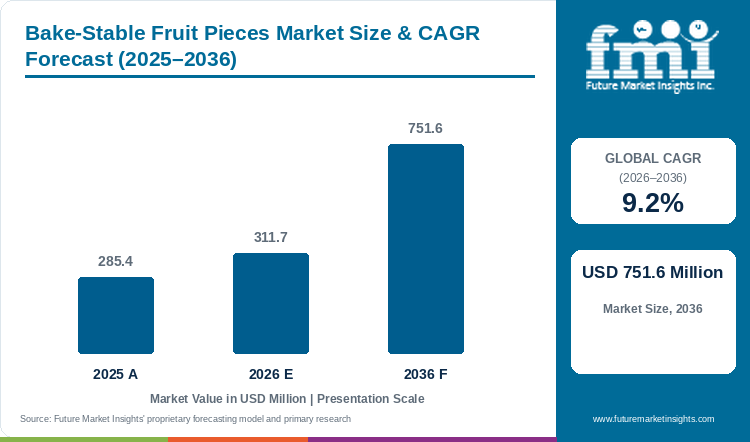
Table 1: Bake-Stable Fruit Pieces Market Size and Forecast (USD million), 2025 to 2036
| Market size and forecast | Value |
|---|---|
| 2025 market size | USD 285.4 million |
| Estimated market size in 2026 | USD 311.7 million |
| Projected market size by 2036 | USD 751.6 million |
| CAGR (2026-2036) | 9.2% |
| Added revenue, 2026 to 2036 | USD 439.9 million |
Key Market Trends & Insights
- By Product Type: The Standard grade segment accounted for the largest share of the bake-stable fruit pieces market in 2026, representing 44.0% of total market revenue.
- By Form: Powder / dry products held the leading market position with a share of 46.0% in 2026.
- By Application: Bread & rolls remained the largest application segment, accounting for 27.0% of the market in 2026.
Regional Highlights
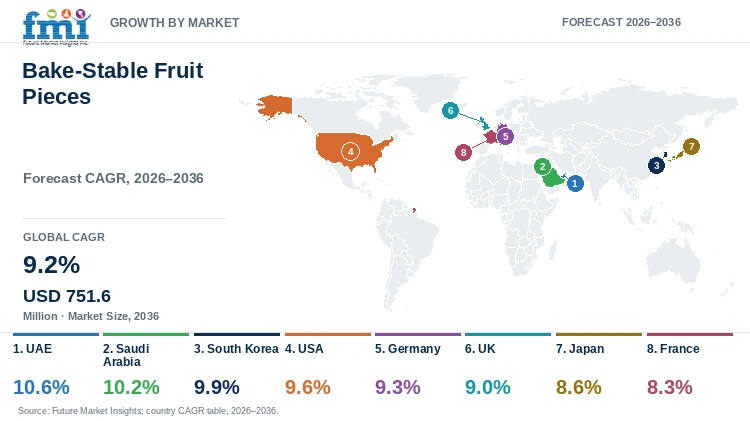
- Fastest-growing country: The UAE is expected to record the highest growth rate among the eight profiled countries, with a projected CAGR of 10.6% between 2026 and 2036.
- Growth across other countries: Saudi Arabia is projected to expand at a CAGR of 10.2%, followed by South Korea at 9.9% and the USA at 9.6%. France is expected to register comparatively slower growth, with a CAGR of 8.3% during the forecast period.
The availability of fruit remains an important factor influencing the supply of bake-stable pieces. Wisconsin, the largest cranberry-producing state, harvested 4.8 million barrels in 2025, more than 60.0% of the US crop but below its forecast of 5.3 million barrels and the previous year's harvest of more than 6 million barrels[5]. Most of the US cranberry crop is processed into products sold year-round, with fresh fruit available only from October to December[6], so dried and infused cranberries for bakery depend on the processing share of each harvest. Sugar is the other main input for infused fruit, and the FAO Sugar Price Index stood 14.7% above its year-earlier level in September 2026[8]. Product properties also matter. IFF's Taura portfolio identifies low water activity and bake stability alongside free-flowing fruit inclusions[1].
Dried vine fruit supply is also constrained. Mundus Agri reported that global production of sultanas, raisins and currants fell by just under 10.0% in the 2025/26 season, and that Turkish production was significantly below average for the third consecutive year[7]. Lower supply of traditional dried fruit can encourage bakeries to consider alternative fruit inclusions and prepared fruit systems. Nexture's Vitalfood Fruffi preparations, which contain whole fruit pieces[3], offer a different application route from discrete inclusions mixed into dough, as the carrier becomes part of the moisture and texture assessment while the retained pieces provide visible fruit character.
Supplier investment is also changing the market. Puratos announced a Buckingham expansion in February 2025 for fillings, patisserie glazes and sourdough, with additional lines planned during 2026[4], and in March 2026 it agreed to acquire Dawn Foods, another profiled supplier of fruit fillings, subject to regulatory approvals[9]. Qualification still depends on the particular material and process. The US Food and Drug Administration's (FDA) preventive controls framework also addresses ingredient hazards and supply chain controls in applicable operations[2], so physical trials and supplier records serve distinct parts of the assessment.
Table 2: Supporting Industry Indicators for the Bake-Stable Fruit Pieces Market, 2025 to 2026
| Indicator | Data point | Why it matters | Source |
|---|---|---|---|
| US cranberry crop | The 2025 US cranberry crop reached 7.46 million barrels, according to USDA figures. | Cranberries are a major dried fruit inclusion in bakery. | [5] |
| Cranberry forecast | USDA had forecast the 2025 crop at 8.13 million barrels, 9.0% below 2024 and close to the five-year average of 7.95 million barrels. | The final crop fell short of both the forecast and the average. | [6] |
| Wisconsin crop | Wisconsin produced 4.8 million barrels in 2025, more than 60.0% of the US crop, below its 5.3 million barrel forecast. | Wisconsin dominates US cranberry supply. | [5] |
| Processing use | Fresh cranberries are available from October to December, with the remainder processed into year-round products. | Processing supplies most of the cranberries used in bakery. | [6] |
| Dried vine fruit | Global production of sultanas, raisins and currants fell by just under 10.0% in 2025/26. | Lower supply affects the cost of traditional fruit inclusions. | [7] |
| Turkish sultanas | Turkish sultana production was significantly below average for the third year in a row. | Turkey is a key origin for bakery sultanas. | [7] |
| Sugar prices | The FAO Sugar Price Index stood 14.7% above its year-earlier level in September 2026. | Sugar is used to infuse and stabilise fruit pieces. | [8] |
| Supplier consolidation | Puratos agreed to acquire Dawn Foods in March 2026, subject to regulatory approvals. | Two profiled fruit filling suppliers may combine. | [9] |
| Fruit inclusion properties | Taura identifies low water activity, free-flowing formats and bake stability. | These properties influence dosing and the finished product. | [1] |
| Whole-fruit preparations | Nexture included Vitalfood Fruffi preparations with whole fruit pieces in November 2025. | Fruit in a carrier adds a route for visible pieces. | [3] |
Demand Intensity Analysis
A comparison of FMI's market estimate with US cranberry production provides a measure of the scale of bake-stable fruit relative to a major fruit inclusion crop. The 2025 US cranberry crop of 7.46 million barrels[5] is equivalent to approximately 338,000 tonnes, based on 100 pounds per barrel. FMI estimated the bake-stable fruit pieces market at USD 285.4 million in 2025, which is equivalent to approximately USD 843.0 for every tonne of US cranberries harvested. Since the market covers many fruits, the figure is a reference point rather than a measure of cranberry use.
Supply shortfalls provide another reference point. The final US cranberry crop was approximately 8.2% below the USDA's forecast and approximately 6.2% below the five-year average[5][6], while global dried vine fruit production fell by just under 10.0%[7]. Lower supply of traditional inclusions, combined with higher sugar prices[8], can raise the cost of fruit pieces and encourage bakeries to use them more precisely.
A similar comparison can be made between projected market growth and fruit supply. FMI expects the market to grow at a CAGR of 9.2% between 2026 and 2036, while major fruit inclusion crops declined in 2025. The difference implies that growth will rely on wider use of processed fruit pieces in bakery, a shift towards infused and low-water-activity formats, and price increases, rather than on growth in raw fruit supply.
Segment values show where demand is concentrated. Standard grade represented USD 137.1 million of Product Type revenue in 2026, while Bread & rolls accounted for USD 84.2 million on the Application axis. Powder / dry represented USD 143.4 million within Form, and Direct to industrial bakeries accounted for USD 140.3 million of Sales Channel revenue. FMI projects added revenue of USD 439.9 million between 2026 and 2036, with the market reaching 2.4 times its 2026 value.
Table 3: Demand Intensity Metrics for the Bake-Stable Fruit Pieces Market, 2025 Crop Data Against 2025 and 2026 Market Values
| Demand intensity metric | Value | Basis |
|---|---|---|
| FMI market value, 2025 | USD 285.4 million | FMI estimate of bake-stable fruit piece revenue. |
| US cranberry crop, 2025 | 7.46 million barrels | USDA figures. |
| US cranberry crop in tonnes | Approximately 338,000 tonnes | 100 pounds per barrel, converted at 0.4536 kg per pound. |
| FMI value per tonne of US cranberries | Approximately USD 843.0 | The calculation divides USD 285.4 million by 338,000 tonnes. |
| Cranberry crop against forecast | Approximately -8.2% | 7.46 million against 8.13 million barrels. |
| Cranberry crop against five-year average | Approximately -6.2% | 7.46 million against 7.95 million barrels. |
| Global dried vine fruit production, 2025/26 | Just under -10.0% | Mundus Agri. |
| FAO Sugar Price Index, year-on-year change | +14.7% | September 2026. |
| FMI value CAGR, 2026 to 2036 | 9.2% | FMI market forecast. |
| Standard grade revenue, 2026 | USD 137.1 million | 44.0% of the market. |
| Direct industrial bakery revenue, 2026 | USD 140.3 million | 45.0% of the market. |
| Market expansion multiple | 2.4 times | Projected 2036 market value relative to 2026. |
Analyst Perspective
"With cranberry and sultana supplies both down in 2025, bakeries are paying more for fruit, so they need pieces that survive the mixer intact rather than turning into fragments."
- Nandini Roy Choudhury, Principal Analyst at Future Market Insights
How is the bake-stable fruit pieces market segmented?
The bake-stable fruit pieces market is segmented by product type, form, application, claim and sales channel. Product Type comprises Standard grade, Premium / specialty grade, Organic certified and Clean label grade. Form comprises Powder / dry, Liquid, Paste / semi-solid and Granules / pieces. Application comprises Bread & rolls, Cakes & muffins, Biscuits & cookies, Viennoiserie & pastry and Other bakery & snacks. Claim comprises Conventional, Clean label, Organic and Non-GMO / identity preserved. Sales Channel comprises Direct to industrial bakeries, Ingredient distributors, Foodservice & artisan supply and Online B2B.
Why does Standard grade anchor the Product Type category?
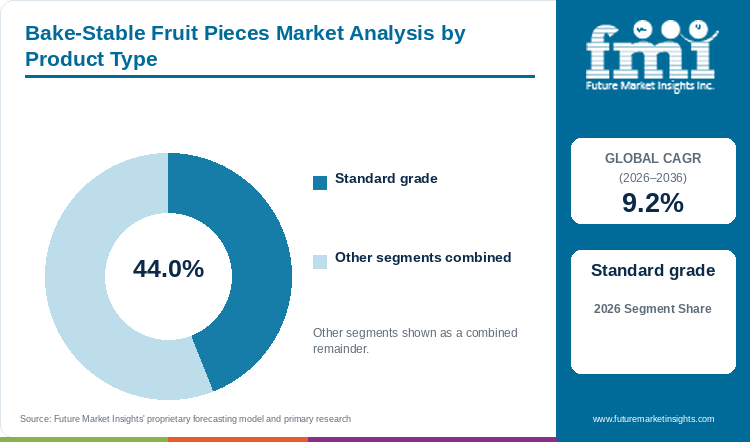
Standard grade represents 44.0% of Product Type revenue in 2026.
An established bakery recipe depends on fruit dimensions and moisture levels for its appearance and handling, and Standard grade generated approximately USD 137.1 million in 2026 by providing a known cut and preparation profile. This limits the customisation needed each time the ingredient is ordered. Premium grades add distinctions in variety or texture, while certified and clean label preparations introduce further documentation requirements. When fruit supply is tight, as with cranberries in 2025[5], a stable standard specification helps buyers confirm that substitute lots match the accepted material.
- Standard grade represents 44.0% of Product Type revenue in 2026.
- A stable cut and moisture profile preserve the fruit behaviour established in an existing bakery recipe.
What makes Powder / dry the main Form configuration?
Powder / dry accounts for 46.0% of Form revenue in 2026.
Dry fruit particles can be metered into dough without the filling-system adjustments needed for a pumpable preparation, and dry formats generated approximately USD 143.4 million in 2026. The material must still deliver recognisable fruit and acceptable texture after heat exposure, with controlled moisture movement. Liquid and semi-solid carriers suit layers or deposited fillings, while generic fruit-flavour powders without identifiable pieces are outside this market. Material that cakes during transport or after a bag is partly used may not empty cleanly, which undermines a useful flow specification.
- Powder / dry accounts for 46.0% of Form revenue in 2026.
- Clean emptying and resistance to caking support accurate metering from the pack.
How do Bread & rolls retain Application leadership?
Bread & rolls hold 27.0% of Application revenue in 2026.
Fruit breads and rolls accounted for approximately USD 84.2 million of revenue in 2026, and dough development places mechanical stress on fruit pieces before they reach the oven. The addition point therefore affects retained structure as much as the fruit's tolerance of baking. Distribution must remain even without sticky deposits or uneven hydration. Cakes, pastries and biscuits create different moisture conditions, and the surrounding flour formulation also contributes to that environment. A defined application and addition sequence connect the incoming specification with actual performance.
- Bread & rolls hold 27.0% of Application revenue in 2026.
- The addition point determines how much mechanical stress the fruit experiences before baking.
Why does Conventional remain the main Claim category?
Conventional represents 50.0% of Claim revenue in 2026.
Conventional products represented half of Claim revenue in 2026, giving bakeries the widest choice of fruit and preservation methods. Organic purchasing adds certified handling and records, while clean label briefs focus attention on declared ingredients and processing, and identity-preserved programmes can require traceability and segregation. These conditions must coexist with the required baking performance. An alternative that tastes similar may alter the finished product's claim or behave differently during processing.
- Conventional represents 50.0% of Claim revenue in 2026.
- Fruit and supporting ingredients must continue to qualify for the finished product's chosen claim.
Why do industrial bakeries favor the direct Sales Channel?
Direct to industrial bakeries generates 45.0% of Sales Channel revenue in 2026.
Industrial bakeries set precise acceptance criteria for fruit pieces, including limits for discolouration, breakage and small fragments alongside a specified cut and water activity, and direct supply generated approximately USD 140.3 million in 2026. Joint trials connect these limits with the actual line, followed by agreement on packing and replenishment. Distributors widen access for smaller factories, while written criteria give successive deliveries a common reference when fruit dimensions affect both handling and appearance.
- Direct to industrial bakeries generates 45.0% of Sales Channel revenue in 2026.
- Limits for dimensions and fragment content give recurring deliveries a practical acceptance standard.
What are the drivers, restraints and opportunities in the bake-stable fruit pieces market?
Visible fruit gives established recipes a practical route to differentiation, but tight fruit supply and mechanical damage narrow the approved supply base, while application-specific fruit systems can broaden the usable recipe range.
Visible fruit gives established recipes a practical route to differentiation
Visible fruit changes the character of an established bun or muffin while retaining much of its manufacturing sequence. Even distribution and compatibility with dosing equipment determine whether this variation can be repeated without extra handling. Taura's portfolio includes free-flowing pieces with bake stability[1], which has value through the fruit retained in the finished item. Stable shape and grading limit the need to alter the dose. The result can support several fruit variants around a common process, which also gives bakeries flexibility to switch fruit types when one crop, such as sultanas in 2025/26[7], is in short supply.
Tight fruit supply and mechanical damage narrow the approved supply base
Fruit supply fell in 2025, with the US cranberry crop below forecast[5][6] and global dried vine fruit production down by just under 10.0%[7], which reduces the pool of material available for bakery processing. Technical constraints add to this. Fruit and crumb continue to interact after baking, as excessive moisture movement can leave the inclusion hard or soften the crumb beside it, and demanding dough mixing can break pieces into fragments. Applicable manufacturers also need to address ingredient hazards and supplier controls under FDA's preventive controls framework[2]. A lower-priced lot offers little benefit if changing fragment content forces dosing adjustments.
Application-specific fruit systems can broaden the usable recipe range
Dry biscuits, soft enriched breads and deposited fillings create different moisture environments for fruit pieces, so the intended application determines how fruit must be prepared. Knowledge of fruit preparations and preserves helps relate fruit integrity to the solids and moisture around it. Adjustments to cut and handling can make identifiable fruit suitable for more recipes. Prepared fruit systems, such as Nexture's Fruffi range[3], and the combined filling expertise of Puratos and Dawn Foods after their planned merger[9] widen the formats available to bakeries.
Which country CAGRs are profiled in the bake-stable fruit pieces market?
Table 4: Country growth outlook for the bake-stable fruit pieces market
| Country | CAGR |
|---|---|
| UAE | 10.6% |
| Saudi Arabia | 10.2% |
| South Korea | 9.9% |
| USA | 9.6% |
| Germany | 9.3% |
| UK | 9.0% |
| Japan | 8.6% |
| France | 8.3% |
UAE
- The UAE is the fastest-growing market among the profiled countries, with a forecast CAGR of 10.6% from 2026 to 2036. For UAE bakery importers, discrete fruit pieces and fruit supplied in a carrier create different storage and application requirements. The selected format must fit the customer's handling sequence before a regular cut and supply schedule can be set, and distributor trial quantities support qualification without large initial stock. Performance after delivery and display determines whether the preparation can support repeat production.
Saudi Arabia
- Saudi industrial bakeries can use fruit pieces to vary their sweet-bread range while leaving the main dough process unchanged. Saudi Arabia is projected to grow at a CAGR of 10.2% from 2026 to 2036. Inventory capacity also affects selection, as a preparation requiring different storage may be awkward for a plant organised around dry ingredients. Testing the actual addition point establishes how the fruit survives mixing, and instructions for opened packs support later runs from the same bulk delivery.
South Korea
- With a forecast CAGR of 9.9% for 2026 to 2036, South Korea ranks third among the profiled countries. In South Korean bakery products, piece size influences distribution and presentation. Smaller inclusions disperse through compact portions, while larger visible fruit can define an exposed pastry filling. Product dimensions and the handling sequence establish the reference for comparing samples, which makes later seasonal flavour changes easier to assess.
USA
- US bakeries using fruit pieces at several sites need clear instructions as well as uniform lots. Domestic cranberry supply was lower than expected in 2025, with the crop reaching 7.46 million barrels against a forecast of 8.13 million[5][6]. The USA is forecast to grow at a CAGR of 9.6% from 2026 to 2036. FDA's preventive controls rule adds context for ingredient hazards and supply chain management[2]. Once a high-volume recipe is established, stable grading and delivery protect the agreement, as a small price difference matters less if it brings fragment variation at several sites.
Germany
- Germany is projected to grow at a CAGR of 9.3% from 2026 to 2036. In Germany, fruit inside a soft roll experiences dough development differently from fruit in a pastry filling, so suppliers serving both uses need to state the application limits of each preparation. Direct factory relationships support successive line trials, while artisan buyers may need smaller quantities. German buyers of sultanas and raisins also face the third consecutive year of below-average Turkish production[7].
UK
- UK buyers have access to expanding local capacity, as Puratos announced in February 2025 that it would expand its Buckingham site for fillings and other bakery ingredients, with additional lines planned during 2026[4]. The UK market is forecast to grow at a CAGR of 9.0% from 2026 to 2036. A specific fruit preparation still has to prove itself in the intended recipe. Nearby technical support makes trials easier to coordinate, particularly during shorter development runs or seasonal changes.
Japan
- Japan is forecast to grow at a CAGR of 8.6% from 2026 to 2036. In a small Japanese bakery item, equal fruit weight does not guarantee equal appearance, as a wide spread of piece sizes produces uneven distribution, which makes grading central to portion design. For imported preparations, remaining working life must fit the purchasing cycle, supported by clear storage instructions.
France
- France is expected to register the slowest growth among the profiled countries, with a CAGR of 8.3% for 2026 to 2036. In French professional applications, recognisable fruit contributes directly to the appearance of a slice or open pastry, so retained structure is assessed together with flavour. Larger manufacturers need that appearance at a repeatable depositing speed, while dry inclusions for dough mixing serve a different purpose.
Who are the notable companies in the bake-stable fruit pieces market?
IFF through Taura; Puratos; Dawn Foods; Zeelandia; IRCA Group through Cesarin
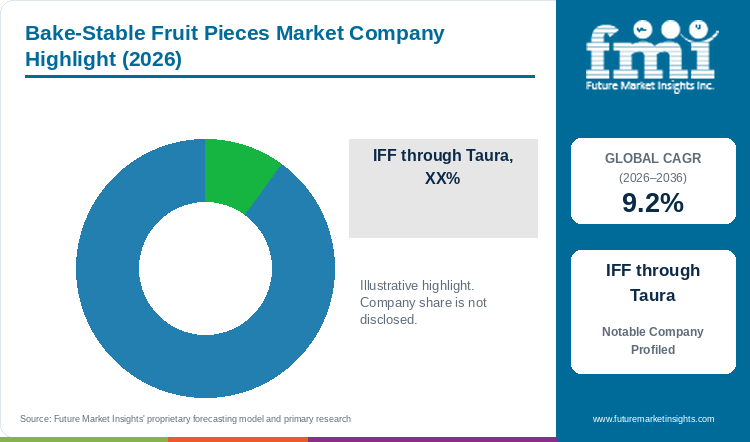
IFF's Taura specialises in low-water-activity fruit formats. Puratos, Dawn Foods and Zeelandia supply fruit within prepared filling systems, while Cesarin, part of IRCA Group, offers semi-candied fruit. The supplier base is consolidating, as Puratos agreed in March 2026 to acquire Dawn Foods[9]. These roles distinguish discrete inclusions from fruit carried in a preparation, with different consequences for mixing, depositing and moisture behaviour.
Cut consistency and pack handling connect the supplier's preparation with the equipment and recipe it will encounter, which explains why a grade suited to one finished product may need further development for another.
Competitive Benchmarking: Bake-Stable Fruit Pieces Market
Table 5: Company capabilities in the bake-stable fruit pieces market
| Company | Product capability | Application emphasis |
|---|---|---|
| IFF through Taura | Low-water-activity fruit pieces and related formats | Direct incorporation into baked goods |
| Puratos | Fruit-containing bakery and pastry fillings | Professional and industrial bakery recipes |
| Dawn Foods | Delifruit and other fruit fillings | Bake-stable fruit preparations |
| Zeelandia | Industrial fruit fillings with fruit integrity | Bakery filling and depositing |
| IRCA Group through Cesarin | Semi-candied fruit | Baked and frozen pastry applications |
Key Developments in the Bake-Stable Fruit Pieces Market
- In February 2025, Puratos UK announced the expansion of its Buckingham site for fillings, patisserie glazes and sourdough, with further lines planned during 2026[4].
- In November 2025, USDA forecast the 2025 US cranberry crop at 8.13 million barrels, 9.0% below 2024[6].
- In November 2025, Nexture included Vitalfood Fruffi preparations containing whole fruit pieces in its Fi Europe announcement[3].
- In December 2025, Mundus Agri reported that global production of sultanas, raisins and currants had fallen by just under 10.0% in 2025/26[7].
- In March 2026, Puratos agreed to acquire Dawn Foods, subject to regulatory approvals[9].
- In May 2026, USDA figures showed that the 2025 US cranberry crop had reached 7.46 million barrels[5].
Key Players in the Bake-Stable Fruit Pieces Market
- IFF through Taura
- Puratos
- Dawn Foods
- Zeelandia
- IRCA Group through Cesarin
Bake-Stable Fruit Pieces Market - Report Scope
Table 6: Report scope for the bake-stable fruit pieces market
| Coverage field | Report scope |
|---|---|
| Market breakdown | Product Type, Form, Application, Claim, Sales Channel, Region |
| Quantitative Units | USD Million |
| Market Definition | Revenue from qualifying bake-stable fruit pieces sold for bakery use, whether supplied as discrete dry inclusions or as identifiable pieces within qualifying liquid and paste preparations. Excludes finished bakery-product sales, smooth fruit fillings without pieces, fruit-flavor powders without pieces, decorative toppings without verified in-bake function, and other adjacent food ingredients; any bundled preparation is counted only for the qualifying ingredient revenue within scope. |
| Regions Covered | North America, Latin America, Western Europe, Eastern Europe, East Asia, South Asia and Pacific, Middle East and Africa |
| Countries Covered | UAE; Saudi Arabia; South Korea; USA; Germany; UK; Japan; France |
| Key Companies Profiled | IFF through Taura; Puratos; Dawn Foods; Zeelandia; IRCA Group through Cesarin |
| Forecast Period | 2026 to 2036 |
| Approach | Market assessment supported by official technical and regulatory publications, company product information and country operating conditions. |
Bake-Stable Fruit Pieces Market - Research Methodology
Table 7: Research approach for the bake-stable fruit pieces market
| Method | Approach |
|---|---|
| Market definition | Bake-stable fruit pieces are defined by identifiable fruit structure and the intended use within a bakery process. |
| Desk research | Government and regulatory publications, technical literature and official product information establish the application and supply context. |
| Commercial assessment | The assessment considers piece dimensions, moisture behavior and the physical stresses associated with mixing, depositing and baking. |
| Comparability | Market values, segment allocations and country growth rates use consistent units and the stated 2026 to 2036 forecast period. Company comparisons describe product roles and purchasing relevance. |
Bake-Stable Fruit Pieces Market by Segments
Product Type
- Standard grade
- Premium / specialty grade
- Organic certified
- Clean label grade
Form
- Powder / dry
- Liquid
- Paste / semi-solid
- Granules / pieces
Application
- Bread & rolls
- Cakes & muffins
- Biscuits & cookies
- Viennoiserie & pastry
- Other bakery & snacks
Claim
- Conventional
- Clean label
- Organic
- Non-GMO / identity preserved
Sales Channel
- Direct to industrial bakeries
- Ingredient distributors
- Foodservice & artisan supply
- Online B2B
Bake-Stable Fruit Pieces Market by Region
- North America
- United States
- Canada
- Latin America
- Brazil
- Mexico
- Argentina
- Chile
- Western Europe
- Germany
- France
- United Kingdom
- Italy
- Spain
- Benelux
- Nordics
- Eastern Europe
- Poland
- Czech Republic
- Romania
- Hungary
- East Asia
- China
- Japan
- South Korea
- South Asia and Pacific
- India
- ASEAN
- Australia and New Zealand
- Middle East and Africa
- GCC Countries
- South Africa
- Türkiye
- Israel
Research Sources and Bibliography
- [1] International Flavors & Fragrances / Taura. (n.d.). Fruit Inclusions for Baked Goods.
- [2] U.S. Food and Drug Administration. (n.d.). FSMA final rule for preventive controls for human food.
- [3] CSM Ingredients / Nexture. (2025, November 20). Nexture debuts at Fi Europe 2025: ingredient innovations.
- [4] Puratos UK. (2025, February 24). Puratos UK to expand Buckingham site to produce fillings, patisserie glazes and sourdough.
- [5] Moe, A. (2026, May 5). WisBusiness. WI remains No. 1 state for cranberries with 4.8M barrels in 2025.
- [6] Wakefield, H. (2025, November 26). USDA Economic Research Service. Cranberry production forecast to land near five-year average in 2025.
- [7] Mundus Agri. (2025, December 10). Sultanas: Global production down by 10%.
- [8] Food and Agriculture Organization of the United Nations. (2026, October 2). FAO Food Price Index.
- [9] Food Ingredients First. (2026, March 12). Puratos strikes deal to acquire Dawn Foods in bakery industry shakeup.
Future Market Insights. (2026). Bake-Stable Fruit Pieces Market: Global Industry Analysis and Opportunity Assessment 2036.
This Report Answers
- How large is the bake-stable fruit pieces market in 2026, and what value is projected for 2036?
- Which bakery production needs support the purchase of bake-stable fruit-piece ingredients?
- Why does Standard grade lead the Product Type category?
- Why does Powder / dry lead the Form category?
- How do the eight profiled country CAGRs compare over 2026 to 2036?
- Which companies supply discrete fruit pieces and fruit-bearing bakery preparations?
Frequently Asked Questions
How big is the bake-stable fruit pieces market in 2026, and what is the forecast for 2036?
The market is valued at USD 311.7 million in 2026 and is expected to reach USD 751.6 million by 2036.
What is the bake-stable fruit pieces market CAGR from 2026 to 2036?
The market is projected to grow at a CAGR of 9.2% from 2026 to 2036.
Which Product Type segment leads the bake-stable fruit pieces market?
Standard grade leads with a 44.0% share in 2026.
Which Form segment has the largest share?
Powder / dry leads with 46.0% in 2026.
Which profiled countries have the highest growth rates?
The UAE leads at 10.6%, followed by Saudi Arabia at 10.2% and South Korea at 9.9% from 2026 to 2036.
Which companies participate in the bake-stable fruit pieces market?
The report profiles IFF through Taura, Puratos, Dawn Foods, Zeelandia and IRCA Group through Cesarin, which supply discrete fruit formats or fruit-bearing preparations.
Preview the report firsthand - request a free sample
Get SampleGet the brochure for pricing and purchase details.
Get PDFTable of Content
- Key Takeaways
- Market Size and CAGR
- Top Growth Driver
- Fastest Growing Segment
- Leading Region
- Key Companies
- Emerging Opportunities
- Executive Summary
- Global Market Outlook
- Demand-side Trends
- Supply-side Trends
- Technology Roadmap Analysis
- Analysis and Recommendations
- Analyst Perspective (What is happening? Why now? What should investors know?)
- Key Questions Answered
- How large is the market?
- What is the CAGR?
- What are key trends?
- Which region dominates?
- Who are the leaders?
- Market Overview
- Market Coverage / Taxonomy
- Market Definition / Scope / Limitations
- Research Methodology
- Chapter Orientation
- Analytical Lens and Working Hypotheses
- Market Structure, Signals, and Trend Drivers
- Benchmarking and Cross-market Comparability
- Market Sizing, Forecasting, and Opportunity Mapping
- Research Design and Evidence Framework
- Desk Research Programme (Secondary Evidence)
- Expert Input and Fieldwork (Primary Evidence)
- Tooling, Models, and Reference Databases
- Data Engineering and Model Build
- Quality Assurance and Audit Trail
- Market Background
- Market Dynamics (Drivers, Restraints, Opportunity, Trends)
- Scenario Forecast (Optimistic, Likely, Conservative)
- Impact Analysis
- AI Impact
- Sustainability Impact
- Regulatory Impact
- Technology Impact
- Consumer / Buyer Analysis
- Purchase Drivers
- Adoption Barriers
- Buyer Journey
- Opportunity Map Analysis
- Product Life Cycle Analysis
- Supply Chain Analysis
- Investment Feasibility Matrix
- Value Chain Analysis
- PESTLE and Porter's Analysis
- Regulatory Landscape
- Regional Parent Market Outlook
- Production and Consumption Statistics
- Import and Export Statistics
- Global Market Analysis and Forecast, 2021 to 2036
- Historical Market Size Value (USD Million) Analysis, 2021 to 2025
- Current and Future Market Size Value (USD Million) Projections, 2026 to 2036
- Y-o-Y Growth Trend Analysis
- Absolute $ Opportunity Analysis
- Global Market Pricing Analysis, 2021 to 2036
- Global Market Analysis and Forecast, By Product Type, 2021 to 2036
- Introduction / Key Findings
- Historical Market Size Value (USD Million) Analysis By Product Type, 2021 to 2025
- Current and Future Market Size Value (USD Million) Analysis and Forecast By Product Type, 2026 to 2036
- Standard grade
- Premium / specialty grade
- Organic certified
- Clean label grade
- Y-o-Y Growth Trend Analysis By Product Type, 2021 to 2025
- Absolute $ Opportunity Analysis By Product Type, 2026 to 2036
- Global Market Analysis and Forecast, By Form, 2021 to 2036
- Introduction / Key Findings
- Historical Market Size Value (USD Million) Analysis By Form, 2021 to 2025
- Current and Future Market Size Value (USD Million) Analysis and Forecast By Form, 2026 to 2036
- Powder / dry
- Liquid
- Paste / semi-solid
- Granules / pieces
- Y-o-Y Growth Trend Analysis By Form, 2021 to 2025
- Absolute $ Opportunity Analysis By Form, 2026 to 2036
- Global Market Analysis and Forecast, By Application, 2021 to 2036
- Introduction / Key Findings
- Historical Market Size Value (USD Million) Analysis By Application, 2021 to 2025
- Current and Future Market Size Value (USD Million) Analysis and Forecast By Application, 2026 to 2036
- Bread & rolls
- Cakes & muffins
- Biscuits & cookies
- Viennoiserie & pastry
- Other bakery & snacks
- Y-o-Y Growth Trend Analysis By Application, 2021 to 2025
- Absolute $ Opportunity Analysis By Application, 2026 to 2036
- Global Market Analysis and Forecast, By Claim, 2021 to 2036
- Introduction / Key Findings
- Historical Market Size Value (USD Million) Analysis By Claim, 2021 to 2025
- Current and Future Market Size Value (USD Million) Analysis and Forecast By Claim, 2026 to 2036
- Conventional
- Clean label
- Organic
- Non-GMO / identity preserved
- Y-o-Y Growth Trend Analysis By Claim, 2021 to 2025
- Absolute $ Opportunity Analysis By Claim, 2026 to 2036
- Global Market Analysis and Forecast, By Sales Channel, 2021 to 2036
- Introduction / Key Findings
- Historical Market Size Value (USD Million) Analysis By Sales Channel, 2021 to 2025
- Current and Future Market Size Value (USD Million) Analysis and Forecast By Sales Channel, 2026 to 2036
- Direct to industrial bakeries
- Ingredient distributors
- Foodservice & artisan supply
- Online B2B
- Y-o-Y Growth Trend Analysis By Sales Channel, 2021 to 2025
- Absolute $ Opportunity Analysis By Sales Channel, 2026 to 2036
- Global Market Analysis and Forecast, By Region, 2021 to 2036
- Introduction
- Historical Market Size Value (USD Million) Analysis By Region, 2021 to 2025
- Current Market Size Value (USD Million) Analysis and Forecast By Region, 2026 to 2036
- North America
- Latin America
- Western Europe
- Eastern Europe
- East Asia
- South Asia and Pacific
- Middle East and Africa
- Market Attractiveness Analysis By Region
- North America Market Analysis and Forecast, By Country, 2021 to 2036
- Historical Market Size Value (USD Million) Trend Analysis By Market Taxonomy, 2021 to 2025
- Market Size Value (USD Million) Forecast By Market Taxonomy, 2026 to 2036
- By Country
- United States
- Canada
- By Product Type
- By Form
- By Application
- By Claim
- By Sales Channel
- By Country
- Market Attractiveness Analysis
- By Country
- By Product Type
- By Form
- By Application
- By Claim
- By Sales Channel
- Key Takeaways
- Latin America Market Analysis and Forecast, By Country
- Historical Market Size Value (USD Million) Trend Analysis By Market Taxonomy, 2021 to 2025
- Market Size Value (USD Million) Forecast By Market Taxonomy, 2026 to 2036
- By Country
- Brazil
- Mexico
- Argentina
- Chile
- By Product Type
- By Form
- By Application
- By Claim
- By Sales Channel
- By Country
- Market Attractiveness Analysis
- By Country
- By Product Type
- By Form
- By Application
- By Claim
- By Sales Channel
- Key Takeaways
- Western Europe Market Analysis and Forecast, By Country
- Historical Market Size Value (USD Million) Trend Analysis By Market Taxonomy, 2021 to 2025
- Market Size Value (USD Million) Forecast By Market Taxonomy, 2026 to 2036
- By Country
- Germany
- France
- United Kingdom
- Italy
- Spain
- Benelux
- Nordics
- By Product Type
- By Form
- By Application
- By Claim
- By Sales Channel
- By Country
- Market Attractiveness Analysis
- By Country
- By Product Type
- By Form
- By Application
- By Claim
- By Sales Channel
- Key Takeaways
- Eastern Europe Market Analysis and Forecast, By Country
- Historical Market Size Value (USD Million) Trend Analysis By Market Taxonomy, 2021 to 2025
- Market Size Value (USD Million) Forecast By Market Taxonomy, 2026 to 2036
- By Country
- Poland
- Czech Republic
- Romania
- Hungary
- By Product Type
- By Form
- By Application
- By Claim
- By Sales Channel
- By Country
- Market Attractiveness Analysis
- By Country
- By Product Type
- By Form
- By Application
- By Claim
- By Sales Channel
- Key Takeaways
- East Asia Market Analysis and Forecast, By Country
- Historical Market Size Value (USD Million) Trend Analysis By Market Taxonomy, 2021 to 2025
- Market Size Value (USD Million) Forecast By Market Taxonomy, 2026 to 2036
- By Country
- China
- Japan
- South Korea
- By Product Type
- By Form
- By Application
- By Claim
- By Sales Channel
- By Country
- Market Attractiveness Analysis
- By Country
- By Product Type
- By Form
- By Application
- By Claim
- By Sales Channel
- Key Takeaways
- South Asia and Pacific Market Analysis and Forecast, By Country
- Historical Market Size Value (USD Million) Trend Analysis By Market Taxonomy, 2021 to 2025
- Market Size Value (USD Million) Forecast By Market Taxonomy, 2026 to 2036
- By Country
- India
- ASEAN
- Australia and New Zealand
- By Product Type
- By Form
- By Application
- By Claim
- By Sales Channel
- By Country
- Market Attractiveness Analysis
- By Country
- By Product Type
- By Form
- By Application
- By Claim
- By Sales Channel
- Key Takeaways
- Middle East and Africa Market Analysis and Forecast, By Country
- Historical Market Size Value (USD Million) Trend Analysis By Market Taxonomy, 2021 to 2025
- Market Size Value (USD Million) Forecast By Market Taxonomy, 2026 to 2036
- By Country
- GCC Countries
- South Africa
- Türkiye
- Israel
- By Product Type
- By Form
- By Application
- By Claim
- By Sales Channel
- By Country
- Market Attractiveness Analysis
- By Country
- By Product Type
- By Form
- By Application
- By Claim
- By Sales Channel
- Key Takeaways
- Key Countries Market Analysis
- United States
- Pricing Analysis
- Market Share Analysis, 2025
- By Product Type
- By Form
- By Application
- By Claim
- By Sales Channel
- Canada
- Pricing Analysis
- Market Share Analysis, 2025
- By Product Type
- By Form
- By Application
- By Claim
- By Sales Channel
- Mexico
- Pricing Analysis
- Market Share Analysis, 2025
- By Product Type
- By Form
- By Application
- By Claim
- By Sales Channel
- Brazil
- Pricing Analysis
- Market Share Analysis, 2025
- By Product Type
- By Form
- By Application
- By Claim
- By Sales Channel
- Chile
- Pricing Analysis
- Market Share Analysis, 2025
- By Product Type
- By Form
- By Application
- By Claim
- By Sales Channel
- Germany
- Pricing Analysis
- Market Share Analysis, 2025
- By Product Type
- By Form
- By Application
- By Claim
- By Sales Channel
- United Kingdom
- Pricing Analysis
- Market Share Analysis, 2025
- By Product Type
- By Form
- By Application
- By Claim
- By Sales Channel
- Italy
- Pricing Analysis
- Market Share Analysis, 2025
- By Product Type
- By Form
- By Application
- By Claim
- By Sales Channel
- Spain
- Pricing Analysis
- Market Share Analysis, 2025
- By Product Type
- By Form
- By Application
- By Claim
- By Sales Channel
- France
- Pricing Analysis
- Market Share Analysis, 2025
- By Product Type
- By Form
- By Application
- By Claim
- By Sales Channel
- India
- Pricing Analysis
- Market Share Analysis, 2025
- By Product Type
- By Form
- By Application
- By Claim
- By Sales Channel
- ASEAN
- Pricing Analysis
- Market Share Analysis, 2025
- By Product Type
- By Form
- By Application
- By Claim
- By Sales Channel
- Australia and New Zealand
- Pricing Analysis
- Market Share Analysis, 2025
- By Product Type
- By Form
- By Application
- By Claim
- By Sales Channel
- China
- Pricing Analysis
- Market Share Analysis, 2025
- By Product Type
- By Form
- By Application
- By Claim
- By Sales Channel
- Japan
- Pricing Analysis
- Market Share Analysis, 2025
- By Product Type
- By Form
- By Application
- By Claim
- By Sales Channel
- South Korea
- Pricing Analysis
- Market Share Analysis, 2025
- By Product Type
- By Form
- By Application
- By Claim
- By Sales Channel
- Poland
- Pricing Analysis
- Market Share Analysis, 2025
- By Product Type
- By Form
- By Application
- By Claim
- By Sales Channel
- Hungary
- Pricing Analysis
- Market Share Analysis, 2025
- By Product Type
- By Form
- By Application
- By Claim
- By Sales Channel
- Türkiye
- Pricing Analysis
- Market Share Analysis, 2025
- By Product Type
- By Form
- By Application
- By Claim
- By Sales Channel
- South Africa
- Pricing Analysis
- Market Share Analysis, 2025
- By Product Type
- By Form
- By Application
- By Claim
- By Sales Channel
- UAE
- Pricing Analysis
- Market Share Analysis, 2025
- By Product Type
- By Form
- By Application
- By Claim
- By Sales Channel
- Saudi Arabia
- Pricing Analysis
- Market Share Analysis, 2025
- By Product Type
- By Form
- By Application
- By Claim
- By Sales Channel
- United States
- Market Structure Analysis
- Competition Dashboard
- Competition Benchmarking
- Market Share Analysis of Top Players
- By Regional
- By Product Type
- By Form
- By Application
- By Claim
- By Sales Channel
- Emerging Startups
- Innovation Benchmarking
- Competition Analysis
- Competition Deep Dive
- IFF through Taura
- Overview
- Product Portfolio
- Profitability by Market Segments
- Sales Footprint
- Strategy Overview
- Marketing Strategy
- Product Strategy
- Channel Strategy
- Puratos
- Dawn Foods
- Zeelandia
- IRCA Group through Cesarin
- IFF through Taura
- Case Studies
- Success Stories
- Recent Developments
- Competition Deep Dive
- Assumptions & Acronyms Used


