

- Market Size (2026)
- USD 127.4 Mn
- Forecast (2036)
- USD 355.3 Mn
- CAGR (2026 to 2036)
- 10.8%
How big is Fruit Set Enhancers Market in 2026?
Sales in the fruit set enhancers market are projected to grow at 10.8% CAGR through 2036. Market size rises from USD 115.0 million in 2025 to USD 127.4 million in 2026 and is expected to reach USD 355.3 million by 2036.
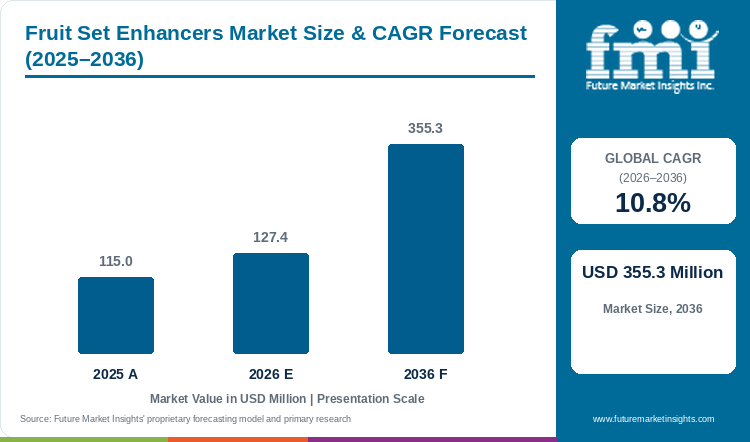
Fruit set enhancers are used during flowering, pollination, fertilization and early fruit development, due to which these products are facing higher demand in crops exposed to heat and water stress. The global fruit set enhancers market was valued at USD 115.0 million in 2025 and is projected to grow from USD 127.4 million in 2026 to USD 355.3 million by 2036, at 10.8% CAGR from 2026 to 2036, reflecting wider commercial investment in agricultural biostimulants. Amino acid and peptide-based products account for 44.9% of demand in 2026, as these formulations can be placed with regular crop nutrition programs. For most major crops, yield decline starts above 30 degrees C, which is increasing requirement for products used before fertilization and early set.[1] Timely application before and during reproductive stress enables growers to protect pollination and support early fruit development.
Key Market Trends & Insights
- By product type: Amino acid and peptide-based products led with 44.9% of demand in 2026, supported by readily available amino acids and peptides during flowering and early set.
- By crop type: Cereals and grains represented the leading 43.9% share in 2026, as broad planted acreage supports one application program over larger crop blocks.
- By application method: Soil application held 37.6% in 2026, enabled by root-zone placement and compatibility with existing irrigation systems.
- By farm type: Large commercial farms accounted for 39.7% in 2026, since larger treated blocks, crop maps and irrigation records allow comparison of treated and untreated fields.
- By sales channel: Agri-input distributors generated 37.7% of demand in 2026, owing to local inventory and agronomy support during short flowering and fruit-set windows.
Regional Highlights
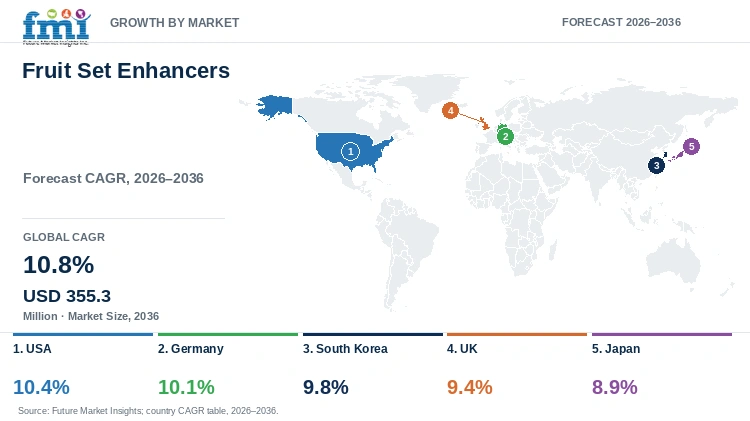
- Fastest-growing profiled country: USA (10.4% CAGR, 2026 to 2036).
- Germany (10.1%) and South Korea (9.8%) follow, while Japan records the lowest profiled CAGR at 8.9% through 2036.
Market Size & Forecast
Table 1: Market Size and Forecast for the Fruit Set Enhancers Market (USD million and CAGR percentage), 2025 to 2036
| Metric | Value |
|---|---|
| 2025 Market Size | USD 115.0 million |
| Estimated Market Size in 2026 | USD 127.4 million |
| Projected Market Size by 2036 | USD 355.3 million |
| CAGR, 2026 to 2036 | 10.8% |
| Added Revenue, 2026 to 2036 | USD 227.9 million |
| Market Expansion Multiple | 2.79x |
Application timing directly shapes commercial demand for fruit set enhancers across high-value production regions. Pressurized irrigation covered 29 million acres in the Western United States during 2023, whereas gravity systems covered 9.8 million acres. Presence of controlled water delivery provides wider scope for soil, drip and fertigation programs near flowering and early fruit set, complementing modern micro irrigation systems.[2] South Korea plans smart conversion across 35% of about 55,000 greenhouse hectares and technology use on 20% of key field-crop areas during 2025 to 2029.[3] Japan has conducted smart-agriculture demonstrations in 217 districts, while drone spraying reduced operation hours by 61% on average and automated water management reduced them by 80%.[4] These technologies allow growers to maintain treated-block records and use crop inputs during short reproductive-stage windows. According to FMI, availability of pressurized irrigation, field records and labor-saving equipment is anticipated to create growth opportunities for fruit set enhancers.
Treated Acreage and Application Readiness
Table 2: Treated Acreage and Application Readiness for the Fruit Set Enhancers Market (million acres, hectares, percentages, and districts), mixed reporting years from 2023 to 2029
| Indicator | Data Point | Why It Matters | Source |
|---|---|---|---|
| U.S. irrigated crop and pastureland | 54.9 million acres in 2022 | Large irrigated base supports measured soil, drip and fertigation programs. | [5] |
| Western U.S. pressurized irrigation | 29 million acres and 75% of irrigated acres in 2023 | Pressurized delivery allows dose and timing to be controlled near reproductive stage. | [2] |
| South Korea smart greenhouse target | 35% of about 55,000 hectares, 2025 to 2029 | Smart conversion expands records and controlled application in protected crops. | [3] |
| South Korea field-crop technology target | 20% of key field-crop areas, 2025 to 2029 | Field technology broadens application beyond greenhouses. | [3] |
| Japan smart-agriculture demonstrations | 217 districts reported in 2025 | Demonstrations widen operating evidence for labor-saving application. | [4] |
| Japan drone-spraying labor result | 61% average reduction in operation hours | Lower application time improves the economics of short crop-stage windows. | [4] |
Basis: External indicators describe application readiness and does not represent global fruit set enhancer market share. Market expansion multiple is calculated by dividing USD 355.3 million by USD 127.4 million, while added revenue equals USD 227.9 million.
Analyst Perspective
“Growers will prefer products showing retained flowers and saleable yield under actual field stress. Suppliers having clear dose, timing and local evidence will receive repeat demand as crop-stage heat increases.”
- Nandini Roy Choudhury, Principal Consultant, Future Market Insights.
How is the fruit set enhancers market segmented?
Fruit set enhancers market is segmented across five commercial axes and region: product type, crop type, application method, farm type, sales channel, and region. In 2026, amino acid and peptide-based products are projected at 44.9% of product type, cereals and grains at 43.9% of crop type, soil application at 37.6% of application method, large commercial farms at 39.7% of farm type, and agri-input distributors at 37.7% of sales channel.
By product type: amino acid and peptide-based, seaweed and botanical-based, humic and fulvic-based, microbial-enhanced blends, and others. By crop type: cereals and grains, fruits and vegetables, oilseeds and pulses, turf and ornamentals, and others. By application method: soil application, foliar application, fertigation or drip, seed application, and others. By farm type: large commercial farms, mid-size farms, smallholders, greenhouses and nurseries, and others. By sales channel: agri-input distributors, cooperatives, agri-retail chains, online or direct-to-farm, and others. By region: North America, Latin America, Western Europe, Eastern Europe, East Asia, South Asia and Pacific, and Middle East and Africa.
Why do amino acid and peptide products retain product type demand?
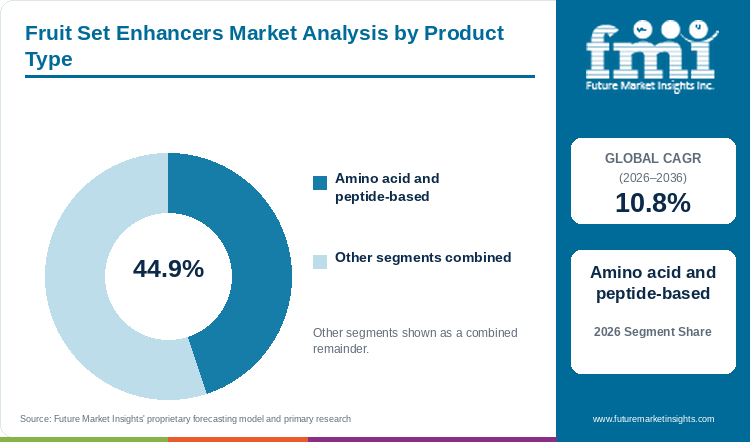
Based on product type, amino acid and peptide-based products are projected to account for 44.9% in 2026, owing to wider use during short crop-stage application windows.
Table 3: Product Type Share for the Fruit Set Enhancers Market (percentage share), 2026
| Product Type | Share (2026) |
|---|---|
| Amino Acid and Peptide-Based Products | 44.9% |
| Other Segments Combined | 55.1%* |
| Total | 100.0% |
*Calculated as the balance remaining after deducting the leading segment's reported share from 100.0%.
Table 4: Product Type Leadership and Market Growth for the Fruit Set Enhancers Market (segment and CAGR percentage), 2026 to 2036
| Metric | Value |
|---|---|
| Global CAGR (2026 to 2036) | 10.8% |
| Leading Segment | Amino Acid and Peptide-Based Products |
As per FMI, amino acid and peptide products are used around flowering and early fruit development as these formulations provide readily available amino acids and short peptides. These products can be added with existing nutrition schedule and does not require separate field operation when compatibility is established. In April 2025, Biolchim described use of tryptophan and arginine after fruit set for supporting fruit development.[6] Availability of products having stated crop and application time is anticipated to support demand for amino acid and peptide formulations. The product route overlaps with crop bioavailability enhancers when formulations improve nutrient access during a defined reproductive stage.
- Amino acid and peptide-based products are projected to account for 44.9% of product type demand in 2026, supported by readily available amino acids and peptides during flowering and early set.
- Commercial peptide formulations allow flexible combination with foliar nutrients, expanding application without requiring dedicated spraying equipment.
What supports cereals and grains as a preferred crop category?
By crop type, cereals and grains are estimated to hold 43.9% in 2026, attributed to large planted area and repeat application through established field operations.
Cereals and grains hold large treated acreage and common application windows during planting and reproductive growth. One formulation can be placed over wider crop area through established field operations, due to which separate handling remains lower than high-value crops having several stage-specific treatments. The UK produced more than 19.5 million tonnes of cereals in 2025.[7] Broad planted acreage and availability of compatible application systems is expected to support the use of fruit set enhancers in cereals and grains, alongside specialized seed treatment materials.
- Cereals and grains are estimated to hold 43.9% of crop type demand in 2026, owing to broad planted acreage and use of one application program over larger crop area.
- Field adoption still depends on storage stability, application compatibility and evidence at the intended crop stage.
How does soil application meet root-zone program needs?
In 2026, soil application is expected to represent 37.6% of application method demand, enabled by root-zone placement before reproductive stress.
Soil application places fruit set enhancer formulations near the root zone before visible heat and water stress appears in the crop. Growers already carrying out soil treatment or controlled irrigation can combine these inputs with humic and fulvic acid based biostimulants to maintain product dose near the intended crop stage. In June 2025, the U.S. Department of Agriculture reported that across conventionally tilled fields adopting cover crops, 70% of nitrogen fertilizer was applied at or after planting.[8] Wider alignment of in-season soil application with reproductive timing is anticipated to support root-zone product delivery.
- Soil application is expected to account for 37.6% of application method demand in 2026, as fruit set enhancers can be placed with existing soil and irrigation operations.
- Controlled irrigation also connects these products with micro-irrigation lines where dose, timing, and line compatibility are documented.
Why do large commercial farms support structured product trials?
Large commercial farms are projected to hold 39.7% of farm type demand in 2026, aided by mapped trials and larger treated blocks.
An FMI analyst notes that large commercial farms have larger treated blocks and can compare crop response under similar field schedule. Availability of irrigation records, crop maps and technical support enables these operations to integrate smart agriculture solutions before regular purchasing. In January 2026, the U.S. Department of Agriculture reported 54.9 million irrigated acres, accounting for less than 17% of harvested cropland but more than 50% of crop sales.[5] Concentration of crop sales on irrigated farms is expected to propel structured trials of fruit set enhancer products.
- Large commercial farms are projected to hold 39.7% of farm type demand in 2026, owing to larger treated blocks and availability of technical support for conducting product trials.
- A defined trial protocol matters more than farm size when weather or crop stage changes the biological response.
Which conditions keep agri-input distributors relevant in sales channels?
Agri-input distributors are set to lead sales channel with 37.7% share in 2026, underpinned by local agronomy access.
Agri-input distributors connect fruit set enhancer products with local crop stages, seasonal inventory, and compatible agricultural adjuvants that improve spray coverage. Growers generally purchase these products during a short flowering window, due to which local stock and agronomy advice remains important. In August 2026, Acadian Plant Health and Koppert USA announced a commercial transition for marketing and distribution responsibilities in the USA.[9] Expansion of distributor-led crop programs is anticipated to support this sales channel.
- Agri-input distributors are forecast to represent 37.7% of sales channel demand in 2026, owing to availability of local agronomy advice and seasonal product inventory.
- The channel can also connect fruit set enhancers with adjacent biological inputs without merging their distinct claims.
What are the drivers, restraints and opportunities in the fruit set enhancers market?
In the fruit set enhancers market, heat and water stress is the key driving factor, variation in field response is the major restraint, whereas increasing use of precision application is creating growth opportunities.
- Driver: Increasing heat and water stress during flowering is boosting demand for products applied before fertilization and early fruit set.
- Restraint: Difference in crop, weather and application timing can change product response, which may limit repeat purchasing.
- Opportunity: Increasing use of sensors and controlled irrigation can place fruit set enhancer products closer to the required reproductive stage.
Heat Raises Reproductive-Stage Risk
Heat and water stress during flowering is one of the primary factor driving demand for fruit set enhancers. The Food and Agriculture Organization and World Meteorological Organization reported in November 2025 that one heatwave can reduce agricultural productivity by up to 50%.[10] Products applied before fertilization and early fruit set can support crop management during extreme weather, functioning alongside heat recovery biologics to mitigate reproductive stress. FMI research indicates that rising reproductive-stage risk is expected to drive the fruit set enhancers market growth.
Field Conditions Change Product Response
Field performance of fruit set enhancers changes according to crop, climate, formulation and application timing. An April 2026 meta-analysis covering 198 studies and 2,021 comparisons recorded average yield gains of 16.3%, whereas response changed by crop setting and treatment route.[11] Due to this variation, field response must be calibrated against crop setting and treatment route, particularly when co-applied with agricultural chelates or foliar nutrients. Lack of repeatable crop response and requirement for local trials may hamper the growth of fruit set enhancers market.
Precision Tools Improve Application Timing
Sensors, irrigation records and controlled water delivery are creating new application opportunities for fruit set enhancers. An April 2026 European CAP Network report on proximal and remote sensing highlighted that integrating soil sensors, satellite imagery, and automated decision-support tools optimizes input efficiency across specialized crop systems.[12] These systems can apply fruit set enhancer products closer to flowering and maintain records of treated crop blocks, expanding use alongside commercial biofertilizers across high-value acreage. Expansion of precision farming is expected to create new avenues for the fruit set enhancers market.
Which country CAGRs are profiled in the fruit set enhancers market?
Table 5: Country CAGR Comparison for the Fruit Set Enhancers Market (CAGR percentage), 2026 to 2036
| Country | CAGR |
|---|---|
| USA | 10.4% |
| Germany | 10.1% |
| South Korea | 9.8% |
| UK | 9.4% |
| Japan | 8.9% |
How do country-level CAGRs compare in the fruit set enhancers market?
FMI data suggests country growth will differ according to farm size, horticultural production, application system and product requirement. The USA and Germany are projected at 10.4% and 10.1% CAGR through 2036, owing to commercial field trials in the USA and crop-specific product requirements in Germany. South Korea, the UK and Japan are likely to expand with smart farming, high-value horticulture and labor-saving application. However, local crop evidence remains important before products move towards wider use.
- USA fruit set enhancers demand is supported by larger treated fields, controlled irrigation and availability of crop records.
- Germany fruit set enhancers demand is supported by large vegetable production and requirement for crop-specific product instructions.
- South Korea is expanding smart farming systems, which supports fertigation and controlled application of fruit set enhancer products.
- UK demand is attributed to high-value fruit and vegetable production along with weather-related crop stress.
- Japan fruit set enhancers demand is linked with labor-saving farming systems and products having simple application method.
Full report country CAGRs cover: North America; Latin America; Western Europe; Eastern Europe; East Asia; South Asia and Pacific; Middle East and Africa.
Country-wise Analysis
- The USA fruit set enhancers market is projected to grow at 10.4% CAGR through 2036, owing to presence of large farms and increasing use of field technologies. In August 2025, the U.S. Department of Agriculture reported that 22% of farms used precision agriculture practices.[13] Guidance systems, crop maps and field records allows growers to compare treated and untreated crop blocks over commercial acreage. Products that can be applied through one spray, soil or irrigation operation are likely to witness higher adoption. As noted by FMI, increasing use of measured crop programs is expected to support the USA fruit set enhancers market growth.
- Germany fruit set enhancers market is anticipated to expand at 10.1% CAGR during 2026 to 2036, attributed to large horticultural production and defined product claims. The German Federal Statistical Office reported that vegetable harvest reached 4.5 million tonnes in 2025, which was 8.1% higher than 2024.[14] Vegetable production under protected and outdoor conditions creates different flowering and fruit-setting requirements. Availability of products having stated plant, intended effect and application instruction is expected to support the Germany fruit set enhancers market growth.
- Demand for fruit set enhancers in South Korea is estimated to expand at 9.8% CAGR through 2036, owing to controlled farming and labor-saving agriculture. The Asian Productivity Organization reported in 2025 that smart agriculture in Asian countries is shifting toward AI-based irrigation, mobile farm applications and cost-effective technologies for small and mid-size farms.[15] Such systems can support flowering-stage application and crop record keeping without increasing repeated manual work. Products having simple dose and fertigation compatibility are expected to witness higher demand, which in turn will fuel the South Korea fruit set enhancers market growth.
- Fruit set enhancer demand in the UK is forecast to rise at 9.4% CAGR through 2036, attributed to high-value horticulture and weather-related crop stress. The Department for Environment, Food & Rural Affairs reported that home-produced fruit increased by 2.3% to 577,000 tonnes in 2025, while vegetable production increased by 8.0% to 2.6 million tonnes.[16] Higher fruit and vegetable production provides wider application for products used during flowering and early fruit set. However, growers compare product cost with saleable yield, due to which crop-specific field results remains important. These factors are anticipated to support the UK fruit set enhancers market growth.
- In Japan, demand for fruit set enhancers is predicted to advance at 8.9% CAGR through 2036, aided by labor-saving agricultural systems. The Ministry of Agriculture, Forestry and Fisheries reported in May 2025 that core agricultural workers in Japan are projected to decline from 1.16 million to approximately 300,000 over twenty years.[17] Lower availability of farm operators is increasing demand for products that can be used through existing spray and irrigation equipment. Simple application instructions and lower manual handling is expected to propel the Japan fruit set enhancers market growth.
Who are the notable companies in the fruit set enhancers market?
UPL (NPP), Rovensa Next (Tradecorp), Hello Nature (Italpollina), Acadian Plant Health, Biolchim, Atlantica Agricola, Brandt and Seipasa are notable companies profiled in this market.
Fruit set enhancers market has presence of global biosolution companies, seaweed specialists and crop-stage nutrition suppliers, due to which the market remains moderately fragmented. UPL, Rovensa Next and Hello Nature provides wider biological input portfolios, whereas Seipasa, Biolchim, Atlantica Agricola and Brandt offers products or programs used around flowering and fruit development. Some of the key companies are focusing on registration, crop application support, production expansion and distributor reach in order to increase its market share. As per the analysis from FMI, development of crop-specific fruit set enhancer products is expected to intensify competition over the forecast period.
- Broad biosolutions platforms: UPL (NPP), Rovensa Next (Tradecorp) and Hello Nature (Italpollina) offers wider biological input portfolios and multi-country commercial support.
- Seaweed and botanical specialists: Acadian Plant Health and Seipasa are focusing on biologically derived products for crop stress, flowering and fruit set applications.
- Crop-stage nutrition specialists: Biolchim, Atlantica Agricola and Brandt offers crop programs used during flowering, fruit set and fruit development.
Competitive Benchmarking: Fruit Set Enhancers Market
Table 6: Competitive Benchmarking for the Fruit Set Enhancers Market (qualitative capability ratings), 2026
| Company | Stage specificity | Platform breadth | Application fit | Geographic reach |
|---|---|---|---|---|
| UPL (NPP) | Medium | High | Medium | High |
| Rovensa Next (Tradecorp) | High | High | Medium | High |
| Hello Nature (Italpollina) | Medium | High | High | High |
| Acadian Plant Health | Medium | Medium | High | Medium |
| Biolchim | High | Medium | Medium | Medium |
| Atlantica Agricola | High | Medium | Medium | Medium |
| Brandt | High | Medium | Medium | Medium |
| Seipasa | High | High | Medium | Medium |
High represents wider availability of public information for the stated company capability, whereas Medium represents comparatively limited product or geographic information. The comparison is based on public company activity and does not indicate product quality, revenue share or company ranking.
Key Developments in the Fruit Set Enhancers Market
- In April 2026, Seipasa secured European registration for Kynetic4 as a PFC 6(B) non-microbial plant biostimulant tied to flower development, pollination, fertilization and fruit set.[18]
- In December 2025, UPL launched HYCOXA, a patented seaweed-based technology positioned for abiotic stress and nitrogen uptake at heat-sensitive reproductive stages.[19]
- In December 2025, Rovensa Next launched Myndra in Europe for fruit-quality improvement in woody perennials and reported trial gains in firmness, sugar content and fruit weight.[20]
- In June 2025, Hello Nature announced an expansion of its Italian biostimulant facility that would double production capacity at the site.[21]
Key Players in the Fruit Set Enhancers Market
Broad biosolutions platforms
- UPL (NPP)
- Rovensa Next (Tradecorp)
- Hello Nature (Italpollina)
Botanical and seaweed technology specialists
- Acadian Plant Health
- Seipasa
Crop-stage specialty nutrition specialists
- Biolchim
- Atlantica Agricola
- Brandt
Fruit Set Enhancers Market - Report Scope
Table 7: Report Scope for the Fruit Set Enhancers Market (coverage fields and definitions), 2026 to 2036
| Coverage field | Report scope |
|---|---|
| Market breakdown | Product type; crop type; application method; farm type; sales channel; region |
| Quantitative units | USD million |
| Market definition | Revenue from crop-input formulations sold to support flowering, pollination, fertilization, early set and tightly linked stress or nutrient processes. Commodity fertilizers, pesticides, irrigation equipment and unrelated crop revenue are excluded. |
| Regions covered | North America; Latin America; Western Europe; Eastern Europe; East Asia; South Asia and Pacific; Middle East and Africa |
| Countries covered | USA; Germany; South Korea; UK; Japan |
| Key companies profiled | UPL (NPP); Rovensa Next (Tradecorp); Hello Nature (Italpollina); Acadian Plant Health; Biolchim; Atlantica Agricola; Brandt; Seipasa |
| Forecast period | 2026 to 2036 |
| Approach | Supplier activity, segment structure, application routes and country adoption within the stated boundary. |
Fruit Set Enhancers Market - Research Methodology
Table 8: Research Methodology for the Fruit Set Enhancers Market (research methods and approach), 2026 edition
| Method | Approach |
|---|---|
| Primary Research | The study includes primary interviews with manufacturers, distributors, end users, procurement teams and industry experts. Interviews covers purchasing decision, product evaluation, pricing, application requirement, technical support and adoption barriers. Respondents were also asked about the evidence required before a product trial develops into regular purchasing. |
| Desk Research | Government statistics, regulatory publications, industry associations, technical literature, company product information and official company announcements were included in desk research. Sources were checked on the basis of publication date, market relevance and geographic coverage. Company development, product approval, production capacity and performance information were retained when supported by direct public evidence. |
| Market Sizing and Forecasting | Base value, historical performance, segment share, pricing, volume, product adoption, company presence and country demand were included in market sizing. Forecasting considers product regulation, technology use, crop production, supply availability and factors limiting wider product use. Segment and regional estimates were checked before calculating the final fruit set enhancers market value. |
| Data Validation | Public statistics, company developments, trade information and primary interviews were used for checking market estimates. Data validation also checked whether products, applications and company activities falls within the stated fruit set enhancers market definition. Overlapping revenue, unrelated fertilizers, pesticides and unsupported claims were excluded. |
Fruit Set Enhancers Market by Segments
Fruit Set Enhancers Market segmented by Product Type:
- Amino acid and peptide-based
- Seaweed and botanical-based
- Humic and fulvic-based
- Microbial-enhanced blends
- Others
Fruit Set Enhancers Market segmented by Crop Type:
- Cereals and grains
- Fruits and vegetables
- Oilseeds and pulses
- Turf and ornamentals
- Others
Fruit Set Enhancers Market segmented by Application Method:
- Soil application
- Foliar application
- Fertigation or drip
- Seed application
- Others
Fruit Set Enhancers Market segmented by Farm Type:
- Large commercial farms
- Mid-size farms
- Smallholders
- Greenhouses and nurseries
- Others
Fruit Set Enhancers Market segmented by Sales Channel:
- Agri-input distributors
- Cooperatives
- Agri-retail chains
- Online or direct-to-farm
- Others
Fruit Set Enhancers Market by Region
- North America
- United States
- Canada
- Latin America
- Brazil
- Mexico
- Argentina
- Chile
- Western Europe
- Germany
- France
- United Kingdom
- Italy
- Spain
- Benelux
- Nordics
- Eastern Europe
- Poland
- Czech Republic
- Romania
- Hungary
- East Asia
- Japan
- South Korea
- South Asia and Pacific
- ASEAN
- Australia and New Zealand
- Middle East and Africa
- GCC Countries
- South Africa
- Türkiye
- Israel
Research Sources and Bibliography
- [1] World Meteorological Organization & Food and Agriculture Organization. (2026, April 22). Extreme heat pushes agrifood systems to the brink.
- [2] U.S. Department of Agriculture, Economic Research Service. (2025, December 3). Gravity irrigation continues to decline in Western States.
- [3] Ministry of Agriculture, Food and Rural Affairs, Republic of Korea. (2025, February 27). First master plan for smart farming, 2025-2029.
- [4] Ministry of Agriculture, Forestry and Fisheries of Japan. (2025, October). Promotion of smart agriculture.
- [5] U.S. Department of Agriculture, Economic Research Service. (2026, January 27). Irrigation and water use.
- [6] Biolchim. (2025, April 3). How to increase fruit size with foliar fertilization.
- [7] Department for Environment, Food & Rural Affairs. (2026, September 3). Agriculture in the United Kingdom 2025: Chapter 7, crops.
- [8] U.S. Department of Agriculture, Economic Research Service. (2025, June 25). Economic outcomes of soil health and conservation practices on U.S. cropland (ERR-353).
- [9] Acadian Plant Health. (2026, August 27). Acadian Plant Health and Koppert USA announce strategic transition.
- [10] World Meteorological Organization & Food and Agriculture Organization. (2025, November 20). FAO and WMO report highlights extreme heat risks for agriculture.
- [11] Perez-Onate, C. J., et al. (2026, April 21). Crop yield responses to seaweed extract-based biostimulants depend on application strategy, formulation, and extraction methods: A meta-analysis. Frontiers in Plant Science, 17, 1803269.
- [12] European Commission, EU CAP Network. (2026, April 30). Sensing the future: Practical applications of proximal and remote sensing for farmers and advisors.
- [13] U.S. Department of Agriculture, National Agricultural Statistics Service. (2025, August 1). Technology use: Farm computer usage and ownership.
- [14] German Federal Statistical Office. (2026, February 26). Vegetable harvest reaches a new record high in 2025.
- [15] Asian Productivity Organization. (2025). Future prospects for smart agriculture: Focusing on case studies in Japan and Asia.
- [16] Department for Environment, Food & Rural Affairs. (2026, June 25). Horticulture statistics 2025.
- [17] Ministry of Agriculture, Forestry and Fisheries of Japan. (2025, May). Basic Plan for Food, Agriculture and Rural Areas: Smart agriculture workforce projections.
- [18] Seipasa. (2026, April 28). Seipasa secures European biostimulant registration for Kynetic4.
- [19] UPL. (2025, December 1). UPL launches seaweed-based biostimulant technology HYCOXA.
- [20] Rovensa Next. (2025, December 9). Rovensa Next launches Myndra in Europe.
- [21] Hello Nature. (2025, June 26). Hello Nature announces expansion of Italian biostimulant production facility.
This bibliography is provided for reader reference. The full report contains the complete reference list and detailed citations.
This Report Answers
- How large is Fruit Set Enhancers Market during 2026?
- What value is Fruit Set Enhancers Market projected by 2036?
- Which product type holds notable Fruit Set Enhancers Market share?
- Which crop type holds notable Fruit Set Enhancers Market share?
- Which country has notable Fruit Set Enhancers Market growth?
- Which companies are notable in Fruit Set Enhancers Market today?
Frequently Asked Questions
How big is the Fruit Set Enhancers Market in 2026?
The fruit set enhancers market is valued at USD 127.4 million in 2026 and is projected to reach USD 355.3 million by 2036.
What CAGR is forecast for the Fruit Set Enhancers Market through 2036?
As per FMI, the fruit set enhancers market is projected to expand at a 10.8% CAGR from 2026 to 2036, owing to rising crop stress during flowering and early fruit set.
Which product type holds a notable market share in 2026?
Amino acid and peptide-based products are projected to account for 44.9% of product type demand in 2026, due to wider use during short crop-stage application windows.
Which crop type holds a notable market share in 2026?
Cereals and grains are estimated to hold 43.9% of crop type demand in 2026, attributed to broad planted acreage and repeat application through established field operations.
Which country has a notable expansion outlook through 2036?
Future Market Insights predicts the USA fruit set enhancers market to expand at a 10.4% CAGR during the 2026 to 2036 assessment period, supported by irrigated production and larger treated crop blocks.
Which companies are active in the Fruit Set Enhancers Market?
Notable companies operating in the fruit set enhancers market include UPL (NPP), Rovensa Next, Hello Nature, Acadian Plant Health, Biolchim, Atlantica Agricola, Brandt and Seipasa. These companies are focusing on reproductive-stage crop claims, application timing, and technical distributor support.
Preview the report firsthand - request a free sample
Get SampleGet the brochure for pricing and purchase details.
Get PDFTable of Content
- Key Takeaways
- Market Size and CAGR
- Top Growth Driver
- Fastest Growing Segment
- Leading Region
- Key Companies
- Emerging Opportunities
- Executive Summary
- Global Market Outlook
- Demand-side Trends
- Supply-side Trends
- Technology Roadmap Analysis
- Analysis and Recommendations
- Analyst Perspective (What is happening? Why now? What should investors know?)
- Key Questions Answered
- How large is the market?
- What is the CAGR?
- What are key trends?
- Which region dominates?
- Who are the leaders?
- Market Overview
- Market Coverage / Taxonomy
- Market Definition / Scope / Limitations
- Research Methodology
- Chapter Orientation
- Analytical Lens and Working Hypotheses
- Market Structure, Signals, and Trend Drivers
- Benchmarking and Cross-market Comparability
- Market Sizing, Forecasting, and Opportunity Mapping
- Research Design and Evidence Framework
- Desk Research Programme (Secondary Evidence)
- Expert Input and Fieldwork (Primary Evidence)
- Tooling, Models, and Reference Databases
- Data Engineering and Model Build
- Quality Assurance and Audit Trail
- Market Background
- Market Dynamics (Drivers, Restraints, Opportunity, Trends)
- Scenario Forecast (Optimistic, Likely, Conservative)
- Impact Analysis
- AI Impact
- Sustainability Impact
- Regulatory Impact
- Technology Impact
- Consumer / Buyer Analysis
- Purchase Drivers
- Adoption Barriers
- Buyer Journey
- Opportunity Map Analysis
- Product Life Cycle Analysis
- Supply Chain Analysis
- Investment Feasibility Matrix
- Value Chain Analysis
- PESTLE and Porter's Analysis
- Regulatory Landscape
- Regional Parent Market Outlook
- Production and Consumption Statistics
- Import and Export Statistics
- Global Market Analysis and Forecast, 2021 to 2036
- Historical Market Size Value (USD Million) Analysis, 2021 to 2025
- Current and Future Market Size Value (USD Million) Projections, 2026 to 2036
- Y-o-Y Growth Trend Analysis
- Absolute $ Opportunity Analysis
- Global Market Pricing Analysis, 2021 to 2036
- Global Market Analysis and Forecast, By Product Type, 2021 to 2036
- Introduction / Key Findings
- Historical Market Size Value (USD Million) Analysis By Product Type, 2021 to 2025
- Current and Future Market Size Value (USD Million) Analysis and Forecast By Product Type, 2026 to 2036
- Amino acid and peptide-based
- Seaweed and botanical-based
- Humic and fulvic-based
- Microbial-enhanced blends
- Others
- Y-o-Y Growth Trend Analysis By Product Type, 2021 to 2025
- Absolute $ Opportunity Analysis By Product Type, 2026 to 2036
- Global Market Analysis and Forecast, By Crop Type, 2021 to 2036
- Introduction / Key Findings
- Historical Market Size Value (USD Million) Analysis By Crop Type, 2021 to 2025
- Current and Future Market Size Value (USD Million) Analysis and Forecast By Crop Type, 2026 to 2036
- Cereals and grains
- Fruits and vegetables
- Oilseeds and pulses
- Turf and ornamentals
- Others
- Y-o-Y Growth Trend Analysis By Crop Type, 2021 to 2025
- Absolute $ Opportunity Analysis By Crop Type, 2026 to 2036
- Global Market Analysis and Forecast, By Application Method, 2021 to 2036
- Introduction / Key Findings
- Historical Market Size Value (USD Million) Analysis By Application Method, 2021 to 2025
- Current and Future Market Size Value (USD Million) Analysis and Forecast By Application Method, 2026 to 2036
- Soil application
- Foliar application
- Fertigation or drip
- Seed application
- Others
- Y-o-Y Growth Trend Analysis By Application Method, 2021 to 2025
- Absolute $ Opportunity Analysis By Application Method, 2026 to 2036
- Global Market Analysis and Forecast, By Farm Type, 2021 to 2036
- Introduction / Key Findings
- Historical Market Size Value (USD Million) Analysis By Farm Type, 2021 to 2025
- Current and Future Market Size Value (USD Million) Analysis and Forecast By Farm Type, 2026 to 2036
- Large commercial farms
- Mid-size farms
- Smallholders
- Greenhouses and nurseries
- Others
- Y-o-Y Growth Trend Analysis By Farm Type, 2021 to 2025
- Absolute $ Opportunity Analysis By Farm Type, 2026 to 2036
- Global Market Analysis and Forecast, By Sales Channel, 2021 to 2036
- Introduction / Key Findings
- Historical Market Size Value (USD Million) Analysis By Sales Channel, 2021 to 2025
- Current and Future Market Size Value (USD Million) Analysis and Forecast By Sales Channel, 2026 to 2036
- Agri-input distributors
- Cooperatives
- Agri-retail chains
- Online or direct-to-farm
- Others
- Y-o-Y Growth Trend Analysis By Sales Channel, 2021 to 2025
- Absolute $ Opportunity Analysis By Sales Channel, 2026 to 2036
- Global Market Analysis and Forecast, By Region, 2021 to 2036
- Introduction
- Historical Market Size Value (USD Million) Analysis By Region, 2021 to 2025
- Current Market Size Value (USD Million) Analysis and Forecast By Region, 2026 to 2036
- North America
- Latin America
- Western Europe
- Eastern Europe
- East Asia
- South Asia and Pacific
- Middle East and Africa
- Market Attractiveness Analysis By Region
- North America Market Analysis and Forecast, By Country, 2021 to 2036
- Historical Market Size Value (USD Million) Trend Analysis By Market Taxonomy, 2021 to 2025
- Market Size Value (USD Million) Forecast By Market Taxonomy, 2026 to 2036
- By Country
- United States
- Canada
- By Product Type
- By Crop Type
- By Application Method
- By Farm Type
- By Sales Channel
- By Country
- Market Attractiveness Analysis
- By Country
- By Product Type
- By Crop Type
- By Application Method
- By Farm Type
- By Sales Channel
- Key Takeaways
- Latin America Market Analysis and Forecast, By Country
- Historical Market Size Value (USD Million) Trend Analysis By Market Taxonomy, 2021 to 2025
- Market Size Value (USD Million) Forecast By Market Taxonomy, 2026 to 2036
- By Country
- Brazil
- Mexico
- Argentina
- Chile
- By Product Type
- By Crop Type
- By Application Method
- By Farm Type
- By Sales Channel
- By Country
- Market Attractiveness Analysis
- By Country
- By Product Type
- By Crop Type
- By Application Method
- By Farm Type
- By Sales Channel
- Key Takeaways
- Western Europe Market Analysis and Forecast, By Country
- Historical Market Size Value (USD Million) Trend Analysis By Market Taxonomy, 2021 to 2025
- Market Size Value (USD Million) Forecast By Market Taxonomy, 2026 to 2036
- By Country
- Germany
- France
- United Kingdom
- Italy
- Spain
- Benelux
- Nordics
- By Product Type
- By Crop Type
- By Application Method
- By Farm Type
- By Sales Channel
- By Country
- Market Attractiveness Analysis
- By Country
- By Product Type
- By Crop Type
- By Application Method
- By Farm Type
- By Sales Channel
- Key Takeaways
- Eastern Europe Market Analysis and Forecast, By Country
- Historical Market Size Value (USD Million) Trend Analysis By Market Taxonomy, 2021 to 2025
- Market Size Value (USD Million) Forecast By Market Taxonomy, 2026 to 2036
- By Country
- Poland
- Czech Republic
- Romania
- Hungary
- By Product Type
- By Crop Type
- By Application Method
- By Farm Type
- By Sales Channel
- By Country
- Market Attractiveness Analysis
- By Country
- By Product Type
- By Crop Type
- By Application Method
- By Farm Type
- By Sales Channel
- Key Takeaways
- East Asia Market Analysis and Forecast, By Country
- Historical Market Size Value (USD Million) Trend Analysis By Market Taxonomy, 2021 to 2025
- Market Size Value (USD Million) Forecast By Market Taxonomy, 2026 to 2036
- By Country
- Japan
- South Korea
- By Product Type
- By Crop Type
- By Application Method
- By Farm Type
- By Sales Channel
- By Country
- Market Attractiveness Analysis
- By Country
- By Product Type
- By Crop Type
- By Application Method
- By Farm Type
- By Sales Channel
- Key Takeaways
- South Asia and Pacific Market Analysis and Forecast, By Country
- Historical Market Size Value (USD Million) Trend Analysis By Market Taxonomy, 2021 to 2025
- Market Size Value (USD Million) Forecast By Market Taxonomy, 2026 to 2036
- By Country
- ASEAN
- Australia and New Zealand
- By Product Type
- By Crop Type
- By Application Method
- By Farm Type
- By Sales Channel
- By Country
- Market Attractiveness Analysis
- By Country
- By Product Type
- By Crop Type
- By Application Method
- By Farm Type
- By Sales Channel
- Key Takeaways
- Middle East and Africa Market Analysis and Forecast, By Country
- Historical Market Size Value (USD Million) Trend Analysis By Market Taxonomy, 2021 to 2025
- Market Size Value (USD Million) Forecast By Market Taxonomy, 2026 to 2036
- By Country
- GCC Countries
- South Africa
- Türkiye
- Israel
- By Product Type
- By Crop Type
- By Application Method
- By Farm Type
- By Sales Channel
- By Country
- Market Attractiveness Analysis
- By Country
- By Product Type
- By Crop Type
- By Application Method
- By Farm Type
- By Sales Channel
- Key Takeaways
- Key Countries Market Analysis
- United States
- Pricing Analysis
- Market Share Analysis, 2025
- By Product Type
- By Crop Type
- By Application Method
- By Farm Type
- By Sales Channel
- Canada
- Pricing Analysis
- Market Share Analysis, 2025
- By Product Type
- By Crop Type
- By Application Method
- By Farm Type
- By Sales Channel
- Mexico
- Pricing Analysis
- Market Share Analysis, 2025
- By Product Type
- By Crop Type
- By Application Method
- By Farm Type
- By Sales Channel
- Brazil
- Pricing Analysis
- Market Share Analysis, 2025
- By Product Type
- By Crop Type
- By Application Method
- By Farm Type
- By Sales Channel
- Chile
- Pricing Analysis
- Market Share Analysis, 2025
- By Product Type
- By Crop Type
- By Application Method
- By Farm Type
- By Sales Channel
- Germany
- Pricing Analysis
- Market Share Analysis, 2025
- By Product Type
- By Crop Type
- By Application Method
- By Farm Type
- By Sales Channel
- United Kingdom
- Pricing Analysis
- Market Share Analysis, 2025
- By Product Type
- By Crop Type
- By Application Method
- By Farm Type
- By Sales Channel
- Italy
- Pricing Analysis
- Market Share Analysis, 2025
- By Product Type
- By Crop Type
- By Application Method
- By Farm Type
- By Sales Channel
- Spain
- Pricing Analysis
- Market Share Analysis, 2025
- By Product Type
- By Crop Type
- By Application Method
- By Farm Type
- By Sales Channel
- France
- Pricing Analysis
- Market Share Analysis, 2025
- By Product Type
- By Crop Type
- By Application Method
- By Farm Type
- By Sales Channel
- ASEAN
- Pricing Analysis
- Market Share Analysis, 2025
- By Product Type
- By Crop Type
- By Application Method
- By Farm Type
- By Sales Channel
- Australia and New Zealand
- Pricing Analysis
- Market Share Analysis, 2025
- By Product Type
- By Crop Type
- By Application Method
- By Farm Type
- By Sales Channel
- Japan
- Pricing Analysis
- Market Share Analysis, 2025
- By Product Type
- By Crop Type
- By Application Method
- By Farm Type
- By Sales Channel
- South Korea
- Pricing Analysis
- Market Share Analysis, 2025
- By Product Type
- By Crop Type
- By Application Method
- By Farm Type
- By Sales Channel
- Poland
- Pricing Analysis
- Market Share Analysis, 2025
- By Product Type
- By Crop Type
- By Application Method
- By Farm Type
- By Sales Channel
- Hungary
- Pricing Analysis
- Market Share Analysis, 2025
- By Product Type
- By Crop Type
- By Application Method
- By Farm Type
- By Sales Channel
- Türkiye
- Pricing Analysis
- Market Share Analysis, 2025
- By Product Type
- By Crop Type
- By Application Method
- By Farm Type
- By Sales Channel
- South Africa
- Pricing Analysis
- Market Share Analysis, 2025
- By Product Type
- By Crop Type
- By Application Method
- By Farm Type
- By Sales Channel
- United States
- Market Structure Analysis
- Competition Dashboard
- Competition Benchmarking
- Market Share Analysis of Top Players
- By Regional
- By Product Type
- By Crop Type
- By Application Method
- By Farm Type
- By Sales Channel
- Emerging Startups
- Innovation Benchmarking
- Competition Analysis
- Competition Deep Dive
- UPL (NPP)
- Overview
- Product Portfolio
- Profitability by Market Segments
- Sales Footprint
- Strategy Overview
- Marketing Strategy
- Product Strategy
- Channel Strategy
- Rovensa Next (Tradecorp)
- Hello Nature (Italpollina)
- Acadian Plant Health
- Biolchim
- Atlantica Agricola
- Brandt
- Seipasa
- UPL (NPP)
- Case Studies
- Success Stories
- Recent Developments
- Competition Deep Dive
- Assumptions & Acronyms Used


