

- Market Size (2026)
- USD 359.2 Mn
- Forecast (2036)
- USD 992.7 Mn
- CAGR (2026 to 2036)
- 10.7%
How big is Fruit Curds Market in 2026?
USD 359.2 million in 2026 and USD 992.7 million by 2036 at a 10.7% CAGR.
Fruit curd sales are projected to rise at 10.7% CAGR from 2026 to 2036, lifting value from USD 359.2 million to USD 992.7 million. Industrial bakeries repeat orders after fillings hold texture and deposition. Puratos opened innovation centers in Montreal and Cartago in August 2025 and reported 120 centers worldwide. The network supports local trials before wider production.
Country scale changes how fruit-curd trials convert into repeated commercial supply contracts. USA Census Bureau business-pattern data released in 2025 counted 2,842 commercial bakery establishments. The count means fruit-ingredient companies face many plant-level qualification points before national supply becomes routine. UAE and Saudi Arabia carry higher approved CAGRs than the USA, but USA bakery scale makes technical coverage and replenishment capacity important for national accounts.
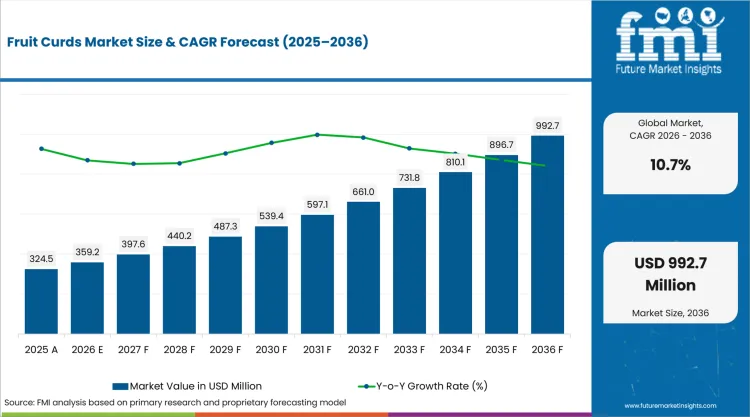
Key Takeaways
- Fruit-curd demand rises as industrial bakeries validate fruit flavor and deposition performance on production lines before repeat purchasing.
- By product type, standard grade is estimated to hold 44.0% in 2026 owing to wider sweetener and stabilizer choices.
- In 2026, powder - dry is expected to lead form with 43.0% share because centralized plants can store and dose it predictably.
- Bread & rolls are set to lead the application category with 32.0% share in 2026 due to frequent deposition and bake-stability checks.
- Fruit variation and claim rules can extend qualification if moisture or added-sugar changes alter the approved recipe.
- Key players in the fruit curds market include Barry Callebaut, Puratos, Dawn Foods, Zeelandia, CSM Ingredients, Bakels, AGRANA, Zentis, Fabbri 1905, and Irca Group.
Analyst Perspective
"Fruit curds earn repeat orders only after a filling holds deposition and bake performance on the customer's production line. Commercial advantage comes from pairing that line evidence with fruit-content and nutrition records that stay usable during reformulation."
- Nandini Roy Choudhury, Principal Consultant, Future Market Insights
How is the fruit curds market segmented?
The fruit curds market is segmented by product type, form, application, claim, sales channel and region.
Product type includes standard grade, premium - specialty grade, organic certified and clean label grade. Form covers powder - dry, liquid, paste - semi-solid and granules - pieces. Application includes bread & rolls, cakes & muffins, biscuits & cookies, viennoiserie & pastry and other bakery & snacks. Claim covers conventional, clean label, organic and non-GMO - identity preserved. Sales channel covers direct to industrial bakeries, ingredient distributors, foodservice & artisan supply and online B2B.
What makes standard grade central to the product type category?
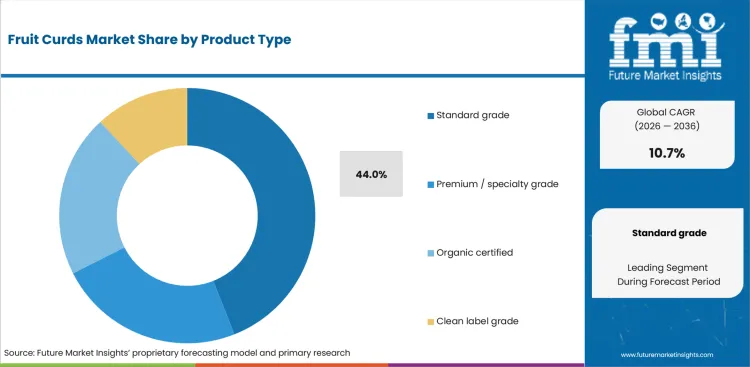
Standard grade gives industrial bakeries room to adjust sweetness and texture without adding organic or clean-label certification to each recipe. Its fit with common bakery ingredients lets bakery R&D teams change fruit flavor without rebuilding line qualification. Operators can compare finished-unit cost while keeping the same depositor and bake profile.
- By product type, standard grade is estimated to hold 44.0% in 2026 owing to wider sweetener and stabilizer choices during routine bakery qualification.
- CSM Ingredients opened a customer product-development centre with a test bakery in November 2025. The facility lets bakery teams trial formulas on dedicated equipment before a plant changes its commercial specification.
Why does powder - dry lead the form category?
Powder - dry form suits plants that separate warehouse storage from final hydration and need controlled recipe addition. Comparable fruit powder formats fit automated weighing because each batch can be portioned before the wet mix reaches the line. The format lowers handling variation without requiring a pumpable filling in storage.
- The form category is forecast to be led by powder - dry at 43.0% share in 2026 due to controlled storage and portioning.
- The Press Information Bureau documented fruit powders for bakery use at AAHAR 2026 in March 2026. The government release described dehydrated fruit powders as shelf-stable ingredients used in bakery products and other processed foods.
How do bread & rolls anchor the application category?
Bread & rolls put fruit fillings through proofing and baking at production speed. Plants using industrial bakery mixes work to tight recipe tolerances, so fruit fillings must hold moisture and deposition position without raising line waste.
- In 2026, bread & rolls are expected to lead application with 32.0% share because frequent runs make deposition and bake stability commercially important.
- ONS manufacturing data released in August 2026 placed the 2025 UK bakery and farinaceous-products output index at 98.8 on a 2023 base of 100. That production base keeps process consistency central to ingredient approval on repeated commercial runs.
What supports conventional within the claim category?
Conventional formulations leave more room to adjust sweeteners and stabilizers than organic or clean-label alternatives. Bakery developers can reserve clean-label ingredients for products where the claim earns enough value to justify narrower sourcing choices and a less flexible base recipe.
- Conventional is projected to hold 55.0% share in 2026 owing to the broadest formulation and sourcing choices within the claim category.
- At its April 2025 webinar the FDA said foods using the updated voluntary "healthy" claim must meet food-group requirements and nutrient limits. Claim-bearing bakery recipes therefore need documentation that supports the finished product rather than fruit content alone.
Why is direct to industrial bakeries central to the sales channel category?
Direct sales shorten the loop between a bakery trial and commercial approval because one technical team can resolve specification changes with the plant. Producers of dough-based premixes use the same service model when a formulation needs line adjustments before regular ordering begins.
- Direct to industrial bakeries is set to lead the sales channel category with 43.0% share in 2026 due to close technical approval and supply planning.
- Puratos launched a direct presence in Albania in February 2026 after moving from a distributor-based model. The company said its local team would provide faster response and closer technical support for bakery and patisserie customers.
What are the drivers, restraints and opportunities in the Fruit Curds Market?
Industrial bakeries buy more fruit curds as line performance becomes repeatable, but crop variability raises qualification cost and nutrition-driven reformulation increases demand for lower-sugar systems that retain bake performance.
- Driver: High-volume bakeries need fruit ingredients that hold deposition and bake behavior during long production runs.
- Restraint: Fruit composition and input-cost shifts can alter viscosity or sweetness enough to force another plant trial.
- Opportunity: Lower-sugar reformulation increases demand for fruit systems that preserve texture and line performance under revised nutrition targets.
Industrial Bakery Scale Raises the Value of Repeatable Fruit Systems
High-throughput bakery plants lose margin if fruit fillings need repeated line adjustments. The USA Census Bureau's February 2026 AIES release recorded more than USD 42 billion in 2023 sales and shipments for commercial bakeries. Baking enzymes face the same plant test, and fruit fillings earn repeat orders only after stable viscosity and deposition survive long runs.
Fruit and Sweetener Price Movement Complicates Recipe Economics
Fruit curds carry crop exposure into formulas where finished-unit yield determines acceptable ingredient cost. Destatis reported in August 2025 that German fruit prices were 7.6% higher year over year. A technically stable filling can still fail the commercial test if fruit-cost movement pushes the recipe beyond the bakery's target margin.
Nutrition Rules Reward Formulas That Can Be Reworked Without Losing Line Fit
Nutrition rules can raise the value of fruit systems that tolerate lower-sugar reformulation without losing bakery performance. In January 2025 the FDA proposed a front-of-package box that would classify added sugars as Low, Med or High. Food flavors become more important after sugar is reduced because bakery brands still need acceptable taste while the revised recipe meets the intended label position.
Which country CAGRs are profiled in the Fruit Curds Market?
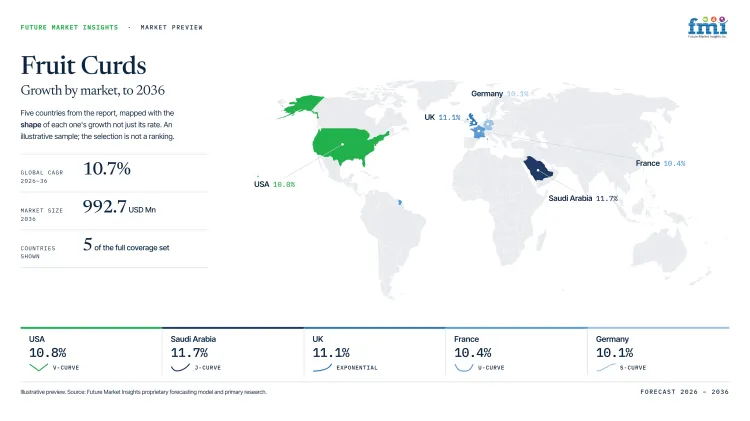
| Country | CAGR |
|---|---|
| UAE | 12.0% |
| Saudi Arabia | 11.7% |
| South Korea | 11.4% |
| UK | 11.1% |
| USA | 10.8% |
| France | 10.4% |
| Germany | 10.1% |
| Japan | 9.8% |
How do country-level CAGRs compare in the Fruit Curds Market?
The eight profiled countries span 2.2 percentage points. UAE, Saudi Arabia and South Korea form the upper group. UK, USA and France occupy the middle. Germany and Japan post the lowest displayed rates, making local execution important despite a narrow forecast spread.
- Hospitality seasonality tightens UAE replenishment windows.
- Saudi hospitality expansion widens professional bakery demand.
- South Korean bakery turnover speeds formulation cycles.
- UK frozen bakery channels reward stable thaw performance.
- USA plant density raises failed-trial costs.
- French pastry seasonality rewards flavor rotation.
- German industrial routines shorten technical onboarding.
- Japanese seasonal menus favor compact flavor launches.
Similar CAGRs can still produce different entry conditions. The full report provides country-level CAGR analysis across North America, Latin America, Western Europe, Eastern Europe, East Asia, South Asia and Pacific, and Middle East and Africa.
Country-wise Analysis
- USA commercial bakeries test fruit fillings against line speed and frozen-storage performance before extending a formula beyond one plant. The FDA delayed the updated "healthy" rule to April 28 in February 2025 and retained limits for added sugars plus sodium. Fruit-curd demand in the USA is projected to grow at 10.8% CAGR because national operators repeat orders after line and claim tests. Frozen bakery products add thaw stability to the normal bake test for filled products. Claim files can delay sweeter recipes if nutrition records do not match the finished formula, so local technical teams need both plant data and usable nutrition records.
- Small recipe losses become visible on repeated production runs, so German bakeries place premium fruit fillings under strict yield and waste checks. Fruit-curd demand in Germany is forecast to rise at 10.1% CAGR over the forecast period tied to mature plant routines and disciplined cost control. Destatis stated in January 2026 that wholesale prices for sugar and bakery products averaged 14.7% above 2024 levels during 2025. Cake enzyme systems face the same cost-per-unit scrutiny on high-throughput industrial bakery lines. Germany offers a stable qualification base, but premium fruit formulas still need portion efficiency and pricing terms that absorb input volatility during annual retail negotiations.
- French bakery sales split between industrial plants and artisan shops that order different case sizes without changing the finished pastry expectation. Insee reported in June 2026 that bakery-pastry shops represented 8.1% of French food-retail value in 2025. Bakery mixes compete for development time because technical service must work for small shops and large plants. Fruit-curd sales in France are anticipated to expand at 10.4% CAGR through 2036 supported by professional bakery demand. Independent shops also place more weight on frequent technical contact during product changeovers. Entry favors distributors that can vary service frequency and pack size without fragmenting formulation control between industrial and artisan accounts.
- UK bakery manufacturers test recipe changes against line performance and the advertising status of the finished product. The fruit-curds market in the UK is estimated to post 11.1% CAGR over the forecast period given continued reformulation activity. Government guidance updated in June 2025 confirmed nationwide restrictions on advertising less-healthy food would take effect on January 5 2026. Sugar therefore enters portfolio planning after line approval. Stable nutrition records become more valuable during retailer review and seasonal assortment planning. Sweeter applications still face a tighter promotion test even when the technical specification passes.
- Saudi bakery chains often run centralized kitchens that need one ingredient file across several outlets under the same menu specification. SFDA announced three nutrition-related menu regulations in February 2025 and set July 1 as the effective date. Fruit-curd demand in Saudi Arabia is predicted to advance at 11.7% CAGR through 2036 owing to foodservice expansion and standardized kitchen processes. Imported specialty ingredients still need local documentation before repeat orders. Companies that package nutrition and handling data for chain use can shorten the handoff from trial kitchen to outlet rollout nationally.
- Long gaps between trial and production make nearby stock valuable to UAE food manufacturers using imported specialty ingredients. Fruit-curd demand in the UAE is forecast to expand at 12.0% CAGR by 2036 reflecting local manufacturing programs and hospitality demand. MoIAT brought PepsiCo into the Future Industries Lab in May 2026 as its first food and beverage participant. The program exposes local manufacturers to multinational production practices. Conformity work can still slow imported formulations, so distributors with local inventory are better placed to convert seasonal trials into repeat orders without extending replenishment lead times.
- Government-set imported wheat prices keep flour economics visible in Japanese bakery reviews for industrial bread and confectionery lines. MAFF cut the October selling price for five imported-wheat classes by 4.0% in September 2025 and identified three classes used mainly for bread. Japan is projected to record 9.8% CAGR during the assessment period attributable to mature bakery consumption and steady fruit differentiation. High-frequency production penalizes fillings that add waste or deposition adjustments. Seasonal fruit launches therefore need controlled yield as well as flavor novelty before a plant retains them in repeat production.
- South Korean bakeries work under nutrient-reduction labeling rules that make recipe records part of claim development. Fruit-curd demand in South Korea is estimated to expand at 11.4% CAGR through 2036 helped by frequent reformulation in bakery and confectionery lines. MFDS issued revised sodium and sugar reduction labeling standards on October 20 2025 for covered claims. Lower sugar can alter filling texture and sweetness. National chains move faster once revised formulas pass commercial application trials, so fruit-curd companies need data proving reduced-sugar recipes deposit and bake consistently on production equipment at scale.
Who are the notable companies in the Fruit Curds Market?
Barry Callebaut, Puratos, Dawn Foods, Zeelandia, CSM Ingredients, Bakels, AGRANA, Zentis, Fabbri 1905, and Irca Group are the notable companies profiled in this market.
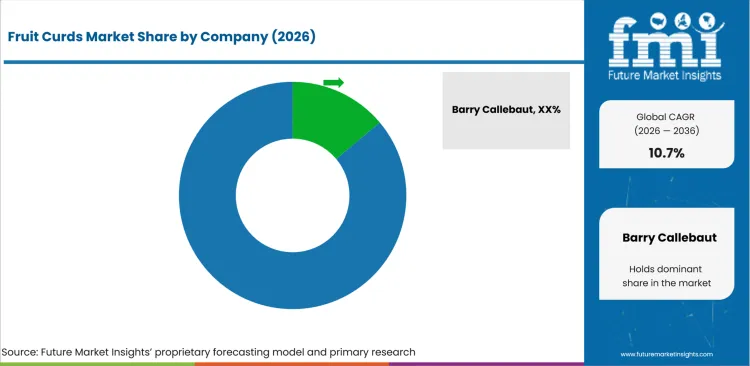
Fruit-curd competition spans bakery systems companies, fruit-preparation specialists and pastry-focused groups. Industrial bakeries require specifications that survive process and documentation review. Multi-region companies must reproduce them with local technical support.
- Bakery systems and application support: Puratos, Dawn Foods, Zeelandia, CSM Ingredients and Bakels.
- Fruit-preparation depth: AGRANA and Zentis.
- Pastry and adjacent filling platforms: Barry Callebaut, Fabbri 1905 and Irca Group.
Competitive Benchmarking: Fruit Curds Market
| Company | Bake / Freeze Stability | Fruit Formulation Breadth | Industrial Application Support | Geographic Reach |
|---|---|---|---|---|
| Barry Callebaut | Medium | Medium | Medium | Global |
| Puratos | High | High | High | Global |
| Dawn Foods | High | High | High | North America, Europe and selected international markets |
| Zeelandia | High | Medium | High | Europe and international bakery markets |
| CSM Ingredients | High | High | High | Europe and international markets |
| Bakels | High | Medium | High | Global network |
| AGRANA | High | High | High | Global |
| Zentis | High | High | High | Europe, North America and international sales |
| Fabbri 1905 | Medium | Medium | Medium | Europe and international professional channels |
| Irca Group | High | Medium | High | Europe, Americas and international markets |
Scoring basis: High bake and freeze stability requires evidence for multiple processing conditions, Medium one condition and Low adjacent use. Fruit breadth follows the number of documented routes. Application support reflects dedicated testing or professional technical resources.
Key Developments in the Fruit Curds Market
- In September 2025, Dawn Foods expanded the Royal Steensma range in North America with four professional bakery products including fruit glazes. The expansion brings ready-to-use fruit finishing closer to regional bakery customers that need repeatable application on commercial runs.
- In September 2025, Puratos formed a joint venture with Guelph Foods in China. The agreement links Puratos development expertise with local UHT production and gives bakery customers another route to regional formulation support.
- In February 2025, Irca Group made its St. Louis facility operational for the Americas. The site places professional chocolate and filling production closer to regional pastry customers and shortens the service distance for product trials.
Key Players in the Fruit Curds Market
Adjacent Chocolate and Filling Platform
- Barry Callebaut
Integrated Bakery Systems and Application Support
- Puratos
- Dawn Foods
- Zeelandia
- CSM Ingredients
- Bakels
Fruit Preparation and Pastry Filling Specialists
- AGRANA
- Zentis
- Fabbri 1905
- Irca Group
Fruit Curds Market - Report Scope
| Coverage field | Report scope |
|---|---|
| Market breakdown | By product type, form, application, claim, sales channel and region. |
| Quantitative Units | USD million. |
| Market Definition | Commercial fruit-curd ingredients and closely specified fruit systems supplied for bakery, pastry and related professional food applications. |
| Regions Covered | North America, Latin America, Western Europe, Eastern Europe, East Asia, South Asia and Pacific, and Middle East and Africa. |
| Countries Covered | UAE, Saudi Arabia, South Korea, UK, USA, France, Germany, Japan, and 20+ countries included in the full report. |
| Key Companies Profiled | Barry Callebaut, Puratos, Dawn Foods, Zeelandia, CSM Ingredients, Bakels, AGRANA, Zentis, Fabbri 1905, Irca Group. |
| Forecast Period | 2026 to 2036. |
| Approach | Primary and secondary research with market triangulation. |
Fruit Curds Market - Research Methodology
| Method | Approach |
|---|---|
| Primary Research | FMI analysts gathered input from manufacturers, service providers, technology developers, distributors, end users, procurement teams, and subject-matter experts. Interviews examined purchasing decisions, product or service evaluation, adoption barriers, approval requirements, pricing considerations, and expectations for technical or commercial support. Respondents were also asked what evidence is required before a trial, pilot, or initial order develops into regular purchasing. |
| Desk Research | Desk research covered government statistics, regulatory publications, trade data, industry associations, technical literature, standards, company filings, product information, and official corporate announcements. Sources were reviewed for relevance, publication date, geographic coverage, and consistency with the defined market scope. Claims relating to performance, applications, approvals, capacity, investment, and commercial activity were retained only when supported by credible public evidence. |
| Market Sizing and Forecasting | The market model combined the baseline value with historical performance, segment structure, pricing and volume indicators, adoption levels, company participation, and country-level demand conditions. Forecast assumptions considered economic activity, investment trends, regulatory developments, technology adoption, purchasing cycles, supply availability, and barriers to wider market use. Segment and regional estimates were reconciled before the final market total was calculated. |
| Data Validation | Estimates were checked against multiple independent indicators, including public data, company activity, trade patterns, industry developments, and findings from primary interviews. Validation also tested whether products, services, applications, and company revenues fell within the defined market boundaries. Adjacent categories, unsupported claims, overlapping revenues, and activities without direct market relevance were excluded to reduce double counting and maintain consistency across segments and countries. |
Fruit Curds Market by Segments
Fruit Curds Market segmented by Product Type:
- Standard grade
- Premium - specialty grade
- Organic certified
- Clean label grade
Fruit Curds Market segmented by Form:
- Powder - dry
- Liquid
- Paste - semi-solid
- Granules - pieces
Fruit Curds Market segmented by Application:
- Bread & rolls
- Cakes & muffins
- Biscuits & cookies
- Viennoiserie & pastry
- Other bakery & snacks
Fruit Curds Market segmented by Claim:
- Conventional
- Clean label
- Organic
- Non-GMO - identity preserved
Fruit Curds Market segmented by Sales Channel:
- Direct to industrial bakeries
- Ingredient distributors
- Foodservice & artisan supply
- Online B2B
Fruit Curds Market by Region:
- North America
- USA
- Canada
- Latin America
- Brazil
- Mexico
- Argentina
- Western Europe
- Germany
- France
- UK
- Italy
- Spain
- Benelux
- Nordics
- Eastern Europe
- Poland
- Czech Republic
- Romania
- Hungary
- East Asia
- Japan
- South Korea
- South Asia and Pacific
- Australia
- New Zealand
- ASEAN
- Middle East and Africa
- UAE
- Saudi Arabia
- South Africa
- Other GCC and African markets
Research Sources and Bibliography
- Puratos. (2025, August 25). Puratos Announces Two New Hubs for Food Innovation: Montreal and Costa Rica.
- USA Census Bureau. (2025). County Business Patterns: Commercial bakeries, 2023.
- CSM Ingredients. (2025, November 18). CSM Ingredients - a Nexture company - opens new £3m state-of-the-art customer focused product development centre in the UK.
- Press Information Bureau. (2026, March 12). From Regional Flavours to Food Innovation: Entrepreneurial Stories from AAHAR 2026.
- Office for National Statistics. (2026, August 13). IOP: 10.7: Manufacture of bakery and farinaceous products: CVMSA.
- USA Food and Drug Administration. (2025, April 10). Webinar on the Updated "Healthy" Claim.
- Puratos. (2026, February 25). Puratos Establishes Direct Presence in Albania with the Launch of Puratos Albania.
- USA Census Bureau. (2026, February 26). All Sectors: Summary Statistics for Industry Groups and Industries for Employer Firms in the USA and Selected Geographies.
- German Federal Statistical Office. (2025, August 13). Inflation rate at +2.0% in July 2025.
- USA Food and Drug Administration. (2025, January 14). FDA Proposes Requiring At-a-Glance Nutrition Information on the Front of Packaged Foods.
- USA Food and Drug Administration. (2025, February 24). FDA Finalizes Updated "Healthy" Nutrient Content Claim.
- German Federal Statistical Office. (2026, January 15). Wholesale prices in December 2025: +1.2% on December 2024.
- Insee. (2026, June 18). Parts de marché du commerce de détail selon la forme de vente - Données annuelles 2025.
- UK Department of Health and Social Care. (2025, June 4). Restricting advertising of less healthy food or drink on TV and online: products in scope.
- Saudi Food and Drug Authority. (2025, February 27). The SFDA Issues Three New Regulations to Promote Healthy Community Nutrition.
- UAE Ministry of Industry and Advanced Technology. (2026, May 7). MoIAT expands Future Industries Lab with new PepsiCo partnership supporting SMEs and young Emiratis.
- Japan Ministry of Agriculture, Forestry and Fisheries. (2025, September 10). 輸入小麦の政府売渡価格の改定について.
- Ministry of Food and Drug Safety, Republic of Korea. (2025, October 20). 「나트륨·당류 저감 표시기준」 고시전문.
- Dawn Foods. (2025, September 15). Dawn Foods Expands Royal Steensma Product Line in North America With Four New Premium, Easy-to-use Products.
- Puratos. (2025, September 12). Puratos and Guelph Announced Strategic Joint Venture to Ignite a New Chapter for Asia Pacific Bakery Industry.
- IRCA Group. (2025, February 18). Crafted in Italy, Produced in the USA.
- Barry Callebaut Group. (2026, June 2). Barry Callebaut Group Launches Focus for Growth.
- Royal Zeelandia Group. (2026). Zeelandia publishes Sustainability Report 2025.
- Bakels. (2025). Worldwide Review Issue 176.
- AGRANA. (2026). Annual Report 2025|26.
- CSM Ingredients. (2026, May 12). CSM INGREDIENTS LAUNCHES CREAMI®, A COMPREHENSIVE RANGE OF INDULGENT FILLINGS FOR BAKERY, PASTRY AND CONFECTIONERY PROFESSIONALS.
- IRCA Group. (2025, November 17). THE CREME COLLECTION.
- Puratos. (2026, January 23). Puratos Strengthens Its Presence in Italy with the Creation of Puratos Cascarano.
- Puratos. (2026, January 21). Puratos acquires Vör Foods, accelerating USA nut-based innovation.
- Fabbri 1905. (2026, January 16). Fabbri 1905 entra nel mondo dello street food e ridefinisce il fuoricasa Made in Italy.
- Zentis. (2025, August 15). Jetzt wird’s bärig lecker - Zentis und Bärchen® launchen Fruchtaufstriche für die ganze Familie.
This bibliography is provided for reader reference and is not exhaustive. The full report contains the complete reference list and detailed citations
This Report Answers
- How large is the fruit curds market?
- What CAGR is projected through 2036?
- Which product type leads in 2026?
- Which form holds the largest share?
- Which bakery application leads demand?
- Which countries record the highest CAGRs?
- How do claim rules affect qualification?
- Which companies are active in fruit curds?
Frequently Asked Questions
How big is the fruit curds market in 2026?
The fruit curds market is valued at USD 359.2 million in 2026 and is projected to reach USD 992.7 million by 2036. Repeat orders follow stable deposition and bake performance.
What is the CAGR of the fruit curds market from 2026 to 2036?
The fruit curds market is projected to grow at 10.7% CAGR between 2026 and 2036. Growth comes from industrial bakery demand and continued reformulation work.
Which product type leads the fruit curds market?
Standard grade is expected to hold 44.0% in 2026 attributable to wider sweetener and stabilizer choices. Its broad specification fit reduces certified-claim controls on routine formulas.
Which form leads the fruit curds market?
Powder - dry is expected to hold 43.0% in 2026 supported by controlled storage and portioning. Plants can dose it before hydration without storing a pumpable filling.
Which countries are projected to record the highest growth in the fruit curds market?
UAE is projected at 12.0% CAGR followed by Saudi Arabia at 11.7% and South Korea at 11.4% through 2036. Foodservice expansion and manufacturing programs support documented formulations.
Which companies are active in the fruit curds market?
Key companies operating in the fruit curds market include Barry Callebaut, Puratos, Dawn Foods, Zeelandia, CSM Ingredients, Bakels, AGRANA, Zentis, Fabbri 1905, and Irca Group. They compete on fruit formulation depth, bake stability, application support and regional coverage.
Preview the report firsthand - request a free sample
Get SampleGet the brochure for pricing and purchase details.
Get PDFTable of Content
- Key Takeaways
- Market Size and CAGR
- Top Growth Driver
- Fastest Growing Segment
- Leading Region
- Key Companies
- Emerging Opportunities
- Executive Summary
- Global Market Outlook
- Demand-side Trends
- Supply-side Trends
- Technology Roadmap Analysis
- Analysis and Recommendations
- Analyst Perspective (What is happening? Why now? What should investors know?)
- Key Questions Answered
- How large is the market?
- What is the CAGR?
- What are key trends?
- Which region dominates?
- Who are the leaders?
- Market Overview
- Market Coverage / Taxonomy
- Market Definition / Scope / Limitations
- Research Methodology
- Chapter Orientation
- Analytical Lens and Working Hypotheses
- Market Structure, Signals, and Trend Drivers
- Benchmarking and Cross-market Comparability
- Market Sizing, Forecasting, and Opportunity Mapping
- Research Design and Evidence Framework
- Desk Research Programme (Secondary Evidence)
- Expert Input and Fieldwork (Primary Evidence)
- Tooling, Models, and Reference Databases
- Data Engineering and Model Build
- Quality Assurance and Audit Trail
- Market Background
- Market Dynamics (Drivers, Restraints, Opportunity, Trends)
- Scenario Forecast (Optimistic, Likely, Conservative)
- Impact Analysis
- AI Impact
- Sustainability Impact
- Regulatory Impact
- Technology Impact
- Consumer / Buyer Analysis
- Purchase Drivers
- Adoption Barriers
- Buyer Journey
- Opportunity Map Analysis
- Product Life Cycle Analysis
- Supply Chain Analysis
- Investment Feasibility Matrix
- Value Chain Analysis
- PESTLE and Porter's Analysis
- Regulatory Landscape
- Regional Parent Market Outlook
- Production and Consumption Statistics
- Import and Export Statistics
- Global Market Analysis and Forecast, 2021 to 2036
- Historical Market Size Value (USD Million) Analysis, 2021 to 2025
- Current and Future Market Size Value (USD Million) Projections, 2026 to 2036
- Y-o-Y Growth Trend Analysis
- Absolute $ Opportunity Analysis
- Global Market Pricing Analysis, 2021 to 2036
- Global Market Analysis and Forecast, By Product Type, 2021 to 2036
- Introduction / Key Findings
- Historical Market Size Value (USD Million) Analysis By Product Type, 2021 to 2025
- Current and Future Market Size Value (USD Million) Analysis and Forecast By Product Type, 2026 to 2036
- Standard grade
- Premium / specialty grade
- Organic certified
- Clean label grade
- Standard grade
- Y-o-Y Growth Trend Analysis By Product Type, 2021 to 2025
- Absolute $ Opportunity Analysis By Product Type, 2026 to 2036
- Global Market Analysis and Forecast, By Form, 2021 to 2036
- Introduction / Key Findings
- Historical Market Size Value (USD Million) Analysis By Form, 2021 to 2025
- Current and Future Market Size Value (USD Million) Analysis and Forecast By Form, 2026 to 2036
- Powder / dry
- Liquid
- Paste / semi-solid
- Granules / pieces
- Powder / dry
- Y-o-Y Growth Trend Analysis By Form, 2021 to 2025
- Absolute $ Opportunity Analysis By Form, 2026 to 2036
- Global Market Analysis and Forecast, By Application, 2021 to 2036
- Introduction / Key Findings
- Historical Market Size Value (USD Million) Analysis By Application, 2021 to 2025
- Current and Future Market Size Value (USD Million) Analysis and Forecast By Application, 2026 to 2036
- Bread & rolls
- Cakes & muffins
- Biscuits & cookies
- Viennoiserie & pastry
- Other bakery & snacks
- Bread & rolls
- Y-o-Y Growth Trend Analysis By Application, 2021 to 2025
- Absolute $ Opportunity Analysis By Application, 2026 to 2036
- Global Market Analysis and Forecast, By Claim, 2021 to 2036
- Introduction / Key Findings
- Historical Market Size Value (USD Million) Analysis By Claim, 2021 to 2025
- Current and Future Market Size Value (USD Million) Analysis and Forecast By Claim, 2026 to 2036
- Conventional
- Clean label
- Organic
- Non-GMO / identity preserved
- Conventional
- Y-o-Y Growth Trend Analysis By Claim, 2021 to 2025
- Absolute $ Opportunity Analysis By Claim, 2026 to 2036
- Global Market Analysis and Forecast, By Sales Channel, 2021 to 2036
- Introduction / Key Findings
- Historical Market Size Value (USD Million) Analysis By Sales Channel, 2021 to 2025
- Current and Future Market Size Value (USD Million) Analysis and Forecast By Sales Channel, 2026 to 2036
- Direct to industrial bakeries
- Ingredient distributors
- Foodservice & artisan supply
- Online B2B
- Direct to industrial bakeries
- Y-o-Y Growth Trend Analysis By Sales Channel, 2021 to 2025
- Absolute $ Opportunity Analysis By Sales Channel, 2026 to 2036
- Global Market Analysis and Forecast, By Region, 2021 to 2036
- Introduction
- Historical Market Size Value (USD Million) Analysis By Region, 2021 to 2025
- Current Market Size Value (USD Million) Analysis and Forecast By Region, 2026 to 2036
- North America
- Latin America
- Western Europe
- Eastern Europe
- East Asia
- South Asia and Pacific
- Middle East & Africa
- Market Attractiveness Analysis By Region
- North America Market Analysis and Forecast, By Country, 2021 to 2036
- Historical Market Size Value (USD Million) Trend Analysis By Market Taxonomy, 2021 to 2025
- Market Size Value (USD Million) Forecast By Market Taxonomy, 2026 to 2036
- By Country
- USA
- Canada
- By Product Type
- By Form
- By Application
- By Claim
- By Sales Channel
- By Country
- Market Attractiveness Analysis
- By Country
- By Product Type
- By Form
- By Application
- By Claim
- By Sales Channel
- Key Takeaways
- Latin America Market Analysis and Forecast, By Country
- Historical Market Size Value (USD Million) Trend Analysis By Market Taxonomy, 2021 to 2025
- Market Size Value (USD Million) Forecast By Market Taxonomy, 2026 to 2036
- By Country
- Brazil
- Mexico
- Chile
- Rest of Latin America
- By Product Type
- By Form
- By Application
- By Claim
- By Sales Channel
- By Country
- Market Attractiveness Analysis
- By Country
- By Product Type
- By Form
- By Application
- By Claim
- By Sales Channel
- Key Takeaways
- Western Europe Market Analysis and Forecast, By Country
- Historical Market Size Value (USD Million) Trend Analysis By Market Taxonomy, 2021 to 2025
- Market Size Value (USD Million) Forecast By Market Taxonomy, 2026 to 2036
- By Country
- Germany
- UK
- Italy
- Spain
- France
- Nordic
- BENELUX
- Rest of Western Europe
- By Product Type
- By Form
- By Application
- By Claim
- By Sales Channel
- By Country
- Market Attractiveness Analysis
- By Country
- By Product Type
- By Form
- By Application
- By Claim
- By Sales Channel
- Key Takeaways
- Eastern Europe Market Analysis and Forecast, By Country
- Historical Market Size Value (USD Million) Trend Analysis By Market Taxonomy, 2021 to 2025
- Market Size Value (USD Million) Forecast By Market Taxonomy, 2026 to 2036
- By Country
- Russia
- Poland
- Hungary
- Balkan & Baltic
- Rest of Eastern Europe
- By Product Type
- By Form
- By Application
- By Claim
- By Sales Channel
- By Country
- Market Attractiveness Analysis
- By Country
- By Product Type
- By Form
- By Application
- By Claim
- By Sales Channel
- Key Takeaways
- East Asia Market Analysis and Forecast, By Country
- Historical Market Size Value (USD Million) Trend Analysis By Market Taxonomy, 2021 to 2025
- Market Size Value (USD Million) Forecast By Market Taxonomy, 2026 to 2036
- By Country
- China
- Japan
- South Korea
- By Product Type
- By Form
- By Application
- By Claim
- By Sales Channel
- By Country
- Market Attractiveness Analysis
- By Country
- By Product Type
- By Form
- By Application
- By Claim
- By Sales Channel
- Key Takeaways
- South Asia and Pacific Market Analysis and Forecast, By Country
- Historical Market Size Value (USD Million) Trend Analysis By Market Taxonomy, 2021 to 2025
- Market Size Value (USD Million) Forecast By Market Taxonomy, 2026 to 2036
- By Country
- India
- ASEAN
- Australia & New Zealand
- Rest of South Asia and Pacific
- By Product Type
- By Form
- By Application
- By Claim
- By Sales Channel
- By Country
- Market Attractiveness Analysis
- By Country
- By Product Type
- By Form
- By Application
- By Claim
- By Sales Channel
- Key Takeaways
- Middle East & Africa Market Analysis and Forecast, By Country
- Historical Market Size Value (USD Million) Trend Analysis By Market Taxonomy, 2021 to 2025
- Market Size Value (USD Million) Forecast By Market Taxonomy, 2026 to 2036
- By Country
- Kingdom of Saudi Arabia
- Other GCC Countries
- Türkiye
- South Africa
- Other African Union
- Rest of Middle East & Africa
- By Product Type
- By Form
- By Application
- By Claim
- By Sales Channel
- By Country
- Market Attractiveness Analysis
- By Country
- By Product Type
- By Form
- By Application
- By Claim
- By Sales Channel
- Key Takeaways
- Key Countries Market Analysis
- USA
- Pricing Analysis
- Market Share Analysis, 2025
- By Product Type
- By Form
- By Application
- By Claim
- By Sales Channel
- Canada
- Pricing Analysis
- Market Share Analysis, 2025
- By Product Type
- By Form
- By Application
- By Claim
- By Sales Channel
- Mexico
- Pricing Analysis
- Market Share Analysis, 2025
- By Product Type
- By Form
- By Application
- By Claim
- By Sales Channel
- Brazil
- Pricing Analysis
- Market Share Analysis, 2025
- By Product Type
- By Form
- By Application
- By Claim
- By Sales Channel
- Chile
- Pricing Analysis
- Market Share Analysis, 2025
- By Product Type
- By Form
- By Application
- By Claim
- By Sales Channel
- Germany
- Pricing Analysis
- Market Share Analysis, 2025
- By Product Type
- By Form
- By Application
- By Claim
- By Sales Channel
- UK
- Pricing Analysis
- Market Share Analysis, 2025
- By Product Type
- By Form
- By Application
- By Claim
- By Sales Channel
- Italy
- Pricing Analysis
- Market Share Analysis, 2025
- By Product Type
- By Form
- By Application
- By Claim
- By Sales Channel
- Spain
- Pricing Analysis
- Market Share Analysis, 2025
- By Product Type
- By Form
- By Application
- By Claim
- By Sales Channel
- France
- Pricing Analysis
- Market Share Analysis, 2025
- By Product Type
- By Form
- By Application
- By Claim
- By Sales Channel
- India
- Pricing Analysis
- Market Share Analysis, 2025
- By Product Type
- By Form
- By Application
- By Claim
- By Sales Channel
- ASEAN
- Pricing Analysis
- Market Share Analysis, 2025
- By Product Type
- By Form
- By Application
- By Claim
- By Sales Channel
- Australia & New Zealand
- Pricing Analysis
- Market Share Analysis, 2025
- By Product Type
- By Form
- By Application
- By Claim
- By Sales Channel
- China
- Pricing Analysis
- Market Share Analysis, 2025
- By Product Type
- By Form
- By Application
- By Claim
- By Sales Channel
- Japan
- Pricing Analysis
- Market Share Analysis, 2025
- By Product Type
- By Form
- By Application
- By Claim
- By Sales Channel
- South Korea
- Pricing Analysis
- Market Share Analysis, 2025
- By Product Type
- By Form
- By Application
- By Claim
- By Sales Channel
- Russia
- Pricing Analysis
- Market Share Analysis, 2025
- By Product Type
- By Form
- By Application
- By Claim
- By Sales Channel
- Poland
- Pricing Analysis
- Market Share Analysis, 2025
- By Product Type
- By Form
- By Application
- By Claim
- By Sales Channel
- Hungary
- Pricing Analysis
- Market Share Analysis, 2025
- By Product Type
- By Form
- By Application
- By Claim
- By Sales Channel
- Kingdom of Saudi Arabia
- Pricing Analysis
- Market Share Analysis, 2025
- By Product Type
- By Form
- By Application
- By Claim
- By Sales Channel
- Türkiye
- Pricing Analysis
- Market Share Analysis, 2025
- By Product Type
- By Form
- By Application
- By Claim
- By Sales Channel
- South Africa
- Pricing Analysis
- Market Share Analysis, 2025
- By Product Type
- By Form
- By Application
- By Claim
- By Sales Channel
- USA
- Market Structure Analysis
- Competition Dashboard
- Competition Benchmarking
- Market Share Analysis of Top Players
- By Regional
- By Product Type
- By Form
- By Application
- By Claim
- By Sales Channel
- Emerging Startups
- Innovation Benchmarking
- Competition Analysis
- Competition Deep Dive
- Barry Callebaut
- Overview
- Product Portfolio
- Profitability by Market Segments
- Sales Footprint
- Strategy Overview
- Marketing Strategy
- Product Strategy
- Channel Strategy
- Puratos
- Dawn Foods
- Zeelandia
- CSM Ingredients
- Bakels
- AGRANA
- Zentis
- Fabbri 1905
- Irca Group
- Barry Callebaut
- Case Studies
- Success Stories
- Recent Developments
- Competition Deep Dive
- Assumptions & Acronyms Used


