

- Market Size (2026)
- USD 1490.4 Mn
- Forecast (2036)
- USD 2381.9 Mn
- CAGR (2026 to 2036)
- 4.8%
How big is Ballast Tank Linings Market in 2026?
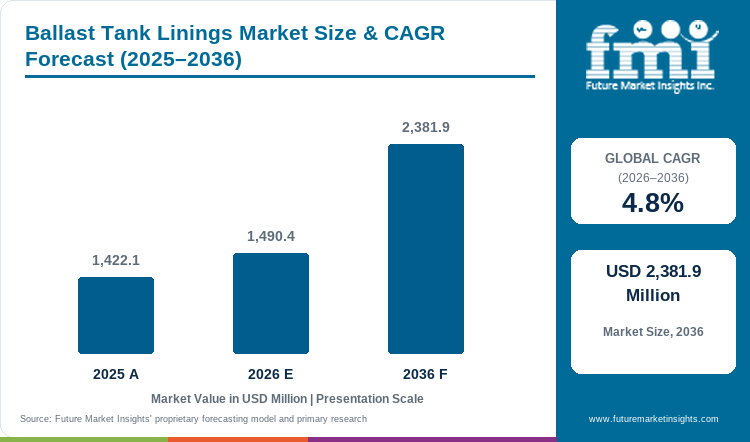
USD 1,490.4 million in 2026 and USD 2,381.9 million by 2036, expanding at 4.8% CAGR.
Sales of ballast tank linings are estimated to rise at 4.8% CAGR through 2036. Valuation rises from USD 1,422.1 million in 2025 to USD 1,490.4 million in 2026 and reaches USD 2,381.9 million by 2036. Shipyards specify marine coatings during new construction and dry-dock work. In June 2026, UNCTAD reported that China, South Korea and Japan built 91% of global ship gross tonnage completed in 2025. The concentration keeps coating approval close to major Asian yards. Crews also favor systems they can apply reliably.
The Netherlands is projected to grow at 5.8% CAGR through 2036. Japan is projected at 3.8% CAGR. In March 2025, the Netherlands Ministry of Defence contracted De Haas Shipyards for 13 Future Fast Interceptors. The order adds coating work to normal repair demand. Japan has a larger shipbuilding base and a mature installed coating base. Local service and dry-dock timing affect how vessel activity becomes lining orders.
Key Takeaways
- New shipbuilding and tank maintenance keep corrosion protection tied to coating specifications and repair schedules.
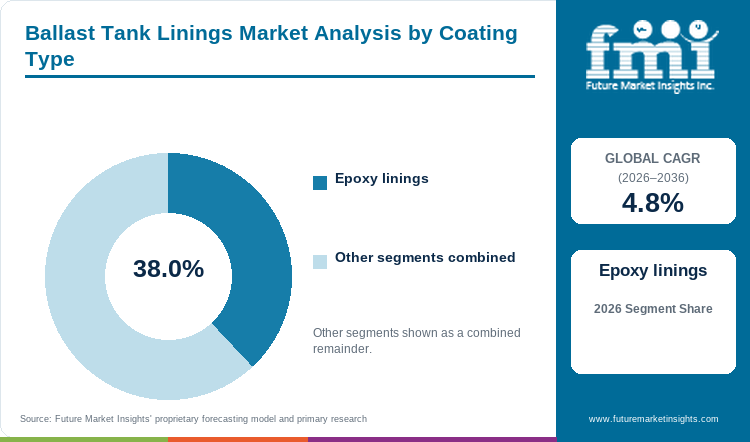
- By coating type, epoxy linings are estimated to hold 38.0% share in 2026, supported by wide use on immersed steel.
- In 2026, tankers are expected to lead vessel type with 29.0% share because their ballast spaces add large coated areas.
- By application, newbuild coating is forecast to represent 35.0% share in 2026, supported by full coating work at shipyards.
- Tight tank access, surface preparation and curing can slow product changes during short dry-dock periods.
- Some of the key players in this market include Jotun A/S, AkzoNobel, Hempel A/S, PPG, The Sherwin-Williams Company, Nippon Paint Marine, Kansai Paint Marine Co., Ltd., Chugoku Marine Paints, Ltd., KCC Corporation and Teknos Group Oy.
Analyst Perspective
"Shipyards value ballast tank linings that keep the required film thickness on welds and edges without adding extra cure time. Owners also favor suppliers that can provide the same approved system during later dry-dock repairs."
- Nikhil Kaitwade, Principal Consultant, Future Market Insights
How is the ballast tank linings market segmented?
The ballast tank linings market is segmented by coating type, vessel type, application, end use, sales channel and region.
The ballast tank linings market is segmented by coating type, vessel type, application, end use, sales channel and region. Coating type includes five epoxy and primer options. Vessel type covers commercial, offshore and naval ships. Application covers newbuild coating, recoating, spot repair, stripe coating and maintenance. End use and sales channel separate fleets, shipyards, MRO contractors and distributors.
Why do epoxy linings lead the coating type category?
Ballast tanks expose steel to seawater, wet-dry cycles and complex weld shapes. For this work, high-performance epoxy coatings let formulators balance adhesion, film thickness and cure time. In July 2025, Chugoku Marine Paints said CMP NOVA 2000 (Bio) was selected for ballast water tanks on a liquefied ammonia tanker being built in Japan. The selection confirms current epoxy use in this exact application.
- Based on coating type, epoxy linings are projected to account for 38.0% in 2026, supported by use on immersed steel.
- Modified and pure epoxy grades serve projects that need different cure speeds, edge performance or owner-approved chemistry.
What supports tanker demand within the vessel type category?
Tankers have large ballast spaces and planned inspections that keep coating condition visible to fleet teams. Their specifications are also part of wider marine coatings programs used at shipyards. In July 2025, PPG completed its 100th marine dry docking using electrostatic coating on a 287-meter bulk carrier. The milestone documents current work to improve coating transfer efficiency on large commercial vessels.
- By vessel type, tankers are estimated to hold 29.0% share in 2026, influenced by their large coated tank area.
- Bulk carriers add volume. Offshore and naval vessels can need longer qualification and service records before approval.
How does newbuild coating shape the application category?
Newbuild projects let shipyards prepare steel, coat edges and apply full systems before a vessel enters service. Newbuild work differs from ship repair services because repair crews work with aged coatings and fixed return dates. In February 2026, Hempel reported that Hempaguard NB was applied during construction of Tangier Mærsk and two sister vessels without delaying launch schedules. The project documents the schedule control needed during new vessel coating work.
- By application, newbuild coating is forecast to represent 35.0% share in 2026, supported by full-system work before vessel delivery.
- MRO/recoating and spot repair repeat as crews fix damaged areas without removing sound coating from the whole tank.
Why does commercial shipping lead the end use category?
Commercial fleets combine a large installed base with planned dry-dock work. Planned dry-dock work gives anti-corrosion coatings a repeat role after original construction. In June 2026, UNCTAD reported that about 116,000 merchant vessels of at least 100 gross tons were in service at the start of 2026. The vessel count does not equal lining demand. The fleet still contains many tanks that owners inspect, repair and recoat.
- Commercial shipping is likely to capture 38.0% of end use in 2026, linked to fleet size and planned maintenance.
- Naval and offshore operators often need longer qualification records before changing an approved lining system.
What makes marine coating suppliers central to the sales channel category?
Marine coating suppliers protect approved specifications with local stock and technical support near shipyards. Local technical teams manage epoxy paint systems with controlled mixing and overcoating times. In June 2026, Jotun COSCO Marine Coatings signed a memorandum covering 125 newbuilding bulk carriers for COSCO SHIPPING Bulk. The agreement documents how direct supplier ties can secure multi-vessel coating specifications before construction.
- Marine coating suppliers are set to lead sales channels with 41.0% share in 2026, supported by specification control and local service.
- Shipyards, MRO contractors and distributors remain important because local stock and defined repair work can control purchasing.
What are the drivers, restraints and opportunities in the Ballast Tank Linings Market?
Fleet renewal and tank maintenance support demand, while application time limits product changes and favors easier repair systems.
- Driver: New ships and regular tank repairs create repeat coating work inside ballast tanks.
- Restraint: Steel preparation, tight tank access and cure time can use valuable dry-dock hours before service resumes.
- Opportunity: Easy-mix compatible systems and shorter coat times can make planned dry-dock repairs faster and simpler.
Fleet scale keeps maintenance demand tied to coating condition
A large merchant fleet creates repeat maintenance work for ballast tank linings even during slower new-ship ordering. In December 2025, UNCTAD reported about 112,500 merchant vessels of at least 100 gross tons in service at the start of that year. Vessel count does not equal coating demand. Tank condition and dry-dock timing decide which ships need work. Owners inspect old coatings and choose local repair or wider recoating. Qualified lining systems therefore remain useful long after original construction.
Application time remains a practical limit during dry-dock work
Ballast tank work shares a fixed dry-dock schedule with steel repair and inspection. In July 2025, PPG reported its 100th marine dry docking using electrostatic coating. PPG used the method to improve transfer efficiency and reduce overspray. The milestone covers hull coatings and documents why faster application matters during planned dockings. A lining that needs more preparation or cure time can lose specification share even if it meets corrosion requirements.
System simplification can widen qualified repair choices
Owners and shipyards prefer repair systems that crews can source and apply the same way at different ports. In March 2025, Sherwin-Williams expanded its Global Core range with zinc, epoxy and urethane products. The products use common performance specifications in several regions. Ballast tank work still needs marine approval and compatibility checks. Suppliers can use coating additives to improve wetting or cure behavior without changing the protection goal. Formulation changes can do the same. Easier application can reduce rework on complex steel details.
Which country CAGRs are profiled in the Ballast Tank Linings Market?
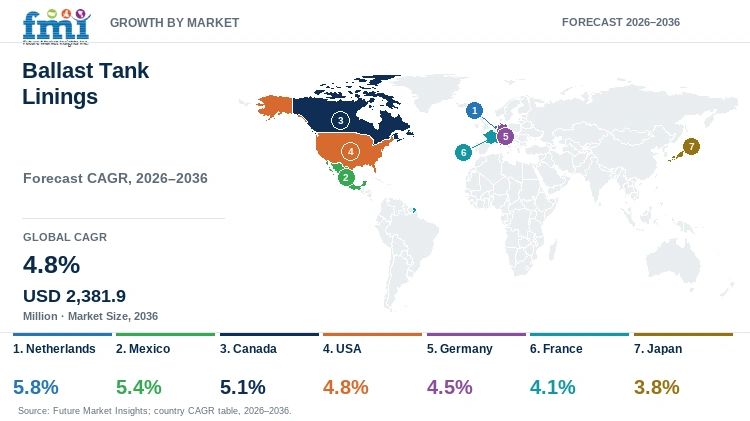
| Country | CAGR |
|---|---|
| Netherlands | 5.8% |
| Mexico | 5.4% |
| Canada | 5.1% |
| USA | 4.8% |
| Germany | 4.5% |
| France | 4.1% |
| Japan | 3.8% |
How do country-level CAGRs compare in the Ballast Tank Linings Market?
The profiled range runs from 5.8% in the Netherlands to 3.8% in Japan. The Netherlands, Mexico and Canada form the faster-growth group because vessel programs add coating work. The USA matches the global rate. Germany, France and Japan grow from mature maritime bases.
- The Netherlands adds naval construction to an active repair base.
- Mexico is renewing naval vessels through domestic shipyards.
- Canada combines fleet renewal with scheduled government-vessel dockings.
- The USA has a broad repair base that supports repeat maintenance.
- Germany adds federal replacement vessels to mature commercial maritime activity.
- France links naval construction with long-cycle maintenance programs.
- Japan grows from a mature coating and shipbuilding base.
Similar CAGRs can still produce different orders because vessel mix and yard timing differ. The full report provides country-level CAGR analysis across North America, Latin America, Western Europe, Eastern Europe, East Asia, South Asia and Pacific and the Middle East and Africa.
Country-wise Analysis
- Dutch naval programs are adding future shipyard coating work beside commercial maintenance. The Netherlands is projected to grow at 5.8% CAGR through 2036, supported by current submarine and fast-vessel programs. In June 2025, the Netherlands Ministry of Defence confirmed that four Orka-class submarines will be built. Royal IHC will supply modules and steel structures for all four vessels. Each project will use an approved coating plan for ballast tanks and other immersed spaces. Suppliers with access to local epoxy resins and shipyard technical support can respond as the projects move from engineering to steelwork.
- Mexico is using domestic naval construction to renew patrol capacity and support local shipyards. Mexico is projected to grow at 5.4% CAGR through 2036, influenced by a defined vessel-building program. In December 2025, the Secretariat of the Navy held a keel-laying ceremony for the first OPV2025 Yucatán-class patrol vessel. The agency said seven ships are planned. Three are for the Pacific and four for the Gulf of Mexico. The program gives coating suppliers a visible series of new steel structures. Qualification and delivery still need to match Mexican naval construction schedules.
- Canada is keeping repair demand active. Its national shipbuilding program is also adding new vessels. Canada is projected to grow at 5.1% CAGR through 2036, tied to fleet renewal and docking work. In July 2026, Public Services and Procurement Canada reported that 17 auxiliary and support vessels had docking work periods during 2025. Those dockings give crews repeated access to coated tanks and other steel spaces for inspection and repair. Suppliers with established corrosion protection coatings and service coverage can compete for maintenance work on tanks that need local repair instead of a full recoat.
- US demand for ballast tank linings comes from commercial yards, government fleets and repair shops. The USA is estimated to post 4.8% CAGR over the forecast period, supported by a broad shipbuilding and repair base. In July 2025, the U.S. Maritime Administration selected 17 small shipyards in 12 states for grants. The grants support equipment and workforce upgrades and document active repair sites, not lining demand itself. Marine contractors using corrosion inhibitors and protective coating systems still need approved products, trained applicators and reliable dry-dock supply before specifications become repeat orders.
- German shipyards work on commercial and government vessels that need documented coating performance. Germany is forecast to grow at 4.5% CAGR through 2036, shaped by replacement construction and a mature repair base. In December 2025, the Federal Ministry of Transport announced contracts for four replacement federal ships. New vessels let shipyards apply complete lining systems under controlled conditions. Ships already in service keep repair demand active. Suppliers of epoxy curing agents and finished coating systems must balance cure speed with approved performance. German yards cannot cut schedules by weakening tank protection.
- France combines naval shipbuilding with a large installed fleet that needs long-term protective maintenance. France is predicted to advance at 4.1% CAGR through 2036, linked to new defence vessel construction and later service needs. In March 2026, the French defence procurement agency ordered the fifth Defence and Intervention Frigate from Naval Group. More class deliveries are scheduled through 2032. Each new vessel creates specification work before delivery and repair demand after commissioning. Coating suppliers need strong yard documents and repeatable application quality. Those controls help the same lining system stay in use during later maintenance.
- Japanese shipyards work at large scale and know approved marine coating systems well. Japan is anticipated to record 3.8% CAGR through 2036, with growth moderated by its mature supplier and specification base. In July 2025, Japan’s Ministry of Defense attended the launch of JS Tatsuta, the 11th Mogami-class frigate, at Mitsubishi Heavy Industries’ Nagasaki shipyard. New naval construction keeps coating demand active. Existing yard rules make entry harder for new suppliers. New suppliers need proven compatibility, reliable local supply and technical support that works with current application controls.
Who are the notable companies in the Ballast Tank Linings Market?
Jotun A/S, AkzoNobel, Hempel A/S, PPG, The Sherwin-Williams Company, Nippon Paint Marine, Kansai Paint Marine Co., Ltd., Chugoku Marine Paints, Ltd., KCC Corporation and Teknos Group Oy.
Most competition comes from global marine coating groups and Asia-based specialists. Both groups sell approved corrosion-protection products. New suppliers face a high entry bar. Shipowners and yards want proof that coatings work. They also need application help and product supply near the job. Owners often keep the same supplier during later maintenance. A chemistry change can require new compatibility checks and more paperwork.
- Jotun A/S, AkzoNobel, Hempel A/S, PPG and The Sherwin-Williams Company have broad marine coating networks.
- Nippon Paint Marine, Kansai Paint Marine Co., Ltd. and Chugoku Marine Paints, Ltd. bring marine formulation skills and shipyard experience.
- KCC Corporation and Teknos Group Oy add regional protective coatings and local service.
Competitive Benchmarking: Ballast Tank Linings Market
| Company | Ballast-Tank System Evidence | Marine Service Coverage | Application Support | Geographic Reach |
|---|---|---|---|---|
| Jotun A/S | High | High | High | Global |
| AkzoNobel | High | High | High | Global |
| Hempel A/S | High | High | High | Global |
| PPG | High | High | High | Global |
| The Sherwin-Williams Company | High | High | High | Global |
| Nippon Paint Marine | Medium | High | High | Global |
| Kansai Paint Marine Co., Ltd. | High | Medium | High | Asia with international alliance |
| Chugoku Marine Paints, Ltd. | High | High | High | Global |
| KCC Corporation | High | Medium | Medium | Asia and international shipbuilding |
| Teknos Group Oy | Medium | Medium | Medium | Europe and Asia |
Scoring basis: High means direct proof of ballast-tank or marine corrosion coating work. High also needs broad service support. Medium means proven protective-coating work with less direct ballast-tank proof. Application support includes technical help, specification work and digital tools. Geographic Reach lists the regions served. It is not a score.
Key Developments in the Ballast Tank Linings Market
- In September 2026, Hempel A/S signed a three-year global hull coatings agreement with Maersk covering fleet dry dockings from 2026 to 2028.
- In August 2026, PPG launched five one-component PPG ONE RANGE marine coatings for simpler onboard maintenance.
- In July 2026, Nippon Paint Marine agreed to supply coatings for two WAN HAI newbuild vessels at Hyundai Samho Heavy Industries.
Key Players in the Ballast Tank Linings Market
Global marine and protective coating networks
- Jotun A/S
- AkzoNobel
- Hempel A/S
- PPG
- The Sherwin-Williams Company
Asia-based marine coating specialists
- Nippon Paint Marine
- Kansai Paint Marine Co., Ltd.
- Chugoku Marine Paints, Ltd.
- KCC Corporation
Specialist protective-coating supplier
- Teknos Group Oy
Ballast Tank Linings Market - Report Scope
| Coverage field | Report scope |
|---|---|
| Market breakdown | By coating type, vessel type, application, end use, sales channel and region. |
| Quantitative Units | USD million. |
| Market Definition | Protective lining products sold for internal steel surfaces of seawater ballast tanks are included. Application labor, steel renewal and ballast water treatment equipment are excluded. |
| Regions Covered | North America, Latin America, Western Europe, Eastern Europe, East Asia, South Asia and Pacific and Middle East and Africa. |
| Countries Covered | Netherlands, Mexico, Canada, USA, Germany, France, Japan and 20+ countries included in the full report. |
| Key Companies Profiled | Jotun A/S, AkzoNobel, Hempel A/S, PPG, The Sherwin-Williams Company, Nippon Paint Marine, Kansai Paint Marine Co., Ltd., Chugoku Marine Paints, Ltd., KCC Corporation and Teknos Group Oy. |
| Forecast Period | 2026 to 2036. |
| Approach | Primary and secondary research with market triangulation. |
Ballast Tank Linings Market - Research Methodology
| Method | Approach |
|---|---|
| Primary Research | FMI analysts gathered input from manufacturers, service providers, technology developers, distributors, end users, procurement teams and subject-matter experts. Interviews examined purchasing decisions, product or service evaluation, adoption barriers, approval requirements, pricing considerations and expectations for technical or commercial support. Respondents were also asked what evidence is required before a trial, pilot, or initial order develops into regular purchasing. |
| Desk Research | Desk research covered government statistics, regulatory publications, trade data, industry associations, technical literature, standards, company filings, product information and official corporate announcements. Sources were reviewed for relevance, publication date, geographic coverage and consistency with the defined market scope. Claims relating to performance, applications, approvals, capacity, investment and commercial activity were retained only when supported by credible public evidence. |
| Market Sizing and Forecasting | The market model combined the baseline value with historical performance, segment structure, pricing and volume indicators, adoption levels, company participation and country-level demand conditions. Forecast assumptions considered economic activity, investment trends, regulatory developments, technology adoption, purchasing cycles, supply availability and barriers to wider market use. Segment and regional estimates were reconciled before the final market total was calculated. |
| Data Validation | Estimates were checked against multiple independent indicators, including public data, company activity, trade patterns, industry developments and findings from primary interviews. Validation also tested whether products, services, applications and company revenues fell within the defined market boundaries. Adjacent categories, unsupported claims, overlapping revenues and activities without direct market relevance were excluded to reduce double counting and maintain consistency across segments and countries. |
Ballast Tank Linings Market by Segments
Ballast Tank Linings Market segmented by Coating Type:
- Epoxy linings
- Modified epoxy linings
- Pure epoxy linings
- Zinc-rich primers
- Edge-retention coatings
Ballast Tank Linings Market segmented by Vessel Type:
- Tankers
- Bulk carriers
- Container ships
- Offshore vessels
- Naval vessels
Ballast Tank Linings Market segmented by Application:
- Newbuild coating
- MRO/recoating
- Spot repair
- Edge stripe coating
- Tank maintenance
Ballast Tank Linings Market segmented by End Use:
- Commercial shipping
- Shipyards
- Offshore marine
- Naval/defense
- Marine MRO
Ballast Tank Linings Market segmented by Sales Channel:
- Marine coating suppliers
- Shipyards
- MRO contractors
- Distributors
Ballast Tank Linings Market by Region:
- North America
- United States
- Canada
- Latin America
- Brazil
- Mexico
- Chile
- Rest of Latin America
- Western Europe
- Germany
- United Kingdom
- Italy
- Spain
- France
- Nordics
- Benelux
- Rest of Western Europe
- Eastern Europe
- Russia
- Poland
- Hungary
- Balkan and Baltic States
- Rest of Eastern Europe
- East Asia
- China
- Japan
- South Korea
- South Asia and Pacific
- India
- ASEAN
- Australia and New Zealand
- Rest of South Asia and Pacific
- Middle East and Africa
- Kingdom of Saudi Arabia
- Other GCC Countries
- Türkiye
- South Africa
- Other African Union Countries
- Rest of Middle East and Africa
Research Sources and Bibliography
- United Nations Conference on Trade and Development. (2026, June 18). Building, ownership, registration and recycling of ships, main specialization, 2026.
- Netherlands Ministry of Defence. (2025, March 10). New fast boats for the navy and army. [English translation].
- Chugoku Marine Paints, Ltd. (2025, July 28). ISCC certified bio-based epoxy resin coating adopted for Mitsui Chemicals’ liquefied ammonia tanker.
- PPG. (2025, July 16). PPG completes 100th dry docking using electrostatic coating application.
- Hempel A/S. (2026, February 3). Hempel completes the first round of successful applications with Hempaguard NB on new Maersk vessels.
- United Nations Conference on Trade and Development. (2025, December). Handbook of statistics 2025: Merchant fleet.
- The Sherwin-Williams Company. (2025, March 18). Sherwin-Williams expands Global Core product offering for customers worldwide.
- Netherlands Ministry of Defence. (2025, June 17). Agreement keeps the Netherlands closely involved in construction of Orka submarines. [English translation].
- Secretariat of the Navy, Mexico. (2025, December 15). Naval capability strengthened with keel-laying ceremony for an ocean patrol vessel. [English translation].
- Public Services and Procurement Canada. (2026, July 9). 2025 year in review: National Shipbuilding Strategy.
- U.S. Maritime Administration. (2025, July 21). Small Shipyard Grant Program selects 17 recipients across 12 states.
- Federal Ministry of Transport, Germany. (2025, December 10). Federal government awards contracts for four new ships. [English translation].
- French Defence Procurement Agency. (2026, April). DGA orders the fifth Defence and Intervention Frigate from Naval Group.
- Japan Ministry of Defense. (2025, July 2). Naming and launching ceremony for JS Tatsuta, the 11th Mogami-class frigate.
- Hempel A/S. (2026, September 14). Hempel secures 3-year global hull coatings agreement with Maersk for fleet dry dockings.
- PPG. (2026, August 31). PPG introduces PPG ONE RANGE portfolio for onboard maintenance.
- Nippon Paint Marine. (2026, July 20). WAN HAI adopts Nippon Paint Marine hull and surface coatings in newbuild projects.
- Jotun A/S. (2026). Jotun joins EOLMED floating wind project in France.
- AkzoNobel. (2025, December 16). AkzoNobel extends Chinese marine coatings partnership to accelerate transition to sustainable shipping.
- Hempel A/S. (2025, June 2). Hempel launches Hempaguard NB for newbuilding applications.
- PPG. (2025, October 7). PPG launches PMC City, a digital hub for coatings selection.
- The Sherwin-Williams Company. (2025, August 25). Sherwin-Williams accelerates coatings applications and shop throughput with Acrolon 680.
- Nippon Paint Marine. (2025, December 2). Nippon Paint Marine and Lloyd’s Register sign technical collaboration to assess hull coating performance.
- Kansai Paint Marine Co., Ltd. (2025, February 28). Paint Sommelier - QUANTUM PASS receives Innovation Endorsement from ClassNK.
- Chugoku Marine Paints, Ltd. (2025, August 8). SEAFLO NEO SL ZX launches as a next-generation antifouling coating.
- KCC Corporation. (2025, October 20). KCC presents MetaCruise BF marine coating at KORMARINE 2025. [English translation].
- Teknos Group Oy. (2025, August 11). Teknos and UP Catalyst collaborate on sustainable carbon materials for paint and coating applications.
This bibliography is provided for reader reference and is not exhaustive. The full report contains the complete reference list and detailed citations.
This Report Answers
- What is the ballast tank linings market value in 2026 and 2036?
- Which segments hold the largest 2026 shares?
- How do surface preparation and cure windows affect ballast tank lining selection?
- Which shipbuilding and maintenance conditions support lining demand?
- Which profiled countries are projected to grow faster than the global market?
- Which companies supply relevant marine and protective coatings?
- How do suppliers compare on ballast-tank evidence and service support?
- Which recent company actions are changing marine coating supply?
Frequently Asked Questions
How big is the ballast tank linings market in 2026?
The ballast tank linings market is valued at USD 1,490.4 million in 2026 and is projected to reach USD 2,381.9 million by 2036. Ship construction and tank maintenance support growth.
What is the CAGR of the ballast tank linings market from 2026 to 2036?
The ballast tank linings market is projected to grow at 4.8% CAGR from 2026 to 2036. Newbuild work and dry-dock repairs support demand.
Which coating type leads the ballast tank linings market?
The epoxy linings segment is expected to hold 38.0% of coating type revenue in 2026. Shipyards favor epoxy systems that balance adhesion, film thickness and cure time.
Which application holds the largest current share in the ballast tank linings market?
The newbuild coating segment is forecast to represent 35.0% of application revenue in 2026. Shipyards can prepare steel and apply full coating systems before delivery.
Which sales channel leads the ballast tank linings market?
Marine coating suppliers are projected to hold 41.0% of sales channel revenue in 2026. Local stock and service help shipyards keep approved coating specifications.
Which companies are active in the ballast tank linings market?
Active companies include Jotun A/S, AkzoNobel, Hempel A/S, PPG, The Sherwin-Williams Company, Nippon Paint Marine, Kansai Paint Marine Co., Ltd., Chugoku Marine Paints, Ltd., KCC Corporation and Teknos Group Oy. They compete on approved systems, technical service and shipyard supply.
Preview the report firsthand - request a free sample
Get SampleGet the brochure for pricing and purchase details.
Get PDFTable of Content
- Key Takeaways
- Market Size and CAGR
- Top Growth Driver
- Fastest Growing Segment
- Leading Region
- Key Companies
- Emerging Opportunities
- Executive Summary
- Global Market Outlook
- Demand-side Trends
- Supply-side Trends
- Technology Roadmap Analysis
- Analysis and Recommendations
- Analyst Perspective (What is happening? Why now? What should investors know?)
- Key Questions Answered
- How large is the market?
- What is the CAGR?
- What are key trends?
- Which region dominates?
- Who are the leaders?
- Market Overview
- Market Coverage / Taxonomy
- Market Definition / Scope / Limitations
- Research Methodology
- Chapter Orientation
- Analytical Lens and Working Hypotheses
- Market Structure, Signals, and Trend Drivers
- Benchmarking and Cross-market Comparability
- Market Sizing, Forecasting, and Opportunity Mapping
- Research Design and Evidence Framework
- Desk Research Programme (Secondary Evidence)
- Expert Input and Fieldwork (Primary Evidence)
- Tooling, Models, and Reference Databases
- Data Engineering and Model Build
- Quality Assurance and Audit Trail
- Market Background
- Market Dynamics (Drivers, Restraints, Opportunity, Trends)
- Scenario Forecast (Optimistic, Likely, Conservative)
- Impact Analysis
- AI Impact
- Sustainability Impact
- Regulatory Impact
- Technology Impact
- Consumer / Buyer Analysis
- Purchase Drivers
- Adoption Barriers
- Buyer Journey
- Opportunity Map Analysis
- Product Life Cycle Analysis
- Supply Chain Analysis
- Investment Feasibility Matrix
- Value Chain Analysis
- PESTLE and Porter's Analysis
- Regulatory Landscape
- Regional Parent Market Outlook
- Production and Consumption Statistics
- Import and Export Statistics
- Global Market Analysis and Forecast, 2021 to 2036
- Historical Market Size Value (USD Million) Analysis, 2021 to 2025
- Current and Future Market Size Value (USD Million) Projections, 2026 to 2036
- Y-o-Y Growth Trend Analysis
- Absolute $ Opportunity Analysis
- Global Market Pricing Analysis, 2021 to 2036
- Global Market Analysis and Forecast, By Coating Type, 2021 to 2036
- Introduction / Key Findings
- Historical Market Size Value (USD Million) Analysis By Coating Type, 2021 to 2025
- Current and Future Market Size Value (USD Million) Analysis and Forecast By Coating Type, 2026 to 2036
- Epoxy linings
- Modified epoxy linings
- Pure epoxy linings
- Zinc-rich primers
- Edge-retention coatings
- Y-o-Y Growth Trend Analysis By Coating Type, 2021 to 2025
- Absolute $ Opportunity Analysis By Coating Type, 2026 to 2036
- Global Market Analysis and Forecast, By Vessel Type, 2021 to 2036
- Introduction / Key Findings
- Historical Market Size Value (USD Million) Analysis By Vessel Type, 2021 to 2025
- Current and Future Market Size Value (USD Million) Analysis and Forecast By Vessel Type, 2026 to 2036
- Tankers
- Bulk carriers
- Container ships
- Offshore vessels
- Naval vessels
- Y-o-Y Growth Trend Analysis By Vessel Type, 2021 to 2025
- Absolute $ Opportunity Analysis By Vessel Type, 2026 to 2036
- Global Market Analysis and Forecast, By Application, 2021 to 2036
- Introduction / Key Findings
- Historical Market Size Value (USD Million) Analysis By Application, 2021 to 2025
- Current and Future Market Size Value (USD Million) Analysis and Forecast By Application, 2026 to 2036
- Newbuild coating
- MRO/recoating
- Spot repair
- Edge stripe coating
- Tank maintenance
- Y-o-Y Growth Trend Analysis By Application, 2021 to 2025
- Absolute $ Opportunity Analysis By Application, 2026 to 2036
- Global Market Analysis and Forecast, By End Use, 2021 to 2036
- Introduction / Key Findings
- Historical Market Size Value (USD Million) Analysis By End Use, 2021 to 2025
- Current and Future Market Size Value (USD Million) Analysis and Forecast By End Use, 2026 to 2036
- Commercial shipping
- Shipyards
- Offshore marine
- Naval/defense
- Marine MRO
- Y-o-Y Growth Trend Analysis By End Use, 2021 to 2025
- Absolute $ Opportunity Analysis By End Use, 2026 to 2036
- Global Market Analysis and Forecast, By Sales Channel, 2021 to 2036
- Introduction / Key Findings
- Historical Market Size Value (USD Million) Analysis By Sales Channel, 2021 to 2025
- Current and Future Market Size Value (USD Million) Analysis and Forecast By Sales Channel, 2026 to 2036
- Marine coating suppliers
- Shipyards
- MRO contractors
- Distributors
- Y-o-Y Growth Trend Analysis By Sales Channel, 2021 to 2025
- Absolute $ Opportunity Analysis By Sales Channel, 2026 to 2036
- Global Market Analysis and Forecast, By Region, 2021 to 2036
- Introduction
- Historical Market Size Value (USD Million) Analysis By Region, 2021 to 2025
- Current Market Size Value (USD Million) Analysis and Forecast By Region, 2026 to 2036
- North America
- Latin America
- Western Europe
- Eastern Europe
- East Asia
- South Asia and Pacific
- Middle East and Africa
- Market Attractiveness Analysis By Region
- North America Market Analysis and Forecast, By Country, 2021 to 2036
- Historical Market Size Value (USD Million) Trend Analysis By Market Taxonomy, 2021 to 2025
- Market Size Value (USD Million) Forecast By Market Taxonomy, 2026 to 2036
- By Country
- United States
- Canada
- By Coating Type
- By Vessel Type
- By Application
- By End Use
- By Sales Channel
- By Country
- Market Attractiveness Analysis
- By Country
- By Coating Type
- By Vessel Type
- By Application
- By End Use
- By Sales Channel
- Key Takeaways
- Latin America Market Analysis and Forecast, By Country
- Historical Market Size Value (USD Million) Trend Analysis By Market Taxonomy, 2021 to 2025
- Market Size Value (USD Million) Forecast By Market Taxonomy, 2026 to 2036
- By Country
- Brazil
- Mexico
- Chile
- Rest of Latin America
- By Coating Type
- By Vessel Type
- By Application
- By End Use
- By Sales Channel
- By Country
- Market Attractiveness Analysis
- By Country
- By Coating Type
- By Vessel Type
- By Application
- By End Use
- By Sales Channel
- Key Takeaways
- Western Europe Market Analysis and Forecast, By Country
- Historical Market Size Value (USD Million) Trend Analysis By Market Taxonomy, 2021 to 2025
- Market Size Value (USD Million) Forecast By Market Taxonomy, 2026 to 2036
- By Country
- Germany
- United Kingdom
- Italy
- Spain
- France
- Nordics
- Benelux
- Rest of Western Europe
- By Coating Type
- By Vessel Type
- By Application
- By End Use
- By Sales Channel
- By Country
- Market Attractiveness Analysis
- By Country
- By Coating Type
- By Vessel Type
- By Application
- By End Use
- By Sales Channel
- Key Takeaways
- Eastern Europe Market Analysis and Forecast, By Country
- Historical Market Size Value (USD Million) Trend Analysis By Market Taxonomy, 2021 to 2025
- Market Size Value (USD Million) Forecast By Market Taxonomy, 2026 to 2036
- By Country
- Russia
- Poland
- Hungary
- Balkan and Baltic States
- Rest of Eastern Europe
- By Coating Type
- By Vessel Type
- By Application
- By End Use
- By Sales Channel
- By Country
- Market Attractiveness Analysis
- By Country
- By Coating Type
- By Vessel Type
- By Application
- By End Use
- By Sales Channel
- Key Takeaways
- East Asia Market Analysis and Forecast, By Country
- Historical Market Size Value (USD Million) Trend Analysis By Market Taxonomy, 2021 to 2025
- Market Size Value (USD Million) Forecast By Market Taxonomy, 2026 to 2036
- By Country
- China
- Japan
- South Korea
- By Coating Type
- By Vessel Type
- By Application
- By End Use
- By Sales Channel
- By Country
- Market Attractiveness Analysis
- By Country
- By Coating Type
- By Vessel Type
- By Application
- By End Use
- By Sales Channel
- Key Takeaways
- South Asia and Pacific Market Analysis and Forecast, By Country
- Historical Market Size Value (USD Million) Trend Analysis By Market Taxonomy, 2021 to 2025
- Market Size Value (USD Million) Forecast By Market Taxonomy, 2026 to 2036
- By Country
- India
- ASEAN
- Australia and New Zealand
- Rest of South Asia and Pacific
- By Coating Type
- By Vessel Type
- By Application
- By End Use
- By Sales Channel
- By Country
- Market Attractiveness Analysis
- By Country
- By Coating Type
- By Vessel Type
- By Application
- By End Use
- By Sales Channel
- Key Takeaways
- Middle East and Africa Market Analysis and Forecast, By Country
- Historical Market Size Value (USD Million) Trend Analysis By Market Taxonomy, 2021 to 2025
- Market Size Value (USD Million) Forecast By Market Taxonomy, 2026 to 2036
- By Country
- Kingdom of Saudi Arabia
- Other GCC Countries
- Türkiye
- South Africa
- Other African Union Countries
- Rest of Middle East and Africa
- By Coating Type
- By Vessel Type
- By Application
- By End Use
- By Sales Channel
- By Country
- Market Attractiveness Analysis
- By Country
- By Coating Type
- By Vessel Type
- By Application
- By End Use
- By Sales Channel
- Key Takeaways
- Key Countries Market Analysis
- United States
- Pricing Analysis
- Market Share Analysis, 2025
- By Coating Type
- By Vessel Type
- By Application
- By End Use
- By Sales Channel
- Canada
- Pricing Analysis
- Market Share Analysis, 2025
- By Coating Type
- By Vessel Type
- By Application
- By End Use
- By Sales Channel
- Mexico
- Pricing Analysis
- Market Share Analysis, 2025
- By Coating Type
- By Vessel Type
- By Application
- By End Use
- By Sales Channel
- Brazil
- Pricing Analysis
- Market Share Analysis, 2025
- By Coating Type
- By Vessel Type
- By Application
- By End Use
- By Sales Channel
- Chile
- Pricing Analysis
- Market Share Analysis, 2025
- By Coating Type
- By Vessel Type
- By Application
- By End Use
- By Sales Channel
- Germany
- Pricing Analysis
- Market Share Analysis, 2025
- By Coating Type
- By Vessel Type
- By Application
- By End Use
- By Sales Channel
- United Kingdom
- Pricing Analysis
- Market Share Analysis, 2025
- By Coating Type
- By Vessel Type
- By Application
- By End Use
- By Sales Channel
- Italy
- Pricing Analysis
- Market Share Analysis, 2025
- By Coating Type
- By Vessel Type
- By Application
- By End Use
- By Sales Channel
- Spain
- Pricing Analysis
- Market Share Analysis, 2025
- By Coating Type
- By Vessel Type
- By Application
- By End Use
- By Sales Channel
- France
- Pricing Analysis
- Market Share Analysis, 2025
- By Coating Type
- By Vessel Type
- By Application
- By End Use
- By Sales Channel
- India
- Pricing Analysis
- Market Share Analysis, 2025
- By Coating Type
- By Vessel Type
- By Application
- By End Use
- By Sales Channel
- ASEAN
- Pricing Analysis
- Market Share Analysis, 2025
- By Coating Type
- By Vessel Type
- By Application
- By End Use
- By Sales Channel
- Australia and New Zealand
- Pricing Analysis
- Market Share Analysis, 2025
- By Coating Type
- By Vessel Type
- By Application
- By End Use
- By Sales Channel
- China
- Pricing Analysis
- Market Share Analysis, 2025
- By Coating Type
- By Vessel Type
- By Application
- By End Use
- By Sales Channel
- Japan
- Pricing Analysis
- Market Share Analysis, 2025
- By Coating Type
- By Vessel Type
- By Application
- By End Use
- By Sales Channel
- South Korea
- Pricing Analysis
- Market Share Analysis, 2025
- By Coating Type
- By Vessel Type
- By Application
- By End Use
- By Sales Channel
- Russia
- Pricing Analysis
- Market Share Analysis, 2025
- By Coating Type
- By Vessel Type
- By Application
- By End Use
- By Sales Channel
- Poland
- Pricing Analysis
- Market Share Analysis, 2025
- By Coating Type
- By Vessel Type
- By Application
- By End Use
- By Sales Channel
- Hungary
- Pricing Analysis
- Market Share Analysis, 2025
- By Coating Type
- By Vessel Type
- By Application
- By End Use
- By Sales Channel
- Kingdom of Saudi Arabia
- Pricing Analysis
- Market Share Analysis, 2025
- By Coating Type
- By Vessel Type
- By Application
- By End Use
- By Sales Channel
- Türkiye
- Pricing Analysis
- Market Share Analysis, 2025
- By Coating Type
- By Vessel Type
- By Application
- By End Use
- By Sales Channel
- South Africa
- Pricing Analysis
- Market Share Analysis, 2025
- By Coating Type
- By Vessel Type
- By Application
- By End Use
- By Sales Channel
- Netherlands
- Pricing Analysis
- Market Share Analysis, 2025
- By Coating Type
- By Vessel Type
- By Application
- By End Use
- By Sales Channel
- United States
- Market Structure Analysis
- Competition Dashboard
- Competition Benchmarking
- Market Share Analysis of Top Players
- By Regional
- By Coating Type
- By Vessel Type
- By Application
- By End Use
- By Sales Channel
- Emerging Startups
- Innovation Benchmarking
- Competition Analysis
- Competition Deep Dive
- Jotun A/S
- Overview
- Product Portfolio
- Profitability by Market Segments
- Sales Footprint
- Strategy Overview
- Marketing Strategy
- Product Strategy
- Channel Strategy
- AkzoNobel
- Hempel A/S
- PPG
- The Sherwin-Williams Company
- Nippon Paint Marine
- Kansai Paint Marine Co., Ltd.
- Chugoku Marine Paints, Ltd.
- KCC Corporation
- Teknos Group Oy
- Jotun A/S
- Case Studies
- Success Stories
- Recent Developments
- Competition Deep Dive
- Assumptions & Acronyms Used


