

- Market Size (2026)
- USD 0.9 Bn
- Forecast (2036)
- USD 1.5 Bn
- CAGR (2026 to 2036)
- 5.6%
How big is Base Terminal Blocks Market in 2026?
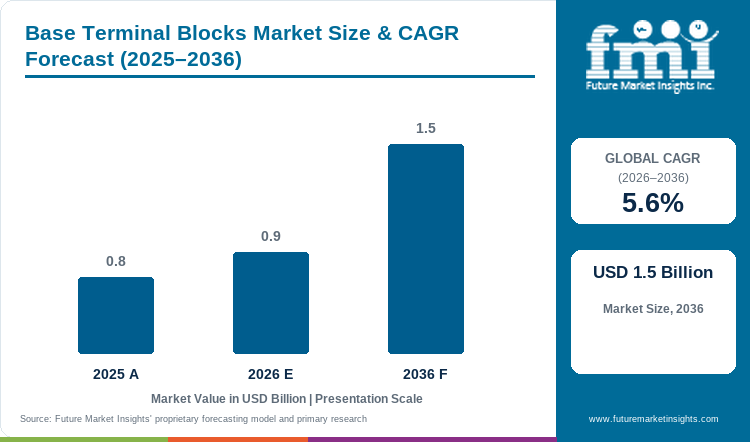
USD 0.9 Billion in 2026 and USD 1.5 Billion by 2036 at a 5.6% CAGR.
The Base Terminal Blocks market stood at USD 0.8 Billion in 2025, is estimated at USD 0.9 Billion in 2026, and is forecast to reach USD 1.5 Billion by 2036 at a 5.6% CAGR from 2026 to 2036.
Demand is being shaped by a simple electrical-engineering reality: more automated equipment creates more signal and power termination points inside control cabinets. The International Federation of Robotics reported in September 2025 that 542,000 industrial robots were installed worldwide in 2024.
That was more than twice the annual total recorded ten years earlier. Each new machine cell still requires reliable conductor termination between field devices and controllers. It also needs termination between power distribution circuits and protection hardware.
Base terminal blocks capture revenue at this connection layer rather than from the downstream machine or panel. Suppliers can therefore benefit when machine builders expand I/O density or redesign cabinets for faster wiring. The purchasing decision remains practical. Buyers compare current and voltage fit first.
They then test connection method and certification coverage. Panel space and accessory compatibility also matter. Wiring labor can decide whether an approved terminal platform changes.
Country conditions alter the pace of conversion. In the USA, manufacturing investment supports new electrical equipment demand but qualification and distributor availability can determine vendor choice.
Germany combines mature panel-building practices with accelerated grid expansion, which raises the value of compact products that fit established DIN-rail workflows. Japan emphasizes automation and labor-saving capital investment while preserving strong supplier-qualification discipline.
South Korea is pushing AI-enabled smart manufacturing, which increases the number of connected control points but also raises expectations for traceable and automation-ready wiring. Mexico adds a faster expansion profile through new manufacturing investment and export-oriented production.
Across these markets, interest becomes a purchase when a terminal block fits the required electrical rating and approved drawings. It must also avoid rework in marking and jumpering. Tooling or certification changes can stop conversion.
Key Takeaways
- The market is estimated at USD 0.9 Billion in 2026 and is forecast to reach USD 1.5 Billion by 2036 at a 5.6% CAGR.
- Screw terminal blocks lead 2026 revenue. The 10-30 A segment leads 2026 revenue.
- Polyamide leads 2026 revenue. Industrial automation leads 2026 revenue. Electrical distributors lead 2026 revenue.
- Driver: Rising automation and control-cabinet density increase the number of reliable signal and power termination points required per equipment build.
- Restraint: Qualification cycles and accessory-system switching costs can delay changes even when a competing block offers faster wiring.
- Opportunity: Tool-free and automation-ready terminal architectures can reduce repetitive wiring work in high-volume cabinet production. Mexico has the highest profiled country CAGR at 6.1%, compared with Japan at 4.4%.
Analyst Perspective
Revenue capture will depend on reducing installed wiring cost without forcing buyers to absorb avoidable qualification or ecosystem-switching costs. Fast connection methods gain leverage when they work with existing conductor preparation and automated cabinet processes.
- Sudip Saha, Principal Consultant, Future Market Insights
How is the Base Terminal Blocks Market segmented?
The market is segmented by Product Type, Current Rating, Material, End Use, and Sales Channel.
Product Type distinguishes how a conductor is secured and how technicians install or release it. Current Rating separates compact control-circuit products from blocks designed for heavier power loads. Material captures the insulation and enclosure choices that influence dielectric behavior and heat resistance.
Mechanical durability and form factor also affect the selection. End Use distinguishes the operating environment and the electrical job that the block performs within a larger system. Sales Channel reflects who holds specification influence and who fulfills the order.
Electrical distributors are especially important for standard catalog items and replacement demand. Direct OEM supply matters more when terminal blocks are designed into repeated machine platforms or high-volume equipment programs.
What makes Screw terminal blocks central to the Product Type category?
Screw terminal blocks retain a broad installed base because technicians can see and service the mechanical clamp without specialized insertion behavior. The architecture also scales across conductor sizes and circuit functions. That flexibility matters in mixed cabinets.
A panel builder may need feed-through and grounding functions. It may also need disconnect, fuse, or higher-current termination while keeping one basic operating method. Faster spring and push-in designs are taking wiring-time-sensitive applications. Panel builders compare copper and aluminum terminal blocks when current rating and connection geometry vary.
Screw blocks still benefit from familiarity in maintenance environments and from long qualification histories. The 2025 edition of IEC 60947-7-1 continues to define requirements for terminal blocks using both screw-type and screwless clamping units.
That standards treatment supports continued procurement of both architectures.
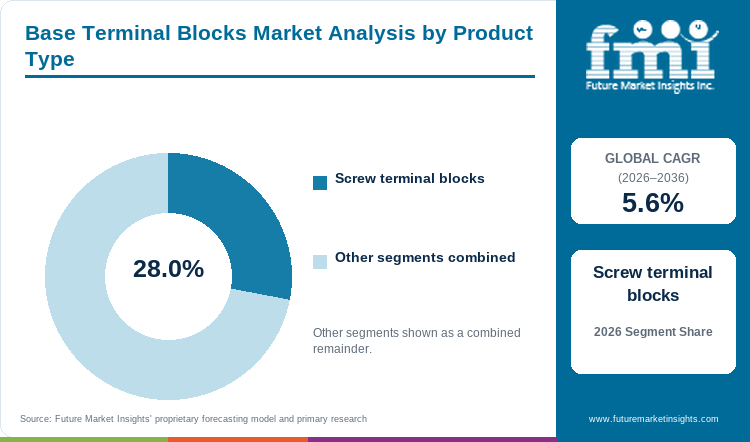
- Screw terminal blocks hold 28.0% of 2026 revenue because service familiarity and broad conductor coverage remain important in established panel designs.
- IEC published IEC 60947-7-1:2025 for terminal blocks with screw-type or screwless clamping units, confirming that screw connection remains within the current industrial terminal-block standard framework.
Why does 10-30 A lead the Current Rating category?
The 10-30 A band sits in the practical center of many control and auxiliary-power circuits. It is high enough for numerous machine-control loads and low-voltage distribution points without requiring the spacing or conductor size associated with heavier power blocks.
This creates a broad addressable set across PLC cabinets and building controls. Process skids and machine subsystems add further demand. Below 10 A products are important for dense signal work, while 30-100 A and above 100 A products serve fewer but more power-intensive circuits.
Phoenix Contact’s January 2025 BC 17.8 push-in PCB terminal-block release supported currents up to 22 A. That first-party example sits directly inside the leading current band and illustrates its usefulness in compact equipment connectivity.
- The 10-30 A segment accounts for 39.0% of 2026 revenue because it combines useful load capacity with compact terminal geometry across common control and auxiliary circuits.
- In January 2025, Phoenix Contact announced BC 17.8 push-in PCB terminal blocks with current ratings up to 22 A for compact electronics and building-automation applications.
What supports Polyamide in the Material category?
Polyamide fits the commercial requirements of molded terminal-block insulation because it can deliver electrical isolation in compact housings while tolerating repeated assembly and service handling. It also supports complex shapes for wire-entry funnels and latches.
Test points and accessory interfaces can be molded into the housing. Polycarbonate and thermoset materials remain important in other use cases. Ceramic and metal-clad assemblies also matter when temperature or mechanical protection takes priority.
Transparency and specialized environmental behavior can shift the material choice. The leading material is therefore tied to the balance of insulation performance and manufacturability rather than a single electrical property.
Molex’s DIN-rail terminal product information reviewed in September 2026 specifies polyamide insulation on a 24 A screw terminal block. That example shows the material in a mainstream industrial current range.
- Polyamide represents 38.0% of 2026 revenue because it supports compact insulated housings that can be molded around common terminal functions and accessories.
- Molex product information reviewed in September 2026 identifies polyamide as the insulation material for its 2297610701 DIN-rail screw terminal block, rated at 24 A.
How does Industrial automation shape the End Use category?
Industrial automation concentrates terminal blocks where signals and control power converge inside cabinets. Safety circuits, actuators, and field devices add further termination points.
Each additional machine axis or remote I/O node can add conductor terminations even when the terminal block represents a small share of total equipment value. This makes wiring density and serviceability more important than component price alone.
Building electrical and power distribution create substantial demand but often use different current ranges and installation practices. Transportation and process control can require stronger vibration or environmental performance.
The International Federation of Robotics reported 542,000 industrial robot installations in 2024. The September 2025 release shows the continued scale of factory automation investment that feeds panel and machine connectivity demand.
- Industrial automation holds 31.0% of 2026 revenue because automated equipment creates recurring signal, control-power, and distribution termination points inside panels.
- In September 2025, the International Federation of Robotics reported 542,000 industrial robot installations worldwide in 2024. That was more than twice the annual level ten years earlier.
What drives Electrical distributors in the Sales Channel category?
Electrical distributors reduce the transaction burden for products that are ordered by part number and supported by a deep accessory set. Panel builders often need terminal blocks together with jumpers and end plates. They may also source markers and ferrules in the same order.
Tools and DIN rail complete the installation set. A distributor can consolidate those items while holding local inventory for replacement or project demand. Direct OEM supply is stronger where a machine platform consumes predictable volumes and the supplier is designed into an approved bill of materials.
Catalog and e-commerce channels are useful for fast selection but still depend on stocked variants and transparent technical data. WAGO’s October 2023 distribution-services material explicitly describes sales through dealers and online channels.
That supports the importance of distributor-led fulfillment in industrial connection products.
- Electrical distributors account for 42.0% of 2026 revenue because local stock, accessory aggregation, and part-number fulfillment reduce sourcing friction for panel builders and maintenance buyers.
- In October 2023, WAGO described distribution through dealers and online channels as part of its route to market for electrical interconnection products.
What are the drivers, restraints, and opportunities in the Base Terminal Blocks Market?
Automation raises termination density and wiring labor pressure, while qualification and ecosystem switching slow supplier changes, and automation-ready connection technologies create a route to higher-value design wins.
- Driver: Rising automation and control-cabinet density increase the number of reliable signal and power termination points required per equipment build.
- Restraint: Qualification cycles and accessory-system switching costs can delay changes even when a competing block offers faster wiring.
- Opportunity: Tool-free and automation-ready terminal architectures can reduce repetitive wiring work in high-volume cabinet production.
Factory automation is the clearest volume mechanism because every automated cell needs electrical interfaces between field devices and control hardware. The International Federation of Robotics reported 542,000 industrial robot installations worldwide in 2024 in its September 2025 World Robotics release.
The commercial link to terminal blocks is not the robot itself. It is the additional control cabinet and machine wiring created around sensors and drives. Safety functions and I/O add further connections. Auxiliary power adds more.
As equipment makers add automation, they need more termination points or higher-density alternatives. Suppliers gain when they are designed into repeated machine platforms and can support the required current range without adding wiring complexity.
The strongest friction appears during supplier or connection-method changeover. UL 1059 and IEC 60947-7-1 set application and performance expectations for terminal blocks. Buyers still have to confirm the exact product within an approved design. A change can affect drawings and markings.
Jumper schemes and conductor preparation may also need revision. Tooling or service instructions can change. Compliance files may need to be updated. That work raises the effective switching cost beyond the terminal price.
It also favors incumbent families when panel builders have standardized accessories and technician routines. The restraint therefore delays conversion rather than removing need. Challengers have to prove electrical equivalence and a lower total installed cost before purchasing teams will accept a redesign.
Automation-ready connection technology is a distinct opportunity because it can turn labor savings into a specification advantage. Phoenix Contact stated in April 2026 that its expanded XT Push-X line supports manual and automated wiring processes across conductor cross-sections from 0.34 to 25 mm².
Weidmüller also positions SNAP IN around tool-free and robot-ready wiring. The opening is strongest in cabinet factories and OEM lines with repeated assemblies. These buyers can measure seconds saved per connection and reduce variability across many units.
Revenue capture still requires accessories and digital engineering data. Marking support and reliable supply are also needed. Without those elements, faster connection alone may not justify a platform change.
Which country CAGRs are profiled in the Base Terminal Blocks Market?
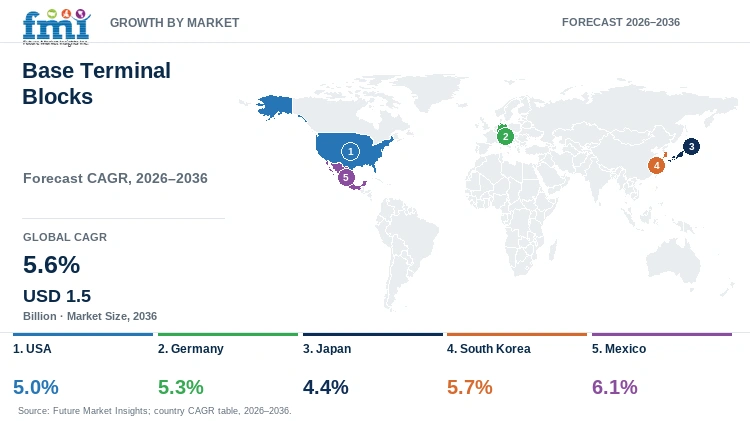
| Country | CAGR |
|---|---|
| USA | 5.0% |
| Germany | 5.3% |
| Japan | 4.4% |
| South Korea | 5.7% |
| Mexico | 6.1% |
How do country-level CAGRs compare in the Base Terminal Blocks Market?
The five profiled markets span 1.7 percentage points between Mexico at 6.1% CAGR from 2026 to 2036 and Japan at 4.4%. Mexico and South Korea form the upper growth band at 6.1% and 5.7%. Germany and the USA sit in a middle band at 5.3% and 5.0%. Japan remains positive but expands more slowly at 4.4%.
These differences indicate different rates of new equipment build and channel expansion rather than country market size. A supplier should therefore use CAGR to time investment. It should use installed manufacturing scale and customer qualification to determine where that investment can convert into revenue.
Distribution depth and application mix refine that decision.
- Mexico leads South Korea by 0.4 percentage points. The gap supports earlier investment in local inventory and OEM coverage where new manufacturing programs are adding electrical-control content.
- South Korea leads Germany by 0.4 percentage points. Suppliers can prioritize automation-ready products in Korea while using Germany’s established engineering channels for specification-led growth.
- Germany leads the USA by 0.3 percentage points. The small spread argues for differentiated execution rather than materially different growth assumptions across the two markets.
- The USA leads Japan by 0.6 percentage points. The slower Japanese rate increases the importance of approved-supplier access and fit with incumbent engineering practices instead of broad channel expansion alone.
CAGR does not identify the largest revenue pool. It describes the pace of change from each country’s own starting point. A slower market can still contain a large installed base and substantial replacement demand. A faster market can require more channel investment before suppliers reach comparable absolute sales.
The full report therefore considers country growth alongside manufacturing investment and automation intensity. Grid and building programs provide another demand signal. Distributor structures and supplier qualification affect conversion. The installed base of electrical-control equipment shapes replacement demand.
Those factors determine how quickly new terminal-block opportunities become repeatable orders.
Country-wise Analysis
- USA buyers commonly source standard terminal families through established electrical distribution while OEMs qualify specific blocks for repeat machine and panel designs. Demand for Base Terminal Blocks in the USA is forecast to expand at 5.0% CAGR from 2026 to 2036. The Bureau of Economic Analysis reported in July 2026 that the US direct-investment position increased to USD 5.86 trillion at year-end 2025. Manufacturing recorded the largest industry increase and electrical equipment was among the contributors. The commercial friction is qualification across OEM drawings and distributor stock. Suppliers need documented electrical equivalence, dependable replenishment, and accessory compatibility before a design change can scale.
- Germany combines mature DIN-rail panel practice with strong engineering discipline in industrial and electrical-infrastructure projects. Demand for Base Terminal Blocks in Germany is forecast to expand at 5.3% CAGR from 2026 to 2036. Bundesnetzagentur stated in January 2026 that roughly 2,000 km of power lines were approved in 2025. That was about 45% more than in 2024 and lifted fully approved projects to around 4,700 km. Grid work creates adjacent demand for switchgear and control assemblies but suppliers still face established specifications. Winning requires standard compliance and compact accessories. Panel builders also need clear engineering data and reliable support.
- Japanese equipment makers tend to emphasize production reliability and disciplined supplier qualification when they change electrical components. Demand for Base Terminal Blocks in Japan is forecast to expand at 4.4% CAGR from 2026 to 2036. METI released its White Paper on International Economy and Trade 2025 on 27 June 2025. Its manufacturing analysis notes domestic capital-investment plans for automation and labor saving. Other plans involve renewing aging equipment and expanding production. The slower growth profile makes design-in access important. Suppliers need stable quality and compact solutions backed by detailed technical documentation and local support. This reduces the risk of changing an incumbent terminal family.
- South Korean manufacturers are increasing the digital and automation content of production lines, which raises the number of connected control points inside equipment. Demand for Base Terminal Blocks in South Korea is forecast to expand at 5.7% CAGR from 2026 to 2036. The Ministry of SMEs and Startups announced its AI-based Smart Manufacturing Innovation 3.0 strategy in October 2025. The program targets wider AI-centered smart-factory adoption and identifies implementation cost as a barrier for smaller manufacturers. That cost sensitivity reaches component selection. Suppliers need labor-saving wiring benefits that can be quantified while maintaining certification, availability and compatibility with automated panel-production methods.
- Mexico’s export-oriented factories and incoming manufacturing projects rely heavily on electrical distributors, local integrators, and OEM supply chains to standardize control components. Demand for Base Terminal Blocks in Mexico is forecast to expand at 6.1% CAGR from 2026 to 2036. The Secretariat of Economy reported in February 2026 that Mexico received USD 40.871 billion of foreign direct investment in 2025. New investment rose strongly and the ministry linked inflows with modernization and productivity. Supplier friction centers on local stock and approved multinational specifications. Manufacturers that combine distributor availability with North American and global certification coverage are better positioned to convert new plant builds into repeat orders.
Who are the notable companies in the Base Terminal Blocks Market?
Phoenix Contact and Weidmüller are profiled. WAGO and TE Connectivity are also covered. ABB and Eaton are also covered. Schneider Electric and Molex are also covered. Degson and Dinkle International complete the notable-company set.
Competition is shaped less by a single terminal design than by the ecosystem around specification, installation, and service. Phoenix Contact and Weidmüller compete around dedicated terminal-block platforms. WAGO and Degson use a similar position with multiple wiring technologies.
Their differentiation includes tool-free connection and functional blocks. Accessories and marking systems extend the platform. Cabinet-engineering support can lower implementation work. ABB, Eaton, and Schneider Electric position terminal blocks inside broader electrical-control portfolios.
That can simplify sourcing when customers also buy control, protection or distribution equipment. TE Connectivity and Molex add deep connector engineering and component channels. Dinkle International combines a focused terminal-block history with manufacturing and sales locations across Asia, Europe and the Americas.
Buyers therefore compare connection performance with accessory continuity and certification coverage. Channel availability and qualification effort can decide the result.
- Dedicated terminal-block platforms: Phoenix Contact and Weidmüller compete alongside WAGO and Degson. Their wiring technology breadth supports DIN-rail functionality and cabinet-focused engineering.
- Electrical-control ecosystems: ABB, Eaton, and Schneider Electric can pair terminal blocks with wider low-voltage control and distribution portfolios for project and panel customers.
- Connector and component platforms: TE Connectivity, Molex and Dinkle International compete through connector engineering depth, component availability and multi-region customer support.
Competitive Benchmarking: Base Terminal Blocks Market
| Company | Connection Technology Breadth | Functional Block Coverage | Panel Engineering Ecosystem | Geographic Reach |
|---|---|---|---|---|
| Phoenix Contact | High | High | High | Global; strong coverage across Europe, North America, and Asia-Pacific |
| Weidmüller | High | High | High | Global; industrial sales and service across Europe, North America, and Asia-Pacific |
| WAGO | High | High | High | Global; broad distributor and industrial channel coverage across major regions |
| TE Connectivity | High | High | Medium | Global; connector channels across North America, Europe, and Asia-Pacific |
| ABB | Medium | Medium | Medium | Global; broad electrical equipment channels across major industrial regions |
| Eaton | High | High | Medium | Global; electrical distribution coverage in North America, Europe, and Asia-Pacific |
| Schneider Electric | High | High | Medium | Global; broad electrical distribution and automation channels |
| Molex | High | High | Medium | Global; industrial and electronics channels across North America, Europe, and Asia-Pacific |
| Degson | High | High | Medium | The company has a global sales network. Products are sold in the USA and Germany as well as Japan and South Korea and other markets. |
| Dinkle International | High | High | Medium | Asia, Europe, and the Americas through manufacturing and sales locations |
Scoring basis: Connection Technology Breadth measures documented coverage across screw and spring methods. Push-in or comparable terminal connection methods are also considered. Functional Block Coverage measures the range of feed-through and grounding functions. Disconnect and fuse blocks also count.
Distribution and multi-level designs extend the score. Panel Engineering Ecosystem measures documented support through accessories and marking. Configuration tools and digital engineering data also count. Wiring-process services can increase the rating. High indicates broad documented capability.
Medium indicates credible but narrower coverage. Low is reserved for a documented limitation. Unavailable public information is left low rather than treated as Low.
Key Developments in the Base Terminal Blocks Market
- In April 2026, Phoenix Contact expanded its XT Push-X terminal-block range with 4 mm² feed-through products. The extension supports tool-free wiring across conductor cross-sections from 0.34 to 25 mm². The new XT 4 terminal blocks are rated at 32 A and 500 V. This broadens the addressable range for a connection method designed for both manual and automated cabinet wiring.
- In October 2025, WAGO broadened its TOPJOB S Power Distribution Terminal Block line with a new 4-gauge input option. The company described the new design as 0.5 inches wide and listed UL 1059 certification for the 2216 and 2016 Series at 70 A and 600 V. The expansion adds compact higher-current distribution capability while retaining compatibility with existing jumper bars.
- In November 2025, Weidmüller and Schneider Electric presented the integration of SNAP IN connection technology into Schneider Electric’s new TeSys series at SPS 2025. Weidmüller described the motor-control and motor-management solution as jointly developed. The action moves a fast wiring architecture beyond standalone terminal blocks into repeat OEM equipment design, which can increase familiarity with the connection method among panel builders.
Key Players in the Base Terminal Blocks Market
Dedicated Terminal-Block and Wiring-Technology Platforms
- Phoenix Contact
- Weidmüller
- WAGO
- Degson
Electrical-Control and Distribution Ecosystems
- ABB
- Eaton
- Schneider Electric
Connector and Component Platforms
- TE Connectivity
- Molex
- Dinkle International
Base Terminal Blocks Market - Report Scope
| Coverage field | Report scope |
|---|---|
| Market breakdown | Product Type, Current Rating, Material, End Use, Sales Channel |
| Quantitative Units | USD Billion |
| Market Definition | Revenue includes base terminal blocks sold as discrete conductor-termination products within the stated segmentation universe. It excludes downstream finished-product revenue and adjacent or substitute product revenue such as complete control panels, switchgear, relays, power supplies, or non-terminal connector systems. |
| Regions Covered | North America; Latin America; Western Europe; Eastern Europe; East Asia; South Asia and Pacific; Middle East and Africa |
| Countries Covered | USA, Germany, Japan, South Korea, Mexico, and more than twenty-five additional countries in the full report |
| Key Companies Profiled | Phoenix Contact, Weidmüller, WAGO, TE Connectivity, ABB, Eaton, Schneider Electric, Molex, Degson, Dinkle International |
| Forecast Period | 2026 to 2036 |
| Approach | A hybrid bottom-up and top-down sizing approach reconciles supplier product coverage, application demand, channel activity, trade and manufacturing indicators, and country-specific adoption conditions. |
Base Terminal Blocks Market - Research Methodology
| Method | Approach |
|---|---|
| Primary Research | FMI consults terminal-block makers and electrical distributors. Panel builders and OEM buyers test qualification and product-mix choices. The research tests purchase criteria and adoption barriers. |
| Desk Research | FMI reviews electrical standards and industrial statistics. Company product documentation supports connection technology and ratings. Sources are retained when they support the defined market boundary. |
| Market Sizing and Forecasting | FMI reconciles supplier coverage with end-use demand and channel structure. Forecasts reflect automation and infrastructure investment. Country conditions and channel structure are checked against the revenue boundary. |
| Data Validation | Findings are checked against independent evidence. The estimate excludes downstream finished products and adjacent connectors. Duplicate channel value and unsupported claims are removed. |
Base Terminal Blocks Market by Segments
Base Terminal Blocks Market segmented by Product Type:
- Screw terminal blocks
- Spring clamp blocks
- Push-in terminal blocks
- Barrier terminal blocks
- DIN rail base blocks
- By Hose Type
Base Terminal Blocks Market segmented by Current Rating:
- 10-30 A
- Below 10 A
- 30-100 A
- Above 100 A
- By Material
Base Terminal Blocks Market segmented by Material:
- Polyamide
- Polycarbonate
- Thermoset
- Ceramic
- Metal-clad assemblies
- By Pressure Rating
Base Terminal Blocks Market segmented by End Use:
- Industrial automation
- Building electrical
- Power distribution
- Transportation
- Process control
- By End Use
Base Terminal Blocks Market segmented by Sales Channel:
- Electrical distributors
- Direct OEM
- Panel builders
- Catalog / e-commerce
- By Sales Channel
Base Terminal Blocks Market by Region:
- North America
- United States
- Canada
- Latin America
- Brazil
- Mexico
- Argentina
- Chile
- Western Europe
- Germany
- France
- United Kingdom
- Italy
- Spain
- Benelux
- Nordics
- Eastern Europe
- Poland
- Czech Republic
- Romania
- Hungary
- East Asia
- China
- Japan
- South Korea
- South Asia and Pacific
- India
- ASEAN
- Australia and New Zealand
- Middle East and Africa
- GCC Countries
- South Africa
- Türkiye
- Israel
Research Sources and Bibliography
- International Electrotechnical Commission (2025). IEC 60947-7-1:2025, Low-voltage switchgear and controlgear - Part 7-1: Ancillary equipment - Terminal blocks for copper conductors.
- UL Standards & Engagement (2024, December 11). UL 1059, Standard for Terminal Blocks, Sixth Edition.
- International Federation of Robotics (2025, September 25). World Robotics 2025.
- U.S. Bureau of Economic Analysis (2026, July 21). Direct Investment by Country and Industry, 2025.
- Bundesnetzagentur (2026, January 2). Grid expansion accelerated significantly in 2025.
- Ministry of Economy, Trade and Industry, Japan (2025, June 27). Release of the White Paper on International Economy and Trade 2025 and the International Trade and Economic Strategy 2025.
- Ministry of SMEs and Startups, Republic of Korea (2025, October 24). AI-based Smart Manufacturing Innovation 3.0 Strategy.
- Secretariat of Economy, Mexico (2026, February 25). Mexico reaches historic foreign direct investment of USD 40.871 billion in 2025.
- Phoenix Contact (2026, April 20). Push-X product program continues to grow.
- Phoenix Contact (2025, January 21). Push-in PCB terminal blocks for electronics housing BC 17.8.
- WAGO (2025, October). WAGO Broadens Power Distribution Terminal Block Line.
- WAGO (2023, October 25). Distribution Services.
- Weidmüller (2025, November). Trade Press Releases for SPS 2025.
- DEGSON (2026, January 12). DEGSON Becomes China's First Terminal Manufacturer to Achieve VDE-TDAP Stage 3 Certification.
- Molex (accessed 2026, September 6). DIN Rail Screw Terminal Block, 2297610701.
This bibliography is provided for reader reference and is not exhaustive. The full report contains the complete reference list and detailed citations.
This Report Answers
- What is the Base Terminal Blocks Market size in 2026 and what value is forecast for 2036?
- Which industrial automation and electrical investment pressures support demand for base terminal blocks?
- Why do Screw terminal blocks hold the leading Product Type position?
- How does the 10-30 A Current Rating band influence control and auxiliary-power demand?
- Why does Polyamide hold the leading Material position?
- How do the profiled country growth rates compare for the Base Terminal Blocks market?
- How do the profiled terminal-block suppliers compete in this market?
- How do qualification requirements and accessory-system switching costs limit adoption of alternative terminal-block families?
Frequently Asked Questions
What is driving growth in the Base Terminal Blocks Market?
Industrial automation increases the number and density of signal and power terminations required inside machines and control cabinets. Buyers also value connection methods that reduce repetitive wiring labor without compromising electrical ratings or certification coverage and serviceability.
Who are the key players in the Base Terminal Blocks Market?
Phoenix Contact, Weidmüller and WAGO are among the profiled companies. The wider group listed under Key Players competes through terminal technology and electrical-control integration.
What notable restraint affects the Base Terminal Blocks Market?
Qualification and ecosystem switching costs can slow changes between terminal families even when an alternative promises faster wiring. Buyers may need to revise drawings and jumper schemes while also updating markings, tooling and compliance documentation before approving a platform change.
Why should executives track the Base Terminal Blocks Market?
The component sits at a high-frequency connection point inside automation and power equipment while building or transportation systems add further demand. Changes in wiring method or sourcing strategy can affect assembly time and inventory complexity while also altering maintenance practices across repeated builds.
What business problem does the Base Terminal Blocks Market address?
Base terminal blocks create organized and serviceable electrical termination points between conductors within equipment and control assemblies. They help designers manage circuit separation and current capacity while preserving maintenance access and labeling at the termination layer.
What should relevant decision-makers evaluate in the Base Terminal Blocks Market?
OEM engineers and panel builders should start with current and voltage ratings plus conductor range and connection method. They should then compare standards fit and required functions against panel space, installation labor and distributor stock before reviewing engineering data and lifecycle service needs.
What limits return on investment in the Base Terminal Blocks Market?
A lower component price or faster connection does not automatically create savings when changeover work is high. ROI can be reduced by qualification effort and new accessories while retraining, inconsistent stock or low production volume may prevent redesign costs from being recovered.
What supports long-term commercial confidence in the Base Terminal Blocks Market?
The demand base spans industrial automation and building electrical systems while power distribution or transportation create additional use cases. Long product lifecycles and recurring panel construction support replacement demand while new wiring technologies create incremental opportunities to reduce assembly labor.
Preview the report firsthand - request a free sample
Get SampleGet the brochure for pricing and purchase details.
Get PDFTable of Content
- Key Takeaways
- Market Size and CAGR
- Top Growth Driver
- Fastest Growing Segment
- Leading Region
- Key Companies
- Emerging Opportunities
- Executive Summary
- Global Market Outlook
- Demand-side Trends
- Supply-side Trends
- Technology Roadmap Analysis
- Analysis and Recommendations
- Analyst Perspective (What is happening? Why now? What should investors know?)
- Key Questions Answered
- How large is the market?
- What is the CAGR?
- What are key trends?
- Which region dominates?
- Who are the leaders?
- Market Overview
- Market Coverage / Taxonomy
- Market Definition / Scope / Limitations
- Research Methodology
- Chapter Orientation
- Analytical Lens and Working Hypotheses
- Market Structure, Signals, and Trend Drivers
- Benchmarking and Cross-market Comparability
- Market Sizing, Forecasting, and Opportunity Mapping
- Research Design and Evidence Framework
- Desk Research Programme (Secondary Evidence)
- Expert Input and Fieldwork (Primary Evidence)
- Tooling, Models, and Reference Databases
- Data Engineering and Model Build
- Quality Assurance and Audit Trail
- Market Background
- Market Dynamics (Drivers, Restraints, Opportunity, Trends)
- Scenario Forecast (Optimistic, Likely, Conservative)
- Impact Analysis
- AI Impact
- Sustainability Impact
- Regulatory Impact
- Technology Impact
- Consumer / Buyer Analysis
- Purchase Drivers
- Adoption Barriers
- Buyer Journey
- Opportunity Map Analysis
- Product Life Cycle Analysis
- Supply Chain Analysis
- Investment Feasibility Matrix
- Value Chain Analysis
- PESTLE and Porter's Analysis
- Regulatory Landscape
- Regional Parent Market Outlook
- Production and Consumption Statistics
- Import and Export Statistics
- Global Market Analysis and Forecast, 2021 to 2036
- Historical Market Size Value (USD Billion) Analysis, 2021 to 2025
- Current and Future Market Size Value (USD Billion) Projections, 2026 to 2036
- Y-o-Y Growth Trend Analysis
- Absolute $ Opportunity Analysis
- Global Market Pricing Analysis, 2021 to 2036
- Global Market Analysis and Forecast, By Product Type, 2021 to 2036
- Introduction / Key Findings
- Historical Market Size Value (USD Billion) Analysis By Product Type, 2021 to 2025
- Current and Future Market Size Value (USD Billion) Analysis and Forecast By Product Type, 2026 to 2036
- Screw terminal blocks
- Spring clamp blocks
- Push-in terminal blocks
- Barrier terminal blocks
- DIN rail base blocks
- By Hose Type
- Y-o-Y Growth Trend Analysis By Product Type, 2021 to 2025
- Absolute $ Opportunity Analysis By Product Type, 2026 to 2036
- Global Market Analysis and Forecast, By Current Rating, 2021 to 2036
- Introduction / Key Findings
- Historical Market Size Value (USD Billion) Analysis By Current Rating, 2021 to 2025
- Current and Future Market Size Value (USD Billion) Analysis and Forecast By Current Rating, 2026 to 2036
- 10-30 A
- Below 10 A
- 30-100 A
- Above 100 A
- By Material
- Y-o-Y Growth Trend Analysis By Current Rating, 2021 to 2025
- Absolute $ Opportunity Analysis By Current Rating, 2026 to 2036
- Global Market Analysis and Forecast, By Material, 2021 to 2036
- Introduction / Key Findings
- Historical Market Size Value (USD Billion) Analysis By Material, 2021 to 2025
- Current and Future Market Size Value (USD Billion) Analysis and Forecast By Material, 2026 to 2036
- Polyamide
- Polycarbonate
- Thermoset
- Ceramic
- Metal-clad assemblies
- By Pressure Rating
- Y-o-Y Growth Trend Analysis By Material, 2021 to 2025
- Absolute $ Opportunity Analysis By Material, 2026 to 2036
- Global Market Analysis and Forecast, By End Use, 2021 to 2036
- Introduction / Key Findings
- Historical Market Size Value (USD Billion) Analysis By End Use, 2021 to 2025
- Current and Future Market Size Value (USD Billion) Analysis and Forecast By End Use, 2026 to 2036
- Industrial automation
- Building electrical
- Power distribution
- Transportation
- Process control
- By End Use
- Y-o-Y Growth Trend Analysis By End Use, 2021 to 2025
- Absolute $ Opportunity Analysis By End Use, 2026 to 2036
- Global Market Analysis and Forecast, By Sales Channel, 2021 to 2036
- Introduction / Key Findings
- Historical Market Size Value (USD Billion) Analysis By Sales Channel, 2021 to 2025
- Current and Future Market Size Value (USD Billion) Analysis and Forecast By Sales Channel, 2026 to 2036
- Electrical distributors
- Direct OEM
- Panel builders
- Catalog / e-commerce
- By Sales Channel
- Y-o-Y Growth Trend Analysis By Sales Channel, 2021 to 2025
- Absolute $ Opportunity Analysis By Sales Channel, 2026 to 2036
- Global Market Analysis and Forecast, By Region, 2021 to 2036
- Introduction
- Historical Market Size Value (USD Billion) Analysis By Region, 2021 to 2025
- Current Market Size Value (USD Billion) Analysis and Forecast By Region, 2026 to 2036
- North America
- Latin America
- Western Europe
- Eastern Europe
- East Asia
- South Asia and Pacific
- Middle East and Africa
- Market Attractiveness Analysis By Region
- North America Market Analysis and Forecast, By Country, 2021 to 2036
- Historical Market Size Value (USD Billion) Trend Analysis By Market Taxonomy, 2021 to 2025
- Market Size Value (USD Billion) Forecast By Market Taxonomy, 2026 to 2036
- By Country
- United States
- Canada
- By Product Type
- By Current Rating
- By Material
- By End Use
- By Sales Channel
- By Country
- Market Attractiveness Analysis
- By Country
- By Product Type
- By Current Rating
- By Material
- By End Use
- By Sales Channel
- Key Takeaways
- Latin America Market Analysis and Forecast, By Country
- Historical Market Size Value (USD Billion) Trend Analysis By Market Taxonomy, 2021 to 2025
- Market Size Value (USD Billion) Forecast By Market Taxonomy, 2026 to 2036
- By Country
- Brazil
- Mexico
- Argentina
- Chile
- By Product Type
- By Current Rating
- By Material
- By End Use
- By Sales Channel
- By Country
- Market Attractiveness Analysis
- By Country
- By Product Type
- By Current Rating
- By Material
- By End Use
- By Sales Channel
- Key Takeaways
- Western Europe Market Analysis and Forecast, By Country
- Historical Market Size Value (USD Billion) Trend Analysis By Market Taxonomy, 2021 to 2025
- Market Size Value (USD Billion) Forecast By Market Taxonomy, 2026 to 2036
- By Country
- Germany
- France
- United Kingdom
- Italy
- Spain
- Benelux
- Nordics
- By Product Type
- By Current Rating
- By Material
- By End Use
- By Sales Channel
- By Country
- Market Attractiveness Analysis
- By Country
- By Product Type
- By Current Rating
- By Material
- By End Use
- By Sales Channel
- Key Takeaways
- Eastern Europe Market Analysis and Forecast, By Country
- Historical Market Size Value (USD Billion) Trend Analysis By Market Taxonomy, 2021 to 2025
- Market Size Value (USD Billion) Forecast By Market Taxonomy, 2026 to 2036
- By Country
- Poland
- Czech Republic
- Romania
- Hungary
- By Product Type
- By Current Rating
- By Material
- By End Use
- By Sales Channel
- By Country
- Market Attractiveness Analysis
- By Country
- By Product Type
- By Current Rating
- By Material
- By End Use
- By Sales Channel
- Key Takeaways
- East Asia Market Analysis and Forecast, By Country
- Historical Market Size Value (USD Billion) Trend Analysis By Market Taxonomy, 2021 to 2025
- Market Size Value (USD Billion) Forecast By Market Taxonomy, 2026 to 2036
- By Country
- China
- Japan
- South Korea
- By Product Type
- By Current Rating
- By Material
- By End Use
- By Sales Channel
- By Country
- Market Attractiveness Analysis
- By Country
- By Product Type
- By Current Rating
- By Material
- By End Use
- By Sales Channel
- Key Takeaways
- South Asia and Pacific Market Analysis and Forecast, By Country
- Historical Market Size Value (USD Billion) Trend Analysis By Market Taxonomy, 2021 to 2025
- Market Size Value (USD Billion) Forecast By Market Taxonomy, 2026 to 2036
- By Country
- India
- ASEAN
- Australia and New Zealand
- By Product Type
- By Current Rating
- By Material
- By End Use
- By Sales Channel
- By Country
- Market Attractiveness Analysis
- By Country
- By Product Type
- By Current Rating
- By Material
- By End Use
- By Sales Channel
- Key Takeaways
- Middle East and Africa Market Analysis and Forecast, By Country
- Historical Market Size Value (USD Billion) Trend Analysis By Market Taxonomy, 2021 to 2025
- Market Size Value (USD Billion) Forecast By Market Taxonomy, 2026 to 2036
- By Country
- GCC Countries
- South Africa
- Türkiye
- Israel
- By Product Type
- By Current Rating
- By Material
- By End Use
- By Sales Channel
- By Country
- Market Attractiveness Analysis
- By Country
- By Product Type
- By Current Rating
- By Material
- By End Use
- By Sales Channel
- Key Takeaways
- Key Countries Market Analysis
- United States
- Pricing Analysis
- Market Share Analysis, 2025
- By Product Type
- By Current Rating
- By Material
- By End Use
- By Sales Channel
- Canada
- Pricing Analysis
- Market Share Analysis, 2025
- By Product Type
- By Current Rating
- By Material
- By End Use
- By Sales Channel
- Mexico
- Pricing Analysis
- Market Share Analysis, 2025
- By Product Type
- By Current Rating
- By Material
- By End Use
- By Sales Channel
- Brazil
- Pricing Analysis
- Market Share Analysis, 2025
- By Product Type
- By Current Rating
- By Material
- By End Use
- By Sales Channel
- Chile
- Pricing Analysis
- Market Share Analysis, 2025
- By Product Type
- By Current Rating
- By Material
- By End Use
- By Sales Channel
- Germany
- Pricing Analysis
- Market Share Analysis, 2025
- By Product Type
- By Current Rating
- By Material
- By End Use
- By Sales Channel
- United Kingdom
- Pricing Analysis
- Market Share Analysis, 2025
- By Product Type
- By Current Rating
- By Material
- By End Use
- By Sales Channel
- Italy
- Pricing Analysis
- Market Share Analysis, 2025
- By Product Type
- By Current Rating
- By Material
- By End Use
- By Sales Channel
- Spain
- Pricing Analysis
- Market Share Analysis, 2025
- By Product Type
- By Current Rating
- By Material
- By End Use
- By Sales Channel
- France
- Pricing Analysis
- Market Share Analysis, 2025
- By Product Type
- By Current Rating
- By Material
- By End Use
- By Sales Channel
- India
- Pricing Analysis
- Market Share Analysis, 2025
- By Product Type
- By Current Rating
- By Material
- By End Use
- By Sales Channel
- ASEAN
- Pricing Analysis
- Market Share Analysis, 2025
- By Product Type
- By Current Rating
- By Material
- By End Use
- By Sales Channel
- Australia and New Zealand
- Pricing Analysis
- Market Share Analysis, 2025
- By Product Type
- By Current Rating
- By Material
- By End Use
- By Sales Channel
- China
- Pricing Analysis
- Market Share Analysis, 2025
- By Product Type
- By Current Rating
- By Material
- By End Use
- By Sales Channel
- Japan
- Pricing Analysis
- Market Share Analysis, 2025
- By Product Type
- By Current Rating
- By Material
- By End Use
- By Sales Channel
- South Korea
- Pricing Analysis
- Market Share Analysis, 2025
- By Product Type
- By Current Rating
- By Material
- By End Use
- By Sales Channel
- Poland
- Pricing Analysis
- Market Share Analysis, 2025
- By Product Type
- By Current Rating
- By Material
- By End Use
- By Sales Channel
- Hungary
- Pricing Analysis
- Market Share Analysis, 2025
- By Product Type
- By Current Rating
- By Material
- By End Use
- By Sales Channel
- Türkiye
- Pricing Analysis
- Market Share Analysis, 2025
- By Product Type
- By Current Rating
- By Material
- By End Use
- By Sales Channel
- South Africa
- Pricing Analysis
- Market Share Analysis, 2025
- By Product Type
- By Current Rating
- By Material
- By End Use
- By Sales Channel
- United States
- Market Structure Analysis
- Competition Dashboard
- Competition Benchmarking
- Market Share Analysis of Top Players
- By Regional
- By Product Type
- By Current Rating
- By Material
- By End Use
- By Sales Channel
- Emerging Startups
- Innovation Benchmarking
- Competition Analysis
- Competition Deep Dive
- Phoenix Contact
- Overview
- Product Portfolio
- Profitability by Market Segments
- Sales Footprint
- Strategy Overview
- Marketing Strategy
- Product Strategy
- Channel Strategy
- Weidmüller
- WAGO
- TE Connectivity
- ABB
- Eaton
- Schneider Electric
- Molex
- Degson
- Dinkle International
- Phoenix Contact
- Case Studies
- Success Stories
- Recent Developments
- Competition Deep Dive
- Assumptions & Acronyms Used


