

- Market Size (2026)
- USD 3.9 Bn
- Forecast (2036)
- USD 6.3 Bn
- CAGR (2026 to 2036)
- 5.1%
How big is DIN-Rail Terminal Blocks Market in 2026?
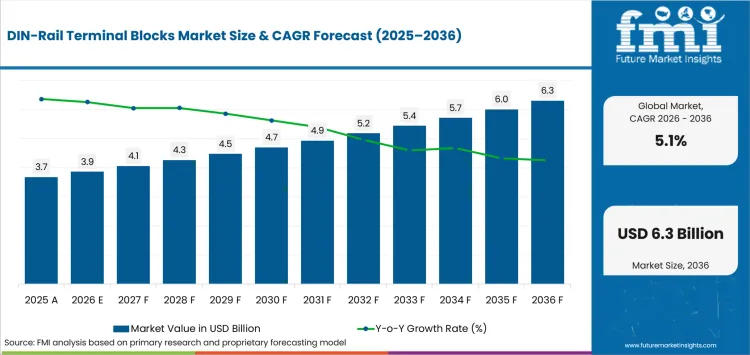
USD 3.9 billion in 2026 and USD 6.3 billion by 2036 at a 5.1% CAGR.
Sales of terminal blocks are projected to increase valuation from USD 3.9 billion in 2026 to USD 6.3 billion by 2036, reflecting a 5.1% CAGR. Demand is rising as manufacturers add sensors, controllers and automated equipment that increase wiring complexity inside industrial control cabinets. The International Federation of Robotics recorded 542,000 industrial robots installed worldwide in 2024. An equipment base at that scale increases repeat connection points for industrial automation systems, while terminal selection still depends on wiring time, test access, and accessory continuity.
Grid investment converts into terminal demand only after new connection capacity reaches substations, industrial loads, and distribution work. In September 2025, Spain's government said its proposed 2030 transmission plan would accommodate 27.7 GW of demand and include 422 connection expansions. That project pipeline can increase electrical enclosure demand, but terminal orders still follow permitting, commissioning schedules, approved standards, and distributor stock.
Key Takeaways
- Automation and electrification increase cabinet wiring density, raising the number of power, signal, safety, and sensor terminations that must stay serviceable.
- Based on terminal type, feed-through terminal blocks are projected to account for 29.0% in 2026 due to routine point-to-point termination in most panel architectures.
- By connection method, screw clamp is estimated to hold 34.0% in 2026 owing to long-qualified specifications and technician familiarity that reduce redesign risk.
- In 2026, miniature terminal blocks are expected to lead pitch - size with 20.0% share because denser wiring increases the value of rail-space savings.
- Qualification, matching accessories, marking systems, and installed bills of materials slow switching even if faster connection methods reduce assembly labor.
- Some of the key players in this market include Phoenix Contact, WAGO, Weidmüller, Schneider Electric, Wieland Electric, Conta-Clip, Dinkle, and Altech Corporation.
Analyst Perspective
"An approved din-rail terminal strip carries bridges, markers, test points, drawings, and service procedures, so connection speed alone rarely justifies replacement. Faster termination earns a design-in once the new family preserves accessory compatibility and the replacement path already qualified for repeat machine production."
- Nikhil Kaitwade, Principal Consultant, Future Market Insights
How is the din-rail terminal blocks market segmented?
The market is assessed by terminal type, connection method, pitch - size, end use, sales channel, and region.
Terminal type covers feed-through, ground, fuse, disconnect, sensor / actuator, and spring-cage functions. Connection method includes screw clamp, spring clamp, push-in, insulation displacement, and bolt connection. Pitch - size separates miniature, standard, high-current, and multi-level formats. End use covers industrial control panels, machine builders, power distribution, building automation, and transportation. Sales channels include electrical distributors, automation distributors, panel builders, and direct OEM supply.
What makes feed-through terminal blocks central to the terminal type category?
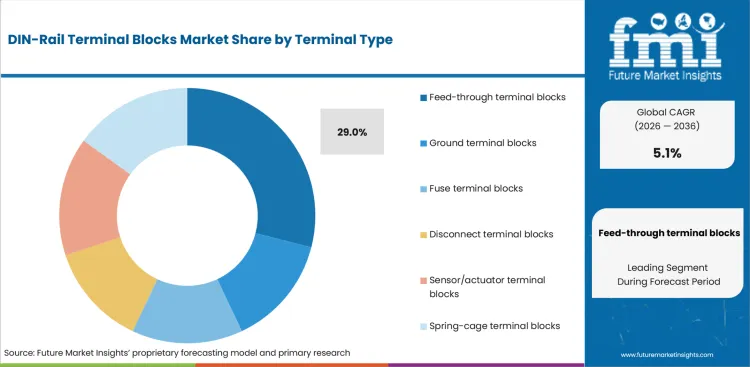
Feed-through blocks form the boundary between field wiring and internal panel circuits, so designers use them ahead of grounding or protection functions. The role also carries into industrial connector platforms as machine builders need separation between external conductors and serviceable cabinet wiring.
- Based on terminal type, feed-through terminal blocks are projected to account for 29.0% in 2026 due to routine conductor-to-conductor termination in the widest range of panel circuits.
- In June 2025, Phoenix Contact introduced XT 2.5.../P pluggable terminal blocks with Push-X and a COMBI plug-in zone, giving feed-through circuits a faster service-disconnection route.
Why does screw clamp lead the connection method category?
Screw clamp retains an installed-base advantage since machine drawings, tightening procedures, spare stocks, and service instructions already specify the connection method. In factory automation controls, changing that method can require drawing revisions and technician retraining before electrical performance is reconsidered.
- By connection method, screw clamp is estimated to hold 34.0% in 2026 owing to familiar conductor preparation and long service histories that lower specification-change risk.
- In July 2025, Altech Corporation launched ATEX- and IECEx-approved DIN-rail terminal blocks that retain screw-clamp options beside tool-free connection families for hazardous-area panel designs.
How does miniature lead the pitch - size category?
Miniature terminal blocks address a physical cabinet limit as conductor counts can rise faster than available rail length in compact equipment. Designers protect space for relays and machine control systems by reducing terminal width instead of enlarging the enclosure.
- In 2026, miniature is expected to lead pitch - size with 20.0% share because smaller terminal footprints preserve rail capacity without changing the surrounding wiring function.
- In November 2025, Phoenix Contact expanded Push-X with XT 1.5 compact terminal blocks, giving dense panels a smaller tool-free option without changing the DIN-rail mounting concept.
Why do electrical distributors lead the sales channel category?
A missing bridge or marker can stop panel completion despite available terminal stock, so terminal strips depend on the full accessory set. Electrical distributors reduce that interruption risk by carrying terminal families beside switchgear portfolios and replacement components.
- By sales channel, electrical distributors are forecast to represent 41.0% in 2026 driven by local stock that supports new panels and mixed-function maintenance orders.
- In August 2025, Phoenix Contact USA partnered with Waldom Electronics so authorized distributors could redirect non-moving inventory for resale through other authorized distributors nationwide.
What are the drivers, restraints and opportunities in the DIN-Rail Terminal Blocks Market?
More electrical functions increase termination density, while qualification and installed accessories slow substitution. Labor-saving connection systems offer the clearest design-in opening.
- More automated equipment raises the number of power, signal, sensor, and safety conductors entering control cabinets.
- Qualification standards and installed accessory systems make a low-cost terminal family costly to replace once design approval is complete.
- Tool-free connection and wiring automation can reduce assembly effort without requiring larger cabinets or additional rail space.
Panel builders add terminal points as sensors and networked equipment increase cabinet wiring. The International Federation of Robotics recorded 38,000 US industrial robot installations during 2025. More automated equipment raises the number of power and signal interfaces terminated beside industrial Ethernet architectures. Terminal value rises if compact wiring and clear testing prevent those connections from extending assembly time.
Qualification friction starts once a terminal family enters drawings, test procedures, and service documents. IEC published IEC 60947-7-1:2025 in April 2025 for terminal blocks with screw-type or screwless clamping units. A replacement has to preserve applicable ratings, accessory compatibility, and service procedures before an engineering team can justify faster wiring or a lower component price.
Panel builders have the clearest opening in projects using automation to remove repetitive wire preparation without changing the approved cabinet architecture. In April 2026, Rittal said its Wire Terminal WT L could speed wire processing by up to 11 times. The gain is commercially useful if prepared conductors still fit the selected terminal family, marking system, and documented assembly procedure.
Which country CAGRs are profiled in the DIN-Rail Terminal Blocks Market?
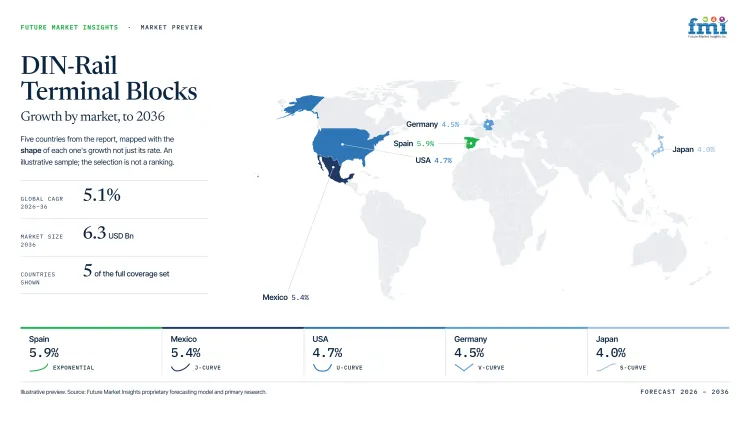
| Country | CAGR |
|---|---|
| Spain | 5.9% |
| Mexico | 5.4% |
| Poland | 5.2% |
| Brazil | 5.1% |
| USA | 4.7% |
| Germany | 4.5% |
| Japan | 4.0% |
How do country-level CAGRs compare in the DIN-Rail Terminal Blocks Market?
Spain and Mexico form the fastest pair, with Poland and Brazil close behind inside a narrow 5%+ band. USA and Germany occupy a slower middle range, while Japan's 4.0% rate points to a mature conversion path. The full spread is 1.9 percentage points, so country pace needs to be read beside installed industrial scale and specification friction.
- Spain's 5.9% rate stays 0.5 points above Mexico as grid-access projects move toward construction.
- Poland and Brazil differ by only 0.1 point, making project access more decisive than forecast pace.
- USA and Germany form a slower pair where installed-base replacement can outweigh modest CAGR differences.
- Japan's 4.0% rate reflects slower component substitution inside mature machine platforms, not weak automation activity.
CAGR is a timing signal for commercial pacing. Absolute opportunity still depends on installed equipment, standards, channel depth, and end-use mix.
Country-wise Analysis
- Spanish panel demand increasingly follows grid reinforcement and renewable projects, so terminal orders rise once generation assets and new industrial loads reach construction. In April 2026, Spain's government said 275 wind turbines had entered operation during 2025, and din-rail terminal blocks demand in Spain is forecast to expand at 5.9% CAGR through 2036 as new generation requires more protection, converter, and signal termination. The active project base gives manufacturers a clear route into utility and renewable-control panels, although commissioning dates remain uneven and require IEC-documented families, stocked accessories, and distributor coverage that can follow project schedules without treating each announced development as an immediate component order.
- Mexico's export factories often standardize one machine design for North American and European destinations, making dual-market approvals and nearby replacement stock part of the initial component decision. INEGI counted 5,217 manufacturing establishments in the IMMEX program in February 2026, giving terminal manufacturers a concentrated export-oriented plant base and repeated panel work from equipment upgrades and maintenance. Mexico is estimated to post 5.4% CAGR over the forecast period because regional manufacturing supports regular panel demand, with mixed approval requirements and lead-time exposure making local inventory and application support more important than a small unit-price advantage for plants serving multiple export markets.
- Polish panel builders are adapting to a power system with more distributed generation, which increases control and protection work at utility and industrial grid connections. The Polish din-rail terminal blocks sector is projected to record 5.2% CAGR during the assessment period, propelled by network modernization and a larger installed renewable base. In February 2026, the Ministry of Climate and Environment stated that renewables represented 50.04% of installed capacity at the end of 2025, so compact IEC portfolios can gain AC switchgear project access but long utility procurement cycles can delay specification changes for projects using mixed utility and industrial standards.
- Brazil's wide service geography makes regional inventory a commercial requirement for distributed-energy and industrial panels far from the largest electrical stocking centers. EPE reported in April 2026 that micro- and mini-distributed generation capacity reached 45.0 GW during 2025, enlarging the installed base of conversion and auxiliary-control equipment that requires field service over its operating life. Din-rail terminal-block sales in Brazil are forecast to expand at 5.1% CAGR by 2036, aided by that equipment base, though freight distance and uneven distributor depth keep Portuguese technical support and local replacement stock central to company selection outside the main distribution hubs and service centers.
- US panel shops usually start with recognized component ratings and distributor availability as machine platforms can ship into several states and end-use sectors with little tolerance for undocumented substitutions. Din-rail terminal blocks demand in the USA is forecast to rise at 4.7% CAGR during the assessment period, helped by storage construction that requires auxiliary control enclosures and battery energy storage interfaces. The USA Energy Information Administration recorded 43.6 GW of operational utility-scale battery storage at the end of 2025, giving approved terminal families more addressable panel work while installed bills of materials keep connection-method changes slow through replacement and expansion projects.
- German machine builders place heavy weight on engineering-data continuity since established automation depends on tested accessories, marking plans, and service documentation that travel with equipment. Bundesnetzagentur reported in January 2026 that renewable installed capacity increased by nearly 21 GW during 2025, adding generation assets that require protection and control cabinets without shortening qualification work. Germany is estimated to post 4.5% CAGR over the forecast period, tied to electrical investment, and a new terminal family earns design-in only after its labor savings and replacement continuity fit the engineering standards already used by local equipment manufacturers for export machines and utility panels.
- Japanese machine builders tend to retain long-qualified component families since repeat production, quality records, and field-service instructions are tightly controlled within compact equipment platforms. In Japan, din-rail terminal blocks demand is predicted to advance at 4.0% CAGR through 2036, given steady automation-equipment activity but slower design substitution inside mature machine programs. Japan Robot Association data for April-June 2026 recorded 50,768 robot shipments, so compact and error-resistant connection formats have a clear opening while manufacturers still need long product-life support and detailed engineering files to win specification changes during multiyear machine-platform refresh cycles and repeat factory maintenance programs in domestic plants.
Who are the notable companies in the DIN-Rail Terminal Blocks Market?
Phoenix Contact, WAGO, Weidmüller, Schneider Electric, Wieland Electric, Conta-Clip, Dinkle, and Altech Corporation are the notable companies profiled in this market.
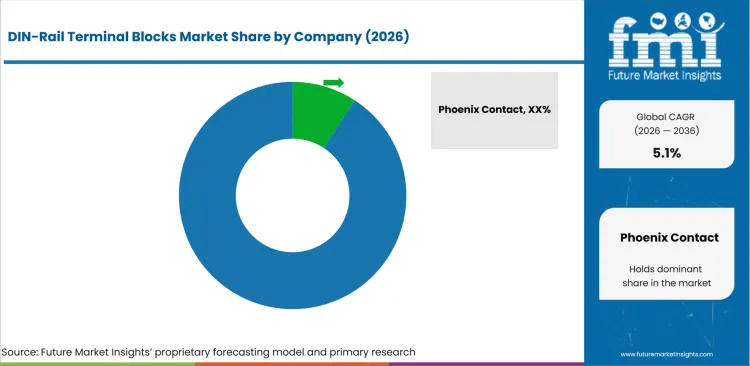
Competition is fragmented by connection technology and accessory depth instead of company size alone. Phoenix Contact, WAGO, and Weidmüller sell broad terminal systems, while Schneider Electric and Wieland Electric tie connection products to larger control-cabinet platforms. Smaller specialists can still win high-voltage switchgear and machine-panel applications if approvals, stocked accessories, and engineering support match established customer designs.
- Phoenix Contact, WAGO, and Weidmüller cover broad terminal systems with bridging, marking, testing, and digital engineering support.
- Schneider Electric and Wieland Electric position terminal products inside wider control-cabinet and industrial electrical portfolios.
- Conta-Clip, Dinkle, and Altech Corporation compete through specialist terminal families, application-specific approvals, and regional channel access.
Competitive Benchmarking: DIN-Rail Terminal Blocks Market
| Company | Connection Technology Breadth | Terminal Function Breadth | Engineering and Accessory Support | Geographic Reach |
|---|---|---|---|---|
| Phoenix Contact | High | High | High | Global |
| WAGO | Medium | High | High | Global |
| Weidmüller | High | High | High | Global |
| Schneider Electric | High | Medium | Medium | Global |
| Wieland Electric | Medium | High | High | Europe, North America, and Asia |
| Conta-Clip | High | High | High | Europe and international distribution |
| Dinkle | High | High | Medium | Asia, North America, and Europe |
| Altech Corporation | High | High | Medium | North America and international distribution |
Scoring basis: High connection breadth requires at least three documented connection methods, Medium requires two, and Low identifies one. High terminal-function breadth requires at least four documented functional families, while Medium covers two or three and Low one. High engineering support requires digital planning plus a broad accessory or marking system. Medium covers one route and Low basic supporting material. Geographic reach records verified operating or distribution coverage.
Key Developments in the DIN-Rail Terminal Blocks Market
- In April 2026, Schneider Electric issued a Linergy TR product-change notice moving its terminal-block range from spring to push-in technology and discontinuing spring-style terminals.
- In March 2026, Phoenix Contact inaugurated the first phase of its Querétaro production facility, expanding regional manufacturing capacity for industrial electrification and control-cabinet components.
- In October 2025, WAGO broadened its TOPJOB S power-distribution terminal-block line with a compact 4-gauge input rated for 70 A / 600 V applications.
Key Players in the DIN-Rail Terminal Blocks Market
Broad Terminal-System Platforms
- Phoenix Contact
- WAGO
- Weidmüller
Control-Cabinet and Electrical Platforms
- Schneider Electric
- Wieland Electric
Terminal and Marking Specialists
- Conta-Clip
- Dinkle
- Altech Corporation
DIN-Rail Terminal Blocks Market - Report Scope
| Coverage field | Report scope |
|---|---|
| Market breakdown | By terminal type, connection method, pitch - size, end use, sales channel, and region. |
| Quantitative Units | USD billion. |
| Market Definition | DIN-rail-mounted terminal blocks used to terminate, distribute, ground, disconnect, protect, or organize electrical conductors in industrial and commercial control architectures. |
| Regions Covered | North America, Latin America, Western Europe, Eastern Europe, East Asia, South Asia and Pacific, and Middle East and Africa. |
| Countries Covered | Spain, Mexico, Poland, Brazil, USA, Germany, Japan, and 20+ countries included in the full report. |
| Key Companies Profiled | Phoenix Contact, WAGO, Weidmüller, Schneider Electric, Wieland Electric, Conta-Clip, Dinkle, and Altech Corporation. |
| Forecast Period | 2026 to 2036. |
| Approach | Primary and secondary research with market triangulation. |
DIN-Rail Terminal Blocks Market - Research Methodology
| Method | Approach |
|---|---|
| Primary Research | FMI analysts gathered input from manufacturers, service providers, technology developers, distributors, end users, procurement teams, and subject-matter experts. Interviews examined purchasing decisions, product or service evaluation, adoption barriers, approval requirements, pricing considerations, and expectations for technical or commercial support. Respondents were also asked what evidence is required before a trial, pilot, or initial order develops into regular purchasing. |
| Desk Research | Desk research covered government statistics, regulatory publications, trade data, industry associations, technical literature, standards, company filings, product information, and official corporate announcements. Sources were reviewed for relevance, publication date, geographic coverage, and consistency with the defined market scope. Claims relating to performance, applications, approvals, capacity, investment, and commercial activity were retained only when supported by credible public evidence. |
| Market Sizing and Forecasting | The market model combined the baseline value with historical performance, segment structure, pricing and volume indicators, adoption levels, company participation, and country-level demand conditions. Forecast assumptions considered economic activity, investment trends, regulatory developments, technology adoption, purchasing cycles, supply availability, and barriers to wider market use. Segment and regional estimates were reconciled before the final market total was calculated. |
| Data Validation | Estimates were checked against multiple independent indicators, including public data, company activity, trade patterns, industry developments, and findings from primary interviews. Validation also tested whether products, services, applications, and company revenues fell within the defined market boundaries. Adjacent categories, unsupported claims, overlapping revenues, and activities without direct market relevance were excluded to reduce double counting and maintain consistency across segments and countries. |
DIN-Rail Terminal Blocks Market by Segments
DIN-Rail Terminal Blocks Market segmented by Terminal Type:
- Feed-through terminal blocks
- Ground terminal blocks
- Fuse terminal blocks
- Disconnect terminal blocks
- Sensor / actuator terminal blocks
- Spring-cage terminal blocks
DIN-Rail Terminal Blocks Market segmented by Connection Method:
- Screw clamp
- Spring clamp
- Push-in
- Insulation displacement connection
- Bolt connection
DIN-Rail Terminal Blocks Market segmented by Pitch - size:
- Miniature
- Standard
- High-current
- Multi-level
DIN-Rail Terminal Blocks Market segmented by End Use:
- Industrial control panels
- Machine builders
- Power distribution
- Building automation
- Transportation
DIN-Rail Terminal Blocks Market segmented by Sales Channel:
- Electrical distributors
- Automation distributors
- Panel builders
- Direct OEM supply
DIN-Rail Terminal Blocks Market by Region:
- North America
- United States
- Canada
- Latin America
- Brazil
- Mexico
- Argentina
- Chile
- Western Europe
- Germany
- France
- United Kingdom
- Italy
- Spain
- Benelux
- Nordics
- Eastern Europe
- Poland
- Czech Republic
- Romania
- Hungary
- East Asia
- China
- Japan
- South Korea
- South Asia and Pacific
- India
- ASEAN
- Australia and New Zealand
- Middle East and Africa
- GCC Countries
- South Africa
- Türkiye
- Israel
Research Sources and Bibliography
- International Federation of Robotics. (2025, September 25). World Robotics 2025 report - INDUSTRIAL ROBOTS - released by IFR
- La Moncloa. (2025, September 12). Sara Aagesen anuncia las líneas generales de la Propuesta de planificación eléctrica a 2030
- Phoenix Contact. (2025, June 24). Convenient wiring of control cabinets with Push-X and Combi plug-in zone
- Altech Corporation. (2025, July 8). Safety Under Pressure: New ATEX-Approved Terminal Blocks for Hazardous Environments
- Phoenix Contact. (2025, November 11). Compact terminal blocks with Push-X technology
- Phoenix Contact USA. (2025, August 5). Phoenix Contact USA and Waldom Electronics announce partnership
- International Federation of Robotics. (2026, June 18). US Robot Industry Returns to Double Digit Growth
- International Electrotechnical Commission. (2025, April 15). IEC 60947-7-1:2025 Low-voltage switchgear and controlgear - Part 7-1: Ancillary equipment - Terminal blocks for copper conductors
- Rittal. (2026, April 20). Little brother steps in: the new Rittal Wire Terminal WT L
- La Moncloa. (2026, April 21). Intervención del presidente del Gobierno, Pedro Sánchez, en la inauguración del evento anual de la industria eólica WindEurope 2026
- Instituto Nacional de Estadística y Geografía. (2026, April 22). Programa de la Industria Manufacturera, Maquiladora y de Servicios de Exportación (IMMEX)
- Ministry of Climate and Environment, Poland. (2026, February 17). Poland achieves 50% of its power from renewable energy sources - a historic breakthrough!
- Empresa de Pesquisa Energética. (2026, April 10). EPE atualiza painel interativo sobre MMGD com dados de 2025
- USA Energy Information Administration. (2026, August 7). Battery storage capacity averaged 70% growth over the last three years
- Bundesnetzagentur. (2026, January 8). Growth in renewable energy in 2025
- Japan Robot Association. (2026, July 24). Order, production, and shipment performance for industrial robots: April-June 2026
- Schneider Electric. (2026, April 2). Linergy TR terminal blocks
- Phoenix Contact. (2026, March 24). First phase of construction for Phoenix Contact’s new Mexican production facility in Querétaro officially inaugurated
- WAGO. (2025, October 20). WAGO Broadens Power Distribution Terminal Block Line
- Weidmüller. (2025, November). Trade Press Releases for SPS 2025
- Altech Corporation. (2026, June 30). Hinge-Type Terminal Blocks Resist Vibrations and Provide Fast, Safe Access
- Phoenix Contact. (2026, April 20). Push-X product program continues to grow
- Conta-Clip. (2025, November 24). Avoid incorrect wiring: New PPVK potential distribution terminals
- Wieland Electric. (2026, January 30). New terminal blocks from Wieland Electric
- Phoenix Contact. (2025, September 15). Efficient marking with UV inkjet printer
- WAGO. (2025, March 13). 4-Conductor Configuration
- Weidmüller. (2025, September 5). New Electronics Plant Opens: Weidmüller Invests in the Future
- Schneider Electric. (2026, February 16). TeSys Deca Spring Terminations Replacement
- Wieland Electric. (2025, November 3). Wieland Electric and h.team at SPS 2025: Working together for safe automation
- Conta-Clip. (2026, August 19). A safe choice: the new KDS-RAIL fire protection set
- Dinkle International Co. Ltd. (2026, July 22). 43 Years Together, Delight Through Connections
- Altech Corporation. (2026, April 1). Pluggable Terminal Blocks: Simple and Secure
This bibliography is provided for reader reference and is not exhaustive. The full report contains the complete reference list and detailed citations
This Report Answers
- How large is the din-rail terminal blocks market in 2026 and what value is forecast for 2036?
- Which control-cabinet conditions support demand for din-rail terminal blocks?
- Why do feed-through terminal blocks lead the terminal type category?
- Why does screw clamp retain the largest connection method share?
- How do miniature terminal blocks respond to higher cabinet wiring density?
- Why do electrical distributors hold the leading sales channel position?
- How do country CAGRs compare across Spain, Mexico, Poland, Brazil, USA, Germany, and Japan?
- Which companies compete through broad terminal systems, control-cabinet platforms, or specialist terminal portfolios?
- How do standards, accessories, and approved bills of materials slow terminal-family substitution?
Frequently Asked Questions
How big is the din-rail terminal blocks market in 2026?
The din-rail terminal blocks market is valued at USD 3.9 billion in 2026 and is projected to reach USD 6.3 billion by 2036. Higher connection density in automated equipment and electrical infrastructure supports the forecast.
What is the CAGR of the din-rail terminal blocks market from 2026 to 2036?
The din-rail terminal blocks market is projected to grow at a CAGR of 5.1% between 2026 and 2036. Automation and electrification increase termination points, while qualification requirements slow replacement of approved terminal families.
Which terminal type leads the din-rail terminal blocks market?
The feed-through terminal blocks segment is expected to hold 29.0% of the din-rail terminal blocks market in 2026, driven by routine conductor-to-conductor termination. The function repeats in machine, power, and building-control panels.
Which sales channel leads the din-rail terminal blocks market?
The electrical distributors segment is expected to hold 41.0% of the din-rail terminal blocks market in 2026, attributable to mixed-stock availability. Local access to terminals, bridges, markers, and replacement parts reduces panel-completion delays.
Which companies are active in the din-rail terminal blocks market?
Key companies operating in the din-rail terminal blocks market include Phoenix Contact, WAGO, Weidmüller, Schneider Electric, Wieland Electric, Conta-Clip, Dinkle, and Altech Corporation. They compete on connection methods, terminal functions, engineering support, approvals, and channel coverage.
Preview the report firsthand - request a free sample
Get SampleGet the brochure for pricing and purchase details.
Get PDFTable of Content
- Key Takeaways
- Market Size and CAGR
- Top Growth Driver
- Fastest Growing Segment
- Leading Region
- Key Companies
- Emerging Opportunities
- Executive Summary
- Global Market Outlook
- Demand-side Trends
- Supply-side Trends
- Technology Roadmap Analysis
- Analysis and Recommendations
- Analyst Perspective (What is happening? Why now? What should investors know?)
- Key Questions Answered
- How large is the market?
- What is the CAGR?
- What are key trends?
- Which region dominates?
- Who are the leaders?
- Market Overview
- Market Coverage / Taxonomy
- Market Definition / Scope / Limitations
- Research Methodology
- Chapter Orientation
- Analytical Lens and Working Hypotheses
- Market Structure, Signals, and Trend Drivers
- Benchmarking and Cross-market Comparability
- Market Sizing, Forecasting, and Opportunity Mapping
- Research Design and Evidence Framework
- Desk Research Programme (Secondary Evidence)
- Expert Input and Fieldwork (Primary Evidence)
- Tooling, Models, and Reference Databases
- Data Engineering and Model Build
- Quality Assurance and Audit Trail
- Market Background
- Market Dynamics (Drivers, Restraints, Opportunity, Trends)
- Scenario Forecast (Optimistic, Likely, Conservative)
- Impact Analysis
- AI Impact
- Sustainability Impact
- Regulatory Impact
- Technology Impact
- Consumer / Buyer Analysis
- Purchase Drivers
- Adoption Barriers
- Buyer Journey
- Opportunity Map Analysis
- Product Life Cycle Analysis
- Supply Chain Analysis
- Investment Feasibility Matrix
- Value Chain Analysis
- PESTLE and Porter's Analysis
- Regulatory Landscape
- Regional Parent Market Outlook
- Production and Consumption Statistics
- Import and Export Statistics
- Global Market Analysis and Forecast, 2021 to 2036
- Historical Market Size Value (USD Billion) Analysis, 2021 to 2025
- Current and Future Market Size Value (USD Billion) Projections, 2026 to 2036
- Y-o-Y Growth Trend Analysis
- Absolute $ Opportunity Analysis
- Global Market Pricing Analysis, 2021 to 2036
- Global Market Analysis and Forecast, By Terminal Type, 2021 to 2036
- Introduction / Key Findings
- Historical Market Size Value (USD Billion) Analysis By Terminal Type, 2021 to 2025
- Current and Future Market Size Value (USD Billion) Analysis and Forecast By Terminal Type, 2026 to 2036
- Feed-through terminal blocks
- Ground terminal blocks
- Fuse terminal blocks
- Disconnect terminal blocks
- Sensor/actuator terminal blocks
- Spring-cage terminal blocks
- Feed-through terminal blocks
- Y-o-Y Growth Trend Analysis By Terminal Type, 2021 to 2025
- Absolute $ Opportunity Analysis By Terminal Type, 2026 to 2036
- Global Market Analysis and Forecast, By Connection Method, 2021 to 2036
- Introduction / Key Findings
- Historical Market Size Value (USD Billion) Analysis By Connection Method, 2021 to 2025
- Current and Future Market Size Value (USD Billion) Analysis and Forecast By Connection Method, 2026 to 2036
- Screw clamp
- Spring clamp
- Push-in
- IDC
- Bolt connection
- Screw clamp
- Y-o-Y Growth Trend Analysis By Connection Method, 2021 to 2025
- Absolute $ Opportunity Analysis By Connection Method, 2026 to 2036
- Global Market Analysis and Forecast, By Pitch / Size, 2021 to 2036
- Introduction / Key Findings
- Historical Market Size Value (USD Billion) Analysis By Pitch / Size, 2021 to 2025
- Current and Future Market Size Value (USD Billion) Analysis and Forecast By Pitch / Size, 2026 to 2036
- Miniature
- Standard
- High-current
- Multi-level
- Miniature
- Y-o-Y Growth Trend Analysis By Pitch / Size, 2021 to 2025
- Absolute $ Opportunity Analysis By Pitch / Size, 2026 to 2036
- Global Market Analysis and Forecast, By End Use, 2021 to 2036
- Introduction / Key Findings
- Historical Market Size Value (USD Billion) Analysis By End Use, 2021 to 2025
- Current and Future Market Size Value (USD Billion) Analysis and Forecast By End Use, 2026 to 2036
- Industrial control panels
- Machine builders
- Power distribution
- Building automation
- Transportation
- Industrial control panels
- Y-o-Y Growth Trend Analysis By End Use, 2021 to 2025
- Absolute $ Opportunity Analysis By End Use, 2026 to 2036
- Global Market Analysis and Forecast, By Sales Channel, 2021 to 2036
- Introduction / Key Findings
- Historical Market Size Value (USD Billion) Analysis By Sales Channel, 2021 to 2025
- Current and Future Market Size Value (USD Billion) Analysis and Forecast By Sales Channel, 2026 to 2036
- Electrical distributors
- Automation distributors
- Panel builders
- Direct OEM supply
- Electrical distributors
- Y-o-Y Growth Trend Analysis By Sales Channel, 2021 to 2025
- Absolute $ Opportunity Analysis By Sales Channel, 2026 to 2036
- Global Market Analysis and Forecast, By Region, 2021 to 2036
- Introduction
- Historical Market Size Value (USD Billion) Analysis By Region, 2021 to 2025
- Current Market Size Value (USD Billion) Analysis and Forecast By Region, 2026 to 2036
- North America
- Latin America
- Western Europe
- Eastern Europe
- East Asia
- South Asia and Pacific
- Middle East & Africa
- Market Attractiveness Analysis By Region
- North America Market Analysis and Forecast, By Country, 2021 to 2036
- Historical Market Size Value (USD Billion) Trend Analysis By Market Taxonomy, 2021 to 2025
- Market Size Value (USD Billion) Forecast By Market Taxonomy, 2026 to 2036
- By Country
- USA
- Canada
- By Terminal Type
- By Connection Method
- By Pitch / Size
- By End Use
- By Sales Channel
- By Country
- Market Attractiveness Analysis
- By Country
- By Terminal Type
- By Connection Method
- By Pitch / Size
- By End Use
- By Sales Channel
- Key Takeaways
- Latin America Market Analysis and Forecast, By Country
- Historical Market Size Value (USD Billion) Trend Analysis By Market Taxonomy, 2021 to 2025
- Market Size Value (USD Billion) Forecast By Market Taxonomy, 2026 to 2036
- By Country
- Brazil
- Mexico
- Chile
- Rest of Latin America
- By Terminal Type
- By Connection Method
- By Pitch / Size
- By End Use
- By Sales Channel
- By Country
- Market Attractiveness Analysis
- By Country
- By Terminal Type
- By Connection Method
- By Pitch / Size
- By End Use
- By Sales Channel
- Key Takeaways
- Western Europe Market Analysis and Forecast, By Country
- Historical Market Size Value (USD Billion) Trend Analysis By Market Taxonomy, 2021 to 2025
- Market Size Value (USD Billion) Forecast By Market Taxonomy, 2026 to 2036
- By Country
- Germany
- UK
- Italy
- Spain
- France
- Nordic
- BENELUX
- Rest of Western Europe
- By Terminal Type
- By Connection Method
- By Pitch / Size
- By End Use
- By Sales Channel
- By Country
- Market Attractiveness Analysis
- By Country
- By Terminal Type
- By Connection Method
- By Pitch / Size
- By End Use
- By Sales Channel
- Key Takeaways
- Eastern Europe Market Analysis and Forecast, By Country
- Historical Market Size Value (USD Billion) Trend Analysis By Market Taxonomy, 2021 to 2025
- Market Size Value (USD Billion) Forecast By Market Taxonomy, 2026 to 2036
- By Country
- Russia
- Poland
- Hungary
- Balkan & Baltic
- Rest of Eastern Europe
- By Terminal Type
- By Connection Method
- By Pitch / Size
- By End Use
- By Sales Channel
- By Country
- Market Attractiveness Analysis
- By Country
- By Terminal Type
- By Connection Method
- By Pitch / Size
- By End Use
- By Sales Channel
- Key Takeaways
- East Asia Market Analysis and Forecast, By Country
- Historical Market Size Value (USD Billion) Trend Analysis By Market Taxonomy, 2021 to 2025
- Market Size Value (USD Billion) Forecast By Market Taxonomy, 2026 to 2036
- By Country
- China
- Japan
- South Korea
- By Terminal Type
- By Connection Method
- By Pitch / Size
- By End Use
- By Sales Channel
- By Country
- Market Attractiveness Analysis
- By Country
- By Terminal Type
- By Connection Method
- By Pitch / Size
- By End Use
- By Sales Channel
- Key Takeaways
- South Asia and Pacific Market Analysis and Forecast, By Country
- Historical Market Size Value (USD Billion) Trend Analysis By Market Taxonomy, 2021 to 2025
- Market Size Value (USD Billion) Forecast By Market Taxonomy, 2026 to 2036
- By Country
- India
- ASEAN
- Australia & New Zealand
- Rest of South Asia and Pacific
- By Terminal Type
- By Connection Method
- By Pitch / Size
- By End Use
- By Sales Channel
- By Country
- Market Attractiveness Analysis
- By Country
- By Terminal Type
- By Connection Method
- By Pitch / Size
- By End Use
- By Sales Channel
- Key Takeaways
- Middle East & Africa Market Analysis and Forecast, By Country
- Historical Market Size Value (USD Billion) Trend Analysis By Market Taxonomy, 2021 to 2025
- Market Size Value (USD Billion) Forecast By Market Taxonomy, 2026 to 2036
- By Country
- Kingdom of Saudi Arabia
- Other GCC Countries
- Türkiye
- South Africa
- Other African Union
- Rest of Middle East & Africa
- By Terminal Type
- By Connection Method
- By Pitch / Size
- By End Use
- By Sales Channel
- By Country
- Market Attractiveness Analysis
- By Country
- By Terminal Type
- By Connection Method
- By Pitch / Size
- By End Use
- By Sales Channel
- Key Takeaways
- Key Countries Market Analysis
- USA
- Pricing Analysis
- Market Share Analysis, 2025
- By Terminal Type
- By Connection Method
- By Pitch / Size
- By End Use
- By Sales Channel
- Canada
- Pricing Analysis
- Market Share Analysis, 2025
- By Terminal Type
- By Connection Method
- By Pitch / Size
- By End Use
- By Sales Channel
- Mexico
- Pricing Analysis
- Market Share Analysis, 2025
- By Terminal Type
- By Connection Method
- By Pitch / Size
- By End Use
- By Sales Channel
- Brazil
- Pricing Analysis
- Market Share Analysis, 2025
- By Terminal Type
- By Connection Method
- By Pitch / Size
- By End Use
- By Sales Channel
- Chile
- Pricing Analysis
- Market Share Analysis, 2025
- By Terminal Type
- By Connection Method
- By Pitch / Size
- By End Use
- By Sales Channel
- Germany
- Pricing Analysis
- Market Share Analysis, 2025
- By Terminal Type
- By Connection Method
- By Pitch / Size
- By End Use
- By Sales Channel
- UK
- Pricing Analysis
- Market Share Analysis, 2025
- By Terminal Type
- By Connection Method
- By Pitch / Size
- By End Use
- By Sales Channel
- Italy
- Pricing Analysis
- Market Share Analysis, 2025
- By Terminal Type
- By Connection Method
- By Pitch / Size
- By End Use
- By Sales Channel
- Spain
- Pricing Analysis
- Market Share Analysis, 2025
- By Terminal Type
- By Connection Method
- By Pitch / Size
- By End Use
- By Sales Channel
- France
- Pricing Analysis
- Market Share Analysis, 2025
- By Terminal Type
- By Connection Method
- By Pitch / Size
- By End Use
- By Sales Channel
- India
- Pricing Analysis
- Market Share Analysis, 2025
- By Terminal Type
- By Connection Method
- By Pitch / Size
- By End Use
- By Sales Channel
- ASEAN
- Pricing Analysis
- Market Share Analysis, 2025
- By Terminal Type
- By Connection Method
- By Pitch / Size
- By End Use
- By Sales Channel
- Australia & New Zealand
- Pricing Analysis
- Market Share Analysis, 2025
- By Terminal Type
- By Connection Method
- By Pitch / Size
- By End Use
- By Sales Channel
- China
- Pricing Analysis
- Market Share Analysis, 2025
- By Terminal Type
- By Connection Method
- By Pitch / Size
- By End Use
- By Sales Channel
- Japan
- Pricing Analysis
- Market Share Analysis, 2025
- By Terminal Type
- By Connection Method
- By Pitch / Size
- By End Use
- By Sales Channel
- South Korea
- Pricing Analysis
- Market Share Analysis, 2025
- By Terminal Type
- By Connection Method
- By Pitch / Size
- By End Use
- By Sales Channel
- Russia
- Pricing Analysis
- Market Share Analysis, 2025
- By Terminal Type
- By Connection Method
- By Pitch / Size
- By End Use
- By Sales Channel
- Poland
- Pricing Analysis
- Market Share Analysis, 2025
- By Terminal Type
- By Connection Method
- By Pitch / Size
- By End Use
- By Sales Channel
- Hungary
- Pricing Analysis
- Market Share Analysis, 2025
- By Terminal Type
- By Connection Method
- By Pitch / Size
- By End Use
- By Sales Channel
- Kingdom of Saudi Arabia
- Pricing Analysis
- Market Share Analysis, 2025
- By Terminal Type
- By Connection Method
- By Pitch / Size
- By End Use
- By Sales Channel
- Türkiye
- Pricing Analysis
- Market Share Analysis, 2025
- By Terminal Type
- By Connection Method
- By Pitch / Size
- By End Use
- By Sales Channel
- South Africa
- Pricing Analysis
- Market Share Analysis, 2025
- By Terminal Type
- By Connection Method
- By Pitch / Size
- By End Use
- By Sales Channel
- USA
- Market Structure Analysis
- Competition Dashboard
- Competition Benchmarking
- Market Share Analysis of Top Players
- By Regional
- By Terminal Type
- By Connection Method
- By Pitch / Size
- By End Use
- By Sales Channel
- Emerging Startups
- Innovation Benchmarking
- Competition Analysis
- Competition Deep Dive
- Phoenix Contact
- Overview
- Product Portfolio
- Profitability by Market Segments
- Sales Footprint
- Strategy Overview
- Marketing Strategy
- Product Strategy
- Channel Strategy
- WAGO
- Weidmüller
- ABB
- Schneider Electric
- Eaton
- TE Connectivity
- Molex
- Dinkle
- Conta-Clip
- Phoenix Contact
- Case Studies
- Success Stories
- Recent Developments
- Competition Deep Dive
- Assumptions & Acronyms Used


