

- Market Size (2026)
- USD 605.7 Mn
- Forecast (2036)
- USD 1556.8 Mn
- CAGR (2026 to 2036)
- 9.9%
How big is Basque Cheesecake Market in 2026?
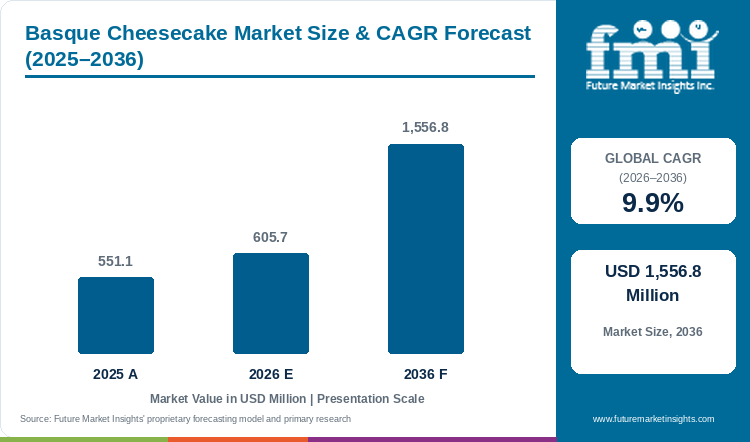
The basque cheesecake market is estimated to be valued at USD 605.7 Million in 2026. During the forecast period 2026-2036, it is likely to grow at 9.9% CAGR.
According to FMI's report, sales of Basque cheesecake are valued at USD 605.7 Million in 2026. Demand is forecast to reach USD 1,556.8 Million by 2036, growing at a 9.9% CAGR. Premium dessert sales through restaurants and bakery counters will support growth during the forecast period, with supermarkets and delivery services adding further sales opportunities. The market was valued at USD 551.1 million in 2025, as per FMI estimates.
Key Takeaways
- Premium desserts will support demand across foodservice and retail. Standard portion sizes will help restaurants and cafés control serving costs while maintaining consistency across orders.
- Baked NY-style is likely to account for 36.0% of Product Type demand in 2026, supported by its familiar taste and suitability for whole cakes, slices, and foodservice use.
- Conventional products are estimated to hold 55.0% of Claim / Nature demand in 2026.
- Fresh products will account for 33.0% of Format demand in 2026. Freshness remains an important quality cue for bakery counters and premium dessert purchases.
- Cold-chain requirements and short refrigerated life after thawing will remain key challenges. Allergen controls can add handling requirements, while changes in dairy prices can increase production costs.
- Key companies profiled by FMI include Rich Products, Sara Lee Frozen Bakery, Dessert Holdings, Mademoiselle Desserts, Finsbury Food Group, Premier Foods, McKee Foods, Hostess Brands, Bauli, and Dr. Oetker.Foods, Hostess Brands, Bauli, and Dr. Oetker.
Analyst Perspective
Suppliers need to maintain a consistent caramelized surface and creamy center across production batches. Higher waste and difficult handling during service can limit larger orders.
- Nandini Roy Choudhury, Principal Consultant, Future Market Insights
How is the basque cheesecake market segmented?
FMI segments the market by Product Type, Claim / Nature, Format, Packaging Format, and Sales Channel.
Product Type covers Baked NY-style, No-bake / chilled, Basque burnt, and Slices & minis. Claim / Nature covers Conventional, Clean label, Organic, Gluten-free, and High-protein / fortified. Format covers Fresh, Frozen, Ambient packaged, Chilled, and Par-baked / thaw-and-serve. Packaging Format covers Multipack, Single-serve, Family / loaf pack, and Bulk foodservice. Sales Channel covers Supermarkets & hypermarkets, Artisan & specialty bakeries, Convenience & forecourt, Online & DTC, and Foodservice distributors.
What keeps Baked NY-style central to the Product Type category?
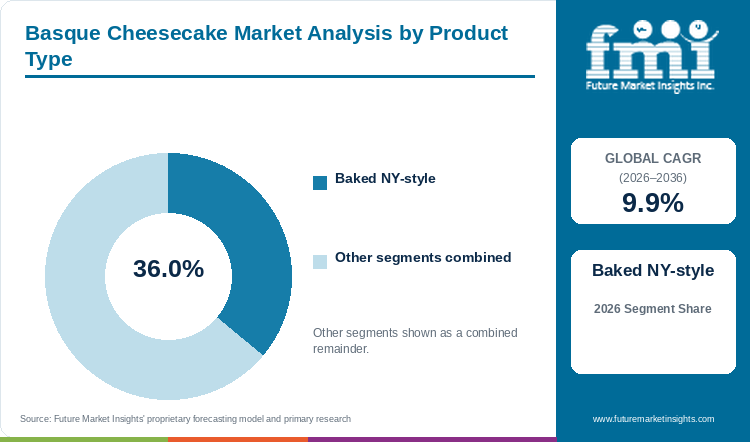
Baked NY-style will hold 36.0% of Product Type demand in 2026.
Baked NY-style cheesecakes are common in commercial ranges because their dense texture holds well during freezing and portioning. They can also be thawed and served with limited preparation. Sara Lee Frozen Bakery offers several pre-cut New York style cheesecakes, while Mademoiselle Desserts includes both New York and Basque varieties in its range.
- Baked NY-style will hold 36.0% of Product Type demand in 2026.
- Sara Lee Frozen Bakery lists a New York style cheesecake with 365 days of frozen shelf life and two days of refrigerated shelf life. The specified storage periods help buyers plan stock and service.
Why does Conventional lead the Claim / Nature category?
Conventional will account for 55.0% of Claim / Nature demand in 2026.
Conventional recipes remain widely used because cream cheese, eggs and sugar give cheesecake its familiar taste and texture. Wheat-based crusts are also common. These products need allergen controls, while changes in dairy prices can raise production costs. Free-from options need to provide a similar texture and hold well after thawing.
- Conventional will account for 55.0% of Claim / Nature demand in 2026.
- In January 2025, the U.S. FDA issued updated allergen-labeling guidance covering major allergens, including milk, eggs and wheat. These ingredients are common in conventional cheesecake recipes.
What supports Fresh leadership in the Format category?
Fresh will hold 33.0% of Format demand in 2026.
Fresh cheesecake will remain important for artisan bakeries and hospitality operators because cakes and slices can be prepared close to service. Fresh products can support premium pricing, but their shorter shelf life requires careful production planning. Frozen and thaw-and-serve products allow longer storage, although the presentation differs from freshly prepared cheesecake.
- Fresh will hold 33.0% of Format demand in 2026.
- France reported in June 2026 that restaurant and accommodation spending in 2025 remained more than 20% above 2019. Higher service spending supports demand for fresh plated desserts.
Why is Multipack the leading Packaging Format?
Multipack will account for 30.0% of Packaging Format demand in 2026.
Multipacks will support demand from households that want separate servings for sharing or later use. They also give shoppers an option between a single portion and a whole cake. The format supports portion control and household value, while single-serve and family packs meet different buying needs.
- Multipack will account for 30.0% of Packaging Format demand in 2026.
- In May 2026, Premier Foods announced smaller four-pack formats in its Mr Kipling sweet-treat range for smaller households and additional consumption occasions.
What gives Supermarkets & hypermarkets the lead in Sales Channel?
Supermarkets & hypermarkets will account for 30.0% of Sales Channel demand in 2026.
Supermarkets & hypermarkets will lead sales through high shopper traffic and the availability of chilled, frozen and ambient products. Retailers can offer established cheesecake ranges alongside newer premium variants and test multipacks or single-serve formats without changing a foodservice menu. Specialty bakeries retain demand for craft-made products, while online sales depend on delivery costs that suit premium orders.
- Supermarkets & hypermarkets will account for 30.0% of Sales Channel demand in 2026.
- In July 2025, Finsbury Food Group reported the launch of a new branded cake range in more than 300 Tesco stores, extending its bakery distribution through national grocery retail.
What are the drivers, restraints and opportunities in the basque cheesecake market?
Premium dessert demand and consistent service will support sales. However, cold-chain handling and allergen requirements can raise costs. Single-serve and free-from products will create further sales opportunities.
- Driver: Demand for premium desserts will support products that can be portioned and served consistently across foodservice and retail.
- Restraint: Dairy costs and allergen controls increase production requirements, while frozen handling and short refrigerated life after thawing can raise waste.
- Opportunity: Single-serve, clean-label and gluten-free products can attract additional buyers when taste and texture match expectations.
Foodservice will remain an important source of demand because operators can buy cheesecake as a finished dessert rather than prepare it in-house. USDA ERS reported USD 1.41 trillion in U.S. food-away-from-home spending in 2025, equal to 56.3% of total food expenditure. Pre-portioned cheesecake makes serving costs easier to calculate and reduces preparation work. The product still needs to look suitable for a premium dessert menu.
The main restraint is the short refrigerated life after thawing. Sara Lee gives one New York cheesecake 365 days of frozen shelf life but only two days under refrigeration. Mademoiselle Desserts also gives a two-day chilled period after defrosting for a commercial baked cheesecake. Milk, eggs and wheat require allergen controls. FAO reported that its 2025 Dairy Price Index averaged 13.2% above 2024, adding further cost pressure to dairy-rich recipes.
Single-serve and free-from products offer room for further growth. Mademoiselle Desserts lists Basque, vegan and gluten-free cheesecakes, while Dessert Holdings offers single-serve and gluten-free desserts alongside premium cheesecake ranges. These formats can serve smaller households, individual purchases and buyers looking for free-from options. Alternative recipes still need to retain their texture after distribution and meet local labeling rules.
Which country CAGRs are profiled in the basque cheesecake market?
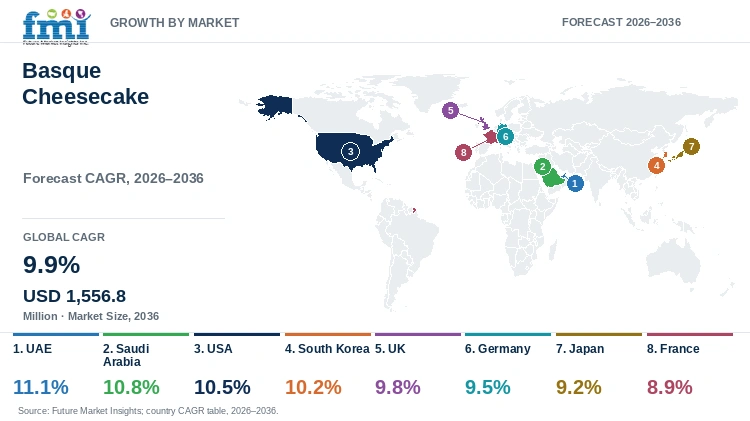
| Country | CAGR |
|---|---|
| UAE | 11.1% |
| Saudi Arabia | 10.8% |
| USA | 10.5% |
| South Korea | 10.2% |
| UK | 9.8% |
| Germany | 9.5% |
| Japan | 9.2% |
| France | 8.9% |
How do country-level CAGRs compare in the basque cheesecake market?
Country CAGRs in the Basque cheesecake market will span 2.2 percentage points through 2036. The UAE will lead at 11.1%, while France will record the lowest rate at 8.9%. The UAE, Saudi Arabia, USA and South Korea will grow at or above 10.0%. The UK, Germany and Japan will record high-single-digit growth. These rates compare forecast growth rather than country market size.
- UAE: Dubai’s large visitor economy gives hotels, cafés and destination bakeries more occasions to sell premium cheesecake. Imported chilled and frozen products still need reliable cold-chain handling because longer delivery routes can raise cost and product-loss risk.
- Saudi Arabia: Restaurant and accommodation spending creates room for cheesecake across cafés, hotels and delivered dessert menus. Frozen and thaw-and-serve products can help larger operators add desserts without increasing pastry preparation work.
- USA: High food-away-from-home spending gives pre-cut and frozen cheesecake a large foodservice route. Restaurants and distributors can use these formats to control portions, reduce preparation and plan case yields more easily.
- South Korea: Online food ordering gives visually distinctive desserts a quick route to customers. Cheesecakes sold through delivery need portions and packs that travel well, since appearance can deteriorate before the product reaches the buyer.
- UK: Higher spending through restaurants and hotels creates more dessert occasions, but operators still have to watch portion cost and waste. Products that arrive ready to portion or serve can reduce work in kitchens with limited staff.
- Germany: High hotel and guest traffic gives cheesecake regular exposure through hospitality and bakery channels. Labor and energy costs make production efficiency important, so buyers are more likely to favor products with predictable handling and limited preparation.
- Japan: Household spending gives premium desserts a steady base, but large portions are not suitable for every buyer or occasion. Smaller slices and recipes adapted to local taste can make cheesecake easier to sell through cafés, department stores and bakery counters.
- France: Restaurant and accommodation spending remains strong enough to provide a large dessert channel. Slower household consumption makes freshness, quality and the reason for paying a premium more important when cheesecake competes with established local pastries.
Country-wise Analysis
- UAE: Refrigerated imports make storage and delivery important for cheesecake suppliers in the UAE. Frozen products need to hold their texture through distribution, while fresh products have less room for delays after arrival. Demand is forecast to grow at an 11.1% CAGR through 2036.
- Saudi Arabia: Restaurants and accommodation services accounted for 8.1% of household final consumption expenditure in 2024. Cheesecake sold into these channels can arrive frozen or ready to thaw, reducing the amount of preparation required in the kitchen. Sales are forecast to rise at a 10.8% CAGR through 2036.
- USA: Food-away-from-home accounted for 56.3% of U.S. food expenditure in 2025. That gives frozen and pre-cut cheesecake a large route through restaurants, catering and other foodservice channels. Buyers can order by case and work with fixed portions instead of preparing cheesecake in-house. The market is forecast to grow at a 10.5% CAGR through 2036.
- South Korea: Online foodservice transactions increased 13.9% year on year in April 2025, while online food and beverage transactions rose 9.1%. Single slices and mini cheesecakes fit this type of ordering better than large cakes. Packaging needs to keep the slice intact and protect the top during delivery. Demand is forecast to rise at a 10.2% CAGR through 2036.
- UK: Frozen bakery products already have established distribution through foodservice and grocery channels in the UK. This makes thaw-and-serve cheesecake easier to add without changing kitchen preparation significantly. The shorter refrigerated life after thawing still requires operators to match case size with expected sales. The market is forecast to grow at a 9.8% CAGR through 2036.
- Germany: Cheesecake enters a market where frozen cakes and other baked desserts are already familiar to shoppers. Basque products therefore need to offer a noticeable difference in texture and appearance rather than rely on the cheesecake format alone. Pre-cut products can also help foodservice buyers manage portions. Germany is forecast to grow at a 9.5% CAGR through 2036.
- Japan: Large whole cakes are not required for every purchase occasion in Japan. Smaller slices, minis and gift packs give retailers more ways to sell cheesecake for individual use or sharing. Imported products also need to retain their texture after refrigerated or frozen handling. Demand is forecast to grow at a 9.2% CAGR through 2036.
- France: Basque cheesecake competes with an established choice of cakes and pastries in France. The caramelized top and soft center give it a different eating profile, but the product still has to meet expectations for texture and ingredient quality. Foodservice buyers will also look at portion size and waste when choosing prepared formats. France is forecast to grow at an 8.9% CAGR through 2036.
Who are the notable companies in the basque cheesecake market?
FMI profiles Rich Products, Sara Lee Frozen Bakery, Dessert Holdings, Mademoiselle Desserts, Finsbury Food Group, Premier Foods, McKee Foods, Hostess Brands, Bauli, and Dr. Oetker.
FMI groups the profiled companies into three supplier categories. Sara Lee Frozen Bakery, Dessert Holdings, Mademoiselle Desserts and Rich Products have documented cheesecake or ready-to-serve dessert ranges. Finsbury Food Group, Premier Foods, McKee Foods, Hostess Brands and Bauli have broader packaged-bakery businesses and established sales channels. Dr. Oetker covers consumer baking and desserts as well as professional foodservice and frozen cakes. Company comparisons consider the specific cheesecake products offered, temperature-controlled distribution and access to retail or foodservice customers.
- Cheesecake and frozen dessert specialists: Sara Lee Frozen Bakery, Dessert Holdings, Mademoiselle Desserts, and Rich Products supply documented cheesecake or ready-to-serve dessert ranges.
- Packaged bakery and channel-scale participants: Finsbury Food Group, Premier Foods, McKee Foods, Hostess Brands, and Bauli supply broader packaged-cake and bakery ranges.
- Broad cake, dessert, and professional-foodservice platform: Dr. Oetker. The cited sources do not establish finished Basque cheesecake products for several broader bakery participants.
Competitive Benchmarking: Basque Cheesecake Market
| Company | Cheesecake Portfolio Evidence | Operational Convenience | Route-to-Market Breadth | Geographic Reach |
|---|---|---|---|---|
| Rich Products | Medium | High | High | North America, Europe, Asia, Middle East, Latin America, Africa, and Australia |
| Sara Lee Frozen Bakery | High | High | Medium | United States and Canada |
| Dessert Holdings | High | High | High | North America |
| Mademoiselle Desserts | High | High | High | Europe with international export markets |
| Finsbury Food Group | Unscored | Medium | High | UK and Europe |
| Premier Foods | Unscored | Medium | High | UK with North America, Europe, and Australia activity |
| McKee Foods | Unscored | Medium | Medium | United States |
| Hostess Brands | Unscored | Medium | Medium | North America |
| Bauli | Unscored | Medium | High | Europe with United States, India, Southeast Asia, Middle East, and other export markets |
| Dr. Oetker | Medium | Medium | High | More than 40 countries across major regions |
Scoring basis: Cheesecake Portfolio Evidence covers the documented range of finished cheesecakes and closely related products. Operational Convenience covers pre-cut and frozen products, including thaw-and-serve, single-serve and other formats that reduce service preparation. Route-to-Market Breadth covers documented retail and foodservice distribution, with DTC and other sales channels also considered. High indicates broad documented capability; Medium indicates credible but narrower evidence; Low indicates a documented limitation. Missing public information is marked Unscored.
Key Developments in the Basque Cheesecake Market
- In May 2024, Mademoiselle Desserts presented its Basque Cheesecake range in classic vanilla and chocolate variants. The products have a hot-baked, dark caramelized surface and no biscuit base, providing foodservice and bakery buyers with a commercially specified Basque format.
- In May 2025, Dessert Holdings announced plans to present new artisanal products at IDDBA alongside its premium dessert portfolio. The company also described thaw-and-serve products across its brands, combining centralized production with premium presentation for retail and foodservice.
- In August 2025, Finsbury Food Group acquired a majority stake in Lola's Cupcakes and entered direct-to-consumer sales. Around half of Lola's sales came through e-commerce, according to Finsbury, alongside a network of 45 kiosks and collection lockers. The acquisition added online sales and high-footfall collection locations for premium bakery products.
Key Players in the Basque Cheesecake Market
Cheesecake and Thaw-and-Serve Specialists
- Sara Lee Frozen Bakery
- Dessert Holdings
- Mademoiselle Desserts
- Rich Products
Packaged Bakery and Consumer Sweet-Treat Platforms
- Finsbury Food Group
- Premier Foods
- McKee Foods
- Hostess Brands
- Bauli
Broad Cake, Dessert and Foodservice Platform
- Dr. Oetker
Basque Cheesecake Market - Report Scope
| Coverage field | Report scope |
|---|---|
| Market breakdown | Product Type; Claim / Nature; Format; Packaging Format; Sales Channel |
| Quantitative Units | USD Million |
| Market Definition | Revenue from commercial cheesecake products within the stated Product Type, Claim / Nature, Format, Packaging Format and Sales Channel categories. The scope excludes meal revenue, unrelated cakes and pies, ingredient-only baking aids and substitute desserts outside commercial cheesecake sales. |
| Regions Covered | North America; Latin America; Western Europe; Eastern Europe; East Asia; South Asia and Pacific; Middle East and Africa |
| Countries Covered | USA; Germany; France; UK; Saudi Arabia; UAE; Japan; South Korea |
| Key Companies Profiled | Rich Products; Sara Lee Frozen Bakery; Dessert Holdings; Mademoiselle Desserts; Finsbury Food Group; Premier Foods; McKee Foods; Hostess Brands; Bauli; Dr. Oetker |
| Forecast Period | 2026 to 2036 |
| Approach | Primary and secondary research, with estimates checked through market triangulation. |
Basque Cheesecake Market - Research Methodology
| Method | Approach |
|---|---|
| Primary Research | FMI analysts gathered input from manufacturers, service providers, technology developers and distributors, alongside end users, procurement teams and subject-matter experts. Interviews covered purchasing criteria and product evaluation, including adoption barriers, approval requirements and pricing. Discussions also examined support needs and the evidence required for trials or initial orders to develop into regular purchasing. |
| Desk Research | Desk research covered government statistics and regulatory publications, supported by trade data, industry associations, technical literature and standards. Company filings, product information and official announcements provided supplier evidence. Sources were checked for date, geography and market relevance. Performance and application claims were retained only where credible public evidence supported them. The same checks covered approvals, capacity, investment and commercial activity. |
| Market Sizing and Forecasting | The market model combined baseline value and historical performance with segment structure, pricing and volume indicators. Country demand and company participation informed the forecast alongside adoption levels. Assumptions covered economic activity, investment, regulation and technology use, as well as purchasing cycles, supply availability and barriers to wider adoption. Segment and regional estimates were reconciled with the total market. |
| Data Validation | Estimates were checked against public data, company activity and trade patterns, with industry developments and primary interviews providing further comparisons. Products, applications and company revenues were reviewed against the market definition. Adjacent categories and overlapping revenue were excluded, together with unsupported claims and activities outside the market scope, to reduce double counting. |
Basque Cheesecake Market by Segments
Basque Cheesecake Market segmented by Product Type:
- Baked NY-style
- No-bake / chilled
- Basque burnt
- Slices & minis
Basque Cheesecake Market segmented by Claim / Nature:
- Conventional
- Clean label
- Organic
- Gluten-free
- High-protein / fortified
Basque Cheesecake Market segmented by Format:
- Fresh
- Frozen
- Ambient packaged
- Chilled
- Par-baked / thaw-and-serve
Basque Cheesecake Market segmented by Packaging Format:
- Multipack
- Single-serve
- Family / loaf pack
- Bulk foodservice
Basque Cheesecake Market segmented by Sales Channel:
- Supermarkets & hypermarkets
- Artisan & specialty bakeries
- Convenience & forecourt
- Online & DTC
- Foodservice distributors
Basque Cheesecake Market by Region:
- North America
- United States
- Canada
- Latin America
- Brazil
- Mexico
- Argentina
- Chile
- Western Europe
- Germany
- France
- United Kingdom
- Italy
- Spain
- Benelux
- Nordics
- Eastern Europe
- Poland
- Czech Republic
- Romania
- Hungary
- East Asia
- China
- Japan
- South Korea
- South Asia and Pacific
- India
- ASEAN
- Australia and New Zealand
- Middle East and Africa
- GCC Countries
- South Africa
- Türkiye
- Israel
Research Sources and Bibliography
- Federal Statistical Office of Germany (Destatis). Tourism in Germany in 2025: another record value for overnight stays. February 11, 2026.
- INSEE. Household Consumption in 2025. June 16, 2026.
- Office for National Statistics. Consumer trends, UK: January to March 2026. June 30, 2026.
- General Authority for Statistics, Saudi Arabia. Annual National Accounts Publication 2024. October 30, 2025.
- Dubai Department of Economy and Tourism. Tourism Performance Report January - December 2025. January 7, 2026.
- Statistics Bureau of Japan. Family Income and Expenditure Survey: 2025 Yearly Average. February 6, 2026.
- Statistics Korea. Online Shopping in April 2025. June 2, 2025.
- U.S. Food and Drug Administration. Food Allergens/Gluten-Free Guidance Documents & Regulatory Information. January 6, 2025.
- European Commission. Food information to consumers - legislation.
- Food and Agriculture Organization of the United Nations. FAO Food Price Index dips in December despite higher world cereal quotations. January 9, 2026.
- Rich Products Corporation. Desserts.
- Rich Products Corporation. Rich Products Introduces Mini Cakes. July 6, 2026.
- Sara Lee Frozen Bakery. Foodservice Cheesecakes.
- Sara Lee Frozen Bakery. Sara Lee New York Style Cheesecake 10-inch Round Plain Tall Pre-Cut 14-Slice.
- Dessert Holdings. Our Brands.
- Dessert Holdings. Our Desserts.
- Dessert Holdings. Dessert Holdings Returns to IDDBA Ahead of 10-Year Anniversary. May 30, 2025.
- Mademoiselle Desserts. The Burnt Beauty: Our Basque Cheesecakes. May 8, 2024.
- Mademoiselle Desserts. Cheesecakes.
- Mademoiselle Desserts. Deep & Creamy Cheesecake.
- Mademoiselle Desserts. Joining Forces with Emmi Group. May 15, 2026.
- Finsbury Food Group. Finsbury Food Group Acquires Majority Stake in Lola’s. August 15, 2025.
- Finsbury Food Group. FFG & Nadiya Hussain Launch New Branded Cake. July 16, 2025.
- Premier Foods. Full Year Results for the 52 weeks ending 28 March 2026. May 14, 2026.
- Premier Foods. Mr Kipling unveils exceedingly good innovation. May 29, 2026.
- McKee Foods Corporation. Our History.
- The J.M. Smucker Co. The J.M. Smucker Co. Completes the Divestiture of Certain Value Brands to JTM Foods, LLC. March 3, 2025.
- The J.M. Smucker Co. The J.M. Smucker Co. Completes the Acquisition of Hostess Brands. November 7, 2023.
- Bauli Group. After 100 years the Bauli Group is reinventing itself and aims for a billion by 2030. August 22, 2024.
- Bauli Group. Olivieri 1882 joins the Bauli Group. May 15, 2025.
- Dr. Oetker. Baked by the sun: Dr. Oetker to produce Fossil-Fuel Free in future. November 14, 2024.
- Dr. Oetker. Our Products.
This bibliography is provided for reader reference and is not exhaustive. The full report contains the complete reference list and detailed citations.
This Report Answers
- What is the Basque Cheesecake Market size in 2026, and what value is forecast for 2036?
- Which demand factors support commercially prepared cheesecake sales?
- Why does Baked NY-style lead the Product Type category?
- Why does Conventional lead the Claim / Nature category?
- How do the profiled country CAGRs compare from 2026 to 2036?
- Which companies supply cheesecake products, and which have broader dessert or bakery businesses?
- Which costs and product requirements limit adoption, repeat purchases or supplier changes?
- What should retail and foodservice buyers assess before purchasing Basque cheesecake?
Frequently Asked Questions
How big is the Basque Cheesecake Market in 2026, and what is forecast for 2036?
According to FMI's report, the Basque Cheesecake Market is valued at USD 605.7 Million in 2026 and is forecast to reach USD 1,556.8 Million by 2036. Retail and foodservice will support sales, with specialty bakeries and online channels providing additional distribution.
What is the CAGR of the Basque Cheesecake Market from 2026 to 2036?
Sales are forecast to grow at a 9.9% CAGR from 2026 to 2036. The forecast covers revenue across the stated product categories and sales channels, rather than one cheesecake format.
Which Product Type segment leads the Basque Cheesecake Market?
Baked NY-style will hold 36.0% of Product Type demand in 2026. Its baked structure suits pre-cut portions and frozen products supplied to retail and foodservice.
Which Claim / Nature segment leads the Basque Cheesecake Market?
Conventional will account for 55.0% of Claim / Nature demand in 2026. Dairy-rich recipes remain the familiar choice for cheesecake taste and texture.
Which profiled countries have the highest growth rates in the Basque Cheesecake Market?
The UAE will record the highest profiled CAGR at 11.1%, followed by Saudi Arabia at 10.8% and the USA at 10.5% from 2026 to 2036. These figures compare growth rates, not country market size.
Which companies are active in the Basque Cheesecake Market?
FMI profiles Rich Products, Sara Lee Frozen Bakery, Dessert Holdings, Mademoiselle Desserts, Finsbury Food Group, Premier Foods, McKee Foods, Hostess Brands, Bauli, and Dr. Oetker. The companies cover direct cheesecake supply as well as broader bakery and dessert ranges, with different levels of product evidence.
Preview the report firsthand - request a free sample
Get SampleGet the brochure for pricing and purchase details.
Get PDFTable of Content
- Key Takeaways
- Market Size and CAGR
- Top Growth Driver
- Fastest Growing Segment
- Leading Region
- Key Companies
- Emerging Opportunities
- Executive Summary
- Global Market Outlook
- Demand-side Trends
- Supply-side Trends
- Technology Roadmap Analysis
- Analysis and Recommendations
- Analyst Perspective (What is happening? Why now? What should investors know?)
- Key Questions Answered
- How large is the market?
- What is the CAGR?
- What are key trends?
- Which region dominates?
- Who are the leaders?
- Market Overview
- Market Coverage / Taxonomy
- Market Definition / Scope / Limitations
- Research Methodology
- Chapter Orientation
- Analytical Lens and Working Hypotheses
- Market Structure, Signals, and Trend Drivers
- Benchmarking and Cross-market Comparability
- Market Sizing, Forecasting, and Opportunity Mapping
- Research Design and Evidence Framework
- Desk Research Programme (Secondary Evidence)
- Expert Input and Fieldwork (Primary Evidence)
- Tooling, Models, and Reference Databases
- Data Engineering and Model Build
- Quality Assurance and Audit Trail
- Market Background
- Market Dynamics (Drivers, Restraints, Opportunity, Trends)
- Scenario Forecast (Optimistic, Likely, Conservative)
- Impact Analysis
- AI Impact
- Sustainability Impact
- Regulatory Impact
- Technology Impact
- Consumer / Buyer Analysis
- Purchase Drivers
- Adoption Barriers
- Buyer Journey
- Opportunity Map Analysis
- Product Life Cycle Analysis
- Supply Chain Analysis
- Investment Feasibility Matrix
- Value Chain Analysis
- PESTLE and Porter's Analysis
- Regulatory Landscape
- Regional Parent Market Outlook
- Production and Consumption Statistics
- Import and Export Statistics
- Global Market Analysis and Forecast, 2021 to 2036
- Historical Market Size Value (USD Million) Analysis, 2021 to 2025
- Current and Future Market Size Value (USD Million) Projections, 2026 to 2036
- Y-o-Y Growth Trend Analysis
- Absolute $ Opportunity Analysis
- Global Market Pricing Analysis, 2021 to 2036
- Global Market Analysis and Forecast, By Product Type, 2021 to 2036
- Introduction / Key Findings
- Historical Market Size Value (USD Million) Analysis By Product Type, 2021 to 2025
- Current and Future Market Size Value (USD Million) Analysis and Forecast By Product Type, 2026 to 2036
- Baked NY-style
- No-bake / chilled
- Basque burnt
- Slices & minis
- Y-o-Y Growth Trend Analysis By Product Type, 2021 to 2025
- Absolute $ Opportunity Analysis By Product Type, 2026 to 2036
- Global Market Analysis and Forecast, By Claim / Nature, 2021 to 2036
- Introduction / Key Findings
- Historical Market Size Value (USD Million) Analysis By Claim / Nature, 2021 to 2025
- Current and Future Market Size Value (USD Million) Analysis and Forecast By Claim / Nature, 2026 to 2036
- Conventional
- Clean label
- Organic
- Gluten-free
- High-protein / fortified
- Y-o-Y Growth Trend Analysis By Claim / Nature, 2021 to 2025
- Absolute $ Opportunity Analysis By Claim / Nature, 2026 to 2036
- Global Market Analysis and Forecast, By Format, 2021 to 2036
- Introduction / Key Findings
- Historical Market Size Value (USD Million) Analysis By Format, 2021 to 2025
- Current and Future Market Size Value (USD Million) Analysis and Forecast By Format, 2026 to 2036
- Fresh
- Frozen
- Ambient packaged
- Chilled
- Par-baked / thaw-and-serve
- Y-o-Y Growth Trend Analysis By Format, 2021 to 2025
- Absolute $ Opportunity Analysis By Format, 2026 to 2036
- Global Market Analysis and Forecast, By Packaging Format, 2021 to 2036
- Introduction / Key Findings
- Historical Market Size Value (USD Million) Analysis By Packaging Format, 2021 to 2025
- Current and Future Market Size Value (USD Million) Analysis and Forecast By Packaging Format, 2026 to 2036
- Multipack
- Single-serve
- Family / loaf pack
- Bulk foodservice
- Y-o-Y Growth Trend Analysis By Packaging Format, 2021 to 2025
- Absolute $ Opportunity Analysis By Packaging Format, 2026 to 2036
- Global Market Analysis and Forecast, By Sales Channel, 2021 to 2036
- Introduction / Key Findings
- Historical Market Size Value (USD Million) Analysis By Sales Channel, 2021 to 2025
- Current and Future Market Size Value (USD Million) Analysis and Forecast By Sales Channel, 2026 to 2036
- Supermarkets & hypermarkets
- Artisan & specialty bakeries
- Convenience & forecourt
- Online & DTC
- Foodservice distributors
- Y-o-Y Growth Trend Analysis By Sales Channel, 2021 to 2025
- Absolute $ Opportunity Analysis By Sales Channel, 2026 to 2036
- Global Market Analysis and Forecast, By Region, 2021 to 2036
- Introduction
- Historical Market Size Value (USD Million) Analysis By Region, 2021 to 2025
- Current Market Size Value (USD Million) Analysis and Forecast By Region, 2026 to 2036
- North America
- Latin America
- Western Europe
- Eastern Europe
- East Asia
- South Asia and Pacific
- Middle East and Africa
- Market Attractiveness Analysis By Region
- North America Market Analysis and Forecast, By Country, 2021 to 2036
- Historical Market Size Value (USD Million) Trend Analysis By Market Taxonomy, 2021 to 2025
- Market Size Value (USD Million) Forecast By Market Taxonomy, 2026 to 2036
- By Country
- United States
- Canada
- By Product Type
- By Claim / Nature
- By Format
- By Packaging Format
- By Sales Channel
- By Country
- Market Attractiveness Analysis
- By Country
- By Product Type
- By Claim / Nature
- By Format
- By Packaging Format
- By Sales Channel
- Key Takeaways
- Latin America Market Analysis and Forecast, By Country
- Historical Market Size Value (USD Million) Trend Analysis By Market Taxonomy, 2021 to 2025
- Market Size Value (USD Million) Forecast By Market Taxonomy, 2026 to 2036
- By Country
- Brazil
- Mexico
- Argentina
- Chile
- By Product Type
- By Claim / Nature
- By Format
- By Packaging Format
- By Sales Channel
- By Country
- Market Attractiveness Analysis
- By Country
- By Product Type
- By Claim / Nature
- By Format
- By Packaging Format
- By Sales Channel
- Key Takeaways
- Western Europe Market Analysis and Forecast, By Country
- Historical Market Size Value (USD Million) Trend Analysis By Market Taxonomy, 2021 to 2025
- Market Size Value (USD Million) Forecast By Market Taxonomy, 2026 to 2036
- By Country
- Germany
- France
- United Kingdom
- Italy
- Spain
- Benelux
- Nordics
- By Product Type
- By Claim / Nature
- By Format
- By Packaging Format
- By Sales Channel
- By Country
- Market Attractiveness Analysis
- By Country
- By Product Type
- By Claim / Nature
- By Format
- By Packaging Format
- By Sales Channel
- Key Takeaways
- Eastern Europe Market Analysis and Forecast, By Country
- Historical Market Size Value (USD Million) Trend Analysis By Market Taxonomy, 2021 to 2025
- Market Size Value (USD Million) Forecast By Market Taxonomy, 2026 to 2036
- By Country
- Poland
- Czech Republic
- Romania
- Hungary
- By Product Type
- By Claim / Nature
- By Format
- By Packaging Format
- By Sales Channel
- By Country
- Market Attractiveness Analysis
- By Country
- By Product Type
- By Claim / Nature
- By Format
- By Packaging Format
- By Sales Channel
- Key Takeaways
- East Asia Market Analysis and Forecast, By Country
- Historical Market Size Value (USD Million) Trend Analysis By Market Taxonomy, 2021 to 2025
- Market Size Value (USD Million) Forecast By Market Taxonomy, 2026 to 2036
- By Country
- China
- Japan
- South Korea
- By Product Type
- By Claim / Nature
- By Format
- By Packaging Format
- By Sales Channel
- By Country
- Market Attractiveness Analysis
- By Country
- By Product Type
- By Claim / Nature
- By Format
- By Packaging Format
- By Sales Channel
- Key Takeaways
- South Asia and Pacific Market Analysis and Forecast, By Country
- Historical Market Size Value (USD Million) Trend Analysis By Market Taxonomy, 2021 to 2025
- Market Size Value (USD Million) Forecast By Market Taxonomy, 2026 to 2036
- By Country
- India
- ASEAN
- Australia and New Zealand
- By Product Type
- By Claim / Nature
- By Format
- By Packaging Format
- By Sales Channel
- By Country
- Market Attractiveness Analysis
- By Country
- By Product Type
- By Claim / Nature
- By Format
- By Packaging Format
- By Sales Channel
- Key Takeaways
- Middle East and Africa Market Analysis and Forecast, By Country
- Historical Market Size Value (USD Million) Trend Analysis By Market Taxonomy, 2021 to 2025
- Market Size Value (USD Million) Forecast By Market Taxonomy, 2026 to 2036
- By Country
- GCC Countries
- South Africa
- Türkiye
- Israel
- By Product Type
- By Claim / Nature
- By Format
- By Packaging Format
- By Sales Channel
- By Country
- Market Attractiveness Analysis
- By Country
- By Product Type
- By Claim / Nature
- By Format
- By Packaging Format
- By Sales Channel
- Key Takeaways
- Key Countries Market Analysis
- United States
- Pricing Analysis
- Market Share Analysis, 2025
- By Product Type
- By Claim / Nature
- By Format
- By Packaging Format
- By Sales Channel
- Canada
- Pricing Analysis
- Market Share Analysis, 2025
- By Product Type
- By Claim / Nature
- By Format
- By Packaging Format
- By Sales Channel
- Mexico
- Pricing Analysis
- Market Share Analysis, 2025
- By Product Type
- By Claim / Nature
- By Format
- By Packaging Format
- By Sales Channel
- Brazil
- Pricing Analysis
- Market Share Analysis, 2025
- By Product Type
- By Claim / Nature
- By Format
- By Packaging Format
- By Sales Channel
- Chile
- Pricing Analysis
- Market Share Analysis, 2025
- By Product Type
- By Claim / Nature
- By Format
- By Packaging Format
- By Sales Channel
- Germany
- Pricing Analysis
- Market Share Analysis, 2025
- By Product Type
- By Claim / Nature
- By Format
- By Packaging Format
- By Sales Channel
- United Kingdom
- Pricing Analysis
- Market Share Analysis, 2025
- By Product Type
- By Claim / Nature
- By Format
- By Packaging Format
- By Sales Channel
- Italy
- Pricing Analysis
- Market Share Analysis, 2025
- By Product Type
- By Claim / Nature
- By Format
- By Packaging Format
- By Sales Channel
- Spain
- Pricing Analysis
- Market Share Analysis, 2025
- By Product Type
- By Claim / Nature
- By Format
- By Packaging Format
- By Sales Channel
- France
- Pricing Analysis
- Market Share Analysis, 2025
- By Product Type
- By Claim / Nature
- By Format
- By Packaging Format
- By Sales Channel
- India
- Pricing Analysis
- Market Share Analysis, 2025
- By Product Type
- By Claim / Nature
- By Format
- By Packaging Format
- By Sales Channel
- ASEAN
- Pricing Analysis
- Market Share Analysis, 2025
- By Product Type
- By Claim / Nature
- By Format
- By Packaging Format
- By Sales Channel
- Australia and New Zealand
- Pricing Analysis
- Market Share Analysis, 2025
- By Product Type
- By Claim / Nature
- By Format
- By Packaging Format
- By Sales Channel
- China
- Pricing Analysis
- Market Share Analysis, 2025
- By Product Type
- By Claim / Nature
- By Format
- By Packaging Format
- By Sales Channel
- Japan
- Pricing Analysis
- Market Share Analysis, 2025
- By Product Type
- By Claim / Nature
- By Format
- By Packaging Format
- By Sales Channel
- South Korea
- Pricing Analysis
- Market Share Analysis, 2025
- By Product Type
- By Claim / Nature
- By Format
- By Packaging Format
- By Sales Channel
- Poland
- Pricing Analysis
- Market Share Analysis, 2025
- By Product Type
- By Claim / Nature
- By Format
- By Packaging Format
- By Sales Channel
- Hungary
- Pricing Analysis
- Market Share Analysis, 2025
- By Product Type
- By Claim / Nature
- By Format
- By Packaging Format
- By Sales Channel
- Türkiye
- Pricing Analysis
- Market Share Analysis, 2025
- By Product Type
- By Claim / Nature
- By Format
- By Packaging Format
- By Sales Channel
- South Africa
- Pricing Analysis
- Market Share Analysis, 2025
- By Product Type
- By Claim / Nature
- By Format
- By Packaging Format
- By Sales Channel
- UAE
- Pricing Analysis
- Market Share Analysis, 2025
- By Product Type
- By Claim / Nature
- By Format
- By Packaging Format
- By Sales Channel
- Saudi Arabia
- Pricing Analysis
- Market Share Analysis, 2025
- By Product Type
- By Claim / Nature
- By Format
- By Packaging Format
- By Sales Channel
- United States
- Market Structure Analysis
- Competition Dashboard
- Competition Benchmarking
- Market Share Analysis of Top Players
- By Regional
- By Product Type
- By Claim / Nature
- By Format
- By Packaging Format
- By Sales Channel
- Emerging Startups
- Innovation Benchmarking
- Competition Analysis
- Competition Deep Dive
- Rich Products
- Overview
- Product Portfolio
- Profitability by Market Segments
- Sales Footprint
- Strategy Overview
- Marketing Strategy
- Product Strategy
- Channel Strategy
- Sara Lee Frozen Bakery
- Dessert Holdings
- Mademoiselle Desserts
- Finsbury Food Group
- Premier Foods
- McKee Foods
- Hostess Brands
- Bauli
- Dr. Oetker
- Rich Products
- Case Studies
- Success Stories
- Recent Developments
- Competition Deep Dive
- Assumptions & Acronyms Used


