

- Market Size (2026)
- USD 1434.1 Mn
- Forecast (2036)
- USD 4259.2 Mn
- CAGR (2026 to 2036)
- 11.5%
How big is Cheesecake Market in 2026?
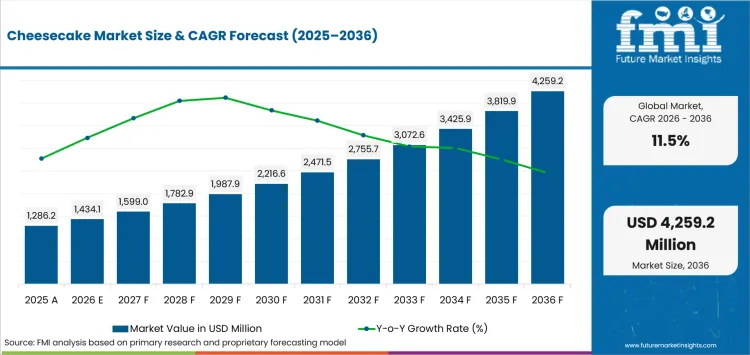
USD 1,434.1 million in 2026 and USD 4,259.2 million by 2036 at an 11.5% CAGR.
Cheesecake revenue is projected to rise from USD 1,434.1 million in 2026 to USD 4,259.2 million by 2036 at an 11.5% CAGR. USDA Economic Research Service data published in June 2026 place 2025 food-away-from-home spending at USD 1.41 trillion. Restaurant demand at that scale gives pre-cut and thaw-and-serve cheesecake more opportunities to enter routine dessert orders. The forecast depends on manufacturers converting familiar cheesecake into repeat portions without adding finishing labor or unstable portion cost.
Country conversion varies with the density of foodservice outlets and the cost of chilled distribution. Saudi Arabia's General Authority for Statistics recorded 5,622 licensed tourism hospitality facilities in the third quarter of 2025. The count was 40.6% above one year earlier, which gives dessert manufacturers a larger service base for trial and distribution. Outlet growth alone does not secure cheesecake volume because labeling and temperature controls still decide whether products remain saleable through local distribution.
Key Takeaways of Cheesecake Market
- Foodservice expansion and smaller retail portions give cheesecake more repeat purchase occasions beyond whole-cake celebrations and seasonal events.
- By product type, baked NY-style is estimated to hold 35.0% in 2026 owing to familiar texture and flexible serving formats.
- In 2026, conventional is expected to lead claim - nature with 49.0% share because taste-first purchasing still sets the category benchmark.
- Fresh is projected to hold 30.0% share in 2026 owing to visible presentation near the point of purchase.
- Cold-chain handling and allergen controls raise execution costs because dairy-rich recipes lose margin quickly through waste or distribution interruption.
- Some of the key players in this market include Rich Products, Dessert Holdings, Emmi Desserts, The English Cheesecake Company, The Cheesecake Factory Incorporated, Eli's Cheesecake Company, Junior's Restaurant & Bakery, and Tesco PLC.
Analyst Perspective
"Cheesecake margins depend on slice integrity through storage and thawing because poor yield turns a premium dessert into waste. Flavor extensions earn shelf space once the base format reaches each outlet with a consistent cut and limited finishing labor."
- Nandini Roy Choudhury, Principal Consultant, Future Market Insights
How is the Cheesecake Market segmented?
The cheesecake market is segmented by product type, claim - nature, format, packaging format and sales channel
Product types include baked NY-style, no-bake / chilled, Basque burnt and slices & minis, and claim - nature covers conventional, clean label, organic, gluten-free and high-protein / fortified recipes. Formats include fresh, frozen, ambient packaged, chilled and par-baked / thaw-and-serve, and packaging formats cover multipack, single-serve, family / loaf pack and bulk foodservice configurations. Sales channels include supermarkets & hypermarkets, artisan & specialty bakeries, convenience & forecourt, online & DTC and foodservice distributors serving retail or commercial accounts.
What makes Baked NY-style central to the Product type category?
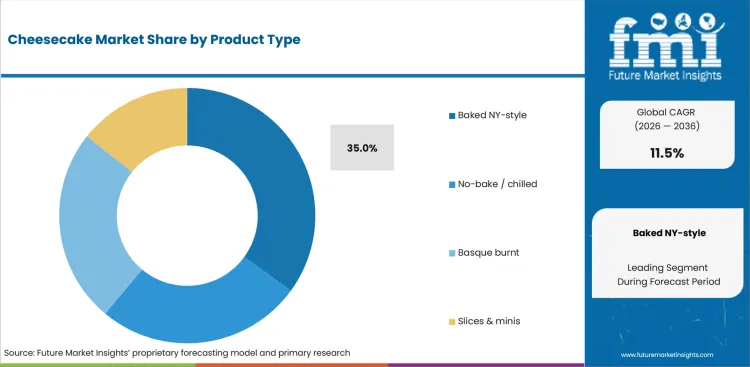
Baked NY-style gives restaurants and retailers a dense cream-cheese reference that works as whole cakes or controlled slices. Junior's marked its seventy-fifth anniversary in November 2025 with a company post centered on its long-running cheesecake identity. That recognition lets operators change toppings or seasonal flavors without teaching customers a new dessert format at each menu reset.
- By product type, baked NY-style is estimated to hold 35.0% in 2026 owing to familiar texture and flexible serving formats.
- Standardizing frozen bakery programs before local service protects portion yield during high-volume periods and limits finishing labor at restaurant counters.
Why does Conventional lead the Claim - nature category?
Conventional cheesecake sets the sensory reference for texture and richness before retailers consider dietary or nutrition claims. Retail category teams compare reformulated products against that familiar eating experience during listing reviews. Free-from and high-protein desserts gain broader listings only if reformulation preserves the creamy body expected from mainstream cheesecake customers.
- In 2026, conventional is expected to lead claim - nature with 49.0% share because taste-first purchasing still sets the category benchmark.
- A May 2026 Mademoiselle Desserts update documented three American-inspired cheesecakes in its 2025 portfolio. The range kept indulgent cream cheese recipes central. Narrower claims addressed specific dietary needs without displacing the mainstream recipe base.
How does Fresh retain leadership within the Format category?
Fresh cheesecake fits channels where appearance supports a premium ticket and daily traffic can absorb shorter shelf life. The Cheesecake Factory introduced Peach Perfect with Raspberry Drizzle in July 2025 for its US restaurant network. Preparing and portioning close to service protects the visual finish that supports higher dessert pricing.
- Fresh is projected to hold 30.0% share in 2026 owing to immediate-consumption merchandising in restaurants and bakery counters with regular foot traffic.
- Fresh slices give food service operators closer control over presentation, though unsold portions raise waste unless daily production follows actual traffic and local sell-through.
What supports Multipack leadership in Packaging format?
Multipacks divide one purchase into several eating occasions and let producers offer flavor variety without requiring a second full cake. The pack works best where households want controlled portions but still expect a complete dessert experience from one purchase.
- Based on packaging format, multipack is projected to account for 32.0% in 2026 due to controlled portions fitting planned at-home dessert purchases.
- In March 2025 the FDA posted a recall covering a two-count Target New York-style cheesecake pack after undeclared pecans were identified. The case shows why private-label frozen desserts need pack-level allergen checks before national distribution expands.
What are the drivers, restraints and opportunities in the Cheesecake Market?
More serving occasions increase cheesecake demand, but food-safety controls raise execution costs and portion choices allow manufacturers to reach lower-ticket dessert purchases.
- Driver: Pre-cut and thaw-and-serve cheesecake enters routine restaurant orders with less finishing work and more predictable portion yield.
- Restraint: Post-bake contamination and allergen failures can interrupt distribution after production costs have already been incurred.
- Opportunity: Minis and slices give restaurants lower-ticket dessert options that fit takeout orders and individual consumption.
Off-premises orders increase the value of portion control
Off-premises orders favor cheesecake formats that arrive portioned and require little finishing at the service counter. The National Restaurant Association reported in April 2025 that nearly 75% of restaurant traffic occurred off-premises. Pre-cut frozen desserts let restaurants serve that traffic with controlled preparation and preserve a familiar dessert format. Standard portions also reduce serving variation between dine-in and takeout orders during busy periods daily.
Post-bake handling can erase margin before demand becomes the constraint
Cheesecake manufacturing becomes expensive if post-bake handling fails to control environmental contamination or allergens. In November 2025 the FDA warned The Father's Table after inspectors found serious preventive-control deficiencies at a facility making ready-to-eat cheesecakes. The letter identified exposure from baking through packaging as a contamination route. Larger accounts therefore place more weight on validated sanitation and packaging controls before expanding volume.
Portion choice gives operators another route to lower-ticket dessert orders
Smaller portions give restaurants a lower-ticket dessert option that fits ready-to-eat food orders and solo consumption. National Restaurant Association research published in April 2025 found that more than seven in ten off-premises customers wanted a choice between smaller and larger portions. Cheesecake brands can use minis or slices to reach those occasions without changing the familiar flavor and texture that support repeat purchase.
Which country CAGRs are profiled in the Cheesecake Market?
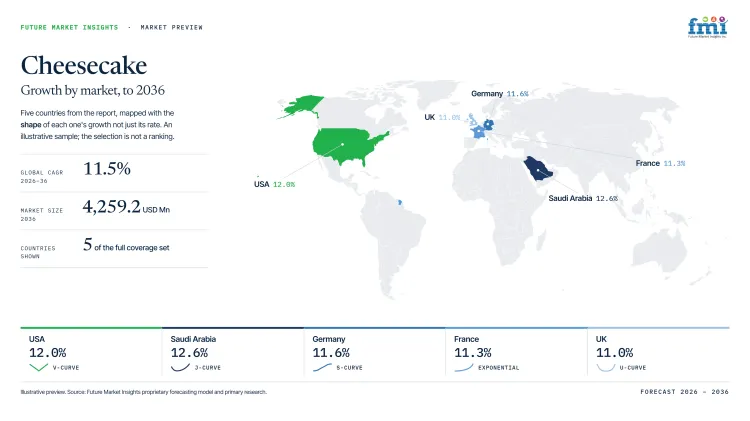
| Country | CAGR |
|---|---|
| Saudi Arabia | 12.6% |
| USA | 12.0% |
| Germany | 11.6% |
| France | 11.3% |
| UK | 11.0% |
How do country-level CAGRs compare in the Cheesecake Market?
The five forecasts span 1.4 percentage points from the Saudi Arabia at 12.6% CAGR to UK at 11%. The USA and Saudi Arabia form the upper pair as retail and restaurant channels absorb varied cheesecake formats. France and the Germany occupy the middle band, with UK expanding more gradually from mature premium-dessert demand.
- Saudi chains test cheesecake flavors through café menus before extending successful concepts into retail programs.
- US chains test cheesecake flavors through restaurant menus before extending successful concepts into retail programs.
- German private-label programs let grocers vary pack size without depending on restaurant launches during trials.
- French supermarket bakery counters merchandise cheesecake beside domestic patisserie and raise expectations for polished presentation.
- UK grocers use own-label ranges to test cheesecake flavors before deciding whether concepts deserve listings.
The full report provides country-level CAGR analysis for North America, Latin America, Europe, East Asia, South Asia, Oceania and the Middle East and Africa.
Country-wise Analysis
- Large restaurant chains, cafés, and foodservice channels give Saudi cheesecake programs multiple routes to repeat volume and rapid flavor testing across major urban markets. Saudi Arabia is forecast to expand at 12.6% CAGR through 2036, supported by growing demand for convenient, premium desserts and ready-to-serve cheesecake portions. Expanding foodservice activity can accelerate new flavor adoption, while wider distribution increases the need for reliable cold-chain handling, thaw stability, and allergen controls across high-volume restaurant and retail programs.
- Large restaurant networks and frozen dessert channels give US cheesecake programs several routes to repeat volume and fast flavor testing in major metropolitan markets. The USA is forecast to expand at 12.0% CAGR through 2036 because pre-cut slices and ready-to-serve stock fit routine foodservice orders without whole-cake commitment. In June 2026 the US Census Bureau reported that food services and drinking places were 2.7% above May 2025 sales. That active channel can reward new flavors quickly, but national distribution also magnifies recall exposure unless thaw performance and allergen controls hold from production through the final outlet in higher-volume metropolitan programs.
- Price-sensitive grocery accounts shape German cheesecake economics because chilled desserts compete with established cakes for limited national shelf space. Destatis stated in January 2026 that household spending on accommodation and food services fell 0.6% in real terms during 2025. Germany is estimated to record 11.6% CAGR over the forecast period aided by refrigerated retail infrastructure and bakery products sold through established counters. Softer service spending limits the room for premium pricing, which places greater weight on pack yield and portion cost. National listings therefore favor cheesecake formats that preserve texture during chilled handling without asking households to pay for oversized servings.
- Restaurant and patisserie counters give French cheesecake a premium route beside well-established local desserts and strong expectations for presentation in urban service channels. Cheesecake demand in France is forecast to rise at 11.3% CAGR over the assessment period tied to service consumption that recovered more fully than several household-goods categories. Insee published in June 2026 that restaurant and accommodation spending stood more than 20% above 2019 in volume. That service base gives distinctive slices a credible trial route, but chilled shelf life limits distribution distance and forces entrants to earn enough premium per portion before regional logistics dilute margin materially.
- Restaurant and hotel demand gives UK cheesecake an away-from-home route that is less dependent on supermarket whole-cake purchases. Office for National Statistics data released in June 2026 show restaurant and hotel spending increased 6% in real terms during FYE 2025. Short chilled life keeps forecasting errors expensive even with a broad national grocery network. The UK is anticipated to post 11.0% CAGR through 2036 given restaurant spending and national grocery reach. Producers entering large accounts face faster assortment changes than specialist bakery channels, making reliable replenishment more valuable than a broad flavor list during seasonal resets and national promotional changes.
Who are the notable companies in the Cheesecake Market?
Rich Products, Dessert Holdings, Emmi Desserts, The English Cheesecake Company, The Cheesecake Factory Incorporated, Eli's Cheesecake Company, Junior's Restaurant & Bakery, and Tesco PLC are the notable companies serving this market.
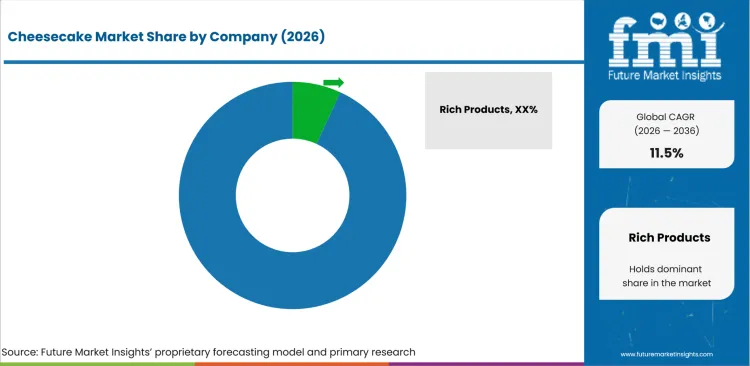
Competition spans scaled dessert manufacturers, specialist cheesecake brands and retailers that control chilled shelf access. Ice cream and frozen dessert experience becomes useful if finished cheesecake must tolerate frozen storage and controlled thawing before service. Entry barriers come from cold distribution, allergen controls and account relationships that keep quality consistent after a program expands beyond local volume.
- Scaled dessert platforms: Rich Products, Dessert Holdings, Emmi Desserts and The English Cheesecake Company use owned production and commercial account coverage to serve larger programs.
- Specialist cheesecake brands: The Cheesecake Factory Incorporated, Eli's Cheesecake Company and Junior's Restaurant & Bakery rely on recognizable recipes plus direct restaurant, wholesale or shipped demand.
- Retail route: Tesco PLC can influence private-label specifications and shelf visibility because its chilled dessert program reaches a national grocery customer base.
Competitive Benchmarking: Cheesecake Market
| Company | Cheesecake Focus | Route-to-Market Breadth | Commercial Scale Evidence | Geographic Reach |
|---|---|---|---|---|
| Rich Products | Medium | High | High | Global |
| Dessert Holdings | High | High | High | North America and international customers |
| Emmi Desserts | High | High | High | Europe, North America and 65+ countries |
| The English Cheesecake Company | High | High | Medium | United Kingdom with broader Emmi distribution |
| The Cheesecake Factory Incorporated | High | Medium | High | United States with international licensed restaurants |
| Eli's Cheesecake Company | High | Medium | Medium | United States wholesale and direct sales |
| Junior's Restaurant & Bakery | High | Medium | Medium | United States restaurants and national shipping |
| Tesco PLC | Low | High | High | United Kingdom |
Scoring basis: Cheesecake focus is High for a specialist business or dedicated multi-brand platform. Medium covers a broader dessert manufacturer with current cheesecake activity. Low identifies a retailer-led own-label route with narrower production ownership. Route-to-market breadth is High with at least two verified commercial routes and Medium with one primary route plus direct sales. Commercial scale evidence is High for international operations or a large national network. Medium identifies specialist national coverage supported by current company records.
Key Developments in the Cheesecake Market
- In May 2025, Rich Products partnered with Baileys to introduce a ready-to-serve Baileys Irish Cream Cheesecake, expanding its branded cheesecake offering.
- In May 2025, Dessert Holdings introduced Strawberry Shortcake Cheesecake and Mango Passion Fruit Cheesecake for IDDBA through its thaw-and-serve dessert platform.
- In March 2026, Emmi Group launched Emmi Desserts as the unified organization for its international premium-dessert business including American cheesecakes.
Key Players in the Cheesecake Market
Scaled dessert manufacturing platforms
- Rich Products
- Dessert Holdings
- Emmi Desserts
- The English Cheesecake Company
Restaurant and specialist cheesecake brands
- The Cheesecake Factory Incorporated
- Eli's Cheesecake Company
- Junior's Restaurant & Bakery
Retail private-label route
- Tesco PLC
Cheesecake Market - Report Scope
| Coverage field | Report scope |
|---|---|
| Market breakdown | By product type, claim - nature, format, packaging format, sales channel and region. |
| Quantitative Units | USD Million. |
| Market Definition | Revenue from commercially sold finished cheesecake products within the stated product, claim, format, packaging and channel categories. The scope excludes cream cheese ingredients, cheesecake mixes, adjacent cakes or pies and downstream restaurant service markup. |
| Regions Covered | North America; Latin America; Western Europe; Eastern Europe; East Asia; South Asia and Pacific; Middle East and Africa. |
| Countries Covered | USA; Germany; France; UK; Japan; and 20+ additional countries in the full report. |
| Key Companies Profiled | Rich Products; Dessert Holdings; Emmi Desserts; The English Cheesecake Company; The Cheesecake Factory Incorporated; Eli's Cheesecake Company; Junior's Restaurant & Bakery; Tesco PLC. |
| Forecast Period | 2026 to 2036. |
| Approach | FMI uses a hybrid bottom-up and top-down sizing approach that reconciles product, channel, company and country indicators within the defined finished-cheesecake revenue boundary. |
Cheesecake Market - Research Methodology
| Method | Approach |
|---|---|
| Primary Research | FMI analysts gathered input from manufacturers, service providers, technology developers, distributors, end users, procurement teams, and subject-matter experts. Interviews examined purchasing decisions, product or service evaluation, adoption barriers, approval requirements, pricing considerations, and expectations for technical or commercial support. Respondents were also asked what evidence is required before a trial, pilot, or initial order develops into regular purchasing. |
| Desk Research | Desk research covered government statistics, regulatory publications, trade data, industry associations, technical literature, standards, company filings, product information, and official corporate announcements. Sources were reviewed for relevance, publication date, geographic coverage, and consistency with the defined market scope. Claims relating to performance, applications, approvals, capacity, investment, and commercial activity were retained only when supported by credible public evidence. |
| Market Sizing and Forecasting | The market model combined the baseline value with historical performance, segment structure, pricing and volume indicators, adoption levels, company participation, and country-level demand conditions. Forecast assumptions considered economic activity, investment trends, regulatory developments, technology adoption, purchasing cycles, supply availability, and barriers to wider market use. Segment and regional estimates were reconciled before the final market total was calculated. |
| Data Validation | Estimates were checked against multiple independent indicators, including public data, company activity, trade patterns, industry developments, and findings from primary interviews. Validation also tested whether products, services, applications, and company revenues fell within the defined market boundaries. Adjacent categories, unsupported claims, overlapping revenues, and activities without direct market relevance were excluded to reduce double counting and maintain consistency across segments and countries. |
Cheesecake Market by Segments
Cheesecake Market segmented by Product Type:
- Baked NY-style
- No-bake / chilled
- Basque burnt
- Slices & minis
Cheesecake Market segmented by Claim - nature:
- Conventional
- Clean label
- Organic
- Gluten-free
- High-protein / fortified
Cheesecake Market segmented by Format:
- Fresh
- Frozen
- Ambient packaged
- Chilled
- Par-baked / thaw-and-serve
Cheesecake Market segmented by Packaging Format:
- Multipack
- Single-serve
- Family / loaf pack
- Bulk foodservice
Cheesecake Market segmented by Sales Channel:
- Supermarkets & hypermarkets
- Artisan & specialty bakeries
- Convenience & forecourt
- Online & DTC
- Foodservice distributors
Cheesecake Market by Region:
- North America
- United States
- Canada
- Latin America
- Brazil
- Mexico
- Chile
- Rest of Latin America
- Western Europe
- Germany
- United Kingdom
- Italy
- Spain
- France
- Nordics
- Benelux
- Rest of Western Europe
- Eastern Europe
- Russia
- Poland
- Hungary
- Balkan and Baltic States
- Rest of Eastern Europe
- East Asia
- China
- Japan
- South Korea
- South Asia and Pacific
- India
- ASEAN
- Australia and New Zealand
- Rest of South Asia and Pacific
- Middle East and Africa
- Kingdom of Saudi Arabia
- Other GCC Countries
- Türkiye
- South Africa
- Other African Union Countries
- Rest of Middle East and Africa
Research Sources and Bibliography
- USA Department of Agriculture, Economic Research Service. (2026, June 11). Total USA food spending reached $2.51 trillion in 2025.
- General Authority for Statistics. (2026, January 8). GASTAT: Publishes Tourism Establishments Statistics for Q3 of 2025.
- Junior's Cheesecake. (2025, November 4). Junior's Celebrates its 75th Anniversary.
- Mademoiselle Desserts. (2026, May 15). Exciting New Launches For 2025.
- The Cheesecake Factory Incorporated. (2025, July 1). The Cheesecake Factory Celebrates National Cheesecake Day With ‘Perfect’ Addition to Its Legendary Lineup and Exclusive Offer for Rewards Members.
- USA Food and Drug Administration. (2025, March 20). Dessert Holdings Issues Allergy Alert on Undeclared Tree Nut Allergen in Favorite Day™ Gourmet New York Style Cheesecake 6oz/2ct.
- National Restaurant Association. (2025, April 16). From Trend to Transformation: Off-Premises Dining Now Essential for Restaurant Consumers, Operators.
- USA Food and Drug Administration. (2025, November 28). The Father's Table, LLC - 706334 - 11/28/2025.
- National Restaurant Association. (2025, April 17). Report: Takeout, drive-thru, delivery are more popular than ever.
- USA Census Bureau. (2026, June 17). Advance Monthly Sales for Retail and Food Services.
- Federal Statistical Office. (2026, January 15). Gross domestic product up 0.2% in 2025.
- Institut national de la statistique et des études économiques. (2026, June 16). Household Consumption in 2025.
- Office for National Statistics. (2026, June 11). Family spending in the UK: April 2024 to March 2025.
- Statistics Bureau of Japan. (2026, February 6). Family Income and Expenditure Survey: 2025 Yearly Average.
- Rich Products Corporation. (2025, May 29). Rich Products teams with Baileys for plethora of product launches.
- Dessert Holdings. (2025, May 30). Dessert Holdings Returns to IDDBA.
- Emmi Group. (2026, March 26). Emmi Group launches “Emmi Desserts” as the unified name for its global dessert business.
- Emmi Group. (2025, November 25). Emmi Group makes bolt-on acquisition and strengthens its desserts business in England.
- The Cheesecake Factory Incorporated. (2026, February 23). Annual Report on Form 10-K for the fiscal year ended December 30, 2025.
- The Cheesecake Factory Incorporated. (2026, June 26). The Cheesecake Factory Celebrates National Cheesecake Day on July 30 With Any Slice, Half Price for All Dine-in Guests and a Decadent New Flavor.
- Dessert Holdings. (2025, July 14). Dessert Holdings Acquires Willamette Valley Pie Co.
- Greencore Group plc. (2026, January 19). Greencore and Bakkavor unite to create leading convenience food business.
- Aldi UK. (2025, October 17). ALDI UNVEILS SPOOK-TACULAR RANGE OF HALLOWEEN SWEET TREATS FROM JUST £2.99.
- Lidl Great Britain. (2026, January 2). UNBEATABLE FESTIVE VALUE, INNOVATIVE PRODUCTS AND A COMMITMENT TO BRITISH SOURCING SEES LIDL GB CELEBRATE A RECORD-BREAKING CHRISTMAS.
- Mademoiselle Desserts. (2026, May 15). Baking a Better Future, Together.
- Asda. (2026, June 1). Asda brings back viral giant Custard Cream Cake plus a first-to-market Jaffa Cake Cheesecake.
- Eli's Cheesecake Company. (2025, July 30). National Cheesecake Day!
- Tesco PLC. (2025, June 11). Tesco Taps into Flavour Trends with New Range of Chilled and Frozen Desserts for Summer.
- Wm Morrison Supermarkets Limited. (2025, September 17). Morrisons reveals its 2025 Christmas range including the introduction of The Best Signature Collection.
- Marks and Spencer Group plc. (2025, June 18). M&S Pudsey’s Brand-New Bigger Foodhall Revealed.
- Junior's Cheesecake. (2025, September 24). Junior’s Cheesecake Mentioned in Highest 2 Lowest.
- Eli's Cheesecake Company. (2026, July 30). National Cheesecake Day Celebration.
- Rich Products Corporation. (2026, April 20). Rich Products Launches First Responsible Business Report, Reflecting a Long-standing, Values-Driven Approach to Responsible Growth.
- Tesco PLC. (2025, April 9). Tesco Annual Report 2025.
This bibliography is provided for reader reference and is not exhaustive. The full report contains the complete reference list and detailed citations.
This Report Answers
- What is the Cheesecake Market size in 2026 and what value is forecast for 2036?
- Which retail and foodservice conditions support repeat cheesecake demand through the forecast period?
- Why does baked NY-style hold the leading product type position in the Cheesecake Market?
- How does the conventional claim - nature segment retain mainstream demand despite reformulation activity?
- Why does fresh cheesecake keep the leading format position near immediate-consumption service points?
- How do the profiled country growth rates differ between the USA, Germany, France, UK and Japan?
- Which companies provide direct cheesecake manufacturing, branded restaurant demand or retail access in this market?
- How do cold-chain, allergen and promotion requirements affect cheesecake margins at larger distribution scale?
- What commercial capabilities separate scaled dessert manufacturers from specialist cheesecake brands and retail programs?
Frequently Asked Questions
How big is the cheesecake market in 2026?
The cheesecake market is valued at USD 1,434.1 million in 2026 and is projected to reach USD 4,259.2 million by 2036. Growth is driven by portioned retail formats and ready-to-serve foodservice occasions that place cheesecake into more routine dessert purchases.
What is the CAGR of the cheesecake market from 2026 to 2036?
The cheesecake market is projected to grow at a CAGR of 11.5% between 2026 and 2036. Expansion is supported by wider foodservice availability and smaller retail portions that fit more frequent dessert occasions.
Which product type leads the cheesecake market?
The baked NY-style segment is expected to hold 35.0% of the cheesecake market in 2026, driven by familiar texture and flexible serving formats. Whole-cake and pre-cut formats let restaurant and retail operators use one recognizable base for several serving occasions.
Which claim - nature segment leads the cheesecake market?
The conventional segment is expected to hold 49.0% of the cheesecake market in 2026, attributable to taste-first purchasing and familiar texture. Claim-led recipes gain wider listings only after matching the sensory standard set by mainstream cheesecake.
Which countries are projected to record the highest growth in the cheesecake market?
The USA is projected to grow at 12.0% CAGR, followed by Germany at 11.6% and France at 11.3% through 2036. Their growth depends on how efficiently local restaurant and retail channels absorb chilled or frozen cheesecake formats.
Which companies are active in the cheesecake market?
Key companies operating in the market include Rich Products, Dessert Holdings, Emmi Desserts, The English Cheesecake Company, The Cheesecake Factory Incorporated, Eli's Cheesecake Company, Junior's Restaurant & Bakery, and Tesco PLC. These companies compete through owned production, branded demand and retail access in distinct cheesecake channels.
Preview the report firsthand - request a free sample
Get SampleGet the brochure for pricing and purchase details.
Get PDFTable of Content
- Key Takeaways
- Market Size and CAGR
- Top Growth Driver
- Fastest Growing Segment
- Leading Region
- Key Companies
- Emerging Opportunities
- Executive Summary
- Global Market Outlook
- Demand-side Trends
- Supply-side Trends
- Technology Roadmap Analysis
- Analysis and Recommendations
- Analyst Perspective (What is happening? Why now? What should investors know?)
- Key Questions Answered
- How large is the market?
- What is the CAGR?
- What are key trends?
- Which region dominates?
- Who are the leaders?
- Market Overview
- Market Coverage / Taxonomy
- Market Definition / Scope / Limitations
- Research Methodology
- Chapter Orientation
- Analytical Lens and Working Hypotheses
- Market Structure, Signals, and Trend Drivers
- Benchmarking and Cross-market Comparability
- Market Sizing, Forecasting, and Opportunity Mapping
- Research Design and Evidence Framework
- Desk Research Programme (Secondary Evidence)
- Expert Input and Fieldwork (Primary Evidence)
- Tooling, Models, and Reference Databases
- Data Engineering and Model Build
- Quality Assurance and Audit Trail
- Market Background
- Market Dynamics (Drivers, Restraints, Opportunity, Trends)
- Scenario Forecast (Optimistic, Likely, Conservative)
- Impact Analysis
- AI Impact
- Sustainability Impact
- Regulatory Impact
- Technology Impact
- Consumer / Buyer Analysis
- Purchase Drivers
- Adoption Barriers
- Buyer Journey
- Opportunity Map Analysis
- Product Life Cycle Analysis
- Supply Chain Analysis
- Investment Feasibility Matrix
- Value Chain Analysis
- PESTLE and Porter's Analysis
- Regulatory Landscape
- Regional Parent Market Outlook
- Production and Consumption Statistics
- Import and Export Statistics
- Global Market Analysis and Forecast, 2021 to 2036
- Historical Market Size Value (USD Million) Analysis, 2021 to 2025
- Current and Future Market Size Value (USD Million) Projections, 2026 to 2036
- Y-o-Y Growth Trend Analysis
- Absolute $ Opportunity Analysis
- Global Market Pricing Analysis, 2021 to 2036
- Global Market Analysis and Forecast, By Product Type, 2021 to 2036
- Introduction / Key Findings
- Historical Market Size Value (USD Million) Analysis By Product Type, 2021 to 2025
- Current and Future Market Size Value (USD Million) Analysis and Forecast By Product Type, 2026 to 2036
- Baked NY-style
- No-bake / chilled
- Basque burnt
- Slices & minis
- Baked NY-style
- Y-o-Y Growth Trend Analysis By Product Type, 2021 to 2025
- Absolute $ Opportunity Analysis By Product Type, 2026 to 2036
- Global Market Analysis and Forecast, By Claim / Nature, 2021 to 2036
- Introduction / Key Findings
- Historical Market Size Value (USD Million) Analysis By Claim / Nature, 2021 to 2025
- Current and Future Market Size Value (USD Million) Analysis and Forecast By Claim / Nature, 2026 to 2036
- Conventional
- Clean label
- Organic
- Gluten-free
- High-protein / fortified
- Conventional
- Y-o-Y Growth Trend Analysis By Claim / Nature, 2021 to 2025
- Absolute $ Opportunity Analysis By Claim / Nature, 2026 to 2036
- Global Market Analysis and Forecast, By Format, 2021 to 2036
- Introduction / Key Findings
- Historical Market Size Value (USD Million) Analysis By Format, 2021 to 2025
- Current and Future Market Size Value (USD Million) Analysis and Forecast By Format, 2026 to 2036
- Fresh
- Frozen
- Ambient packaged
- Chilled
- Par-baked / thaw-and-serve
- Fresh
- Y-o-Y Growth Trend Analysis By Format, 2021 to 2025
- Absolute $ Opportunity Analysis By Format, 2026 to 2036
- Global Market Analysis and Forecast, By Packaging Format, 2021 to 2036
- Introduction / Key Findings
- Historical Market Size Value (USD Million) Analysis By Packaging Format, 2021 to 2025
- Current and Future Market Size Value (USD Million) Analysis and Forecast By Packaging Format, 2026 to 2036
- Multipack
- Single-serve
- Family / loaf pack
- Bulk foodservice
- Multipack
- Y-o-Y Growth Trend Analysis By Packaging Format, 2021 to 2025
- Absolute $ Opportunity Analysis By Packaging Format, 2026 to 2036
- Global Market Analysis and Forecast, By Sales Channel, 2021 to 2036
- Introduction / Key Findings
- Historical Market Size Value (USD Million) Analysis By Sales Channel, 2021 to 2025
- Current and Future Market Size Value (USD Million) Analysis and Forecast By Sales Channel, 2026 to 2036
- Supermarkets & hypermarkets
- Artisan & specialty bakeries
- Convenience & forecourt
- Online & DTC
- Foodservice distributors
- Supermarkets & hypermarkets
- Y-o-Y Growth Trend Analysis By Sales Channel, 2021 to 2025
- Absolute $ Opportunity Analysis By Sales Channel, 2026 to 2036
- Global Market Analysis and Forecast, By Region, 2021 to 2036
- Introduction
- Historical Market Size Value (USD Million) Analysis By Region, 2021 to 2025
- Current Market Size Value (USD Million) Analysis and Forecast By Region, 2026 to 2036
- North America
- Latin America
- Western Europe
- Eastern Europe
- East Asia
- South Asia and Pacific
- Middle East & Africa
- Market Attractiveness Analysis By Region
- North America Market Analysis and Forecast, By Country, 2021 to 2036
- Historical Market Size Value (USD Million) Trend Analysis By Market Taxonomy, 2021 to 2025
- Market Size Value (USD Million) Forecast By Market Taxonomy, 2026 to 2036
- By Country
- USA
- Canada
- By Product Type
- By Claim / Nature
- By Format
- By Packaging Format
- By Sales Channel
- By Country
- Market Attractiveness Analysis
- By Country
- By Product Type
- By Claim / Nature
- By Format
- By Packaging Format
- By Sales Channel
- Key Takeaways
- Latin America Market Analysis and Forecast, By Country
- Historical Market Size Value (USD Million) Trend Analysis By Market Taxonomy, 2021 to 2025
- Market Size Value (USD Million) Forecast By Market Taxonomy, 2026 to 2036
- By Country
- Brazil
- Mexico
- Chile
- Rest of Latin America
- By Product Type
- By Claim / Nature
- By Format
- By Packaging Format
- By Sales Channel
- By Country
- Market Attractiveness Analysis
- By Country
- By Product Type
- By Claim / Nature
- By Format
- By Packaging Format
- By Sales Channel
- Key Takeaways
- Western Europe Market Analysis and Forecast, By Country
- Historical Market Size Value (USD Million) Trend Analysis By Market Taxonomy, 2021 to 2025
- Market Size Value (USD Million) Forecast By Market Taxonomy, 2026 to 2036
- By Country
- Germany
- UK
- Italy
- Spain
- France
- Nordic
- BENELUX
- Rest of Western Europe
- By Product Type
- By Claim / Nature
- By Format
- By Packaging Format
- By Sales Channel
- By Country
- Market Attractiveness Analysis
- By Country
- By Product Type
- By Claim / Nature
- By Format
- By Packaging Format
- By Sales Channel
- Key Takeaways
- Eastern Europe Market Analysis and Forecast, By Country
- Historical Market Size Value (USD Million) Trend Analysis By Market Taxonomy, 2021 to 2025
- Market Size Value (USD Million) Forecast By Market Taxonomy, 2026 to 2036
- By Country
- Russia
- Poland
- Hungary
- Balkan & Baltic
- Rest of Eastern Europe
- By Product Type
- By Claim / Nature
- By Format
- By Packaging Format
- By Sales Channel
- By Country
- Market Attractiveness Analysis
- By Country
- By Product Type
- By Claim / Nature
- By Format
- By Packaging Format
- By Sales Channel
- Key Takeaways
- East Asia Market Analysis and Forecast, By Country
- Historical Market Size Value (USD Million) Trend Analysis By Market Taxonomy, 2021 to 2025
- Market Size Value (USD Million) Forecast By Market Taxonomy, 2026 to 2036
- By Country
- China
- Japan
- South Korea
- By Product Type
- By Claim / Nature
- By Format
- By Packaging Format
- By Sales Channel
- By Country
- Market Attractiveness Analysis
- By Country
- By Product Type
- By Claim / Nature
- By Format
- By Packaging Format
- By Sales Channel
- Key Takeaways
- South Asia and Pacific Market Analysis and Forecast, By Country
- Historical Market Size Value (USD Million) Trend Analysis By Market Taxonomy, 2021 to 2025
- Market Size Value (USD Million) Forecast By Market Taxonomy, 2026 to 2036
- By Country
- India
- ASEAN
- Australia & New Zealand
- Rest of South Asia and Pacific
- By Product Type
- By Claim / Nature
- By Format
- By Packaging Format
- By Sales Channel
- By Country
- Market Attractiveness Analysis
- By Country
- By Product Type
- By Claim / Nature
- By Format
- By Packaging Format
- By Sales Channel
- Key Takeaways
- Middle East & Africa Market Analysis and Forecast, By Country
- Historical Market Size Value (USD Million) Trend Analysis By Market Taxonomy, 2021 to 2025
- Market Size Value (USD Million) Forecast By Market Taxonomy, 2026 to 2036
- By Country
- Kingdom of Saudi Arabia
- Other GCC Countries
- Türkiye
- South Africa
- Other African Union
- Rest of Middle East & Africa
- By Product Type
- By Claim / Nature
- By Format
- By Packaging Format
- By Sales Channel
- By Country
- Market Attractiveness Analysis
- By Country
- By Product Type
- By Claim / Nature
- By Format
- By Packaging Format
- By Sales Channel
- Key Takeaways
- Key Countries Market Analysis
- USA
- Pricing Analysis
- Market Share Analysis, 2025
- By Product Type
- By Claim / Nature
- By Format
- By Packaging Format
- By Sales Channel
- Canada
- Pricing Analysis
- Market Share Analysis, 2025
- By Product Type
- By Claim / Nature
- By Format
- By Packaging Format
- By Sales Channel
- Mexico
- Pricing Analysis
- Market Share Analysis, 2025
- By Product Type
- By Claim / Nature
- By Format
- By Packaging Format
- By Sales Channel
- Brazil
- Pricing Analysis
- Market Share Analysis, 2025
- By Product Type
- By Claim / Nature
- By Format
- By Packaging Format
- By Sales Channel
- Chile
- Pricing Analysis
- Market Share Analysis, 2025
- By Product Type
- By Claim / Nature
- By Format
- By Packaging Format
- By Sales Channel
- Germany
- Pricing Analysis
- Market Share Analysis, 2025
- By Product Type
- By Claim / Nature
- By Format
- By Packaging Format
- By Sales Channel
- UK
- Pricing Analysis
- Market Share Analysis, 2025
- By Product Type
- By Claim / Nature
- By Format
- By Packaging Format
- By Sales Channel
- Italy
- Pricing Analysis
- Market Share Analysis, 2025
- By Product Type
- By Claim / Nature
- By Format
- By Packaging Format
- By Sales Channel
- Spain
- Pricing Analysis
- Market Share Analysis, 2025
- By Product Type
- By Claim / Nature
- By Format
- By Packaging Format
- By Sales Channel
- France
- Pricing Analysis
- Market Share Analysis, 2025
- By Product Type
- By Claim / Nature
- By Format
- By Packaging Format
- By Sales Channel
- India
- Pricing Analysis
- Market Share Analysis, 2025
- By Product Type
- By Claim / Nature
- By Format
- By Packaging Format
- By Sales Channel
- ASEAN
- Pricing Analysis
- Market Share Analysis, 2025
- By Product Type
- By Claim / Nature
- By Format
- By Packaging Format
- By Sales Channel
- Australia & New Zealand
- Pricing Analysis
- Market Share Analysis, 2025
- By Product Type
- By Claim / Nature
- By Format
- By Packaging Format
- By Sales Channel
- China
- Pricing Analysis
- Market Share Analysis, 2025
- By Product Type
- By Claim / Nature
- By Format
- By Packaging Format
- By Sales Channel
- Japan
- Pricing Analysis
- Market Share Analysis, 2025
- By Product Type
- By Claim / Nature
- By Format
- By Packaging Format
- By Sales Channel
- South Korea
- Pricing Analysis
- Market Share Analysis, 2025
- By Product Type
- By Claim / Nature
- By Format
- By Packaging Format
- By Sales Channel
- Russia
- Pricing Analysis
- Market Share Analysis, 2025
- By Product Type
- By Claim / Nature
- By Format
- By Packaging Format
- By Sales Channel
- Poland
- Pricing Analysis
- Market Share Analysis, 2025
- By Product Type
- By Claim / Nature
- By Format
- By Packaging Format
- By Sales Channel
- Hungary
- Pricing Analysis
- Market Share Analysis, 2025
- By Product Type
- By Claim / Nature
- By Format
- By Packaging Format
- By Sales Channel
- Kingdom of Saudi Arabia
- Pricing Analysis
- Market Share Analysis, 2025
- By Product Type
- By Claim / Nature
- By Format
- By Packaging Format
- By Sales Channel
- Türkiye
- Pricing Analysis
- Market Share Analysis, 2025
- By Product Type
- By Claim / Nature
- By Format
- By Packaging Format
- By Sales Channel
- South Africa
- Pricing Analysis
- Market Share Analysis, 2025
- By Product Type
- By Claim / Nature
- By Format
- By Packaging Format
- By Sales Channel
- USA
- Market Structure Analysis
- Competition Dashboard
- Competition Benchmarking
- Market Share Analysis of Top Players
- By Regional
- By Product Type
- By Claim / Nature
- By Format
- By Packaging Format
- By Sales Channel
- Emerging Startups
- Innovation Benchmarking
- Competition Analysis
- Competition Deep Dive
- Rich Products
- Overview
- Product Portfolio
- Profitability by Market Segments
- Sales Footprint
- Strategy Overview
- Marketing Strategy
- Product Strategy
- Channel Strategy
- Sara Lee Frozen Bakery
- Dessert Holdings
- Mademoiselle Desserts
- Finsbury Food Group
- Premier Foods
- McKee Foods
- Hostess Brands
- Bauli
- Dr. Oetker
- Rich Products
- Case Studies
- Success Stories
- Recent Developments
- Competition Deep Dive
- Assumptions & Acronyms Used


