

- Market Size (2026)
- USD 89.2 Mn
- Forecast (2036)
- USD 177.1 Mn
- CAGR (2026 to 2036)
- 7.1%
How big is the royal icing mixes market in 2026?
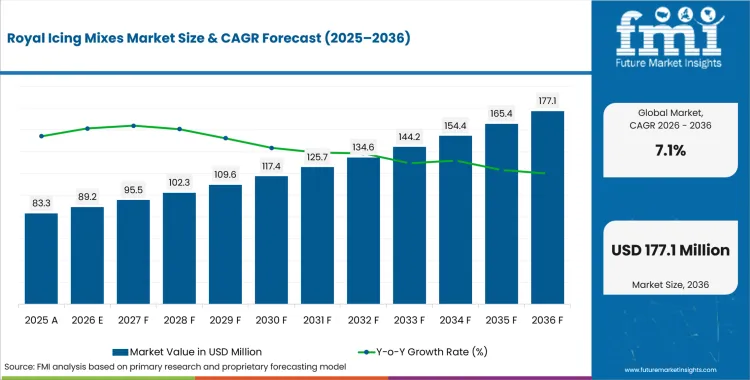
USD 89.2 million in 2026 and USD 177.1 million by 2036 at a 7.1% CAGR.
Demand for royal icing mixes is projected to expand at a 7.1% CAGR between 2026 and 2036, increasing valuation from USD 89.2 million in 2026 to USD 177.1 million by 2036. Professional bakeries first qualify piping control and hard-setting behavior under their own decoration conditions. Irca Group introduced Graffiti Sprinkles in June 2025 with colors designed not to bleed on icing. Stable color under decoration gives bakeries a practical reason to prefer documented finishing inputs over scratch color adjustment.
National bakery structures change how standardized mixes reach professional users even where the decoration task is similar. INSEE counted 50,122 boulangerie-pâtisserie establishments nationally in France for the 2025 reference year. A buyer base spread among many independent shops increases the value of local distributor stock and practical pack sizes.
Key Takeaways
- Professional bakeries use royal icing mixes to reduce preparation variation and reproduce piping performance during repeated decoration work.
- Based on product type, ready-to-use is projected to account for 39.0% in 2026 due to lower preparation work at the decorating station.
- By form, powder - dry is estimated to hold 46.0% in 2026 owing to concentrated storage and flexible batch preparation.
- In 2026, bread & rolls is expected to lead application with 35.0% share because frequent finishing supports repeated mix use.
- Color and allergen rule changes delay formula approval because revised mixes must preserve accepted decoration performance during customer trials.
- Some of the key players in this market include Barry Callebaut, Puratos, Dawn Foods, Zeelandia, CSM Ingredients, Bakels, AGRANA, Zentis, Fabbri 1905, and Irca Group.
Analyst Perspective
"Royal icing mixes earn their place when decorators can reproduce line-ready viscosity and set without rebuilding the formula each shift. Unit price matters less if the selected mix cuts rework while preserving piping detail after storage and color reformulation."
- Nandini Roy Choudhury, Principal Consultant, Future Market Insights
How is the royal icing mixes market segmented?
The royal icing mixes market is segmented by product type, form, application, claim and sales channel.
Product type covers ready-to-use and dry mixes plus aerosol or piping formats and specialty stabilized products. Form separates powder - dry from liquid and paste - semi-solid plus granules - pieces formats. Application covers bread & rolls and other listed bakery uses. Claim covers conventional plus cleaner-positioned formulations. Sales channel separates direct industrial supply from distributor, artisan, foodservice and online B2B routes.
How does bread & rolls shape the application category?
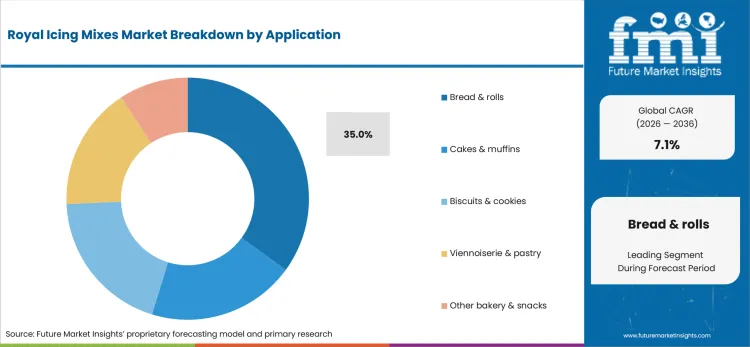
Bread and roll programs require frequent finishing ahead of packaging as egg replacement ingredients affect nearby formulation decisions. CSM Ingredients launched Egg N Easy Plus in April 2025 and documented full egg replacement in brioche. The adjacent launch shows why high-volume bread programs favor ingredients that reduce preparation without weakening repeatability.
- In 2026, bread & rolls is expected to lead application with 35.0% share because frequent finishing supports repeated mix use.
- High-throughput lines leave little time for decoration rework, so adoption depends on adhesion and reliable set performance.
What makes ready-to-use central to the product type category?
Ready-to-use systems remove hydration work where bakery processing equipment depends on predictable icing viscosity. Dawn Foods introduced two ready-to-use buttercreme-style icings in April 2025 for piping and decorating. Prepared formats shift viscosity control to the manufacturer before decorators begin finishing work.
- Ready-to-use is set to lead the product type with 39.0% share in 2026 due to immediate usability and lower preparation variation.
- Commercial adoption improves where labor time outweighs water-shipping costs and stable texture reduces adjustment during repeated decoration work.
Why does powder - dry hold the form category?
Powder systems concentrate functional solids and let bakery teams set batch size beside other measured food enzymes. CSM Ingredients launched Tiger Granulat in March 2026 as a powdered decorative solution for artisan and industrial bakeries. Dry handling reduces stored water but makes reconstitution discipline central to final viscosity.
- By form, powder - dry is estimated to hold 46.0% in 2026 owing to concentrated storage and controlled reconstitution for production batches.
- The format suits operations that need flexible consistency and can follow controlled reconstitution instructions during scheduled piping work.
What supports conventional formulations in the claim category?
Conventional formulations give bakers broad control over whiteness and set as natural food colors gain relevance under newer rules. Dawn Foods introduced cleaner-ingredient colorful buttercreme-style icings in September 2025 using plant-based colors and natural flavors. The launch raises documentation expectations but keeps conventional systems useful where familiar production behavior carries more weight.
- By claim, conventional is forecast to represent 52.0% in 2026 driven by familiar specifications and broad formulation options for appearance.
- Cleaner-label alternatives gain consideration if ingredient changes preserve piping control and accepted drying behavior under production conditions.
What drives direct supply to industrial bakeries within the sales channel category?
Industrial bakeries qualify decoration inputs against specifications and need technical contact for industrial bakery ingredient trials. CSM Ingredients opened a UK Product Development Centre in November 2025 with a test bakery. Direct relationships suit accounts that need coordinated reformulation before a revised icing specification reaches production.
- The direct to industrial bakeries segment is likely to capture 51.0% share in 2026 attributable to specification control and bulk requirements.
- Distributors serve fragmented accounts, whereas direct service is useful during color matching or set-time adjustments at larger production sites.
What are the drivers, restraints and opportunities in the royal icing mixes market?
Repeatable bakery finishing supports demand while formulation requalification slows conversion and documented cleaner-ingredient options open new portfolio routes.
- Driver: Professional bakeries need repeatable decoration systems that reduce manual preparation and operator-dependent variation during scheduled production runs.
- Restraint: Color and allergen changes can return accepted formulas to technical review before continued production approval at bakery sites.
- Opportunity: Documented color alternatives and claim-ready formulations can capture reformulation work without weakening decoration performance under production conditions.
Professional bakers reproduce decoration under time pressure as baking enzymes and other measured formulation inputs move through the same production floor. The USA Bureau of Labor Statistics counted 262,400 baker jobs in 2025 and identified bakery manufacturing as a major employment sector. Standardized royal icing mixes reduce operator adjustment by moving measured preparation into a repeatable routine during busy production shifts.
Formulation approval becomes the binding restraint once food color systems change inside an accepted decoration specification. The USA Food and Drug Administration revoked authorization for FD&C Red No. 3 in food during January 2025 and set January 15 2027 as the reformulation deadline. Affected icing formulas need new color choices plus performance checks before production returns to the approved decoration standard.
Reformulation offers a commercial route for manufacturers whose cake enzymes and other adjusted bakery inputs already pass line-level performance checks. The USA Food and Drug Administration approved three colors from natural sources in May 2025 and allowed Galdieria extract blue in flavored frostings. Mix manufacturers can win reformulation work if documented alternatives retain the required shade and hard-setting behavior.
Which country CAGRs are profiled in the royal icing mixes market?
| Country | CAGR |
|---|---|
| UAE | 8.4% |
| Saudi Arabia | 8.1% |
| South Korea | 7.8% |
| USA | 7.4% |
| Germany | 7.1% |
| UK | 6.8% |
| France | 6.5% |
| Japan | 6.2% |
How do country-level CAGRs compare in the royal icing mixes market?
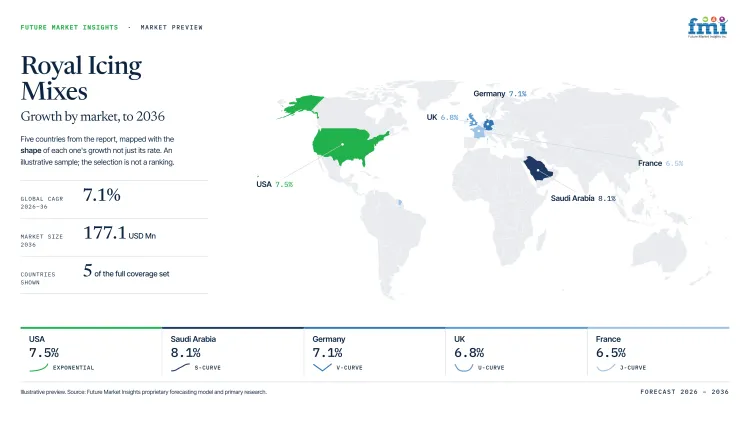
The 2.2 percentage-point range forms a compact Gulf group and a lower cluster spanning Europe plus Japan. UAE and Saudi Arabia exceed 8.0% as hospitality distribution turns finishing inventory more quickly. South Korea and USA occupy the middle band. Mature bakery channels and heavier reformulation checks shape the lower group.
- The UAE’s import-oriented supply chain provides strong access to hotel, catering, and commercial bakery accounts.
- In Saudi Arabia, foodservice compliance and menu requirements increase the need for detailed ingredient documentation and traceability.
- South Korean bakery chains favor standardized specifications that support product consistency across large store networks.
- The USA combines large-scale industrial baking with a fragmented retail bakery sector, creating diverse sourcing requirements.
- German manufacturers closely monitor batch yields and processing efficiency as ingredient costs remain under pressure.
- In the UK, evolving promotion and labeling requirements add complexity to bakery recipe qualification and reformulation efforts.
- France’s dense artisan bakery landscape supports frequent small-volume replenishment and localized supply relationships.
- Japan’s stringent allergen standards increase the importance of detailed specifications for multi-component bakery ingredients.
Similar CAGRs create different service and documentation requirements. The full report provides country-level CAGR analysis across North America, Latin America, Western Europe, Eastern Europe, East Asia, South Asia and Pacific and the Middle East and Africa.
Country-wise Analysis
- USA bakeries span industrial plants and retail production sites that need decoration inputs to behave consistently during peak shifts. The USA Bureau of Labor Statistics counted 236,200 bakers nationally in May 2025 and published the estimate in May 2026. Royal icing mix demand in USA is forecast to rise at 7.4% CAGR over the forecast period, supported by labor-saving preparation and documented color alternatives. A trained workforce gives manufacturers a route for standardizing bakery ingredients in professional production nationwide. Color changes can reopen shade and piping checks on an accepted specification, so reformulation must preserve decorating performance during retraining.
- German bakery operators face input-cost pressure that makes batch yield a practical test during icing-format selection and routine production planning. Germany is projected to record 7.1% CAGR during the assessment period, supported by dry formats that reduce stored water and permit controlled reconstitution. Destatis reported in February 2026 that wholesale prices for sugar plus confectionery and bakery products were 12.5% higher in January 2026 than one year earlier. Industrial plants can trial concentrated mixes against existing preparation controls and calculate yield before approving a revised format. Cost volatility can delay conversion if a changed mix raises waste during customer trials.
- France's dense artisan bakery base requires distribution models that can serve many independent production sites without oversized packs or long replenishment cycles. INSEE counted 50,106 boulangerie-pâtisserie establishments for 2024 in its July 2025 national release. In France, royal icing mix demand is predicted to advance at 6.5% CAGR through 2036, owing to frequent small-batch decoration and distributor access to artisan bakeries. Distributors can trial bakery mixes in small batches without imposing one decorating method on every shop. Service costs remain a constraint because manufacturers need French documentation plus pack sizes that fit smaller production runs outside national industrial accounts.
- UK bakery manufacturers review finished-product promotion rules beside recipe performance before changing decoration ingredients for packaged and foodservice lines. The Department of Health and Social Care updated national guidance in June 2025 for advertising restrictions effective January 5 2026. The guidance covers qualifying cakes and several morning goods but treats decorations separately in the category definitions. Royal icing mix sales in UK are forecast to expand at 6.8% CAGR by 2036, supported by standardized finishing systems that simplify documented recipe changes. Established distribution gives manufacturers technical access, although nutrient-profile rules can force wider reformulation and extend approval time overall.
- Saudi foodservice bakeries now work under wider menu-information requirements that increase attention to ingredient data from professional finishing manufacturers. Saudi Arabia is estimated to post 8.1% CAGR over the forecast period, driven by hospitality channels that need consistent decoration with clear specifications. The Saudi Food and Drug Authority stated in June 2025 that detailed nutrition information would be required on physical and online menus from July 1 2025. Hotels and restaurant bakeries give distributors a customer base for standardized mixes used in repeated service. Documentation can slow listings since menu systems depend on accurate ingredient and nutrition data from every component manufacturer.
- UAE bakery imports and locally packed ingredients operate under national quantity-control requirements that make declared pack information part of routine compliance. Cabinet Resolution No. 83 of 2024 became effective on January 27 2025 and sets national quantity-control rules for prepackages. Adoption of royal icing mixes in UAE is estimated to expand at 8.4% CAGR through 2036, driven by hospitality demand and distributor networks serving professional production. Import channels give hotels and bakery operators access to international finishing products without local manufacturing scale. Manufacturers need net-content control and documents local partners can use during receiving and regulatory inspection of imported formats.
- Japanese packaged bakery programs require disciplined allergen control because finished items often use icing beside fillings and other decoration components. By 2036, Japan is projected to grow at 6.2% CAGR, supported by standardized ingredient statements and repeatable production handling. The Consumer Affairs Agency added cashew nuts to mandatory specified-allergen labeling on April 1 2026 and updated national guidance materials. Retail bakery channels can qualify documented mixes within established packaged-food routines without changing every production step. Cross-contact management remains a constraint since an ingredient change must fit the customer's broader label-control process for multi-component bakery products and preserve the approved declaration.
- South Korean industrial and retail bakeries operate under detailed national labeling rules that make complete ingredient information important during product approval. The Ministry of Food and Drug Safety issued Food Labeling Standards Notice No. 2026-37 on May 12 2026 as the current national framework. South Korea's royal icing mixes outlook is anticipated to advance at 7.8% CAGR over the assessment period, attributable to standardized bakery formats and documentation needs in packaged food channels. Dense retail distribution gives compliant mixes access to bakery programs. New listings can slow if importers lack Korean-language specifications matching the declaration and allergen information required for finished products.
Who are the notable companies in the royal icing mixes market?
Barry Callebaut, Puratos, Dawn Foods, Zeelandia, CSM Ingredients, Bakels, AGRANA, Zentis, Fabbri 1905, and Irca Group are notable companies serving professional bakery finishing and adjacent ingredient categories.
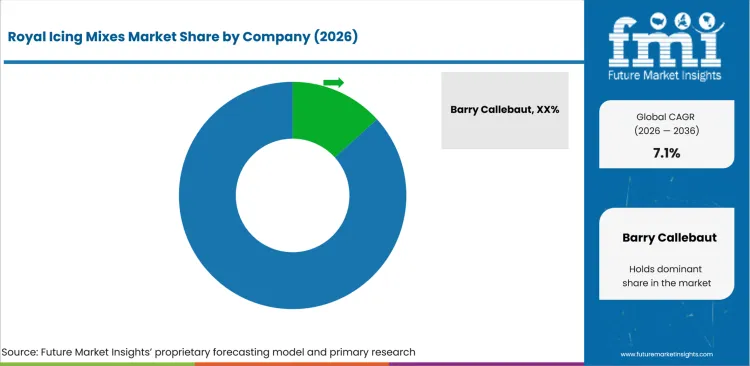
Professional bakery ingredient groups compete beside chocolate and fruit specialists whose products reach the same finishing decision. Trial access depends on application support because icing must survive storage plus piping and drying under each customer's production conditions.
- Puratos, Dawn Foods and CSM Ingredients support bakery formulation work through test facilities and application resources used during customer trials.
- Zeelandia and Bakels serve artisan and industrial bakeries with ingredient mixes plus technical support for finishing operations.
- Barry Callebaut, Fabbri 1905 and Irca Group focus on pastry finishing alongside AGRANA and Zentis, which supply fruit-based systems.
Competitive Benchmarking: Royal Icing Mixes Market
| Company | Bakery Finishing Breadth | Application Support | Formulation Flexibility | Geographic Reach |
|---|---|---|---|---|
| Barry Callebaut | High | High | Medium | Global |
| Puratos | High | High | High | Global |
| Dawn Foods | High | High | High | Europe and North America with wider international operations |
| Zeelandia | Medium | High | Medium | International bakery operations |
| CSM Ingredients | High | High | High | Europe-centered with international reach |
| Bakels | High | High | Medium | Five-continent Bakels network |
| AGRANA | Medium | Medium | High | Global food and beverage operations |
| Zentis | Medium | Medium | High | Europe and North America |
| Fabbri 1905 | Medium | Medium | Medium | International pastry and foodservice channels |
| Irca Group | High | High | High | Europe, North America and Asia |
Bakery-finishing breadth scores High with at least three documented finishing families, Medium with two and Low with one. Application support scores High with dedicated test facilities, Medium with published technical assistance and Low with a single documented route. Formulation flexibility scores High with several documented claim routes, Medium with narrower options and Low with one documented route.
Key Developments in the Royal Icing Mixes Market
- In June 2026, Barry Callebaut launched its Focus for Growth plan with greater emphasis on value-added fillings and decorations serving professional bakery applications.
- In March 2026, Puratos agreed to acquire Dawn Foods subject to regulatory approvals, which would combine complementary professional bakery manufacturing and distribution networks after completion.
- In June 2026, Irca Group announced that CVC Capital Partners had agreed to acquire the company from Advent, subject to regulatory approvals expected before closing.
Key Players in the Royal Icing Mixes Market
Broad Bakery Ingredient Companies
- Puratos
- Dawn Foods
- Zeelandia
- CSM Ingredients
- Bakels
Chocolate and Pastry Finishing Companies
- Barry Callebaut
- Fabbri 1905
- Irca Group
Fruit and Filling Specialists
- AGRANA
- Zentis
Royal Icing Mixes Market - Report Scope
| Coverage field | Report scope |
|---|---|
| Market breakdown | By product type, form, application, claim, sales channel and region. |
| Quantitative units | USD million. |
| Market definition | Prepared ingredient systems sold for royal-icing style decoration and hard-setting bakery finishing within the defined revenue boundary. |
| Regions covered | North America, Latin America, Western Europe, Eastern Europe, East Asia, South Asia and Pacific and Middle East and Africa. |
| Countries covered | USA, Germany, France, UK, Saudi Arabia, UAE, Japan, South Korea and additional countries included in the full report. |
| Key companies | Barry Callebaut, Puratos, Dawn Foods, Zeelandia, CSM Ingredients, Bakels, AGRANA, Zentis, Fabbri 1905, Irca Group. |
| Forecast period | 2026 to 2036. |
| Approach | Primary and secondary research with market triangulation. |
Royal Icing Mixes Market - Research Methodology
| Method | Approach |
|---|---|
| Primary Research | FMI analysts gathered input from manufacturers, service providers, technology developers, distributors, end users, procurement teams, and subject-matter experts. Interviews examined purchasing decisions, product or service evaluation, adoption barriers, approval requirements, pricing considerations, and expectations for technical or commercial support. Respondents were also asked what evidence is required before a trial, pilot, or initial order develops into regular purchasing. |
| Desk Research | Desk research covered government statistics, regulatory publications, trade data, industry associations, technical literature, standards, company filings, product information, and official corporate announcements. Sources were reviewed for relevance, publication date, geographic coverage, and consistency with the defined market scope. Claims relating to performance, applications, approvals, capacity, investment, and commercial activity were retained only when supported by credible public evidence. |
| Market Sizing and Forecasting | The market model combined the baseline value with historical performance, segment structure, pricing and volume indicators, adoption levels, company participation, and country-level demand conditions. Forecast assumptions considered economic activity, investment trends, regulatory developments, technology adoption, purchasing cycles, supply availability, and barriers to wider market use. Segment and regional estimates were reconciled before the final market total was calculated. |
| Data Validation | Estimates were checked against multiple independent indicators, including public data, company activity, trade patterns, industry developments, and findings from primary interviews. Validation also tested whether products, services, applications, and company revenues fell within the defined market boundaries. Adjacent categories, unsupported claims, overlapping revenues, and activities without direct market relevance were excluded to reduce double counting and maintain consistency across segments and countries. |
Royal Icing Mixes Market by Segments
Royal Icing Mixes Market segmented by Product Type:
- Ready-to-use
- Dry mixes
- Aerosol & piping formats
- Specialty stabilized
Royal Icing Mixes Market segmented by Form:
- Powder - dry
- Liquid
- Paste - semi-solid
- Granules - pieces
Royal Icing Mixes Market segmented by Application:
- Bread & rolls
- Cakes & muffins
- Biscuits & cookies
- Viennoiserie & pastry
- Other bakery & snacks
Royal Icing Mixes Market segmented by Claim:
- Conventional
- Clean label
- Organic
- Non-GMO - identity preserved
Royal Icing Mixes Market segmented by Sales Channel:
- Direct to industrial bakeries
- Ingredient distributors
- Foodservice & artisan supply
- Online B2B
Royal Icing Mixes Market by Region:
- North America
- United States
- Canada
- Latin America
- Brazil
- Mexico
- Argentina
- Chile
- Western Europe
- Germany
- France
- United Kingdom
- Italy
- Spain
- Benelux
- Nordics
- Eastern Europe
- Poland
- Czech Republic
- Romania
- Hungary
- East Asia
- China
- Japan
- South Korea
- South Asia and Pacific
- India
- ASEAN
- Australia and New Zealand
- Middle East and Africa
- GCC Countries
- South Africa
- Türkiye
- Israel
Research Sources and Bibliography
- Puratos. (2026, June 15). Puratos opens new research center to tackle flour variability.
- Irca Group. (2025, June 26). Graffiti Sprinkles.
- INSEE. (2026, August 6). Dossier complet − France.
- Dawn Foods. (2025, April 3). Dawn Foods Unveils New Products to Meet Seasonal Flavor Demand.
- CSM Ingredients. (2026, March 10). CSM Ingredients launches Tiger Granulat.
- CSM Ingredients. (2025, April 1). CSM Ingredients launches Egg N Easy Plus, the new benchmark in egg reduction solutions.
- Dawn Foods. (2025, September 13). Dawn Foods Introduces New Dawn Balance Cleaner Ingredients Colorful Buttercreme Style Icings.
- CSM Ingredients. (2025, November 18). CSM Ingredients, a Nexture company, opens new customer-focused Product Development Centre in the UK.
- USA Bureau of Labor Statistics. (2026, August 27). Bakers: Occupational Outlook Handbook.
- USA Food and Drug Administration. (2025, January 15). FDA to Revoke Authorization for the Use of Red No. 3 in Food and Ingested Drugs.
- USA Food and Drug Administration. (2025, May 9). FDA Approves Three Food Colors from Natural Sources.
- USA Bureau of Labor Statistics. (2026, May 15). May 2025 National Occupational Employment and Wage Estimates.
- German Federal Statistical Office. (2026, February 13). Wholesale prices in January 2026: +1.2% on January 2025.
- INSEE. (2025, July 10). Équipements et services à la population en 2024 - France.
- UK Department of Health and Social Care. (2025, June 4). Restricting advertising of less healthy food or drink on TV and online: products in scope.
- Saudi Food and Drug Authority. (2025, June 18). SFDA to Implement New Food Rules for Transparency and Consumer Health.
- United Arab Emirates Legislation. (2025, January 27). Cabinet Resolution No. (83) of 2024 Concerning the Technical Regulation on Quantity Control in Prepackages.
- Consumer Affairs Agency, Japan. (2026, April 1). Food Allergen Labeling Information.
- Ministry of Food and Drug Safety, Republic of Korea. (2026, May 12). Food Labeling Standards, MFDS Notice No. 2026-37.
- Barry Callebaut. (2026, June 2). Barry Callebaut launches Focus for Growth action plan.
- Puratos. (2026, March 10). Puratos to Acquire Dawn Foods.
- AGRANA. (2026). AGRANA Annual Report 2025|26.
- AGRANA. (2026, April 23). AGRANA launch in Slovenia: acquisition of the food company Mercator-Emba successfully concluded.
- Barry Callebaut. (2025). Barry Callebaut Group Full-Year Results Fiscal Year 2024-25.
- Puratos. (2025, August 25). Puratos Announces Two New Hubs for Food Innovation: Montreal and Costa Rica.
- Puratos. (2026, May 28). Puratos marks major sustainability milestone with carbon neutral operations.
- Dawn Foods. (2026). 2025 Corporate Social Responsibility Report for Europe & AMEAP.
- CSM Ingredients. (2025, November 20). Nexture debuts at Fi Europe 2025: the ingredients group presents its innovations for a better food future.
- Fabbri 1905. (2026). A family company since 1905.
- Irca Group. (2026, July 20). Sustainability report 2025.
- Irca Group. (2025, February 18). Crafted in Italy, Produced in the USA.
- Nexture. (2025, November 10). NEXTURE, THE GLOBAL VALUE-ADDED FOOD INGREDIENTS GROUP, ANNOUNCES THE ACQUISITION OF FRULACT, A GLOBALLY LEADING MANUFACTURER OF FRUIT AND VEGETABLES-BASED SPECIALTY INGREDIENTS.
- Royal Zeelandia Group. (2026, June 2). Zeelandia publishes Sustainability Report 2025.
- Bakels Worldwide. (2025, June). Bakels Worldwide Review.
- Zentis. (2026, April 28). Natürlich geprägt von Verantwortung: Zentis veröffentlicht 8. Nachhaltigkeitsbericht.
- Barry Callebaut. (2025, November 5). Barry Callebaut and Planet A Foods Partner to Pioneer Sustainable Chocolate Alternatives Without Cocoa.
- CSM Ingredients. (2025, November 13). CSM Ingredients Group launches Nuaré, a range of cocoa alternatives which opens new creative possibilities in bakery and ice cream.
- Puratos. (2026, January 23). Puratos Strengthens Its Presence in Italy with the Creation of Puratos Cascarano.
- Barry Callebaut. (2025, November 13). Barry Callebaut Opens Third Canadian Chocolate Factory in Brantford, Ontario.
- Puratos. (2026, January 21). Puratos acquires Vör Foods, accelerating USA nut-based innovation.
- Dawn Foods. (2025, May 15). Beloved Dessert Takes New Form With Dawn Churro Donut Mix and Ready-to-Finish Donuts.
- Irca Group. (2026, June 29). CVC Capital Partners agrees to acquire Irca from Advent.
- CSM Ingredients. (2026, May 12). CSM Ingredients launches Creami, a comprehensive range of indulgent fillings for bakery, pastry and confectionery professionals.
- Bakels Sweden. (2026, February 5). Bakels Sweden launches Ready-to-use Mallow.
- Zentis. (2025, August 16). Jetzt wird’s bärig lecker - Zentis und Bärchen launchen Fruchtaufstriche für die ganze Familie.
- Fabbri 1905. (2026, January 16). Fabbri 1905 entra nel mondo dello street food e ridefinisce il fuoricasa Made in Italy.
- Irca Group. (2026, May 8). Dobla Asia achieves BRC A+ rating in Vietnam.
This bibliography is provided for reader reference and is not exhaustive. The full report contains the complete reference list and detailed citations
This Report Answers
- How large is the royal icing mixes market in 2026 and 2036?
- What operating conditions support standardized royal icing mixes in professional bakeries?
- Why does ready-to-use lead product type in 2026?
- Why does powder - dry lead form in 2026?
- Why does bread & rolls lead application in 2026?
- How do country CAGRs differ among the eight compared countries?
- Which conditions slow reformulation after color or allergen changes?
- How do notable companies differ in finishing breadth and application support?
Frequently Asked Questions
How big is the royal icing mixes market in 2026?
The royal icing mixes market is valued at USD 89.2 million in 2026 and is projected to reach USD 177.1 million by 2036. Professional bakeries increase demand by replacing variable scratch preparation with standardized decoration inputs during repeated finishing work.
What is the CAGR of the royal icing mixes market from 2026 to 2036?
The royal icing mixes market is projected to grow at a CAGR of 7.1% between 2026 and 2036. Repeatable finishing requirements increase demand for documented mixes that retain performance after ingredient or color changes.
Which product type leads the royal icing mixes market?
The ready-to-use segment is expected to hold 39.0% of the royal icing mixes market in 2026 attributable to immediate usability. Prepared viscosity reduces operator mixing and improves consistency during repetitive professional bakery decoration work.
Which form leads the royal icing mixes market?
The powder - dry segment is expected to hold 46.0% of the royal icing mixes market in 2026 driven by concentrated storage. Professional users set batch size without storing the water contained in prepared formats onsite.
Which companies are active in the royal icing mixes market?
Key companies operating in the market include Barry Callebaut, Puratos, Dawn Foods, Zeelandia, CSM Ingredients, Bakels, AGRANA, Zentis, Fabbri 1905, and Irca Group. Their roles span bakery systems plus chocolate, fruit and pastry-finishing formats serving professional users during formulation and qualification work.
Preview the report firsthand - request a free sample
Get SampleGet the brochure for pricing and purchase details.
Get PDFTable of Content
- Key Takeaways
- Market Size and CAGR
- Top Growth Driver
- Fastest Growing Segment
- Leading Region
- Key Companies
- Emerging Opportunities
- Executive Summary
- Global Market Outlook
- Demand-side Trends
- Supply-side Trends
- Technology Roadmap Analysis
- Analysis and Recommendations
- Analyst Perspective (What is happening? Why now? What should investors know?)
- Key Questions Answered
- How large is the market?
- What is the CAGR?
- What are key trends?
- Which region dominates?
- Who are the leaders?
- Market Overview
- Market Coverage / Taxonomy
- Market Definition / Scope / Limitations
- Research Methodology
- Chapter Orientation
- Analytical Lens and Working Hypotheses
- Market Structure, Signals, and Trend Drivers
- Benchmarking and Cross-market Comparability
- Market Sizing, Forecasting, and Opportunity Mapping
- Research Design and Evidence Framework
- Desk Research Programme (Secondary Evidence)
- Expert Input and Fieldwork (Primary Evidence)
- Tooling, Models, and Reference Databases
- Data Engineering and Model Build
- Quality Assurance and Audit Trail
- Market Background
- Market Dynamics (Drivers, Restraints, Opportunity, Trends)
- Scenario Forecast (Optimistic, Likely, Conservative)
- Impact Analysis
- AI Impact
- Sustainability Impact
- Regulatory Impact
- Technology Impact
- Consumer / Buyer Analysis
- Purchase Drivers
- Adoption Barriers
- Buyer Journey
- Opportunity Map Analysis
- Product Life Cycle Analysis
- Supply Chain Analysis
- Investment Feasibility Matrix
- Value Chain Analysis
- PESTLE and Porter's Analysis
- Regulatory Landscape
- Regional Parent Market Outlook
- Production and Consumption Statistics
- Import and Export Statistics
- Global Market Analysis and Forecast, 2021 to 2036
- Historical Market Size Value (USD Million) Analysis, 2021 to 2025
- Current and Future Market Size Value (USD Million) Projections, 2026 to 2036
- Y-o-Y Growth Trend Analysis
- Absolute $ Opportunity Analysis
- Global Market Pricing Analysis, 2021 to 2036
- Global Market Analysis and Forecast, By Product Type, 2021 to 2036
- Introduction / Key Findings
- Historical Market Size Value (USD Million) Analysis By Product Type, 2021 to 2025
- Current and Future Market Size Value (USD Million) Analysis and Forecast By Product Type, 2026 to 2036
- Ready-to-use
- Dry mixes
- Aerosol & piping formats
- Specialty stabilized
- Ready-to-use
- Y-o-Y Growth Trend Analysis By Product Type, 2021 to 2025
- Absolute $ Opportunity Analysis By Product Type, 2026 to 2036
- Global Market Analysis and Forecast, By Form, 2021 to 2036
- Introduction / Key Findings
- Historical Market Size Value (USD Million) Analysis By Form, 2021 to 2025
- Current and Future Market Size Value (USD Million) Analysis and Forecast By Form, 2026 to 2036
- Powder / dry
- Liquid
- Paste / semi-solid
- Granules / pieces
- Powder / dry
- Y-o-Y Growth Trend Analysis By Form, 2021 to 2025
- Absolute $ Opportunity Analysis By Form, 2026 to 2036
- Global Market Analysis and Forecast, By Application, 2021 to 2036
- Introduction / Key Findings
- Historical Market Size Value (USD Million) Analysis By Application, 2021 to 2025
- Current and Future Market Size Value (USD Million) Analysis and Forecast By Application, 2026 to 2036
- Bread & rolls
- Cakes & muffins
- Biscuits & cookies
- Viennoiserie & pastry
- Other bakery & snacks
- Bread & rolls
- Y-o-Y Growth Trend Analysis By Application, 2021 to 2025
- Absolute $ Opportunity Analysis By Application, 2026 to 2036
- Global Market Analysis and Forecast, By Claim, 2021 to 2036
- Introduction / Key Findings
- Historical Market Size Value (USD Million) Analysis By Claim, 2021 to 2025
- Current and Future Market Size Value (USD Million) Analysis and Forecast By Claim, 2026 to 2036
- Conventional
- Clean label
- Organic
- Non-GMO / identity preserved
- Conventional
- Y-o-Y Growth Trend Analysis By Claim, 2021 to 2025
- Absolute $ Opportunity Analysis By Claim, 2026 to 2036
- Global Market Analysis and Forecast, By Sales Channel, 2021 to 2036
- Introduction / Key Findings
- Historical Market Size Value (USD Million) Analysis By Sales Channel, 2021 to 2025
- Current and Future Market Size Value (USD Million) Analysis and Forecast By Sales Channel, 2026 to 2036
- Direct to industrial bakeries
- Ingredient distributors
- Foodservice & artisan supply
- Online B2B
- Direct to industrial bakeries
- Y-o-Y Growth Trend Analysis By Sales Channel, 2021 to 2025
- Absolute $ Opportunity Analysis By Sales Channel, 2026 to 2036
- Global Market Analysis and Forecast, By Region, 2021 to 2036
- Introduction
- Historical Market Size Value (USD Million) Analysis By Region, 2021 to 2025
- Current Market Size Value (USD Million) Analysis and Forecast By Region, 2026 to 2036
- North America
- Latin America
- Western Europe
- Eastern Europe
- East Asia
- South Asia and Pacific
- Middle East & Africa
- Market Attractiveness Analysis By Region
- North America Market Analysis and Forecast, By Country, 2021 to 2036
- Historical Market Size Value (USD Million) Trend Analysis By Market Taxonomy, 2021 to 2025
- Market Size Value (USD Million) Forecast By Market Taxonomy, 2026 to 2036
- By Country
- USA
- Canada
- By Product Type
- By Form
- By Application
- By Claim
- By Sales Channel
- By Country
- Market Attractiveness Analysis
- By Country
- By Product Type
- By Form
- By Application
- By Claim
- By Sales Channel
- Key Takeaways
- Latin America Market Analysis and Forecast, By Country
- Historical Market Size Value (USD Million) Trend Analysis By Market Taxonomy, 2021 to 2025
- Market Size Value (USD Million) Forecast By Market Taxonomy, 2026 to 2036
- By Country
- Brazil
- Mexico
- Chile
- Rest of Latin America
- By Product Type
- By Form
- By Application
- By Claim
- By Sales Channel
- By Country
- Market Attractiveness Analysis
- By Country
- By Product Type
- By Form
- By Application
- By Claim
- By Sales Channel
- Key Takeaways
- Western Europe Market Analysis and Forecast, By Country
- Historical Market Size Value (USD Million) Trend Analysis By Market Taxonomy, 2021 to 2025
- Market Size Value (USD Million) Forecast By Market Taxonomy, 2026 to 2036
- By Country
- Germany
- UK
- Italy
- Spain
- France
- Nordic
- BENELUX
- Rest of Western Europe
- By Product Type
- By Form
- By Application
- By Claim
- By Sales Channel
- By Country
- Market Attractiveness Analysis
- By Country
- By Product Type
- By Form
- By Application
- By Claim
- By Sales Channel
- Key Takeaways
- Eastern Europe Market Analysis and Forecast, By Country
- Historical Market Size Value (USD Million) Trend Analysis By Market Taxonomy, 2021 to 2025
- Market Size Value (USD Million) Forecast By Market Taxonomy, 2026 to 2036
- By Country
- Russia
- Poland
- Hungary
- Balkan & Baltic
- Rest of Eastern Europe
- By Product Type
- By Form
- By Application
- By Claim
- By Sales Channel
- By Country
- Market Attractiveness Analysis
- By Country
- By Product Type
- By Form
- By Application
- By Claim
- By Sales Channel
- Key Takeaways
- East Asia Market Analysis and Forecast, By Country
- Historical Market Size Value (USD Million) Trend Analysis By Market Taxonomy, 2021 to 2025
- Market Size Value (USD Million) Forecast By Market Taxonomy, 2026 to 2036
- By Country
- China
- Japan
- South Korea
- By Product Type
- By Form
- By Application
- By Claim
- By Sales Channel
- By Country
- Market Attractiveness Analysis
- By Country
- By Product Type
- By Form
- By Application
- By Claim
- By Sales Channel
- Key Takeaways
- South Asia and Pacific Market Analysis and Forecast, By Country
- Historical Market Size Value (USD Million) Trend Analysis By Market Taxonomy, 2021 to 2025
- Market Size Value (USD Million) Forecast By Market Taxonomy, 2026 to 2036
- By Country
- India
- ASEAN
- Australia & New Zealand
- Rest of South Asia and Pacific
- By Product Type
- By Form
- By Application
- By Claim
- By Sales Channel
- By Country
- Market Attractiveness Analysis
- By Country
- By Product Type
- By Form
- By Application
- By Claim
- By Sales Channel
- Key Takeaways
- Middle East & Africa Market Analysis and Forecast, By Country
- Historical Market Size Value (USD Million) Trend Analysis By Market Taxonomy, 2021 to 2025
- Market Size Value (USD Million) Forecast By Market Taxonomy, 2026 to 2036
- By Country
- Kingdom of Saudi Arabia
- Other GCC Countries
- Türkiye
- South Africa
- Other African Union
- Rest of Middle East & Africa
- By Product Type
- By Form
- By Application
- By Claim
- By Sales Channel
- By Country
- Market Attractiveness Analysis
- By Country
- By Product Type
- By Form
- By Application
- By Claim
- By Sales Channel
- Key Takeaways
- Key Countries Market Analysis
- USA
- Pricing Analysis
- Market Share Analysis, 2025
- By Product Type
- By Form
- By Application
- By Claim
- By Sales Channel
- Canada
- Pricing Analysis
- Market Share Analysis, 2025
- By Product Type
- By Form
- By Application
- By Claim
- By Sales Channel
- Mexico
- Pricing Analysis
- Market Share Analysis, 2025
- By Product Type
- By Form
- By Application
- By Claim
- By Sales Channel
- Brazil
- Pricing Analysis
- Market Share Analysis, 2025
- By Product Type
- By Form
- By Application
- By Claim
- By Sales Channel
- Chile
- Pricing Analysis
- Market Share Analysis, 2025
- By Product Type
- By Form
- By Application
- By Claim
- By Sales Channel
- Germany
- Pricing Analysis
- Market Share Analysis, 2025
- By Product Type
- By Form
- By Application
- By Claim
- By Sales Channel
- UK
- Pricing Analysis
- Market Share Analysis, 2025
- By Product Type
- By Form
- By Application
- By Claim
- By Sales Channel
- Italy
- Pricing Analysis
- Market Share Analysis, 2025
- By Product Type
- By Form
- By Application
- By Claim
- By Sales Channel
- Spain
- Pricing Analysis
- Market Share Analysis, 2025
- By Product Type
- By Form
- By Application
- By Claim
- By Sales Channel
- France
- Pricing Analysis
- Market Share Analysis, 2025
- By Product Type
- By Form
- By Application
- By Claim
- By Sales Channel
- India
- Pricing Analysis
- Market Share Analysis, 2025
- By Product Type
- By Form
- By Application
- By Claim
- By Sales Channel
- ASEAN
- Pricing Analysis
- Market Share Analysis, 2025
- By Product Type
- By Form
- By Application
- By Claim
- By Sales Channel
- Australia & New Zealand
- Pricing Analysis
- Market Share Analysis, 2025
- By Product Type
- By Form
- By Application
- By Claim
- By Sales Channel
- China
- Pricing Analysis
- Market Share Analysis, 2025
- By Product Type
- By Form
- By Application
- By Claim
- By Sales Channel
- Japan
- Pricing Analysis
- Market Share Analysis, 2025
- By Product Type
- By Form
- By Application
- By Claim
- By Sales Channel
- South Korea
- Pricing Analysis
- Market Share Analysis, 2025
- By Product Type
- By Form
- By Application
- By Claim
- By Sales Channel
- Russia
- Pricing Analysis
- Market Share Analysis, 2025
- By Product Type
- By Form
- By Application
- By Claim
- By Sales Channel
- Poland
- Pricing Analysis
- Market Share Analysis, 2025
- By Product Type
- By Form
- By Application
- By Claim
- By Sales Channel
- Hungary
- Pricing Analysis
- Market Share Analysis, 2025
- By Product Type
- By Form
- By Application
- By Claim
- By Sales Channel
- Kingdom of Saudi Arabia
- Pricing Analysis
- Market Share Analysis, 2025
- By Product Type
- By Form
- By Application
- By Claim
- By Sales Channel
- Türkiye
- Pricing Analysis
- Market Share Analysis, 2025
- By Product Type
- By Form
- By Application
- By Claim
- By Sales Channel
- South Africa
- Pricing Analysis
- Market Share Analysis, 2025
- By Product Type
- By Form
- By Application
- By Claim
- By Sales Channel
- USA
- Market Structure Analysis
- Competition Dashboard
- Competition Benchmarking
- Market Share Analysis of Top Players
- By Regional
- By Product Type
- By Form
- By Application
- By Claim
- By Sales Channel
- Emerging Startups
- Innovation Benchmarking
- Competition Analysis
- Competition Deep Dive
- Barry Callebaut
- Overview
- Product Portfolio
- Profitability by Market Segments
- Sales Footprint
- Strategy Overview
- Marketing Strategy
- Product Strategy
- Channel Strategy
- Puratos
- Dawn Foods
- Zeelandia
- CSM Ingredients
- Bakels
- AGRANA
- Zentis
- Fabbri 1905
- Irca Group
- Barry Callebaut
- Case Studies
- Success Stories
- Recent Developments
- Competition Deep Dive
- Assumptions & Acronyms Used


