

- Market Size (2026)
- USD 18.0 Bn
- Forecast (2036)
- USD 36.0 Bn
- CAGR (2026 to 2036)
- 7.2%
Private Label Frozen Desserts Market Size, Market Forecast and Outlook By FMI
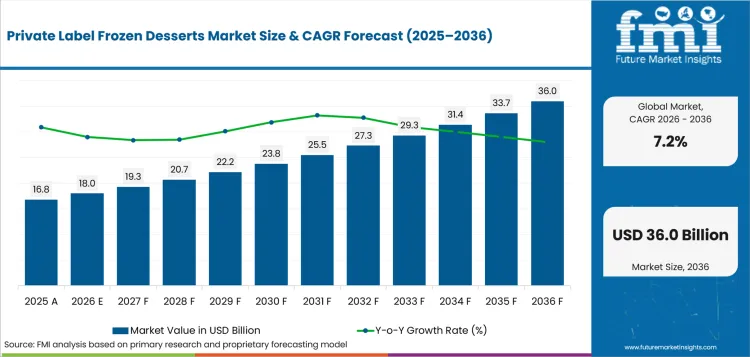
The private label frozen desserts market size is forecast to expand from USD 16.8 billion in 2025 to USD 36.0 billion by 2036 at 7.2% CAGR, supported by rising consumer preference for affordable yet premium-quality food products. Dairy-based formats are anticipated to secure 54.7% share in 2026 due to familiar texture and established processing capacity. Value-driven consumers are projected to represent 51.6% share in 2026 as household dessert baskets move toward retailer-owned freezer products.
Key Takeaways, Market Size, and Forecast
- 2026 Market Size: USD 18.0 billion
- 2036 Market Size: USD 36.0 billion
- Forecast CAGR: 7.2% from 2026 to 2036
- Leading Source: Dairy Based
- Dairy Based Share in 2026: 54.7%
- Leading Consumer Group: Value-Driven Consumers
- Value-Driven Consumers Share in 2026: 51.6%
- Leading Product Type: Ice Cream
- Ice Cream Share in 2026: 46.9%
- Fastest-growing Country: India
- India CAGR: 8.1% through 2036
Summary of Private Label Frozen Desserts Market
- Demand and Growth Drivers
- Value-driven consumers are shifting dessert spending toward retailer-owned tubs and multipacks.
- Supermarket freezer aisles are giving store brands stronger reach across regular grocery trips.
- Private label ranges are moving from basic ice cream into low-fat low-calorie desserts and premium spoonable formats.
- Product and Segment View
- Dairy-based products are forecast to hold 54.7% share in 2026, driven by cream texture and local supply access.
- Value-driven consumers are projected to represent 51.6% share in 2026, influenced by household budget checks guiding dessert choice.
- Ice cream formats are expected to account for 46.9% share in 2026 due to tubs and sticks converting routine dessert buyers.
- Geography and Competitive Outlook
- India is projected to record 8.1% CAGR by 2036 owing to urban freezer access and dairy supply.
- China is forecast to expand at 7.9% CAGR by 2036 through online grocery and club-store freezer trials.
- Walmart and ALDI compete based on store brand control and national freezer access.
- Kroger and Tesco compete by owned brand tiers and retailer loyalty data.
- Analyst Opinion
- Nandini Roy Choudhury, Principal Consultant for Food and Beverage at FMI, observes, “Private label frozen desserts are moving from value-only freezer space toward retailer-owned dessert systems. Shoppers compare pack price and flavor proof before repeat purchase. Retailers with dairy supply depth and clear brand tiers should gain stronger freezer control.”
- Private Label Frozen Desserts Market Value Analysis
- Market value is driven by eligible private label frozen dessert SKU revenue before foodservice contracts add incremental volume.
- Supplier pricing reflects dairy fat cost and inclusion quality before pack size affects retail price.
- Revenue improves as retailers convert branded dessert users into owned-brand repeat buyers through taste and price control.
- Retail trust rises as store-owned products shift from basic freezer tubs into premium family and wellness formats.
Retailers are putting more pressure on recipes used in frozen desserts. Walmart’s October 2025 plan to remove synthetic dyes and over 30 ingredients from its private brand foods by January 2027 shows why recipe control is now important. Private label suppliers need to reformulate ice cream and novelty packs without weakening taste or texture. Price control is also shaping store-owned freezer products.
Target’s March 2025 annual report stated that it lowered prices on over 10,000 items in 2024 and reported a USD 31 billion owned brand portfolio. Such scale gives retailers more freedom to position frozen food ranges across value and premium shelves. Tesco’s June 2025 update showed over 350 new own-brand products in one quarter and 18% year-on-year growth in Finest sales. Retailers that combine taste and premium cues can move private label frozen desserts beyond basic value tubs.
Private Label Frozen Desserts Market Definition
Private label frozen desserts cover frozen sweet products sold under retailer-owned brands. Scope includes ice cream, frozen yogurt, sorbet, bars and pops sold through grocery chains, club stores and discount retailers. Revenue includes finished private label frozen desserts sold through retail, online grocery, convenience channels and foodservice supply.
Private Label Frozen Desserts Market Inclusions
Market scope covers all commercially traded private label frozen dessert products categorized by product type such as ice cream, frozen yogurt, sorbet, frozen bars and frozen pops; retail ownership tier such as mass retailer brands, discounter brands, grocer premium brands, club brands and online brands; source such as dairy based, plant based and hybrid based formats; pack format such as multi-serve tubs, single bars, mini cups, multipacks and novelty packs; sales channel such as supermarkets, discount stores, online retail, club stores and convenience stores; and consumer group such as value-driven consumers, treat seekers, health managers, children and convenience buyers.
Revenue scope covers 2026 to 2036. The key stakeholders include grocery retailers, discount chains, club stores, frozen dessert co-manufacturers, dairy processors, plant based ingredient suppliers, packaging suppliers, cold-chain service providers, online grocery platforms, private brand managers, distributors and food regulatory bodies.
Private Label Frozen Desserts Market Exclusions
Scope excludes national branded frozen desserts and foodservice frozen desserts not sold under retailer-owned brands. Frozen bakery products, refrigerated puddings and shelf-stable dessert mixes are outside scope. Ice cream ingredients are counted only inside finished private label frozen dessert products.
Private Label Frozen Desserts Market Research Methodology
- Primary Research: FMI analysts reviewed retailer brand portfolios and freezer assortment checks across major grocery markets.
- Desk Research: Public data from PLMA, USDA ERS, FDA, Eurostat, India PIB, China NBS, UK Department for Environment, Food & Rural Affairs, Statistics Canada and official retailer releases were checked against private label freezer evidence.
- Market Sizing and Forecasting: Estimated using a bottom-up product-boundary approach based on eligible SKU revenue, channel presence, retail pricing, product positioning and country-level adoption.
- Data Validation: Forecast checks compared private label grocery penetration, frozen dairy output, retail freezer access and active supplier portfolios across leading countries.
Why is the Private Label Frozen Desserts Market Growing?
- Families are choosing retailer-owned freezer desserts offering familiar taste at controlled pack prices.
- Retailers are using store brands to refresh dessert shelves through flavor variety and clearer product tiers.
- Co-manufacturers are gaining a larger role as owned-brand desserts need stable texture and repeatable recipe quality.
Private label frozen desserts are gaining stronger retail support as store brands move from basic value packs toward controlled recipes and better product tiers. Carrefour stated in its 2024 Universal Registration Document, it removed 989 tonnes of sugar and 143 tonnes of salt from Carrefour-brand products in 2024. This shows why recipe control is becoming more important for retailer-owned frozen desserts.
Carrefour also stated that 76% of plants producing Carrefour-brand products were certified to IFS or BRC standards in 2024. This gives retailers a clearer route to manage suppliers across ice cream, frozen bars and novelty packs. Ahold Delhaize stated in its 2025 annual report that its USA brands delivered over 14.2 billion personalized offers during 2025. Such loyalty reach can help store-owned frozen food lines match price offers with household dessert needs.
Market Segmentation Analysis
- Ice cream formats are projected to hold 46.9% share in 2026 since tubs and sticks give retailers a familiar route into family freezer baskets.
- Mass retailer brands are forecast to capture 39.4% share in 2026 owing to shelf control and national owned-brand marketing programs.
- Dairy-based products are expected to represent 54.7% share in 2026, reflected by milk fat and dairy solids influencing texture in store-owned desserts.
- Multi-serve tubs are anticipated to account for 42.8% share in 2026 due to family pack value and repeat use at home.
- Supermarkets are projected to secure 49.5% share in 2026, led by weekly grocery trips placing private label tubs beside branded products.
- Value-driven consumers are forecast to hold 51.6% share in 2026 as household dessert choice tilts toward price-trusted retailer brands.
The private label frozen desserts market is divided into six primary segment groups based on product type and retail ownership tier. Source, pack format, sales channel and consumer group complete the structure. Product type covers ice cream and frozen yogurt. Sorbet, frozen bars and frozen pops complete the group. Retail ownership tier covers mass retailer brands and discounter brands. Grocer premium brands, club brands and online brands complete the group.
Source coverage includes dairy-based and plant-based formats. Hybrid-based formats complete the source scope. Pack format covers multi-serve tubs and single bars. Mini cups, multipacks and novelty packs complete the pack scope. Sales channel coverage includes supermarkets and discount stores. Online retail, club stores and convenience stores complete the channel scope. Consumer group coverage includes value-driven consumers and treat seekers. Health managers, children and convenience buyers complete the group.
Insights into Private Label Frozen Desserts Market by Product Type
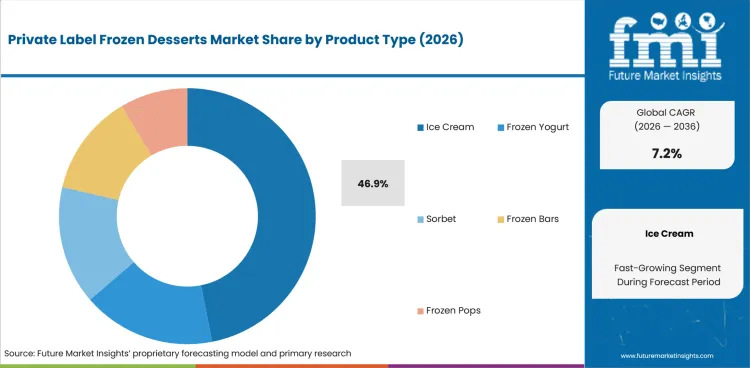
- Ice cream formats are projected to hold 46.9% share in 2026, led by retailer-owned tubs and sticks that feel familiar to branded dessert users.
- Frozen yogurt gains use as retailers link spoonable desserts with protein cues and lighter freezer positioning.
Insights into Private Label Frozen Desserts Market by Retail Ownership Tier
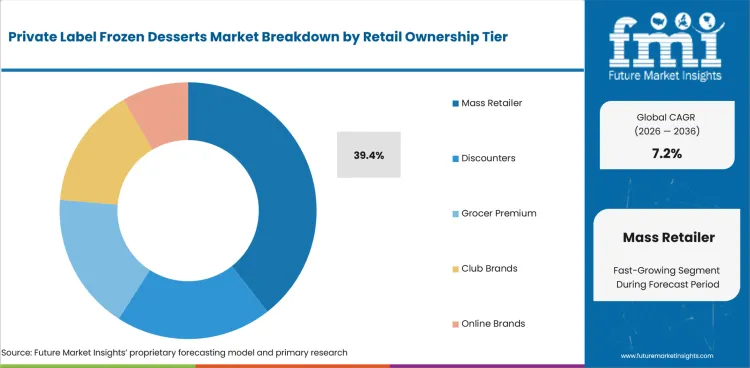
- Mass retailer brands are forecast to hold 39.4% share in 2026 due to national chains placing owned desserts across high-traffic freezer space.
- Discounter brands gain share through simple pack architecture and narrow SKU lines that keep retail price controlled.
Insights into Private Label Frozen Desserts Market by Source
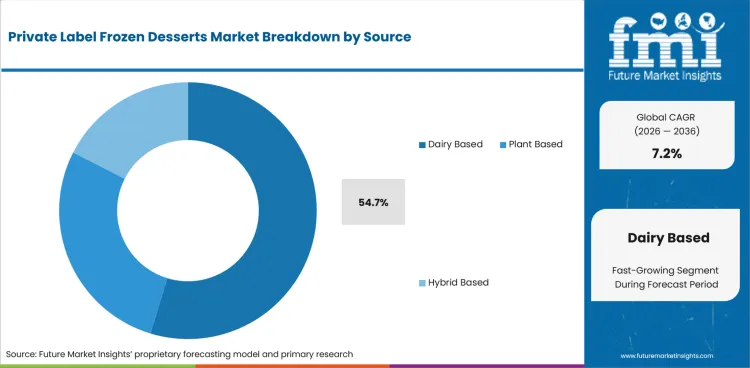
- Dairy-based products are expected to represent 54.7% share in 2026, supported by cream texture and established frozen dessert plants.
- Plant-based formats gain shelf space as oat and almond systems connect with milk alternatives and dairy-free buying.
Insights into Private Label Frozen Desserts Market by Pack Format
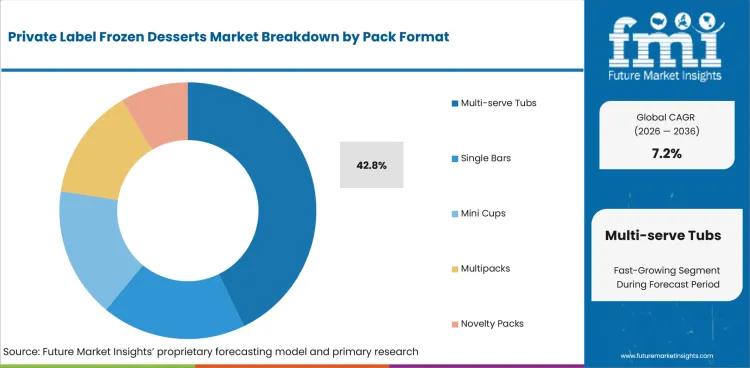
- Multi-serve tubs are anticipated to account for 42.8% share in 2026, reflected by family consumption favoring value packs and repeat servings.
- Single bars gain use led by portion control and on-the-go snacking promoting private label novelty lines.
Insights into Private Label Frozen Desserts Market by Sales Channel
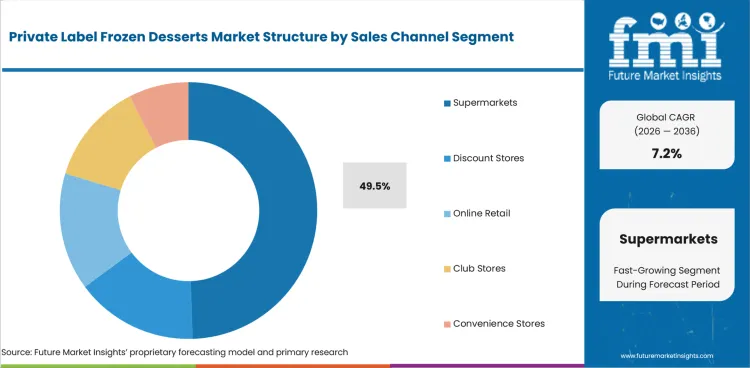
- Supermarkets are projected to secure 49.5% share in 2026, driven by freezer aisle discovery during weekly grocery trips.
- Online retail adds value due to shoppers searching store-owned desserts and comparing pack price before checkout.
Insights into Private Label Frozen Desserts Market by Consumer Group
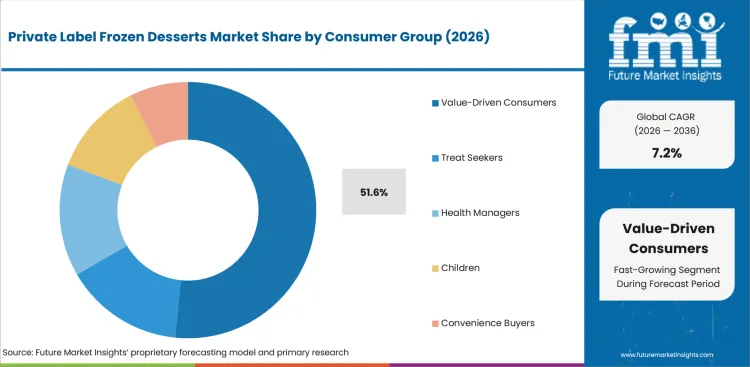
- Value-driven consumers are forecast to hold 51.6% share in 2026 as family dessert baskets favor lower price per serving.
- Health managers influence specialty demand for private label products linked to better-for-you snacks and controlled indulgence.
Private Label Frozen Desserts Market Drivers, Restraints and Opportunities
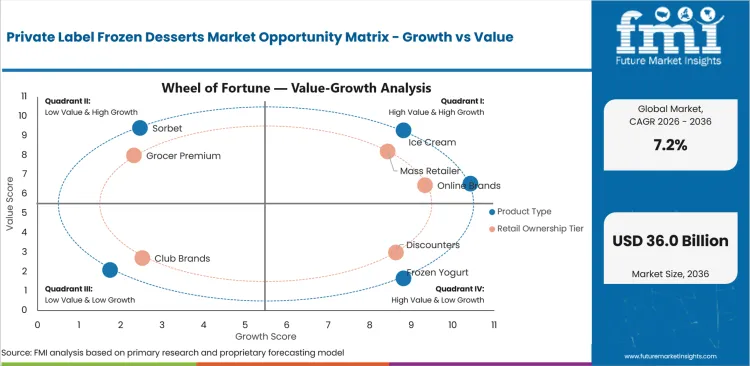
- Driver: Retailer-owned freezer brands are moving from basic value tubs into family and premium dessert lines.
- Restraint: Texture and flavor consistency can weaken if storage conditions and recipe systems are not tightly controlled.
- Opportunity: Store-owned plant-based desserts can extend freezer choice into dairy-free and wellness shelves.
Retailer Recipe Control Improves Store Brand Execution
Private label frozen desserts are gaining from tighter retailer control over recipes and suppliers. Albertsons stated in its April 2025 Form 10-K that its Own Brands portfolio offered nearly 14,000 items and generated USD 16.4 billion in fiscal 2024 sales. Albertsons also operated 2 ice cream plants within its 19 food production plants. This gives store-owned frozen desserts a clearer route to manage quality and seasonal output.
Storage Quality Limits Repeat Purchase
Texture and flavor consistency can weaken when freezer handling varies between plants, warehouses and stores. A 2025 peer-reviewed frozen dessert study found higher storage temperatures increased ice crystal size and grittiness over 12 weeks. Retailers need tighter cold-chain checks so that private label tubs can match branded products after repeat purchase.
Dairy-Free Store Brands Open Shelf Extension
Store-owned plant-based desserts can extend freezer choice into dairy-free shelves where retailers already control price tiers. Oat, almond and hybrid bases let grocers test smaller novelty runs without moving the whole freezer set away from dairy. The opportunity is strongest where retailers pair clear ingredient claims with stable texture.
Brand Preference and Switching Behavior Analysis
Private label frozen desserts are likely to gain trial as shoppers compare store brands with national dessert brands on value, pack size and taste. EY’s 2025 Future Consumer Index for India found, 52% of consumers are switching to private labels, while 70% believe private labels now provide better quality products. The same source found, 59% buy branded products only when they are on sale and 47% are willing to return to branded products for superior taste or performance. This shows that switching is not permanent unless retailer-owned frozen desserts deliver repeatable taste and clear value. Retailers can therefore strengthen private label ice cream loyalty through consistent texture and trusted store-brand positioning.
Product Attribute and Claim Preference Analysis
Private label frozen desserts are expected to move toward products that combine familiar flavor, visual appeal and indulgent texture rather than relying only on low price. Barry Callebaut’s 2025 ice cream trends analysis stated, 67% of global consumers prefer ice cream with multiple flavors and 53% are drawn to visually striking multi-colored formats. The same source stated that one in two global consumers actively seek exclusive or seasonal offerings. These findings support stronger retailer focus on layered formats and seasonal flavors across frozen desserts. Store-owned frozen food ranges can use these claims to make private label tubs and novelty packs feel closer to branded indulgence while keeping price discipline.
Competitive Landscape and Strategic Positioning
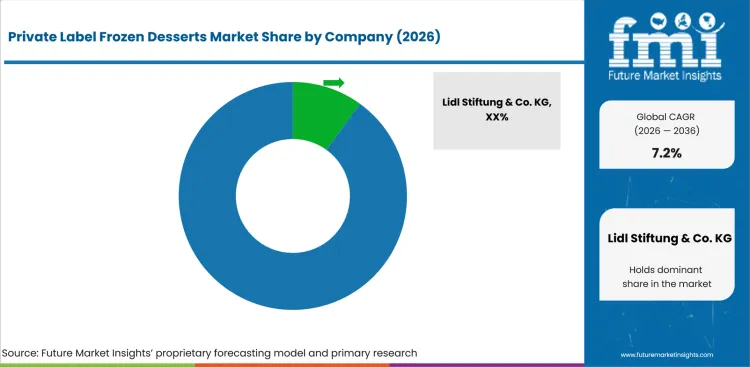
- Large retailers compete on freezer access and owned-brand trust.
- Discounters compete through narrow SKU ranges and price clarity.
- Club stores gain ground by moving multipack frozen desserts into stock-up baskets.
- Co-manufacturers shape success through texture control and seasonal production scale.
Competitive outlook is supported by grocery retailers that control freezer space and consumer data. Walmart and Kroger hold strong positions through national owned-brand ranges and frequent grocery trips. ALDI and Lidl compete by simple packs and tight price control. Tesco and Carrefour add value through tiered private label architecture across basic and premium desserts. Costco uses club-size packs to convert family stock-up missions into repeat freezer purchases.
Supplier advantage will come from consistent taste and reliable plant capacity. Larger retailers are best placed to secure co-manufacturing contracts and national freezer resets. Regional retailers can gain if local dairy partners deliver low-cost tubs and novelty packs with stable texture. Companies with strong own-brand design and clear price tiers are best placed to win repeat purchases.
Key Companies in the Private Label Frozen Desserts Market
Competitive structure is differentiated by mass retailers, discount retailers and grocery chains with strong owned brands.
- Mass Retailers: Walmart and Target compete based on national freezer access and owned-brand food programs.
- Grocery Chains: Kroger, Tesco and Carrefour compete through tiered store brands and frequent grocery visits.
- Club and Discount Retailers: Costco, ALDI and Lidl compete by pack value and simpler dessert ranges.
Competitive Benchmarking: Private Label Frozen Desserts Market
| Company | Frozen Private Brand Depth | Retail Freezer Access | Co-Manufacturing Control | Value-Tier Range | Geographic Footprint |
|---|---|---|---|---|---|
| Walmart Inc. | Very Strong | Very Strong | Strong | Very Strong | Global |
| ALDI | Strong | Very Strong | Strong | Very Strong | Global |
| Lidl Stiftung & Co. KG | Strong | Very Strong | Strong | Very Strong | Europe and United States |
| The Kroger Co. | Very Strong | Very Strong | Strong | Strong | United States |
| Costco Wholesale Corporation | Strong | Very Strong | Moderate | Very Strong | Global |
| Target Corporation | Strong | Strong | Moderate | Strong | United States |
| Tesco PLC | Very Strong | Very Strong | Strong | Strong | United Kingdom |
| Carrefour S.A. | Strong | Very Strong | Strong | Strong | Europe and Latin America |
Source: Future Market Insights competitive analysis, 2026.
Key Developments in Private Label Frozen Desserts Market
- In April 2024, Walmart launched bettergoods, a private food brand with 300 items across frozen, dairy and other aisles.
- In June 2025, Tesco launched a new chilled and frozen desserts range for summer.
- In September 2025, ALDI US announced its largest packaging refresh and said ALDI-exclusive products would carry either the ALDI brand or “an ALDI Original” endorsement.
Key Players in the Private Label Frozen Desserts Market
- Walmart Inc.
- ALDI
- Lidl Stiftung & Co. KG
- The Kroger Co.
- Costco Wholesale Corporation
- Target Corporation
- Tesco PLC
- Carrefour S.A.
Analysis of Private Label Frozen Desserts Market by Key Countries
.webp "Top Country Growth Comparison Private Label Frozen Desserts Market Cagr (2026 2036)")
| Country | CAGR |
|---|---|
| India | 8.1% |
| China | 7.9% |
| United States | 7.5% |
| United Kingdom | 7.0% |
| Germany | 6.6% |
| France | 6.3% |
| Canada | 6.0% |
Source: Future Market Insights, 2026.
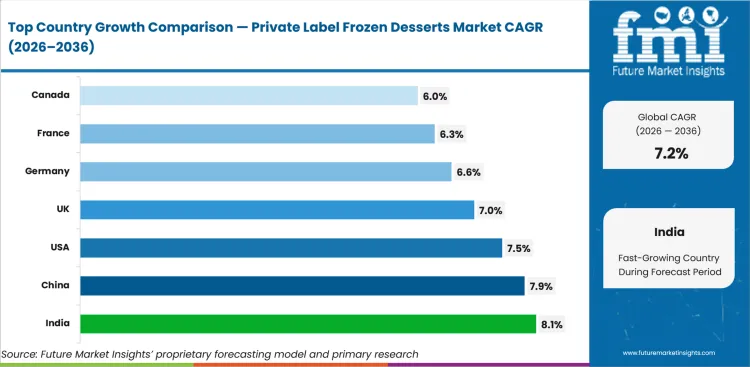
Private Label Frozen Desserts Market CAGR Analysis by Country
- India is forecast to record 8.1% CAGR by 2036, supported by expanding metro freezer access and strong domestic dairy supply encouraging store-owned dessert trials.
- China is projected to expand at 7.9% CAGR through 2036, driven by online grocery platforms and club-store freezer tests enhancing retailer brand reach.
- The United States is expected to rise at 7.5% CAGR by 2036, supported by national store brand programs keeping freezer promotions active.
- The United Kingdom is forecast to advance at 7.0% CAGR through 2036, with supermarket own-label ranges spanning both value and premium desserts.
- Germany is expected to record 6.6% CAGR over the forecast period, aided by discounter freezer ranges and local ice cream output supporting private label supply.
- France is projected to expand at 6.3% CAGR by 2036, driven by growing acceptance of premium private labels supporting higher-value dessert tiers.
- Canada is forecast to grow at 6.0% CAGR through 2036, supported by premium grocery chains and regional dairy processors expanding store-owned dessert ranges.
Sales Outlook for Private Label Frozen Desserts Market in India
Value freezer growth center · 2026 to 2036
Country Market Snapshot Table
| Parameter | Value |
|---|---|
| Market Size in 2025 (Value) | USD 1,018.5 million |
| Market Size in 2026 (Value) | USD 1,101.0 million |
| Market Forecast in 2036 (Value) | USD 2,399.1 million |
| CAGR (2026-2036) | 8.1% |
| Years Considered | 2021-2036 |
| Base Year | 2025 |
| Forecast Period | 2026-2036 |
| Units Considered | Value (USD million) |
| Leading Sub-Region | Metro and tier-one grocery retail |
India Private Label Frozen Desserts Market Outlook
India private label frozen dessert demand is shaped by value buying and quick-commerce freezer access. Retailers can place store-owned tubs beside dairy desserts and family multipacks at metro stores.
Local dairy supply gives grocers a manufacturing route for ice cream and frozen yogurt. Imported inclusions and limited cold-chain reach outside tier-one cities can restrict premium freezer trials.
Key Growth Drivers
- Metro households create a stronger trial pool for store-owned freezer desserts, supported by urban monthly per capita consumption expenditure of INR 6,996 in 2023-24.
- Domestic dairy processors give retailers local supply options owing to milk output reaching 239.3 million tonnes in 2023-24.
- India’s dairy cost position supports store-owned tubs, reflected by national milk output rising 63.6% from 2014-15 to 2023-24.
- Retailer-owned freezer launches can use local supply depth, as India contributed 24.8% of global milk production in 2023-24.
Key Restraints
- Rural freezer reach can lag metro grocery channels, given rural monthly per capita consumption expenditure stood at INR 4,122 in 2023-24.
- Premium private label tubs can face price resistance outside large cities, with imputed rural MPCE at INR 4,247 in 2023-24.
- Smaller outlets may carry fewer freezer SKUs since HCES 2023-24 covered 8,684 rural first stage units compared with urban samples.
What makes India unique
India is garnering expansion due to quick commerce adoption and a large dairy processing network.
Key Companies
- Reliance Retail
- DMart
- More Retail
- Amul
- Heritage Foods
Sales & Marketing Channels
- Supermarkets
- Quick commerce
- Online grocery
- Hypermarkets
- Dairy parlours
- Foodservice partners
Country Segment Breakdown Table
| Segment | Sub-Segments |
|---|---|
| By Product Type | Ice Cream · Frozen Yogurt · Sorbet · Frozen Bars · Frozen Pops |
| By Retail Ownership Tier | Mass Retailer · Discounters · Grocer Premium · Club Brands · Online Brands |
| By Source | Dairy Based · Plant Based · Hybrid Based |
| By Pack Format | Multi-serve Tubs · Single Bars · Mini Cups · Multipacks · Novelty Packs |
| By Sales Channel | Supermarkets · Discount Stores · Online Retail · Club Stores · Convenience Stores |
| By Consumer Group | Value-Driven Consumers · Treat Seekers · Health Managers · Children · Convenience Buyers |
| Key Sub-Regions Covered, Retail Clusters | Delhi NCR · Mumbai · Bengaluru · Hyderabad · Chennai · Pune |
Frequently Asked Questions
How fast is India private label frozen desserts market growing?
India private label frozen desserts demand is forecast at 8.1% CAGR from 2026 to 2036 through metro freezer access.
Who leads India private label frozen desserts market?
Reliance Retail and DMart compete with Amul and regional dairy makers across store-owned frozen dessert ranges.
What is driving adoption in India private label frozen desserts market?
Urban freezer reach and domestic dairy output are pulling store-owned tubs into regular grocery baskets.
Sales Outlook for Private Label Frozen Desserts Market in China
Urban digital grocery center · 2026 to 2036
Country Market Snapshot Table
| Parameter | Value |
|---|---|
| Market Size in 2025 (Value) | USD 2,317.0 million |
| Market Size in 2026 (Value) | USD 2,500.1 million |
| Market Forecast in 2036 (Value) | USD 5,347.8 million |
| CAGR (2026-2036) | 7.9% |
| Years Considered | 2021-2036 |
| Base Year | 2025 |
| Forecast Period | 2026-2036 |
| Units Considered | Value (USD million) |
| Leading Sub-Region | Coastal supermarket and club retail |
China Private Label Frozen Desserts Market Outlook
China private label frozen dessert demand is guided by digital grocery habits and club-store freezer trials. Retailers can test value tubs and premium sticks across high-density urban outlets.
Domestic dairy groups support frozen dessert production capacity. Price promotions and uneven cold-chain standards can limit private label quality proof outside leading coastal cities.
Key Growth Drivers
- Urban food shoppers give retailer brands a stronger online discovery route, as online food retail sales rose 14.5% in China during 2025.
- Supermarket chains can expand freezer placement at scale since retail sales by supermarkets above designated size rose 4.3% in 2025.
- Retail platforms can market store-owned desserts directly to search shoppers, with online retail sales reaching 15,972.2 billion yuan in 2025.
- Digital basket conversion supports frozen dessert listing tests since physical goods online retail reached 13,092.3 billion yuan in 2025.
Key Restraints
- Freezer fulfilment costs can pressure store-owned dessert margins as physical goods online retail growth was 5.2% in 2025.
- Consumer spending checks remain important since total retail sales of consumer goods increased 3.7% in 2025.
- Grocery retailers may avoid excessive SKU expansion, as online physical goods accounted for 26.1% of total retail sales in 2025.
What makes China unique
China is unique due to platform grocery buying and premium freezer testing in coastal cities.
Key Companies
- Freshippo
- Yonghui Superstores
- China Resources Vanguard
- Sam’s Club China
- RT-Mart China
- Mengniu Dairy
Sales & Marketing Channels
- Premium supermarkets
- Club stores
- Online grocery
- Convenience chains
- Specialty stores
- Café partners
Country Segment Breakdown Table
| Segment | Sub-Segments |
|---|---|
| By Product Type | Ice Cream · Frozen Yogurt · Sorbet · Frozen Bars · Frozen Pops |
| By Retail Ownership Tier | Mass Retailer · Discounters · Grocer Premium · Club Brands · Online Brands |
| By Source | Dairy Based · Plant Based · Hybrid Based |
| By Pack Format | Multi-serve Tubs · Single Bars · Mini Cups · Multipacks · Novelty Packs |
| By Sales Channel | Supermarkets · Discount Stores · Online Retail · Club Stores · Convenience Stores |
| By Consumer Group | Value-Driven Consumers · Treat Seekers · Health Managers · Children · Convenience Buyers |
| Key Sub-Regions Covered, Retail Clusters | Shanghai · Beijing · Guangzhou · Shenzhen · Hangzhou · Chengdu |
Frequently Asked Questions
How fast is China private label frozen desserts market growing?
China private label frozen desserts sales are projected to record 7.9% CAGR by 2036, driven by urban grocery platforms expansion.
Who leads China private label frozen desserts market?
Freshippo and Yonghui compete beside Sam’s Club China and dairy groups in store-owned freezer products.
What is driving adoption in China private label frozen desserts market?
Online food retail and coastal supermarket density are moving shoppers toward retailer-owned frozen dessert products.
Sales Outlook for Private Label Frozen Desserts Market in United States
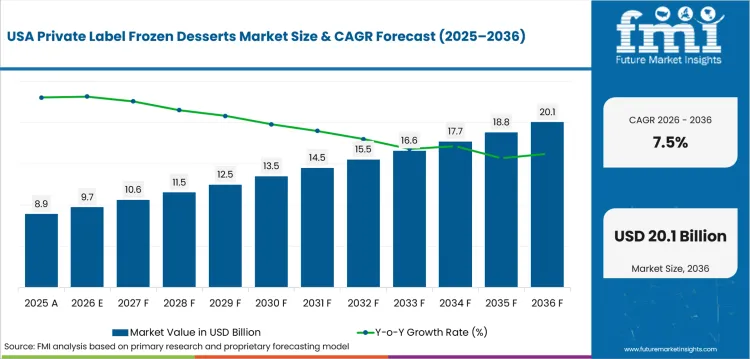
National store brand freezer center · 2026 to 2036
Country Market Snapshot Table
| Parameter | Value |
|---|---|
| Market Size in 2025 (Value) | USD 4,279.1 million |
| Market Size in 2026 (Value) | USD 4,600.0 million |
| Market Forecast in 2036 (Value) | USD 9,480.7 million |
| CAGR (2026-2036) | 7.5% |
| Years Considered | 2021-2036 |
| Base Year | 2025 |
| Forecast Period | 2026-2036 |
| Units Considered | Value (USD million) |
| Leading Sub-Region | National grocery freezer aisle |
United States Private Label Frozen Desserts Market Outlook
United States private label frozen dessert demand is centered on store brands across mass retail and club freezer aisles. Family tubs and multipack novelties give retailers a direct value message.
Store brand trust gives grocers a clear route into premium and better-for-you desserts. Manufacturing output pressure can raise co-packer competition during seasonal ice cream peaks.
Key Growth Drivers
- Store-owned desserts gain buyer trust from total private label scale as PLMA reported USD 282.8 billion in USA store brand sales during 2025.
- Frozen private label units improved across all outlets during the first half of 2025 with frozen department units rising 2.1%.
- National retailers can support owned dessert tiers as private label dollar sales increased 3.3% across 2025.
- Store brand dessert trial benefits from branded product comparison, as national brand dollar sales rose only 1.2% in 2025.
Key Restraints
- Co-manufacturing capacity needs tighter planning after USDA ERS reported 1,386 million gallons of USA frozen dairy output during 2024.
- Freezer supply pressure can limit rapid SKU growth since USA frozen dairy production declined 10.0% from 2000 to 2024.
- Production scheduling remains seasonal because USDA NASS reported regular hard ice cream output at 64.7 million gallons in April 2024, up 7.3% from April 2023.
What makes United States unique
United States is unique due to national store brand programs and large freezer aisle scale.
Key Companies
- Walmart
- Kroger
- Costco Wholesale
- Target
- ALDI US
- Albertsons
Sales & Marketing Channels
- Mass retail
- Supermarkets
- Club stores
- Online grocery
- Convenience stores
- Foodservice partners
Country Segment Breakdown Table
| Segment | Sub-Segments |
|---|---|
| By Product Type | Ice Cream · Frozen Yogurt · Sorbet · Frozen Bars · Frozen Pops |
| By Retail Ownership Tier | Mass Retailer · Discounters · Grocer Premium · Club Brands · Online Brands |
| By Source | Dairy Based · Plant Based · Hybrid Based |
| By Pack Format | Multi-serve Tubs · Single Bars · Mini Cups · Multipacks · Novelty Packs |
| By Sales Channel | Supermarkets · Discount Stores · Online Retail · Club Stores · Convenience Stores |
| By Consumer Group | Value-Driven Consumers · Treat Seekers · Health Managers · Children · Convenience Buyers |
| Key Sub-Regions Covered, Retail Clusters | California · Texas · Florida · New York · Midwest · Pacific Northwest |
Frequently Asked Questions
How fast is United States private label frozen desserts market growing?
United States private label frozen desserts sales are forecast to rise at 7.5% CAGR by 2036 on retailer brand scale.
Who leads United States private label frozen desserts market?
Walmart and Kroger compete with Costco and Target through owned frozen dessert lines and freezer access.
What is driving adoption in United States private label frozen desserts market?
National store-brand trust and frozen aisle scale are lifting private label dessert trial across grocery outlets.
Industry Outlook for Private Label Frozen Desserts Market in United Kingdom
Retailer brand dessert center · 2026 to 2036
Country Market Snapshot Table
| Parameter | Value |
|---|---|
| Market Size in 2025 (Value) | USD 1,775.7 million |
| Market Size in 2026 (Value) | USD 1,900.0 million |
| Market Forecast in 2036 (Value) | USD 3,737.6 million |
| CAGR (2026-2036) | 7.0% |
| Years Considered | 2021-2036 |
| Base Year | 2025 |
| Forecast Period | 2026-2036 |
| Units Considered | Value (USD million) |
| Leading Sub-Region | England grocery multiples |
United Kingdom Private Label Frozen Desserts Market Outlook
United Kingdom private label frozen dessert demand is shaped by supermarket brand strength and household value checks. Grocery multiples can extend own-label frozen desserts across basic and premium ranges.
Retailers must protect taste while keeping family pack prices controlled. Food spending outside home can compete for dessert spending during warmer months.
Key Growth Drivers
- Grocery freezer budgets support retailer brand desserts as household food and drink spending reached £35.94 per person each week in FYE 2024.
- Home dessert occasions retain value appeal since household food and non-alcoholic drink spending reached £32.30 per person each week in FYE 2024.
- Grocery multiples can test store-owned dessert tiers since UK households spent £70.50 per week on food and alcoholic drinks in FYE 2024.
- Own-label freezer programs can use online grocery habits and retail loyalty data, supported by total food and drink expenditure of £47.19 per person each week.
Key Restraints
- Foodservice recovery can pull dessert spending away from home freezers, with food and drink eaten out at £11.25 per person each week in FYE 2024.
- Dessert spending outside home remains a competing occasion as eating-out food and non-alcoholic drink spending reached £8.67 per person each week in FYE 2024.
- Private label premium pints need careful price positioning since total food and drink expenditure rose 3.2% in real terms.
What makes United Kingdom unique
United Kingdom is unique due to deep supermarket private label ranges and active own-brand dessert tiers.
Key Companies
- Tesco
- Sainsbury’s
- ASDA
- Morrisons
- Iceland Foods
- Co-op
Sales & Marketing Channels
- Grocery multiples
- Discounters
- Online grocery
- Frozen specialists
- Convenience chains
- Club stores
Country Segment Breakdown Table
| Segment | Sub-Segments |
|---|---|
| By Product Type | Ice Cream · Frozen Yogurt · Sorbet · Frozen Bars · Frozen Pops |
| By Retail Ownership Tier | Mass Retailer · Discounters · Grocer Premium · Club Brands · Online Brands |
| By Source | Dairy Based · Plant Based · Hybrid Based |
| By Pack Format | Multi-serve Tubs · Single Bars · Mini Cups · Multipacks · Novelty Packs |
| By Sales Channel | Supermarkets · Discount Stores · Online Retail · Club Stores · Convenience Stores |
| By Consumer Group | Value-Driven Consumers · Treat Seekers · Health Managers · Children · Convenience Buyers |
| Key Sub-Regions Covered, Retail Clusters | England · Scotland · Wales · Northern Ireland · London · Midlands |
Frequently Asked Questions
How fast is United Kingdom private label frozen desserts market growing?
The United Kingdom private label frozen desserts market is expected to advance at 7.0% CAGR by 2036.
Who leads United Kingdom private label frozen desserts market?
Tesco and Sainsbury’s compete with ASDA and Iceland Foods through own-label frozen dessert tiers.
What is driving adoption in United Kingdom private label frozen desserts market?
Supermarket brand trust and household value checks are increasing retailer-owned frozen dessert adoption.
Growth Outlook for Private Label Frozen Desserts Market in Germany
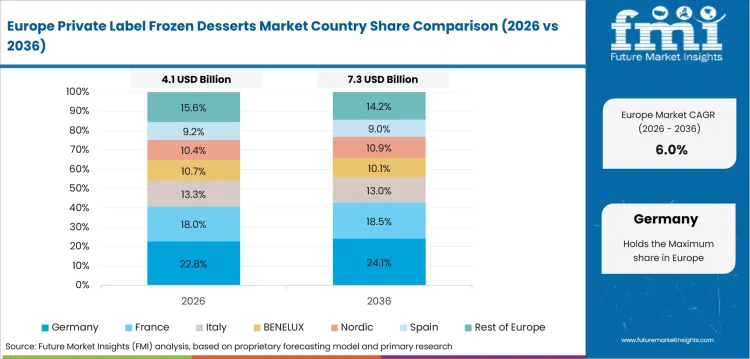
Discounters and dairy scale center · 2026 to 2036
Country Market Snapshot Table
| Parameter | Value |
|---|---|
| Market Size in 2025 (Value) | USD 1,500.9 million |
| Market Size in 2026 (Value) | USD 1,600.0 million |
| Market Forecast in 2036 (Value) | USD 3,031.7 million |
| CAGR (2026-2036) | 6.6% |
| Years Considered | 2021-2036 |
| Base Year | 2025 |
| Forecast Period | 2026-2036 |
| Units Considered | Value (USD million) |
| Leading Sub-Region | Discounters and full-line grocers |
Germany Private Label Frozen Desserts Market Outlook
Germany private label frozen dessert demand is shaped by discounter strength and dairy manufacturing scale. Store-owned tubs can gain from trusted retailer brands and stable freezer placement.
Ingredient standards and price comparison keep supplier choice disciplined. Brands need consistent texture and clear allergen labelling across dairy and plant-based offerings.
Key Growth Drivers
- Discounter-led freezer programs have a strong production pool as Germany produced 607 million litres of ice cream in 2024.
- European output scale supports retailer-owned supply as EU ice cream production reached 3.3 billion litres in 2024.
- Store-owned dessert programs benefit from regional manufacturing depth as EU production increased 2.0% from 2023 to 2024.
- German retailers can pair dairy pints with demand for frozen food in EU as private label share across Germany, France and the United Kingdom reached 40.3%.
Key Restraints
- Supplier cost checks remain tight after German ice cream production declined from 612 million litres in 2023 to 607 million litres in 2024.
- High own-label share increases taste expectations, making weak dessert texture more costly for repeat sales at discount chains.
- Plant based store brands need clear allergen and ingredient control before gaining freezer retention in discounter shelves.
What makes Germany unique
Germany is unique due to discount-chain private label strength and local ice cream production depth.
Key Companies
- ALDI
- Lidl
- REWE
- Edeka
- DMK Group
- Froneri Germany
Sales & Marketing Channels
- Discounters
- Supermarkets
- Hypermarkets
- Drugstores
- Online grocery
- Foodservice partners
Country Segment Breakdown Table
| Segment | Sub-Segments |
|---|---|
| By Product Type | Ice Cream · Frozen Yogurt · Sorbet · Frozen Bars · Frozen Pops |
| By Retail Ownership Tier | Mass Retailer · Discounters · Grocer Premium · Club Brands · Online Brands |
| By Source | Dairy Based · Plant Based · Hybrid Based |
| By Pack Format | Multi-serve Tubs · Single Bars · Mini Cups · Multipacks · Novelty Packs |
| By Sales Channel | Supermarkets · Discount Stores · Online Retail · Club Stores · Convenience Stores |
| By Consumer Group | Value-Driven Consumers · Treat Seekers · Health Managers · Children · Convenience Buyers |
| Key Sub-Regions Covered, Retail Clusters | North Rhine-Westphalia · Bavaria · Baden-Wurttemberg · Hesse · Berlin · Hamburg |
Frequently Asked Questions
How fast is Germany private label frozen desserts market growing?
Germany private label frozen desserts sector is projected at 6.6% CAGR over the assessment period.
Who leads Germany private label frozen desserts market?
ALDI and Lidl compete with REWE and Edeka through retailer-owned frozen dessert assortments.
What is driving adoption in Germany private label frozen desserts market?
Discounter reach and domestic ice cream output are supporting store-owned frozen dessert supply.
Sales Outlook for Private Label Frozen Desserts Market in France
Premium private label freezer center · 2026 to 2036
Country Market Snapshot Table
| Parameter | Value |
|---|---|
| Market Size in 2025 (Value) | USD 1,317.1 million |
| Market Size in 2026 (Value) | USD 1,400.0 million |
| Market Forecast in 2036 (Value) | USD 2,579.1 million |
| CAGR (2026-2036) | 6.3% |
| Years Considered | 2021-2036 |
| Base Year | 2025 |
| Forecast Period | 2026-2036 |
| Units Considered | Value (USD million) |
| Leading Sub-Region | Hypermarkets and frozen specialists |
France Private Label Frozen Desserts Market Outlook
France private label frozen dessert demand is guided by hypermarket range depth and frozen specialists. Retailers can use premium store brands to stretch beyond basic value tubs.
Local dairy supply and export skill support dessert manufacturing. Price sensitivity can slow premium lines if store-owned products move too close to national-brand pricing.
Key Growth Drivers
- Premium store brands have a clear path in France as NIQ reported premium private labels at 8.5% of total private label sales.
- Ice cream supply depth supports store-owned dessert output since Eurostat recorded 501 million litres of French ice cream production in 2024.
- French retailers can build premium freezer tiers as PLMA International placed France among Europe’s store brand leaders.
- Store-owned dessert programs can use frozen supply expertise through France’s established ice cream export base.
Key Restraints
- Export focus can tighten domestic supply choices as France’s non-EU ice cream exports reached 55.9 million kg in 2024.
- Premium own-label pints can face price comparison against national brands in hypermarket freezer aisles.
- Co-manufacturers must protect texture quality because premium own-label pints are compared directly with national brands in hypermarket freezer aisles
What makes France unique
France is unique due to hypermarket private labels and frozen specialist retail strength.
Key Companies
- Carrefour
- Auchan
- E.Leclerc
- Intermarche
- Picard
- Lactalis
Sales & Marketing Channels
- Hypermarkets
- Frozen specialists
- Supermarkets
- Drive pickup
- Online grocery
- Foodservice partners
Country Segment Breakdown Table
| Segment | Sub-Segments |
|---|---|
| By Product Type | Ice Cream · Frozen Yogurt · Sorbet · Frozen Bars · Frozen Pops |
| By Retail Ownership Tier | Mass Retailer · Discounters · Grocer Premium · Club Brands · Online Brands |
| By Source | Dairy Based · Plant Based · Hybrid Based |
| By Pack Format | Multi-serve Tubs · Single Bars · Mini Cups · Multipacks · Novelty Packs |
| By Sales Channel | Supermarkets · Discount Stores · Online Retail · Club Stores · Convenience Stores |
| By Consumer Group | Value-Driven Consumers · Treat Seekers · Health Managers · Children · Convenience Buyers |
| Key Sub-Regions Covered, Retail Clusters | Ile-de-France · Auvergne-Rhone-Alpes · Hauts-de-France · Occitanie · Nouvelle-Aquitaine · Provence-Alpes-Cote dAzur |
Frequently Asked Questions
How fast is France private label frozen desserts market growing?
France private label frozen desserts demand is set to grow at 6.3% CAGR by 2036 with premium store brands expanding.
Who leads France private label frozen desserts market?
Carrefour and E.Leclerc compete with Auchan and Picard through own-label frozen dessert ranges.
What is driving adoption in France private label frozen desserts market?
Premium private label acceptance and local ice cream production are lifting store-owned dessert activity.
Demand Outlook for Private Label Frozen Desserts Market in Canada
Premium grocery freezer center · 2026 to 2036
Country Market Snapshot Table
| Parameter | Value |
|---|---|
| Market Size in 2025 (Value) | USD 846.7 million |
| Market Size in 2026 (Value) | USD 897.5 million |
| Market Forecast in 2036 (Value) | USD 1,607.3 million |
| CAGR (2026-2036) | 6.0% |
| Years Considered | 2021-2036 |
| Base Year | 2025 |
| Forecast Period | 2026-2036 |
| Units Considered | Value (USD million) |
| Leading Sub-Region | Ontario and British Columbia |
Canada Private Label Frozen Desserts Market Outlook
Canada private label frozen dessert demand is shaped by premium grocery chains and cross-border brand learning. Retailers can blend family tubs with lactose-free and plant-based freezer choices.
Distance between provinces raises cold-chain costs for frozen desserts. Regional brands need stable texture and clear label proof to earn shelf space.
Key Growth Drivers
- Local production supports freezer depth as Statistics Canada recorded 15,293 kilolitres of hard ice cream output in March 2024.
- Household dessert familiarity supports store-owned tubs as Canadian dairy processors produced 197,750 kilolitres of hard ice cream across 2025.
- Seasonal freezer planning can support store-owned summer ranges, reflected by hard ice cream output reaching 61,121 kilolitres in Q2 2025.
- Retailers can test domestic and imported dairy-free cream options as Canadian shoppers compare lactose-free and plant-based choices.
Key Restraints
- Imported ranges can pressure domestic store brands as Canada imported 6.35 million kg of ice cream and other edible ice in 2024.
- Regional distribution can raise costs for frozen tubs sold outside Ontario and British Columbia.
- Cold-chain planning must focus on current seasonal production peaks and regional freezer distribution costs.
What makes Canada unique
Canada is unique due to premium grocery chains and regional dairy processors serving large provinces.
Key Companies
- Loblaw
- Sobeys
- Metro Inc.
- Costco Canada
- Chapman’s
- Agropur
Sales & Marketing Channels
- Supermarkets
- Club stores
- Online grocery
- Natural stores
- Convenience stores
- Foodservice partners
Country Segment Breakdown Table
| Segment | Sub-Segments |
|---|---|
| By Product Type | Ice Cream · Frozen Yogurt · Sorbet · Frozen Bars · Frozen Pops |
| By Retail Ownership Tier | Mass Retailer · Discounters · Grocer Premium · Club Brands · Online Brands |
| By Source | Dairy Based · Plant Based · Hybrid Based |
| By Pack Format | Multi-serve Tubs · Single Bars · Mini Cups · Multipacks · Novelty Packs |
| By Sales Channel | Supermarkets · Discount Stores · Online Retail · Club Stores · Convenience Stores |
| By Consumer Group | Value-Driven Consumers · Treat Seekers · Health Managers · Children · Convenience Buyers |
| Key Sub-Regions Covered, Retail Clusters | Ontario · Quebec · British Columbia · Alberta · Manitoba · Atlantic Canada |
Frequently Asked Questions
How fast is Canada private label frozen desserts market growing?
Canada private label frozen desserts industry is expected to record 6.0% CAGR during the projection period.
Who leads Canada private label frozen desserts market?
Loblaw and Sobeys compete with Metro and Costco Canada through retailer-owned frozen dessert lines.
What is driving adoption in Canada private label frozen desserts market?
Local ice cream production and premium grocery chains are improving store-owned frozen dessert reach.
Market Report Scope
| Item | Value |
|---|---|
| Market size by 2036 | USD 36.0 billion |
| Growth rate | 7.2% CAGR from 2026 to 2036 |
| Market size in 2026 | USD 18.0 billion |
| Quantitative Units | Value in USD billion |
| Market Definition | Retailer-owned frozen desserts sold through grocery and foodservice channels |
| Product Type Segmentation | Ice Cream · Frozen Yogurt · Sorbet · Frozen Bars · Frozen Pops |
| Retail Ownership Tier Segmentation | Mass Retailer · Discounters · Grocer Premium · Club Brands · Online Brands |
| Source Segmentation | Dairy Based · Plant Based · Hybrid Based |
| Pack Format Segmentation | Multi-serve Tubs · Single Bars · Mini Cups · Multipacks · Novelty Packs |
| Sales Channel Segmentation | Supermarkets · Discount Stores · Online Retail · Club Stores · Convenience Stores |
| Consumer Group Segmentation | Value-Driven Consumers · Treat Seekers · Health Managers · Children · Convenience Buyers |
| Regions Covered | North America · Europe · East Asia · South Asia · Latin America |
| Countries Covered | India · China · United States · United Kingdom · Germany · France · Canada |
| Key Companies Profiled | Walmart · ALDI · Kroger · Costco · Target · Tesco · Carrefour |
| Forecast Period | 2026-2036 |
| Approach | Bottom-up product-boundary approach with SKU revenue and channel checks |
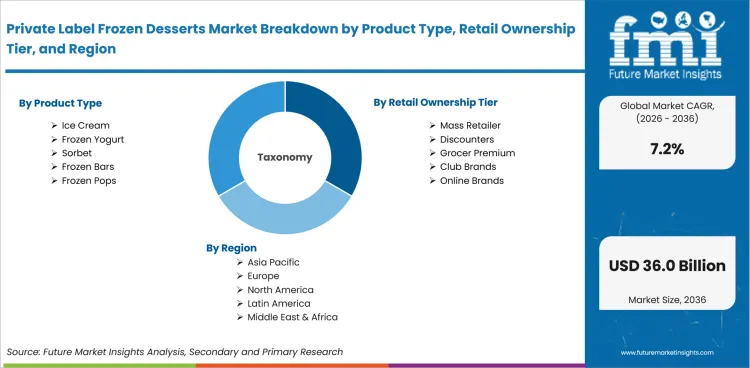
Private Label Frozen Desserts Market Breakdown by Product Type, Retail Ownership Tier, Source, Pack Format, Sales Channel, Consumer Group and Region
By Product Type
- Ice Cream
- Frozen Yogurt
- Sorbet
- Frozen Bars
- Frozen Pops
By Retail Ownership Tier
- Mass Retailer
- Discounters
- Grocer Premium
- Club Brands
- Online Brands
By Source
- Dairy Based
- Plant Based
- Hybrid Based
By Pack Format
- Multi-serve Tubs
- Single Bars
- Mini Cups
- Multipacks
- Novelty Packs
By Sales Channel
- Supermarkets
- Discount Stores
- Online Retail
- Club Stores
- Convenience Stores
By Consumer Group
- Value-Driven Consumers
- Treat Seekers
- Health Managers
- Children
- Convenience Buyers
By Region
- North America
- Latin America
- Europe
- East Asia
- South Asia
- Oceania
- Middle East and Africa
Research Sources and Bibliography
- Target Corporation. (2025). 2024 annual report.
- Carrefour. (2025, March 27). Universal registration document 2024.
- Private Label Manufacturers Association. (2026, January 20). USA private label industry reached $282.8 billion in sales in 2025.
- Walmart Inc. (2024, April 30). Walmart launches bettergoods, a new private brand making elevated culinary experiences accessible for all.
- Tesco PLC. (2025, June 11). Tesco taps into flavour trends with new range of chilled and frozen desserts for summer.
- ALDI US. (2025, September 24). ALDI gives fans what they want with its largest packaging refresh yet.
- The Kroger Co. (2025, October). 2025 responsible business report.
- Walmart Inc. (2025, October 1). Walmart USA moves to eliminate synthetic dyes across all private brand food products.
- Tesco PLC. (2025, June 12). Q1 trading statement 2025/26.
- Koninklijke Ahold Delhaize N.V. (2026, February 25). Annual report 2025.
- Albertsons Companies, Inc. (2025, April 21). Form 10-K for the fiscal year ended February 22, 2025.
- Sinclair, N., Difonzo, P., & McDonough, J. (2025). Effect of storage temperature on frozen dessert quality using scanning electron microscopy and a trained sensory panel. Exploration of Foods and Foodomics.
- EY India. (2025, May 21). 52% consumers are switching to private labels: EY Future Consumer Index.
- Eurostat. (2025, July 29). EU ice cream production sees uptick of 2% in 2024.
- National Bureau of Statistics of China. (2026, January 20). Total retail sales of consumer goods in December 2025.
- Department for Environment, Food & Rural Affairs. (2025, November 6). Family Food FYE 2024.
- Statistics Canada. (2026). Table 32-10-0483-01: Production and stocks of various food products.
- Office for National Statistics. (2025, September 10). Family spending in the UK: April 2023 to March 2024.
- World Integrated Trade Solution. (2025). Canada imports of ice cream and other edible ice from world in 2024. World Bank.
- USA Department of Agriculture, National Agricultural Statistics Service. (2024, June 5). Dairy products: April 2024.
- Press Information Bureau. (2025, January 30). Household Consumption Expenditure Survey: 2023-24.
- Press Information Bureau. (2025, September 29). India’s dairy sector.
- USA Department of Agriculture, Economic Research Service. (2025, July 16). Ice cream and frozen dairy production dipped from 2000 to 2024.
- NielsenIQ. (2025, October 16). Private label power in Western Europe: Confidence, value and innovation drive growth.
- Barry Callebaut. (2025). 2025 ice cream trends: Global market insights & innovation.
- Bibliography uses English-language official public body, company and trade association sources dated 2024 onward.
This bibliography is provided for reader reference and is not exhaustive. The full report contains the complete reference list and detailed citations.
This Report Answers
- What is the 2026 value and 2036 forecast for the private label frozen desserts market?
- Which product type is projected to hold the leading share during the forecast period?
- Which source is expected to account for the leading 2026 share?
- How do retailer-owned brands affect frozen dessert pricing and freezer shelf rotation?
- Which companies compete in the private label frozen desserts market?
Frequently Asked Questions
What is the private label frozen desserts market size in 2026?
The private label frozen desserts market is expected to cross USD 18.0 billion in 2026.
What is the private label frozen desserts market forecast for 2036?
The private label frozen desserts industry is forecast to reach USD 36.0 billion by 2036 as retailer-owned freezer lines expand.
What is the private label frozen desserts market CAGR?
The private label frozen desserts sector is projected to expand at 7.2% CAGR from 2026 to 2036.
What segment leads the private label frozen desserts market?
Dairy-based products are likely to garner 54.7% share in 2026 due to familiar texture and strong dairy supply.
What country grows fastest in the private label frozen desserts market?
India is forecast to record 8.1% CAGR by 2036 owing to metro grocery growth and domestic dairy supply.
Which companies compete in the private label frozen desserts market?
Walmart, ALDI, Kroger, Costco, Target, Tesco and Carrefour compete through retailer-owned frozen dessert programs.
Preview the report firsthand - request a free sample
Get SampleGet the brochure for pricing and purchase details.
Get PDFTable of Content
- Executive Summary
- Global Market Outlook
- Demand-side Trends
- Supply-side Trends
- Technology Roadmap Analysis
- Analysis and Recommendations
- Market Overview
- Market Coverage / Taxonomy
- Market Definition / Scope / Limitations
- Research Methodology
- Chapter Orientation
- Analytical Lens and Working Hypotheses
- Market Structure, Signals, and Trend Drivers
- Benchmarking and Cross-market Comparability
- Market Sizing, Forecasting, and Opportunity Mapping
- Research Design and Evidence Framework
- Desk Research Programme (Secondary Evidence)
- Company Annual and Sustainability Reports
- Peer-reviewed Journals and Academic Literature
- Corporate Websites, Product Literature, and Technical Notes
- Earnings Decks and Investor Briefings
- Statutory Filings and Regulatory Disclosures
- Technical White Papers and Standards Notes
- Trade Journals, Industry Magazines, and Analyst Briefs
- Conference Proceedings, Webinars, and Seminar Materials
- Government Statistics Portals and Public Data Releases
- Press Releases and Reputable Media Coverage
- Specialist Newsletters and Curated Briefings
- Sector Databases and Reference Repositories
- FMI Internal Proprietary Databases and Historical Market Datasets
- Subscription Datasets and Paid Sources
- Social Channels, Communities, and Digital Listening Inputs
- Additional Desk Sources
- Expert Input and Fieldwork (Primary Evidence)
- Primary Modes
- Qualitative Interviews and Expert Elicitation
- Quantitative Surveys and Structured Data Capture
- Blended Approach
- Why Primary Evidence is Used
- Field Techniques
- Interviews
- Surveys
- Focus Groups
- Observational and In-context Research
- Social and Community Interactions
- Stakeholder Universe Engaged
- C-suite Leaders
- Board Members
- Presidents and Vice Presidents
- R&D and Innovation Heads
- Technical Specialists
- Domain Subject-matter Experts
- Scientists
- Retail buyers, manufacturers, and food industry professionals
- Governance, Ethics, and Data Stewardship
- Research Ethics
- Data Integrity and Handling
- Primary Modes
- Tooling, Models, and Reference Databases
- Desk Research Programme (Secondary Evidence)
- Data Engineering and Model Build
- Data Acquisition and Ingestion
- Cleaning, Normalisation, and Verification
- Synthesis, Triangulation, and Analysis
- Quality Assurance and Audit Trail
- Market Background
- Market Dynamics
- Drivers
- Restraints
- Opportunity
- Trends
- Scenario Forecast
- Demand in Optimistic Scenario
- Demand in Likely Scenario
- Demand in Conservative Scenario
- Opportunity Map Analysis
- Product Life Cycle Analysis
- Supply Chain Analysis
- Investment Feasibility Matrix
- Value Chain Analysis
- PESTLE and Porter’s Analysis
- Regulatory Landscape
- Regional Parent Market Outlook
- Production and Consumption Statistics
- Import and Export Statistics
- Market Dynamics
- Global Market Analysis 2021 to 2025 and Forecast, 2026 to 2036
- Historical Market Size Value (USD Million) Analysis, 2021 to 2025
- Current and Future Market Size Value (USD Million) Projections, 2026 to 2036
- Y-o-Y Growth Trend Analysis
- Absolute $ Opportunity Analysis
- Global Market Pricing Analysis 2021 to 2025 and Forecast 2026 to 2036
- Global Market Analysis 2021 to 2025 and Forecast 2026 to 2036, By Product Type
- Introduction / Key Findings
- Historical Market Size Value (USD Million) Analysis By Product Type , 2021 to 2025
- Current and Future Market Size Value (USD Million) Analysis and Forecast By Product Type , 2026 to 2036
- Ice Cream
- Frozen Yogurt
- Sorbet
- Frozen Bars
- Frozen Pops
- Ice Cream
- Y-o-Y Growth Trend Analysis By Product Type , 2021 to 2025
- Absolute $ Opportunity Analysis By Product Type , 2026 to 2036
- Global Market Analysis 2021 to 2025 and Forecast 2026 to 2036, By Retail Ownership Tier
- Introduction / Key Findings
- Historical Market Size Value (USD Million) Analysis By Retail Ownership Tier, 2021 to 2025
- Current and Future Market Size Value (USD Million) Analysis and Forecast By Retail Ownership Tier, 2026 to 2036
- Mass Retailer
- Discounters
- Grocer Premium
- Club Brands
- Online Brands
- Mass Retailer
- Y-o-Y Growth Trend Analysis By Retail Ownership Tier, 2021 to 2025
- Absolute $ Opportunity Analysis By Retail Ownership Tier, 2026 to 2036
- Global Market Analysis 2021 to 2025 and Forecast 2026 to 2036, By Source
- Introduction / Key Findings
- Historical Market Size Value (USD Million) Analysis By Source, 2021 to 2025
- Current and Future Market Size Value (USD Million) Analysis and Forecast By Source, 2026 to 2036
- Dairy Based
- Plant Based
- Hybrid Based
- Dairy Based
- Y-o-Y Growth Trend Analysis By Source, 2021 to 2025
- Absolute $ Opportunity Analysis By Source, 2026 to 2036
- Global Market Analysis 2021 to 2025 and Forecast 2026 to 2036, By Pack Format
- Introduction / Key Findings
- Historical Market Size Value (USD Million) Analysis By Pack Format, 2021 to 2025
- Current and Future Market Size Value (USD Million) Analysis and Forecast By Pack Format, 2026 to 2036
- Multi-serve Tubs
- Single Bars
- Mini Cups
- Multipacks
- Novelty Packs
- Multi-serve Tubs
- Y-o-Y Growth Trend Analysis By Pack Format, 2021 to 2025
- Absolute $ Opportunity Analysis By Pack Format, 2026 to 2036
- Global Market Analysis 2021 to 2025 and Forecast 2026 to 2036, By Sales Channel
- Introduction / Key Findings
- Historical Market Size Value (USD Million) Analysis By Sales Channel, 2021 to 2025
- Current and Future Market Size Value (USD Million) Analysis and Forecast By Sales Channel, 2026 to 2036
- Supermarkets
- Discount Stores
- Online Retail
- Club Stores
- Convenience Stores
- Supermarkets
- Y-o-Y Growth Trend Analysis By Sales Channel, 2021 to 2025
- Absolute $ Opportunity Analysis By Sales Channel, 2026 to 2036
- Global Market Analysis 2021 to 2025 and Forecast 2026 to 2036, By Consumer Group
- Introduction / Key Findings
- Historical Market Size Value (USD Million) Analysis By Consumer Group, 2021 to 2025
- Current and Future Market Size Value (USD Million) Analysis and Forecast By Consumer Group, 2026 to 2036
- Value-Driven Consumers
- Treat Seekers
- Health Managers
- Children
- Convenience Buyers
- Value-Driven Consumers
- Y-o-Y Growth Trend Analysis By Consumer Group, 2021 to 2025
- Absolute $ Opportunity Analysis By Consumer Group, 2026 to 2036
- Global Market Analysis 2021 to 2025 and Forecast 2026 to 2036, By Region
- Introduction
- Historical Market Size Value (USD Million) Analysis By Region, 2021 to 2025
- Current Market Size Value (USD Million) Analysis and Forecast By Region, 2026 to 2036
- North America
- Latin America
- Western Europe
- Eastern Europe
- East Asia
- South Asia and Pacific
- Middle East & Africa
- Market Attractiveness Analysis By Region
- North America Market Analysis 2021 to 2025 and Forecast 2026 to 2036, By Country
- Historical Market Size Value (USD Million) Trend Analysis By Market Taxonomy, 2021 to 2025
- Market Size Value (USD Million) Forecast By Market Taxonomy, 2026 to 2036
- By Country
- USA
- Canada
- Mexico
- By Product Type
- By Retail Ownership Tier
- By Source
- By Pack Format
- By Sales Channel
- By Consumer Group
- By Country
- Market Attractiveness Analysis
- By Country
- By Product Type
- By Retail Ownership Tier
- By Source
- By Pack Format
- By Sales Channel
- By Consumer Group
- Key Takeaways
- Latin America Market Analysis 2021 to 2025 and Forecast 2026 to 2036, By Country
- Historical Market Size Value (USD Million) Trend Analysis By Market Taxonomy, 2021 to 2025
- Market Size Value (USD Million) Forecast By Market Taxonomy, 2026 to 2036
- By Country
- Brazil
- Chile
- Rest of Latin America
- By Product Type
- By Retail Ownership Tier
- By Source
- By Pack Format
- By Sales Channel
- By Consumer Group
- By Country
- Market Attractiveness Analysis
- By Country
- By Product Type
- By Retail Ownership Tier
- By Source
- By Pack Format
- By Sales Channel
- By Consumer Group
- Key Takeaways
- Western Europe Market Analysis 2021 to 2025 and Forecast 2026 to 2036, By Country
- Historical Market Size Value (USD Million) Trend Analysis By Market Taxonomy, 2021 to 2025
- Market Size Value (USD Million) Forecast By Market Taxonomy, 2026 to 2036
- By Country
- Germany
- UK
- Italy
- Spain
- France
- Nordic
- BENELUX
- Rest of Western Europe
- By Product Type
- By Retail Ownership Tier
- By Source
- By Pack Format
- By Sales Channel
- By Consumer Group
- By Country
- Market Attractiveness Analysis
- By Country
- By Product Type
- By Retail Ownership Tier
- By Source
- By Pack Format
- By Sales Channel
- By Consumer Group
- Key Takeaways
- Eastern Europe Market Analysis 2021 to 2025 and Forecast 2026 to 2036, By Country
- Historical Market Size Value (USD Million) Trend Analysis By Market Taxonomy, 2021 to 2025
- Market Size Value (USD Million) Forecast By Market Taxonomy, 2026 to 2036
- By Country
- Russia
- Poland
- Hungary
- Balkan & Baltic
- Rest of Eastern Europe
- By Product Type
- By Retail Ownership Tier
- By Source
- By Pack Format
- By Sales Channel
- By Consumer Group
- By Country
- Market Attractiveness Analysis
- By Country
- By Product Type
- By Retail Ownership Tier
- By Source
- By Pack Format
- By Sales Channel
- By Consumer Group
- Key Takeaways
- East Asia Market Analysis 2021 to 2025 and Forecast 2026 to 2036, By Country
- Historical Market Size Value (USD Million) Trend Analysis By Market Taxonomy, 2021 to 2025
- Market Size Value (USD Million) Forecast By Market Taxonomy, 2026 to 2036
- By Country
- China
- Japan
- South Korea
- By Product Type
- By Retail Ownership Tier
- By Source
- By Pack Format
- By Sales Channel
- By Consumer Group
- By Country
- Market Attractiveness Analysis
- By Country
- By Product Type
- By Retail Ownership Tier
- By Source
- By Pack Format
- By Sales Channel
- By Consumer Group
- Key Takeaways
- South Asia and Pacific Market Analysis 2021 to 2025 and Forecast 2026 to 2036, By Country
- Historical Market Size Value (USD Million) Trend Analysis By Market Taxonomy, 2021 to 2025
- Market Size Value (USD Million) Forecast By Market Taxonomy, 2026 to 2036
- By Country
- India
- ASEAN
- Australia & New Zealand
- Rest of South Asia and Pacific
- By Product Type
- By Retail Ownership Tier
- By Source
- By Pack Format
- By Sales Channel
- By Consumer Group
- By Country
- Market Attractiveness Analysis
- By Country
- By Product Type
- By Retail Ownership Tier
- By Source
- By Pack Format
- By Sales Channel
- By Consumer Group
- Key Takeaways
- Middle East & Africa Market Analysis 2021 to 2025 and Forecast 2026 to 2036, By Country
- Historical Market Size Value (USD Million) Trend Analysis By Market Taxonomy, 2021 to 2025
- Market Size Value (USD Million) Forecast By Market Taxonomy, 2026 to 2036
- By Country
- Kingdom of Saudi Arabia
- Other GCC Countries
- Turkiye
- South Africa
- Other African Union
- Rest of Middle East & Africa
- By Product Type
- By Retail Ownership Tier
- By Source
- By Pack Format
- By Sales Channel
- By Consumer Group
- By Country
- Market Attractiveness Analysis
- By Country
- By Product Type
- By Retail Ownership Tier
- By Source
- By Pack Format
- By Sales Channel
- By Consumer Group
- Key Takeaways
- Key Countries Market Analysis
- USA
- Pricing Analysis
- Market Share Analysis, 2025
- By Product Type
- By Retail Ownership Tier
- By Source
- By Pack Format
- By Sales Channel
- By Consumer Group
- Canada
- Pricing Analysis
- Market Share Analysis, 2025
- By Product Type
- By Retail Ownership Tier
- By Source
- By Pack Format
- By Sales Channel
- By Consumer Group
- Mexico
- Pricing Analysis
- Market Share Analysis, 2025
- By Product Type
- By Retail Ownership Tier
- By Source
- By Pack Format
- By Sales Channel
- By Consumer Group
- Brazil
- Pricing Analysis
- Market Share Analysis, 2025
- By Product Type
- By Retail Ownership Tier
- By Source
- By Pack Format
- By Sales Channel
- By Consumer Group
- Chile
- Pricing Analysis
- Market Share Analysis, 2025
- By Product Type
- By Retail Ownership Tier
- By Source
- By Pack Format
- By Sales Channel
- By Consumer Group
- Germany
- Pricing Analysis
- Market Share Analysis, 2025
- By Product Type
- By Retail Ownership Tier
- By Source
- By Pack Format
- By Sales Channel
- By Consumer Group
- UK
- Pricing Analysis
- Market Share Analysis, 2025
- By Product Type
- By Retail Ownership Tier
- By Source
- By Pack Format
- By Sales Channel
- By Consumer Group
- Italy
- Pricing Analysis
- Market Share Analysis, 2025
- By Product Type
- By Retail Ownership Tier
- By Source
- By Pack Format
- By Sales Channel
- By Consumer Group
- Spain
- Pricing Analysis
- Market Share Analysis, 2025
- By Product Type
- By Retail Ownership Tier
- By Source
- By Pack Format
- By Sales Channel
- By Consumer Group
- France
- Pricing Analysis
- Market Share Analysis, 2025
- By Product Type
- By Retail Ownership Tier
- By Source
- By Pack Format
- By Sales Channel
- By Consumer Group
- India
- Pricing Analysis
- Market Share Analysis, 2025
- By Product Type
- By Retail Ownership Tier
- By Source
- By Pack Format
- By Sales Channel
- By Consumer Group
- ASEAN
- Pricing Analysis
- Market Share Analysis, 2025
- By Product Type
- By Retail Ownership Tier
- By Source
- By Pack Format
- By Sales Channel
- By Consumer Group
- Australia & New Zealand
- Pricing Analysis
- Market Share Analysis, 2025
- By Product Type
- By Retail Ownership Tier
- By Source
- By Pack Format
- By Sales Channel
- By Consumer Group
- China
- Pricing Analysis
- Market Share Analysis, 2025
- By Product Type
- By Retail Ownership Tier
- By Source
- By Pack Format
- By Sales Channel
- By Consumer Group
- Japan
- Pricing Analysis
- Market Share Analysis, 2025
- By Product Type
- By Retail Ownership Tier
- By Source
- By Pack Format
- By Sales Channel
- By Consumer Group
- South Korea
- Pricing Analysis
- Market Share Analysis, 2025
- By Product Type
- By Retail Ownership Tier
- By Source
- By Pack Format
- By Sales Channel
- By Consumer Group
- Russia
- Pricing Analysis
- Market Share Analysis, 2025
- By Product Type
- By Retail Ownership Tier
- By Source
- By Pack Format
- By Sales Channel
- By Consumer Group
- Poland
- Pricing Analysis
- Market Share Analysis, 2025
- By Product Type
- By Retail Ownership Tier
- By Source
- By Pack Format
- By Sales Channel
- By Consumer Group
- Hungary
- Pricing Analysis
- Market Share Analysis, 2025
- By Product Type
- By Retail Ownership Tier
- By Source
- By Pack Format
- By Sales Channel
- By Consumer Group
- Kingdom of Saudi Arabia
- Pricing Analysis
- Market Share Analysis, 2025
- By Product Type
- By Retail Ownership Tier
- By Source
- By Pack Format
- By Sales Channel
- By Consumer Group
- Turkiye
- Pricing Analysis
- Market Share Analysis, 2025
- By Product Type
- By Retail Ownership Tier
- By Source
- By Pack Format
- By Sales Channel
- By Consumer Group
- South Africa
- Pricing Analysis
- Market Share Analysis, 2025
- By Product Type
- By Retail Ownership Tier
- By Source
- By Pack Format
- By Sales Channel
- By Consumer Group
- USA
- Market Structure Analysis
- Competition Dashboard
- Competition Benchmarking
- Market Share Analysis of Top Players
- By Regional
- By Product Type
- By Retail Ownership Tier
- By Source
- By Pack Format
- By Sales Channel
- By Consumer Group
- Competition Analysis
- Competition Deep Dive
- Lidl Stiftung & Co. KG
- Overview
- Product Portfolio
- Profitability by Market Segments (Product/Sales Channel/Region)
- Sales Footprint
- Strategy Overview
- Marketing Strategy
- Product Strategy
- Channel Strategy
- The Kroger Co.
- Costco Wholesale Corporation
- Target Corporation
- Tesco PLC
- Carrefour S.A.
- Lidl Stiftung & Co. KG
- Competition Deep Dive
- Assumptions & Acronyms Used


