

- Market Size (2026)
- USD 3.0 Bn
- Forecast (2036)
- USD 6.2 Bn
- CAGR (2026 to 2036)
- 7.5%
Mini Frozen Dessert Novelties Market Size, Market Forecast and Outlook By FMI
The mini frozen dessert novelties market value is expected to grow from USD 2.8 billion in 2025 to USD 6.2 billion by 2036 at 7.5% CAGR driven by increasing consumer demand for convenient and indulgent frozen treats. Dairy is likely to represent 62.4% share in 2026 as consumers continue to prefer familiar creaminess in small frozen formats. Multipacks are expected to secure 57.8% share in 2026, led by household freezer stocking and portion-controlled dessert buying.
Summary of Mini Frozen Dessert Novelties Market
- Demand and Growth Drivers
- Mini frozen formats are moving from children-only treats into household portion packs for evening desserts.
- Dairy-based products are strengthening freezer space as familiar taste supports mini bars and cups.
- Multipacks are gaining attention since families can manage unit cost and serving size in one pack.
- Product and Segment View
- Dairy is forecast to represent 62.4% share in 2026, led by familiar taste and established frozen dessert manufacturing lines.
- Multipacks are projected to hold 57.8% share in 2026, influenced by household freezer stocking and planned snack buying.
- Supermarkets are expected to secure 48.7% share in 2026, supported by freezer aisle discovery and weekly grocery trips.
- Geography and Competitive Outlook
- India is projected to record 9.1% CAGR by 2036, backed by dairy scale and metro freezer retail expansion.
- China is expected to expand at 8.7% CAGR by 2036 through online grocery and premium freezer discovery.
- The Magnum Ice Cream Company and General Mills compete by branded mini formats and established freezer access.
- Mars and Bubbies compete based on portion packs that connect single pieces with multipack replenishment.
- Analyst Opinion
- Nandini Roy Choudhury, Principal Consultant for Food and Beverage at FMI, observes, “Mini frozen dessert novelties represent a choice reflecting portion control and familiar indulgence. Shoppers want small servings first and flavor trust second. Brands balancing pack count and freezer price points should gain stronger repeat buying.”
- Mini Frozen Dessert Novelties Market Value Analysis
- Market value is driven by freezer SKU revenue before foodservice and online grocery add incremental volume.
- Supplier pricing reflects dairy solids and coating inputs before wrapping costs affect retail price.
- Revenue improves as brands convert full-size dessert users into portion-controlled novelty buyers through taste trust.
- Retail trust rises as mini pack labels make serving size and unit count easier for shoppers to compare.
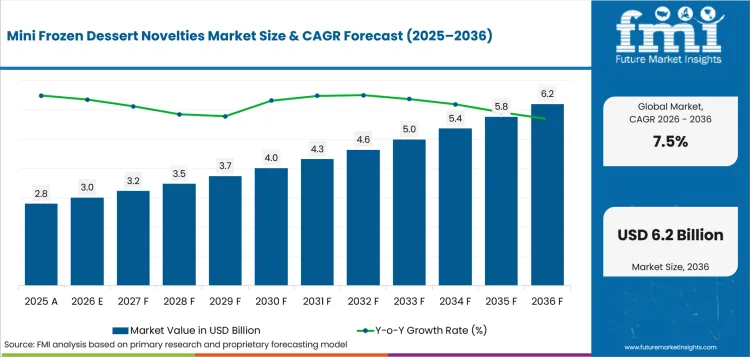
Key Takeaways, Market Size, and Forecast
- 2026 Market Size: USD 3.0 billion
- 2036 Market Size: USD 6.2 billion
- Forecast CAGR: 7.5% from 2026 to 2036
- Leading Base Ingredient: Dairy
- Dairy Share in 2026: 62.4%
- Leading Pack Type: Multipacks
- Multipacks Share in 2026: 57.8%
- Fastest-growing Country: India
- India CAGR: 9.1% by 2036
Mini frozen desserts are harder to scale than full-size bars because each small piece needs accurate coating and cost control. Unilever’s November 2024 Bon Bon work shows the production challenge clearly. Its automated lines can make 200 million bites per year. The chocolate coating system must cover thousands of bites per minute. Brands in the ice cream and frozen dessert market therefore need dedicated equipment before mini bites move from test launches into large retail programs. Plant-based mini novelties add another challenge. Unilever’s 2024 patent uses 0.5% to 12.0% oat material solids and 0.4% to 10.0% plant protein, reflecting texture depending on a controlled recipe. This gives ingredient suppliers a stronger role as dairy-free minis enters the plant-based ice creams market. Labeling also needs careful planning. eCFR requires ice cream to contain at least 10.0% milkfat and weighs at least 4.5 pounds per gallon. Manufacturers therefore need clear product names before placing dairy and plant-based minis in the same frozen desserts market freezer aisle.
Mini Frozen Dessert Novelties Market Definition
Mini Frozen Dessert Novelties Market covers frozen sweet products sold in small portion-controlled formats. Scope includes mini bars, mini cones, mini sandwiches, mini cups, and mochi bites using dairy, plant-based, frozen yogurt, sorbet, or hybrid bases. Revenue includes finished branded and private label frozen novelties sold through retail, online grocery, convenience, and foodservice channels.
Mini Frozen Dessert Novelties Market Inclusions
Market scope covers commercially sold mini frozen dessert novelties by product type such as mini bars and mini cups. Base ingredient coverage includes dairy and plant-based systems. Pack type analysis includes multipacks and single-serve formats. Claim analysis includes portion control and low calorie. Sales channel analysis includes supermarkets and online retail. Revenue scope covers market activity from 2026 to 2036 across finished frozen dessert products and private label retail formats. Key participants include frozen dessert brands, dairy processors, plant-based formulators, ingredient suppliers, grocery chains, packaging suppliers, and online grocery platforms.
Mini Frozen Dessert Novelties Market Exclusions
Scope excludes full-size tubs and bulk foodservice ice cream that do not carry mini novelty positioning. Frozen bakery desserts, refrigerated yogurt cups, shelf-stable dessert mixes, and ordinary frozen desserts are outside scope. Ingredient revenue is counted only if used inside finished mini frozen dessert novelty products.
Mini Frozen Dessert Novelties Market Research Methodology
- Primary Research: FMI analysts reviewed frozen dessert brand portfolios and retail freezer assortment checks across major grocery markets.
- Desk Research: Public data from USDA ERS, Eurostat, India dairy bodies, China NBS, USDA FAS, AHDB, and official company releases were checked against mini frozen dessert evidence.
- Market Sizing and Forecasting: Estimated using a bottom-up product-boundary approach. Eligible SKU revenue, channel presence, retail pricing, product positioning, and country-level adoption were used to construct the 2026 market estimate.
- Data Validation: Forecast checks compared dairy output, frozen dessert production, retail freezer access, and active supplier portfolios. Official product launches were reviewed across mini novelty demand.
Why is the Mini Frozen Dessert Novelties Market Growing?
- Smaller frozen treats are moving into regular snacking as consumers look for portion control without changing dessert habits.
- Brand owners are using bite-sized formats to extend premium products into easier freezer and sharing occasions.
- Retailers are giving more attention to pack-ready formats that can rotate quickly and stay visible in freezer cabinets.
Industry outlook is strengthening as mini novelties move from limited trials into planned freezer programs. Unilever stated in February 2025, in-home ice cream performance was supported by snacking innovations with smaller portions, and Magnum Bon Bons were already present in 12 markets with further rollout planned. This supports wider retail testing for mini bars and bite formats across the ice cream and frozen dessert market. Freezer execution is becoming equally important. Unilever stated in August 2024, 100,000 ice cream freezer cabinets used AI-enabled image recognition, with a target of 350,000 by the end of 2025. Such freezer visibility can help retailers track fast-moving small packs before stock gaps hurt repeat purchases. Packaging will also shape rollout, as the European Commission stated that Packaging and Packaging Waste Regulation 2025/40 generally applies from 12 August 2026. Mini multipacks in the frozen food packaging market therefore need recyclable wrappers and cartons that protect small frozen pieces.
Market Segmentation Analysis
- Mini bars are projected to secure 31.6% share in 2026 as stick handling and coating familiarity support freezer trial.
- Dairy is projected to hold 62.4% share in 2026, led by familiar creaminess and established frozen dessert manufacturing lines.
- Multipacks are forecast to capture 57.8% share in 2026, since household freezer stocking supports planned dessert use.
- Portion control claims are anticipated to hold 44.3% share in 2026, driven by smaller pieces that simplify serving discipline.
- Supermarkets are expected to represent 48.7% share in 2026, influenced by freezer aisle comparison and weekly grocery buying.
The mini frozen dessert novelties industry is divided by product type, base ingredient, pack type, claim, sales channel, and region. Product type includes mini bars, mini cones, mini sandwiches, mini cups, and mochi bites. Base ingredient covers dairy, plant-based, frozen yogurt, sorbet, and hybrid formats. Pack type covers multipacks, single-serve, club packs, party packs, and variety packs. Claim analysis covers portion control, low calorie, clean label, dairy free, and kids. Sales channel analysis covers supermarkets, club stores, online retail, foodservice, and convenience stores.
Insights into Mini Frozen Dessert Novelties Market by Product Type
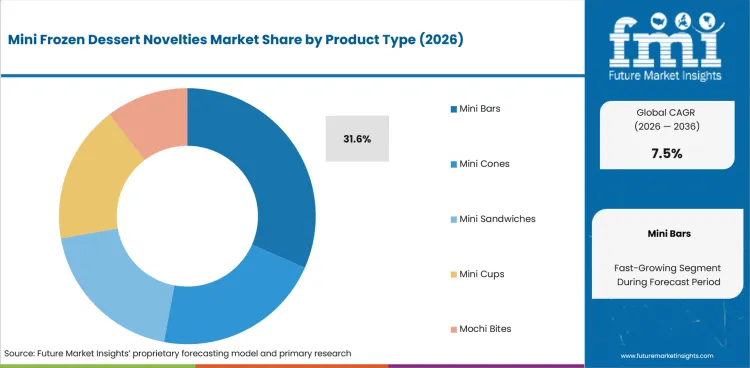
- Mini bars are projected to account for 31.6% share in 2026, influenced by stick-format convenience and coating protection during freezer handling.
- Mini cones gain use as familiar wafer formats create a small indulgent serving without full cone sizing.
Insights into Mini Frozen Dessert Novelties Market by Base Ingredient
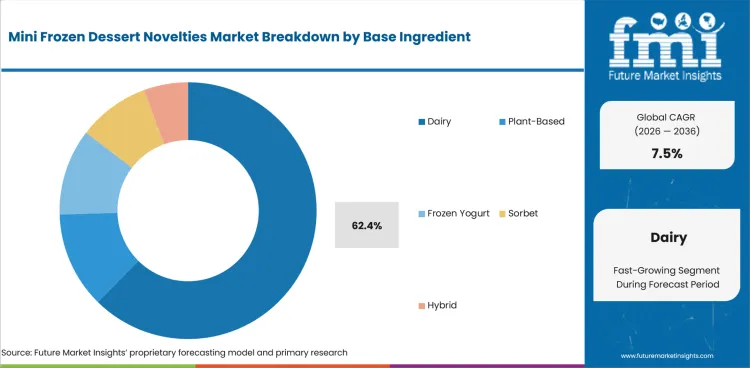
- Dairy is forecast to hold 62.4% share in 2026 through familiar flavor delivery and established creamery capacity.
- Plant-based formats gain attention as plant-based ice creams move into mainstream frozen cases.
Insights into Mini Frozen Dessert Novelties Market by Pack Type
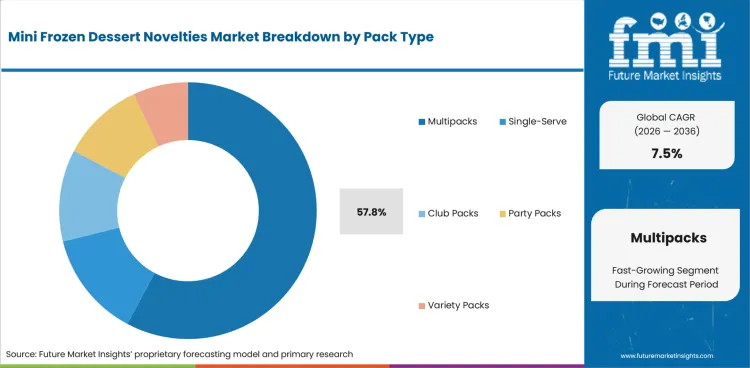
- Multipacks are expected to account for 57.8% share in 2026 due to family freezer stocking and unit-price clarity.
- Variety packs gain value as retailers test mixed flavors for trial without adding many shelf slots.
Insights into Mini Frozen Dessert Novelties Market by Claim
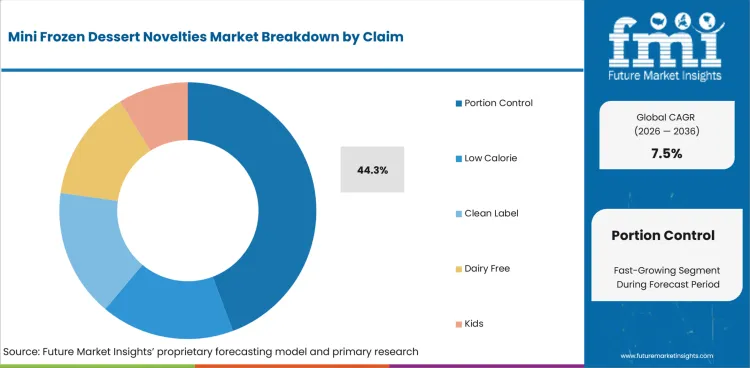
- Portion control is projected to secure 44.3% share in 2026 as smaller servings align with normal dessert selection.
- Dairy-free claims gain shelf space as non-dairy ice cream products extend from tubs into single-piece novelties.
Insights into Mini Frozen Dessert Novelties Market by Sales Channel
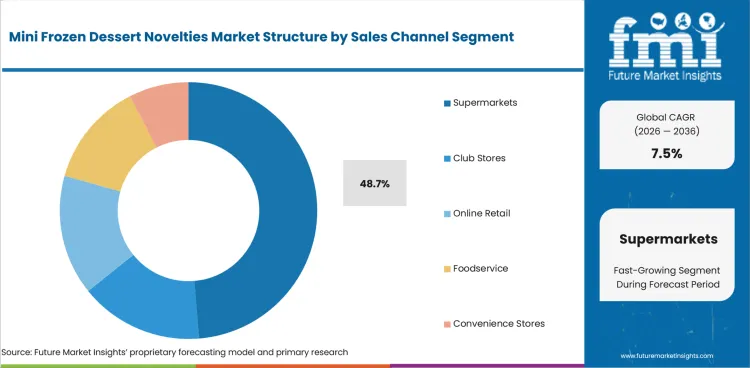
- Supermarkets are anticipated to hold 48.7% share in 2026, driven by freezer aisle comparison across bars and mini cups.
- Club stores create value through larger pack counts and promotional freezer pallets for mini bars.
Mini Frozen Dessert Novelties Market Drivers, Restraints and Opportunities
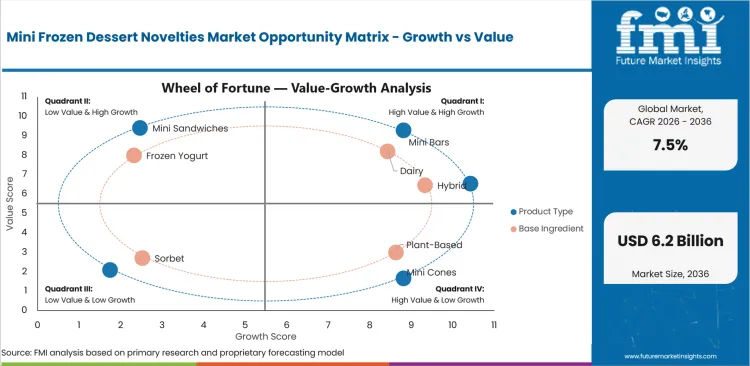
- Driver: Smaller frozen treats are gaining space as consumers look for controlled indulgence without shifting away from familiar dessert habits.
- Restraint: Recipe and labeling rules can raise complexity when brands position dairy and hybrid mini formats.
- Opportunity: Premium bar launches and recyclable small-pack design are creating room for differentiated freezer assortments.
Growth outlook is moving toward mini novelties combining portion control and premium freezer appeal. IFIC’s December 2025 sweetener survey found, 79.0% of Americans enjoy a bite-sized portion daily or weekly, while 53.0% choose ice cream when they want a sweet food or beverage. This supports smaller treats in the ice cream and frozen dessert market as a practical fit for controlled snacking. Formulation discipline remains important since Australia New Zealand Standard 2.5.6 requires ice cream to contain at least 100 g/kg milk fat and 168 g/L food solids, which can affect product naming and recipe design. General Mills stated in April 2025, Häagen-Dazs Belgian Chocolate Stickbars launched in select European stores in four flavors, showing how premium bar formats can support differentiated freezer testing across the frozen desserts market.
Retail Price and Pack-price Architecture Analysis
Retail price planning for mini frozen dessert novelties is expected to use sharper pack ladders so brands can protect affordability and premium cues. BLS data hosted by FRED shows the U.S. average price for prepackaged bulk ice cream at USD 6.24 per half-gallon in April 2026. That compared with USD 6.40 in December 2025 and gives retailers a mainstream price anchor for freezer comparison. Pack-price architecture will depend on unit count clarity and price gaps that make premium minis affordable beside take-home tubs.
Consumer Segmentation and Purchase Behavior Analysis
Consumer targeting is expected to shift toward dessert users who buy on impulse and still want a treat-led experience. NIQ’s June 2026 dessert analysis reported that over nine in ten consumers typically order desserts when eating out. One-third of consumers and nearly half of those aged 18 to 34 order dessert every time or most times they eat out. The same source found that nearly two-thirds of frequent dessert consumers eat out weekly and spend £12.41 more per month on out-of-home food and drink. This supports stronger positioning for mini bars and mochi-style formats in the frozen desserts market. Younger consumers and regular dessert buyers still want portion control and manageable spend in one product.
Analysis of Mini Frozen Dessert Novelties Market by Key Countries
.webp "Top Country Growth Comparison Mini Frozen Dessert Novelties Market Cagr (2026 2036)")
| Country | CAGR |
|---|---|
| India | 9.1% |
| China | 8.7% |
| Australia | 8.2% |
| United States | 7.9% |
| United Kingdom | 7.1% |
| Germany | 6.8% |
| Japan | 6.3% |
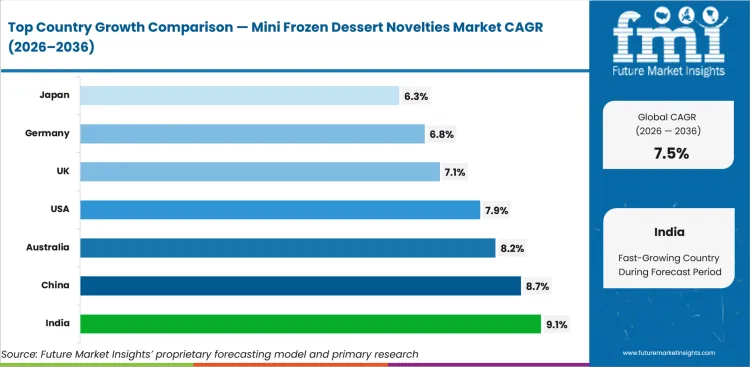
Source: Future Market Insights, 2026.
Mini Frozen Dessert Novelties Market CAGR Analysis by Country
- India is forecast to record a 9.1% CAGR by 2036, supported by expanding dairy scale and growing metro freezer retail adoption of mini-pack formats.
- China’s 8.7% CAGR reflects strong digital grocery penetration and increasing premium freezer product discovery across coastal cities during the forecast period.
- Australia is projected to expand at an 8.2% CAGR by 2036, driven by supermarket freezer networks encouraging snack-pack experimentation.
- The United States is forecast to rise at a 7.9% CAGR by 2036, supported by widespread freezer distribution and ongoing multipack expansion.
- The United Kingdom is expected to advance at a 7.1% CAGR through 2036, aided by growing bite-size product trials within grocery freezer programs.
- Germany’s 6.8% CAGR reflects strong ice cream production capacity alongside disciplined retail price comparison trends.
- Japan is forecast to expand at a 6.3% CAGR by 2036, supported by convenience store freezers promoting premium portion-controlled formats.
Sales Outlook for Mini Frozen Dessert Novelties Market in India
Dairy scale and metro freezer retail center · 2026 to 2036
Country Market Snapshot Table
| Parameter | Value |
|---|---|
| Market Size in 2025 (Value) | USD 229.1 million |
| Market Size in 2026 (Value) | USD 250.0 million |
| Market Forecast in 2036 (Value) | USD 597.3 million |
| CAGR (2026 to 2036) | 9.1% |
| Years Considered | 2021 to 2036 |
| Base Year | 2025 |
| Forecast Period | 2026 to 2036 |
| Units Considered | Value (USD million) |
| Leading Sub-Region | Delhi NCR and western metro freezer corridors |
India Mini Frozen Dessert Novelties Market Outlook
India mini frozen dessert novelty demand is shaped by dairy scale and urban freezer access. Organized retail and quick commerce support premium frozen products among consumers familiar with milk-based desserts and packaged snack formats.
Metro consumers are expected to adopt mini bars and multipacks before wider tier-one rollout. Brands with cold chain control and localized flavors should gain early freezer rotation.
Key Growth Drivers
- Manufacturers can build mini dairy bars around domestic supply depth. Dairy ingredient access supports local formulation, with Basic Animal Husbandry Statistics 2025 reporting milk production at 247.9 million tonnes during 2024 to 2025.
- Frozen mini cups can connect with routine milk-based eating habits. Daily dairy familiarity aids dessert trial, since the 2026 year-end review placed per-capita milk availability at 485.0 grams per day for 2024 to 2025.
- Processors can test mini novelty lines with stronger supply confidence. Recent milk output improvement supports value-added dairy conversion, reflected by official growth of 3.6% over the previous year.
- Premium dessert makers can plan phased sourcing around high-output regions. Milk solids availability gains support from producing states, with five leading states contributing 54.1% of national milk production in 2024 to 2025.
Key Restraints
- Mini dessert makers may need fat-standardization work across dairy sources. Ingredient mix can require formulation control, with exotic and crossbred cattle milk output rising 5.0% while buffalo milk output rose 2.5% over the prior year.
- Mini novelty texture may need tighter fat control. Ingredient mix can require formulation control, with indigenous buffalo contributing 31.2% of milk output and crossbred cattle contributing 30.8%.
- Premium freezer rollout can lag dairy depth, since milk production strength does not automatically create stable frozen distribution. Brands may need phased launches across metro corridors.
What makes India unique
India is witnessing expansiondue to dairy scale plus urban retail expansion and fast growth in packaged portion desserts.
Key Companies
- Amul
- Havmor Ice Cream
- NIC Honestly Crafted Ice Creams
- Baskin Robbins India
- Kwality Wall’s India
- Go Zero
- Koozies Ice Cream
Sales & Marketing Channels
- Supermarket freezers
- Club stores
- Online grocery
- Quick commerce
- Convenience stores
- Foodservice freezers
Country Segment Breakdown Table
| Segment | Sub-Segments |
|---|---|
| By Product Type | Mini Bars · Mini Cones · Mini Sandwiches · Mini Cups · Mochi Bites |
| By Base Ingredient | Dairy · Plant-Based · Frozen Yogurt · Sorbet · Hybrid |
| By Pack Type | Multipacks · Single-Serve · Club Packs · Party Packs · Variety Packs |
| By Claim | Portion Control · Low Calorie · Clean Label · Dairy Free · Kids |
| By Sales Channel | Supermarkets · Club Stores · Online Retail · Foodservice · Convenience Stores |
| Key Sub-Regions Covered, Urban Retail Clusters | Delhi NCR · Mumbai · Bengaluru · Hyderabad · Pune · Chennai |
Market Taxonomy and Sub-Regions Covered
Frequently Asked Questions
How fast is India mini frozen dessert novelties market growing?
India sales are forecast to expand at 9.1% CAGR from 2026 to 2036, driven by dairy depth and urban freezer retail expansion.
Who leads India mini frozen dessert novelties market?
Dairy processors and premium frozen dessert brands compete through local milk access, retail freezer placement, and flavor localization.
What is driving adoption in India mini frozen dessert novelties market?
Dairy supply depth and metro portion-controlled snacking are moving consumers toward mini frozen dessert novelties.
Demand Outlook for Mini Frozen Dessert Novelties Market in China
Digital grocery and premium freezer retail center · 2026 to 2036
Country Market Snapshot Table
| Parameter | Value |
|---|---|
| Market Size in 2025 (Value) | USD 312.8 million |
| Market Size in 2026 (Value) | USD 340.0 million |
| Market Forecast in 2036 (Value) | USD 783.0 million |
| CAGR (2026 to 2036) | 8.7% |
| Years Considered | 2021 to 2036 |
| Base Year | 2025 |
| Forecast Period | 2026 to 2036 |
| Units Considered | Value (USD million) |
| Leading Sub-Region | Shanghai and coastal premium retail clusters |
China Mini Frozen Dessert Novelties Market Outlook
China mini frozen dessert novelty demand is led by premium grocery channels and digital food discovery. Urban shoppers compare texture and portion cues before choosing frozen dessert formats.
Coastal cities are expected to take early share through club stores and convenience retail. Local brands can scale faster by pairing familiar flavors with mini pack positioning.
Key Growth Drivers
- Mini dessert brands can reach shoppers through direct search and platform promotions. Digital grocery discovery supports premium freezer products, with China’s online retail sales of physical goods reaching 13,092.3 billion yuan in 2025.
- New frozen formats can use digital product pages to explain serving size and pack count. Food e-commerce gives small frozen desserts a sharper route to trial, as online food sales increased 14.5% in 2025.
- Coastal supermarkets can test mini bars before wider inland rollout. Urban retail channels remain central to premium frozen products, with urban retail sales reaching 43,297.2 billion yuan in 2025.
- Dessert makers can use premium grocery placement to convert dairy dessert buyers. Total consumer spending provides a large route to freezer growth, as China’s retail sales of consumer goods reached 50,120.2 billion yuan in 2025.
Key Restraints
- Brands may need smaller packs before larger family boxes gain repeat demand. Premium dessert trade-up needs careful pricing, as total retail sales rose 3.7% in 2025.
- Mini dessert brands may need stronger platform visibility to compete with faster food categories. Physical goods online sales rose 5.2% in 2025, below growth seen in online food sales.
- Packaging should explain serving size and unit count in plain language. Dairy and frozen dessert labels need clear product education, since small packs can be mistaken for children-only products.
What makes China unique
China stands out because online grocery depth and premium coastal retail allow faster packaged-food testing.
Key Companies
- Inner Mongolia Yili Industrial Group
- China Mengniu Dairy
- Bright Dairy & Food
- The Magnum Ice Cream Company
- Häagen-Dazs China
- Nestlé China
Sales & Marketing Channels
- Premium supermarkets
- Online grocery
- Club stores
- Convenience chains
- Specialty stores
- Café partners
Country Segment Breakdown Table
| Segment | Sub-Segments |
|---|---|
| By Product Type | Mini Bars · Mini Cones · Mini Sandwiches · Mini Cups · Mochi Bites |
| By Base Ingredient | Dairy · Plant-Based · Frozen Yogurt · Sorbet · Hybrid |
| By Pack Type | Multipacks · Single-Serve · Club Packs · Party Packs · Variety Packs |
| By Claim | Portion Control · Low Calorie · Clean Label · Dairy Free · Kids |
| By Sales Channel | Supermarkets · Club Stores · Online Retail · Foodservice · Convenience Stores |
| Key Sub-Regions Covered, Coastal Retail Areas | Shanghai · Beijing · Guangzhou · Shenzhen · Hangzhou · Chengdu |
Market Taxonomy and Sub-Regions Covered
Frequently Asked Questions
How fast is China mini frozen dessert novelties market growing?
Demand in China is ready to rise at 8.7% CAGR from 2026 to 2036, influenced by online grocery and premium freezer testing.
Who leads China mini frozen dessert novelties market?
Yili, Mengniu, and Bright Dairy compete based on local brand strength and premium freezer reach.
What is driving adoption in China mini frozen dessert novelties market?
Digital grocery access and premium dessert trial are moving urban shoppers toward mini frozen dessert formats.
Growth Outlook for Mini Frozen Dessert Novelties Market in Australia
Dairy ingredient and supermarket freezer center · 2026 to 2036
Country Market Snapshot Table
| Parameter | Value |
|---|---|
| Market Size in 2025 (Value) | USD 115.5 million |
| Market Size in 2026 (Value) | USD 125.0 million |
| Market Forecast in 2036 (Value) | USD 274.9 million |
| CAGR (2026 to 2036) | 8.2% |
| Years Considered | 2021 to 2036 |
| Base Year | 2025 |
| Forecast Period | 2026 to 2036 |
| Units Considered | Value (USD million) |
| Leading Sub-Region | Sydney and Melbourne supermarket corridors |
Australia Mini Frozen Dessert Novelties Market Outlook
Australia mini frozen dessert novelty demand is shaped by dairy processing know-how and snack pack buying. Consumers already buy multipack frozen products through large supermarket chains.
Supermarket freezer networks create a clear launch route for bars and cones. Local dairy ingredient access can support premium formulations before export-oriented scale develops.
Key Growth Drivers
- Mini dairy novelties can use strong household familiarity. Retail dairy demand supports frozen dessert extensions, with more than 95.0% of Australian households purchasing dairy over the 52 weeks to February 22, 2026.
- Ingredient buyers can watch regional milk availability with more confidence. Farm expansion plans support longer-term dairy input planning, as Dairy Australia’s 2026 farmer survey found 26.0% of farms in an expansion phase.
- Mini novelty producers can plan supply discussions around processors serving growth regions. Herd investment signals future supply support, with 38.0% of Australian dairy farms increasing herd size during the 12 months before February 2026.
- Frozen dessert makers can work with improving supply conditions. Dairy production recovered after a soft start to 2025 to 2026, with season-to-date output down only 0.7% as of March 2026.
Key Restraints
- Dairy mini packs may face tighter input planning. Future milk supply may tighten again, as Dairy Australia projected milk production to fall by 2.0% in 2026 to 2027.
- Smaller frozen formats may need careful margin control. Input cost pressure can affect dessert pricing, with urea prices surging in March 2026 amid supply constraints and precautionary buying.
- Dairy dessert brands may need longer input contracting. Water costs can affect farm-level stability, as temporary water prices in Northern Victoria were higher in March 2026 than a year earlier.
What makes Australia unique
Australia is differentiated by supermarket concentration, dairy know-how, and established snack pack buying.
Key Companies
- Bulla Dairy Foods
- Peters Ice Cream
- Norco Dairy
- Denada
- Twisted Healthy Treats
- Connoisseur
- The Magnum Ice Cream Company
Sales & Marketing Channels
- Supermarket freezers
- Club stores
- Online grocery
- Convenience stores
- Foodservice freezers
- Petrol station freezers
Country Segment Breakdown Table
| Segment | Sub-Segments |
|---|---|
| By Product Type | Mini Bars · Mini Cones · Mini Sandwiches · Mini Cups · Mochi Bites |
| By Base Ingredient | Dairy · Plant-Based · Frozen Yogurt · Sorbet · Hybrid |
| By Pack Type | Multipacks · Single-Serve · Club Packs · Party Packs · Variety Packs |
| By Claim | Portion Control · Low Calorie · Clean Label · Dairy Free · Kids |
| By Sales Channel | Supermarkets · Club Stores · Online Retail · Foodservice · Convenience Stores |
| Key Sub-Regions Covered, Retail Areas | Sydney · Melbourne · Brisbane · Perth · Adelaide · Gold Coast |
Market Taxonomy and Sub-Regions Covered
Frequently Asked Questions
How fast is Australia mini frozen dessert novelties market growing?
The market in Australia is expected to rise at 8.2% CAGR from 2026 to 2036 through dairy depth and snack pack adoption.
Who leads Australia mini frozen dessert novelties market?
Global brands and regional dessert firms compete depending on supermarket freezers and portion pack positioning.
What is driving adoption in Australia mini frozen dessert novelties market?
Dairy processing strength and snack pack habits are supporting mini frozen dessert product trial.
Demand Analysis for Mini Frozen Dessert Novelties Market in the United States
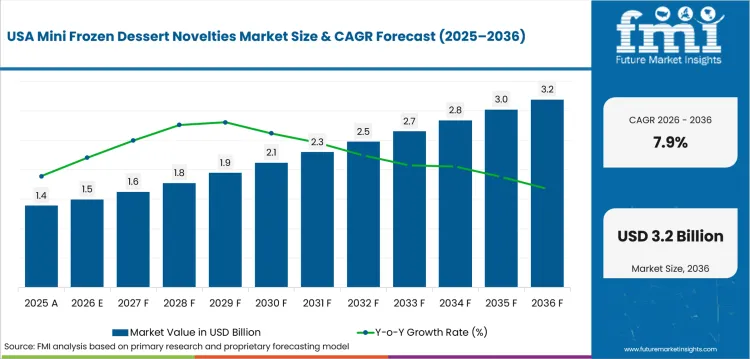
National freezer retail and mini pack center · 2026 to 2036
Country Market Snapshot Table
| Parameter | Value |
|---|---|
| Market Size in 2025 (Value) | USD 824.8 million |
| Market Size in 2026 (Value) | USD 890.0 million |
| Market Forecast in 2036 (Value) | USD 1,903.7 million |
| CAGR (2026 to 2036) | 7.9% |
| Years Considered | 2021 to 2036 |
| Base Year | 2025 |
| Forecast Period | 2026 to 2036 |
| Units Considered | Value (USD million) |
| Leading Sub-Region | Texas and national grocery freezer networks |
United States Mini Frozen Dessert Novelties Market Outlook
United States mini frozen dessert novelty demand is led by established freezer retail and strong snack behavior. Brands can scale through national grocery chains, club stores, and convenience freezers.
Brand launches and retail freezer reach create an active test environment. Mini bars and bites can gain trial if taste remains close to full-size ice cream novelties.
Key Growth Drivers
- Mini novelty launches can use established production channels. Frozen dairy manufacturing provides a large product platform, with USDA ERS reporting U.S. output at 1,386.0 million gallons in 2024.
- Mini bars must protect familiar flavor delivery. Regular ice cream continues to define taste expectations, as USDA ERS placed its share near 60.0% to 65.0% of total ice cream production.
- Multipack planning can raise basket value. Bite-size interest has a proven retail signal, with Unilever reporting consumers buying bite-sized ice creams with traditional formats spent 76.0% more on average.
- Artificial color reformulation is entering freezer planning, as HHS and USDA confirmed the dairy industry’s pledge to remove certified artificial colors from ice cream and frozen dairy desserts by 2028. Clean label mini packs can benefit.
Key Restraints
- Regular ice cream still controls much of the freezer reference point, with USDA ERS placing its share around 60.0% to 65.0% of total ice cream production. New mini novelties need familiar taste before shelf expansion.
- Artificial color removal will require reformulation work by 2028 across ice cream and frozen dairy desserts. Character-themed mini novelties may face color replacement checks.
- Small novelty packs can face wrapper and stick cost pressure. Retailers may resist price increases unless unit counts and flavors support repeat buying.
What makes the United States unique
The United States industry is unique because national freezer distribution supports active portion-pack launches from large brands.
Key Companies
- The Magnum Ice Cream Company
- General Mills
- Mars Ice Cream
- Wells Enterprises
- Blue Bell Creameries
- Bubbies Ice Cream
- Jeni’s Splendid Ice Creams
Sales & Marketing Channels
- Supermarket freezers
- Club stores
- Mass retail
- Online grocery
- Convenience stores
- Foodservice freezers
Country Segment Breakdown Table
| Segment | Sub-Segments |
|---|---|
| By Product Type | Mini Bars · Mini Cones · Mini Sandwiches · Mini Cups · Mochi Bites |
| By Base Ingredient | Dairy · Plant-Based · Frozen Yogurt · Sorbet · Hybrid |
| By Pack Type | Multipacks · Single-Serve · Club Packs · Party Packs · Variety Packs |
| By Claim | Portion Control · Low Calorie · Clean Label · Dairy Free · Kids |
| By Sales Channel | Supermarkets · Club Stores · Online Retail · Foodservice · Convenience Stores |
| Key Sub-Regions Covered, Freezer Retail Networks | Texas · California · New York · Florida · Midwest · Pacific Northwest |
Market Taxonomy and Sub-Regions Covered
Frequently Asked Questions
How fast is United States mini frozen dessert novelties market growing?
Sector in the United States is anticipated to grow at 7.9% CAGR from 2026 to 2036 due to mini multipacks gaining freezer space.
Who leads United States mini frozen dessert novelties market?
The Magnum Ice Cream Company, General Mills, Mars Ice Cream, and Wells Enterprises compete on mini bars and freezer access.
What is driving adoption in United States mini frozen dessert novelties market?
Portion awareness and national freezer distribution are moving shoppers toward mini frozen dessert formats.
Opportunity Analysis for Mini Frozen Dessert Novelties Market in the United Kingdom
Bite-size trial and grocery freezer center · 2026 to 2036
Country Market Snapshot Table
| Parameter | Value |
|---|---|
| Market Size in 2025 (Value) | USD 172.7 million |
| Market Size in 2026 (Value) | USD 185.0 million |
| Market Forecast in 2036 (Value) | USD 367.3 million |
| CAGR (2026 to 2036) | 7.1% |
| Years Considered | 2021 to 2036 |
| Base Year | 2025 |
| Forecast Period | 2026 to 2036 |
| Units Considered | Value (USD million) |
| Leading Sub-Region | London and national grocery freezer chains |
United Kingdom Mini Frozen Dessert Novelties Market Outlook
United Kingdom mini frozen dessert novelty demand is supported by grocery freezer depth and interest in smaller portions. Brands can position mini bars as a dessert option aligned with portion-aware snacking.
Grocery pricing discipline will shape brand trial. Retailers are expected to test compact ranges before expanding multipacks and bite-sized tubs.
Key Growth Drivers
- Freezer brands can compete inside planned baskets. Grocery spending supports frozen dessert testing, with AHDB reporting UK ice cream spending grew 6.9% in the year to August 2024.
- Mini formats can convert curiosity into repeat buying. Bite-size interest is clear in the UK, as Unilever cited one-third of ice cream consumers interested in trying bite-sized portions.
- Smaller units can protect indulgence as shoppers control spend. Unit pressure guides pack design, with AHDB reporting ice cream units were down 4.4% in the same retail period.
- Seasonal licensed products can create store traffic, with Wall’s launching Minecraft ice cream in the UK on 1 July 2025. Character-led novelty packs can support short retail windows.
Key Restraints
- Grocery cost discipline can limit premium mini novelty trial, with UK household food and non-alcoholic drink spend at £32.30 per person each week in FYE 2024. Mini novelty products need careful price architecture.
- Eating-out spending can redirect dessert occasions away from home freezers, as food and non-alcoholic drinks consumed outside the home reached £8.67 per person each week in FYE 2024. Retail brands may need bar and mini formats for snack occasions.
- Freezer price pressure can restrict small-format variety, for example, AHDB reported UK ice cream units declined by 4.4% even as spending rose 6.9% in the year to August 2024. Retailers may prefer fewer flavors unless launch velocity is proven early.
What makes the United Kingdom unique
The United Kingdom industry is garnering expansion as grocery freezer programs give bite-size novelties an early testing route.
Key Companies
- The Magnum Ice Cream Company
- Mars Ice Cream
- General Mills
- Froneri
- Mackie’s of Scotland
- Baskin Robbins UK
- Jude’s
Sales & Marketing Channels
- Supermarket freezers
- Convenience stores
- Online grocery
- Club stores
- Foodservice freezers
- Cinema and leisure outlets
Country Segment Breakdown Table
| Segment | Sub-Segments |
|---|---|
| By Product Type | Mini Bars · Mini Cones · Mini Sandwiches · Mini Cups · Mochi Bites |
| By Base Ingredient | Dairy · Plant-Based · Frozen Yogurt · Sorbet · Hybrid |
| By Pack Type | Multipacks · Single-Serve · Club Packs · Party Packs · Variety Packs |
| By Claim | Portion Control · Low Calorie · Clean Label · Dairy Free · Kids |
| By Sales Channel | Supermarkets · Club Stores · Online Retail · Foodservice · Convenience Stores |
| Key Sub-Regions Covered, Grocery Clusters | London · Manchester · Birmingham · Leeds · Glasgow · Bristol |
Market Taxonomy and Sub-Regions Covered
Frequently Asked Questions
How fast is United Kingdom mini frozen dessert novelties market growing?
Industry in the United Kingdom is projected to increase at 7.1% CAGR from 2026 to 2036, led by grocery freezer adoption.
Who leads United Kingdom mini frozen dessert novelties market?
The Magnum Ice Cream Company and specialist dessert brands compete, driven by grocery reach and flavor depth.
What is driving adoption in United Kingdom mini frozen dessert novelties market?
Bite-size interest and premium grocery testing are moving shoppers toward mini frozen dessert novelties.
Sales Analysis for Mini Frozen Dessert Novelties Market in Germany
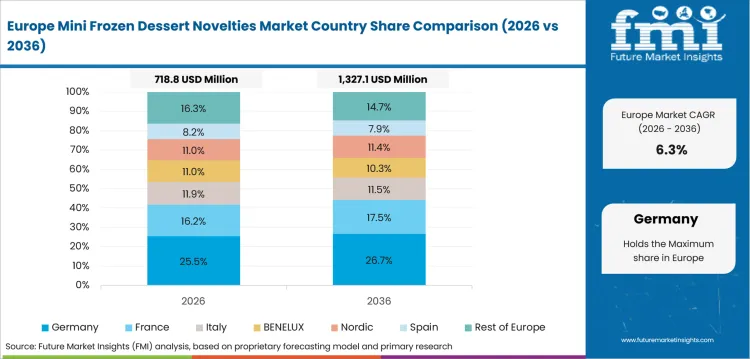
European ice cream production and multipack retail center · 2026 to 2036
Country Market Snapshot Table
| Parameter | Value |
|---|---|
| Market Size in 2025 (Value) | USD 154.5 million |
| Market Size in 2026 (Value) | USD 165.0 million |
| Market Forecast in 2036 (Value) | USD 318.6 million |
| CAGR (2026 to 2036) | 6.8% |
| Years Considered | 2021 to 2036 |
| Base Year | 2025 |
| Forecast Period | 2026 to 2036 |
| Units Considered | Value (USD million) |
| Leading Sub-Region | North Rhine-Westphalia and southern retail clusters |
Germany Mini Frozen Dessert Novelties Market Outlook
Germany mini frozen dessert novelty demand is supported by organized grocery, ice cream production scale, and disciplined retail pricing. Consumers assess ingredient quality carefully, so brands must balance familiar taste with small-pack value.
Discount and supermarket freezer chains can move mini novelties into weekly baskets. Local production depth supports private label and branded testing.
Key Growth Drivers
- Local manufacturing can support mini novelty trials. Production scale supports frozen dessert testing, with Eurostat reporting Germany produced 607.0 million litres of ice cream in 2024.
- Regional supply chains can support format learning. European output gives Germany a large operating setting, reflected by Eurostat reporting EU ice cream production at 3.3 billion litres in 2024.
- Producers can extend mini formats into nearby markets. Export depth supports supplier reach, as Eurostat recorded Germany exported 28.2 million kg of ice cream outside the EU in 2024.
- Mini formats can use established export channels. Extra-EU trade supports branded scale, led by Germany holding 11.0% of EU ice cream exports outside the bloc.
Key Restraints
- Mini novelty launches need margin protection. Production pressure can affect factory economics, as Eurostat recorded Germany ice cream production decreased by 1.0% compared with 2023.
- German brands need differentiated portion packs. Export competition remains tight, with Eurostat showing France exported 55.9 million kg of ice cream outside the EU in 2024.
- Local brands may face stronger freezer price comparison. Import pressure can sharpen price competition, since Eurostat reported extra-EU ice cream imports rose 24.0% in 2024.
What makes Germany unique
Germany is differentiated by European ice cream production scale and disciplined grocery price comparison.
Key Companies
- The Magnum Ice Cream Company
- Froneri
- General Mills
- DMK Group
- Mars Ice Cream
- Eisstern
Sales & Marketing Channels
- Supermarket freezers
- Discount chains
- Online grocery
- Club stores
- Convenience stores
- Foodservice freezers
Country Segment Breakdown Table
| Segment | Sub-Segments |
|---|---|
| By Product Type | Mini Bars · Mini Cones · Mini Sandwiches · Mini Cups · Mochi Bites |
| By Base Ingredient | Dairy · Plant-Based · Frozen Yogurt · Sorbet · Hybrid |
| By Pack Type | Multipacks · Single-Serve · Club Packs · Party Packs · Variety Packs |
| By Claim | Portion Control · Low Calorie · Clean Label · Dairy Free · Kids |
| By Sales Channel | Supermarkets · Club Stores · Online Retail · Foodservice · Convenience Stores |
| Key Sub-Regions Covered, Retail Areas | North Rhine-Westphalia · Bavaria · Berlin · Hamburg · Hesse · Baden-Württemberg |
Market Taxonomy and Sub-Regions Covered
Frequently Asked Questions
How fast is Germany mini frozen dessert novelties market growing?
The market in Germany is expected to rise at 6.8% CAGR from 2026 to 2036 with grocery testing and production strength.
Who leads Germany mini frozen dessert novelties market?
Large ice cream groups and local frozen dessert brands compete through retail freezer access and portion pack quality.
What is driving adoption in Germany mini frozen dessert novelties market?
Grocery scale and ice cream production strength are supporting mini dessert launches in German retail.
Growth Outlook for Mini Frozen Dessert Novelties Market in Japan
Convenience freezer and portion precision center · 2026 to 2036
Country Market Snapshot Table
| Parameter | Value |
|---|---|
| Market Size in 2025 (Value) | USD 141.1 million |
| Market Size in 2026 (Value) | USD 150.0 million |
| Market Forecast in 2036 (Value) | USD 276.3 million |
| CAGR (2026 to 2036) | 6.3% |
| Years Considered | 2021 to 2036 |
| Base Year | 2025 |
| Forecast Period | 2026 to 2036 |
| Units Considered | Value (USD million) |
| Leading Sub-Region | Tokyo and Kansai convenience retail networks |
Japan Mini Frozen Dessert Novelties Market Outlook
Japan mini frozen dessert novelty demand is shaped by portion control, premium flavor standards, and convenience retail. Growth is slower than India and China, but product quality expectations can support higher value formats.
Compact bars and cups are likely to perform better than large family pints. Convenience freezers create limited but high-frequency exposure for controlled-portion desserts.
Key Growth Drivers
- Mini dessert bars can use high-frequency retail traffic. Convenience freezer access supports small-pack trial, since Japanese convenience store sales reached 11,795.3 billion yen in 2024.
- Brands can test limited flavors across dense urban networks. Retail coverage supports single-serve dessert formats, led by Japan recording 55,736 convenience stores at the end of 2024.
- Frozen dessert makers can use store-level rotation for seasonal mini launches. Same-store convenience sales improved in 2024, rising 1.1% from the previous year.
- Mini novelties can benefit from quick snack decisions. Customer traffic supported impulse freezer products, with convenience store customer count rising 0.9% in 2024.
Key Restraints
- Mini novelty brands may need stronger per-store productivity. Store count expansion stayed narrow in 2024, with Japan adding only 23.0 convenience stores during the year.
- Premium mini desserts may need smaller packs to match daily basket limits. Average purchase amount increased only 0.2% to 725.5 yen in 2024.
- Mini dairy desserts need careful milk solids sourcing. Dairy input planning remains important, with USDA FAS citing around 1.3 million dairy cattle in Japan as of February 1, 2025.
What makes Japan unique
Industry in Japan is rising due to portion discipline and high sensory expectations in packaged frozen desserts.
Key Companies
- Meiji
- Morinaga Milk Industry
- Lotte Japan
- Akagi Nyugyo
- Ezaki Glico
- Imuraya Group
- The Magnum Ice Cream Company
Sales & Marketing Channels
- Convenience stores
- Supermarket freezers
- Online grocery
- Club stores
- Drugstores
- Foodservice freezers
Country Segment Breakdown Table
| Segment | Sub-Segments |
|---|---|
| By Product Type | Mini Bars · Mini Cones · Mini Sandwiches · Mini Cups · Mochi Bites |
| By Base Ingredient | Dairy · Plant-Based · Frozen Yogurt · Sorbet · Hybrid |
| By Pack Type | Multipacks · Single-Serve · Club Packs · Party Packs · Variety Packs |
| By Claim | Portion Control · Low Calorie · Clean Label · Dairy Free · Kids |
| By Sales Channel | Supermarkets · Club Stores · Online Retail · Foodservice · Convenience Stores |
| Key Sub-Regions Covered, Retail Clusters | Tokyo · Osaka · Yokohama · Nagoya · Fukuoka · Sapporo |
Market Taxonomy and Sub-Regions Covered
Frequently Asked Questions
How fast is Japan mini frozen dessert novelties market growing?
Sector in Japan is projected at 6.3% CAGR from 2026 to 2036 as premium portion-controlled frozen desserts gain adoption.
Who leads Japan mini frozen dessert novelties market?
Large ice cream brands and specialty dessert firms compete fueled by flavor quality and convenience retail reach.
What is driving adoption in Japan mini frozen dessert novelties market?
Portion control and premium texture expectations are moving mini frozen dessert novelties toward bars and cups.
Competitive Landscape and Strategic Positioning
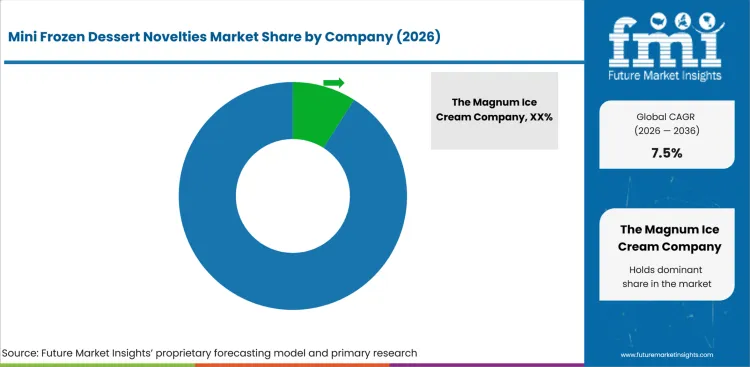
- Established frozen dessert brands hold an advantage through retail freezer authorization and familiar flavors.
- Mini-format specialists gain shelf space by offering portion-controlled formats with clear pack counts.
- Packaging specialists support small formats by improving wrapping speed and freezer durability.
- Retail-ready packaging supports trial through clear serving size and unit-count labeling.
Competition in the market is influenced by frozen dessert brand owners along with mini-format specialists and packaging partners. The Magnum Ice Cream Company and General Mills compete through premium mini formats and global freezer access. Mars Ice Cream and Wells Enterprises defend familiar bar formats through established retail networks. Bubbies Ice Cream competes through mochi pieces and pack design. Retailers assess pack count, unit economics, and flavor recognition before expanding mini frozen dessert space.
Supplier advantage will come from taste retention and credible pack execution. Larger companies are best placed to secure supermarkets through freezer scale and retailer programs. Specialist brands can win premium consumers if they solve texture gaps and communicate portion value clearly. Companies with frozen dessert manufacturing depth and small-pack execution skill are best positioned to win repeat buying.
Key Companies in the Mini Frozen Dessert Novelties Market
Competitive structure is differentiated by global frozen dessert companies, regional dairy processors, and mini-format specialists.
- Global Frozen Dessert Companies: The Magnum Ice Cream Company, General Mills, Mars Ice Cream, and Froneri compete based on freezer access and frozen dessert production depth.
- Regional Dairy and Dessert Players: Wells Enterprises, Blue Bell Creameries, Amul, Lotte, and Meiji compete through dairy skill and grocery reach.
- Mini-Format Specialists: Bubbies Ice Cream, Jeni’s Splendid Ice Creams, and premium mochi brands compete through bite-sized texture and specialty packaging.
Competitive Benchmarking: Mini Frozen Dessert Novelties Market
| Company | Mini Format Depth | Freezer Channel Access | Pack Count Execution | Channel Reach | Geographic Footprint |
|---|---|---|---|---|---|
| The Magnum Ice Cream Company | Very Strong | Very Strong | Very Strong | Very Strong | Global |
| General Mills | Strong | Very Strong | Strong | Very Strong | Global |
| Mars Ice Cream | Strong | Very Strong | Strong | Very Strong | Global |
| Wells Enterprises | Moderate | Very Strong | Strong | Strong | North America |
| Blue Bell Creameries | Moderate | Strong | Strong | Strong | United States |
| Bubbies Ice Cream | Strong | Moderate | Very Strong | Moderate | United States |
| Froneri | Strong | Strong | Strong | Strong | Europe and Global |
| Lotte | Strong | Strong | Strong | Strong | East Asia |
Source: Future Market Insights competitive analysis, 2026.
Key Developments in Mini Frozen Dessert Novelties Market
- In April 2025, Bubbies Ice Cream moved from plastic clamshell inner trays to recyclable and certified backyard-compostable paper pulp trays that reduced plastic use by 94.0%. The change supports packaging upgrades for mochi bites and small frozen dessert pieces.
- In June 2025, Marubeni acquired 100% of Bubbies Homemade Ice Cream & Desserts Inc. and entered the U.S. ice cream manufacturing business.
- In February 2026, General Mills listed Häagen-Dazs Stick Bar formats across North Asia and Southeast Asia. The listing also covered LATAM and China product ranges. The development supports premium stick-format freezer assortment expansion.
Key Players in the Mini Frozen Dessert Novelties Market
- The Magnum Ice Cream Company
- General Mills
- Mars Ice Cream
- Wells Enterprises
- Blue Bell Creameries
- Bubbies Ice Cream
- Froneri
- Lotte
- Meiji Holdings
- Amul
Mini Frozen Dessert Novelties Market - Report Scope
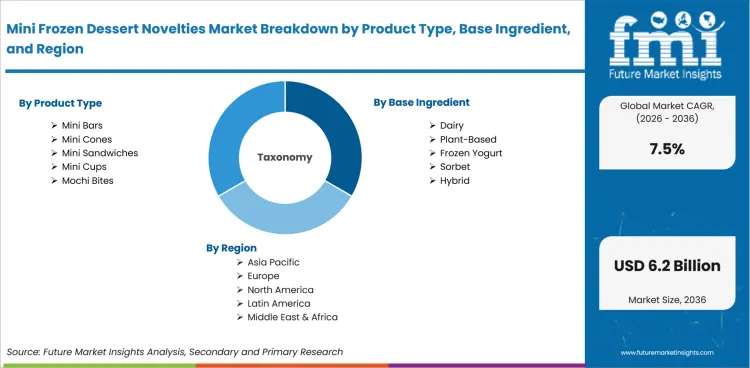
| Item | Value |
|---|---|
| Market size by 2036 | USD 6.2 billion |
| Growth rate | 7.5% CAGR from 2026 to 2036 |
| Forecast period | 2026 to 2036 |
| Estimated year value 2026 | USD 3.0 billion |
| By product type | Mini bars, mini cones, mini sandwiches, mini cups, mochi bites |
| By base ingredient | Dairy, plant-based, frozen yogurt, sorbet, hybrid |
| By pack type | Multipacks, single-serve, club packs, party packs, variety packs |
| By claim | Portion control, low calorie, clean label, dairy free, kids |
| By sales channel | Supermarkets, club stores, online retail, foodservice, convenience stores |
| Regions covered | North America, Latin America, Europe, East Asia, South Asia and Pacific, Middle East and Africa |
| Countries covered | India, China, Australia, United States, United Kingdom, Germany, Japan |
| Key companies profiled | The Magnum Ice Cream Company, General Mills, Mars Ice Cream, Wells Enterprises, Blue Bell Creameries, Bubbies Ice Cream, Froneri |
| Approach | Bottom-up product-boundary approach using eligible SKU revenue, channel presence, retail pricing, product positioning, and country-level adoption |
Source: Future Market Insights, 2026.
Mini Frozen Dessert Novelties Market Breakdown by Product Type, Base Ingredient, Pack Type, Claim, Sales Channel, and Region
By Product Type
- Mini Bars
- Mini Cones
- Mini Sandwiches
- Mini Cups
- Mochi Bites
By Base Ingredient
- Dairy
- Plant-Based
- Frozen Yogurt
- Sorbet
- Hybrid
By Pack Type
- Multipacks
- Single-Serve
- Club Packs
- Party Packs
- Variety Packs
By Claim
- Portion Control
- Low Calorie
- Clean Label
- Dairy Free
- Kids
By Sales Channel
- Supermarkets
- Club Stores
- Online Retail
- Foodservice
- Convenience Stores
By Region
- North America
- Latin America
- Europe
- East Asia
- South Asia and Pacific
- Middle East and Africa
Research Sources and Bibliography
- USA Department of Agriculture Economic Research Service. (2025, July 16). Ice cream and frozen dairy production dipped from 2000 to 2024.
- USA Department of Health and Human Services. (2025, July 14). HHS applauds dairy industry’s voluntary commitment to eliminate artificial food dyes from ice cream.
- Unilever. (2024, October 4). Unilever’s new bite-sized ice creams tap into growing snacking trend.
General Mills. (2024, June 26). New must-try products for summer 2024. - Unilever. (2025, July 10). Wall’s launches limited-edition Minecraft ice cream to target gamers.
Department of Animal Husbandry and Dairying. (2025, November 26). Release of Basic Animal Husbandry Statistics 2025. - National Bureau of Statistics of China. (2026, January 20). Total retail sales of consumer goods in December 2025.
- Dairy Australia. (2026, May). Situation and Outlook Report - Mid-year 2026.
- Agriculture and Horticulture Development Board. (2024, August 8). A sweet spot for ice cream sales.
- European Commission, Eurostat. (2025, July 29). EU ice cream production sees uptick of 2% in 2024.
National Association of Convenience Stores. (2025, January 21). Japanese C-stores continue to see growth. - USA Department of Agriculture Foreign Agricultural Service. (2025, December 8). Dairy and products annual: Japan.
- Bubbies Ice Cream. (2025). Sustainability.
- Department for Environment, Food & Rural Affairs. (2025, November 6). Family Food FYE 2024. GOV.UK.
- Unilever. (2024, November 15). The science behind Magnum Bon Bon bite-sized ice creams.
- Unilever IP Holdings B.V., & Conopco, Inc. (2024, September 6). Plant-based frozen confection (WO2024179926A1). Google Patents.
- National Archives and Records Administration. (2026). 21 CFR § 135.110: Ice cream and frozen custard. Electronic Code of Federal Regulations.
- European Union. (2025, January 22). Regulation (EU) 2025/40 of the European Parliament and of the Council on packaging and packaging waste. Official Journal of the European Union.
- USA Food and Drug Administration. (2025, January). Draft guidance for industry: Labeling of plant-based alternatives to animal-derived foods.
- Unilever. (2025, February 14). A look at Unilever’s full-year results by business group.
- Unilever. (2024, August 22). How our AI-enabled freezers are revolutionising ice cream sales.
- International Food Information Council. (2025, December). IFIC spotlight survey: Americans’ perceptions of added sugars & sweeteners.
- Food Standards Australia New Zealand. (2026, May 29). Food Standards Code legislation.
- General Mills. (2026, February 3). Discover our latest launches for 2026.
- USA Bureau of Labor Statistics. (2026). Average price: Ice cream, prepackaged, bulk, regular, per one-half gallon (1.9 liters) in USA city average [APU0000710411]. FRED, Federal Reserve Bank of St. Louis. Retrieved June 9, 2026, from
- NielsenIQ. (2026, June 3). Winning the dessert moment: What consumers crave in 2026.
- General Mills. (2025, January 29). Spread the love this Valentine’s Day with General Mills.
- Marubeni Corporation. (2025, June 30). Marubeni to enter the ice cream manufacturing business in the United States.
This bibliography is provided for reader reference and is not exhaustive. The full report contains the complete reference list and detailed citations
This Report Answers
- What is the 2026 value and 2036 forecast for mini frozen dessert novelties market?
- What parent segment is projected to hold the leading share during the forecast period?
- What pack type is expected to account for the leading 2026 share?
- How do dairy inputs and small-pack formats affect texture and pricing?
- What companies compete in mini frozen dessert novelties?
Frequently Asked Questions
What is the mini frozen dessert novelties market size in 2026?
The mini frozen dessert novelties market size is expected to cross USD 3.0 billion in 2026.
What is the mini frozen dessert novelties market forecast for 2036?
The mini frozen dessert novelties industry is forecast to reach USD 6.2 billion by 2036 as portion packs expand.
What is the mini frozen dessert novelties market CAGR?
The mini frozen dessert novelties sector is projected to expand at 7.5% CAGR from 2026 to 2036.
What segment leads the mini frozen dessert novelties market?
Dairy is likely to capture 62.4% share in 2026 due to familiar creaminess and frozen dessert production scale.
What country grows fastest in the mini frozen dessert novelties market?
India is forecast to record 9.1% CAGR by 2036, driven by dairy scale and urban freezer retail.
Preview the report firsthand - request a free sample
Get SampleGet the brochure for pricing and purchase details.
Get PDFTable of Content
- Executive Summary
- Global Market Outlook
- Demand-side Trends
- Supply-side Trends
- Technology Roadmap Analysis
- Analysis and Recommendations
- Market Overview
- Market Coverage / Taxonomy
- Market Definition / Scope / Limitations
- Research Methodology
- Chapter Orientation
- Analytical Lens and Working Hypotheses
- Market Structure, Signals, and Trend Drivers
- Benchmarking and Cross-market Comparability
- Market Sizing, Forecasting, and Opportunity Mapping
- Research Design and Evidence Framework
- Desk Research Programme (Secondary Evidence)
- Company Annual and Sustainability Reports
- Peer-reviewed Journals and Academic Literature
- Corporate Websites, Product Literature, and Technical Notes
- Earnings Decks and Investor Briefings
- Statutory Filings and Regulatory Disclosures
- Technical White Papers and Standards Notes
- Trade Journals, Industry Magazines, and Analyst Briefs
- Conference Proceedings, Webinars, and Seminar Materials
- Government Statistics Portals and Public Data Releases
- Press Releases and Reputable Media Coverage
- Specialist Newsletters and Curated Briefings
- Sector Databases and Reference Repositories
- FMI Internal Proprietary Databases and Historical Market Datasets
- Subscription Datasets and Paid Sources
- Social Channels, Communities, and Digital Listening Inputs
- Additional Desk Sources
- Expert Input and Fieldwork (Primary Evidence)
- Primary Modes
- Qualitative Interviews and Expert Elicitation
- Quantitative Surveys and Structured Data Capture
- Blended Approach
- Why Primary Evidence is Used
- Field Techniques
- Interviews
- Surveys
- Focus Groups
- Observational and In-context Research
- Social and Community Interactions
- Stakeholder Universe Engaged
- C-suite Leaders
- Board Members
- Presidents and Vice Presidents
- R&D and Innovation Heads
- Technical Specialists
- Domain Subject-matter Experts
- Scientists
- Retail buyers, manufacturers, and food industry professionals
- Governance, Ethics, and Data Stewardship
- Research Ethics
- Data Integrity and Handling
- Primary Modes
- Tooling, Models, and Reference Databases
- Desk Research Programme (Secondary Evidence)
- Data Engineering and Model Build
- Data Acquisition and Ingestion
- Cleaning, Normalisation, and Verification
- Synthesis, Triangulation, and Analysis
- Quality Assurance and Audit Trail
- Market Background
- Market Dynamics
- Drivers
- Restraints
- Opportunity
- Trends
- Scenario Forecast
- Demand in Optimistic Scenario
- Demand in Likely Scenario
- Demand in Conservative Scenario
- Opportunity Map Analysis
- Product Life Cycle Analysis
- Supply Chain Analysis
- Investment Feasibility Matrix
- Value Chain Analysis
- PESTLE and Porter’s Analysis
- Regulatory Landscape
- Regional Parent Market Outlook
- Production and Consumption Statistics
- Import and Export Statistics
- Market Dynamics
- Global Market Analysis 2021 to 2025 and Forecast, 2026 to 2036
- Historical Market Size Value (USD Million) Analysis, 2021 to 2025
- Current and Future Market Size Value (USD Million) Projections, 2026 to 2036
- Y-o-Y Growth Trend Analysis
- Absolute $ Opportunity Analysis
- Global Market Pricing Analysis 2021 to 2025 and Forecast 2026 to 2036
- Global Market Analysis 2021 to 2025 and Forecast 2026 to 2036, By Product Type
- Introduction / Key Findings
- Historical Market Size Value (USD Million) Analysis By Product Type , 2021 to 2025
- Current and Future Market Size Value (USD Million) Analysis and Forecast By Product Type , 2026 to 2036
- Mini Bars
- Mini Cones
- Mini Sandwiches
- Mini Cups
- Mochi Bites
- Mini Bars
- Y-o-Y Growth Trend Analysis By Product Type , 2021 to 2025
- Absolute $ Opportunity Analysis By Product Type , 2026 to 2036
- Global Market Analysis 2021 to 2025 and Forecast 2026 to 2036, By Base Ingredient
- Introduction / Key Findings
- Historical Market Size Value (USD Million) Analysis By Base Ingredient, 2021 to 2025
- Current and Future Market Size Value (USD Million) Analysis and Forecast By Base Ingredient, 2026 to 2036
- Dairy
- Plant-Based
- Frozen Yogurt
- Sorbet
- Hybrid
- Dairy
- Y-o-Y Growth Trend Analysis By Base Ingredient, 2021 to 2025
- Absolute $ Opportunity Analysis By Base Ingredient, 2026 to 2036
- Global Market Analysis 2021 to 2025 and Forecast 2026 to 2036, By Pack Type
- Introduction / Key Findings
- Historical Market Size Value (USD Million) Analysis By Pack Type, 2021 to 2025
- Current and Future Market Size Value (USD Million) Analysis and Forecast By Pack Type, 2026 to 2036
- Multipacks
- Single-Serve
- Club Packs
- Party Packs
- Variety Packs
- Multipacks
- Y-o-Y Growth Trend Analysis By Pack Type, 2021 to 2025
- Absolute $ Opportunity Analysis By Pack Type, 2026 to 2036
- Global Market Analysis 2021 to 2025 and Forecast 2026 to 2036, By Claim
- Introduction / Key Findings
- Historical Market Size Value (USD Million) Analysis By Claim, 2021 to 2025
- Current and Future Market Size Value (USD Million) Analysis and Forecast By Claim, 2026 to 2036
- Portion Control
- Low Calorie
- Clean Label
- Dairy Free
- Kids
- Portion Control
- Y-o-Y Growth Trend Analysis By Claim, 2021 to 2025
- Absolute $ Opportunity Analysis By Claim, 2026 to 2036
- Global Market Analysis 2021 to 2025 and Forecast 2026 to 2036, By Sales Channel
- Introduction / Key Findings
- Historical Market Size Value (USD Million) Analysis By Sales Channel, 2021 to 2025
- Current and Future Market Size Value (USD Million) Analysis and Forecast By Sales Channel, 2026 to 2036
- Supermarkets
- Club Stores
- Online Retail
- Foodservice
- Convenience Stores
- Supermarkets
- Y-o-Y Growth Trend Analysis By Sales Channel, 2021 to 2025
- Absolute $ Opportunity Analysis By Sales Channel, 2026 to 2036
- Global Market Analysis 2021 to 2025 and Forecast 2026 to 2036, By Region
- Introduction
- Historical Market Size Value (USD Million) Analysis By Region, 2021 to 2025
- Current Market Size Value (USD Million) Analysis and Forecast By Region, 2026 to 2036
- North America
- Latin America
- Western Europe
- Eastern Europe
- East Asia
- South Asia and Pacific
- Middle East & Africa
- Market Attractiveness Analysis By Region
- North America Market Analysis 2021 to 2025 and Forecast 2026 to 2036, By Country
- Historical Market Size Value (USD Million) Trend Analysis By Market Taxonomy, 2021 to 2025
- Market Size Value (USD Million) Forecast By Market Taxonomy, 2026 to 2036
- By Country
- USA
- Canada
- Mexico
- By Product Type
- By Base Ingredient
- By Pack Type
- By Claim
- By Sales Channel
- By Country
- Market Attractiveness Analysis
- By Country
- By Product Type
- By Base Ingredient
- By Pack Type
- By Claim
- By Sales Channel
- Key Takeaways
- Latin America Market Analysis 2021 to 2025 and Forecast 2026 to 2036, By Country
- Historical Market Size Value (USD Million) Trend Analysis By Market Taxonomy, 2021 to 2025
- Market Size Value (USD Million) Forecast By Market Taxonomy, 2026 to 2036
- By Country
- Brazil
- Chile
- Rest of Latin America
- By Product Type
- By Base Ingredient
- By Pack Type
- By Claim
- By Sales Channel
- By Country
- Market Attractiveness Analysis
- By Country
- By Product Type
- By Base Ingredient
- By Pack Type
- By Claim
- By Sales Channel
- Key Takeaways
- Western Europe Market Analysis 2021 to 2025 and Forecast 2026 to 2036, By Country
- Historical Market Size Value (USD Million) Trend Analysis By Market Taxonomy, 2021 to 2025
- Market Size Value (USD Million) Forecast By Market Taxonomy, 2026 to 2036
- By Country
- Germany
- UK
- Italy
- Spain
- France
- Nordic
- BENELUX
- Rest of Western Europe
- By Product Type
- By Base Ingredient
- By Pack Type
- By Claim
- By Sales Channel
- By Country
- Market Attractiveness Analysis
- By Country
- By Product Type
- By Base Ingredient
- By Pack Type
- By Claim
- By Sales Channel
- Key Takeaways
- Eastern Europe Market Analysis 2021 to 2025 and Forecast 2026 to 2036, By Country
- Historical Market Size Value (USD Million) Trend Analysis By Market Taxonomy, 2021 to 2025
- Market Size Value (USD Million) Forecast By Market Taxonomy, 2026 to 2036
- By Country
- Russia
- Poland
- Hungary
- Balkan & Baltic
- Rest of Eastern Europe
- By Product Type
- By Base Ingredient
- By Pack Type
- By Claim
- By Sales Channel
- By Country
- Market Attractiveness Analysis
- By Country
- By Product Type
- By Base Ingredient
- By Pack Type
- By Claim
- By Sales Channel
- Key Takeaways
- East Asia Market Analysis 2021 to 2025 and Forecast 2026 to 2036, By Country
- Historical Market Size Value (USD Million) Trend Analysis By Market Taxonomy, 2021 to 2025
- Market Size Value (USD Million) Forecast By Market Taxonomy, 2026 to 2036
- By Country
- China
- Japan
- South Korea
- By Product Type
- By Base Ingredient
- By Pack Type
- By Claim
- By Sales Channel
- By Country
- Market Attractiveness Analysis
- By Country
- By Product Type
- By Base Ingredient
- By Pack Type
- By Claim
- By Sales Channel
- Key Takeaways
- South Asia and Pacific Market Analysis 2021 to 2025 and Forecast 2026 to 2036, By Country
- Historical Market Size Value (USD Million) Trend Analysis By Market Taxonomy, 2021 to 2025
- Market Size Value (USD Million) Forecast By Market Taxonomy, 2026 to 2036
- By Country
- India
- ASEAN
- Australia & New Zealand
- Rest of South Asia and Pacific
- By Product Type
- By Base Ingredient
- By Pack Type
- By Claim
- By Sales Channel
- By Country
- Market Attractiveness Analysis
- By Country
- By Product Type
- By Base Ingredient
- By Pack Type
- By Claim
- By Sales Channel
- Key Takeaways
- Middle East & Africa Market Analysis 2021 to 2025 and Forecast 2026 to 2036, By Country
- Historical Market Size Value (USD Million) Trend Analysis By Market Taxonomy, 2021 to 2025
- Market Size Value (USD Million) Forecast By Market Taxonomy, 2026 to 2036
- By Country
- Kingdom of Saudi Arabia
- Other GCC Countries
- Turkiye
- South Africa
- Other African Union
- Rest of Middle East & Africa
- By Product Type
- By Base Ingredient
- By Pack Type
- By Claim
- By Sales Channel
- By Country
- Market Attractiveness Analysis
- By Country
- By Product Type
- By Base Ingredient
- By Pack Type
- By Claim
- By Sales Channel
- Key Takeaways
- Key Countries Market Analysis
- USA
- Pricing Analysis
- Market Share Analysis, 2025
- By Product Type
- By Base Ingredient
- By Pack Type
- By Claim
- By Sales Channel
- Canada
- Pricing Analysis
- Market Share Analysis, 2025
- By Product Type
- By Base Ingredient
- By Pack Type
- By Claim
- By Sales Channel
- Mexico
- Pricing Analysis
- Market Share Analysis, 2025
- By Product Type
- By Base Ingredient
- By Pack Type
- By Claim
- By Sales Channel
- Brazil
- Pricing Analysis
- Market Share Analysis, 2025
- By Product Type
- By Base Ingredient
- By Pack Type
- By Claim
- By Sales Channel
- Chile
- Pricing Analysis
- Market Share Analysis, 2025
- By Product Type
- By Base Ingredient
- By Pack Type
- By Claim
- By Sales Channel
- Germany
- Pricing Analysis
- Market Share Analysis, 2025
- By Product Type
- By Base Ingredient
- By Pack Type
- By Claim
- By Sales Channel
- UK
- Pricing Analysis
- Market Share Analysis, 2025
- By Product Type
- By Base Ingredient
- By Pack Type
- By Claim
- By Sales Channel
- Italy
- Pricing Analysis
- Market Share Analysis, 2025
- By Product Type
- By Base Ingredient
- By Pack Type
- By Claim
- By Sales Channel
- Spain
- Pricing Analysis
- Market Share Analysis, 2025
- By Product Type
- By Base Ingredient
- By Pack Type
- By Claim
- By Sales Channel
- France
- Pricing Analysis
- Market Share Analysis, 2025
- By Product Type
- By Base Ingredient
- By Pack Type
- By Claim
- By Sales Channel
- India
- Pricing Analysis
- Market Share Analysis, 2025
- By Product Type
- By Base Ingredient
- By Pack Type
- By Claim
- By Sales Channel
- ASEAN
- Pricing Analysis
- Market Share Analysis, 2025
- By Product Type
- By Base Ingredient
- By Pack Type
- By Claim
- By Sales Channel
- Australia & New Zealand
- Pricing Analysis
- Market Share Analysis, 2025
- By Product Type
- By Base Ingredient
- By Pack Type
- By Claim
- By Sales Channel
- China
- Pricing Analysis
- Market Share Analysis, 2025
- By Product Type
- By Base Ingredient
- By Pack Type
- By Claim
- By Sales Channel
- Japan
- Pricing Analysis
- Market Share Analysis, 2025
- By Product Type
- By Base Ingredient
- By Pack Type
- By Claim
- By Sales Channel
- South Korea
- Pricing Analysis
- Market Share Analysis, 2025
- By Product Type
- By Base Ingredient
- By Pack Type
- By Claim
- By Sales Channel
- Russia
- Pricing Analysis
- Market Share Analysis, 2025
- By Product Type
- By Base Ingredient
- By Pack Type
- By Claim
- By Sales Channel
- Poland
- Pricing Analysis
- Market Share Analysis, 2025
- By Product Type
- By Base Ingredient
- By Pack Type
- By Claim
- By Sales Channel
- Hungary
- Pricing Analysis
- Market Share Analysis, 2025
- By Product Type
- By Base Ingredient
- By Pack Type
- By Claim
- By Sales Channel
- Kingdom of Saudi Arabia
- Pricing Analysis
- Market Share Analysis, 2025
- By Product Type
- By Base Ingredient
- By Pack Type
- By Claim
- By Sales Channel
- Turkiye
- Pricing Analysis
- Market Share Analysis, 2025
- By Product Type
- By Base Ingredient
- By Pack Type
- By Claim
- By Sales Channel
- South Africa
- Pricing Analysis
- Market Share Analysis, 2025
- By Product Type
- By Base Ingredient
- By Pack Type
- By Claim
- By Sales Channel
- USA
- Market Structure Analysis
- Competition Dashboard
- Competition Benchmarking
- Market Share Analysis of Top Players
- By Regional
- By Product Type
- By Base Ingredient
- By Pack Type
- By Claim
- By Sales Channel
- Competition Analysis
- Competition Deep Dive
- The Magnum Ice Cream Company
- Overview
- Product Portfolio
- Profitability by Market Segments (Product/Sales Channel/Region)
- Sales Footprint
- Strategy Overview
- Marketing Strategy
- Product Strategy
- Channel Strategy
- General Mills
- Mars Ice Cream
- Wells Enterprises
- Blue Bell Creameries
- Bubbies Ice Cream
- Froneri
- Lotte
- The Magnum Ice Cream Company
- Competition Deep Dive
- Assumptions & Acronyms Used


