

- Market Size (2026)
- USD 1.4 Bn
- Forecast (2036)
- USD 2.6 Bn
- CAGR (2026 to 2036)
- 6.4%
Low Glycemic Frozen Desserts Market Size, Market Forecast and Outlook By FMI
The low glycemic frozen desserts market is projected to expand from USD 1.4 billion in 2026 to USD 2.6 billion by 2036 at 6.4% CAGR due to increasing consumer demand for healthier dessert alternatives and low-sugar food products. Glucose-conscious adults are projected at 52.3% share as shoppers seek controlled sugar impact in freezer products and dairy-based formats are forecast to hold 48.6% share in 2026.
Summary of Low Glycemic Frozen Desserts Market
- Demand and Growth Drivers
- Glucose-conscious consumers are moving toward freezer desserts with lower added sugar exposure.
- Frozen dessert brands are reformulating using stevia blends and allulose blends for cleaner sweetness.
- Retail freezer space is shifting toward better-for-you desserts that carry clearer sugar and protein positioning.
- Product and Segment View
- Glucose-conscious adults are forecast to represent 52.3% share in 2026, driven by blood sugar control and weight management needs.
- Dairy-based products are projected to hold 48.6% share in 2026, influenced by cream texture and familiar taste.
- Ice cream formats are expected to secure 41.9% share in 2026 due to familiar tubs and bars converting standard dessert buyers.
- Geography and Competitive Outlook
- India is projected to record 7.2% CAGR by 2036, reflected by urban freezer retail and higher diabetes awareness.
- China is expected to expand at 6.9% CAGR by 2036 through premium freezer retail and controlled sugar product launches.
- Wells Enterprises and Beyond Better Foods compete by low-sugar freezer brands and national retail access.
- N!CK’S and Rebel Creamery compete based on sweetener formulation and low-sugar nutrition positioning.
- Analyst Opinion
- Nandini Roy Choudhury, Principal Consultant for Food and Beverage at FMI, observes, “Low glycemic frozen dessert buying has moved beyond being only a diet aisle choice. Shoppers compare sugar impact and freezer taste before repeat purchase. Brands with clean sweetener disclosure and reliable texture should gain stronger space in supermarkets and online grocery.”
- Low Glycemic Frozen Desserts Market Value Analysis
- Market value is tied to freezer SKU revenue before foodservice and online grocery add incremental volume.
- Supplier pricing reflects sweetener cost and dairy fat content before packaging size affects retail price.
- Revenue improves as brands convert sugar-free buyers into repeat dessert buyers through flavor and texture.
- Retail trust rises as low-sugar labels and glucose-conscious positioning become easier for shoppers to compare.
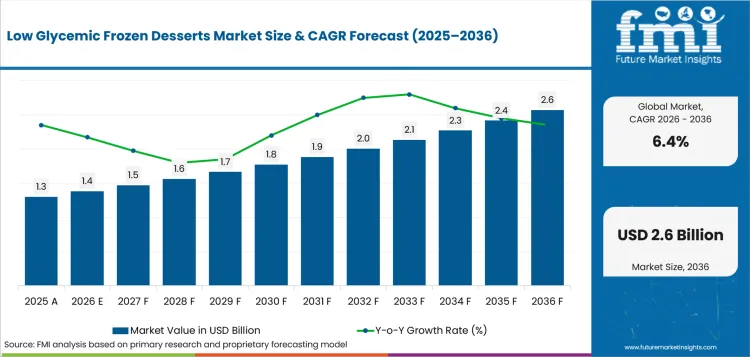
Key Takeaways, Market Size, and Forecast
- 2026 Market Size: USD 1.4 billion
- 2036 Market Size: USD 2.6 billion
- Forecast CAGR: 6.4% from 2026 to 2036
- Leading Consumer Group: Glucose-conscious adults
- Glucose Conscious Adults Share in 2026: 52.3%
- Leading Source: Dairy-based
- Dairy Based Share in 2026: 48.6%
- Fastest-growing Country: India
- India CAGR: 7.2% by 2036
Texture weakness and sweetener proof are the main design pressures for low glycemic frozen dessert makers. Allulose is gaining formulation value as FDA’s September 2024 GRAS response covered D-psicose sweetener use from 2.1% to 100% across food groups. FDA also listed low or reduced calorie frozen dairy desserts at 8% intended use.
A clearer regulatory route gives formulators more room to balance freezing point control with sugar reduction. European launch planning needs stricter sequencing as EFSA stated in June 2025, its allulose draft opinion was adopted on 6 May 2025 subject to editorial comments. Approval timing now affects ingredient sourcing and product launch calendars. Retail conversion is moving away from plain diet cues.
Low Glycemic Frozen Desserts Market Definition
Low glycemic frozen desserts cover frozen sweet products designed to create a lower post-meal glucose response than conventional high sugar desserts. Scope includes ice cream, frozen yogurt, sorbet, bars, and pops sold with low glycemic, low-sugar, no added sugar, keto, diabetic friendly, or controlled carbohydrate positioning. Revenue includes finished branded and private label frozen desserts sold through retail, online grocery, specialty stores, and foodservice channels.
Low Glycemic Frozen Desserts Market Inclusions
Market scope covers commercially sold low glycemic frozen desserts by product type such as ice cream and frozen yogurt. Sweetener system coverage includes stevia blends and monk fruit. Source analysis includes dairy-based and plant-based products. Sales channel analysis includes supermarkets and online retail. Revenue scope covers market activity from 2026 to 2036 across finished frozen desserts and private label retail formats. Key participants include frozen dessert brands, dairy processors, plant-based formulators, sweetener suppliers, grocery chains, and online grocery platforms.
Low Glycemic Frozen Desserts Market Exclusions
Scope excludes standard frozen desserts that do not carry low glycemic or low-sugar positioning. Frozen bakery products, shelf stable dessert mixes, meal replacement shakes, and refrigerated yogurt cups are outside scope. General sweeteners are counted only if used inside finished low glycemic frozen dessert products.
Low Glycemic Frozen Desserts Market Research Methodology
- Primary Research: FMI analysts reviewed frozen dessert brand portfolios and retail freezer assortment checks across major grocery markets.
- Desk Research: Public data from IDF, FDA, USDA ERS, NHS England, Statistics Canada, Health Canada, China NBS, and official food sector releases were checked against low-sugar frozen dessert evidence.
- Market Sizing and Forecasting: Market size used eligible low glycemic frozen dessert SKUs and retail channel presence. Average retail pricing and country-level product adoption were used for cross-checks.
- Data Validation: Forecast checks compared diabetes prevalence, frozen dairy output, retail freezer access, and active supplier portfolios. Official product launches were reviewed across low-sugar frozen dessert demand.
Why is the Low Glycemic Frozen Desserts Market Growing?
- Shoppers are choosing frozen desserts giving a sweet taste with less sugar pressure.
- Brands are using cleaner sweetener systems to protect taste and texture in reduced sugar formats.
- Retailers are adding glucose-aware freezer products beside diet and better-for-you dessert ranges.
Reformulation demand is improving as ingredient choices become more practical for frozen dessert development. For instance, ACNFP stated in November 2024 that allulose has 70% of sucrose sweetness and a reported low-calorie value of ≤0.4 kcal per gram. This supports low glycemic freezer products requiring sweetness and bulk without standard sugar loading. FDA stated in February 2025, steviol glycosides are 200 to 400 times sweeter than table sugar and monk fruit extracts are 100 to 250 times sweeter. High-intensity sweeteners let brands reduce sugar while controlling serving calories in ice cream and bars. FDA’s February 2025 GRN 1203 letter covered rebaudioside M2 for use as a general-purpose sweetener in foods at levels set by good manufacturing practice. Such ingredient clearance supports reformulation across allulose, sugar substitutes along with low calorie desserts and diabetic food applications.
Market Segmentation Analysis
- Ice cream formats are projected to hold 41.9% share in 2026, led by tubs and bars giving brands an easier route from conventional frozen desserts into low glycemic choices.
- Stevia blends are forecast to capture 34.8% share in 2026 due to formulators using plant-based sweetness with dairy fat and fiber systems to reduce sugar load.
- Dairy-based products are expected to represent 48.6% share in 2026, influenced by cream texture and established freezer habits making low-sugar versions easier to accept.
- Supermarkets are anticipated to hold 45.7% share in 2026, driven by freezer aisle discovery and weekly grocery trips promoting repeat purchase.
- Glucose-conscious adults are projected to secure 52.3% share in 2026 as diabetes risk and weight control needs guide dessert selection.
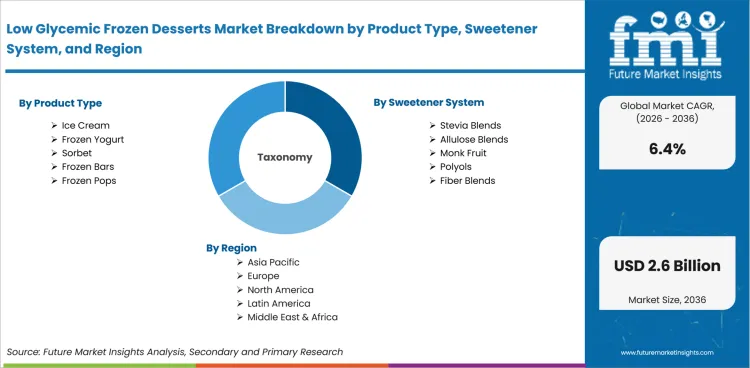
The low glycemic frozen dessert market is divided into groups based on product type, sweetener system, source, sales channel, consumer group, and region. Product type includes ice cream, frozen yogurt, sorbet, frozen bars, and frozen pops. Sweetener system coverage includes stevia blends, allulose blends, monk fruit, polyols, and fiber blends. Source analysis covers dairy-based, plant-based and hybrid-based formats. Sales channel analysis covers supermarkets, online retail, specialty stores, foodservice and convenience stores. Consumer group analysis includes glucose-conscious adults, weight managers, fitness consumers, and children.
Insights into Low Glycemic Frozen Desserts Market by Product Type
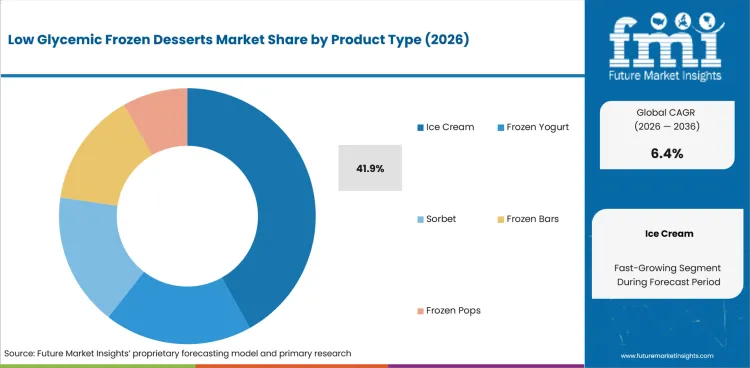
- Ice cream formats are projected to hold 41.9% share in 2026, influenced by familiar tub and bar formats lowering trial friction for reduced sugar products.
- Frozen yogurt gains use as protein positioning and tart flavor profiles support controlled sweetness in spoonable desserts.
Insights into Low Glycemic Frozen Desserts Market by Sweetener System
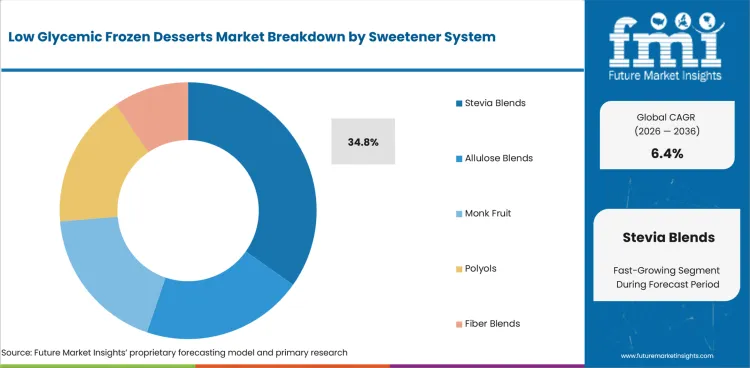
- Stevia blends are forecast to hold 34.8% share in 2026 since brands use plant-based sweetening with fibers to reduce sugar impact.
- Allulose blends gain formulation interest as brands seek sugar-like bulk and softer texture in low-sugar frozen desserts.
Insights into Low Glycemic Frozen Desserts Market by Source
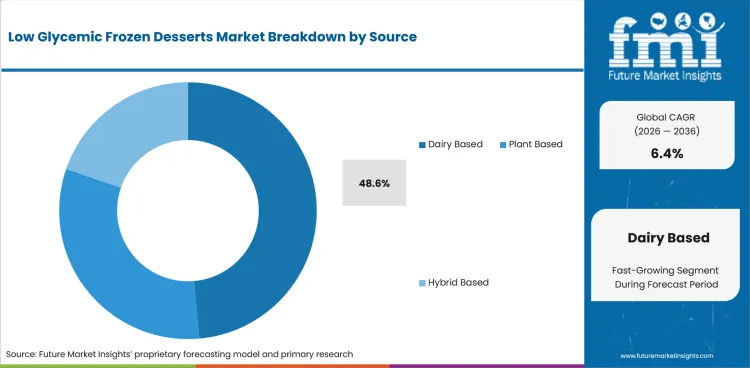
- Dairy-based products are expected to represent 48.6% share in 2026, reflected by milk fat and protein support mouthfeel in low-sugar desserts.
- Plant-based formats gain freezer space as almond and oat systems connect low glycemic positioning with dairy alternative buying.
Insights into Low Glycemic Frozen Desserts Market by Sales Channel
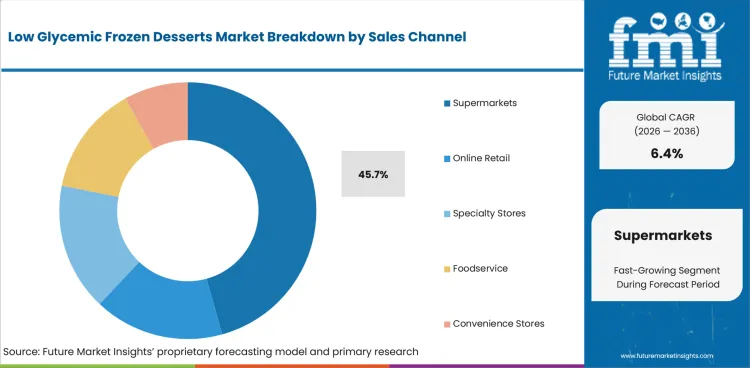
- Supermarkets are anticipated to hold 45.7% share in 2026, driven by freezer aisle trial and multi-pack purchase behavior.
- Online retail adds value as shoppers search directly for low-sugar desserts and compare nutrition labels before purchase.
Insights into Low Glycemic Frozen Desserts Market by Consumer Group
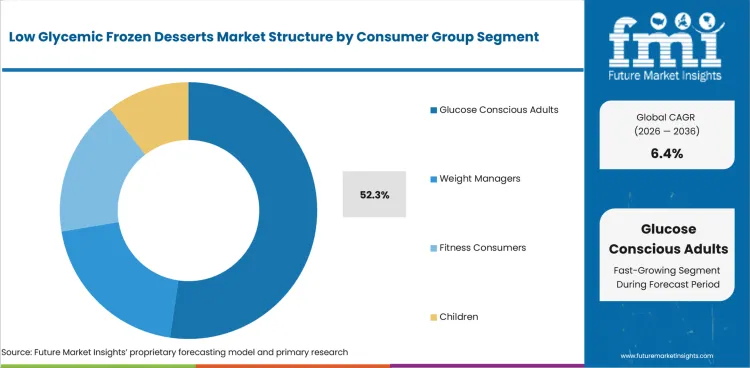
- Glucose-conscious adults are projected to secure 52.3% share in 2026 as blood sugar control enters routine food selection.
- Fitness consumers create premium demand for protein-enriched frozen desserts with controlled carbohydrate content.
Low Glycemic Frozen Desserts Market Drivers, Restraints, and Opportunities
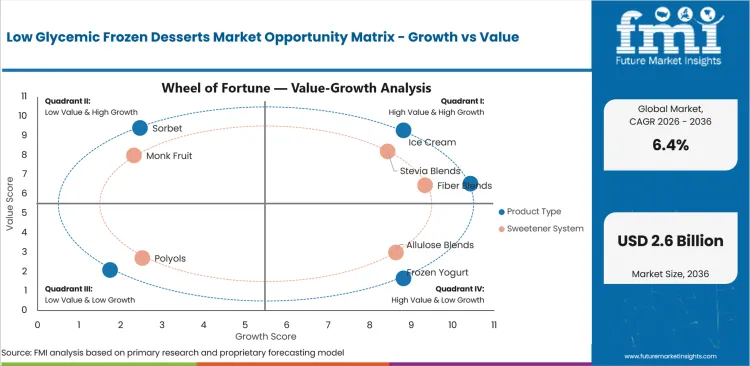
- Driver: Sugar reduction is moving from label claims into formulation decisions for freezer brands.
- Restraint: Sugar replacement still creates texture and melt-control risk in frozen dessert systems.
- Opportunity: Protein-rich low-sugar pints are expanding controlled indulgence into everyday snacking.
Product development is shifting toward products that solve sweetness, texture and nutrition claims together. A January 2025 peer-reviewed frozen dessert study stated, sugar reduction is difficult since sugar controls ice formation and melting behavior. This gives sugar substitutes and ice cream premix and stabilizers suppliers a larger role in low-sugar freezer formulation. EFSA’s June 2025 scientific opinion on D-allulose concluded that safety could not be established from available data, so EU-facing brands need approval-aware sweetener planning before scaling allulose-based products. Protein-led formats create a clearer premium route. Dairy Foods reported in June 2026 that David Protein’s frozen dessert pints deliver 30 g protein, 210 to 260 calories and less than 1 g to 2 g sugar per pint. This connects low-calorie desserts with protein snacks positioning.
Voice of Customer and Decision-driver Analysis
Low glycemic frozen dessert brands need to treat sugar reduction as a taste-led purchase decision rather than a diet-only message. IFIC’s 2025 Food & Health Survey found, 75% of Americans are trying to limit or avoid sugars, while 63% of those consumers focus on added sugars. The same survey showed “good source of protein” at 38% and “low in sugar” at 34% among the leading healthy-food definitions. Brand selection is therefore expected to favor desserts that pair sugar substitutes and familiar flavors with clear label reading. Products positioned only around restriction may lose repeat purchase unless they deliver indulgent taste and clear portion value across diabetic food and low-calorie desserts shelves.
Consumption Occasion and Usage Pattern Analysis
Low glycemic frozen desserts are likely to gain stronger usage as portion-controlled evening treats, mindful snacks and better-for-you indulgence formats. Mondelēz International’s June 2025 State of Snacking release reported, 96% of global consumers engage in mindful snacking, 81% pay attention to sensory experience, and 69% look for portion-controlled snacks. These patterns support single-serve bars and protein-led pints helping consumers manage indulgence without shifting fully away from dessert. Repeat purchase will depend on formats matching snack timing and sensory satisfaction across frozen snacks and healthy snacks positioning.
Analysis of Low Glycemic Frozen Desserts Market by Key Countries
.webp "Top Country Growth Comparison Low Glycemic Frozen Desserts Market Cagr (2026 2036)")
| Country | CAGR |
|---|---|
| India | 7.2% |
| China | 6.9% |
| United States | 6.8% |
| United Kingdom | 6.5% |
| Germany | 5.9% |
| Canada | 5.8% |
| Japan | 5.4% |
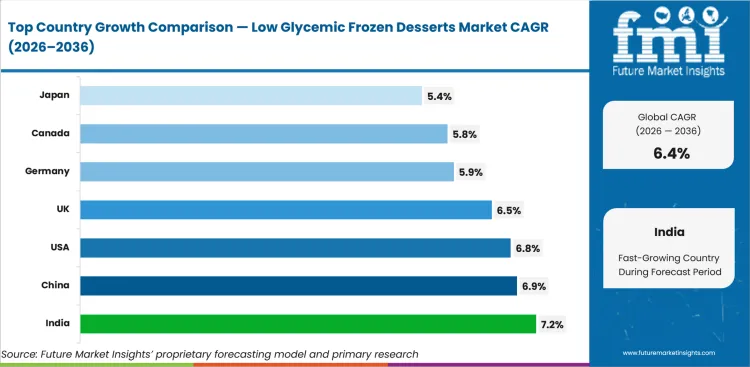
Source: Future Market Insights, 2026.
Low Glycemic Frozen Desserts Market CAGR Analysis by Country
- India is forecast to post 7.2% CAGR by 2036 as metro freezer access broadens low-sugar dessert trial.
- China’s 6.9% CAGR through 2036 reflects premium grocery demand and controlled-sugar launch activity.
- The United States is expected to expand at 6.8% CAGR as low-sugar brands keep national freezer visibility.
- The United Kingdom is projected to grow at 6.5% CAGR during the forecast period as nutrition label comparison supports trial.
- Germany’s 5.9% CAGR reflects ingredient scrutiny and high frozen food consumption across retail channels.
- Canada is forecast to rise at 5.8% CAGR by 2036 as premium grocery and label rules support reformulation.
- Japan is expected to advance at 5.4% CAGR through 2036 as single-serve freezer habits support portion control.
Sales Outlook for Low Glycemic Frozen Desserts Market in India
Urban diabetes awareness center · 2026 to 2036
Country Market Snapshot Table
| Parameter | Value |
|---|---|
| Market Size in 2025 (Value) | USD 97.9 million |
| Market Size in 2026 (Value) | USD 105.0 million |
| Market Forecast in 2036 (Value) | USD 210.4 million |
| CAGR (2026-2036) | 7.2% |
| Years Considered | 2021-2036 |
| Base Year | 2025 |
| Forecast Period | 2026-2036 |
| Units Considered | Value (USD million) |
| Leading Sub-Region | Metro and tier-one freezer retail |
India Low Glycemic Frozen Desserts Market Outlook
India low glycemic frozen dessert demand is shaped by urban freezer retail and glucose-aware food choices. Metro supermarkets and quick-commerce platforms are creating a clearer route for low-sugar tubs, bars, and frozen yogurt formats.
Local dairy availability supports frozen dessert manufacturing. Imported sweetener cost and limited cold chain reach outside large cities can restrict price access.
Key Growth Drivers
- Urban consumers are giving controlled sugar desserts a larger trial pool, as IDF recorded 89.8 million adults aged 20 to 79 with diabetes in India in 2024.
- Dairy-based low glycemic formats have a strong manufacturing base, supported by India’s milk output reaching 239.3 million tonnes in 2023-24.
- Metro grocery spending supports premium freezer purchases, reflected by urban monthly per capita consumption expenditure of INR 6,996 in 2023-24.
- Domestic dairy scale can support local low-sugar ice cream production, led by India contributing 24.76% of global milk output in 2023-24.
Key Restraints
- Rural freezer expansion can move more slowly outside metro channels, given rural monthly per capita consumption expenditure stood at INR 4,122 in 2023-24.
- Price gaps can limit low glycemic dessert reach, as rural and urban imputed MPCE stood at INR 4,247 and INR 7,078 respectively in 2023-24.
- Smaller retail outlets may offer limited frozen dessert choice, influenced by HCES 2023-24 covering 8,684 rural FSUs against 6,143 urban FSUs.
What makes India unique
India is unique due to fast urban freezer growth and a large population managing sugar intake.
Key Companies
- Go Zero
- NOTO
- The Brooklyn Creamery
- Get-A-Way
- Minus 30
Sales & Marketing Channels
- Supermarkets
- Online grocery
- Quick commerce
- Specialty stores
- Foodservice partners
- Health retail stores
Country Segment Breakdown Table
| Segment | Sub-Segments |
|---|---|
| By Product Type | Ice Cream · Frozen Yogurt · Sorbet · Frozen Bars · Frozen Pops |
| By Sweetener System | Stevia Blends · Allulose Blends · Monk Fruit · Polyols · Fiber Blends |
| By Source | Dairy Based · Plant Based · Hybrid Based |
| By Sales Channel | Supermarkets · Online Retail · Specialty Stores · Foodservice · Convenience Stores |
| By Consumer Group | Glucose Conscious Adults · Weight Managers · Fitness Consumers · Children |
| Key Sub-Regions Covered, Urban Retail Clusters | Delhi NCR · Mumbai · Bengaluru · Hyderabad · Chennai · Pune |
Market Taxonomy and Sub-Regions Covered
Frequently Asked Questions
How fast is India low glycemic frozen desserts market growing?
Demand in India is projected at 7.2% CAGR from 2026 to 2036, driven by urban freezer retail and sugar awareness rise.
Who leads India low glycemic frozen desserts market?
The Magnum Ice Cream Company, Wells Enterprises and N!CK’S compete based on brands and low sugar product skill.
What is driving adoption in India low glycemic frozen desserts market?
Urban consumers are choosing controlled sugar desserts as diabetes awareness and premium freezer access increase across metro grocery channels.
Demand Outlook for Low Glycemic Frozen Desserts Market in China
Premium controlled sugar freezer center · 2026 to 2036
Country Market Snapshot Table
| Parameter | Value |
|---|---|
| Market Size in 2025 (Value) | USD 168.4 million |
| Market Size in 2026 (Value) | USD 180.0 million |
| Market Forecast in 2036 (Value) | USD 350.8 million |
| CAGR (2026-2036) | 6.9% |
| Years Considered | 2021-2036 |
| Base Year | 2025 |
| Forecast Period | 2026-2036 |
| Units Considered | Value (USD million) |
| Leading Sub-Region | Coastal retail clusters |
China Low Glycemic Frozen Desserts Market Outlook
China low glycemic frozen dessert demand is guided by premium retail and controlled sugar product claims. Urban shoppers compare sugar content and ingredient quality before choosing frozen desserts.
Coastal cities support stronger freezer availability and imported ingredient acceptance. Domestic brands can scale faster if local flavors are paired with lower-sugar nutrition labels.
Key Growth Drivers
- Controlled sugar dessert positioning has a large health-aware consumer pool, as IDF recorded 148.0 million adults aged 20 to 79 with diabetes in China in 2024.
- Online grocery discovery supports low-sugar freezer brands, since physical goods online retail sales of food rose 16.0% in China during 2024.
- Urban retail channels support premium freezer products, reflected by urban consumer goods retail sales reaching 42,116.6 billion yuan in 2024.
- Digital food buying gives low-sugar desserts stronger search access, as China’s physical goods online retail sales reached 13,081.6 billion yuan in 2024.
Key Restraints
- Dairy formulation planning faces raw material pressure, led by liquid milk production falling 2.8% to 27.4 million tonnes in 2024.
- Premium dessert trade-up can face slower consumer spending, reflected by total retail sales of consumer goods rising 3.5% in 2024.
- Dairy ingredient planning may require closer cost monitoring, as fluctuations in milk supply and raw material prices continue to impact production expenses.
What makes China unique
China is unique due to premium freezer retail and fast reformulation activity in urban packaged food.
Key Companies
- Inner Mongolia Yili Industrial Group
- China Mengniu Dairy
- Bright Dairy & Food
- Junlebao Dairy Group
- Zhong Xuegao
Sales & Marketing Channels
- Premium supermarkets
- Online grocery
- Convenience chains
- Specialty stores
- Club stores
- Café partners
Country Segment Breakdown Table
| Segment | Sub-Segments |
|---|---|
| By Product Type | Ice Cream · Frozen Yogurt · Sorbet · Frozen Bars · Frozen Pops |
| By Sweetener System | Stevia Blends · Allulose Blends · Monk Fruit · Polyols · Fiber Blends |
| By Source | Dairy Based · Plant Based · Hybrid Based |
| By Sales Channel | Supermarkets · Online Retail · Specialty Stores · Foodservice · Convenience Stores |
| By Consumer Group | Glucose Conscious Adults · Weight Managers · Fitness Consumers · Children |
| Key Sub-Regions Covered, Coastal Retail Areas | Shanghai · Beijing · Guangzhou · Shenzhen · Hangzhou · Chengdu |
Market Taxonomy and Sub-Regions Covered
Frequently Asked Questions
How fast is China low glycemic frozen desserts market growing?
The market in China is expected to rise at 6.9% CAGR from 2026 to 2036 due to premium freezer choices expansion.
Who leads China low glycemic frozen desserts market?
The Magnum Ice Cream Company, Wells Enterprises and Rebel Creamery compete through premium frozen dessert know-how and sweetener depth.
What is driving adoption in China low glycemic frozen desserts market?
Controlled sugar labels and premium retail access are moving urban shoppers toward low glycemic frozen desserts.
Growth Outlook for Low Glycemic Frozen Desserts Market in the United States
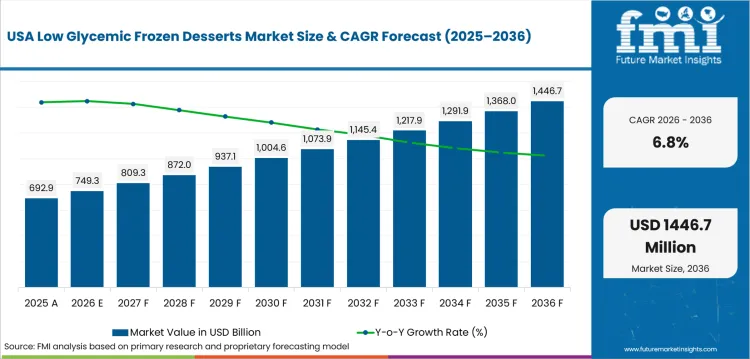
Low sugar freezer aisle center · 2026 to 2036
Country Market Snapshot Table
| Parameter | Value |
|---|---|
| Market Size in 2025 (Value) | USD 421.3 million |
| Market Size in 2026 (Value) | USD 450.0 million |
| Market Forecast in 2036 (Value) | USD 868.8 million |
| CAGR (2026-2036) | 6.8% |
| Years Considered | 2021-2036 |
| Base Year | 2025 |
| Forecast Period | 2026-2036 |
| Units Considered | Value (USD million) |
| Leading Sub-Region | National grocery freezer aisle |
United States Low Glycemic Frozen Desserts Market Outlook
United States low glycemic frozen dessert demand is centered on national grocery chains and established low-sugar ice cream brands. Shoppers compare sugar, calories, and protein claims before choosing tubs or bars.
Large frozen dairy output supports manufacturing scale. Retail competition remains heavy as freezer shelves already carry many better-for-you dessert options.
Key Growth Drivers
- Low-sugar frozen dessert brands have a large target audience, as CDC reported 40.1 million people with diagnosed or undiagnosed diabetes in 2023.
- Manufacturing capacity supports reformulated desserts, with USDA ERS reporting 1,386 million gallons of ice cream and other frozen dairy products produced in 2024.
- Package claim clarity is gaining policy support, as FDA proposed a front-of-package Nutrition Info box covering 3 nutrients in January 2025.
- Lower-sugar product claims are receiving clearer guardrails, due to FDA announcing an updated healthy claim rule on December 19, 2024.
Key Restraints
- Frozen dairy volume has softened over time, reflected by USDA ERS reporting production declined 10.0% from 2000 to 2024.
- Standard ice cream comparison remains demanding, as U.S. frozen dairy output was below its 1,542 million gallon peak from 2003.
- Nutrition label scrutiny raises reformulation pressure, as FDA’s proposed Nutrition Info box covers saturated fat and added sugars.
What makes the United States unique
United States is unique due to established low-sugar ice cream brands and national freezer aisle scale.
Key Companies
- Wells Enterprises
- Halo Top
- Rebel Creamery
- Arctic Zero
- GoodPop
- Yasso
Sales & Marketing Channels
- Supermarkets
- Club stores
- Online grocery
- Natural stores
- Convenience stores
- Foodservice partners
Country Segment Breakdown Table
| Segment | Sub-Segments |
|---|---|
| By Product Type | Ice Cream · Frozen Yogurt · Sorbet · Frozen Bars · Frozen Pops |
| By Sweetener System | Stevia Blends · Allulose Blends · Monk Fruit · Polyols · Fiber Blends |
| By Source | Dairy Based · Plant Based · Hybrid Based |
| By Sales Channel | Supermarkets · Online Retail · Specialty Stores · Foodservice · Convenience Stores |
| By Consumer Group | Glucose Conscious Adults · Weight Managers · Fitness Consumers · Children |
| Key Sub-Regions Covered, Grocery Regions | California · Texas · Florida · New York · Midwest · Pacific Northwest |
Market Taxonomy and Sub-Regions Covered
Frequently Asked Questions
How fast is United States low glycemic frozen desserts market growing?
Industry in the United States is forecast to grow at 6.8% CAGR from 2026 to 2036, influenced by low sugar freezer brands scale.
Who leads United States low glycemic frozen desserts market?
Wells Enterprises, The Magnum Ice Cream Company and Beyond Better Foods compete led by national freezer distribution and brand depth.
What is driving adoption in United States low glycemic frozen desserts market?
FDA label activity and established low sugar ice cream awareness are supporting repeat buying in national grocery channels.
Sales Outlook for Low Glycemic Frozen Desserts Market in the United Kingdom
Nutrition label comparison center · 2026 to 2036
Country Market Snapshot Table
| Parameter | Value |
|---|---|
| Market Size in 2025 (Value) | USD 89.2 million |
| Market Size in 2026 (Value) | USD 95.0 million |
| Market Forecast in 2036 (Value) | USD 178.3 million |
| CAGR (2026-2036) | 6.5% |
| Years Considered | 2021-2036 |
| Base Year | 2025 |
| Forecast Period | 2026-2036 |
| Units Considered | Value (USD million) |
| Leading Sub-Region | England grocery multiples |
United Kingdom Low Glycemic Frozen Desserts Market Outlook
United Kingdom demand is shaped by supermarket private label strength and active nutrition comparison. Grocery multiples can test low-sugar tubs, frozen bars, and yogurt-based desserts before national rollout.
Health positioning needs strong price control. Value-focused shoppers may switch back to standard ice cream if low glycemic products carry a high premium.
Key Growth Drivers
- Diabetes-related food choices have a clear addressable audience, as Diabetes UK estimated almost 6.0 million people living with diabetes in the United Kingdom.
- Preventive health awareness supports lower-sugar dessert trial, since NHS England identified 3,615,330 people with non-diabetic hyperglycaemia in 2023.
- Grocery spending gives controlled sugar desserts a supermarket route, with households spending £35.94 per person per week on household food and drink in FYE 2024.
- Younger adult diagnosis raises long-term sugar reduction interest, as Diabetes UK reported almost 168,000 people under 40 living with type 2 diabetes in 2024.
Key Restraints
- Value pressure can restrict healthier dessert trial, reflected by household food and non-alcoholic drink spending at £32.30 per person per week in FYE 2024.
- Foodservice recovery can pull dessert spending away from home freezers, with food and drink eaten out at £11.25 per person per week in FYE 2024.
- Under-40 diabetes growth raises health concern but complicates messaging, as diagnoses increased by 40.0% between 2016-17 and 2022-23.
What makes the United Kingdom unique
United Kingdom is unique due to private label strength and active nutrition comparison across grocery channels.
Key Companies
- Oppo Brothers
- Jude’s
- Booja-Booja
- Yeo Valley Organic
- Remeo Gelato
Sales & Marketing Channels
- Grocery multiples
- Online grocery
- Convenience chains
- Discount retail
- Natural food stores
- Foodservice partners
Country Segment Breakdown Table
| Segment | Sub-Segments |
|---|---|
| By Product Type | Ice Cream · Frozen Yogurt · Sorbet · Frozen Bars · Frozen Pops |
| By Sweetener System | Stevia Blends · Allulose Blends · Monk Fruit · Polyols · Fiber Blends |
| By Source | Dairy Based · Plant Based · Hybrid Based |
| By Sales Channel | Supermarkets · Online Retail · Specialty Stores · Foodservice · Convenience Stores |
| By Consumer Group | Glucose Conscious Adults · Weight Managers · Fitness Consumers · Children |
| Key Sub-Regions Covered, Retail Areas | England · Scotland · Wales · Northern Ireland · London · Midlands |
Market Taxonomy and Sub-Regions Covered
Frequently Asked Questions
How fast is United Kingdom low glycemic frozen desserts market growing?
Sales in the United Kingdom are set to scale at 6.5% CAGR from 2026 to 2036 through supermarket-led freezer adoption.
Who leads United Kingdom low glycemic frozen desserts market?
The Magnum Ice Cream Company, N!CK’S and Wells Enterprises compete depending on premium brands and freezer shelf access.
What is driving adoption in United Kingdom low glycemic frozen desserts market?
Nutrition label use and private label testing are moving low glycemic frozen desserts into mainstream grocery aisles.
Demand Outlook for Low Glycemic Frozen Desserts Market in Germany
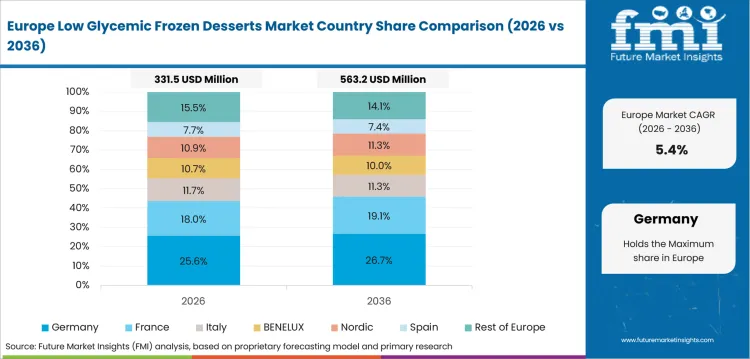
Dairy quality and sugar reduction center · 2026 to 2036
Country Market Snapshot Table
| Parameter | Value |
|---|---|
| Market Size in 2025 (Value) | USD 83.1 million |
| Market Size in 2026 (Value) | USD 88.0 million |
| Market Forecast in 2036 (Value) | USD 156.1 million |
| CAGR (2026-2036) | 5.9% |
| Years Considered | 2021-2036 |
| Base Year | 2025 |
| Forecast Period | 2026-2036 |
| Units Considered | Value (USD million) |
| Leading Sub-Region | Western retail chains |
Germany Low Glycemic Frozen Desserts Market Outlook
Germany low glycemic frozen dessert demand is shaped by ingredient scrutiny and strong frozen food habits. Consumers expect reduced sugar products to keep creaminess and clean taste.
Discounters and supermarkets can scale low-sugar desserts if price and taste align. Crowded freezer assortments can make shelf retention harder for new brands.
Key Growth Drivers
- Glucose-aware food choices have a strong consumer pool, since IDF recorded 6.5 million adults aged 20 to 79 with diabetes in Germany in 2024.
- Frozen product buying supports low glycemic dessert placement, as dti reported per capita frozen food consumption of 50.0 kg in Germany in 2024.
- Retail freezer scale is favorable, with dti reporting total frozen food sales above 4.0 million tonnes in Germany in 2024.
- Household freezer habits support repeat purchase, reflected by frozen product consumption per household reaching 101.1 kg in 2024.
Key Restraints
- Shelf competition can limit new low glycemic SKUs, as dti reported consumers purchased more than 11,000 different frozen food products in 2024.
- Retail price pressure remains active, reflected by food retail and home service frozen food volume reaching 2.017 million tonnes in 2024.
- Foodservice demand can compete for low-sugar frozen dessert development, as out-of-home frozen food sales reached 2.12 million tonnes in 2024.
What makes Germany unique
Germany is unique due to strict ingredient expectations and strong private label freezer retail.
Key Companies
- NOMOO
- Florida Eis
- IceDate
- Eis Greissler Germany
- Lidl Gelatelli
Sales & Marketing Channels
- Supermarkets
- Discount chains
- Drugstores
- Online grocery
- Natural stores
- Foodservice partners
Country Segment Breakdown Table
| Segment | Sub-Segments |
|---|---|
| By Product Type | Ice Cream · Frozen Yogurt · Sorbet · Frozen Bars · Frozen Pops |
| By Sweetener System | Stevia Blends · Allulose Blends · Monk Fruit · Polyols · Fiber Blends |
| By Source | Dairy Based · Plant Based · Hybrid Based |
| By Sales Channel | Supermarkets · Online Retail · Specialty Stores · Foodservice · Convenience Stores |
| By Consumer Group | Glucose Conscious Adults · Weight Managers · Fitness Consumers · Children |
| Key Sub-Regions Covered, Retail Regions | North Rhine-Westphalia · Bavaria · Baden-Württemberg · Hesse · Berlin · Hamburg |
Market Taxonomy and Sub-Regions Covered
Frequently Asked Questions
How fast is Germany low glycemic frozen desserts market growing?
Demand in Germany is anticipated to rise at 5.9% CAGR from 2026 to 2036, led by sugar reduction integrating into freezer aisles.
Who leads Germany low glycemic frozen desserts market?
The Magnum Ice Cream Company, N!CK’S and Rebel Creamery compete driven by formulation strength and premium freezer positioning.
What is driving adoption in Germany low glycemic frozen desserts market?
Ingredient scrutiny and retail private label testing are pushing brands toward cleaner low glycemic frozen desserts.
Growth Outlook for Low Glycemic Frozen Desserts Market in Canada
Premium grocery and diabetes awareness center · 2026 to 2036
Country Market Snapshot Table
| Parameter | Value |
|---|---|
| Market Size in 2025 (Value) | USD 52.0 million |
| Market Size in 2026 (Value) | USD 55.0 million |
| Market Forecast in 2036 (Value) | USD 96.7 million |
| CAGR (2026-2036) | 5.8% |
| Years Considered | 2021-2036 |
| Base Year | 2025 |
| Forecast Period | 2026-2036 |
| Units Considered | Value (USD million) |
| Leading Sub-Region | Ontario and British Columbia |
Canada Low Glycemic Frozen Desserts Market Outlook
Canada low glycemic frozen dessert demand is guided by premium grocery adoption and cross-border brand flow. National chains can combine low-sugar ice cream with lactose free and plant-based freezer ranges.
Long distribution distances can raise cold chain cost. Brands need stable texture and clear nutrition claims to justify premium pricing.
Key Growth Drivers
- Diabetes-aware consumers give low glycemic desserts a defined pool, as IDF recorded 2.8 million adults aged 20 to 79 with diabetes in Canada in 2024.
- Local frozen dessert output supports freezer depth, with Statistics Canada reporting 15,293 kilolitres of hard ice cream production in March 2024.
- Premium grocery positioning gains label support, as Health Canada made front-of-package symbols mandatory from January 2026.
- Food label review now affects frozen dessert claims, since Health Canada rules cover saturated fat and sodium on prepackaged foods.
Key Restraints
- Canada-specific pack compliance can add cost, as Health Canada rules apply to prepackaged foods meeting set nutrient thresholds.
- Production seasonality can complicate supply planning, reflected by hard ice cream output reaching 17,310 kilolitres in July 2023.
- Long-distance distribution can raise freezer logistics pressure, especially for imported brands serving provinces outside large metro areas.
What makes Canada unique
Canada is unique due to premium grocery adoption and strong cross-border frozen dessert brand flow.
Key Companies
- Chapman’s
- Central Smith
- Kawartha Dairy
- Foothills Creamery
- Scotsburn
Sales & Marketing Channels
- Supermarkets
- Club stores
- Online grocery
- Natural stores
- Convenience stores
- Foodservice partners
Country Segment Breakdown Table
| Segment | Sub-Segments |
|---|---|
| By Product Type | Ice Cream · Frozen Yogurt · Sorbet · Frozen Bars · Frozen Pops |
| By Sweetener System | Stevia Blends · Allulose Blends · Monk Fruit · Polyols · Fiber Blends |
| By Source | Dairy Based · Plant Based · Hybrid Based |
| By Sales Channel | Supermarkets · Online Retail · Specialty Stores · Foodservice · Convenience Stores |
| By Consumer Group | Glucose Conscious Adults · Weight Managers · Fitness Consumers · Children |
| Key Sub-Regions Covered, Grocery Provinces | Ontario · British Columbia · Quebec · Alberta · Manitoba · Nova Scotia |
Market Taxonomy and Sub-Regions Covered
Frequently Asked Questions
How fast is Canada low glycemic frozen desserts market growing?
Sector in Canada is expected to progress at 5.8% CAGR from 2026 to 2036, influenced by premium grocery choices expansion.
Who leads Canada low glycemic frozen desserts market?
The Magnum Ice Cream Company, Wells Enterprises and GoodPop compete on freezer channels and established brand access.
What is driving adoption in Canada low glycemic frozen desserts market?
Premium grocery habits and diabetes awareness are supporting low glycemic frozen dessert trial across major provinces.
Sales Outlook for Low Glycemic Frozen Desserts Market in Japan
Portion control and convenience freezer center · 2026 to 2036
Country Market Snapshot Table
| Parameter | Value |
|---|---|
| Market Size in 2025 (Value) | USD 75.9 million |
| Market Size in 2026 (Value) | USD 80.0 million |
| Market Forecast in 2036 (Value) | USD 135.4 million |
| CAGR (2026-2036) | 5.4% |
| Years Considered | 2021-2036 |
| Base Year | 2025 |
| Forecast Period | 2026-2036 |
| Units Considered | Value (USD million) |
| Leading Sub-Region | Kanto convenience retail |
Japan Low Glycemic Frozen Desserts Market Outlook
Japan low glycemic frozen dessert demand is shaped by portion control and convenience retail. Single-serve freezer formats suit shoppers seeking measured indulgence and lower-sugar impact.
Product success will depend on texture precision and flavor balance. Convenience store freezer space can make shelf access selective for new brands.
Key Growth Drivers
- Controlled sugar desserts have a sizeable health audience, as IDF recorded 10.8 million adults aged 20 to 79 with diabetes in Japan in 2024.
- Convenience retail supports single-serve freezer products, as Japan had 55,736 convenience stores in December 2024.
- Export activity supports Japanese frozen dessert quality signals. MAFF reported food and agricultural exports reached JPY 1,507.1 billion in 2024.
- Portion-controlled freezer products match local snacking habits, making smaller cups and bars more practical than large take-home tubs.
Key Restraints
- Convenience freezer space is selective, reflected by Japan’s store count rising by only 23 locations from December 2023 to December 2024.
- Population structure can narrow volume expansion, as Japan’s adult diabetes count is forecast by IDF to decline to 9.4 million by 2050.
- Premium flavor standards raise formulation risk, so low-sugar products need clean taste before earning repeat purchase.
What makes Japan unique
Japan is unique due to single-serve freezer habits and precise portion control preferences.
Key Companies
- Ezaki Glico
- Morinaga Milk Industry
- Lotte Japan
- Akagi Nyugyo
- Imuraya Group
Sales & Marketing Channels
- Convenience stores
- Supermarkets
- Online grocery
- Drugstores
- Specialty stores
- Café partners
Country Segment Breakdown Table
| Segment | Sub-Segments |
|---|---|
| By Product Type | Ice Cream · Frozen Yogurt · Sorbet · Frozen Bars · Frozen Pops |
| By Sweetener System | Stevia Blends · Allulose Blends · Monk Fruit · Polyols · Fiber Blends |
| By Source | Dairy Based · Plant Based · Hybrid Based |
| By Sales Channel | Supermarkets · Online Retail · Specialty Stores · Foodservice · Convenience Stores |
| By Consumer Group | Glucose Conscious Adults · Weight Managers · Fitness Consumers · Children |
| Key Sub-Regions Covered, Convenience Retail Areas | Kanto · Kansai · Chubu · Kyushu · Hokkaido · Tohoku |
Market Taxonomy and Sub-Regions Covered
Frequently Asked Questions
How fast is Japan low glycemic frozen desserts market growing?
Sales in Japan are forecast at 5.4% CAGR from 2026 to 2036 due to portion-controlled freezer desserts gaining attention.
Who leads Japan low glycemic frozen desserts market?
The Magnum Ice Cream Company, Wells Enterprises and N!CK’S compete through freezer formats and low sugar formulation ability.
What is driving adoption in Japan low glycemic frozen desserts market?
Single-serve retail and sugar control needs are moving shoppers toward low glycemic frozen dessert formats.
Competitive Landscape and Strategic Positioning
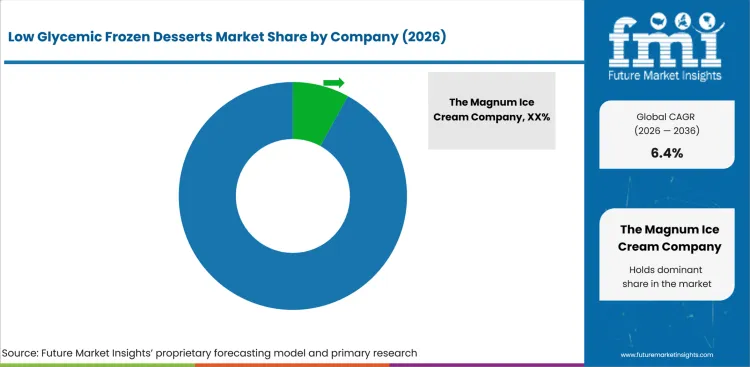
- Large ice cream companies compete on freezer access and manufacturing scale.
- Specialist low-sugar brands compete led by sweetener systems and repeat-purchase taste.
- Private label suppliers gain ground by matching supermarket nutrition targets at controlled retail prices.
- Ingredient partners shape product success based on sweetness balance and freezing point control.
Competitive structure is led by large frozen dessert companies and specialist low-sugar brands. The Magnum Ice Cream Company and Wells Enterprises hold strong positions through ice cream brand reach and established freezer distribution. N!CK’S, Rebel Creamery and Beyond Better Foods compete on sweetener formulation and nutrition-led product claims. GoodPop and Arctic Zero add value through bars and frozen yogurt formats that suit portion-controlled buying.
Supplier advantage will come from taste retention and credible sugar reduction. Larger players are best placed to secure supermarkets through freezer scale and retailer programs. Specialist brands can win premium consumers if they solve aftertaste and texture gaps. Ingredient depth will decide which companies can keep low glycemic positioning while maintaining mainstream dessert appeal.
Key Companies in the Low Glycemic Frozen Desserts Market
Competitive structure is differentiated by global frozen dessert companies, low-sugar specialists and better-for-you frozen brands.
-
- Global Frozen Dessert Companies: The Magnum Ice Cream Company and Wells Enterprises compete based on freezer access and large-scale frozen dessert production.
- Low Sugar Specialists: N!CK’S, Rebel Creamery and Beyond Better Foods compete through sweetener systems and controlled carbohydrate positioning.
- Better-for-You Frozen Brands: GoodPop and Arctic Zero compete by portion-controlled formats and health-oriented frozen dessert positioning.
Competitive Benchmarking: Low Glycemic Frozen Desserts Market
| Company | Low Sugar Formulation Depth | Freezer Channel Access | Better-for-You Brand Strength | Channel Reach | Geographic Footprint |
|---|---|---|---|---|---|
| The Magnum Ice Cream Company | Strong | Very Strong | Strong | Very Strong | Global |
| Wells Enterprises | Strong | Very Strong | Strong | Very Strong | North America |
| N!CK’S | Very Strong | Strong | Very Strong | Strong | North America and Europe |
| Rebel Creamery | Very Strong | Moderate | Very Strong | Moderate | North America |
| Beyond Better Foods | Strong | Strong | Strong | Strong | North America |
| GoodPop | Moderate | Strong | Strong | Strong | North America |
| Arctic Zero | Strong | Moderate | Strong | Moderate | North America |
Source: Future Market Insights competitive analysis, 2026.
Key Developments in Low Glycemic Frozen Desserts Market
- In June 2024, GoodPop launched Hydrating Freezer Pops made with organic fruit juice and no added sugar.
- In January 2025, Halo Top introduced eight light ice cream mix-in pints under Wells Enterprises.
- In October 2025, Yasso launched spoonable frozen Greek yogurt pints exclusively at Target before a national rollout from January 2026.
Key Players in the Low Glycemic Frozen Desserts Market
- The Magnum Ice Cream Company
- Wells Enterprises
- N!CK’S
- Rebel Creamery
- Beyond Better Foods
- GoodPop
- Arctic Zero
Market Report Scope
| Item | Value |
|---|---|
| Market size by 2036 | USD 2.6 billion |
| Growth rate | 6.4% CAGR (2026-2036) |
| Forecast period | 2026 to 2036 |
| Base year value (2026) | USD 1.4 billion |
| By Product Type | Ice cream, frozen yogurt, sorbet, frozen bars, frozen pops |
| By Sweetener System | Stevia blends, allulose blends, monk fruit, polyols, fiber blends |
| By Source | Dairy based, plant based, hybrid based |
| By Sales Channel | Supermarkets, online retail, specialty stores, foodservice, convenience stores |
| By Consumer Group | Glucose conscious adults, weight managers, fitness consumers, children |
| Regions covered | North America, Latin America, Europe, East Asia, South Asia, Oceania, Middle East and Africa |
| Countries covered | India, China, United States, United Kingdom, Germany, Canada, Japan |
| Key companies profiled | The Magnum Ice Cream Company, Wells Enterprises, N!CK’S, Rebel Creamery, Beyond Better Foods, GoodPop, Arctic Zero |
| Approach | Bottom-up product-boundary approach using eligible SKU revenue, channel presence, retail pricing, product positioning and country-level adoption |
Source: Future Market Insights, 2026.
Low Glycemic Frozen Desserts Market Breakdown by Product Type, Sweetener System, Source, Sales Channel, Consumer Group, and Region
By Product Type
- Ice Cream
- Frozen Yogurt
- Sorbet
- Frozen Bars
- Frozen Pops
By Sweetener System
- Stevia Blends
- Allulose Blends
- Monk Fruit
- Polyols
- Fiber Blends
By Source
- Dairy Based
- Plant Based
- Hybrid Based
By Sales Channel
- Supermarkets
- Online Retail
- Specialty Stores
- Foodservice
- Convenience Stores
By Consumer Group
- Glucose Conscious Adults
- Weight Managers
- Fitness Consumers
- Children
By Region
- North America
- Latin America
- Europe
- East Asia
- South Asia
- Oceania
- Middle East and Africa
Research Sources and Bibliography
- USA Food and Drug Administration. (2024, September 30). GRAS notice no. GRN 001148: D-psicose.
- European Food Safety Authority. (2025, June). Minutes of the 158th plenary meeting of the NDA Panel held on 6-7 May 2025: Open to observers.
- Advisory Committee on Novel Foods and Processes. (2024, November 15). Allulose discussion paper.
- USA Food and Drug Administration. (2025, February 27). Aspartame and other sweeteners in food.
- USA Food and Drug Administration. (2025, February 12). GRAS notice inventory: Rebaudioside M2 obtained by enzymatic treatment of steviol glycosides.
- Wang, Q., Sala, G., & Scholten, E. (2025, January). Functionality of sugars and sugar replacers in model frozen dessert systems. Current Research in Food Science, 11, Article 101128.
- EFSA Panel on Nutrition, Novel Foods and Food Allergens. (2025, June 5). Safety of D-allulose as a novel food pursuant to Regulation (EU) 2015/2283. EFSA Journal, 23(6), Article e9468.
- Dairy Foods. (2026, June). David Protein enters frozen dessert category.
- International Food Information Council. (2025). 2025 IFIC Food & Health Survey.
- Mondelēz International. (2025, June 17). Mondelēz International State of Snacking Survey: Global consumers prioritize portions and snacking mindfully.
- Centers for Disease Control and Prevention. (2026, January 21). National Diabetes Statistics Report.
- Deutsches Tiefkühlinstitut e. V. (2025, April). Frozen food continues on record course.
- Diabetes UK. (2024, May 22). Action needed to tackle rising type 2 cases among under-40s.
- Food and Drug Administration. (2024, December 19). FDA updates “healthy” claim, providing a refreshed tool for consumers.
- Food and Drug Administration. (2025, January 14). FDA proposes requiring at-a-glance nutrition information on the front of packaged foods.
- Government of India, Ministry of Fisheries, Animal Husbandry and Dairying. (2024, December 19). Year-end review 2024: Department of Animal Husbandry and Dairying.
- Government of India, Ministry of Statistics and Programme Implementation. (2024, December 27). Household Consumption Expenditure Survey: 2023-24.
- Government of the United Kingdom. (2025, November 6). Family Food FYE 2024.
- Health Canada. (2026, January 5). Nutrition labelling: Front-of-package nutrition symbol.
- International Diabetes Federation. (2025). IDF Diabetes Atlas 11th Edition: Canada country profile.
- International Diabetes Federation. (2025). IDF Diabetes Atlas 11th Edition: Germany country profile.
- International Diabetes Federation. (2025). IDF Diabetes Atlas 11th Edition: India country profile.
- International Diabetes Federation. (2025). IDF Diabetes Atlas 11th Edition: Japan country profile.
- Ministry of Agriculture, Forestry and Fisheries. (2025). Annual report on food, agriculture and rural areas in Japan FY2024.
- National Bureau of Statistics of China. (2025, January 17). National economy witnessed steady progress amidst stability in 2024.
- National Bureau of Statistics of China. (2025, January 24). Total retail sales of consumer goods in December 2024.
- NHS England. (2024, June 12). NHS identifies over half a million more people at risk of type 2 diabetes in a year.
- Statistics Canada. (2024, July 8). Our ice cream time machine is not broken! We’ve got the scoop right here.
- The Magnum Ice Cream Company. (2025, October 1). Yasso expands better-for-you portfolio in the USA.
- USA Department of Agriculture, Economic Research Service. (2025, July 16). Ice cream and frozen dairy production dipped from 2000 to 2024.
Bibliography uses English-language official public body and company sources dated 2024 onward.
This Report Answers
- What is the 2026 value and 2036 forecast for Low Glycemic Frozen Desserts Market?
- What product type is projected to hold the leading share during the forecast period?
- What consumer group is expected to account for the leading 2026 share?
- How do sweetener systems affect taste and product pricing?
- What companies compete in low glycemic frozen desserts?
Frequently Asked Questions
What is the low glycemic frozen desserts market size in 2026?
The low glycemic frozen desserts market is expected to cross USD 1.4 billion in 2026.
What is the low glycemic frozen desserts market forecast for 2036?
The low glycemic frozen desserts industry is forecast to reach USD 2.6 billion by 2036 as controlled sugar desserts expand.
What is the low glycemic frozen desserts market CAGR?
The low glycemic frozen desserts sector is projected to advance at 6.4% CAGR from 2026 to 2036.
What segment leads the low glycemic frozen desserts market?
Dairy-based products are likely to garner 48.6% share in 2026 due to taste familiarity and stronger cream texture.
What country grows fastest in the low glycemic frozen desserts market?
India is set to record 7.2% CAGR by 2036, driven by urban freezer retail and diabetes awareness influencing product trial.
Preview the report firsthand - request a free sample
Get SampleGet the brochure for pricing and purchase details.
Get PDFTable of Content
- Executive Summary
- Global Market Outlook
- Demand-side Trends
- Supply-side Trends
- Technology Roadmap Analysis
- Analysis and Recommendations
- Market Overview
- Market Coverage / Taxonomy
- Market Definition / Scope / Limitations
- Research Methodology
- Chapter Orientation
- Analytical Lens and Working Hypotheses
- Market Structure, Signals, and Trend Drivers
- Benchmarking and Cross-market Comparability
- Market Sizing, Forecasting, and Opportunity Mapping
- Research Design and Evidence Framework
- Desk Research Programme (Secondary Evidence)
- Company Annual and Sustainability Reports
- Peer-reviewed Journals and Academic Literature
- Corporate Websites, Product Literature, and Technical Notes
- Earnings Decks and Investor Briefings
- Statutory Filings and Regulatory Disclosures
- Technical White Papers and Standards Notes
- Trade Journals, Industry Magazines, and Analyst Briefs
- Conference Proceedings, Webinars, and Seminar Materials
- Government Statistics Portals and Public Data Releases
- Press Releases and Reputable Media Coverage
- Specialist Newsletters and Curated Briefings
- Sector Databases and Reference Repositories
- FMI Internal Proprietary Databases and Historical Market Datasets
- Subscription Datasets and Paid Sources
- Social Channels, Communities, and Digital Listening Inputs
- Additional Desk Sources
- Expert Input and Fieldwork (Primary Evidence)
- Primary Modes
- Qualitative Interviews and Expert Elicitation
- Quantitative Surveys and Structured Data Capture
- Blended Approach
- Why Primary Evidence is Used
- Field Techniques
- Interviews
- Surveys
- Focus Groups
- Observational and In-context Research
- Social and Community Interactions
- Stakeholder Universe Engaged
- C-suite Leaders
- Board Members
- Presidents and Vice Presidents
- R&D and Innovation Heads
- Technical Specialists
- Domain Subject-matter Experts
- Scientists
- Retail buyers, manufacturers, and food industry professionals
- Governance, Ethics, and Data Stewardship
- Research Ethics
- Data Integrity and Handling
- Primary Modes
- Tooling, Models, and Reference Databases
- Desk Research Programme (Secondary Evidence)
- Data Engineering and Model Build
- Data Acquisition and Ingestion
- Cleaning, Normalisation, and Verification
- Synthesis, Triangulation, and Analysis
- Quality Assurance and Audit Trail
- Market Background
- Market Dynamics
- Drivers
- Restraints
- Opportunity
- Trends
- Scenario Forecast
- Demand in Optimistic Scenario
- Demand in Likely Scenario
- Demand in Conservative Scenario
- Opportunity Map Analysis
- Product Life Cycle Analysis
- Supply Chain Analysis
- Investment Feasibility Matrix
- Value Chain Analysis
- PESTLE and Porter’s Analysis
- Regulatory Landscape
- Regional Parent Market Outlook
- Production and Consumption Statistics
- Import and Export Statistics
- Market Dynamics
- Global Market Analysis 2021 to 2025 and Forecast, 2026 to 2036
- Historical Market Size Value (USD Million) Analysis, 2021 to 2025
- Current and Future Market Size Value (USD Million) Projections, 2026 to 2036
- Y-o-Y Growth Trend Analysis
- Absolute $ Opportunity Analysis
- Global Market Pricing Analysis 2021 to 2025 and Forecast 2026 to 2036
- Global Market Analysis 2021 to 2025 and Forecast 2026 to 2036, By Product Type
- Introduction / Key Findings
- Historical Market Size Value (USD Million) Analysis By Product Type , 2021 to 2025
- Current and Future Market Size Value (USD Million) Analysis and Forecast By Product Type , 2026 to 2036
- Ice Cream
- Frozen Yogurt
- Sorbet
- Frozen Bars
- Frozen Pops
- Ice Cream
- Y-o-Y Growth Trend Analysis By Product Type , 2021 to 2025
- Absolute $ Opportunity Analysis By Product Type , 2026 to 2036
- Global Market Analysis 2021 to 2025 and Forecast 2026 to 2036, By Sweetener System
- Introduction / Key Findings
- Historical Market Size Value (USD Million) Analysis By Sweetener System, 2021 to 2025
- Current and Future Market Size Value (USD Million) Analysis and Forecast By Sweetener System, 2026 to 2036
- Stevia Blends
- Allulose Blends
- Monk Fruit
- Polyols
- Fiber Blends
- Stevia Blends
- Y-o-Y Growth Trend Analysis By Sweetener System, 2021 to 2025
- Absolute $ Opportunity Analysis By Sweetener System, 2026 to 2036
- Global Market Analysis 2021 to 2025 and Forecast 2026 to 2036, By Source
- Introduction / Key Findings
- Historical Market Size Value (USD Million) Analysis By Source, 2021 to 2025
- Current and Future Market Size Value (USD Million) Analysis and Forecast By Source, 2026 to 2036
- Dairy Based
- Plant Based
- Hybrid Based
- Dairy Based
- Y-o-Y Growth Trend Analysis By Source, 2021 to 2025
- Absolute $ Opportunity Analysis By Source, 2026 to 2036
- Global Market Analysis 2021 to 2025 and Forecast 2026 to 2036, By Sales Channel
- Introduction / Key Findings
- Historical Market Size Value (USD Million) Analysis By Sales Channel, 2021 to 2025
- Current and Future Market Size Value (USD Million) Analysis and Forecast By Sales Channel, 2026 to 2036
- Supermarkets
- Online Retail
- Specialty Stores
- Foodservice
- Convenience Stores
- Supermarkets
- Y-o-Y Growth Trend Analysis By Sales Channel, 2021 to 2025
- Absolute $ Opportunity Analysis By Sales Channel, 2026 to 2036
- Global Market Analysis 2021 to 2025 and Forecast 2026 to 2036, By Consumer Group
- Introduction / Key Findings
- Historical Market Size Value (USD Million) Analysis By Consumer Group, 2021 to 2025
- Current and Future Market Size Value (USD Million) Analysis and Forecast By Consumer Group, 2026 to 2036
- Glucose Conscious Adults
- Weight Managers
- Fitness Consumers
- Children
- Glucose Conscious Adults
- Y-o-Y Growth Trend Analysis By Consumer Group, 2021 to 2025
- Absolute $ Opportunity Analysis By Consumer Group, 2026 to 2036
- Global Market Analysis 2021 to 2025 and Forecast 2026 to 2036, By Region
- Introduction
- Historical Market Size Value (USD Million) Analysis By Region, 2021 to 2025
- Current Market Size Value (USD Million) Analysis and Forecast By Region, 2026 to 2036
- North America
- Latin America
- Western Europe
- Eastern Europe
- East Asia
- South Asia and Pacific
- Middle East & Africa
- Market Attractiveness Analysis By Region
- North America Market Analysis 2021 to 2025 and Forecast 2026 to 2036, By Country
- Historical Market Size Value (USD Million) Trend Analysis By Market Taxonomy, 2021 to 2025
- Market Size Value (USD Million) Forecast By Market Taxonomy, 2026 to 2036
- By Country
- USA
- Canada
- Mexico
- By Product Type
- By Sweetener System
- By Source
- By Sales Channel
- By Consumer Group
- By Country
- Market Attractiveness Analysis
- By Country
- By Product Type
- By Sweetener System
- By Source
- By Sales Channel
- By Consumer Group
- Key Takeaways
- Latin America Market Analysis 2021 to 2025 and Forecast 2026 to 2036, By Country
- Historical Market Size Value (USD Million) Trend Analysis By Market Taxonomy, 2021 to 2025
- Market Size Value (USD Million) Forecast By Market Taxonomy, 2026 to 2036
- By Country
- Brazil
- Chile
- Rest of Latin America
- By Product Type
- By Sweetener System
- By Source
- By Sales Channel
- By Consumer Group
- By Country
- Market Attractiveness Analysis
- By Country
- By Product Type
- By Sweetener System
- By Source
- By Sales Channel
- By Consumer Group
- Key Takeaways
- Western Europe Market Analysis 2021 to 2025 and Forecast 2026 to 2036, By Country
- Historical Market Size Value (USD Million) Trend Analysis By Market Taxonomy, 2021 to 2025
- Market Size Value (USD Million) Forecast By Market Taxonomy, 2026 to 2036
- By Country
- Germany
- UK
- Italy
- Spain
- France
- Nordic
- BENELUX
- Rest of Western Europe
- By Product Type
- By Sweetener System
- By Source
- By Sales Channel
- By Consumer Group
- By Country
- Market Attractiveness Analysis
- By Country
- By Product Type
- By Sweetener System
- By Source
- By Sales Channel
- By Consumer Group
- Key Takeaways
- Eastern Europe Market Analysis 2021 to 2025 and Forecast 2026 to 2036, By Country
- Historical Market Size Value (USD Million) Trend Analysis By Market Taxonomy, 2021 to 2025
- Market Size Value (USD Million) Forecast By Market Taxonomy, 2026 to 2036
- By Country
- Russia
- Poland
- Hungary
- Balkan & Baltic
- Rest of Eastern Europe
- By Product Type
- By Sweetener System
- By Source
- By Sales Channel
- By Consumer Group
- By Country
- Market Attractiveness Analysis
- By Country
- By Product Type
- By Sweetener System
- By Source
- By Sales Channel
- By Consumer Group
- Key Takeaways
- East Asia Market Analysis 2021 to 2025 and Forecast 2026 to 2036, By Country
- Historical Market Size Value (USD Million) Trend Analysis By Market Taxonomy, 2021 to 2025
- Market Size Value (USD Million) Forecast By Market Taxonomy, 2026 to 2036
- By Country
- China
- Japan
- South Korea
- By Product Type
- By Sweetener System
- By Source
- By Sales Channel
- By Consumer Group
- By Country
- Market Attractiveness Analysis
- By Country
- By Product Type
- By Sweetener System
- By Source
- By Sales Channel
- By Consumer Group
- Key Takeaways
- South Asia and Pacific Market Analysis 2021 to 2025 and Forecast 2026 to 2036, By Country
- Historical Market Size Value (USD Million) Trend Analysis By Market Taxonomy, 2021 to 2025
- Market Size Value (USD Million) Forecast By Market Taxonomy, 2026 to 2036
- By Country
- India
- ASEAN
- Australia & New Zealand
- Rest of South Asia and Pacific
- By Product Type
- By Sweetener System
- By Source
- By Sales Channel
- By Consumer Group
- By Country
- Market Attractiveness Analysis
- By Country
- By Product Type
- By Sweetener System
- By Source
- By Sales Channel
- By Consumer Group
- Key Takeaways
- Middle East & Africa Market Analysis 2021 to 2025 and Forecast 2026 to 2036, By Country
- Historical Market Size Value (USD Million) Trend Analysis By Market Taxonomy, 2021 to 2025
- Market Size Value (USD Million) Forecast By Market Taxonomy, 2026 to 2036
- By Country
- Kingdom of Saudi Arabia
- Other GCC Countries
- Turkiye
- South Africa
- Other African Union
- Rest of Middle East & Africa
- By Product Type
- By Sweetener System
- By Source
- By Sales Channel
- By Consumer Group
- By Country
- Market Attractiveness Analysis
- By Country
- By Product Type
- By Sweetener System
- By Source
- By Sales Channel
- By Consumer Group
- Key Takeaways
- Key Countries Market Analysis
- USA
- Pricing Analysis
- Market Share Analysis, 2025
- By Product Type
- By Sweetener System
- By Source
- By Sales Channel
- By Consumer Group
- Canada
- Pricing Analysis
- Market Share Analysis, 2025
- By Product Type
- By Sweetener System
- By Source
- By Sales Channel
- By Consumer Group
- Mexico
- Pricing Analysis
- Market Share Analysis, 2025
- By Product Type
- By Sweetener System
- By Source
- By Sales Channel
- By Consumer Group
- Brazil
- Pricing Analysis
- Market Share Analysis, 2025
- By Product Type
- By Sweetener System
- By Source
- By Sales Channel
- By Consumer Group
- Chile
- Pricing Analysis
- Market Share Analysis, 2025
- By Product Type
- By Sweetener System
- By Source
- By Sales Channel
- By Consumer Group
- Germany
- Pricing Analysis
- Market Share Analysis, 2025
- By Product Type
- By Sweetener System
- By Source
- By Sales Channel
- By Consumer Group
- UK
- Pricing Analysis
- Market Share Analysis, 2025
- By Product Type
- By Sweetener System
- By Source
- By Sales Channel
- By Consumer Group
- Italy
- Pricing Analysis
- Market Share Analysis, 2025
- By Product Type
- By Sweetener System
- By Source
- By Sales Channel
- By Consumer Group
- Spain
- Pricing Analysis
- Market Share Analysis, 2025
- By Product Type
- By Sweetener System
- By Source
- By Sales Channel
- By Consumer Group
- France
- Pricing Analysis
- Market Share Analysis, 2025
- By Product Type
- By Sweetener System
- By Source
- By Sales Channel
- By Consumer Group
- India
- Pricing Analysis
- Market Share Analysis, 2025
- By Product Type
- By Sweetener System
- By Source
- By Sales Channel
- By Consumer Group
- ASEAN
- Pricing Analysis
- Market Share Analysis, 2025
- By Product Type
- By Sweetener System
- By Source
- By Sales Channel
- By Consumer Group
- Australia & New Zealand
- Pricing Analysis
- Market Share Analysis, 2025
- By Product Type
- By Sweetener System
- By Source
- By Sales Channel
- By Consumer Group
- China
- Pricing Analysis
- Market Share Analysis, 2025
- By Product Type
- By Sweetener System
- By Source
- By Sales Channel
- By Consumer Group
- Japan
- Pricing Analysis
- Market Share Analysis, 2025
- By Product Type
- By Sweetener System
- By Source
- By Sales Channel
- By Consumer Group
- South Korea
- Pricing Analysis
- Market Share Analysis, 2025
- By Product Type
- By Sweetener System
- By Source
- By Sales Channel
- By Consumer Group
- Russia
- Pricing Analysis
- Market Share Analysis, 2025
- By Product Type
- By Sweetener System
- By Source
- By Sales Channel
- By Consumer Group
- Poland
- Pricing Analysis
- Market Share Analysis, 2025
- By Product Type
- By Sweetener System
- By Source
- By Sales Channel
- By Consumer Group
- Hungary
- Pricing Analysis
- Market Share Analysis, 2025
- By Product Type
- By Sweetener System
- By Source
- By Sales Channel
- By Consumer Group
- Kingdom of Saudi Arabia
- Pricing Analysis
- Market Share Analysis, 2025
- By Product Type
- By Sweetener System
- By Source
- By Sales Channel
- By Consumer Group
- Turkiye
- Pricing Analysis
- Market Share Analysis, 2025
- By Product Type
- By Sweetener System
- By Source
- By Sales Channel
- By Consumer Group
- South Africa
- Pricing Analysis
- Market Share Analysis, 2025
- By Product Type
- By Sweetener System
- By Source
- By Sales Channel
- By Consumer Group
- USA
- Market Structure Analysis
- Competition Dashboard
- Competition Benchmarking
- Market Share Analysis of Top Players
- By Regional
- By Product Type
- By Sweetener System
- By Source
- By Sales Channel
- By Consumer Group
- Competition Analysis
- Competition Deep Dive
- The Magnum Ice Cream Company
- Overview
- Product Portfolio
- Profitability by Market Segments (Product/Sales Channel/Region)
- Sales Footprint
- Strategy Overview
- Marketing Strategy
- Product Strategy
- Channel Strategy
- Wells Enterprises
- N!CK’S
- Rebel Creamery
- Beyond Better Foods
- GoodPop
- Arctic Zero
- The Magnum Ice Cream Company
- Competition Deep Dive
- Assumptions & Acronyms Used


