

- Market Size (2026)
- USD 3.0 Bn
- Forecast (2036)
- USD 5.5 Bn
- CAGR (2026 to 2036)
- 6.2%
High Protein Frozen Desserts Market Size, Market Forecast and Outlook By FMI
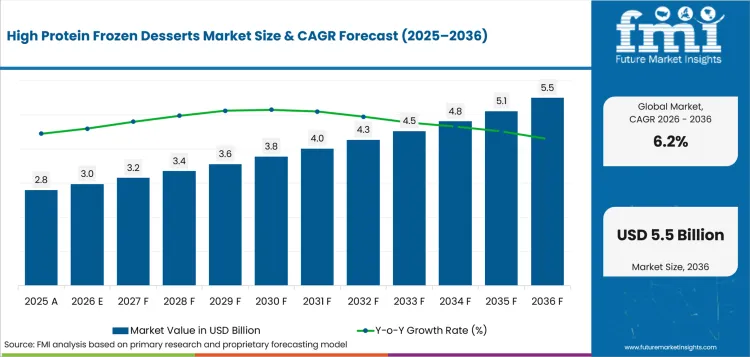
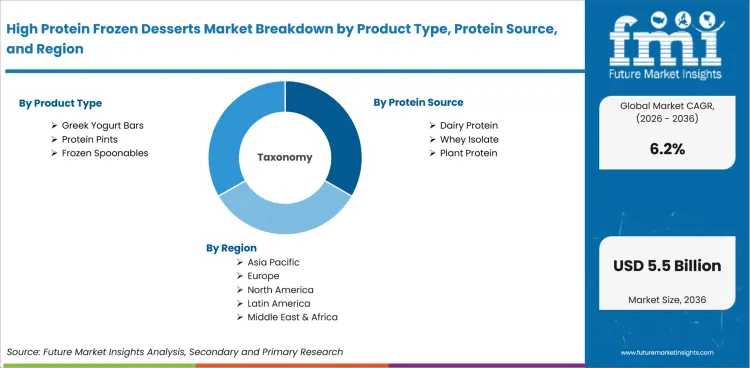
The high protein frozen desserts market value is estimated to rise from USD 2.8 billion in 2025 to USD 5.5 billion by 2036 at 6.2% CAGR, driven by increasing consumer demand for protein-rich healthy snacks and the growing popularity of low-sugar, functional frozen desserts. Dairy protein is projected at 58.9% share in 2026 and supermarkets are forecast to hold 46.3% share as brands use freezer aisle placement to move protein-positioned desserts into routine grocery baskets.
Key Takeaways, Market Size, and Forecast
- 2026 Market Size: USD 3.0 billion
- 2036 Market Size: USD 5.5 billion
- Forecast CAGR: 6.2% from 2026 to 2036
- Leading Protein Source: dairy protein
- Dairy Protein Share in 2026: 58.9%
- Leading Sales Channel: supermarkets
- Supermarkets Share in 2026: 46.3%
- Fastest-growing Country: India
- India CAGR: 7.5% by 2036
Summary of High Protein Frozen Desserts Market
- Demand and Growth Drivers
- Protein claims are moving from nutrition bars into frozen desserts due to shoppers seeking snack formats with familiar taste.
- Greek yogurt bars are strengthening shelf presence as portion control and dairy protein support daily dessert use.
- Low sugar positioning is improving trial since high protein desserts compete with light ice cream and frozen yogurt.
- Product and Segment View
- Dairy protein is expected to represent 58.9% share in 2026, supported by whey and milk protein texture performance.
- Supermarkets are likely to secure 46.3% share in 2026, influenced by freezer aisle placement promoting routine grocery discovery.
- Multi-serve pints are set to hold 42.6% share in 2026, led by shoppers comparing protein and sugar claims during at-home dessert buying.
- Geography and Competitive Outlook
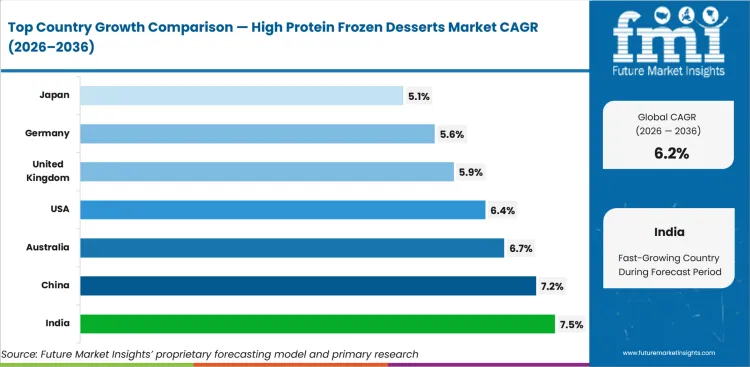
- India is projected to record 7.5% CAGR by 2036, reflected by dairy scale and urban freezer retail expansion.
- China is expected to expand at 7.2% CAGR by 2036 through premium retail and rising dairy dessert trial.
- Blue Bell Creameries and Wells Enterprises compete based on protein pint launches and established freezer access.
- Yasso and The Magnum Ice Cream Company compete by Greek yogurt formats and global ice cream scale.
- Analyst Opinion
- Nandini Roy Choudhury, Principal Consultant for Food and Beverages at FMI, observes, “High protein frozen dessert buying is moving from diet-only positioning toward everyday dessert replacement. Consumers compare protein per serving and sugar claims before choosing pints or bars. Brands protecting texture and keep familiar flavors should gain repeat shelf space as retailers test nutrition-forward frozen desserts.”
- High Protein Frozen Desserts Market Value Analysis
- Market value is tied to protein pints and single-serve bars before ingredient pricing affects delivered shelf price.
- Supplier pricing reflects whey quality and stabilizer systems before promotional depth changes weekly freezer movement.
- Revenue improves since brands convert protein snack behavior into dessert formats with clear nutrition panels.
- Retail confidence rises as proven frozen dessert brands add protein claims without losing familiar taste.
Texture and claim accuracy are likely to decide repeat buying in the ice cream and frozen desserts space. FDA updated its healthy claim rule raising the need for cleaner nutrition checks before brands place health-positioned frozen desserts in retail freezers. A 2025 Foods study found, WPC-fortified ice cream reached 276.54 N hardness and 52.40% overrun. Manufacturers therefore need protein systems maintaining scoopability and aeration close to regular ice cream. AmulFed’s 2024 to 2025 sustainability report stated, Amul High Protein Dahi delivers 25g protein per pack. Dairy brands with strong high protein yogurt platforms can use that trust to test frozen formats. Ingredient suppliers serving protein ingredients can support value by helping brands balance protein level and texture in one product.
High Protein Frozen Desserts Market Definition
High Protein Frozen Desserts Market covers frozen pints, bars, sandwiches, cups, bites, and spoonable desserts marketed with clear protein claims. Scope includes dairy protein, whey isolate, plant protein, precision fermentation whey, and blended protein formats sold through retail and foodservice channels. Revenue includes branded and private label finished products. Standard frozen desserts are excluded unless protein positioning forms a direct selling point.
High Protein Frozen Desserts Market Inclusions
Market scope covers all commercially traded high protein frozen dessert products categorized by product type, including Greek yogurt bars, protein pints, frozen spoonables, sandwiches, and bites; protein source, including dairy protein, whey isolate, plant protein, precision whey, and blended protein; formats, including multi-serve pints, single bars, mini bites, sandwich packs, and cups; claims, including low sugar, low calorie, keto friendly, lactose free, and clean label; and sales channels, including supermarkets, club stores, online, convenience stores, and foodservice. Revenue scope covers 2026 to 2036. The key stakeholders include frozen dessert manufacturers, dairy processors, whey and plant protein suppliers, precision fermentation protein companies, stabilizer and sweetener providers, flavor houses, packaging suppliers, cold chain operators, supermarket and club store retailers, online grocery platforms, foodservice distributors, private label producers, regulatory bodies, and food safety authorities.
High Protein Frozen Desserts Market Exclusions
Scope excludes protein powders and refrigerated protein yogurts not sold as frozen desserts. Ordinary ice cream, gelato, sherbet, and frozen novelties are excluded unless a protein claim defines the product. Meal replacement shakes and sports nutrition bars are outside scope. Ingredient revenue is counted only if linked to finished high protein frozen dessert formulation.
High Protein Frozen Desserts Market Research Methodology
- Primary Research: FMI analysts reviewed frozen dessert brand portfolios and freezer aisle distributor feedback across major retail countries.
- Desk Research: Public data from USDA ERS, IFIC, Eurostat, national dairy bodies, and official company releases were checked against frozen dessert evidence.
- Market Sizing and Forecasting: Market size used eligible SKU revenue and retail freezer presence. Average product pricing and protein dessert positioning were used for cross-checks.
- Data Validation: Forecast checks compared frozen dairy output and active supplier portfolios. Official product launches were reviewed across high protein dessert demand.
Why is the High Protein Frozen Desserts Market Growing?
- Frozen dessert brands are reframing protein as an everyday snack cue rather than a diet-only claim.
- Retailers are giving space to spoonable tubs and portioned bars combining familiar flavors with nutrition cues.
- Formulators are focusing on ice crystal control and aeration so protein enrichment does not weaken texture.
Growth outlook is turning toward freezer products making protein easier to understand at the pack level. The Magnum Ice Cream Company stated in October 2025, Yasso’s spoonable frozen Greek yogurt launched in five flavors. Each 14 oz container carried up to 19g protein and 400 calories or less. This launch supports wider movement from single bars into frozen yogurt tubs for planned snacking. A 2024 Foods study found, whey protein isolate affected ice crystal structure in acidophilic ice cream. Samples using hydrolyzed whey concentrate and WPI recorded X50 ice crystal sizes of 12.23 µm to 13.68 µm after 24 hours at -18°C. This finding connects protein ingredients with texture control in ice cream and frozen dessert formulation. Brands that keep protein claims simple and maintain smooth texture are expected to gain stronger freezer repeat sales.
Market Segmentation Analysis
- Greek yogurt bars are expected to represent 34.7% share in 2026, due to portion size and dairy familiarity promoting freezer aisle trial.
- Dairy protein is projected to account for 58.9% share in 2026, led by whey and milk protein systems protecting mouthfeel in frozen desserts.
- Multi-serve pints are forecast to capture 42.6% share in 2026, reflected by shoppers comparing protein and sugar directly in supermarket freezers.
- Low sugar claims are anticipated to hold 39.8% share in 2026 as high protein brands often pair nutrition claims with dessert permission.
- Supermarkets are expected to represent 46.3% share in 2026 as freezer shelf space and grocery trips support discovery.
The high protein frozen dessert market is divided into groups based on product type, protein source, format, claim, sales channel, and region. Product type includes Greek yogurt bars, protein pints, frozen spoonables, sandwiches, and bites. Protein source includes dairy protein, whey isolate, plant protein, precision whey, and blended protein. Format analysis covers multi-serve pints and single bars. Claim analysis covers low sugar, low calorie, keto friendly, lactose free, and clean label. Sales channel analysis includes supermarkets, club stores, online, convenience stores, and foodservice.
Insights into High Protein Frozen Desserts Market by Product Type
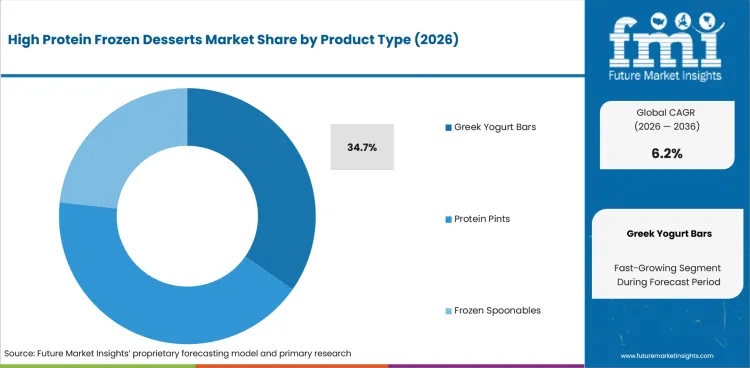
- Greek yogurt bars are projected to account for 34.7% share in 2026, led by familiar yogurt branding and easy portion sizing for daily snacking.
- Protein pints gain use among shoppers replacing standard ice cream pints with higher protein alternatives during at-home dessert occasions.
Insights into High Protein Frozen Desserts Market by Protein Source
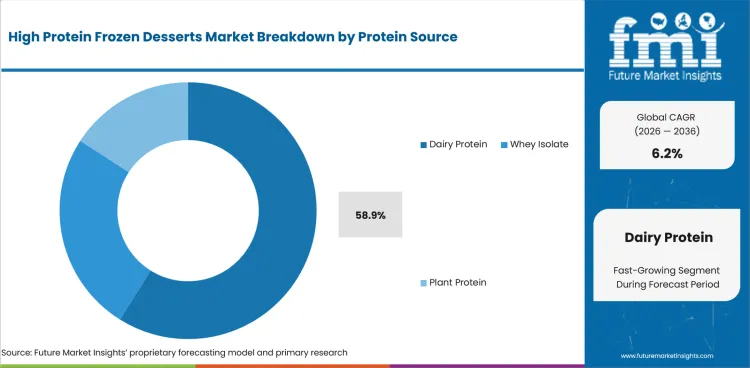
- Dairy protein is forecast to hold 58.9% share in 2026 through texture control and complete protein positioning in frozen applications.
- Precision whey gains attention after fermentation protein entered frozen dairy dessert through a multinational ice cream brand launch.
Insights into High Protein Frozen Desserts Market by Format
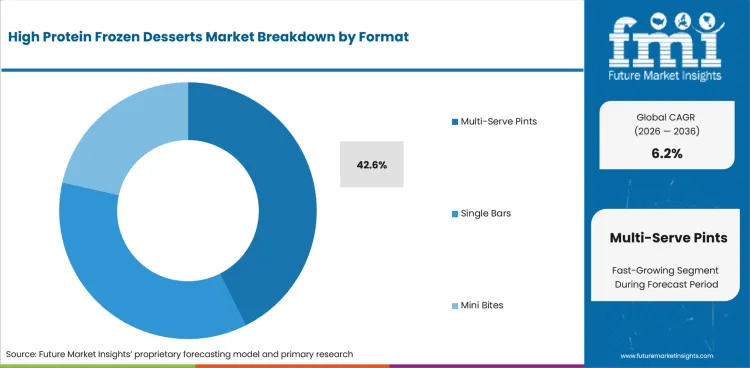
- Multi-serve pints are expected to account for 42.6% share in 2026 due to freezer cases making protein and sugar claims easy to compare.
- Single bars gain value led by controlled portions influencing higher protein dessert use after meals and during snack occasions.
Insights into High Protein Frozen Desserts Market by Claim
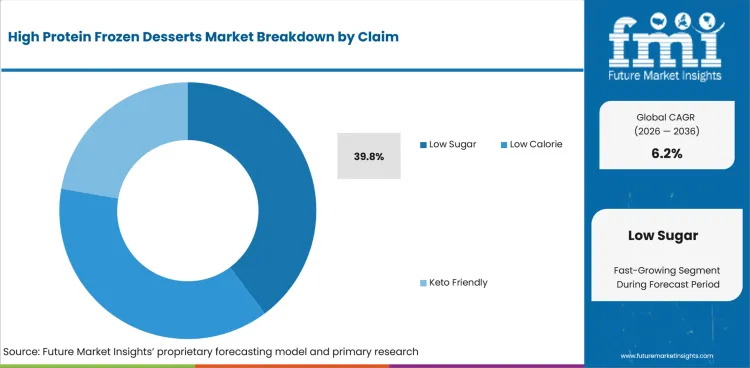
- ected by protein pints often pairing higher protein with no added sugar positioning.
- Low calorie claims gain shelf space due to brands using dairy proteins and sweetener systems to reduce serving-level energy counts.
Insights into High Protein Frozen Desserts Market by Sales Channel
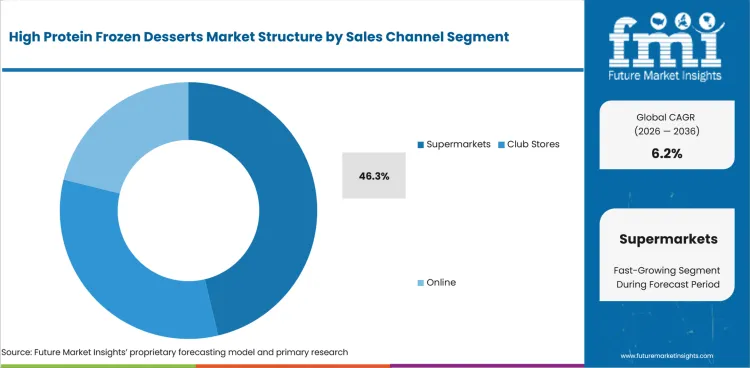
- Supermarkets are projected to represent 46.3% share in 2026 since freezer aisle discovery and basket frequency support repeat buying.
- Club stores create value through larger pack sizes and high-velocity multipacks for households buying protein snacks.
High Protein Frozen Desserts Market Drivers, Restraints and Opportunities
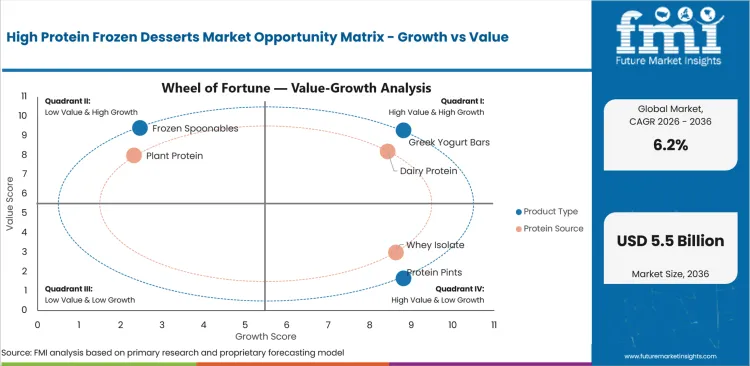
- Driver: Protein ice cream is moving into routine grocery baskets as shoppers look for dessert formats integrating in fitness-led snacking.
- Restraint: Higher protein loading can weaken texture and freezer stability if formulation systems are not carefully controlled.
- Opportunity: Retail-ready pints and clean-label stabilizer systems are opening space for brands able to protect taste and scoopability.
High protein frozen desserts are gaining a clearer retail path as brands combine nutrition positioning with familiar ice cream formats. Meijer stated in January 2025, Protein Pints expanded from 14 Meijer stores to 187 locations across the Midwest, with each pint formulated with 30 grams of protein and 5 grams of sugar per serving. This gives ice cream and frozen dessert brands a practical model for scaling protein-led pints through grocery freezers rather than specialty channels alone. Texture remains the main product risk. A 2025 Foods study on whey-based ice cream tested 0.6% Cremodan SI 320 and 0.25% to 0.5% oat or yeast beta-glucan as stabilizing systems, showing why protein ingredients suppliers are becoming more important to repeat buying. Brands that balance protein and freezer stability can extend from pints into high protein yogurt linked frozen formats.
Consumption Occasion and Usage Pattern Analysis
High protein frozen desserts are moving into planned snacking as consumers look for treats combining familiar taste with nutrition cues. As per report in August 2025, Protein Pints is positioned for health-focused consumers and fitness-led shoppers, with 85% less sugar than traditional ice cream. This supports stronger use across evening dessert and portion-led indulgence. The shift gives ice cream and frozen dessert brands a clearer route to connect with protein snacks and high protein yogurt demand.
Channel Preference and Shopping Journey AnalysisRetail discovery is becoming more important as high protein frozen desserts move from specialty freezer space into mainstream grocery networks. Michigan SBDC stated in September 2025, Protein Pints reached 8,000+ retail stores nationwide and became a USD 20 million+ business in 2025. This shows how modern trade and store-locator support can turn protein ice cream from trial buying into repeat basket behavior. Brands with clear pack claims and reliable freezer access are better placed to convert protein ingredients positioning into regular retail purchases.
Competitive Landscape and Strategic Positioning
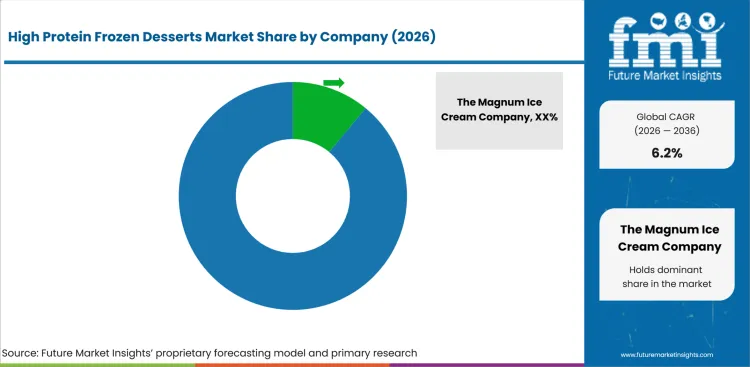
- Established frozen dessert brands hold an advantage through retail freezer authorization and familiar flavors.
- Better-for-you dessert specialists gain shelf space by offering portion-controlled formats with clear protein claims.
- Ingredient specialists support formulation by improving whey texture and sugar reduction performance.
- Retail-ready packaging supports trial through clear protein-per-serving and low sugar labeling.
Competitive structure is led by frozen dessert brand owners along with high protein dessert specialists, and ingredient technology suppliers. Wells Enterprises and Blue Bell Creameries compete through USA freezer reach and pint formats. Yasso competes through Greek yogurt bars and spoonable frozen snacks under The Magnum Ice Cream Company platform. Protein Pints is gaining relevance through grocery-led high protein ice cream distribution.
Ingredient capability is becoming more important as protein levels rise in frozen products. Perfect Day supports precision whey routes for lactose-free and animal-free dairy protein claims, while whey and stabilizer suppliers help brands manage texture. Best-positioned firms will secure freezer space and keep repeat buying after protein-led trial.
Key Companies in the High Protein Frozen Desserts Market
Competitive structure is differentiated by global frozen dessert brand owners, better-for-you dessert specialists, and protein technology suppliers.
- Global Frozen Dessert Brand Owners: The Magnum Ice Cream Company and Wells Enterprises compete through freezer networks and retailer relationships. The Magnum Ice Cream Company owns Yasso, while Wells Enterprises supports frozen dessert scale through Halo Top and Blue Bunny.
- Better-for-You Dessert Specialists: Yasso, Protein Pints, N!CK’S, and Enlightened compete through Greek yogurt bars and diet-positioned frozen desserts. These brands build demand through clear protein and calorie claims.
- Ingredient and Protein Technology Suppliers: Perfect Day and dairy protein suppliers influence high protein frozen dessert formulation through whey systems and texture support. These suppliers are relevant where brands need protein enrichment without weakening flavor or freezer stability.
Competitive Benchmarking: High Protein Frozen Desserts Market
| Company | Protein Format Depth | Freezer Retail Reach | Texture Control Capability | Channel Reach | Geographic Footprint |
|---|---|---|---|---|---|
| The Magnum Ice Cream Company | Very Strong | Very Strong | Strong | Very Strong | Global |
| Wells Enterprises | Strong | Very Strong | Strong | Very Strong | North America |
| Yasso | Very Strong | Strong | Strong | Strong | North America |
| Blue Bell Creameries | Moderate | Strong | Strong | Strong | United States |
| Protein Pints | Strong | Strong | Strong | Strong | United States |
| N!CK’S | Strong | Moderate | Strong | Moderate | North America and Europe |
| Enlightened | Strong | Moderate | Moderate | Moderate | North America |
| Perfect Day | Moderate | Low | Very Strong | Moderate | Multi-regional |
Source: Future Market Insights competitive analysis, 2026.
Key Developments in High Protein Frozen Desserts Market
- In April 2025, Two Spoons Creamery debuted high-protein, zero-added-sugar ice cream in four flavors including rocky road and fudgy brownie.
- In April 2026, Frozen One raised USD 2.0 million in seed funding to scale production and retail sell-through for its high-protein ice cream.
- In June 2026, David launched David Frozen Dessert as a high-protein frozen dessert line.
Key Players in the High Protein Frozen Desserts Market
- The Magnum Ice Cream Company
- Wells Enterprises
- Yasso
- Blue Bell Creameries
- Protein Pints
- N!CK’S
- Enlightened
- Perfect Day
Analysis of High Protein Frozen Desserts Market by Key Countries
.webp "Top Country Growth Comparison High Protein Frozen Desserts Market Cagr (2026 2036)")
| Country | CAGR |
|---|---|
| India | 7.5% |
| China | 7.2% |
| Australia | 6.7% |
| United States | 6.4% |
| United Kingdom | 5.9% |
| Germany | 5.6% |
| Japan | 5.1% |
Source: Future Market Insights, 2026.
Sales Outlook for High Protein Frozen Desserts Market in India
Dairy scale and urban freezer retail center · 2026 to 2036
Country Market Snapshot Table
| Parameter | Value |
|---|---|
| Market Size in 2025 (Value) | USD 167.4 million |
| Market Size in 2026 (Value) | USD 180.0 million |
| Market Forecast in 2036 (Value) | USD 371.0 million |
| CAGR (2026 to 2036) | 7.5% |
| Years Considered | 2021 to 2036 |
| Base Year | 2025 |
| Forecast Period | 2026 to 2036 |
| Units Considered | Value (USD million) |
| Leading Sub-Region | Delhi NCR and western urban retail clusters |
India High Protein Frozen Desserts Market Outlook
India high protein frozen dessert demand is shaped by dairy scale and urban freezer access. Organized retail and quick commerce support premium frozen products among consumers familiar with yogurt and milk-based desserts.
Metro consumers are expected to adopt protein bars and pints before tier one cities follow. Brands with cold chain control and localized flavors should gain early shelf rotation.
Key Growth Drivers
- Dairy ingredient access supports local formulation, with Basic Animal Husbandry Statistics 2025 reporting milk production at 247.9 million tonnes during 2024 to 2025. Manufacturers can build protein pints around domestic dairy depth.
- Daily dairy familiarity aids dessert trial, as the same 2025 release placed per-capita milk availability at 485.0 grams per day. Frozen yogurt bars can connect with familiar dairy eating habits.
- Recent milk output improvement supports value-added dairy conversion, reflected by official growth of 3.6% over the previous year. Processors can test protein dessert lines with stronger supply confidence.
- Milk solids quality gains support whey-based product planning, led by exotic and crossbred cattle milk output rising 5.0% over the prior year. Premium dessert makers can plan smoother dairy protein systems.
Key Restraints
- State-level supply concentration can affect sourcing balance, as five leading states contributed 54.1% of national milk production. Frozen dessert manufacturers may need wider sourcing networks.
- Ingredient mix can require formulation control, with indigenous buffalo contributing 31.2% of milk output and crossbred cattle contributing 30.8%. Protein dessert texture may need fat-standardization work.
- Premium freezer rollout can lag dairy depth, since milk production strength does not automatically create stable frozen distribution. Brands may need phased launches across metro corridors.
What makes India unique
India is unique due to dairy scale, urban retail expansion, and fast growth in protein-positioned packaged foods.
Key Companies
- Get-A-Way
- LEAN by Aroma Ice Cream
- Koozies Ice Cream
- Amul
- NIC Honestly Crafted Ice Creams
- Havmor Ice Cream
- Baskin Robbins India
Sales & Marketing Channels
- Supermarket freezers
- Club stores
- Online grocery
- Quick commerce
- Convenience stores
- Foodservice freezers
Country Segment Breakdown Table
| Segment | Sub-Segments |
|---|---|
| By Product Type | Greek Yogurt Bars · Protein Pints · Frozen Spoonables · Sandwiches · Bites |
| By Protein Source | Dairy Protein · Whey Isolate · Plant Protein · Precision Whey · Blended Protein |
| By Format | Multi-Serve Pints · Single Bars · Mini Bites · Sandwich Packs · Cups |
| By Claim | Low Sugar · Low Calorie · Keto Friendly · Lactose Free · Clean Label |
| By Sales Channel | Supermarkets · Club Stores · Online · Convenience · Foodservice |
| Key Sub-Regions Covered, Urban Retail Clusters | Delhi NCR · Mumbai · Bengaluru · Hyderabad · Pune · Chennai |
Frequently Asked Questions
How fast is India high protein frozen desserts market growing?
Demand in India is ready to scale at 7.5% CAGR from 2026 to 2036, driven by dairy depth and urban freezer retail expansion.
Who leads India high protein frozen desserts market?
Global brands and premium dairy processors compete through protein pints and supermarket freezer placement.
What is driving adoption in India high protein frozen desserts market?
Dairy supply depth and metro fitness snacking are moving consumers toward protein-rich frozen desserts.
Demand Outlook for High Protein Frozen Desserts Market in China
Urban dairy dessert trial center · 2026 to 2036
Country Market Snapshot Table
| Parameter | Value |
|---|---|
| Market Size in 2025 (Value) | USD 279.9 million |
| Market Size in 2026 (Value) | USD 300.0 million |
| Market Forecast in 2036 (Value) | USD 601.3 million |
| CAGR (2026 to 2036) | 7.2% |
| Years Considered | 2021 to 2036 |
| Base Year | 2025 |
| Forecast Period | 2026 to 2036 |
| Units Considered | Value (USD million) |
| Leading Sub-Region | Shanghai and coastal premium retail clusters |
China High Protein Frozen Desserts Market Outlook
China high protein frozen dessert demand is guided by premium retail and growing interest in dairy-based nutrition. Large cities create early trial for protein pints and bars through modern supermarkets and online grocery platforms.
Localized flavors and controlled price points will shape repeat buying. Domestic dairy processors can support frozen launches through existing milk and yogurt brand trust.
Key Growth Drivers
- Dairy input scale supports local product testing, with China NBS reporting milk output at 40.8 million tons in 2024. Local processors can use dairy availability for protein dessert trials.
- Online retail supports premium frozen discovery, as China NBS reported national online retail sales of 8,683.5 billion yuan from January to July 2025. Online shelf comparison can help protein claims stand out.
- Physical goods sold online create a large grocery route, reflected by NBS reporting 7,079.0 billion yuan in online physical goods sales through July 2025. Frozen brands can test city-level assortment online.
- Food sales online support nutrition-positioned products, with NBS reporting online food sales rising 14.7% during January to July 2025. High protein desserts can benefit from search-led buying.
Key Restraints
- Dairy supply pressure can affect pricing discipline, as China NBS reported milk output declined by 2.8% in 2024. Ingredient cost swings can slow premium freezer launches.
- Physical goods online still represented 24.9% of total retail sales through July 2025, so offline freezer access remains needed. Brands cannot rely only on online channels.
- Urban retail strength may not translate evenly across inland cities, given premium frozen dessert trial is concentrated in major coastal clusters.
What makes China unique
China is unique due to urban premium retail scale and a large consumer group expanding dairy dessert trial.
Key Companies
- Yili Group
- Mengniu Dairy
- Bright Dairy
- BAXY Ice Cream
- Beijing Allied Faxi Food
- General Mills China
- Ningji-linked Häagen-Dazs China operations
Sales & Marketing Channels
- Supermarket freezers
- Online grocery
- Club stores
- Convenience stores
- Foodservice counters
- Premium retail chains
Country Segment Breakdown Table
| Segment | Sub-Segments |
|---|---|
| By Product Type | Greek Yogurt Bars · Protein Pints · Frozen Spoonables · Sandwiches · Bites |
| By Protein Source | Dairy Protein · Whey Isolate · Plant Protein · Precision Whey · Blended Protein |
| By Format | Multi-Serve Pints · Single Bars · Mini Bites · Sandwich Packs · Cups |
| By Claim | Low Sugar · Low Calorie · Keto Friendly · Lactose Free · Clean Label |
| By Sales Channel | Supermarkets · Club Stores · Online · Convenience · Foodservice |
| Key Sub-Regions Covered, Retail Clusters | Shanghai · Beijing · Guangzhou · Shenzhen · Hangzhou · Chengdu |
Frequently Asked Questions
How fast is China high protein frozen desserts market growing?
China is projected to grow at 7.2% CAGR from 2026 to 2036, reflected by premium dairy dessert trial improvement.
Who leads China high protein frozen desserts market?
Large frozen dessert brands and dairy processors compete by freezer access and product localization.
What is driving adoption in China high protein frozen desserts market?
Urban dairy familiarity and online grocery discovery are moving shoppers toward protein-positioned frozen desserts.
Growth Outlook for High Protein Frozen Desserts Market in Australia
Dairy ingredient and premium freezer center · 2026 to 2036
Country Market Snapshot Table
| Parameter | Value |
|---|---|
| Market Size in 2025 (Value) | USD 112.5 million |
| Market Size in 2026 (Value) | USD 120.0 million |
| Market Forecast in 2036 (Value) | USD 229.5 million |
| CAGR (2026 to 2036) | 6.7% |
| Years Considered | 2021 to 2036 |
| Base Year | 2025 |
| Forecast Period | 2026 to 2036 |
| Units Considered | Value (USD million) |
| Leading Sub-Region | Sydney and Melbourne retail corridors |
Australia High Protein Frozen Desserts Market Outlook
Australia high protein frozen dessert demand is shaped by dairy processing know-how and protein snack habits. Consumers already buy high protein yogurts and chilled nutrition snacks, creating a shorter path for frozen dessert brands.
Supermarket freezer networks create a clear launch route for bars and pints. Local dairy ingredient access can support whey-based formulation before export-oriented scale develops.
Key Growth Drivers
- Local dairy processing supports whey and milk protein use, with Dairy Australia forecasting national milk production near 8.1 billion litres for the 2025 to 2026 season. This gives formulators an input foundation.
- Retail tracking supports freezer aisle planning. Brands can read household dairy buying shifts before frozen launches.
- Domestic dairy remains a large rural sector, reflected by Dairy Australia calling dairy the third largest rural industry by farmgate value and exports. Protein dessert producers can build on an established supply chain.
- Premium freezer testing benefits from urban supermarket concentration, with Sydney and Melbourne serving as launch corridors for higher value dairy products.
Key Restraints
- Milk flow weakness can affect ingredient planning. Dairy protein dessert producers may face tighter input costs.
- Year-to-date production pressure can limit processor flexibility, with Dairy Australia noting output was down more than 2.0% on the prior season. Brands may need longer input contracting.
- Water cost pressure can raise dairy farm costs, for instance, temporary water prices in key irrigation regions reached their highest levels in five years. Ingredient price risk can pass into dessert formulation.
What makes Australia unique
Australia is unique due to dairy know-how and established protein snack buying across supermarkets.
Key Companies
- GYM BOD
- Twisted Healthy Treats
- Denada
- YoPRO Australia
- Bulla Dairy Foods
- Peters Ice Cream
- Norco Dairy
Sales & Marketing Channels
- Supermarket freezers
- Club stores
- Online grocery
- Fitness retail
- Convenience stores
- Foodservice freezers
Country Segment Breakdown Table
| Segment | Sub-Segments |
|---|---|
| By Product Type | Greek Yogurt Bars · Protein Pints · Frozen Spoonables · Sandwiches · Bites |
| By Protein Source | Dairy Protein · Whey Isolate · Plant Protein · Precision Whey · Blended Protein |
| By Format | Multi-Serve Pints · Single Bars · Mini Bites · Sandwich Packs · Cups |
| By Claim | Low Sugar · Low Calorie · Keto Friendly · Lactose Free · Clean Label |
| By Sales Channel | Supermarkets · Club Stores · Online · Convenience · Foodservice |
| Key Sub-Regions Covered, Retail Areas | Sydney · Melbourne · Brisbane · Perth · Adelaide · Gold Coast |
Frequently Asked Questions
How fast is Australia high protein frozen desserts market growing?
Australia is expected to rise at 6.7% CAGR from 2026 to 2036 through dairy depth and protein snack adoption.
Who leads Australia high protein frozen desserts market?
Global brands and regional better-for-you dessert firms compete depending on supermarket freezers and protein snack positioning.
What is driving adoption in Australia high protein frozen desserts market?
Dairy processing strength and protein snack habits are supporting frozen high protein product trial.
Demand Analysis for High Protein Frozen Desserts Market in the United States
Protein pints launch and freezer retail center · 2026 to 2036
Country Market Snapshot Table
| Parameter | Value |
|---|---|
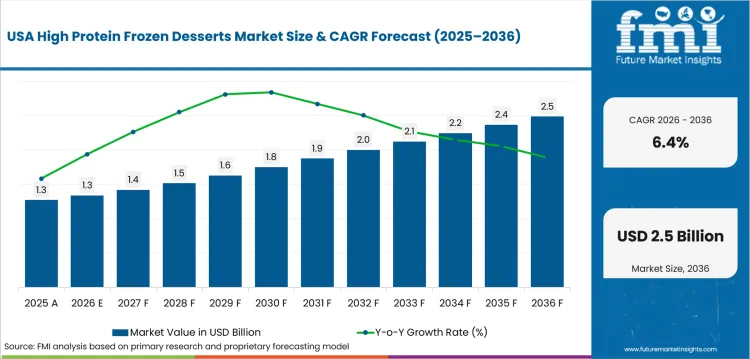
| Market Size in 2025 (Value) | USD 789.5 million |
| Market Size in 2026 (Value) | USD 840.0 million |
| Market Forecast in 2036 (Value) | USD 1,562.1 million |
| CAGR (2026 to 2036) | 6.4% |
| Years Considered | 2021 to 2036 |
| Base Year | 2025 |
| Forecast Period | 2026 to 2036 |
| Units Considered | Value (USD million) |
| Leading Sub-Region | Texas and national grocery freezer networks |
United States High Protein Frozen Desserts Market Outlook
United States high protein frozen dessert demand is led by established freezer retail and strong protein awareness. Brands can scale through national grocery chains, club stores, and specialty health channels.
Brand launches and retail freezer reach create an active test environment. Protein pints can gain trial if taste remains close to standard ice cream.
Key Growth Drivers
- Protein awareness supports nutrition claims, with IFIC reporting 35.0% of Americans increased protein intake over the prior year. High protein pints can address daily snack goals.
- Daily eating occasions support dessert reformulation, as report stated 80.0% of Americans prioritize protein during at least one eating occasion. Frozen desserts can enter a routine protein choice set.
- Protein label comparison aids shelf clarity, backed by IFIC finding grams per serving as the most used packaging information among consumers tracking protein. Brands can place claims upfront.
- Frozen dairy manufacturing provides a large product platform, with USDA ERS reporting USA output of ice cream and other frozen dairy products at 1,386.0 million gallons in 2024. Protein launches can use established production channels.
Key Restraints
- Frozen dairy volume pressure can make shelf competition tighter, as USDA ERS reported USA frozen dairy output fell 10.0% from 2000 to 2024. New protein products must defend freezer space.
- Standard ice cream remains a tough benchmark, with USDA ERS stating regular ice cream represented around 60.0% to 65.0% of total ice cream production. Protein products need familiar taste.
- Low-fat and nonfat products have mixed traction. Nutrition-led frozen desserts still need strong flavor delivery.
What makes the United States unique
United States is unique due to national freezer distribution and active protein pint launches from established brands.
Key Companies
- Blue Bell Creameries
- Protein Pints
- Halo Top
- Yasso
- Enlightened
- Wells Enterprises
- Fairlife
Sales & Marketing Channels
- Supermarket freezers
- Club stores
- Mass retail
- Online grocery
- Convenience stores
- Foodservice freezers
Country Segment Breakdown Table
| Segment | Sub-Segments |
|---|---|
| By Product Type | Greek Yogurt Bars · Protein Pints · Frozen Spoonables · Sandwiches · Bites |
| By Protein Source | Dairy Protein · Whey Isolate · Plant Protein · Precision Whey · Blended Protein |
| By Format | Multi-Serve Pints · Single Bars · Mini Bites · Sandwich Packs · Cups |
| By Claim | Low Sugar · Low Calorie · Keto Friendly · Lactose Free · Clean Label |
| By Sales Channel | Supermarkets · Club Stores · Online · Convenience · Foodservice |
| Key Sub-Regions Covered, Freezer Retail Networks | Texas · California · New York · Florida · Midwest · Pacific Northwest |
Frequently Asked Questions
How fast is United States high protein frozen desserts market growing?
Sector in the United States is anticipated to grow at 6.4% CAGR from 2026 to 2036 due to protein pints gaining freezer space.
Who leads United States high protein frozen desserts market?
Wells Enterprises, Blue Bell Creameries, Yasso, and N!CK’S compete on protein pints and frozen yogurt formats.
What is driving adoption in United States high protein frozen desserts market?
Protein awareness and national freezer distribution are moving shoppers toward high protein dessert formats.
Opportunity Analysis for High Protein Frozen Desserts Market in the United Kingdom
Premium grocery and sugar-control center · 2026 to 2036
Country Market Snapshot Table
| Parameter | Value |
|---|---|
| Market Size in 2025 (Value) | USD 146.4 million |
| Market Size in 2026 (Value) | USD 155.0 million |
| Market Forecast in 2036 (Value) | USD 275.0 million |
| CAGR (2026 to 2036) | 5.9% |
| Years Considered | 2021 to 2036 |
| Base Year | 2025 |
| Forecast Period | 2026 to 2036 |
| Units Considered | Value (USD million) |
| Leading Sub-Region | London and South East grocery networks |
United Kingdom High Protein Frozen Desserts Market Outlook
United Kingdom high protein frozen dessert demand is supported by premium grocery chains and interest in sugar control. Brands can position protein pints as a dessert option aligned with health-aware snacking.
Grocery pricing discipline will shape brand trial. Retailers are expected to test compact ranges before expanding multipacks and spoonable formats.
Key Growth Drivers
- Grocery spending supports frozen dessert testing, with the Department for Environment, Food & Rural Affairs reporting average food and drink spend at £47.2 per person per week in FYE 2024. Freezer brands can compete inside planned baskets.
- Household food spending provides a supermarket route. Protein desserts can seek placement in routine grocery trips.
- Basket resilience supports premium freezer testing, with the Office for National Statistics reporting UK households spent £70.50 per week on food and alcoholic drinks in FYE 2024, a nominal increase of £7.00 or 11% from FYE 2023. High protein frozen desserts can compete where shoppers still pay for familiar food quality.
- Sugar-control interest supports low sugar high protein desserts, reflecting the Office for Health Improvement and Disparities reporting average adult free sugar intake at 10.0% of energy. Retailers can test low calorie desserts beside protein pints.
Key Restraints
- High protein desserts need careful pricing. Grocery cost discipline can limit trial, as the Department for Environment, Food & Rural Affairs recorded the lowest income households spent 14.3% of expenditure on household food and non-alcoholic drinks.
- Brands need credible low sugar formulation. Nutrition scrutiny can slow sugar-heavy dessert positioning, with the Office for Health Improvement and Disparities reporting less than one in five adults met free sugar recommendations.
- Price pack architecture will influence repeat buying. Household food and non-alcoholic drink spend stood at £32.3 per person per week, so premium frozen snacks must compete for limited basket room.
What makes the United Kingdom unique
United Kingdom is unique due to premium grocery discipline and strong sugar-control positioning in packaged foods.
Key Companies
- Graham’s Family Dairy
- Oppo Brothers
- Wheyhey
- Beechdean Dairies
- Jude’s Ice Cream
- Mackie’s of Scotland
- Froneri UK
Sales & Marketing Channels
- Supermarket freezers
- Online grocery
- Convenience stores
- Club stores
- Foodservice freezers
- Health retail
Country Segment Breakdown Table
| Segment | Sub-Segments |
|---|---|
| By Product Type | Greek Yogurt Bars · Protein Pints · Frozen Spoonables · Sandwiches · Bites |
| By Protein Source | Dairy Protein · Whey Isolate · Plant Protein · Precision Whey · Blended Protein |
| By Format | Multi-Serve Pints · Single Bars · Mini Bites · Sandwich Packs · Cups |
| By Claim | Low Sugar · Low Calorie · Keto Friendly · Lactose Free · Clean Label |
| By Sales Channel | Supermarkets · Club Stores · Online · Convenience · Foodservice |
| Key Sub-Regions Covered, Grocery Clusters | London · South East · Midlands · Manchester · Leeds · Scotland |
Frequently Asked Questions
How fast is United Kingdom high protein frozen desserts market growing?
Industry in the United Kingdom is projected to increase at 5.9% CAGR from 2026 to 2036, led by grocery freezer adoption.
Who leads United Kingdom high protein frozen desserts market?
The Magnum Ice Cream Company and specialist better-for-you dessert brands compete, driven by grocery reach and flavor depth.
What is driving adoption in United Kingdom high protein frozen desserts market?
Sugar-control interest and premium grocery testing are moving shoppers toward high protein frozen desserts.
Sales Analysis for High Protein Frozen Desserts Market in Germany
European ice cream production and dairy protein center · 2026 to 2036
Country Market Snapshot Table
| Parameter | Value |
|---|---|
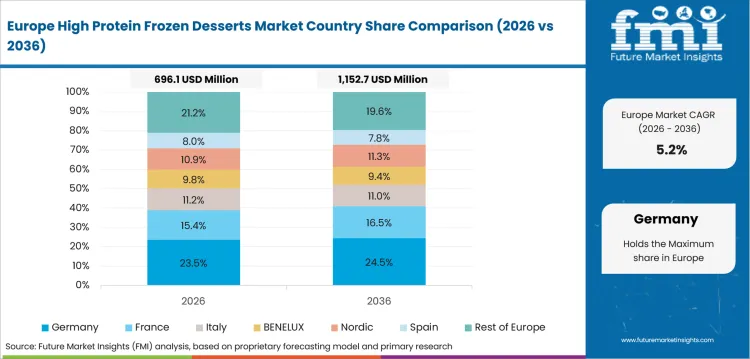
| Market Size in 2025 (Value) | USD 161.0 million |
| Market Size in 2026 (Value) | USD 170.0 million |
| Market Forecast in 2036 (Value) | USD 293.1 million |
| CAGR (2026 to 2036) | 5.6% |
| Years Considered | 2021 to 2036 |
| Base Year | 2025 |
| Forecast Period | 2026 to 2036 |
| Units Considered | Value (USD million) |
| Leading Sub-Region | North Rhine-Westphalia and southern retail clusters |
Germany High Protein Frozen Desserts Market Outlook
Germany high protein frozen dessert demand is supported by organized grocery, dairy processing, and disciplined nutrition labeling. Consumers assess ingredient quality carefully, so brands must balance protein claims with clean sensory delivery.
Discount and supermarket freezer chains can move high protein desserts into weekly baskets. Local production depth supports private label and branded testing.
Key Growth Drivers
- Production scale supports frozen dessert testing, with Eurostat reporting Germany produced 607.0 million litres of ice cream in 2024. Local manufacturing can support protein pint trials.
- European output gives Germany a large operating setting, reflected by Eurostat reporting EU ice cream production at 3.3 billion litres in 2024. Regional supply chains can support formulation learning.
- Export depth supports supplier reach, as Eurostat recorded Germany exported 28.2 million kg of ice cream outside the EU in 2024. Producers can extend high protein formats into nearby markets.
- Extra-EU trade supports branded scale, led by Germany holding 11.0% of EU ice cream exports outside the bloc. Protein formats can use established export channels.
Key Restraints
- Production pressure can affect factory economics, as Eurostat recorded Germany ice cream production decreased by 1.0% compared with 2023. High protein launches need margin protection.
- Export competition remains tight, with Eurostat showing France exported 55.9 million kg of ice cream outside the EU. German brands need differentiated protein claims.
- Import pressure can sharpen price competition, since Eurostat reported extra-EU ice cream imports rose 24.0% in 2024. Local brands may face stronger freezer price comparison.
What makes Germany unique
Germany is unique due to European ice cream production scale and disciplined grocery price competition.
Key Companies
- DMK Ice Cream
- Ehrmann
- More Nutrition
- Florida Eis
- Gelatelli
- MILRAM
- Sanobub
Sales & Marketing Channels
- Supermarket freezers
- Discount chains
- Online grocery
- Club stores
- Convenience stores
- Foodservice freezers
Country Segment Breakdown Table
| Segment | Sub-Segments |
|---|---|
| By Product Type | Greek Yogurt Bars · Protein Pints · Frozen Spoonables · Sandwiches · Bites |
| By Protein Source | Dairy Protein · Whey Isolate · Plant Protein · Precision Whey · Blended Protein |
| By Format | Multi-Serve Pints · Single Bars · Mini Bites · Sandwich Packs · Cups |
| By Claim | Low Sugar · Low Calorie · Keto Friendly · Lactose Free · Clean Label |
| By Sales Channel | Supermarkets · Club Stores · Online · Convenience · Foodservice |
| Key Sub-Regions Covered, Retail Areas | North Rhine-Westphalia · Bavaria · Berlin · Hamburg · Hesse · Baden-Württemberg |
Frequently Asked Questions
How fast is Germany high protein frozen desserts market growing?
The market in Germany is expected to rise at 5.6% CAGR from 2026 to 2036 with grocery testing and dairy processing strength.
Who leads Germany high protein frozen desserts market?
Large ice cream groups and nutrition-focused brands compete through retail freezer access and formulation quality.
What is driving adoption in Germany high protein frozen desserts market?
Grocery scale and dairy production strength are supporting protein dessert launches in German retail.
Growth Outlook for High Protein Frozen Desserts Market in Japan
Portion control and premium flavor center · 2026 to 2036
Country Market Snapshot Table
| Parameter | Value |
|---|---|
| Market Size in 2025 (Value) | USD 152.2 million |
| Market Size in 2026 (Value) | USD 160.0 million |
| Market Forecast in 2036 (Value) | USD 263.1 million |
| CAGR (2026 to 2036) | 5.1% |
| Years Considered | 2021 to 2036 |
| Base Year | 2025 |
| Forecast Period | 2026 to 2036 |
| Units Considered | Value (USD million) |
| Leading Sub-Region | Tokyo and Kansai convenience retail networks |
Japan High Protein Frozen Desserts Market Outlook
Japan high protein frozen dessert demand is shaped by portion control, premium flavor standards, and convenience retail. Growth is slower than India and China, but product quality expectations can support higher value formats.
Compact bars and cups are likely to perform better than large family pints. Convenience freezers create limited but high-frequency exposure for controlled-portion desserts.
Key Growth Drivers
- Dairy processing stability supports frozen formats. Suppliers can plan steady dairy input access.
- Foodservice movement can support dessert demand, as USDA FAS reported foreign visitors to Japan reached 35.5 million from January to October 2025. Premium frozen desserts can benefit from restaurant and retail traffic.
- Domestic dairy scale supports product testing. For instance, USDA FAS reported Japan produced nearly 7.3 million metric tons of raw milk in 2024. Frozen dessert makers can plan dairy-based protein trials.
- Convenience retail supports portion-controlled formats, aided by Japan’s dense store networks and frequent snack buying. Protein cups and bars can use small-pack placement.
Key Restraints
- Dairy farm contraction can tighten domestic supply depth. Ingredient cost control remains important.
- Milk retail pressure affects dairy dessert positioning, as USDA FAS noted Japan’s milk consumer price index was 26.0% above 2020 levels in September 2025. Premium protein desserts need clear value.
- Cheese import reliance shows dairy input exposure. Specialty dairy protein costs can affect pricing.
What makes Japan unique
Japan is unique due to portion discipline and high sensory expectations in packaged frozen desserts.
Key Companies
- Meiji
- Morinaga Milk Industry
- Lotte Japan
- Akagi Nyugyo
- Ezaki Glico
- Imuraya Group
- Futaba Foods
Sales & Marketing Channels
- Convenience stores
- Supermarket freezers
- Online grocery
- Club stores
- Drugstores
- Foodservice freezers
Country Segment Breakdown Table
| Segment | Sub-Segments |
|---|---|
| By Product Type | Greek Yogurt Bars · Protein Pints · Frozen Spoonables · Sandwiches · Bites |
| By Protein Source | Dairy Protein · Whey Isolate · Plant Protein · Precision Whey · Blended Protein |
| By Format | Multi-Serve Pints · Single Bars · Mini Bites · Sandwich Packs · Cups |
| By Claim | Low Sugar · Low Calorie · Keto Friendly · Lactose Free · Clean Label |
| By Sales Channel | Supermarkets · Club Stores · Online · Convenience · Foodservice |
| Key Sub-Regions Covered, Retail Clusters | Tokyo · Osaka · Yokohama · Nagoya · Fukuoka · Sapporo |
Frequently Asked Questions
How fast is Japan high protein frozen desserts market growing?
Sector in Japan is projected at 5.1% CAGR from 2026 to 2036 as premium portion-controlled frozen desserts gain adoption.
Who leads Japan high protein frozen desserts market?
Large ice cream brands and specialty nutrition dessert firms compete fueled by flavor quality and convenience retail reach.
What is driving adoption in Japan high protein frozen desserts market?
Portion control and premium texture expectations are moving high protein frozen desserts toward bars and cups.
High Protein Frozen Desserts Market - Report Scope
| Parameter | Details |
|---|---|
| Market size by 2036 | USD 5.5 billion |
| Growth rate | 6.2% CAGR from 2026 to 2036 |
| Forecast period | 2026 to 2036 |
| Base year value (2025) | USD 2.8 billion |
| By product type | Greek yogurt bars, protein pints, frozen spoonables, sandwiches, bites |
| By protein source | Dairy protein, whey isolate, plant protein, precision whey, blended protein |
| By format | Multi-serve pints, single bars, mini bites, sandwich packs, cups |
| By claim | Low sugar, low calorie, keto friendly, lactose free, clean label |
| By sales channel | Supermarkets, club stores, online, convenience, foodservice |
| Regions covered | North America, Latin America, Europe, East Asia, South Asia and Pacific, Middle East and Africa |
| Countries covered | India, China, Australia, United States, United Kingdom, Germany, Japan |
| Key companies profiled | The Magnum Ice Cream Company, Wells Enterprises, Yasso, Blue Bell Creameries, N!CK’S, Enlightened, Perfect Day |
| Approach | Bottom-up product-boundary checks with eligible SKU revenue, freezer presence, retail pricing, and official source validation |
Source: Future Market Insights, 2026.
High Protein Frozen Desserts Market Breakdown by Product Type, Protein Source, Format, Claim, Sales Channel, and Region
High Protein Frozen Desserts Market Segmented by Product Type
- Greek Yogurt Bars
- Protein Pints
- Frozen Spoonables
- Sandwiches
- Bites
High Protein Frozen Desserts Market Segmented by Protein Source
- Dairy Protein
- Whey Isolate
- Plant Protein
- Precision Whey
- Blended Protein
High Protein Frozen Desserts Market Segmented by Format
- Multi-Serve Pints
- Single Bars
- Mini Bites
- Sandwich Packs
- Cups
High Protein Frozen Desserts Market Segmented by Claim
- Low Sugar
- Low Calorie
- Keto Friendly
- Lactose Free
- Clean Label
High Protein Frozen Desserts Market Segmented by Sales Channel
- Supermarkets
- Club Stores
- Online
- Convenience
- Foodservice
High Protein Frozen Desserts Market by Region
- North America
- Latin America
- Europe
- East Asia
- South Asia and Pacific
- Middle East and Africa
Research Sources and Bibliography
- Food and Drug Administration. (2024, December 19). FDA finalizes updated “healthy” nutrient content claim. USA Food and Drug Administration.
- Kiełczewska, K., Smoczyński, M., & Gutkowska, M. (2025). The use of high-protein preparations in ice cream production. Foods, 14(3), 345.
- Kaira District Co-operative Milk Producers’ Union Limited. (2025). Annual sustainability report 2024-25: AmulFed Dairy, Gandhinagar.
- The Magnum Ice Cream Company. (2025, October 1). Yasso expands better-for-you portfolio in the US.
- Mykhalevych, A., Buniowska-Olejnik, M., Polishchuk, G., Puchalski, C., Kaminska-Dwórznicka, A., & Berthold-Pluta, A. (2024). The influence of whey protein isolate on the quality indicators of acidophilic ice cream based on liquid concentrates of demineralized whey. Foods, 13(1), 170.
- Meijer. (2025, January 13). Childhood friends bring high-protein ice cream to Meijer.
- Mykhalevych, A., Polishchuk, G., Znamirowska-Piotrowska, A., Kamińska-Dwórznicka, A., Kluz, M., & Buniowska-Olejnik, M. (2025). The effect of β-glucans from oats and yeasts on the dynamics of ice crystal growth in acidophilic ice cream based on liquid hydrolyzed whey concentrate. Foods, 14(13), 2184.
- Lyubomirova, T. (2025, August 5). High-protein game-changers: Protein Pints. DairyReporter.
- Office for National Statistics. (2025). Family spending in the UK: April 2023 to March 2024.
- Michigan Small Business Development Center. (2025, September). Protein Pints.
- USDA Economic Research Service. (2025, July 16). Ice cream and frozen dairy production dipped from 2000 to 2024.
- International Food Information Council. (2025, July 9). IFIC spotlight survey: Americans’ perceptions of protein.
- Department of Animal Husbandry and Dairying. (2025, November). Release of Basic Animal Husbandry Statistics 2025. Government of India.
- National Bureau of Statistics of China. (2025, February 28). Statistical communiqué of the People’s Republic of China on the 2024 national economic and social development.
- National Bureau of Statistics of China. (2025, August 21). Total retail sales of consumer goods in July 2025.
- Dairy Australia. (2025, December). Situation and outlook year-end 2025.
- Eurostat. (2025, July 29). EU ice cream production sees uptick of 2% in 2024.
- Department for Environment, Food & Rural Affairs. (2025, November 6). Family food FYE 2024. GOV.UK.
- Office for Health Improvement and Disparities. (2025, June 11). National Diet and Nutrition Survey 2019 to 2023: Report. GOV.UK.
- USDA Foreign Agricultural Service. (2025, December 8). Dairy and products annual: Japan.
- Blue Bell Creameries. (2026, March 10). New Blue Bell PRO, a high-protein dairy dessert, is now in stores.
- Perfect Day. (2024, February 22). Perfect Day and Unilever launch new Breyers Lactose-Free Chocolate.
- The Magnum Ice Cream Company. (2025). Demerger information.
- Food Business News. (2026, June 2). David launches high-protein frozen dessert.
- Food Business News. (2026, April 24). Frozen One raises $2 million in seed funding.
- Food Business News. (2025, April 15). Two Spoons Creamery unveils high-protein ice creams.
This Report Answers
- What is the 2026 value and 2036 forecast for the high protein frozen desserts market?
- Which product type is projected to hold the leading share during the forecast period?
- Which protein source is expected to account for the leading 2026 share?
- How do protein claims affect frozen dessert formulation and freezer shelf rotation?
- Which companies compete in the high protein frozen desserts market?
Frequently Asked Questions
What is the high protein frozen desserts market size in 2026?
The high protein frozen desserts market value is expected to reach USD 3.0 billion in 2026, led by protein pints and bars expansion.
What is the forecast value of high protein frozen desserts market by 2036?
The high protein frozen desserts industry revenue is predicted to scale USD 5.5 billion by 2036 as nutrition-led frozen formats expand.
What is the forecast CAGR for high protein frozen desserts market?
The high protein frozen desserts sector is projected to expand at 6.2% CAGR from 2026 to 2036.
What product type leads high protein frozen desserts market?
Greek yogurt bars are expected to garner 34.7% share in 2026 due to portion control and dairy familiarity.
What protein source leads high protein frozen desserts market?
Dairy protein is forecast to account for 58.9% share in 2026 as whey systems support texture performance.
Preview the report firsthand - request a free sample
Get SampleGet the brochure for pricing and purchase details.
Get PDFTable of Content
- Executive Summary
- Global Market Outlook
- Demand-side Trends
- Supply-side Trends
- Technology Roadmap Analysis
- Analysis and Recommendations
- Market Overview
- Market Coverage / Taxonomy
- Market Definition / Scope / Limitations
- Research Methodology
- Chapter Orientation
- Analytical Lens and Working Hypotheses
- Market Structure, Signals, and Trend Drivers
- Benchmarking and Cross-market Comparability
- Market Sizing, Forecasting, and Opportunity Mapping
- Research Design and Evidence Framework
- Desk Research Programme (Secondary Evidence)
- Company Annual and Sustainability Reports
- Peer-reviewed Journals and Academic Literature
- Corporate Websites, Product Literature, and Technical Notes
- Earnings Decks and Investor Briefings
- Statutory Filings and Regulatory Disclosures
- Technical White Papers and Standards Notes
- Trade Journals, Industry Magazines, and Analyst Briefs
- Conference Proceedings, Webinars, and Seminar Materials
- Government Statistics Portals and Public Data Releases
- Press Releases and Reputable Media Coverage
- Specialist Newsletters and Curated Briefings
- Sector Databases and Reference Repositories
- FMI Internal Proprietary Databases and Historical Market Datasets
- Subscription Datasets and Paid Sources
- Social Channels, Communities, and Digital Listening Inputs
- Additional Desk Sources
- Expert Input and Fieldwork (Primary Evidence)
- Primary Modes
- Qualitative Interviews and Expert Elicitation
- Quantitative Surveys and Structured Data Capture
- Blended Approach
- Why Primary Evidence is Used
- Field Techniques
- Interviews
- Surveys
- Focus Groups
- Observational and In-context Research
- Social and Community Interactions
- Stakeholder Universe Engaged
- C-suite Leaders
- Board Members
- Presidents and Vice Presidents
- R&D and Innovation Heads
- Technical Specialists
- Domain Subject-matter Experts
- Scientists
- Retail buyers, manufacturers, and food industry professionals
- Governance, Ethics, and Data Stewardship
- Research Ethics
- Data Integrity and Handling
- Primary Modes
- Tooling, Models, and Reference Databases
- Desk Research Programme (Secondary Evidence)
- Data Engineering and Model Build
- Data Acquisition and Ingestion
- Cleaning, Normalisation, and Verification
- Synthesis, Triangulation, and Analysis
- Quality Assurance and Audit Trail
- Market Background
- Market Dynamics
- Drivers
- Restraints
- Opportunity
- Trends
- Scenario Forecast
- Demand in Optimistic Scenario
- Demand in Likely Scenario
- Demand in Conservative Scenario
- Opportunity Map Analysis
- Product Life Cycle Analysis
- Supply Chain Analysis
- Investment Feasibility Matrix
- Value Chain Analysis
- PESTLE and Porter’s Analysis
- Regulatory Landscape
- Regional Parent Market Outlook
- Production and Consumption Statistics
- Import and Export Statistics
- Market Dynamics
- Global Market Analysis 2021 to 2025 and Forecast, 2026 to 2036
- Historical Market Size Value (USD Million) Analysis, 2021 to 2025
- Current and Future Market Size Value (USD Million) Projections, 2026 to 2036
- Y-o-Y Growth Trend Analysis
- Absolute $ Opportunity Analysis
- Global Market Pricing Analysis 2021 to 2025 and Forecast 2026 to 2036
- Global Market Analysis 2021 to 2025 and Forecast 2026 to 2036, By Product Type
- Introduction / Key Findings
- Historical Market Size Value (USD Million) Analysis By Product Type , 2021 to 2025
- Current and Future Market Size Value (USD Million) Analysis and Forecast By Product Type , 2026 to 2036
- Greek Yogurt Bars
- Protein Pints
- Frozen Spoonables
- Greek Yogurt Bars
- Y-o-Y Growth Trend Analysis By Product Type , 2021 to 2025
- Absolute $ Opportunity Analysis By Product Type , 2026 to 2036
- Global Market Analysis 2021 to 2025 and Forecast 2026 to 2036, By Protein Source
- Introduction / Key Findings
- Historical Market Size Value (USD Million) Analysis By Protein Source, 2021 to 2025
- Current and Future Market Size Value (USD Million) Analysis and Forecast By Protein Source, 2026 to 2036
- Dairy Protein
- Whey Isolate
- Plant Protein
- Dairy Protein
- Y-o-Y Growth Trend Analysis By Protein Source, 2021 to 2025
- Absolute $ Opportunity Analysis By Protein Source, 2026 to 2036
- Global Market Analysis 2021 to 2025 and Forecast 2026 to 2036, By Format
- Introduction / Key Findings
- Historical Market Size Value (USD Million) Analysis By Format, 2021 to 2025
- Current and Future Market Size Value (USD Million) Analysis and Forecast By Format, 2026 to 2036
- Multi-Serve Pints
- Single Bars
- Mini Bites
- Multi-Serve Pints
- Y-o-Y Growth Trend Analysis By Format, 2021 to 2025
- Absolute $ Opportunity Analysis By Format, 2026 to 2036
- Global Market Analysis 2021 to 2025 and Forecast 2026 to 2036, By Claim
- Introduction / Key Findings
- Historical Market Size Value (USD Million) Analysis By Claim, 2021 to 2025
- Current and Future Market Size Value (USD Million) Analysis and Forecast By Claim, 2026 to 2036
- Low Sugar
- Low Calorie
- Keto Friendly
- Low Sugar
- Y-o-Y Growth Trend Analysis By Claim, 2021 to 2025
- Absolute $ Opportunity Analysis By Claim, 2026 to 2036
- Global Market Analysis 2021 to 2025 and Forecast 2026 to 2036, By Sales Channel
- Introduction / Key Findings
- Historical Market Size Value (USD Million) Analysis By Sales Channel, 2021 to 2025
- Current and Future Market Size Value (USD Million) Analysis and Forecast By Sales Channel, 2026 to 2036
- Supermarkets
- Club Stores
- Online
- Supermarkets
- Y-o-Y Growth Trend Analysis By Sales Channel, 2021 to 2025
- Absolute $ Opportunity Analysis By Sales Channel, 2026 to 2036
- Global Market Analysis 2021 to 2025 and Forecast 2026 to 2036, By Region
- Introduction
- Historical Market Size Value (USD Million) Analysis By Region, 2021 to 2025
- Current Market Size Value (USD Million) Analysis and Forecast By Region, 2026 to 2036
- North America
- Latin America
- Western Europe
- Eastern Europe
- East Asia
- South Asia and Pacific
- Middle East & Africa
- Market Attractiveness Analysis By Region
- North America Market Analysis 2021 to 2025 and Forecast 2026 to 2036, By Country
- Historical Market Size Value (USD Million) Trend Analysis By Market Taxonomy, 2021 to 2025
- Market Size Value (USD Million) Forecast By Market Taxonomy, 2026 to 2036
- By Country
- USA
- Canada
- Mexico
- By Product Type
- By Protein Source
- By Format
- By Claim
- By Sales Channel
- By Country
- Market Attractiveness Analysis
- By Country
- By Product Type
- By Protein Source
- By Format
- By Claim
- By Sales Channel
- Key Takeaways
- Latin America Market Analysis 2021 to 2025 and Forecast 2026 to 2036, By Country
- Historical Market Size Value (USD Million) Trend Analysis By Market Taxonomy, 2021 to 2025
- Market Size Value (USD Million) Forecast By Market Taxonomy, 2026 to 2036
- By Country
- Brazil
- Chile
- Rest of Latin America
- By Product Type
- By Protein Source
- By Format
- By Claim
- By Sales Channel
- By Country
- Market Attractiveness Analysis
- By Country
- By Product Type
- By Protein Source
- By Format
- By Claim
- By Sales Channel
- Key Takeaways
- Western Europe Market Analysis 2021 to 2025 and Forecast 2026 to 2036, By Country
- Historical Market Size Value (USD Million) Trend Analysis By Market Taxonomy, 2021 to 2025
- Market Size Value (USD Million) Forecast By Market Taxonomy, 2026 to 2036
- By Country
- Germany
- UK
- Italy
- Spain
- France
- Nordic
- BENELUX
- Rest of Western Europe
- By Product Type
- By Protein Source
- By Format
- By Claim
- By Sales Channel
- By Country
- Market Attractiveness Analysis
- By Country
- By Product Type
- By Protein Source
- By Format
- By Claim
- By Sales Channel
- Key Takeaways
- Eastern Europe Market Analysis 2021 to 2025 and Forecast 2026 to 2036, By Country
- Historical Market Size Value (USD Million) Trend Analysis By Market Taxonomy, 2021 to 2025
- Market Size Value (USD Million) Forecast By Market Taxonomy, 2026 to 2036
- By Country
- Russia
- Poland
- Hungary
- Balkan & Baltic
- Rest of Eastern Europe
- By Product Type
- By Protein Source
- By Format
- By Claim
- By Sales Channel
- By Country
- Market Attractiveness Analysis
- By Country
- By Product Type
- By Protein Source
- By Format
- By Claim
- By Sales Channel
- Key Takeaways
- East Asia Market Analysis 2021 to 2025 and Forecast 2026 to 2036, By Country
- Historical Market Size Value (USD Million) Trend Analysis By Market Taxonomy, 2021 to 2025
- Market Size Value (USD Million) Forecast By Market Taxonomy, 2026 to 2036
- By Country
- China
- Japan
- South Korea
- By Product Type
- By Protein Source
- By Format
- By Claim
- By Sales Channel
- By Country
- Market Attractiveness Analysis
- By Country
- By Product Type
- By Protein Source
- By Format
- By Claim
- By Sales Channel
- Key Takeaways
- South Asia and Pacific Market Analysis 2021 to 2025 and Forecast 2026 to 2036, By Country
- Historical Market Size Value (USD Million) Trend Analysis By Market Taxonomy, 2021 to 2025
- Market Size Value (USD Million) Forecast By Market Taxonomy, 2026 to 2036
- By Country
- India
- ASEAN
- Australia & New Zealand
- Rest of South Asia and Pacific
- By Product Type
- By Protein Source
- By Format
- By Claim
- By Sales Channel
- By Country
- Market Attractiveness Analysis
- By Country
- By Product Type
- By Protein Source
- By Format
- By Claim
- By Sales Channel
- Key Takeaways
- Middle East & Africa Market Analysis 2021 to 2025 and Forecast 2026 to 2036, By Country
- Historical Market Size Value (USD Million) Trend Analysis By Market Taxonomy, 2021 to 2025
- Market Size Value (USD Million) Forecast By Market Taxonomy, 2026 to 2036
- By Country
- Kingdom of Saudi Arabia
- Other GCC Countries
- Turkiye
- South Africa
- Other African Union
- Rest of Middle East & Africa
- By Product Type
- By Protein Source
- By Format
- By Claim
- By Sales Channel
- By Country
- Market Attractiveness Analysis
- By Country
- By Product Type
- By Protein Source
- By Format
- By Claim
- By Sales Channel
- Key Takeaways
- Key Countries Market Analysis
- USA
- Pricing Analysis
- Market Share Analysis, 2025
- By Product Type
- By Protein Source
- By Format
- By Claim
- By Sales Channel
- Canada
- Pricing Analysis
- Market Share Analysis, 2025
- By Product Type
- By Protein Source
- By Format
- By Claim
- By Sales Channel
- Mexico
- Pricing Analysis
- Market Share Analysis, 2025
- By Product Type
- By Protein Source
- By Format
- By Claim
- By Sales Channel
- Brazil
- Pricing Analysis
- Market Share Analysis, 2025
- By Product Type
- By Protein Source
- By Format
- By Claim
- By Sales Channel
- Chile
- Pricing Analysis
- Market Share Analysis, 2025
- By Product Type
- By Protein Source
- By Format
- By Claim
- By Sales Channel
- Germany
- Pricing Analysis
- Market Share Analysis, 2025
- By Product Type
- By Protein Source
- By Format
- By Claim
- By Sales Channel
- UK
- Pricing Analysis
- Market Share Analysis, 2025
- By Product Type
- By Protein Source
- By Format
- By Claim
- By Sales Channel
- Italy
- Pricing Analysis
- Market Share Analysis, 2025
- By Product Type
- By Protein Source
- By Format
- By Claim
- By Sales Channel
- Spain
- Pricing Analysis
- Market Share Analysis, 2025
- By Product Type
- By Protein Source
- By Format
- By Claim
- By Sales Channel
- France
- Pricing Analysis
- Market Share Analysis, 2025
- By Product Type
- By Protein Source
- By Format
- By Claim
- By Sales Channel
- India
- Pricing Analysis
- Market Share Analysis, 2025
- By Product Type
- By Protein Source
- By Format
- By Claim
- By Sales Channel
- ASEAN
- Pricing Analysis
- Market Share Analysis, 2025
- By Product Type
- By Protein Source
- By Format
- By Claim
- By Sales Channel
- Australia & New Zealand
- Pricing Analysis
- Market Share Analysis, 2025
- By Product Type
- By Protein Source
- By Format
- By Claim
- By Sales Channel
- China
- Pricing Analysis
- Market Share Analysis, 2025
- By Product Type
- By Protein Source
- By Format
- By Claim
- By Sales Channel
- Japan
- Pricing Analysis
- Market Share Analysis, 2025
- By Product Type
- By Protein Source
- By Format
- By Claim
- By Sales Channel
- South Korea
- Pricing Analysis
- Market Share Analysis, 2025
- By Product Type
- By Protein Source
- By Format
- By Claim
- By Sales Channel
- Russia
- Pricing Analysis
- Market Share Analysis, 2025
- By Product Type
- By Protein Source
- By Format
- By Claim
- By Sales Channel
- Poland
- Pricing Analysis
- Market Share Analysis, 2025
- By Product Type
- By Protein Source
- By Format
- By Claim
- By Sales Channel
- Hungary
- Pricing Analysis
- Market Share Analysis, 2025
- By Product Type
- By Protein Source
- By Format
- By Claim
- By Sales Channel
- Kingdom of Saudi Arabia
- Pricing Analysis
- Market Share Analysis, 2025
- By Product Type
- By Protein Source
- By Format
- By Claim
- By Sales Channel
- Turkiye
- Pricing Analysis
- Market Share Analysis, 2025
- By Product Type
- By Protein Source
- By Format
- By Claim
- By Sales Channel
- South Africa
- Pricing Analysis
- Market Share Analysis, 2025
- By Product Type
- By Protein Source
- By Format
- By Claim
- By Sales Channel
- USA
- Market Structure Analysis
- Competition Dashboard
- Competition Benchmarking
- Market Share Analysis of Top Players
- By Regional
- By Product Type
- By Protein Source
- By Format
- By Claim
- By Sales Channel
- Competition Analysis
- Competition Deep Dive
- The Magnum Ice Cream Company
- Overview
- Product Portfolio
- Profitability by Market Segments (Product/Sales Channel/Region)
- Sales Footprint
- Strategy Overview
- Marketing Strategy
- Product Strategy
- Channel Strategy
- Wells Enterprises
- Yasso
- Blue Bell Creameries
- Protein Pints
- The Magnum Ice Cream Company
- Competition Deep Dive
- Assumptions & Acronyms Used


