

- Market Size (2026)
- USD 286.1 Mn
- Forecast (2036)
- USD 776.5 Mn
- CAGR (2026 to 2036)
- 10.5%
How big is Protein Waffles Market in 2026?
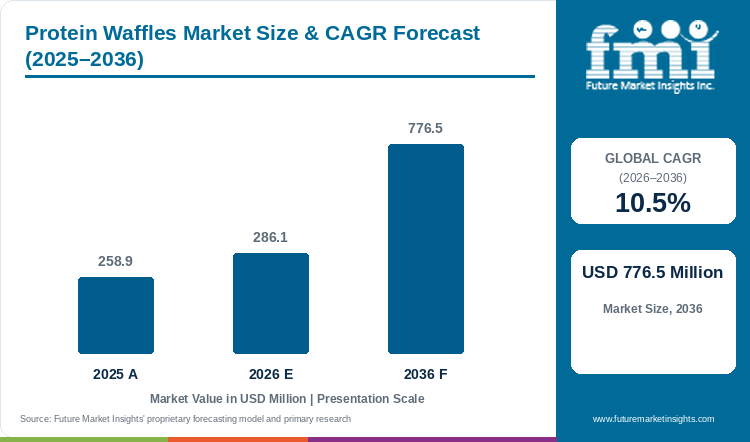
The protein waffles market is estimated at USD 258.9 million in 2025 and is expected to reach USD 286.1 million in 2026. Sales of protein waffles are projected to grow at a 10.5% CAGR and reach USD 776.5 million by 2036.
Demand for protein waffles comes mostly from frozen breakfast shoppers. The protein waffles market moves from an estimated USD 258.9 million in 2025 to an expected USD 286.1 million in 2026, and is projected to reach USD 776.5 million by 2036 at a 10.5% CAGR. Over the forecast period, the dominant trend will be protein paired with zero added sugar, as brands answer label readers who check both lines of the nutrition panel. For instance, Mars announced Eggo Zero waffles in June 2026, with 0 g of added sugar and 11 g to 12 g of complete protein per serving, at USD 5.99 for an eight-count box.[1] That move by a mass toaster brand to remove added sugar resets the shelf benchmark, so smaller protein brands now compete on taste and price per serving instead of the protein claim alone.
In response, FMI analysts recommend that frozen waffle makers reformulate core flavours to at least 10 g of protein with no added sugar before adding new SKUs, since freezer space goes to lines that repeat in the shopping basket. Likewise, foodservice suppliers can follow the same path with add-in packs, keeping one batter and one iron in each kitchen.
Key Market Trends & Insights
- Classic round waffles are estimated to hold 34% in 2026, against 27.5% for Belgian and Liege styles, as families toast them on school mornings.
- Milk and whey protein is projected to supply 46% of protein source volume in 2026, as dairy isolates give a soft crumb at 10 g or more per serving. Brands are also pushing protein higher per serving. Kodiak launched a no-sugar-added Power Waffle with 16 g of protein in February 2026.[2] A no-sugar recipe at 16 g raises the bar that every rival recipe now has to meet.
- Within format, frozen waffles are likely to hold 52% in 2026, fresh baked waffles about 26% and ambient packs near 22%.
- Supermarket and hypermarket freezers carry an estimated 31% of channel sales in 2026, with foodservice close at 27%. In that freezer aisle, Jimmy Dean added three frozen Protein Waffles with 20 g of protein per serving in March 2026.[3] A breakfast meat brand entering the aisle at 20 g adds shelf competition and keeps supermarket promotions frequent.
Regional Highlights
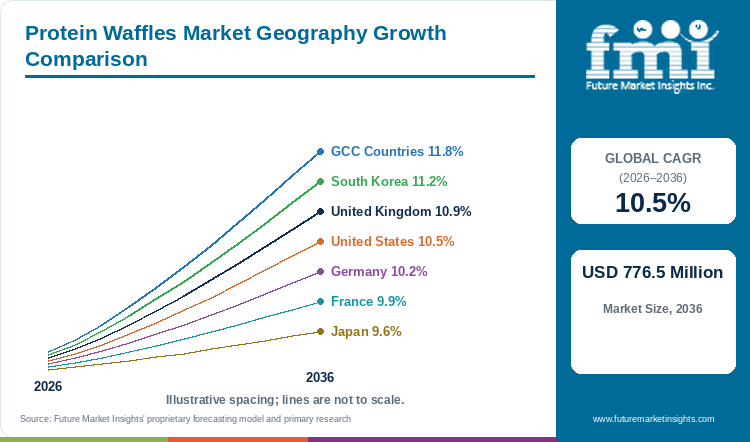
- On FMI's forecast, GCC Countries grow fastest at 11.8%, with gyms, hotels and importers adding protein breakfasts.
- Next come South Korea, at 11.2% on convenience-store protein ranges, and the United Kingdom, at 10.9% on own-label launches. The United States matches the global 10.5%. Germany (10.2%), France (9.9%) and Japan (9.6%) grow more slowly, with fewer waffle breakfasts in daily routines.
- British grocers are widening protein ranges quickly. Sainsbury's launched 19 high-protein lines in February 2026, and searches for high protein on the retailer website rose 57% year on year, Food Manufacture reported.[4] A search rise of that size tells buyers that protein breakfast lines will earn freezer space, which favours protein waffle listings.
Market Size & Forecast
Table 1: Market Size and Forecast for the Protein Waffles Market (USD million and percentage), 2025 to 2036
| Metric | Value |
|---|---|
| 2025 Market Size | USD 258.9 million |
| Estimated Market Size in 2026 | USD 286.1 million |
| Projected Market Size by 2036 | USD 776.5 million |
| CAGR, 2026 to 2036 | 10.5% |
| Added Revenue, 2026 to 2036 | USD 490.4 million |
| Market Expansion Multiple | 2.7x |
New entrants from other breakfast categories are widening the protein waffle shelf. Tyson Foods called the Jimmy Dean Protein Waffles the brand's first frozen waffle product when the line reached select retailers nationwide in March 2026.[3] A meat brand moving into waffles shows that protein breakfast sales are now large enough to draw players from other aisles. Earlier, Kodiak Cakes added a 100% whole grain Power Waffle with no added sugar the month before.[2] Whole grain and no-sugar claims on one box set a higher standard for every later launch. Meanwhile, bars, bites and brownies compete for the same protein snack occasion, and the protein snacks market is predicted to expand at an 8.2% CAGR, behind protein waffles. The protein waffles market gains USD 490.4 million in new sales between 2026 and 2036, FMI analysis shows, ending the period 2.7 times larger than in 2026. Even so, price per serving against plain waffles remains the main risk to repeat buying.
Frozen Brand Launches, Foodservice Add-Ins and Retailer Ranges
Frozen brands are reformulating fast. Eggo Zero Buttermilk carries 12 g of complete protein and Eggo Zero Blueberry 11 g, both with no artificial flavours, colours or sweeteners, and the line reached retailers nationwide in July 2026.[1] Clean labels at a mass price make protein the default for the leading toaster brand. Behind that launch, Mars completed the acquisition of Kellanova on 11 December 2025, and Eggo now launches products as a Mars brand.[5][1] Ownership by Mars gives Eggo more launch funding and more weight with grocers. Alongside Eggo, Jimmy Dean launched Buttermilk, Blueberry and Cinnamon Protein Waffles, each made to heat in a toaster.[3] Three reformulated or new lines in one year push smaller brands to compete on taste and price per serving.
Foodservice operators are adding protein without new equipment. Golden Waffles introduced Protein and Fiber Nutritional Boost Packs that add 5 g to 6 g of protein per half waffle to the existing batter, with a debut at the National Restaurant Association Show in Chicago on 16 to 19 May 2026.[6] As a result, hotel buffets, campus dining and cafés can then list a protein waffle from the same iron.
Table 2: Launch, Foodservice and Retail Indicators for the Protein Waffles Market (protein content, packs and ranges), 2025 to 2026
| Indicator | Data Point | Relevance | Source |
|---|---|---|---|
| Eggo Zero waffles, June 2026 | 11 g to 12 g complete protein; 0 g added sugar; USD 5.99 for 8 waffles | Mass toaster benchmark | [1] |
| Kodiak Power Waffle, February 2026 | 16 g protein; no added sugar; 100% whole grains | Premium frozen protein line | [2] |
| Jimmy Dean Protein Waffles, March 2026 | 20 g protein per serving; three flavours | New entrant from a breakfast meat brand | [3] |
| Golden Waffles Boost Packs, May 2026 | 5 g to 6 g protein per half waffle | Fresh-baked foodservice protein | [6] |
| Sainsbury's high-protein range, February 2026 | 19 new SKUs; searches up 57% | UK retailer demand for protein | [4] |
| GS25 protein drinks, H1 2026 | Sales up 26.8% | Korean convenience demand for protein | [7] |
Analyst Perspective
“Protein waffles have moved from gym shops to the main freezer door, and the next contest is about sugar, taste and price per serving. Brands that hold 10 g to 20 g of protein with no added sugar and a toaster texture close to the original will keep the repeat buyer. I expect foodservice add-ins to bring protein waffles into hotel and campus breakfasts, opening a breakfast-buffet lane for high-protein batters across the decade.”
- Nandini Roy Choudhury, Principal Consultant, Future Market Insights.
How is the protein waffles market segmented?
The market is segmented into product type, protein source, format, sales channel, and region. Classic round waffles are expected to lead product type with 34% share in 2026, and frozen packs lead format with 52%.
By product type: classic round, Belgian and Liege, mini and bites, and snack waffles.
By protein source: milk and whey protein, wheat and grain protein, plant protein, and egg protein.
By format: frozen, fresh baked, and ambient packaged.
By sales channel: supermarkets and hypermarkets, foodservice, online and direct to consumer, convenience stores, and specialty and health food stores.
By region: households, cafés, hotels, gyms and campuses in North America, Latin America, Western Europe, Eastern Europe, East Asia, South Asia and Pacific, and Middle East and Africa.
Why do classic round protein waffles lead sales by product type?
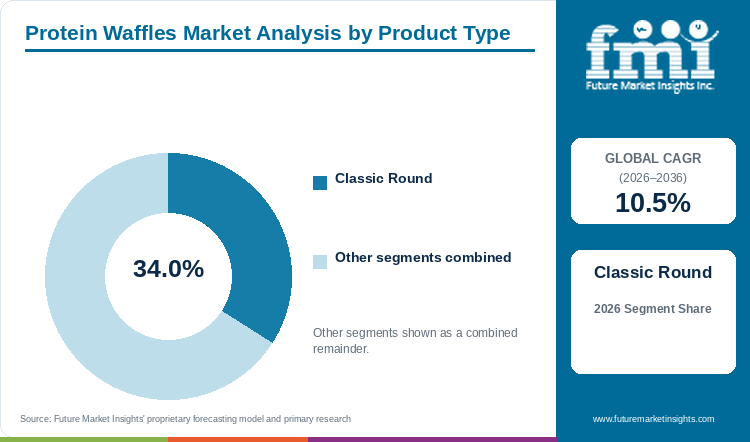
Classic round waffles are expected to lead product type sales with 34% share in 2026, ahead of Belgian and Liege styles at about 27.5% and mini and bites at an estimated 21%.
Table 3: Product Type Share for the Protein Waffles Market (percentage share), 2026
| Product Type | Estimated Share (2026) |
|---|---|
| Classic Round | 34% |
| Belgian and Liege | 27.5% |
| Mini and Bites | 21% |
| Snack Waffles | 17.5% |
| Total | 100.0% |
Table 4: Product Type Leadership and Market Growth for the Protein Waffles Market (segment and CAGR percentage), 2026 to 2036
| Metric | Value |
|---|---|
| Global CAGR (2026 to 2036) | 10.5% |
| Leading Segment | Classic Round |
Classic round protein waffles are predicted to stay first at 34% in 2026, as every household toaster fits a thin round waffle. Mass brands are launching protein lines in this format first. Eggo Zero sells the toaster round in an eight-count box, and Jimmy Dean offers the same format in three flavours.[1][3] Two national launches in one format make the round the easiest switch for shoppers who buy plain waffles. By comparison, Belgian and Liege styles, about 27.5%, are thicker and suit hotel buffets and cafés, though the deeper pocket needs more batter per serving. Next, parents buy mini and bites, an estimated 21%, for lunch boxes and snacks, with a higher price per gram. Snack waffles hold 17.5%, sold as ambient bars and wafers beside protein brownies, and the protein brownies market is predicted to rise at a 12% CAGR as that snack shelf widens. Above all, a shopper switching from a plain toaster waffle changes only the box, so the round format keeps the largest base.
- Buttermilk, blueberry, chocolate chip and cinnamon toaster rounds make up most classic round volume.
- Price points stay close to everyday toaster waffles. Eggo Zero sells at USD 5.99 for an eight-count box.[1] At about USD 0.75 per waffle, the round format keeps protein within reach of family budgets.
Why does milk and whey protein lead sales by protein source?
Milk and whey protein is likely to lead protein source sales with 46% share in 2026, ahead of wheat and grain protein at about 24% and plant protein at an estimated 18%.
Table 5: Protein Source Share for the Protein Waffles Market (percentage share), 2026
| Protein Source | Estimated Share (2026) |
|---|---|
| Milk and Whey Protein | 46% |
| Wheat and Grain Protein | 24% |
| Plant Protein | 18% |
| Egg Protein | 12% |
| Total | 100.0% |
Milk and whey protein will hold the largest part, 46%, in 2026, as dairy isolates add protein without a beany note and keep the crumb soft after freezing. Eggo Zero lists complete protein with all nine essential amino acids, a claim dairy blends meet easily.[1] A complete-protein claim on the leading brand steers other makers toward dairy blends. Second in line, wheat and grain protein, near 24%, comes from whole grain flours, the route Kodiak uses in a 100% whole grain Power Waffle.[2] Whole grain recipes add a fibre claim as well, which keeps grain protein in second place. Plant protein, an estimated 18%, relies on pea and soy for vegan and dairy-free buyers, though texture still lags dairy. Finally, egg white powder makes up 12% in keto and paleo lines. On the supply side, the whey protein market is forecast to expand at a 7.5% CAGR, which keeps dairy isolate supply wide for waffle makers.
- Milk protein concentrate, whey protein isolate and casein blends form the dairy group.
- Grain-based brands are matching dairy on protein. Kodiak Power Waffles carry 16 g of protein per serving with no added sugar.[2] Protein at that level keeps whole grain recipes competitive with whey-based rivals.
Why do frozen protein waffles lead sales by format?
Frozen protein waffles are projected to lead format sales with 52% share in 2026, ahead of fresh baked waffles at about 26% and ambient packaged waffles at an estimated 22%.
Table 6: Format Share for the Protein Waffles Market (percentage share), 2026
| Format | Estimated Share (2026) |
|---|---|
| Frozen | 52% |
| Fresh Baked | 26% |
| Ambient Packaged | 22% |
| Total | 100.0% |
Frozen packs are likely to remain the top format at 52% in 2026, as freezing keeps protein waffles soft for months without preservatives and the toaster restores the crust. Fresh baked waffles, about 26%, come from café, hotel and campus irons, and Golden Waffles now lets operators add 5 g to 6 g of protein per half waffle to the same batter.[6] Add-ins of that kind let kitchens offer protein without stocking a second batter, which supports fresh baked volume. On the other hand, ambient packaged waffles, an estimated 22%, are shelf-stable snack waffles sold in gyms, convenience stores and online. At the same time, frozen bakery investment supports the leading format, and the frozen bakery market is predicted to grow at a 6.5% CAGR. In the end, households keep buying frozen, since one box covers a week of breakfasts.
- Toaster rounds, Belgian squares and mini waffles sold from grocery freezers make up the frozen group.
- Foodservice suppliers are launching protein tools at trade shows. Golden Waffles debuted the Boost Packs at the National Restaurant Association Show in May 2026.[6] Show launches put the packs in front of chain buyers, which speeds menu trials in hotels and campuses.
Why do supermarkets and hypermarkets lead sales by sales channel?
Supermarkets and hypermarkets are expected to lead sales channel with 31% share in 2026, ahead of foodservice at about 27% and online and direct to consumer at an estimated 18%.
Table 7: Sales Channel Share for the Protein Waffles Market (percentage share), 2026
| Sales Channel | Estimated Share (2026) |
|---|---|
| Supermarkets and Hypermarkets | 31% |
| Foodservice | 27% |
| Online and Direct to Consumer | 18% |
| Convenience Stores | 13.5% |
| Specialty and Health Food Stores | 10.5% |
| Total | 100.0% |
Supermarkets and hypermarkets will hold 31% of 2026 channel sales, the largest single route, as weekly grocery trips fill household freezers. Grocers are also building protein ranges under own labels. For example, Sainsbury's added 19 high-protein products in February 2026, including High Protein Buttermilk Pancakes at four for GBP 1.75.[4] Own-label pricing at that level draws first-time protein buyers into the aisle, which raises traffic for branded waffles too. Foodservice, about 27%, then covers hotels, cafés, campuses and gyms that bake fresh. Online and direct to consumer sales, an estimated 18%, move through brand web stores and subscription boxes. Convenience stores account for 13.5% through single-serve snack waffles, and specialty and health food stores 10.5%. Overall, grocery chains stay ahead, as most shoppers first see a protein waffle in the freezer aisle beside the plain version.
- National grocery chains, warehouse clubs and discount supermarkets make up most retail volume.
- Grocers read protein demand in online search data. Searches for high protein on the Sainsbury's website rose 57% year on year.[4] Rising searches guide range reviews, which favours protein breakfast products when freezer space is reallocated.
What are the drivers, restraints, and opportunities in the protein waffles market?
Shoppers who want more protein at breakfast keep pulling protein waffles into the freezer aisle. Price per serving and taste gaps limit repeat purchases, and foodservice add-ins and no-sugar recipes open new buyers.
- Driver: Breakfast shoppers who track protein can swap a plain waffle for a high-protein one without changing the morning routine, which makes the switch easy.
- Restraint: Protein waffles cost more per serving than plain waffles and can turn dry or dense, so some first-time buyers do not return.
- Opportunity: Hotels, campuses and cafés can add protein to fresh waffles with simple add-ins, and no-sugar recipes reach diabetic and low-sugar buyers.
Breakfast Protein Habits Pull Waffles into New Baskets
Consumer preference for protein at every meal is moving into the breakfast freezer. Sainsbury's reported that searches for high protein rose 57% year on year and launched 19 high-protein lines in February 2026.[4] Retail moves of that kind turn protein from a gym claim into a mainstream grocery category. Similarly, in South Korea, GS25 said protein drink sales rose 26.8% over January to June 2026 and passed banana milk for the first time, EDAILY reported.[7] Consequently, shoppers already buying protein drinks and meals are the first to try a protein waffle.
Price and Texture Gaps Limit Repeat Buying
Producers of protein waffles face a price gap against plain frozen waffles. Eggo Zero carries a USD 5.99 suggested price for eight waffles.[1] A price near USD 0.75 per waffle can slow repeat buying among budget shoppers. To justify that premium, brands such as Kodiak lean on whole grains and protein claims.[2] Such claims persuade nutrition-minded buyers, though price-led households often return to plain waffles. Besides price, dense or dry texture after toasting remains the most common reason a trial buyer does not repurchase, so recipe work on moisture matters as much as protein grams.
Foodservice Add-Ins and No-Sugar Recipes Open New Buyers
Growth of the protein waffles market will come from kitchens and buyers outside the grocery freezer. Golden Waffles designed Boost Packs to fit an existing fresh-baked waffle program without a separate mix or new equipment.[6] With no new equipment needed, kitchens can test protein waffles at almost no setup cost. In retail, Mars launched Eggo Zero with no added sugar, which opens the category to low-sugar shoppers.[1] Therefore, suppliers with both a frozen line and a foodservice add-in will reach the widest set of breakfast buyers.
Which country CAGRs are profiled in the protein waffles market?
Table 8: Country CAGR Comparison for the Protein Waffles Market (CAGR percentage), 2026 to 2036
| Country | CAGR (2026 to 2036) |
|---|---|
| GCC Countries | 11.8% |
| South Korea | 11.2% |
| United Kingdom | 10.9% |
| United States | 10.5% |
| Germany | 10.2% |
| France | 9.9% |
| Japan | 9.6% |
How do country-level CAGRs compare in the protein waffles market?
GCC Countries are expected to grow fastest, at 11.8% on FMI's forecast, as gym chains and hotel breakfasts in Dubai and Riyadh import frozen protein waffles from a small base. South Korea follows at 11.2% as convenience chains stock high-protein food. Close behind, the United Kingdom is projected at 10.9%, with supermarkets building own-label protein ranges. The United States, at 10.5%, matches the global rate from the largest base. By contrast, Germany (10.2%) and France (9.9%) grow below that pace, and Japan, at 9.6%, has the slowest rate, as rice and bread breakfasts leave less room for waffles.
- Gulf gyms and hotels serve protein waffles to fitness-minded guests at breakfast, so imports lean toward frozen foodservice packs, and distributors with cold-chain reach gain the first listings.
- Korean convenience chains already sell protein drinks and gimbap in volume. Single-serve snack waffles fit the same chiller, giving brands with small packs the easiest entry.
- Own-label protein lines in British supermarkets set a low entry price, which widens trial and squeezes branded margins; national brands need clear protein and taste gains to hold facings.
- With three national frozen brands fighting for one US aisle, promotions stay frequent, and the brand that sustains taste at 10 g or more per serving keeps repeat buyers.
- German discount grocers price protein ranges low under own labels. Volume can rise quickly on that shelf, though suppliers face tight margins.
- Fresh bakery gaufres remain the French default, so packaged protein waffles start in sports nutrition stores and online, a narrower route for brands.
- Japanese shoppers take most added protein in drinks and ready meals, which leaves waffles a smaller breakfast slot; snack formats in convenience stores have the best chance of trial.
Full report country CAGRs cover: rates for every standard country by region, led by GCC Countries on 11.8% and closed by Japan on 9.6%, with the United States matching the 10.5% figure for the world.
Country-wise Analysis
GCC Countries Protein Waffles Market Outlook (2026 to 2036)
Imported frozen protein waffles reach Gulf hotel buffets, gym cafés and expatriate homes through regional distributors. However, retail listing requires Arabic labels and Gulf nutrition panels. FMI projects demand for protein waffles in GCC Countries at an 11.8% CAGR, from a small import base.
Key takeaway: Gym and hotel breakfasts carry the fastest growth in the Gulf.
South Korea Protein Waffles Market Outlook (2026 to 2036)
Korean convenience shoppers are already buying protein in volume. Protein drinks at GS25 sold 26.8% more from January to June 2026, and two high-protein gimbap lines passed 1.5 million units combined, EDAILY reported on 27 July 2026.[7] These convenience shoppers who buy protein drinks and gimbap are ready for protein snack waffles. FMI forecasts an 11.2% CAGR for South Korea as those shoppers move into breakfast snacks.
Key takeaway: Convenience store protein ranges open a fast lane for snack waffles in South Korea.
United Kingdom Protein Waffles Market Outlook (2026 to 2036)
British grocers are using own labels to widen protein breakfasts. Sainsbury's launched 19 high-protein SKUs in February 2026, including High Protein Buttermilk Pancakes with 8 g of protein, Food Manufacture reported.[4] In turn, protein waffles are shelved close to that breakfast range in British freezers and bakery aisles. Demand for protein waffles in the United Kingdom is projected to expand at a 10.9% CAGR on the back of that breakfast range.
Key takeaway: Own-label protein breakfasts give British shoppers a cheap first trial.
United States Protein Waffles Market Outlook (2026 to 2036)
Competition among national brands is setting the pace in the United States. US freezers now carry Eggo Zero, Kodiak Power Waffles and Jimmy Dean Protein Waffles, with 11 g to 20 g of protein per serving.[1][2][3] With three national brands competing in one aisle, promotions stay frequent and household trial widens. FMI's forecast has US sales rising 10.5% a year, level with the global rate.
Key takeaway: Three national frozen brands set the protein bar in the United States.
Germany Protein Waffles Market Outlook (2026 to 2036)
German discount grocers and drugstores sell high-protein snacks, bars and breads under own labels at low prices. Protein waffles therefore enter through the same shelves as ambient snack waffles and frozen packs. Sales in Germany are set to rise 10.2% a year from that price-led base.
Key takeaway: Discount own labels shape protein waffle prices in Germany.
France Protein Waffles Market Outlook (2026 to 2036)
French shoppers buy fresh gaufres from bakeries and street stalls, and front-of-pack nutrition scores push packaged brands to cut sugar. As a result, protein versions appear mainly in sports nutrition stores and online. Growth of packaged protein waffles in France is predicted at 9.9% a year, held back by fresh gaufres.
Key takeaway: Bakery gaufres hold back packaged protein waffles in France.
Japan Protein Waffles Market Outlook (2026 to 2036)
Japanese food makers are adding protein to everyday products. House Foods released a pouch curry with 30 g of protein in June 2026, and Maisen Fine Food sells soy protein granules that add protein to rice during cooking, Jiji Press reported on 10 September 2026.[8] Protein waffles compete with these drinks and meals for the same buyers, and Japan is projected to grow at a 9.6% CAGR.
Key takeaway: Japanese buyers get most added protein from drinks and ready meals.
Who are the notable companies in the protein waffles market?
Mars, Kodiak, Tyson Foods, BellRing Brands, General Mills, Golden Waffles, Europastry and Vandemoortele are the profiled companies.
Frozen breakfast brands own most protein waffle shelf space, and foodservice and bakery suppliers serve hotels and cafés. Mars closed the Kellanova acquisition on 11 December 2025, and Eggo now sells as a Mars brand.[5][1] Mars ownership gives Eggo deeper launch budgets for no-sugar and protein lines. In addition, Tyson Foods extended the Jimmy Dean brand into frozen waffles for the first time with Jimmy Dean Protein Waffles in March 2026.[3] Entry by a breakfast meat brand widens the competitive set beyond bakery companies. FMI analysis shows Kodiak, BellRing Brands, General Mills, Golden Waffles, Europastry and Vandemoortele competing for the same breakfast shoppers and kitchens.
- Frozen breakfast brands: Mars, Kodiak, Tyson Foods, BellRing Brands and General Mills.
- Foodservice and bakery suppliers: Golden Waffles, Europastry and Vandemoortele.
Competitive Benchmarking: Protein Waffles Market
Table 9: Competitive Benchmarking for the Protein Waffles Market (qualitative ratings), 2026
| Company | Protein Waffle Range | No-Sugar Lines | Foodservice Reach | Recent Activity |
|---|---|---|---|---|
| Mars | High | High | Low | High |
| Kodiak | High | High | Low | High |
| Tyson Foods | High | Low | Medium | High |
| Golden Waffles | Medium | Low | High | High |
| BellRing Brands | Medium | Low | Low | Medium |
Ratings compare the companies on protein waffle range, no-sugar lines and foodservice reach.
Key Developments in the Protein Waffles Market
- House Foods and Maisen Fine Food added high-protein curry and rice products in Japan, as reported on 10 September 2026, which shows protein reaching everyday Japanese meals ahead of breakfast waffles.[8]
- GS25 protein drink sales rose 26.8% in the first half of 2026, EDAILY figures of 27 July 2026 show, pointing snack waffle brands toward a ready convenience store audience.[7]
- Mars announced Eggo Zero waffles on 22 June 2026, with 0 g of added sugar and up to 12 g of complete protein, setting a mass-market benchmark for no-sugar recipes.[1]
- In a 15 May 2026 launch, Golden Waffles announced Protein and Fiber Nutritional Boost Packs for foodservice waffle programs, giving hotel and campus kitchens a low-cost route to protein menus.[6]
- On 16 March 2026, Tyson Foods launched Jimmy Dean Protein Waffles with 20 g of protein per serving, the highest of the three national frozen lines.[3]
- Kodiak introduced a no-sugar-added Power Waffle with 16 g of protein on 13 February 2026, raising the protein bar for premium frozen lines.[2]
- Sainsbury's launch of 19 high-protein products on 3 February 2026 brought own-label price competition into British protein breakfasts.[4]
- On 11 December 2025, Mars completed the acquisition of Kellanova, bringing Eggo under a larger owner with more launch funding.[5]
Key Players in the Protein Waffles Market
Frozen Breakfast Brands
- Mars
- Kodiak
- Tyson Foods
- BellRing Brands
- General Mills
Foodservice and Bakery Suppliers
- Golden Waffles
- Europastry
- Vandemoortele
Protein Waffles Market - Report Scope
Table 10: Report Scope for the Protein Waffles Market (coverage fields and definitions), 2026 to 2036
| Coverage field | Report scope |
|---|---|
| Market breakdown | Product type; protein source; format; sales channel; region |
| Quantitative units | USD million |
| Market definition | Ready-to-eat, frozen, fresh baked and ambient waffles formulated and labelled for higher protein content per serving, sold to households through retail and online channels and to foodservice operators. Plain waffles, pancakes, dry waffle mixes without added protein and plated restaurant meals are excluded. |
| Regions covered | North America; Latin America; Western Europe; Eastern Europe; East Asia; South Asia and Pacific; Middle East and Africa |
| Countries covered | United States; Canada; Brazil; Mexico; Argentina; Chile; Germany; France; United Kingdom; Italy; Spain; Benelux; Nordics; Poland; Czech Republic; Romania; Hungary; China; Japan; South Korea; India; ASEAN; Australia and New Zealand; GCC Countries; South Africa; Türkiye; Israel |
| Key companies profiled | Mars, Kodiak, Tyson Foods, BellRing Brands, General Mills, Golden Waffles, Europastry, Vandemoortele |
| Forecast period | 2026 to 2036 |
Protein Waffles Market - Research Methodology
Table 11: Research Methodology for the Protein Waffles Market (research methods and approach), 2026 edition
| Method | Approach |
|---|---|
| Data Sources | Company results, industry associations, government statistics and trade publications. |
| Desk Research | Desk research covers protein content, sugar reformulation, frozen and fresh formats, retailer ranges and foodservice add-ins. |
| Market Sizing and Forecasting | Sizing starts from the 2026 base of USD 286.1 million and the 10.5% CAGR for 2026 to 2036. |
| Data Validation | Figures are cross-checked across company, industry and government sources. |
Protein Waffles Market by Segments
Protein Waffles Market segmented by Product Type:
- Classic Round
- Belgian and Liege
- Mini and Bites
- Snack Waffles
Protein Waffles Market segmented by Protein Source:
- Milk and Whey Protein
- Wheat and Grain Protein
- Plant Protein
- Egg Protein
Protein Waffles Market segmented by Format:
- Frozen
- Fresh Baked
- Ambient Packaged
Protein Waffles Market segmented by Sales Channel:
- Supermarkets and Hypermarkets
- Foodservice
- Online and Direct to Consumer
- Convenience Stores
- Specialty and Health Food Stores
Protein Waffles Market by Region
- North America
- United States
- Canada
- Latin America
- Brazil
- Mexico
- Argentina
- Chile
- Western Europe
- Germany
- France
- United Kingdom
- Italy
- Spain
- Benelux
- Nordics
- Eastern Europe
- Poland
- Czech Republic
- Romania
- Hungary
- East Asia
- China
- Japan
- South Korea
- South Asia and Pacific
- India
- ASEAN
- Australia and New Zealand
- Middle East and Africa
- GCC Countries
- South Africa
- Türkiye
- Israel
Research Sources and Bibliography
- [1] Snack Food & Wholesale Bakery. (2026, June 22). Eggo unveils zero-added sugar waffles. https://www.snackandbakery.com/articles/115932-eggo-unveils-zero-added-sugar-waffles
- [2] Baking Business. (2026, February 13). Kodiak introduces no sugar added waffles. https://www.bakingbusiness.com/articles/65666-kodiak-introduces-no-sugar-added-waffles
- [3] Tyson Foods, Inc. (2026, March 16). Jimmy Dean Protein Lineup Expands with New Bowls Featuring 40 Grams of Protein. https://www.tysonfoods.com/news/news-releases/2026/3/jimmy-deanr-protein-lineup-expands-new-bowls-featuring-40-grams-protein
- [4] Food Manufacture. (2026, February 3). Sainsbury's launches a raft of new high protein products alongside its new Small but Mighty range. https://www.foodmanufacture.co.uk/Article/2026/02/03/sainsburys-launches-a-raft-of-new-high-protein-products-alongside-its-new-small-but-mighty-range
- [5] Kellanova (Form 8-K, Exhibit 99.1). (2025, December 11). Mars Completes Acquisition of Kellanova. https://www.sec.gov/Archives/edgar/data/55067/000119312525315130/d90636dex991.htm
- [6] Prepared Foods. (2026, May 15). Golden Waffles Launches Protein, Fiber Boost Packs. https://www.preparedfoods.com/articles/131597-golden-waffles-launches-protein-fiber-boost-packs
- [7] EDAILY. (2026, July 27). GS Holdings' High-Protein Gimbap Becomes a Million-Seller as Healthy Convenience Foods Boost Sales. https://en.edaily.co.kr/news/eda202607275092
- [8] Nippon.com (Jiji Press). (2026, September 10). Convenient Protein Products Gaining Popularity in Japan. https://www.nippon.com/en/news/yjj2026090900866/
This bibliography is provided for reader reference. The full report contains the complete reference list and detailed citations.
This Report Answers
- How big is the protein waffles market during 2026?
- What market size is projected by 2036?
- Which product type holds notable share?
- Which protein source holds notable share?
- Which countries have notable growth?
- Which companies are notable in the market?
Frequently Asked Questions
How large is the protein waffles market expected in 2026?
Sales of protein waffles are expected to reach USD 286.1 million in 2026, from USD 258.9 million in 2025, on FMI's estimate. The protein waffles market is projected to reach USD 776.5 million by 2036.
What CAGR is projected for the protein waffles market through 2036?
Demand for protein waffles is forecast to grow at a 10.5% CAGR through 2036. Shoppers adding protein to breakfast and brands cutting added sugar carry that growth.
Which product type holds a notable market share in 2026?
Classic round waffles are expected to lead with 34% share in 2026. Belgian and Liege styles follow at an estimated 27.5%.
Which protein source holds a notable market share in 2026?
Milk and whey protein is likely to lead with 46% share in 2026. Wheat and grain protein holds an estimated 24%.
Which country has a notable expansion outlook through 2036?
FMI projects the fastest growth for GCC Countries, at an 11.8% CAGR. South Korea follows at 11.2%.
Who are the key companies in the protein waffles market?
Mars, Kodiak, Tyson Foods, BellRing Brands and General Mills lead the frozen breakfast brands. Golden Waffles, Europastry and Vandemoortele complete the foodservice and bakery suppliers.
Preview the report firsthand - request a free sample
Get SampleGet the brochure for pricing and purchase details.
Get PDFTable of Content
- Key Takeaways
- Market Size and CAGR
- Top Growth Driver
- Fastest Growing Segment
- Leading Region
- Key Companies
- Emerging Opportunities
- Executive Summary
- Global Market Outlook
- Demand-side Trends
- Supply-side Trends
- Technology Roadmap Analysis
- Analysis and Recommendations
- Analyst Perspective (What is happening? Why now? What should investors know?)
- Key Questions Answered
- How large is the market?
- What is the CAGR?
- What are key trends?
- Which region dominates?
- Who are the leaders?
- Market Overview
- Market Coverage / Taxonomy
- Market Definition / Scope / Limitations
- Research Methodology
- Chapter Orientation
- Analytical Lens and Working Hypotheses
- Market Structure, Signals, and Trend Drivers
- Benchmarking and Cross-market Comparability
- Market Sizing, Forecasting, and Opportunity Mapping
- Research Design and Evidence Framework
- Desk Research Programme (Secondary Evidence)
- Expert Input and Fieldwork (Primary Evidence)
- Tooling, Models, and Reference Databases
- Data Engineering and Model Build
- Quality Assurance and Audit Trail
- Market Background
- Market Dynamics (Drivers, Restraints, Opportunity, Trends)
- Scenario Forecast (Optimistic, Likely, Conservative)
- Impact Analysis
- AI Impact
- Sustainability Impact
- Regulatory Impact
- Technology Impact
- Consumer / Buyer Analysis
- Purchase Drivers
- Adoption Barriers
- Buyer Journey
- Opportunity Map Analysis
- Product Life Cycle Analysis
- Supply Chain Analysis
- Investment Feasibility Matrix
- Value Chain Analysis
- PESTLE and Porter's Analysis
- Regulatory Landscape
- Regional Parent Market Outlook
- Production and Consumption Statistics
- Import and Export Statistics
- Global Market Analysis and Forecast, 2021 to 2036
- Historical Market Size Value (USD Million) Analysis, 2021 to 2025
- Current and Future Market Size Value (USD Million) Projections, 2026 to 2036
- Y-o-Y Growth Trend Analysis
- Absolute $ Opportunity Analysis
- Global Market Pricing Analysis, 2021 to 2036
- Global Market Analysis and Forecast, By Product Type, 2021 to 2036
- Introduction / Key Findings
- Historical Market Size Value (USD Million) Analysis By Product Type, 2021 to 2025
- Current and Future Market Size Value (USD Million) Analysis and Forecast By Product Type, 2026 to 2036
- Classic Round
- Belgian and Liege
- Mini and Bites
- Snack Waffles
- Y-o-Y Growth Trend Analysis By Product Type, 2021 to 2025
- Absolute $ Opportunity Analysis By Product Type, 2026 to 2036
- Global Market Analysis and Forecast, By Protein Source, 2021 to 2036
- Introduction / Key Findings
- Historical Market Size Value (USD Million) Analysis By Protein Source, 2021 to 2025
- Current and Future Market Size Value (USD Million) Analysis and Forecast By Protein Source, 2026 to 2036
- Milk and Whey Protein
- Wheat and Grain Protein
- Plant Protein
- Egg Protein
- Y-o-Y Growth Trend Analysis By Protein Source, 2021 to 2025
- Absolute $ Opportunity Analysis By Protein Source, 2026 to 2036
- Global Market Analysis and Forecast, By Format, 2021 to 2036
- Introduction / Key Findings
- Historical Market Size Value (USD Million) Analysis By Format, 2021 to 2025
- Current and Future Market Size Value (USD Million) Analysis and Forecast By Format, 2026 to 2036
- Frozen
- Fresh Baked
- Ambient Packaged
- Y-o-Y Growth Trend Analysis By Format, 2021 to 2025
- Absolute $ Opportunity Analysis By Format, 2026 to 2036
- Global Market Analysis and Forecast, By Sales Channel, 2021 to 2036
- Introduction / Key Findings
- Historical Market Size Value (USD Million) Analysis By Sales Channel, 2021 to 2025
- Current and Future Market Size Value (USD Million) Analysis and Forecast By Sales Channel, 2026 to 2036
- Supermarkets and Hypermarkets
- Foodservice
- Online and Direct to Consumer
- Convenience Stores
- Specialty and Health Food Stores
- Y-o-Y Growth Trend Analysis By Sales Channel, 2021 to 2025
- Absolute $ Opportunity Analysis By Sales Channel, 2026 to 2036
- Global Market Analysis and Forecast, By Region, 2021 to 2036
- Introduction
- Historical Market Size Value (USD Million) Analysis By Region, 2021 to 2025
- Current Market Size Value (USD Million) Analysis and Forecast By Region, 2026 to 2036
- North America
- Latin America
- Western Europe
- Eastern Europe
- East Asia
- South Asia and Pacific
- Middle East and Africa
- Market Attractiveness Analysis By Region
- North America Market Analysis and Forecast, By Country, 2021 to 2036
- Historical Market Size Value (USD Million) Trend Analysis By Market Taxonomy, 2021 to 2025
- Market Size Value (USD Million) Forecast By Market Taxonomy, 2026 to 2036
- By Country
- United States
- Canada
- By Product Type
- By Protein Source
- By Format
- By Sales Channel
- By Country
- Market Attractiveness Analysis
- By Country
- By Product Type
- By Protein Source
- By Format
- By Sales Channel
- Key Takeaways
- Latin America Market Analysis and Forecast, By Country
- Historical Market Size Value (USD Million) Trend Analysis By Market Taxonomy, 2021 to 2025
- Market Size Value (USD Million) Forecast By Market Taxonomy, 2026 to 2036
- By Country
- Brazil
- Mexico
- Argentina
- Chile
- By Product Type
- By Protein Source
- By Format
- By Sales Channel
- By Country
- Market Attractiveness Analysis
- By Country
- By Product Type
- By Protein Source
- By Format
- By Sales Channel
- Key Takeaways
- Western Europe Market Analysis and Forecast, By Country
- Historical Market Size Value (USD Million) Trend Analysis By Market Taxonomy, 2021 to 2025
- Market Size Value (USD Million) Forecast By Market Taxonomy, 2026 to 2036
- By Country
- Germany
- France
- United Kingdom
- Italy
- Spain
- Benelux
- Nordics
- By Product Type
- By Protein Source
- By Format
- By Sales Channel
- By Country
- Market Attractiveness Analysis
- By Country
- By Product Type
- By Protein Source
- By Format
- By Sales Channel
- Key Takeaways
- Eastern Europe Market Analysis and Forecast, By Country
- Historical Market Size Value (USD Million) Trend Analysis By Market Taxonomy, 2021 to 2025
- Market Size Value (USD Million) Forecast By Market Taxonomy, 2026 to 2036
- By Country
- Poland
- Czech Republic
- Romania
- Hungary
- By Product Type
- By Protein Source
- By Format
- By Sales Channel
- By Country
- Market Attractiveness Analysis
- By Country
- By Product Type
- By Protein Source
- By Format
- By Sales Channel
- Key Takeaways
- East Asia Market Analysis and Forecast, By Country
- Historical Market Size Value (USD Million) Trend Analysis By Market Taxonomy, 2021 to 2025
- Market Size Value (USD Million) Forecast By Market Taxonomy, 2026 to 2036
- By Country
- China
- Japan
- South Korea
- By Product Type
- By Protein Source
- By Format
- By Sales Channel
- By Country
- Market Attractiveness Analysis
- By Country
- By Product Type
- By Protein Source
- By Format
- By Sales Channel
- Key Takeaways
- South Asia and Pacific Market Analysis and Forecast, By Country
- Historical Market Size Value (USD Million) Trend Analysis By Market Taxonomy, 2021 to 2025
- Market Size Value (USD Million) Forecast By Market Taxonomy, 2026 to 2036
- By Country
- India
- ASEAN
- Australia and New Zealand
- By Product Type
- By Protein Source
- By Format
- By Sales Channel
- By Country
- Market Attractiveness Analysis
- By Country
- By Product Type
- By Protein Source
- By Format
- By Sales Channel
- Key Takeaways
- Middle East and Africa Market Analysis and Forecast, By Country
- Historical Market Size Value (USD Million) Trend Analysis By Market Taxonomy, 2021 to 2025
- Market Size Value (USD Million) Forecast By Market Taxonomy, 2026 to 2036
- By Country
- GCC Countries
- South Africa
- Türkiye
- Israel
- By Product Type
- By Protein Source
- By Format
- By Sales Channel
- By Country
- Market Attractiveness Analysis
- By Country
- By Product Type
- By Protein Source
- By Format
- By Sales Channel
- Key Takeaways
- Key Countries Market Analysis
- United States
- Pricing Analysis
- Market Share Analysis, 2025
- By Product Type
- By Protein Source
- By Format
- By Sales Channel
- Canada
- Pricing Analysis
- Market Share Analysis, 2025
- By Product Type
- By Protein Source
- By Format
- By Sales Channel
- Mexico
- Pricing Analysis
- Market Share Analysis, 2025
- By Product Type
- By Protein Source
- By Format
- By Sales Channel
- Brazil
- Pricing Analysis
- Market Share Analysis, 2025
- By Product Type
- By Protein Source
- By Format
- By Sales Channel
- Chile
- Pricing Analysis
- Market Share Analysis, 2025
- By Product Type
- By Protein Source
- By Format
- By Sales Channel
- Germany
- Pricing Analysis
- Market Share Analysis, 2025
- By Product Type
- By Protein Source
- By Format
- By Sales Channel
- United Kingdom
- Pricing Analysis
- Market Share Analysis, 2025
- By Product Type
- By Protein Source
- By Format
- By Sales Channel
- Italy
- Pricing Analysis
- Market Share Analysis, 2025
- By Product Type
- By Protein Source
- By Format
- By Sales Channel
- Spain
- Pricing Analysis
- Market Share Analysis, 2025
- By Product Type
- By Protein Source
- By Format
- By Sales Channel
- France
- Pricing Analysis
- Market Share Analysis, 2025
- By Product Type
- By Protein Source
- By Format
- By Sales Channel
- India
- Pricing Analysis
- Market Share Analysis, 2025
- By Product Type
- By Protein Source
- By Format
- By Sales Channel
- ASEAN
- Pricing Analysis
- Market Share Analysis, 2025
- By Product Type
- By Protein Source
- By Format
- By Sales Channel
- Australia and New Zealand
- Pricing Analysis
- Market Share Analysis, 2025
- By Product Type
- By Protein Source
- By Format
- By Sales Channel
- China
- Pricing Analysis
- Market Share Analysis, 2025
- By Product Type
- By Protein Source
- By Format
- By Sales Channel
- Japan
- Pricing Analysis
- Market Share Analysis, 2025
- By Product Type
- By Protein Source
- By Format
- By Sales Channel
- South Korea
- Pricing Analysis
- Market Share Analysis, 2025
- By Product Type
- By Protein Source
- By Format
- By Sales Channel
- Poland
- Pricing Analysis
- Market Share Analysis, 2025
- By Product Type
- By Protein Source
- By Format
- By Sales Channel
- Hungary
- Pricing Analysis
- Market Share Analysis, 2025
- By Product Type
- By Protein Source
- By Format
- By Sales Channel
- Türkiye
- Pricing Analysis
- Market Share Analysis, 2025
- By Product Type
- By Protein Source
- By Format
- By Sales Channel
- South Africa
- Pricing Analysis
- Market Share Analysis, 2025
- By Product Type
- By Protein Source
- By Format
- By Sales Channel
- GCC Countries
- Pricing Analysis
- Market Share Analysis, 2025
- By Product Type
- By Protein Source
- By Format
- By Sales Channel
- United States
- Market Structure Analysis
- Competition Dashboard
- Competition Benchmarking
- Market Share Analysis of Top Players
- By Regional
- By Product Type
- By Protein Source
- By Format
- By Sales Channel
- Emerging Startups
- Innovation Benchmarking
- Competition Analysis
- Competition Deep Dive
- Mars
- Overview
- Product Portfolio
- Profitability by Market Segments
- Sales Footprint
- Strategy Overview
- Marketing Strategy
- Product Strategy
- Channel Strategy
- Kodiak
- Tyson Foods
- Golden Waffles
- BellRing Brands
- General Mills
- Europastry
- Vandemoortele
- Mars
- Case Studies
- Success Stories
- Recent Developments
- Competition Deep Dive
- Assumptions & Acronyms Used


