

- Market Size (2026)
- USD 0.90 Bn
- Forecast (2036)
- USD 1.74 Bn
- CAGR (2026 to 2036)
- 6.8%
High Protein Bakery Mix Market Size, Market Forecast and Outlook By FMI
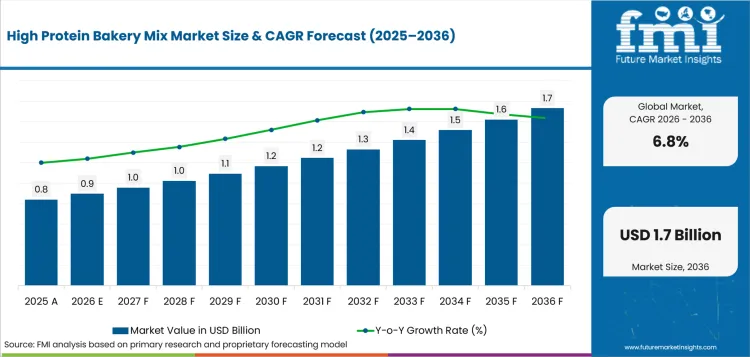
The high protein bakery mix market was valued at USD 0.84 billion in 2025. The market is estimated at USD 0.90 billion in 2026 and is projected to reach USD 1.74 billion by 2036. This reflects 6.8% CAGR through 2036, supported by protein claim use in bread and snack bakery formats. Bread mixes are expected to account for 38.4% share in 2026 while direct business sales are estimated at 55.4% share.
Key Takeaways, Market Size, and Forecast
- 2026 Market Size: USD 0.90 billion
- 2036 Market Size: USD 1.74 billion
- Forecast CAGR: 6.8% from 2026 to 2036
- Leading Product Type: Bread Mixes
- Bread Mixes Share in 2026: 38.4%
- Leading Sales Channel: Direct B2B Sales
- Direct B2B Sales Share in 2026: 55.4%
- Fastest-growing Country: South Korea
- South Korea CAGR: 8.0% through 2036
Summary of High Protein Bakery Mix Market
- Demand and Growth Drivers
- Protein enrichment is shifting into bakery mixes used for bread, muffins and snack bases.
- Commercial bakeries need mixes that hold volume after protein addition.
- Retail buyers compare protein grams, taste and claim clarity before adding new SKUs.
- Product and Segment View
- Bread mixes are forecast to represent 38.4% share in 2026, led by repeat use in commercial baking lines.
- Wheat protein is expected to hold 36.8% share in 2026 due to dough strength and familiar formulation behavior.
- Direct B2B sales are projected to secure 55.4% share in 2026 as bakeries need technical support with premix trials.
- Geography and Competitive Outlook
- South Korea is forecast to record 8.0% CAGR through 2036 as functional food buying supports protein bakery launches.
- The United States is expected to expand at 6.9% CAGR through 2036 through national bakery channels and high protein diets.
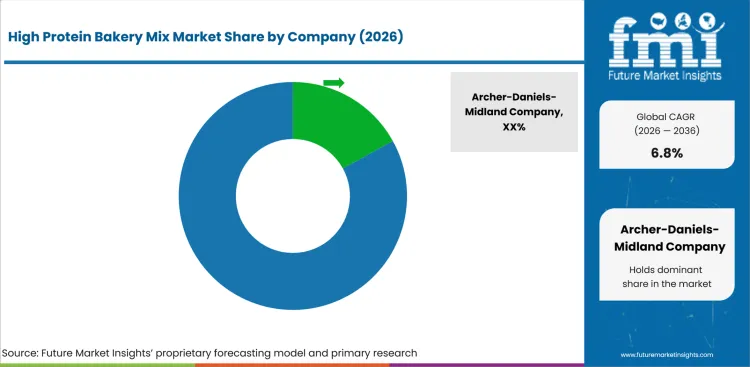
- Archer-Daniels-Midland Company and Cargill Incorporated compete by protein input breadth and bakery formulation support. Puratos Group competes through premix systems and baker-facing application support.
- Ardent Mills LLC and Bakels Group focus on premix portfolios and baker-facing sales teams. IREKS GmbH and Koninklijke Zeelandia Group B.V. add European application depth.
- Analyst Opinion
- Nandini Roy Choudhury, Principal Consultant for Food and Beverage at FMI, observes, “High protein bakery mixes are not a simple protein powder story. Bakers need mixes that survive mixing and shelf-life checks. The suppliers that win here are the ones that can make protein claims work without turning bread or muffins into a texture problem.”
- High Protein Bakery Mix Market Value Analysis
- Market value is supported by finished dry mixes and premix systems sold to bakeries and retailers.
- Pricing reflects protein source and claim level while enzyme support shapes dough stability.
- Revenue improves when bakeries replace separate flour and protein dosing with one tested blend.
- Private label and foodservice buyers raise order value when a mix can support bread, muffin and snack formats from one base.
Protein is moving from sports nutrition into everyday bakery decisions. International Food Information Council reported in June 2024 that 71% of United States consumers were trying to consume protein. Agriculture and Agri-Food Canada reported in July 2025 that bakery products with plant-based or high-added protein claims rose 140% in Canada between second quarter 2023 and second quarter 2024. Premix suppliers therefore compete on dough tolerance, protein grams per serving and clean taste rather than on powder inclusion alone.
High Protein Bakery Mix Market Definition
High protein bakery mixes cover dry or semi-finished premixes positioned to increase protein content in bread, muffins, pancakes, snack cakes, bars, and related baked goods. Scope includes wheat protein mixes, whey protein mixes, soy protein mixes, pea protein mixes, egg protein mixes, and mixed protein systems sold for bakery formulation. Revenue includes branded retail mixes, foodservice packs, and business-to-business premixes sold to commercial bakeries, packaged food manufacturers, foodservice kitchens, retail baking channels, and online business ordering platforms.
High Protein Bakery Mix Market Inclusions
Market scope covers commercially supplied high protein bakery mixes categorized by product type such as bread mixes, muffin mixes, snack mixes, pancake mixes, and cookie mixes. Protein source coverage includes wheat protein, whey protein, soy protein, pea protein, egg protein, and mixed proteins. Protein level coverage includes 10 to 15 Percent, 15 to 20 Percent, Above 20 Percent, and Claim Flexible formats. End-use coverage includes commercial bakeries, food manufacturers, retail baking, foodservice kitchens, and sports nutrition brands.
Sales channel coverage includes direct B2B sales, ingredient distributors, retail packs, and online B2B ordering. Claim positioning includes high protein, high fiber protein, gluten free protein, low sugar protein, and plant based protein. Revenue scope covers 2026 to 2036. Key stakeholders include bakery ingredient suppliers, premix manufacturers, commercial bakeries, packaged food producers, foodservice buyers, retail category teams, ingredient distributors, private label suppliers, and formulation support teams.
High Protein Bakery Mix Market Exclusions
Scope excludes standard bakery mixes, plain flours, finished high-protein baked goods, protein bars without bakery mix use, raw protein powders sold without bakery formulation support, and general baking ingredients without protein enrichment positioning. Finished bakery products are excluded unless revenue is clearly tied to an eligible bakery mix SKU or premix system.
High Protein Bakery Mix Market Research Methodology
- Primary Research: FMI analysts reviewed high protein bakery mix SKUs, bakery ingredient supplier portfolios, premix manufacturer offerings, commercial bakery trials, foodservice pack availability, retail baking aisle listings, and country-level functional bakery purchase behavior.
- Desk Research: Public data from government agencies, food safety bodies, trade associations, official company product pages, bakery ingredient suppliers, and functional food references were checked against high protein bakery mix evidence.
- Market Sizing and Forecasting: Estimated using a bottom-up product-boundary approach based on eligible SKU revenue, channel presence, retail and foodservice pricing, protein claim positioning, premix availability, and country-level adoption.
- Data Validation: Forecast checks compared bakery mix revenue pools, protein ingredient portfolios, high protein bakery launch activity, commercial bakery use cases, distributor reach, retail pack availability, and active supplier portfolios across leading countries.
Why is the High Protein Bakery Mix Market Growing?
- Driven by protein-first eating, commercial bakers are using baking ingredients that can raise protein without breaking texture.
- Supported by premix standardization, suppliers can sell tested pea protein ingredients into breads and snack cakes with fewer plant trials.
- Reflects retail claim discipline, buyers now ask for protein grams per serving and clean taste before shelf approval.
- Attributable to foodservice menu testing, bakery bases must deliver repeatable volume after freezing and reheating.
Protein enrichment is becoming a bakery formulation choice rather than a gym-focused claim. International Food Information Council reported in June 2024 that 71% of United States consumers were trying to consume protein. That figure gives retailers a reason to test bread and muffin mixes with front-of-pack protein cues. Mix suppliers gain from this shift when they can combine protein source and leavening system with flavor masking inside one blend. The commercial result is a shorter trial path for bakeries that want nutrition claims without rebuilding the whole formula.
Commercial bakeries are also trying to reduce trial waste in protein reformulation. Protein can tighten crumb and alter proofing while creating dry mouthfeel when it is added after a base mix is already designed. Agriculture and Agri-Food Canada reported in July 2025 that bakery products with plant-based or high-added protein claims increased 140% in Canada between second quarter 2023 and second quarter 2024. That signal shows bakery is becoming a preferred carrier for protein claims. Premix suppliers benefit when they sell a complete bakery base rather than one isolated protein powder.
Market Segmentation Analysis
- With an estimated 38.4% share in 2026, bread mixes are expected to lead product type since loaf volume and crumb structure need tighter control than many snack formats.
- Wheat protein is anticipated to hold 36.8% of protein source revenue in 2026, supported by dough strength and familiar bakery handling.
- Buyers specifying 15 to 20 Percent protein levels are forecast to represent 44.2% of protein level use in 2026 since this range balances claim value and texture risk.
- Commercial bakeries are projected to account for 47.5% of end use in 2026 where line trials depend on repeatable dough-based premixes.
- Direct business sales are estimated at 55.4% of channel revenue in 2026 with buyers requiring technical support and batch validation.
- High protein positioning is expected to secure 52.7% of claim positioning in 2026 while soy protein ingredients support cost-managed blended formulas.
The market is divided by product type, protein source, protein level, end use, sales channel and claim positioning. Product decisions start with bread, muffin and snack mix formats. Protein source decisions then decide dough behavior and taste. Protein level shapes the label claim and the risk of dryness. End-use choices differ between commercial bakeries, packaged food makers, foodservice kitchens and retail packs. Sales channel choice matters because most large buyers need trial support before moving to repeat orders.
Insights into the Bread Mixes Product Type Segment
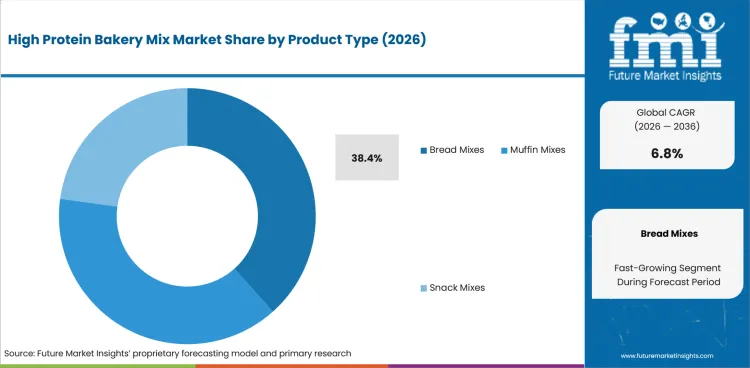
- With an estimated 38.4% of product type revenue in 2026, bread mixes are anticipated to lead because protein addition must preserve loaf height and slicing quality.
- Bread mix buyers often request trial loaves before purchase since proofing tolerance is harder to correct after a protein base reaches production.
Insights into the Wheat Protein Source Segment
- By protein source, wheat protein is expected to lead with 36.8% share in 2026 due to gluten network support in breads and buns.
- Cargill lists wheat protein with minimum 75% protein content for protein-enriched bakery applications, which shows why this source fits industrial dough systems.
Insights into the 15 to 20 Percent Protein Level Segment
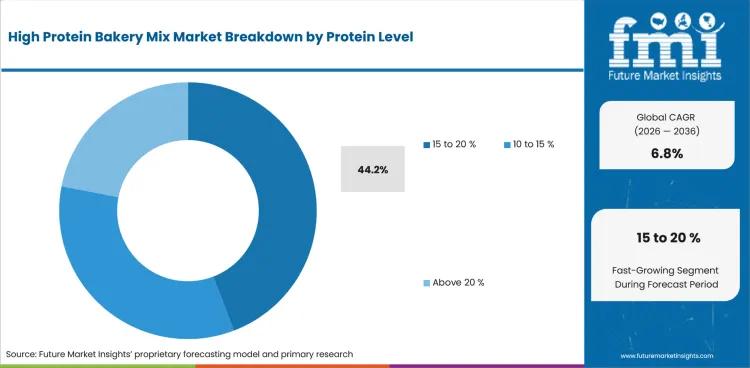
- Balanced protein claims are projected to push 15 to 20 Percent levels to 44.2% share in 2026 while higher levels remain harder to texture-manage.
- This protein band lets muffins, pancakes and snack bases carry clear protein cues without forcing expensive flavor masking in every formula.
Insights into the Commercial Bakeries End Use Segment
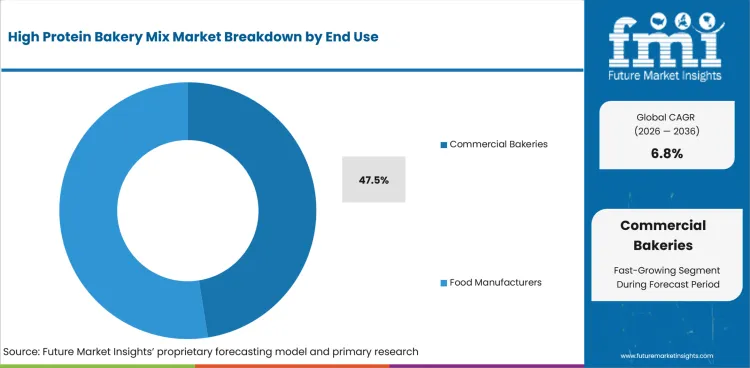
- Commercial bakeries account for 47.5% of end-use value in 2026 because line speed and consistent hydration decide repeat orders.
- Protein bakery trials usually involve proofing, bake loss and shelf-life checks, not only a taste panel.
Insights into the Direct B2B Sales Channel Segment
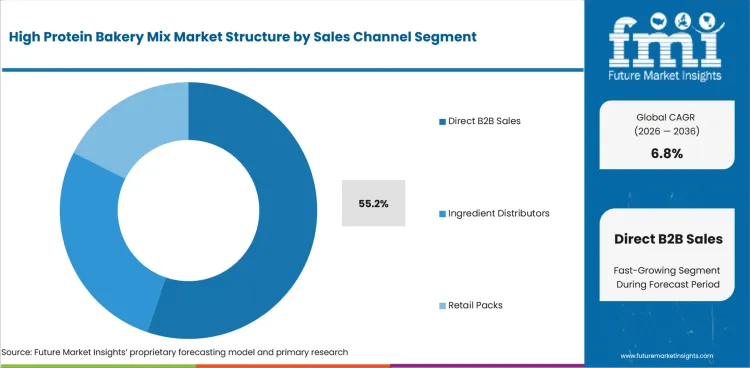
- Direct B2B sales are estimated to lead sales channels with 55.4% in 2026 while distributor sales serve smaller bakery buyers.
- Supplier technical teams help customers adjust water absorption, mixing time and bake profile before a protein mix receives plant approval.
Insights into the High Protein Claim Positioning Segment
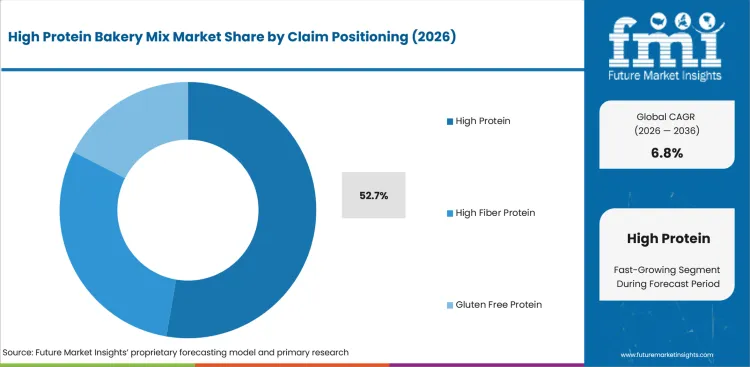
- Claim clarity is forecast to move High protein positioning to 52.7% share across claim positioning in 2026.
- Protein grams per serving gives retail buyers a simpler comparison point than broad better-for-you language on bakery packs.
High Protein Bakery Mix Market Drivers, Restraints, and Opportunities
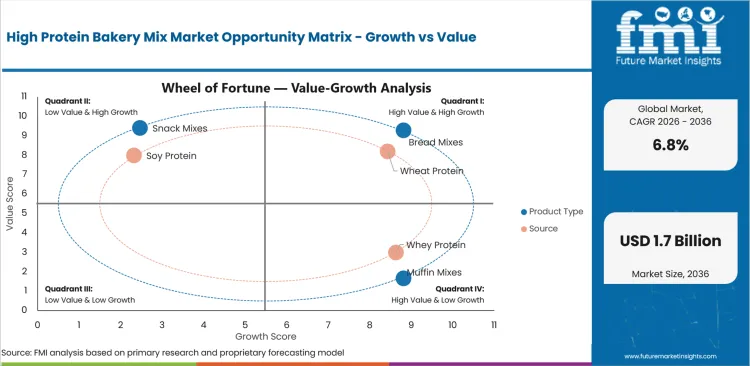
- Driven by protein claim visibility, bakery brands are testing mixes that can carry measurable grams per serving.
- Supported by plant protein ingredient launches, formulators have more options for bread, muffin and snack bases.
- Constrained by texture risk, high inclusion levels can reduce volume and create dry eating quality.
- Attributable to adjacent claim work, allergen-aware premix suppliers can extend into protein-plus formulas when taste and volume stay stable.
- Concentrated in functional snack bases, whey protein ingredients remain useful when dairy flavor fits pancakes and muffins in breakfast formats.
Protein Claims Need Texture
Product design is one of the primary driver behind industry growth. A protein number on the pack does not help if bread loses volume or muffins feel dry. Roquette launched four NUTRALYS pea protein ingredients in February 2024 for high-protein nutritional products and better sensory performance. That type of ingredient work gives premix makers more formulation room. Bakery buyers can then specify a complete mix that balances protein source and leavening with hydration and taste. Growth remains tied to suppliers that solve texture before a buyer commits to scale.
Cost Pressure Shapes Recipes
Buyer decisions are moving toward blends that control input cost and protect production yield. Puratos Group and Burcon NutraScience Corporation announced a canola protein collaboration in November 2024 for bakery and patisserie solutions. The companies highlighted cost-in-use savings when replacing eggs in formulations. That matters for muffin and snack mix makers facing ingredient inflation and allergen reviews. The opportunity is not only higher protein. It is also a lower-risk reformulation path for buyers that need consistent volume and predictable batch economics.
Dairy Protein Needs Fit
Dairy-based systems remain useful when flavor and browning support the target product. Whey ingredients can help bars and pancakes deliver a firmer protein cue in breakfast formats. The restraint appears when dairy notes conflict with clean taste or plant-based positioning. Cargill identifies wheat and pea proteins as bakery-ready options with minimum 75% to 80% protein content in its bakery materials. This pushes suppliers to offer source-specific mix design rather than a single universal protein base.
Analysis of High Protein Bakery Mix Market by Key Countries
.webp "Top Country Growth Comparison High Protein Bakery Mix Market Cagr (2026 2036)")
| Country | CAGR |
|---|---|
| South Korea | 8.0% |
| United States | 6.9% |
| Australia | 6.7% |
| Canada | 6.6% |
| United Kingdom | 6.4% |
| Germany | 6.2% |
| Japan | 5.8% |
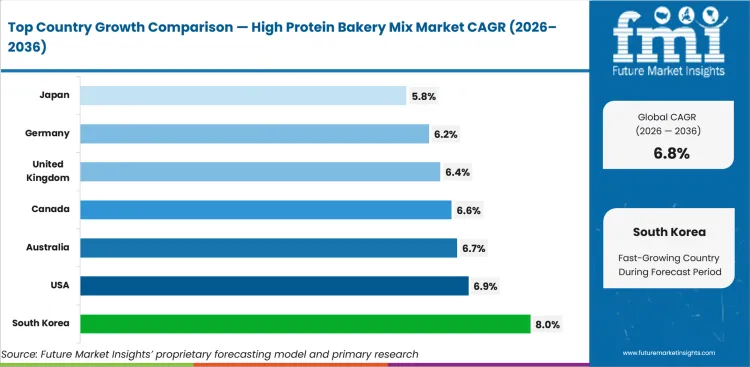
Source: FMI analysis based on primary research and proprietary forecasting model.
High Protein Bakery Mix Market CAGR Analysis by Country
- South Korea is projected to record 8.0% CAGR through 2036 as functional food buying supports protein bakery trial.
- The United States is expected to expand at 6.9% CAGR through 2036 since protein remains a mainstream diet cue.
- Australia is forecast to grow at 6.7% CAGR through 2036 with home baking and better-for-you snacking supporting mix use.
- Canada is expected to advance at 6.6% CAGR through 2036 given that bakery claim activity is already visible in high-added protein launches.
- The United Kingdom is projected to rise at 6.4% CAGR through 2036 where healthier bakery reformulation meets cost-aware buying.
- Germany is forecast at 6.2% CAGR through 2036 with industrial bakery channels requiring clean label protein systems.
- Japan is expected to post 5.8% CAGR through 2036 as convenience retail favors measured portions and snack bakery formats.
The global CAGR is estimated at 6.8% through 2036. South Korea and the United States are forecast above that rate due to protein-oriented consumer behavior and functional food retail structures. Japan and Germany are expected to remain lower than the global average due to conservative product entry and tighter taste expectations. The spread reflects how quickly buyers accept protein claims in everyday bakery formats.
Demand Outlook for High Protein Bakery Mix Market in the United States
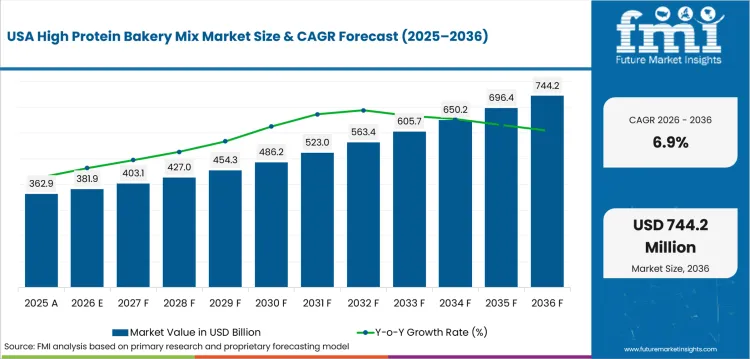
Largest value base, 2026 to 2036
Country Market Snapshot Table
| Parameter | Value |
|---|---|
| Market Size in 2025 (Value) | USD 294.7 million |
| Market Size in 2026 (Value) | USD 315.0 million |
| Market Forecast in 2036 (Value) | USD 613.6 million |
| CAGR (2026 to 2036) | 6.9% |
| Years Considered | 2021 to 2036 |
| Base Year | 2025 |
| Forecast Period | 2026 to 2036 |
| Units Considered | Value (USD million) |
| Leading Sub-Region | South Atlantic and national bakery corridors |
United States High Protein Bakery Mix Market Outlook
Commercial bakery scale gives the United States the largest country revenue base. United States bakery mix purchasing is shaped by national retail chains, commercial bread makers and protein-focused shoppers. International Food Information Council reported in June 2024 that 71% of United States consumers were trying to consume protein. The United States is expected to expand at 6.9% CAGR through 2036 since these buyers give suppliers a clear trial route. Suppliers with bakery labs and national account coverage is expected to gain better access.
Key Growth Drivers
- Protein remains a mainstream food cue across adult shoppers and helps bread mixes move beyond diet-only positioning.
- Commercial bakers use premixes to reduce line errors when protein changes water absorption and crumb structure.
- Retail category teams can compare protein grams per serving more easily than broad wellness language.
Key Restraints
- Higher protein inclusion can raise input cost before repeat volume is proven.
- Dryness and volume loss remain purchase barriers when protein is added without full mix balancing.
- Private label buyers may delay rollouts if protein claims need new nutrition panel reviews.
What makes United States unique
The United States is unique due to national bakery chains and a protein-aware shopper base.
Key Companies
- Archer-Daniels-Midland Company
- Cargill Incorporated
- Ardent Mills LLC
- Glanbia Nutritionals
- Corbion N.V.
- Ingredion Incorporated
- Bunge Global SA
Sales & Marketing Channels
- Commercial bakery sales teams
- Ingredient distributors
- Retail baking aisles
- Foodservice distributors
- Online business ordering
- Private label channels
Country Segment Breakdown Table
| Segment | Sub-Segments |
|---|---|
| By Product Type | Bread Mixes, Muffin Mixes, Snack Mixes, Pancake Mixes, Cookie Mixes |
| By Protein Source | Wheat Protein, Whey Protein, Soy Protein, Pea Protein, Egg Protein, Mixed Proteins |
| By Protein Level | 15 to 20 Percent, 10 to 15 Percent, Above 20 Percent, Claim Flexible |
| By End Use | Commercial Bakeries, Food Manufacturers, Retail Baking, Foodservice Kitchens, Sports Nutrition Brands |
| By Sales Channel | Direct B2B Sales, Ingredient Distributors, Retail Packs, Online B2B |
| By Claim Positioning | High Protein, High Fiber Protein, Gluten Free Protein, Low Sugar Protein, Plant Based Protein |
| Key Sub-Regions Covered, Bakery Retail and Manufacturing Corridors | California, Texas, Illinois, Ohio, Pennsylvania, New York, Georgia, Florida |
Market Taxonomy and Sub-Regions Covered
Frequently Asked Questions
How fast is United States high protein bakery mix market growing?
Sales in United States are forecast at 6.9% CAGR from 2026 to 2036.
Who leads United States high protein bakery mix market?
Local bakery ingredient suppliers and multinational premix makers compete through bakery technical support.
What is driving adoption in United States high protein bakery mix market?
Protein claim demand and bakery format familiarity are moving buyers toward tested premixes.
Sales Analysis of High Protein Bakery Mix Market in Canada
Claim-led bakery testing center, 2026 to 2036
Country Market Snapshot Table
| Parameter | Value |
|---|---|
| Market Size in 2025 (Value) | USD 51.6 million |
| Market Size in 2026 (Value) | USD 55.0 million |
| Market Forecast in 2036 (Value) | USD 104.1 million |
| CAGR (2026 to 2036) | 6.6% |
| Years Considered | 2021 to 2036 |
| Base Year | 2025 |
| Forecast Period | 2026 to 2036 |
| Units Considered | Value (USD million) |
| Leading Sub-Region | Ontario and Quebec bakery corridors |
Canada High Protein Bakery Mix Market Outlook
Canadian buyers are comparing mixes through clean ingredient lists and protein label claims. Canada is expected to expand at 6.6% CAGR through 2036, with bakery launch data supporting this rate. Agriculture and Agri-Food Canada reported in July 2025 that plant-based or high-added protein bakery products rose 140% between second quarter 2023 and second quarter 2024. High protein flour development is therefore tied to bakery products that can carry both nutrition and familiar taste. Buyers are likely to favor suppliers that support bilingual packs and distributor training.
Key Growth Drivers
- Bakery claim activity gives suppliers a measurable route for protein premix trials.
- Ontario and Quebec provide the strongest retail and bakery manufacturing base for launch testing.
- Plant-forward protein sources can fit Canadian buyer requests for allergen and ingredient transparency.
Key Restraints
- Shorter production runs can make protein mix trials more expensive for regional bakeries.
- Cross-border ingredient pricing can shift when United States dairy and wheat protein costs move.
- Retailers may restrict new SKUs when protein claims overlap with gluten-free or plant-based claims.
What makes Canada unique
Canada is unique because claim-led bakery launches show visible movement into protein and plant-based formats.
Key Companies
- Puratos Canada Inc.
- Bakels Canada Inc.
- Ardent Mills Canada
- Cargill Limited
- Glanbia Canada
- Dawn Foods Canada
- Ingredion Canada Corporation
Sales & Marketing Channels
- Commercial bakery sales teams
- Ingredient distributors
- Retail baking aisles
- Foodservice distributors
- Online business ordering
- Private label channels
Country Segment Breakdown Table
| Segment | Sub-Segments |
|---|---|
| By Product Type | Bread Mixes, Muffin Mixes, Snack Mixes, Pancake Mixes, Cookie Mixes |
| By Protein Source | Wheat Protein, Whey Protein, Soy Protein, Pea Protein, Egg Protein, Mixed Proteins |
| By Protein Level | 15 to 20 Percent, 10 to 15 Percent, Above 20 Percent, Claim Flexible |
| By End Use | Commercial Bakeries, Food Manufacturers, Retail Baking, Foodservice Kitchens, Sports Nutrition Brands |
| By Sales Channel | Direct B2B Sales, Ingredient Distributors, Retail Packs, Online B2B |
| By Claim Positioning | High Protein, High Fiber Protein, Gluten Free Protein, Low Sugar Protein, Plant Based Protein |
| Key Sub-Regions Covered, Bakery Retail and Manufacturing Corridors | Ontario, Quebec, British Columbia, Alberta, Manitoba, Saskatchewan |
Market Taxonomy and Sub-Regions Covered
Frequently Asked Questions
How fast is Canada high protein bakery mix market growing?
Sales in Canada are forecast at 6.6% CAGR from 2026 to 2036.
Who leads Canada high protein bakery mix market?
Local bakery ingredient suppliers and multinational premix makers compete through bakery technical support.
What is driving adoption in Canada high protein bakery mix market?
Protein claim demand and bakery format familiarity are moving buyers toward tested premixes.
Demand Analysis of High Protein Bakery Mix Market in Germany
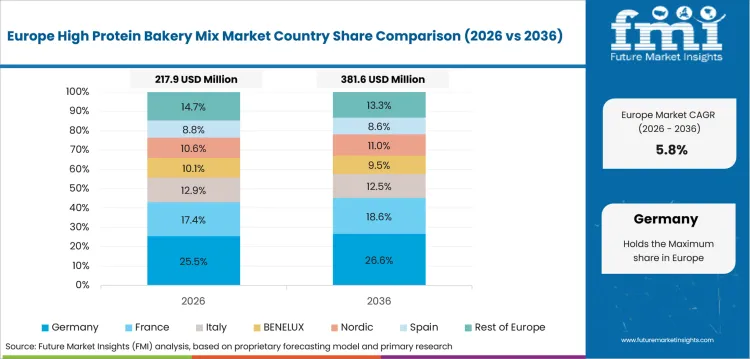
Industrial bakery specification base, 2026 to 2036
Country Market Snapshot Table
| Parameter | Value |
|---|---|
| Market Size in 2025 (Value) | USD 75.3 million |
| Market Size in 2026 (Value) | USD 80.0 million |
| Market Forecast in 2036 (Value) | USD 146.1 million |
| CAGR (2026 to 2036) | 6.2% |
| Years Considered | 2021 to 2036 |
| Base Year | 2025 |
| Forecast Period | 2026 to 2036 |
| Units Considered | Value (USD million) |
| Leading Sub-Region | North Rhine-Westphalia and Bavaria bakery clusters |
Germany High Protein Bakery Mix Market Outlook
German supply is shaped by industrial bakeries and ingredient houses that test dough behavior before product approval. Buyers expect clean taste, reliable volume and stable crumb across bread and roll lines. Germany is forecast to grow at 6.2% CAGR through 2036 as industrial bakers add protein claims at a measured pace. Wheat protein selection matters here because protein sources must support dough strength rather than only raise label numbers. Faster growth is constrained by strict taste expectations and cost discipline.
Key Growth Drivers
- Industrial bakery buyers need protein mixes that match existing line speeds and hydration windows.
- Wheat protein fits bread and roll systems where structure is a larger issue than sweetness masking.
- Premium retail bread can absorb protein positioning when texture remains close to standard loaves.
Key Restraints
- Ingredient declarations can limit buyer appetite for complex protein systems.
- Regional craft bakers may choose flour adjustment over full premix adoption.
- Plant protein flavor notes can slow adoption in bread categories with traditional taste standards.
What makes Germany unique
Germany is unique because bakery specification work is strict and industrial trials decide repeat sales.
Key Companies
- IREKS GmbH
- Stern-Wywiol Gruppe GmbH & Co. KG
- GoodMills Innovation GmbH
- Mühlenchemie GmbH & Co. KG
- Martin Braun-Gruppe
- BENEO GmbH
- Döhler GmbH
Sales & Marketing Channels
- Commercial bakery sales teams
- Ingredient distributors
- Retail baking aisles
- Foodservice distributors
- Online business ordering
- Private label channels
Country Segment Breakdown Table
| Segment | Sub-Segments |
|---|---|
| By Product Type | Bread Mixes, Muffin Mixes, Snack Mixes, Pancake Mixes, Cookie Mixes |
| By Protein Source | Wheat Protein, Whey Protein, Soy Protein, Pea Protein, Egg Protein, Mixed Proteins |
| By Protein Level | 15 to 20 Percent, 10 to 15 Percent, Above 20 Percent, Claim Flexible |
| By End Use | Commercial Bakeries, Food Manufacturers, Retail Baking, Foodservice Kitchens, Sports Nutrition Brands |
| By Sales Channel | Direct B2B Sales, Ingredient Distributors, Retail Packs, Online B2B |
| By Claim Positioning | High Protein, High Fiber Protein, Gluten Free Protein, Low Sugar Protein, Plant Based Protein |
| Key Sub-Regions Covered, Bakery Retail and Manufacturing Corridors | North Rhine-Westphalia, Bavaria, Baden-Württemberg, Lower Saxony, Hesse, Hamburg |
Market Taxonomy and Sub-Regions Covered
Frequently Asked Questions
How fast is Germany high protein bakery mix market growing?
Sales in Germany are forecast at 6.2% CAGR from 2026 to 2036.
Who leads Germany high protein bakery mix market?
Local bakery ingredient suppliers and multinational premix makers compete through bakery technical support.
What is driving adoption in Germany high protein bakery mix market?
Protein claim demand and bakery format familiarity are moving buyers toward tested premixes.
Opportunity Analysis of High Protein Bakery Mix Market in the United Kingdom
Cost-aware reformulation market, 2026 to 2036
Country Market Snapshot Table
| Parameter | Value |
|---|---|
| Market Size in 2025 (Value) | USD 65.8 million |
| Market Size in 2026 (Value) | USD 70.0 million |
| Market Forecast in 2036 (Value) | USD 130.1 million |
| CAGR (2026 to 2036) | 6.4% |
| Years Considered | 2021 to 2036 |
| Base Year | 2025 |
| Forecast Period | 2026 to 2036 |
| Units Considered | Value (USD million) |
| Leading Sub-Region | London, Midlands and northern bakery corridors |
United Kingdom High Protein Bakery Mix Market Outlook
United Kingdom bakery buyers are balancing nutrition claims with household affordability. Government of the United Kingdom reported in December 2024 that 29% of Food Standards Scotland consumer survey respondents said they could not afford a healthy balanced diet. This creates pressure for bakery mixes that raise protein without making products unaffordable. Gluten-free bakery premix work is relevant where protein claims are combined with allergen-aware positioning. The United Kingdom is projected to rise at 6.4% CAGR through 2036 if suppliers keep price gaps narrow.
Key Growth Drivers
- Cost-aware shoppers favor protein claims only when the price premium remains easy to justify.
- Foodservice bakeries can use protein muffin and pancake mixes to refresh breakfast menus.
- Retailers need simple protein claims that fit front-of-pack comparison and nutrition panel rules.
Key Restraints
- Price sensitivity limits premium mix rotation in mainstream supermarkets.
- Protein claims can compete with sugar reduction and fiber priorities inside limited shelf space.
- Bakery launches may slow when reformulation raises allergen or label review workload.
What makes United Kingdom unique
The United Kingdom is unique because affordability and nutrition claims must be solved together.
Key Companies
- Bakels Limited
- British Bakels Limited
- Zeelandia UK Ltd.
- Dawn Foods UK Ltd.
- AB Mauri UK & Ireland
- Tate & Lyle PLC
- Glanbia Nutritionals UK
Sales & Marketing Channels
- Commercial bakery sales teams
- Ingredient distributors
- Retail baking aisles
- Foodservice distributors
- Online business ordering
- Private label channels
Country Segment Breakdown Table
| Segment | Sub-Segments |
|---|---|
| By Product Type | Bread Mixes, Muffin Mixes, Snack Mixes, Pancake Mixes, Cookie Mixes |
| By Protein Source | Wheat Protein, Whey Protein, Soy Protein, Pea Protein, Egg Protein, Mixed Proteins |
| By Protein Level | 15 to 20 Percent, 10 to 15 Percent, Above 20 Percent, Claim Flexible |
| By End Use | Commercial Bakeries, Food Manufacturers, Retail Baking, Foodservice Kitchens, Sports Nutrition Brands |
| By Sales Channel | Direct B2B Sales, Ingredient Distributors, Retail Packs, Online B2B |
| By Claim Positioning | High Protein, High Fiber Protein, Gluten Free Protein, Low Sugar Protein, Plant Based Protein |
| Key Sub-Regions Covered, Bakery Retail and Manufacturing Corridors | London, West Midlands, Greater Manchester, Yorkshire, Scotland, Wales |
Market Taxonomy and Sub-Regions Covered
Frequently Asked Questions
How fast is United Kingdom high protein bakery mix market growing?
Sales in United Kingdom are forecast at 6.4% CAGR from 2026 to 2036.
Who leads United Kingdom high protein bakery mix market?
Local bakery ingredient suppliers and multinational premix makers compete through bakery technical support.
What is driving adoption in United Kingdom high protein bakery mix market?
Protein claim demand and bakery format familiarity are moving buyers toward tested premixes.
Future Outlook for High Protein Bakery Mix Market in Japan
Convenience snack bakery center, 2026 to 2036
Country Market Snapshot Table
| Parameter | Value |
|---|---|
| Market Size in 2025 (Value) | USD 58.6 million |
| Market Size in 2026 (Value) | USD 62.0 million |
| Market Forecast in 2036 (Value) | USD 108.9 million |
| CAGR (2026 to 2036) | 5.8% |
| Years Considered | 2021 to 2036 |
| Base Year | 2025 |
| Forecast Period | 2026 to 2036 |
| Units Considered | Value (USD million) |
| Leading Sub-Region | Tokyo, Osaka and Nagoya retail corridors |
Japan High Protein Bakery Mix Market Outlook
Japan’s convenience retail structure favors portion-controlled bakery products and snack formats. Agriculture and Agri-Food Canada described Japan as the fifth largest global retail sales market for baked goods with USD 24.7 billion in 2023. This base gives protein bakery mixes a route through muffins, pancakes and handheld snacks rather than only bread loaves. Japan is expected to post 5.8% CAGR through 2036 as buyers test measured protein cues through familiar formats. The channel implication is a stronger role for small packs and foodservice-ready bases.
Key Growth Drivers
- Convenience stores support small-format bakery launches where protein grams can be printed clearly.
- Snack bakery mixes fit Japanese retail routines better than large bulk bakery packs.
- Domestic taste expectations require mild protein systems and careful sweetness control.
Key Restraints
- Slow SKU turnover can limit wide rollout of new protein bakery mixes.
- Retailers may reject protein formulas that change soft texture or clean flavor.
- Imported protein inputs can raise cost when exchange rates move against buyers.
What makes Japan unique
Japan is unique due to convenience retail discipline and portion-controlled bakery formats.
Key Companies
- Nisshin Seifun Group Inc.
- NIPPN Corporation
- Showa Sangyo Co. Ltd.
- Japan Tobacco Inc. Food Division
- Mitsubishi Corporation Life Sciences Limited
- Morinaga Milk Industry Co. Ltd.
- Puratos Japan Co. Ltd.
Sales & Marketing Channels
- Commercial bakery sales teams
- Ingredient distributors
- Retail baking aisles
- Foodservice distributors
- Online business ordering
- Private label channels
Country Segment Breakdown Table
| Segment | Sub-Segments |
|---|---|
| By Product Type | Bread Mixes, Muffin Mixes, Snack Mixes, Pancake Mixes, Cookie Mixes |
| By Protein Source | Wheat Protein, Whey Protein, Soy Protein, Pea Protein, Egg Protein, Mixed Proteins |
| By Protein Level | 15 to 20 Percent, 10 to 15 Percent, Above 20 Percent, Claim Flexible |
| By End Use | Commercial Bakeries, Food Manufacturers, Retail Baking, Foodservice Kitchens, Sports Nutrition Brands |
| By Sales Channel | Direct B2B Sales, Ingredient Distributors, Retail Packs, Online B2B |
| By Claim Positioning | High Protein, High Fiber Protein, Gluten Free Protein, Low Sugar Protein, Plant Based Protein |
| Key Sub-Regions Covered, Bakery Retail and Manufacturing Corridors | Tokyo, Osaka, Yokohama, Nagoya, Fukuoka, Sapporo |
Market Taxonomy and Sub-Regions Covered
Frequently Asked Questions
How fast is Japan high protein bakery mix market growing?
Sales in Japan are forecast at 5.8% CAGR from 2026 to 2036.
Who leads Japan high protein bakery mix market?
Local bakery ingredient suppliers and multinational premix makers compete through bakery technical support.
What is driving adoption in Japan high protein bakery mix market?
Protein claim demand and bakery format familiarity are moving buyers toward tested premixes.
Demand Outlook for High Protein Bakery Mix Market in South Korea
Fastest-growing functional food base, 2026 to 2036
Country Market Snapshot Table
| Parameter | Value |
|---|---|
| Market Size in 2025 (Value) | USD 38.9 million |
| Market Size in 2026 (Value) | USD 42.0 million |
| Market Forecast in 2036 (Value) | USD 90.7 million |
| CAGR (2026 to 2036) | 8.0% |
| Years Considered | 2021 to 2036 |
| Base Year | 2025 |
| Forecast Period | 2026 to 2036 |
| Units Considered | Value (USD million) |
| Leading Sub-Region | Seoul metropolitan bakery and convenience corridors |
South Korea High Protein Bakery Mix Market Outlook
South Korea is projected to record 8.0% CAGR through 2036 as functional food buying creates faster protein bakery trial. United States Department of Agriculture Foreign Agricultural Service reported in April 2026 that South Korea’s health functional food industry reached 5.07 trillion Korean won in 2024. The same report stated that imported products accounted for 28.4% of that market. This makes protein bakery mixes commercially relevant when suppliers can connect nutrition cues with familiar bread and snack formats. The rate is higher than the global average due to readiness for function-led foods.
Key Growth Drivers
- Functional food purchasing habits give protein bakery mixes a stronger starting point than in many developed markets.
- Convenience retail can test protein muffins and snack bases with faster consumer feedback.
- Imported ingredient familiarity supports United States and European protein source suppliers.
Key Restraints
- Product claims need careful framing so bakery mixes do not appear as regulated health functional foods.
- Premium pricing can narrow trial outside Seoul and larger cities.
- Taste expectations in soft breads can limit high inclusion formulas.
What makes South Korea unique
South Korea is unique because functional food buying habits can lift bakery protein trial.
Key Companies
- CJ CheilJedang Corporation
- Samlip General Foods Co. Ltd.
- Daesang Corporation
- Sajo Daerim Corporation
- SPC Samlip Co. Ltd.
- Lotte Wellfood Co. Ltd.
- Ottogi Corporation
Sales & Marketing Channels
- Commercial bakery sales teams
- Ingredient distributors
- Retail baking aisles
- Foodservice distributors
- Online business ordering
- Private label channels
Country Segment Breakdown Table
| Segment | Sub-Segments |
|---|---|
| By Product Type | Bread Mixes, Muffin Mixes, Snack Mixes, Pancake Mixes, Cookie Mixes |
| By Protein Source | Wheat Protein, Whey Protein, Soy Protein, Pea Protein, Egg Protein, Mixed Proteins |
| By Protein Level | 15 to 20 Percent, 10 to 15 Percent, Above 20 Percent, Claim Flexible |
| By End Use | Commercial Bakeries, Food Manufacturers, Retail Baking, Foodservice Kitchens, Sports Nutrition Brands |
| By Sales Channel | Direct B2B Sales, Ingredient Distributors, Retail Packs, Online B2B |
| By Claim Positioning | High Protein, High Fiber Protein, Gluten Free Protein, Low Sugar Protein, Plant Based Protein |
| Key Sub-Regions Covered, Bakery Retail and Manufacturing Corridors | Seoul, Gyeonggi, Incheon, Busan, Daegu, Daejeon |
Market Taxonomy and Sub-Regions Covered
Frequently Asked Questions
How fast is South Korea high protein bakery mix market growing?
Sales in South Korea are forecast at 8.0% CAGR from 2026 to 2036.
Who leads South Korea high protein bakery mix market?
Local bakery ingredient suppliers and multinational premix makers compete through bakery technical support.
What is driving adoption in South Korea high protein bakery mix market?
Protein claim demand and bakery format familiarity are moving buyers toward tested premixes.
In-depth Analysis of High Protein Bakery Mix Market in Australia
Home baking and snack mix base, 2026 to 2036
Country Market Snapshot Table
| Parameter | Value |
|---|---|
| Market Size in 2025 (Value) | USD 35.6 million |
| Market Size in 2026 (Value) | USD 38.0 million |
| Market Forecast in 2036 (Value) | USD 72.7 million |
| CAGR (2026 to 2036) | 6.7% |
| Years Considered | 2021 to 2036 |
| Base Year | 2025 |
| Forecast Period | 2026 to 2036 |
| Units Considered | Value (USD million) |
| Leading Sub-Region | New South Wales and Victoria retail corridors |
Australia High Protein Bakery Mix Market Outlook
Australian buyers often compare protein bakery mixes against home baking convenience and snack nutrition. Australian Bureau of Statistics reported in March 2025 that cereal-based products averaged 63.0 grams per person per day in 2023 to 2024. Australia is forecast to grow at 6.7% CAGR through 2036 as bakery mixes remain linked to home and retail baking routines. Australia bakery mixes gain value where protein mixes help buyers improve nutrition cues without changing familiar formats. Suppliers can build value through muffins, pancakes and snack bases with clear preparation instructions.
Key Growth Drivers
- Home baking familiarity helps protein mixes enter through pancakes, muffins and snack formats.
- Retail packs can explain serving size and protein grams in a simple format for households.
- Foodservice cafés can use mix bases to add protein-led breakfast options without new bakery labor.
Key Restraints
- High grocery costs can limit premium high-protein mix purchases.
- Texture gaps can reduce repeat buying when home bakers compare mixes with standard products.
- Distance from North American and European protein suppliers can raise landed ingredient costs.
What makes Australia unique
Australia is unique because home baking habits and café breakfast formats give protein mixes two clear channels.
Key Companies
- Bakels Australia Pty Ltd
- Allied Pinnacle Pty Ltd
- Manildra Group
- George Weston Foods Limited
- MAURI anz
- Puratos Australia New Zealand
- Dawn Foods Australia
Sales & Marketing Channels
- Commercial bakery sales teams
- Ingredient distributors
- Retail baking aisles
- Foodservice distributors
- Online business ordering
- Private label channels
Country Segment Breakdown Table
| Segment | Sub-Segments |
|---|---|
| By Product Type | Bread Mixes, Muffin Mixes, Snack Mixes, Pancake Mixes, Cookie Mixes |
| By Protein Source | Wheat Protein, Whey Protein, Soy Protein, Pea Protein, Egg Protein, Mixed Proteins |
| By Protein Level | 15 to 20 Percent, 10 to 15 Percent, Above 20 Percent, Claim Flexible |
| By End Use | Commercial Bakeries, Food Manufacturers, Retail Baking, Foodservice Kitchens, Sports Nutrition Brands |
| By Sales Channel | Direct B2B Sales, Ingredient Distributors, Retail Packs, Online B2B |
| By Claim Positioning | High Protein, High Fiber Protein, Gluten Free Protein, Low Sugar Protein, Plant Based Protein |
| Key Sub-Regions Covered, Bakery Retail and Manufacturing Corridors | New South Wales, Victoria, Queensland, Western Australia, South Australia, Tasmania |
Market Taxonomy and Sub-Regions Covered
Frequently Asked Questions
How fast is Australia high protein bakery mix market growing?
Sales in Australia are forecast at 6.7% CAGR from 2026 to 2036.
Who leads Australia high protein bakery mix market?
Local bakery ingredient suppliers and multinational premix makers compete through bakery technical support.
What is driving adoption in Australia high protein bakery mix market?
Protein claim demand and bakery format familiarity are moving buyers toward tested premixes.
Competitive Landscape and Strategic Positioning
- Supplier selection is shaped by protein source breadth and bakery formulation support.
- Ingredient suppliers compete depending on wheat, soy, pea, and whey protein availability.
- Premix manufacturers gain ground when they support trial batches and plant validation.
- Regional suppliers shape success through faster customization and direct bakery access.
Competitive outlook is supported by suppliers combining protein ingredient depth and bakery application support. Buyers compare high protein bakery mixes on texture stability and protein grams per serving before approving repeat use. Archer-Daniels-Midland Company competes through soy protein, wheat protein, and bakery ingredient scale. Cargill Incorporated competes through protein ingredient breadth and bakery-ready formulation materials. Puratos Group competes through premix know-how and baker-facing application support. Bakels Group participates through bakery premixes and technical sales access. Ardent Mills LLC, IREKS GmbH, Koninklijke Zeelandia Group B.V., Glanbia Nutritionals, and Corbion N.V. compete depending on regional bakery relationships or protein formulation depth.
Supplier advantage is expected to come from claim-ready mixes that protect crumb, volume, and taste. Larger suppliers are best placed to support commercial bakeries that need protein inputs, bakery enzymes, and validation support in one buying route. Regional suppliers can gain if they offer faster trials and private label customization. Companies with bakery-specific protein systems and plant-level technical support are best placed to win repeat programs.
Key Companies in the High Protein Bakery Mix Market
- Archer-Daniels-Midland Company
- Cargill Incorporated
- Ardent Mills LLC
- Puratos Group
- Bakels Group
- IREKS GmbH
- Koninklijke Zeelandia Group B.V.
Competitive Benchmarking: High Protein Bakery Mix Market
| Company | Relevance | Protein Source Depth | Bakery Application Support | Premix Portfolio | Geographic Footprint |
|---|---|---|---|---|---|
| Archer-Daniels-Midland Company | Very High | Very Strong | Strong | Strong | Global |
| Cargill Incorporated | Very High | Very Strong | Strong | Moderate | Global |
| Puratos Group | Very High | Strong | Very Strong | Very Strong | Global |
| Bakels Group | High | Moderate | Very Strong | Very Strong | Global |
| Ardent Mills LLC | High | Strong | Strong | Strong | North America |
| IREKS GmbH | High | Moderate | Very Strong | Very Strong | Europe and global exports |
| Koninklijke Zeelandia Group B.V. | High | Moderate | Strong | Very Strong | Europe and global exports |
Source: Future Market Insights competitive analysis, 2026.
Key Developments in the High Protein Bakery Mix Market
- In November 2024, Puratos Group partnered with Burcon NutraScience Corporation to incorporate Puratein canola protein into bakery and patisserie solutions.
- In February 2024, Roquette launched four NUTRALYS pea protein ingredients for high-protein nutritional products with improved taste and texture targets.
- In February 2026, Roquette introduced NUTRALYS Pea 850F as a clean-tasting pea protein isolate for plant-based product formulations.
High Protein Bakery Mix Market - Report Scope
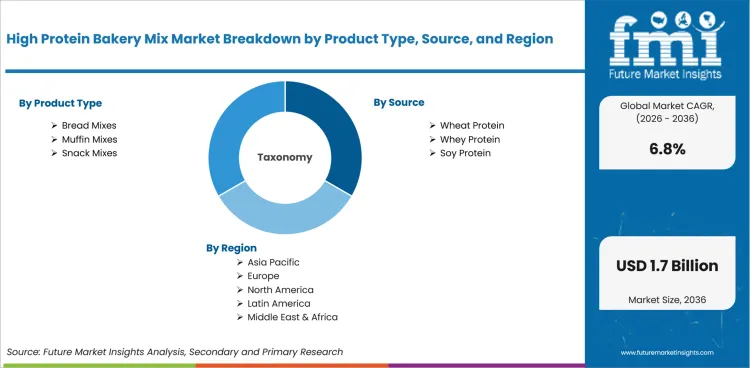
| Parameter | Details |
|---|---|
| Market size by 2036 | USD 1.74 billion |
| Growth rate | 6.8% CAGR from 2026 to 2036 |
| Forecast period | 2026 to 2036 |
| Base year value (2025) | USD 0.84 billion |
| By product type | Bread mixes, muffin mixes, snack mixes, pancake mixes, cookie mixes |
| By protein source | Wheat protein, whey protein, soy protein, pea protein, egg protein, mixed proteins |
| By protein level | 15 to 20 percent, 10 to 15 percent, above 20 percent, claim flexible |
| By end use | Commercial bakeries, food manufacturers, retail baking, foodservice kitchens, sports nutrition brands |
| By sales channel | Direct business sales, ingredient distributors, retail packs, online business ordering |
| By claim positioning | High protein, high fiber protein, gluten free protein, low sugar protein, plant based protein |
| Regions covered | North America, Latin America, Europe, East Asia, South Asia and Pacific, Middle East and Africa |
| Countries covered | South Korea, United States, Australia, Canada, United Kingdom, Germany, Japan |
| Key companies profiled | Archer-Daniels-Midland Company, Cargill Incorporated, Puratos Group, Bakels Group, Ardent Mills LLC, IREKS GmbH, Koninklijke Zeelandia Group B.V., Glanbia Nutritionals, Corbion N.V. |
| Approach | Bottom-up product-boundary approach using eligible SKU revenue, channel presence, retail pricing, product positioning, protein source depth, claim positioning, bakery mix format coverage, direct B2B access, and country-level adoption |
High Protein Bakery Mix Market by Segments
By Product Type
- Bread mixes
- Muffin mixes
- Snack mixes
- Pancake mixes
- Cookie mixes
By Protein Source
- Wheat protein
- Whey protein
- Soy protein
- Pea protein
- Egg protein
- Mixed proteins
By Protein Level
- 15 to 20 percent
- 10 to 15 percent
- Above 20 percent
- Claim flexible
By End Use
- Commercial bakeries
- Food manufacturers
- Retail baking
- Foodservice kitchens
- Sports nutrition brands
By Sales Channel
- Direct business sales
- Ingredient distributors
- Retail packs
- Online business ordering
By Claim Positioning
- High protein
- High fiber protein
- Gluten free protein
- Low sugar protein
- Plant based protein
By Region
- North America
- Latin America
- Europe
- East Asia
- South Asia and Pacific
- Middle East and Africa
Research Sources and Bibliography
- 1. International Food Information Council. (2024, June). 2024 Food & Health Survey. International Food Information Council.
- 2. Agriculture and Agri-Food Canada. (2025, July). Sector trend analysis: Plant-based protein food and drink trends in Canada. Government of Canada.
- 3. Australian Bureau of Statistics. (2025, March). Apparent Consumption of Selected Foodstuffs, Australia, 2023-24 financial year. Australian Bureau of Statistics.
- 4. United States Department of Agriculture Foreign Agricultural Service. (2026, April). Health functional food and supplements market brief for the Republic of Korea. United States Department of Agriculture.
- 5. Department for Environment, Food & Rural Affairs. (2024, December). United Kingdom Food Security Report 2024. Government of the United Kingdom.
- 6. Food Standards Agency. (2024, October). Alternative proteins consumer survey. Government of the United Kingdom.
- 7. Puratos Group. (2024, November). Puratos partners with Burcon to innovate with canola protein. Puratos Group.
- 8. Roquette Frères. (2024, February). NUTRALYS® Pea Protein Range Extansion. Roquette.
- 9. Roquette Frères. (2026, February). Launch of breakthrough clean-tasting pea protein isolate. Roquette.
- 10. Ardent Mills LLC. (2025, January). The 2025 and beyond flour trend guide. Ardent Mills.
- 11. Ardent Mills LLC. (2024, February). Nourish: Intention and impact. Ardent Mills.
- 12. Cargill Incorporated. (2025, May). Solutions for your bakery success. Cargill.
This Report Answers
- What is the 2026 value of the high protein bakery mix market across commercial and retail channels?
- How fast is the high protein bakery mix market expected to grow from 2026 to 2036?
- Which product type leads high protein bakery mix revenue in 2026 and why?
- Which protein source is most used in bakery premixes and what makes it suitable for bread?
- How do direct business sales shape supplier access in high protein bakery mixes?
- Which countries show faster adoption of protein-enriched bakery mixes through 2036?
- How do protein claims affect formulation, texture and buyer approval cycles?
- Which companies are best placed to serve bakery buyers with protein premix systems?
- What product formats are included and excluded in this market definition?
- How was the market size estimated from bakery mix and protein ingredient evidence?
Frequently Asked Questions
What is the global market demand for High Protein Bakery Mix Market in 2026?
In 2026, the global High Protein Bakery Mix Market is expected to be worth USD 0.90 billion through bakery and foodservice use.
What is the expected value of High Protein Bakery Mix Market by 2036?
By 2036, the market is projected to reach USD 1.74 billion as protein enrichment moves into bread, muffin and snack bases.
What is the CAGR for High Protein Bakery Mix Market?
The market is forecast to grow at 6.8% CAGR from 2026 to 2036 based on protein claim use and bakery mix penetration.
Which product type leads High Protein Bakery Mix Market?
Bread mixes lead with 38.4% share in 2026 since bread needs premix control to protect volume and crumb structure.
Which sales channel leads High Protein Bakery Mix Market?
Direct B2B Sales lead with 55.4% share in 2026 as commercial bakeries require technical support before repeat orders.
Which country is growing fastest in High Protein Bakery Mix Market?
South Korea is forecast to grow at 8.0% CAGR through 2036 due to functional food buying and convenience bakery testing.
What does High Protein Bakery Mix Market include?
The market includes protein-enriched premixes for bread, muffins, pancakes, snack cakes and similar baked goods sold to retail and business buyers.
How was the High Protein Bakery Mix Market forecast calculated?
The forecast used a bottom-up product-boundary model using eligible SKUs and channel availability with country adoption and supplier portfolio checks.
Preview the report firsthand - request a free sample
Get SampleGet the brochure for pricing and purchase details.
Get PDFTable of Content
- Executive Summary
- Global Market Outlook
- Demand to side Trends
- Supply to side Trends
- Technology Roadmap Analysis
- Analysis and Recommendations
- Market Overview
- Market Coverage / Taxonomy
- Market Definition / Scope / Limitations
- Research Methodology
- Chapter Orientation
- Analytical Lens and Working Hypotheses
- Market Structure, Signals, and Trend Drivers
- Benchmarking and Cross-market Comparability
- Market Sizing, Forecasting, and Opportunity Mapping
- Research Design and Evidence Framework
- Desk Research Programme (Secondary Evidence)
- Company Annual and Sustainability Reports
- Peer-reviewed Journals and Academic Literature
- Corporate Websites, Product Literature, and Technical Notes
- Earnings Decks and Investor Briefings
- Statutory Filings and Regulatory Disclosures
- Technical White Papers and Standards Notes
- Trade Journals, Industry Magazines, and Analyst Briefs
- Conference Proceedings, Webinars, and Seminar Materials
- Government Statistics Portals and Public Data Releases
- Press Releases and Reputable Media Coverage
- Specialist Newsletters and Curated Briefings
- Sector Databases and Reference Repositories
- FMI Internal Proprietary Databases and Historical Market Datasets
- Subscription Datasets and Paid Sources
- Social Channels, Communities, and Digital Listening Inputs
- Additional Desk Sources
- Expert Input and Fieldwork (Primary Evidence)
- Primary Modes
- Qualitative Interviews and Expert Elicitation
- Quantitative Surveys and Structured Data Capture
- Blended Approach
- Why Primary Evidence is Used
- Field Techniques
- Interviews
- Surveys
- Focus Groups
- Observational and In-context Research
- Social and Community Interactions
- Stakeholder Universe Engaged
- C-suite Leaders
- Board Members
- Presidents and Vice Presidents
- R&D and Innovation Heads
- Technical Specialists
- Domain Subject-matter Experts
- Scientists
- Physicians and Other Healthcare Professionals
- Governance, Ethics, and Data Stewardship
- Research Ethics
- Data Integrity and Handling
- Primary Modes
- Tooling, Models, and Reference Databases
- Desk Research Programme (Secondary Evidence)
- Data Engineering and Model Build
- Data Acquisition and Ingestion
- Cleaning, Normalisation, and Verification
- Synthesis, Triangulation, and Analysis
- Quality Assurance and Audit Trail
- Market Background
- Market Dynamics
- Drivers
- Restraints
- Opportunity
- Trends
- Scenario Forecast
- Demand in Optimistic Scenario
- Demand in Likely Scenario
- Demand in Conservative Scenario
- Opportunity Map Analysis
- Product Life Cycle Analysis
- Supply Chain Analysis
- Investment Feasibility Matrix
- Value Chain Analysis
- PESTLE and Porter’s Analysis
- Regulatory Landscape
- Regional Parent Market Outlook
- Production and Consumption Statistics
- Import and Export Statistics
- Market Dynamics
- Global Market Analysis 2021 to 2025 and Forecast, 2026 to 2036
- Historical Market Size Value (USD Million) Analysis, 2021 to 2025
- Current and Future Market Size Value (USD Million) Projections, 2026 to 2036
- Y to o to Y Growth Trend Analysis
- Absolute $ Opportunity Analysis
- Global Market Pricing Analysis 2021 to 2025 and Forecast 2026 to 2036
- Global Market Analysis 2021 to 2025 and Forecast 2026 to 2036, By Product Type
- Introduction / Key Findings
- Historical Market Size Value (USD Million) Analysis By Product Type , 2021 to 2025
- Current and Future Market Size Value (USD Million) Analysis and Forecast By Product Type , 2026 to 2036
- Bread Mixes
- Muffin Mixes
- Snack Mixes
- Bread Mixes
- Y to o to Y Growth Trend Analysis By Product Type , 2021 to 2025
- Absolute $ Opportunity Analysis By Product Type , 2026 to 2036
- Global Market Analysis 2021 to 2025 and Forecast 2026 to 2036, By Source
- Introduction / Key Findings
- Historical Market Size Value (USD Million) Analysis By Source, 2021 to 2025
- Current and Future Market Size Value (USD Million) Analysis and Forecast By Source, 2026 to 2036
- Wheat Protein
- Whey Protein
- Soy Protein
- Wheat Protein
- Y to o to Y Growth Trend Analysis By Source, 2021 to 2025
- Absolute $ Opportunity Analysis By Source, 2026 to 2036
- Global Market Analysis 2021 to 2025 and Forecast 2026 to 2036, By Protein Level
- Introduction / Key Findings
- Historical Market Size Value (USD Million) Analysis By Protein Level, 2021 to 2025
- Current and Future Market Size Value (USD Million) Analysis and Forecast By Protein Level, 2026 to 2036
- 15 to 20 %
- 10 to 15 %
- Above 20 %
- 15 to 20 %
- Y to o to Y Growth Trend Analysis By Protein Level, 2021 to 2025
- Absolute $ Opportunity Analysis By Protein Level, 2026 to 2036
- Global Market Analysis 2021 to 2025 and Forecast 2026 to 2036, By End Use
- Introduction / Key Findings
- Historical Market Size Value (USD Million) Analysis By End Use, 2021 to 2025
- Current and Future Market Size Value (USD Million) Analysis and Forecast By End Use, 2026 to 2036
- Commercial Bakeries
- Food Manufacturers
- Commercial Bakeries
- Y to o to Y Growth Trend Analysis By End Use, 2021 to 2025
- Absolute $ Opportunity Analysis By End Use, 2026 to 2036
- Global Market Analysis 2021 to 2025 and Forecast 2026 to 2036, By Sales Channel
- Introduction / Key Findings
- Historical Market Size Value (USD Million) Analysis By Sales Channel, 2021 to 2025
- Current and Future Market Size Value (USD Million) Analysis and Forecast By Sales Channel, 2026 to 2036
- Direct B2B Sales
- Ingredient Distributors
- Retail Packs
- Direct B2B Sales
- Y to o to Y Growth Trend Analysis By Sales Channel, 2021 to 2025
- Absolute $ Opportunity Analysis By Sales Channel, 2026 to 2036
- Global Market Analysis 2021 to 2025 and Forecast 2026 to 2036, By Claim Positioning
- Introduction / Key Findings
- Historical Market Size Value (USD Million) Analysis By Claim Positioning, 2021 to 2025
- Current and Future Market Size Value (USD Million) Analysis and Forecast By Claim Positioning, 2026 to 2036
- High Protein
- High Fiber Protein
- Gluten Free Protein
- High Protein
- Y to o to Y Growth Trend Analysis By Claim Positioning, 2021 to 2025
- Absolute $ Opportunity Analysis By Claim Positioning, 2026 to 2036
- Global Market Analysis 2021 to 2025 and Forecast 2026 to 2036, By Region
- Introduction
- Historical Market Size Value (USD Million) Analysis By Region, 2021 to 2025
- Current Market Size Value (USD Million) Analysis and Forecast By Region, 2026 to 2036
- North America
- Latin America
- Western Europe
- Eastern Europe
- East Asia
- South Asia and Pacific
- Middle East & Africa
- Market Attractiveness Analysis By Region
- North America Market Analysis 2021 to 2025 and Forecast 2026 to 2036, By Country
- Historical Market Size Value (USD Million) Trend Analysis By Market Taxonomy, 2021 to 2025
- Market Size Value (USD Million) Forecast By Market Taxonomy, 2026 to 2036
- By Country
- USA
- Canada
- Mexico
- By Product Type
- By Source
- By Protein Level
- By End Use
- By Sales Channel
- By Claim Positioning
- By Country
- Market Attractiveness Analysis
- By Country
- By Product Type
- By Source
- By Protein Level
- By End Use
- By Sales Channel
- By Claim Positioning
- Key Takeaways
- Latin America Market Analysis 2021 to 2025 and Forecast 2026 to 2036, By Country
- Historical Market Size Value (USD Million) Trend Analysis By Market Taxonomy, 2021 to 2025
- Market Size Value (USD Million) Forecast By Market Taxonomy, 2026 to 2036
- By Country
- Brazil
- Chile
- Rest of Latin America
- By Product Type
- By Source
- By Protein Level
- By End Use
- By Sales Channel
- By Claim Positioning
- By Country
- Market Attractiveness Analysis
- By Country
- By Product Type
- By Source
- By Protein Level
- By End Use
- By Sales Channel
- By Claim Positioning
- Key Takeaways
- Western Europe Market Analysis 2021 to 2025 and Forecast 2026 to 2036, By Country
- Historical Market Size Value (USD Million) Trend Analysis By Market Taxonomy, 2021 to 2025
- Market Size Value (USD Million) Forecast By Market Taxonomy, 2026 to 2036
- By Country
- Germany
- UK
- Italy
- Spain
- France
- Nordic
- BENELUX
- Rest of Western Europe
- By Product Type
- By Source
- By Protein Level
- By End Use
- By Sales Channel
- By Claim Positioning
- By Country
- Market Attractiveness Analysis
- By Country
- By Product Type
- By Source
- By Protein Level
- By End Use
- By Sales Channel
- By Claim Positioning
- Key Takeaways
- Eastern Europe Market Analysis 2021 to 2025 and Forecast 2026 to 2036, By Country
- Historical Market Size Value (USD Million) Trend Analysis By Market Taxonomy, 2021 to 2025
- Market Size Value (USD Million) Forecast By Market Taxonomy, 2026 to 2036
- By Country
- Russia
- Poland
- Hungary
- Balkan & Baltic
- Rest of Eastern Europe
- By Product Type
- By Source
- By Protein Level
- By End Use
- By Sales Channel
- By Claim Positioning
- By Country
- Market Attractiveness Analysis
- By Country
- By Product Type
- By Source
- By Protein Level
- By End Use
- By Sales Channel
- By Claim Positioning
- Key Takeaways
- East Asia Market Analysis 2021 to 2025 and Forecast 2026 to 2036, By Country
- Historical Market Size Value (USD Million) Trend Analysis By Market Taxonomy, 2021 to 2025
- Market Size Value (USD Million) Forecast By Market Taxonomy, 2026 to 2036
- By Country
- China
- Japan
- South Korea
- By Product Type
- By Source
- By Protein Level
- By End Use
- By Sales Channel
- By Claim Positioning
- By Country
- Market Attractiveness Analysis
- By Country
- By Product Type
- By Source
- By Protein Level
- By End Use
- By Sales Channel
- By Claim Positioning
- Key Takeaways
- South Asia and Pacific Market Analysis 2021 to 2025 and Forecast 2026 to 2036, By Country
- Historical Market Size Value (USD Million) Trend Analysis By Market Taxonomy, 2021 to 2025
- Market Size Value (USD Million) Forecast By Market Taxonomy, 2026 to 2036
- By Country
- India
- ASEAN
- Australia & New Zealand
- Rest of South Asia and Pacific
- By Product Type
- By Source
- By Protein Level
- By End Use
- By Sales Channel
- By Claim Positioning
- By Country
- Market Attractiveness Analysis
- By Country
- By Product Type
- By Source
- By Protein Level
- By End Use
- By Sales Channel
- By Claim Positioning
- Key Takeaways
- Middle East & Africa Market Analysis 2021 to 2025 and Forecast 2026 to 2036, By Country
- Historical Market Size Value (USD Million) Trend Analysis By Market Taxonomy, 2021 to 2025
- Market Size Value (USD Million) Forecast By Market Taxonomy, 2026 to 2036
- By Country
- Kingdom of Saudi Arabia
- Other GCC Countries
- Turkiye
- South Africa
- Other African Union
- Rest of Middle East & Africa
- By Product Type
- By Source
- By Protein Level
- By End Use
- By Sales Channel
- By Claim Positioning
- By Country
- Market Attractiveness Analysis
- By Country
- By Product Type
- By Source
- By Protein Level
- By End Use
- By Sales Channel
- By Claim Positioning
- Key Takeaways
- Key Countries Market Analysis
- USA
- Pricing Analysis
- Market Share Analysis, 2025
- By Product Type
- By Source
- By Protein Level
- By End Use
- By Sales Channel
- By Claim Positioning
- Canada
- Pricing Analysis
- Market Share Analysis, 2025
- By Product Type
- By Source
- By Protein Level
- By End Use
- By Sales Channel
- By Claim Positioning
- Mexico
- Pricing Analysis
- Market Share Analysis, 2025
- By Product Type
- By Source
- By Protein Level
- By End Use
- By Sales Channel
- By Claim Positioning
- Brazil
- Pricing Analysis
- Market Share Analysis, 2025
- By Product Type
- By Source
- By Protein Level
- By End Use
- By Sales Channel
- By Claim Positioning
- Chile
- Pricing Analysis
- Market Share Analysis, 2025
- By Product Type
- By Source
- By Protein Level
- By End Use
- By Sales Channel
- By Claim Positioning
- Germany
- Pricing Analysis
- Market Share Analysis, 2025
- By Product Type
- By Source
- By Protein Level
- By End Use
- By Sales Channel
- By Claim Positioning
- UK
- Pricing Analysis
- Market Share Analysis, 2025
- By Product Type
- By Source
- By Protein Level
- By End Use
- By Sales Channel
- By Claim Positioning
- Italy
- Pricing Analysis
- Market Share Analysis, 2025
- By Product Type
- By Source
- By Protein Level
- By End Use
- By Sales Channel
- By Claim Positioning
- Spain
- Pricing Analysis
- Market Share Analysis, 2025
- By Product Type
- By Source
- By Protein Level
- By End Use
- By Sales Channel
- By Claim Positioning
- France
- Pricing Analysis
- Market Share Analysis, 2025
- By Product Type
- By Source
- By Protein Level
- By End Use
- By Sales Channel
- By Claim Positioning
- India
- Pricing Analysis
- Market Share Analysis, 2025
- By Product Type
- By Source
- By Protein Level
- By End Use
- By Sales Channel
- By Claim Positioning
- ASEAN
- Pricing Analysis
- Market Share Analysis, 2025
- By Product Type
- By Source
- By Protein Level
- By End Use
- By Sales Channel
- By Claim Positioning
- Australia & New Zealand
- Pricing Analysis
- Market Share Analysis, 2025
- By Product Type
- By Source
- By Protein Level
- By End Use
- By Sales Channel
- By Claim Positioning
- China
- Pricing Analysis
- Market Share Analysis, 2025
- By Product Type
- By Source
- By Protein Level
- By End Use
- By Sales Channel
- By Claim Positioning
- Japan
- Pricing Analysis
- Market Share Analysis, 2025
- By Product Type
- By Source
- By Protein Level
- By End Use
- By Sales Channel
- By Claim Positioning
- South Korea
- Pricing Analysis
- Market Share Analysis, 2025
- By Product Type
- By Source
- By Protein Level
- By End Use
- By Sales Channel
- By Claim Positioning
- Russia
- Pricing Analysis
- Market Share Analysis, 2025
- By Product Type
- By Source
- By Protein Level
- By End Use
- By Sales Channel
- By Claim Positioning
- Poland
- Pricing Analysis
- Market Share Analysis, 2025
- By Product Type
- By Source
- By Protein Level
- By End Use
- By Sales Channel
- By Claim Positioning
- Hungary
- Pricing Analysis
- Market Share Analysis, 2025
- By Product Type
- By Source
- By Protein Level
- By End Use
- By Sales Channel
- By Claim Positioning
- Kingdom of Saudi Arabia
- Pricing Analysis
- Market Share Analysis, 2025
- By Product Type
- By Source
- By Protein Level
- By End Use
- By Sales Channel
- By Claim Positioning
- Turkiye
- Pricing Analysis
- Market Share Analysis, 2025
- By Product Type
- By Source
- By Protein Level
- By End Use
- By Sales Channel
- By Claim Positioning
- South Africa
- Pricing Analysis
- Market Share Analysis, 2025
- By Product Type
- By Source
- By Protein Level
- By End Use
- By Sales Channel
- By Claim Positioning
- USA
- Market Structure Analysis
- Competition Dashboard
- Competition Benchmarking
- Market Share Analysis of Top Players
- By Regional
- By Product Type
- By Source
- By Protein Level
- By End Use
- By Sales Channel
- By Claim Positioning
- Competition Analysis
- Competition Deep Dive
- Archer-Daniels-Midland Company
- Overview
- Product Portfolio
- Profitability by Market Segments (Product/Age /Sales Channel/Region)
- Sales Footprint
- Strategy Overview
- Marketing Strategy
- Product Strategy
- Channel Strategy
- Cargill Incorporated
- Ardent Mills LLC
- Puratos Group
- Bakels Group
- IREKS GmbH
- Archer-Daniels-Midland Company
- Competition Deep Dive
- Assumptions & Acronyms Used


