

- Market Size (2026)
- USD 600.2 Mn
- Forecast (2036)
- USD 1864.1 Mn
- CAGR (2026 to 2036)
- 12.0%
How big is Protein Brownies Market in 2026?
USD 600.2 million in 2026 and USD 1864.1 million by 2036 at a 12.0% CAGR.
Demand for protein brownies is projected to expand at a 12.0% CAGR between 2026 and 2036, increasing valuation from USD 600.2 million to USD 1864.1 million. Consumer interest in higher-protein foods continues to extend beyond traditional sports-nutrition products into mainstream snack categories. IFIC found in July 2025 that one in three USA adults increased protein intake, while taste and price remained primary purchase considerations. The finding supports demand for protein-enriched snacks that fit everyday eating occasions.
German Nutri-Score participation shows how nutrition communication affects commercial recipe work before shelf placement. BMLEH counted about 960 companies covering roughly 1,420 registered brands by April 2025. The scale makes nutrient balance a practical packaging and formulation condition for protein brownies sold in Germany.

Key Takeaways of Protein Brownies Market
- Protein becomes a routine food-selection cue while familiar brownie taste keeps the product within mainstream snacking occasions.
- Based on product type, classic fudge is projected to account for 39.0% in 2026 because familiar texture lowers trial uncertainty.
- By claim - nature, conventional is estimated to hold 56.0% in 2026 as mainstream recipes preserve ingredient and pricing flexibility.
- Fresh is set to lead the format category with 35.0% share in 2026 due to the reason that shorter selling windows protect moisture and texture.
- Protein fortification can reduce moistness and raise ingredient cost, narrowing the formulation window for repeat purchase.
- Some of the key players in this market include Rich Products, Sara Lee Frozen Bakery, Dessert Holdings, Mademoiselle Desserts, Finsbury Food Group, Premier Foods, McKee Foods, J.M. Smucker's Hostess Brands, Bauli, and Dr. Oetker.
Analyst Perspective
"Protein brownies need credible protein delivery without losing the chocolate texture and price expected from mainstream brownies. Commercial value improves if format choice also protects shelf life and local label compliance."
- Nandini Roy Choudhury, Principal Consultant, Future Market Insights
How is the Protein Brownies Market segmented?
Product Type, Claim - Nature, Format, Packaging Format, Sales Channel and Region.
Product type distinguishes classic fudge through better-for-you variants while claim - nature separates conventional from clean-label, organic, gluten-free and high-protein - fortified products. Format distinguishes fresh, frozen, ambient packaged, chilled and par-baked - thaw-and-serve products while packaging format and sales channel capture portioning and route-to-customer differences.
Why does conventional hold the stated share within claim - nature?

Conventional recipes allow protein positioning without adding organic certification or narrow free-from rules that restrict ingredient choices. In November 2025 the American Bakers Association said more than 90% of participating member companies committed to removing certified FD&C colors by 2028. Mainstream formulas can absorb those changes without requiring a separate certified clean-label ingredients system.
- By claim - nature, conventional is estimated to hold 56.0% in 2026 driven by broader recipe flexibility and mainstream price expectations.
- Bakers can adjust colors or sweeteners while preserving familiar processing conditions and avoiding another certification layer for the finished brownie.
What makes classic fudge central to the product type category?
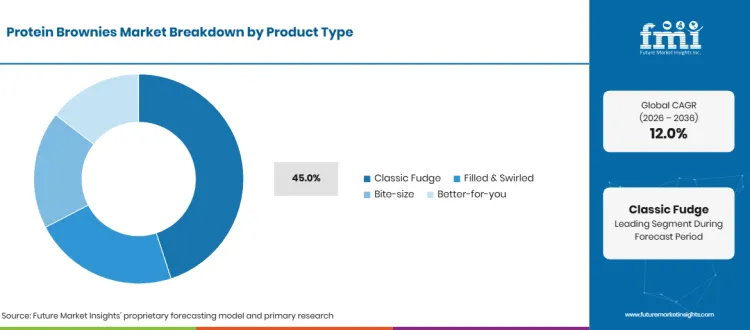
Classic fudge gives formulators a familiar sensory target for added protein without changing the expected brownie identity. The 2025 American Bakers Association playbook found 45% of Americans consume snack cakes or pies at least weekly. Familiar chocolate cues also reduce explanation compared with adjacent bakery products marketed as nutrition-positioned snacks.
- Based on product type, classic fudge is projected to account for 39.0% in 2026 attributable to recognizable chocolate cues that reduce trial uncertainty.
- Formulators can use cocoa intensity and moisture control to offset structural changes introduced by added protein in a familiar base.
How does fresh shape demand within the format category?
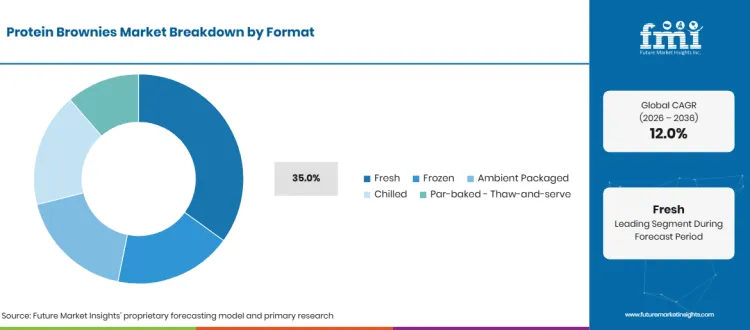
Fresh brownies suit bakery programs that replenish frequently enough to protect moisture before fortified texture becomes noticeably firmer. IDDBA material published in 2025 recorded a year-over-year dollar-sales increase for perimeter cakes, with Circana data showing the category reaching approximately USD 6.2 billion for the period. Bakery-counter demand remains commercially relevant even as frozen desserts provide longer distribution windows for national bakery programs.
- In 2026, fresh is expected to lead format with 35.0% share supported by shorter selling windows that protect brownie eating quality.
- Frequent replenishment gives operators more control over moisture loss before protein-induced firmness becomes apparent to repeat customers.
What supports multipack demand within the packaging format category?
Multipacks make serving count and household replenishment visible before purchase for shoppers comparing protein snacks by portion. Premier Foods moved Mr Kipling Whirls into four-pack formats with new flavours rolling out from April 2026, as part of a wider sweet-bakery expansion announced in May 2026. The packaging logic resembles nutritional bars because shoppers can compare portions and pack value.
- Multipack is likely to capture 36.0% share in 2026 owing to repeat snacking and predictable portioning within household purchase cycles.
- Retailers can compare price per serving against bars and conventional cakes without requiring separate bakery handling for every unit.
How do supermarkets and hypermarkets influence sales channel selection?
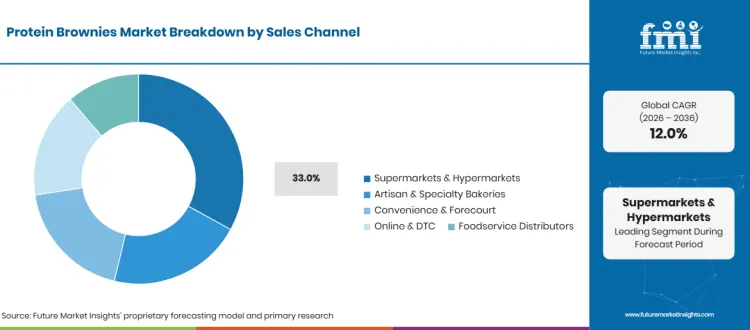
Supermarkets place protein brownies beside conventional cakes and nutrition-positioned snacks during one trip for direct price comparison. FMI - The Food Industry Association reported an average in-store supermarket transaction of USD 49.06 in 2025. The transaction value makes pack economics visible beside protein claims and gluten-free food options.
- The sales channel category is forecast to be led by supermarkets and hypermarkets at 33.0% share in 2026 because assortment comparison supports trial.
- Retail placement exposes protein brownies to existing snack shoppers while shelf velocity must justify space after the initial purchase.
What are the drivers, restraints and opportunities in the Protein Brownies Market?

Routine protein seeking supports demand, sensory and price trade-offs constrain repeat purchase, and balanced nutrition reformulation provides the clearest route to wider use.
- Driver: Protein has moved into ordinary eating occasions and gives familiar baked snacks an additional reason for consideration.
- Restraint: Added protein can weaken brownie texture while price pressure limits how much formulation cost can reach shoppers.
- Opportunity: Lower-sugar or better-balanced recipes can broaden the proposition without removing the indulgent cues that define brownies.
Protein now reaches ordinary snack formats instead of remaining limited to powders or bars. Dr. Oetker launched a refrigerated high-protein porridge in September 2025 with 30 grams of protein per pack. The launch places familiar foods beside established protein ingredients supply, but protein brownies still need conventional chocolate texture for repeat purchase.
Sensory performance and price can block repeat purchase even after a protein claim attracts initial attention. The 2025 IFIC Food & Health Survey found price influenced 71% of American food and beverage purchase decisions. Costly moisture or flavor corrections narrow the price window against conventional bakery ingredients alternatives.
Nutrition reformulation offers a commercial opening because consumers can seek moderation without abandoning dessert occasions. IFIC reported in December 2025 that 63% of Americans remained concerned about sugar intake. Portioning and lower-sugar recipes can preserve familiar chocolate cues while fitting broader functional foods positioning.
Which country CAGRs are covered in the Protein Brownies Market?

| Country | CAGR |
|---|---|
| United Arab Emirates | 13.5% |
| Saudi Arabia | 13.2% |
| South Korea | 12.8% |
| United States | 12.5% |
| United Kingdom | 12.2% |
| Germany | 11.9% |
| France | 11.6% |
| Japan | 11.3% |
How do country-level CAGRs compare in the Protein Brownies Market?
The 2.2-point spread separates a Gulf-led upper group from a slower France-Japan pair without measuring current market size. South Korea sits near the upper group while the United States through Germany form a compact middle band shaped by mature retail access and direct shelf-price comparison for packaged snacks.
- United Arab Emirates retailers give premium packaged bakery broad exposure through modern grocery and convenience networks.
- Saudi Arabia gives portioned desserts a sizable foodservice route through chain menus and delivery platforms.
- South Korea gives compact packaged snacks strong convenience-store exposure beside bars and ready-to-drink products.
- United States grocery breadth gives brownies several shelf routes while dense snack competition sharpens price comparison.
- United Kingdom retailers can balance packaged cakes with in-store bakery formats that depend on store traffic.
- German supermarkets expose protein brownies to direct value comparison beside conventional cakes and nutrition-positioned snacks.
- French retail gives portioned desserts room to differentiate through pack size and premium presentation cues.
- Japanese convenience and supermarket channels favor compact packaged formats suited to mature single-serve snacking occasions.
Comparable CAGRs produce different entry costs because local retail structure and formulation rules affect separate commercial tasks. The full report provides country-level CAGR analysis across North America, Latin America, Western Europe, Eastern Europe, East Asia, South Asia and Pacific, and the Middle East and Africa.
Country-wise Analysis
- Abu Dhabi retailers now use a front-of-pack nutrition grade that exposes the complete brownie formula during comparison. The United Arab Emirates protein brownies outlook is anticipated to advance at 13.5% CAGR over the assessment period with premium packaged snacking widening retailer interest. Abu Dhabi Quality and Conformity Council approved the Nutri-Mark guideline in March 2025 with an A-to-E grading system. Protein content alone cannot offset an unfavorable grade when sugar or saturated fat weakens the total nutrient profile. Brands targeting Abu Dhabi need reformulation scenarios before packaging approval and retailer presentations instead of treating Nutri-Mark as final artwork.
- Saudi Arabian foodservice operators increasingly need nutrition information that moves from manufacturer specifications into menus and digital ordering systems. The Saudi Food and Drug Authority announced three menu-labeling regulations in February 2025 that became effective on July 1. Saudi Arabia is estimated to post 13.2% CAGR over the forecast period as branded foodservice and packaged-snack demand expands. Local listings require Arabic-ready nutrient data that stays consistent between packaged products and the operator’s displayed menu information. Manufacturers with documented specifications can support chain accounts more efficiently while incomplete claim files delay onboarding and distributor changes during complex multi-site commercial launches.
- South Korean packaged-bakery companies are preparing for broader nutrition-label coverage and more detailed local-language information on finished packs. In South Korea, protein brownie demand is predicted to advance at 12.8% CAGR through 2036 with modern retail supporting frequent packaged-snack purchases. The Ministry of Food and Drug Safety finalized Food Labeling Standards Notice 2025-27 in April 2025 before expanded nutrition labeling took effect in January 2026. Importers must reconcile protein communication with Korean requirements before commercial inventory reaches retailer distribution centers. Launch teams with controlled pack specifications can reduce artwork rework during distributor onboarding and industrial bakery mixes production planning.
- United States retailers can position protein brownies beside ordinary snacks because familiar merchandising already exists. In January 2025 the FDA proposed a front-of-package Nutrition Info box for most packaged foods using low or medium or high nutrient designations. Protein brownie demand in the United States is forecast to rise at 12.5% CAGR over the forecast period as interest extends beyond specialist sports nutrition channels. The proposal would increase front-panel comparison if finalized and make the broader nutrient profile harder to separate from protein messaging. Brands need familiar texture and accessible pricing because nutrition interest does not remove conventional snack expectations.
- United Kingdom packaged-cake brands face advertising restrictions that change the economics of promoting indulgent products through paid online media. Protein brownie sales in the United Kingdom are forecast to expand at 12.2% CAGR by 2036 with supermarket scale sustaining familiar cake occasions. Department of Health and Social Care guidance updated in June 2025 places cakes within less-healthy-food advertising rules taking effect on January 5, 2026. Products caught by the criteria may lose promotional flexibility even when protein improves the nutrition message. Manufacturers can reduce exposure through recipe work and stronger in-store execution without assuming protein content changes the classification.
- German retailers can use voluntary Nutri-Score labeling beside taste and price during packaged-bakery assortment review. BMLEH confirmed in January 2025 that previously labeled products could use the old algorithm only until January 1, 2026. The German protein brownies sector is projected to record 11.9% CAGR during the assessment period because broad grocery distribution makes nutrition comparison easy. The revised calculation puts sugar and salt thresholds beside protein content during recipe review. Reformulation teams therefore need to test the complete brownie formula before committing final packaging artwork. Familiar chocolate texture and acceptable shelf pricing still determine whether stronger nutrition communication converts into repeat purchase.
- French grocery buyers now use a revised Nutri-Score presentation framework that changes packaged nutrition comparison during assortment review. Adoption of protein brownies in France is estimated to expand at 11.6% CAGR through 2036 as portioned indulgence gains a clearer nutrition story. A March 2025 French government order implemented updated Nutri-Score specifications from March 16 for packaged foods nationwide. Protein fortification does not automatically improve the total nutrient rating because sugar and saturated fat still remain part of the calculation. Brands entering France need to test protein claims beside portion size and the full score outcome before final artwork approval.
- Japanese packaged-food launches require local-language nutrition specifications that leave little room for informal translation of protein claims or ingredient details. The Consumer Affairs Agency published its fifth nutrition-labeling guideline edition in April 2025 for businesses handling packaged foods. Protein brownie demand in Japan is forecast to rise at 11.3% CAGR over the forecast period with compact snacking formats fitting mature convenience retail. Accurate nutrient and ingredient information must be settled before local distribution partners accept imported commercial inventory. Companies with Japan-specific artwork and specification control can avoid relabeling costs after production while protecting launch timing during national retail rollout.
Who are the notable companies in the Protein Brownies Market?
Rich Products, Sara Lee Frozen Bakery, Dessert Holdings, Mademoiselle Desserts, Finsbury Food Group, Premier Foods, McKee Foods, J.M. Smucker's Hostess Brands, Bauli, and Dr. Oetker are the notable companies serving this market.

Protein brownies draw competition from dessert manufacturers and sweet-baked groups already serving brownie or adjacent cake occasions. Rich Products and Sara Lee Frozen Bakery bring foodservice access while Dessert Holdings and Mademoiselle Desserts supply dessert scale. Entry depends on brownie capability beside nutrition reformulation and channel fit rather than corporate size.
- Frozen dessert platforms include Rich Products and Sara Lee Frozen Bakery beside Dessert Holdings and Mademoiselle Desserts.
- Retail bakery groups include Finsbury Food Group and Premier Foods through direct retailer-facing cake programs.
- Packaged sweet-baked platforms include McKee Foods and J.M. Smucker's Hostess Brands beside Bauli and Dr. Oetker in consumer distribution.
Competitive Benchmarking: Protein Brownies Market
| Company | Sweet-Bakery Platform Breadth | Nutrition-Positioned Innovation | Retail and Foodservice Coverage | Geographic Reach |
|---|---|---|---|---|
| Rich Products | High | Medium | High | Global |
| Sara Lee Frozen Bakery | Medium | Medium | High | North America |
| Dessert Holdings | High | High | High | North America |
| Mademoiselle Desserts | Medium | High | High | Europe and selected international markets |
| Finsbury Food Group | Medium | High | High | United Kingdom and Europe |
| Premier Foods | High | High | Medium | United Kingdom and selected international markets |
| McKee Foods | High | Medium | High | North America |
| J.M. Smucker's Hostess Brands | Medium | Medium | High | United States and Canada |
| Bauli | Medium | Medium | High | Europe and international markets |
| Dr. Oetker | Medium | High | High | Europe and international markets |
Key Developments in the Protein Brownies Market
- In August 2025, Finsbury Food Group acquired a majority stake in Lola’s Cupcakes and gained a direct-to-consumer platform with 45 kiosks and lockers.
- In June 2025, McKee Foods launched Little Debbie Big Pack Old Fashioned Donuts and extended its multi-pack snack offer for household purchase.
- In April 2025, Rich Products expanded its Funfetti partnership with a five-inch uniced cake layer for in-store bakery customization.
Key Players in the Protein Brownies Market
Frozen Dessert and Foodservice Bakery Platforms
- Rich Products
- Sara Lee Frozen Bakery
- Dessert Holdings
- Mademoiselle Desserts
Retail Cake and Specialty Bakery Platforms
- Finsbury Food Group
- Premier Foods
- Dr. Oetker
Packaged Sweet-Baked Snack Platforms
- McKee Foods
- J.M. Smucker's Hostess Brands
- Bauli
Protein Brownies Market - Report Scope
| Coverage field | Report scope |
|---|---|
| Market breakdown | By product type, claim - nature, format, packaging format, sales channel and region. |
| Quantitative Units | Revenue in USD million and CAGR in %. |
| Market Definition | Revenue from finished protein brownie products sold through retail and foodservice channels as fresh, frozen, ambient packaged, chilled, or par-baked - thaw-and-serve formats. |
| Regions Covered | North America, Latin America, Western Europe, Eastern Europe, East Asia, South Asia and Pacific, and Middle East and Africa. |
| Countries Covered | United Arab Emirates, Saudi Arabia, South Korea, United States, United Kingdom, Germany, France, Japan, and 20+ countries included in the full report. |
| Key Companies | Rich Products, Sara Lee Frozen Bakery, Dessert Holdings, Mademoiselle Desserts, Finsbury Food Group, Premier Foods, McKee Foods, J.M. Smucker's Hostess Brands, Bauli, Dr. Oetker. |
| Forecast Period | 2026 to 2036. |
| Approach | Primary and secondary research with market triangulation. |
Protein Brownies Market - Research Methodology
| Method | Approach |
|---|---|
| Primary Research | FMI analysts gathered input from manufacturers, service providers, technology developers, distributors, end users, procurement teams, and subject-matter experts. Interviews examined purchasing decisions, product or service evaluation, adoption barriers, approval requirements, pricing considerations, and expectations for technical or commercial support. Respondents were also asked what evidence is required before a trial, pilot, or initial order develops into regular purchasing. |
| Desk Research | Desk research covered government statistics, regulatory publications, trade data, industry associations, technical literature, standards, company filings, product information, and official corporate announcements. Sources were reviewed for relevance, publication date, geographic coverage, and consistency with the defined market scope. Claims relating to performance, applications, approvals, capacity, investment, and commercial activity were retained only when supported by credible public evidence. |
| Market Sizing and Forecasting | The market model combined the baseline value with historical performance, segment structure, pricing and volume indicators, adoption levels, company participation, and country-level demand conditions. Forecast assumptions considered economic activity, investment trends, regulatory developments, technology adoption, purchasing cycles, supply availability, and barriers to wider market use. Segment and regional estimates were reconciled before the final market total was calculated. |
| Data Validation | Estimates were checked against multiple independent indicators, including public data, company activity, trade patterns, industry developments, and findings from primary interviews. Validation also tested whether products, services, applications, and company revenues fell within the defined market boundaries. Adjacent categories, unsupported claims, overlapping revenues, and activities without direct market relevance were excluded to reduce double counting and maintain consistency across segments and countries. |
Protein Brownies Market by Segments
Protein Brownies Market segmented by Product Type:
- Classic fudge
- Filled & swirled
- Bite-size
- Better-for-you
Protein Brownies Market segmented by Claim - Nature:
- Conventional
- Clean label
- Organic
- Gluten-free
- High-protein - fortified
Protein Brownies Market segmented by Format:
- Fresh
- Frozen
- Ambient packaged
- Chilled
- Par-baked - thaw-and-serve
Protein Brownies Market segmented by Packaging Format:
- Multipack
- Single-serve
- Family - loaf pack
- Bulk foodservice
Protein Brownies Market segmented by Sales Channel:
- Supermarkets & hypermarkets
- Artisan & specialty bakeries
- Convenience & forecourt
- Online & DTC
- Foodservice distributors
Protein Brownies Market by Region:
- North America
- United States
- Canada
- Latin America
- Brazil
- Mexico
- Argentina
- Chile
- Western Europe
- Germany
- France
- United Kingdom
- Italy
- Spain
- Benelux
- Nordics
- Eastern Europe
- Poland
- Czech Republic
- Romania
- Hungary
- East Asia
- China
- Japan
- South Korea
- South Asia and Pacific
- India
- ASEAN
- Australia and New Zealand
- Middle East and Africa
- GCC Countries
- South Africa
- Türkiye
- Israel
Research Sources and Bibliography
- International Food Information Council. (2025, July 9). IFIC Spotlight Survey: Americans’ Perceptions of Protein
- Federal Ministry of Food and Agriculture, Germany. (2025, June 4). Hilfestellung für Unternehmen - Verwendung des Nutri-Score
- American Bakers Association. (2025). Consumer Trends: 2025 Bakery Playbook
- American Bakers Association. (2025, November 7). Baking Industry Unites Around National FD&C Colors Commitment
- International Dairy Deli Bakery Association. (2025, March). Through the Eyes of the Consumer: Trends that Matter in Retail Food
- Premier Foods. (2026, May 29). Mr Kipling unveils exceedingly good innovation
- FMI - The Food Industry Association. (2025). Food Industry Facts
- Dr. Oetker. (2025, August 12). High Protein Porridge aus dem Kühlregal
- International Food Information Council. (2026, January 13). 2025 IFIC Food & Health Survey: The Full Report
- International Food Information Council. (2025, December 4). Americans Scrutinize Sugar Consumption As Holiday Season Begins, New IFIC Research Finds
- USA Food and Drug Administration. (2025, January 14). FDA Proposes Requiring At-a-Glance Nutrition Information on the Front of Packaged Foods
- Federal Ministry of Food and Agriculture, Germany. (2025, January 29). Internationale Zusammenarbeit beim Nutri-Score
- Légifrance. (2025, March 15). Arrêté du 14 mars 2025 fixant la forme de présentation complémentaire à la déclaration nutritionnelle recommandée par l’Etat
- UK Department of Health and Social Care. (2025, June 4). Restricting advertising of less healthy food or drink on TV and online: products in scope
- Saudi Food and Drug Authority. (2025, February 27). The SFDA Issues Three New Regulations to Promote Healthy Community Nutrition
- Abu Dhabi Quality and Conformity Council. (2025, March 1). The Abu Dhabi Quality and Conformity Council Approves the Nutri-Mark Label Guideline
- Consumer Affairs Agency, Japan. (2025, April). Nutrition Labeling Guidelines for Businesses, Fifth Edition
- Ministry of Food and Drug Safety, Republic of Korea. (2025, April 21). Partial Amendment to the Food Labeling Standards, Notice No. 2025-27
- Finsbury Food Group. (2025, August 15). Finsbury Food Group Acquires Majority Stake in Lola’s
- McKee Foods Corporation. (2025, June 23). Little Debbie Snacks Introduces Big Pack Old Fashioned Donuts
- Rich Products Corporation. (2025, April 10). Rich Products, Funfetti extend partnership
- Dessert Holdings. (2025, May 30). Dessert Holdings Returns to IDDBA Ahead of 10-Year Anniversary
- Dr. Oetker. (2025, August 14). Noch mehr High Protein zum Shaken
- Rich Products Corporation. (2026, July 6). Rich Products Introduces Mini Cakes
- Finsbury Food Group. (2026, April 30). Finsbury Food Group Acquires Flower & White To Boost DTC And Healthy Snacking Growth
- Premier Foods. (2026, August 5). Mr Kipling expands its Signature home baking range
- McKee Foods Corporation. (2026, January 14). Little Debbie Ice Cream Sandwiches
- Rich Products Corporation. (2025, September 25). Running Back James Cook partners with Rich’s to launch ‘James Cookie’
- United States Patent and Trademark Office. (2025, March 4). PYBRIDS, Serial No. 99065876
- Dessert Holdings. (2025, July 14). Dessert Holdings Acquires Willamette Valley Pie Co.
- Mademoiselle Desserts. (2026, May 15). Introducing Our Newest Venture
- Finsbury Food Group. (2025, December 9). Finsbury Food Group Invests in Kara Foodservice Site to Drive Innovation and Growth
- Premier Foods. (2025, March 24). Mr Kipling Delicious & Light Chocolate Slices
- McKee Foods Corporation. (2025, March 3). Little Debbie Double Decker Chocolate Chip Creme Pies
- The J.M. Smucker Co.. (2025, February 27). Fiscal Year 2025 Third Quarter Earnings Prepared Remarks
- Bauli Group. (2025, May 15). Olivieri 1882 entra a far parte del Gruppo Bauli
- Dr. Oetker. (2025, March 27). Airfryer Backin: Backfreude mit der Heißluftfritteuse
- Bauli Group. (2026, January). Sustainable Goodness 2025
This bibliography is provided for reader reference and is not exhaustive. The full report contains the complete reference list and detailed citations.
This Report Answers
- How large is the protein brownies market in 2026 and 2036?
- Which consumer behavior supports mainstream protein brownie demand?
- Why does classic fudge account for 39.0% of product type demand?
- How does conventional positioning affect formulation flexibility?
- Why does fresh account for 35.0% of format demand?
- How do the eight country CAGRs compare?
- Which companies participate in the protein brownies market?
- Which product and channel frictions can weaken repeat purchase?
Frequently Asked Questions
How big is the Protein Brownies Market in 2026?
The protein brownies market is valued at USD 600.2 million in 2026 and is projected to reach USD 1864.1 million by 2036. Mainstream protein interest supports trial while familiar taste and acceptable pricing determine repeat purchase.
What is the CAGR of the Protein Brownies Market from 2026 to 2036?
The protein brownies market is projected to grow at a CAGR of 12.0% between 2026 and 2036. Expansion depends on manufacturers protecting brownie texture while keeping protein communication clear in mainstream retail and foodservice channels.
Which product type leads the Protein Brownies Market?
The classic fudge segment is expected to hold 39.0% of the protein brownies market in 2026 because familiar chocolate texture lowers trial uncertainty. Manufacturers can adjust moisture and cocoa intensity to preserve the familiar sensory benchmark after adding protein.
Which claim - nature segment holds the stated current share in the Protein Brownies Market?
The conventional segment is estimated to hold 56.0% in 2026 because mainstream formulas preserve broader ingredient flexibility within protein brownies. Manufacturers can manage protein and sweetness without adding separate certification requirements that narrow mainstream recipe flexibility.
Which companies are active in the Protein Brownies Market?
Key companies in the protein brownies market include Rich Products, Sara Lee Frozen Bakery, Dessert Holdings, Mademoiselle Desserts, Finsbury Food Group, Premier Foods, McKee Foods, J.M. Smucker's Hostess Brands, Bauli, and Dr. Oetker. Their positions differ by bakery platform and channel coverage between retail bakery and packaged sweet-snack distribution.
Preview the report firsthand - request a free sample
Get SampleGet the brochure for pricing and purchase details.
Get PDFTable of Content
- Key Takeaways
- Market Size and CAGR
- Top Growth Driver
- Fastest Growing Segment
- Leading Region
- Key Companies
- Emerging Opportunities
- Executive Summary
- Global Market Outlook
- Demand-side Trends
- Supply-side Trends
- Technology Roadmap Analysis
- Analysis and Recommendations
- Analyst Perspective (What is happening? Why now? What should investors know?)
- Key Questions Answered
- How large is the market?
- What is the CAGR?
- What are key trends?
- Which region dominates?
- Who are the leaders?
- Market Overview
- Market Coverage / Taxonomy
- Market Definition / Scope / Limitations
- Research Methodology
- Chapter Orientation
- Analytical Lens and Working Hypotheses
- Market Structure, Signals, and Trend Drivers
- Benchmarking and Cross-market Comparability
- Market Sizing, Forecasting, and Opportunity Mapping
- Research Design and Evidence Framework
- Desk Research Programme (Secondary Evidence)
- Expert Input and Fieldwork (Primary Evidence)
- Tooling, Models, and Reference Databases
- Data Engineering and Model Build
- Quality Assurance and Audit Trail
- Market Background
- Market Dynamics (Drivers, Restraints, Opportunity, Trends)
- Scenario Forecast (Optimistic, Likely, Conservative)
- Impact Analysis
- AI Impact
- Sustainability Impact
- Regulatory Impact
- Technology Impact
- Consumer / Buyer Analysis
- Purchase Drivers
- Adoption Barriers
- Buyer Journey
- Opportunity Map Analysis
- Product Life Cycle Analysis
- Supply Chain Analysis
- Investment Feasibility Matrix
- Value Chain Analysis
- PESTLE and Porter's Analysis
- Regulatory Landscape
- Regional Parent Market Outlook
- Production and Consumption Statistics
- Import and Export Statistics
- Global Market Analysis and Forecast, 2021 to 2036
- Historical Market Size Value (USD Million) Analysis, 2021 to 2025
- Current and Future Market Size Value (USD Million) Projections, 2026 to 2036
- Y-o-Y Growth Trend Analysis
- Absolute $ Opportunity Analysis
- Global Market Pricing Analysis, 2021 to 2036
- Global Market Analysis and Forecast, By Product Type, 2021 to 2036
- Introduction / Key Findings
- Historical Market Size Value (USD Million) Analysis By Product Type, 2021 to 2025
- Current and Future Market Size Value (USD Million) Analysis and Forecast By Product Type, 2026 to 2036
- Classic fudge
- Filled & swirled
- Bite-size
- Better-for-you
- Classic fudge
- Y-o-Y Growth Trend Analysis By Product Type, 2021 to 2025
- Absolute $ Opportunity Analysis By Product Type, 2026 to 2036
- Global Market Analysis and Forecast, By Claim / Nature, 2021 to 2036
- Introduction / Key Findings
- Historical Market Size Value (USD Million) Analysis By Claim / Nature, 2021 to 2025
- Current and Future Market Size Value (USD Million) Analysis and Forecast By Claim / Nature, 2026 to 2036
- Conventional
- Clean label
- Organic
- Gluten-free
- High-protein / fortified
- Conventional
- Y-o-Y Growth Trend Analysis By Claim / Nature, 2021 to 2025
- Absolute $ Opportunity Analysis By Claim / Nature, 2026 to 2036
- Global Market Analysis and Forecast, By Format, 2021 to 2036
- Introduction / Key Findings
- Historical Market Size Value (USD Million) Analysis By Format, 2021 to 2025
- Current and Future Market Size Value (USD Million) Analysis and Forecast By Format, 2026 to 2036
- Fresh
- Frozen
- Ambient packaged
- Chilled
- Par-baked / thaw-and-serve
- Fresh
- Y-o-Y Growth Trend Analysis By Format, 2021 to 2025
- Absolute $ Opportunity Analysis By Format, 2026 to 2036
- Global Market Analysis and Forecast, By Packaging Format, 2021 to 2036
- Introduction / Key Findings
- Historical Market Size Value (USD Million) Analysis By Packaging Format, 2021 to 2025
- Current and Future Market Size Value (USD Million) Analysis and Forecast By Packaging Format, 2026 to 2036
- Multipack
- Single-serve
- Family / loaf pack
- Bulk foodservice
- Multipack
- Y-o-Y Growth Trend Analysis By Packaging Format, 2021 to 2025
- Absolute $ Opportunity Analysis By Packaging Format, 2026 to 2036
- Global Market Analysis and Forecast, By Sales Channel, 2021 to 2036
- Introduction / Key Findings
- Historical Market Size Value (USD Million) Analysis By Sales Channel, 2021 to 2025
- Current and Future Market Size Value (USD Million) Analysis and Forecast By Sales Channel, 2026 to 2036
- Supermarkets & hypermarkets
- Artisan & specialty bakeries
- Convenience & forecourt
- Online & DTC
- Foodservice distributors
- Supermarkets & hypermarkets
- Y-o-Y Growth Trend Analysis By Sales Channel, 2021 to 2025
- Absolute $ Opportunity Analysis By Sales Channel, 2026 to 2036
- Global Market Analysis and Forecast, By Region, 2021 to 2036
- Introduction
- Historical Market Size Value (USD Million) Analysis By Region, 2021 to 2025
- Current Market Size Value (USD Million) Analysis and Forecast By Region, 2026 to 2036
- North America
- Latin America
- Western Europe
- Eastern Europe
- East Asia
- South Asia and Pacific
- Middle East & Africa
- Market Attractiveness Analysis By Region
- North America Market Analysis and Forecast, By Country, 2021 to 2036
- Historical Market Size Value (USD Million) Trend Analysis By Market Taxonomy, 2021 to 2025
- Market Size Value (USD Million) Forecast By Market Taxonomy, 2026 to 2036
- By Country
- USA
- Canada
- By Product Type
- By Claim / Nature
- By Format
- By Packaging Format
- By Sales Channel
- By Country
- Market Attractiveness Analysis
- By Country
- By Product Type
- By Claim / Nature
- By Format
- By Packaging Format
- By Sales Channel
- Key Takeaways
- Latin America Market Analysis and Forecast, By Country
- Historical Market Size Value (USD Million) Trend Analysis By Market Taxonomy, 2021 to 2025
- Market Size Value (USD Million) Forecast By Market Taxonomy, 2026 to 2036
- By Country
- Brazil
- Mexico
- Chile
- Rest of Latin America
- By Product Type
- By Claim / Nature
- By Format
- By Packaging Format
- By Sales Channel
- By Country
- Market Attractiveness Analysis
- By Country
- By Product Type
- By Claim / Nature
- By Format
- By Packaging Format
- By Sales Channel
- Key Takeaways
- Western Europe Market Analysis and Forecast, By Country
- Historical Market Size Value (USD Million) Trend Analysis By Market Taxonomy, 2021 to 2025
- Market Size Value (USD Million) Forecast By Market Taxonomy, 2026 to 2036
- By Country
- Germany
- UK
- Italy
- Spain
- France
- Nordic
- BENELUX
- Rest of Western Europe
- By Product Type
- By Claim / Nature
- By Format
- By Packaging Format
- By Sales Channel
- By Country
- Market Attractiveness Analysis
- By Country
- By Product Type
- By Claim / Nature
- By Format
- By Packaging Format
- By Sales Channel
- Key Takeaways
- Eastern Europe Market Analysis and Forecast, By Country
- Historical Market Size Value (USD Million) Trend Analysis By Market Taxonomy, 2021 to 2025
- Market Size Value (USD Million) Forecast By Market Taxonomy, 2026 to 2036
- By Country
- Russia
- Poland
- Hungary
- Balkan & Baltic
- Rest of Eastern Europe
- By Product Type
- By Claim / Nature
- By Format
- By Packaging Format
- By Sales Channel
- By Country
- Market Attractiveness Analysis
- By Country
- By Product Type
- By Claim / Nature
- By Format
- By Packaging Format
- By Sales Channel
- Key Takeaways
- East Asia Market Analysis and Forecast, By Country
- Historical Market Size Value (USD Million) Trend Analysis By Market Taxonomy, 2021 to 2025
- Market Size Value (USD Million) Forecast By Market Taxonomy, 2026 to 2036
- By Country
- China
- Japan
- South Korea
- By Product Type
- By Claim / Nature
- By Format
- By Packaging Format
- By Sales Channel
- By Country
- Market Attractiveness Analysis
- By Country
- By Product Type
- By Claim / Nature
- By Format
- By Packaging Format
- By Sales Channel
- Key Takeaways
- South Asia and Pacific Market Analysis and Forecast, By Country
- Historical Market Size Value (USD Million) Trend Analysis By Market Taxonomy, 2021 to 2025
- Market Size Value (USD Million) Forecast By Market Taxonomy, 2026 to 2036
- By Country
- India
- ASEAN
- Australia & New Zealand
- Rest of South Asia and Pacific
- By Product Type
- By Claim / Nature
- By Format
- By Packaging Format
- By Sales Channel
- By Country
- Market Attractiveness Analysis
- By Country
- By Product Type
- By Claim / Nature
- By Format
- By Packaging Format
- By Sales Channel
- Key Takeaways
- Middle East & Africa Market Analysis and Forecast, By Country
- Historical Market Size Value (USD Million) Trend Analysis By Market Taxonomy, 2021 to 2025
- Market Size Value (USD Million) Forecast By Market Taxonomy, 2026 to 2036
- By Country
- Kingdom of Saudi Arabia
- Other GCC Countries
- Türkiye
- South Africa
- Other African Union
- Rest of Middle East & Africa
- By Product Type
- By Claim / Nature
- By Format
- By Packaging Format
- By Sales Channel
- By Country
- Market Attractiveness Analysis
- By Country
- By Product Type
- By Claim / Nature
- By Format
- By Packaging Format
- By Sales Channel
- Key Takeaways
- Key Countries Market Analysis
- USA
- Pricing Analysis
- Market Share Analysis, 2025
- By Product Type
- By Claim / Nature
- By Format
- By Packaging Format
- By Sales Channel
- Canada
- Pricing Analysis
- Market Share Analysis, 2025
- By Product Type
- By Claim / Nature
- By Format
- By Packaging Format
- By Sales Channel
- Mexico
- Pricing Analysis
- Market Share Analysis, 2025
- By Product Type
- By Claim / Nature
- By Format
- By Packaging Format
- By Sales Channel
- Brazil
- Pricing Analysis
- Market Share Analysis, 2025
- By Product Type
- By Claim / Nature
- By Format
- By Packaging Format
- By Sales Channel
- Chile
- Pricing Analysis
- Market Share Analysis, 2025
- By Product Type
- By Claim / Nature
- By Format
- By Packaging Format
- By Sales Channel
- Germany
- Pricing Analysis
- Market Share Analysis, 2025
- By Product Type
- By Claim / Nature
- By Format
- By Packaging Format
- By Sales Channel
- UK
- Pricing Analysis
- Market Share Analysis, 2025
- By Product Type
- By Claim / Nature
- By Format
- By Packaging Format
- By Sales Channel
- Italy
- Pricing Analysis
- Market Share Analysis, 2025
- By Product Type
- By Claim / Nature
- By Format
- By Packaging Format
- By Sales Channel
- Spain
- Pricing Analysis
- Market Share Analysis, 2025
- By Product Type
- By Claim / Nature
- By Format
- By Packaging Format
- By Sales Channel
- France
- Pricing Analysis
- Market Share Analysis, 2025
- By Product Type
- By Claim / Nature
- By Format
- By Packaging Format
- By Sales Channel
- India
- Pricing Analysis
- Market Share Analysis, 2025
- By Product Type
- By Claim / Nature
- By Format
- By Packaging Format
- By Sales Channel
- ASEAN
- Pricing Analysis
- Market Share Analysis, 2025
- By Product Type
- By Claim / Nature
- By Format
- By Packaging Format
- By Sales Channel
- Australia & New Zealand
- Pricing Analysis
- Market Share Analysis, 2025
- By Product Type
- By Claim / Nature
- By Format
- By Packaging Format
- By Sales Channel
- China
- Pricing Analysis
- Market Share Analysis, 2025
- By Product Type
- By Claim / Nature
- By Format
- By Packaging Format
- By Sales Channel
- Japan
- Pricing Analysis
- Market Share Analysis, 2025
- By Product Type
- By Claim / Nature
- By Format
- By Packaging Format
- By Sales Channel
- South Korea
- Pricing Analysis
- Market Share Analysis, 2025
- By Product Type
- By Claim / Nature
- By Format
- By Packaging Format
- By Sales Channel
- Russia
- Pricing Analysis
- Market Share Analysis, 2025
- By Product Type
- By Claim / Nature
- By Format
- By Packaging Format
- By Sales Channel
- Poland
- Pricing Analysis
- Market Share Analysis, 2025
- By Product Type
- By Claim / Nature
- By Format
- By Packaging Format
- By Sales Channel
- Hungary
- Pricing Analysis
- Market Share Analysis, 2025
- By Product Type
- By Claim / Nature
- By Format
- By Packaging Format
- By Sales Channel
- Kingdom of Saudi Arabia
- Pricing Analysis
- Market Share Analysis, 2025
- By Product Type
- By Claim / Nature
- By Format
- By Packaging Format
- By Sales Channel
- Türkiye
- Pricing Analysis
- Market Share Analysis, 2025
- By Product Type
- By Claim / Nature
- By Format
- By Packaging Format
- By Sales Channel
- South Africa
- Pricing Analysis
- Market Share Analysis, 2025
- By Product Type
- By Claim / Nature
- By Format
- By Packaging Format
- By Sales Channel
- USA
- Market Structure Analysis
- Competition Dashboard
- Competition Benchmarking
- Market Share Analysis of Top Players
- By Regional
- By Product Type
- By Claim / Nature
- By Format
- By Packaging Format
- By Sales Channel
- Emerging Startups
- Innovation Benchmarking
- Competition Analysis
- Competition Deep Dive
- Rich Products
- Overview
- Product Portfolio
- Profitability by Market Segments
- Sales Footprint
- Strategy Overview
- Marketing Strategy
- Product Strategy
- Channel Strategy
- Sara Lee Frozen Bakery
- Dessert Holdings
- Mademoiselle Desserts
- Finsbury Food Group
- Premier Foods
- McKee Foods
- Hostess Brands
- Bauli
- Dr. Oetker
- Rich Products
- Case Studies
- Success Stories
- Recent Developments
- Competition Deep Dive
- Assumptions & Acronyms Used


