

- Market Size (2026)
- USD 697.0 Mn
- Forecast (2036)
- USD 1634.9 Mn
- CAGR (2026 to 2036)
- 8.9%
How big is Protein Dips Market in 2026?
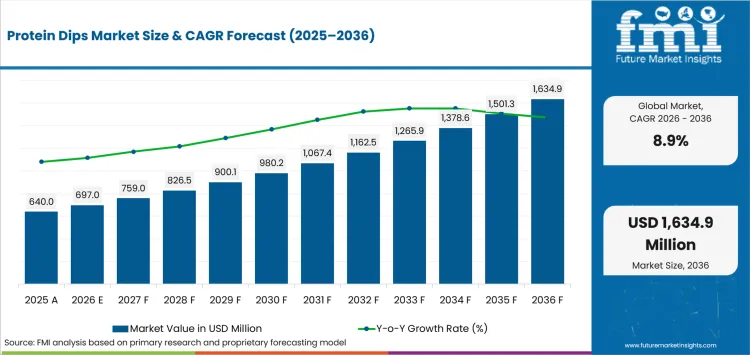
USD 697.0 million in 2026 and USD 1,634.9 million by 2036 at an 8.9% CAGR.
Demand for protein dips is projected to expand at 8.9% CAGR between 2026 and 2036, increasing from USD 697.0 million in 2026 to USD 1,634.9 million by 2036. The category places dairy or plant protein inside a chilled dip format already used with vegetables, crackers, sandwiches and meal components. Growth therefore depends on whether added nutrition value survives the taste, texture and price test during repeat purchase.
Nutrition guidance gives the category a supportive backdrop without removing formulation constraints. In January 2026, the USA Department of Health and Human Services and USDA released the 2025-2030 Dietary Guidelines for Americans with an emphasis on protein foods and nutrient-dense eating. For dip suppliers, that signal is commercially useful when protein is delivered through recognizable ingredients and a portion format that works in routine snacks or meals.
Key Takeaways of Protein Dips Market
- Protein dips expand by placing a visible nutrition benefit inside an established refrigerated eating occasion.
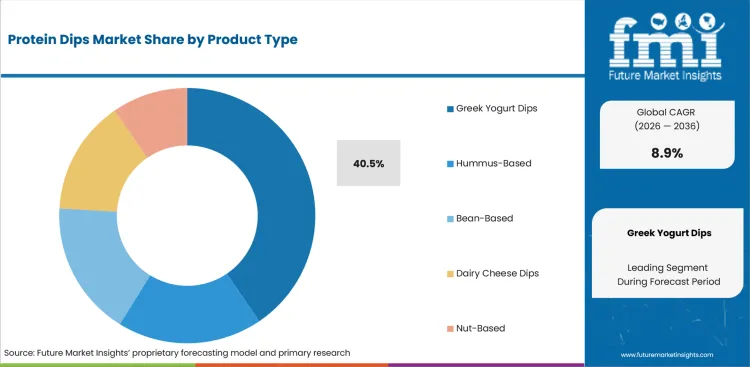
- Greek Yogurt Dips are projected at 40.5% of Product Type demand in 2026 as yogurt supports a creamy texture and a familiar dairy-protein base.
- Dairy is estimated at 26.7% of Protein Source demand in 2026 because yogurt and cheese work across several savory profiles.
- High-Protein is forecast at 30.3% of Claim demand in 2026 where serving-level nutrition can be communicated without changing the dip use case.
- Tubs account for 29.8% of Packaging demand in 2026, while Supermarkets & Hypermarkets represent 37.0% of Sales Channel demand.
- Taste changes from fortification, chilled shelf-life requirements and nutrition-profile rules can slow range expansion when product economics are weak.
- Good Foods, Sabra, Bolthouse Farms, Ithaca Hummus, Litehouse, Lantana Foods, Fresh Cravings, Cedar's Mediterranean Foods and Boar's Head serve relevant refrigerated dip or hummus routes.
Analyst Perspective
"Protein dips have a workable route to repeat purchase when the protein source improves the product story without making texture, portion economics or refrigerated handling harder. Retail teams should judge the full eating experience before treating protein grams as a stand-alone reason for shelf space."
- Nandini Roy Choudhury, Principal Consultant, Future Market Insights
How is the Protein Dips Market segmented?
The protein dips market is segmented by Product Type, Protein Source, Claim, Packaging, Sales Channel and Region.
Protein dips are segmented across the formulation, source, nutrition proposition, pack format and route to purchase. Product Type covers Greek Yogurt Dips, Hummus-Based, Bean-Based, Dairy Cheese Dips and Nut-Based formats. Protein Source includes Dairy, Chickpea & Legume, Nut & Seed, Pea Protein and Others. Claim includes High-Protein, Plant-Based, Low-Fat, Organic and Others. Packaging includes Tubs, Single-Serve Cups, Pouches, Multipacks and Others. Sales Channel includes Supermarkets & Hypermarkets, Online / DTC, Convenience Stores, Specialty & Health Stores and Others.
What supports Greek Yogurt Dips within the Product Type category?
Greek yogurt gives formulators a cultured dairy base that can carry herbs, vegetables and savory seasoning while keeping a recognizable protein cue. Its chilled use pattern also overlaps with the high-protein Greek yogurt category, which helps retailers place nutrition-oriented dairy products near familiar refrigerated foods rather than in a separate supplement occasion.
- Based on Product Type, Greek Yogurt Dips are projected to account for 40.5% in 2026 because yogurt combines creamy sensory performance with a familiar dairy-protein platform.
- Good Foods currently markets dairy dips that include Greek yogurt, while Litehouse sells refrigerated yogurt dressing and dip products. These product lines show how cultured dairy can support dip texture without changing the basic savory use case.
What supports Dairy within the Protein Source category?
Dairy works across yogurt, cheese and cultured bases that consumers already understand. It can add body and acidity while leaving room for vegetable, herb or spicy flavor systems. The wider yogurt market reinforces the commercial role of protein-led cultured dairy formats. Germany's DGE recommendations also retain daily milk and dairy while giving separate attention to legumes and nuts, which keeps dairy relevant alongside plant-based protein choices.
- Dairy is estimated at 26.7% of Protein Source demand in 2026 because yogurt and cheese provide a familiar protein source with broad compatibility across savory dip profiles.
- Bolthouse Farms states that it uses yogurt in creamy dressings and offers several products for use as dips. Litehouse also maintains refrigerated yogurt dressing and dip lines, supporting the commercial use of cultured dairy in adjacent dip occasions.
What supports High-Protein within the Claim category?
High-Protein gives shoppers a direct nutrition signal that can separate a protein dip from a conventional flavor-first product. The claim works when the serving size delivers a meaningful benefit and the product still tastes like a dip. That logic also connects with the broader protein snacks space, where nutrition value has to fit an established snacking occasion rather than replace it.
- High-Protein is forecast at 30.3% of Claim demand in 2026 because it communicates the category’s functional proposition directly at shelf.
- The 2025-2030 Dietary Guidelines for Americans emphasize protein foods within nutrient-dense eating patterns, giving manufacturers a current policy context for protein-forward positioning without implying that a nutrition claim can compensate for weak taste or portion value.
What supports Tubs within the Packaging category?
Tubs fit the repeated scooping and sharing pattern common to chilled dips. They also provide a broad front panel for flavor, protein, ingredient and certification information. The format handles dense yogurt and hummus textures without the dispensing limits of narrow openings and can support resealing after partial use. Similar packaging logic appears across the wider dips and spreads category, where shared and single-serve formats address different eating occasions.
- Tubs account for 29.8% of Packaging demand in 2026 because they fit shared refrigerated use, resealing and front-of-pack communication.
- Cedar's sells hummus in resealable tubs across its current range, while Boar's Head markets hummus and spreads in chilled packs. The format remains practical when brands need product protection and enough label area for flavor and nutrition information.
What supports Supermarkets & Hypermarkets within the Sales Channel category?
Supermarkets and hypermarkets combine refrigerated infrastructure with the shopper traffic needed for trial across produce, deli and snack-adjacent sets. Protein dips can be compared directly with conventional dips and spreads on flavor, price per serving and pack size. That shelf context makes distribution discipline important because chilled facings need steady rotation and dependable replenishment.
- Supermarkets & Hypermarkets account for 37.0% of Sales Channel demand in 2026 because chilled merchandising supports discovery, comparison and repeat purchase.
- Good Foods distributes refrigerated dips through grocery and club retail, while Lantana and Fresh Cravings maintain store-finder or retail availability for chilled hummus. The channel therefore remains central to physical trial and routine replenishment.
What are the drivers, restraints and opportunities in the Protein Dips Market?
Protein-forward eating supports familiar chilled snacking, while formulation and cold-chain constraints raise execution risk as portioned dairy and plant-based recipes create room for differentiated use occasions.
- Driver: Dairy and legume bases let brands add a recognizable protein benefit to a dip occasion consumers already understand.
- Restraint: Protein enrichment can alter texture or flavor, while refrigerated shelf life and nutrition-profile rules can narrow viable formulations.
- Opportunity: Single-serve packs and differentiated dairy or plant-protein recipes can address portable snacking and meal-component occasions.
The demand driver is familiarity. A dip does not require consumers to learn a new preparation routine, so brands can build a protein proposition around a known snack or meal component. USA dietary guidance published in January 2026 emphasizes protein foods and nutrient-dense choices, while current German guidance gives a role to both dairy and plant protein sources such as legumes and nuts. This creates more than one formulation path inside the same category.
Execution is more difficult than the nutrition message alone suggests. Protein ingredients can thicken a formula or introduce off-notes, while refrigerated products need shelf life that works for distribution and store rotation. In England, restrictions on location promotions for less healthy foods have applied since 2022 and volume-price restrictions took effect in October 2025. UK-wide advertising restrictions for less healthy food and drink took effect in January 2026, which gives overall nutrition profile greater commercial relevance for qualifying products.
The opportunity is to match a specific protein source and pack size with a defined eating occasion. Single-serve cups can serve lunch or portable snacks, while family tubs can support sharing. Plant-based variants can reach shoppers who prefer legumes, nuts or seeds, linking product development with the wider vegan dips category. The commercial test is whether the recipe delivers enough distinction to justify price and refrigerated space.
Which country CAGRs are covered in the Protein Dips Market?
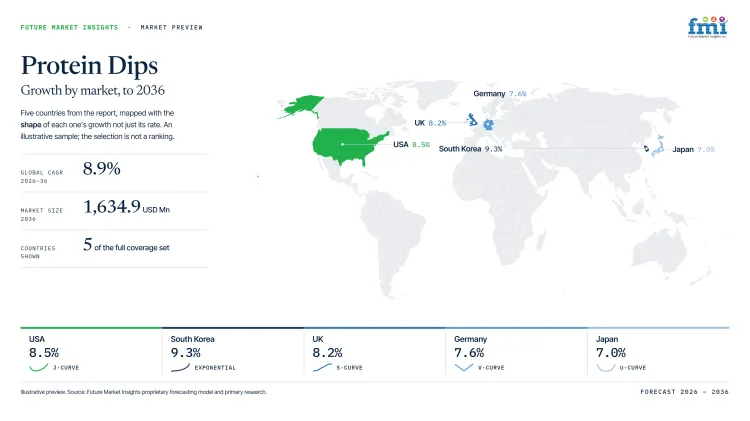
| Country | CAGR |
|---|---|
| USA | 8.5% |
| UK | 8.2% |
| Germany | 7.6% |
| Japan | 7.0% |
| South Korea | 9.3% |
How do country-level CAGRs compare in the Protein Dips Market?
The five country CAGRs span 2.3 percentage points, from 7.0% in Japan to 9.3% in South Korea during 2026-2036. The spread measures expected percentage expansion from each country’s own base and should not be read as a ranking of starting market size.
- USA is forecast at 8.5% CAGR, supported by established refrigerated merchandising and current policy emphasis on protein foods.
- UK is forecast at 8.2% CAGR, with promotion and advertising rules increasing the value of balanced nutrition profiles for qualifying products.
- Germany is forecast at 7.6% CAGR, where current dietary guidance gives visibility to legumes and nuts while retaining daily dairy.
- Japan is forecast at 7.0% CAGR, with packaging and nutrition communication shaped by Japanese labeling requirements and the national front-of-pack guideline process.
- South Korea is forecast at 9.3% CAGR, with convenient portions and clear nutrition labeling relevant to packaged-food adoption.
Comparable growth rates can still create different launch conditions. Refrigerated distribution, pack size, claim wording and retailer economics need to be assessed country by country. The full report covers North America, Latin America, Western Europe, Eastern Europe, East Asia, South Asia and Pacific, and the Middle East and Africa.
Country-wise Analysis
- USA is forecast to expand at 8.5% CAGR through 2036. The January 2026 Dietary Guidelines for Americans emphasize protein foods and nutrient-dense choices, giving brands a current policy context for dairy, legume, nut and seed formulations. Retail conversion still depends on taste and shelf life, because chilled dips compete for space against conventional dips, spreads and snack solutions.
- UK demand is forecast to expand at 8.2% CAGR through 2036. England restricts prominent placement and volume-price promotions for qualifying less healthy foods, and UK-wide advertising restrictions took effect in January 2026. Protein-dip brands therefore benefit from formulations that communicate nutrition value without creating a profile that restricts promotional flexibility.
- Germany is forecast at 7.6% CAGR during 2026-2036. DGE guidance published in 2024 places separate emphasis on legumes and nuts while retaining daily milk and dairy, giving both plant and dairy protein bases a familiar nutrition context. Suppliers can use that dual pathway to localize flavor and formulation without treating one protein source as the only route into the category.
- Japan is forecast at 7.0% CAGR through 2036. Japan’s Consumer Affairs Agency opened consultation on a Japanese front-of-pack nutrition labeling guideline in September 2025 and published consultation results in February 2026. The initiative covers core nutrition information including protein, so compact pack design needs to balance flavor communication with clear nutrition information for the local retail environment.
- South Korea combines a 9.3% CAGR forecast with a packaged-food labeling system that includes protein among mandatory nutrients for covered processed foods. MFDS guidance lists protein within nutrition labeling, while KDCA published updated national energy-intake trends in October 2025. For protein-dip suppliers, the commercial task is to convert nutrition awareness into a repeatable chilled-snack occasion through convenient portions and locally suitable flavors.
Who are the notable companies in the Protein Dips Market?
Good Foods, Sabra, Bolthouse Farms, Ithaca Hummus, Litehouse, Lantana Foods, Fresh Cravings, Cedar's Mediterranean Foods and Boar's Head are notable companies serving relevant protein-dip, hummus or refrigerated dip routes.
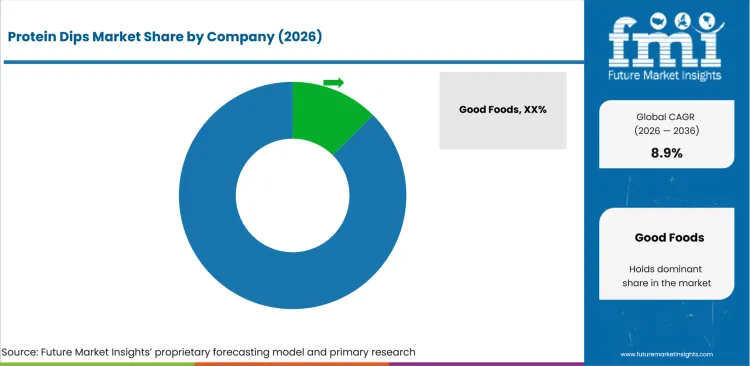
Competition spans refrigerated dairy dips, hummus specialists and brands with broad deli or grocery access. Companies differentiate through protein source, pack architecture and channel reach. Dairy and yogurt-based products compete on texture and flavor, while hummus and plant-oriented lines compete through ingredient profiles, portion formats and refrigerated availability.
- Good Foods, Bolthouse Farms and Litehouse serve dairy or yogurt-based refrigerated dip occasions through active product lines.
- Ithaca Hummus, Lantana Foods and Fresh Cravings focus on refrigerated hummus or plant-oriented dips with current retail availability.
- Sabra, Cedar's Mediterranean Foods and Boar's Head serve hummus or Mediterranean dip occasions through established grocery or deli channels.
Competitive Benchmarking: Protein Dips Market
| Company | Protein-relevant base | Pack architecture | Ingredient / claim differentiation | Geographic reach |
|---|---|---|---|---|
| Good Foods | High | High | High | United States grocery and club retail |
| Sabra | High | High | Medium | United States and Canada |
| Bolthouse Farms | Medium | Medium | Medium | United States and Canada |
| Ithaca Hummus | High | Medium | High | United States retail |
| Litehouse | Medium | High | Medium | United States and Canada |
| Lantana Foods | High | Medium | High | United States retail |
| Fresh Cravings | High | High | High | United States refrigerated retail |
| Cedar's Mediterranean Foods | High | High | High | United States retail |
| Boar's Head | High | Medium | Medium | United States deli and retail network |
Scoring basis: Protein-relevant base is High when a portfolio directly includes hummus, yogurt dips or another protein-rich dip base; Medium covers adjacent yogurt dressing-and-dip products or a narrower qualifying set. Pack architecture is High when several chilled pack or portion formats are available and Medium when the range is narrower. Ingredient / claim differentiation is High when products use distinct base ingredients, organic or plant-based positioning, or differentiated recipes; Medium reflects a more conventional assortment. Geographic reach reflects active retail markets and does not represent each company's complete corporate footprint.
Key Developments in the Protein Dips Market
- In June 2026, Good Foods expanded its dairy dip assortment with chef-created dip and spread recipes developed around current flavor trends.
- In February 2026, PepsiCo said it was testing mini-meal solutions with Sabra for quick, portioned eating occasions and planned further innovation around the brand.
- In March 2025, Cedar's Foods introduced Cedar's Reserve Hommus in six flavors using olive and avocado oils, additional tahini and Mediterranean-style toppings.
Key Players in the Protein Dips Market
Refrigerated Dairy and Fresh-Dip Platforms
- Good Foods
- Bolthouse Farms
- Litehouse
Hummus and Plant-Protein Specialists
- Ithaca Hummus
- Lantana Foods
- Fresh Cravings
Mediterranean and Deli Distribution Brands
- Sabra
- Cedar's Mediterranean Foods
- Boar's Head
Protein Dips Market - Report Scope
| Coverage field | Report scope |
|---|---|
| Market breakdown | By Product Type, Protein Source, Claim, Packaging, Sales Channel and Region. |
| Quantitative Units | USD million. |
| Market Definition | Ready-to-eat chilled dips or spreads whose formulation or positioning centers on a protein-rich ingredient or a protein-forward nutrition proposition. The market includes qualifying dairy, hummus, bean, nut and other protein-based dip formats sold through the defined channels. |
| Regions Covered | North America, Latin America, Western Europe, Eastern Europe, East Asia, South Asia and Pacific, and Middle East and Africa. |
| Countries Covered | USA, UK, Germany, Japan, South Korea, and additional countries included in the full report. |
| Notable Companies | Good Foods, Sabra, Bolthouse Farms, Ithaca Hummus, Litehouse, Lantana Foods, Fresh Cravings, Cedar's Mediterranean Foods, Boar's Head. |
| Forecast Period | 2026 to 2036. |
| Approach | Primary and secondary research with market triangulation. |
Protein Dips Market - Research Methodology
| Method | Approach |
|---|---|
| Primary Research | FMI analysts gathered input from manufacturers, distributors, retail category buyers, foodservice buyers, procurement teams and subject-matter experts. Interviews covered purchasing decisions, formulation requirements, shelf-life expectations, price architecture and channel conditions across chilled dip applications. |
| Desk Research | Desk research used government nutrition and labeling guidance, regulatory publications, company filings, product pages, company announcements and relevant technical literature. The material supported analysis of nutrition claims, packaging, cold-chain conditions and commercial availability across the defined market. |
| Market Sizing and Forecasting | The market model combined the baseline value with historical performance, segment structure, pricing and volume indicators, product availability, company participation and country-level demand conditions. Forecast assumptions considered dietary trends, retail conditions, packaging economics, cold-chain requirements and barriers to wider use. |
| Data Validation | Market values were reconciled with public policy indicators, company activity, product availability and primary interview findings. Sauces, dressings, prepared meals and protein beverages remain outside the protein-dips category unless they are sold directly as qualifying dips. |
Protein Dips Market by Segments
Protein Dips Market segmented by Product Type:
- Greek Yogurt Dips
- Hummus-Based
- Bean-Based
- Dairy Cheese Dips
- Nut-Based
Protein Dips Market segmented by Protein Source:
- Dairy
- Chickpea & Legume
- Nut & Seed
- Pea Protein
- Others
Protein Dips Market segmented by Claim:
- High-Protein
- Plant-Based
- Low-Fat
- Organic
- Others
Protein Dips Market segmented by Packaging:
- Tubs
- Single-Serve Cups
- Pouches
- Multipacks
- Others
Protein Dips Market segmented by Sales Channel:
- Supermarkets & Hypermarkets
- Online / DTC
- Convenience Stores
- Specialty & Health Stores
- Others
Protein Dips Market by Region:
- North America
- United States
- Canada
- Latin America
- Brazil
- Mexico
- Argentina
- Chile
- Western Europe
- Germany
- France
- United Kingdom
- Italy
- Spain
- Benelux
- Nordics
- Eastern Europe
- Poland
- Czech Republic
- Romania
- Hungary
- East Asia
- China
- Japan
- South Korea
- South Asia and Pacific
- India
- ASEAN
- Australia and New Zealand
- Middle East and Africa
- GCC Countries
- South Africa
- Türkiye
- Israel
Research Sources and Bibliography
- USA Department of Health and Human Services and USA Department of Agriculture. (2026, January 7). Dietary Guidelines for Americans, 2025-2030: fact sheet and release.
- UK Government. (2026, March 25). Less healthy food or drink: advertising and promotions restrictions.
- UK Government. (2025, October 1). Restricting volume price promotions of HFSS products.
- Deutsche Gesellschaft für Ernährung e. V. (2024). Gut essen und trinken - DGE recommendations and food-based guidance.
- Consumer Affairs Agency, Government of Japan. (2025, September 22). Consultation on the draft Japanese front-of-pack nutrition labeling guideline.
- Consumer Affairs Agency, Government of Japan. (2026, February 26). Results of consultation on the draft Japanese front-of-pack nutrition labeling guideline.
- Ministry of Food and Drug Safety, Republic of Korea. (accessed 2026). Food Labeling System.
- Korea Disease Control and Prevention Agency. (2025, October 16). Trends in the Intake of Energy, 2014-2023.
- Refrigerated & Frozen Foods. (2026, July 3). Good Foods Expands Dairy Dips.
- Good Foods. (accessed 2026). Products - refrigerated dairy dips and spreads.
- PepsiCo. (2026, February 18). Consumer Analyst Group of New York Conference transcript.
- Bolthouse Farms. (accessed 2026). FAQs and refrigerated yogurt dressing product pages.
- Litehouse Foods. (accessed 2026). Yogurt Dressing & Dip product pages.
- Ithaca Hummus. (accessed 2026). Hummus products and company information.
- Lantana Products - Hummus Gourmet LLC. (accessed 2026). Hummus products and store availability.
- Cedar's Mediterranean Foods. (2025, March 10). Cedar's Reserve Hommus launch; current product pages accessed 2026.
- Fresh Cravings - Novus Foods. (accessed 2026). Refrigerated hummus and dips product pages.
- Boar's Head. (accessed 2026). Hummus, dips and spreads product pages.
This bibliography is provided for reader reference and is not exhaustive. The full report contains the complete reference list and detailed citations
This Report Answers
- How large is the Protein Dips Market in 2026 and 2036?
- Which nutrition and snacking conditions support demand for protein dips?
- Why do Greek Yogurt Dips account for 40.5% of Product Type demand in 2026?
- How does Dairy at 26.7% of Protein Source demand influence formulation choices?
- Why does High-Protein account for 30.3% of Claim demand in 2026?
- How do country growth rates differ across South Korea, USA, UK, Germany and Japan?
- Which companies serve refrigerated dairy, hummus and deli-oriented dip routes?
- Which formulation and cold-chain constraints can limit wider adoption?
Frequently Asked Questions
How big is the protein dips market in 2026?
USD 697.0 million represents the protein dips market value in 2026. The market is forecast to reach USD 1,634.9 million by 2036 as dairy and plant-protein formulations expand across established chilled dip occasions.
What is the CAGR of the protein dips market from 2026 to 2036?
An 8.9% CAGR is projected for the protein dips market between 2026 and 2036. Growth depends on the ability to combine a clear protein proposition with taste, workable refrigerated shelf life and pricing that supports repeat purchase.
Which Product Type accounts for 40.5% of the protein dips market in 2026?
Greek Yogurt Dips are projected to account for 40.5% of Product Type demand in 2026. Yogurt supports a creamy chilled base while giving brands a familiar dairy-protein route for savory flavors.
How much will the protein dips market add between 2026 and 2036?
USD 937.9 million is expected to be added to the protein dips market between 2026 and 2036. The increase reflects broader use of protein-forward dips across grocery, specialty and convenience-oriented eating occasions.
Which companies are active in the protein dips market?
Nine companies active in protein dips and adjacent refrigerated formats include Good Foods, Sabra, Bolthouse Farms, Ithaca Hummus, Litehouse, Lantana Foods, Fresh Cravings, Cedar's Mediterranean Foods and Boar's Head. Their portfolios cover yogurt-based dips, hummus, refrigerated spreads and deli-oriented formats.
Preview the report firsthand - request a free sample
Get SampleGet the brochure for pricing and purchase details.
Get PDFTable of Content
- Key Takeaways
- Market Size and CAGR
- Top Growth Driver
- Fastest Growing Segment
- Leading Region
- Key Companies
- Emerging Opportunities
- Executive Summary
- Global Market Outlook
- Demand-side Trends
- Supply-side Trends
- Technology Roadmap Analysis
- Analysis and Recommendations
- Analyst Perspective (What is happening? Why now? What should investors know?)
- Key Questions Answered
- How large is the market?
- What is the CAGR?
- What are key trends?
- Which region dominates?
- Who are the leaders?
- Market Overview
- Market Coverage / Taxonomy
- Market Definition / Scope / Limitations
- Research Methodology
- Chapter Orientation
- Analytical Lens and Working Hypotheses
- Market Structure, Signals, and Trend Drivers
- Benchmarking and Cross-market Comparability
- Market Sizing, Forecasting, and Opportunity Mapping
- Research Design and Evidence Framework
- Desk Research Programme (Secondary Evidence)
- Expert Input and Fieldwork (Primary Evidence)
- Tooling, Models, and Reference Databases
- Data Engineering and Model Build
- Quality Assurance and Audit Trail
- Market Background
- Market Dynamics (Drivers, Restraints, Opportunity, Trends)
- Scenario Forecast (Optimistic, Likely, Conservative)
- Impact Analysis
- AI Impact
- Sustainability Impact
- Regulatory Impact
- Technology Impact
- Consumer / Buyer Analysis
- Purchase Drivers
- Adoption Barriers
- Buyer Journey
- Opportunity Map Analysis
- Product Life Cycle Analysis
- Supply Chain Analysis
- Investment Feasibility Matrix
- Value Chain Analysis
- PESTLE and Porter's Analysis
- Regulatory Landscape
- Regional Parent Market Outlook
- Production and Consumption Statistics
- Import and Export Statistics
- Global Market Analysis and Forecast, 2021 to 2036
- Historical Market Size Value (USD Million) Analysis, 2021 to 2025
- Current and Future Market Size Value (USD Million) Projections, 2026 to 2036
- Y-o-Y Growth Trend Analysis
- Absolute $ Opportunity Analysis
- Global Market Pricing Analysis, 2021 to 2036
- Global Market Analysis and Forecast, By Product Type, 2021 to 2036
- Introduction / Key Findings
- Historical Market Size Value (USD Million) Analysis By Product Type, 2021 to 2025
- Current and Future Market Size Value (USD Million) Analysis and Forecast By Product Type, 2026 to 2036
- Greek Yogurt Dips
- Hummus-Based
- Bean-Based
- Dairy Cheese Dips
- Nut-Based
- Greek Yogurt Dips
- Y-o-Y Growth Trend Analysis By Product Type, 2021 to 2025
- Absolute $ Opportunity Analysis By Product Type, 2026 to 2036
- Global Market Analysis and Forecast, By Protein Source, 2021 to 2036
- Introduction / Key Findings
- Historical Market Size Value (USD Million) Analysis By Protein Source, 2021 to 2025
- Current and Future Market Size Value (USD Million) Analysis and Forecast By Protein Source, 2026 to 2036
- Dairy
- Chickpea & Legume
- Nut & Seed
- Pea Protein
- Others
- Dairy
- Y-o-Y Growth Trend Analysis By Protein Source, 2021 to 2025
- Absolute $ Opportunity Analysis By Protein Source, 2026 to 2036
- Global Market Analysis and Forecast, By Claim, 2021 to 2036
- Introduction / Key Findings
- Historical Market Size Value (USD Million) Analysis By Claim, 2021 to 2025
- Current and Future Market Size Value (USD Million) Analysis and Forecast By Claim, 2026 to 2036
- High-Protein
- Plant-Based
- Low-Fat
- Organic
- Others
- High-Protein
- Y-o-Y Growth Trend Analysis By Claim, 2021 to 2025
- Absolute $ Opportunity Analysis By Claim, 2026 to 2036
- Global Market Analysis and Forecast, By Packaging, 2021 to 2036
- Introduction / Key Findings
- Historical Market Size Value (USD Million) Analysis By Packaging, 2021 to 2025
- Current and Future Market Size Value (USD Million) Analysis and Forecast By Packaging, 2026 to 2036
- Tubs
- Single-Serve Cups
- Pouches
- Multipacks
- Others
- Tubs
- Y-o-Y Growth Trend Analysis By Packaging, 2021 to 2025
- Absolute $ Opportunity Analysis By Packaging, 2026 to 2036
- Global Market Analysis and Forecast, By Sales Channel, 2021 to 2036
- Introduction / Key Findings
- Historical Market Size Value (USD Million) Analysis By Sales Channel, 2021 to 2025
- Current and Future Market Size Value (USD Million) Analysis and Forecast By Sales Channel, 2026 to 2036
- Supermarkets & Hypermarkets
- Online / DTC
- Convenience Stores
- Specialty & Health Stores
- Others
- Supermarkets & Hypermarkets
- Y-o-Y Growth Trend Analysis By Sales Channel, 2021 to 2025
- Absolute $ Opportunity Analysis By Sales Channel, 2026 to 2036
- Global Market Analysis and Forecast, By Region, 2021 to 2036
- Introduction
- Historical Market Size Value (USD Million) Analysis By Region, 2021 to 2025
- Current Market Size Value (USD Million) Analysis and Forecast By Region, 2026 to 2036
- North America
- Latin America
- Western Europe
- Eastern Europe
- East Asia
- South Asia and Pacific
- Middle East & Africa
- Market Attractiveness Analysis By Region
- North America Market Analysis and Forecast, By Country, 2021 to 2036
- Historical Market Size Value (USD Million) Trend Analysis By Market Taxonomy, 2021 to 2025
- Market Size Value (USD Million) Forecast By Market Taxonomy, 2026 to 2036
- By Country
- USA
- Canada
- By Product Type
- By Protein Source
- By Claim
- By Packaging
- By Sales Channel
- By Country
- Market Attractiveness Analysis
- By Country
- By Product Type
- By Protein Source
- By Claim
- By Packaging
- By Sales Channel
- Key Takeaways
- Latin America Market Analysis and Forecast, By Country
- Historical Market Size Value (USD Million) Trend Analysis By Market Taxonomy, 2021 to 2025
- Market Size Value (USD Million) Forecast By Market Taxonomy, 2026 to 2036
- By Country
- Brazil
- Mexico
- Chile
- Rest of Latin America
- By Product Type
- By Protein Source
- By Claim
- By Packaging
- By Sales Channel
- By Country
- Market Attractiveness Analysis
- By Country
- By Product Type
- By Protein Source
- By Claim
- By Packaging
- By Sales Channel
- Key Takeaways
- Western Europe Market Analysis and Forecast, By Country
- Historical Market Size Value (USD Million) Trend Analysis By Market Taxonomy, 2021 to 2025
- Market Size Value (USD Million) Forecast By Market Taxonomy, 2026 to 2036
- By Country
- Germany
- UK
- Italy
- Spain
- France
- Nordic
- BENELUX
- Rest of Western Europe
- By Product Type
- By Protein Source
- By Claim
- By Packaging
- By Sales Channel
- By Country
- Market Attractiveness Analysis
- By Country
- By Product Type
- By Protein Source
- By Claim
- By Packaging
- By Sales Channel
- Key Takeaways
- Eastern Europe Market Analysis and Forecast, By Country
- Historical Market Size Value (USD Million) Trend Analysis By Market Taxonomy, 2021 to 2025
- Market Size Value (USD Million) Forecast By Market Taxonomy, 2026 to 2036
- By Country
- Russia
- Poland
- Hungary
- Balkan & Baltic
- Rest of Eastern Europe
- By Product Type
- By Protein Source
- By Claim
- By Packaging
- By Sales Channel
- By Country
- Market Attractiveness Analysis
- By Country
- By Product Type
- By Protein Source
- By Claim
- By Packaging
- By Sales Channel
- Key Takeaways
- East Asia Market Analysis and Forecast, By Country
- Historical Market Size Value (USD Million) Trend Analysis By Market Taxonomy, 2021 to 2025
- Market Size Value (USD Million) Forecast By Market Taxonomy, 2026 to 2036
- By Country
- China
- Japan
- South Korea
- By Product Type
- By Protein Source
- By Claim
- By Packaging
- By Sales Channel
- By Country
- Market Attractiveness Analysis
- By Country
- By Product Type
- By Protein Source
- By Claim
- By Packaging
- By Sales Channel
- Key Takeaways
- South Asia and Pacific Market Analysis and Forecast, By Country
- Historical Market Size Value (USD Million) Trend Analysis By Market Taxonomy, 2021 to 2025
- Market Size Value (USD Million) Forecast By Market Taxonomy, 2026 to 2036
- By Country
- India
- ASEAN
- Australia & New Zealand
- Rest of South Asia and Pacific
- By Product Type
- By Protein Source
- By Claim
- By Packaging
- By Sales Channel
- By Country
- Market Attractiveness Analysis
- By Country
- By Product Type
- By Protein Source
- By Claim
- By Packaging
- By Sales Channel
- Key Takeaways
- Middle East & Africa Market Analysis and Forecast, By Country
- Historical Market Size Value (USD Million) Trend Analysis By Market Taxonomy, 2021 to 2025
- Market Size Value (USD Million) Forecast By Market Taxonomy, 2026 to 2036
- By Country
- Kingdom of Saudi Arabia
- Other GCC Countries
- Türkiye
- South Africa
- Other African Union
- Rest of Middle East & Africa
- By Product Type
- By Protein Source
- By Claim
- By Packaging
- By Sales Channel
- By Country
- Market Attractiveness Analysis
- By Country
- By Product Type
- By Protein Source
- By Claim
- By Packaging
- By Sales Channel
- Key Takeaways
- Key Countries Market Analysis
- USA
- Pricing Analysis
- Market Share Analysis, 2025
- By Product Type
- By Protein Source
- By Claim
- By Packaging
- By Sales Channel
- Canada
- Pricing Analysis
- Market Share Analysis, 2025
- By Product Type
- By Protein Source
- By Claim
- By Packaging
- By Sales Channel
- Mexico
- Pricing Analysis
- Market Share Analysis, 2025
- By Product Type
- By Protein Source
- By Claim
- By Packaging
- By Sales Channel
- Brazil
- Pricing Analysis
- Market Share Analysis, 2025
- By Product Type
- By Protein Source
- By Claim
- By Packaging
- By Sales Channel
- Chile
- Pricing Analysis
- Market Share Analysis, 2025
- By Product Type
- By Protein Source
- By Claim
- By Packaging
- By Sales Channel
- Germany
- Pricing Analysis
- Market Share Analysis, 2025
- By Product Type
- By Protein Source
- By Claim
- By Packaging
- By Sales Channel
- UK
- Pricing Analysis
- Market Share Analysis, 2025
- By Product Type
- By Protein Source
- By Claim
- By Packaging
- By Sales Channel
- Italy
- Pricing Analysis
- Market Share Analysis, 2025
- By Product Type
- By Protein Source
- By Claim
- By Packaging
- By Sales Channel
- Spain
- Pricing Analysis
- Market Share Analysis, 2025
- By Product Type
- By Protein Source
- By Claim
- By Packaging
- By Sales Channel
- France
- Pricing Analysis
- Market Share Analysis, 2025
- By Product Type
- By Protein Source
- By Claim
- By Packaging
- By Sales Channel
- India
- Pricing Analysis
- Market Share Analysis, 2025
- By Product Type
- By Protein Source
- By Claim
- By Packaging
- By Sales Channel
- ASEAN
- Pricing Analysis
- Market Share Analysis, 2025
- By Product Type
- By Protein Source
- By Claim
- By Packaging
- By Sales Channel
- Australia & New Zealand
- Pricing Analysis
- Market Share Analysis, 2025
- By Product Type
- By Protein Source
- By Claim
- By Packaging
- By Sales Channel
- China
- Pricing Analysis
- Market Share Analysis, 2025
- By Product Type
- By Protein Source
- By Claim
- By Packaging
- By Sales Channel
- Japan
- Pricing Analysis
- Market Share Analysis, 2025
- By Product Type
- By Protein Source
- By Claim
- By Packaging
- By Sales Channel
- South Korea
- Pricing Analysis
- Market Share Analysis, 2025
- By Product Type
- By Protein Source
- By Claim
- By Packaging
- By Sales Channel
- Russia
- Pricing Analysis
- Market Share Analysis, 2025
- By Product Type
- By Protein Source
- By Claim
- By Packaging
- By Sales Channel
- Poland
- Pricing Analysis
- Market Share Analysis, 2025
- By Product Type
- By Protein Source
- By Claim
- By Packaging
- By Sales Channel
- Hungary
- Pricing Analysis
- Market Share Analysis, 2025
- By Product Type
- By Protein Source
- By Claim
- By Packaging
- By Sales Channel
- Kingdom of Saudi Arabia
- Pricing Analysis
- Market Share Analysis, 2025
- By Product Type
- By Protein Source
- By Claim
- By Packaging
- By Sales Channel
- Türkiye
- Pricing Analysis
- Market Share Analysis, 2025
- By Product Type
- By Protein Source
- By Claim
- By Packaging
- By Sales Channel
- South Africa
- Pricing Analysis
- Market Share Analysis, 2025
- By Product Type
- By Protein Source
- By Claim
- By Packaging
- By Sales Channel
- USA
- Market Structure Analysis
- Competition Dashboard
- Competition Benchmarking
- Market Share Analysis of Top Players
- By Regional
- By Product Type
- By Protein Source
- By Claim
- By Packaging
- By Sales Channel
- Emerging Startups
- Innovation Benchmarking
- Competition Analysis
- Competition Deep Dive
- Good Foods
- Overview
- Product Portfolio
- Profitability by Market Segments
- Sales Footprint
- Strategy Overview
- Marketing Strategy
- Product Strategy
- Channel Strategy
- Sabra
- Bolthouse Farms
- Ithaca Hummus
- Litehouse
- Hope Foods
- Lantana Foods
- Cedar's Foods
- Tribe Hummus
- Boar's Head
- Good Foods
- Case Studies
- Success Stories
- Recent Developments
- Competition Deep Dive
- Assumptions & Acronyms Used


