

- Market Size (2026)
- USD 426.7 Mn
- Forecast (2036)
- USD 1047.7 Mn
- CAGR (2026 to 2036)
- 9.4%
How big is Protein Fiber Bites Market in 2026?
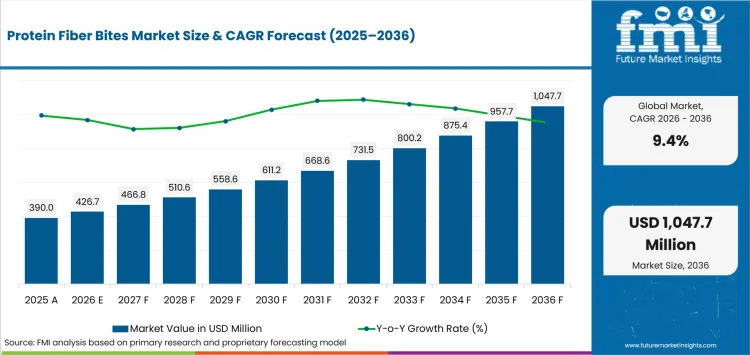
USD 426.7 million in 2026 and USD 1047.7 million by 2036 at a 9.4% CAGR.
Demand for protein fiber bites is projected to expand at 9.4% CAGR between 2026 and 2036, increasing valuation from USD 426.7 million in 2026 to USD 1047.7 million by 2036. Commercial adoption depends on delivering enough fiber per portion to create a clear nutrition benefit while protecting chew, flavor and portion value.
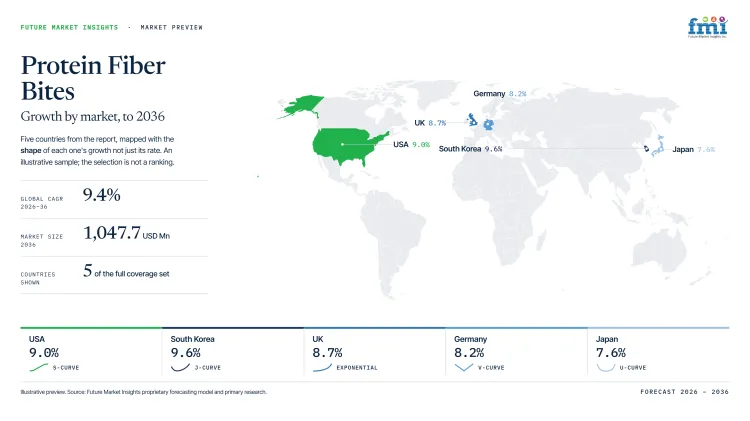
Country trajectories reflect different retail and nutrition conditions. South Korea is forecast at 9.6% CAGR, followed by the USA at 9.0%, the UK at 8.7%, Germany at 8.2% and Japan at 7.6%. Product localization therefore turns on label rules and preferred ingredients together with channel placement and repeat-purchase economics.
Key Takeaways of Protein Fiber Bites Market
- Protein-plus-fiber positioning gives an established portable-snacking occasion a second measurable nutrition cue.
- Refrigerated Protein Bites are projected at 36.8% share in 2026 because chilled formulations can support softer textures and fresh-snack positioning.
- Nut Butter Base is projected at 38.4% of Protein Source revenue in 2026 because it combines flavor, fat, protein and binding functionality.
- High-Fiber is forecast at 37.9% of Claim revenue in 2026 as shoppers can compare the claim against per-serving nutrition information.
- Pouches are estimated at 40.4% of Packaging revenue in 2026, while Supermarkets & Hypermarkets are projected at 45.9% of Sales Channel revenue.
- Perfect Snacks, RXBAR, Bobo's, Munk Pack, Siren Snacks, No Cow, MOSH and 88 Acres provide direct bite formats or adjacent formulation and channel capability.
Analyst Perspective
"Protein and fiber can strengthen the nutrition panel while making a small bite denser or drier. Product teams need to lock the eating texture before increasing either nutrient, then test the same formulation after the intended chilled or shelf-stable distribution cycle."
- Nandini Roy Choudhury, Principal Consultant, Future Market Insights
How is the Protein Fiber Bites Market segmented?
The protein fiber bites market is segmented by product type, protein source, claim, packaging, sales channel and region.
Protein fiber bites are segmented across product architecture, nutrition system and route to purchase. The broader protein snacks category provides the familiar portability benchmark, while bite-sized products add a stronger emphasis on portion control. Product Type separates chilled formats from shelf-stable, filled and coated architectures. Protein Source captures the formulation base. Claim reflects the front-of-pack nutrition message. Packaging and Sales Channel determine how the product is portioned, discovered and replenished.
Why does High-Fiber lead the Claim category?
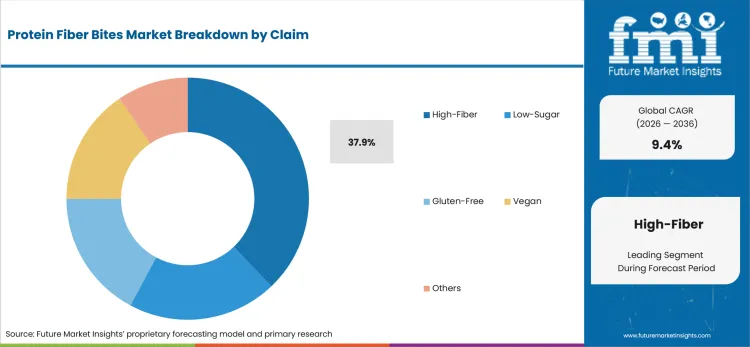
High-Fiber gives the category a measurable nutrition anchor beside protein. The claim is especially relevant where shoppers want a snack to contribute meaningfully to daily intake rather than rely on broad wellness language. FMI's dietary fiber outlook similarly reflects wider use of fiber across routine food formats as manufacturers try to close intake gaps without asking consumers to change eating occasions sharply.
- High-Fiber is projected to account for 37.9% of Claim revenue in 2026 because it creates an explicit nutrition proposition that complements protein snacking.
- The USA Food and Drug Administration states that 20% of Daily Value or more per serving is considered high for a nutrient, making serving size and substantiation central to the claim.
Why do Refrigerated Protein Bites lead the Product Type category?
Refrigeration gives brands more room to build around soft nut-butter matrices and fresh-snack positioning. That matters when higher protein and added fiber would otherwise make a small bite dense or dry. Chilled distribution can also place the product near fresh convenience foods rather than only inside the conventional nutrition-bar set.
- Based on Product Type, Refrigerated Protein Bites are projected to account for 36.8% in 2026 because texture differentiation and fresh-snack positioning support the format.
- Perfect Snacks introduced Protein + Prebiotics in March 2026 with 20 grams of protein and 6 grams of fiber on a refrigerated platform, showing how chilled formulation can carry a material protein-fiber load.
Why does Nut Butter Base lead the Protein Source category?
Nut butter contributes protein and fat while supplying flavor and adhesion without requiring a long ingredient system. This multifunctionality helps when fiber ingredients and added protein increase firmness. The wider FMI nut butter outlook also shows the ingredient base moving into protein-rich and convenient nutrition formats, which supports its role in portable bites.
- Nut Butter Base is projected to account for 38.4% of Protein Source revenue in 2026 because it combines nutritional contribution with binding and sensory functionality.
- RXBAR Protein Energy Bites launched in December 2025 with peanut butter, egg whites and dates in a filled two-bite pouch, demonstrating direct use of nut butter in a portioned protein-fiber format.
Why do Pouches lead the Packaging category?
Pouches fit the physical logic of a multi-bite product. They can hold several pieces without the rigid dimensions of a conventional bar wrapper and can support portioning across more than one eating moment. Resealability also helps limit exposure after opening for filled or coated bites.
- Pouches are projected to account for 40.4% of Packaging revenue in 2026 because the format supports portable multi-bite portions and resealability.
- Siren Snacks used single-serve resealable pouches for protein bites made with pea protein, nuts and dates, showing how flexible packaging can support a bite-sized functional-snack format.
Why do Supermarkets & Hypermarkets lead the Sales Channel category?
Large-format retail gives protein fiber bites discovery and replenishment during a routine shopping trip. Chilled products can use existing refrigeration, while shelf-stable brands can sit beside protein bars and better-for-you snacks. The channel must still justify shelf or cold-space productivity through repeat purchase.
- Supermarkets & Hypermarkets are projected to account for 45.9% of Sales Channel revenue in 2026 because they combine shopper traffic with recurring access and refrigeration where required.
- Munk Pack expanded its Probiotic Protein Bars into more than 3,200 Walmart stores in May 2025, showing how mass retail can widen availability for protein-plus-prebiotic snack platforms.
What are the drivers, restraints and opportunities in the Protein Fiber Bites Market?
Fiber-intake gaps support protein-plus-fiber snacking while texture and cold-chain requirements constrain scale as prebiotic ingredients and portable packs create product-development routes.
- Driver: Fiber shortfalls strengthen the case for snacks that add meaningful fiber to an already familiar protein occasion.
- Restraint: Higher protein and fiber loads can impair texture, while refrigerated formats add distribution cost and shelf-space requirements.
- Opportunity: Prebiotic fiber, familiar whole-food ingredients and portion-friendly packaging can extend the category into everyday snacking.
Demand is strongest where consumers already use portable protein snacks but still fall short on fiber. The wider healthy snacks market also shows how health-positioned products compete directly with conventional snacks on taste and price. The UK National Diet and Nutrition Survey reported in June 2025 that 96% of adults and people aged 11 to 18 did not meet the fiber recommendation during 2019 to 2023, giving protein-fiber formats a clear nutrition use case.
Formulation and distribution create the main friction. Protein concentrates and added fibers change moisture binding and chew, so a strong nutrition panel does not guarantee an acceptable bite. Refrigeration can protect a softer product but shifts cost into cold storage and retail space. Shelf-stable competitors avoid that route but must maintain texture and coating stability through a longer distribution cycle.
The opportunity is to make fiber functional without making the snack feel medicinal. Prebiotic fiber can add a specific digestive-health cue, while familiar nuts or seeds keep the ingredient story recognizable. The FMI plant-based snacks outlook shows how high-protein claims and supermarket access can bring plant-forward snacks into routine buying. Protein fiber bites can apply the same logic through smaller portions and clearer per-serving nutrition.
Which country CAGRs are profiled in the Protein Fiber Bites Market?
| Country | CAGR |
|---|---|
| South Korea | 9.6% |
| USA | 9.0% |
| UK | 8.7% |
| Germany | 8.2% |
| Japan | 7.6% |
How do country-level CAGRs compare in the Protein Fiber Bites Market?
The five profiled CAGRs span 2.0 percentage points across different nutrition frameworks and retail environments. The spacing measures expected expansion rather than current market size or absolute snack consumption within each country.
- South Korea is forecast at 9.6% CAGR, supported by a packaged-food environment where local labeling and digital retail can influence early assortment testing.
- The USA is forecast at 9.0%, with broad mass-retail access and established protein-snack buying supporting distribution once a bite format proves repeat purchase.
- The UK is forecast at 8.7%, while the national nutrition survey indicates a persistent fiber-intake gap that can support a clear functional proposition.
- Germany is forecast at 8.2%, where plant-forward dietary guidance supports familiar nut, seed and whole-food ingredient narratives.
- Japan is forecast at 7.6%, with serving logic and nutrition communication requiring careful localization for Japanese retail.
Comparable CAGRs can produce different market-entry conditions. Commercial prioritization should combine forecast pace with local price points and label rules. Refrigeration needs, channel concentration and evidence of repeat purchase also determine whether a specific formulation can scale profitably.
Country-wise Analysis
- South Korean demand for Protein Fiber Bites is forecast to expand at a 9.6% CAGR from 2026 to 2036. The Ministry of Food and Drug Safety updated food-labeling and advertising rules in March 2024, so suppliers need local claim and pack compliance before reusing global protein-fiber packaging.
- Demand in the USA is forecast to expand at a 9.0% CAGR from 2026 to 2036. FDA nutrition-label guidance makes per-serving fiber communication important, while texture and price must hold through the intended chilled or shelf-stable route.
- Demand in the UK is forecast to expand at an 8.7% CAGR from 2026 to 2036. The National Diet and Nutrition Survey reported in June 2025 that 96% of adults and people aged 11 to 18 did not meet the fiber recommendation during 2019 to 2023.
- Demand in Germany is forecast to expand at an 8.2% CAGR from 2026 to 2036. German Nutrition Society guidance emphasizes whole grains, legumes and nuts, supporting ingredient stories built around recognizable plant-food sources.
- Demand in Japan is forecast to expand at a 7.6% CAGR from 2026 to 2036. The 2025 Dietary Reference Intakes provide a current nutrition framework, while serving size and flavor need localization before broad retail rollout.
Who are the notable companies in the Protein Fiber Bites Market?
Perfect Snacks, RXBAR, Bobo's, Munk Pack, Siren Snacks, No Cow, MOSH and 88 Acres are notable companies serving direct bite formats or adjacent protein-fiber snack platforms.
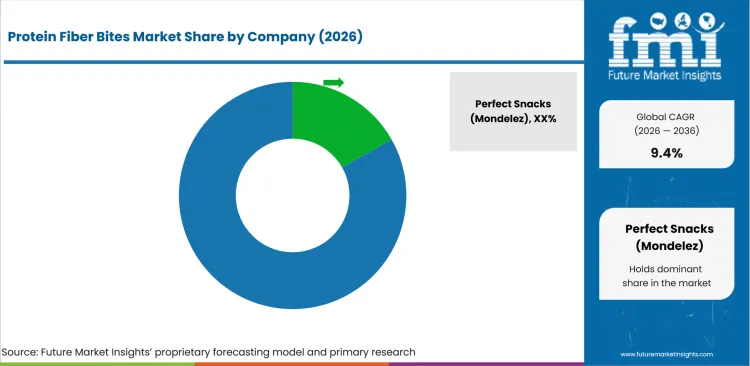
Competition combines direct bite products with adjacent refrigerated, prebiotic, low-sugar and seed-led platforms that can transfer formulation or channel capability into bite-sized snacks. Commercial selection turns on nutrition density, texture, pack convenience and access to the channel that matches the product's storage requirements.
- RXBAR, Bobo's and Siren Snacks bring direct experience with bite formats, fillings or portioned multipacks.
- Perfect Snacks, Munk Pack and No Cow bring protein-plus-fiber, prebiotic, refrigerated or low-sugar formulation capabilities from adjacent snack formats.
- MOSH and 88 Acres compete through premium functional nutrition or seed-based ingredient systems that can support differentiated bite concepts.
Competitive Benchmarking: Protein Fiber Bites Market
| Company | Protein-Fiber Claim Depth | Bite-Format Relevance | Channel & Pack Flexibility | Geographic Reach |
|---|---|---|---|---|
| Perfect Snacks | High | Medium | High | USA; national retail and DTC with refrigerated distribution |
| RXBAR | High | High | High | USA; nationwide retail and DTC |
| Bobo's | Low | High | High | USA; national retail and DTC |
| Munk Pack | High | Low | High | USA; mass retail and DTC |
| Siren Snacks | Medium | High | Medium | USA; protein-bite retail history |
| No Cow | High | Low | Medium | USA; retail, wholesale and DTC |
| MOSH | Medium | Low | High | USA; Target and DTC |
| 88 Acres | Medium | Low | Medium | USA; retail and DTC |
Scoring basis: Protein-Fiber Claim Depth compares how clearly each platform combines protein with fiber or prebiotic fiber. Bite-Format Relevance reflects direct bites, mini formats or closely transferable portioned products. Channel & Pack Flexibility reflects retail and DTC access together with support for different pack or storage formats. High indicates broad capability, Medium indicates narrower capability, and Low indicates that the company participates mainly through an adjacent format.
Key Developments in the Protein Fiber Bites Market
- In March 2026, Perfect Snacks introduced Protein + Prebiotics, a refrigerated protein bar with 20 grams of protein and 6 grams of fiber, including 3 grams of prebiotic fiber. The launch highlights growing innovation in protein-and-fiber functional snacking
- In March 2026, Bobo's expanded its Oat Bites line with larger multipacks, refreshed packaging and two new flavors. The action increases the company's experience with portioned oat-bite formats and shelf presentation in packaged snacking.
- In December 2025, RXBAR launched Protein Energy Bites nationwide in Strawberry Peanut Butter and Dark Chocolate Peanut Butter. Each pouch contains two bites and delivers 8 to 10 grams of protein per serving with a good source of fiber.
Key Players in the Protein Fiber Bites Market
Direct Bite and Portioned-Snack Platforms
- RXBAR
- Bobo's
- Siren Snacks
Adjacent Protein-Fiber Formulation Platforms
- Perfect Snacks
- Munk Pack
- No Cow
Premium Functional and Seed-Led Nutrition
- MOSH
- 88 Acres
Protein Fiber Bites Market - Report Scope
| Coverage field | Report scope |
|---|---|
| Market breakdown | By Product Type, Protein Source, Claim, Packaging, Sales Channel and Region. |
| Quantitative Units | USD Million. |
| Market Definition | Packaged protein bites, balls and comparable mini or bite-sized protein snacks that deliver fiber through whole-food or added-fiber ingredients within the defined segmentation universe. Conventional full-size bars, beverages, powders, supplements and prepared foods are excluded from market revenue. |
| Regions Covered | North America, Latin America, Western Europe, Eastern Europe, East Asia, South Asia and Pacific, and Middle East and Africa. |
| Countries Covered | USA, UK, Germany, Japan, South Korea, and more than twenty-five additional countries in the full report. |
| Key Companies Profiled | Perfect Snacks, RXBAR, Bobo's, Munk Pack, Siren Snacks, No Cow, MOSH and 88 Acres. |
| Forecast Period | 2026 to 2036. |
| Approach | Primary and secondary research with market triangulation. |
Protein Fiber Bites Market - Research Methodology
| Method | Approach |
|---|---|
| Primary Research | FMI analysts gathered input from manufacturers, ingredient suppliers, distributors, retail buyers, end users, procurement teams and subject-matter experts. Discussions examined product definition, nutrient claims, ingredient systems, pack choice, channel economics, refrigeration needs, purchase triggers and repeat-purchase frictions. |
| Desk Research | Desk research covered government nutrition guidance, food-labeling rules, industry associations, technical literature, company filings, product information and official corporate announcements. Sources were reviewed for relevance to market mechanisms, country conditions, company actions and category boundaries. |
| Market Sizing and Forecasting | Market sizing and forecasting combined product-format revenue logic with segmentation, pricing, distribution, country growth conditions and company or channel activity. Forecast assumptions considered formulation progress, cold-chain economics, claim credibility, retail access, packaging and repeat purchase. |
| Data Validation | Estimates were checked against product and channel indicators together with category boundaries. Conventional full-size bars and other adjacent categories were excluded from market revenue unless they fit the defined bite-size scope, reducing overlap across segments and companies. |
Protein Fiber Bites Market by Segments
Protein Fiber Bites Market segmented by Product Type:
- Refrigerated Protein Bites
- Shelf-Stable Bites & Balls
- Filled Bites
- Coated Bites
- Others
Protein Fiber Bites Market segmented by Protein Source:
- Nut Butter Base
- Whey
- Plant Blends
- Collagen
- Others
Protein Fiber Bites Market segmented by Claim:
- High-Fiber
- Low-Sugar
- Gluten-Free
- Vegan
- Others
Protein Fiber Bites Market segmented by Packaging:
- Pouches
- Single-Serve
- Multipacks
- Others
Protein Fiber Bites Market segmented by Sales Channel:
- Supermarkets & Hypermarkets
- Online / DTC
- Convenience Stores
- Specialty & Health Stores
- Others
Protein Fiber Bites Market by Region:
- North America
- United States
- Canada
- Latin America
- Brazil
- Mexico
- Argentina
- Chile
- Western Europe
- Germany
- France
- United Kingdom
- Italy
- Spain
- Benelux
- Nordics
- Eastern Europe
- Poland
- Czech Republic
- Romania
- Hungary
- East Asia
- China
- Japan
- South Korea
- South Asia and Pacific
- India
- ASEAN
- Australia and New Zealand
- Middle East and Africa
- GCC Countries
- South Africa
- Türkiye
- Israel
Research Sources and Bibliography
- USA Food and Drug Administration. (2024, March 5). Daily Value on the Nutrition and Supplement Facts Labels.
- Office for Health Improvement and Disparities. (2025, June 11). National Diet and Nutrition Survey 2019 to 2023: report.
- German Nutrition Society. (2024). Food-Based Dietary Guidelines for Germany.
- Ministry of Health, Labour and Welfare, Japan. (2024, October). Dietary Reference Intakes for Japanese, 2025.
- Ministry of Food and Drug Safety, Republic of Korea. (2024, March 5). Enforcement Rule of the Act on Labeling and Advertising of Foods (No. 1813).
- Perfect Snacks. (2026, March 24). Perfect Bar Introduces New Protein + Prebiotics, With High Protein and No Junk.
- Perfect Snacks. (Accessed 2026, August 24). Protein + Prebiotics Peanut Butter Chocolate Crunch.
- Perfect Snacks. (2025, May 19). Perfect Bar Rolls Out New Mini Protein Bar Built for Summer Adventures.
- Kellanova. (2025, December 8). RXBAR Expands Beyond the Bar with New Protein Energy Bites.
- Mars, Incorporated. (2025, December 11). Mars Completes Acquisition of Kellanova.
- Bobo's. (2026, March 11). Bobo's Brings More Bites, Bolder Brights, and Two New Flavors to the Snack Aisle.
- Munk Pack. (2025, May 21). Munk Pack Probiotic Protein Bars: Now in Walmart!
- Food Business News. (2021, February 9). Siren Snacks adds keto-friendly bites.
- No Cow. (Accessed 2026, August 13). Upgraded - Peanut Butter Chocolate Chip Protein Bar.
- MOSH. (2026, May 18). MOSH High Protein Hits 2,000 Target Stores Nationwide, Taking Brain Health Mainstream.
- 88 Acres. (Accessed 2026, August 13). 88 Acres Bars & Butters | Just Good Nutrition, Powered by Seeds.
This bibliography is provided for reader reference and is not exhaustive. The full report contains the complete reference list and detailed citations.
This Report Answers
- How large is the Protein Fiber Bites Market in 2026 and 2036?
- Which nutrition and snacking conditions support demand for protein fiber bites?
- Which Product Type segment accounts for the leading approved 2026 share?
- How do Protein Source and Claim choices shape formulation and purchase decisions?
- Which Packaging and Sales Channel segments support recurring access?
- How do profiled country growth rates affect commercial entry conditions?
- Which companies serve direct bite formats or adjacent protein-fiber snack platforms?
- What formulation, cold-chain and retail constraints limit wider adoption?
Frequently Asked Questions
How big is the protein fiber bites market in 2026?
USD 426.7 million represents the Protein Fiber Bites Market value in 2026 across packaged bite-sized protein snacks that deliver fiber through whole-food or added-fiber ingredients. The market is forecast to reach USD 1,047.7 million by 2036 as brands improve formulation and retail access.
What is the CAGR of the protein fiber bites market from 2026 to 2036?
A 9.4% CAGR is projected for the Protein Fiber Bites Market between 2026 and 2036. Growth depends on stronger protein-plus-fiber positioning while suppliers maintain texture, serving value and claim credibility across chilled and shelf-stable formats.
Which Product Type segment is projected to account for 36.8% of the protein fiber bites market?
Refrigerated Protein Bites are projected to account for 36.8% of Product Type revenue in 2026. Chilled formulation can support softer texture and fresh-snack positioning, although the format requires cold-chain handling and productive refrigerator space.
How much will the protein fiber bites market add between 2026 and 2036?
USD 621.0 million is expected to be added to the Protein Fiber Bites Market between 2026 and 2036. The increase depends on wider retail availability and formulations that deliver a credible fiber benefit without weakening taste or portion value.
Which companies are active in the protein fiber bites market?
Eight companies active in direct or adjacent protein-fiber snack formats include Perfect Snacks, RXBAR, Bobo's, Munk Pack, Siren Snacks, No Cow, MOSH and 88 Acres. The group spans direct bites, refrigerated protein platforms, prebiotic formulations and seed-led nutrition.
Preview the report firsthand - request a free sample
Get SampleGet the brochure for pricing and purchase details.
Get PDFTable of Content
- Key Takeaways
- Market Size and CAGR
- Top Growth Driver
- Fastest Growing Segment
- Leading Region
- Key Companies
- Emerging Opportunities
- Executive Summary
- Global Market Outlook
- Demand-side Trends
- Supply-side Trends
- Technology Roadmap Analysis
- Analysis and Recommendations
- Analyst Perspective (What is happening? Why now? What should investors know?)
- Key Questions Answered
- How large is the market?
- What is the CAGR?
- What are key trends?
- Which region dominates?
- Who are the leaders?
- Market Overview
- Market Coverage / Taxonomy
- Market Definition / Scope / Limitations
- Research Methodology
- Chapter Orientation
- Analytical Lens and Working Hypotheses
- Market Structure, Signals, and Trend Drivers
- Benchmarking and Cross-market Comparability
- Market Sizing, Forecasting, and Opportunity Mapping
- Research Design and Evidence Framework
- Desk Research Programme (Secondary Evidence)
- Expert Input and Fieldwork (Primary Evidence)
- Tooling, Models, and Reference Databases
- Data Engineering and Model Build
- Quality Assurance and Audit Trail
- Market Background
- Market Dynamics (Drivers, Restraints, Opportunity, Trends)
- Scenario Forecast (Optimistic, Likely, Conservative)
- Impact Analysis
- AI Impact
- Sustainability Impact
- Regulatory Impact
- Technology Impact
- Consumer / Buyer Analysis
- Purchase Drivers
- Adoption Barriers
- Buyer Journey
- Opportunity Map Analysis
- Product Life Cycle Analysis
- Supply Chain Analysis
- Investment Feasibility Matrix
- Value Chain Analysis
- PESTLE and Porter's Analysis
- Regulatory Landscape
- Regional Parent Market Outlook
- Production and Consumption Statistics
- Import and Export Statistics
- Global Market Analysis and Forecast, 2021 to 2036
- Historical Market Size Value (USD Million) Analysis, 2021 to 2025
- Current and Future Market Size Value (USD Million) Projections, 2026 to 2036
- Y-o-Y Growth Trend Analysis
- Absolute $ Opportunity Analysis
- Global Market Pricing Analysis, 2021 to 2036
- Global Market Analysis and Forecast, By Product Type, 2021 to 2036
- Introduction / Key Findings
- Historical Market Size Value (USD Million) Analysis By Product Type, 2021 to 2025
- Current and Future Market Size Value (USD Million) Analysis and Forecast By Product Type, 2026 to 2036
- Refrigerated Protein Bites
- Shelf-Stable Bites & Balls
- Filled Bites
- Coated Bites
- Others
- Refrigerated Protein Bites
- Y-o-Y Growth Trend Analysis By Product Type, 2021 to 2025
- Absolute $ Opportunity Analysis By Product Type, 2026 to 2036
- Global Market Analysis and Forecast, By Protein Source, 2021 to 2036
- Introduction / Key Findings
- Historical Market Size Value (USD Million) Analysis By Protein Source, 2021 to 2025
- Current and Future Market Size Value (USD Million) Analysis and Forecast By Protein Source, 2026 to 2036
- Nut Butter Base
- Whey
- Plant Blends
- Collagen
- Others
- Nut Butter Base
- Y-o-Y Growth Trend Analysis By Protein Source, 2021 to 2025
- Absolute $ Opportunity Analysis By Protein Source, 2026 to 2036
- Global Market Analysis and Forecast, By Claim, 2021 to 2036
- Introduction / Key Findings
- Historical Market Size Value (USD Million) Analysis By Claim, 2021 to 2025
- Current and Future Market Size Value (USD Million) Analysis and Forecast By Claim, 2026 to 2036
- High-Fiber
- Low-Sugar
- Gluten-Free
- Vegan
- Others
- High-Fiber
- Y-o-Y Growth Trend Analysis By Claim, 2021 to 2025
- Absolute $ Opportunity Analysis By Claim, 2026 to 2036
- Global Market Analysis and Forecast, By Packaging, 2021 to 2036
- Introduction / Key Findings
- Historical Market Size Value (USD Million) Analysis By Packaging, 2021 to 2025
- Current and Future Market Size Value (USD Million) Analysis and Forecast By Packaging, 2026 to 2036
- Pouches
- Single-Serve
- Multipacks
- Others
- Pouches
- Y-o-Y Growth Trend Analysis By Packaging, 2021 to 2025
- Absolute $ Opportunity Analysis By Packaging, 2026 to 2036
- Global Market Analysis and Forecast, By Sales Channel, 2021 to 2036
- Introduction / Key Findings
- Historical Market Size Value (USD Million) Analysis By Sales Channel, 2021 to 2025
- Current and Future Market Size Value (USD Million) Analysis and Forecast By Sales Channel, 2026 to 2036
- Supermarkets & Hypermarkets
- Online / DTC
- Convenience Stores
- Specialty & Health Stores
- Others
- Supermarkets & Hypermarkets
- Y-o-Y Growth Trend Analysis By Sales Channel, 2021 to 2025
- Absolute $ Opportunity Analysis By Sales Channel, 2026 to 2036
- Global Market Analysis and Forecast, By Region, 2021 to 2036
- Introduction
- Historical Market Size Value (USD Million) Analysis By Region, 2021 to 2025
- Current Market Size Value (USD Million) Analysis and Forecast By Region, 2026 to 2036
- North America
- Latin America
- Western Europe
- Eastern Europe
- East Asia
- South Asia and Pacific
- Middle East & Africa
- Market Attractiveness Analysis By Region
- North America Market Analysis and Forecast, By Country, 2021 to 2036
- Historical Market Size Value (USD Million) Trend Analysis By Market Taxonomy, 2021 to 2025
- Market Size Value (USD Million) Forecast By Market Taxonomy, 2026 to 2036
- By Country
- USA
- Canada
- By Product Type
- By Protein Source
- By Claim
- By Packaging
- By Sales Channel
- By Country
- Market Attractiveness Analysis
- By Country
- By Product Type
- By Protein Source
- By Claim
- By Packaging
- By Sales Channel
- Key Takeaways
- Latin America Market Analysis and Forecast, By Country
- Historical Market Size Value (USD Million) Trend Analysis By Market Taxonomy, 2021 to 2025
- Market Size Value (USD Million) Forecast By Market Taxonomy, 2026 to 2036
- By Country
- Brazil
- Mexico
- Chile
- Rest of Latin America
- By Product Type
- By Protein Source
- By Claim
- By Packaging
- By Sales Channel
- By Country
- Market Attractiveness Analysis
- By Country
- By Product Type
- By Protein Source
- By Claim
- By Packaging
- By Sales Channel
- Key Takeaways
- Western Europe Market Analysis and Forecast, By Country
- Historical Market Size Value (USD Million) Trend Analysis By Market Taxonomy, 2021 to 2025
- Market Size Value (USD Million) Forecast By Market Taxonomy, 2026 to 2036
- By Country
- Germany
- UK
- Italy
- Spain
- France
- Nordic
- BENELUX
- Rest of Western Europe
- By Product Type
- By Protein Source
- By Claim
- By Packaging
- By Sales Channel
- By Country
- Market Attractiveness Analysis
- By Country
- By Product Type
- By Protein Source
- By Claim
- By Packaging
- By Sales Channel
- Key Takeaways
- Eastern Europe Market Analysis and Forecast, By Country
- Historical Market Size Value (USD Million) Trend Analysis By Market Taxonomy, 2021 to 2025
- Market Size Value (USD Million) Forecast By Market Taxonomy, 2026 to 2036
- By Country
- Russia
- Poland
- Hungary
- Balkan & Baltic
- Rest of Eastern Europe
- By Product Type
- By Protein Source
- By Claim
- By Packaging
- By Sales Channel
- By Country
- Market Attractiveness Analysis
- By Country
- By Product Type
- By Protein Source
- By Claim
- By Packaging
- By Sales Channel
- Key Takeaways
- East Asia Market Analysis and Forecast, By Country
- Historical Market Size Value (USD Million) Trend Analysis By Market Taxonomy, 2021 to 2025
- Market Size Value (USD Million) Forecast By Market Taxonomy, 2026 to 2036
- By Country
- China
- Japan
- South Korea
- By Product Type
- By Protein Source
- By Claim
- By Packaging
- By Sales Channel
- By Country
- Market Attractiveness Analysis
- By Country
- By Product Type
- By Protein Source
- By Claim
- By Packaging
- By Sales Channel
- Key Takeaways
- South Asia and Pacific Market Analysis and Forecast, By Country
- Historical Market Size Value (USD Million) Trend Analysis By Market Taxonomy, 2021 to 2025
- Market Size Value (USD Million) Forecast By Market Taxonomy, 2026 to 2036
- By Country
- India
- ASEAN
- Australia & New Zealand
- Rest of South Asia and Pacific
- By Product Type
- By Protein Source
- By Claim
- By Packaging
- By Sales Channel
- By Country
- Market Attractiveness Analysis
- By Country
- By Product Type
- By Protein Source
- By Claim
- By Packaging
- By Sales Channel
- Key Takeaways
- Middle East & Africa Market Analysis and Forecast, By Country
- Historical Market Size Value (USD Million) Trend Analysis By Market Taxonomy, 2021 to 2025
- Market Size Value (USD Million) Forecast By Market Taxonomy, 2026 to 2036
- By Country
- Kingdom of Saudi Arabia
- Other GCC Countries
- Türkiye
- South Africa
- Other African Union
- Rest of Middle East & Africa
- By Product Type
- By Protein Source
- By Claim
- By Packaging
- By Sales Channel
- By Country
- Market Attractiveness Analysis
- By Country
- By Product Type
- By Protein Source
- By Claim
- By Packaging
- By Sales Channel
- Key Takeaways
- Key Countries Market Analysis
- USA
- Pricing Analysis
- Market Share Analysis, 2025
- By Product Type
- By Protein Source
- By Claim
- By Packaging
- By Sales Channel
- Canada
- Pricing Analysis
- Market Share Analysis, 2025
- By Product Type
- By Protein Source
- By Claim
- By Packaging
- By Sales Channel
- Mexico
- Pricing Analysis
- Market Share Analysis, 2025
- By Product Type
- By Protein Source
- By Claim
- By Packaging
- By Sales Channel
- Brazil
- Pricing Analysis
- Market Share Analysis, 2025
- By Product Type
- By Protein Source
- By Claim
- By Packaging
- By Sales Channel
- Chile
- Pricing Analysis
- Market Share Analysis, 2025
- By Product Type
- By Protein Source
- By Claim
- By Packaging
- By Sales Channel
- Germany
- Pricing Analysis
- Market Share Analysis, 2025
- By Product Type
- By Protein Source
- By Claim
- By Packaging
- By Sales Channel
- UK
- Pricing Analysis
- Market Share Analysis, 2025
- By Product Type
- By Protein Source
- By Claim
- By Packaging
- By Sales Channel
- Italy
- Pricing Analysis
- Market Share Analysis, 2025
- By Product Type
- By Protein Source
- By Claim
- By Packaging
- By Sales Channel
- Spain
- Pricing Analysis
- Market Share Analysis, 2025
- By Product Type
- By Protein Source
- By Claim
- By Packaging
- By Sales Channel
- France
- Pricing Analysis
- Market Share Analysis, 2025
- By Product Type
- By Protein Source
- By Claim
- By Packaging
- By Sales Channel
- India
- Pricing Analysis
- Market Share Analysis, 2025
- By Product Type
- By Protein Source
- By Claim
- By Packaging
- By Sales Channel
- ASEAN
- Pricing Analysis
- Market Share Analysis, 2025
- By Product Type
- By Protein Source
- By Claim
- By Packaging
- By Sales Channel
- Australia & New Zealand
- Pricing Analysis
- Market Share Analysis, 2025
- By Product Type
- By Protein Source
- By Claim
- By Packaging
- By Sales Channel
- China
- Pricing Analysis
- Market Share Analysis, 2025
- By Product Type
- By Protein Source
- By Claim
- By Packaging
- By Sales Channel
- Japan
- Pricing Analysis
- Market Share Analysis, 2025
- By Product Type
- By Protein Source
- By Claim
- By Packaging
- By Sales Channel
- South Korea
- Pricing Analysis
- Market Share Analysis, 2025
- By Product Type
- By Protein Source
- By Claim
- By Packaging
- By Sales Channel
- Russia
- Pricing Analysis
- Market Share Analysis, 2025
- By Product Type
- By Protein Source
- By Claim
- By Packaging
- By Sales Channel
- Poland
- Pricing Analysis
- Market Share Analysis, 2025
- By Product Type
- By Protein Source
- By Claim
- By Packaging
- By Sales Channel
- Hungary
- Pricing Analysis
- Market Share Analysis, 2025
- By Product Type
- By Protein Source
- By Claim
- By Packaging
- By Sales Channel
- Kingdom of Saudi Arabia
- Pricing Analysis
- Market Share Analysis, 2025
- By Product Type
- By Protein Source
- By Claim
- By Packaging
- By Sales Channel
- Türkiye
- Pricing Analysis
- Market Share Analysis, 2025
- By Product Type
- By Protein Source
- By Claim
- By Packaging
- By Sales Channel
- South Africa
- Pricing Analysis
- Market Share Analysis, 2025
- By Product Type
- By Protein Source
- By Claim
- By Packaging
- By Sales Channel
- USA
- Market Structure Analysis
- Competition Dashboard
- Competition Benchmarking
- Market Share Analysis of Top Players
- By Regional
- By Product Type
- By Protein Source
- By Claim
- By Packaging
- By Sales Channel
- Emerging Startups
- Innovation Benchmarking
- Competition Analysis
- Competition Deep Dive
- Perfect Snacks (Mondelez)
- Overview
- Product Portfolio
- Profitability by Market Segments
- Sales Footprint
- Strategy Overview
- Marketing Strategy
- Product Strategy
- Channel Strategy
- RXBAR (Kellanova)
- Bobo's
- Munk Pack
- Siren Snacks
- No Cow
- MOSH
- 88 Acres
- Perfect Snacks (Mondelez)
- Case Studies
- Success Stories
- Recent Developments
- Competition Deep Dive
- Assumptions & Acronyms Used


