

- Market Size (2026)
- USD 1222.9 Mn
- Forecast (2036)
- USD 1917.4 Mn
- CAGR (2026 to 2036)
- 4.6%
How big is Upcycled Protein & Fiber Ingredients Market in 2026?
USD 1,222.9 million in 2026 and USD 1,917.4 million by 2036 at a 4.6% CAGR.
Sales of upcycled protein and fiber ingredients are projected to rise at 4.6% CAGR through 2036 from the baseline. The valuation is forecast to increase from USD 1,222.9 million in 2026 to USD 1,917.4 million by 2036. In March 2026, Elbow Beach reported that UPP formed a five-year partnership with East of Scotland Growers for broccoli biomass supply. The agreement creates a feedstock route of up to 100,000 tonnes annually for ingredient production. Activity across upcycled food products gives food manufacturers more commercial formats for testing recovered protein and fiber. The supply agreement links field collection with processing scale and reduces source-continuity risk during seasonal harvesting periods.
European Union novel-food rules require authorization for foods lacking significant consumption in member states by May 15, 1997. FDA guidance treats an ingredient as a food additive without authorized intended use or generally recognized as safe status. These routes make source identity and production controls central to market entry across recovered protein and fiber projects. Broader food waste management priorities encourage higher-value recovery but do not replace source-specific safety evidence for human food use. Ingredient developers need composition data and stable manufacturing controls that match each intended application and national approval route. Commercial entry becomes practical with a repeatable specification and a defensible regulatory position for the exact recovered fraction.
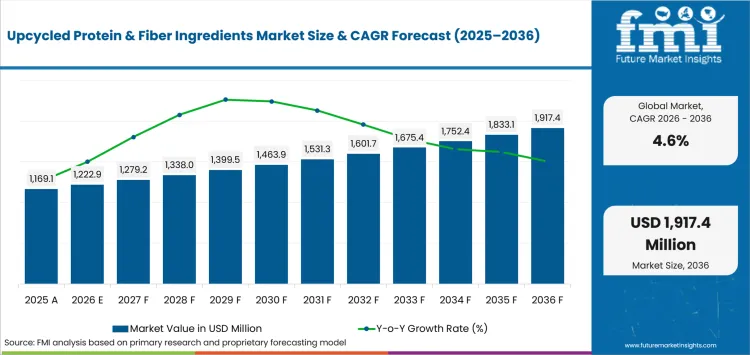
Key Takeaways of Upcycled Protein & Fiber Ingredients Market
- Demand for upcycled protein and fiber ingredients is driven by converting segregated food sidestreams into saleable nutrition, with commercial growth depending on stable collection and controlled processing that preserve ingredient quality across recurring production lots.
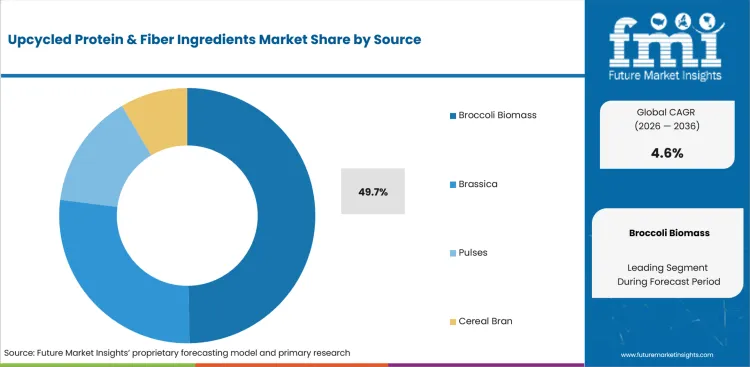
- Broccoli biomass holds the leading share at 49.7% in 2026, attributable to concentrated residues near commercial vegetable operations where regional recovery hubs shorten wet-biomass transport and preserve narrow stabilization windows across repeated harvest cycles.
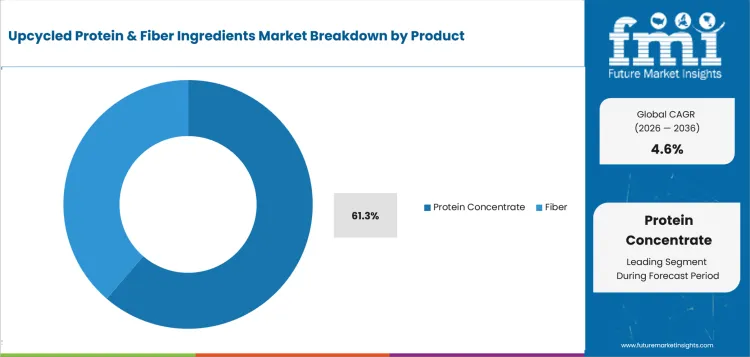
- Protein concentrate leads the product category at 61.3% share in 2026, owing to measurable nutrition, compact shipping economics, and a clear test framework for purity and solubility across beverage and baked food applications.
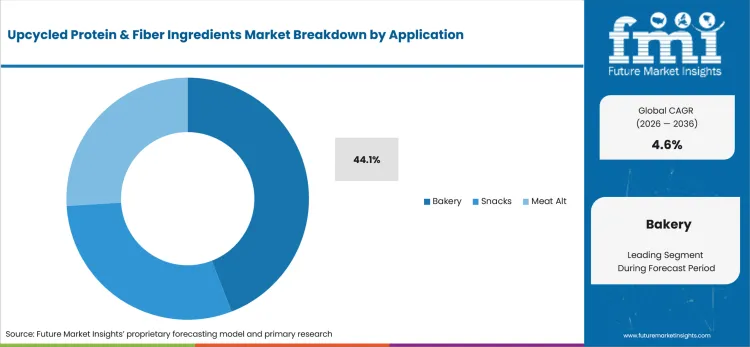
- Bakery accounts for 44.1% application share in 2026, supported by flexible inclusion levels across high-volume products where familiar dry handling and established mixing controls accept modest recovered protein or fiber additions.
- The Netherlands, the United States, and the United Kingdom record CAGRs of 6.7%, 6.3%, and 5.9% respectively through 2036, shaped by fiscal support for leaf-protein extraction equipment, broad manufacturing volumes, and formal market-authorization procedures.
- Competition separates multi-source ingredient platforms from specialized extraction routes, with Upcycled Foods and UPP competing through portfolio breadth, COMET and EverGrain focusing on wheat and brewing residues, and Burcon and Revyve adding multi-source protein technology and specialized yeast functionality.
Analyst Perspective
"Commercial adoption will increasingly depend on ingredient consistency rather than isolated production success. Food manufacturers are prioritizing stable specifications, reliable sensory performance, and dependable shelf-life across commercial-scale production. Companies that demonstrate robust quality control, secure raw material sourcing, and consistent manufacturing performance will be better positioned to strengthen long-term customer confidence."
- Nandini Roy Choudhury, Principal Analyst at Future Market Insights
Source: FMI's proprietary forecasting model and primary research
How is the Upcycled Protein & Fiber Ingredients Market segmented?
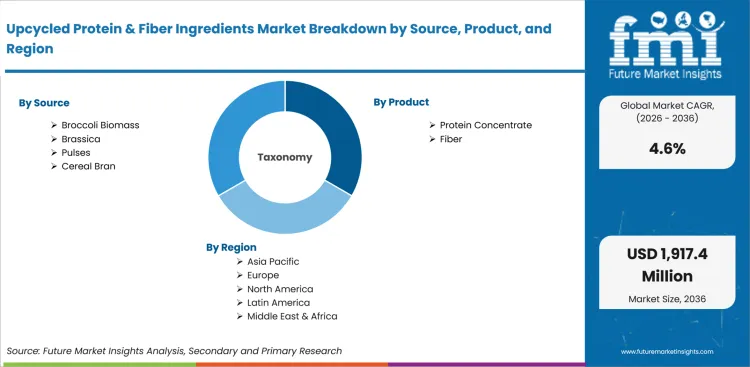
The upcycled protein and fiber ingredients industry is segmented by source, product, application, and region.
Source analysis separates broccoli biomass and other brassica material from pulses and cereal bran through their different collection and stabilization requirements. Product analysis distinguishes protein concentrate from fiber according to the nutrition and formulation functions measured during qualification. Application analysis covers bakery and snacks together with meat alternatives that impose different flavor and texture limits.
Regional analysis follows approval routes and feedstock concentration alongside processing infrastructure and technical service access. The framework connects each recovered source with a finished ingredient and its commercial use without including animal-feed products or finished foods lacking separable ingredient revenue. Related alternative protein activity provides a useful formulation comparison but remains outside this market without recovered sidestream inputs.
Why is broccoli biomass central to the source category?
Broccoli harvesting leaves stalks and leaves near farms and packing sites across concentrated vegetable regions. Prompt collection limits deterioration across wet biomass that rapidly loses functional quality during prolonged storage. In March 2025, the European Commission recorded the BRAVE grant agreement for extracting Brassica by-products into ingredients for cereal foods. The project tests laboratory extraction and industrial scale-up methods for polysaccharide-rich ingredients used in cereal formulations. Related insoluble dietary fiber development provides a formulation comparison without proving commercial adoption of broccoli-derived ingredients.
- The source category is forecast to be led by broccoli biomass at 49.7% share in 2026 due to concentrated residues near commercial vegetable operations. Regional recovery hubs shorten wet-biomass transport and preserve a narrow stabilization window across repeated harvest cycles. Commercial advantage depends on coordinated pickup and drying capacity rather than the nutritional value of untreated leaves alone.
- Ingredient processors are expected to favour broccoli biomass for blended fiber systems that need water binding and vegetable solids from one recovered source. Adoption requires lot-level controls for color and microbial quality across changing harvest conditions throughout the season. Food manufacturers also need sensory data that confirms acceptable flavor at the intended inclusion rate.
Why is protein concentrate central to the product category?
Protein concentrate allows formulators to compare protein delivery through measurable nutrition and processing tests rather than feedstock identity alone. Solubility and heat response determine suitability across beverages and baked foods with different production conditions. Concentrated formats also reduce freight per unit of target protein compared with untreated sidestream powders. Related plant-based protein comparisons help development teams benchmark concentration levels without treating purity as complete finished-product performance. Commercial qualification depends on flavor stability and dispersibility alongside the declared protein specification across each intended use.
- Protein concentrate is set to lead the product category with 61.3% share in 2026 due to measurable nutrition and compact shipping economics. Concentrated formats simplify dosage during formulation trials and support consistent protein claims across commercial recipes. Their position reflects a clear test framework for purity and solubility rather than guaranteed performance in every finished product.
- Food and beverage developers are increasingly purchasing protein concentrate for nutrition upgrades within familiar processing systems. In January 2025, Burcon launched Solatein sunflower protein isolate through a process that upcycles sunflower oil by-products into a high-purity ingredient. The launch creates a commercial specification for application trials across food and beverage development programs. Sensory stability and thermal behavior remain separate qualification requirements for each intended formulation and processing method.
Why is bakery central to the application category?
Bakery production uses familiar dry handling and established mixing controls for modest additions of recovered protein or fiber. In March 2025, Upcycled Foods and Misfits Market launched two private-label breads using ReGrained SuperGrain+ in certified finished products. The launch confirms a direct commercial route from recovered grain ingredients into bread production at retail scale. Related bakery ingredients comparisons help developers assess dough handling and finished texture across alternative fiber systems.
- Bakery is projected to hold 44.1% share in 2026 owing to flexible inclusion levels across high-volume products. Flour-based systems accept modest recovered protein or fiber additions through existing mixing and proofing operations. The segment offers measurable qualification points through dough handling and loaf volume alongside moisture retention and finished flavor.
- Industrial bakers are expected to favour upcycled ingredients for nutrition improvements that fit familiar product formats. Commercial use requires consistent performance across several production dates rather than one successful development trial. Formulation teams must compare crumb texture and moisture migration throughout shelf life so ingredient benefits do not weaken product quality.
What are the drivers, restraints, and opportunities in the Upcycled Protein & Fiber Ingredients Market?
Reliable sidestream collection supports steady ingredient production across concentrated farm and processing locations. Regulatory requirements and variable feedstock quality restrict commercial scale across unfamiliar recovered fractions in food applications. Selective extraction and fermentation create credible routes to standardized protein and fiber ingredients for established food applications.
- Driver: Food processors create ingredient value from nutritious sidestreams that otherwise enter disposal routes or low-value outlets.
- Restraint: Variable composition and unfamiliar source fractions increase safety documentation and commercial qualification requirements across intended food applications.
- Opportunity: Selective extraction and fermentation convert underused biomass into standardized protein or fiber ingredients for established food products.
Commercial demand for food waste valorization strengthens through specifications that replace an undefined residue with a controlled ingredient. In July 2025, COMET introduced Arrabina L for light-colored applications including lemonade and snack bars. The launch lowers reformulation effort for foods that cannot hide a dark fiber powder within their final appearance. Regular orders depend on lot consistency and intended-use documentation for the finished formulation throughout recurring production across several commercial lots.
Regulatory classification creates a material restraint for unfamiliar plant fractions through source-specific safety and production requirements. In February 2026, Commission Implementing Regulation (EU) 2026/386 authorized defatted rapeseed powder with defined uses and labeling conditions. The narrow authorization demonstrates that technical similarity does not transfer approval to another recovered ingredient. Commercial functional food ingredients need evidence matched to the exact source and manufacturing process used in production. Incomplete technical dossiers delay customer qualification despite successful pilot-scale formulation performance across intended commercial applications.
Fermentation and selective fractionation create a credible opening for more consistent proteins from mixed agricultural residues. In May 2025, the European Commission recorded the MOA FOODTECH grant agreement for converting agri-food by-products into customizable proteins through fermentation. The documented pilot projects and license agreements provide direct evidence of work beyond laboratory development. Ingredient producers use such methods to control feedstock variability but must prove flavor and process performance for food use.
Which country CAGRs are profiled in the Upcycled Protein & Fiber Ingredients Market?
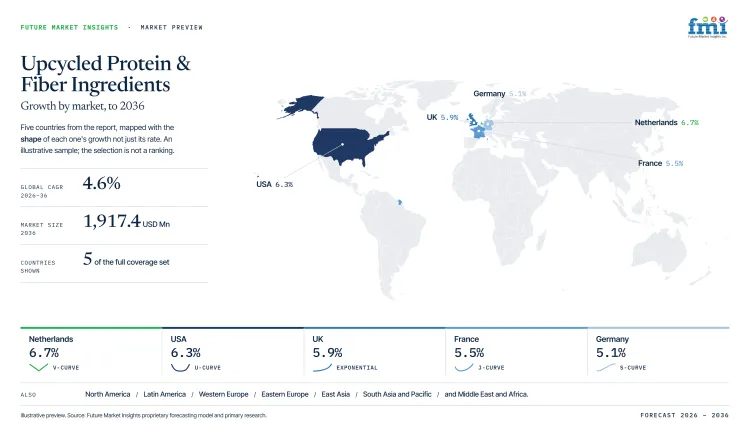
| Country | CAGR |
|---|---|
| UK | 5.9% |
| USA | 6.3% |
| Germany | 5.1% |
| Netherlands | 6.7% |
| France | 5.5% |
How do country-level CAGRs compare in the Upcycled Protein & Fiber Ingredients Market?
Forecast growth remains within a compact range rather than separating into sharply different national trajectories. Netherlands and USA form the upper cluster with a 0.4 percentage-point gap between their approved rates. UK follows USA by another 0.4 points and France remains 0.4 points below the UK. Germany trails France by 0.4 points and establishes a total range of 1.6 percentage points. The pattern measures different commercialization speeds rather than current market revenue across the five countries.
- Netherlands benefits from targeted equipment support and compact logistics that connect growers with specialized leaf-protein processors.
- USA combines broad food-processing volumes with several safety-substantiation routes across distinct ingredient applications and customer groups.
- UK relies on public authorization records and source-specific classification during ingredient approval and commercial launch planning.
- France and Germany occupy the lower cluster despite different strengths in bakery formulation and concentrated brassica production.
Similar CAGRs produce different entry economics through feedstock distance and approval effort across each operating model. Commercial planning combines forecast growth pace with source quality and technical-service requirements for every country. The full report provides country-level analysis across North America, Latin America, Europe, East Asia, South Asia, Oceania and the Middle East and Africa.
Country-wise Analysis
- Great Britain uses a public register to identify authorized regulated products and their permitted conditions of use. The UK's upcycled protein and fiber ingredients outlook is anticipated to advance at 5.9% CAGR over the assessment period shaped by formal authorization routes. In April 2025, the Food Standards Agency introduced the register route through reforms that replaced separate statutory instruments for each authorization. The public record helps development teams confirm permitted uses and labeling conditions during qualification with major food manufacturers. Specialist laboratories and regulatory advisers provide dossier support for companies without permanent compliance teams in Great Britain. Unfamiliar plant fractions require source-specific safety evidence that does not transfer automatically from European Union decisions.
- United States food processors generate large segregated sidestream volumes across widely dispersed manufacturing regions and crop zones. In January 2026, EPA updated its Wasted Food Scale and placed upcycling among preferred management routes for manufacturing-stage material. Adoption of upcycled protein and fiber ingredients in the USA is estimated to expand at 6.3% CAGR through 2036 supported by broad processing volumes. The framework gives processing facilities a direct reason to screen segregated food-grade fractions for higher-value recovery. National ingredient laboratories and experienced food manufacturers support application trials across several established product categories. Long freight distances raise delivered costs and delay local technical support during early qualification programs.
- German vegetable production creates concentrated brassica streams near established food-manufacturing clusters and regional processing infrastructure. In February 2026, the Federal Statistical Office reported 49,029.9 tonnes of broccoli and 941,618 tonnes of total brassica harvest during 2025. The availability of sizable vegetable-processing streams and the need to reduce food waste are strengthening opportunities for upcycled ingredient production in the country. In April 2025, the federal agriculture ministry reported that processing-stage food waste reached 1.6 million tonnes during 2022. The German upcycled protein and fiber ingredients sector is projected to record 5.1% CAGR during the assessment period influenced by concentrated feedstock availability. Regional crop density supports shorter collection routes and pilot extraction near specialized food-processing facilities within Germany. Wet-biomass transport costs and strict specification controls remain material barriers for dependable commercial supply across multiple seasons.
- Dutch processors benefit from compact agri-food logistics and fiscal support for equipment that extracts water-soluble leaf protein. In December 2025, the Netherlands Enterprise Agency listed 45% MIA and 75% Vamil support for qualifying equipment. In the Netherlands, upcycled protein and fiber ingredient demand is predicted to advance at 6.7% CAGR through 2036 enabled by equipment incentives. In November 2025, NVWA published a novel-food handbook that clarifies the classification route for ingredient developers. Specialist engineering firms support pilot conversion and maintenance across the country's concentrated food-processing network. Uncertain legal status delays commercial launch despite available extraction equipment and short feedstock transport distances.
- French food manufacturers combine established bakery formulation capabilities with national programs for reducing processing losses. In October 2025, the French agriculture ministry reported 9.7 million tonnes of food waste for 2023 and attributed 17% to processing. By 2036, France's upcycled protein and fiber ingredients market is projected to grow at 5.5% CAGR supported by bakery applications and recoverable processing streams. The official volume gives manufacturers a reason to screen segregated fractions for higher-value ingredient use. Large formulation networks support trials across bread and snack products through familiar mixing and baking equipment. Strict expectations for color and flavor limit ingredient inclusion despite acceptable nutrition and safety performance.
Who are the notable companies in the Upcycled Protein & Fiber Ingredients Market?
The notable companies profiled are Upcycled Foods, Inc.; UPP; COMET; EverGrain; Burcon NutraScience Corporation; and Revyve.
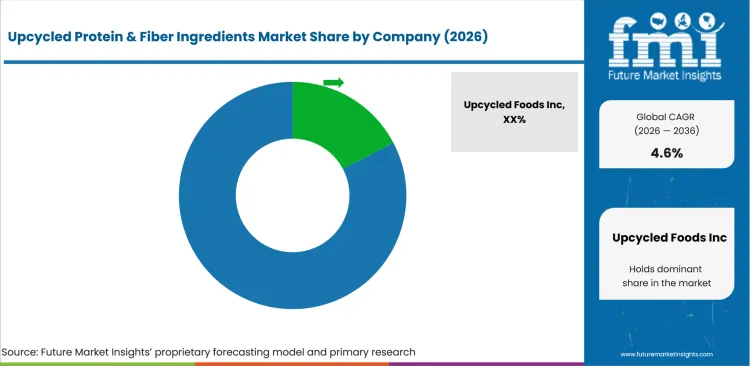
The competitive outlook combines multi-source ingredient platforms with companies that control one recovered feedstock and a specialized extraction route. In September 2025, Revyve announced Series B financing to expand commercial yeast-protein output and international sales. In May 2025, Alfa Laval documented EverGrain's commercial barley-protein process and confirmed integrated separation equipment at its Missouri facility. Related upcycled protein snacks give ingredient developers one application route for recovered nutrition beyond bakery staples. Broader dietary fiber demand supports testing across beverages and nutrition products without proving performance for every upcycled source.
- Upcycled Foods develops ingredients from brewer grain and wine-grape sidestreams for bakery and snack applications. UPP connects automated broccoli harvesting with ingredient production through a field-to-processing model that protects source continuity.
- COMET converts wheat crop leftovers into soluble arabinoxylan fiber for beverage and nutrition products across multiple commercial grades. EverGrain recovers barley protein from brewer spent grain through commercial separation and beverage-focused application support.
- Burcon operates several protein technologies across oilseed and pulse inputs through documented commercial production capability. Revyve uses upcycled yeast to replace egg texture functions across bakery and other defined food applications.
Competitive Benchmarking: Upcycled Protein & Fiber Ingredients Market
| Company | Source | Product | Process Integration | Geographic Reach |
|---|---|---|---|---|
| Upcycled Foods, Inc. | High | High | Medium | United States |
| UPP | Low | Medium | High | United Kingdom and Europe |
| COMET | Low | Medium | High | North America and Europe |
| EverGrain | Low | Low | High | United States with international customer reach |
| Burcon NutraScience Corporation | High | High | High | North America with global customer programs |
| Revyve | Low | Medium | High | Europe, North America, and Australia |
Key Developments in the Upcycled Protein & Fiber Ingredients Market
- In January 2025, COMET gained FODMAP Friendly certification for Arrabina through third-party testing of its low-FODMAP classification. The credential gives food developers a recognized ingredient option for sensitive-digestion formulations across beverages and nutrition products. Finished products require separate formulation and labeling review across each intended application and national sales route. Ingredient certification does not establish compliance or tolerance claims for every recipe and intended consumer group.
- In March 2025, Upcycled Foods introduced whole raisins from California wine-grape varieties through a partnership with The Wine RayZyn Company. The launch expanded its ingredient portfolio into dried fruit and created new options for bakery and snack formulations. Commercial use depends on stable sensory specifications across crop lots and the intended product format. Dried fruit handling also requires storage controls that preserve texture and flavor quality throughout commercial distribution.
- In April 2025, Burcon commissioned proprietary protein equipment at its Galesburg facility through its alliance with RE ProMan. The completed installation created a commercial manufacturing route for several high-purity proteins and reduced dependence on laboratory production. Food manufacturers require separate application trials for flavor and functionality across each intended formulation and processing method. Commercial output must also meet repeatability requirements across normal production lots and planned customer specifications.
- In October 2025, UPP received new investment from Elbow Beach to scale its Harvesta system and support planned Prota and Fiba launches. The development connects automated broccoli recovery with commercial ingredient production and strengthens source continuity for food manufacturers. Market progress depends on consistent specifications across seasonal biomass and repeatable qualification by commercial food manufacturers. Seasonal feedstock also requires blending controls that protect ingredient consistency across several production periods and customer batches.
Key Players in the Upcycled Protein & Fiber Ingredients Market
Circular Ingredient Platform Developers
- Upcycled Foods, Inc.
- UPP
Scaled Protein and Fiber Processors
- COMET
- EverGrain
- Burcon NutraScience Corporation
Application and Commercialization Specialist
- Revyve
Upcycled Protein & Fiber Ingredients Market - Report Scope
| Coverage field | Report scope |
|---|---|
| Market Breakdown | Source, Product, Application, and region. |
| Quantitative Units | USD Million, CAGR in %. |
| Market Definition | Revenue from commercially supplied protein and fiber ingredients produced from agricultural or food-processing sidestreams for human food applications. The scope excludes products limited to animal feed and finished foods that do not generate separable ingredient revenue. |
| Regions Covered | North America, Latin America, Western Europe, Eastern Europe, East Asia, South Asia and Pacific, and Middle East and Africa. |
| Countries Covered | UK, USA, Germany, Netherlands, France, and more than twenty-five additional countries across the regions covered. |
| Key Companies Profiled | Upcycled Foods, Inc.; UPP; COMET; EverGrain; Burcon NutraScience Corporation; and Revyve. |
| Forecast Period | 2026 to 2036. |
| Approach | Hybrid bottom-up and top-down sizing combines company activity with regulatory records and technical research relevant to upcycled ingredients. |
Upcycled Protein & Fiber Ingredients Market - Research Methodology
| Method | Approach |
|---|---|
| Primary Research | FMI analysts gathered input from manufacturers, service providers, technology developers, distributors, end users, procurement teams, and subject-matter experts. Interviews examined purchasing decisions, product or service evaluation, adoption barriers, approval requirements, pricing considerations, and expectations for technical or commercial support. Respondents were also asked what evidence is required before a trial, pilot, or initial order develops into regular purchasing. |
| Desk Research | Desk research covered government statistics, regulatory publications, trade data, industry associations, technical literature, standards, company filings, product information, and official corporate announcements. Sources were reviewed for relevance, publication date, geographic coverage, and consistency with the defined market scope. Claims relating to performance, applications, approvals, capacity, investment, and commercial activity were retained only when supported by credible public evidence. |
| Market Sizing and Forecasting | The market model combined the baseline value with historical performance, segment structure, pricing and volume indicators, adoption levels, company participation, and country-level demand conditions. Forecast assumptions considered economic activity, investment trends, regulatory developments, technology adoption, purchasing cycles, supply availability, and barriers to wider market use. Segment and regional estimates were reconciled before the final market total was calculated. |
| Data Validation | Estimates were checked against multiple independent indicators, including public data, company activity, trade patterns, industry developments, and findings from primary interviews. Validation also tested whether products, services, applications, and company revenues fell within the defined market boundaries. Adjacent categories, unsupported claims, overlapping revenues, and activities without direct market relevance were excluded to reduce double counting and maintain consistency across segments and countries. |
Upcycled Protein & Fiber Ingredients Market by Segments
Upcycled Protein & Fiber Ingredients Market segmented by Source:
- Broccoli Biomass
- Brassica
- Pulses
- Cereal Bran
Upcycled Protein & Fiber Ingredients Market segmented by Product:
- Protein Concentrate
- Fiber
Upcycled Protein & Fiber Ingredients Market segmented by Application:
- Bakery
- Snacks
- Meat Alt
Upcycled Protein & Fiber Ingredients Market by Region:
- North America
- United States
- Canada
- Latin America
- Brazil
- Mexico
- Argentina
- Chile
- Western Europe
- Germany
- France
- United Kingdom
- Italy
- Spain
- Benelux
- Nordics
- Eastern Europe
- Poland
- Czech Republic
- Romania
- Hungary
- East Asia
- China
- Japan
- South Korea
- South Asia and Pacific
- India
- ASEAN
- Australia and New Zealand
- Middle East and Africa
- GCC Countries
- South Africa
- Türkiye
- Israel
Research Sources and Bibliography
- Elbow Beach. (2026, March 31). UPP Partners with East of Scotland Growers to Transform Broccoli Waste into Commercially Valuable Plant Protein.
- European Parliament and Council of the European Union. (2015, November 25). Regulation (EU) 2015/2283 of the European Parliament and of the Council of 25 November 2015 on novel foods, amending Regulation (EU) No 1169/2011 and repealing Regulation (EC) No 258/97 and Commission Regulation (EC) No 1852/2001.
- USA Food and Drug Administration. (2018, September 20). Determining the Regulatory Status of a Food Ingredient.
- European Commission. (2025, March 12). Sustainable extraction of BRAssica by-products for innovative VEgetable ingredients.
- Burcon NutraScience Corporation. (2025, January 8). Burcon Launches Groundbreaking Sunflower Protein Isolate.
- Upcycled Foods, Inc. (2025, March 3). UPCYCLED FOODS, INC. AND MISFITS MARKET LAUNCH FIRST UPCYCLED BREADS FOR GROCER’S PRIVATE LABEL.
- COMET. (2025, July 18). IFT First 2025: Comet Bio unveils Arrabina L for modern functional foods.
- European Commission. (2026, February 20). Commission Implementing Regulation (EU) 2026/386 of 20 February 2026 authorising the placing on the market of defatted rapeseed powder as a novel food and amending Implementing Regulation (EU) 2017/2470.
- European Commission. (2025, May 25). Transforming Agri-Food By-Products into High-Nutritional Value, Sustainable Proteins and Ingredients.
- Food Standards Agency. (2025, April 1). Reforms to the market authorisation process for regulated products come into force.
- USA Environmental Protection Agency. (2026, January 20). Wasted Food Scale.
- German Federal Statistical Office. (2026, February 26). Holdings, agricultural area, yield and harvest volume.
- Federal Ministry of Food and Agriculture. (2025, April 9). Kompetenzstelle gegen Lebensmittelverschwendung geht an den Start.
- Netherlands Enterprise Agency. (2025, December 16). Apparatuur voor de winning van blad-eiwit.
- Netherlands Food and Consumer Product Safety Authority. (2025, November 5). Handboek Nieuwe voedingsmiddelen.
- Ministère de l’Agriculture, de l’Agro-alimentaire et de la Souveraineté alimentaire. (2025, October 13). Infographie - Le gaspillage alimentaire.
- Revyve. (2025, September 23). Revyve Secures €24 Million Funding to Boost Egg-Replacing Yeast Proteins.
- Alfa Laval. (2025, May 19). Here for the beer: upcycling sustainable protein from brewer’s spent grain.
- COMET. (2025, January 21). ARRABINA® GAINS FODMAP FRIENDLY CERTIFICATION.
- Upcycled Foods, Inc. (2025, March 27). UPCYCLED FOODS, INC. DIVERSIFIES INGREDIENT PORTFOLIO WITH FIRST LINE OF UPCYCLED WHOLE RAISINS FOR COMMERCIAL MARKET.
- Burcon NutraScience Corporation. (2025, April 1). Burcon Integrates Protein Technologies at Galesburg Facility.
- Elbow Beach. (2025, October 23). £1.5M Investment in Food-Tech Pioneer, UPP.
This bibliography is provided for reader reference and is not exhaustive. The full report contains the complete reference list and detailed citations.
This Report Answers
- How large is the Upcycled Protein & Fiber Ingredients Market during 2026 and at the end of the forecast period?
- Which production and regulatory pressures support investment across upcycled protein and fiber ingredient supply chains?
- Why is broccoli biomass projected to capture the largest source share during 2026?
- Why is protein concentrate forecast to represent the largest product share during 2026?
- Why is bakery estimated to capture the largest application share during 2026?
- How do country growth rates differ across the UK, USA, Germany, Netherlands, and France?
- Which companies provide ingredient platforms and extraction scale with application support across the competitive field?
- Which factors restrict customer qualification and commercial scale-up across unfamiliar sidestream ingredients?
- Which technical and commercial tests support approval of larger recurring orders?
Frequently Asked Questions
How big is the Upcycled Protein & Fiber Ingredients Market in 2026?
The upcycled protein & fiber ingredients market is valued at USD 1222.9 million in 2026 and is forecast to reach USD 1917.4 million by 2036, reflecting growing demand from food processors converting segregated agricultural and food-processing sidestreams into saleable nutrition ingredients across bakery, snack, and meat alternative applications.
What is the CAGR of the Upcycled Protein & Fiber Ingredients Market from 2026 to 2036?
The upcycled protein & fiber ingredients market is projected to grow at a CAGR of 4.6% between 2026 and 2036, supported by food processors creating ingredient value from nutritious sidestreams that otherwise enter disposal routes or low-value outlets across established food manufacturing systems.
Which product leads the Upcycled Protein & Fiber Ingredients Market?
Protein concentrate accounts for 61.3% of the upcycled protein & fiber ingredients market by product in 2026, driven by measurable nutrition fortification across food and beverage formulations and compact shipping economics that simplify dosage during formulation trials and support consistent protein claims across commercial recipes.
Which country segment is growing fastest in the Upcycled Protein & Fiber Ingredients Market?
The Netherlands is the fastest-growing country segment in the upcycled protein & fiber ingredients market, expanding at a 6.7% CAGR through 2036, ahead of the market average of 4.6%, enabled by fiscal equipment incentives covering 45% MIA and 75% Vamil support for qualifying leaf-protein extraction systems and compact agri-food logistics.
Who are the leading companies in the Upcycled Protein & Fiber Ingredients Market?
Leading companies in the upcycled protein & fiber ingredients market include Upcycled Foods Inc., UPP, COMET, EverGrain, Burcon NutraScience Corporation, and Revyve, competing across circular ingredient platforms, scaled protein and fiber processing operations, and application commercialization programs for human food use.
Preview the report firsthand - request a free sample
Get SampleGet the brochure for pricing and purchase details.
Get PDFTable of Content
- Key Takeaways
- Market Size and CAGR
- Top Growth Driver
- Fastest Growing Segment
- Leading Region
- Key Companies
- Emerging Opportunities
- Executive Summary
- Global Market Outlook
- Demand-side Trends
- Supply-side Trends
- Technology Roadmap Analysis
- Analysis and Recommendations
- Analyst Perspective (What is happening? Why now? What should investors know?)
- Key Questions Answered
- How large is the market?
- What is the CAGR?
- What are key trends?
- Which region dominates?
- Who are the leaders?
- Market Overview
- Market Coverage / Taxonomy
- Market Definition / Scope / Limitations
- Research Methodology
- Chapter Orientation
- Analytical Lens and Working Hypotheses
- Market Structure, Signals, and Trend Drivers
- Benchmarking and Cross-market Comparability
- Market Sizing, Forecasting, and Opportunity Mapping
- Research Design and Evidence Framework
- Desk Research Programme (Secondary Evidence)
- Expert Input and Fieldwork (Primary Evidence)
- Tooling, Models, and Reference Databases
- Data Engineering and Model Build
- Quality Assurance and Audit Trail
- Market Background
- Market Dynamics (Drivers, Restraints, Opportunity, Trends)
- Scenario Forecast (Optimistic, Likely, Conservative)
- Impact Analysis
- AI Impact
- Sustainability Impact
- Regulatory Impact
- Technology Impact
- Consumer / Buyer Analysis
- Purchase Drivers
- Adoption Barriers
- Buyer Journey
- Opportunity Map Analysis
- Product Life Cycle Analysis
- Supply Chain Analysis
- Investment Feasibility Matrix
- Value Chain Analysis
- PESTLE and Porter's Analysis
- Regulatory Landscape
- Regional Parent Market Outlook
- Production and Consumption Statistics
- Import and Export Statistics
- Global Market Analysis and Forecast, 2021 to 2036
- Historical Market Size Value (USD Million) Analysis, 2021 to 2025
- Current and Future Market Size Value (USD Million) Projections, 2026 to 2036
- Y-o-Y Growth Trend Analysis
- Absolute $ Opportunity Analysis
- Global Market Pricing Analysis, 2021 to 2036
- Global Market Analysis and Forecast, By Source, 2021 to 2036
- Introduction / Key Findings
- Historical Market Size Value (USD Million) Analysis By Source, 2021 to 2025
- Current and Future Market Size Value (USD Million) Analysis and Forecast By Source, 2026 to 2036
- Broccoli Biomass
- Brassica
- Pulses
- Cereal Bran
- Broccoli Biomass
- Y-o-Y Growth Trend Analysis By Source, 2021 to 2025
- Absolute $ Opportunity Analysis By Source, 2026 to 2036
- Global Market Analysis and Forecast, By Product, 2021 to 2036
- Introduction / Key Findings
- Historical Market Size Value (USD Million) Analysis By Product, 2021 to 2025
- Current and Future Market Size Value (USD Million) Analysis and Forecast By Product, 2026 to 2036
- Protein Concentrate
- Fiber
- Protein Concentrate
- Y-o-Y Growth Trend Analysis By Product, 2021 to 2025
- Absolute $ Opportunity Analysis By Product, 2026 to 2036
- Global Market Analysis and Forecast, By Application, 2021 to 2036
- Introduction / Key Findings
- Historical Market Size Value (USD Million) Analysis By Application, 2021 to 2025
- Current and Future Market Size Value (USD Million) Analysis and Forecast By Application, 2026 to 2036
- Bakery
- Snacks
- Meat Alt
- Bakery
- Y-o-Y Growth Trend Analysis By Application, 2021 to 2025
- Absolute $ Opportunity Analysis By Application, 2026 to 2036
- Global Market Analysis and Forecast, By Region, 2021 to 2036
- Introduction
- Historical Market Size Value (USD Million) Analysis By Region, 2021 to 2025
- Current Market Size Value (USD Million) Analysis and Forecast By Region, 2026 to 2036
- North America
- Latin America
- Western Europe
- Eastern Europe
- East Asia
- South Asia and Pacific
- Middle East & Africa
- Market Attractiveness Analysis By Region
- North America Market Analysis and Forecast, By Country, 2021 to 2036
- Historical Market Size Value (USD Million) Trend Analysis By Market Taxonomy, 2021 to 2025
- Market Size Value (USD Million) Forecast By Market Taxonomy, 2026 to 2036
- By Country
- USA
- Canada
- By Source
- By Product
- By Application
- By Country
- Market Attractiveness Analysis
- By Country
- By Source
- By Product
- By Application
- Key Takeaways
- Latin America Market Analysis and Forecast, By Country
- Historical Market Size Value (USD Million) Trend Analysis By Market Taxonomy, 2021 to 2025
- Market Size Value (USD Million) Forecast By Market Taxonomy, 2026 to 2036
- By Country
- Brazil
- Mexico
- Chile
- Rest of Latin America
- By Source
- By Product
- By Application
- By Country
- Market Attractiveness Analysis
- By Country
- By Source
- By Product
- By Application
- Key Takeaways
- Western Europe Market Analysis and Forecast, By Country
- Historical Market Size Value (USD Million) Trend Analysis By Market Taxonomy, 2021 to 2025
- Market Size Value (USD Million) Forecast By Market Taxonomy, 2026 to 2036
- By Country
- Germany
- UK
- Italy
- Spain
- France
- Nordic
- BENELUX
- Rest of Western Europe
- By Source
- By Product
- By Application
- By Country
- Market Attractiveness Analysis
- By Country
- By Source
- By Product
- By Application
- Key Takeaways
- Eastern Europe Market Analysis and Forecast, By Country
- Historical Market Size Value (USD Million) Trend Analysis By Market Taxonomy, 2021 to 2025
- Market Size Value (USD Million) Forecast By Market Taxonomy, 2026 to 2036
- By Country
- Russia
- Poland
- Hungary
- Balkan & Baltic
- Rest of Eastern Europe
- By Source
- By Product
- By Application
- By Country
- Market Attractiveness Analysis
- By Country
- By Source
- By Product
- By Application
- Key Takeaways
- East Asia Market Analysis and Forecast, By Country
- Historical Market Size Value (USD Million) Trend Analysis By Market Taxonomy, 2021 to 2025
- Market Size Value (USD Million) Forecast By Market Taxonomy, 2026 to 2036
- By Country
- China
- Japan
- South Korea
- By Source
- By Product
- By Application
- By Country
- Market Attractiveness Analysis
- By Country
- By Source
- By Product
- By Application
- Key Takeaways
- South Asia and Pacific Market Analysis and Forecast, By Country
- Historical Market Size Value (USD Million) Trend Analysis By Market Taxonomy, 2021 to 2025
- Market Size Value (USD Million) Forecast By Market Taxonomy, 2026 to 2036
- By Country
- India
- ASEAN
- Australia & New Zealand
- Rest of South Asia and Pacific
- By Source
- By Product
- By Application
- By Country
- Market Attractiveness Analysis
- By Country
- By Source
- By Product
- By Application
- Key Takeaways
- Middle East & Africa Market Analysis and Forecast, By Country
- Historical Market Size Value (USD Million) Trend Analysis By Market Taxonomy, 2021 to 2025
- Market Size Value (USD Million) Forecast By Market Taxonomy, 2026 to 2036
- By Country
- Kingdom of Saudi Arabia
- Other GCC Countries
- Türkiye
- South Africa
- Other African Union
- Rest of Middle East & Africa
- By Source
- By Product
- By Application
- By Country
- Market Attractiveness Analysis
- By Country
- By Source
- By Product
- By Application
- Key Takeaways
- Key Countries Market Analysis
- USA
- Pricing Analysis
- Market Share Analysis, 2025
- By Source
- By Product
- By Application
- Canada
- Pricing Analysis
- Market Share Analysis, 2025
- By Source
- By Product
- By Application
- Mexico
- Pricing Analysis
- Market Share Analysis, 2025
- By Source
- By Product
- By Application
- Brazil
- Pricing Analysis
- Market Share Analysis, 2025
- By Source
- By Product
- By Application
- Chile
- Pricing Analysis
- Market Share Analysis, 2025
- By Source
- By Product
- By Application
- Germany
- Pricing Analysis
- Market Share Analysis, 2025
- By Source
- By Product
- By Application
- UK
- Pricing Analysis
- Market Share Analysis, 2025
- By Source
- By Product
- By Application
- Italy
- Pricing Analysis
- Market Share Analysis, 2025
- By Source
- By Product
- By Application
- Spain
- Pricing Analysis
- Market Share Analysis, 2025
- By Source
- By Product
- By Application
- France
- Pricing Analysis
- Market Share Analysis, 2025
- By Source
- By Product
- By Application
- India
- Pricing Analysis
- Market Share Analysis, 2025
- By Source
- By Product
- By Application
- ASEAN
- Pricing Analysis
- Market Share Analysis, 2025
- By Source
- By Product
- By Application
- Australia & New Zealand
- Pricing Analysis
- Market Share Analysis, 2025
- By Source
- By Product
- By Application
- China
- Pricing Analysis
- Market Share Analysis, 2025
- By Source
- By Product
- By Application
- Japan
- Pricing Analysis
- Market Share Analysis, 2025
- By Source
- By Product
- By Application
- South Korea
- Pricing Analysis
- Market Share Analysis, 2025
- By Source
- By Product
- By Application
- Russia
- Pricing Analysis
- Market Share Analysis, 2025
- By Source
- By Product
- By Application
- Poland
- Pricing Analysis
- Market Share Analysis, 2025
- By Source
- By Product
- By Application
- Hungary
- Pricing Analysis
- Market Share Analysis, 2025
- By Source
- By Product
- By Application
- Kingdom of Saudi Arabia
- Pricing Analysis
- Market Share Analysis, 2025
- By Source
- By Product
- By Application
- Türkiye
- Pricing Analysis
- Market Share Analysis, 2025
- By Source
- By Product
- By Application
- South Africa
- Pricing Analysis
- Market Share Analysis, 2025
- By Source
- By Product
- By Application
- USA
- Market Structure Analysis
- Competition Dashboard
- Competition Benchmarking
- Market Share Analysis of Top Players
- By Regional
- By Source
- By Product
- By Application
- Emerging Startups
- Innovation Benchmarking
- Competition Analysis
- Competition Deep Dive
- Upcycled Foods Inc
- Overview
- Product Portfolio
- Profitability by Market Segments
- Sales Footprint
- Strategy Overview
- Marketing Strategy
- Product Strategy
- Channel Strategy
- Renewal Mill
- Comet Bio
- ReGrained
- The Supplant Company
- Planetarians
- Upcycled Foods Inc
- Case Studies
- Success Stories
- Recent Developments
- Competition Deep Dive
- Assumptions & Acronyms Used


