

- Market Size (2026)
- USD 312.2 Bn
- Forecast (2036)
- USD 580.6 Bn
- CAGR (2026 to 2036)
- 6.4%
How big is Upcycled Food Ingredients Market in 2026?
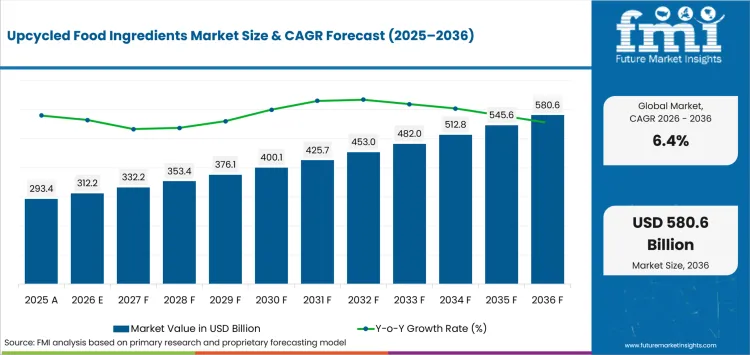
USD 312.2 billion in 2026 and USD 580.6 billion by 2036 at a 6.4% CAGR.
Sales of upcycled food ingredients are projected to rise at 6.4% CAGR through 2036, increasing valuation from USD 312.2 billion in 2026 to USD 580.6 billion by 2036. Food processors use food waste management systems to recover edible material early enough to prevent moisture loss or contamination from redirecting it toward animal feed and disposal. In February 2025, ReFED reported that food producers and businesses generated 21.5 million tons of surplus food annually and lost USD 108 billion in revenue. The loss creates a commercial reason to recover edible side streams although food-grade suitability requires separate safety and specification checks. Products from food waste gain repeat orders through stable specifications that remain dependable across storage and high-volume production.
Regulatory classification determines whether a side stream can enter food production without a new authorization or revised labeling dossier. In June 2025, the FDA updated its food-labeling compliance program for domestic and imported products. The program directs inspectors toward truthful ingredient declarations and current labeling requirements across regulated food facilities. European manufacturers face separate novel-food tests for materials without an established history of consumption in recognized food applications. Product developers must align clean-label ingredients with legal use and stable sensory performance across commercial recipes.
Key Takeaways of Upcycled Food Ingredients Market
- Demand for upcycled food ingredients is driven by food processors stabilizing edible side streams into dependable food-grade specifications, with retailer commitments supporting ingredient demand once manufacturers prove repeatable formulation performance across regular production runs.
- Brewer's spent grain holds the leading share at 38.0% in 2026, attributable to recurring brewery output and established bakery use, with nearby collection routes reducing transport time and protecting usable material quality.
- Protein leads the ingredient category at 45.0% share in 2026, driven by measurable nutrition fortification across food and beverage products where separate proof for moisture control and flavor consistency is required across routine customer production conditions.
- Bakery accounts for 38.0% application share in 2026, supported by familiar equipment and visible finished-product performance across commercial formulation programs requiring consistent shelf stability.
- Canada and the Netherlands form the upper growth pair through agricultural feedstock availability and concentrated processing networks, while the USA and UK occupy the middle range through established formulation capacity and structured food-safety oversight.
- Competition spans source specialists and scaled ingredient manufacturers, with Circular Grain and Agrain focusing on brewer-grain applications, EverGrain and Comet Bio pairing controlled conversion with documented specifications, and Renewal Mill and Upcycled Foods broadening portfolios through recovered plant materials and commercial formulation partnerships.
Analyst Perspective
"The upcycled food ingredients market is shifting from sustainability-led adoption toward performance-driven commercialization. Food manufacturers are evaluating ingredient consistency, processing compatibility, and sensory quality alongside environmental benefits. Companies that demonstrate reliable supply, standardized quality, and repeatable application performance will be better positioned to expand adoption across mainstream food and beverage formulations."
- Nandini Roy Choudhury, Principal Analyst at Future Market Insights
Source: FMI's proprietary forecasting model and primary research
How is the Upcycled Food Ingredients Market segmented?
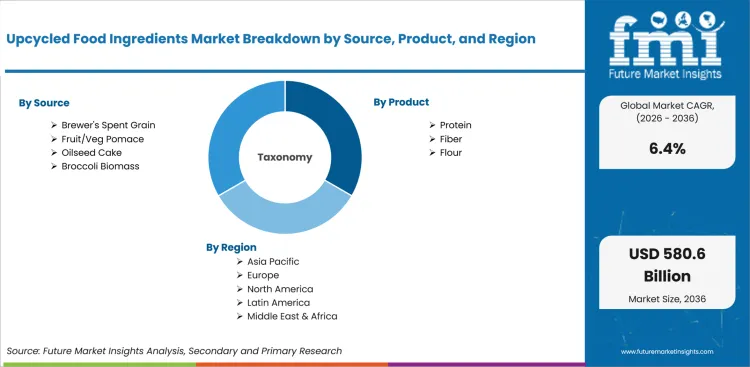
The upcycled food ingredients industry is segmented by source, product, application, and region.
The segmentation framework separates feedstock origin from ingredient format and final application requirements across commercial food manufacturing. Source analysis compares brewer's spent grain with fruit pomace and recoverable residues from established processing lines. Product categories distinguish protein and fiber specifications from flour formats used during formulation and commercial qualification. Application categories assess bakery and beverage use alongside snacks and dairy alternatives under representative production conditions. Each category therefore reflects a different control point for moisture stability and flavor performance across repeat production batches.
Why is brewer's spent grain central to the source category?
Wet brewer's spent grain deteriorates rapidly outside brewery processing and requires immediate moisture reduction during commercial collection. In March 2025, Upcycled Foods and Misfits Market launched two private-label breads containing ReGrained SuperGrain+. The launch established a commercial bakery route for spent-grain material through a national grocery partner. Processors must preserve food-grade traceability and roasted flavor throughout drying and milling operations at commercial production scale.
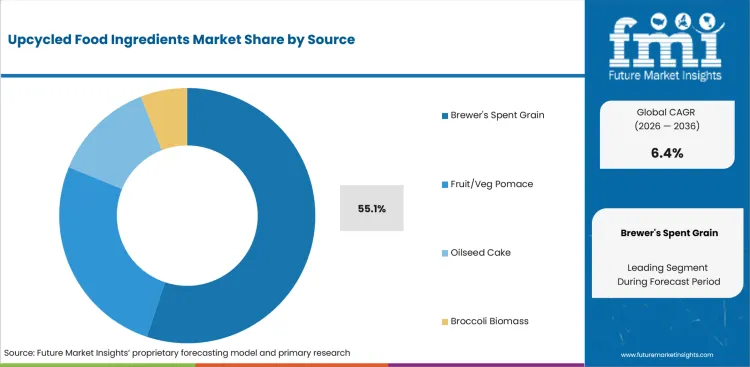
- Brewer's spent grain is set to lead the source category with 55.1% share in 2026 due to recurring brewery output and established bakery demand. Concentrated brewing sites support predictable collection schedules and reduce raw-material variation across regular commercial production batches. Commercial bread launches also lower formulation uncertainty for manufacturers evaluating a new recovered grain source.
- Food developers use brewer's spent grain for roasted flavor and insoluble dietary fiber enrichment across breads and savory snacks. Milling controls help manage particle size and water absorption across repeated dough and extrusion trials. Sites without nearby drying capacity face weaker texture and shorter ingredient life as moisture variation increases during storage.
Why is protein central to the product category?
Protein approval depends on amino-acid quality and dispersibility together with flavor across beverages and baked foods. Food manufacturers also need stable protein concentration across repeated production lots and established customer applications. The Food Standards Agency register updated in April 2025 lists EverGrain's partially hydrolyzed spent-barley and rice protein as authorized in Great Britain. The entry provides a defined legal route across several food categories and identifies required allergen labeling for plant-based protein formulations.
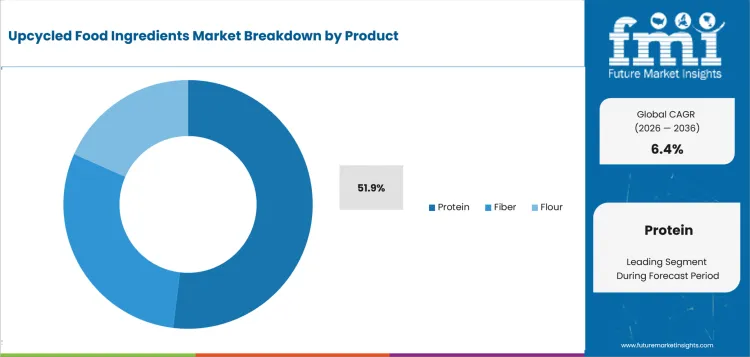
- By product, protein is forecast to represent 51.9% share in 2026 driven by nutrition fortification across food and beverage formulations. The format provides measurable protein content across drinks and bakery products without major equipment changes. Stable specifications help manufacturers compare substitution levels against conventional concentrates throughout formal commercial qualification programs.
- Food manufacturers approve upcycled protein through heat-treatment trials that measure texture and flavor across the intended shelf life. Dispersibility determines whether powders enter existing mixing systems without sediment or excessive processing time across complete production runs. Adoption slows if protein concentration varies between lots or requires costly masking across high-volume commercial recipes.
Why is bakery central to the application category?
Bakery production provides a controlled route for introducing upcycled flour and fiber through familiar mixing and baking operations. A dry format can enter established storage and dosing systems without changing every recipe stage. Manufacturers can test inclusion levels through standard dough controls and finished-product reviews across commercial production runs. In December 2025, Agrain detailed a spent-grain dry sourdough series for commercial bakers seeking consistent flavor and handling. The development combines fermentation with established bakery ingredients across routine commercial storage and dosing operations.
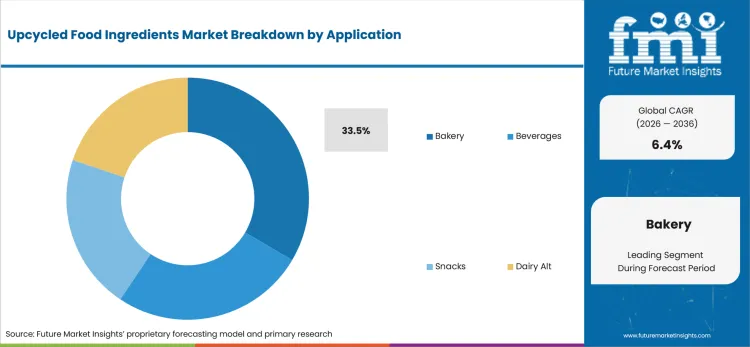
- The application category is forecast to be led by bakery at 33.5% share in 2026 due to measurable substitution rates and familiar production methods. Standard dough tests let manufacturers compare water absorption and finished texture against existing production controls across repeated runs. Visible product outcomes support clearer review during commercial range extensions and formulation changes across familiar bakery categories.
- Commercial bakeries expand upcycled ingredient use through trials that measure dough strength and line tolerance under routine conditions. Standard particle size and moisture targets reduce operating adjustments between shifts and across separate commercial production sites. Strong roasted notes can limit inclusion rates in familiar breads that require stable flavor and consumer texture.
What are the drivers, restraints, and opportunities in the Upcycled Food Ingredients Market?
Food manufacturers gain saleable value from stable side streams; contamination risk raises conversion costs; local processing creates openings for application-specific ingredients.
- Driver: Food manufacturers seek saleable ingredients from side streams that already contain useful protein or fiber for commercial formulations.
- Restraint: Variable moisture and contamination risk increase stabilization costs and extend qualification across regulated food applications.
- Opportunity: Application-specific processing can convert overlooked residues into differentiated ingredients with clearer specifications and recurring commercial demand.
Waste-reduction commitments pressure food manufacturers to recover edible side streams instead of sending usable material toward disposal. In February 2026, WRAP reported that 88% of participating businesses had established a food-waste reduction target. The same report found that 59% of participating businesses reduced food waste against their established baseline year. Upcycled functional food ingredients connect measured waste reduction with saleable formulation value across established production systems. Long-term orders require feedstock contracts that define quality and output expectations across regular commercial operating periods.
Moisture variation and pathogen risk constrain ingredients derived from wet residues that deteriorate without controlled stabilization. Small processors often lack validated drying capacity near original food production sites and accessible testing laboratories. In January 2025, the FDA issued draft sanitation guidance for low-moisture ready-to-eat foods following contamination events. The guidance emphasizes sanitation programs and environmental monitoring throughout affected facilities and connected production areas. Ingredient developers need batch records that connect raw-material handling with final food specifications during qualification.
Distributed conversion systems create an opening for agricultural side streams that lose value during long transport or delayed stabilization. The commercial case depends on local processing capacity and confirmed demand within the same regional supply chain. The European Commission signed the PRIMARY project agreement in April 2025 and scheduled operations from May 2025. The project develops local upcycling routes for underused feedstocks through rural businesses and cooperative processing. Successful models must prove food-grade performance so local production can support recurring ingredient orders across established customer accounts.
Which country CAGRs are profiled in the Upcycled Food Ingredients Market?
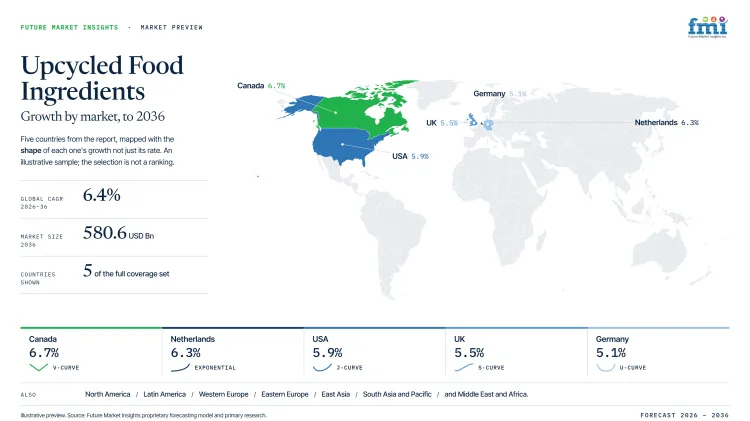
| Country | CAGR |
|---|---|
| USA | 5.9% |
| UK | 5.5% |
| Germany | 5.1% |
| Netherlands | 6.3% |
| Canada | 6.7% |
How do country-level CAGRs compare in the Upcycled Food Ingredients Market?
Canada and the Netherlands form the upper growth pair across the profiled country outlook. The USA and UK follow within a narrower middle band and Germany closes the comparison range. The 1.6 percentage-point spread reflects different commercialization speeds rather than differences in absolute market revenue. Equal 0.4-point gaps between every adjacent rate create a gradual pattern without a sharp separation between country groups. The pattern reflects differences in food-law classification and processing density rather than a simple regional divide.
- Canada records a 0.4 percentage-point gap over the Netherlands and combines broad agricultural residues with established cereal and oilseed processing capacity.
- The Netherlands remains 0.4 points above the USA and benefits from compact logistics across concentrated food-manufacturing clusters.
- The USA maintains a 0.4-point advantage over the UK through wider ingredient-development networks and contract manufacturing capacity.
- The UK remains 0.4 points above Germany and combines retailer collaboration with concentrated food-manufacturing partnerships.
- Germany follows the UK by 0.4 percentage points and faces longer qualification routes for unfamiliar residues despite dense brewing and bakery networks.
Comparable growth rates can conceal different authorization costs and feedstock economics across national manufacturing clusters. Ingredient developers should compare service distance and local partnership depth during production-capacity planning for each country. The full report provides country-level CAGR analysis across North America, Latin America, Europe, East Asia, South Asia, Oceania and the Middle East and Africa.
Country-wise Analysis
- FDA preventive-control inspections require United States food manufacturers to document hazard analysis and sanitation programs across commercial facilities. The FDA listed Preventive Controls and Sanitary Human Food Operations with a May 7, 2025 implementation date. Upcycled food ingredient demand in the USA is forecast to rise at 5.9% CAGR over the forecast period, supported by extensive processing capacity and recoverable side streams. Contract manufacturers and application laboratories can qualify bakery or beverage formulations near major production clusters. Wet feedstocks lose economic value across long transport routes and smaller facilities face expensive testing. Projects therefore need nearby drying capacity and technical service routes that preserve food-grade records across regular production.
- Great Britain requires authorization for novel ingredients without an established history of food use under retained food law. Adoption of upcycled food ingredients in the UK is estimated to expand at 5.5% CAGR through 2036, influenced by concentrated manufacturing and retail networks. In April 2025, the Food Standards Agency made its novel-food register the primary public source for authorized products in Great Britain. Dietary fibers provide a familiar formulation route for recovered plant material across bakery and nutrition applications. Separate authorization work can delay projects that depend on new residues or variable seasonal feedstocks. Local developers also need dependable drying partners to protect wet material during collection and transportation.
- Germany applies European food law alongside a national waste strategy that covers processing and downstream food operations. The federal food ministry reported 1.6 million tonnes of annual food waste from processing in April 2025. Upcycled food ingredient sales in Germany are forecast to expand at 5.1% CAGR by 2036, shaped by mature food processing and strict documentation. Dense brewing and bakery networks provide nearby feedstocks and application partners for technical validation across regional production clusters. Energy-intensive drying can weaken project economics for smaller plants that lack shared processing infrastructure or dependable heat recovery. Novel-food reviews also extend launch schedules for unfamiliar source materials across regulated commercial food applications.
- Compact Dutch logistics connect food processors with national waste-measurement programs across closely spaced manufacturing clusters. Upcycled food ingredient demand in the Netherlands is predicted to advance at 6.3% CAGR through 2036, enabled by concentrated production and short transport routes. Plant-based food applications provide familiar routes for recovered proteins and fibers through established development networks. Official data from the Dutch government placed processing at about one-third of national food waste in September 2025. The same release recorded self-monitoring across more than 130 businesses operating throughout the national food chain. Small individual feedstock volumes can restrict dependable contracts outside major processing clusters and established collection networks.
- Canadian processors coordinate food-safety records across long distances between farms and regional commercial manufacturing facilities. Agriculture and Agri-Food Canada placed processing at 49% of national food loss and waste in December 2025. Protein-rich meal streams support specialized fractionation projects across cereal and oilseed regions with recurring commercial output. The Canadian upcycled food ingredients sector is projected to record 6.7% CAGR during the assessment period, supported by broad agricultural feedstock availability. Long service distances raise maintenance and transport costs for smaller conversion sites operating beyond established processing corridors. Uneven access to food-grade fractionation equipment also limits projects outside established cereal and oilseed processing regions.
Who are the notable companies in the Upcycled Food Ingredients Market?
Circular Grain, EverGrain (AB InBev), Renewal Mill, Upcycled Foods, Inc. (ReGrained brand), Comet Bio, Agrain (Circular Food Technology ApS), and MOA Foodtech (MOA Biotech, S.L.) are the notable companies shaping this market.
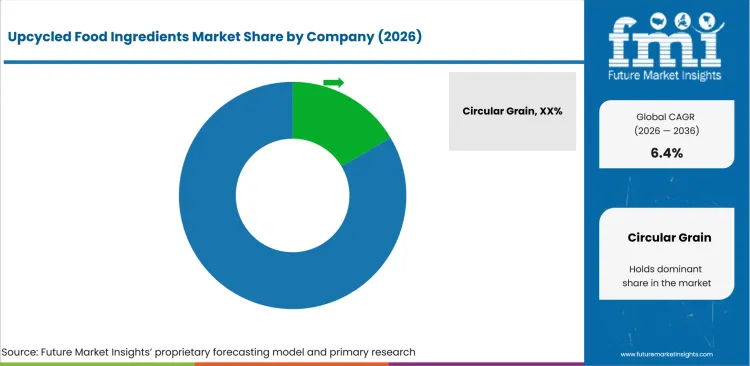
The competitive field combines source specialists with scaled ingredient manufacturers and application partners across several food categories. In May 2025, Alfa Laval confirmed that EverGrain remains wholly owned by AB InBev and produces EverPro from spent grain. Specialists such as Circular Grain and Agrain remain closer to application-specific scale-up than groups with established industrial production. The competitive range extends from pilot commercialization to recurring ingredient supply across regulated commercial food applications. Commercial strength depends on feedstock continuity and repeatable performance under normal manufacturing conditions across customer production sites.
- Circular Grain develops a brewer-grain beverage while Agrain supplies spent-grain flour and sourdough formats for bakery applications. MOA Foodtech (MOA Biotech, S.L.) develops fermentation routes for varied agri-food byproducts through ingredient and process-development programs. Each company competes through a distinct conversion route with application evidence tied to its chosen side stream.
- EverGrain combines AB InBev's brewing network with commercial barley protein production in the United States. Comet Bio converts wheat crop residues into certified prebiotic fiber for commercial food and beverage formulations. Both groups compete through precise specifications and technical support for recurring manufacturing volumes across several application categories.
- Renewal Mill manages several upcycled flour and fiber formats with application support for food manufacturers. Upcycled Foods operates the ReGrained brand and adds ingredients from fruit and other agricultural side streams. Both companies use launches and partner projects to demonstrate ingredient performance across familiar commercial food categories.
Competitive Benchmarking: Upcycled Food Ingredients Market
| Company | Source | Product | Process Integration | Geographic Reach |
|---|---|---|---|---|
| Circular Grain | Low | Low | Low | Germany pilot and European accelerator |
| EverGrain (AB InBev) | Medium | Medium | High | United States and Great Britain |
| Renewal Mill | High | High | High | United States commercial market |
| Upcycled Foods, Inc. (ReGrained brand) | High | High | High | United States commercial market |
| Comet Bio | Medium | Medium | Medium | North American commercial market |
| Agrain (Circular Food Technology ApS) | Low | Medium | Medium | Denmark and selected European markets |
| MOA Foodtech (MOA Biotech, S.L.) | Medium | Low | Medium | Spain and European scale-up program |
Key Developments in the Upcycled Food Ingredients Market
- In March 2025, Upcycled Foods introduced three whole-raisin ingredients produced from recovered California wine grapes for commercial formulations. The portfolio expansion added a fruit side stream with defined uses across bakery and snack products. Manufacturers gained a recognizable dried-fruit format that supports sweetness and texture without a new processing platform. The launch also broadened sourcing beyond spent grain and created another commercially recognized recovery route.
- In June 2026, Circular Grain joined Amazon's Sustainability Accelerator with a brewer-grain milk alternative developed for consumer products. The nine-week program provides commercial guidance and access to Amazon's European customer network for structured product testing. The selection takes its brewer-grain conversion route beyond technical validation toward broader consumer-market testing across Europe. Scale-up depends on dependable grain collection and consistent sensory performance across repeated commercial beverage production.
- In July 2025, Comet Bio unveiled Arrabina L for lighter commercial food and beverage applications. The fully soluble upcycled wheat fiber format extends the Arrabina line into lemonade and snack-bar formulations that require neutral taste and reliable functionality. Food developers gain another application-specific option for adding prebiotic fiber through established commercial mixing systems. Commercial qualification requires product-level dose and sensory testing across each intended finished food and beverage formulation.
- In February 2025, MOA Foodtech's legal entity MOA Biotech was selected for European Innovation Council support to transform agri-food byproducts into protein ingredients. The selection strengthens funding for technology scale-up and commercial development across fermentation-based food ingredient programs. Food manufacturers gain another route for converting variable side streams into standardized functional material for commercial formulations. Industrial economics depend on source composition and reliable production volumes across each targeted commercial application.
Key Players in the Upcycled Food Ingredients Market
Core Technology and Ingredient Developers
- Circular Grain
- Agrain (Circular Food Technology ApS)
- MOA Foodtech (MOA Biotech, S.L.)
Scaled Manufacturing and Supply Groups
- EverGrain (AB InBev)
- Comet Bio
Application and Commercialization Specialists
- Renewal Mill
- Upcycled Foods, Inc. (ReGrained brand)
Upcycled Food Ingredients Market - Report Scope
| Coverage field | Report scope |
|---|---|
| Market breakdown | Source, product, application, and region. |
| Quantitative Units | Revenue in USD Billion, CAGR in %. |
| Market Definition | Revenue from food-grade ingredients produced by recovering edible side streams from established food and beverage processing. The scope includes the named source, product, and application categories and excludes finished foods without a direct ingredient conversion role. |
| Regions Covered | North America, Latin America, Western Europe, Eastern Europe, East Asia, South Asia and Pacific, and Middle East and Africa. |
| Countries Covered | USA, UK, Germany, Netherlands, Canada, plus more than twenty-five additional countries across the regions covered. |
| Key Companies Profiled | Circular Grain, EverGrain (AB InBev), Renewal Mill, Upcycled Foods, Inc. (ReGrained brand), Comet Bio, Agrain (Circular Food Technology ApS), and MOA Foodtech (MOA Biotech, S.L.). |
| Forecast Period | 2026 to 2036. |
| Approach | Hybrid bottom-up and top-down market sizing supported by primary interviews and official desk research. |
Upcycled Food Ingredients Market - Research Methodology
| Method | Approach |
|---|---|
| Primary Research | FMI analysts gathered input from manufacturers, service providers, technology developers, distributors, end users, procurement teams, and subject-matter experts. Interviews examined purchasing decisions, product or service evaluation, adoption barriers, approval requirements, pricing considerations, and expectations for technical or commercial support. Respondents were also asked what evidence is required before a trial, pilot, or initial order develops into regular purchasing. |
| Desk Research | Desk research covered government statistics, regulatory publications, trade data, industry associations, technical literature, standards, company filings, product information, and official corporate announcements. Sources were reviewed for relevance, publication date, geographic coverage, and consistency with the defined market scope. Claims relating to performance, applications, approvals, capacity, investment, and commercial activity were retained only when supported by credible public evidence. |
| Market Sizing and Forecasting | The market model combined the baseline value with historical performance, segment structure, pricing and volume indicators, adoption levels, company participation, and country-level demand conditions. Forecast assumptions considered economic activity, investment trends, regulatory developments, technology adoption, purchasing cycles, supply availability, and barriers to wider market use. Segment and regional estimates were reconciled before the final market total was calculated. |
| Data Validation | Estimates were checked against multiple independent indicators, including public data, company activity, trade patterns, industry developments, and findings from primary interviews. Validation also tested whether products, services, applications, and company revenues fell within the defined market boundaries. Adjacent categories, unsupported claims, overlapping revenues, and activities without direct market relevance were excluded to reduce double counting and maintain consistency across segments and countries. |
Upcycled Food Ingredients Market by Segments
Upcycled Food Ingredients Market segmented by Source:
- Brewer's Spent Grain
- Fruit/Veg Pomace
- Oilseed Cake
- Broccoli Biomass
Upcycled Food Ingredients Market segmented by Product:
- Protein
- Fiber
- Flour
Upcycled Food Ingredients Market segmented by Application:
- Bakery
- Beverages
- Snacks
- Dairy Alt
Upcycled Food Ingredients Market by Region:
- North America
- United States
- Canada
- Latin America
- Brazil
- Mexico
- Argentina
- Chile
- Western Europe
- Germany
- France
- United Kingdom
- Italy
- Spain
- Benelux
- Nordics
- Eastern Europe
- Poland
- Czech Republic
- Romania
- Hungary
- East Asia
- China
- Japan
- South Korea
- South Asia and Pacific
- India
- ASEAN
- Australia and New Zealand
- Middle East and Africa
- GCC Countries
- South Africa
- Türkiye
- Israel
Research Sources and Bibliography
- Agriculture and Agri-Food Canada. (2025, December 11). Question Period Note: FOOD WASTE.
- Agrain. (2025, December 1). Tradition Meets Innovation with Agrain's Spent Grain Dry Sourdough.
- Alfa Laval. (2025, May 19). Here for the beer: upcycling sustainable protein from brewer’s spent grain.
- Amazon. (2026, June 10). Meet the nine start-ups joining Amazon's Sustainability Accelerator to reshape everyday consumer products.
- Bundesministerium für Ernährung und Landwirtschaft. (2025, April 9). Kompetenzstelle gegen Lebensmittelverschwendung geht an den Start.
- Comet Bio. (2025, July 18). IFT First 2025: Comet Bio unveils Arrabina L for modern functional foods.
- European Commission. (2025, April 25). New business for farmers and cooperatives in rural areas by local upcycling solutions using underutilized agricultural feedstocks.
- European Innovation Council. (2025, February 17). EIC Accelerator - 71 companies selected in the most competitive funding round so far.
- Food Standards Agency. (2025, April 1). Guidance on using the Register of Novel Food Authorisations.
- Food Standards Agency. (2025, April 1). Partially hydrolysed protein from spent barley (Hordeum vulgare) and rice (Oryza sativa).
- Government of the Netherlands. (2025, September 4). Voedselverspilling gedaald met 17% sinds 2015.
- ReFED. (2025, February 25). Food Waste Remains Stubbornly High Despite Signs of Progress, According to New ReFED Report.
- USA Food and Drug Administration. (2025, January). Draft Guidance for Industry: Establishing Sanitation Programs for Low-Moisture Ready-to-Eat Human Foods and Taking Corrective Actions Following a Pathogen Contamination Event.
- USA Food and Drug Administration. (2025, June 24). FDA Updates General Food Labeling Requirements Compliance Program.
- USA Food and Drug Administration. (2025, May 7). Food Compliance Programs.
- Upcycled Foods, Inc. (2025, March 3). UPCYCLED FOODS, INC. AND MISFITS MARKET LAUNCH FIRST UPCYCLED BREADS FOR GROCER’S PRIVATE LABEL.
- Upcycled Foods, Inc. (2025, March 27). UPCYCLED FOODS, INC. DIVERSIFIES INGREDIENT PORTFOLIO WITH FIRST LINE OF UPCYCLED WHOLE RAISINS FOR COMMERCIAL MARKET.
- WRAP. (2026, February 19). UK Food and Drink Pact Annual Progress Report 2024-25.
This bibliography is provided for reader reference and is not exhaustive. The full report contains the complete reference list and detailed citations.
This Report Answers
- How large is the upcycled food ingredients market in 2026 and 2036?
- Which operating pressures support investment in upcycled ingredient processing?
- Why does Brewer's Spent Grain hold the largest Source share in 2026?
- Why does Protein account for the largest Product share in 2026?
- How does Bakery support commercial adoption across the Application category?
- How do country growth rates differ across the five profiled national markets?
- Which companies convert food side streams into commercial ingredients through specialized source and application strategies?
- What limits commercial scale across wet residues and variable raw materials?
- How do certification and application support improve repeat purchasing?
Frequently Asked Questions
How big is the Upcycled Food Ingredients Market in 2026?
The upcycled food ingredients market is valued at USD 312.2 billion in 2026 and is forecast to reach USD 580.6 billion by 2036, reflecting growing demand from food manufacturers recovering edible side streams to generate saleable protein and fiber ingredients across bakery, beverage, and snack applications.
What is the CAGR of the Upcycled Food Ingredients Market from 2026 to 2036?
The upcycled food ingredients market is projected to grow at a CAGR of 6.4% between 2026 and 2036, supported by food manufacturers seeking saleable ingredients from side streams that already contain useful protein or fiber for commercial formulations across established production systems.
Which product leads the Upcycled Food Ingredients Market?
Protein accounts for 45.0% of the upcycled food ingredients market by product in 2026, driven by measurable nutrition fortification across food and beverage formulations and stable specifications that allow manufacturers to compare substitution levels against conventional concentrates throughout formal commercial qualification programs.
Which country segment is growing fastest in the Upcycled Food Ingredients Market?
Canada is the fastest-growing country segment in the upcycled food ingredients market, expanding at a 6.7% CAGR through 2036, ahead of the market average of 6.4%, supported by broad agricultural feedstock availability and protein-rich meal streams enabling specialized fractionation projects across cereal and oilseed processing regions.
Who are the leading companies in the Upcycled Food Ingredients Market?
Leading companies in the upcycled food ingredients market include Circular Grain, EverGrain (AB InBev), Renewal Mill, Upcycled Foods Inc. (ReGrained brand), Comet Bio, Agrain (Circular Food Technology ApS), and MOA Foodtech (MOA Biotech, S.L.), competing across source-specific conversion routes, scaled manufacturing platforms, and application commercialization programs.
Preview the report firsthand - request a free sample
Get SampleGet the brochure for pricing and purchase details.
Get PDFTable of Content
- Key Takeaways
- Market Size and CAGR
- Top Growth Driver
- Fastest Growing Segment
- Leading Region
- Key Companies
- Emerging Opportunities
- Executive Summary
- Global Market Outlook
- Demand-side Trends
- Supply-side Trends
- Technology Roadmap Analysis
- Analysis and Recommendations
- Analyst Perspective (What is happening? Why now? What should investors know?)
- Key Questions Answered
- How large is the market?
- What is the CAGR?
- What are key trends?
- Which region dominates?
- Who are the leaders?
- Market Overview
- Market Coverage / Taxonomy
- Market Definition / Scope / Limitations
- Research Methodology
- Chapter Orientation
- Analytical Lens and Working Hypotheses
- Market Structure, Signals, and Trend Drivers
- Benchmarking and Cross-market Comparability
- Market Sizing, Forecasting, and Opportunity Mapping
- Research Design and Evidence Framework
- Desk Research Programme (Secondary Evidence)
- Expert Input and Fieldwork (Primary Evidence)
- Tooling, Models, and Reference Databases
- Data Engineering and Model Build
- Quality Assurance and Audit Trail
- Market Background
- Market Dynamics (Drivers, Restraints, Opportunity, Trends)
- Scenario Forecast (Optimistic, Likely, Conservative)
- Impact Analysis
- AI Impact
- Sustainability Impact
- Regulatory Impact
- Technology Impact
- Consumer / Buyer Analysis
- Purchase Drivers
- Adoption Barriers
- Buyer Journey
- Opportunity Map Analysis
- Product Life Cycle Analysis
- Supply Chain Analysis
- Investment Feasibility Matrix
- Value Chain Analysis
- PESTLE and Porter's Analysis
- Regulatory Landscape
- Regional Parent Market Outlook
- Production and Consumption Statistics
- Import and Export Statistics
- Global Market Analysis and Forecast, 2021 to 2036
- Historical Market Size Value (USD Billion) Analysis, 2021 to 2025
- Current and Future Market Size Value (USD Billion) Projections, 2026 to 2036
- Y-o-Y Growth Trend Analysis
- Absolute $ Opportunity Analysis
- Global Market Pricing Analysis, 2021 to 2036
- Global Market Analysis and Forecast, By Source, 2021 to 2036
- Introduction / Key Findings
- Historical Market Size Value (USD Billion) Analysis By Source, 2021 to 2025
- Current and Future Market Size Value (USD Billion) Analysis and Forecast By Source, 2026 to 2036
- Brewer's Spent Grain
- Fruit/Veg Pomace
- Oilseed Cake
- Broccoli Biomass
- Brewer's Spent Grain
- Y-o-Y Growth Trend Analysis By Source, 2021 to 2025
- Absolute $ Opportunity Analysis By Source, 2026 to 2036
- Global Market Analysis and Forecast, By Product, 2021 to 2036
- Introduction / Key Findings
- Historical Market Size Value (USD Billion) Analysis By Product, 2021 to 2025
- Current and Future Market Size Value (USD Billion) Analysis and Forecast By Product, 2026 to 2036
- Protein
- Fiber
- Flour
- Protein
- Y-o-Y Growth Trend Analysis By Product, 2021 to 2025
- Absolute $ Opportunity Analysis By Product, 2026 to 2036
- Global Market Analysis and Forecast, By Application, 2021 to 2036
- Introduction / Key Findings
- Historical Market Size Value (USD Billion) Analysis By Application, 2021 to 2025
- Current and Future Market Size Value (USD Billion) Analysis and Forecast By Application, 2026 to 2036
- Bakery
- Beverages
- Snacks
- Dairy Alt
- Bakery
- Y-o-Y Growth Trend Analysis By Application, 2021 to 2025
- Absolute $ Opportunity Analysis By Application, 2026 to 2036
- Global Market Analysis and Forecast, By Region, 2021 to 2036
- Introduction
- Historical Market Size Value (USD Billion) Analysis By Region, 2021 to 2025
- Current Market Size Value (USD Billion) Analysis and Forecast By Region, 2026 to 2036
- North America
- Latin America
- Western Europe
- Eastern Europe
- East Asia
- South Asia and Pacific
- Middle East & Africa
- Market Attractiveness Analysis By Region
- North America Market Analysis and Forecast, By Country, 2021 to 2036
- Historical Market Size Value (USD Billion) Trend Analysis By Market Taxonomy, 2021 to 2025
- Market Size Value (USD Billion) Forecast By Market Taxonomy, 2026 to 2036
- By Country
- USA
- Canada
- By Source
- By Product
- By Application
- By Country
- Market Attractiveness Analysis
- By Country
- By Source
- By Product
- By Application
- Key Takeaways
- Latin America Market Analysis and Forecast, By Country
- Historical Market Size Value (USD Billion) Trend Analysis By Market Taxonomy, 2021 to 2025
- Market Size Value (USD Billion) Forecast By Market Taxonomy, 2026 to 2036
- By Country
- Brazil
- Mexico
- Chile
- Rest of Latin America
- By Source
- By Product
- By Application
- By Country
- Market Attractiveness Analysis
- By Country
- By Source
- By Product
- By Application
- Key Takeaways
- Western Europe Market Analysis and Forecast, By Country
- Historical Market Size Value (USD Billion) Trend Analysis By Market Taxonomy, 2021 to 2025
- Market Size Value (USD Billion) Forecast By Market Taxonomy, 2026 to 2036
- By Country
- Germany
- UK
- Italy
- Spain
- France
- Nordic
- BENELUX
- Rest of Western Europe
- By Source
- By Product
- By Application
- By Country
- Market Attractiveness Analysis
- By Country
- By Source
- By Product
- By Application
- Key Takeaways
- Eastern Europe Market Analysis and Forecast, By Country
- Historical Market Size Value (USD Billion) Trend Analysis By Market Taxonomy, 2021 to 2025
- Market Size Value (USD Billion) Forecast By Market Taxonomy, 2026 to 2036
- By Country
- Russia
- Poland
- Hungary
- Balkan & Baltic
- Rest of Eastern Europe
- By Source
- By Product
- By Application
- By Country
- Market Attractiveness Analysis
- By Country
- By Source
- By Product
- By Application
- Key Takeaways
- East Asia Market Analysis and Forecast, By Country
- Historical Market Size Value (USD Billion) Trend Analysis By Market Taxonomy, 2021 to 2025
- Market Size Value (USD Billion) Forecast By Market Taxonomy, 2026 to 2036
- By Country
- China
- Japan
- South Korea
- By Source
- By Product
- By Application
- By Country
- Market Attractiveness Analysis
- By Country
- By Source
- By Product
- By Application
- Key Takeaways
- South Asia and Pacific Market Analysis and Forecast, By Country
- Historical Market Size Value (USD Billion) Trend Analysis By Market Taxonomy, 2021 to 2025
- Market Size Value (USD Billion) Forecast By Market Taxonomy, 2026 to 2036
- By Country
- India
- ASEAN
- Australia & New Zealand
- Rest of South Asia and Pacific
- By Source
- By Product
- By Application
- By Country
- Market Attractiveness Analysis
- By Country
- By Source
- By Product
- By Application
- Key Takeaways
- Middle East & Africa Market Analysis and Forecast, By Country
- Historical Market Size Value (USD Billion) Trend Analysis By Market Taxonomy, 2021 to 2025
- Market Size Value (USD Billion) Forecast By Market Taxonomy, 2026 to 2036
- By Country
- Kingdom of Saudi Arabia
- Other GCC Countries
- Türkiye
- South Africa
- Other African Union
- Rest of Middle East & Africa
- By Source
- By Product
- By Application
- By Country
- Market Attractiveness Analysis
- By Country
- By Source
- By Product
- By Application
- Key Takeaways
- Key Countries Market Analysis
- USA
- Pricing Analysis
- Market Share Analysis, 2025
- By Source
- By Product
- By Application
- Canada
- Pricing Analysis
- Market Share Analysis, 2025
- By Source
- By Product
- By Application
- Mexico
- Pricing Analysis
- Market Share Analysis, 2025
- By Source
- By Product
- By Application
- Brazil
- Pricing Analysis
- Market Share Analysis, 2025
- By Source
- By Product
- By Application
- Chile
- Pricing Analysis
- Market Share Analysis, 2025
- By Source
- By Product
- By Application
- Germany
- Pricing Analysis
- Market Share Analysis, 2025
- By Source
- By Product
- By Application
- UK
- Pricing Analysis
- Market Share Analysis, 2025
- By Source
- By Product
- By Application
- Italy
- Pricing Analysis
- Market Share Analysis, 2025
- By Source
- By Product
- By Application
- Spain
- Pricing Analysis
- Market Share Analysis, 2025
- By Source
- By Product
- By Application
- France
- Pricing Analysis
- Market Share Analysis, 2025
- By Source
- By Product
- By Application
- India
- Pricing Analysis
- Market Share Analysis, 2025
- By Source
- By Product
- By Application
- ASEAN
- Pricing Analysis
- Market Share Analysis, 2025
- By Source
- By Product
- By Application
- Australia & New Zealand
- Pricing Analysis
- Market Share Analysis, 2025
- By Source
- By Product
- By Application
- China
- Pricing Analysis
- Market Share Analysis, 2025
- By Source
- By Product
- By Application
- Japan
- Pricing Analysis
- Market Share Analysis, 2025
- By Source
- By Product
- By Application
- South Korea
- Pricing Analysis
- Market Share Analysis, 2025
- By Source
- By Product
- By Application
- Russia
- Pricing Analysis
- Market Share Analysis, 2025
- By Source
- By Product
- By Application
- Poland
- Pricing Analysis
- Market Share Analysis, 2025
- By Source
- By Product
- By Application
- Hungary
- Pricing Analysis
- Market Share Analysis, 2025
- By Source
- By Product
- By Application
- Kingdom of Saudi Arabia
- Pricing Analysis
- Market Share Analysis, 2025
- By Source
- By Product
- By Application
- Türkiye
- Pricing Analysis
- Market Share Analysis, 2025
- By Source
- By Product
- By Application
- South Africa
- Pricing Analysis
- Market Share Analysis, 2025
- By Source
- By Product
- By Application
- USA
- Market Structure Analysis
- Competition Dashboard
- Competition Benchmarking
- Market Share Analysis of Top Players
- By Regional
- By Source
- By Product
- By Application
- Emerging Startups
- Innovation Benchmarking
- Competition Analysis
- Competition Deep Dive
- Circular Grain
- Overview
- Product Portfolio
- Profitability by Market Segments
- Sales Footprint
- Strategy Overview
- Marketing Strategy
- Product Strategy
- Channel Strategy
- EverGrain (AB InBev)
- Renewal Mill
- ReGrained
- Upcycled Foods Inc
- Comet Bio
- Planetarians
- Circular Grain
- Case Studies
- Success Stories
- Recent Developments
- Competition Deep Dive
- Assumptions & Acronyms Used


