

- CAGR (2025 to 2035)
- 3.7%
Beer Dispensers Market Size, Market Forecast and Outlook By FMI
The beer dispensers market is expected to expand from USD 2.00 billion in 2025 to USD 2.90 billion by 2035. The market is projected to register a 3.7% CAGR during the forecast period. Single faucet dispensers are likely to lead faucet type with a 55.0% share in 2025, while household/residential applications are anticipated to account for 35.0% share of application demand in 2025.
Summary of the Beer Dispensers Market
- Demand and Growth Drivers
- Craft beer consumption is expected to increase demand for draft systems across bars and home entertainment spaces.
- Homebrewing interest is likely to support compact dispenser adoption among consumers seeking at-home draft service.
- Smart dispensing systems are anticipated to improve inventory control and pour consistency in commercial venues.
- Product and Segment View
- Single faucet dispensers are expected to lead faucet type due to compact installation and lower setup complexity.
- Household/residential applications are likely to remain important as consumers invest in home bar and kegerator systems.
- Digital beer dispensers are anticipated to gain wider use as operators adopt temperature control and keg tracking.
- Geography and Competitive Outlook
- South Korea is expected to lead country-level expansion as automated pouring systems and premium draft experiences gain traction.
- USA is likely to record steady growth as craft beer venues and home dispensing setups remain active.
- Companies with stronger IoT features and energy-efficient cooling systems are anticipated to improve their market position.
- Analyst Opinion
- Ronak Shah, Principal consultant for Consumer Product at FMI, suggests, “The beer dispensers market is likely to shift toward compact and smart dispensing systems that improve pour quality and reduce waste. Brands with reliable cooling, automatic cleaning, and digital monitoring features are expected to gain advantage as commercial venues and households seek easier draft beer service.”
- Beer Dispensers Market Value Analysis
- The beer dispensers market is moving from basic draft equipment into connected beverage service systems.
- Demand is likely to rise as bars and households seek consistent draft beer quality with lower spillage.
- Adoption is expected to gain support from single faucet units that fit small venues and residential spaces.
- Spending is anticipated to be backed by craft beer culture and wider use of smart dispenser technologies.
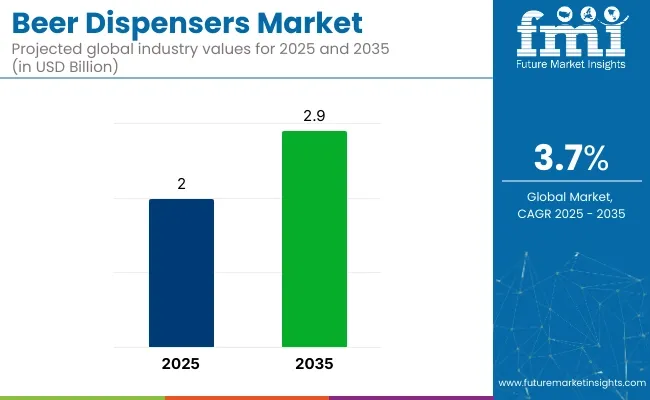
Key Takeaways, Market Size, and Forecast
| Metric | Value |
|---|---|
| Market Size (2025) | USD 2.00 Billion |
| Market Size (2035) | USD 2.90 Billion |
| CAGR (2025–2035) | 3.7% |
| Leading Faucet Type (2025) | Single Faucet Dispensers |
| Single Faucet Dispensers Share (2025) | 55.0% |
| Leading Application (2025) | Household/Residential Applications |
| Household/Residential Applications Share (2025) | 35.0% |
| Fastest-Growing Country | South Korea |
| South Korea CAGR | 4.0% |
| Metric | Value |
|---|---|
| Market Size in 2025 | USD 2.0 Billion |
| Projected Market Size in 2035 | USD 2.9 Billion |
| CAGR (2025 to 2035) | 3.7% |
On August 15, 2024, Micro Matic, a leading draft beer dispensing specialist, announced a partnership with BarTrack to launch the Smart Draft System powered by BarTrack-as per Craft Brewing Business . This integrated system combines Micro Matic’s dispensing hardware with BarTrack’s IoT sensors and analytics to monitor draft-line temperature, pressure, cleanliness, foam, keg levels, and system health in real time.
“The Smart Draft System is designed to give you peace of mind and protect your business,” stated Brett Danielson, CEO of BarTrack. This marks a significant step in elevating beer dispenser technology, enabling proactive maintenance and ensuring consistent pour quality-driving efficiency and profitability in bars and breweries.
As the beer dispensers market continues to expand, ongoing research and development efforts are expected to introduce more advanced solutions, further driving market growth and improving beer service efficiency in both commercial and home settings.
Certification Requirements in the Beer Dispenser Market
Certification Requirements in the Beer Dispenser Market
Certification plays a critical role in the beer dispenser market, ensuring that products meet essential safety, hygiene, and environmental standards. Various certifications are required depending on the region and product type, helping manufacturers gain consumer trust and regulatory approval. These certifications cover electrical safety, sanitation, energy efficiency, and the use of safe materials. Compliance with these standards is vital for market access and competitiveness. Together, they guarantee that beer dispensers are reliable, safe to use, environmentally friendly, and suitable for food and beverage applications across global markets.
- UL Certification: In North America, Underwriters Laboratories (UL) certification verifies that beer dispensers meet stringent electrical safety and performance standards.
- CE Marking: For products sold in the European Economic Area (EEA), CE marking ensures compliance with EU safety, health, and environmental protection regulations.
- NSF Certification: The National Sanitation Foundation (NSF) certification is essential for food and beverage equipment, confirming that beer dispensers meet strict sanitation and hygiene standards.
- Energy Star Certification: Some beer dispensers, particularly refrigerated units, require Energy Star certification to demonstrate energy efficiency and reduced environmental impact.
- RoHS Compliance: Restriction of Hazardous Substances (RoHS) certification ensures that beer dispensers do not contain harmful materials, supporting environmental and health safety.
Trade Landscape of the Beer Dispensers Market
The global trade of beer dispensers is driven by increasing demand from bars, restaurants, hotels, and home consumers seeking convenient and efficient beverage dispensing solutions. Key manufacturing hubs are located in regions with advanced industrial capabilities, supplying both domestic and international markets.
- Major Exporters: Countries such as China, Germany, and the United States lead in beer dispenser exports. China dominates due to its large manufacturing base and cost-effective production, while Germany and the U.S. focus on high-quality and technologically advanced products.
- Key Importers: Developed regions including North America, Europe, and Asia-Pacific import significant volumes of beer dispensers. These markets rely on imports to meet consumer demand and benefit from innovations introduced by leading manufacturers worldwide.
Analyzing Beer Dispensers Market by Top Investment Segments
The global beer dispensers market is anticipated to grow steadily from 2025 to 2035, fueled by rising demand for high-quality draft beer experiences across commercial and residential settings. Prominent segments include single faucet dispensers and household/residential applications, with key players such as Perlick Corporation, True Manufacturing, and Danby leading advancements in design, functionality, and energy efficiency.
Single Faucet Dispensers Gain Traction in Compact Installations
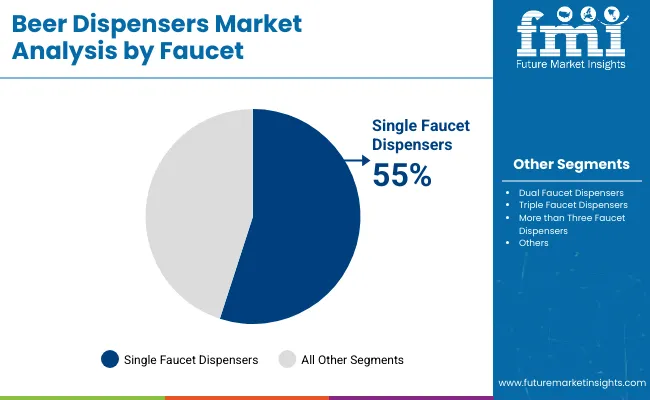
The single faucet dispensers segment is projected to hold 55.0% of the market share in 2025. Increasing demand for space-efficient and user-friendly dispensing solutions is driving growth in this segment, particularly within small bars, restaurants, and home entertainment spaces. These dispensers offer ease of installation, affordability, and versatility, making them ideal for venues with limited draft beer offerings or constrained counter space.
Leading manufacturers like Perlick Corporation and True Manufacturing are innovating single faucet designs with advanced cooling systems, adjustable flow controls, and energy-efficient components. The rising trend of craft beer consumption is also fueling demand for customizable single faucet units that cater to a wide variety of beer styles.
Furthermore, the growing popularity of at-home kegerators and countertop beer dispensers is expanding the consumer base for single faucet models, particularly in urban settings where space is at a premium. This segment is expected to maintain strong growth momentum, supported by evolving consumer preferences and product innovations.
Household/Residential Applications Drive Demand for At-Home Draft Experience
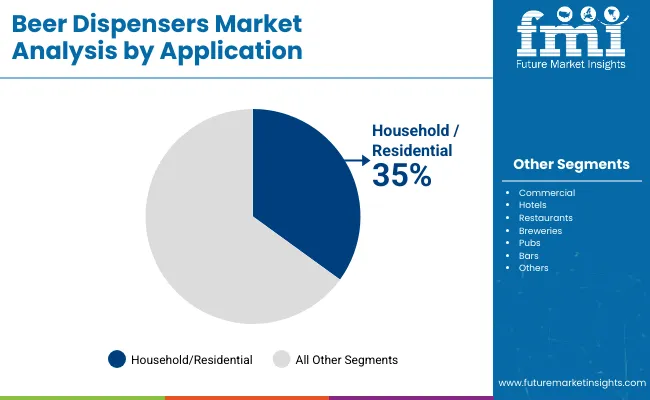
The household/residential segment is expected to capture 35.0% of the application segment market share in 2025. The surge in home-based entertainment and the increasing preference for premium draft beer experiences at home are key factors driving demand in this segment. Consumers are seeking compact, stylish, and easy-to-use beer dispensers that can seamlessly integrate into home kitchens, bars, and outdoor spaces.
Companies such as Danby and Krups are leading the residential beer dispenser market with innovative offerings that prioritize convenience, portability, and aesthetic appeal. Product innovations include compact countertop models, adjustable temperature controls, and compatibility with various keg sizes.
The growing trend of homebrewing is also fueling demand for dispensers that cater to small-batch craft beer enthusiasts. In addition, rising disposable incomes and lifestyle shifts toward personalized, high-quality at-home experiences are expected to further accelerate growth in this segment, making it a pivotal focus area for manufacturers targeting the beer dispensers market.
Challenges and Opportunities
Challenge
High Initial Investment and Maintenance Costs
High cost associated with the purchasing, installation and maintenance of dispensing systems is the major factor augmenting the growth of the beer dispensers market. These dedicated dispensing systems like kegerators, draft, and automated tap systems are too expensive for small breweries, bars, and restaurants to invest in because of the associated costs.
Moreover, routine maintenance, cleaning, and system calibration incur operational costs as specialized technicians are needed to ensure adherence to industry standards. Ongoing dogeomi: electricity (for consumption), wear (for equipment), and CO2 (for usage).
Manufacturers must deal with these issues by developing affordable, energy-efficient, and modular products that minimize the need for maintenance, incorporate automation, and offer scalable solutions for companies of different sizes.
Stringent Regulations and Compliance Requirements
Under constant scrutiny of the local health department, how they must meet sanitation standards, temperature control requirements, and alcohol distribution laws - just like any beer drinker on campus. There are rules in different areas around how draft beer is stored, kept clean and dispensed, making life difficult for manufacturers in multiple markets.
Vendors risk fines, losing the ability to do business, damage to reputation and potential lawsuits for failing to comply. Stringent regulations require those businesses to do regular audits and sanitation protocols and picturesque temperature monitoring systems.
To ensure compliance to local and international standards, companies need systems that self-clean, systems that monitor body temperature, automated regulatory-reporting features and cleaning systems and remote diagnostics systems.
Opportunity
Growing Demand for Smart and Automated Dispensing Solutions
Smart beer dispensers are increasingly becoming the hands of industry players, which is likely to be a key opportunity for the growth of the market. Automated and IOT-enabled dispensing systems provide pour precision, real-time inventory management, and cashless payment integration, allowing for increased operational efficiency over traditional bar-room dispensing systems for bar, restaurant and event spaces.
Subscribe to the Beer Edge Pro for the questions and answers behind this article, along with industry insights. Self-serve beer walls, voice-driven systems, and app-based ordering are changing the way consumers experience these products.
As the beer dispensing industry embraces this next generation of connected devices, organizations investing in user-friendly, energy-efficient solutions equipped with blockchain-based security and cloud-based inventory monitoring will be well positioned.
Expansion in Home Beer Dispensing and Craft Beer Culture
The increasing popularity of home brewing as well as the consumption of craft beer is expected to drive demand for personal beer dispensers, as well as high-quality draft experiences outside of traditional bars. Consumers are gradually looking for at-home kegerators, countertop dispensers, and compact draft systems to use for personal consumption, beer tasting events, and social gatherings.
Modern beer dispensers are utilizing features like smart home integration, voice activation and mobile app controls. This segment will be benefitted by manufacturers concentrating on personalizable, stylish and easy to use residential dispensing units incorporating energy efficient cooling systems.
Moreover, entering into strategic partnerships with craft breweries to create co-branded dispensers and exclusive beer subscription services will help strengthen brand loyalty and penetrate the market further.
Market Overview and Dynamics Demand for Beer Dispensers: The demand for Beer dispensers is on the rise, as more consumers turn to craft beer. Additional factors that were responsible for hindering the market growth include supply chain obstacles, high initial investments & costs, labor shortage, and changing regulatory frameworks.
Business enacted: Product durability, smart technology, keg tracking, and customizability for consumers and businesses. Growing in popularity were sustainable materials and recyclable keg packaging, in line with sustainability objectives and consumer desires for less environmental impact.
For 2025 to 2035: The market will observe more of AI-powered dispensing, eco-friendly refrigerants and sustainable draft system. The use of blockchain technology for inventory management, touchless pouring systems for cleanliness-minded consumers to avoid cross-contamination of their beer, and customizable flavor infusion dispensers will revolutionize the beer consumption experience.
Self-cleaning technology, mobile appcontrolled dispensers, smart temperature control, and energy-efficient cooling systems will also be some of the trends that will define the future of the Beer dispensers market.
There will be a universal need for sustainable sourcing, reduced CO2 emissions as well as automated cleaning systems for increased efficiency, cost savings and better user experiences in both commercial and residential applications.
Country-wise Outlook- Beer dispensers market
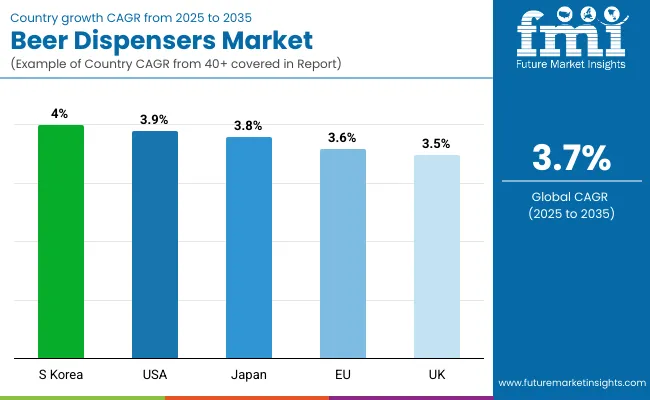
United States
The vast Craft Beer industry, rising demand for homemade beer dispensing systems, and increasing trend of self-serve beer taps in bars and restaurants contributed to the USA being the leading country in the Beer dispensers Market. Factors such as the dominance of major beverage equipment manufacturers, new milking products, innovation in dispensing technology also fuel the market growth.
Additionally, which is expected to help drive future market growth is the increasing demand for high-capacity dispensers, automated tap systems, and energy-efficient cooling mechanisms. Increasing popularity of technologically integrated IoT-enabled dispensers with features such as real-time monitoring and temperature control capabilities are augmenting end-user experience across commercial and residential spaces.
Moreover, organizations are also concentrating on carrying small and convenient beer dispensing appliances for home use, craving the soaring fad for home entertainment. Turbidization with the increase of breweries, beer festivals in the USA market.
Furthermore, strong growth in the demand for premium varieties of craft beer, as well as taproom experiences is further boosting adoption of advanced dispensing soland growing demand for draft beer at personal occasions is bolstering development in keg-primarily based dispensers.
| Country | CAGR (2025 to 2035) |
|---|---|
| USA | 3.9% |
United Kingdom
Growing pub culture, increasing demand for quality draft beer experiences is contributing towards beer dispensers market growth with the United Kingdom being one of the prominent markets during the forecast period. The demand has also been helped by the growing popularity of craft beer consumption and self-pour technology in bars.
The presence of government regulations promoting responsible alcohol dispensing, additionally for alternative serving solutions is the need of the hour further boosts the growth of the market. Additionally, the rise of nitrogen-infused beer dispensers and smart keg tracking systems are promising.
Brands are also working with more sustainable and CO2-efficient dispensing systems to hit sustainability targets. Demand in the UK’s Beer dispensers market is also benefitting from rising inclination for customizable and multi-tap dispensers for various styles of beer.
The grow-at-home boom and an uptick in beer subscription services and direct-to-consumer beer delivery are also sparking interest in at-home dispense solutions. Rising number of beer festivals and craft beer tasting events are driving the demand for portable and on-the-go dispensing system.
| Country | CAGR (2025 to 2035) |
|---|---|
| UK | 3.5% |
European Union
Top three countries in the European Beer dispensers market are Germany, France, and Italy which accounts for the dominating beer culture, higher consumption rates, and growing investments in the bar and restaurant infrastructure.
The quick growth of the market is attributed to the European Union's focus on the quality of premium draft beer, including the availability of new keg technologies and self-service dispensing solutions. The introduction of dispensers integrated with digital payments, pressurized tap systems, and efficient cooling technologies, is further driving the product innovation.
The popularity of beer tourism, the craft brewing industry, and mobile beer dispensing units, is also driving demand for flexible and high-performance beer dispensers.
Furthermore, the growing trend of automated pouring of beer in large-scale events and stadium will further boost the demand for modern beer dispensing technologies throughout the EU market. In addition, increasing trends of zero-waste beer dispensers and refillable kegs are aiding the product development towards sustainability.
| Country | CAGR (2025 to 2035) |
|---|---|
| European Union (EU) | 3.6% |
Japan
The Japan Beer dispensers Industry is thriving because of the country's commitment to precision engineering, demand for high-quality draft beer experiences, and advancements in self-pour technology. The market is influenced by the rising penetration of automated beer dispensing systems in restaurants and recreation sites.
Innovation is being propelled by the country’s concentration on technology and the use of foam control technology along with temperature-regulated tap systems. In addition, stringent government regulations regarding beverage quality and cleanliness are prompting companies to sponsor the manufacture of high-efficiency and contamination-free beer dispensers.
Japan's beverage industry is repeating market growth prophesy due to soaring demand for compact, counter-top beer dispensers for home and work. Moreover, the growing popularity of seasonal and limited-edition craft beers is propelling demand for dispensers that accommodate various keg sizes and beer styles.
For instance, introduction of contactless and cashless self-serve beer dispensers in leisure and recreational hubs and convenience stores is reconfiguring the market milieu.
| Country | CAGR (2025 to 2035) |
|---|---|
| Japan | 3.8% |
South Korea
It is estimated that South Korea is a significant beer dispenser market owing to its growing bar culture, automated beer pouring system demand, and increasingly popular premium draft beer experience.
The market is further driven due to favorable government regulations, which urge manufacturers to innovate their food and beverage offerings, and the expanding adoption of AI-enabled dispensing systems. Meanwhile, the nation's emphasis on efficiency, with advances in high-speed dispensing technology, customizable taps and nitrogen-infused beer dispensing, has made it more competitive.
Adoption in the market increasing due to rising demand for self-serve beer taps in entertainment districts, hotels, and event venues. They are implementing IoT-connected beer dispensers equipped with real-time analytics and maintenance monitoring.
In South Korea, the high demand for breweries is driven by rising home beer dispensing solutions and the impact of K-culture and experiential dining, which ultimately boosts the need for innovative beer dispensers in the country. Moreover, the rising trend of single-serve and automated mini-keg dispensers for personal use is driving growth in the premium beverage class.
| Country | CAGR (2025 to 2035) |
|---|---|
| South Korea | 4.0% |
Competitive Outlook
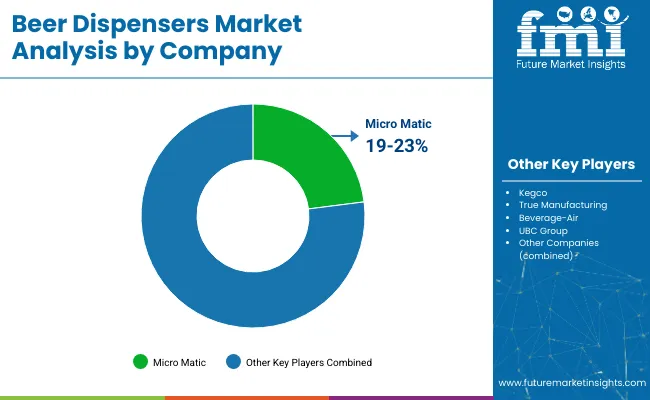
Beer dispensers market is growing owing to rising demand for draft beer solutions for bars, restaurants, and home entertainment venues.
To increase user convenience, firms are currently investing in smart dispensing technologies, energy-efficient cooling systems, and compact designs. Some key trends include nitrogen-infused beer dispensers, automated tap systems and eco-friendly kegs for sustainable dispensing.
Report Scope Table - Beer Dispensers Market
| Report Attributes | Details |
|---|---|
| Current Total Market Size (2025) | USD 2.0 billion |
| Projected Market Size (2035) | USD 2.9 billion |
| CAGR (2025 to 2035) | 3.7% |
| Base Year for Estimation | 2024 |
| Historical Period | 2020 to 2024 |
| Projections Period | 2025 to 2035 |
| Quantitative Units | USD billion for value and thousand units for volume |
| Segments by Keg Capacity | 1 Keg, 2 Kegs, 3 Kegs, 4 Kegs, >5 Kegs |
| Segments by Faucet Type | Single Faucet, Dual Faucet, Triple Faucet, More than Three Faucets |
| Applications Analyzed (Segment 3) | Household/Residential, Commercial, Hotels, Restaurants, Breweries, Pubs, Bars, Others |
| Sales Channels Analyzed (Segment 4) | Direct, Indirect (Hypermarkets/Supermarkets, Convenience Stores, Exclusive Stores, Multi-Brand Stores, Online Retailers, Other Sales Channels) |
| Regions Covered | North America; Latin America; Western Europe; Eastern Europe; South Asia and Pacific; East Asia; Middle East & Africa |
| Countries Covered | United States, Canada, Mexico, Brazil, Argentina, Germany, France, United Kingdom, Italy, Spain, Netherlands, China, India, Japan, South Korea, ANZ, GCC Countries, South Africa |
| Key Players influencing the Beer Dispensers Market | Micro Matic AS, Kegco Brewing & Draft, True Manufacturing Co. Inc., Beverage-Air, UBC Group, Beerjet GmbH, Lancer Worldwide, Celli Spa, Craig Industries Inc., Cydea Ltd., Danby Products, Felix Storch, Inc. |
| Additional Attributes | Sales trends across residential and commercial segments, Technological innovation in multi-faucet systems, E-commerce expansion in small appliance retail, Customization and draft performance in brewery installations |
Key Segmentation
By On Basis of the Kegs:
- 1 Keg
- 2 Kegs
- 3 Kegs
- 4 Kegs
- >5 Kegs
By On Basis of the Faucet:
- Single Faucet Dispensers
- Dual Faucet Dispensers
- Triple Faucet Dispensers
- More than Three Faucet Dispensers
By On Basis of the Application:
- Household/ Residential
- Commercial
- Hotels
- Restaurants
- Breweries
- Pubs
- Bars
- Others
By On Basis of Sales Channel:
- Direct
- Indirect
- Hypermarkets/ Supermarkets
- Convenience Stores
- Exclusive Stores
- Multi-Brand Stores
- Online Retailers
- Others Sales Channel
By Region:
- North America
- Latin America
- East Asia
- South Asia & Pacific
- Eastern Europe
- Western Europe
- Middle East & Africa
Frequently Asked Questions
What was the overall size of the Beer dispensers market in 2025?
The overall market size for Beer dispensers market was USD 2.0 Billion in 2025.
How big the Bio is based Beer dispensers market expected in 2035?
The Beer dispensers market expected to reach USD 2.9 Billion in 2035.
What will drive the demand for Beer dispensers market during the forecast period?
Growing home brewing and increasing demand for the draft beer in bars and restaurants, increasing focus on consumer preference towards experiences of freshness and on-tap beer, new developments in dispensing technology, and increasingly widespread craft beer cultural traits will drive the demand for the beer dispensers market.
List the top 5 countries contributing Beer dispensers market?
The top 5 countries which drives the development of Beer dispensers market are USA, UK, Europe Union, Japan and South Korea.
Which segment in type is expected to lead Beer dispensers market?
Faucet configuration growth to command significant share over the assessment period.
Preview the report firsthand - request a free sample
Get SampleGet the brochure for pricing and purchase details.
Get PDFTable of Content
- Executive Summary
- Industry Introduction, including Taxonomy and Market Definition
- Market Trends and Success Factors, including Macro-economic Factors, Market Dynamics, and Recent Industry Developments
- Global Market Demand Analysis 2020 to 2024 and Forecast 2025 to 2035, including Historical Analysis and Future Projections
- Pricing Analysis
- Global Market Analysis 2020 to 2024 and Forecast 2025 to 2035
- On Basis of the Kegs
- On Basis of the Faucet
- On Basis of the Application
- On Basis of Sales Channel
- Global Market Analysis 2020 to 2024 and Forecast 2025 to 2035, By On Basis of the Kegs
- 1 Keg
- 2 Kegs
- 3 Kegs
- 4 Kegs
- >5 Kegs
- Global Market Analysis 2020 to 2024 and Forecast 2025 to 2035, By On Basis of the Faucet
- Single Faucet Dispensers
- Dual Faucet Dispensers
- Triple Faucet Dispensers
- More than Three Faucet Dispensers
- Global Market Analysis 2020 to 2024 and Forecast 2025 to 2035, By On Basis of the Application
- Household/ Residential
- Commercial
- Hotels
- Restaurants
- Breweries
- Pubs
- Bars
- Others
- Global Market Analysis 2020 to 2024 and Forecast 2025 to 2035, By On Basis of Sales Channel
- Direct
- Indirect
- Hypermarkets/ Supermarkets
- Convenience Stores
- Exclusive Stores
- Multi-Brand Stores
- Online Retailers
- Others Sales Channel
- Global Market Analysis 2020 to 2024 and Forecast 2025 to 2035, By Region
- North America
- Latin America
- East Asia
- South Asia & Pacific
- Eastern Europe
- Western Europe
- Middle East & Africa
- North America Sales Analysis 2020 to 2024 and Forecast 2025 to 2035, by Key Segments and Countries
- Latin America Sales Analysis 2020 to 2024 and Forecast 2025 to 2035, by Key Segments and Countries
- East Asia Sales Analysis 2020 to 2024 and Forecast 2025 to 2035, by Key Segments and Countries
- South Asia & Pacific Sales Analysis 2020 to 2024 and Forecast 2025 to 2035, by Key Segments and Countries
- Eastern Europe Sales Analysis 2020 to 2024 and Forecast 2025 to 2035, by Key Segments and Countries
- Western Europe Sales Analysis 2020 to 2024 and Forecast 2025 to 2035, by Key Segments and Countries
- Middle East & Africa Sales Analysis 2020 to 2024 and Forecast 2025 to 2035, by Key Segments and Countries
- Sales Forecast 2025 to 2035 by On Basis of the Kegs, On Basis of the Faucet, On Basis of the Application, and On Basis of Sales Channel for 30 Countries
- Competition Outlook, including Market Structure Analysis, Company Share Analysis by Key Players, and Competition Dashboard
- Company Profile
- Beerjet GmbH
- Lancer Worldwide
- Celli Spa
- Kegco Brewing & Draft
- Micro Matic AS
- True Manufacturing Co. Inc.
- Craig Industries Inc.
- Cydea Ltd.
- Danby Products
- Felix Storch, Inc.


