

- Market Size (2026)
- USD 319.5 Mn
- Forecast (2036)
- USD 512.4 Mn
- CAGR (2026 to 2036)
- 4.8%
How big is Beverage Can Decorator Machines Market in 2026?
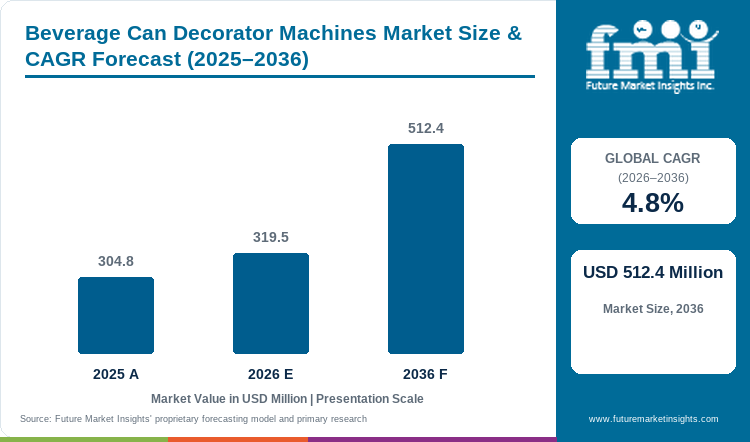
The beverage can decorator machines market is valued at USD 319.5 million in 2026 and is projected to reach USD 512.4 million by 2036, expanding at a CAGR of 4.8% over the 2026-2036 period.
The beverage can decorator machines market is valued at USD 319.5 million in 2026 and is projected to reach USD 512.4 million by 2036, expanding at a CAGR of 4.8% over the 2026-2036 period. The market was valued at USD 304.8 million in 2025. The estimate covers beverage-can decorators, basecoaters and major inker or control upgrades. Label applicators and digital print services are excluded unless delivered as part of the decorator equipment package.
Equipment demand follows the drink cans market, where printed aluminum cans carry brand graphics directly on the container. Decorator orders occur during a new line, a format conversion or a print-quality upgrade.
Key Takeaways
- The market sits at USD 319.5 million in 2026 and is projected to expand by USD 192.9 million over the decade, reaching USD 512.4 million by 2036.
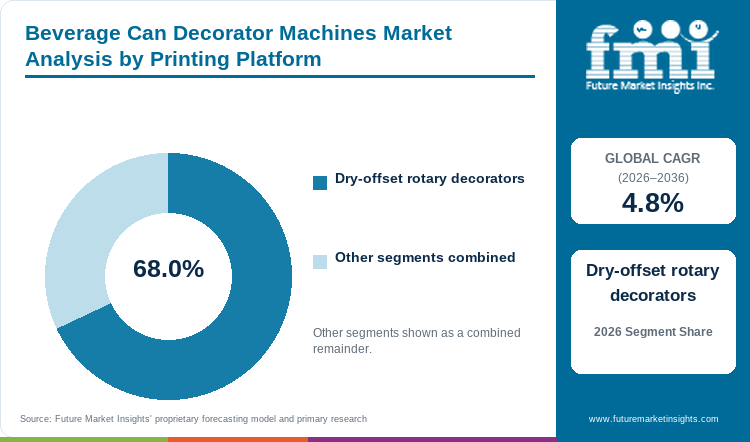
- Dry-offset rotary decorators are projected to account for 68.0% of printing platform demand in 2026, driven by their proven ability to deposit multi-color process inks at full line velocity.
- Print stations configured for eight colors and above will represent 45.0% of color capacity demand in 2026, matching brand owner requirements for complex promotional graphics, fine halftones, and regional SKU versioning.
- Decorators rated above 1,800 cans per minute are estimated to generate 49.0% of rated speed revenue in 2026, serving as the continuous downstream aggregation point for multiple upstream bodymaker banks.
- Operating at higher speeds with expanded color stations increases commercial vulnerability to print register drift, cross-color ink fountain contamination, and costly line stops for unscheduled blanket changes.
- Primary original equipment manufacturers and specialized engineering suppliers in this sector include Stolle Machinery, Koenig & Bauer MetalPrint, Hinterkopf, SLAC Precision Equipment, CarnaudMetalbox Engineering, Belvac, D.I.E.C., BW Integrated Systems, INX International, and Nordson.
Analyst Perspective
"Decorator value comes from saleable graphics per hour. Plants buy speed, but the business case closes only when registration, ink density and trip losses remain stable throughout the campaign."
- Nandini Roy Choudhury, Principal Consultant, Future Market Insights
How is the beverage can decorator machines market segmented?
The beverage can decorator machines market is segmented six ways: by printing platform, color capacity, rated speed, can format, demand type, and region. Dry-offset rotary decorators lead the printing platform category with 68.0% of 2026 revenue.
The global beverage can decorator machines market is segmented across six core operational dimensions: by printing platform into dry-offset rotary decorators, digital direct-to-can systems, hybrid print platforms, and basecoater-only systems; by color capacity into up to six colors, seven to eight colors, and nine colors and above; by rated speed into up to 1,200 cans per minute, 1,201 to 1,800 cans per minute, and above 1,800 cans per minute; by can format into standard cans, sleek cans, slim cans, and specialty shaped aluminum containers; by demand type into upgrades and rebuilds, greenfield line equipment, format conversion packages, and digital retrofit modules.
Why do dry-offset rotary decorators lead printing-platform demand?
Rotary dry-offset printing systems transfer multi-color graphics onto cylindrical can bodies in a single revolution at continuous line velocity. Packaging plants rely on this platform because ink formulations, photopolymer plate technologies, and operator maintenance competencies are already deeply entrenched across operating facilities.
- Dry-offset rotary decorators are estimated to account for 68.0% of printing platform demand in 2026 because the architecture reliably combines multi-color graphic registration with continuous high-speed can line output.
- Stolle Machinery documents industry-standard Rutherford and Concord decorator platforms engineered specifically for two-piece container printing.
What supports eight-color and higher configurations?
Beverage brand owners continue to expand graphic complexity, using expanded tonal ranges and promotional artwork variations directly on the metal container. Additional inking stations provide greater aesthetic flexibility, though they demand tighter registration controls and more intensive wash-up routines.
- Eight colors and above are estimated to account for 45.0% of color-capacity demand in 2026, driven by retail requirements for intricate brand graphics and regional SKU versioning.
- Stolle has commercialized and documented nine-color inker arrangements for its Rutherford decorator series to accommodate extended color gamuts without sacrificing line speed.
Why do machines above 1,800 cans per minute lead speed-category value?
Decorators act as the central downstream collection hub for multiple bodymaker and wash lines. High rated output prevents decorating stations from becoming line bottlenecks, while automated mandrel trip mechanisms discard defective or missing cans without interrupting continuous production flows.
- Machines rated above 1,800 cans per minute are estimated to generate 49.0% of rated speed revenue in 2026 because decorators must match the combined throughput of upstream forming banks.
- Published equipment specifications for Rutherford decorators demonstrate continuous production capabilities operating at up to 2,200 cans per minute.
How do standard and sleek cans shape format demand?
Standard container diameters provide predictable, high-volume production baselines, while sleek and slim profiles require adaptable tooling and frequent changeover procedures. Decorator commercial value is increasingly tied to mandrel wheel agility and automated can-handling systems that minimize downtime during format transitions.
- Standard and sleek beverage cans are estimated to represent 74.0% of can format demand in 2026, anchored by broad market adoption across beer, soft drinks, and ready-to-drink beverages.
- Beverage can manufacturers increasingly configure individual decorating lines to handle standard, sleek, and slim formats interchangeably from shared plant operations.
Why do upgrades and rebuilds lead demand type?
Cast decorator machine bases maintain operational integrity over decades, allowing plants to modernize inkers and overvarnish applicators independently. These modular retrofits significantly elevate graphic definition and reduce trip losses without requiring costly foundation rebuilds.
- Upgrades and rebuilds are estimated to capture 54.0% of demand-type spend in 2026, reflecting the cost efficiency of modular inker and control retrofits over complete greenfield frame installations.
- Stolle introduced a high-performance inker upgrade package for Rutherford decorators in 2025, specifically designed to enhance print quality and component life across existing machine installations.
What are the drivers, restraints and opportunities in the Beverage Can Decorator Machines Market?
- Driver: Canned beverage launches require direct-to-can printing capacity that keeps pace with front-end output.
- Restraint: More ink stations and design changes increase setup time, waste and operator skill requirements.
- Opportunity: High-performance inkers, camera inspection and digital modules can improve short-run flexibility on installed lines.
Expansion across the aluminum cans market directly multiplies both gross decorated can volumes and the number of active graphic iterations. Decorators frequently turn into plant bottlenecks whenever graphic changeovers outpace upstream forming and washing cycles.
Decorators often operate below nominal rated capacity due to ink rheology shifts, blanket wear, or registration drift, while frequent promotional swaps introduce wash-up delays and ink scrap. Consequently, procurement teams weigh setup duration and print spoilage just as heavily as headline cans-per-minute ratings.
Concurrently, capital investments across the wider metal containers market support the adoption of premium graphics and specialty shapes. Modular inker banks, automated plate mounting, and inline vision inspection systems allow converters to elevate print quality while preserving existing machine frames.
Which country CAGRs are profiled in the Beverage Can Decorator Machines Market?
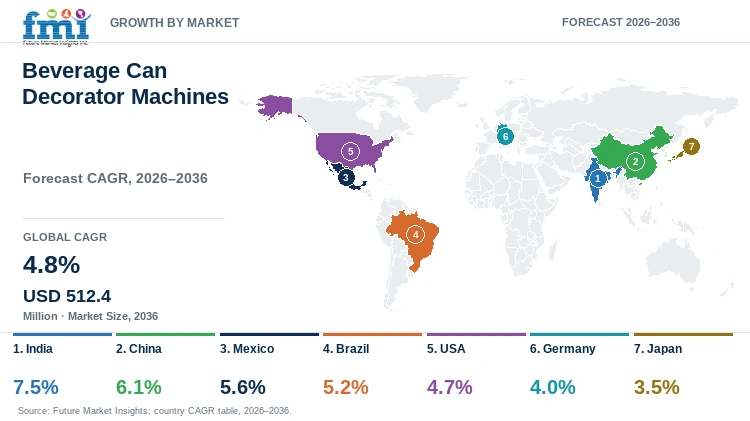
| Country | CAGR |
|---|---|
| India | 7.5% |
| China | 6.1% |
| Mexico | 5.6% |
| Brazil | 5.2% |
| USA | 4.7% |
| Germany | 4.0% |
| Japan | 3.5% |
How do country-level CAGRs compare in the Beverage Can Decorator Machines Market?
India and China lead global growth through aggressive container capacity expansion. Mexico and Brazil scale regional packaging footprints and graphic variety, while United States spending focuses on modular rebuilds. Germany and Japan target print precision, solvent reduction, and automated changeover control.
- India is expected to outpace Japan by 4.0 percentage points and China by 1.4 percentage points as new canmaking plants require dedicated high-speed decorating lines.
- China is projected to exceed Mexico by 0.5 percentage points and the USA by 1.4 percentage points as massive national output drives demand across new machinery and brownfield inker modernizations.
- Mexico is likely to run 0.4 percentage points ahead of Brazil and 0.9 percentage points ahead of the USA, sustained by regional container supply contracts for major multinational brands.
- Brazil is set to finish 0.5 percentage points above the USA and 1.2 percentage points over Germany, driven by continuous beer and energy drink can consumption.
- USA is anticipated to outpace Germany by 0.7 percentage points and Japan by 1.2 percentage points as an established manufacturing footprint directs investment toward inkers, vision systems, and drive upgrades.
- Germany is estimated to outperform Japan by 0.5 percentage points while trailing India by 3.5 percentage points, with procurement teams prioritizing VOC containment, resource efficiency, and registration accuracy.
- Japan is poised to trail the USA by 1.2 percentage points and the global leader India by 4.0 percentage points, with capital dedicated to ultra-precise color reproduction and versatile short-run tooling.
Country-wise Analysis
- India is forecast to grow at a 7.5% CAGR through 2036. Beverage brands are rapidly scaling canned product portfolios and introducing localized visual graphics. Plant operators focus procurement on equipment manufacturers providing reliable on-site commissioning, domestic plate support, and rapid inker servicing.
- China is forecast to grow at a 6.1% CAGR through 2036. Domestic machinery builders compete aggressively on machine pricing, while export-oriented container manufacturers invest in advanced registration controls and rapid-wash ink stations to minimize changeover downtime.
- Mexico is forecast to grow at a 5.6% CAGR through 2036. Facilities dedicated to major North American beverage contracts require highly repeatable color density, minimal ink splatter at high speeds, and fast campaign turnaround times.
- Brazil is forecast to grow at a 5.2% CAGR through 2036. Intensive promotional campaigns across beer and beverage segments place a premium on machine uptime, robust mechanical drives, and rapid artwork conversion capabilities.
- USA is forecast to grow at a 4.7% CAGR through 2036. A mature installed line base favors high-performance inker retrofits, digital register controls, and high-speed camera verification over full machine replacements.
- Germany is forecast to grow at a 4.0% CAGR through 2036. Environmental regulations regarding solvent emissions, energy efficiency, and waste reduction carry equal weight alongside mechanical registration tolerances during capital equipment reviews.
- Japan is forecast to grow at a 3.5% CAGR through 2036. Procurement activity focuses on exceptional graphic resolution, tight color consistency, and format flexibility within established factory floorplans.
Who are the notable companies in the Beverage Can Decorator Machines Market?
Direct market competition centers on manufacturers supplying complete decorator platforms and supported by global aftermarket service networks. Specialized component, ink, and system integrators influence overall line yield but occupy secondary tiers unless verified by public commercial evidence as complete decorator platform builders.
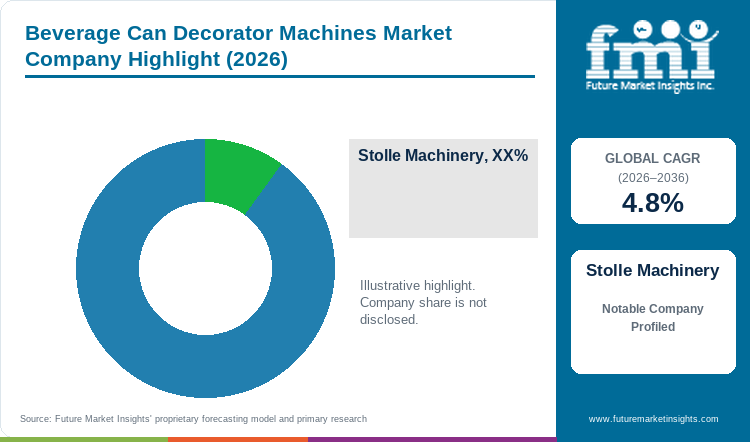
- Decorator platform suppliers include Stolle Machinery, Koenig & Bauer MetalPrint, Hinterkopf, and SLAC Precision Equipment, which manufacture complete high-speed rotary printing and direct-to-can machines.
- Can-line equipment and service providers encompass CarnaudMetalbox Engineering, Belvac, and D.I.E.C., delivering integrated line systems, engineering conversions, and dedicated technical field support.
- Ink and integration partners comprise BW Integrated Systems, INX International, and Nordson, providing essential process automation, specialized metal decorating inks, and precision overvarnish coating equipment.
Competitive Benchmarking: Beverage Can Decorator Machines Market
| Company | Direct Decorator Evidence | Multi-Color Capability | Aftermarket Support | Geographic Reach |
|---|---|---|---|---|
| Stolle Machinery | High | High | High | Global |
| Koenig & Bauer MetalPrint | High | High | High | Global |
| Hinterkopf | High | High | High | Global |
| SLAC Precision Equipment | High | Medium | High | Asia, Americas |
| CarnaudMetalbox Engineering | Medium | High | High | Global |
| Belvac | Medium | High | High | Global |
| D.I.E.C. | Medium | Medium | Medium | Japan, Asia |
| BW Integrated Systems | Low | High | High | Global |
| INX International | Low | High | Medium | Global |
| Nordson | Low | Medium | High | Global |
Key Developments in the Beverage Can Decorator Machines Market
- In September 2025, Stolle introduced a high-performance inker for Rutherford decorators to improve print quality and component life.
- In August 2025, CMI published recycled-content guidance for aluminum can sheet, linking brand sustainability claims more closely with can production records.
- In March 2025, CMI reported that nearly 97.0% of recycled US aluminum beverage cans return to new cans, supporting continued investment in decorated can capacity.
Key Players in the Beverage Can Decorator Machines Market
Decorator Machine Platforms
- Stolle Machinery
- Koenig & Bauer MetalPrint
- Hinterkopf
- SLAC Precision Equipment
Can-Line Equipment and Service
- CarnaudMetalbox Engineering
- Belvac
- D.I.E.C.
Ink and Integration Partners
- BW Integrated Systems
- INX International
- Nordson
Beverage Can Decorator Machines Market - Report Scope
| Coverage field | Report scope |
|---|---|
| Market Size | USD 319.5 million in 2026 and USD 512.4 million by 2036 at 4.8% CAGR. |
| Market Definition | High-speed machines that apply graphics, basecoat or overvarnish directly to beverage can bodies, including new systems and major upgrades. |
| Segmentation | Printing platform, color capacity, rated speed, can format, demand type and region. |
| Regional Coverage | North America, Latin America, Western Europe, Eastern Europe, East Asia, South Asia and Pacific, and Middle East and Africa. |
| Countries Covered | India, China, Mexico, Brazil, USA, Germany, Japan and more than 20 countries included in the full report. |
| Key Companies Profiled | Stolle Machinery, Koenig & Bauer MetalPrint, Hinterkopf, SLAC Precision Equipment, CarnaudMetalbox Engineering, Belvac, D.I.E.C., BW Integrated Systems, INX International, Nordson. |
| Forecast Period | 2026 to 2036. |
| Approach | Bottom-up model using can-line additions, decorators per line, installed-fleet rebuild cycles, inker upgrade value and regional printed-can output. |
Beverage Can Decorator Machines Market - Research Methodology
| Method | Approach |
|---|---|
| Primary Research | FMI analysts gathered input from manufacturers and system integrators as well as distributors and plant engineers. Procurement teams and application specialists also contributed. Interviews tested purchasing criteria and replacement cycles along with qualification work and technical-service requirements. |
| Desk Research | Desk research covered government statistics and standards as well as industry associations and technical literature. Patents and official product information were also reviewed alongside corporate announcements. Evidence was screened for scope and date as well as direct relevance. |
| Market Sizing and Forecasting | The bottom-up model uses can-line additions and decorators per line. It also incorporates installed-fleet rebuild cycles and inker upgrade value along with regional printed-can output. |
| Data Validation | Estimates were checked against parent-market activity and installed-base indicators as well as product specifications and supplier participation. Adjacent products without the defined function were excluded. |
Beverage Can Decorator Machines Market by Segments
Beverage Can Decorator Machines Market segmented by Printing Platform:
- Dry-offset rotary decorators
- Digital direct-to-can systems
- Hybrid print platforms
- Basecoater-only systems
Beverage Can Decorator Machines Market segmented by Color Capacity:
- Up to six colors
- Seven to eight colors
- Nine colors and above
Beverage Can Decorator Machines Market segmented by Rated Speed:
- Up to 1,200 cans per minute
- 1,201 to 1,800 cans per minute
- Above 1,800 cans per minute
Beverage Can Decorator Machines Market segmented by Can Format:
- Standard cans
- Sleek cans
- Slim cans
- Specialty shaped aluminum containers
Beverage Can Decorator Machines Market segmented by Demand Type:
- Upgrades and rebuilds
- Greenfield line equipment
- Format conversion packages
- Digital retrofit modules
Beverage Can Decorator Machines Market by Region:
- North America
- United States
- Canada
- Latin America
- Brazil
- Mexico
- Argentina
- Chile
- Western Europe
- Germany
- France
- United Kingdom
- Italy
- Spain
- Benelux
- Nordics
- Eastern Europe
- Poland
- Czech Republic
- Romania
- Hungary
- East Asia
- China
- Japan
- South Korea
- South Asia and Pacific
- India
- ASEAN
- Australia and New Zealand
- Middle East and Africa
- GCC Countries
- South Africa
- Türkiye
- Israel
Research Sources and Bibliography
- Can Manufacturers Institute. (n.d.; accessed September 23, 2026). US metal can manufacturing statistics.
- Can Manufacturers Institute and The Aluminum Association. (2024, December 5). Aluminum Beverage Can Recycling Rate Report.
- Can Manufacturers Institute. (2025). Guidance for Calculating Recycled Content in Aluminum Beverage Can Sheet.
- International Aluminium Institute. (2024). Aluminium: The Sustainable Choice for Beverage Cans.
- United States Environmental Protection Agency. (n.d.; accessed September 23, 2026). Metal can manufacturing effluent guidelines.
- Future Market Insights. (2026). Drink Cans Market.
- Future Market Insights. (2026). Aluminum Cans Market.
- Stolle Machinery. (n.d.; accessed September 23, 2026). Rutherford and Concord Decorator technical resources.
- Mundo Latas. (2025, September 30). Stolle launches high-performance inker for Rutherford Decorator.
- Koenig & Bauer MetalPrint. (n.d.; accessed September 23, 2026). Metal decorating systems.
- United States Patent and Trademark Office. (2012). Can decorator machine and ink station assembly.
This bibliography is provided for reader reference and is not exhaustive. The full report contains the complete reference list and detailed citations.
This Report Answers
- How large is the beverage can decorator machines market in 2026 and 2036?
- Which product specification leads demand in 2026?
- What operating condition converts technical need into a purchase?
- Which constraint can delay qualification or replacement?
- How do country growth rates compare across the profiled markets?
- Which companies provide direct or adjacent market capability?
Frequently Asked Questions
How big is the beverage can decorator machines market in 2026?
The beverage can decorator machines market is valued at USD 319.5 million in 2026 and is projected to reach USD 512.4 million by 2036, expanding at a CAGR of 4.8% over the 2026–2036 period. The estimate covers revenue within the stated market definition and excludes adjacent equipment or chemicals sold without the required function.
What is the CAGR of the beverage can decorator machines market from 2026 to 2036?
The market is projected to grow at a 4.8% CAGR between 2026 and 2036. Expansion depends on end-market output and how quickly plants adopt higher-specification products.
Which printing platform leads the beverage can decorator machines market?
Dry-offset rotary decorators are expected to hold a 68.0% share in 2026 because the process combines multi-color output with high can-line speed. The installed process remains the reference for volume beverage cans.
Which countries are projected to record higher growth?
India is projected to grow at a 7.5% CAGR through 2036. China is projected at 6.1% and Mexico at 5.6% over the same period. The comparison reflects local production investment and the timing of replacement or qualification cycles.
Which companies are active in the beverage can decorator machines market?
The profiled group includes Stolle Machinery and Koenig & Bauer MetalPrint. Hinterkopf and SLAC Precision Equipment are also included. CarnaudMetalbox Engineering and Belvac form another pair. D.I.E.C. and BW Integrated Systems are also profiled. INX International and Nordson complete the group. Capability differs by product range and application evidence.
Preview the report firsthand - request a free sample
Get SampleGet the brochure for pricing and purchase details.
Get PDFTable of Content
- Key Takeaways
- Market Size and CAGR
- Top Growth Driver
- Fastest Growing Segment
- Leading Region
- Key Companies
- Emerging Opportunities
- Executive Summary
- Global Market Outlook
- Demand-side Trends
- Supply-side Trends
- Technology Roadmap Analysis
- Analysis and Recommendations
- Analyst Perspective (What is happening? Why now? What should investors know?)
- Key Questions Answered
- How large is the market?
- What is the CAGR?
- What are key trends?
- Which region dominates?
- Who are the leaders?
- Market Overview
- Market Coverage / Taxonomy
- Market Definition / Scope / Limitations
- Research Methodology
- Chapter Orientation
- Analytical Lens and Working Hypotheses
- Market Structure, Signals, and Trend Drivers
- Benchmarking and Cross-market Comparability
- Market Sizing, Forecasting, and Opportunity Mapping
- Research Design and Evidence Framework
- Desk Research Programme (Secondary Evidence)
- Expert Input and Fieldwork (Primary Evidence)
- Tooling, Models, and Reference Databases
- Data Engineering and Model Build
- Quality Assurance and Audit Trail
- Market Background
- Market Dynamics (Drivers, Restraints, Opportunity, Trends)
- Scenario Forecast (Optimistic, Likely, Conservative)
- Impact Analysis
- AI Impact
- Sustainability Impact
- Regulatory Impact
- Technology Impact
- Consumer / Buyer Analysis
- Purchase Drivers
- Adoption Barriers
- Buyer Journey
- Opportunity Map Analysis
- Product Life Cycle Analysis
- Supply Chain Analysis
- Investment Feasibility Matrix
- Value Chain Analysis
- PESTLE and Porter's Analysis
- Regulatory Landscape
- Regional Parent Market Outlook
- Production and Consumption Statistics
- Import and Export Statistics
- Global Market Analysis and Forecast, 2021 to 2036
- Historical Market Size Value (USD Million) Analysis, 2021 to 2025
- Current and Future Market Size Value (USD Million) Projections, 2026 to 2036
- Y-o-Y Growth Trend Analysis
- Absolute $ Opportunity Analysis
- Global Market Pricing Analysis, 2021 to 2036
- Global Market Analysis and Forecast, By Printing Platform, 2021 to 2036
- Introduction / Key Findings
- Historical Market Size Value (USD Million) Analysis By Printing Platform, 2021 to 2025
- Current and Future Market Size Value (USD Million) Analysis and Forecast By Printing Platform, 2026 to 2036
- Dry-offset rotary decorators
- Digital direct-to-can systems
- Hybrid print platforms
- Basecoater-only systems
- Y-o-Y Growth Trend Analysis By Printing Platform, 2021 to 2025
- Absolute $ Opportunity Analysis By Printing Platform, 2026 to 2036
- Global Market Analysis and Forecast, By Color Capacity, 2021 to 2036
- Introduction / Key Findings
- Historical Market Size Value (USD Million) Analysis By Color Capacity, 2021 to 2025
- Current and Future Market Size Value (USD Million) Analysis and Forecast By Color Capacity, 2026 to 2036
- Up to six colors
- Seven to eight colors
- Nine colors and above
- Y-o-Y Growth Trend Analysis By Color Capacity, 2021 to 2025
- Absolute $ Opportunity Analysis By Color Capacity, 2026 to 2036
- Global Market Analysis and Forecast, By Rated Speed, 2021 to 2036
- Introduction / Key Findings
- Historical Market Size Value (USD Million) Analysis By Rated Speed, 2021 to 2025
- Current and Future Market Size Value (USD Million) Analysis and Forecast By Rated Speed, 2026 to 2036
- Up to 1,200 cans per minute
- 1,201 to 1,800 cans per minute
- Above 1,800 cans per minute
- Y-o-Y Growth Trend Analysis By Rated Speed, 2021 to 2025
- Absolute $ Opportunity Analysis By Rated Speed, 2026 to 2036
- Global Market Analysis and Forecast, By Can Format, 2021 to 2036
- Introduction / Key Findings
- Historical Market Size Value (USD Million) Analysis By Can Format, 2021 to 2025
- Current and Future Market Size Value (USD Million) Analysis and Forecast By Can Format, 2026 to 2036
- Standard cans
- Sleek cans
- Slim cans
- Specialty shaped aluminum containers
- Y-o-Y Growth Trend Analysis By Can Format, 2021 to 2025
- Absolute $ Opportunity Analysis By Can Format, 2026 to 2036
- Global Market Analysis and Forecast, By Demand Type, 2021 to 2036
- Introduction / Key Findings
- Historical Market Size Value (USD Million) Analysis By Demand Type, 2021 to 2025
- Current and Future Market Size Value (USD Million) Analysis and Forecast By Demand Type, 2026 to 2036
- Upgrades and rebuilds
- Greenfield line equipment
- Format conversion packages
- Digital retrofit modules
- Y-o-Y Growth Trend Analysis By Demand Type, 2021 to 2025
- Absolute $ Opportunity Analysis By Demand Type, 2026 to 2036
- Global Market Analysis and Forecast, By Region, 2021 to 2036
- Introduction
- Historical Market Size Value (USD Million) Analysis By Region, 2021 to 2025
- Current Market Size Value (USD Million) Analysis and Forecast By Region, 2026 to 2036
- North America
- Latin America
- Western Europe
- Eastern Europe
- East Asia
- South Asia and Pacific
- Middle East and Africa
- Market Attractiveness Analysis By Region
- North America Market Analysis and Forecast, By Country, 2021 to 2036
- Historical Market Size Value (USD Million) Trend Analysis By Market Taxonomy, 2021 to 2025
- Market Size Value (USD Million) Forecast By Market Taxonomy, 2026 to 2036
- By Country
- United States
- Canada
- By Printing Platform
- By Color Capacity
- By Rated Speed
- By Can Format
- By Demand Type
- By Country
- Market Attractiveness Analysis
- By Country
- By Printing Platform
- By Color Capacity
- By Rated Speed
- By Can Format
- By Demand Type
- Key Takeaways
- Latin America Market Analysis and Forecast, By Country
- Historical Market Size Value (USD Million) Trend Analysis By Market Taxonomy, 2021 to 2025
- Market Size Value (USD Million) Forecast By Market Taxonomy, 2026 to 2036
- By Country
- Brazil
- Mexico
- Argentina
- Chile
- By Printing Platform
- By Color Capacity
- By Rated Speed
- By Can Format
- By Demand Type
- By Country
- Market Attractiveness Analysis
- By Country
- By Printing Platform
- By Color Capacity
- By Rated Speed
- By Can Format
- By Demand Type
- Key Takeaways
- Western Europe Market Analysis and Forecast, By Country
- Historical Market Size Value (USD Million) Trend Analysis By Market Taxonomy, 2021 to 2025
- Market Size Value (USD Million) Forecast By Market Taxonomy, 2026 to 2036
- By Country
- Germany
- France
- United Kingdom
- Italy
- Spain
- Benelux
- Nordics
- By Printing Platform
- By Color Capacity
- By Rated Speed
- By Can Format
- By Demand Type
- By Country
- Market Attractiveness Analysis
- By Country
- By Printing Platform
- By Color Capacity
- By Rated Speed
- By Can Format
- By Demand Type
- Key Takeaways
- Eastern Europe Market Analysis and Forecast, By Country
- Historical Market Size Value (USD Million) Trend Analysis By Market Taxonomy, 2021 to 2025
- Market Size Value (USD Million) Forecast By Market Taxonomy, 2026 to 2036
- By Country
- Poland
- Czech Republic
- Romania
- Hungary
- By Printing Platform
- By Color Capacity
- By Rated Speed
- By Can Format
- By Demand Type
- By Country
- Market Attractiveness Analysis
- By Country
- By Printing Platform
- By Color Capacity
- By Rated Speed
- By Can Format
- By Demand Type
- Key Takeaways
- East Asia Market Analysis and Forecast, By Country
- Historical Market Size Value (USD Million) Trend Analysis By Market Taxonomy, 2021 to 2025
- Market Size Value (USD Million) Forecast By Market Taxonomy, 2026 to 2036
- By Country
- China
- Japan
- South Korea
- By Printing Platform
- By Color Capacity
- By Rated Speed
- By Can Format
- By Demand Type
- By Country
- Market Attractiveness Analysis
- By Country
- By Printing Platform
- By Color Capacity
- By Rated Speed
- By Can Format
- By Demand Type
- Key Takeaways
- South Asia and Pacific Market Analysis and Forecast, By Country
- Historical Market Size Value (USD Million) Trend Analysis By Market Taxonomy, 2021 to 2025
- Market Size Value (USD Million) Forecast By Market Taxonomy, 2026 to 2036
- By Country
- India
- ASEAN
- Australia and New Zealand
- By Printing Platform
- By Color Capacity
- By Rated Speed
- By Can Format
- By Demand Type
- By Country
- Market Attractiveness Analysis
- By Country
- By Printing Platform
- By Color Capacity
- By Rated Speed
- By Can Format
- By Demand Type
- Key Takeaways
- Middle East and Africa Market Analysis and Forecast, By Country
- Historical Market Size Value (USD Million) Trend Analysis By Market Taxonomy, 2021 to 2025
- Market Size Value (USD Million) Forecast By Market Taxonomy, 2026 to 2036
- By Country
- GCC Countries
- South Africa
- Türkiye
- Israel
- By Printing Platform
- By Color Capacity
- By Rated Speed
- By Can Format
- By Demand Type
- By Country
- Market Attractiveness Analysis
- By Country
- By Printing Platform
- By Color Capacity
- By Rated Speed
- By Can Format
- By Demand Type
- Key Takeaways
- Key Countries Market Analysis
- United States
- Pricing Analysis
- Market Share Analysis, 2025
- By Printing Platform
- By Color Capacity
- By Rated Speed
- By Can Format
- By Demand Type
- Canada
- Pricing Analysis
- Market Share Analysis, 2025
- By Printing Platform
- By Color Capacity
- By Rated Speed
- By Can Format
- By Demand Type
- Mexico
- Pricing Analysis
- Market Share Analysis, 2025
- By Printing Platform
- By Color Capacity
- By Rated Speed
- By Can Format
- By Demand Type
- Brazil
- Pricing Analysis
- Market Share Analysis, 2025
- By Printing Platform
- By Color Capacity
- By Rated Speed
- By Can Format
- By Demand Type
- Chile
- Pricing Analysis
- Market Share Analysis, 2025
- By Printing Platform
- By Color Capacity
- By Rated Speed
- By Can Format
- By Demand Type
- Germany
- Pricing Analysis
- Market Share Analysis, 2025
- By Printing Platform
- By Color Capacity
- By Rated Speed
- By Can Format
- By Demand Type
- United Kingdom
- Pricing Analysis
- Market Share Analysis, 2025
- By Printing Platform
- By Color Capacity
- By Rated Speed
- By Can Format
- By Demand Type
- Italy
- Pricing Analysis
- Market Share Analysis, 2025
- By Printing Platform
- By Color Capacity
- By Rated Speed
- By Can Format
- By Demand Type
- Spain
- Pricing Analysis
- Market Share Analysis, 2025
- By Printing Platform
- By Color Capacity
- By Rated Speed
- By Can Format
- By Demand Type
- France
- Pricing Analysis
- Market Share Analysis, 2025
- By Printing Platform
- By Color Capacity
- By Rated Speed
- By Can Format
- By Demand Type
- India
- Pricing Analysis
- Market Share Analysis, 2025
- By Printing Platform
- By Color Capacity
- By Rated Speed
- By Can Format
- By Demand Type
- ASEAN
- Pricing Analysis
- Market Share Analysis, 2025
- By Printing Platform
- By Color Capacity
- By Rated Speed
- By Can Format
- By Demand Type
- Australia and New Zealand
- Pricing Analysis
- Market Share Analysis, 2025
- By Printing Platform
- By Color Capacity
- By Rated Speed
- By Can Format
- By Demand Type
- China
- Pricing Analysis
- Market Share Analysis, 2025
- By Printing Platform
- By Color Capacity
- By Rated Speed
- By Can Format
- By Demand Type
- Japan
- Pricing Analysis
- Market Share Analysis, 2025
- By Printing Platform
- By Color Capacity
- By Rated Speed
- By Can Format
- By Demand Type
- South Korea
- Pricing Analysis
- Market Share Analysis, 2025
- By Printing Platform
- By Color Capacity
- By Rated Speed
- By Can Format
- By Demand Type
- Poland
- Pricing Analysis
- Market Share Analysis, 2025
- By Printing Platform
- By Color Capacity
- By Rated Speed
- By Can Format
- By Demand Type
- Hungary
- Pricing Analysis
- Market Share Analysis, 2025
- By Printing Platform
- By Color Capacity
- By Rated Speed
- By Can Format
- By Demand Type
- Türkiye
- Pricing Analysis
- Market Share Analysis, 2025
- By Printing Platform
- By Color Capacity
- By Rated Speed
- By Can Format
- By Demand Type
- South Africa
- Pricing Analysis
- Market Share Analysis, 2025
- By Printing Platform
- By Color Capacity
- By Rated Speed
- By Can Format
- By Demand Type
- United States
- Market Structure Analysis
- Competition Dashboard
- Competition Benchmarking
- Market Share Analysis of Top Players
- By Regional
- By Printing Platform
- By Color Capacity
- By Rated Speed
- By Can Format
- By Demand Type
- Emerging Startups
- Innovation Benchmarking
- Competition Analysis
- Competition Deep Dive
- Stolle Machinery
- Overview
- Product Portfolio
- Profitability by Market Segments
- Sales Footprint
- Strategy Overview
- Marketing Strategy
- Product Strategy
- Channel Strategy
- Koenig & Bauer MetalPrint
- Hinterkopf
- SLAC Precision Equipment
- CarnaudMetalbox Engineering
- Belvac
- D.I.E.C.
- BW Integrated Systems
- INX International
- Nordson
- Stolle Machinery
- Case Studies
- Success Stories
- Recent Developments
- Competition Deep Dive
- Assumptions & Acronyms Used


