

- Market Size (2026)
- USD 0.7 Bn
- Forecast (2036)
- USD 1.2 Bn
- CAGR (2026 to 2036)
- 5.4%
How big is Beverage Hoses Market in 2026?
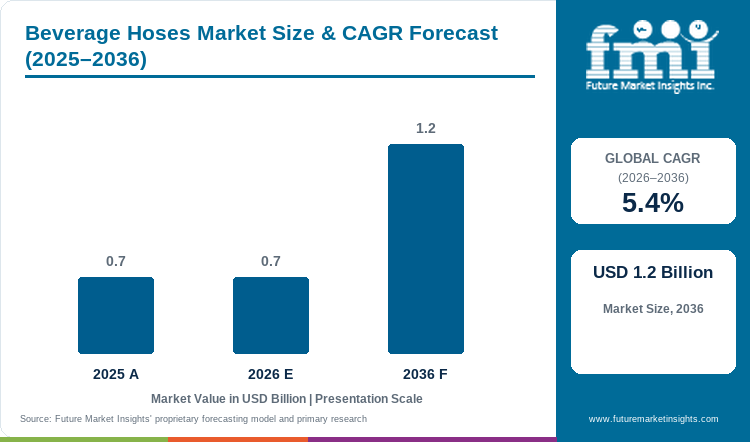
The beverage hoses market is valued at USD 0.7 billion in 2026 and is projected to reach USD 1.2 billion by 2036, growing at a 5.4% CAGR.
The beverage hoses market stood at USD 0.7 Billion in 2025, is estimated at USD 0.7 Billion in 2026, and is forecast to reach USD 1.2 Billion by 2036 at a 5.4% CAGR from 2026 to 2036.
Revenue moves with beverage plants because a flexible hose is both a transfer component and a food-contact surface. Buyers therefore replace or upgrade hoses when cleaning chemistry changes, when pressure or vacuum duty rises or when a line needs better traceability.
During February 2026 3-A Sanitary Standards updated its foundational hygienic design standard for food and beverage equipment. The revision reinforces acceptable materials and hygienic construction as core design tests.
In the United States, an FDA food-contact notification effective in March 2025 expressly covered repeat-use rubber articles such as hoses and tubing used in food-processing equipment. These requirements do not create demand by themselves.
They change the purchasing threshold by making documented material suitability and cleanability part of routine specification. Pressure performance and assembly integrity are also screened before replacement approval.
Country behavior reflects different installed bases and operating priorities. German breweries face a mature production environment so hose spending is weighted toward replacement cycles and clean-in-place reliability.
Brazil has a growing number of registered breweries, which broadens the population of plants that need transfer and sanitation hardware. Mexico combines a wide beverage-manufacturing footprint with dispersed facility sizes. This raises the value of local distributor stock and assembly support.
Italy adds a large wine-processing base where taste neutrality and seasonal throughput matter alongside hygiene. Across these markets, interest converts to an order only after the supplier documents food-contact suitability and chemical compatibility.
Working pressure, cleaning limits and the correct coupling or sanitary end connection also have to match the specific line.
Key Takeaways of Beverage Hoses Market
- Beverage transfer hoses lead the market in 2026. PVC leads in 2026.
- Medium pressure leads the market in 2026. Breweries lead in 2026. Hose distributors lead the market in 2026.
- Driver: Hygienic design, cleaning performance, and traceability requirements make hose condition and material suitability recurring procurement concerns.
- Restraint: Qualification across product chemistry and temperature can extend approval cycles. Pressure and vacuum add further checks. Cleaning method and end connections also require confirmation.
- Opportunity: Certified or well-documented hose assemblies with local stock can convert compliance and downtime risk into higher-value replacement demand. Italy has the highest profiled country CAGR at 6.0%, compared with Germany at 4.5%.
Analyst Perspective
Credible revenue capture depends on lowering qualification risk at the point where a plant converts a hose specification into an installed assembly. Material claims need application-specific food-contact and cleaning documentation.
- Nandini Roy Choudhury, Principal Consultant, Future Market Insights
How is the Beverage Hoses Market segmented?
The market is segmented by Hose Type, Material, Pressure Rating, End Use, and Sales Channel.
The beverage hoses market uses five segment axes with region as the geographic split.
Hose type covers beverage transfer hoses, food-grade suction hoses, brewery hoses, milk/dairy hoses, and carbonated beverage hoses.
Material covers PVC, EPDM rubber, silicone, NBR/nitrile, and thermoplastic elastomer.
Pressure rating covers medium pressure, low pressure, high pressure, and vacuum/suction duty.
End use covers breweries, soft drink plants, dairy processing, wineries/distilleries, and foodservice dispensing.
Sales channel covers hose distributors, direct industrial supply, beverage equipment OEMs, and replacement/MRO.
Beverage transfer hoses sit at the center of the category because most plants need repeatable movement of liquid across storage and processing points. Filling and cleaning steps add further transfer connections. The specification has to balance flexibility with taste neutrality and cleaning resistance.
It also needs enough reinforcement for the expected pressure or suction duty. Continental demonstrated this design logic in January 2025 when it introduced the BLAUDIECK SUPER range for food and beverage service with a UPE liner and ready-pressed fitting options.
The commercial advantage is broad usability across transfer steps without moving into a narrowly specialized hose unless the medium or operating cycle requires it.
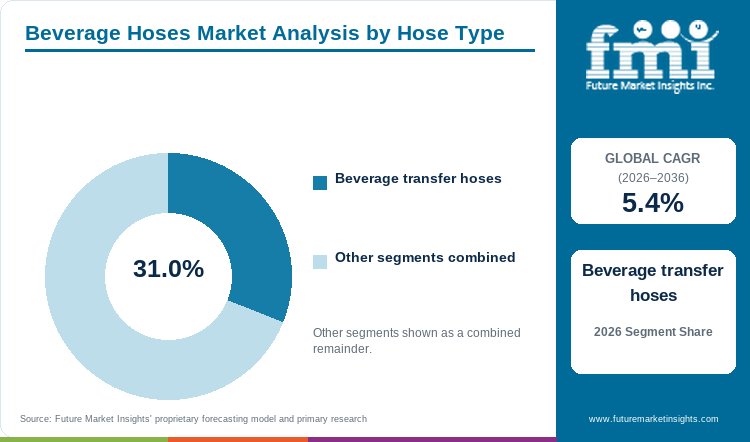
- Beverage transfer hoses account for 31.0% of the market in 2026 because they serve the most common movement step across beverage processing lines.
- Continental announced in January 2025 that BLAUDIECK SUPER would replace its prior food and beverage hose offering, using a UPE liner and matched fitting systems for hygienic transfer service.
Why does PVC hold the leading Material position?
PVC leads where buyers value light weight and transparency. Easy routing and competitive replacement cost also matter more than extreme heat or chemical resistance in many duties. Clear tubing can also let operators visually confirm product flow or line condition.
Those characteristics fit beverage dispensing and potable-water transfer. They also suit packaging equipment and many lower-temperature liquid duties. The material is not universal. Steam cleaning or aggressive chemistry can shift specifications toward EPDM. Material selection overlaps with the beverage processing polymers market when cleaning chemistry and taste neutrality matter.
High-temperature cycles can also favor silicone or specialty polymers. Kuriyama product documentation dated March 2026 shows reinforced PVC beverage hose offered with food-contact certifications and pressure ratings that support a wide set of practical dispensing and transfer applications.
- PVC holds a 31.0% share in 2026 because transparent, lightweight constructions cover many routine beverage-transfer and dispensing duties at an accessible installed cost.
- Kuriyama documentation dated March 14, 2026 describes CLEARBRAID K3150 as a phthalate-free reinforced PVC beverage hose for food and beverage uses with recognized food-contact certifications.
How does Medium pressure define the Pressure Rating category?
Medium-pressure hose captures the operating middle ground in beverage plants. It provides useful headroom for pumped transfer and cleaning operations without imposing the weight and bend penalties associated with more heavily reinforced high-pressure products.
This matters because operators routinely drag, coil, or reposition hose near tanks and processing skids. A design that is technically over-specified can raise handling effort and assembly cost.
Continental stated in January 2025 that its BLAUDIECK SUPER range operates up to 16 bar and is designed for food and beverage service. That rating illustrates why the medium-pressure band covers many mainstream liquid-transfer conditions.
- Medium pressure accounts for 39.0% of the market in 2026 because it balances working-pressure margin, flexibility, and cost for mainstream process transfer.
- Continental reported in January 2025 that BLAUDIECK SUPER supports working pressures up to 16 bar while retaining a food and beverage focused construction.
What supports Breweries in the End Use category?
Breweries create repeated hose demand across wort and beer transfer. Water, by-product, and cleaning workflows add further flexible connections. Product integrity also matters because oxygen pickup or taste transfer can affect finished beverage quality.
The installed base includes large production sites and many smaller operations. This creates planned replacement programs alongside fragmented maintenance demand. In August 2026, Germany’s Federal Statistical Office reported 1,415 breweries for 2025.
More than half were small breweries producing no more than 100,000 liters annually. This mix supports flexible hose configurations and practical distributor access. Application guidance must work across very different plant scales.
- Breweries hold a 26.0% share in 2026 because brewing combines frequent liquid transfer with sanitation cycles and strong sensitivity to taste, odor, and oxygen exposure.
- Destatis reported on 4 August 2026 that Germany had 1,415 breweries in 2025. This included 821 small breweries producing no more than 100,000 liters annually.
What drives Hose distributors in the Sales Channel category?
Hose distributors lead because the final purchase often depends on more than a roll of hose. Plants need cut length and suitable end fittings. They also need documented crimping or clamping plus fast replacement when an installed line fails inspection. Local inventory can therefore be as important as brand preference.
Distributors also bridge smaller processors that do not buy directly from global manufacturers. Dixon Valve's 3-A hose-assembly certificate was issued on 25 April 2017. It covers sanitary hose assemblies under Standard 62-02 and identifies approved hose families used with those assemblies.
That documented assembly requirement shows why channel expertise extends beyond stocking hose. Fitting selection, fabrication quality, and traceable replacement supply remain important distributor functions.
- Hose distributors account for 38.0% of the market in 2026 because they combine local inventory with fabrication, fitting selection, and replacement support.
- Dixon Valve's 3-A certificate issued on April 25, 2017 documents hose assemblies under Standard 62-02, illustrating the role of verified fabrication and fitting compatibility in the replacement channel.
What are the drivers, restraints, and opportunities in the Beverage Hoses Market?
In the beverage hoses market, the key driver is hygienic design, cleaning performance and traceability requirements that make hose condition and material suitability a recurring procurement concern, making beverage transfer hoses the leading hose type since nearly every plant needs repeatable liquid movement across storage, filling and cleaning points, the key restraint is that qualification across product chemistry, temperature, pressure and vacuum duty can extend approval cycles, since switching from a known hose creates validation work for engineering, quality and sanitation teams even when a new construction offers a lower unit price, and the key opportunity is selling certified or well-documented hose assemblies with local distributor stock, which converts compliance and downtime risk into higher-value replacement demand by shortening the time between an inspection failure and a compliant return to service.
- Driver: Hygienic design, cleaning performance, and traceability requirements make hose condition and material suitability recurring procurement concerns.
- Restraint: Qualification across product chemistry and temperature can extend approval cycles. Pressure and vacuum add further checks. Cleaning method and end connections also require confirmation.
- Opportunity: Certified or well-documented hose assemblies with local stock can convert compliance and downtime risk into higher-value replacement demand.
The main driver is the operating need to keep food-contact transfer lines clean, documented and fit for repeated use. 3-A Sanitary Standards updated its foundational hygienic design standard in February 2026.
The standard defines baseline expectations for acceptable materials, construction methods and hygienic design across food and beverage equipment. For hose buyers, the implication is practical: replacement decisions cannot focus on diameter and price alone.
A hose that survives the media but performs poorly during cleaning can create maintenance risk. That keeps attention on liner chemistry and cleanability throughout the life of the processing line. Fittings, traceability and replacement intervals remain part of the same maintenance decision.
The main restraint appears during qualification and change control. An FDA food-contact notification effective in March 2025 explicitly covered repeat-use rubber articles such as hoses and tubing used in food-processing equipment. The notification also attached conditions to the intended use and material formulation.
Buyers must still translate regulatory compliance into the specific media and cleaning regime on their line. Switching from a known hose therefore creates work for engineering and quality teams. Sanitation and procurement functions also have to approve the change.
The friction can delay a purchase or keep an incumbent construction in place even when a new hose has a lower unit price.
The opportunity is to sell a lower-risk installed solution rather than an undifferentiated hose. Mexico illustrates the channel logic. Data México reported 33,082 beverage-manufacturing economic units in May 2026 with most units in the smallest employment class.
A dispersed buyer base increases the value of distributor inventory, cut-to-length service and pre-qualified fitting combinations. Suppliers can capture more replacement demand by publishing clear pressure and vacuum limits. Cleaning-chemical and temperature limits should be equally explicit.
They can also support traceable assemblies that shorten plant approval. The strongest offer is one that reduces the time between inspection failure and a compliant return to service.
Which country CAGRs are profiled in the Beverage Hoses Market?
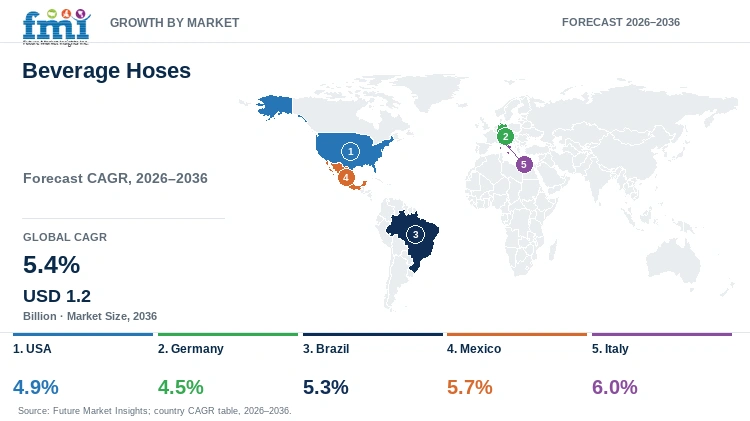
| Country | CAGR |
|---|---|
| USA | 4.9% from 2026 to 2036 |
| Germany | 4.5% from 2026 to 2036 |
| Brazil | 5.3% from 2026 to 2036 |
| Mexico | 5.7% from 2026 to 2036 |
| Italy | 6.0% from 2026 to 2036 |
How do country-level CAGRs compare in the Beverage Hoses Market?
The five profiled markets span 1.5 percentage points, from Italy at 6.0% CAGR to Germany at 4.5% from 2026 to 2036. Italy and Mexico form the upper-growth band. Brazil sits in the middle at 5.3%. USA follows at 4.9% while Germany is the slowest of the five at 4.5%.
The spacing is commercially meaningful but not extreme. It suggests different timing for channel investment and product specialization rather than five separate market models. Growth rates also need to be read alongside installed beverage capacity, replacement intensity and the cost of reaching fragmented buyers.
- Italy at 6.0% and Mexico at 5.7% are separated by 0.3 percentage points, supporting earlier attention to distributor coverage and application-specific stock in both markets.
- Mexico at 5.7% exceeds Brazil at 5.3% by 0.4 percentage points, but supplier execution still depends on local manufacturing density and service reach.
- Brazil at 5.3% is 0.4 percentage points above the USA at 4.9%, which favors a balanced approach between new-site demand and recurring MRO business.
- USA at 4.9% is 0.4 percentage points above Germany at 4.5%, where mature brewery demand makes replacement economics and cleaning performance especially important.
CAGR does not describe absolute revenue opportunity or account quality. A slower-growth country can still support a large replacement pool when it has a substantial installed processing base. A faster-growth market can require more distributor investment before sales scale.
The broader report therefore evaluates company reach and end-use mix alongside the five growth rates. Material requirements and channel structure complete the opportunity view.
Country-wise Analysis
- USA: USA buyers commonly rely on industrial distributors and hose-assembly specialists for maintenance replacements because plants need local stock and correct end fittings. Demand for beverage hoses in the USA is forecast to expand at a 4.9% CAGR from 2026 to 2036. An FDA food-contact notification effective March 15, 2025 explicitly included repeat-use rubber hoses and tubing used as components of food-processing equipment. The friction is a fragmented installed base with varied plant standards and documentation practices. Suppliers can compete through food-contact documentation plus rapid fabrication and traceable assemblies across common beverage-transfer sizes.
- Germany: German beverage processors operate within a mature industrial base where hose replacement has to justify reliability and sanitation performance. Demand for beverage hoses in Germany is forecast to expand at a 4.5% CAGR from 2026 to 2036. Destatis reported on August 4, 2026 that Germany had 1,415 breweries in 2025 and that the count had fallen from recent highs. That creates a friction: lower beer volumes limit the case for indiscriminate greenfield expansion. Suppliers need to emphasize service life and clean-in-place compatibility. Organoleptic neutrality and standardized assemblies can further reduce maintenance risk in established facilities.
- Brazil: Brazilian breweries and beverage plants span a growing set of independent and scaled operations. This creates demand for both project supply and maintenance replacement. Demand for beverage hoses in Brazil is forecast to expand at a 5.3% CAGR from 2026 to 2036. Brazil's Ministry of Agriculture reported on 5 August 2025 that 1,949 breweries were registered in 2024. The total included 102 new establishments. Regional distance and uneven distributor depth can slow service for smaller processors. Suppliers can improve conversion through stocked food-grade constructions, clear cleaning guidance and distributor partners able to fabricate sanitary hose assemblies close to the plant.
- Mexico: Mexican beverage processors buy across a wide manufacturing footprint so supplier reach and local assembly support can influence the final specification. Demand for beverage hoses in Mexico is forecast to expand at a 5.7% CAGR from 2026 to 2036. Data México reported 33,082 beverage-manufacturing economic units in May 2026 with the majority in the smallest employment class. The friction is serving many locations without forcing processors to hold excessive spare inventory. Suppliers can respond with regional distributor stock and common PVC or rubber sizes. Documented sanitary fittings and technical support should cover pressure, suction and cleaning requirements.
- Italy: Italian purchasing reflects strong winery and beverage-processing activity where flexible transfer lines must protect flavor while handling seasonal throughput. Demand for beverage hoses in Italy is forecast to expand at a 6.0% CAGR from 2026 to 2036. ISTAT reported on September 4, 2026 that Italian wine production reached 47.8 million hectoliters in 2025. Seasonal operating peaks and stringent food-contact requirements can make hose failure or off-flavor risk expensive during production windows. Suppliers can differentiate through winery-specific transfer hoses and chemical cleaning guidance. Low taste and odor materials plus distributor coverage can support rapid replacement during campaigns.
Who are the notable companies in the Beverage Hoses Market?
Parker Hannifin and Gates are profiled. Continental and Trelleborg are also covered. Alfagomma and Kuriyama are also covered. Saint-Gobain and Novaflex are also covered. Dixon Valve and Watson-Marlow complete the notable-company set.
Competition depends on how completely a supplier can move from material selection to an installed hygienic connection. Parker Hannifin and Gates offer broad beverage-hose families alongside Continental and Trelleborg. These cover transfer and suction as well as cleaning-related needs.
Alfagomma and Kuriyama add strength in rubber and PVC alongside Saint-Gobain and Novaflex. Their portfolios also cover thermoplastic and silicone constructions. Dixon Valve brings sanitary couplings and certified hose assemblies while Watson-Marlow adds PTFE-lined assemblies and broader fluid-path expertise.
The groups overlap in practice. Their commercial distinction lies in how much of the specification and assembly problem they can solve. Validation support and local service deepen that position for beverage processors.
- Parker Hannifin and Gates compete alongside Continental and Trelleborg. Their broad food-contact transfer portfolios cover pressure and cleaning needs across beverage end uses.
- Alfagomma and Kuriyama compete alongside Saint-Gobain and Novaflex. Their material range spans rubber and PVC as well as thermoplastic and silicone constructions for specialized beverage transfer.
- Dixon Valve and Watson-Marlow: hygienic assembly and fluid-path specialists where fittings, traceability, high-purity materials and cleanability shape the purchase.
Competitive Benchmarking: Beverage Hoses Market
| Company | Food-contact Hose Breadth | CIP and Sanitary Assembly Capability | Specialty Material Range | Geographic Reach |
|---|---|---|---|---|
| Parker Hannifin | High | Medium | High | North America, Europe, and Asia-Pacific |
| Gates | Medium | Medium | Low | North America with documented sanitary assembly use |
| Continental | High | High | High | Europe, Americas, and Asia-Pacific |
| Trelleborg | High | High | High | Europe, Americas, and Asia-Pacific |
| Alfagomma | High | High | Medium | Europe, Americas, and Asia-Pacific |
| Kuriyama | Medium | Medium | High | North America and Asia with distributor coverage |
| Saint-Gobain | High | Medium | High | North America, Europe, and Asia-Pacific |
| Novaflex | High | Medium | Medium | North America with international distribution |
| Dixon Valve | Medium | High | Medium | North America, Europe, and Asia-Pacific |
| Watson-Marlow | Medium | High | High | Europe and North America are covered. Coverage extends to Asia-Pacific and other distributor markets. |
Scoring basis: Food-contact Hose Breadth measures documented coverage across beverage transfer and suction. Dispensing and related sanitary uses are also considered. CIP and Sanitary Assembly Capability measures evidence of clean-in-place suitability and hygienic fittings.
Certified assemblies or traceability support strengthen the rating. Specialty Material Range measures documented coverage beyond conventional general-purpose rubber or PVC. UPE and PTFE strengthen the rating. Silicone and other application-specific polymers also count toward material breadth.
High indicates broad or deep documented capability. Medium indicates credible but narrower coverage. Low would indicate a documented limitation, while unavailable public information is left low.
Key Developments in the Beverage Hoses Market
- In January 2025, Continental launched the BLAUDIECK SUPER food and beverage hose range. The company moved to a UPE liner across the range and paired the hose with fitting systems designed to protect the liner during assembly. The launch simplified Continental's prior food and beverage offering and gave processors a broader standardized transfer platform for hygienic applications.
- In November 2025, Trelleborg highlighted its new BEERDIAL brewery hose for beer transfer. The hose uses a phthalate-free SKM liner and is designed for pressures up to 15 bar with resistance to common cleaning chemistry. The product targets brewery operators that want taste neutrality, lower oxygenation risk and a hose construction built around repeated sanitation cycles.
- In June 2026, Saint-Gobain introduced Tygon Food D-1070 silicone dairy tubing. The smooth-bore tube is designed for raw milk handling and supports CIP and COP cleaning while maintaining a low taste and odor profile. The addition expands Saint-Gobain's food-transfer offering toward dairy applications that need full-vacuum capability, high-temperature tolerance and documented food-contact compliance.
Key Players in the Beverage Hoses Market
Broad Food and Beverage Transfer Portfolios
- Parker Hannifin
- Gates
- Continental
- Trelleborg
Material-Specialist and Thermoplastic Hose Platforms
- Alfagomma
- Kuriyama
- Saint-Gobain
- Novaflex
Hygienic Assembly and High-Purity Fluid Path Specialists
- Dixon Valve
- Watson-Marlow
Beverage Hoses Market - Report Scope
| Coverage field | Report scope |
|---|---|
| Market breakdown | Hose Type, Material, Pressure Rating, End Use, and Sales Channel |
| Quantitative Units | USD Billion |
| Market Definition | Revenue includes flexible beverage-grade hoses, tubing, and hose assemblies sold for transfer, suction, brewery, dairy, carbonated-beverage, and dispensing uses within the stated segmentation. It excludes downstream beverage revenue, rigid piping, separately sold pumps or valves, and industrial hose not intended for beverage service. |
| Regions Covered | North America, Latin America, Western Europe, Eastern Europe, East Asia, South Asia and Pacific, Middle East and Africa |
| Countries Covered | USA, Germany, Brazil, Mexico, Italy, and more than twenty-five additional countries in the full report |
| Key Companies Profiled | Parker Hannifin, Gates, Continental, Trelleborg, Alfagomma, Kuriyama, Saint-Gobain, Novaflex, Dixon Valve, Watson-Marlow |
| Forecast Period | 2026 to 2036 |
| Approach | A hybrid bottom-up and top-down sizing approach reconciles supplier portfolios, channel activity, end-use demand, regulatory requirements, and country-level manufacturing indicators while excluding adjacent product revenue and double counting. |
Beverage Hoses Market - Research Methodology
| Method | Approach |
|---|---|
| Primary Research | FMI consults hose makers and beverage-equipment suppliers. Processors and plant engineers explain sanitation and replacement requirements. The research tests purchase criteria and adoption barriers. |
| Desk Research | FMI reviews sanitary standards and beverage-industry statistics. Company documentation supports the defined hose boundary. Sources are retained when they support the defined market boundary. |
| Market Sizing and Forecasting | FMI reconciles supplier participation with beverage processing and replacement demand. Forecasts reflect hygienic design and line investment. Country conditions and channel structure are checked against the revenue boundary. |
| Data Validation | Findings are checked against independent evidence. The estimate excludes beverage sales and separately sold pumps or valves. Rigid piping and unrelated hose are excluded. |
Beverage Hoses Market by Segments
Beverage Hoses Market segmented by Hose Type
- Beverage transfer hoses
- Food-grade suction hoses
- Brewery hoses
- Milk / dairy hoses
- Carbonated beverage hoses
Beverage Hoses Market segmented by Material
- PVC
- EPDM rubber
- Silicone
- NBR / nitrile
- Thermoplastic elastomer
Beverage Hoses Market segmented by Pressure Rating
- Medium pressure
- Low pressure
- High pressure
- Vacuum / suction duty
Beverage Hoses Market segmented by End Use
- Breweries
- Soft drink plants
- Dairy processing
- Wineries / distilleries
- Foodservice dispensing
Beverage Hoses Market segmented by Sales Channel
- Hose distributors
- Direct industrial supply
- Beverage equipment OEMs
- Replacement / MRO
Beverage Hoses Market by Region
- North America
- United States
- Canada
- Latin America
- Brazil
- Mexico
- Argentina
- Chile
- Western Europe
- Germany
- France
- United Kingdom
- Italy
- Spain
- Benelux
- Nordics
- Eastern Europe
- Poland
- Czech Republic
- Romania
- Hungary
- East Asia
- China
- Japan
- South Korea
- South Asia and Pacific
- India
- ASEAN
- Australia and New Zealand
- Middle East and Africa
- GCC Countries
- South Africa
- Türkiye
- Israel
Research Sources and Bibliography
- 3-A Sanitary Standards, Inc. (2026, February 13). 3-A SSI Updates Foundational Hygienic Design Standard.
- U.S. Food and Drug Administration (2025, March 15). Food Contact Substance Notification No. 2420.
- Statistisches Bundesamt (2026, August 4). Zahl der Brauereien auf 1 415 im Jahr 2025 gesunken.
- Ministério da Agricultura e Pecuária (2025, August 5). Brasil tem mais de 43 mil cervejas registradas.
- Secretaría de Economía, Data México (2026, May). Beverage Manufacturing.
- Istituto Nazionale di Statistica (2026, September 4). Produzioni agricole e zootecniche - Anno 2025.
- Parker Hannifin (n.d.). PURE Food Grade Hoses.
- Continental (2025, January 28). Safe, Clean, Stable: Continental Launches New Hose for the Food and Beverage Industry.
- Trelleborg (2025, November 18). A brewer's best friend.
- Alfagomma (n.d.). Food Hose catalogue.
- Kuriyama of America (2026, March 14). CLEARBRAID K3150 Series Reinforced PVC Beverage Hose product sheet.
- Saint-Gobain Industrial & Consumer Solutions (2026, June 29). New Product: Tygon Food D-1070 Tubing.
- Novaflex (n.d.). Food and Beverage hose portfolio.
- Dixon Valve (2017, April 25). 3-A Sanitary Standards for Hose Assemblies, Number 62-02, Certificate Authorization Number 3575.
- Food Industry Executive / Watson-Marlow Fluid Technology Solutions (2022, June 14). Watson-Marlow Fluid Technology Solutions Announces Aflex FaBLINE Hose for Food and Beverage Processing.
This bibliography is provided for reader reference and is not exhaustive. The full report contains the complete reference list and detailed citations.
This Report Answers
- What is the Beverage Hoses Market size in 2026 and what value is forecast by 2036?
- Which hygiene, cleaning, and processing pressures support demand for beverage hoses?
- Why do Beverage transfer hoses hold the leading position within Hose Type?
- How does PVC influence material selection and downstream beverage-hose demand?
- Why does Medium pressure hold the leading position within Pressure Rating?
- How do the profiled country growth rates compare for the Beverage Hoses market?
- Which product and service positions are represented by the profiled beverage-hose companies?
- How do qualification, compatibility, and switching requirements limit adoption?
Frequently Asked Questions
How big is the Beverage Hoses Market in 2026?
The beverage hoses market is valued at USD 0.7 billion in 2026 and is forecast to reach USD 1.2 billion by 2036. Growth is supported by recurring replacement demand across breweries, wineries, soft drink plants, and dairy processors, where food-contact compliance, cleanability, and material compatibility make hose condition an active maintenance concern rather than a one-time capital decision.
What is the CAGR of the Beverage Hoses Market from 2026 to 2036?
The beverage hoses market grows at a CAGR of 5.4% between 2026 and 2036, supported by tightening hygienic design standards and food-contact documentation requirements that raise the specification threshold for replacement hoses across transfer, suction, and cleaning-in-place workflows in beverage processing plants globally.
Which hose type leads the Beverage Hoses Market?
Beverage transfer hoses account for 31.0% of the beverage hoses market by hose type in 2026, driven by their role as the most common flexible connection across liquid movement, filling, and cleaning steps in beverage plants, where the specification must balance taste neutrality, cleaning resistance, and pressure or suction capability within a single repeatable construction.
How much will the Beverage Hoses Market add between 2026 and 2036?
The beverage hoses market is set to add USD 0.5 billion between 2026 and 2036, growing from USD 0.7 billion to USD 1.2 billion as brewery registration continues to expand in Brazil and Mexico, Italy's winery throughput sustains seasonal transfer demand, and updated food-contact regulations in the USA and hygienic design standards globally convert routine hose inspection into documented replacement programs.
Who are the leading companies in the Beverage Hoses Market?
Ten companies are profiled in the beverage hoses market, including Parker Hannifin, Gates, Continental, Trelleborg, Alfagomma, Kuriyama, Saint-Gobain, Novaflex, Dixon Valve, and Watson-Marlow, competing through food-contact hose breadth, clean-in-place and sanitary assembly capability, and specialty material range across broad transfer portfolios, material-specialist platforms, and hygienic assembly and high-purity fluid-path categories globally.
Preview the report firsthand - request a free sample
Get SampleGet the brochure for pricing and purchase details.
Get PDFTable of Content
- Key Takeaways
- Market Size and CAGR
- Top Growth Driver
- Fastest Growing Segment
- Leading Region
- Key Companies
- Emerging Opportunities
- Executive Summary
- Global Market Outlook
- Demand-side Trends
- Supply-side Trends
- Technology Roadmap Analysis
- Analysis and Recommendations
- Analyst Perspective (What is happening? Why now? What should investors know?)
- Key Questions Answered
- How large is the market?
- What is the CAGR?
- What are key trends?
- Which region dominates?
- Who are the leaders?
- Market Overview
- Market Coverage / Taxonomy
- Market Definition / Scope / Limitations
- Research Methodology
- Chapter Orientation
- Analytical Lens and Working Hypotheses
- Market Structure, Signals, and Trend Drivers
- Benchmarking and Cross-market Comparability
- Market Sizing, Forecasting, and Opportunity Mapping
- Research Design and Evidence Framework
- Desk Research Programme (Secondary Evidence)
- Expert Input and Fieldwork (Primary Evidence)
- Tooling, Models, and Reference Databases
- Data Engineering and Model Build
- Quality Assurance and Audit Trail
- Market Background
- Market Dynamics (Drivers, Restraints, Opportunity, Trends)
- Scenario Forecast (Optimistic, Likely, Conservative)
- Impact Analysis
- AI Impact
- Sustainability Impact
- Regulatory Impact
- Technology Impact
- Consumer / Buyer Analysis
- Purchase Drivers
- Adoption Barriers
- Buyer Journey
- Opportunity Map Analysis
- Product Life Cycle Analysis
- Supply Chain Analysis
- Investment Feasibility Matrix
- Value Chain Analysis
- PESTLE and Porter's Analysis
- Regulatory Landscape
- Regional Parent Market Outlook
- Production and Consumption Statistics
- Import and Export Statistics
- Global Market Analysis and Forecast, 2021 to 2036
- Historical Market Size Value (USD Billion) Analysis, 2021 to 2025
- Current and Future Market Size Value (USD Billion) Projections, 2026 to 2036
- Y-o-Y Growth Trend Analysis
- Absolute $ Opportunity Analysis
- Global Market Pricing Analysis, 2021 to 2036
- Global Market Analysis and Forecast, By Hose Type, 2021 to 2036
- Introduction / Key Findings
- Historical Market Size Value (USD Billion) Analysis By Hose Type, 2021 to 2025
- Current and Future Market Size Value (USD Billion) Analysis and Forecast By Hose Type, 2026 to 2036
- Beverage transfer hoses
- Food-grade suction hoses
- Brewery hoses
- Milk / dairy hoses
- Carbonated beverage hoses
- By System Type
- Y-o-Y Growth Trend Analysis By Hose Type, 2021 to 2025
- Absolute $ Opportunity Analysis By Hose Type, 2026 to 2036
- Global Market Analysis and Forecast, By Material, 2021 to 2036
- Introduction / Key Findings
- Historical Market Size Value (USD Billion) Analysis By Material, 2021 to 2025
- Current and Future Market Size Value (USD Billion) Analysis and Forecast By Material, 2026 to 2036
- PVC
- EPDM rubber
- Silicone
- NBR / nitrile
- Thermoplastic elastomer
- By Component
- Y-o-Y Growth Trend Analysis By Material, 2021 to 2025
- Absolute $ Opportunity Analysis By Material, 2026 to 2036
- Global Market Analysis and Forecast, By Pressure Rating, 2021 to 2036
- Introduction / Key Findings
- Historical Market Size Value (USD Billion) Analysis By Pressure Rating, 2021 to 2025
- Current and Future Market Size Value (USD Billion) Analysis and Forecast By Pressure Rating, 2026 to 2036
- Medium pressure
- Low pressure
- High pressure
- Vacuum / suction duty
- By Object Type
- Y-o-Y Growth Trend Analysis By Pressure Rating, 2021 to 2025
- Absolute $ Opportunity Analysis By Pressure Rating, 2026 to 2036
- Global Market Analysis and Forecast, By End Use, 2021 to 2036
- Introduction / Key Findings
- Historical Market Size Value (USD Billion) Analysis By End Use, 2021 to 2025
- Current and Future Market Size Value (USD Billion) Analysis and Forecast By End Use, 2026 to 2036
- Breweries
- Soft drink plants
- Dairy processing
- Wineries / distilleries
- Foodservice dispensing
- By End Use
- Y-o-Y Growth Trend Analysis By End Use, 2021 to 2025
- Absolute $ Opportunity Analysis By End Use, 2026 to 2036
- Global Market Analysis and Forecast, By Sales Channel, 2021 to 2036
- Introduction / Key Findings
- Historical Market Size Value (USD Billion) Analysis By Sales Channel, 2021 to 2025
- Current and Future Market Size Value (USD Billion) Analysis and Forecast By Sales Channel, 2026 to 2036
- Hose distributors
- Direct industrial supply
- Beverage equipment OEMs
- Replacement / MRO
- By Sales Model
- Y-o-Y Growth Trend Analysis By Sales Channel, 2021 to 2025
- Absolute $ Opportunity Analysis By Sales Channel, 2026 to 2036
- Global Market Analysis and Forecast, By Region, 2021 to 2036
- Introduction
- Historical Market Size Value (USD Billion) Analysis By Region, 2021 to 2025
- Current Market Size Value (USD Billion) Analysis and Forecast By Region, 2026 to 2036
- North America
- Latin America
- Western Europe
- Eastern Europe
- East Asia
- South Asia and Pacific
- Middle East and Africa
- Market Attractiveness Analysis By Region
- North America Market Analysis and Forecast, By Country, 2021 to 2036
- Historical Market Size Value (USD Billion) Trend Analysis By Market Taxonomy, 2021 to 2025
- Market Size Value (USD Billion) Forecast By Market Taxonomy, 2026 to 2036
- By Country
- United States
- Canada
- By Hose Type
- By Material
- By Pressure Rating
- By End Use
- By Sales Channel
- By Country
- Market Attractiveness Analysis
- By Country
- By Hose Type
- By Material
- By Pressure Rating
- By End Use
- By Sales Channel
- Key Takeaways
- Latin America Market Analysis and Forecast, By Country
- Historical Market Size Value (USD Billion) Trend Analysis By Market Taxonomy, 2021 to 2025
- Market Size Value (USD Billion) Forecast By Market Taxonomy, 2026 to 2036
- By Country
- Brazil
- Mexico
- Argentina
- Chile
- By Hose Type
- By Material
- By Pressure Rating
- By End Use
- By Sales Channel
- By Country
- Market Attractiveness Analysis
- By Country
- By Hose Type
- By Material
- By Pressure Rating
- By End Use
- By Sales Channel
- Key Takeaways
- Western Europe Market Analysis and Forecast, By Country
- Historical Market Size Value (USD Billion) Trend Analysis By Market Taxonomy, 2021 to 2025
- Market Size Value (USD Billion) Forecast By Market Taxonomy, 2026 to 2036
- By Country
- Germany
- France
- United Kingdom
- Italy
- Spain
- Benelux
- Nordics
- By Hose Type
- By Material
- By Pressure Rating
- By End Use
- By Sales Channel
- By Country
- Market Attractiveness Analysis
- By Country
- By Hose Type
- By Material
- By Pressure Rating
- By End Use
- By Sales Channel
- Key Takeaways
- Eastern Europe Market Analysis and Forecast, By Country
- Historical Market Size Value (USD Billion) Trend Analysis By Market Taxonomy, 2021 to 2025
- Market Size Value (USD Billion) Forecast By Market Taxonomy, 2026 to 2036
- By Country
- Poland
- Czech Republic
- Romania
- Hungary
- By Hose Type
- By Material
- By Pressure Rating
- By End Use
- By Sales Channel
- By Country
- Market Attractiveness Analysis
- By Country
- By Hose Type
- By Material
- By Pressure Rating
- By End Use
- By Sales Channel
- Key Takeaways
- East Asia Market Analysis and Forecast, By Country
- Historical Market Size Value (USD Billion) Trend Analysis By Market Taxonomy, 2021 to 2025
- Market Size Value (USD Billion) Forecast By Market Taxonomy, 2026 to 2036
- By Country
- China
- Japan
- South Korea
- By Hose Type
- By Material
- By Pressure Rating
- By End Use
- By Sales Channel
- By Country
- Market Attractiveness Analysis
- By Country
- By Hose Type
- By Material
- By Pressure Rating
- By End Use
- By Sales Channel
- Key Takeaways
- South Asia and Pacific Market Analysis and Forecast, By Country
- Historical Market Size Value (USD Billion) Trend Analysis By Market Taxonomy, 2021 to 2025
- Market Size Value (USD Billion) Forecast By Market Taxonomy, 2026 to 2036
- By Country
- India
- ASEAN
- Australia and New Zealand
- By Hose Type
- By Material
- By Pressure Rating
- By End Use
- By Sales Channel
- By Country
- Market Attractiveness Analysis
- By Country
- By Hose Type
- By Material
- By Pressure Rating
- By End Use
- By Sales Channel
- Key Takeaways
- Middle East and Africa Market Analysis and Forecast, By Country
- Historical Market Size Value (USD Billion) Trend Analysis By Market Taxonomy, 2021 to 2025
- Market Size Value (USD Billion) Forecast By Market Taxonomy, 2026 to 2036
- By Country
- GCC Countries
- South Africa
- Türkiye
- Israel
- By Hose Type
- By Material
- By Pressure Rating
- By End Use
- By Sales Channel
- By Country
- Market Attractiveness Analysis
- By Country
- By Hose Type
- By Material
- By Pressure Rating
- By End Use
- By Sales Channel
- Key Takeaways
- Key Countries Market Analysis
- United States
- Pricing Analysis
- Market Share Analysis, 2025
- By Hose Type
- By Material
- By Pressure Rating
- By End Use
- By Sales Channel
- Canada
- Pricing Analysis
- Market Share Analysis, 2025
- By Hose Type
- By Material
- By Pressure Rating
- By End Use
- By Sales Channel
- Mexico
- Pricing Analysis
- Market Share Analysis, 2025
- By Hose Type
- By Material
- By Pressure Rating
- By End Use
- By Sales Channel
- Brazil
- Pricing Analysis
- Market Share Analysis, 2025
- By Hose Type
- By Material
- By Pressure Rating
- By End Use
- By Sales Channel
- Chile
- Pricing Analysis
- Market Share Analysis, 2025
- By Hose Type
- By Material
- By Pressure Rating
- By End Use
- By Sales Channel
- Germany
- Pricing Analysis
- Market Share Analysis, 2025
- By Hose Type
- By Material
- By Pressure Rating
- By End Use
- By Sales Channel
- United Kingdom
- Pricing Analysis
- Market Share Analysis, 2025
- By Hose Type
- By Material
- By Pressure Rating
- By End Use
- By Sales Channel
- Italy
- Pricing Analysis
- Market Share Analysis, 2025
- By Hose Type
- By Material
- By Pressure Rating
- By End Use
- By Sales Channel
- Spain
- Pricing Analysis
- Market Share Analysis, 2025
- By Hose Type
- By Material
- By Pressure Rating
- By End Use
- By Sales Channel
- France
- Pricing Analysis
- Market Share Analysis, 2025
- By Hose Type
- By Material
- By Pressure Rating
- By End Use
- By Sales Channel
- India
- Pricing Analysis
- Market Share Analysis, 2025
- By Hose Type
- By Material
- By Pressure Rating
- By End Use
- By Sales Channel
- ASEAN
- Pricing Analysis
- Market Share Analysis, 2025
- By Hose Type
- By Material
- By Pressure Rating
- By End Use
- By Sales Channel
- Australia and New Zealand
- Pricing Analysis
- Market Share Analysis, 2025
- By Hose Type
- By Material
- By Pressure Rating
- By End Use
- By Sales Channel
- China
- Pricing Analysis
- Market Share Analysis, 2025
- By Hose Type
- By Material
- By Pressure Rating
- By End Use
- By Sales Channel
- Japan
- Pricing Analysis
- Market Share Analysis, 2025
- By Hose Type
- By Material
- By Pressure Rating
- By End Use
- By Sales Channel
- South Korea
- Pricing Analysis
- Market Share Analysis, 2025
- By Hose Type
- By Material
- By Pressure Rating
- By End Use
- By Sales Channel
- Poland
- Pricing Analysis
- Market Share Analysis, 2025
- By Hose Type
- By Material
- By Pressure Rating
- By End Use
- By Sales Channel
- Hungary
- Pricing Analysis
- Market Share Analysis, 2025
- By Hose Type
- By Material
- By Pressure Rating
- By End Use
- By Sales Channel
- Türkiye
- Pricing Analysis
- Market Share Analysis, 2025
- By Hose Type
- By Material
- By Pressure Rating
- By End Use
- By Sales Channel
- South Africa
- Pricing Analysis
- Market Share Analysis, 2025
- By Hose Type
- By Material
- By Pressure Rating
- By End Use
- By Sales Channel
- United States
- Market Structure Analysis
- Competition Dashboard
- Competition Benchmarking
- Market Share Analysis of Top Players
- By Regional
- By Hose Type
- By Material
- By Pressure Rating
- By End Use
- By Sales Channel
- Emerging Startups
- Innovation Benchmarking
- Competition Analysis
- Competition Deep Dive
- Parker Hannifin
- Overview
- Product Portfolio
- Profitability by Market Segments
- Sales Footprint
- Strategy Overview
- Marketing Strategy
- Product Strategy
- Channel Strategy
- Gates
- Continental
- Trelleborg
- Alfagomma
- Kuriyama
- Saint-Gobain
- Novaflex
- Dixon Valve
- Watson-Marlow
- Parker Hannifin
- Case Studies
- Success Stories
- Recent Developments
- Competition Deep Dive
- Assumptions & Acronyms Used


