

- Market Size (2026)
- USD 410.6 Mn
- Forecast (2036)
- USD 1765.0 Mn
- CAGR (2026 to 2036)
- 15.7%
Bipolar-Plate Coatings Market Size, Market Forecast and Outlook By FMI
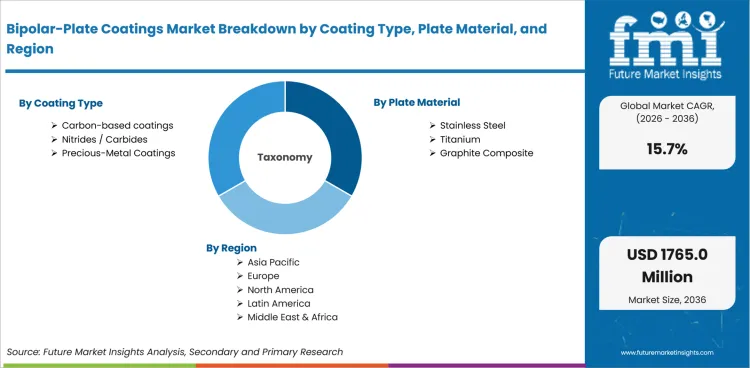
USD 410.6 million in 2026 and USD 1,765.0 million by 2036 at a 15.7% CAGR.
The bipolar-plate coatings industry value is forecast to grow from USD 354.9 million in 2025 to USD 1,765.0 million by 2036 at 15.7% CAGR as stack makers use conductive coatings to protect metallic plates inside fuel cells and electrolyzers. Direct OEM is forecast to represent 66.0% share in 2026 as coating approval stays close to stack design teams. PEMFC systems are expected to hold 63.0% share in 2026, led by mobility stacks that need low-temperature operation and stable surface resistance.
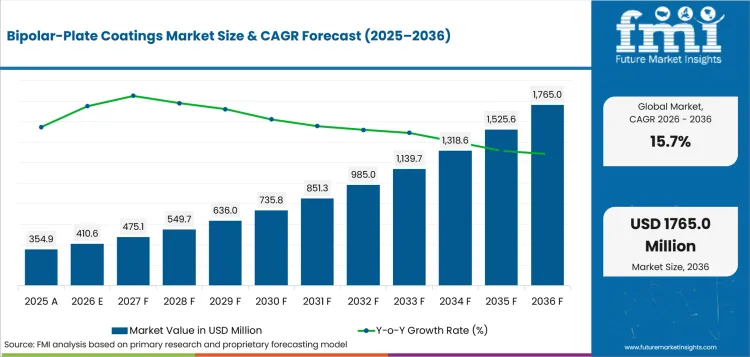
Bipolar-Plate Coatings Market Overview: Size and Forecast
- 2026 Market Size: USD 410.6 million
- 2036 Market Size: USD 1,765.0 million
- Forecast CAGR: 15.7% from 2026 to 2036
- Leading Sales Channel: Direct OEM
- Direct OEM Share in 2026: 66.0%
- Leading Fuel Cell Type: PEMFC
- PEMFC Share in 2026: 63.0%
- Fastest-growing Country: China
- China CAGR: 18.0% by 2036
Summary of the Bipolar-Plate Coatings Market
- Demand and Growth Drivers
- Metallic bipolar plates are gaining attention as OEMs seek lower weight and compact stack design without losing corrosion protection.
- Fuel cell and electrolyzer suppliers are asking for coating data that proves contact resistance stability after repeated operating cycles.
- Coating service providers are gaining value as stack makers need prototype support before internal coating lines are justified.
- Product and Segment View
- Direct OEM is forecast to represent 66.0% share in 2026, led by coating specifications that must align with stack design freeze.
- PEMFC systems are projected to hold 63.0% share in 2026, supported by mobility and compact power applications using low-temperature stacks.
- Stainless steel is expected to secure 54.0% share in 2026, influenced by lower substrate cost and established forming capability.
- Geography and Competitive Outlook
- China is forecast to record 18.0% CAGR by 2036, supported by fuel cell stack localization and domestic coating-service activity.
- South Korea is expected to expand at 17.4% CAGR by 2036 through hydrogen vehicle and stationary fuel cell programs.
- Impact Coatings, TreadStone Technologies, Cell Impact, Hutchinson, Bekaert, and SGL Carbon compete through coating validation, plate integration, and hydrogen component expertise.
- Specialist suppliers gain advantage when they validate corrosion resistance, interfacial contact resistance, and coating throughput together.
- Analyst Opinion
- Nikhil Kaitwade, Associate Vice President at FMI, observes, “Bipolar-plate coatings are moving from a material purchase into a stack-risk decision. Buyers want proof that coatings survive forming, sealing, humid operation, and repeated cycling without raising contact resistance. Cost pressure is coming from metallic plates, while qualification pressure is coming from heavy-duty fuel cell life targets and electrolyzer uptime. Suppliers with a stronger position are those able to connect coating chemistry with surface cleaning, inspection, production control, and stack-level validation.”
Quality proof is now a central buying pressure for bipolar-plate coatings as buyers compare coated metal plates with graphite reference systems. The U.S. Department of Energy’s 2024 fuel cell milestones call for a 68% peak-efficient heavy-duty direct hydrogen fuel cell system with 25,000 hours of durability and USD 80/kW mass-production cost by 2030. DOE’s hydrogen production plan set 2026 electrolyzer system cost targets of USD 250/kW for low-temperature systems and USD 500/kW for high-temperature systems. IEA stated in 2025 that low-emissions hydrogen project capital spending reached USD 4.3 billion in 2024 and could rise to nearly USD 8.0 billion in 2025. These figures make surface engineering more valuable for suppliers serving hydrogen fuel cell market outlook, PEM electrolyzer market outlook, and hydrogen storage market outlook programs.
Which factors support expansion in the bipolar-plate coatings market?
Finished coated plate revenue and validated surface engineering support market value across fuel cell and electrolyzer channels.
- Market value is supported by conductive coating revenue before stack assembly and balance-of-plant integration add more value.
- Supplier pricing reflects coating chemistry, substrate preparation, inspection, and batch validation before serial plate contracts are signed.
- Revenue improves as fuel cell stack makers shift metallic plates from development programs into repeat sourcing cycles.
- Buyer trust rises as coating suppliers provide corrosion testing, contact resistance data, and process traceability in one package.
Why is the bipolar-plate coatings market growing?
Metallic bipolar plates need conductive protection as fuel cell and electrolyzer environments can corrode unprotected metal surfaces.
Growth outlook has become more structured as stack makers move from sample coatings toward full plate qualification. DOE’s 2024 fuel cell program stated a long-haul truck target of USD 80/kW by 2030 and USD 60/kW as an ultimate high-volume production cost while meeting 25,000 hours of durability. These targets make coated plates important for cost, life, and packaging. Metallic substrates can improve stack compactness, but they need stable coatings to protect electrical output. Buyers serving fuel cell market analysis and green hydrogen market revenue programs therefore prefer suppliers with coating data, line repeatability, and plate-level validation.
How is the bipolar-plate coatings market segmented?
The bipolar-plate coatings industry is segmented by coating type, plate material, fuel cell type, application, and sales channel.
- Carbon-based coatings are projected to secure 46.0% share in 2026, led by conductive barrier performance and lower dependence on precious metals.
- Stainless steel is expected to hold 54.0% share in 2026, supported by sheet availability and established forming routes for metallic plates.
- PEMFC systems are anticipated to represent 63.0% share in 2026 due to low-temperature stacks used in mobility and compact stationary platforms.
- Mobility applications are projected to account for 49.0% share in 2026, influenced by truck and bus stacks that face vibration and humid cycling.
- Direct OEM channels are forecast to represent 66.0% share in 2026, guided by design freeze decisions and stack-level approval requirements.
Why do carbon-based coatings dominate the bipolar-plate coatings market?
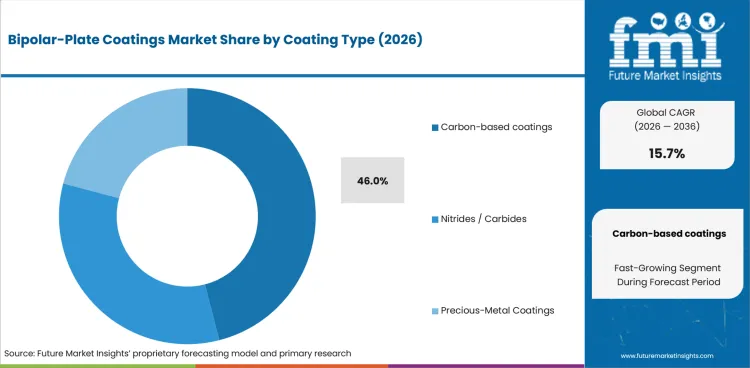
- Carbon-based coatings are projected to account for 46.0% share in 2026, influenced by lower precious-metal reliance and practical conductivity across high-volume metallic plates.
- Furthermore, buyers compare carbon coatings by contact resistance stability after cycling, as a low first-test value has limited commercial use without repeatable stack behavior.
Which plate material leads the bipolar-plate coatings market?
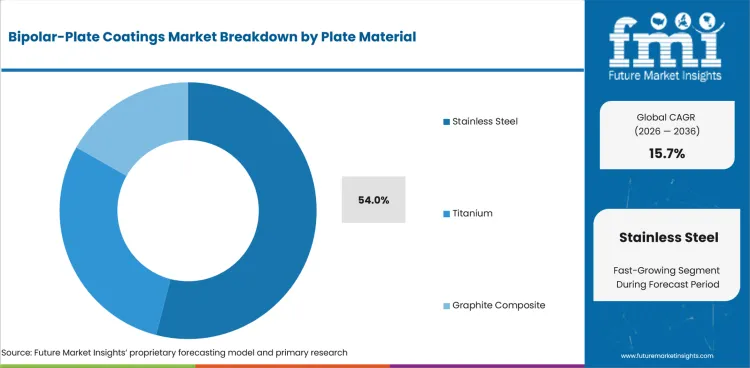
- Stainless steel is expected to hold 54.0% share in 2026 through lower substrate cost and established forming capability for compact plate designs.
- In addition, stainless steel plates often require surface preparation before coating, making cleaning and activation part of supplier qualification.
Which fuel cell type leads the bipolar-plate coatings market?
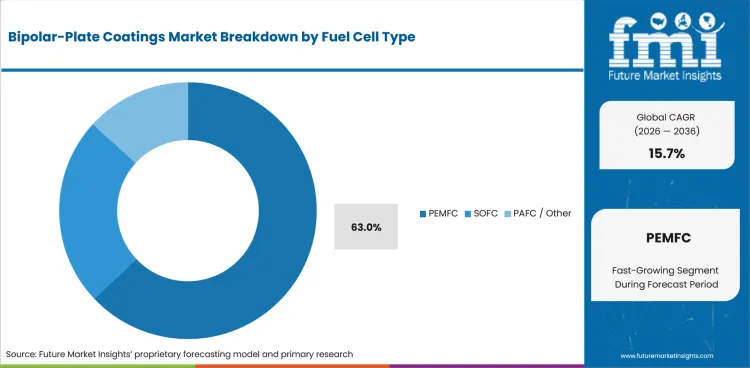
- PEMFC is anticipated to represent 63.0% share in 2026, reflected by low-temperature fuel cell stacks used in mobility and compact stationary systems.
- Moreover, PEMFC buyers require stable coatings under humid operating conditions, so suppliers must prove conductivity retention after repeated cycles.
Which application leads the bipolar-plate coatings market?
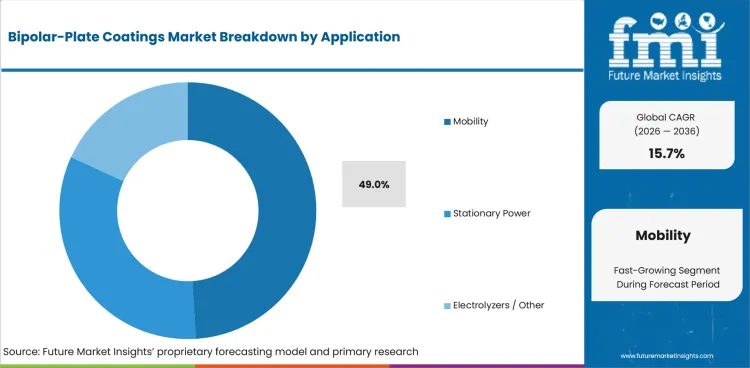
- Mobility is projected to secure 49.0% share in 2026, led by fuel cell trucks and buses that expose coated plates to vibration and thermal stress.
- Also, fleet operators avoid unproven plate systems when stack replacement is costly, raising the value of coatings backed by vehicle-duty validation.
Which sales channel leads the bipolar-plate coatings market?
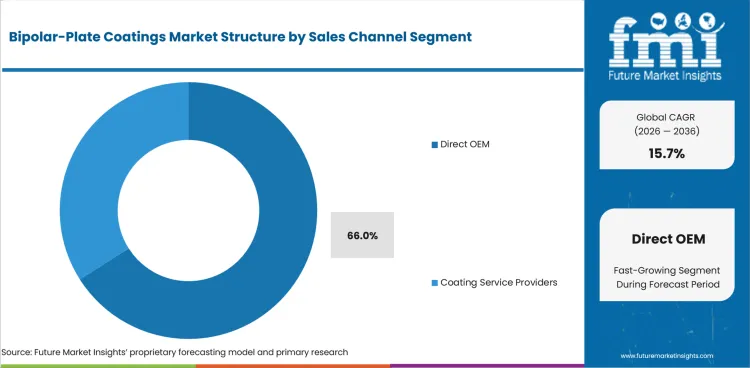
- Direct OEM is expected to account for 66.0% share in 2026, shaped by stack makers controlling coating recipes during qualification and design freeze.
- Besides, coating service providers win prototype and bridge-volume work when OEMs need batch flexibility before installing dedicated coating lines.
What are the driver, restraints, and opportunities in the bipolar-plate coatings market?
Heavy-duty stack targets and electrolyzer demand support adoption while qualification costs and graphite competition restrain faster supplier switching.
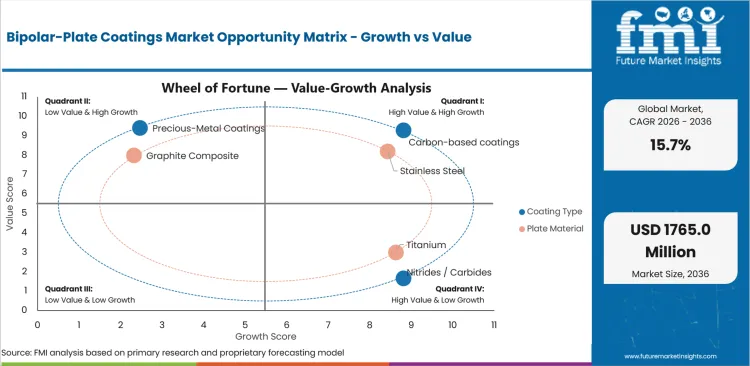
- Driver: Metallic plates need coatings that protect conductivity and corrosion resistance across fuel cell and electrolyzer duty cycles.
- Restraint: Graphite plates continue to challenge coated metal plates in applications that prioritize proven durability over compact packaging.
- Opportunity: Coating service providers can support bridge volumes before stack makers commit to dedicated coating lines.
Bipolar-Plate Coatings Market Demand Outlook
Demand outlook is moving toward coating programs that can prove plate preparation, corrosion performance, and resistance stability before full sourcing. DOE’s 2026 heavy-duty fuel cell cost record stated 2025 interim, 2030, and ultimate cost targets of USD 140/kWnet, USD 80/kWnet, and USD 60/kWnet for heavy-duty systems. This creates a direct cost-and-life benchmark for coated metal plates. Suppliers serving electrolyzer market demand can gain faster buyer confidence when coating data connects with system architecture.
Graphite Reference Systems Restraint
Graphite plates restrain coated metal adoption in heavy-duty applications where long service evidence is more important than compactness. DOE’s 2026 heavy-duty fuel cell cost record used graphite bipolar plates in its baseline after more than 30,000 hours of bus operation, while metallic plates still required coating selection to meet heavy-duty durability needs. This gap turns coatings into a risk-control point rather than a minor surface treatment. OEMs may delay switching if a coating change requires fresh corrosion, sealing, and stack validation.
Electrolyzer Service Opportunity
Opportunity is widening as hydrogen equipment investment moves from early pilots into larger procurement planning. IEA stated in 2025 that low-emissions hydrogen production grew 10% in 2024 and was on track to reach 1 Mt in 2025, although it still accounted for less than 1% of global hydrogen production. This early scale leaves room for coating suppliers that can serve both fuel cell and electrolyzer stack surfaces. Companies able to support hydrogen generation market analysis and fuel cell plate validation can reduce duplicate testing for OEM customers.
Which countries are growing fastest in the bipolar-plate coatings market?
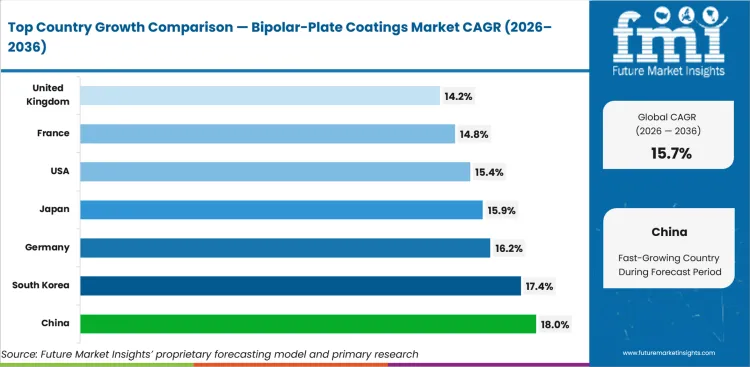
China 18.0% CAGR, South Korea 17.4% CAGR, India 16.8% CAGR, Germany 16.2% CAGR, Japan 15.9% CAGR, United States 15.4% CAGR, France 14.8% CAGR, and United Kingdom 14.2% CAGR through 2036.
.webp "Top Country Growth Comparison Bipolar Plate Coatings Market Cagr (2026 2036)")
| Country | CAGR |
|---|---|
| United States | 15.4% |
| United Kingdom | 14.2% |
| Germany | 16.2% |
| France | 14.8% |
| Japan | 15.9% |
| China | 18.0% |
| South Korea | 17.4% |
| India | 16.8% |
Source: Future Market Insights, 2026.
How do country-level CAGRs compare in the bipolar-plate coatings market?
China leads country expansion while the United Kingdom records the most cautious outlook among profiled markets.
- The United States is forecast to grow at 15.4% CAGR through 2036 due to DOE targets and heavy-duty fuel cell validation.
- The United Kingdom is projected to expand at 14.2% CAGR by 2036 as hydrogen project procurement and engineering services develop gradually.
- Germany is estimated to rise at 16.2% CAGR through 2036 with industrial hydrogen planning and electrolyzer capacity supporting suppliers.
- France is projected to post 14.8% CAGR by 2036 as public hydrogen strategy and bipolar plate projects support component localization.
- Japan is expected to advance at 15.9% CAGR over the forecast period as OEM qualification programs shape coated plate sourcing.
- China is forecast to record 18.0% CAGR by 2036 as local fuel cell stacks and coating service centers support faster conversion.
- South Korea is expected to expand at 17.4% CAGR through 2036 as hydrogen mobility and stationary fuel cell programs support coated plates.
- India is projected to grow at 16.8% CAGR by 2036 as electrolyzer manufacturing creates an early base for coated component demand.
How fast is the bipolar-plate coatings market growing in the United States?
A 15.4% CAGR through 2036 reflects heavy-duty fuel cell validation and electrolyzer component demand.
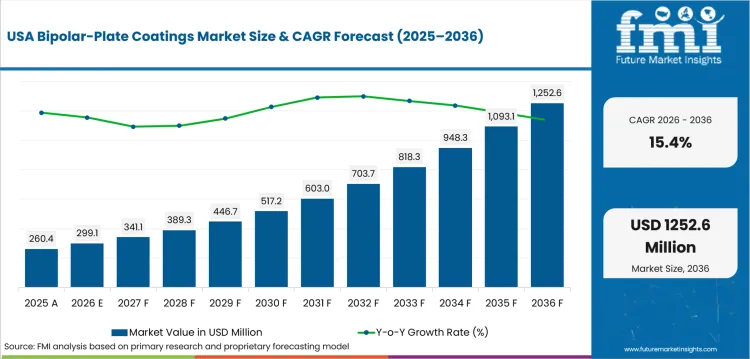
Country Market Snapshot Table
| Parameter | Value |
|---|---|
| Market Size in 2025 (Value) | USD 62.4 million |
| Market Size in 2026 (Value) | USD 72.0 million |
| Market Forecast in 2036 (Value) | USD 301.6 million |
| CAGR (2026 to 2036) | 15.4% |
| Years Considered | 2021 to 2036 |
| Base Year | 2025 |
| Forecast Period | 2026 to 2036 |
| Units Considered | Value (USD million) |
| Leading Sub-Region | Southwest and Midwest fuel cell truck corridors |
United States Bipolar-Plate Coatings Market Outlook
United States bipolar-plate coating demand is shaped by DOE-backed fuel cell validation and heavy-duty mobility requirements. Stack makers need coatings that protect metal plates without increasing warranty exposure during long operating cycles.
Suppliers with test data, surface preparation capability, and prototype support should gain stronger positioning. Buyer decisions will favor coating partners that connect laboratory results with truck, bus, backup power, and electrolyzer programs.
Key Growth Drivers
- Heavy-duty fuel cell cost targets create pressure for cheaper coated metal plates. DOE’s program plan includes a high-volume fuel cell system target of USD 80/kW by 2030.
- Hydrogen production targets support electrolyzer component demand. DOE listed a clean hydrogen production target of USD 2/kg by 2026 and USD 1/kg by 2031.
- U.S. truck and backup power applications value lower stack weight and longer operating life, supporting controlled metallic plate adoption.
- DOE-backed component projects provide routes for carbon, nitride, and coated metal plate technologies to move from testing into pilot sourcing.
Key Restraints
- Heavy-duty system targets remain demanding for newer coated metal routes. DOE’s program includes 25,000 hours of durability for long-haul truck systems before broad acceptance.
- Qualification cost limits rapid supplier changes after a stack maker selects a coating route for a platform.
- OEMs may avoid unfamiliar suppliers when coating defects could increase contact resistance across humid operating cycles.
What makes United States unique
United States is unique due to DOE target-setting and validation-led sourcing for heavy-duty fuel cell components.
Key Companies
- TreadStone Technologies
- Starfire Industries
- PVD Products
- Impact Coatings
- Plug Power
- Ballard Power Systems
- Cummins Accelera
Sales & Marketing Channels
- Direct stack OEM qualification
- DOE-funded project partnerships
- Coating equipment sales
- Prototype coating services
- University and national laboratory collaborations
- Heavy-duty vehicle platform sourcing
Country Segment Breakdown Table
| Segment | Sub-Segments |
|---|---|
| By Coating Type | Carbon-based Coatings · Nitrides / Carbides · Precious-Metal Coatings · Other |
| By Plate Material | Stainless Steel · Titanium · Graphite Composite · Other |
| By Fuel Cell Type | PEMFC · SOFC · PAFC / Other |
| By Application | Stationary Power · Mobility · Electrolyzers / Other |
| By Sales Channel | Direct OEM · Coating Service Providers |
| Key Sub-Regions Covered, Hydrogen Equipment Corridors | California · Texas · Midwest truck corridors · Pacific Northwest · Northeast clean energy hubs · Gulf Coast hydrogen clusters |
Frequently Asked Questions
How fast is United States bipolar-plate coatings market growing?
Sales in United States are set to grow at 15.4% CAGR from 2026 to 2036, guided by hydrogen component qualification.
Who leads United States bipolar-plate coatings market?
TreadStone Technologies, Starfire Industries, PVD Products, and Impact Coatings compete through coating development and fuel cell plate programs.
What is driving adoption in United States bipolar-plate coatings market?
Fuel cell stack validation, electrolyzer localization, and hydrogen equipment sourcing are moving buyers toward coated bipolar plates.
What is the bipolar-plate coatings market outlook in the United Kingdom?
A 14.2% CAGR through 2036 is supported by hydrogen project procurement and engineering services.
Country Market Snapshot Table
| Parameter | Value |
|---|---|
| Market Size in 2025 (Value) | USD 18.4 million |
| Market Size in 2026 (Value) | USD 21.0 million |
| Market Forecast in 2036 (Value) | USD 79.2 million |
| CAGR (2026 to 2036) | 14.2% |
| Years Considered | 2021 to 2036 |
| Base Year | 2025 |
| Forecast Period | 2026 to 2036 |
| Units Considered | Value (USD million) |
| Leading Sub-Region | Midlands and hydrogen project clusters |
United Kingdom Bipolar-Plate Coatings Market Outlook
United Kingdom demand is shaped by hydrogen equipment exports and project integration rather than a large domestic coating production base. System developers need suppliers that can support fuel cell and electrolyzer components through European sourcing routes.
Engineering firms can create demand when coated plates are built into export-oriented hydrogen equipment. Suppliers with technical data and flexible cross-border service should gain better access to local projects.
Key Growth Drivers
- Hydrogen strategy gives suppliers a measurable component demand base. The national target reaches up to 10 GW of low-carbon hydrogen production capacity by 2030, with at least half expected from electrolytic hydrogen.
- Project activity creates qualification opportunities for electrolyzer-linked components. The second allocation round shortlist included 27 electrolytic projects across England, Scotland, and Wales.
- UK engineering firms can integrate coated plates into fuel cell equipment and electrolyzer assemblies for export-focused programs.
- Project developers need tested components that reduce technical risk before procurement moves into execution.
Key Restraints
- Award timing can slow component orders. The second allocation round targeted up to 875 MW of capacity, but projects still needed affordability, value-for-money, and delivery-quality checks before contract award.
- Domestic coating-scale evidence remains thinner than leading Asian and continental European production hubs.
- Coating suppliers may rely on imported service routes when local stack volumes are not enough to justify dedicated lines.
What makes United Kingdom unique
United Kingdom is unique as a design, integration, and export services market for hydrogen equipment components.
Key Companies
- Ceres Power
- Intelligent Energy
- Johnson Matthey
- ITM Power
- Bramble Energy
- Impact Coatings
- Cell Impact
Sales & Marketing Channels
- Engineering services partnerships
- European OEM sourcing routes
- Hydrogen project procurement
- Fuel cell system integrator sales
- Coating service imports
- Demonstration project partnerships
Country Segment Breakdown Table
| Segment | Sub-Segments |
|---|---|
| By Coating Type | Carbon-based Coatings · Nitrides / Carbides · Precious-Metal Coatings · Other |
| By Plate Material | Stainless Steel · Titanium · Graphite Composite · Other |
| By Fuel Cell Type | PEMFC · SOFC · PAFC / Other |
| By Application | Stationary Power · Mobility · Electrolyzers / Other |
| By Sales Channel | Direct OEM · Coating Service Providers |
| Key Sub-Regions Covered, Hydrogen Equipment Corridors | Midlands · Humber · Teesside · Scotland hydrogen clusters · South Wales · London engineering corridors |
Market Taxonomy and Sub-Regions Covered
Frequently Asked Questions
How fast is United Kingdom bipolar-plate coatings market growing?
Sales in United Kingdom are set to grow at 14.2% CAGR from 2026 to 2036, guided by hydrogen component qualification.
Who leads United Kingdom bipolar-plate coatings market?
Ceres Power, Intelligent Energy, Johnson Matthey, and ITM Power compete through fuel cell and hydrogen equipment channels.
What is driving adoption in United Kingdom bipolar-plate coatings market?
Hydrogen project procurement and engineering integration are moving buyers toward coated bipolar plates.
How is the bipolar-plate coatings market performing in Germany?
A 16.2% CAGR through 2036 reflects industrial hydrogen planning and electrolyzer capacity development.
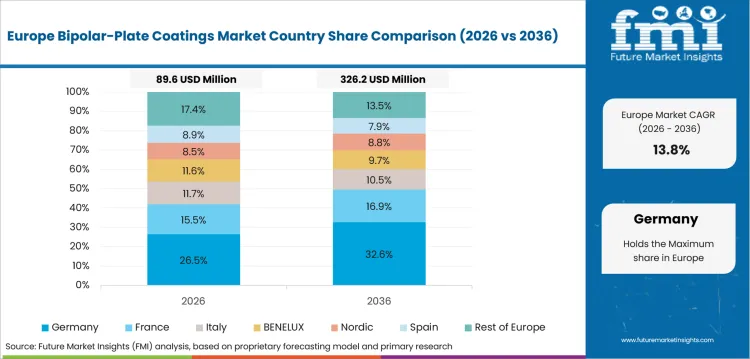
Country Market Snapshot Table
| Parameter | Value |
|---|---|
| Market Size in 2025 (Value) | USD 33.9 million |
| Market Size in 2026 (Value) | USD 39.4 million |
| Market Forecast in 2036 (Value) | USD 176.8 million |
| CAGR (2026 to 2036) | 16.2% |
| Years Considered | 2021 to 2036 |
| Base Year | 2025 |
| Forecast Period | 2026 to 2036 |
| Units Considered | Value (USD million) |
| Leading Sub-Region | North Rhine-Westphalia and industrial hydrogen corridors |
Germany Bipolar-Plate Coatings Market Outlook
Germany presents a strong industrial outlook as hydrogen demand, electrolyzer planning, and automotive supplier discipline align with coated component requirements. Buyers place high value on corrosion data, contact resistance stability, and repeatable quality control.
Supplier access is likely to move through tier relationships and stack OEM engineering programs. Coating firms with European service capacity and qualification records should gain stronger approval in industrial hydrogen and mobility channels.
Key Growth Drivers
- Industrial hydrogen demand supports coated component sourcing. German policy expects hydrogen and derivative demand of 95 TWh to 130 TWh by 2030.
- Electrolyzer planning creates demand for coated titanium and stainless plate surfaces. Germany’s strategy targets at least 10 GW of electrolyzer capacity by 2030.
- Automotive supplier networks create routes for coated metal plates in mobility stacks and high-quality plate integration.
- Industrial buyers encourage coating suppliers to deliver repeatable corrosion and contact resistance proof before nomination.
Key Restraints
- Import dependence can moderate domestic component localization. German policy states that 50% to 70% of expected 2030 hydrogen needs may have to be imported.
- Qualification expectations raise costs for smaller coating suppliers entering German OEM channels.
- Industrial tender timing can delay coated plate orders when electrolyzer and hydrogen project decisions move cautiously.
What makes Germany unique
Germany is unique because industrial hydrogen planning and automotive supplier discipline converge around high-specification coated plate sourcing.
Key Companies
- Schaeffler
- Dana Incorporated
- Cell Impact
- Borit
- Impact Coatings
- thyssenkrupp nucera
- SGL Carbon
Sales & Marketing Channels
- Tier supplier sourcing
- Stack OEM engineering programs
- Industrial hydrogen tenders
- Coating equipment sales
- Automotive supplier partnerships
- Electrolyzer component qualification
Country Segment Breakdown Table
| Segment | Sub-Segments |
|---|---|
| By Coating Type | Carbon-based Coatings · Nitrides / Carbides · Precious-Metal Coatings · Other |
| By Plate Material | Stainless Steel · Titanium · Graphite Composite · Other |
| By Fuel Cell Type | PEMFC · SOFC · PAFC / Other |
| By Application | Stationary Power · Mobility · Electrolyzers / Other |
| By Sales Channel | Direct OEM · Coating Service Providers |
| Key Sub-Regions Covered, Hydrogen Equipment Corridors | North Rhine-Westphalia · Bavaria · Baden-Wurttemberg · Lower Saxony · Hamburg · Saxony industrial corridors |
Market Taxonomy and Sub-Regions Covered
Frequently Asked Questions
How fast is Germany bipolar-plate coatings market growing?
Sales in Germany are set to grow at 16.2% CAGR from 2026 to 2036, guided by hydrogen component qualification.
Who leads Germany bipolar-plate coatings market?
Schaeffler, Dana Incorporated, Cell Impact, Borit, and SGL Carbon compete through plate integration and hydrogen component channels.
What is driving adoption in Germany bipolar-plate coatings market?
Industrial hydrogen planning and electrolyzer capacity targets are moving buyers toward coated bipolar plates.
What is driving bipolar-plate coatings growth in France?
A 14.8% CAGR through 2036 is supported by decarbonized hydrogen strategy and local bipolar plate development.
Country Market Snapshot Table
| Parameter | Value |
|---|---|
| Market Size in 2025 (Value) | USD 25.7 million |
| Market Size in 2026 (Value) | USD 29.5 million |
| Market Forecast in 2036 (Value) | USD 117.3 million |
| CAGR (2026 to 2036) | 14.8% |
| Years Considered | 2021 to 2036 |
| Base Year | 2025 |
| Forecast Period | 2026 to 2036 |
| Units Considered | Value (USD million) |
| Leading Sub-Region | Auvergne-Rhone-Alpes and northern industrial clusters |
France Bipolar-Plate Coatings Market Outlook
France demand is shaped by electrolysis-centered hydrogen policy and local bipolar plate development programs. Coating suppliers can benefit when public projects prioritize domestic component capability and fuel cell performance improvement.
Industrial sovereignty and low-carbon electricity support a favorable sourcing environment. Suppliers with French production links or European validation partners should gain better access to publicly supported fuel cell and electrolyzer programs.
Key Growth Drivers
- Electrolyzer targets support coated plate demand. IEA reported that France lowered its 2030 installed electrolyzer capacity target to 4.5 GW and added an 8 GW target for 2035.
- Hydrogen infrastructure planning creates component demand around industrial hubs. European Hydrogen Observatory reporting stated that France aims to develop 500 km of hydrogen pipelines by 2030.
- France 2030-backed technology projects support local bipolar plate development and sealing integration.
- Low-carbon electricity availability supports domestic electrolyzer use cases that require stable coated plate surfaces.
Key Restraints
- Industrial conversion can take longer than project announcements suggest. France’s 2025 strategy stated that decarbonized hydrogen needs could reach 520 kt/year by 2030.
- Electricity cost remains a barrier for electrolyzer-backed hydrogen production and related component demand.
- Public funding cycles can slow supplier decisions when technology calls and industrial sites move at different speeds.
What makes France unique
France is unique due to its low-carbon power base and public support for domestic hydrogen technology building blocks.
Key Companies
- Hutchinson
- Symbio
- Forvia
- Plastic Omnium
- McPhy Energy
- Impact Coatings
- Cell Impact
Sales & Marketing Channels
- France 2030 project sourcing
- Industrial cluster procurement
- Electrolyzer OEM qualification
- Automotive supplier partnerships
- Hydrogen technology calls
- Cross-border coating services
Country Segment Breakdown Table
| Segment | Sub-Segments |
|---|---|
| By Coating Type | Carbon-based Coatings · Nitrides / Carbides · Precious-Metal Coatings · Other |
| By Plate Material | Stainless Steel · Titanium · Graphite Composite · Other |
| By Fuel Cell Type | PEMFC · SOFC · PAFC / Other |
| By Application | Stationary Power · Mobility · Electrolyzers / Other |
| By Sales Channel | Direct OEM · Coating Service Providers |
| Key Sub-Regions Covered, Hydrogen Equipment Corridors | Auvergne-Rhone-Alpes · Normandy · Hauts-de-France · Grand Est · Ile-de-France · Occitanie hydrogen corridors |
Market Taxonomy and Sub-Regions Covered
Frequently Asked Questions
How fast is France bipolar-plate coatings market growing?
Sales in France are set to grow at 14.8% CAGR from 2026 to 2036, guided by hydrogen component qualification.
Who leads France bipolar-plate coatings market?
Hutchinson, Symbio, Forvia, Plastic Omnium, and McPhy Energy compete through fuel cell and hydrogen equipment channels.
What is driving adoption in France bipolar-plate coatings market?
Domestic hydrogen strategy and bipolar plate development projects are moving buyers toward coated plate systems.
What is the bipolar-plate coatings market forecast for Japan?
A 15.9% CAGR through 2036 reflects long-cycle OEM qualification and policy support for low-carbon hydrogen.
Country Market Snapshot Table
| Parameter | Value |
|---|---|
| Market Size in 2025 (Value) | USD 29.9 million |
| Market Size in 2026 (Value) | USD 34.6 million |
| Market Forecast in 2036 (Value) | USD 151.3 million |
| CAGR (2026 to 2036) | 15.9% |
| Years Considered | 2021 to 2036 |
| Base Year | 2025 |
| Forecast Period | 2026 to 2036 |
| Units Considered | Value (USD million) |
| Leading Sub-Region | Tokyo, Chubu, and Kansai supplier corridors |
Japan Bipolar-Plate Coatings Market Outlook
Japan demand is shaped by long qualification cycles, domestic OEM networks, and policy support for low-carbon hydrogen supply. Coating suppliers must prove consistency before they can move into repeated fuel cell or electrolyzer component sourcing.
Stationary power and industrial hydrogen applications provide added demand beyond vehicles. Local partner access will remain important for foreign coating suppliers seeking trusted entry into Japanese programs.
Key Growth Drivers
- Long-term hydrogen volume goals support component qualification. Japan’s Strategic Energy Plan targets hydrogen and ammonia introduction at 3 million tonnes by 2030 and about 20 million tonnes by 2050.
- Price-gap support can stimulate early hydrogen demand. OECD noted that Japan’s low-carbon hydrogen support scheme provides subsidy coverage over 15 years for selected projects.
- Japanese OEMs value stable coatings that can pass repeated stack qualification and customer approval steps.
- Stationary power and industrial hydrogen applications widen the addressable base beyond passenger fuel cell vehicles.
Key Restraints
- High cost support is still needed before demand scales naturally. Japan’s hydrogen subsidy design includes approximately JPY 3 trillion for low-carbon hydrogen price-gap support.
- Long supplier approval cycles slow market entry for foreign coating firms without local technical representation.
- Vehicle-led demand can develop gradually when refueling infrastructure and vehicle economics limit near-term fleet expansion.
What makes Japan unique
Japan is unique as a relationship-driven qualification market where local trust can be as important as coating chemistry.
Key Companies
- Toyota Motor Corporation
- Honda Motor Co.
- ENEOS
- Cell Impact Japan
- FCC Co.
- Impact Coatings
- Toppan Holdings
Sales & Marketing Channels
- Japanese OEM qualification
- Local partner representation
- Fuel cell stack testing programs
- Stationary power integrators
- Electrolyzer component sourcing
- Long-term supplier development agreements
Country Segment Breakdown Table
| Segment | Sub-Segments |
|---|---|
| By Coating Type | Carbon-based Coatings · Nitrides / Carbides · Precious-Metal Coatings · Other |
| By Plate Material | Stainless Steel · Titanium · Graphite Composite · Other |
| By Fuel Cell Type | PEMFC · SOFC · PAFC / Other |
| By Application | Stationary Power · Mobility · Electrolyzers / Other |
| By Sales Channel | Direct OEM · Coating Service Providers |
| Key Sub-Regions Covered, Hydrogen Equipment Corridors | Tokyo · Chubu · Kansai · Kyushu · Yokohama · Nagoya supplier corridors |
Market Taxonomy and Sub-Regions Covered
Frequently Asked Questions
How fast is Japan bipolar-plate coatings market growing?
Sales in Japan are set to grow at 15.9% CAGR from 2026 to 2036, guided by hydrogen component qualification.
Who leads Japan bipolar-plate coatings market?
Toyota Motor Corporation, Honda Motor Co., ENEOS, and Cell Impact Japan compete through fuel cell and hydrogen component channels.
What is driving adoption in Japan bipolar-plate coatings market?
OEM qualification and low-carbon hydrogen support are moving buyers toward coated bipolar plates.
How fast is China bipolar-plate coatings market growing?
An 18.0% CAGR through 2036 reflects domestic stack localization and coating-service activity.
Country Market Snapshot Table
| Parameter | Value |
|---|---|
| Market Size in 2025 (Value) | USD 74.6 million |
| Market Size in 2026 (Value) | USD 88.0 million |
| Market Forecast in 2036 (Value) | USD 460.6 million |
| CAGR (2026 to 2036) | 18.0% |
| Years Considered | 2021 to 2036 |
| Base Year | 2025 |
| Forecast Period | 2026 to 2036 |
| Units Considered | Value (USD million) |
| Leading Sub-Region | Shanghai and Yangtze River Delta fuel cell supply clusters |
China Bipolar-Plate Coatings Market Outlook
China is the strongest volume-conversion market as domestic fuel cell stacks, electrolyzer production, and coating service centers expand near customer sites. Local sourcing can reduce logistics friction for stack makers.
Price sensitivity remains high, so imported coating technologies must prove cost and durability advantages. Suppliers with service centers and production partnerships should gain better access to Chinese OEM programs serving fuel cell electric vehicle market demand and stationary systems.
Key Growth Drivers
- New energy vehicle scale supports local supply-chain investment. China’s statistics office reported 16.524 million new energy vehicles in 2025, up 25.1% from the previous year.
- Electrolyzer manufacturing strengthens adjacent coated plate demand. IEA stated in 2025 that China accounted for nearly 60% of global electrolyzer manufacturing capacity.
- Local coating service centers reduce logistics friction for Chinese stack makers and plate producers.
- Provincial hydrogen clusters encourage suppliers to support both fuel cell mobility and electrolyzer customers.
Key Restraints
- Fuel cell vehicle economics create restraint. IEA reported that fuel cell trucks remained around 35% more expensive than diesel trucks in China in 2024.
- Domestic price pressure can reduce margins for imported coating technology and equipment suppliers.
- Rapid design changes may force coating requalification and delay repeat orders from stack manufacturers.
What makes China unique
China is unique because local coating services can turn fuel cell stack activity into near-term coating revenue faster than most markets.
Key Companies
- Impact Coatings Shanghai
- FTXT Energy Technology
- Shanghai Hydrogen Propulsion Technology
- SinoHytec
- Re-fire Group
- Boyuan New Energy
- Cell Impact
Sales & Marketing Channels
- Domestic stack maker sourcing
- Shanghai coating service centers
- Plate forming equipment partnerships
- Fuel cell vehicle OEM programs
- Provincial hydrogen clusters
- Coating system sales
Country Segment Breakdown Table
| Segment | Sub-Segments |
|---|---|
| By Coating Type | Carbon-based Coatings · Nitrides / Carbides · Precious-Metal Coatings · Other |
| By Plate Material | Stainless Steel · Titanium · Graphite Composite · Other |
| By Fuel Cell Type | PEMFC · SOFC · PAFC / Other |
| By Application | Stationary Power · Mobility · Electrolyzers / Other |
| By Sales Channel | Direct OEM · Coating Service Providers |
| Key Sub-Regions Covered, Hydrogen Equipment Corridors | Shanghai · Jiangsu · Guangdong · Beijing-Tianjin-Hebei · Shandong · Hubei hydrogen clusters |
Market Taxonomy and Sub-Regions Covered
Frequently Asked Questions
How fast is China bipolar-plate coatings market growing?
Sales in China are set to grow at 18.0% CAGR from 2026 to 2036, guided by hydrogen component qualification.
Who leads China bipolar-plate coatings market?
Impact Coatings Shanghai, FTXT Energy Technology, Shanghai Hydrogen Propulsion Technology, and SinoHytec compete through local fuel cell channels.
What is driving adoption in China bipolar-plate coatings market?
Domestic stack production and electrolyzer manufacturing are moving buyers toward coated bipolar plates.
What is the South Korea bipolar-plate coatings market outlook?
A 17.4% CAGR through 2036 reflects hydrogen mobility and stationary fuel cell demand.
Country Market Snapshot Table
| Parameter | Value |
|---|---|
| Market Size in 2025 (Value) | USD 36.2 million |
| Market Size in 2026 (Value) | USD 42.5 million |
| Market Forecast in 2036 (Value) | USD 211.4 million |
| CAGR (2026 to 2036) | 17.4% |
| Years Considered | 2021 to 2036 |
| Base Year | 2025 |
| Forecast Period | 2026 to 2036 |
| Units Considered | Value (USD million) |
| Leading Sub-Region | Seoul Capital Area and Ulsan hydrogen corridors |
South Korea Bipolar-Plate Coatings Market Outlook
South Korea demand is shaped by commercial vehicle hydrogen programs and stationary fuel cell experience. Coating suppliers need to work through OEM relationships and industrial groups that value service support and repeatability.
The market favors suppliers able to support high-quality qualification and local component sourcing. Stationary fuel cells, commercial vehicles, and clean hydrogen projects can provide multiple entry routes for coated plates.
Key Growth Drivers
- Hydrogen infrastructure funding supports mobility adoption. South Korea’s environment ministry stated in January 2026 that it would provide KRW 189.7 billion in national funding for hydrogen refueling infrastructure during the year.
- Infrastructure growth supports fuel cell vehicle programs. Korean trade reporting stated that the country operated approximately 400 hydrogen refueling stations in early 2025, up from 250 in 2024.
- Stationary fuel cell use gives coating suppliers a second application route outside transport programs.
- Large industrial groups can help qualified coating suppliers move from testing into repeated commercial sourcing.
Key Restraints
- Station buildout remains policy-led. The environment ministry aimed to build more than 660 hydrogen refueling stations by 2030, showing continued dependence on public support.
- Large buyers may prefer established domestic supplier relationships and local technical service arrangements.
- Imported coating systems face qualification and service expectations before major OEMs commit to serial sourcing.
What makes South Korea unique
South Korea is unique because commercial mobility and stationary fuel cell demand are closely connected through large industrial groups.
Key Companies
- Hyundai Motor Group
- Doosan Fuel Cell
- SK E&S
- Hyundai Mobis
- POSCO Holdings
- Impact Coatings
- Cell Impact
Sales & Marketing Channels
- Commercial vehicle OEM sourcing
- Stationary fuel cell integrator procurement
- Government-backed hydrogen programs
- Industrial group partnerships
- Coating equipment sales
- Component distributor networks
Country Segment Breakdown Table
| Segment | Sub-Segments |
|---|---|
| By Coating Type | Carbon-based Coatings · Nitrides / Carbides · Precious-Metal Coatings · Other |
| By Plate Material | Stainless Steel · Titanium · Graphite Composite · Other |
| By Fuel Cell Type | PEMFC · SOFC · PAFC / Other |
| By Application | Stationary Power · Mobility · Electrolyzers / Other |
| By Sales Channel | Direct OEM · Coating Service Providers |
| Key Sub-Regions Covered, Hydrogen Equipment Corridors | Seoul Capital Area · Ulsan · Busan · Incheon · Jeolla hydrogen corridors · Gyeonggi industrial areas |
Market Taxonomy and Sub-Regions Covered
Frequently Asked Questions
How fast is South Korea bipolar-plate coatings market growing?
Sales in South Korea are set to grow at 17.4% CAGR from 2026 to 2036, guided by hydrogen component qualification.
Who leads South Korea bipolar-plate coatings market?
Hyundai Motor Group, Doosan Fuel Cell, SK E&S, and Hyundai Mobis compete through fuel cell and hydrogen component channels.
What is driving adoption in South Korea bipolar-plate coatings market?
Hydrogen mobility and stationary fuel cell programs are moving buyers toward coated bipolar plates.
How is the bipolar-plate coatings market developing in India?
A 16.8% CAGR through 2036 reflects electrolyzer manufacturing localization and hydrogen pilot projects.
Country Market Snapshot Table
| Parameter | Value |
|---|---|
| Market Size in 2025 (Value) | USD 24.7 million |
| Market Size in 2026 (Value) | USD 28.8 million |
| Market Forecast in 2036 (Value) | USD 136.1 million |
| CAGR (2026 to 2036) | 16.8% |
| Years Considered | 2021 to 2036 |
| Base Year | 2025 |
| Forecast Period | 2026 to 2036 |
| Units Considered | Value (USD million) |
| Leading Sub-Region | Gujarat, Maharashtra, and green hydrogen industrial clusters |
India Bipolar-Plate Coatings Market Outlook
India is an electrolyzer-first market where coated plate demand is likely to follow manufacturing localization before fuel cell vehicle scale. Tender-led hydrogen projects can create early demand for validated components.
Suppliers are expected to enter through OEM partnerships, licensing, and engineering services. Local coated plate capacity may develop gradually as approved equipment and performance criteria become clearer.
Key Growth Drivers
- Electrolyzer manufacturing awards create a local base for coated component demand. India’s Press Information Bureau reported 3,000 MW of annual electrolyzer manufacturing capacity awarded to 15 firms in May 2025.
- Green hydrogen allocation supports early hydrogen equipment sourcing. PIB reported 862,000 TPA annual green hydrogen production capacity allocated to 19 companies in May 2025.
- Green hydrogen pilots in steel, mobility, and shipping can support early fuel cell component testing.
- Quality criteria in tenders encourage validated coating and plate performance before large procurement decisions.
Key Restraints
- Local coated bipolar plate manufacturing evidence remains limited in public sources. India’s National Green Hydrogen Mission has an outlay of INR 19,744 crore through FY 2029-30, but dedicated coated plate capacity remains less visible.
- Tender timing and price sensitivity can slow adoption of premium coating routes during early procurement cycles.
- Suppliers may need local partnerships before imported coatings or equipment gain buyer confidence in public projects.
What makes India unique
India is unique because electrolyzer manufacturing localization is likely to create coating demand before fuel cell vehicle volumes scale.
Key Companies
- Reliance Industries
- Larsen & Toubro
- Adani New Industries
- Ohmium International
- H2e Power
- Thermax
- Tata Projects
Sales & Marketing Channels
- Electrolyzer OEM partnerships
- Government tender channels
- Industrial hydrogen project sourcing
- Coating technology licensing
- Local manufacturing alliances
- Engineering service providers
Country Segment Breakdown Table
| Segment | Sub-Segments |
|---|---|
| By Coating Type | Carbon-based Coatings · Nitrides / Carbides · Precious-Metal Coatings · Other |
| By Plate Material | Stainless Steel · Titanium · Graphite Composite · Other |
| By Fuel Cell Type | PEMFC · SOFC · PAFC / Other |
| By Application | Stationary Power · Mobility · Electrolyzers / Other |
| By Sales Channel | Direct OEM · Coating Service Providers |
| Key Sub-Regions Covered, Hydrogen Equipment Corridors | Gujarat · Maharashtra · Tamil Nadu · Karnataka · Andhra Pradesh · Rajasthan hydrogen corridors |
Market Taxonomy and Sub-Regions Covered
Frequently Asked Questions
How fast is India bipolar-plate coatings market growing?
Sales in India are set to grow at 16.8% CAGR from 2026 to 2036, guided by hydrogen component qualification.
Who leads India bipolar-plate coatings market?
Reliance Industries, Larsen & Toubro, Adani New Industries, and Ohmium International compete through hydrogen equipment channels.
What is driving adoption in India bipolar-plate coatings market?
Electrolyzer manufacturing localization and hydrogen pilot projects are moving buyers toward coated bipolar plates.
Who are the leading companies in the bipolar-plate coatings market?
Impact Coatings, TreadStone Technologies, Starfire Industries, Cell Impact, Hutchinson, and Bekaert.
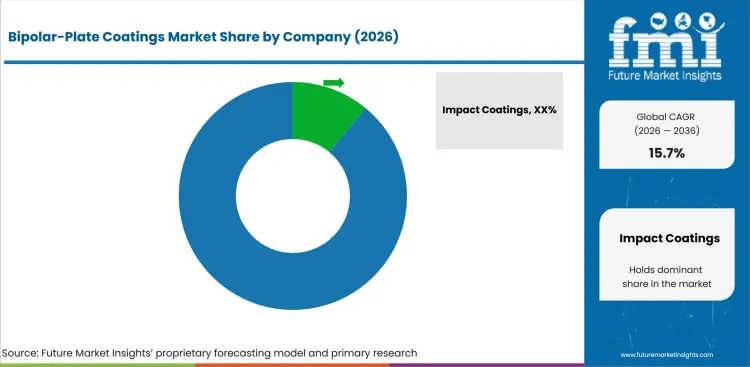
- Specialist coating companies gain advantage through validated corrosion resistance and interfacial contact resistance data.
- Plate integrators improve customer access by combining forming, sealing, welding, and coating compatibility support.
- Electrolyzer component suppliers gain stronger positioning when they can test coated interfaces under high-current operation.
- Equipment providers support scale-up by helping customers move from prototype batches toward repeatable production lines.
Competition is defined by whether suppliers can prove coating durability under real stack conditions. Buyers increasingly ask for coating data that links laboratory corrosion results with plate forming and stack behavior. Impact Coatings and TreadStone Technologies stand out in surface engineering, while Cell Impact and Hutchinson strengthen the plate integration side. Bekaert and other electrochemical interface specialists can benefit when electrolyzer manufacturers require coating validation across conductive and corrosive environments.
Manufacturing scale has become a separator as fuel cell and electrolyzer customers move from development batches toward production planning. Coating systems must support uniform thickness, stable contact resistance, and traceable inspection across many plates. Suppliers with service centers near customers can win bridge volumes before OEMs justify internal coating assets. Companies that combine industrial coatings market demand know-how with hydrogen stack validation should gain stronger repeat business.
Smaller and specialist suppliers can win through technical proof rather than broad stack portfolios. TreadStone Technologies and Starfire Industries are visible through DOE-backed work linked to low-cost metal bipolar plate coatings and corrosion-resistant films. Entry remains difficult because coating approval is tied to stack design freeze and warranty risk. Suppliers addressing surface treatment market outlook needs can expand faster when their coating platform works across fuel cell and electrolysis use cases.
How do top bipolar-plate coatings companies compare?
Impact Coatings scores strongly on coating depth while Cell Impact and Hutchinson strengthen plate integration relevance.
| Company | Relevance to Market Title | Coating Process Depth | Plate Integration Capability | Stack Qualification Support | Geographic Footprint |
|---|---|---|---|---|---|
| Impact Coatings | Very High | Very Strong | Moderate | Strong | Europe, China, North America |
| TreadStone Technologies | Very High | Very Strong | Moderate | Strong | United States |
| Starfire Industries | High | Strong | Low to Moderate | Moderate | United States |
| PVD Products | High | Strong | Low to Moderate | Moderate | North America |
| Cell Impact | Very High | Moderate | Very Strong | Strong | Europe and Asia |
| Hutchinson | High | Moderate | Very Strong | Strong | Europe |
| Borit | High | Moderate | Strong | Moderate | Europe |
| Dana Incorporated | High | Moderate | Strong | Strong | Global |
| Bekaert | High | Moderate | Moderate | Strong | Global |
| SGL Carbon | Moderate to High | Moderate | Strong | Moderate | Global |
Source: Future Market Insights competitive analysis, 2026.
Who are the key players in the bipolar-plate coatings market?
Impact Coatings, TreadStone Technologies, Starfire Industries, and Cell Impact are listed with Hutchinson and Bekaert among other suppliers.
Key global companies leading the bipolar-plate coatings market include:
- Impact Coatings
- TreadStone Technologies
- Starfire Industries
- PVD Products
- Cell Impact
- Hutchinson
- Bekaert
- Borit
- Dana Incorporated
- SGL Carbon
Key Developments in Bipolar-Plate Coatings Market
- In April 2025, Impact Coatings received a letter of intent from FTXT Energy Technology for continued coating services for fuel cell bipolar plates, with Shanghai service-center production capacity corresponding to at least CNY 4.5 million in revenue.
- In September 2024, Cell Impact signed an agreement with ANDRITZ Soutec for a galvo laser welding system capable of welding one bipolar plate per second, supporting high-volume bipolar flow plate production.
- In January 2025, Hutchinson launched its OBI-1 bipolar plate project to develop composite and metal plates with optimized sealing, transverse conductivity, corrosion resistance, and mass-production readiness.
Key Players in the Bipolar-Plate Coatings Market
Coating Specialists
- Impact Coatings
- TreadStone Technologies
- Starfire Industries
- PVD Products
Plate Integrators
- Cell Impact
- Hutchinson
- Borit
- Dana Incorporated
- Schaeffler
- SGL Carbon
Electrolyzer Component Specialists
- Bekaert
- thyssenkrupp nucera
- Ohmium International
- Cummins Accelera
Bipolar-Plate Coatings Market - Report Scope
| Parameter | Details |
|---|---|
| Forecast period | 2026 to 2036 |
| Historical period | 2021 to 2025 |
| Quantitative unit | Revenue in USD million |
| By coating type | Carbon-based coatings, nitrides / carbides, precious-metal coatings, other |
| By plate material | Stainless steel, titanium, graphite composite, other |
| By fuel cell type | PEMFC, SOFC, PAFC / other |
| By application | Stationary power, mobility, electrolyzers / other |
| By sales channel | Direct OEM, coating service providers |
| Regions covered | North America, Latin America, Europe, East Asia, South Asia and Pacific, Middle East and Africa |
| Countries covered | United States, United Kingdom, Germany, France, Japan, China, South Korea, India |
| Key companies profiled | Impact Coatings, TreadStone Technologies, Starfire Industries, PVD Products, Cell Impact, Hutchinson, Bekaert, Borit, Dana Incorporated, SGL Carbon |
| Approach | Bottom-up coated plate approach using plate volume, coating value per area, stack production signals, country hydrogen programs, and supplier validation evidence |
Source: Future Market Insights, 2026.
Bipolar-Plate Coatings Market - Scope & Definition
| Attribute | Detail |
|---|---|
| Market Definition | Conductive and corrosion-resistant coatings applied to bipolar plates used in fuel cells and electrolyzers. |
| Functions Covered | Electrical conduction, corrosion protection, gas distribution support, thermal management support, and stack life protection. |
| Applications Covered | Coated plates for stationary power, mobility fuel cells, electrolyzers, and related hydrogen equipment platforms. |
| End-Use Industries | Fuel cell systems, electrolyzer manufacturing, hydrogen equipment, commercial mobility, stationary power, and industrial energy systems. |
| Grades Covered | Carbon-based coatings, nitrides / carbides, precious-metal coatings, and other conductive protective coatings. |
| Inclusions | Coatings and coating services applied to stainless steel, titanium, graphite composite, and other bipolar plate substrates. |
| Exclusions | Complete fuel cell stacks, membrane electrode assemblies, catalysts, gas diffusion layers, uncoated plates, seals sold separately, hydrogen tanks, and balance-of-plant equipment. |
Bipolar-Plate Coatings Market - Research Methodology
| Method | Description |
|---|---|
| Primary Research | FMI analyst interviews with fuel cell stack developers, electrolyzer component suppliers, coating service providers, plate makers, and procurement teams serving mobility and stationary power buyers. |
| Desk Research | Review of government hydrogen programs, DOE fuel cell cost targets, company disclosures, official releases, and technical papers on metallic bipolar plate coatings. |
| Market Sizing & Forecasting | Bottom-up modeling using coated plate volume, coating value per square meter, fuel cell stack production signals, electrolyzer project activity, and country-level hydrogen policy support. |
| Data Validation | Cross-verification using component targets, company order signals, country hydrogen procurement frameworks, coating qualification requirements, and metallic bipolar plate commercialization evidence. |
Bipolar-Plate Coatings Market Breakdown by Coating Type, Plate Material, Fuel Cell Type, Application, Sales Channel, and Region
Bipolar-Plate Coatings Market Segmented by Coating Type
- Carbon-based Coatings
- Nitrides / Carbides
- Precious-Metal Coatings
- Other
Bipolar-Plate Coatings Market Segmented by Plate Material
- Stainless Steel
- Titanium
- Graphite Composite
- Other
Bipolar-Plate Coatings Market Segmented by Fuel Cell Type
- PEMFC
- SOFC
- PAFC / Other
Bipolar-Plate Coatings Market Segmented by Application
- Stationary Power
- Mobility
- Electrolyzers / Other
Bipolar-Plate Coatings Market Segmented by Sales Channel
- Direct OEM
- Coating Service Providers
Bipolar-Plate Coatings Market by Region
- North America
- Latin America
- Europe
- East Asia
- South Asia and Pacific
- Middle East and Africa
Research Sources and Bibliography
- Agency for Natural Resources and Energy. (2025). Strategic Energy Plan. Ministry of Economy, Trade and Industry.
- Cell Impact AB. (2024, September 27). Cell Impact enhances production capacity through an agreement with Andritz Soutec AG.
- Department for Energy Security and Net Zero. (2025, April 7). Hydrogen Allocation Round 2: Shortlisted projects. UK Government.
- Department for Energy Security and Net Zero. (2024). Second Hydrogen Allocation Round: Application guidance. UK Government.
- European Hydrogen Observatory. (2025, June 23). France: Hydrogen landscape, policies and standards. Clean Hydrogen Partnership.
- Federal Ministry for Economic Affairs and Climate Action. (2024). System Development Strategy 2024. German Federal Government.
- Federal Ministry for Economic Affairs and Climate Action. (2025). Hydrogen: A key element of the energy transition. German Federal Government.
- Hutchinson. (2025, January 27). Hutchinson launches bipolar plates for more economical and efficient fuel cells.
- Impact Coatings AB. (2025, April 24). Impact Coatings receives fuel cell coating service LoI from FTXT.
- International Energy Agency. (2025). Electrolysers: Energy system tracking. International Energy Agency.
- International Energy Agency. (2025). Global EV Outlook 2025: Trends in heavy-duty electric vehicles. International Energy Agency.
- International Energy Agency. (2025, September 12). Global Hydrogen Review 2025. International Energy Agency.
- International Energy Agency. (2025). Northwest European Hydrogen Monitor 2025. International Energy Agency.
- Ministry of Climate Change and Environment. (2026, January 4). Launch of support for hydrogen vehicle and hydrogen refueling station deployment programs. Republic of Korea.
- Ministry of Economy, Finance and Industrial and Digital Sovereignty. (2025, September 30). French Decarbonised Hydrogen Strategy. Government of France.
- National Bureau of Statistics of China. (2026, February 28). Statistical communiqué of the People’s Republic of China on the 2025 national economic and social development.
- Organisation for Economic Co-operation and Development. (2024). Case study: Japanese government subsidy scheme for low-carbon hydrogen.
- Press Information Bureau. (2025, May 20). Ministry of New and Renewable Energy participates in World Hydrogen Summit 2025. Government of India.
- Press Information Bureau. (2025, November 12). Unlocking India’s green hydrogen production potential. Government of India.
- USA Department of Commerce. (2025, September 30). South Korea hydrogen economy. International Trade Administration.
- USA Department of Energy. (2026, May 14). Heavy-duty fuel cell system cost - 2024.
- USA Department of Energy Hydrogen Program. (2024, May). Fuel cell technologies: Hydrogen and Fuel Cell Technologies Office multi-year program plan.
- USA Department of Energy Hydrogen Program. (2024, May). Hydrogen production: Hydrogen and Fuel Cell Technologies Office multi-year program plan.
This bibliography is provided for reader reference and is not exhaustive. The full report contains the complete reference list and detailed citations.
This Report Answers
- Market size estimates for 2026 and forecasts through 2036 for the bipolar-plate coatings market.
- Insights across more than 30 regional and country-level markets.
- Analysis of demand drivers, coating qualification patterns, fuel cell stack behavior, and electrolyzer component sourcing.
- Evaluation of coating types, plate materials, fuel cell types, applications, and sales channels.
- Assessment of hydrogen programs, DOE technical targets, electrolyzer project signals, and mobility fuel cell sourcing.
- Identification of coating service opportunities across prototype, bridge-volume, and serial production programs.
- Evaluation of supplier positioning across coating specialists, plate integrators, and electrolyzer component suppliers.
- Country-level growth analysis covering the United States, the United Kingdom, Germany, France, Japan, China, South Korea, and India.
- Assessment of the competitive landscape, including leading coating system providers, coated plate companies, and fuel cell component participants.
- Analysis of contact resistance, corrosion behavior, surface preparation, inspection, and traceability requirements.
- Regional outlooks across North America, Europe, East Asia, and South Asia and Pacific.
- Delivery of market data, forecasts, and supporting analysis in PDF and Excel formats.
Frequently Asked Questions
What is the growth prospect for bipolar-plate coatings?
Demand for bipolar-plate coatings is expected to rise at a considerable pace as metallic plates move into fuel cell and electrolyzer stacks.
Which companies are expected to shape the bipolar-plate coatings market?
Impact Coatings, TreadStone Technologies, Starfire Industries, Cell Impact, Hutchinson, Bekaert, and SGL Carbon are expected to shape competition.
Why are fuel cell suppliers investing in bipolar-plate coatings?
Fuel cell suppliers are investing in coatings to protect metal plates from corrosion while maintaining low electrical resistance.
Why are direct OEM channels important in the bipolar-plate coatings market?
Direct OEM channels support controlled qualification because coating recipes must align with stack architecture and validation cycles.
Which coating type is gaining attention in bipolar-plate coatings?
Carbon-based coatings are gaining attention as buyers seek conductive layers with lower exposure to precious metals.
How do hydrogen policies influence bipolar-plate coating demand?
Hydrogen policies influence demand by supporting fuel cell, electrolyzer, and clean hydrogen equipment programs that require validated components.
Why is plate material important for bipolar-plate coatings?
Plate material matters because stainless steel, titanium, and graphite composite surfaces require different coating and protection approaches.
What role do electrolyzers play in the bipolar-plate coatings market?
Electrolyzers create additional demand for coated conductive surfaces that can withstand high-current and corrosive operating conditions.
How do coating services support early market adoption?
Coating services help OEMs test prototypes and bridge volumes before they invest in internal coating assets.
Preview the report firsthand - request a free sample
Get SampleGet the brochure for pricing and purchase details.
Get PDFTable of Content
- Executive Summary
- Global Market Outlook
- Demand-side Trends
- Supply-side Trends
- Technology Roadmap Analysis
- Analysis and Recommendations
- Market Overview
- Market Coverage / Taxonomy
- Market Definition / Scope / Limitations
- Research Methodology
- Chapter Orientation
- Analytical Lens and Working Hypotheses
- Market Structure, Signals, and Trend Drivers
- Benchmarking and Cross-market Comparability
- Market Sizing, Forecasting, and Opportunity Mapping
- Research Design and Evidence Framework
- Desk Research Programme (Secondary Evidence)
- Company Annual and Sustainability Reports
- Peer-reviewed Journals and Academic Literature
- Corporate Websites, Product Literature, and Technical Notes
- Earnings Decks and Investor Briefings
- Statutory Filings and Regulatory Disclosures
- Technical White Papers and Standards Notes
- Trade Journals, Industry Magazines, and Analyst Briefs
- Conference Proceedings, Webinars, and Seminar Materials
- Government Statistics Portals and Public Data Releases
- Press Releases and Reputable Media Coverage
- Specialist Newsletters and Curated Briefings
- Sector Databases and Reference Repositories
- FMI Internal Proprietary Databases and Historical Market Datasets
- Subscription Datasets and Paid Sources
- Social Channels, Communities, and Digital Listening Inputs
- Additional Desk Sources
- Expert Input and Fieldwork (Primary Evidence)
- Primary Modes
- Qualitative Interviews and Expert Elicitation
- Quantitative Surveys and Structured Data Capture
- Blended Approach
- Why Primary Evidence is Used
- Field Techniques
- Interviews
- Surveys
- Focus Groups
- Observational and In-context Research
- Social and Community Interactions
- Stakeholder Universe Engaged
- C-suite Leaders
- Board Members
- Presidents and Vice Presidents
- R&D and Innovation Heads
- Technical Specialists
- Domain Subject-matter Experts
- Scientists
- Physicians and Other Healthcare Professionals
- Governance, Ethics, and Data Stewardship
- Research Ethics
- Data Integrity and Handling
- Primary Modes
- Tooling, Models, and Reference Databases
- Desk Research Programme (Secondary Evidence)
- Data Engineering and Model Build
- Data Acquisition and Ingestion
- Cleaning, Normalisation, and Verification
- Synthesis, Triangulation, and Analysis
- Quality Assurance and Audit Trail
- Market Background
- Market Dynamics
- Drivers
- Restraints
- Opportunity
- Trends
- Scenario Forecast
- Demand in Optimistic Scenario
- Demand in Likely Scenario
- Demand in Conservative Scenario
- Opportunity Map Analysis
- Product Life Cycle Analysis
- Supply Chain Analysis
- Investment Feasibility Matrix
- Value Chain Analysis
- PESTLE and Porter’s Analysis
- Regulatory Landscape
- Regional Parent Market Outlook
- Production and Consumption Statistics
- Import and Export Statistics
- Market Dynamics
- Global Market Analysis 2021 to 2025 and Forecast, 2026 to 2036
- Historical Market Size Value (USD Million) Analysis, 2021 to 2025
- Current and Future Market Size Value (USD Million) Projections, 2026 to 2036
- Y to o to Y Growth Trend Analysis
- Absolute $ Opportunity Analysis
- Global Market Pricing Analysis 2021 to 2025 and Forecast 2026 to 2036
- Global Market Analysis 2021 to 2025 and Forecast 2026 to 2036, By Coating Type
- Introduction / Key Findings
- Historical Market Size Value (USD Million) Analysis By Coating Type , 2021 to 2025
- Current and Future Market Size Value (USD Million) Analysis and Forecast By Coating Type , 2026 to 2036
- Carbon-based coatings
- Nitrides / Carbides
- Precious-Metal Coatings
- Carbon-based coatings
- Y to o to Y Growth Trend Analysis By Coating Type , 2021 to 2025
- Absolute $ Opportunity Analysis By Coating Type , 2026 to 2036
- Global Market Analysis 2021 to 2025 and Forecast 2026 to 2036, By Plate Material
- Introduction / Key Findings
- Historical Market Size Value (USD Million) Analysis By Plate Material, 2021 to 2025
- Current and Future Market Size Value (USD Million) Analysis and Forecast By Plate Material, 2026 to 2036
- Stainless Steel
- Titanium
- Graphite Composite
- Stainless Steel
- Y to o to Y Growth Trend Analysis By Plate Material, 2021 to 2025
- Absolute $ Opportunity Analysis By Plate Material, 2026 to 2036
- Global Market Analysis 2021 to 2025 and Forecast 2026 to 2036, By Fuel Cell Type
- Introduction / Key Findings
- Historical Market Size Value (USD Million) Analysis By Fuel Cell Type, 2021 to 2025
- Current and Future Market Size Value (USD Million) Analysis and Forecast By Fuel Cell Type, 2026 to 2036
- PEMFC
- SOFC
- PAFC / Other
- PEMFC
- Y to o to Y Growth Trend Analysis By Fuel Cell Type, 2021 to 2025
- Absolute $ Opportunity Analysis By Fuel Cell Type, 2026 to 2036
- Global Market Analysis 2021 to 2025 and Forecast 2026 to 2036, By Application
- Introduction / Key Findings
- Historical Market Size Value (USD Million) Analysis By Application, 2021 to 2025
- Current and Future Market Size Value (USD Million) Analysis and Forecast By Application, 2026 to 2036
- Mobility
- Stationary Power
- Electrolyzers / Other
- Mobility
- Y to o to Y Growth Trend Analysis By Application, 2021 to 2025
- Absolute $ Opportunity Analysis By Application, 2026 to 2036
- Global Market Analysis 2021 to 2025 and Forecast 2026 to 2036, By Sales Channel
- Introduction / Key Findings
- Historical Market Size Value (USD Million) Analysis By Sales Channel, 2021 to 2025
- Current and Future Market Size Value (USD Million) Analysis and Forecast By Sales Channel, 2026 to 2036
- Direct OEM
- Coating Service Providers
- Direct OEM
- Y to o to Y Growth Trend Analysis By Sales Channel, 2021 to 2025
- Absolute $ Opportunity Analysis By Sales Channel, 2026 to 2036
- Global Market Analysis 2021 to 2025 and Forecast 2026 to 2036, By Region
- Introduction
- Historical Market Size Value (USD Million) Analysis By Region, 2021 to 2025
- Current Market Size Value (USD Million) Analysis and Forecast By Region, 2026 to 2036
- North America
- Latin America
- Western Europe
- Eastern Europe
- East Asia
- South Asia and Pacific
- Middle East & Africa
- Market Attractiveness Analysis By Region
- North America Market Analysis 2021 to 2025 and Forecast 2026 to 2036, By Country
- Historical Market Size Value (USD Million) Trend Analysis By Market Taxonomy, 2021 to 2025
- Market Size Value (USD Million) Forecast By Market Taxonomy, 2026 to 2036
- By Country
- USA
- Canada
- Mexico
- By Coating Type
- By Plate Material
- By Fuel Cell Type
- By Application
- By Sales Channel
- By Country
- Market Attractiveness Analysis
- By Country
- By Coating Type
- By Plate Material
- By Fuel Cell Type
- By Application
- By Sales Channel
- Key Takeaways
- Latin America Market Analysis 2021 to 2025 and Forecast 2026 to 2036, By Country
- Historical Market Size Value (USD Million) Trend Analysis By Market Taxonomy, 2021 to 2025
- Market Size Value (USD Million) Forecast By Market Taxonomy, 2026 to 2036
- By Country
- Brazil
- Chile
- Rest of Latin America
- By Coating Type
- By Plate Material
- By Fuel Cell Type
- By Application
- By Sales Channel
- By Country
- Market Attractiveness Analysis
- By Country
- By Coating Type
- By Plate Material
- By Fuel Cell Type
- By Application
- By Sales Channel
- Key Takeaways
- Western Europe Market Analysis 2021 to 2025 and Forecast 2026 to 2036, By Country
- Historical Market Size Value (USD Million) Trend Analysis By Market Taxonomy, 2021 to 2025
- Market Size Value (USD Million) Forecast By Market Taxonomy, 2026 to 2036
- By Country
- Germany
- UK
- Italy
- Spain
- France
- Nordic
- BENELUX
- Rest of Western Europe
- By Coating Type
- By Plate Material
- By Fuel Cell Type
- By Application
- By Sales Channel
- By Country
- Market Attractiveness Analysis
- By Country
- By Coating Type
- By Plate Material
- By Fuel Cell Type
- By Application
- By Sales Channel
- Key Takeaways
- Eastern Europe Market Analysis 2021 to 2025 and Forecast 2026 to 2036, By Country
- Historical Market Size Value (USD Million) Trend Analysis By Market Taxonomy, 2021 to 2025
- Market Size Value (USD Million) Forecast By Market Taxonomy, 2026 to 2036
- By Country
- Russia
- Poland
- Hungary
- Balkan & Baltic
- Rest of Eastern Europe
- By Coating Type
- By Plate Material
- By Fuel Cell Type
- By Application
- By Sales Channel
- By Country
- Market Attractiveness Analysis
- By Country
- By Coating Type
- By Plate Material
- By Fuel Cell Type
- By Application
- By Sales Channel
- Key Takeaways
- East Asia Market Analysis 2021 to 2025 and Forecast 2026 to 2036, By Country
- Historical Market Size Value (USD Million) Trend Analysis By Market Taxonomy, 2021 to 2025
- Market Size Value (USD Million) Forecast By Market Taxonomy, 2026 to 2036
- By Country
- China
- Japan
- South Korea
- By Coating Type
- By Plate Material
- By Fuel Cell Type
- By Application
- By Sales Channel
- By Country
- Market Attractiveness Analysis
- By Country
- By Coating Type
- By Plate Material
- By Fuel Cell Type
- By Application
- By Sales Channel
- Key Takeaways
- South Asia and Pacific Market Analysis 2021 to 2025 and Forecast 2026 to 2036, By Country
- Historical Market Size Value (USD Million) Trend Analysis By Market Taxonomy, 2021 to 2025
- Market Size Value (USD Million) Forecast By Market Taxonomy, 2026 to 2036
- By Country
- India
- ASEAN
- Australia & New Zealand
- Rest of South Asia and Pacific
- By Coating Type
- By Plate Material
- By Fuel Cell Type
- By Application
- By Sales Channel
- By Country
- Market Attractiveness Analysis
- By Country
- By Coating Type
- By Plate Material
- By Fuel Cell Type
- By Application
- By Sales Channel
- Key Takeaways
- Middle East & Africa Market Analysis 2021 to 2025 and Forecast 2026 to 2036, By Country
- Historical Market Size Value (USD Million) Trend Analysis By Market Taxonomy, 2021 to 2025
- Market Size Value (USD Million) Forecast By Market Taxonomy, 2026 to 2036
- By Country
- Kingdom of Saudi Arabia
- Other GCC Countries
- Turkiye
- South Africa
- Other African Union
- Rest of Middle East & Africa
- By Coating Type
- By Plate Material
- By Fuel Cell Type
- By Application
- By Sales Channel
- By Country
- Market Attractiveness Analysis
- By Country
- By Coating Type
- By Plate Material
- By Fuel Cell Type
- By Application
- By Sales Channel
- Key Takeaways
- Key Countries Market Analysis
- USA
- Pricing Analysis
- Market Share Analysis, 2025
- By Coating Type
- By Plate Material
- By Fuel Cell Type
- By Application
- By Sales Channel
- Canada
- Pricing Analysis
- Market Share Analysis, 2025
- By Coating Type
- By Plate Material
- By Fuel Cell Type
- By Application
- By Sales Channel
- Mexico
- Pricing Analysis
- Market Share Analysis, 2025
- By Coating Type
- By Plate Material
- By Fuel Cell Type
- By Application
- By Sales Channel
- Brazil
- Pricing Analysis
- Market Share Analysis, 2025
- By Coating Type
- By Plate Material
- By Fuel Cell Type
- By Application
- By Sales Channel
- Chile
- Pricing Analysis
- Market Share Analysis, 2025
- By Coating Type
- By Plate Material
- By Fuel Cell Type
- By Application
- By Sales Channel
- Germany
- Pricing Analysis
- Market Share Analysis, 2025
- By Coating Type
- By Plate Material
- By Fuel Cell Type
- By Application
- By Sales Channel
- UK
- Pricing Analysis
- Market Share Analysis, 2025
- By Coating Type
- By Plate Material
- By Fuel Cell Type
- By Application
- By Sales Channel
- Italy
- Pricing Analysis
- Market Share Analysis, 2025
- By Coating Type
- By Plate Material
- By Fuel Cell Type
- By Application
- By Sales Channel
- Spain
- Pricing Analysis
- Market Share Analysis, 2025
- By Coating Type
- By Plate Material
- By Fuel Cell Type
- By Application
- By Sales Channel
- France
- Pricing Analysis
- Market Share Analysis, 2025
- By Coating Type
- By Plate Material
- By Fuel Cell Type
- By Application
- By Sales Channel
- India
- Pricing Analysis
- Market Share Analysis, 2025
- By Coating Type
- By Plate Material
- By Fuel Cell Type
- By Application
- By Sales Channel
- ASEAN
- Pricing Analysis
- Market Share Analysis, 2025
- By Coating Type
- By Plate Material
- By Fuel Cell Type
- By Application
- By Sales Channel
- Australia & New Zealand
- Pricing Analysis
- Market Share Analysis, 2025
- By Coating Type
- By Plate Material
- By Fuel Cell Type
- By Application
- By Sales Channel
- China
- Pricing Analysis
- Market Share Analysis, 2025
- By Coating Type
- By Plate Material
- By Fuel Cell Type
- By Application
- By Sales Channel
- Japan
- Pricing Analysis
- Market Share Analysis, 2025
- By Coating Type
- By Plate Material
- By Fuel Cell Type
- By Application
- By Sales Channel
- South Korea
- Pricing Analysis
- Market Share Analysis, 2025
- By Coating Type
- By Plate Material
- By Fuel Cell Type
- By Application
- By Sales Channel
- Russia
- Pricing Analysis
- Market Share Analysis, 2025
- By Coating Type
- By Plate Material
- By Fuel Cell Type
- By Application
- By Sales Channel
- Poland
- Pricing Analysis
- Market Share Analysis, 2025
- By Coating Type
- By Plate Material
- By Fuel Cell Type
- By Application
- By Sales Channel
- Hungary
- Pricing Analysis
- Market Share Analysis, 2025
- By Coating Type
- By Plate Material
- By Fuel Cell Type
- By Application
- By Sales Channel
- Kingdom of Saudi Arabia
- Pricing Analysis
- Market Share Analysis, 2025
- By Coating Type
- By Plate Material
- By Fuel Cell Type
- By Application
- By Sales Channel
- Turkiye
- Pricing Analysis
- Market Share Analysis, 2025
- By Coating Type
- By Plate Material
- By Fuel Cell Type
- By Application
- By Sales Channel
- South Africa
- Pricing Analysis
- Market Share Analysis, 2025
- By Coating Type
- By Plate Material
- By Fuel Cell Type
- By Application
- By Sales Channel
- USA
- Market Structure Analysis
- Competition Dashboard
- Competition Benchmarking
- Market Share Analysis of Top Players
- By Regional
- By Coating Type
- By Plate Material
- By Fuel Cell Type
- By Application
- By Sales Channel
- Competition Analysis
- Competition Deep Dive
- Impact Coatings
- Overview
- Product Portfolio
- Profitability by Market Segments (Product/Age /Sales Channel/Region)
- Sales Footprint
- Strategy Overview
- Marketing Strategy
- Product Strategy
- Channel Strategy
- TreadStone Technologies
- Starfire Industries
- PVD Products
- Cell Impact
- Impact Coatings
- Competition Deep Dive
- Assumptions & Acronyms Used


