

- Market Size (2026)
- USD 580.0 Mn
- Forecast (2036)
- USD 1934.3 Mn
- CAGR (2026 to 2036)
- 12.8%
How big is the biscuit production lines market in 2026?
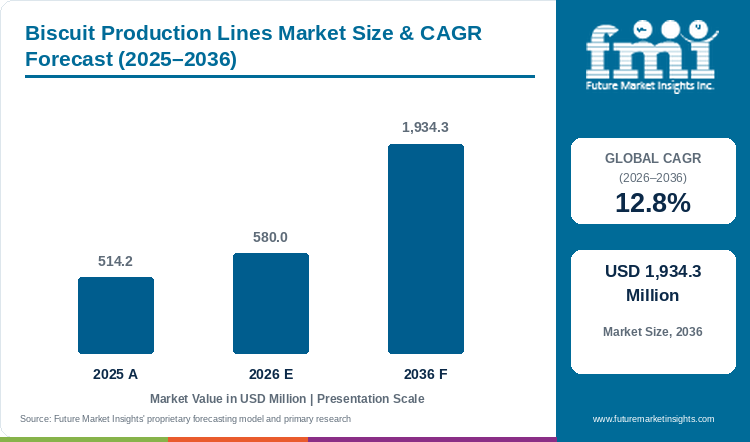
The market was valued at USD 514.2 million in 2025 and is expected to reach USD 580.0 million in 2026. It is projected to reach USD 1,934.3 million by 2036 at a CAGR of 12.8% from 2026 to 2036.
The biscuit production lines market was valued at USD 514.2 million in 2025 and is estimated at USD 580.0 million in 2026. Revenue is forecast to reach USD 1,934.3 million by 2036 at a CAGR of 12.8%, with mid-capacity lines accounting for 39.0% of equipment type demand in 2026. Japan produced 247,075 tonnes of biscuits in 2025, close to the 246,985 tonnes recorded in 2024, while estimated production value rose 6.0% to JPY 317.0 billion.[2] The difference between volume and value underlines why line replacement is often a question of operating economics: energy use, breakage and changeover losses may matter more than additional tonnage. An oven can also be the limiting stage in an otherwise serviceable line, making targeted renewal preferable for some producers. A full line order must also account for recipe flexibility and the service plan for thermal components, since unplanned stops can erode the savings expected from more efficient baking.
Key Market Trends & Insights
- By equipment type: Mid-Capacity Lines represented 39.0% of 2026 equipment type demand. One line can take several biscuit products without the footprint of a high-capacity installation. The test is whether tool changes and cleaning leave enough oven time for the order mix.
- By capacity: 500-2,000 kg/hr accounted for 39.0% of 2026 capacity demand. Oven scale, breakage and cooling decide how much rated output reaches packing. It's tested by the weight of saleable biscuits at the packing point, not at the oven exit.
- By automation level: Fully Automatic / Robotic held 47.0% of 2026 automation level demand. Linked dough feed, forming speed and oven zones let a recipe return after a stop without station-by-station correction. The test is how much dough in process is lost when the line stops.
Regional Highlights
- The UAE's 14.2% projected CAGR is the highest of the biscuit production line country forecasts, where energy use, breakage and changeover losses can matter as much as added capacity.
- Saudi Arabia follows at 13.8%, South Korea at 13.5% and the USA at 13.2%; France's 11.9% outlook is the slowest in the eight-country comparison.
Market Size & Forecast
Table 1: Biscuit Production Lines Market Size and Forecast (USD million), 2025 to 2036
| Market size and forecast | Value |
|---|---|
| 2025 Value (actual) | USD 514.2 million |
| Estimated market size in 2026 | USD 580.0 million |
| Projected market size by 2036 | USD 1,934.3 million |
| CAGR (2026-2036) | 12.8% |
The practical opportunity depends on whether a line delivers a biscuit with the right colour, moisture and texture at the packing point. Reading Bakery Systems introduced Emithermic XE in May 2025 as an option to replace direct-gas-fired cracker ovens.[3] Bühler added TurbuBake Smart and RotaMold Max Smart to its biscuit portfolio in May 2026 and claims up to 15.0% lower energy consumption for the oven.[4] These offers target different stages, although a supplier’s claim cannot show how much energy a particular product will save. FDA allergen guidance of March 2025 adds a declaration requirement when a plant broadens its assortment.[1] Consequently, actual demand will depend on whether a project cuts thermal cost or breakage without adding changeover and cleaning time that offsets the gain.
Biscuit Production Lines Market is segmented by Equipment Type, Capacity, Automation Level, End User, Sales Channel and Region. The forecast period runs from 2026 to 2036.
A biscuit assortment can require several distinct manufacturing methods. Dough properties and bakery ingredients influence the choice between moulding, sheeting, cutting and depositing. Japan’s industry statistics distinguish hard biscuits, soft biscuits and crackers, each with its own production total.[2] A factory seeking to broaden that mix may need new tooling or a different heat profile even when it has sufficient overall capacity. This creates a role for specialist equipment within an established plant. It also places a limit on the appeal of a standard complete line: forming equipment suited to one product family may leave a second family dependent on substantial alterations.
The oven is a major point of renewal because it determines how the formed dough becomes a finished biscuit. RBS describes Emithermic XE as combining electric radiant elements, radiant panels and convection, with gas or electric penthouse options and no ribbon burners in the baking zone.[3] That configuration opens a replacement opportunity where cracker manufacturers want to change heat delivery. The investment extends to the energy connection, cooling and operating methods around the oven. It can preserve the value of suitable forming machinery, but the new thermal profile must still produce the required colour, moisture and texture across the products allocated to it.
Bühler’s May 2026 introduction of TurbuBake Smart and RotaMold Max Smart addresses baking and forming respectively.[4] The manufacturer claims up to 15.0% lower energy consumption for TurbuBake Smart; RotaMold Max Smart focuses on consistent forming and accessible components.[4] Together, these offers show how suppliers can compete for different parts of a factory’s investment budget. The case for each depends on where the losses occur. A plant introducing another recipe also has to manage ingredient declarations, which FDA’s March 2025 allergen guidance addresses.[1] Product variety consequently affects tooling, thermal settings and the work between runs, as well as the marketability of the finished assortment.
Table 2: Supporting Industry Indicators for the Biscuit Production Lines Market, 2024 to 2026
| Indicator | Data point | Why it matters | Source |
|---|---|---|---|
| Downstream biscuit output | Japan produced 247,075 tonnes in 2025 versus 246,985 tonnes in 2024. | Near-flat tonnage directs attention to replacement and product-mix investment. | [2] |
| Downstream production value | Japan’s estimated biscuit production value rose 6.0% to JPY 317.0 billion in 2025. | Higher sales value can coexist with stable physical production. | [2] |
| Cracker-oven replacement | RBS introduced Emithermic XE in May 2025. | The thermal stage can be renewed while suitable upstream assets remain. | [3] |
| Heat-delivery arrangement | Emithermic XE combines radiant elements, panels and convective heat. | Heat delivery influences bake profile and the scope of an oven replacement. | [3] |
| Manufacturer energy claim | Bühler states up to 15.0% lower energy consumption for TurbuBake Smart. | Lower energy use can support replacement where thermal cost is material. | [4] |
| Product-information requirement | FDA issued food-allergen labelling guidance in March 2025. | A varied product schedule requires declarations that match each formulation. | [1] |
Demand Intensity Analysis
The biscuit production lines market is forecast to generate an additional USD 1,354.3 million in annual revenue between 2026 and 2036, growing at a 12.8% value CAGR. Japan’s biscuit output was steady in 2025, so machinery spending need not follow tonnage.[2] In a factory with little additional food volume, machinery spending can still increase when the bakery changes how it makes the product. That possibility is strongest where investment addresses a recurring cost or enables a saleable new format. It is weaker where suitable machinery already exists and a larger line would remain underused. Demand therefore depends on individual factories finding a reason to commit capital, with the age and suitability of their installed equipment shaping both the timing and size of orders.
Mid-capacity lines represent USD 226.2 million in 2026. Their commercial appeal rests on accommodating regular biscuit orders while allowing a manufacturer to spread production across several products. Oven width, forming tools and cooling space define how broad that assortment can become. A factory may expand one of those stages first as its order book changes. This creates demand for equipment that can join an existing installation, alongside complete lines for new facilities. For suppliers, the distinction matters: a renewal project depends heavily on engineering around the factory, while a new line allows the stages to be specified together. Each added product raises the share of oven time spent on changes rather than baking.
Fully automatic / robotic equipment accounts for USD 272.6 million in 2026. In a continuous biscuit line, coordination has value because dough feed, oven residence time and the arrival of product at packing are interdependent. A stoppage can leave dough waiting upstream while biscuits continue to leave the oven. Controls that manage these transitions can protect material already in process and reduce the time spent restoring the recipe. Their contribution is most apparent on lines with repeated interruptions or several products, where frequent manual correction can erode the advantages of continuous production. Recipe memory in the controls also helps a new operator restore a known setting after a stop.
Direct OEM sales contributes USD 324.8 million in 2026. The manufacturer’s engineering role spans forming tools, oven behaviour and connections between machines, which helps explain the channel’s importance in substantial projects. Winning this expenditure will require suppliers to show how a proposed line changes the economics of the biscuit being made: less breakage, a lower thermal burden or a product range the factory can supply consistently. The demand determinant is a credible improvement in production economics supported by sufficient orders for the resulting biscuits. Service provision protects that improvement after installation. Long-term sales are ultimately determined by whether a proposed line cuts breakage or thermal burden for the biscuits it makes.
Table 3: Demand Intensity Metrics for the Biscuit Production Lines Market, 2026 to 2036 with relevant industry comparisons
| Demand intensity metric | Value | Basis |
|---|---|---|
| Biscuit production lines value CAGR | 12.8% | Global market value, 2026 to 2036. |
| Japanese biscuit output, 2025 | 247,075 tonnes | Japan Biscuit Association statistics; 2024 output was 246,985 tonnes.[2] |
| Japanese production-value growth | 6.0% | Association estimate for 2025; value rose to JPY 317.0 billion.[2] |
| Mid-capacity-line revenue, 2026 | USD 226.2 million | Equipment Type category. |
| Fully automatic / robotic revenue, 2026 | USD 272.6 million | Automation Level category. |
| Direct OEM sales revenue, 2026 | USD 324.8 million | Sales Channel category. |
| Added revenue through 2036 | USD 1,354.3 million | Increase in market value between 2026 and 2036. |
Analyst Perspective
A biscuit line earns a lasting place when it lowers the cost of the stage that limits output without disrupting the existing assortment. Suppliers that name the stage they improve win the order, while those offering extra capacity alone lose it.
- Nandini Roy Choudhury, Principal Analyst at Future Market Insights
How is the biscuit production lines market segmented?
The biscuit production lines market is segmented by Equipment Type (Mid-capacity lines, Compact / entry systems, High-capacity industrial lines), Capacity (500-2,000 kg/hr, Below 500 kg/hr, Above 2,000 kg/hr), Automation Level (Fully automatic / robotic, Semi-automatic, Manual), End User (Industrial bakeries, In-store & retail bakeries, Artisan bakeries, Foodservice / QSR central kitchens), and Sales Channel (Direct OEM sales, Dealers & distributors, Aftermarket & refurbished). Regionally, the market is segmented into North America, Latin America, Western Europe, Eastern Europe, East Asia, South Asia and Pacific, and Middle East and Africa.
Why do Mid-capacity lines anchor Equipment Type demand?
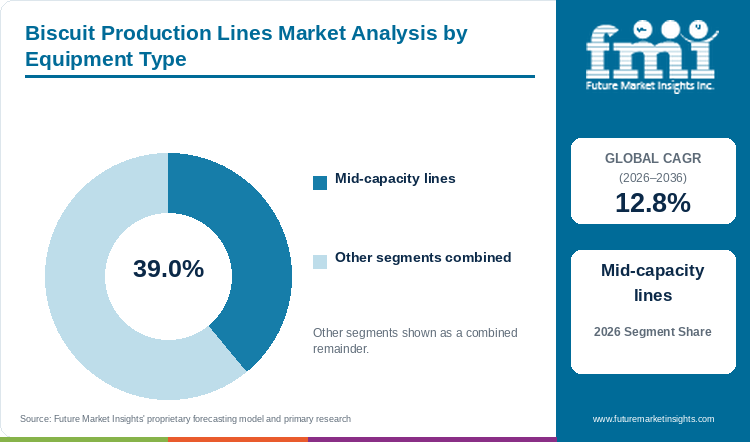
Mid-capacity lines lead with 39.0% of Equipment Type revenue in 2026.
A mid-capacity installation suits a factory whose regular orders support continuous baking but do not keep the largest line occupied. Several products can share it where their forming and thermal needs are compatible, which lets the segment widen an assortment as well as raise volume. The limit is time lost to small campaigns, since frequent tool changes make a versatile line expensive to run.
- Mid-capacity lines hold 39.0% of Equipment Type in 2026, accommodating recurring biscuit orders without the footprint of the largest installations.
- The order mix needs to be large enough for shared equipment to earn its cost across several products.
What makes 500-2,000 kg/hr the leading Capacity category?
500-2,000 kg/hr leads with 39.0% of Capacity revenue in 2026.
Within a dough processing system, the 500-2,000 kg/hr class links oven scale with the equipment that feeds and empties it. Breakage and cooling losses reduce the amount available for packing, and each recipe occupies the oven for a different interval. Moving above 2,000 kg/hr adds a larger requirement for feeding, transfers and packing, while below 500 kg/hr suits specialist products.
- 500-2,000 kg/hr accounts for 39.0% of Capacity in 2026. Output depends on the baking, cooling and packing route sustaining the same workload.
- Oven residence time and cooling space need to be sized for the share of rated capacity that must reach packing.
How does Fully automatic / robotic automation shape buying decisions?
Fully automatic / robotic leads with 47.0% of Automation Level revenue in 2026.
Automatic recipe controls connect forming speed and oven zones, so a product change depends less on separate adjustment at every station. The benefit comes from repeating those settings across campaigns and limiting losses when production stops. Transfers remain critical because a short stop can affect dough and baked biscuits together. Semi-automatic arrangements leave more to the operator where the product mix changes often.
- Fully automatic / robotic leads Automation Level at 47.0% in 2026, linking dough feed, forming speeds and oven recipes.
- Restart control needs to protect material already in the oven and restore the product recipe.
Why do Industrial bakeries lead the End User category?
Industrial bakeries lead with 44.0% of End User revenue in 2026.
Industrial bakeries supply products to defined weight, moisture and appearance requirements. Their investment case includes the condition of the biscuit after cooling and transfer, when breakage becomes visible, and equipment that reduces those losses improves the economics of a long campaign. In-store and artisan bakeries generally run smaller installations, while central kitchens have their own output and dispatch requirements.
- Industrial bakeries hold 44.0% of End User in 2026, with repeated campaigns placing emphasis on consistent finished-product specifications.
- Cooling and transfers need to protect product quality between the oven exit and packing.
Why does Direct OEM sales predominate among Sales Channels?
Direct OEM sales hold 56.0% of Sales Channel revenue in 2026.
A complete biscuit line combines forming expertise with oven engineering and product handling. Buying direct places those responsibilities in one contract, which matters when commissioning exposes a problem between two machines. Dealers and distributors give access to smaller systems and local assistance. Aftermarket and refurbished equipment can lower the purchase commitment, although controls, critical components and the condition of tooling need checking.
- Direct OEM sales hold 56.0% of Sales Channel revenue in 2026, providing technical coordination across a project with several connected machines.
- The line contract needs to cover the performance of the connections between machines.
What are the drivers, restraints and opportunities in the biscuit production lines market?
Coordinated forming and baking can remove persistent production bottlenecks
A line can lose production at the boundaries between otherwise capable machines. Forming that outruns baking creates excess dough, and inadequate cooling slows the release of biscuits to packing. Bühler’s May 2026 portfolio additions included both an oven and a rotary moulder.[4] A supplier gains where removing the persistent constraint lets existing assets contribute more to sales without a complete new line.
Recipe changes and thermal behaviour make commissioning demanding
Flour, fat and sugar change how dough responds in forming and the oven, so a new recipe can need changes across several stages. Ingredient declarations must also follow the formulation under FDA’s 2025 allergen guidance.[1] A factory with many short campaigns may spend a large part of its hours on cleaning and setup. A supplier gains where commissioning support shortens that work.
Thermal-system upgrades can give established plants a new investment route
Oven renewal can concentrate spending on the most costly part of an established cracker line. Reading Bakery Systems introduced Emithermic XE in May 2025 with radiant and convective heat combined.[3] The extent of the project depends on utility work and the cooling arrangements around the oven. A supplier gains where thermal specialists reach customers who are not considering a complete new line.
Which country CAGRs are profiled in the biscuit production lines market?
Table 4: Country growth outlook for the biscuit production lines market
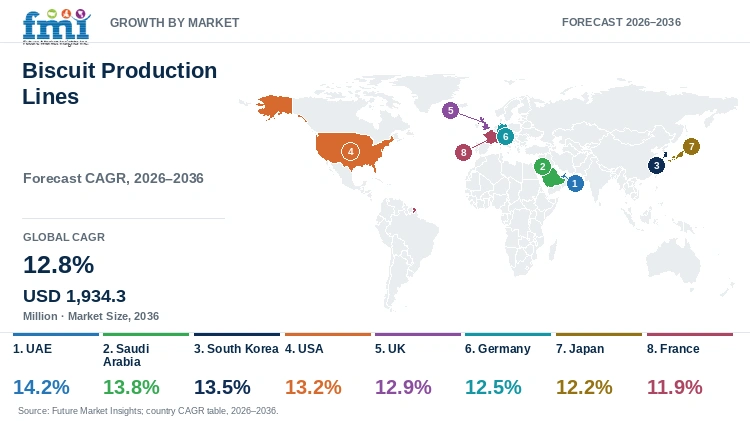
| Country | CAGR, 2026 to 2036 |
|---|---|
| UAE | 14.2% |
| Saudi Arabia | 13.8% |
| South Korea | 13.5% |
| USA | 13.2% |
| UK | 12.9% |
| Germany | 12.5% |
| Japan | 12.2% |
| France | 11.9% |
UAE
The UAE has the highest profiled CAGR at 14.2% for 2026 to 2036, above the global rate of 12.8%. The USDA Foreign Agricultural Service’s December 2025 food service report put imports of bakery goods, cereals and pasta at USD 856 million in 2024. The figure shows an import-reliant market, not how much biscuit production will move onshore. Local producers compete with imports on price, so breakage and giveaway matter from the first month. For a new biscuit facility, the initial assortment decides which forming machines must be installed from the start. However, further products can be added economically only when oven width and cooling leave room. Demand will depend on how many new facilities separate launch equipment from later additions.
Saudi Arabia
Saudi Arabia is forecast at 13.8% CAGR for 2026 to 2036, above the global rate of 12.8%. The USDA Foreign Agricultural Service’s December 2025 food service report ranked baked goods third among the ten leading growth products. The ranking points to demand for baked goods in general, not biscuits specifically. In a project involving several machinery suppliers, forming, baking and packing specifications have to meet at the same product rate. Each machine’s output has to be matched to the oven, because the slowest stage sets the rate for the whole line. However, unresolved connections lengthen the time between equipment delivery and commercial production. Demand will depend on how many projects place coordination and commissioning with one supplier.
South Korea
South Korea is projected at 13.5% CAGR over 2026 to 2036, above the global rate of 12.8%. The agriculture ministry reported food exports of USD 13.62 billion in 2025, up 5.1% on the year. The figure covers all food and shows export momentum that can justify new formats, not equipment spending. For projects serving several pack formats, biscuit dimensions can influence the forming investment as much as recipe composition. Another die or cutting arrangement may be needed even when the dough changes little. However, the new dimensions must pass through cooling and packing without added breakage. Demand will depend on how many producers can add formats through tooling within existing lines without replacing the forming stage.
USA
US demand is forecast to grow at 13.2% CAGR through 2036, above the global rate of 12.8%. The Bureau of Labor Statistics put the average price of chocolate chip cookies at USD 5.15 per pound in September 2026, unchanged from a year earlier. Flat shelf prices leave producers little room to pass on cost, though the figure says nothing about line budgets. RBS’s Emithermic XE launch offers an example of technology aimed at replacing an existing cracker oven,[3] which concentrates spending on heat delivery while preserving much of the plant. FDA’s 2025 allergen guidance also makes accurate formulation relevant when an upgraded line broadens its assortment.[1] Demand will depend on whether renewal and range expansion fit in one capital project.
UK
The UK has a 12.9% CAGR forecast for 2026 to 2036, slightly above the global rate of 12.8%. The Department for Energy Security and Net Zero reported an average non-domestic gas price of 5.28 pence per kWh in the second quarter of 2026, 0.6% below a year earlier. Stable gas costs make the energy case for oven replacement depend on efficiency gains, not on price relief. An established plant can generate a replacement order when repeated manual feeding or forming adjustments interrupt an otherwise capable line. However, short orders make tool changes and cleaning especially consequential, so a supplier that simplifies transitions strengthens its offer. Demand will depend on how many plants can recover production time across their regular campaigns.
Germany
Germany is projected at 12.5% CAGR from 2026 to 2036, below the global rate of 12.8%. Destatis reported that non-household gas cost 6.29 cents per kWh in the first half of 2026, 6.8% less than a year earlier. Lower gas prices ease operating cost, but the figure does not show oven investment, and a plant may defer replacement. In an oven replacement, the cost of energy and the heating arrangement shape the financial case. Bühler’s TurbuBake Smart carries a manufacturer claim of up to 15.0% lower energy consumption.[4] However, the benefit for an individual factory depends on its products and operating conditions. Demand will depend on how many plants can show a thermal saving without compromising the biscuit specification.
Japan
Japan is projected at 12.2% CAGR from 2026 to 2036, below the global rate of 12.8%. The Japan Biscuit Association reported 2025 output of 247,075 tonnes, almost unchanged on 2024, while estimated production value rose 6.0%.[2] Value grew without extra tonnage, which points to price and mix rather than new capacity, and each shift in balance may need new tooling. In a plant with steady volume, changing the balance of hard biscuits, soft biscuits and crackers can create demand for different forming and baking equipment. However, the statistics do not show how many plants will act on that. Suppliers of bakery processing equipment can find opportunities in renewal and assortment development. Demand will depend on how many plants change their product balance.
France
France has the lowest profiled CAGR at 11.9% for 2026 to 2036, below the global rate of 12.8%. INSEE reported food prices up 1.4% over the twelve months to September 2026, led by fresh products at 9.5% while other food rose 0.4%. Biscuit makers sit in the slower category, which limits how far cost increases reach shelf prices. A manufacturer adding a soft biscuit or cookie may need cookie depositing equipment alongside an existing moulding or sheeting section. That changes the upstream investment and the range assigned to the oven. However, the opportunity holds only with enough compatible baking and cooling capacity. Demand will depend on how many French plants can run the new method as a recurring product line.
Who are the notable companies in the biscuit production lines market?
Bühler; Baker Perkins; Reading Bakery Systems; GEA; Polin
Bühler, Baker Perkins, Reading Bakery Systems, GEA and Polin supply different combinations of biscuit forming and thermal equipment. Their competitive positions depend on the product family and the breadth of the project. Complete-line orders reward coordination across several stages; a specialist oven or forming replacement gives greater weight to the particular process being changed.
A supplier can compete through a broader installation or through a focused improvement within the customer’s existing plant. The latter requires detailed knowledge of surrounding equipment and can involve substantial engineering despite a smaller machinery order. Commissioning support and subsequent technical service help protect both forms of business.
Competitive Benchmarking: Biscuit Production Lines Market
Table 5: Company capabilities in the biscuit production lines market
| Company | Relevant offer | Commercial capability |
|---|---|---|
| Bühler | Biscuit and cracker forming and baking systems | Coordinated equipment including Smartline technologies |
| Baker Perkins | Biscuit, cookie and cracker systems | Mixing, forming, baking and product handling |
| Reading Bakery Systems | Hard and soft biscuit systems | Forming and thermal equipment with development facilities |
| GEA | Biscuit and cookie production technologies | Sheeting, rotary moulding, depositing and baking |
| Polin | Soft-biscuit and cookie production lines | Forming equipment combined with industrial ovens |
Key Developments in the Biscuit Production Lines Market
- Reading Bakery Systems launched Emithermic XE in May 2025 as a replacement option for direct-gas-fired cracker ovens. It combines radiant and convective heat with attention to control and maintenance access.[3]
- Bühler added TurbuBake Smart and RotaMold Max Smart to its biscuit and cracker portfolio in May 2026, extending the available options at the baking and forming stages.[4]
Key Players in the Biscuit Production Lines Market
- Bühler
- Baker Perkins
- Reading Bakery Systems
- GEA
- Polin
Biscuit Production Lines Market - Report Scope
Table 6: Report scope for the biscuit production lines market
| Coverage field | Report scope |
|---|---|
| Market breakdown | Equipment Type; Capacity; Automation Level; End User; Sales Channel |
| Quantitative Units | USD Million |
| Market Definition | Sales revenue from new or refurbished biscuit, cookie, and cracker production-line equipment within the stated segments. The scope includes identifiable line machinery and directly allocated bundled components or commissioning charges. It excludes downstream finished biscuit sales, standalone maintenance-only fees, and unrelated bread, pastry, or substitute processing equipment. |
| Regions Covered | North America; Latin America; Western Europe; Eastern Europe; East Asia; South Asia and Pacific; Middle East and Africa |
| Countries Covered | UAE; Saudi Arabia; South Korea; USA; UK; Germany; Japan; France |
| Key Companies Profiled | Bühler; Baker Perkins; Reading Bakery Systems; GEA; Polin |
| Forecast Period | 2026 to 2036 |
| Approach | Market assessment supported by official technical and regulatory publications, company product information and country operating conditions. |
Biscuit Production Lines Market - Research Methodology
Table 7: Research approach for the biscuit production lines market
| Method | Approach |
|---|---|
| Market coverage | The assessment follows product specifications, application boundaries and the point at which the defined ingredient or equipment is sold. |
| Secondary evidence | Government and technical publications are considered alongside first-party product information and dated corporate announcements. |
| Commercial analysis | Purchasing requirements, operating constraints, service needs and country-specific routes to market inform the interpretation of demand. |
| Forecast presentation | Global values, leading segment shares and country growth rates are stated for the 2026 to 2036 forecast period. |
Biscuit Production Lines Market by Segments
Equipment Type
- Mid-capacity lines
- Compact / entry systems
- High-capacity industrial lines
Capacity
- 500-2,000 kg/hr
- Below 500 kg/hr
- Above 2,000 kg/hr
Automation Level
- Fully automatic / robotic
- Semi-automatic
- Manual
End User
- Industrial bakeries
- In-store & retail bakeries
- Artisan bakeries
- Foodservice / QSR central kitchens
Sales Channel
- Direct OEM sales
- Dealers & distributors
- Aftermarket & refurbished
Biscuit Production Lines Market by Region
- North America
- United States
- Canada
- Latin America
- Brazil
- Mexico
- Argentina
- Chile
- Western Europe
- Germany
- France
- United Kingdom
- Italy
- Spain
- Benelux
- Nordics
- Eastern Europe
- Poland
- Czech Republic
- Romania
- Hungary
- East Asia
- China
- Japan
- South Korea
- South Asia and Pacific
- India
- ASEAN
- Australia and New Zealand
- Middle East and Africa
- GCC Countries
- South Africa
- Türkiye
- Israel
Research Sources and Bibliography
- [1] U.S. Food and Drug Administration. (2025, March 26). Frequently asked questions: Food allergen labeling guidance for industry.
- [2] Japan Biscuit Association. (2026, May 13). Biscuits statistics of Japan: Production by sort [Statistical table].
- [3] Reading Bakery Systems. (2025, May 14). RBS designs Emithermic XE oven to replace direct gas fired oven technology.
- [4] Bühler Group. (2026, May 7). Bühler launches innovations and releases major upgrades to its Grains & Food portfolio.
This Report Answers
- How large is the biscuit production lines market in 2026 and what value is projected for 2036?
- Which industrial pressures encourage biscuit manufacturers to replace or automate lines?
- Why do Mid-capacity lines retain the leading Equipment Type position?
- What supports the position of 500-2,000 kg/hr lines in Capacity?
- How do the 2026 to 2036 growth rates differ across the eight profiled countries?
- Which profiled companies supply biscuit processing systems and which offer adjacent bakery capabilities?
Frequently Asked Questions
How big is the biscuit production lines market in 2026, and what is the 2036 forecast?
The market is valued at USD 580.0 Million in 2026 and is forecast at USD 1,934.3 Million in 2036.
What is the forecast CAGR for the biscuit production lines market from 2026 to 2036?
The forecast CAGR is 12.8% from 2026 to 2036.
Which Equipment Type segment leads the biscuit production lines market?
Mid-capacity lines lead Equipment Type with 39.0% in 2026. Their scale accommodates recurring biscuit orders and production across several compatible products.
Which Capacity segment holds the largest 2026 share?
500-2,000 kg/hr leads Capacity with 39.0% in 2026. Baking time, cooling and ordinary handling losses influence the volume reaching packing.
Which profiled countries have the highest CAGRs from 2026 to 2036?
UAE leads at 14.2%, followed by Saudi Arabia at 13.8% and South Korea at 13.5%.
Which companies participate in the biscuit production lines market?
Relevant participants include Bühler, Baker Perkins, Reading Bakery Systems, GEA and Polin.
Preview the report firsthand - request a free sample
Get SampleGet the brochure for pricing and purchase details.
Get PDFTable of Content
- Key Takeaways
- Market Size and CAGR
- Top Growth Driver
- Fastest Growing Segment
- Leading Region
- Key Companies
- Emerging Opportunities
- Executive Summary
- Global Market Outlook
- Demand-side Trends
- Supply-side Trends
- Technology Roadmap Analysis
- Analysis and Recommendations
- Analyst Perspective (What is happening? Why now? What should investors know?)
- Key Questions Answered
- How large is the market?
- What is the CAGR?
- What are key trends?
- Which region dominates?
- Who are the leaders?
- Market Overview
- Market Coverage / Taxonomy
- Market Definition / Scope / Limitations
- Research Methodology
- Chapter Orientation
- Analytical Lens and Working Hypotheses
- Market Structure, Signals, and Trend Drivers
- Benchmarking and Cross-market Comparability
- Market Sizing, Forecasting, and Opportunity Mapping
- Research Design and Evidence Framework
- Desk Research Programme (Secondary Evidence)
- Expert Input and Fieldwork (Primary Evidence)
- Tooling, Models, and Reference Databases
- Data Engineering and Model Build
- Quality Assurance and Audit Trail
- Market Background
- Market Dynamics (Drivers, Restraints, Opportunity, Trends)
- Scenario Forecast (Optimistic, Likely, Conservative)
- Impact Analysis
- AI Impact
- Sustainability Impact
- Regulatory Impact
- Technology Impact
- Consumer / Buyer Analysis
- Purchase Drivers
- Adoption Barriers
- Buyer Journey
- Opportunity Map Analysis
- Product Life Cycle Analysis
- Supply Chain Analysis
- Investment Feasibility Matrix
- Value Chain Analysis
- PESTLE and Porter's Analysis
- Regulatory Landscape
- Regional Parent Market Outlook
- Production and Consumption Statistics
- Import and Export Statistics
- Global Market Analysis and Forecast, 2021 to 2036
- Historical Market Size Value (USD Million) Analysis, 2021 to 2025
- Current and Future Market Size Value (USD Million) Projections, 2026 to 2036
- Y-o-Y Growth Trend Analysis
- Absolute $ Opportunity Analysis
- Global Market Pricing Analysis, 2021 to 2036
- Global Market Analysis and Forecast, By Equipment Type, 2021 to 2036
- Introduction / Key Findings
- Historical Market Size Value (USD Million) Analysis By Equipment Type, 2021 to 2025
- Current and Future Market Size Value (USD Million) Analysis and Forecast By Equipment Type, 2026 to 2036
- Mid-capacity lines
- Compact / entry systems
- High-capacity industrial lines
- Y-o-Y Growth Trend Analysis By Equipment Type, 2021 to 2025
- Absolute $ Opportunity Analysis By Equipment Type, 2026 to 2036
- Global Market Analysis and Forecast, By Capacity, 2021 to 2036
- Introduction / Key Findings
- Historical Market Size Value (USD Million) Analysis By Capacity, 2021 to 2025
- Current and Future Market Size Value (USD Million) Analysis and Forecast By Capacity, 2026 to 2036
- 500-2,000 kg/hr
- Below 500 kg/hr
- Above 2,000 kg/hr
- Y-o-Y Growth Trend Analysis By Capacity, 2021 to 2025
- Absolute $ Opportunity Analysis By Capacity, 2026 to 2036
- Global Market Analysis and Forecast, By Automation Level, 2021 to 2036
- Introduction / Key Findings
- Historical Market Size Value (USD Million) Analysis By Automation Level, 2021 to 2025
- Current and Future Market Size Value (USD Million) Analysis and Forecast By Automation Level, 2026 to 2036
- Fully automatic / robotic
- Semi-automatic
- Manual
- Y-o-Y Growth Trend Analysis By Automation Level, 2021 to 2025
- Absolute $ Opportunity Analysis By Automation Level, 2026 to 2036
- Global Market Analysis and Forecast, By End User, 2021 to 2036
- Introduction / Key Findings
- Historical Market Size Value (USD Million) Analysis By End User, 2021 to 2025
- Current and Future Market Size Value (USD Million) Analysis and Forecast By End User, 2026 to 2036
- Industrial bakeries
- In-store & retail bakeries
- Artisan bakeries
- Foodservice / QSR central kitchens
- Y-o-Y Growth Trend Analysis By End User, 2021 to 2025
- Absolute $ Opportunity Analysis By End User, 2026 to 2036
- Global Market Analysis and Forecast, By Sales Channel, 2021 to 2036
- Introduction / Key Findings
- Historical Market Size Value (USD Million) Analysis By Sales Channel, 2021 to 2025
- Current and Future Market Size Value (USD Million) Analysis and Forecast By Sales Channel, 2026 to 2036
- Direct OEM sales
- Dealers & distributors
- Aftermarket & refurbished
- Y-o-Y Growth Trend Analysis By Sales Channel, 2021 to 2025
- Absolute $ Opportunity Analysis By Sales Channel, 2026 to 2036
- Global Market Analysis and Forecast, By Region, 2021 to 2036
- Introduction
- Historical Market Size Value (USD Million) Analysis By Region, 2021 to 2025
- Current Market Size Value (USD Million) Analysis and Forecast By Region, 2026 to 2036
- North America
- Latin America
- Western Europe
- Eastern Europe
- East Asia
- South Asia and Pacific
- Middle East and Africa
- Market Attractiveness Analysis By Region
- North America Market Analysis and Forecast, By Country, 2021 to 2036
- Historical Market Size Value (USD Million) Trend Analysis By Market Taxonomy, 2021 to 2025
- Market Size Value (USD Million) Forecast By Market Taxonomy, 2026 to 2036
- By Country
- United States
- Canada
- By Equipment Type
- By Capacity
- By Automation Level
- By End User
- By Sales Channel
- By Country
- Market Attractiveness Analysis
- By Country
- By Equipment Type
- By Capacity
- By Automation Level
- By End User
- By Sales Channel
- Key Takeaways
- Latin America Market Analysis and Forecast, By Country
- Historical Market Size Value (USD Million) Trend Analysis By Market Taxonomy, 2021 to 2025
- Market Size Value (USD Million) Forecast By Market Taxonomy, 2026 to 2036
- By Country
- Brazil
- Mexico
- Argentina
- Chile
- By Equipment Type
- By Capacity
- By Automation Level
- By End User
- By Sales Channel
- By Country
- Market Attractiveness Analysis
- By Country
- By Equipment Type
- By Capacity
- By Automation Level
- By End User
- By Sales Channel
- Key Takeaways
- Western Europe Market Analysis and Forecast, By Country
- Historical Market Size Value (USD Million) Trend Analysis By Market Taxonomy, 2021 to 2025
- Market Size Value (USD Million) Forecast By Market Taxonomy, 2026 to 2036
- By Country
- Germany
- France
- United Kingdom
- Italy
- Spain
- Benelux
- Nordics
- By Equipment Type
- By Capacity
- By Automation Level
- By End User
- By Sales Channel
- By Country
- Market Attractiveness Analysis
- By Country
- By Equipment Type
- By Capacity
- By Automation Level
- By End User
- By Sales Channel
- Key Takeaways
- Eastern Europe Market Analysis and Forecast, By Country
- Historical Market Size Value (USD Million) Trend Analysis By Market Taxonomy, 2021 to 2025
- Market Size Value (USD Million) Forecast By Market Taxonomy, 2026 to 2036
- By Country
- Poland
- Czech Republic
- Romania
- Hungary
- By Equipment Type
- By Capacity
- By Automation Level
- By End User
- By Sales Channel
- By Country
- Market Attractiveness Analysis
- By Country
- By Equipment Type
- By Capacity
- By Automation Level
- By End User
- By Sales Channel
- Key Takeaways
- East Asia Market Analysis and Forecast, By Country
- Historical Market Size Value (USD Million) Trend Analysis By Market Taxonomy, 2021 to 2025
- Market Size Value (USD Million) Forecast By Market Taxonomy, 2026 to 2036
- By Country
- China
- Japan
- South Korea
- By Equipment Type
- By Capacity
- By Automation Level
- By End User
- By Sales Channel
- By Country
- Market Attractiveness Analysis
- By Country
- By Equipment Type
- By Capacity
- By Automation Level
- By End User
- By Sales Channel
- Key Takeaways
- South Asia and Pacific Market Analysis and Forecast, By Country
- Historical Market Size Value (USD Million) Trend Analysis By Market Taxonomy, 2021 to 2025
- Market Size Value (USD Million) Forecast By Market Taxonomy, 2026 to 2036
- By Country
- India
- ASEAN
- Australia and New Zealand
- By Equipment Type
- By Capacity
- By Automation Level
- By End User
- By Sales Channel
- By Country
- Market Attractiveness Analysis
- By Country
- By Equipment Type
- By Capacity
- By Automation Level
- By End User
- By Sales Channel
- Key Takeaways
- Middle East and Africa Market Analysis and Forecast, By Country
- Historical Market Size Value (USD Million) Trend Analysis By Market Taxonomy, 2021 to 2025
- Market Size Value (USD Million) Forecast By Market Taxonomy, 2026 to 2036
- By Country
- GCC Countries
- South Africa
- Türkiye
- Israel
- By Equipment Type
- By Capacity
- By Automation Level
- By End User
- By Sales Channel
- By Country
- Market Attractiveness Analysis
- By Country
- By Equipment Type
- By Capacity
- By Automation Level
- By End User
- By Sales Channel
- Key Takeaways
- Key Countries Market Analysis
- United States
- Pricing Analysis
- Market Share Analysis, 2025
- By Equipment Type
- By Capacity
- By Automation Level
- By End User
- By Sales Channel
- Canada
- Pricing Analysis
- Market Share Analysis, 2025
- By Equipment Type
- By Capacity
- By Automation Level
- By End User
- By Sales Channel
- Mexico
- Pricing Analysis
- Market Share Analysis, 2025
- By Equipment Type
- By Capacity
- By Automation Level
- By End User
- By Sales Channel
- Brazil
- Pricing Analysis
- Market Share Analysis, 2025
- By Equipment Type
- By Capacity
- By Automation Level
- By End User
- By Sales Channel
- Chile
- Pricing Analysis
- Market Share Analysis, 2025
- By Equipment Type
- By Capacity
- By Automation Level
- By End User
- By Sales Channel
- Germany
- Pricing Analysis
- Market Share Analysis, 2025
- By Equipment Type
- By Capacity
- By Automation Level
- By End User
- By Sales Channel
- United Kingdom
- Pricing Analysis
- Market Share Analysis, 2025
- By Equipment Type
- By Capacity
- By Automation Level
- By End User
- By Sales Channel
- Italy
- Pricing Analysis
- Market Share Analysis, 2025
- By Equipment Type
- By Capacity
- By Automation Level
- By End User
- By Sales Channel
- Spain
- Pricing Analysis
- Market Share Analysis, 2025
- By Equipment Type
- By Capacity
- By Automation Level
- By End User
- By Sales Channel
- France
- Pricing Analysis
- Market Share Analysis, 2025
- By Equipment Type
- By Capacity
- By Automation Level
- By End User
- By Sales Channel
- India
- Pricing Analysis
- Market Share Analysis, 2025
- By Equipment Type
- By Capacity
- By Automation Level
- By End User
- By Sales Channel
- ASEAN
- Pricing Analysis
- Market Share Analysis, 2025
- By Equipment Type
- By Capacity
- By Automation Level
- By End User
- By Sales Channel
- Australia and New Zealand
- Pricing Analysis
- Market Share Analysis, 2025
- By Equipment Type
- By Capacity
- By Automation Level
- By End User
- By Sales Channel
- China
- Pricing Analysis
- Market Share Analysis, 2025
- By Equipment Type
- By Capacity
- By Automation Level
- By End User
- By Sales Channel
- Japan
- Pricing Analysis
- Market Share Analysis, 2025
- By Equipment Type
- By Capacity
- By Automation Level
- By End User
- By Sales Channel
- South Korea
- Pricing Analysis
- Market Share Analysis, 2025
- By Equipment Type
- By Capacity
- By Automation Level
- By End User
- By Sales Channel
- Poland
- Pricing Analysis
- Market Share Analysis, 2025
- By Equipment Type
- By Capacity
- By Automation Level
- By End User
- By Sales Channel
- Hungary
- Pricing Analysis
- Market Share Analysis, 2025
- By Equipment Type
- By Capacity
- By Automation Level
- By End User
- By Sales Channel
- Türkiye
- Pricing Analysis
- Market Share Analysis, 2025
- By Equipment Type
- By Capacity
- By Automation Level
- By End User
- By Sales Channel
- South Africa
- Pricing Analysis
- Market Share Analysis, 2025
- By Equipment Type
- By Capacity
- By Automation Level
- By End User
- By Sales Channel
- UAE
- Pricing Analysis
- Market Share Analysis, 2025
- By Equipment Type
- By Capacity
- By Automation Level
- By End User
- By Sales Channel
- Saudi Arabia
- Pricing Analysis
- Market Share Analysis, 2025
- By Equipment Type
- By Capacity
- By Automation Level
- By End User
- By Sales Channel
- United States
- Market Structure Analysis
- Competition Dashboard
- Competition Benchmarking
- Market Share Analysis of Top Players
- By Regional
- By Equipment Type
- By Capacity
- By Automation Level
- By End User
- By Sales Channel
- Emerging Startups
- Innovation Benchmarking
- Competition Analysis
- Competition Deep Dive
- Bühler
- Overview
- Product Portfolio
- Profitability by Market Segments
- Sales Footprint
- Strategy Overview
- Marketing Strategy
- Product Strategy
- Channel Strategy
- Baker Perkins
- Reading Bakery Systems
- GEA
- Polin
- Bühler
- Case Studies
- Success Stories
- Recent Developments
- Competition Deep Dive
- Assumptions & Acronyms Used


