

- Market Size (2026)
- USD 247.4 Mn
- Forecast (2036)
- USD 754.8 Mn
- CAGR (2026 to 2036)
- 11.8%
How big is Cookie Depositors & Wire-Cut Machines Market in 2026?
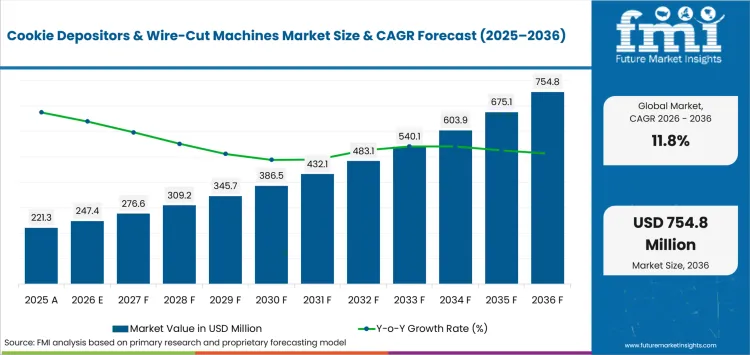
USD 247.4 million in 2026 and USD 754.8 million by 2036 at an 11.8% CAGR.
Demand for cookie depositors & wire-cut machines is projected to expand at 11.8% CAGR from 2026 to 2036. Market value rises from USD 247.4 million to USD 754.8 million. Plants invest because one forming platform can handle more recipes without losing piece-weight control. BEMA reported in February 2025 that 48% of bakery respondents expected equipment investment to increase. Orders still require trials that prove forming repeatability and cleanability.
Project economics split between retrofit-heavy bakery bases and countries adding processing capacity. The forecast adds USD 507.4 million in value from 2026 to 2036, but equipment orders follow different approval routes. IBIE 2025 drew more than 19,000 baking professionals from 96 countries. Mature plants screen line fit and downtime before approval. Greenfield sites can specify controls earlier but still require local service.
Key Takeaways
- Recipe variety raises demand because industrial bakeries need one forming platform to hold weight through soft doughs and inclusion-heavy products.
- In 2026, assorted premium is expected to lead product type with 27.0% share because flexible forming reduces dedicated equipment needs by recipe.
- By capacity, 500-2,000 kg/hr is estimated to hold 43.0% in 2026 owing to a throughput range that fits many industrial expansion projects.
- Fully automatic - robotic systems are set to lead the automation level with 43.0% share in 2026 due to repeatable recipe settings and coordinated handling.
- Recipe trials and retrofit engineering slow approvals because sanitation access and controls must fit existing lines.
- Key players in the cookie depositors & wire-cut machines market include AMF Bakery Systems, Bühler Group, Baker Perkins, Rademaker, FRITSCH Group, Rheon Automatic Machinery, Mecatherm, Midera Food Processing, Reading Bakery Systems, and Kaak Group.
Analyst Perspective
"Cookie-forming equipment should be judged on the recipe that is hardest to run, not the speed printed on the nameplate. The stronger capital case is the machine that holds piece weight through changeovers and can be serviced within the bakery's shutdown window."
- Nandini Roy Choudhury, Principal Consultant, Future Market Insights
How is the cookie depositors & wire-cut machines market segmented?
The market is segmented by product type, capacity, automation level, end user, sales channel and region.
Market taxonomy covers product type, capacity, automation level, end user, sales channel, and region. Product types include assorted premium, filled & stuffed, chocolate chip, and seasonal & decorated. Capacity includes 500-2,000 kg/hr, below 500 kg/hr, and above 2,000 kg/hr. Automation levels are fully automatic - robotic, semi-automatic, and manual. End users include industrial bakeries, in-store & retail bakeries, artisan bakeries, and foodservice - QSR central kitchens. Sales channels comprise direct OEM sales, dealers & distributors, and aftermarket & refurbished.
What makes assorted premium central to the product type category?
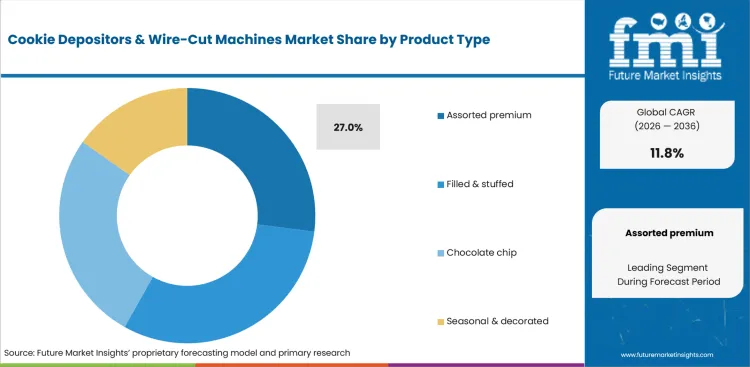
Assorted premium cookie dough changes the forming task because large inclusions and fillings alter flow at the head. In March 2026 Reading Bakery Systems said its WCX wirecut machine would run at Interpack with ultrasonic cutting for products carrying large inclusions.
- In 2026, assorted premium is expected to lead product type with 27.0% share because flexible forming reduces the need for dedicated equipment by recipe.
- Industrial bakeries qualify premium recipes on the actual machine so cut quality and cleanup time are proven before a wider SKU program reaches capital approval.
Why does 500-2,000 kg/hr define the capacity sweet spot?
Mid-capacity bakery processing equipment projects usually enter existing plants that are adding a cookie line without rebuilding ovens or downstream handling. BEMA's February 2025 review found bakery capital budgets were expected to average 12.8% of annual revenue, keeping equipment sizing tied closely to available investment.
- By capacity, 500-2,000 kg/hr is estimated to hold 43.0% in 2026 owing to a throughput range that fits many industrial expansion projects.
- Plants can automate at this scale without oversizing downstream equipment, though approval still depends on oven balance and the operating hours needed to earn the return.
How does fully automatic - robotic lead the automation level category?
Automatic forming within food processing equipment lines becomes more valuable once recipe settings must repeat between shifts without constant operator correction. In May 2025 Mecatherm unveiled MyMecatherm for real-time and historical monitoring on industrial bakery lines, raising expectations for control visibility beyond the forming head.
- Fully automatic - robotic systems are set to lead the automation level with 43.0% share in 2026 due to repeatable recipe settings and coordinated handling.
- Alarm history can shorten restart diagnosis after changeovers, provided local technicians can restore controls quickly enough to protect the bakery's production plan.
What supports industrial bakeries in the end user category?
Industrial bakeries spread tooling and commissioning costs over longer runs than retail or artisan sites. Their industrial bakery inputs programs also expose forming equipment to frequent recipe changes. BLS counted 81,880 bakers working in US food manufacturing during 2025, showing the labor base exposed to high-volume production routines and automated equipment.
- Based on end user, industrial bakeries are projected to account for 43.0% in 2026 due to longer runs that increase the value of repeatable forming.
- Trials and tooling can be amortized over more output, while weight drift or slow cleaning carries a larger production penalty on connected lines.
What drives direct OEM sales in the sales channel category?
Direct OEM sales fit dough processing systems that need recipe trials and interface work before installation. In June 2025 AMF Bakery Systems and Puratos opened a pilot bakery for commercial-scale product testing, giving bakery teams a place to validate equipment before changing their own plants.
- By sales channel, direct OEM sales are forecast to represent 54.0% in 2026 driven by specification trials and commissioning responsibility that stay with the manufacturer.
- Direct technical selling keeps one party accountable for trials and installation, while dealers remain more practical where retrofit risk and interface work are limited.
What are the drivers, restraints and opportunities in the Cookie Depositors & Wire-Cut Machines Market?
Recipe variety raises forming complexity, retrofit qualification slows approval, and service-backed mid-capacity automation gives OEMs the clearest route to new projects.
- Driver: Premium and inclusion-heavy recipes increase the need for repeatable depositing and wire-cut forming on one controlled platform.
- Restraint: Retrofit engineering can delay capital approval because controls and sanitation access must fit the bakery's existing production line.
- Opportunity: Mid-capacity automatic cells can win expansion projects where recipe trials and local service reduce installation risk.
Recipe variety raises the value of flexible forming
Recipe proliferation changes the forming task before it changes oven capacity. Bakeries need depositors to meter soft doughs and wire-cut systems to separate inclusion-heavy products without constant manual correction. BEMA's Q4 2025 member pulse found 33% of equipment manufacturers had higher bookings than the prior quarter, which puts more weight on machines that can prove recipe breadth while holding repeatable piece weight.
Retrofit qualification extends capital approval
Capital approval can stall even after a machine passes the recipe trial because retrofit work must fit controls and sanitation access inside a planned shutdown. BEMA's February 2025 review said bakery decision makers often plan equipment investments more than a year ahead. Commercial bakeware and downstream interfaces can extend that schedule if a forming change also alters product transfer or tray handling.
Service-backed automation improves mid-capacity economics
Mid-capacity automatic cells become easier to justify where the manufacturer can cover retrofit work and parts after installation. BEMA reported that 82% of equipment manufacturers were positive about the industrial and commercial bakery channel outlook after Q4 2025. Bakery depanners can then be scheduled inside the same installation window, giving the equipment company a service and upgrade route beyond the original forming machine.
Which country CAGRs are profiled in the Cookie Depositors & Wire-Cut Machines Market?
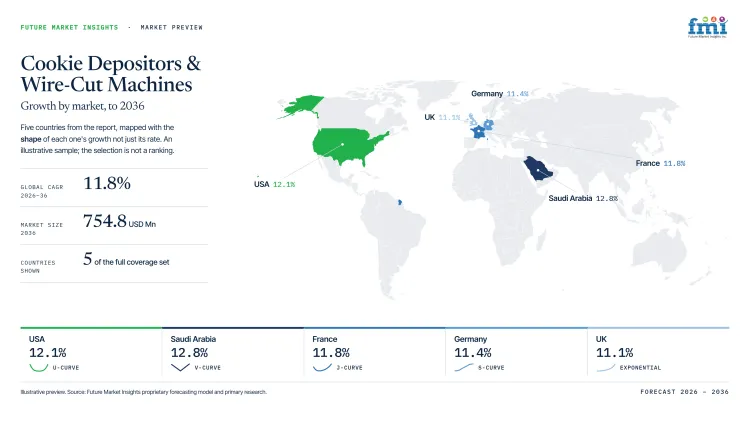
| Country | CAGR |
|---|---|
| UAE | 13.1% |
| Saudi Arabia | 12.8% |
| South Korea | 12.4% |
| USA | 12.1% |
| France | 11.8% |
| Germany | 11.4% |
| UK | 11.1% |
| Japan | 10.8% |
How do country-level CAGRs compare in the Cookie Depositors & Wire-Cut Machines Market?
UAE and Saudi Arabia form the upper band as greenfield food investment reduces installed-base constraints. South Korea and USA occupy the middle. Western European markets and Japan depend more on retrofit economics.
- UAE greenfield layouts allow earlier control specification.
- Saudi plants raise commissioning and training needs.
- South Korea rewards fast recipe change.
- USA retrofit work must fit legacy line geometry.
- France sharpens waste-control payback under factory-cost pressure.
- Germany favors modular upgrades within shutdown windows.
- UK plants require documented labor-return cases.
- Japan rewards precision in compact production footprints.
Similar CAGRs still produce different approval routes. The full report provides country-level CAGR analysis across North America, Latin America, Western Europe, Eastern Europe, East Asia, South Asia and Pacific, and Middle East and Africa.
Country-wise Analysis
- USA cookie plants usually treat a new depositor as a retrofit because existing ovens and transfers already fix line geometry and leave little tolerance for belt-height changes during shutdowns. The USA outlook is projected to expand at 12.1% CAGR over the assessment period because replacement projects and bakery ingredients programs need broader recipe flexibility without extended production stoppages or expensive downstream reconstruction. US Census Bureau data released in June 2025 counted 461 employer establishments in cookie and cracker manufacturing, so retrofit drawings and recipe trials can shorten technical review while control compatibility and local service remain decisive for equipment orders at established plants.
- German bakery plants upgrade forming equipment inside established lines where oven balance and sanitation access limit how much hardware can change during a scheduled shutdown. Destatis documented a 1.8% decline in industrial employment during 2025, increasing the commercial value of labor-saving bakery mixes and automation that fit existing production layouts without adding operator steps. Cookie depositor and wire-cut machine demand in Germany is forecast to rise at 11.4% CAGR through 2036 owing to modernization spending. Approval still depends on modular integration and maintenance support that can restore production quickly after installation.
- French biscuit plants face visible producer-price pressure that puts product giveaway and cleaning minutes directly into the capital-payback model for forming equipment and makes repeatable piece weight easier to quantify. France is anticipated to record 11.8% CAGR during the forecast period driven by replacement projects that seek tighter weight control without rebuilding complete bakery lines or extending planned cleaning windows. INSEE published a May 2026 producer-price index of 131.0 for biscuits and preserved cakes on a 2021 base, which makes trials on actual customer dough more persuasive while slow changeovers can weaken the expected return from higher throughput.
- UK bakery engineering teams assess depositors against mature installed lines where interface work can consume much of the planned shutdown before production resumes and leave little room for late control changes. ONS recorded a domestic producer-price index of 123.4 for rusks and biscuits in February 2026, keeping labor savings and downtime reduction visible in equipment payback reviews for established plants. The UK market is expected to maintain 11.1% CAGR through 2036 tied to replacement projects, but compact retrofit packages and dependable local service remain necessary because added conveyor work can push commissioning beyond the approved local outage window.
- Saudi food manufacturers are specifying forming equipment for new processing sites as industrial clusters increase the number of projects that start without a legacy bakery layout and can plan utilities around automation. NIDLP reported that the Jeddah Food Cluster covers more than 11 million square meters, giving processors room to build new production capacity with controls and product flow defined from the first line design. Saudi Arabia is set to post 12.8% CAGR over the forecast period propelled by greenfield investment, although commissioning speed still depends on trained technicians and spare-parts coverage that can keep recipe start-up from stretching into commercial production.
- UAE bakery projects increasingly start inside localization programs where equipment can be specified before plant geometry and downstream transfers are fixed, giving automatic cells a cleaner path into first-line purchases. In May 2026 MoIAT said a new food-manufacturing policy could support up to 200 factories and target a 15-30% increase in local production capacity, expanding the pool of sites that may need full bakery systems. The UAE sector is projected to record 13.1% CAGR during the assessment period helped by new factory programs, while regional service capacity and commissioning crews remain the practical constraint on bringing newly installed lines to stable output.
- Japanese cookie producers often replace equipment inside compact mature plants where portion consistency and long service life carry more weight than maximum rated throughput, especially for lines serving domestic and export recipes. Adoption in Japan is estimated to expand at 10.8% CAGR through 2036 reflecting replacement spending that favors precise forming and limited installation disruption over large changes to existing bakery layouts. MAFF reported in February 2026 that agricultural and food exports increased 12.8% during 2025 for a thirteenth consecutive record, so export-facing producers can justify recipe flexibility while large footprints and weak spare-parts support keep the investment threshold high.
- South Korean food plants compete on rapid product turnover and need recipe recall that reduces downtime as branded formulations change, which favors compact forming cells with quick-change tooling and stored settings. MAFRA reported in July 2025 that food and beverage manufacturing businesses increased 3.5%, giving flexible automation a larger production base for dough-based premixes and frequent product changeovers without tying the evidence to the approved CAGR. South Korea is forecast to grow at 12.4% CAGR during the forecast period supported by manufacturing expansion, although local service and disciplined trial records still determine whether recipe flexibility converts into a funded equipment project.
Who are the notable companies in the Cookie Depositors & Wire-Cut Machines Market?
AMF Bakery Systems, Bühler Group, Baker Perkins, Rademaker, FRITSCH Group, Rheon Automatic Machinery, Mecatherm, Midera Food Processing, Reading Bakery Systems, and Kaak Group are the notable companies serving this market.
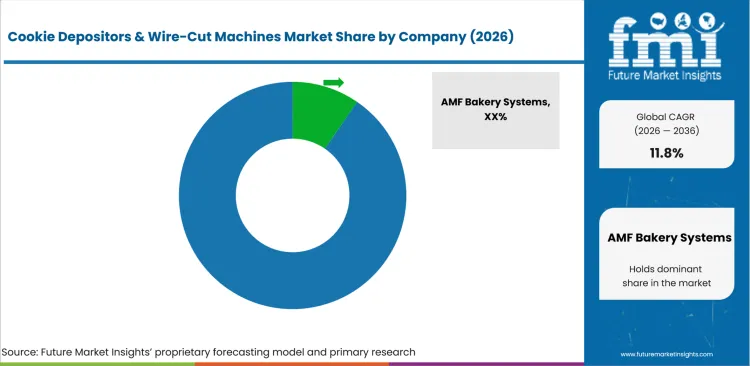
Competition separates into dedicated cookie forming, broader bakery-line integration and adjacent dough make-up. Baker Perkins and Reading Bakery Systems serve the forming task most directly. AMF and Mecatherm carry broader line responsibility. Midera and Kaak share that position. Rademaker and FRITSCH sit in adjacent roles. Rheon and Bühler span mixed positions based on verified product scope.
- Baker Perkins and Reading Bakery Systems focus on dedicated cookie and filled-product forming. Bühler Group and Rheon Automatic Machinery also serve this role.
- AMF Bakery Systems and Mecatherm provide integrated industrial bakery automation. Midera Food Processing and Kaak Group also carry line-level responsibility.
- Flexible dough make-up and adjacent forming: Rademaker and FRITSCH Group.
Competitive Benchmarking: Cookie Depositors & Wire-Cut Machines Market
| Company | Cookie Forming Depth | Automation & Line Integration | Changeover & Sanitation Support | Geographic Reach |
|---|---|---|---|---|
| AMF Bakery Systems | Medium | High | High | North America with international bakery projects |
| Bühler Group | High | High | High | Europe with global food-processing sales and service |
| Baker Perkins | High | High | High | United Kingdom and North America with global support |
| Rademaker | Low | High | High | Europe and North America with international bakery reach |
| FRITSCH Group | Low | High | High | Europe with international bakery-line coverage |
| Rheon Automatic Machinery | High | Medium | High | Japan and North America with international sales |
| Mecatherm | Low | High | High | Europe with international industrial bakery projects |
| Midera Food Processing | Medium | High | Medium | Six-continent food-processing reach |
| Reading Bakery Systems | High | High | High | North America with expanding EMEA support |
| Kaak Group | Low | High | Medium | Europe with Africa and wider international service |
Scoring basis: High cookie-forming depth requires depositing or wire-cutting plus another documented forming route. Medium covers one direct route and Low marks narrower bakery-line participation. High integration requires coordinated systems and Medium covers subsystem automation. High changeover support requires cleaning access plus tooling or recipe support. Low marks basic documented service.
Key Developments in the Cookie Depositors & Wire-Cut Machines Market
- In July 2026, Midera Food Processing began operating as an independent public company after Middleby completed the spin-off. The separation transferred the former Middleby food-processing platform into a standalone business serving bakery and snack equipment customers.
- In July 2026, FRITSCH Group broke ground on a new headquarters and an approximately 20,000-square-meter production facility. The site is planned to expand manufacturing space and customer testing capacity after completion in 2028.
- In May 2026, Bühler Group launched SoftDrop for depositing and wire-cutting soft masses. The product gives the company a direct cookie-forming route inside a broader industrial food-processing portfolio.
Key Players in the Cookie Depositors & Wire-Cut Machines Market
Dedicated Cookie and Filled-Product Forming Systems
- Baker Perkins
- Reading Bakery Systems
- Bühler Group
- Rheon Automatic Machinery
Integrated Industrial Bakery Automation Platforms
- AMF Bakery Systems
- Mecatherm
- Midera Food Processing
- Kaak Group
Flexible Dough Make-Up and Adjacent Forming
- Rademaker
- FRITSCH Group
Cookie Depositors & Wire-Cut Machines Market - Report Scope
| Coverage field | Report scope |
|---|---|
| Market breakdown | By product type, capacity, automation level, end user, sales channel and region. |
| Quantitative Units | USD million. |
| Market Definition | Commercial cookie depositing and wire-cut forming machines, including machine-specific tooling, controls, and directly attributable retrofit or refurbished equipment. |
| Regions Covered | North America, Latin America, Western Europe, Eastern Europe, East Asia, South Asia and Pacific, and Middle East and Africa. |
| Countries Covered | UAE, Saudi Arabia, South Korea, USA, France, Germany, UK, Japan, and 20+ countries included in the full report. |
| Key Companies Profiled | AMF Bakery Systems, Bühler Group, Baker Perkins, Rademaker, FRITSCH Group, Rheon Automatic Machinery, Mecatherm, Midera Food Processing, Reading Bakery Systems, and Kaak Group. |
| Forecast Period | 2026 to 2036. |
| Approach | Primary and secondary research with market triangulation. |
Cookie Depositors & Wire-Cut Machines Market - Research Methodology
| Method | Approach |
|---|---|
| Primary Research | FMI analysts gathered input from manufacturers, service providers, technology developers, distributors, end users, procurement teams, and subject-matter experts. Interviews examined purchasing decisions, product or service evaluation, adoption barriers, approval requirements, pricing considerations, and expectations for technical or commercial support. Respondents were also asked what evidence is required before a trial, pilot, or initial order develops into regular purchasing. |
| Desk Research | Desk research covered government statistics, regulatory publications, trade data, industry associations, technical literature, standards, company filings, product information, and official corporate announcements. Sources were reviewed for relevance, publication date, geographic coverage, and consistency with the defined market scope. Claims relating to performance, applications, approvals, capacity, investment, and commercial activity were retained only when supported by credible public evidence. |
| Market Sizing and Forecasting | The market model combined the baseline value with historical performance, segment structure, pricing and volume indicators, adoption levels, company participation, and country-level demand conditions. Forecast assumptions considered economic activity, investment trends, regulatory developments, technology adoption, purchasing cycles, supply availability, and barriers to wider market use. Segment and regional estimates were reconciled before the final market total was calculated. |
| Data Validation | Estimates were checked against multiple independent indicators, including public data, company activity, trade patterns, industry developments, and findings from primary interviews. Validation also tested whether products, services, applications, and company revenues fell within the defined market boundaries. Adjacent categories, unsupported claims, overlapping revenues, and activities without direct market relevance were excluded to reduce double counting and maintain consistency across segments and countries. |
Cookie Depositors & Wire-Cut Machines Market by Segments
Cookie Depositors & Wire-Cut Machines Market segmented by Product Type:
- Assorted premium
- Filled & stuffed
- Chocolate chip
- Seasonal & decorated
Cookie Depositors & Wire-Cut Machines Market segmented by Capacity:
- 500-2,000 kg/hr
- Below 500 kg/hr
- Above 2,000 kg/hr
Cookie Depositors & Wire-Cut Machines Market segmented by Automation Level:
- Fully automatic - robotic
- Semi-automatic
- Manual
Cookie Depositors & Wire-Cut Machines Market segmented by End User:
- Industrial bakeries
- In-store & retail bakeries
- Artisan bakeries
- Foodservice - QSR central kitchens
Cookie Depositors & Wire-Cut Machines Market segmented by Sales Channel:
- Direct OEM sales
- Dealers & distributors
- Aftermarket & refurbished
Cookie Depositors & Wire-Cut Machines Market by Region:
- North America
- United States
- Canada
- Latin America
- Brazil
- Mexico
- Chile
- Rest of Latin America
- Western Europe
- Germany
- United Kingdom
- Italy
- Spain
- France
- Nordics
- Benelux
- Rest of Western Europe
- Eastern Europe
- Russia
- Poland
- Hungary
- Balkan and Baltic States
- Rest of Eastern Europe
- East Asia
- China
- Japan
- South Korea
- South Asia and Pacific
- India
- ASEAN
- Australia and New Zealand
- Rest of South Asia and Pacific
- Middle East and Africa
- Kingdom of Saudi Arabia
- Other GCC Countries
- Türkiye
- South Africa
- Other African Union Countries
- Rest of Middle East and Africa
Research Sources and Bibliography
- Baking Equipment Manufacturers & Allieds. (2025, February 24). Capital Spending Outlook 2025: Trends, Challenges, and Key Takeaways.
- Baking Equipment Manufacturers & Allieds. (2025, November 11). Press Release: IBIE 2025 Sets New Standard for the Global Baking Industry.
- Reading Bakery Systems. (2026, March 18). Visit RBS at Interpack 2026. New Tech. Live Demos. Better Baking.
- Mecatherm. (2025, May 18). MECATHERM Facilitates Production Line Operations with MyMecatherm Digital Platform.
- USA Bureau of Labor Statistics. (2026). Food Manufacturing: NAICS 311.
- AMF Bakery Systems. (2025, June 9). AMF and Puratos Launch Joint Pilot Bakery Facility to Accelerate Commercial Baking Innovation.
- Baking Equipment Manufacturers & Allieds. (2026). BEMA Intel.
- USA Census Bureau. (2025, June 26). All Sectors: County Business Patterns, including ZIP Code Business Patterns, by Legal Form of Organization and Employment Size Class for the USA, States, and Selected Geographies: 2023.
- Federal Statistical Office of Germany. (2026, January 2). Employment Figures Largely Unchanged in 2025.
- INSEE. (2026, July 31). Indice de prix de production de l’industrie française pour le marché français - CPF 10.72 - Biscuits et gâteaux de conservation MN.
- Office for National Statistics. (2026, March 25). PPI INDEX OUTPUT DOMESTIC - C1072 Rusks and biscuits; preserved pastry goods and cakes 2015=100.
- Saudi Vision 2030, National Industrial Development and Logistics Program. (2025). Annual Report 2024.
- UAE Ministry of Industry and Advanced Technology. (2026, May 20). Make it in the Emirates Concludes Largest Edition Yet.
- Japan Ministry of Agriculture, Forestry and Fisheries. (2026, February 3).
- Republic of Korea Ministry of Agriculture, Food and Rural Affairs. (2025, July 31). The Result of the Survey on the Korean Food Industry for the Year 2024.
- The Middleby Corporation. (2026, July 6). Middleby Completes Spin-off of Midera Food Processing.
- FRITSCH Group. (2026, July 22). Groundbreaking Ceremony for New Company Headquarters.
- Bühler Group. (2026, May 7). Bühler Launches Innovations and Releases Major Upgrades to Its Grains & Food Portfolio.
- AMF Bakery Systems. (2026). Advancing Industrial Baking Innovation Through Global Collaboration.
- Royal Kaak. (2025, September 18). Kaak Africa Has Officially Started!
- Reading Bakery Systems. (2026, April 9). Reading Bakery Systems Expands Customer Care and Sales Leadership in EMEA.
- FRITSCH Group. (2025, May 13). PROGRESSA pastry - the new pastry line for retail bakers.
- Royal Kaak. (2026, June 8). Royal Kaak Introduces New Innovations for DrieM Sheeting Lines.
- Reading Bakery Systems. (2025, August 1). RBS Expands Customer Care Team to Strengthen Global Support.
- Coperion. (2025, May 19). Coperion Elevates Customer Experience with Enhanced Brand Identity and Unified Technology Solutions.
This bibliography is provided for reader reference and is not exhaustive. The full report contains the complete reference list and detailed citations
This Report Answers
- How large is the cookie depositors & wire-cut machines market in 2026 and 2036?
- Which recipe conditions support investment in cookie-forming equipment?
- Why does assorted premium hold the leading product type share?
- How does the 500-2,000 kg/hr range affect line selection?
- Why do fully automatic - robotic systems lead the automation level?
- How do country growth conditions change the equipment approval route?
- Which companies compete most directly in forming and line integration?
- What slows retrofit approval for cookie depositors and wire-cut machines?
Frequently Asked Questions
How big is the cookie depositors & wire-cut machines market in 2026?
The cookie depositors & wire-cut machines market is valued at USD 247.4 million in 2026 and is projected to reach USD 754.8 million by 2036. Recipe flexibility and repeatable portion control support equipment investment.
What is the CAGR of the cookie depositors & wire-cut machines market from 2026 to 2036?
The cookie depositors & wire-cut machines market is projected to grow at a CAGR of 11.8% between 2026 and 2036. Automation reduces manual correction while allowing one forming line to handle more commercial recipes.
Which product type leads the cookie depositors & wire-cut machines market?
The assorted premium segment is expected to hold 27.0% of the cookie depositors & wire-cut machines market in 2026, driven by flexible forming for inclusion-heavy and differentiated recipes. Trials still determine whether those recipes can run at commercial speed.
How much value will the cookie depositors & wire-cut machines market add between 2026 and 2036?
The cookie depositors & wire-cut machines market is expected to add USD 507.4 million in value between 2026 and 2036. Projects must clear line-fit, sanitation and service checks before the forecast converts into equipment revenue.
Which companies are active in the cookie depositors & wire-cut machines market?
Key companies operating in the market include AMF Bakery Systems, Bühler Group, Baker Perkins, Rademaker, FRITSCH Group, Rheon Automatic Machinery, Mecatherm, Midera Food Processing, Reading Bakery Systems, and Kaak Group. Their positions differ by forming depth, line integration and service coverage.
Preview the report firsthand - request a free sample
Get SampleGet the brochure for pricing and purchase details.
Get PDFTable of Content
- Key Takeaways
- Market Size and CAGR
- Top Growth Driver
- Fastest Growing Segment
- Leading Region
- Key Companies
- Emerging Opportunities
- Executive Summary
- Global Market Outlook
- Demand-side Trends
- Supply-side Trends
- Technology Roadmap Analysis
- Analysis and Recommendations
- Analyst Perspective (What is happening? Why now? What should investors know?)
- Key Questions Answered
- How large is the market?
- What is the CAGR?
- What are key trends?
- Which region dominates?
- Who are the leaders?
- Market Overview
- Market Coverage / Taxonomy
- Market Definition / Scope / Limitations
- Research Methodology
- Chapter Orientation
- Analytical Lens and Working Hypotheses
- Market Structure, Signals, and Trend Drivers
- Benchmarking and Cross-market Comparability
- Market Sizing, Forecasting, and Opportunity Mapping
- Research Design and Evidence Framework
- Desk Research Programme (Secondary Evidence)
- Expert Input and Fieldwork (Primary Evidence)
- Tooling, Models, and Reference Databases
- Data Engineering and Model Build
- Quality Assurance and Audit Trail
- Market Background
- Market Dynamics (Drivers, Restraints, Opportunity, Trends)
- Scenario Forecast (Optimistic, Likely, Conservative)
- Impact Analysis
- AI Impact
- Sustainability Impact
- Regulatory Impact
- Technology Impact
- Consumer / Buyer Analysis
- Purchase Drivers
- Adoption Barriers
- Buyer Journey
- Opportunity Map Analysis
- Product Life Cycle Analysis
- Supply Chain Analysis
- Investment Feasibility Matrix
- Value Chain Analysis
- PESTLE and Porter's Analysis
- Regulatory Landscape
- Regional Parent Market Outlook
- Production and Consumption Statistics
- Import and Export Statistics
- Global Market Analysis and Forecast, 2021 to 2036
- Historical Market Size Value (USD Million) Analysis, 2021 to 2025
- Current and Future Market Size Value (USD Million) Projections, 2026 to 2036
- Y-o-Y Growth Trend Analysis
- Absolute $ Opportunity Analysis
- Global Market Pricing Analysis, 2021 to 2036
- Global Market Analysis and Forecast, By Product Type, 2021 to 2036
- Introduction / Key Findings
- Historical Market Size Value (USD Million) Analysis By Product Type, 2021 to 2025
- Current and Future Market Size Value (USD Million) Analysis and Forecast By Product Type, 2026 to 2036
- Assorted premium
- Filled & stuffed
- Chocolate chip
- Seasonal & decorated
- Assorted premium
- Y-o-Y Growth Trend Analysis By Product Type, 2021 to 2025
- Absolute $ Opportunity Analysis By Product Type, 2026 to 2036
- Global Market Analysis and Forecast, By Capacity, 2021 to 2036
- Introduction / Key Findings
- Historical Market Size Value (USD Million) Analysis By Capacity, 2021 to 2025
- Current and Future Market Size Value (USD Million) Analysis and Forecast By Capacity, 2026 to 2036
- 500-2,000 kg/hr
- Below 500 kg/hr
- Above 2,000 kg/hr
- 500-2,000 kg/hr
- Y-o-Y Growth Trend Analysis By Capacity, 2021 to 2025
- Absolute $ Opportunity Analysis By Capacity, 2026 to 2036
- Global Market Analysis and Forecast, By Automation Level, 2021 to 2036
- Introduction / Key Findings
- Historical Market Size Value (USD Million) Analysis By Automation Level, 2021 to 2025
- Current and Future Market Size Value (USD Million) Analysis and Forecast By Automation Level, 2026 to 2036
- Fully automatic / robotic
- Semi-automatic
- Manual
- Fully automatic / robotic
- Y-o-Y Growth Trend Analysis By Automation Level, 2021 to 2025
- Absolute $ Opportunity Analysis By Automation Level, 2026 to 2036
- Global Market Analysis and Forecast, By End User, 2021 to 2036
- Introduction / Key Findings
- Historical Market Size Value (USD Million) Analysis By End User, 2021 to 2025
- Current and Future Market Size Value (USD Million) Analysis and Forecast By End User, 2026 to 2036
- Industrial bakeries
- In-store & retail bakeries
- Artisan bakeries
- Foodservice / QSR central kitchens
- Industrial bakeries
- Y-o-Y Growth Trend Analysis By End User, 2021 to 2025
- Absolute $ Opportunity Analysis By End User, 2026 to 2036
- Global Market Analysis and Forecast, By Sales Channel, 2021 to 2036
- Introduction / Key Findings
- Historical Market Size Value (USD Million) Analysis By Sales Channel, 2021 to 2025
- Current and Future Market Size Value (USD Million) Analysis and Forecast By Sales Channel, 2026 to 2036
- Direct OEM sales
- Dealers & distributors
- Aftermarket & refurbished
- Direct OEM sales
- Y-o-Y Growth Trend Analysis By Sales Channel, 2021 to 2025
- Absolute $ Opportunity Analysis By Sales Channel, 2026 to 2036
- Global Market Analysis and Forecast, By Region, 2021 to 2036
- Introduction
- Historical Market Size Value (USD Million) Analysis By Region, 2021 to 2025
- Current Market Size Value (USD Million) Analysis and Forecast By Region, 2026 to 2036
- North America
- Latin America
- Western Europe
- Eastern Europe
- East Asia
- South Asia and Pacific
- Middle East & Africa
- Market Attractiveness Analysis By Region
- North America Market Analysis and Forecast, By Country, 2021 to 2036
- Historical Market Size Value (USD Million) Trend Analysis By Market Taxonomy, 2021 to 2025
- Market Size Value (USD Million) Forecast By Market Taxonomy, 2026 to 2036
- By Country
- USA
- Canada
- By Product Type
- By Capacity
- By Automation Level
- By End User
- By Sales Channel
- By Country
- Market Attractiveness Analysis
- By Country
- By Product Type
- By Capacity
- By Automation Level
- By End User
- By Sales Channel
- Key Takeaways
- Latin America Market Analysis and Forecast, By Country
- Historical Market Size Value (USD Million) Trend Analysis By Market Taxonomy, 2021 to 2025
- Market Size Value (USD Million) Forecast By Market Taxonomy, 2026 to 2036
- By Country
- Brazil
- Mexico
- Chile
- Rest of Latin America
- By Product Type
- By Capacity
- By Automation Level
- By End User
- By Sales Channel
- By Country
- Market Attractiveness Analysis
- By Country
- By Product Type
- By Capacity
- By Automation Level
- By End User
- By Sales Channel
- Key Takeaways
- Western Europe Market Analysis and Forecast, By Country
- Historical Market Size Value (USD Million) Trend Analysis By Market Taxonomy, 2021 to 2025
- Market Size Value (USD Million) Forecast By Market Taxonomy, 2026 to 2036
- By Country
- Germany
- UK
- Italy
- Spain
- France
- Nordic
- BENELUX
- Rest of Western Europe
- By Product Type
- By Capacity
- By Automation Level
- By End User
- By Sales Channel
- By Country
- Market Attractiveness Analysis
- By Country
- By Product Type
- By Capacity
- By Automation Level
- By End User
- By Sales Channel
- Key Takeaways
- Eastern Europe Market Analysis and Forecast, By Country
- Historical Market Size Value (USD Million) Trend Analysis By Market Taxonomy, 2021 to 2025
- Market Size Value (USD Million) Forecast By Market Taxonomy, 2026 to 2036
- By Country
- Russia
- Poland
- Hungary
- Balkan & Baltic
- Rest of Eastern Europe
- By Product Type
- By Capacity
- By Automation Level
- By End User
- By Sales Channel
- By Country
- Market Attractiveness Analysis
- By Country
- By Product Type
- By Capacity
- By Automation Level
- By End User
- By Sales Channel
- Key Takeaways
- East Asia Market Analysis and Forecast, By Country
- Historical Market Size Value (USD Million) Trend Analysis By Market Taxonomy, 2021 to 2025
- Market Size Value (USD Million) Forecast By Market Taxonomy, 2026 to 2036
- By Country
- China
- Japan
- South Korea
- By Product Type
- By Capacity
- By Automation Level
- By End User
- By Sales Channel
- By Country
- Market Attractiveness Analysis
- By Country
- By Product Type
- By Capacity
- By Automation Level
- By End User
- By Sales Channel
- Key Takeaways
- South Asia and Pacific Market Analysis and Forecast, By Country
- Historical Market Size Value (USD Million) Trend Analysis By Market Taxonomy, 2021 to 2025
- Market Size Value (USD Million) Forecast By Market Taxonomy, 2026 to 2036
- By Country
- India
- ASEAN
- Australia & New Zealand
- Rest of South Asia and Pacific
- By Product Type
- By Capacity
- By Automation Level
- By End User
- By Sales Channel
- By Country
- Market Attractiveness Analysis
- By Country
- By Product Type
- By Capacity
- By Automation Level
- By End User
- By Sales Channel
- Key Takeaways
- Middle East & Africa Market Analysis and Forecast, By Country
- Historical Market Size Value (USD Million) Trend Analysis By Market Taxonomy, 2021 to 2025
- Market Size Value (USD Million) Forecast By Market Taxonomy, 2026 to 2036
- By Country
- Kingdom of Saudi Arabia
- Other GCC Countries
- Türkiye
- South Africa
- Other African Union
- Rest of Middle East & Africa
- By Product Type
- By Capacity
- By Automation Level
- By End User
- By Sales Channel
- By Country
- Market Attractiveness Analysis
- By Country
- By Product Type
- By Capacity
- By Automation Level
- By End User
- By Sales Channel
- Key Takeaways
- Key Countries Market Analysis
- USA
- Pricing Analysis
- Market Share Analysis, 2025
- By Product Type
- By Capacity
- By Automation Level
- By End User
- By Sales Channel
- Canada
- Pricing Analysis
- Market Share Analysis, 2025
- By Product Type
- By Capacity
- By Automation Level
- By End User
- By Sales Channel
- Mexico
- Pricing Analysis
- Market Share Analysis, 2025
- By Product Type
- By Capacity
- By Automation Level
- By End User
- By Sales Channel
- Brazil
- Pricing Analysis
- Market Share Analysis, 2025
- By Product Type
- By Capacity
- By Automation Level
- By End User
- By Sales Channel
- Chile
- Pricing Analysis
- Market Share Analysis, 2025
- By Product Type
- By Capacity
- By Automation Level
- By End User
- By Sales Channel
- Germany
- Pricing Analysis
- Market Share Analysis, 2025
- By Product Type
- By Capacity
- By Automation Level
- By End User
- By Sales Channel
- UK
- Pricing Analysis
- Market Share Analysis, 2025
- By Product Type
- By Capacity
- By Automation Level
- By End User
- By Sales Channel
- Italy
- Pricing Analysis
- Market Share Analysis, 2025
- By Product Type
- By Capacity
- By Automation Level
- By End User
- By Sales Channel
- Spain
- Pricing Analysis
- Market Share Analysis, 2025
- By Product Type
- By Capacity
- By Automation Level
- By End User
- By Sales Channel
- France
- Pricing Analysis
- Market Share Analysis, 2025
- By Product Type
- By Capacity
- By Automation Level
- By End User
- By Sales Channel
- India
- Pricing Analysis
- Market Share Analysis, 2025
- By Product Type
- By Capacity
- By Automation Level
- By End User
- By Sales Channel
- ASEAN
- Pricing Analysis
- Market Share Analysis, 2025
- By Product Type
- By Capacity
- By Automation Level
- By End User
- By Sales Channel
- Australia & New Zealand
- Pricing Analysis
- Market Share Analysis, 2025
- By Product Type
- By Capacity
- By Automation Level
- By End User
- By Sales Channel
- China
- Pricing Analysis
- Market Share Analysis, 2025
- By Product Type
- By Capacity
- By Automation Level
- By End User
- By Sales Channel
- Japan
- Pricing Analysis
- Market Share Analysis, 2025
- By Product Type
- By Capacity
- By Automation Level
- By End User
- By Sales Channel
- South Korea
- Pricing Analysis
- Market Share Analysis, 2025
- By Product Type
- By Capacity
- By Automation Level
- By End User
- By Sales Channel
- Russia
- Pricing Analysis
- Market Share Analysis, 2025
- By Product Type
- By Capacity
- By Automation Level
- By End User
- By Sales Channel
- Poland
- Pricing Analysis
- Market Share Analysis, 2025
- By Product Type
- By Capacity
- By Automation Level
- By End User
- By Sales Channel
- Hungary
- Pricing Analysis
- Market Share Analysis, 2025
- By Product Type
- By Capacity
- By Automation Level
- By End User
- By Sales Channel
- Kingdom of Saudi Arabia
- Pricing Analysis
- Market Share Analysis, 2025
- By Product Type
- By Capacity
- By Automation Level
- By End User
- By Sales Channel
- Türkiye
- Pricing Analysis
- Market Share Analysis, 2025
- By Product Type
- By Capacity
- By Automation Level
- By End User
- By Sales Channel
- South Africa
- Pricing Analysis
- Market Share Analysis, 2025
- By Product Type
- By Capacity
- By Automation Level
- By End User
- By Sales Channel
- USA
- Market Structure Analysis
- Competition Dashboard
- Competition Benchmarking
- Market Share Analysis of Top Players
- By Regional
- By Product Type
- By Capacity
- By Automation Level
- By End User
- By Sales Channel
- Emerging Startups
- Innovation Benchmarking
- Competition Analysis
- Competition Deep Dive
- AMF Bakery Systems
- Overview
- Product Portfolio
- Profitability by Market Segments
- Sales Footprint
- Strategy Overview
- Marketing Strategy
- Product Strategy
- Channel Strategy
- Buhler Group
- Baker Perkins
- Rademaker
- FRITSCH Group
- Rheon Automatic Machinery
- Mecatherm
- Middleby
- Reading Bakery Systems
- Kaak Group
- AMF Bakery Systems
- Case Studies
- Success Stories
- Recent Developments
- Competition Deep Dive
- Assumptions & Acronyms Used


