

- Market Size (2026)
- USD 505.6 Mn
- Forecast (2036)
- USD 1230.3 Mn
- CAGR (2026 to 2036)
- 9.3%
How big is Commercial Bakeware Market in 2026?
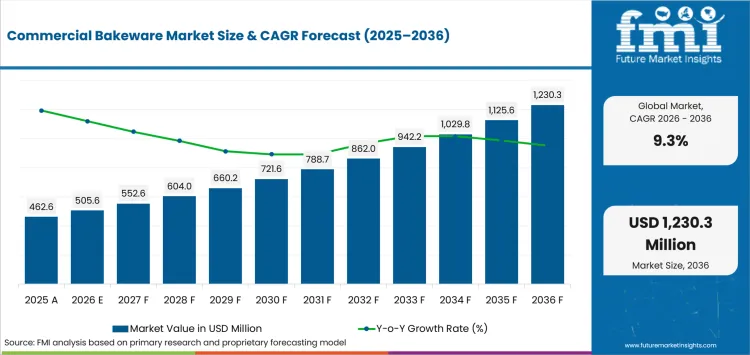
USD 505.6 million in 2026 and USD 1230.3 million by 2036 at a 9.3% CAGR.
Demand for commercial bakeware is projected to expand at a 9.3% CAGR between 2026 and 2036, increasing valuation from USD 505.6 million in 2026 to USD 1230.3 million by 2036. Commercial bakery plants replace pans as release surfaces wear and product formats change. BEMA Intel recorded a 2.3% year-on-year rise in commercial-aisle bakery unit sales in Q4 2025. Higher equipment movement increases the number of pan fleets entering qualification, replacement or expansion cycles.
Country demand converts differently in mature production bases. The UK bakery and farinaceous-products output index moved from 96.0 in 2024 to 98.5 in 2025 according to the Office for National Statistics. The recovery supports replacement demand without removing capital scrutiny. Gulf markets grow faster as hospitality additions require new kitchen capacity and standardized bakeware without waiting for an installed fleet to reach replacement age.
Key Takeaways
- Professional bakeries replace bakeware as repeated heating and cleaning change coating life, flatness and line fit.
- By equipment type, mid-capacity lines are projected to account for 39.0% in 2026 due to throughput that supports planned pan fleets with format flexibility.
- In 2026, the 500-2,000 kg/hr segment is expected to lead capacity with 44.0% share owing to fleet scale that makes pan-life economics visible.
- Fully automatic - robotic environments are likely to capture 43.0% share in 2026 attributable to tighter dimensional requirements in conveyor and robotic handling.
- Line-fit trials, coating documentation and shorter payback targets can extend approval cycles for large fleet changes.
- Some of the key players in this market include Bundy Baking Solutions (Chicago Metallic), USA Pan, Nordic Ware, Wilton Brands, Ateco, de Buyer, Matfer Bourgeat, Silikomart, Lakeland, and Vollrath.
Analyst Perspective
"Commercial bakery economics turn on pan life under the plant's wash cycle and the cost of requalifying a new specification. Verified geometry, recoating records and local replenishment can protect uptime once a fleet reaches its replacement threshold."
- Nandini Roy Choudhury, Principal Consultant, Future Market Insights
How is the commercial bakeware market segmented?
The commercial bakeware market is segmented by equipment type, capacity, automation level, end user, sales channel and region.
By equipment type, analysis covers mid-capacity lines, compact - entry systems and high-capacity industrial lines. Capacity includes 500-2,000 kg/hr, below 500 kg/hr and above 2,000 kg/hr. Automation level covers fully automatic - robotic, semi-automatic and manual settings. End users include industrial bakeries, in-store and retail bakeries, artisan bakeries and foodservice - QSR central kitchens. Sales channels include direct OEM sales, dealers and distributors, and aftermarket and refurbished supply.
Why do fully automatic - robotic settings demand tighter bakeware control?
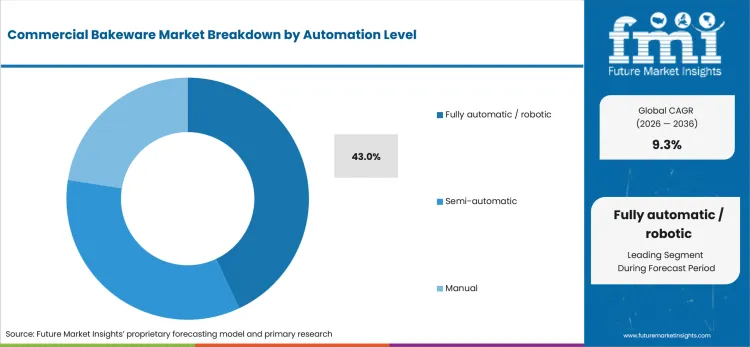
Conveyors cannot correct pan position by hand. Automated transfers need pans with stable rims and dimensions. The USA Bureau of Labor Statistics recorded 30% of bakers in bakery and tortilla manufacturing in 2025. It also notes that commercial bakers may use automated high-volume equipment. That operating base makes repeatable geometry a qualification issue for robotic bakery lines.
- Fully automatic - robotic environments are projected to hold 43.0% share in 2026 owing to repeated handling that requires consistent pan dimensions and nesting.
- Maintenance teams need flatness and restored-geometry records to return recoated pans to an automated transfer path.
What makes mid-capacity lines central to the equipment type category?
Mid-capacity plants need enough pan standardization to control wear without fixing every SKU to one line format. BEMA found in February 2025 that 48% of surveyed bakery manufacturers expected equipment investment to increase. That capital program gives baking molds and trays a larger role in line-change planning since new equipment still needs qualified pan dimensions.
- By equipment type, mid-capacity lines are estimated to hold 39.0% in 2026 owing to production volumes that justify controlled pan families and scheduled replacement.
- Regional stock and custom sizing reduce the risk that a new menu format interrupts a line awaiting a compatible pan.
How does the 500-2,000 kg/hr band influence capacity selection?
A geometry change affects loading efficiency over many batches. Operators can measure pan wear more clearly in the 500-2,000 kg/hr band. BEMA Intel documented higher Q4 2025 bookings for 33% of equipment manufacturers. The booking shift increases lines where pan specifications must be reviewed alongside bakery processing equipment changes.
- In 2026, the 500-2,000 kg/hr segment is expected to lead capacity with 44.0% share owing to fleet scale that supports lifecycle comparisons without the rigidity of the largest lines.
- Plants can stage a trial and measure coating life, then extend one specification to the full operating fleet.
What supports industrial bakeries within the end user category?
Industrial bakeries expose the same pans to frequent thermal and cleaning cycles. Fleet condition therefore becomes part of uptime planning. The American Bakers Association stated in April 2025 that its membership represented more than 1,200 USA commercial baking facilities. That installed base gives lifecycle service a practical role as bakery ingredients can change by SKU while qualified line dimensions stay fixed.
- By end user, industrial bakeries are forecast to represent 48.0% in 2026 driven by large installed fleets that make planned replacement economically visible.
- Scale spreads trial work over more pans, so a verified recoating route can compete with full-fleet replacement.
What are the drivers, restraints and opportunities in the Commercial Bakeware Market?
Higher bakery throughput raises replacement demand, shorter payback targets delay some fleet changes, and documented trials can shorten qualification for new specifications.
- Driver: Higher bakery and foodservice throughput increases the thermal, release and washing cycles that commercial pan fleets must absorb.
- Restraint: Shorter payback expectations and line-fit qualification can postpone a fleet change after wear becomes visible.
- Opportunity: Documented line trials, lifecycle service and local stock can reduce the cost of changing or restoring a qualified pan family.
Production volume directly raises bakeware demand as each additional batch consumes pan life. It also increases the cost of an unplanned failure. The National Restaurant Association projected 15.9 million restaurant and foodservice jobs in 2025. For food service equipment and bakeware companies, higher service activity increases replenishment where central kitchens standardize formats.
Capital approval becomes the main friction once a bakery identifies a replacement need. BEMA documented in February 2025 that operators had shortened target return on investment from three years to two. A pan proposal must therefore quantify usable life, cleaning burden and downtime risk early enough for engineering and finance teams to compare it with continued fleet use.
Qualification support gives manufacturers a revenue route as plants release larger orders once fit is documented. BEMA found that 90% of survey participants planned to attend IBIE 2025 and attendees wanted live demonstrations, integration information and cost-benefit analysis. Dimensional records and coating documentation can move a trial toward fleet approval without treating the sample itself as proof of long-term performance.
Which country CAGRs are profiled in the Commercial Bakeware Market?
| Country | CAGR |
|---|---|
| UAE | 10.7% |
| Saudi Arabia | 10.3% |
| South Korea | 10.0% |
| USA | 9.7% |
| UK | 9.3% |
| Germany | 9.0% |
| France | 8.7% |
| Japan | 8.4% |
How do country-level CAGRs compare in the Commercial Bakeware Market?
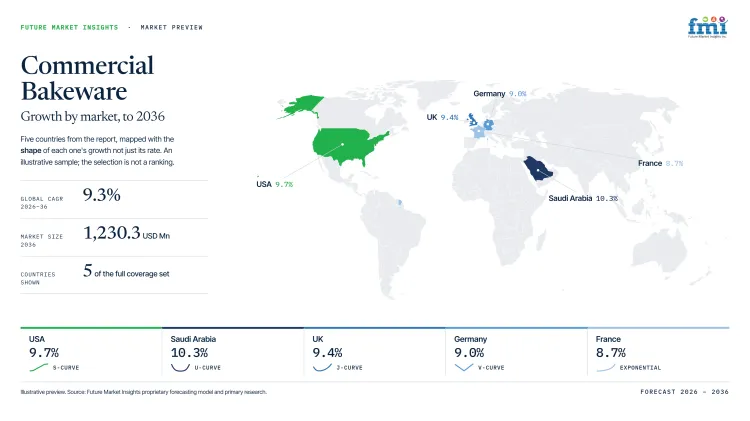
The forecasts form an upper Gulf and South Korean group, followed by four mature Western markets and Japan. The 2.3-point spread from UAE to Japan reflects different additions to hospitality and bakery capacity rather than current market size. Faster markets need first-install supply, while mature markets depend more heavily on replacement timing and service coverage.
- UAE hotel openings add first-install kitchen demand.
- Saudi specialty pans depend on import timing.
- South Korean chains replicate approved formats quickly.
- USA fleets make refurbishment economically relevant.
- UK approvals face tighter capital payback tests.
- German metal prices sharpen pan-life comparisons.
- French distributors aggregate smaller bakery orders.
- Japanese automation raises geometry qualification thresholds.
Comparable CAGRs still produce different order sizes and qualification routes. The full report provides country-level CAGR analysis across North America, Latin America, Western Europe, Eastern Europe, East Asia, South Asia and Pacific, and the Middle East and Africa.
Country-wise Analysis
- Commercial bakeware demand in the USA is expected to expand at 9.7% CAGR during the forecast period, driven by fleet replacement and equipment renewal across large commercial bakeries. The USA Bureau of Labor Statistics counted 262,400 bakery jobs in 2025. The scale of domestic baking operations keeps pan wear visible to engineering teams and supports recurring refurbishment programs. New pan families still require geometry, coating, and cleaning validation before qualification at plant level.
- Germany is projected to record 9.0% CAGR through 2036, supported by replacement planning and local metal-forming capabilities for commercial bakeware. Destatis reported in February 2025 that wholesale prices for non-ferrous ores, metals, and semi-finished products were 24.4% higher than a year earlier. Rising material costs strengthen lifecycle comparisons and place greater emphasis on replacement timing. Premium specifications therefore need a clear service-life advantage before broader fleet adoption.
- Commercial bakeware demand in France is likely to grow at 8.7% CAGR over the assessment period, reflecting the country's extensive bakery and pastry network. INSEE counted 50,122 bakery-pastry shops in its 2025 permanent equipment database. The large outlet base creates a broad route to market for trays, tins, and molds. Many accounts replenish in smaller batches, so stock depth and service consistency often matter more than factory-scale order volumes.
- Sales of commercial bakeware in the UK are anticipated to advance at 9.3% CAGR by 2036, aided by a production base that returned to growth in 2025. The Office for National Statistics recorded 2.7% annual output growth for bakery and farinaceous products. The increase supports replacement activity across active manufacturing sites. Suppliers must still demonstrate a compelling lifecycle benefit before operators accept the disruption associated with fleet changes.
- Saudi Arabia is poised to achieve 10.3% CAGR through 2036, benefiting from hospitality capacity additions and new kitchen commissioning projects. The General Authority for Statistics recorded 4,988 licensed tourist hospitality facilities in the first quarter of 2025, including 2,414 hotels. The expanding service base increases demand for bakery and foodservice formats. Imported specialty pans remain exposed to lead-time risk, making regional inventory increasingly important.
- The UAE commercial bakeware market is forecast to rise at 10.7% CAGR during the forecast period, underpinned by hospitality growth and regional warehousing capacity. Dubai ended 2025 with 154,264 hotel rooms across 827 establishments and average occupancy of 80.7%. High utilization rates create recurring replenishment requirements for commercial kitchens. Local stock availability therefore becomes a competitive advantage during peak operating periods.
- Adoption of commercial bakeware in Japan is predicted to increase at 8.4% CAGR through 2036, fueled by automation investment across food manufacturing. The Ministry of Agriculture, Forestry and Fisheries incorporated food manufacturing into a labor-saving investment plan through fiscal 2029. The initiative increases reliance on repeatable tooling and controlled equipment interfaces. Vendors face a higher qualification threshold because dimensional variation can disrupt automated handling systems.
- South Korea is expected to post 10.0% CAGR by 2036, supported by franchise-led expansion and centralized purchasing programs. Statistics Korea counted 9,476 bakery franchise establishments in 2024. The network allows approved tray and mold specifications to be replicated quickly across multiple outlets. Reliable replenishment and specification consistency often create more value than maintaining a broad but less responsive product portfolio.
Who are the notable companies in the Commercial Bakeware Market?
Bundy Baking Solutions (Chicago Metallic), USA Pan, Nordic Ware, Wilton Brands, Ateco, de Buyer, Matfer Bourgeat, Silikomart, Lakeland, and Vollrath are the notable companies profiled in this market.
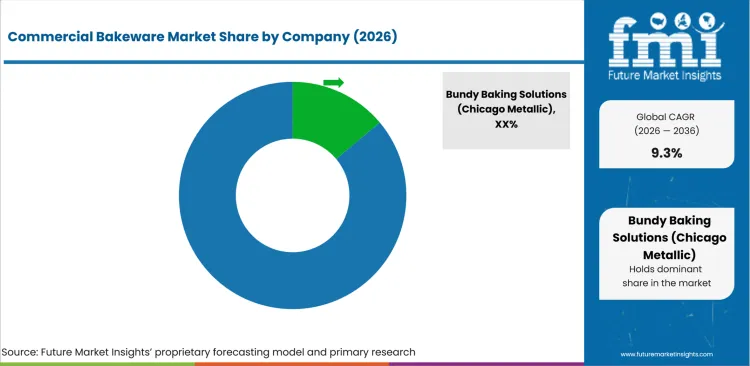
Competition separates by production setting and service depth. Bundy Baking Solutions and Vollrath carry deeper industrial or foodservice exposure. De Buyer, Matfer Bourgeat, Silikomart and Ateco concentrate on professional pastry use. USA Pan and Nordic Ware retain professional relevance, while Wilton Brands and Lakeland are more retail-led.
- Industrial bakeware and lifecycle supply: Bundy Baking Solutions (Chicago Metallic) and Vollrath provide deeper metal-forming and foodservice access.
- Professional pastry and culinary supply: Ateco, de Buyer, Matfer Bourgeat and Silikomart serve pastry teams through specialist forms and tools.
- Retail-overlap bakeware: USA Pan, Nordic Ware, Wilton Brands and Lakeland widen format access with varying commercial-duty support.
Competitive Benchmarking: Commercial Bakeware Market
| Company | Professional Bakeware Breadth | High-Throughput Compatibility | Professional Channel Depth | Geographic Reach |
|---|---|---|---|---|
| Bundy Baking Solutions (Chicago Metallic) | High | High | High | North America and international commercial bakery channels |
| USA Pan | Medium | Medium | Medium | United States with broader retail and wholesale reach |
| Nordic Ware | Medium | Low | Medium | United States with international retail and professional availability |
| Wilton Brands | Medium | Low | Low | North America with distribution in more than 100 countries |
| Ateco | Medium | Low | Medium | United States with international pastry-tool distribution |
| de Buyer | High | Medium | High | Europe with international professional culinary distribution |
| Matfer Bourgeat | High | Medium | High | Europe and North America with international professional reach |
| Silikomart | High | Medium | High | Europe with international professional and HoReCa channels |
| Lakeland | Medium | Low | Low | United Kingdom retail-led distribution |
| Vollrath | High | Medium | High | North America with international foodservice channels |
Scoring basis: High requires broad documented professional bakeware or service coverage. Medium indicates narrower verified professional coverage and Low indicates a documented retail or adjacent-use limitation. High-throughput compatibility requires industrial or commercial-duty evidence. Professional channel depth reflects direct, distributor or service access.
Key Developments in the Commercial Bakeware Market
- In December 2025, Vollrath announced its Sheboygan modernization with a new 110,000-square-foot manufacturing facility. The project increases production flexibility for its commercial foodservice portfolio, including bakeware.
- In January 2025, Bundy Baking Solutions (Chicago Metallic) expanded its pizza-pan range with 40 new items covering flatbread, Roman, Grandma and Sicilian styles. The range gives commercial operators more formats within an established pan supply relationship.
- In January 2025, de Buyer joined Groupe SEB after the acquisition of La Brigade de Buyer. The transaction placed the pastry and professional cookware brand inside a larger international professional division.
Key Players in the Commercial Bakeware Market
Industrial Bakeware and Lifecycle Supply
- Bundy Baking Solutions (Chicago Metallic)
- Vollrath
Professional Pastry and Culinary Supply
- Ateco
- de Buyer
- Matfer Bourgeat
- Silikomart
Retail-Overlap Bakeware
- USA Pan
- Nordic Ware
- Wilton Brands
- Lakeland
Commercial Bakeware Market - Report Scope
| Coverage field | Report scope |
|---|---|
| Market breakdown | equipment type, capacity, automation level, end user, sales channel |
| Quantitative Units | USD million |
| Market Definition | Revenue includes reusable commercial bakeware sold for professional bakery and foodservice use, including pans, trays, molds, baking sheets or mats, pan systems, and directly associated refurbishment or recoating. Processing-line machinery, ovens, proofers, mixers, depositors, downstream baked goods and consumer-only purchases are excluded. |
| Regions Covered | North America, Latin America, Western Europe, Eastern Europe, East Asia, South Asia and Pacific, Middle East and Africa |
| Countries Covered | USA, Germany, France, UK, Saudi Arabia, UAE, Japan, South Korea, and 20+ countries included in the full report. |
| Key Companies Profiled | Bundy Baking Solutions (Chicago Metallic), USA Pan, Nordic Ware, Wilton Brands, Ateco, de Buyer, Matfer Bourgeat, Silikomart, Lakeland, Vollrath |
| Forecast Period | 2026 to 2036 |
| Approach | Primary and secondary research with market triangulation. |
Commercial Bakeware Market - Research Methodology
| Method | Approach |
|---|---|
| Primary Research | FMI analysts gathered input from manufacturers, service providers, technology developers, distributors, end users, procurement teams, and subject-matter experts. Interviews examined purchasing decisions, product or service evaluation, adoption barriers, approval requirements, pricing considerations, and expectations for technical or commercial support. Respondents were also asked what evidence is required before a trial, pilot, or initial order develops into regular purchasing. |
| Desk Research | Desk research covered government statistics, regulatory publications, trade data, industry associations, technical literature, standards, company filings, product information, and official corporate announcements. Sources were reviewed for relevance, publication date, geographic coverage, and consistency with the defined market scope. Claims relating to performance, applications, approvals, capacity, investment, and commercial activity were retained only when supported by credible public evidence. |
| Market Sizing and Forecasting | The market model combined the baseline value with historical performance, segment structure, pricing and volume indicators, adoption levels, company participation, and country-level demand conditions. Forecast assumptions considered economic activity, investment trends, regulatory developments, technology adoption, purchasing cycles, supply availability, and barriers to wider market use. Segment and regional estimates were reconciled before the final market total was calculated. |
| Data Validation | Estimates were checked against multiple independent indicators, including public data, company activity, trade patterns, industry developments, and findings from primary interviews. Validation also tested whether products, services, applications, and company revenues fell within the defined market boundaries. Adjacent categories, unsupported claims, overlapping revenues, and activities without direct market relevance were excluded to reduce double counting and maintain consistency across segments and countries. |
Commercial Bakeware Market by Segments
Commercial Bakeware Market segmented by Equipment Type:
- Mid-capacity lines
- Compact - entry systems
- High-capacity industrial lines
Commercial Bakeware Market segmented by Capacity:
- 500-2,000 kg/hr
- Below 500 kg/hr
- Above 2,000 kg/hr
Commercial Bakeware Market segmented by Automation Level:
- Fully automatic - robotic
- Semi-automatic
- Manual
Commercial Bakeware Market segmented by End User:
- Industrial bakeries
- In-store & retail bakeries
- Artisan bakeries
- Foodservice - QSR central kitchens
Commercial Bakeware Market segmented by Sales Channel:
- Direct OEM sales
- Dealers & distributors
- Aftermarket & refurbished
Commercial Bakeware Market by Region:
- North America
- United States
- Canada
- Latin America
- Brazil
- Mexico
- Argentina
- Chile
- Western Europe
- Germany
- France
- United Kingdom
- Italy
- Spain
- Benelux
- Nordics
- Eastern Europe
- Poland
- Czech Republic
- Romania
- Hungary
- East Asia
- China
- Japan
- South Korea
- South Asia and Pacific
- India
- ASEAN
- Australia and New Zealand
- Middle East and Africa
- GCC Countries
- South Africa
- Türkiye
- Israel
Research Sources and Bibliography
- Baking Equipment Manufacturers & Allieds. (2026, March 16). BEMA Intel.
- Office for National Statistics. (2026, May 14). IOP: 10.7:Manufacture of bakery and farinaceous products: CVMNSA.
- Baking Equipment Manufacturers & Allieds. (2025, February 24). Capital Spending Outlook 2025: Trends, Challenges, and Key Takeaways.
- USA Bureau of Labor Statistics. (2026, August 27). Occupational Outlook Handbook: Bakers.
- American Bakers Association. (2025, April 28). Workforce Study from ABA, ASB, and IDDBA Highlights Opportunities for Talent Development in Commercial Baking.
- National Restaurant Association. (2025, February 6). Restaurant Industry Poised for Growth in 2025, Expected to Employ 15.9 Million People.
- German Federal Statistical Office. (2025, February 14). Wholesale prices in January 2025: +0.9% on January 2024.
- INSEE. (2026, September 2). Dossier complet - France entière: sélection d'équipements et services à la population en 2025.
- Office for National Statistics. (2026, August 13). 10.7:Manufacture of Bakery and Farinaceous Products: CVM: annual & monthly gr.
- General Authority for Statistics, Saudi Arabia. (2025, June). Tourism Establishments Statistics - Q1 of 2025.
- Government of Dubai Media Office. (2026, February 9). Dubai's tourism industry achieves third successive record-breaking year.
- Ministry of Agriculture, Forestry and Fisheries, Japan. (2025, June 13). Food manufacturing productivity improvement and labor-saving investment measures.
- Statistics Korea. (2025, December 23). Preliminary Results of the 2024 Franchise Survey.
- The Vollrath Company. (2025, December 10). The Vollrath Company Announces Multi-Million Dollar Investment in Sheboygan Headquarters.
- Chicago Metallic. (2025, January 28). Chicago Metallic Expands Pizza Lineup with Pans for Every Style.
- Groupe SEB. (2025, January 22). Groupe SEB Acquires La Brigade de Buyer and Continues Its Expansion in the Professional and Premium Markets.
- USA Pan. (n.d.). Our Story. Retrieved September 4, 2026.
- Nordic Ware. (n.d.). About Us. Retrieved September 4, 2026.
- Wilton Brands. (n.d.). Press Room. Retrieved September 4, 2026.
- Ateco. (n.d.). Company information for professional baking and decorating tools. Retrieved September 4, 2026.
- Matfer Bourgeat. (n.d.). Who are we? Retrieved September 4, 2026.
- Silikomart S.r.l. (2025). General Conditions of Sales for professional B2B customers.
- Lakeland. (n.d.). About us. Retrieved September 4, 2026.
- The Vollrath Company. (n.d.). About Vollrath. Retrieved September 4, 2026.
- International Housewares Association. (2026, March). Nordic Ware press releases for The Inspired Home Show 2026.
- Groupe SEB. (2026, March 12). DE BUYER, PARTNER OF BOCUSE D'OR EUROPE, PUTTING PRECISION AT THE SERVICE OF CHEFS.
- Matfer Bourgeat. (2026, April 24). Trophée Marcel Le Servot 2026 : Matfer Bourgeat partenaire officiel de la 8e édition.
- Matfer Bourgeat. (2026, May 4). Concours boulangerie pâtisserie apprentis à Grenoble : Matfer Bourgeat partenaire du Trophée Jeunes Talents 2026.
- Matfer Bourgeat. (2026, June 22). Matfer Bourgeat, partenaire du Séminaire Relais Desserts 2026 à Barcelone.
This bibliography is provided for reader reference and is not exhaustive. The full report contains the complete reference list and detailed citations.
This Report Answers
- What is the commercial bakeware market size in 2026 and what is it forecast to reach by 2036?
- Which operating conditions increase commercial bakeware replacement demand?
- Why do mid-capacity lines lead equipment type?
- How does the 500-2,000 kg/hr band shape pan-fleet economics?
- Why do fully automatic - robotic settings require tighter bakeware geometry?
- How do country CAGRs differ among the eight profiled markets?
- Which companies serve industrial, pastry and retail-overlap channels?
- What qualification and capital frictions can delay fleet replacement?
Frequently Asked Questions
How big is the commercial bakeware market in 2026?
The commercial bakeware market is valued at USD 505.6 million in 2026 and is projected to reach USD 1,230.3 million by 2036. Worn pan replacement and format changes sustain demand.
What is the CAGR of the commercial bakeware market from 2026 to 2036?
The commercial bakeware market is projected to grow at a CAGR of 9.3% between 2026 and 2036. Higher bakery throughput increases the production cycles that consume pan life.
Which equipment type leads the commercial bakeware market?
The mid-capacity lines segment is expected to hold 39.0% of the commercial bakeware market in 2026, attributable to fleet-scale purchasing with format flexibility. Plants can standardize pan families without fixing production to one format.
Which capacity segment leads the commercial bakeware market?
The 500-2,000 kg/hr segment is expected to hold 44.0% of the commercial bakeware market in 2026, supported by visible pan-life economics at fleet scale. Plants can stage replacements without rebuilding the processing line.
Which countries are projected to record the highest growth in the commercial bakeware market?
UAE is projected to grow at 10.7% CAGR, followed by Saudi Arabia at 10.3% and South Korea at 10.0% through 2036. Hospitality additions and franchise-scale bakery programs increase new-format demand.
Which companies are active in the commercial bakeware market?
Key companies operating in the commercial bakeware market include Bundy Baking Solutions (Chicago Metallic), USA Pan, Nordic Ware, Wilton Brands, Ateco, de Buyer, Matfer Bourgeat, Silikomart, Lakeland, and Vollrath. Their positions differ by industrial depth and professional channel coverage.
Preview the report firsthand - request a free sample
Get SampleGet the brochure for pricing and purchase details.
Get PDFTable of Content
- Key Takeaways
- Market Size and CAGR
- Top Growth Driver
- Fastest Growing Segment
- Leading Region
- Key Companies
- Emerging Opportunities
- Executive Summary
- Global Market Outlook
- Demand-side Trends
- Supply-side Trends
- Technology Roadmap Analysis
- Analysis and Recommendations
- Analyst Perspective (What is happening? Why now? What should investors know?)
- Key Questions Answered
- How large is the market?
- What is the CAGR?
- What are key trends?
- Which region dominates?
- Who are the leaders?
- Market Overview
- Market Coverage / Taxonomy
- Market Definition / Scope / Limitations
- Research Methodology
- Chapter Orientation
- Analytical Lens and Working Hypotheses
- Market Structure, Signals, and Trend Drivers
- Benchmarking and Cross-market Comparability
- Market Sizing, Forecasting, and Opportunity Mapping
- Research Design and Evidence Framework
- Desk Research Programme (Secondary Evidence)
- Expert Input and Fieldwork (Primary Evidence)
- Tooling, Models, and Reference Databases
- Data Engineering and Model Build
- Quality Assurance and Audit Trail
- Market Background
- Market Dynamics (Drivers, Restraints, Opportunity, Trends)
- Scenario Forecast (Optimistic, Likely, Conservative)
- Impact Analysis
- AI Impact
- Sustainability Impact
- Regulatory Impact
- Technology Impact
- Consumer / Buyer Analysis
- Purchase Drivers
- Adoption Barriers
- Buyer Journey
- Opportunity Map Analysis
- Product Life Cycle Analysis
- Supply Chain Analysis
- Investment Feasibility Matrix
- Value Chain Analysis
- PESTLE and Porter's Analysis
- Regulatory Landscape
- Regional Parent Market Outlook
- Production and Consumption Statistics
- Import and Export Statistics
- Global Market Analysis and Forecast, 2021 to 2036
- Historical Market Size Value (USD Million) Analysis, 2021 to 2025
- Current and Future Market Size Value (USD Million) Projections, 2026 to 2036
- Y-o-Y Growth Trend Analysis
- Absolute $ Opportunity Analysis
- Global Market Pricing Analysis, 2021 to 2036
- Global Market Analysis and Forecast, By Equipment Type, 2021 to 2036
- Introduction / Key Findings
- Historical Market Size Value (USD Million) Analysis By Equipment Type, 2021 to 2025
- Current and Future Market Size Value (USD Million) Analysis and Forecast By Equipment Type, 2026 to 2036
- Mid-capacity lines
- Compact / entry systems
- High-capacity industrial lines
- Mid-capacity lines
- Y-o-Y Growth Trend Analysis By Equipment Type, 2021 to 2025
- Absolute $ Opportunity Analysis By Equipment Type, 2026 to 2036
- Global Market Analysis and Forecast, By Capacity, 2021 to 2036
- Introduction / Key Findings
- Historical Market Size Value (USD Million) Analysis By Capacity, 2021 to 2025
- Current and Future Market Size Value (USD Million) Analysis and Forecast By Capacity, 2026 to 2036
- 500-2,000 kg/hr
- Below 500 kg/hr
- Above 2,000 kg/hr
- 500-2,000 kg/hr
- Y-o-Y Growth Trend Analysis By Capacity, 2021 to 2025
- Absolute $ Opportunity Analysis By Capacity, 2026 to 2036
- Global Market Analysis and Forecast, By Automation Level, 2021 to 2036
- Introduction / Key Findings
- Historical Market Size Value (USD Million) Analysis By Automation Level, 2021 to 2025
- Current and Future Market Size Value (USD Million) Analysis and Forecast By Automation Level, 2026 to 2036
- Fully automatic / robotic
- Semi-automatic
- Manual
- Fully automatic / robotic
- Y-o-Y Growth Trend Analysis By Automation Level, 2021 to 2025
- Absolute $ Opportunity Analysis By Automation Level, 2026 to 2036
- Global Market Analysis and Forecast, By End User, 2021 to 2036
- Introduction / Key Findings
- Historical Market Size Value (USD Million) Analysis By End User, 2021 to 2025
- Current and Future Market Size Value (USD Million) Analysis and Forecast By End User, 2026 to 2036
- Industrial bakeries
- In-store & retail bakeries
- Artisan bakeries
- Foodservice / QSR central kitchens
- Industrial bakeries
- Y-o-Y Growth Trend Analysis By End User, 2021 to 2025
- Absolute $ Opportunity Analysis By End User, 2026 to 2036
- Global Market Analysis and Forecast, By Sales Channel, 2021 to 2036
- Introduction / Key Findings
- Historical Market Size Value (USD Million) Analysis By Sales Channel, 2021 to 2025
- Current and Future Market Size Value (USD Million) Analysis and Forecast By Sales Channel, 2026 to 2036
- Direct OEM sales
- Dealers & distributors
- Aftermarket & refurbished
- Direct OEM sales
- Y-o-Y Growth Trend Analysis By Sales Channel, 2021 to 2025
- Absolute $ Opportunity Analysis By Sales Channel, 2026 to 2036
- Global Market Analysis and Forecast, By Region, 2021 to 2036
- Introduction
- Historical Market Size Value (USD Million) Analysis By Region, 2021 to 2025
- Current Market Size Value (USD Million) Analysis and Forecast By Region, 2026 to 2036
- North America
- Latin America
- Western Europe
- Eastern Europe
- East Asia
- South Asia and Pacific
- Middle East & Africa
- Market Attractiveness Analysis By Region
- North America Market Analysis and Forecast, By Country, 2021 to 2036
- Historical Market Size Value (USD Million) Trend Analysis By Market Taxonomy, 2021 to 2025
- Market Size Value (USD Million) Forecast By Market Taxonomy, 2026 to 2036
- By Country
- USA
- Canada
- By Equipment Type
- By Capacity
- By Automation Level
- By End User
- By Sales Channel
- By Country
- Market Attractiveness Analysis
- By Country
- By Equipment Type
- By Capacity
- By Automation Level
- By End User
- By Sales Channel
- Key Takeaways
- Latin America Market Analysis and Forecast, By Country
- Historical Market Size Value (USD Million) Trend Analysis By Market Taxonomy, 2021 to 2025
- Market Size Value (USD Million) Forecast By Market Taxonomy, 2026 to 2036
- By Country
- Brazil
- Mexico
- Chile
- Rest of Latin America
- By Equipment Type
- By Capacity
- By Automation Level
- By End User
- By Sales Channel
- By Country
- Market Attractiveness Analysis
- By Country
- By Equipment Type
- By Capacity
- By Automation Level
- By End User
- By Sales Channel
- Key Takeaways
- Western Europe Market Analysis and Forecast, By Country
- Historical Market Size Value (USD Million) Trend Analysis By Market Taxonomy, 2021 to 2025
- Market Size Value (USD Million) Forecast By Market Taxonomy, 2026 to 2036
- By Country
- Germany
- UK
- Italy
- Spain
- France
- Nordic
- BENELUX
- Rest of Western Europe
- By Equipment Type
- By Capacity
- By Automation Level
- By End User
- By Sales Channel
- By Country
- Market Attractiveness Analysis
- By Country
- By Equipment Type
- By Capacity
- By Automation Level
- By End User
- By Sales Channel
- Key Takeaways
- Eastern Europe Market Analysis and Forecast, By Country
- Historical Market Size Value (USD Million) Trend Analysis By Market Taxonomy, 2021 to 2025
- Market Size Value (USD Million) Forecast By Market Taxonomy, 2026 to 2036
- By Country
- Russia
- Poland
- Hungary
- Balkan & Baltic
- Rest of Eastern Europe
- By Equipment Type
- By Capacity
- By Automation Level
- By End User
- By Sales Channel
- By Country
- Market Attractiveness Analysis
- By Country
- By Equipment Type
- By Capacity
- By Automation Level
- By End User
- By Sales Channel
- Key Takeaways
- East Asia Market Analysis and Forecast, By Country
- Historical Market Size Value (USD Million) Trend Analysis By Market Taxonomy, 2021 to 2025
- Market Size Value (USD Million) Forecast By Market Taxonomy, 2026 to 2036
- By Country
- China
- Japan
- South Korea
- By Equipment Type
- By Capacity
- By Automation Level
- By End User
- By Sales Channel
- By Country
- Market Attractiveness Analysis
- By Country
- By Equipment Type
- By Capacity
- By Automation Level
- By End User
- By Sales Channel
- Key Takeaways
- South Asia and Pacific Market Analysis and Forecast, By Country
- Historical Market Size Value (USD Million) Trend Analysis By Market Taxonomy, 2021 to 2025
- Market Size Value (USD Million) Forecast By Market Taxonomy, 2026 to 2036
- By Country
- India
- ASEAN
- Australia & New Zealand
- Rest of South Asia and Pacific
- By Equipment Type
- By Capacity
- By Automation Level
- By End User
- By Sales Channel
- By Country
- Market Attractiveness Analysis
- By Country
- By Equipment Type
- By Capacity
- By Automation Level
- By End User
- By Sales Channel
- Key Takeaways
- Middle East & Africa Market Analysis and Forecast, By Country
- Historical Market Size Value (USD Million) Trend Analysis By Market Taxonomy, 2021 to 2025
- Market Size Value (USD Million) Forecast By Market Taxonomy, 2026 to 2036
- By Country
- Kingdom of Saudi Arabia
- Other GCC Countries
- Türkiye
- South Africa
- Other African Union
- Rest of Middle East & Africa
- By Equipment Type
- By Capacity
- By Automation Level
- By End User
- By Sales Channel
- By Country
- Market Attractiveness Analysis
- By Country
- By Equipment Type
- By Capacity
- By Automation Level
- By End User
- By Sales Channel
- Key Takeaways
- Key Countries Market Analysis
- USA
- Pricing Analysis
- Market Share Analysis, 2025
- By Equipment Type
- By Capacity
- By Automation Level
- By End User
- By Sales Channel
- Canada
- Pricing Analysis
- Market Share Analysis, 2025
- By Equipment Type
- By Capacity
- By Automation Level
- By End User
- By Sales Channel
- Mexico
- Pricing Analysis
- Market Share Analysis, 2025
- By Equipment Type
- By Capacity
- By Automation Level
- By End User
- By Sales Channel
- Brazil
- Pricing Analysis
- Market Share Analysis, 2025
- By Equipment Type
- By Capacity
- By Automation Level
- By End User
- By Sales Channel
- Chile
- Pricing Analysis
- Market Share Analysis, 2025
- By Equipment Type
- By Capacity
- By Automation Level
- By End User
- By Sales Channel
- Germany
- Pricing Analysis
- Market Share Analysis, 2025
- By Equipment Type
- By Capacity
- By Automation Level
- By End User
- By Sales Channel
- UK
- Pricing Analysis
- Market Share Analysis, 2025
- By Equipment Type
- By Capacity
- By Automation Level
- By End User
- By Sales Channel
- Italy
- Pricing Analysis
- Market Share Analysis, 2025
- By Equipment Type
- By Capacity
- By Automation Level
- By End User
- By Sales Channel
- Spain
- Pricing Analysis
- Market Share Analysis, 2025
- By Equipment Type
- By Capacity
- By Automation Level
- By End User
- By Sales Channel
- France
- Pricing Analysis
- Market Share Analysis, 2025
- By Equipment Type
- By Capacity
- By Automation Level
- By End User
- By Sales Channel
- India
- Pricing Analysis
- Market Share Analysis, 2025
- By Equipment Type
- By Capacity
- By Automation Level
- By End User
- By Sales Channel
- ASEAN
- Pricing Analysis
- Market Share Analysis, 2025
- By Equipment Type
- By Capacity
- By Automation Level
- By End User
- By Sales Channel
- Australia & New Zealand
- Pricing Analysis
- Market Share Analysis, 2025
- By Equipment Type
- By Capacity
- By Automation Level
- By End User
- By Sales Channel
- China
- Pricing Analysis
- Market Share Analysis, 2025
- By Equipment Type
- By Capacity
- By Automation Level
- By End User
- By Sales Channel
- Japan
- Pricing Analysis
- Market Share Analysis, 2025
- By Equipment Type
- By Capacity
- By Automation Level
- By End User
- By Sales Channel
- South Korea
- Pricing Analysis
- Market Share Analysis, 2025
- By Equipment Type
- By Capacity
- By Automation Level
- By End User
- By Sales Channel
- Russia
- Pricing Analysis
- Market Share Analysis, 2025
- By Equipment Type
- By Capacity
- By Automation Level
- By End User
- By Sales Channel
- Poland
- Pricing Analysis
- Market Share Analysis, 2025
- By Equipment Type
- By Capacity
- By Automation Level
- By End User
- By Sales Channel
- Hungary
- Pricing Analysis
- Market Share Analysis, 2025
- By Equipment Type
- By Capacity
- By Automation Level
- By End User
- By Sales Channel
- Kingdom of Saudi Arabia
- Pricing Analysis
- Market Share Analysis, 2025
- By Equipment Type
- By Capacity
- By Automation Level
- By End User
- By Sales Channel
- Türkiye
- Pricing Analysis
- Market Share Analysis, 2025
- By Equipment Type
- By Capacity
- By Automation Level
- By End User
- By Sales Channel
- South Africa
- Pricing Analysis
- Market Share Analysis, 2025
- By Equipment Type
- By Capacity
- By Automation Level
- By End User
- By Sales Channel
- USA
- Market Structure Analysis
- Competition Dashboard
- Competition Benchmarking
- Market Share Analysis of Top Players
- By Regional
- By Equipment Type
- By Capacity
- By Automation Level
- By End User
- By Sales Channel
- Emerging Startups
- Innovation Benchmarking
- Competition Analysis
- Competition Deep Dive
- Bundy Baking Solutions (Chicago Metallic)
- Overview
- Product Portfolio
- Profitability by Market Segments
- Sales Footprint
- Strategy Overview
- Marketing Strategy
- Product Strategy
- Channel Strategy
- USA Pan
- Nordic Ware
- Wilton Brands
- Ateco
- de Buyer
- Matfer Bourgeat
- Silikomart
- Lakeland
- Vollrath
- Bundy Baking Solutions (Chicago Metallic)
- Case Studies
- Success Stories
- Recent Developments
- Competition Deep Dive
- Assumptions & Acronyms Used


