

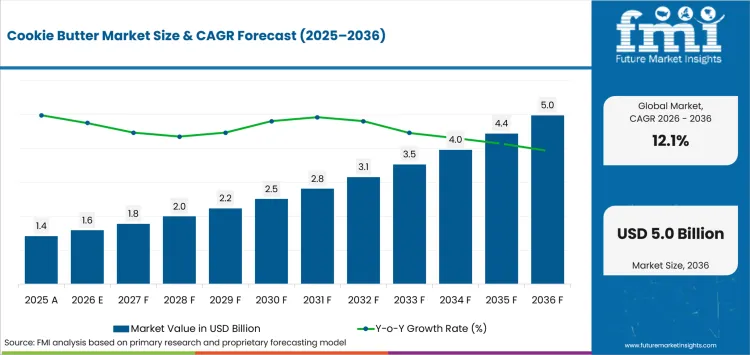
- Market Size (2026)
- USD 1.6 Bn
- Forecast (2036)
- USD 5.0 Bn
- CAGR (2026 to 2036)
- 12.1%
How big is Cookie Butter Market in 2026?
USD 1.6 billion in 2026 and USD 5.0 billion by 2036 at a 12.1% CAGR.
Demand for cookie butter is projected to expand at 12.1% CAGR between 2026 and 2036, increasing valuation from USD 1.6 billion to USD 5.0 billion. Expanding distribution remains critical because repeat purchases depend on consistent shelf availability after consumers adopt the product. Mondelez International and Lotus Bakeries launched Biscoff in India in November 2025 through local manufacturing and nationwide Mondelez distribution. The combination reduces lead times and broadens retail reach compared with imported supply models. Once trial converts into repeat purchases, retailers can replenish inventory more quickly and with lower supply uncertainty, supporting wider category penetration.
The UAE is forecast at 13.3% CAGR compared with 12.4% in the USA because market expansion depends on different commercialization constraints. USA growth opportunities are larger in absolute terms, but national rollouts increasingly require brands to evaluate how sugar- and fat-based spreads fit evolving nutrition-label expectations. FDA proposed in January 2025 that most packaged foods carry a front-of-package box identifying Low, Med, or High levels of saturated fat, sodium, and added sugars. For cookie butter and similar sweet spreads, the proposal can add labeling reviews or reformulation work before nationwide expansion. The UAE market faces fewer category-wide labeling adjustments, allowing distribution execution and consumer trial to play a larger role in growth.
Key Takeaways of Cookie Butter Market
- Recognizable caramelized-cookie flavor broadens demand through spreads, filled formats and desserts that require no separate flavor education.
- Based on product type, chocolate chip is projected to account for 32.0% in 2026 due to immediate flavor recognition during mainstream trial.
- By claim - nature, conventional is estimated to hold 47.0% in 2026 owing to recipes that avoid separate certification and claim-verification steps.
- In 2026, fresh is expected to lead format with 36.0% share because aroma and texture are strongest close to consumption.
- Nutrition labeling and promotion rules slow wider adoption by forcing pack redesign or reformulation ahead of national retail expansion.
- Some of the key players in this market include Mondelez International, pladis, Bahlsen, Lotus Bakeries, Walkers Shortbread, Arnott's, Ferrero, and The Campbell's Company.
Analyst Perspective
"Cookie-butter economics are won after trial once a recognizable caramelized-cookie profile holds repeat velocity without sustained discounting or heavy launch support. Strong offers keep flavor stable and adjust label content or pack size enough to protect margins in grocery and foodservice."
- Nandini Roy Choudhury, Principal Consultant, Future Market Insights
How is the Cookie Butter Market segmented?
The cookie butter market is segmented by product type, claim - nature, format, packaging format, sales channel and region.
Product type includes chocolate chip, filled & stuffed, assorted premium and seasonal & decorated. Claim - nature covers conventional, clean label, organic, gluten-free and high-protein / fortified. Format includes fresh, frozen, ambient packaged, chilled and par-baked / thaw-and-serve. Packaging format includes multipack, single-serve, family / loaf pack and bulk foodservice. Sales channels include supermarkets & hypermarkets, artisan & specialty bakeries, convenience & forecourt, online & DTC and foodservice distributors.
Why does Chocolate chip lead demand within the Product type category?
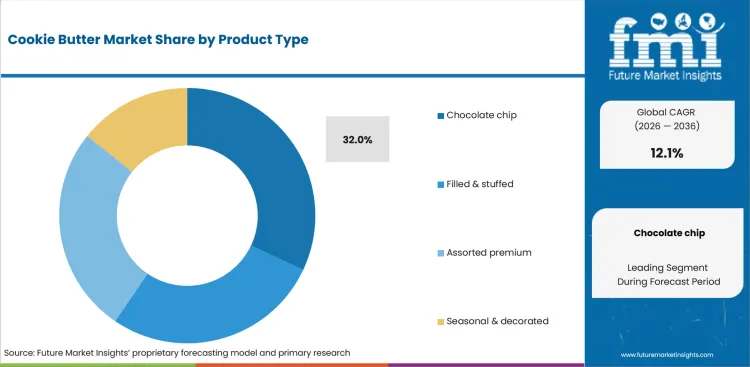
Chocolate chip gives cookie-butter-led products a familiar indulgence cue beside plain caramelized or filled-cookie alternatives. Visible pieces also give shoppers texture information at trial and let brands raise perceived richness without introducing an unfamiliar flavor system.
- Based on product type, chocolate chip is projected to account for 32.0% in 2026 due to immediate flavor recognition in mainstream chocolate confectionery assortments.
- Large cookie brands invest in visible chocolate differentiation as familiar formats are renewed for premium shelves. Ferrero expanded Keebler Chips Deluxe in May 2026 with more chocolate plus new filled and brownie variants for premium cookie formats.
Why does Conventional lead demand within the Claim - nature category?
Conventional recipes let manufacturers balance sweetness and texture without the certification rules attached to specialized claims in mainstream bakery products. Clean-label and allergen-free food propositions require separate ingredient controls or substantiation for equivalent retail treatment.
- By claim - nature, conventional is estimated to hold 47.0% in 2026 owing to familiar recipes that reach mainstream channels with fewer claim-verification steps.
- National rollout of specialized claims requires documented formula and certification support from retailers in mainstream grocery. Arnott's launched gluten-free Jatz and Barbecue Shapes in April 2025 with Coeliac Australia and New Zealand endorsement for validated gluten-free propositions.
Why does Fresh lead demand within the Format category?
Fresh formats concentrate value in aroma and texture near bakery counters or foodservice preparation points. Short holding times raise the cost of poor demand planning as production frequency and waste control must match outlet traffic.
- Fresh is projected to hold 36.0% share of the format category in 2026 attributable to stronger sensory presentation near the point of consumption.
- Current bakery networks show why fresh formats require operating control beyond the recipe during replenishment. The Campbell's Company reported in June 2026 that Pepperidge Farm spans cookies and fresh bakery plus frozen products, making production planning and fresh food packaging relevant to established bakery operations.
Why does Multipack lead demand within the Packaging format category?
Multipacks divide planned household consumption into several portions and give retailers a larger basket contribution than a single serving. Their advantage weakens if food packaging raises unit cost enough to erase the value consumers expect from buying several portions together.
- Multipack is set to lead the packaging format with 33.0% share in 2026 due to household stock-up behavior and clearer portion planning.
- Family-oriented packs work best once the size ladder makes the use case obvious for households. Mondelez India launched Oreo Golden in May 2026 with small and mid-size packs plus a multipack for family moments, separating individual and household occasions.
Why do Supermarkets and hypermarkets lead the Sales channel category?
Cookie butter depends on high-frequency grocery placement beside bread and breakfast foods before repeat purchase becomes routine. Large food stores give brands enough shelf reach to convert first trial into planned household replenishment.
- Supermarkets and hypermarkets are projected to hold 34.0% of sales channel demand in 2026 because weekly grocery trips create repeat spread-purchase occasions.
- INSEE reported in June 2026 that large general food stores represented 58.6% of French food retail value during 2025. That channel scale makes shelf placement and disciplined replenishment more important than launch visibility alone during annual national grocery range reviews.
What are the drivers, restraints and opportunities in the Cookie Butter Market?
Recognizable cookie flavor expands usage occasions, nutrition rules raise commercialization work and distinctive spread packaging improves shelf recognition.
- Driver: Familiar caramelized-cookie flavor lets brands extend one recognizable taste profile into retail spreads and dessert applications without rebuilding awareness for every format.
- Restraint: Less-healthy food rules can require label redesign or promotion changes ahead of broad channel support for sweet spreads or cookie-led SKUs.
- Opportunity: Distinctive spread packaging can improve shelf recognition without changing the familiar Biscoff flavor that underpins repeat purchase.
Recognizable Flavor Converts into More Purchase Occasions
A recognizable caramelized-cookie profile can support spread and dessert occasions without requiring a separate flavor education campaign. Mondelez India stated in March 2026 that Biscoff had moved from its local biscuit launch into spread use in cafes and home kitchens. The Biscoff extension gives retailers several reorder occasions from one taste cue, provided pack economics and replenishment stay stable beside adjacent nut butters after launch support fades.
Nutrition and Promotion Rules Raise Commercialization Costs
Promotion limits raise commercialization costs without removing underlying appetite for indulgent products sold through national media campaigns. UK rules effective January 2026 prohibit paid online advertising for less healthy products and impose a 9pm television watershed. Cookie-butter brands caught by those rules must qualify permitted brand activity or adjust formulations ahead of broad confectionery media support that justifies national listings and repeat promotional investment.
Distinctive Packaging Improves Shelf Recognition
Packaging can extend cookie-butter value by making a familiar spread easier to identify beside competing sweet spread products. Lotus Bakeries documented a bespoke Biscoff spread jar in September 2025 as part of its annual Biscoff milestone review. The format gives retailers a stronger shelf cue without changing the core flavor, although pack economics and replenishment efficiency determine whether the visual change pays back.
Which country CAGRs are profiled in the Cookie Butter Market?
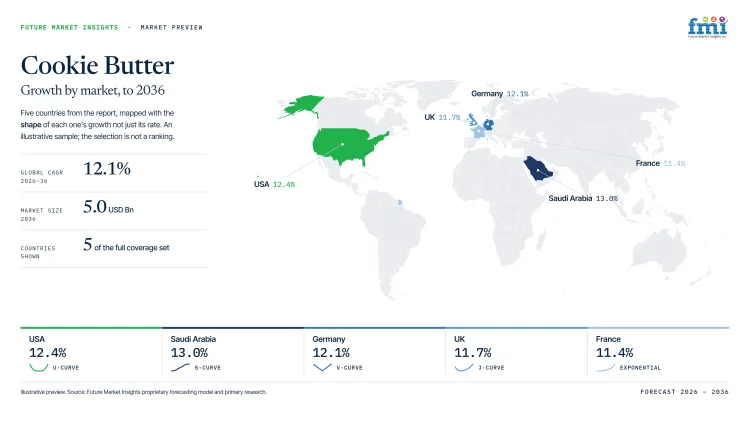
| Country | CAGR |
|---|---|
| UAE | 13.3% |
| Saudi Arabia | 13.0% |
| South Korea | 12.7% |
| USA | 12.4% |
| Germany | 12.1% |
| UK | 11.7% |
| France | 11.4% |
| Japan | 11.1% |
How do country-level CAGRs compare in the Cookie Butter Market?
The forecasts span 2.2 percentage points from UAE at 13.3% CAGR to Japan at 11.1% through 2036. UAE and Saudi Arabia form the faster Gulf pair while South Korea follows through dense urban retail channels. USA and Germany occupy the next band with UK and France slightly lower before Japan closes the group. The ranking separates localization markets from mature grocery systems where promotion and package economics carry more weight.
- UAE benefits from local manufacturing momentum and concentrated premium retail channels that shorten replenishment after successful product trial.
- Saudi Arabia gains from expanding modern retail and hospitality channels that support premium cookie-led formats during repeated purchase occasions.
- South Korea combines fast product renovation with dense convenience distribution that rewards compact indulgent formats and repeated launches.
- USA offers national retail scale although proposed front-of-package nutrition rules can add reformulation work before broader rollout.
- Germany supports premium grocery placement but mature competition makes velocity and promotional economics decisive during national range reviews.
- UK food-store growth broadens routine shelf exposure while retailer resets quickly expose products that depend on introductory discounts.
- France provides broad food-store coverage although Nutri-Score transitions can reopen packaging work during national assortment planning.
- Japan offers established packaged-food distribution but voluntary front-of-package guidance raises the value of disciplined nutrition data during launch planning.
Small forecast gaps still conceal meaningful differences in distribution economics and package-change burdens between the eight profiled countries. The full report provides country-level CAGR analysis across North America, Latin America, Europe, East Asia, South Asia, Oceania and the Middle East and Africa.
Country-wise Analysis
- Dubai routes many imported food launches through local agents who must settle product registration prior to broad retail inventory commitments. Cookie butter sales in UAE are forecast to expand at 13.3% CAGR by 2036, tied to premium grocery and hotel demand. Dubai Municipality stated in February 2025 that Montaji+ contained more than 1.7 million registered food products for market control. The digital registration route gives importers a defined compliance path but crowded premium shelves penalize slow replenishment and weak Arabic-ready packs. Brands entering UAE need enough local inventory depth to keep successful trial from turning into missed repeat orders.
- Saudi premium grocers concentrate imported dessert flavors in Riyadh and Jeddah, with cafe menus extending trial beyond supermarket shelves. The SFDA announced three nutrition regulations in February 2025 for restaurants and cafes that became effective on July 1. Saudi Arabia's cookie butter outlook is anticipated to advance at 13.0% CAGR over the assessment period, because complete nutrition data eases foodservice onboarding. Menu economics limit slow-moving flavors since operators cannot carry every imported dessert extension through repeated seasonal rotations. The forecast therefore depends on foodservice turnover as much as initial interest in premium imported spreads during national range planning today.
- South Korean convenience stores rotate imported snacks quickly, so packaging changes must be ready ahead of short assortment windows closing. MFDS published Food Labeling Standards Notice 2025-27 on April 21, 2025 and reset the current labeling reference for packaged food. Importers gain a clear regulatory reference but Korean-language package control adds cost to variants that sell in modest volumes. In South Korea, cookie butter demand is predicted to advance at 12.7% CAGR through 2036 on the back of fast digital ordering and premium dessert demand. Quick assortment turnover should favor brands that can refresh compliant packs without repeatedly rebuilding local artwork and inventory.
- USA grocery networks can scale a successful regional spread nationally through established category resets, but weak velocity becomes expensive once promotion and listing fees widen. The Census Bureau reported in August 2026 that e-commerce accounted for 17.1% of second-quarter retail sales nationwide. By 2036, USA is projected to grow at 12.4% CAGR given omnichannel access and familiar premium-cookie flavor cues. Retailer websites extend discovery beyond physical shelf space for smaller brands but national listings require repeat volume sufficient to absorb promotional costs. Compared with Gulf markets, the USA case depends more on retailer economics than on import registration speed.
- German grocery shelves place nutrition scores beside strong discount pricing for many packaged foods. BZfE stated in November 2025 that roughly 700 companies used Nutri-Score on more than 1,000 brands. Germany is estimated to post 12.1% CAGR over the forecast period, attributable to established biscuit demand and broad grocery access. National coverage gives premium biscuit and spread brands several routes into mainstream retail without relying on specialty stores. Discounters keep price ladders tight and formula changes can alter Nutri-Score grades during pack refreshes. Imported premium variants therefore carry less margin room for repeated label changes than brands with local production or simpler recipes.
- UK grocery distribution gives premium spreads broad shelf access while retailer resets quickly expose weak repeat velocity and price resistance. Cookie butter in the UK is forecast to grow at 11.7% CAGR through 2036 as established food stores widen availability beyond specialty import channels. ONS reported in January 2026 that annual retail sales volumes increased by 1.3% during the complete 2025 calendar year. The annual improvement expands routine purchase occasions for cookie-led spreads through mainstream food retail and regular grocery replenishment cycles. Suppliers still need promotional economics that remain viable after introductory discounts end across major accounts during planned assortment reviews.
- French grocery buyers compare indulgent spreads inside a nutrition-label system that can reopen packaging work during national range reviews. Cookie butter in France is projected to expand at 11.4% CAGR through 2036 because premium biscuit flavors retain grocery appeal under tighter nutrition screening. The French government stated in July 2025 that Nutri-Score users have until March 2027 to adopt the revised calculation. That transition timetable can require coordinated label updates before brands extend a single package design across national retail accounts. Brands with stable recipes can protect repeat listings more easily than importers revising packs market by market during coordinated national range updates.
- Japanese packaged-food launches now have a clearer voluntary nutrition-information route for brands considering front-of-package disclosure on processed foods. Cookie butter demand in Japan is expected to expand at 11.1% CAGR through 2036 because imported indulgent spreads must compete through familiar retail formats and disciplined labeling. The Consumer Affairs Agency published Japan's front-of-package nutrition guideline in February 2026 after industry and consumer review. The framework gives manufacturers another packaging decision to evaluate before extending a dedicated national package across Japanese retail channels. Importers may delay dedicated package changes until repeat velocity justifies wider grocery distribution and the associated local artwork investment.
Who are the notable companies in the Cookie Butter Market?
Mondelez International, pladis, Bahlsen, Lotus Bakeries, Walkers Shortbread, Arnott's, Ferrero, and The Campbell's Company.
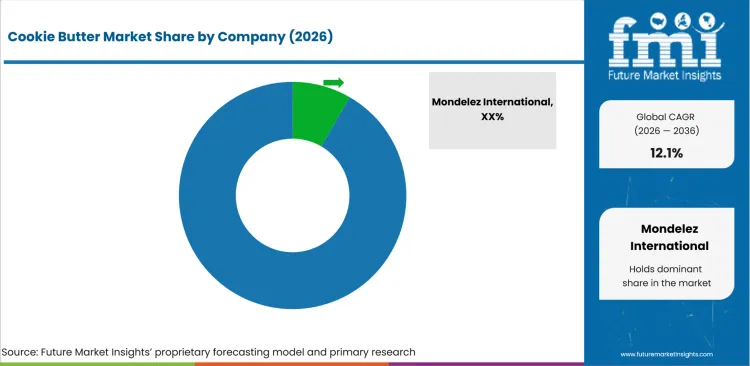
Direct participation centers on Lotus Bakeries as Biscoff owner and Mondelez International through its current brand partnership. Ferrero provides large spread adjacency through Nutella and a national cookie route through Keebler in the United States. pladis, Bahlsen, Walkers Shortbread, Arnott's and The Campbell's Company provide biscuit or bakery benchmarks within biscuits and crackers instead of direct cookie-butter specialization.
- Mondelez International, pladis and Bahlsen bring large biscuit platforms with current manufacturing or distribution evidence in multiple national markets.
- Lotus Bakeries, Walkers Shortbread, Arnott's and Ferrero provide direct Biscoff exposure or specialized cookie and spread platforms used for competitive comparison.
- The Campbell's Company contributes a North American Pepperidge Farm bakery route with national snack distribution and adjacent cookie manufacturing.
Competitive Benchmarking: Cookie Butter Market
| Company | Cookie / Spread Adjacency | Format and Claim Breadth | Route-to-Market Evidence | Geographic Reach |
|---|---|---|---|---|
| Mondelez International | High | High | High | Global |
| pladis | Medium | High | High | Europe, Middle East and selected global markets |
| Bahlsen | Medium | Medium | Medium | Europe and selected export markets |
| Lotus Bakeries | High | High | High | Europe, Americas and Asia-Pacific |
| Walkers Shortbread | Low | Medium | Medium | United Kingdom and close to 100 export markets |
| Arnott's | Medium | High | Medium | Australia and New Zealand |
| Ferrero | High | High | High | Global |
| The Campbell's Company | Medium | High | High | North America |
Scoring basis: High cookie / spread adjacency requires a spread or filled-cookie route plus current branded cookie activity. Medium requires one verified adjacency route and Low identifies a narrower cookie platform with documented branded activity. High format and claim breadth requires at least three documented routes, whereas Medium requires two and Low records one. High route-to-market evidence requires current manufacturing plus multi-channel distribution, whereas Medium requires one commercial route and Low one narrower active route. Geographic reach records the regions supported by current company evidence and does not contribute to the three capability ratings. Ratings use official company filings, newsroom releases and certification records reviewed for current market relevance.
Key Developments in the Cookie Butter Market
- In May 2026, Lotus Bakeries started construction of an additional Lembeke production hall that will expand Biscoff output for European demand.
- In April 2026, Ferrero introduced Nutella Peanut as the brand's first new flavor in more than 60 years and extended its spread platform into a peanut formulation.
- In July 2025, pladis announced a multi-site upgrade of its UK biscuit factories with new ovens and automation intended to expand manufacturing capacity.
Key Players in the Cookie Butter Market
Global Biscuit and Biscoff Platforms
- Mondelez International
- pladis
- Bahlsen
Specialized Cookie and Spread Platforms
- Lotus Bakeries
- Walkers Shortbread
- Arnott's
- Ferrero
North American Bakery Distribution Platform
- The Campbell's Company
Cookie Butter Market - Report Scope
| Coverage field | Report scope |
|---|---|
| Market breakdown | By product type, claim - nature, format, packaging format, sales channel and region. |
| Quantitative Units | USD Billion. |
| Market Definition | Commercial cookie-butter spreads and cookie-led products whose primary commercial proposition is cookie butter within the stated segmentation. Adjacent nut spreads and ordinary cookies without a cookie-butter proposition are excluded. |
| Regions Covered | North America, Latin America, Europe, East Asia, South Asia and Pacific and Middle East and Africa. |
| Countries Covered | UAE, Saudi Arabia, South Korea, USA, Germany, UK, France, Japan, and 20+ countries included in the full report. |
| Key Companies Profiled | Mondelez International, pladis, Bahlsen, Lotus Bakeries, Walkers Shortbread, Arnott's, Ferrero, and The Campbell's Company. |
| Forecast Period | 2026 to 2036. |
| Approach | Primary and secondary research with market triangulation. |
Cookie Butter Market - Research Methodology
| Method | Approach |
|---|---|
| Primary Research | FMI analysts gathered input from manufacturers, service providers, technology developers, distributors, end users, procurement teams, and subject-matter experts. Interviews examined purchasing decisions, product or service evaluation, adoption barriers, approval requirements, pricing considerations, and expectations for technical or commercial support. Respondents were also asked what evidence is required before a trial, pilot, or initial order develops into regular purchasing. |
| Desk Research | Desk research covered government statistics, regulatory publications, trade data, industry associations, technical literature, standards, company filings, product information, and official corporate announcements. Sources were reviewed for relevance, publication date, geographic coverage, and consistency with the defined market scope. Claims relating to performance, applications, approvals, capacity, investment, and commercial activity were retained only when supported by credible public evidence. |
| Market Sizing and Forecasting | The market model combined the baseline value with historical performance, segment structure, pricing and volume indicators, adoption levels, company participation, and country-level demand conditions. Forecast assumptions considered economic activity, investment trends, regulatory developments, technology adoption, purchasing cycles, supply availability, and barriers to wider market use. Segment and regional estimates were reconciled before the final market total was calculated. |
| Data Validation | Estimates were checked against multiple independent indicators, including public data, company activity, trade patterns, industry developments, and findings from primary interviews. Validation also tested whether products, services, applications, and company revenues fell within the defined market boundaries. Adjacent categories, unsupported claims, overlapping revenues, and activities without direct market relevance were excluded to reduce double counting and maintain consistency across segments and countries. |
Cookie Butter Market by Segments
Cookie Butter Market segmented by Product Type:
- Chocolate chip
- Filled & stuffed
- Assorted premium
- Seasonal & decorated
Cookie Butter Market segmented by Claim - nature:
- Conventional
- Clean label
- Organic
- Gluten-free
- High-protein / fortified
Cookie Butter Market segmented by Format:
- Fresh
- Frozen
- Ambient packaged
- Chilled
- Par-baked / thaw-and-serve
Cookie Butter Market segmented by Packaging Format:
- Multipack
- Single-serve
- Family / loaf pack
- Bulk foodservice
Cookie Butter Market segmented by Sales Channel:
- Supermarkets & hypermarkets
- Artisan & specialty bakeries
- Convenience & forecourt
- Online & DTC
- Foodservice distributors
Cookie Butter Market by Region:
- North America
- United States
- Canada
- Latin America
- Brazil
- Mexico
- Chile
- Rest of Latin America
- Western Europe
- Germany
- United Kingdom
- Italy
- Spain
- France
- Nordics
- Benelux
- Rest of Western Europe
- Eastern Europe
- Russia
- Poland
- Hungary
- Balkan and Baltic States
- Rest of Eastern Europe
- East Asia
- China
- Japan
- South Korea
- South Asia and Pacific
- India
- ASEAN
- Australia and New Zealand
- Rest of South Asia and Pacific
- Middle East and Africa
- Kingdom of Saudi Arabia
- Other GCC Countries
- Türkiye
- South Africa
- Other African Union Countries
- Rest of Middle East and Africa
Research Sources and Bibliography
- Mondelēz International (2025, November 13). Mondelēz International brings the world’s favourite Biscoff® to India.
- USA Food and Drug Administration (2025, January 14). FDA Proposes Requiring At-a-Glance Nutrition Information on the Front of Packaged Foods.
- Ferrero (2026, May 5). Keebler Chips Deluxe Is Getting 'Deluxified' With More Chips, More Fudge, and New Flavors Across the Full Portfolio.
- Arnott's (2025, April 10). Arnott's Gluten Free Biscuits and Snacks Range.
- The Campbell's Company (2026, June 8). Campbell's Reports Third Quarter Fiscal 2026 Results.
- Mondelēz International (2026, May 11). Oreo Turns Golden with a Vanilla Twist!.
- Mondelēz International (2026, March 26). Mondelez India Celebrates the Many Ways India Loves Biscoff with “Every Way to Biscoff”.
- UK Department of Health and Social Care (2026, March 25). Less healthy food or drink: advertising and promotions restrictions.
- Lotus Bakeries (2026, February 6). IR Presentation Annual Results 2025.
- Dubai Municipality (2025, February 17). Latest digital food safety services showcased at Gulfood 2025.
- Saudi Food and Drug Authority (2025, February 27). The SFDA Issues Three New Regulations to Promote Healthy Community Nutrition.
- Ministry of Food and Drug Safety, Republic of Korea (2025, April 21). 「식품등의 표시기준」 고시 전문(고시 제2025-27호, '25.4.21.).
- USA Census Bureau (2026, August 18). Quarterly Retail E-Commerce Sales.
- Bundeszentrum für Ernährung (2025, November 4). Nutri-Score.
- Lotus Bakeries (2026, May 12). Lotus Bakeries marks the start of the expansion of its Lembeke production site.
- Ferrero (2026, April 15). The Wait Is Over: Introducing Nutella® Peanut, the Brand’s First New Flavor Innovation in Over 60 Years.
- Yıldız Holding (2025, July 14). McVitie's Owner Pumps £68m Into British Operations.
- Walker's Shortbread. (2026). Walker’s Awards and Accreditations.
- Lotus Bakeries (2025, November). Sustainability Recognitions.
- Yıldız Holding (2025, January 6). pladis Launches Chocolate & Hazelnut Addition to Consumer Favourite McVitie's Gold Billions Range.
- Ferrero (2025, October 8). Keebler® to Release Limited-Edition, Wicked-Inspired Treats to Celebrate the Upcoming Wicked: For Good Premiere.
- Mondelēz International (2026, May 26). The OREO Brand & BTS Movement is On! Introducing the Limited Edition OREO & BTS Cookies.
- Lotus Bakeries (2026, May 4). Biscoff® and Tomorrowland introduce a limited edition Biscoff® Sandwich Cookie Espresso.
- Ferrero (2026, April 27). Mother's Cookies and Magnolia Bakery Whip Up a Whimsical Collab to Sweeten National Strawberry Month.
- Mondelēz International (2025, September 23). Your Favourite Oreo Now Has a New Toffee Crunch Twist.
- Yıldız Holding (2025, May 16). pladis Launches 'Better than ever' Retailer Platform.
- Bahlsen (2025, April 4). Bahlsen Markenrelaunch: Neues Design betont Genussmomente.
- Lotus Bakeries (2025, May 5). Mondelēz International and Lotus Bakeries are strengthening their strategic partnership for Belgium.
- Walker's Shortbread (2026, June 12). Walker’s Shortbread Partners with ASPCA Through 'Shortbread That Saves'.
- Arnott's (2025, July). The Block 2025.
- Ferrero (2026, March 2). Keebler® Brings the Magic Back with Limited Edition Harry Potter™ Butterbeer Fudge Stripes™ Cookies.
- The Campbell's Company (2026, August 6). A key milestone in our FD&C colors transition.
- INSEE. (2026, June 18). Parts de marché du commerce de détail selon la forme de vente.
- Office for National Statistics. (2026, January 23). Retail sales, Great Britain: December 2025.
- Ministry of Economy, Finance and Industrial and Digital Sovereignty, France. (2025, July 9). Nutri-Score.
- Consumer Affairs Agency, Japan. (2026, February 26). Guidelines for front-of-package nutrition labeling in Japan.
This bibliography is provided for reader reference and is not exhaustive. The full report contains the complete reference list and detailed citations.
This Report Answers
- What is the cookie butter market size in 2026 and 2036?
- What CAGR is projected for the cookie butter market from 2026 to 2036?
- Why does chocolate chip lead the product type category in 2026?
- Why does conventional lead the claim - nature category in 2026?
- Why does fresh lead the format category in 2026?
- Why does multipack lead the packaging format category in 2026?
- Which five countries are profiled for cookie butter market growth through 2036?
- Which commercial drivers and restraints influence repeat cookie-butter purchasing?
- Which companies shape direct and adjacent competition in the cookie butter market?
Frequently Asked Questions
How big is the cookie butter market in 2026?
The cookie butter market is valued at USD 1.6 billion in 2026 and is projected to reach USD 5.0 billion by 2036. Growth is driven by wider use of familiar caramelized-cookie flavor in retail spreads and dessert occasions.
What is the CAGR of the cookie butter market from 2026 to 2036?
The cookie butter market is projected to grow at a CAGR of 12.1% between 2026 and 2036. Expansion is supported by wider retail distribution and repeat use of recognizable cookie flavor in several eating occasions.
Which product type leads the cookie butter market?
The chocolate chip segment is expected to hold 32.0% of the cookie butter market in 2026, driven by familiar indulgence cues and visible texture. The segment also fits mainstream cookie and dessert assortments without requiring a new flavor explanation.
Which claim - nature segment leads the cookie butter market?
The conventional segment is estimated to hold 47.0% of the cookie butter market in 2026, driven by familiar recipes with fewer certification steps. Specialized claims require extra formulation work and documented substantiation before national listings.
Which companies are active in the cookie butter market?
Key companies operating in the market include Mondelez International, pladis, Bahlsen, Lotus Bakeries, Walkers Shortbread, Arnott's, Ferrero, and The Campbell's Company. Direct Biscoff participation belongs to Lotus Bakeries and Mondelez International whereas the remaining companies serve as adjacent spread and biscuit platforms.
Preview the report firsthand - request a free sample
Get SampleGet the brochure for pricing and purchase details.
Get PDFTable of Content
- Key Takeaways
- Market Size and CAGR
- Top Growth Driver
- Fastest Growing Segment
- Leading Region
- Key Companies
- Emerging Opportunities
- Executive Summary
- Global Market Outlook
- Demand-side Trends
- Supply-side Trends
- Technology Roadmap Analysis
- Analysis and Recommendations
- Analyst Perspective (What is happening? Why now? What should investors know?)
- Key Questions Answered
- How large is the market?
- What is the CAGR?
- What are key trends?
- Which region dominates?
- Who are the leaders?
- Market Overview
- Market Coverage / Taxonomy
- Market Definition / Scope / Limitations
- Research Methodology
- Chapter Orientation
- Analytical Lens and Working Hypotheses
- Market Structure, Signals, and Trend Drivers
- Benchmarking and Cross-market Comparability
- Market Sizing, Forecasting, and Opportunity Mapping
- Research Design and Evidence Framework
- Desk Research Programme (Secondary Evidence)
- Expert Input and Fieldwork (Primary Evidence)
- Tooling, Models, and Reference Databases
- Data Engineering and Model Build
- Quality Assurance and Audit Trail
- Market Background
- Market Dynamics (Drivers, Restraints, Opportunity, Trends)
- Scenario Forecast (Optimistic, Likely, Conservative)
- Impact Analysis
- AI Impact
- Sustainability Impact
- Regulatory Impact
- Technology Impact
- Consumer / Buyer Analysis
- Purchase Drivers
- Adoption Barriers
- Buyer Journey
- Opportunity Map Analysis
- Product Life Cycle Analysis
- Supply Chain Analysis
- Investment Feasibility Matrix
- Value Chain Analysis
- PESTLE and Porter's Analysis
- Regulatory Landscape
- Regional Parent Market Outlook
- Production and Consumption Statistics
- Import and Export Statistics
- Global Market Analysis and Forecast, 2021 to 2036
- Historical Market Size Value (USD Billion) Analysis, 2021 to 2025
- Current and Future Market Size Value (USD Billion) Projections, 2026 to 2036
- Y-o-Y Growth Trend Analysis
- Absolute $ Opportunity Analysis
- Global Market Pricing Analysis, 2021 to 2036
- Global Market Analysis and Forecast, By Product Type, 2021 to 2036
- Introduction / Key Findings
- Historical Market Size Value (USD Billion) Analysis By Product Type, 2021 to 2025
- Current and Future Market Size Value (USD Billion) Analysis and Forecast By Product Type, 2026 to 2036
- Chocolate chip
- Filled & stuffed
- Assorted premium
- Seasonal & decorated
- Chocolate chip
- Y-o-Y Growth Trend Analysis By Product Type, 2021 to 2025
- Absolute $ Opportunity Analysis By Product Type, 2026 to 2036
- Global Market Analysis and Forecast, By Claim / Nature, 2021 to 2036
- Introduction / Key Findings
- Historical Market Size Value (USD Billion) Analysis By Claim / Nature, 2021 to 2025
- Current and Future Market Size Value (USD Billion) Analysis and Forecast By Claim / Nature, 2026 to 2036
- Conventional
- Clean label
- Organic
- Gluten-free
- High-protein / fortified
- Conventional
- Y-o-Y Growth Trend Analysis By Claim / Nature, 2021 to 2025
- Absolute $ Opportunity Analysis By Claim / Nature, 2026 to 2036
- Global Market Analysis and Forecast, By Format, 2021 to 2036
- Introduction / Key Findings
- Historical Market Size Value (USD Billion) Analysis By Format, 2021 to 2025
- Current and Future Market Size Value (USD Billion) Analysis and Forecast By Format, 2026 to 2036
- Fresh
- Frozen
- Ambient packaged
- Chilled
- Par-baked / thaw-and-serve
- Fresh
- Y-o-Y Growth Trend Analysis By Format, 2021 to 2025
- Absolute $ Opportunity Analysis By Format, 2026 to 2036
- Global Market Analysis and Forecast, By Packaging Format, 2021 to 2036
- Introduction / Key Findings
- Historical Market Size Value (USD Billion) Analysis By Packaging Format, 2021 to 2025
- Current and Future Market Size Value (USD Billion) Analysis and Forecast By Packaging Format, 2026 to 2036
- Multipack
- Single-serve
- Family / loaf pack
- Bulk foodservice
- Multipack
- Y-o-Y Growth Trend Analysis By Packaging Format, 2021 to 2025
- Absolute $ Opportunity Analysis By Packaging Format, 2026 to 2036
- Global Market Analysis and Forecast, By Sales Channel, 2021 to 2036
- Introduction / Key Findings
- Historical Market Size Value (USD Billion) Analysis By Sales Channel, 2021 to 2025
- Current and Future Market Size Value (USD Billion) Analysis and Forecast By Sales Channel, 2026 to 2036
- Supermarkets & hypermarkets
- Artisan & specialty bakeries
- Convenience & forecourt
- Online & DTC
- Foodservice distributors
- Supermarkets & hypermarkets
- Y-o-Y Growth Trend Analysis By Sales Channel, 2021 to 2025
- Absolute $ Opportunity Analysis By Sales Channel, 2026 to 2036
- Global Market Analysis and Forecast, By Region, 2021 to 2036
- Introduction
- Historical Market Size Value (USD Billion) Analysis By Region, 2021 to 2025
- Current Market Size Value (USD Billion) Analysis and Forecast By Region, 2026 to 2036
- North America
- Latin America
- Western Europe
- Eastern Europe
- East Asia
- South Asia and Pacific
- Middle East & Africa
- Market Attractiveness Analysis By Region
- North America Market Analysis and Forecast, By Country, 2021 to 2036
- Historical Market Size Value (USD Billion) Trend Analysis By Market Taxonomy, 2021 to 2025
- Market Size Value (USD Billion) Forecast By Market Taxonomy, 2026 to 2036
- By Country
- USA
- Canada
- By Product Type
- By Claim / Nature
- By Format
- By Packaging Format
- By Sales Channel
- By Country
- Market Attractiveness Analysis
- By Country
- By Product Type
- By Claim / Nature
- By Format
- By Packaging Format
- By Sales Channel
- Key Takeaways
- Latin America Market Analysis and Forecast, By Country
- Historical Market Size Value (USD Billion) Trend Analysis By Market Taxonomy, 2021 to 2025
- Market Size Value (USD Billion) Forecast By Market Taxonomy, 2026 to 2036
- By Country
- Brazil
- Mexico
- Chile
- Rest of Latin America
- By Product Type
- By Claim / Nature
- By Format
- By Packaging Format
- By Sales Channel
- By Country
- Market Attractiveness Analysis
- By Country
- By Product Type
- By Claim / Nature
- By Format
- By Packaging Format
- By Sales Channel
- Key Takeaways
- Western Europe Market Analysis and Forecast, By Country
- Historical Market Size Value (USD Billion) Trend Analysis By Market Taxonomy, 2021 to 2025
- Market Size Value (USD Billion) Forecast By Market Taxonomy, 2026 to 2036
- By Country
- Germany
- UK
- Italy
- Spain
- France
- Nordic
- BENELUX
- Rest of Western Europe
- By Product Type
- By Claim / Nature
- By Format
- By Packaging Format
- By Sales Channel
- By Country
- Market Attractiveness Analysis
- By Country
- By Product Type
- By Claim / Nature
- By Format
- By Packaging Format
- By Sales Channel
- Key Takeaways
- Eastern Europe Market Analysis and Forecast, By Country
- Historical Market Size Value (USD Billion) Trend Analysis By Market Taxonomy, 2021 to 2025
- Market Size Value (USD Billion) Forecast By Market Taxonomy, 2026 to 2036
- By Country
- Russia
- Poland
- Hungary
- Balkan & Baltic
- Rest of Eastern Europe
- By Product Type
- By Claim / Nature
- By Format
- By Packaging Format
- By Sales Channel
- By Country
- Market Attractiveness Analysis
- By Country
- By Product Type
- By Claim / Nature
- By Format
- By Packaging Format
- By Sales Channel
- Key Takeaways
- East Asia Market Analysis and Forecast, By Country
- Historical Market Size Value (USD Billion) Trend Analysis By Market Taxonomy, 2021 to 2025
- Market Size Value (USD Billion) Forecast By Market Taxonomy, 2026 to 2036
- By Country
- China
- Japan
- South Korea
- By Product Type
- By Claim / Nature
- By Format
- By Packaging Format
- By Sales Channel
- By Country
- Market Attractiveness Analysis
- By Country
- By Product Type
- By Claim / Nature
- By Format
- By Packaging Format
- By Sales Channel
- Key Takeaways
- South Asia and Pacific Market Analysis and Forecast, By Country
- Historical Market Size Value (USD Billion) Trend Analysis By Market Taxonomy, 2021 to 2025
- Market Size Value (USD Billion) Forecast By Market Taxonomy, 2026 to 2036
- By Country
- India
- ASEAN
- Australia & New Zealand
- Rest of South Asia and Pacific
- By Product Type
- By Claim / Nature
- By Format
- By Packaging Format
- By Sales Channel
- By Country
- Market Attractiveness Analysis
- By Country
- By Product Type
- By Claim / Nature
- By Format
- By Packaging Format
- By Sales Channel
- Key Takeaways
- Middle East & Africa Market Analysis and Forecast, By Country
- Historical Market Size Value (USD Billion) Trend Analysis By Market Taxonomy, 2021 to 2025
- Market Size Value (USD Billion) Forecast By Market Taxonomy, 2026 to 2036
- By Country
- Kingdom of Saudi Arabia
- Other GCC Countries
- Türkiye
- South Africa
- Other African Union
- Rest of Middle East & Africa
- By Product Type
- By Claim / Nature
- By Format
- By Packaging Format
- By Sales Channel
- By Country
- Market Attractiveness Analysis
- By Country
- By Product Type
- By Claim / Nature
- By Format
- By Packaging Format
- By Sales Channel
- Key Takeaways
- Key Countries Market Analysis
- USA
- Pricing Analysis
- Market Share Analysis, 2025
- By Product Type
- By Claim / Nature
- By Format
- By Packaging Format
- By Sales Channel
- Canada
- Pricing Analysis
- Market Share Analysis, 2025
- By Product Type
- By Claim / Nature
- By Format
- By Packaging Format
- By Sales Channel
- Mexico
- Pricing Analysis
- Market Share Analysis, 2025
- By Product Type
- By Claim / Nature
- By Format
- By Packaging Format
- By Sales Channel
- Brazil
- Pricing Analysis
- Market Share Analysis, 2025
- By Product Type
- By Claim / Nature
- By Format
- By Packaging Format
- By Sales Channel
- Chile
- Pricing Analysis
- Market Share Analysis, 2025
- By Product Type
- By Claim / Nature
- By Format
- By Packaging Format
- By Sales Channel
- Germany
- Pricing Analysis
- Market Share Analysis, 2025
- By Product Type
- By Claim / Nature
- By Format
- By Packaging Format
- By Sales Channel
- UK
- Pricing Analysis
- Market Share Analysis, 2025
- By Product Type
- By Claim / Nature
- By Format
- By Packaging Format
- By Sales Channel
- Italy
- Pricing Analysis
- Market Share Analysis, 2025
- By Product Type
- By Claim / Nature
- By Format
- By Packaging Format
- By Sales Channel
- Spain
- Pricing Analysis
- Market Share Analysis, 2025
- By Product Type
- By Claim / Nature
- By Format
- By Packaging Format
- By Sales Channel
- France
- Pricing Analysis
- Market Share Analysis, 2025
- By Product Type
- By Claim / Nature
- By Format
- By Packaging Format
- By Sales Channel
- India
- Pricing Analysis
- Market Share Analysis, 2025
- By Product Type
- By Claim / Nature
- By Format
- By Packaging Format
- By Sales Channel
- ASEAN
- Pricing Analysis
- Market Share Analysis, 2025
- By Product Type
- By Claim / Nature
- By Format
- By Packaging Format
- By Sales Channel
- Australia & New Zealand
- Pricing Analysis
- Market Share Analysis, 2025
- By Product Type
- By Claim / Nature
- By Format
- By Packaging Format
- By Sales Channel
- China
- Pricing Analysis
- Market Share Analysis, 2025
- By Product Type
- By Claim / Nature
- By Format
- By Packaging Format
- By Sales Channel
- Japan
- Pricing Analysis
- Market Share Analysis, 2025
- By Product Type
- By Claim / Nature
- By Format
- By Packaging Format
- By Sales Channel
- South Korea
- Pricing Analysis
- Market Share Analysis, 2025
- By Product Type
- By Claim / Nature
- By Format
- By Packaging Format
- By Sales Channel
- Russia
- Pricing Analysis
- Market Share Analysis, 2025
- By Product Type
- By Claim / Nature
- By Format
- By Packaging Format
- By Sales Channel
- Poland
- Pricing Analysis
- Market Share Analysis, 2025
- By Product Type
- By Claim / Nature
- By Format
- By Packaging Format
- By Sales Channel
- Hungary
- Pricing Analysis
- Market Share Analysis, 2025
- By Product Type
- By Claim / Nature
- By Format
- By Packaging Format
- By Sales Channel
- Kingdom of Saudi Arabia
- Pricing Analysis
- Market Share Analysis, 2025
- By Product Type
- By Claim / Nature
- By Format
- By Packaging Format
- By Sales Channel
- Türkiye
- Pricing Analysis
- Market Share Analysis, 2025
- By Product Type
- By Claim / Nature
- By Format
- By Packaging Format
- By Sales Channel
- South Africa
- Pricing Analysis
- Market Share Analysis, 2025
- By Product Type
- By Claim / Nature
- By Format
- By Packaging Format
- By Sales Channel
- USA
- Market Structure Analysis
- Competition Dashboard
- Competition Benchmarking
- Market Share Analysis of Top Players
- By Regional
- By Product Type
- By Claim / Nature
- By Format
- By Packaging Format
- By Sales Channel
- Emerging Startups
- Innovation Benchmarking
- Competition Analysis
- Competition Deep Dive
- Mondelez International
- Overview
- Product Portfolio
- Profitability by Market Segments
- Sales Footprint
- Strategy Overview
- Marketing Strategy
- Product Strategy
- Channel Strategy
- pladis
- Bahlsen
- Lotus Bakeries
- Walkers Shortbread
- Kellanova
- Arnott's
- Ferrero
- Grupo Bimbo
- Campbell Company
- Mondelez International
- Case Studies
- Success Stories
- Recent Developments
- Competition Deep Dive
- Assumptions & Acronyms Used


